RNA Secondary
Structure
Prediction
What is RNA and where is it used
• Proteins and nucleic acids, like RNA(ribonucleic acid) and
DNA(deoxyribonucleic acid),play an important role in reproducing
and maintaining life:
• Proteins are important because they control processes like energy
metabolism, intercellular communication and biosyntheses. They are
synthesized using the genetic information which is stored in the
DNA
• RNA molecules are used for the synthesis of proteins, they act as
messengers.
• Both, DNA and RNA are composed of subunits, the so-called
nucleotides or bases.
• There are only four different types of nucleotides in a molecule, but
DNA and RNA do have other sets of nucleotides.
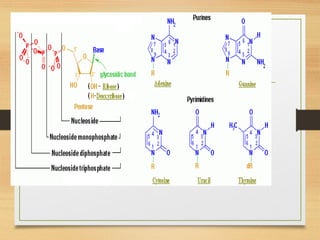
• Nucleotides consist of a nitrogen-containing base, a five-carbon sugar
ring and a phosphate group .
• The nucleotides are linked together by phosphodiester linkages
through the hydroxyl group on the sugar on one nucleotide and the
phosphate on the next one.
• As a result one can observe a strand with the so-called 5'-end, where
a
• free phosphate group can be found, and the 3'-end with a free
hydroxyl group.
• The nitrogenous base has the structure of a planar ring and is either
a purine or a pyrimidine.
The structure of RNA
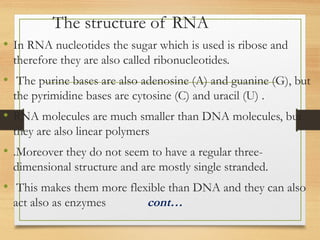
• In RNA nucleotides the sugar which is used is ribose and
therefore they are also called ribonucleotides.
• The purine bases are also adenosine (A) and guanine (G), but
the pyrimidine bases are cytosine (C) and uracil (U) .
• RNA molecules are much smaller than DNA molecules, but
they are also linear polymers
• .Moreover they do not seem to have a regular three-
dimensional structure and are mostly single stranded.
• This makes them more flexible than DNA and they can also
act also as enzymes cont…
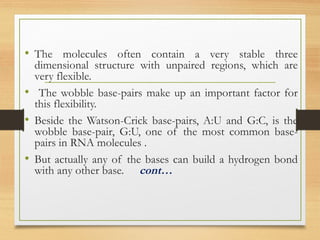
• The molecules often contain a very stable three
dimensional structure with unpaired regions, which are
very flexible.
• The wobble base-pairs make up an important factor for
this flexibility.
• Beside the Watson-Crick base-pairs, A:U and G:C, is the
wobble base-pair, G:U, one of the most common base-
pairs in RNA molecules .
• But actually any of the bases can build a hydrogen bond
with any other base. cont…
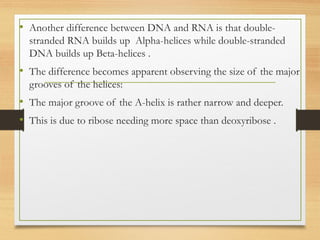
• Another difference between DNA and RNA is that double-
stranded RNA builds up Alpha-helices while double-stranded
DNA builds up Beta-helices .
• The difference becomes apparent observing the size of the major
grooves of the helices:
• The major groove of the A-helix is rather narrow and deeper.
• This is due to ribose needing more space than deoxyribose .
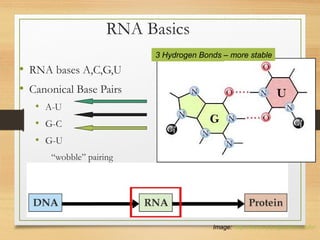
RNA Basics
• RNA bases A,C,G,U
• Canonical Base Pairs
• A-U
• G-C
• G-U
“wobble” pairing
• Bases can only pair with one
other base.
Image: http://www.bioalgorithms.info/
2 Hydrogen Bonds3 Hydrogen Bonds – more stable
Primary, secondary and tertiary structures
• The primary structure of a molecule describes only the
one-dimensional sequence of it components.
• The primary structure of RNA is almost identical to the
primary structure of DNA, besides the components being
A,C,G and U instead of T.
• The secondary structure of molecules is more complex
than the primary structure and can be drawn in two-
dimensional space .
• By definition, the local conformation of polymers is called
secondary structure .
• For RNA and DNA the secondary structure is their
base-paired structure. cont…
• RNA secondary structure is mainly composed of double
stranded RNA regions formed by folding the single stranded
RNA molecule back on itself.
• The tertiary structure is the overall three-dimensional structure
of molecules .
• It is built on the interactions of the lower-order secondary
structures .
• Helices are examples of RNA and DNA tertiary structures.
• pseudoknot is a tertiary structure of RNA.
Importance of RNA secondary structure
prediction
• Important aspect of the prediction of RNA secondary
structure is that there are many sequences whose
structures have not yet been experimentally determined
and
• for which there are no homologues in the databases from
which the structure could be derived. Hence it is a good
idea to predict the structure.
• Moreover it has been shown that RNA secondary
structure prediction has applications to the design of
nucleic acid probes . cont…
• It is also used by molecular biologists to help
predict conserved structural elements in non-
coding regions of gene transcripts.
• Finally there is also an application in predicting
structures that are conserved during evolution .
Different secondary structure elements
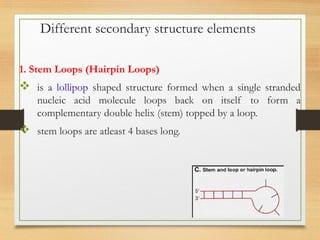
1. Stem Loops (Hairpin Loops)
 is a lollipop shaped structure formed when a single stranded
nucleic acid molecule loops back on itself to form a
complementary double helix (stem) topped by a loop.
 stem loops are atleast 4 bases long.
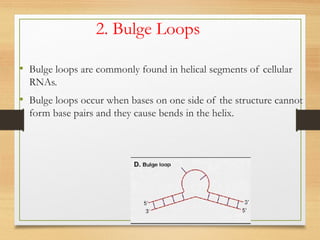
2. Bulge Loops
• Bulge loops are commonly found in helical segments of cellular
RNAs.
• Bulge loops occur when bases on one side of the structure cannot
form base pairs and they cause bends in the helix.
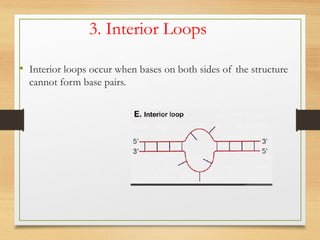
3. Interior Loops
• Interior loops occur when bases on both sides of the structure
cannot form base pairs.
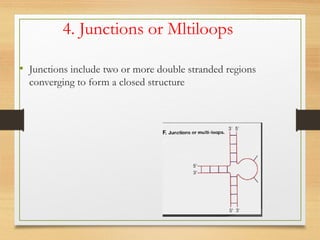
4. Junctions or Mltiloops
• Junctions include two or more double stranded regions
converging to form a closed structure
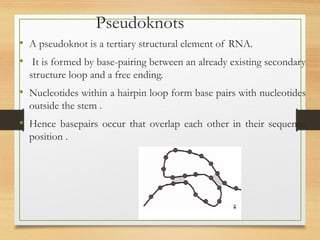
Pseudoknots
• A pseudoknot is a tertiary structural element of RNA.
• It is formed by base-pairing between an already existing secondary
structure loop and a free ending.
• Nucleotides within a hairpin loop form base pairs with nucleotides
outside the stem .
• Hence basepairs occur that overlap each other in their sequence
position .
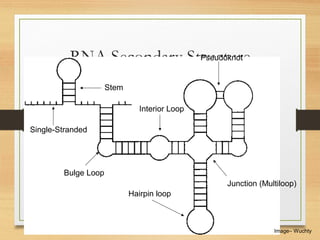
RNA Secondary Structure
Hairpin loop
Junction (Multiloop)
Bulge Loop
Single-Stranded
Interior Loop
Stem
Image– Wuchty
Pseudoknot
ASSUMPTIONS IN RNA STRUCTURE PREDICTION
• The most likely structure is similar to the energetically most stable
structure.
• The energy associated with any position in the structure is only
influenced by local sequence and strtucture.
• The structure formed does not produce pseudoknots.
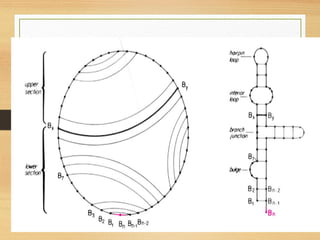
• One method of representing the base pairs of a secondary
structure is to draw the structure in a circle.
• An arc is drawn to represent each base pairing found in the
structure.
• If any of the arc cross, then a pseudoknot is present.
RNA structure prediction methods
• Base Pair Maximization
• Energy Minimization
Base Pairs Maximization
• This approach is to find the configuration with the greatest
numbers of paired bases.
• Given a RNA sequence, determine the set of maximal base
pairs(no base pair across each other)
• Align bases according to their ability to pair with each other gives
an approach to determining the optimal structure
Methods adopted
• Dynamic programming approach
• Nussinov Algorithm
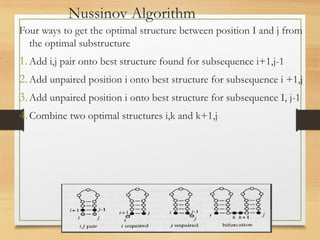
Nussinov Algorithm
Four ways to get the optimal structure between position I and j from
the optimal substructure
1.Add i,j pair onto best structure found for subsequence i+1,j-1
2.Add unpaired position i onto best structure for subsequence i +1,j
3.Add unpaired position i onto best structure for subsequence I, j-1
4.Combine two optimal structures i,k and k+1,j
NussinovAlgorithm
• compares a sequence against itself in a n*n matrix
• Find the maximum of the scores for the four possible structures at
a particular position.
Base Pair Maximization - Drawbacks
• Base pair maximization will not necessarily lead to
the most stable structure
• May create structure with many interior loops or hairpins
which are energetically unfavorable
• Comparable to aligning sequences with scattered
matches – not biologically reasonable
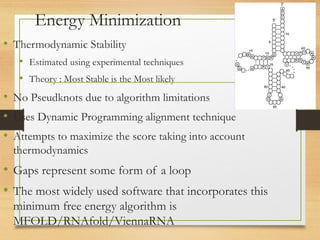
Energy Minimization
• Thermodynamic Stability
• Estimated using experimental techniques
• Theory : Most Stable is the Most likely
• No Pseudknots due to algorithm limitations
• Uses Dynamic Programming alignment technique
• Attempts to maximize the score taking into account
thermodynamics
• Gaps represent some form of a loop
• The most widely used software that incorporates this
minimum free energy algorithm is
MFOLD/RNAfold/ViennaRNA
Energy Minimization Drawbacks
• Compute only one optimal structure
• Usual drawbacks of purely mathematical approaches
• Similar difficulties in other algorithms
• Protein structure
• Exon finding

RNA secondary structure prediction

  • 1.
  • 2.
    What is RNAand where is it used • Proteins and nucleic acids, like RNA(ribonucleic acid) and DNA(deoxyribonucleic acid),play an important role in reproducing and maintaining life: • Proteins are important because they control processes like energy metabolism, intercellular communication and biosyntheses. They are synthesized using the genetic information which is stored in the DNA
  • 3.
    • RNA moleculesare used for the synthesis of proteins, they act as messengers. • Both, DNA and RNA are composed of subunits, the so-called nucleotides or bases. • There are only four different types of nucleotides in a molecule, but DNA and RNA do have other sets of nucleotides. • Nucleotides consist of a nitrogen-containing base, a five-carbon sugar ring and a phosphate group .
  • 4.
    • The nucleotidesare linked together by phosphodiester linkages through the hydroxyl group on the sugar on one nucleotide and the phosphate on the next one. • As a result one can observe a strand with the so-called 5'-end, where a • free phosphate group can be found, and the 3'-end with a free hydroxyl group. • The nitrogenous base has the structure of a planar ring and is either a purine or a pyrimidine.
  • 6.
    The structure ofRNA • In RNA nucleotides the sugar which is used is ribose and therefore they are also called ribonucleotides. • The purine bases are also adenosine (A) and guanine (G), but the pyrimidine bases are cytosine (C) and uracil (U) . • RNA molecules are much smaller than DNA molecules, but they are also linear polymers • .Moreover they do not seem to have a regular three- dimensional structure and are mostly single stranded. • This makes them more flexible than DNA and they can also act also as enzymes cont…
  • 7.
    • The moleculesoften contain a very stable three dimensional structure with unpaired regions, which are very flexible. • The wobble base-pairs make up an important factor for this flexibility. • Beside the Watson-Crick base-pairs, A:U and G:C, is the wobble base-pair, G:U, one of the most common base- pairs in RNA molecules . • But actually any of the bases can build a hydrogen bond with any other base. cont…
  • 8.
    • Another differencebetween DNA and RNA is that double- stranded RNA builds up Alpha-helices while double-stranded DNA builds up Beta-helices . • The difference becomes apparent observing the size of the major grooves of the helices: • The major groove of the A-helix is rather narrow and deeper. • This is due to ribose needing more space than deoxyribose .
  • 9.
    RNA Basics • RNAbases A,C,G,U • Canonical Base Pairs • A-U • G-C • G-U “wobble” pairing • Bases can only pair with one other base. Image: http://www.bioalgorithms.info/ 2 Hydrogen Bonds3 Hydrogen Bonds – more stable
  • 10.
    Primary, secondary andtertiary structures • The primary structure of a molecule describes only the one-dimensional sequence of it components. • The primary structure of RNA is almost identical to the primary structure of DNA, besides the components being A,C,G and U instead of T. • The secondary structure of molecules is more complex than the primary structure and can be drawn in two- dimensional space . • By definition, the local conformation of polymers is called secondary structure . • For RNA and DNA the secondary structure is their base-paired structure. cont…
  • 11.
    • RNA secondarystructure is mainly composed of double stranded RNA regions formed by folding the single stranded RNA molecule back on itself. • The tertiary structure is the overall three-dimensional structure of molecules . • It is built on the interactions of the lower-order secondary structures . • Helices are examples of RNA and DNA tertiary structures. • pseudoknot is a tertiary structure of RNA.
  • 12.
    Importance of RNAsecondary structure prediction • Important aspect of the prediction of RNA secondary structure is that there are many sequences whose structures have not yet been experimentally determined and • for which there are no homologues in the databases from which the structure could be derived. Hence it is a good idea to predict the structure. • Moreover it has been shown that RNA secondary structure prediction has applications to the design of nucleic acid probes . cont…
  • 13.
    • It isalso used by molecular biologists to help predict conserved structural elements in non- coding regions of gene transcripts. • Finally there is also an application in predicting structures that are conserved during evolution .
  • 14.
    Different secondary structureelements 1. Stem Loops (Hairpin Loops)  is a lollipop shaped structure formed when a single stranded nucleic acid molecule loops back on itself to form a complementary double helix (stem) topped by a loop.  stem loops are atleast 4 bases long.
  • 15.
    2. Bulge Loops •Bulge loops are commonly found in helical segments of cellular RNAs. • Bulge loops occur when bases on one side of the structure cannot form base pairs and they cause bends in the helix.
  • 16.
    3. Interior Loops •Interior loops occur when bases on both sides of the structure cannot form base pairs.
  • 17.
    4. Junctions orMltiloops • Junctions include two or more double stranded regions converging to form a closed structure
  • 18.
    Pseudoknots • A pseudoknotis a tertiary structural element of RNA. • It is formed by base-pairing between an already existing secondary structure loop and a free ending. • Nucleotides within a hairpin loop form base pairs with nucleotides outside the stem . • Hence basepairs occur that overlap each other in their sequence position .
  • 19.
    RNA Secondary Structure Hairpinloop Junction (Multiloop) Bulge Loop Single-Stranded Interior Loop Stem Image– Wuchty Pseudoknot
  • 20.
    ASSUMPTIONS IN RNASTRUCTURE PREDICTION • The most likely structure is similar to the energetically most stable structure. • The energy associated with any position in the structure is only influenced by local sequence and strtucture. • The structure formed does not produce pseudoknots.
  • 21.
    • One methodof representing the base pairs of a secondary structure is to draw the structure in a circle. • An arc is drawn to represent each base pairing found in the structure. • If any of the arc cross, then a pseudoknot is present.
  • 23.
    RNA structure predictionmethods • Base Pair Maximization • Energy Minimization
  • 24.
    Base Pairs Maximization •This approach is to find the configuration with the greatest numbers of paired bases. • Given a RNA sequence, determine the set of maximal base pairs(no base pair across each other) • Align bases according to their ability to pair with each other gives an approach to determining the optimal structure
  • 25.
    Methods adopted • Dynamicprogramming approach • Nussinov Algorithm
  • 26.
    Nussinov Algorithm Four waysto get the optimal structure between position I and j from the optimal substructure 1.Add i,j pair onto best structure found for subsequence i+1,j-1 2.Add unpaired position i onto best structure for subsequence i +1,j 3.Add unpaired position i onto best structure for subsequence I, j-1 4.Combine two optimal structures i,k and k+1,j
  • 27.
    NussinovAlgorithm • compares asequence against itself in a n*n matrix • Find the maximum of the scores for the four possible structures at a particular position.
  • 28.
    Base Pair Maximization- Drawbacks • Base pair maximization will not necessarily lead to the most stable structure • May create structure with many interior loops or hairpins which are energetically unfavorable • Comparable to aligning sequences with scattered matches – not biologically reasonable
  • 29.
    Energy Minimization • ThermodynamicStability • Estimated using experimental techniques • Theory : Most Stable is the Most likely • No Pseudknots due to algorithm limitations • Uses Dynamic Programming alignment technique • Attempts to maximize the score taking into account thermodynamics • Gaps represent some form of a loop • The most widely used software that incorporates this minimum free energy algorithm is MFOLD/RNAfold/ViennaRNA
  • 30.
    Energy Minimization Drawbacks •Compute only one optimal structure • Usual drawbacks of purely mathematical approaches • Similar difficulties in other algorithms • Protein structure • Exon finding