GENE DISCOVERY MADE EASIER
ESTs are small pieces of DNA sequence  (usually 100 to 800 nucleotides long)  generated by sequencing randomly selected cDNA clones from a library Expressed Sequence Tags (ESTs) are  short , single-pass sequence reads from mRNA  (cDNA). ESTs are bits of DNA sequence that  represent genes expressed in certain cells, tissues, or organs from different organisms  and  use these " tags " to fish a gene out of a portion of chromosomal DNA by matching base pairs.
Identify  unknown genes  and to  map their positions  within a genome. ESTs provide researchers with a quick and inexpensive route for  discovering new genes ,  For obtaining  data on gene expression and regulation, constructing  genome maps.  Economical approach to  identify and characterize expressed genes EST represent a snapshot of  genes expressed in a given tissue and/or at a given developmental stage.
mRNA is very unstable  outside of a cell; therefore they are converted to  complementary DNA (cDNA) .  cDNA is a much more  stable compound  and, importantly, because it is generated from a mRNA in which the introns have been removed, cDNA represents only expressed DNA sequence .
Sequencing only the beginning portion of the cDNA produces  5' EST . 5' EST is obtained from the portion of a transcript that  usually codes for a protein.  These  regions tend to be conserved  across species and  do not change much within a  gene family .  Sequencing the ending portion of the cDNA molecule produces  3' EST .  3' EST  are likely to fall  within non-coding, or  untranslated regions (UTRs) ,  and therefore tend to exhibit less cross-species conservation than do coding sequences.
ESTs as Genome Landmarks  The 3' ESTs serve as a common source of  STSs because of their likelihood of being unique to a particular An  STS is a short DNA sequence that is easily recognizable and occurs only once in a genome (or chromosome  ESTs as Gene Discovery Resources Tools in the hunt for  genes involved in hereditary diseases .  ESTs are generated  rapidly and inexpensively , only one sequencing experiment is needed per each cDNA generated, and they do not have to be checked for sequencing errors . Using ESTs, scientists have rapidly isolated some of the  genes involved in Alzheimer's disease and colon cancer.
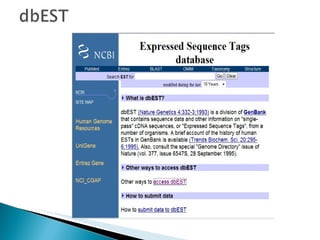
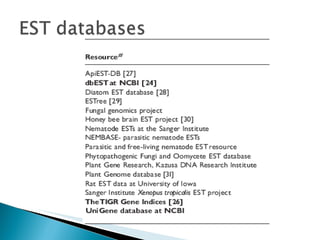
In 1992, scientists at NCBI developed a new database designed to serve as a collection point for ESTs.  Once an EST that was submitted to GenBank had been  screened and annotated , it was then deposited in this new database, called  dbEST .  
 
Scientists at NCBI created dbEST to  organize, store, and provide access to the great mass of public EST data  that has already accumulated and that continues to grow daily. Using dbEST, a scientist can access not only data on  human ESTs  but information on ESTs from over  300 other organisms  as well.
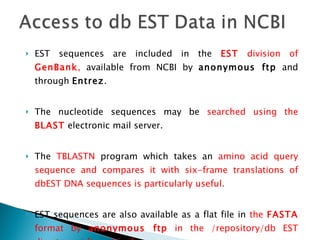
EST sequences are included in the  EST  division of  GenBank ,  available from NCBI by  anonymous ftp  and through  Entrez .  The nucleotide sequences may be  searched using the  BLAST   electronic mail server.  The  TBLASTN  program which takes an  amino acid query sequence and compares it with six-frame translations of dbEST DNA sequences is particularly useful.  EST sequences are also available as a flat file in  the  FASTA  format by  anonymous ftp  in the /repository/db EST directory at ftp.ncbi.nih.gov
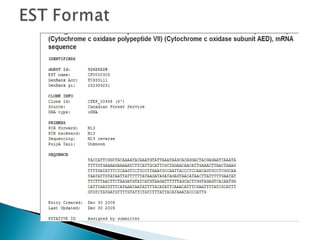
"Trace data" for sequences derived from I.M.A.G.E clones is available from the Washington University Genome Sequencing Center.  Traces are retrieved using the identifier labelled  " EST name "  in the dbEST record (e.g.  yb01a01.s1 , corresponding to GenBank accession number  T48601 ). Note that this identifier may also be found in the  DEFINITION line of the GenBank Record Clones may be ordered using the identifier labelled  " Clone Id "  in the dbEST record (e.g.  69864 , corresponding to GenBank accession number  T48601 ) This identifier is also available in the  DEFINITION line of the corresponding GenBank Record
 
 
It is very  difficult to isolate mRNA  from some tissues and cell types. Second is that  important gene regulatory sequences may be found within an intron .  For most ESTs, there is no indication as to the gene from which it is derived Because a gene can be expressed as mRNA many, many times,  ESTs ultimately derived from this mRNA may be  redundant .  There may be  many identical, or similar, copies of the same EST.
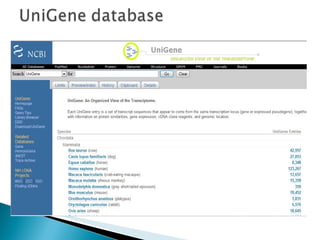
To resolve the redundancy and overlap problem, NCBI investigators developed the  UniGene database UniGene  cluster EST sequences  with traditional gene sequences It automatically partitions GenBank sequences into a non-redundant set of ESTs For each cluster additional information are included
 
Clustering : associate individual EST sequences with  unique transcripts  or genes Assembling : derive  consensus sequences  from overlapping ESTs belonging to the same cluster Mapping : associate ESTs (or EST contigs) with  exons in genomic sequences Interpreting : find and correct coding regions
Incyte  has created the LifeSeq databases. SANBI  in South Africa produces the STACK collection of human EST contigs MIPS  in Munich and the SIB  produce BLAST-searchable contigs from Unigene TIGEM  in Italy has a nice collection of EST search and assembly tools, local & remote The CBIL at the U. of Pennsylvania has assembled the  DOTS  database
 

Est database

  • 1.
  • 2.
    ESTs are smallpieces of DNA sequence (usually 100 to 800 nucleotides long) generated by sequencing randomly selected cDNA clones from a library Expressed Sequence Tags (ESTs) are short , single-pass sequence reads from mRNA (cDNA). ESTs are bits of DNA sequence that represent genes expressed in certain cells, tissues, or organs from different organisms and use these " tags " to fish a gene out of a portion of chromosomal DNA by matching base pairs.
  • 3.
    Identify unknowngenes and to map their positions within a genome. ESTs provide researchers with a quick and inexpensive route for discovering new genes , For obtaining data on gene expression and regulation, constructing genome maps. Economical approach to identify and characterize expressed genes EST represent a snapshot of genes expressed in a given tissue and/or at a given developmental stage.
  • 4.
    mRNA is veryunstable outside of a cell; therefore they are converted to complementary DNA (cDNA) . cDNA is a much more stable compound and, importantly, because it is generated from a mRNA in which the introns have been removed, cDNA represents only expressed DNA sequence .
  • 5.
    Sequencing only thebeginning portion of the cDNA produces 5' EST . 5' EST is obtained from the portion of a transcript that usually codes for a protein. These regions tend to be conserved across species and do not change much within a gene family . Sequencing the ending portion of the cDNA molecule produces 3' EST . 3' EST are likely to fall within non-coding, or untranslated regions (UTRs) , and therefore tend to exhibit less cross-species conservation than do coding sequences.
  • 6.
    ESTs as GenomeLandmarks The 3' ESTs serve as a common source of STSs because of their likelihood of being unique to a particular An STS is a short DNA sequence that is easily recognizable and occurs only once in a genome (or chromosome ESTs as Gene Discovery Resources Tools in the hunt for genes involved in hereditary diseases . ESTs are generated rapidly and inexpensively , only one sequencing experiment is needed per each cDNA generated, and they do not have to be checked for sequencing errors . Using ESTs, scientists have rapidly isolated some of the genes involved in Alzheimer's disease and colon cancer.
  • 7.
    In 1992, scientistsat NCBI developed a new database designed to serve as a collection point for ESTs. Once an EST that was submitted to GenBank had been screened and annotated , it was then deposited in this new database, called dbEST .  
  • 8.
  • 9.
    Scientists at NCBIcreated dbEST to organize, store, and provide access to the great mass of public EST data that has already accumulated and that continues to grow daily. Using dbEST, a scientist can access not only data on human ESTs but information on ESTs from over 300 other organisms as well.
  • 10.
    EST sequences areincluded in the EST division of GenBank , available from NCBI by anonymous ftp and through Entrez . The nucleotide sequences may be searched using the BLAST electronic mail server. The TBLASTN program which takes an amino acid query sequence and compares it with six-frame translations of dbEST DNA sequences is particularly useful. EST sequences are also available as a flat file in the FASTA format by anonymous ftp in the /repository/db EST directory at ftp.ncbi.nih.gov
  • 11.
    "Trace data" forsequences derived from I.M.A.G.E clones is available from the Washington University Genome Sequencing Center. Traces are retrieved using the identifier labelled " EST name " in the dbEST record (e.g. yb01a01.s1 , corresponding to GenBank accession number T48601 ). Note that this identifier may also be found in the DEFINITION line of the GenBank Record Clones may be ordered using the identifier labelled " Clone Id " in the dbEST record (e.g. 69864 , corresponding to GenBank accession number T48601 ) This identifier is also available in the DEFINITION line of the corresponding GenBank Record
  • 12.
  • 13.
  • 14.
    It is very difficult to isolate mRNA from some tissues and cell types. Second is that important gene regulatory sequences may be found within an intron . For most ESTs, there is no indication as to the gene from which it is derived Because a gene can be expressed as mRNA many, many times, ESTs ultimately derived from this mRNA may be redundant . There may be many identical, or similar, copies of the same EST.
  • 15.
    To resolve theredundancy and overlap problem, NCBI investigators developed the UniGene database UniGene cluster EST sequences with traditional gene sequences It automatically partitions GenBank sequences into a non-redundant set of ESTs For each cluster additional information are included
  • 16.
  • 17.
    Clustering : associateindividual EST sequences with unique transcripts or genes Assembling : derive consensus sequences from overlapping ESTs belonging to the same cluster Mapping : associate ESTs (or EST contigs) with exons in genomic sequences Interpreting : find and correct coding regions
  • 18.
    Incyte hascreated the LifeSeq databases. SANBI in South Africa produces the STACK collection of human EST contigs MIPS in Munich and the SIB produce BLAST-searchable contigs from Unigene TIGEM in Italy has a nice collection of EST search and assembly tools, local & remote The CBIL at the U. of Pennsylvania has assembled the DOTS database
  • 19.