ChIP-Seq
Immunoprecipitation
(Chromatin Immunoprecipitation Sequencing)
Presented by : Amira Moustafa
Chromatin immunoprecipitation
• it was considered one of the most popular methods to study protein-DNA
interactions and can be used , to identify the binding sites of transcription
factors ( activators or repressors) or to determine the distributions of
histones ( histone modifications) with specific post-translational modifications
throughout the genome.
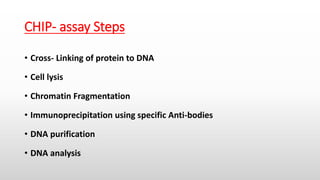
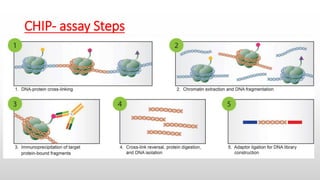
CHIP- assay Steps
• Cross- Linking of protein to DNA
• Cell lysis
• Chromatin Fragmentation
• Immunoprecipitation using specific Anti-bodies
• DNA purification
• DNA analysis
CHIP- assay Steps
Cross-linking of protein to DNA : this step was performed using cross- linking
agent (e.g. 16% formaldehyde (W:V) (methanol free), glutaraldehyde,
disuccinimidyl glutarate [DSG](preferred) .
Chromatin fragmentation : The chromatin is fragmented or “sheared” to
mononucleosome sized fragments (150-300 bp), which is important for obtaining
high resolution sequencing data. Chromatin shearing is accomplished by
sonication or enzymatic digestion using micrococcal nuclease (MNase) and
monitored by gel (e.g. agarose) or capillary electrophoresis .
Immunoprecipitation using specific Anti-bodies : Selected Abs should be highly –
specific Abs and show highly effective binding with chromatin associated
proteins . The amount of primary antibody required for good signal in a ChIP is
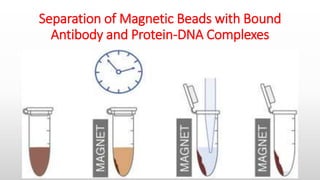
usually 2–5 μg . The antibody is coupled to magnetic beads , and incubate at 4°C
for at least 12 h, with rotation such that the samples mix and the beads remain
suspended . the antibody-bound chromatin is isolated from bulk chromatin using
a magnet, followed by a series of stringent washes.
Separation of Magnetic Beads with Bound
Antibody and Protein-DNA Complexes
• DNA purification : This step needed a proteases enzymes to digest proteins . For
Purification of ChIP and Input samples a Zymo ChIP DNA Clean & Concentrator Kit
were used. Elute in 26 μl of Kit Elution Buffer.
• DNA quantification : 0.5 - 1 μl should be taken from each sample for quantification
of DNA concentration using a Nanodrop or Qubit fluorometer.
• Data analysis:
1. Amplification of DNA samples by qPCR.
2. The e ChIP-seq DNA libraries may be safely stored in the freezer until convenient.
3. Determine the concentration of the libraries in ng/mL using a Qubit fluorometer .
4. Estimate the mean library size in base pair (bp) by running a small amount (2 mL)
of the library on a Tape Station, Bio analyzer, or a 2% agarose/TBE gel pre-stained
with GelGreen.
5. Analysis of Data by Easeq software
ChIP-Seq Immunoprecipitation.pptx

ChIP-Seq Immunoprecipitation.pptx

  • 1.
  • 2.
    Chromatin immunoprecipitation • itwas considered one of the most popular methods to study protein-DNA interactions and can be used , to identify the binding sites of transcription factors ( activators or repressors) or to determine the distributions of histones ( histone modifications) with specific post-translational modifications throughout the genome.
  • 3.
    CHIP- assay Steps •Cross- Linking of protein to DNA • Cell lysis • Chromatin Fragmentation • Immunoprecipitation using specific Anti-bodies • DNA purification • DNA analysis
  • 4.
  • 5.
    Cross-linking of proteinto DNA : this step was performed using cross- linking agent (e.g. 16% formaldehyde (W:V) (methanol free), glutaraldehyde, disuccinimidyl glutarate [DSG](preferred) . Chromatin fragmentation : The chromatin is fragmented or “sheared” to mononucleosome sized fragments (150-300 bp), which is important for obtaining high resolution sequencing data. Chromatin shearing is accomplished by sonication or enzymatic digestion using micrococcal nuclease (MNase) and monitored by gel (e.g. agarose) or capillary electrophoresis . Immunoprecipitation using specific Anti-bodies : Selected Abs should be highly – specific Abs and show highly effective binding with chromatin associated proteins . The amount of primary antibody required for good signal in a ChIP is usually 2–5 μg . The antibody is coupled to magnetic beads , and incubate at 4°C for at least 12 h, with rotation such that the samples mix and the beads remain suspended . the antibody-bound chromatin is isolated from bulk chromatin using a magnet, followed by a series of stringent washes.
  • 6.
    Separation of MagneticBeads with Bound Antibody and Protein-DNA Complexes
  • 7.
    • DNA purification: This step needed a proteases enzymes to digest proteins . For Purification of ChIP and Input samples a Zymo ChIP DNA Clean & Concentrator Kit were used. Elute in 26 μl of Kit Elution Buffer. • DNA quantification : 0.5 - 1 μl should be taken from each sample for quantification of DNA concentration using a Nanodrop or Qubit fluorometer. • Data analysis: 1. Amplification of DNA samples by qPCR. 2. The e ChIP-seq DNA libraries may be safely stored in the freezer until convenient. 3. Determine the concentration of the libraries in ng/mL using a Qubit fluorometer . 4. Estimate the mean library size in base pair (bp) by running a small amount (2 mL) of the library on a Tape Station, Bio analyzer, or a 2% agarose/TBE gel pre-stained with GelGreen. 5. Analysis of Data by Easeq software