BHARATHIDASAN INSTITUTE OF TECHNOLOGY
ANNA UNIVERSITY
TIRUCHIRAPPALLI-24
DEPARTMENT OF BIOTECHNOLOGY
CLASS SEMINAR
SUBJECT CODE/ TITLE: BT6603/GENETIC ENGINEERING & GENOMICS
NEXT GENERATION SEQUENCING
Presented by Faculty in charge
Name : P. Swathipriya Dr. P.S. Sudhakar Gandhi
Reg No. : 810014214042 Asst. Professor
BHARATHIDASAN INSTITUTE OF TECHNOLOGY
ANNA UNIVERSITY
TIRUCHIRAPPALLI-24
BHARATHIDASAN INSTITUTE OF TECHNOLOGY
ANNA UNIVERSITY
TIRUCHIRAPPALLI-24
DEPARTMENT OF BIOTECHNOLOGY
CLASS SEMINAR
SUBJECT CODE/ TITLE: BT6603/GENETIC ENGINEERING & GENOMICS
NEXT GENERATION SEQUENCING
Presented by Faculty in charge
Name : P. Swathipriya Dr. P.S. Sudhakar Gandhi
Reg No. : 810014214042 Asst. Professor
WHAT IS SEQUENCING?
Genome sequencing is a method used to figure out the
order of DNA nucleotides, or bases in a genome-the order
of A, C, G, and T that make up an organism's DNA.
IMPORTANCE OF DNA SEQUENCING
 Better understanding of gene expression. Gene
expression has significance in protein creation etc.
 It is capable to detect various diseases and genetic
illnesses.
 Personalised medicine and disease discovery is possible.
 Forensics
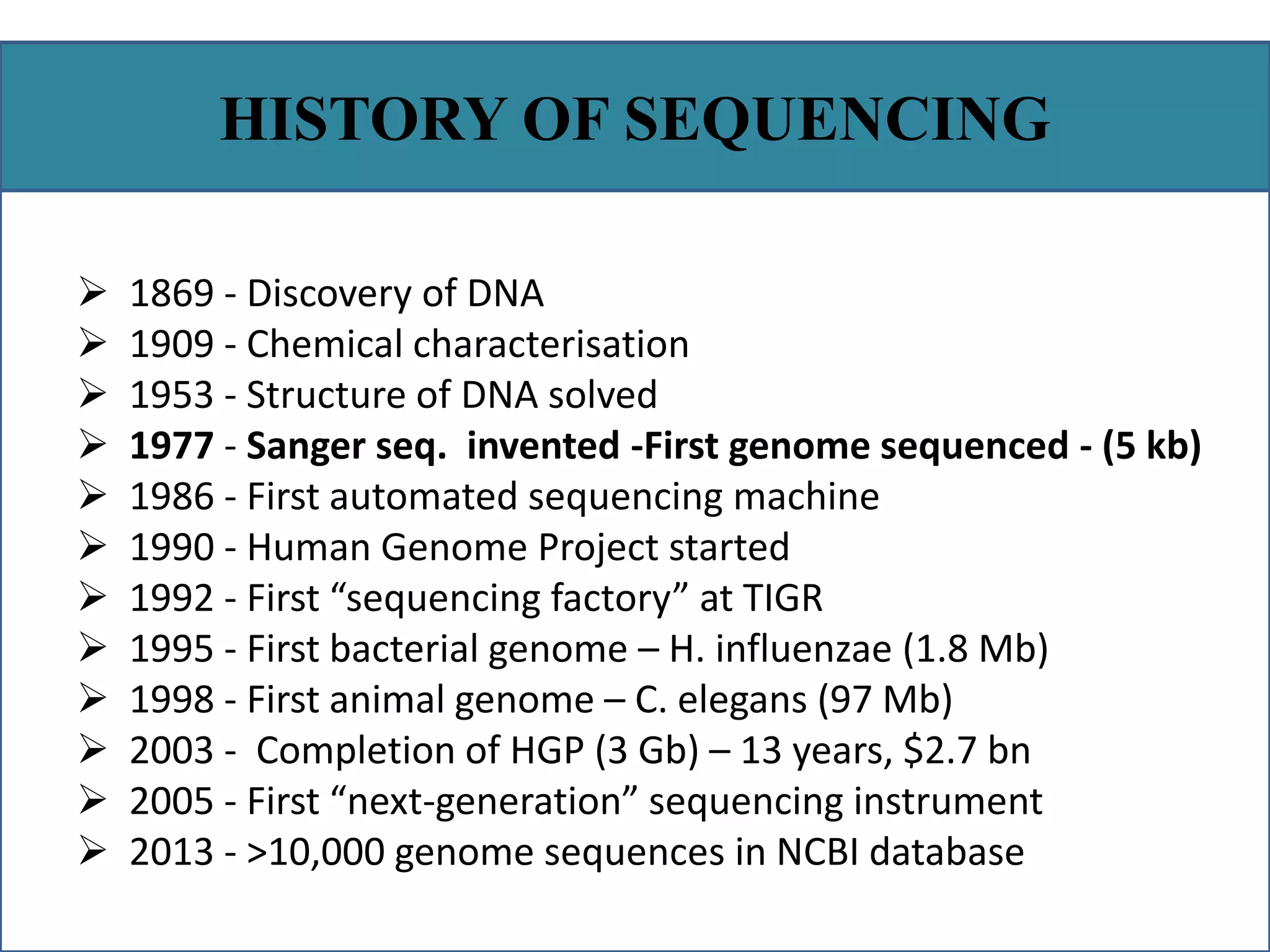
HISTORY OF SEQUENCING
 1869 - Discovery of DNA
 1909 - Chemical characterisation
 1953 - Structure of DNA solved
 1977 - Sanger seq. invented -First genome sequenced - (5 kb)
 1986 - First automated sequencing machine
 1990 - Human Genome Project started
 1992 - First “sequencing factory” at TIGR
 1995 - First bacterial genome – H. influenzae (1.8 Mb)
 1998 - First animal genome – C. elegans (97 Mb)
 2003 - Completion of HGP (3 Gb) – 13 years, $2.7 bn
 2005 - First “next-generation” sequencing instrument
 2013 - >10,000 genome sequences in NCBI database
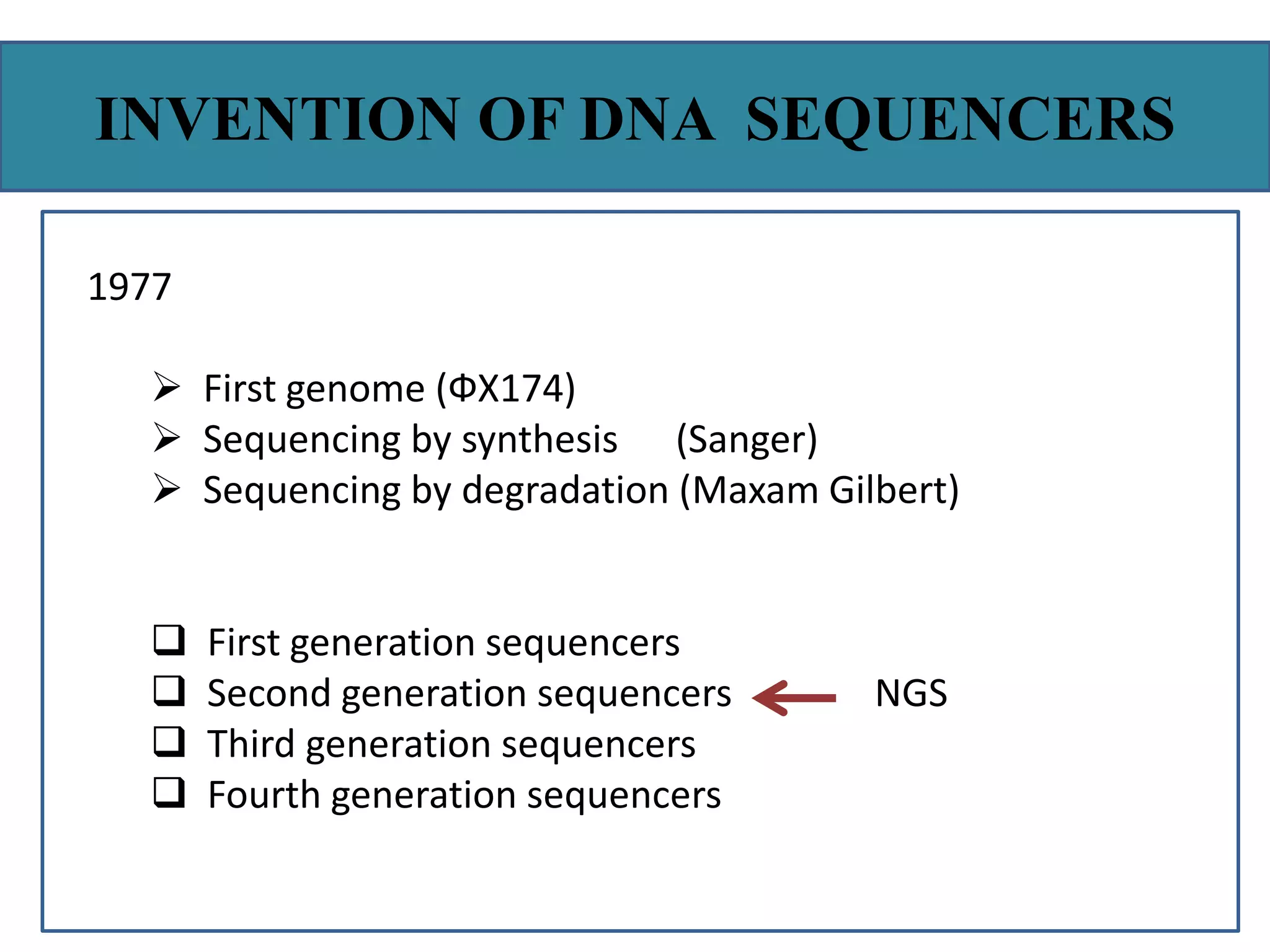
INVENTION OF DNA SEQUENCERS
1977
 First genome (ФX174)
 Sequencing by synthesis (Sanger)
 Sequencing by degradation (Maxam Gilbert)
 First generation sequencers
 Second generation sequencers NGS
 Third generation sequencers
 Fourth generation sequencers
Next-generation sequencing (NGS), also known as high-
throughput sequencing, is the catch-all term used to
describe a number of different modern sequencing
technologies including:
 Illumina (Solexa) sequencing
 Roche 454 sequencing
 SOLiD sequencing
 Ion torrent: Proton / PGM sequencing
NEXT GENERATION SEQUENCERS
 These recent technologies allow us to sequence
DNA and RNA much more quickly and cheaply
than the previously used Sanger sequencing, and
as such have revolutionised the study of genomics
and molecular biology.
 NGS has brought high speed not only to
genome sequencing and personal medicine it has
also changed the way we do genome research
NEXT GENERATION SEQUENCERS
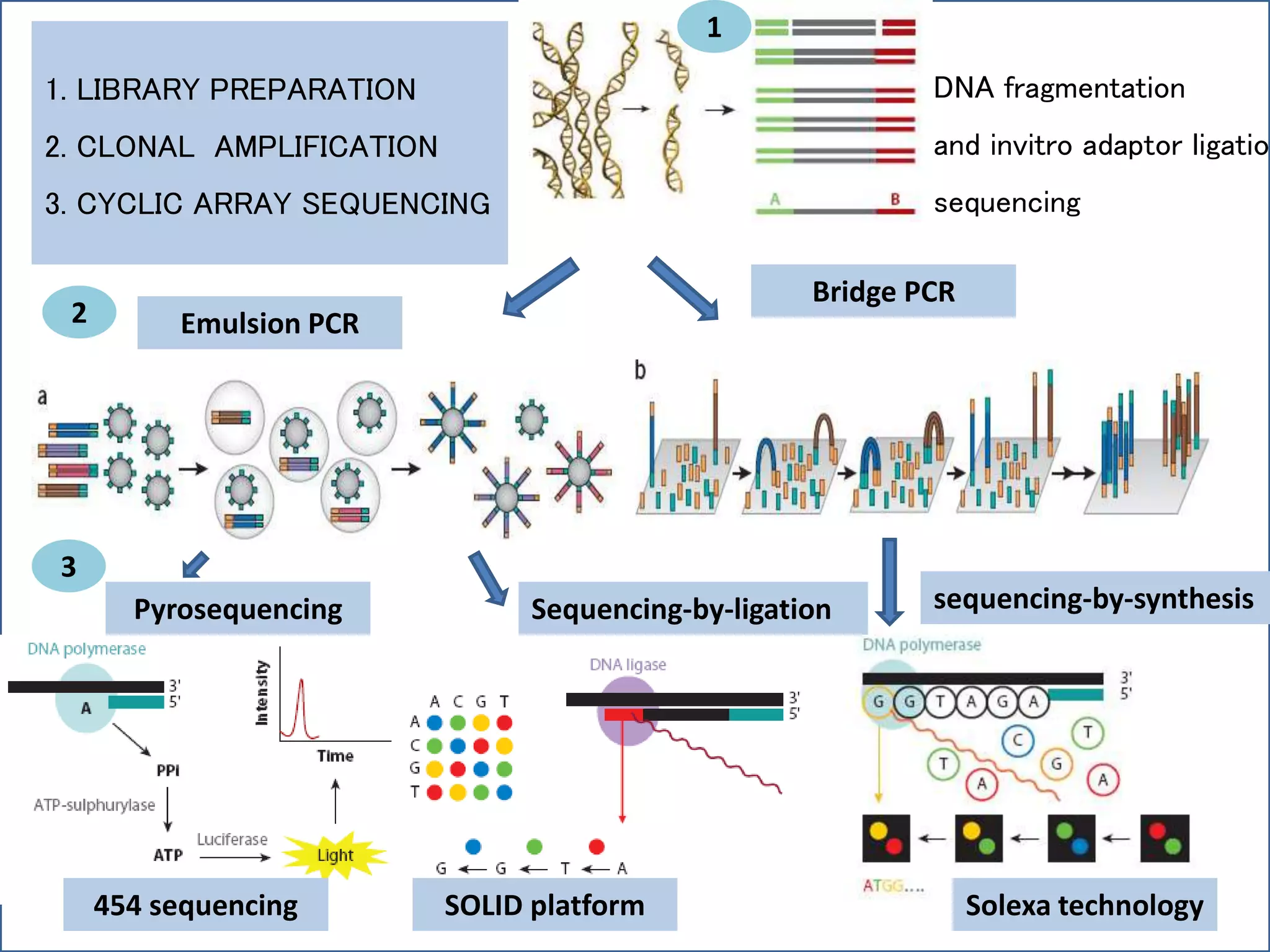
OVERVIEW OF NEXT GENERATION
SEQUENCING PROTOCOL
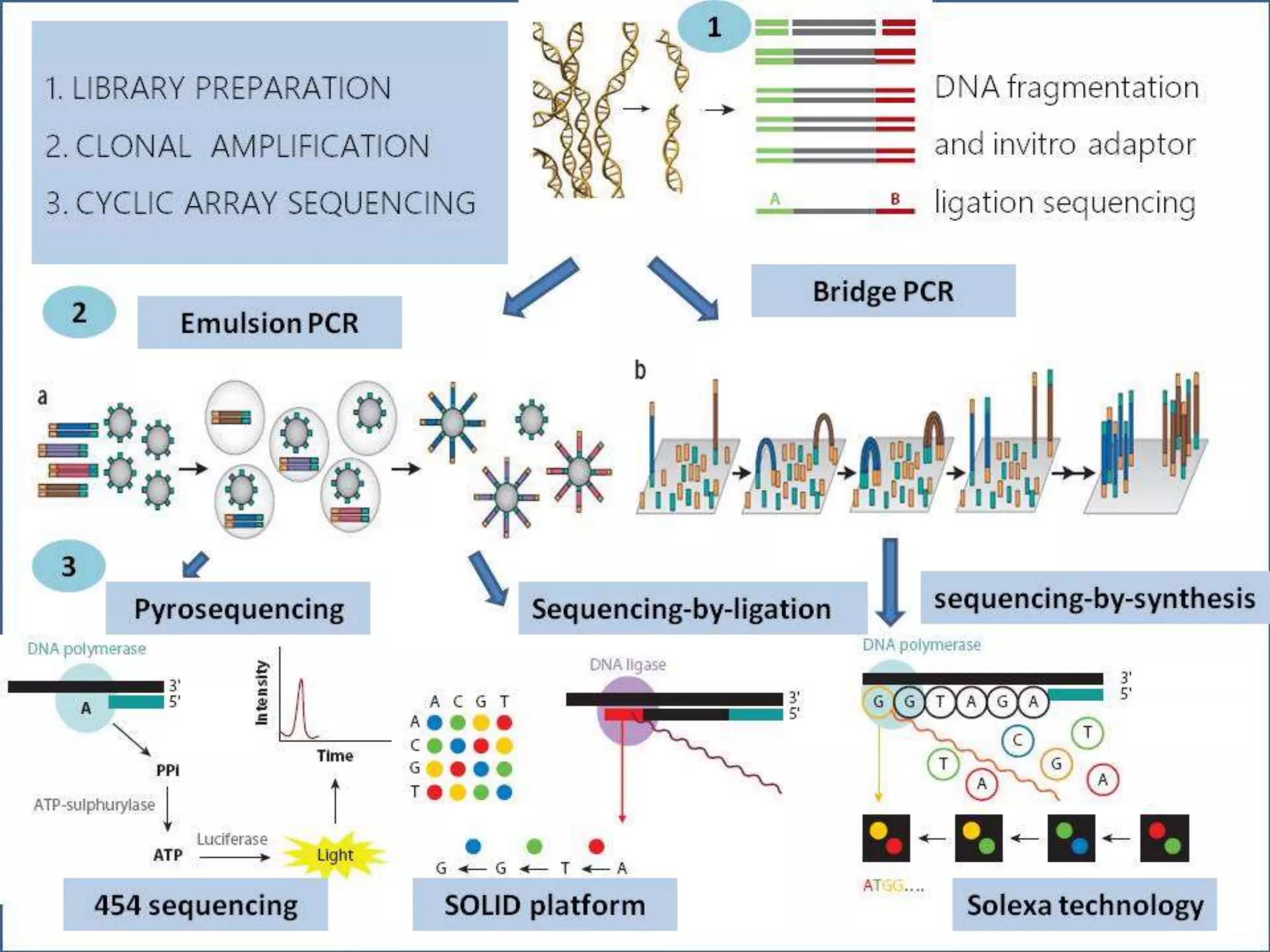
The sequencing process1. LIBRARY PREPARATION
2. CLONAL AMPLIFICATION
3. CYCLIC ARRAY SEQUENCING
DNA fragmentation
and invitro adaptor ligation
sequencing
1
2 Emulsion PCR
Bridge PCR
3
Pyrosequencing
454 sequencing SOLID platform Solexa technology
Sequencing-by-ligation sequencing-by-synthesis
IILUMINA / SOLEXA SEQUENCING
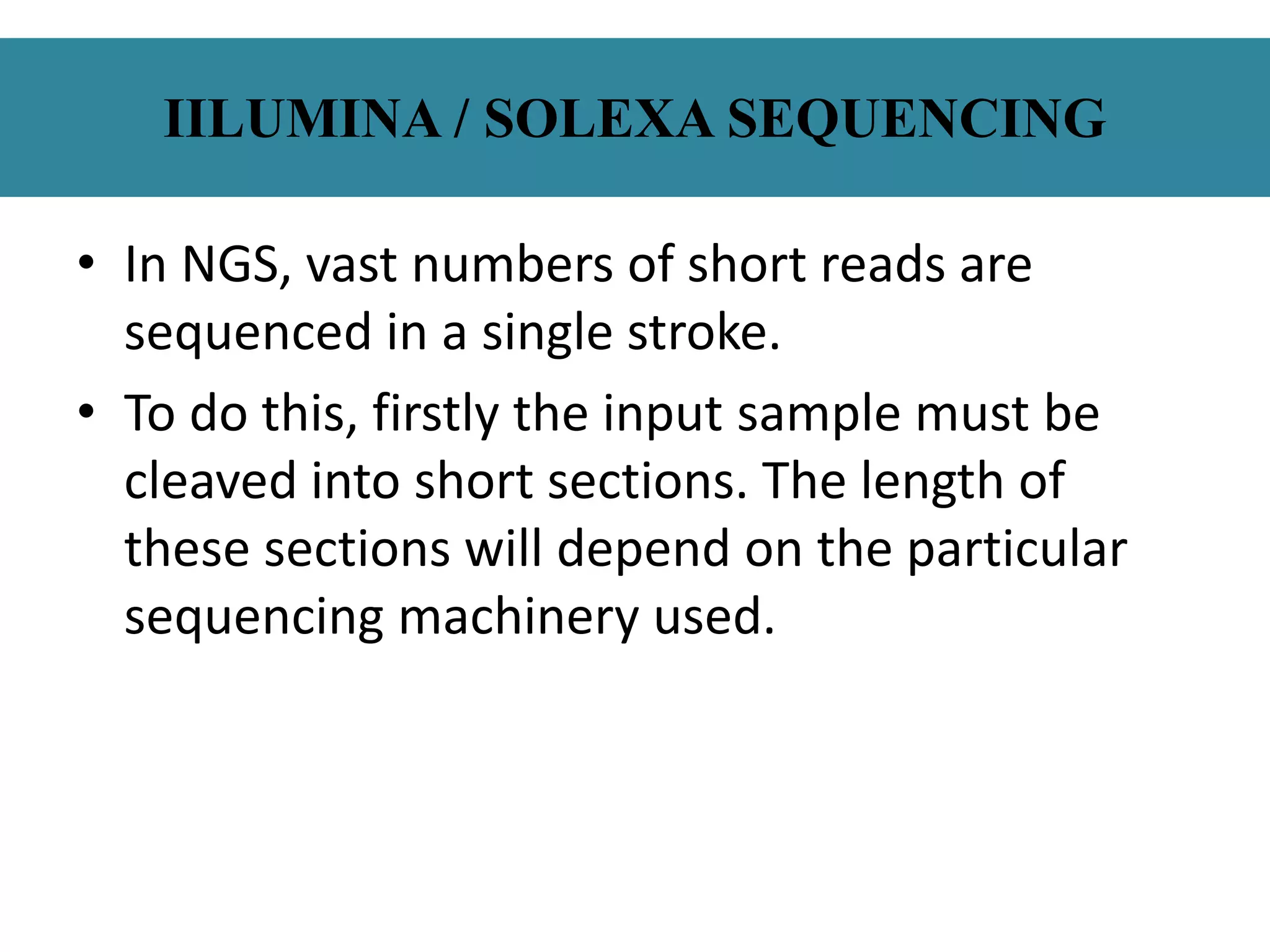
• In NGS, vast numbers of short reads are
sequenced in a single stroke.
• To do this, firstly the input sample must be
cleaved into short sections. The length of
these sections will depend on the particular
sequencing machinery used.
.
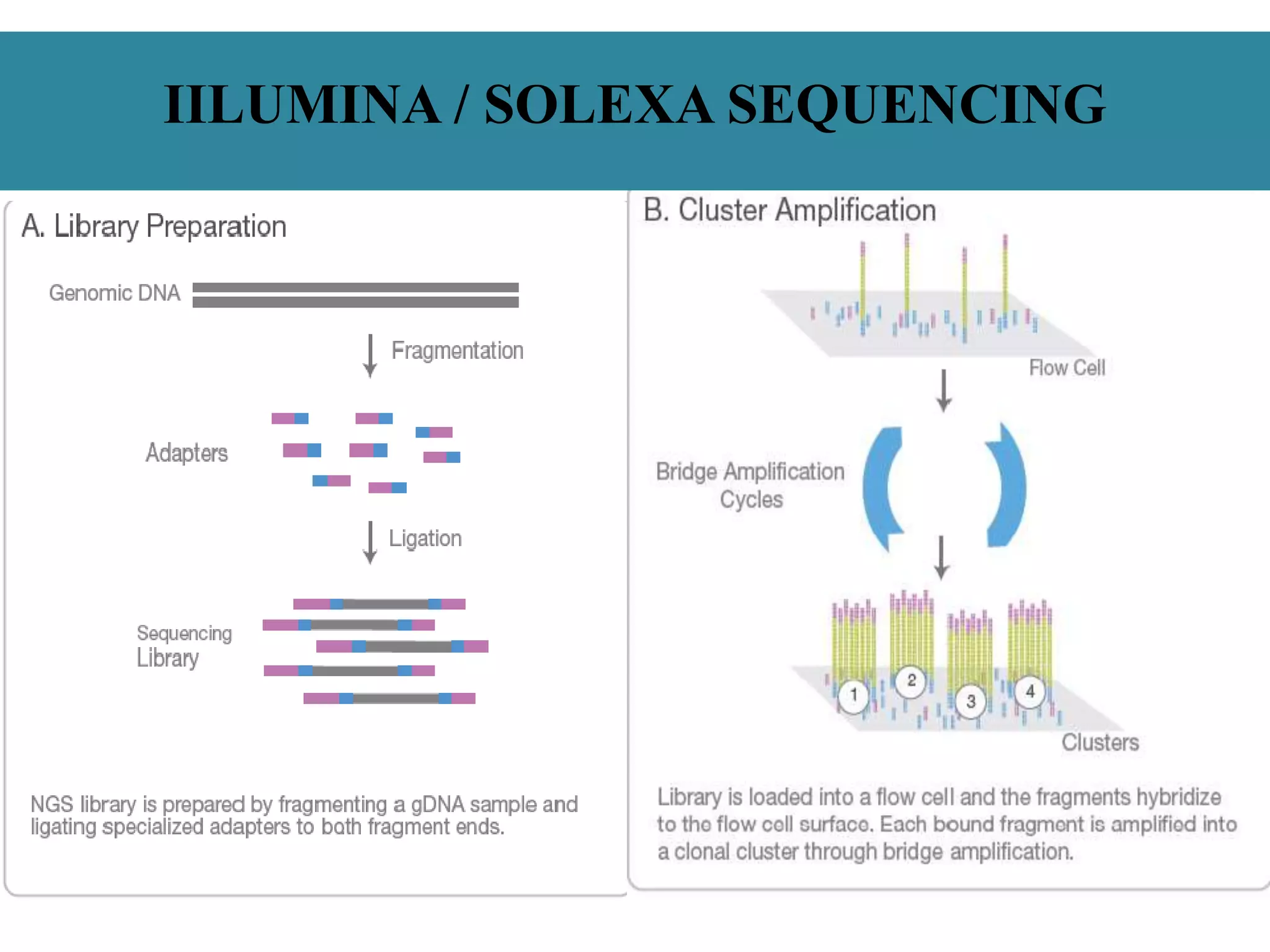
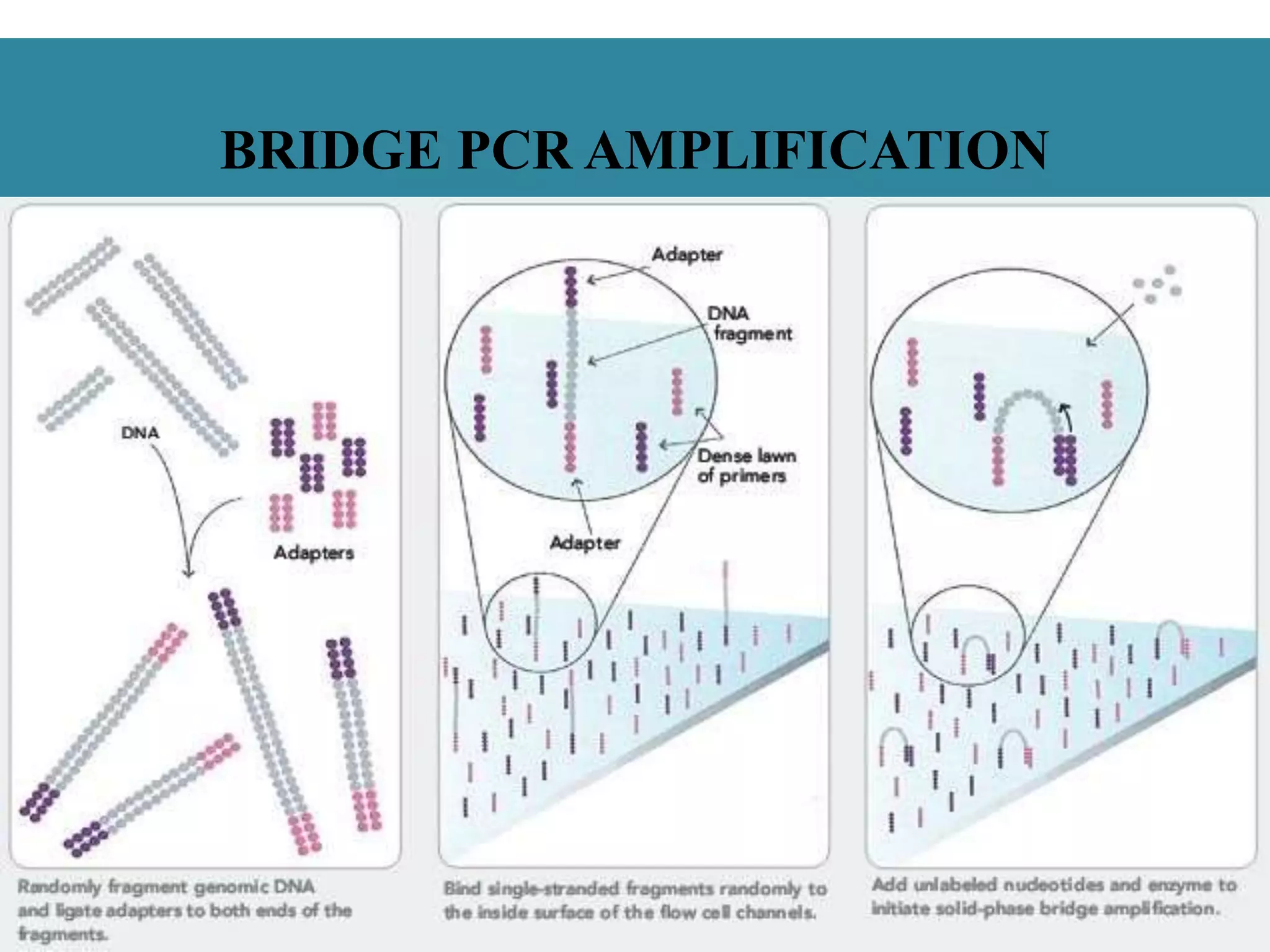
• In Illumina sequencing, 100-150bp reads are
used. Somewhat longer fragments are ligated to
generic adaptors and annealed to a slide using the
adaptors. PCR is carried out to amplify each read,
creating a spot with many copies of the same
read. They are then separated into single strands to
be sequenced.
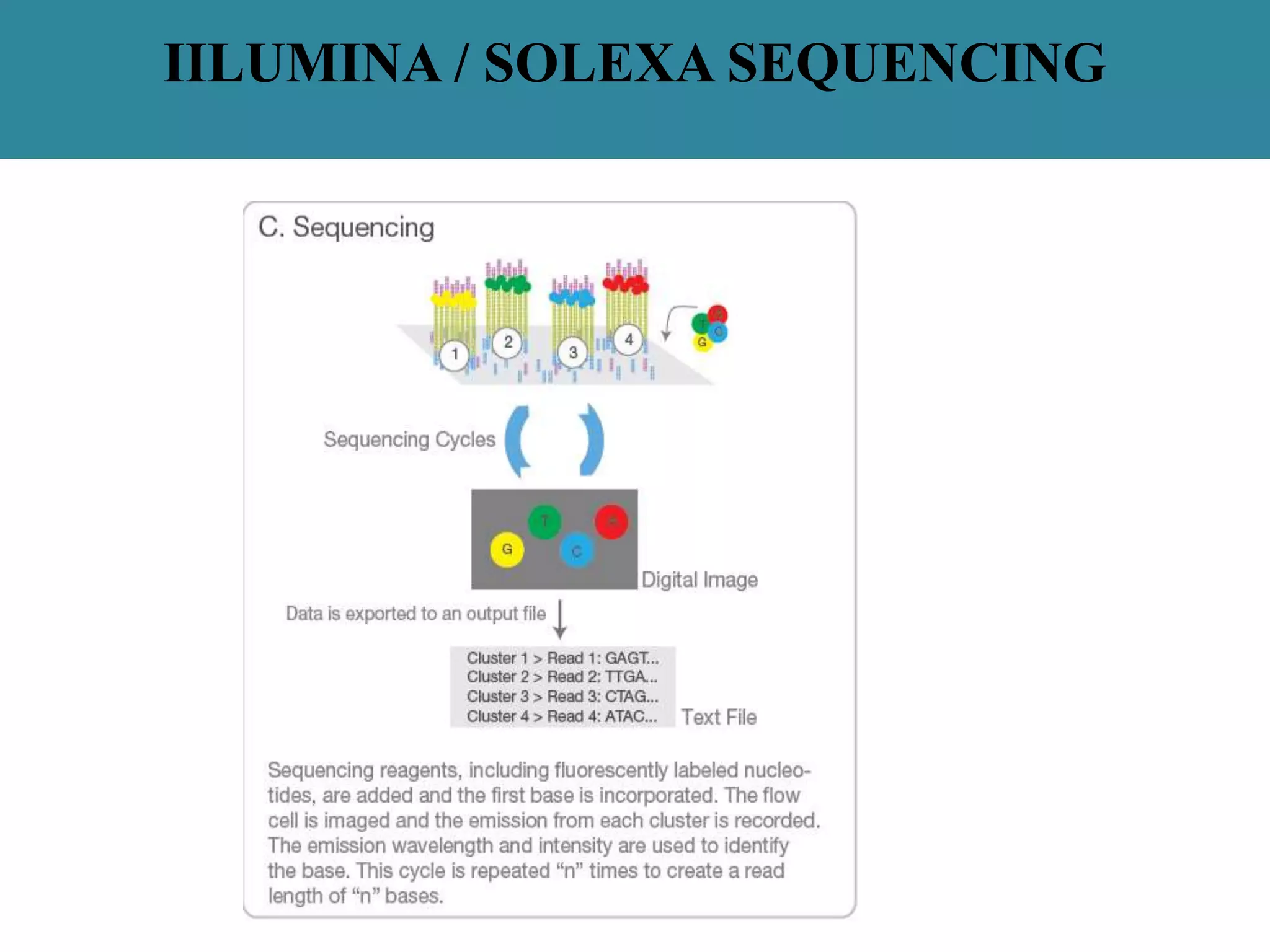
• The slide is flooded with nucleotides and DNA
polymerase. These nucleotides are fluorescently
labelled, with the colour corresponding to the
base. They also have a terminator, so that only one
base is added at a time.
IILUMINA / SOLEXA SEQUENCING
Illumina sequencingIILUMINA / SOLEXA SEQUENCING
BRIDGE PCR AMPLIFICATION
Illumina sequencing
IILUMINA / SOLEXA SEQUENCING
Illumina sequencing
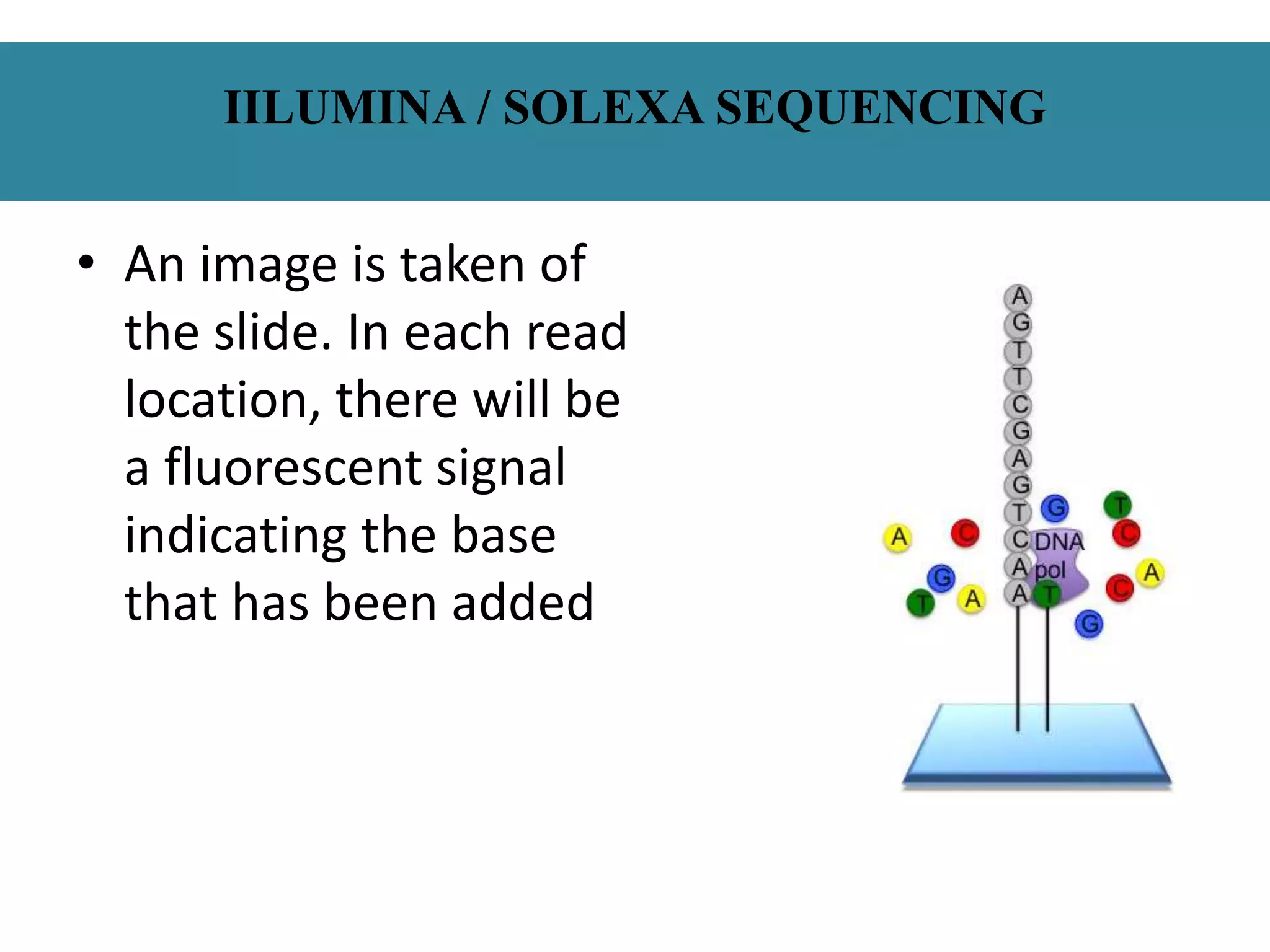
• An image is taken of
the slide. In each read
location, there will be
a fluorescent signal
indicating the base
that has been added
IILUMINA / SOLEXA SEQUENCING
Illumina sequencing
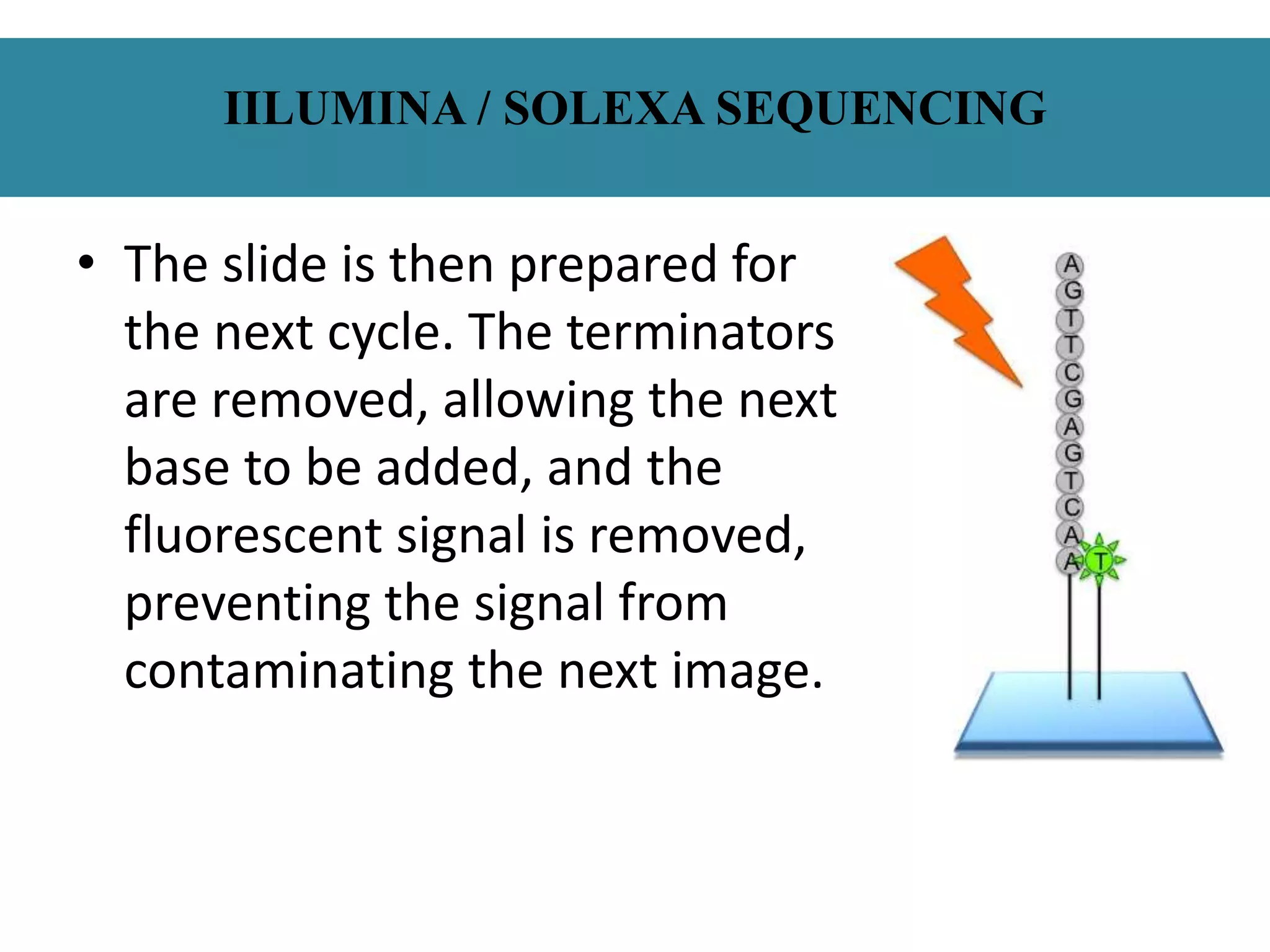
• The slide is then prepared for
the next cycle. The terminators
are removed, allowing the next
base to be added, and the
fluorescent signal is removed,
preventing the signal from
contaminating the next image.
IILUMINA / SOLEXA SEQUENCING
Illumina sequencing
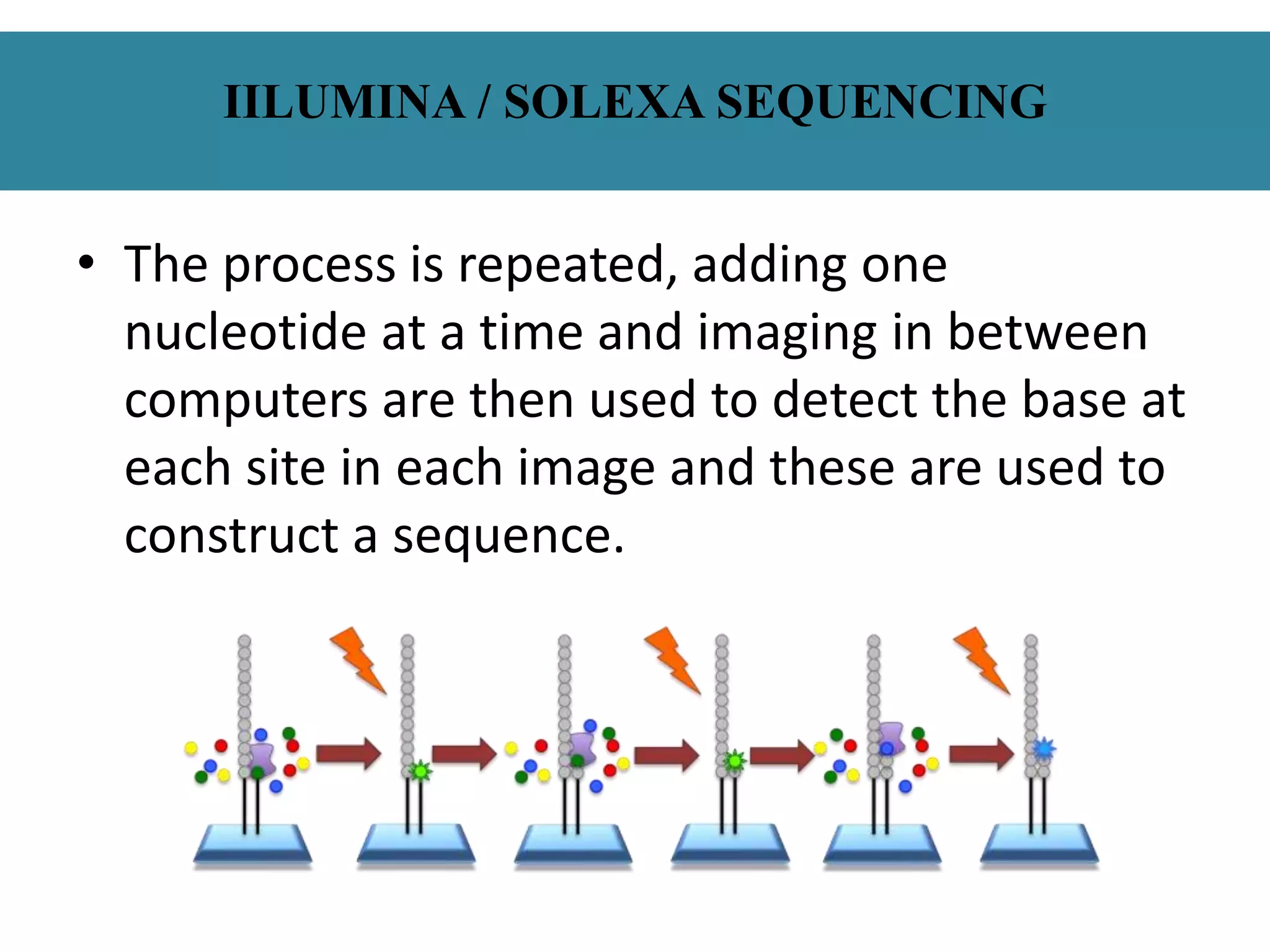
• The process is repeated, adding one
nucleotide at a time and imaging in between
computers are then used to detect the base at
each site in each image and these are used to
construct a sequence.
IILUMINA / SOLEXA SEQUENCING
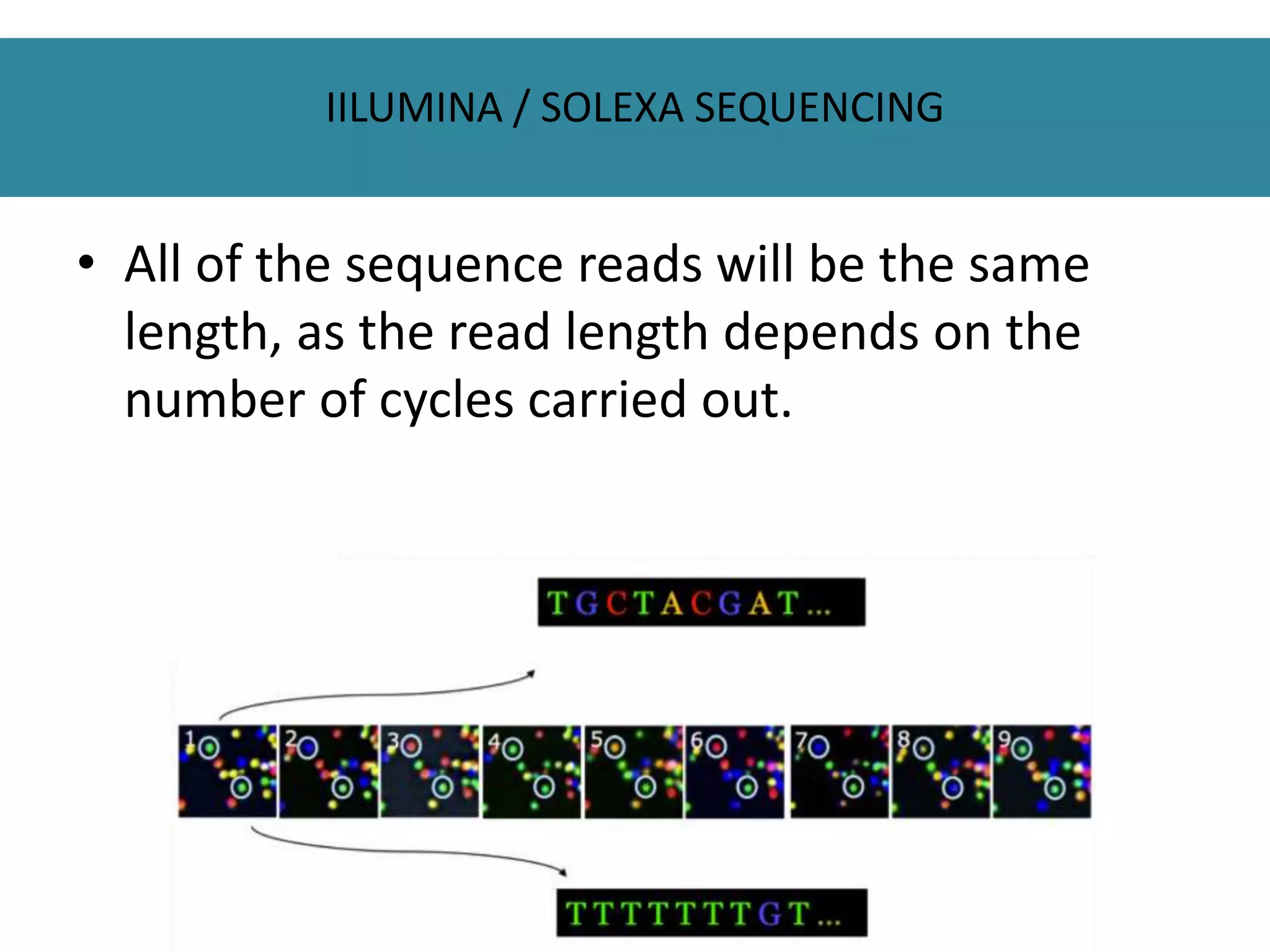
• All of the sequence reads will be the same
length, as the read length depends on the
number of cycles carried out.
IILUMINA / SOLEXA SEQUENCING
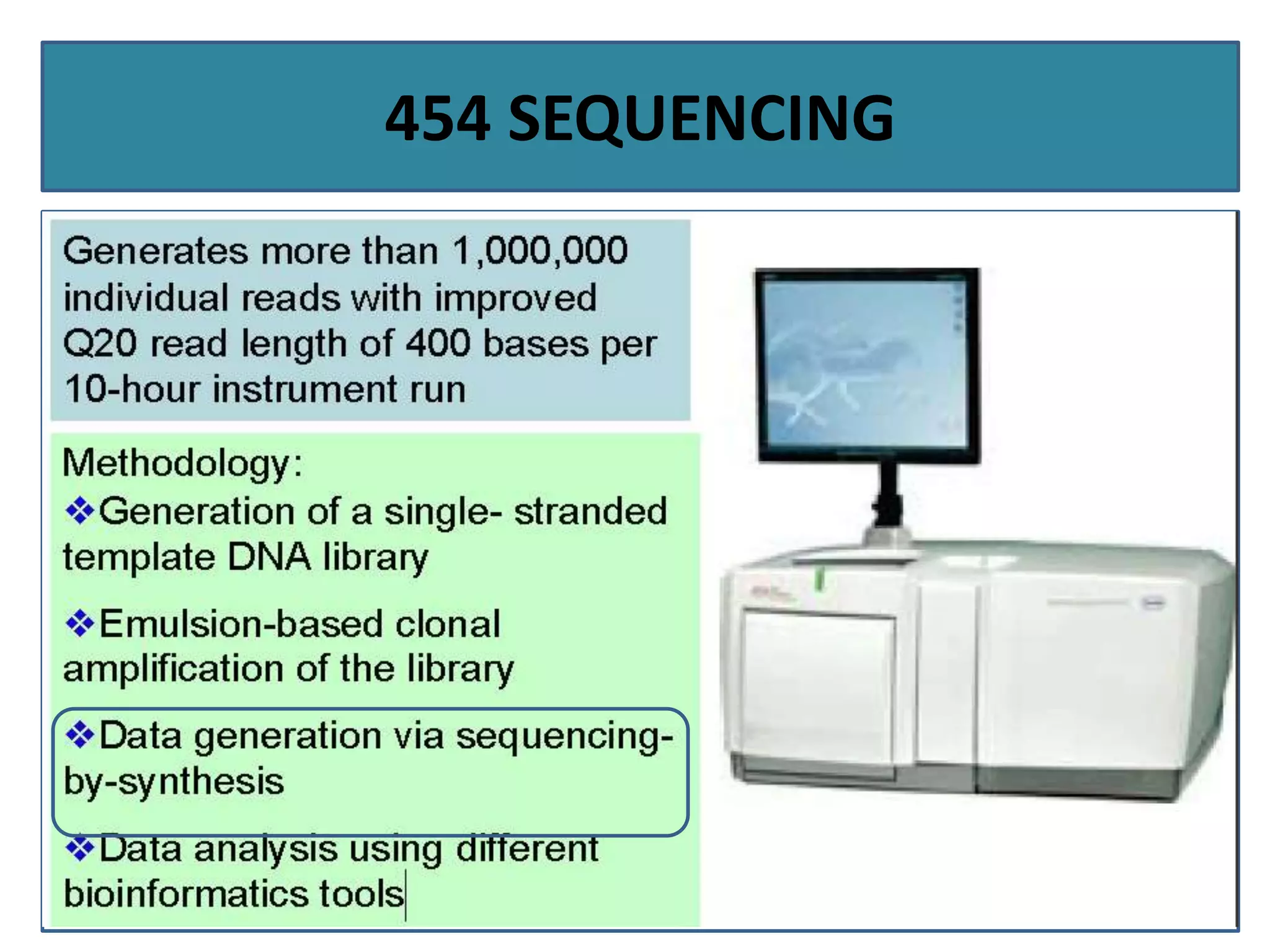
454 SEQUENCING
PYROSEQUENCING
 A method of DNA sequencing based on the “sequencing
by synthesis" principle.
 It differs from Sanger sequencing, relying on the detection
of pyrophosphate release (hence the name) on nucleotide
incorporation, rather than chain termination with
dideoxynucleotides.
 ssDNA template is hybridized to a sequencing primer
 Incubated with the enzymes DNA polymerase, ATP
sulfurylase, luciferase and apyrase, and with the
substrates adenosine 5´ phosphosulfate (APS) and luciferin.
PYROSEQUENCING
PYROSEQUENCING CHEMISTRY
PYROSEQUENCING
PYRO SEQUENCING
 The addition of one of the four deoxynucleotide
triphosphates (dNTPs)(in the case of dATP we add dATPαS
which is not a substrate for a luciferase) initiates the second
step.
 DNA polymerase incorporates the correct, complementary
dNTPs onto the template.
 This incorporation releases pyrophosphate (PPi)
stoichiometrically.
PYROSEQUENCING
PYRO SEQUENCING
 ATP sulfurylase quantitatively converts PPi to ATP
in the presence of adenosine 5´ phosphosulfate.
 This ATP acts as fuel to the luciferase-mediated
conversion of luciferin to oxyluciferin that
generates visible light in amounts that are
proportional to the amount of ATP.
PYROSEQUENCING
 The light produced in the luciferase-catalyzed
reaction is detected by a camera and analyzed in
a program.
 Unincorporated nucleotides and ATP are
degraded by the apyrase, and the reaction can
restart with another nucleotide
PYROSEQUENCING
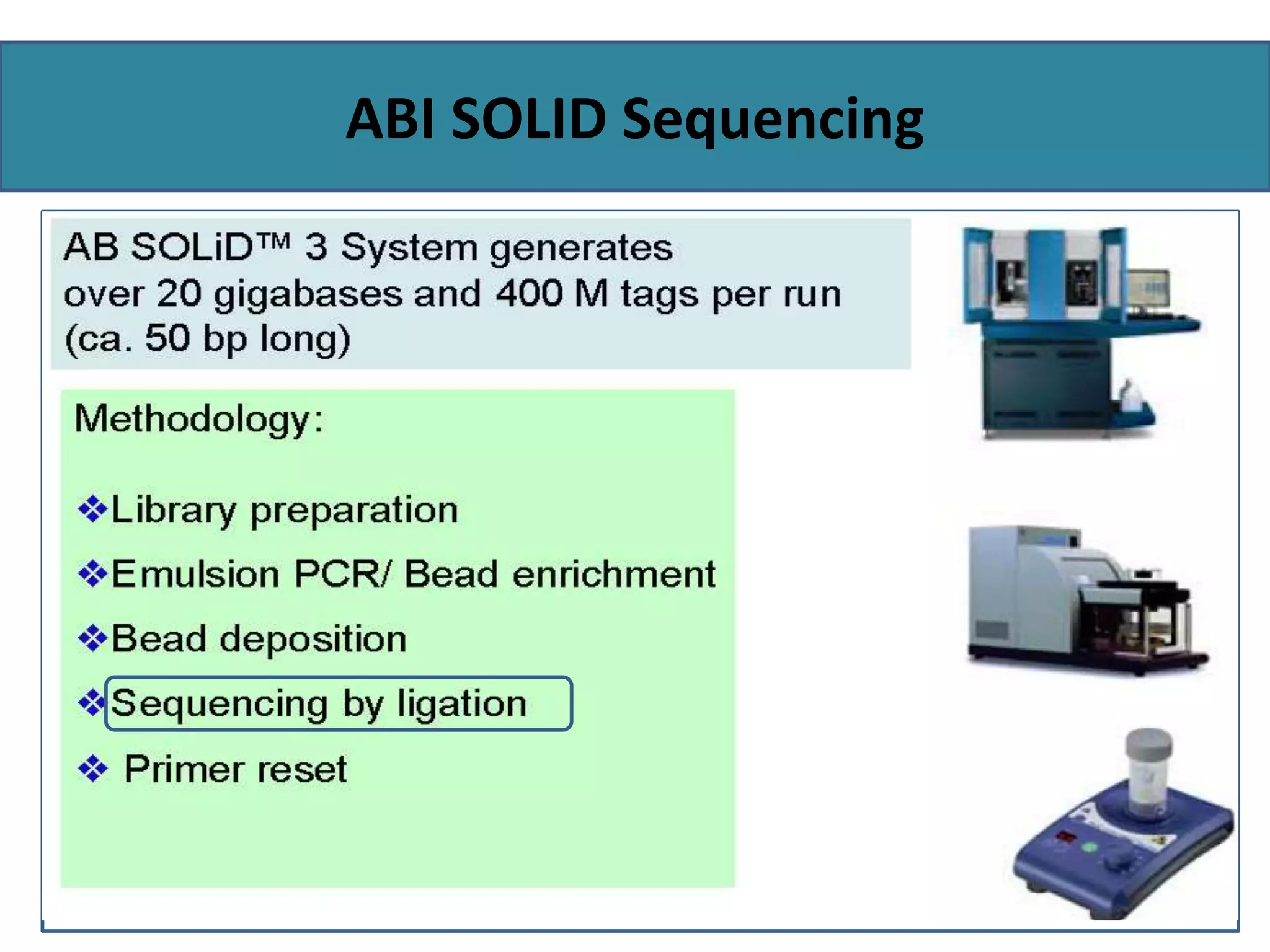
ABI SOLID Sequencing
NGS APPLICATION
NGS
ADVANTAGES
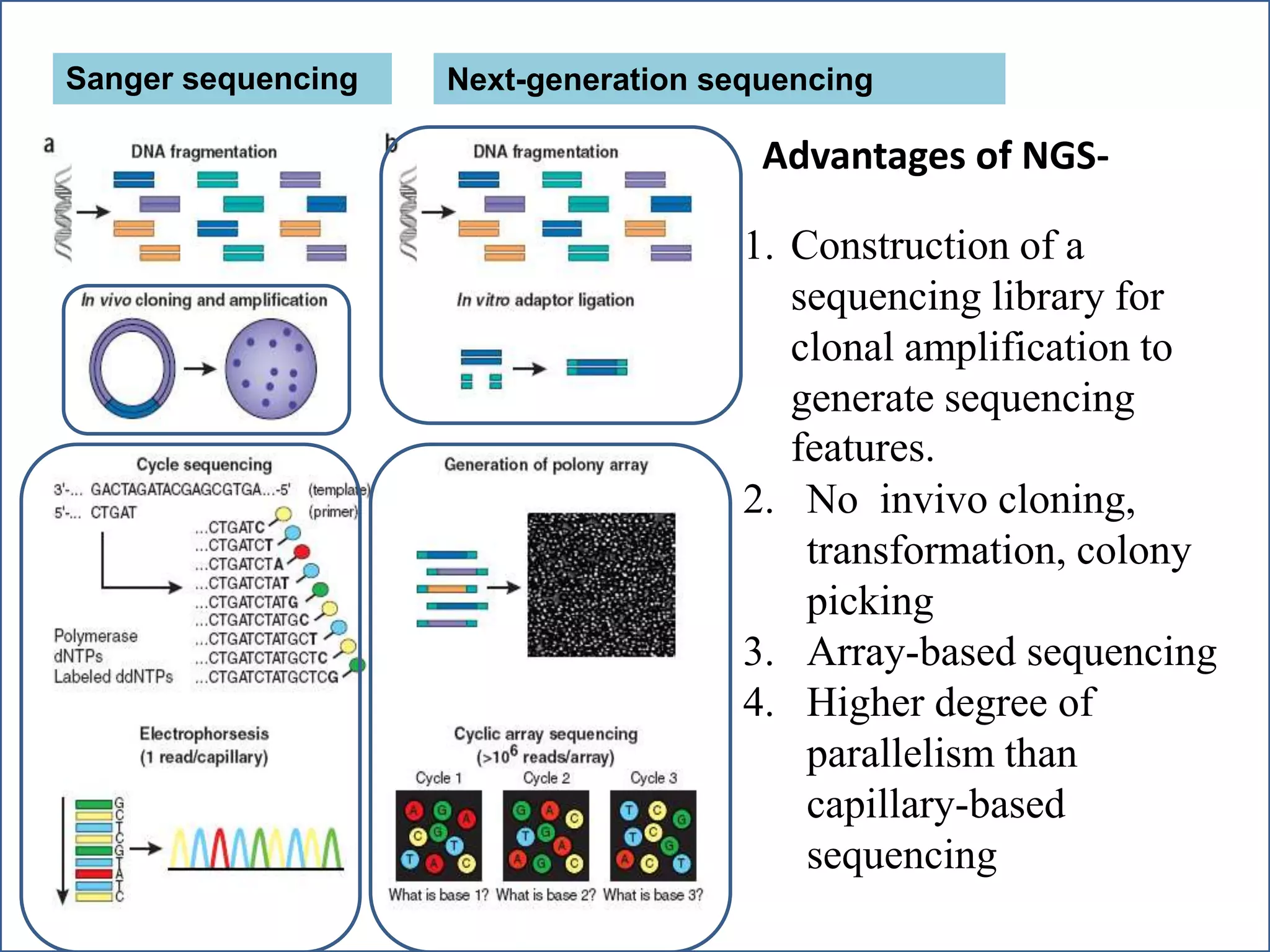
Array-basedsequencing
Sanger sequencing Next-generation sequencing
Advantages of NGS-
1. Construction of a
sequencing library for
clonal amplification to
generate sequencing
features.
2. No invivo cloning,
transformation, colony
picking
3. Array-based sequencing
4. Higher degree of
parallelism than
capillary-based
sequencing
-ROBERT GREEN INGERSOLL

Next generation sequencing

  • 1.
    BHARATHIDASAN INSTITUTE OFTECHNOLOGY ANNA UNIVERSITY TIRUCHIRAPPALLI-24 DEPARTMENT OF BIOTECHNOLOGY CLASS SEMINAR SUBJECT CODE/ TITLE: BT6603/GENETIC ENGINEERING & GENOMICS NEXT GENERATION SEQUENCING Presented by Faculty in charge Name : P. Swathipriya Dr. P.S. Sudhakar Gandhi Reg No. : 810014214042 Asst. Professor
  • 2.
    BHARATHIDASAN INSTITUTE OFTECHNOLOGY ANNA UNIVERSITY TIRUCHIRAPPALLI-24 BHARATHIDASAN INSTITUTE OF TECHNOLOGY ANNA UNIVERSITY TIRUCHIRAPPALLI-24 DEPARTMENT OF BIOTECHNOLOGY CLASS SEMINAR SUBJECT CODE/ TITLE: BT6603/GENETIC ENGINEERING & GENOMICS NEXT GENERATION SEQUENCING Presented by Faculty in charge Name : P. Swathipriya Dr. P.S. Sudhakar Gandhi Reg No. : 810014214042 Asst. Professor
  • 3.
    WHAT IS SEQUENCING? Genomesequencing is a method used to figure out the order of DNA nucleotides, or bases in a genome-the order of A, C, G, and T that make up an organism's DNA. IMPORTANCE OF DNA SEQUENCING  Better understanding of gene expression. Gene expression has significance in protein creation etc.  It is capable to detect various diseases and genetic illnesses.  Personalised medicine and disease discovery is possible.  Forensics
  • 4.
    HISTORY OF SEQUENCING 1869 - Discovery of DNA  1909 - Chemical characterisation  1953 - Structure of DNA solved  1977 - Sanger seq. invented -First genome sequenced - (5 kb)  1986 - First automated sequencing machine  1990 - Human Genome Project started  1992 - First “sequencing factory” at TIGR  1995 - First bacterial genome – H. influenzae (1.8 Mb)  1998 - First animal genome – C. elegans (97 Mb)  2003 - Completion of HGP (3 Gb) – 13 years, $2.7 bn  2005 - First “next-generation” sequencing instrument  2013 - >10,000 genome sequences in NCBI database
  • 5.
    INVENTION OF DNASEQUENCERS 1977  First genome (ФX174)  Sequencing by synthesis (Sanger)  Sequencing by degradation (Maxam Gilbert)  First generation sequencers  Second generation sequencers NGS  Third generation sequencers  Fourth generation sequencers
  • 6.
    Next-generation sequencing (NGS),also known as high- throughput sequencing, is the catch-all term used to describe a number of different modern sequencing technologies including:  Illumina (Solexa) sequencing  Roche 454 sequencing  SOLiD sequencing  Ion torrent: Proton / PGM sequencing NEXT GENERATION SEQUENCERS
  • 7.
     These recenttechnologies allow us to sequence DNA and RNA much more quickly and cheaply than the previously used Sanger sequencing, and as such have revolutionised the study of genomics and molecular biology.  NGS has brought high speed not only to genome sequencing and personal medicine it has also changed the way we do genome research NEXT GENERATION SEQUENCERS
  • 8.
    OVERVIEW OF NEXTGENERATION SEQUENCING PROTOCOL
  • 9.
    The sequencing process1.LIBRARY PREPARATION 2. CLONAL AMPLIFICATION 3. CYCLIC ARRAY SEQUENCING DNA fragmentation and invitro adaptor ligation sequencing 1 2 Emulsion PCR Bridge PCR 3 Pyrosequencing 454 sequencing SOLID platform Solexa technology Sequencing-by-ligation sequencing-by-synthesis
  • 10.
    IILUMINA / SOLEXASEQUENCING • In NGS, vast numbers of short reads are sequenced in a single stroke. • To do this, firstly the input sample must be cleaved into short sections. The length of these sections will depend on the particular sequencing machinery used.
  • 11.
    . • In Illuminasequencing, 100-150bp reads are used. Somewhat longer fragments are ligated to generic adaptors and annealed to a slide using the adaptors. PCR is carried out to amplify each read, creating a spot with many copies of the same read. They are then separated into single strands to be sequenced. • The slide is flooded with nucleotides and DNA polymerase. These nucleotides are fluorescently labelled, with the colour corresponding to the base. They also have a terminator, so that only one base is added at a time. IILUMINA / SOLEXA SEQUENCING
  • 12.
  • 13.
  • 14.
  • 15.
  • 16.
  • 17.
  • 18.
  • 19.
  • 20.
  • 21.
    Illumina sequencing • Animage is taken of the slide. In each read location, there will be a fluorescent signal indicating the base that has been added IILUMINA / SOLEXA SEQUENCING
  • 22.
    Illumina sequencing • Theslide is then prepared for the next cycle. The terminators are removed, allowing the next base to be added, and the fluorescent signal is removed, preventing the signal from contaminating the next image. IILUMINA / SOLEXA SEQUENCING
  • 23.
    Illumina sequencing • Theprocess is repeated, adding one nucleotide at a time and imaging in between computers are then used to detect the base at each site in each image and these are used to construct a sequence. IILUMINA / SOLEXA SEQUENCING
  • 24.
    • All ofthe sequence reads will be the same length, as the read length depends on the number of cycles carried out. IILUMINA / SOLEXA SEQUENCING
  • 25.
  • 27.
  • 28.
    PYROSEQUENCING  A methodof DNA sequencing based on the “sequencing by synthesis" principle.  It differs from Sanger sequencing, relying on the detection of pyrophosphate release (hence the name) on nucleotide incorporation, rather than chain termination with dideoxynucleotides.  ssDNA template is hybridized to a sequencing primer  Incubated with the enzymes DNA polymerase, ATP sulfurylase, luciferase and apyrase, and with the substrates adenosine 5´ phosphosulfate (APS) and luciferin.
  • 29.
  • 30.
  • 31.
  • 32.
    PYRO SEQUENCING  Theaddition of one of the four deoxynucleotide triphosphates (dNTPs)(in the case of dATP we add dATPαS which is not a substrate for a luciferase) initiates the second step.  DNA polymerase incorporates the correct, complementary dNTPs onto the template.  This incorporation releases pyrophosphate (PPi) stoichiometrically. PYROSEQUENCING
  • 33.
    PYRO SEQUENCING  ATPsulfurylase quantitatively converts PPi to ATP in the presence of adenosine 5´ phosphosulfate.  This ATP acts as fuel to the luciferase-mediated conversion of luciferin to oxyluciferin that generates visible light in amounts that are proportional to the amount of ATP. PYROSEQUENCING
  • 34.
     The lightproduced in the luciferase-catalyzed reaction is detected by a camera and analyzed in a program.  Unincorporated nucleotides and ATP are degraded by the apyrase, and the reaction can restart with another nucleotide PYROSEQUENCING
  • 35.
  • 36.
  • 37.
  • 38.
    Array-basedsequencing Sanger sequencing Next-generationsequencing Advantages of NGS- 1. Construction of a sequencing library for clonal amplification to generate sequencing features. 2. No invivo cloning, transformation, colony picking 3. Array-based sequencing 4. Higher degree of parallelism than capillary-based sequencing
  • 39.