ON
A comprehensive study of microarray
A-9606/16
DEPARTMENT OF PMB&GE
N.D. University of Agriculture & Technology
Kumarganj, Faizabad
 Molecular Biology research evolves through the development of
the technologies used for carrying them out. It is not possible to
research on a large number of genes using traditional methods.
 DNA Microarray is one such technology which enables the
researchers to investigate and address issues which were once
thought to be non traceable. One can analyze the expression of
many genes in a single reaction quickly and in an efficient
manner.
 DNA Microarray technology has empowered the scientific
community to understand the fundamental aspects underlining
the growth and development of life as well as to explore the
genetic causes of anomalies occurring in the functioning of the
human body.
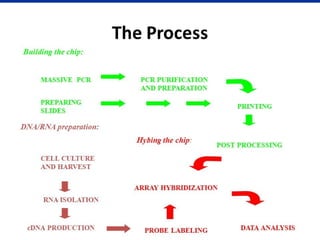
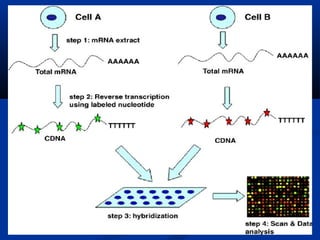
 A typical microarray experiment involves the
hybridization of an mRNA molecule to the
DNA template from which it is originated.
 Many DNA samples are used to construct an
array. The amount of mRNA bound to each site
on the array indicates the expression level of the
various genes.
 This number may run in thousands. All the data
is collected and a profile is generated for gene
expression in the cell.
 Microarrays are simply small glass or silicon slidesMicroarrays are simply small glass or silicon slides
upon the surface of which are arrayed thousands ofupon the surface of which are arrayed thousands of
features (usually between 500 up to a million)features (usually between 500 up to a million)
 Using a conventionalUsing a conventional hybridizationhybridization process, the level ofprocess, the level of
expression of genes is measured (for instance)expression of genes is measured (for instance)
 Microarrays are read using laser-based FluorescenceMicroarrays are read using laser-based Fluorescence
scanners.scanners.
 A microarray is a multiplex lab-on-a-chip It is a 2D
array on a solid substrate(usually a glass slide or silicon
thin-film cell) that assays large amounts of biological
material using high-throughput screening
miniaturized, multiplexed and parallel processing and
detection methods
MICROARRAY TECHNIQE
 An array is an orderly arrangement of samples
where matching of known and unknown DNA
samples is done based on base pairing rules.
 An array experiment makes use of common
assay systems such as microplates or standard
blotting membranes.
 The sample spot sizes are typically less than 200
microns in diameter usually contain thousands
of spots.
 Thousands of spotted samples known as probes (with
known identity) are immobilized on a solid support (a
microscope glass slides or silicon chips or nylon membrane).
 The spots can be DNA, cDNA, or oligonucleotides.
 These are used to determine complementary binding of the
unknown sequences thus allowing parallel analysis for gene
expression and gene discovery.
 An experiment with a single DNA chip can provide
information on thousands of genes simultaneously.
 An orderly arrangement of the probes on the support is
important as the location of each spot on the array is used
for the identification of a gene.
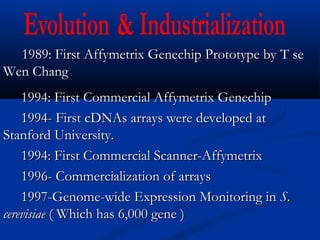
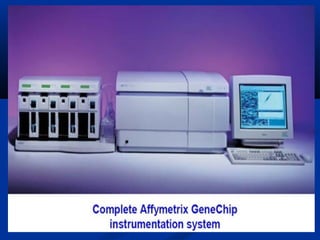
1989: First Affymetrix Genechip Prototype by1989: First Affymetrix Genechip Prototype by T se
Wen Chang
1994: First Commercial Affymetrix Genechip1994: First Commercial Affymetrix Genechip
1994- First cDNAs arrays were developed at1994- First cDNAs arrays were developed at
Stanford University.Stanford University.
1994: First Commercial Scanner-Affymetrix1994: First Commercial Scanner-Affymetrix
1996- Commercialization of arrays1996- Commercialization of arrays
1997-Genome-wide Expression Monitoring in1997-Genome-wide Expression Monitoring in S.S.
cerevisiaecerevisiae ( Which has 6,000 gene )( Which has 6,000 gene )
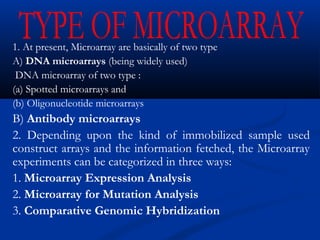
1. At present, Microarray are basically of two type
A) DNA microarrays (being widely used)
DNA microarray of two type :
(a) Spotted microarrays and
(b) Oligonucleotide microarrays
B) Antibody microarrays
2. Depending upon the kind of immobilized sample used
construct arrays and the information fetched, the Microarray
experiments can be categorized in three ways:
1. Microarray Expression Analysis
2. Microarray for Mutation Analysis
3. Comparative Genomic Hybridization
3. Other Types of microarrays include:
1) Expression array
2) Protien microarray
3) SNP, Genotyping, and DNA Mapping ArraysSNP, Genotyping, and DNA Mapping Arrays
4) Resequencing Arrays [Affy]4) Resequencing Arrays [Affy]
5)5) Tissue microarrays
6) Cellular microarrays (also called transfection
microarrays)
7) Chemical compound microarrays
8) Carbohydrate arrays (glycoarrays)
9) Phenotype microarrays
10) Reverse Phase Protein Microarrays
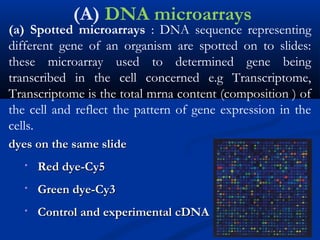
(A) DNA microarrays
(a) Spotted microarrays : DNA sequence representing
different gene of an organism are spotted on to slides:
these microarray used to determined gene being
transcribed in the cell concerned e.g Transcriptome,
Transcriptome is the total mrna content (composition ) of
the cell and reflect the pattern of gene expression in the
cells.
dyes on the same slidedyes on the same slide
• Red dye-Cy5Red dye-Cy5
• Green dye-Cy3Green dye-Cy3
• Control and experimental cDNAControl and experimental cDNA
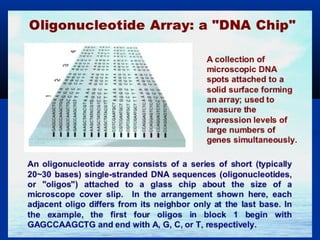
(b)Oligonucleotide microarrays (DNA Chip):
DNA Chip are thin wafer of silicon glass carrying many
different oligonucleotide synthesized at a high density
(3000,000 to over 1million oligonucleotide /cm ) directly on to
wafer.
the oligonucleotide are synthesized at a high spatial
resolution and in precise locations each nucleotide has the
sequence of a deferent gene present in the genome.
therefor, sequence information for gene to be represented in
the DNA chip must be available.
The oligonucleotide synthesized is based on two technique
called photolithography and solid phase DNA synthesis.
It used a series of building blocks of that photochemically
removable a protective groups.
 The DNA Chips are inverted and mounted in aThe DNA Chips are inverted and mounted in a
temperature –controlled hybridization chambertemperature –controlled hybridization chamber
in too which fluorescently labeled cDNAin too which fluorescently labeled cDNA
preparation is injected and allow to hybridizedpreparation is injected and allow to hybridized
with nucleotide.with nucleotide.
 laser excitation enter through the back of thelaser excitation enter through the back of the
glass support focused at the interface of theglass support focused at the interface of the
array surface and targets solution.array surface and targets solution.
 Fluorescence emission is collected by lens andFluorescence emission is collected by lens and
passed on to sensitive detector and a quantitativepassed on to sensitive detector and a quantitative
assays of hybridization intensity is obtained.assays of hybridization intensity is obtained.
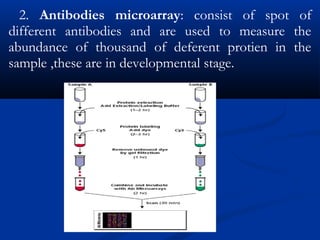
2. Antibodies microarray: consist of spot of
different antibodies and are used to measure the
abundance of thousand of deferent protien in the
sample ,these are in developmental stage.
2.1. Microarray Expression Analysis: 
In this experimental setup, the cDNA derived
from the mRNA of known genes is immobilized.
The sample has genes from both the normal as
well as the diseased tissues. Spots with more
intensity are obtained for diseased tissue gene if
the gene is over expressed in the diseased
condition.
This expression pattern is then compared to the
expression pattern of a gene responsible for a
disease.
2.2. Microarray for Mutation Analysis:
For this analysis, the researchers use cDNA. The
genes might differ from each other by as less as a
single nucleotide base.
A single base difference between two sequences
is known as Single Nucleotide Polymorphism
(SNP) and detecting them is known as SNP
detection.
2.3. Comparative Genomic Hybridization: 
It is used for the identification in the increase or
decrease of the important chromosomal fragments
harboring genes involved in a disease.
3.1 Expression Arrays3.1 Expression Arrays
 Most common type of microarrayMost common type of microarray
 Spotted glass, cartridge, and electronicSpotted glass, cartridge, and electronic
 Involves extracting RNA from a sample and converting it toInvolves extracting RNA from a sample and converting it to
cDNA by priming off of the Poly A tail of mRNA forcDNA by priming off of the Poly A tail of mRNA for
eukaryotes and using random hexamers for prokaryoteseukaryotes and using random hexamers for prokaryotes
 Measures the amount and type of mRNA transcriptsMeasures the amount and type of mRNA transcripts
 Provides information on whether genes are up or downProvides information on whether genes are up or down
regulated in a specific conditionregulated in a specific condition
 Can find novel changes in ESTs for specific conditionsCan find novel changes in ESTs for specific conditions
3.2 Protein Microarrays3.2 Protein Microarrays
True protein microarrays are evolving very slowTrue protein microarrays are evolving very slow
and only a few exist.and only a few exist.
Technology is not straight forward due toTechnology is not straight forward due to
inherent characteristic of proteins [e.g. availableinherent characteristic of proteins [e.g. available
ligands, folding, drying…]ligands, folding, drying…]
Most are designed to detect antibodies orMost are designed to detect antibodies or
enzymes in a biological systemenzymes in a biological system
Protein is on the microarrayProtein is on the microarray
Some detect protein-protein interaction bySome detect protein-protein interaction by
surface plasmon resonance other use asurface plasmon resonance other use a
fluorescence based approachfluorescence based approach
3.3 SNP, Genotyping, and DNA Mapping Arrays3.3 SNP, Genotyping, and DNA Mapping Arrays
 Targets DNA not RNA like expression.Targets DNA not RNA like expression.
 Requires amplification of target DNA.Requires amplification of target DNA.
 Uses multiple probes sets to determine baseUses multiple probes sets to determine base
change at a specific nucleotide position in thechange at a specific nucleotide position in the
genomic DNA.genomic DNA.
 Provides sequence and genotyping dataProvides sequence and genotyping data
including LOH, Linkage analysis and singleincluding LOH, Linkage analysis and single
nucleotide polymorphisms.nucleotide polymorphisms.
3.4 Resequencing Arrays [Affy]3.4 Resequencing Arrays [Affy]
 Enable the analysis of up to 300,000+ bases ofEnable the analysis of up to 300,000+ bases of
double-stranded sequence (600,000 bases total)double-stranded sequence (600,000 bases total)
on a single Affy array.on a single Affy array.
 Used for large-scale resequencing of organismsUsed for large-scale resequencing of organisms
genome and organelles.genome and organelles.
 Faster and cheaper than sequencing but veryFaster and cheaper than sequencing but very
limited to few organisms and/or organelles.limited to few organisms and/or organelles.
 Large potential.Large potential.
DATA ANALYSIS OFDATA ANALYSIS OF
MICROARRAYSMICROARRAYS
 Gene Discovery: DNA Microarray technology helps in
the identification of new genes, know about their
functioning and expression levels under different
conditions.
 Disease Diagnosis: DNA Microarray technology helps
researchers learn more about different diseases such as
heart diseases, mental illness, infectious disease and
especially the study of cancer.
 Drug Discovery: Microarray technology has extensive
application in Pharmacogenomics. Pharmacogenomics is the
study of correlations between therapeutic responses to
drugs and the genetic profiles of the patients
ADVANTAGES OF MICROARRAYSADVANTAGES OF MICROARRAYS
 The analysis based on microarray are vary rapidThe analysis based on microarray are vary rapid
and highly sensitive.and highly sensitive.
 All the gene present in the genome are analyzedAll the gene present in the genome are analyzed
in one test.in one test.
 The assay also provides quantities data viz. theThe assay also provides quantities data viz. the
level of expression of deferent genelevel of expression of deferent gene
 Multiple colour test ( target ) sample using aMultiple colour test ( target ) sample using a
single DNA microarraysingle DNA microarray
A comprehensive study of microarray

A comprehensive study of microarray

  • 1.
    ON A comprehensive studyof microarray A-9606/16 DEPARTMENT OF PMB&GE N.D. University of Agriculture & Technology Kumarganj, Faizabad
  • 2.
     Molecular Biologyresearch evolves through the development of the technologies used for carrying them out. It is not possible to research on a large number of genes using traditional methods.  DNA Microarray is one such technology which enables the researchers to investigate and address issues which were once thought to be non traceable. One can analyze the expression of many genes in a single reaction quickly and in an efficient manner.  DNA Microarray technology has empowered the scientific community to understand the fundamental aspects underlining the growth and development of life as well as to explore the genetic causes of anomalies occurring in the functioning of the human body.
  • 3.
     A typicalmicroarray experiment involves the hybridization of an mRNA molecule to the DNA template from which it is originated.  Many DNA samples are used to construct an array. The amount of mRNA bound to each site on the array indicates the expression level of the various genes.  This number may run in thousands. All the data is collected and a profile is generated for gene expression in the cell.
  • 4.
     Microarrays aresimply small glass or silicon slidesMicroarrays are simply small glass or silicon slides upon the surface of which are arrayed thousands ofupon the surface of which are arrayed thousands of features (usually between 500 up to a million)features (usually between 500 up to a million)  Using a conventionalUsing a conventional hybridizationhybridization process, the level ofprocess, the level of expression of genes is measured (for instance)expression of genes is measured (for instance)  Microarrays are read using laser-based FluorescenceMicroarrays are read using laser-based Fluorescence scanners.scanners.  A microarray is a multiplex lab-on-a-chip It is a 2D array on a solid substrate(usually a glass slide or silicon thin-film cell) that assays large amounts of biological material using high-throughput screening miniaturized, multiplexed and parallel processing and detection methods
  • 5.
    MICROARRAY TECHNIQE  Anarray is an orderly arrangement of samples where matching of known and unknown DNA samples is done based on base pairing rules.  An array experiment makes use of common assay systems such as microplates or standard blotting membranes.  The sample spot sizes are typically less than 200 microns in diameter usually contain thousands of spots.
  • 6.
     Thousands ofspotted samples known as probes (with known identity) are immobilized on a solid support (a microscope glass slides or silicon chips or nylon membrane).  The spots can be DNA, cDNA, or oligonucleotides.  These are used to determine complementary binding of the unknown sequences thus allowing parallel analysis for gene expression and gene discovery.  An experiment with a single DNA chip can provide information on thousands of genes simultaneously.  An orderly arrangement of the probes on the support is important as the location of each spot on the array is used for the identification of a gene.
  • 9.
    1989: First AffymetrixGenechip Prototype by1989: First Affymetrix Genechip Prototype by T se Wen Chang 1994: First Commercial Affymetrix Genechip1994: First Commercial Affymetrix Genechip 1994- First cDNAs arrays were developed at1994- First cDNAs arrays were developed at Stanford University.Stanford University. 1994: First Commercial Scanner-Affymetrix1994: First Commercial Scanner-Affymetrix 1996- Commercialization of arrays1996- Commercialization of arrays 1997-Genome-wide Expression Monitoring in1997-Genome-wide Expression Monitoring in S.S. cerevisiaecerevisiae ( Which has 6,000 gene )( Which has 6,000 gene )
  • 10.
    1. At present,Microarray are basically of two type A) DNA microarrays (being widely used) DNA microarray of two type : (a) Spotted microarrays and (b) Oligonucleotide microarrays B) Antibody microarrays 2. Depending upon the kind of immobilized sample used construct arrays and the information fetched, the Microarray experiments can be categorized in three ways: 1. Microarray Expression Analysis 2. Microarray for Mutation Analysis 3. Comparative Genomic Hybridization
  • 11.
    3. Other Typesof microarrays include: 1) Expression array 2) Protien microarray 3) SNP, Genotyping, and DNA Mapping ArraysSNP, Genotyping, and DNA Mapping Arrays 4) Resequencing Arrays [Affy]4) Resequencing Arrays [Affy] 5)5) Tissue microarrays 6) Cellular microarrays (also called transfection microarrays) 7) Chemical compound microarrays 8) Carbohydrate arrays (glycoarrays) 9) Phenotype microarrays 10) Reverse Phase Protein Microarrays
  • 12.
    (A) DNA microarrays (a)Spotted microarrays : DNA sequence representing different gene of an organism are spotted on to slides: these microarray used to determined gene being transcribed in the cell concerned e.g Transcriptome, Transcriptome is the total mrna content (composition ) of the cell and reflect the pattern of gene expression in the cells. dyes on the same slidedyes on the same slide • Red dye-Cy5Red dye-Cy5 • Green dye-Cy3Green dye-Cy3 • Control and experimental cDNAControl and experimental cDNA
  • 13.
    (b)Oligonucleotide microarrays (DNAChip): DNA Chip are thin wafer of silicon glass carrying many different oligonucleotide synthesized at a high density (3000,000 to over 1million oligonucleotide /cm ) directly on to wafer. the oligonucleotide are synthesized at a high spatial resolution and in precise locations each nucleotide has the sequence of a deferent gene present in the genome. therefor, sequence information for gene to be represented in the DNA chip must be available. The oligonucleotide synthesized is based on two technique called photolithography and solid phase DNA synthesis. It used a series of building blocks of that photochemically removable a protective groups.
  • 14.
     The DNAChips are inverted and mounted in aThe DNA Chips are inverted and mounted in a temperature –controlled hybridization chambertemperature –controlled hybridization chamber in too which fluorescently labeled cDNAin too which fluorescently labeled cDNA preparation is injected and allow to hybridizedpreparation is injected and allow to hybridized with nucleotide.with nucleotide.  laser excitation enter through the back of thelaser excitation enter through the back of the glass support focused at the interface of theglass support focused at the interface of the array surface and targets solution.array surface and targets solution.  Fluorescence emission is collected by lens andFluorescence emission is collected by lens and passed on to sensitive detector and a quantitativepassed on to sensitive detector and a quantitative assays of hybridization intensity is obtained.assays of hybridization intensity is obtained.
  • 16.
    2. Antibodies microarray:consist of spot of different antibodies and are used to measure the abundance of thousand of deferent protien in the sample ,these are in developmental stage.
  • 17.
    2.1. Microarray ExpressionAnalysis:  In this experimental setup, the cDNA derived from the mRNA of known genes is immobilized. The sample has genes from both the normal as well as the diseased tissues. Spots with more intensity are obtained for diseased tissue gene if the gene is over expressed in the diseased condition. This expression pattern is then compared to the expression pattern of a gene responsible for a disease.
  • 18.
    2.2. Microarray for MutationAnalysis: For this analysis, the researchers use cDNA. The genes might differ from each other by as less as a single nucleotide base. A single base difference between two sequences is known as Single Nucleotide Polymorphism (SNP) and detecting them is known as SNP detection. 2.3. Comparative Genomic Hybridization:  It is used for the identification in the increase or decrease of the important chromosomal fragments harboring genes involved in a disease.
  • 19.
    3.1 Expression Arrays3.1Expression Arrays  Most common type of microarrayMost common type of microarray  Spotted glass, cartridge, and electronicSpotted glass, cartridge, and electronic  Involves extracting RNA from a sample and converting it toInvolves extracting RNA from a sample and converting it to cDNA by priming off of the Poly A tail of mRNA forcDNA by priming off of the Poly A tail of mRNA for eukaryotes and using random hexamers for prokaryoteseukaryotes and using random hexamers for prokaryotes  Measures the amount and type of mRNA transcriptsMeasures the amount and type of mRNA transcripts  Provides information on whether genes are up or downProvides information on whether genes are up or down regulated in a specific conditionregulated in a specific condition  Can find novel changes in ESTs for specific conditionsCan find novel changes in ESTs for specific conditions
  • 20.
    3.2 Protein Microarrays3.2Protein Microarrays True protein microarrays are evolving very slowTrue protein microarrays are evolving very slow and only a few exist.and only a few exist. Technology is not straight forward due toTechnology is not straight forward due to inherent characteristic of proteins [e.g. availableinherent characteristic of proteins [e.g. available ligands, folding, drying…]ligands, folding, drying…] Most are designed to detect antibodies orMost are designed to detect antibodies or enzymes in a biological systemenzymes in a biological system Protein is on the microarrayProtein is on the microarray Some detect protein-protein interaction bySome detect protein-protein interaction by surface plasmon resonance other use asurface plasmon resonance other use a fluorescence based approachfluorescence based approach
  • 21.
    3.3 SNP, Genotyping,and DNA Mapping Arrays3.3 SNP, Genotyping, and DNA Mapping Arrays  Targets DNA not RNA like expression.Targets DNA not RNA like expression.  Requires amplification of target DNA.Requires amplification of target DNA.  Uses multiple probes sets to determine baseUses multiple probes sets to determine base change at a specific nucleotide position in thechange at a specific nucleotide position in the genomic DNA.genomic DNA.  Provides sequence and genotyping dataProvides sequence and genotyping data including LOH, Linkage analysis and singleincluding LOH, Linkage analysis and single nucleotide polymorphisms.nucleotide polymorphisms.
  • 22.
    3.4 Resequencing Arrays[Affy]3.4 Resequencing Arrays [Affy]  Enable the analysis of up to 300,000+ bases ofEnable the analysis of up to 300,000+ bases of double-stranded sequence (600,000 bases total)double-stranded sequence (600,000 bases total) on a single Affy array.on a single Affy array.  Used for large-scale resequencing of organismsUsed for large-scale resequencing of organisms genome and organelles.genome and organelles.  Faster and cheaper than sequencing but veryFaster and cheaper than sequencing but very limited to few organisms and/or organelles.limited to few organisms and/or organelles.  Large potential.Large potential.
  • 24.
    DATA ANALYSIS OFDATAANALYSIS OF MICROARRAYSMICROARRAYS
  • 25.
     Gene Discovery: DNAMicroarray technology helps in the identification of new genes, know about their functioning and expression levels under different conditions.  Disease Diagnosis: DNA Microarray technology helps researchers learn more about different diseases such as heart diseases, mental illness, infectious disease and especially the study of cancer.  Drug Discovery: Microarray technology has extensive application in Pharmacogenomics. Pharmacogenomics is the study of correlations between therapeutic responses to drugs and the genetic profiles of the patients
  • 26.
    ADVANTAGES OF MICROARRAYSADVANTAGESOF MICROARRAYS  The analysis based on microarray are vary rapidThe analysis based on microarray are vary rapid and highly sensitive.and highly sensitive.  All the gene present in the genome are analyzedAll the gene present in the genome are analyzed in one test.in one test.  The assay also provides quantities data viz. theThe assay also provides quantities data viz. the level of expression of deferent genelevel of expression of deferent gene  Multiple colour test ( target ) sample using aMultiple colour test ( target ) sample using a single DNA microarraysingle DNA microarray