CONTENTS
1. INTRODUCTION
2. HISTORY
3.PRINCIPLE
4. DNA MICROARRAY TECHNOLOGY
5. PRINCIPLES OF DNA MICROARRAY TECHNOLOGY
6. TYPES OF DNA MICROARRAY
GLASS cDNA MICROARRAYS
IN SITU OLIGONUCLEOTIDE ARRAY FORMAT
7. APPLICATIONS OF MICROARRAY TECHNOLOGY
3.
INTRODUCTION
The large-scale genomesequencing effort and
the ability to immobilize thousands of DNA
fragments on coated glass slide or membrane,
have led to the development of microarray
technology.
A microarray is a pattern of ssDNA probes
which are immobilized on a surface called a
chip or a slide.
Microarrays use hybridization to detect a
specific DNA or RNA in a sample.
DNA microarray uses a million different
probes, fixed on a solid surface.
4.
WHAT IS ANARRAY
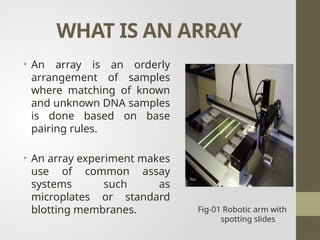
• An array is an orderly
arrangement of samples
where matching of known
and unknown DNA samples
is done based on base
pairing rules.
• An array experiment makes
use of common assay
systems such as
microplates or standard
blotting membranes. Fig-01 Robotic arm with
spotting slides
5.
HISTORY
• Microarray technologyevolved from Southern
blotting.
• The concept of microarrays was first proposed in
the late 1980s by Augenlicht and his colleagues.
• They spotted 4000 cDNA sequences on
nitrocellulose membrane and used radioactive
labeling to analyze differences in gene
expression patterns among different types of
colon tumors in various stages of malignancy.
6.
DNA MICROARRAY TECHNOLOGY
•DNA microarray technology may be defined
as a high-throughput and versatile
technology used for parallel gene expression
analysis for thousands of genes of known and
unknown functions.
• Used for detection of polymorphisms and
mutations in genomic DNA
• A DNA microarray is a collection of
microscopic DNA spots on solid surface. Each
spot contains picomoles of a specific DNA
sequence, known as probes or reporters.
7.
• Each identifiedsequenced gene on the glass,
silicon chips or nylon membrane corresponds to
a fragment of genomic DNA, cDNAs, PCR
products or chemically synthesized
oligonucleotides of up to 70mers and represents
a single gene.
• Probe-target hybridization is usually detected
and quantified by detection of fluorophore,
silver, or chemiluminescence labeled targets to
determine relative abundance of nucleic acid
sequences in the target.
9.
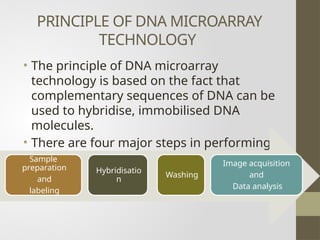
PRINCIPLE OF DNAMICROARRAY
TECHNOLOGY
• The principle of DNA microarray
technology is based on the fact that
complementary sequences of DNA can be
used to hybridise, immobilised DNA
molecules.
• There are four major steps in performing
a typical microarray experiment.
Sample
preparation
and
labeling
Hybridisatio
n
Washing
Image acquisition
and
Data analysis
10.
SAMPLE PREPARATION ANDLABELING
• Isolate a total RNA
containing mRNA that ideally
represents a quantitative
copy of genes expressed at
the time of sample collection.
• Preparation of cDNA from
mRNA using a reverse-
transcriptase enzyme.
• Short primer is required to
initiate cDNA synthesis.
• Each cDNA (Sample and
Control) is labelled with
fluorescent cyanine dyes (i.e.
Cy3 and Cy5).
Fig-03 Sample labeling
11.
ARRAY HYBRIDISATION
• Here,the labelled
cDNA (Sample and
Control) are mixed
together.
• Purification
• After purification, the
mixed labelled cDNA
is competitively
hybridised against
denatured PCR
product or cDNA
molecules spotted on
a glass slide.
Fig-04 Array Hybridisation
12.
IMAGE ACQUISITION ANDDATA
ANALYSIS
• Slide is dried and scanned
to determine how much
labelled cDNA (probe) is
bound to each target spot.
• Hybridized target
produces emissions.
• Microarray software often
uses green spots on the
microarray to represent
upregulated genes.
• Red to represent those
genes that are
downregulated and yellow
to present in equal
abundance
Fig-05 Gene chip showing different
type of color spots
13.
TYPES OF DNAMICROARRAY
1) Glass cDNA microarrays which involves the micro
spotting of pre-fabricated cDNA fragments on a glass
slide.
2) High-density oligonucleotide microarrays often referred
to as a "chip" which involves in situ oligonucleotide
synthesis.
14.
GLASS cDNA MICROARRAYS
•Glass cDNA microarrays
was the first type of DNA
microarray technology
developed.
• It was pioneered by Patrick
Brown and his colleagues
at Stanford University.
• Produced by using a
robotic device which
deposits (spots) a nanoliter
of DNA onto a coated
microscopic glass slide (50-
150 µm in diameter) .
Fig-06 Contact printer with
robotic pins
15.
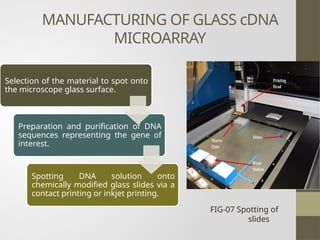
MANUFACTURING OF GLASScDNA
MICROARRAY
FIG-07 Spotting of
slides
Selection of the material to spot onto
the microscope glass surface.
Preparation and purification of DNA
sequences representing the gene of
interest.
Spotting DNA solution onto
chemically modified glass slides via a
contact printing or inkjet printing.
16.
ADVANTAGES OF GLASScDNA MICROARRAYS
• Advantages of Glass cDNA microarrays include their
relative affordability with a lower cost.
• Its accessibility requiring no specific equipment for use
such that hybridisation does not need specialized
equipment.
• Data capture can be carried out using equipment that is
very often already available in the laboratory.
17.
DISADVANTAGES OF GLASScDNA
MICROARRAYS
• Glass cDNA microarray have a few disadvantages such as
intensive labour requirement for synthesizing, purifying,
and storing DNA solutions before microarray fabrication.
• They may hybridise to spots designed to detect transcript
from a different gene.
18.
IN SITU OLIGONUCLEOTIDEARRAY
FORMAT
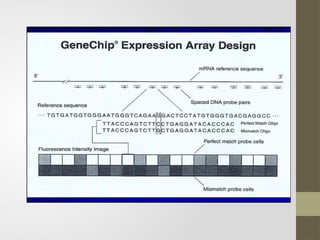
• Oligonucleotides are synthesized on the chip.
• Presently, the commercial versions of Affymetrix Gene
Chips hold up to 500,000 probes/sites in a 1.28-cm2
chip area.
• Due to such very high information content (genes)
they are finding widespread use in the hybridisation-
based detection and analysis of mutations and
polymorphisms, such as single nucleotide
polymorphisms.
19.
In situ light-directedoligonucleotide
probe array synthesis.
• In situ light-directed oligonucleotide probe array
synthesis is a method that
combines photolithography and solid-phase
chemical synthesis to fabricate high-density DNA
microarrays directly onto a solid surface, such as a
glass slide.
• This technique, pioneered by Affymetrix and later
developed into maskless array synthesis (MAS) by
NimbleGen, enables the creation of arrays with
thousands to hundreds of thousands of unique,
short oligonucleotide probes in a highly
automated and flexible manner.
20.
ADVANTAGES OF IN
SITUOLIGONUCLEOTIDE ARRAY FORMAT
• Advantages offered by the in
situ oligonucleotide array format
include speed, specificity and
reproducibility.
21.
DISADVANTAGES OF
IN SITUOLIGONUCLEOTIDE ARRAY FORMAT
• In situ oligonucleotide array formats tend to have
expensive specialised equipments e.g. to carry out the
hybridisation, staining of label, washing, and quantitation
process.
• Short-sequences used on the array have decreased
sensitivity/binding compared with glass cDNA microarrays.
22.
Applications of MicroarrayTechnology
MICROARRA
Y AS A GENE
EXPRESSION
PROFILING
TOOL
MICROARRA
Y AS A
COMPARATI
VE
GENOMICS
TOOL
DISEASE
DIAGNOSI
S
DRUG
DISCOVER
Y
TOXICOLOGIC
AL RESEARCH
23.
MICROARRAY AS AGENE EXPRESSION PROFILING TOOL
• The principle aim of using microarray technology as a
gene expression profiling tool is to answer some of
the fundamental questions in biology such as "when,
where, and to what magnitude genes of interest are
expressed.
• Microarray analysis measure changes in the
multigene patterns of expression to better
understand about regulatory mechanisms and
broader bioactivity functions of genes.
24.
MICROARRAY AS ACOMPARATIVE GENOMICS TOOL
• Microarray technology have widespread use in
comparative gene mutation analysis to analyse genomic
alterations such as sequence and single nucleotide
polymorphisms.
• In microbiology microarray gene mutation analysis is
directed to characterisation of genetic differences among
microbial isolates, particularly closely related species.
25.
DISEASE DIAGNOSIS
• Differenttypes of cancer have been classified on the basis
of the organs in which the tumors develop.
• Now, with the evolution of microarray technology, it will be
possible for the researchers to further classify the types of
cancer on the basis of the patterns of gene activity in the
tumor cells.
26.
DRUG DISCOVERY
• Microarraytechnology has extensive application in
Pharmacogenomics.
• Comparative analysis of the genes from a diseased and a
normal cell will help the identification of the biochemical
constitution of the proteins synthesized by the diseased
genes.
27.
TOXICOLOGICAL RESEARCH
• Microarraytechnology provides a robust platform for
the research of the impact of toxins on the cells and
their passing on to the progeny.
• Toxicogenomics establishes correlation between
responses to toxicants and the changes in the genetic
profiles of the cells exposed to such toxicants.
• The microarray permits researchers to examine
thousands of different genes in the same experiment
and thus to obtain a good understanding of the
relative levels of expression between different genes
in an organism.













![Human Reproduction [ Reproductive System ] Notes @irfanullah_mehar Irfanullah...](https://cdn.slidesharecdn.com/ss_thumbnails/humanreproductionreproductivesystemnotesirfanullahmeharirfanullahmeharjanantantra-260111172350-56e85778-thumbnail.jpg?width=640&height=640&fit=bounds)


