DNA chips and
microarrays
Biotechnology (FST 2163)
Group no: 02
108018
108019
108078
Content
o Introduction
o Principle
o Types of microarray
o Applications
o Advantages and disadvantages
o Summery
o References
Introduction
DNA chips and microarrays …
o Made with thousands of nucleotide
attached to a chip
o Contains a particular cDNA sequence known
as “probe”
o Probes are deposited on a solid support,
either positively charged nylon or glass
slide
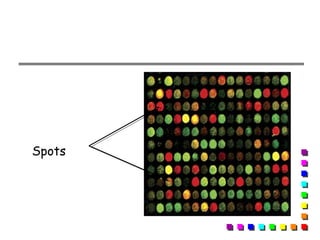
o Probes occupy a particular “spot” on the
chip
Spots
Principle
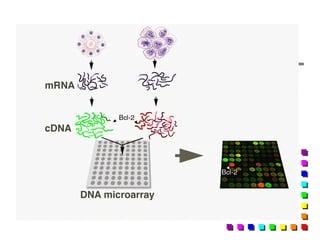
The core principle behind microarrays is
hybridization
Samples are labeled using fluorescent dyes
At least two samples are hybridized to chip
Complementary nucleic acid sequences get
pair via hydrogen bonds
Washing off of non-specific bonding
sequences
Principle cont…
Fluorescently labeled target sequences
that bind to a probe sequence generate a
signal
The signal depends on
The hybridization conditions, ex: temperature
washing after hybridization
Total strength of the signal, depends upon
the; amount of target sample
Principle cont…
Microarrays use relative quantization in
which the intensity of a spot is compared
to the intensity of the same spot under a
different condition
Identity of the spot is known by its
position
Scanning the arrays
Laser scanners
Excellent spatial resolution
Good sensitivity, but can bleach fluorochromes
Still rather slow
CCD scanners
Low resolution
Sensitivity easily adjustable (exposure time)
Faster and cheaper than lasers
In all cases, raw data are images showing
fluorescence on surface of chip
Types of Microarrays
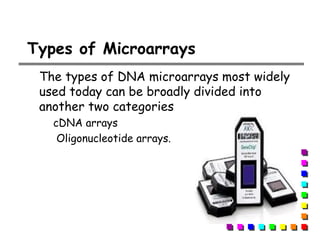
The types of DNA microarrays most widely
used today can be broadly divided into
another two categories
cDNA arrays
Oligonucleotide arrays.
Produces by Affymetrix
An oligonucleotide array
The most commonly used type of DNA
microarray
Each array contain hundreds of thousands
of probe spots
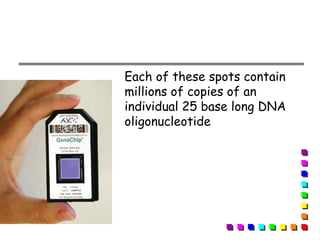
The Affymetrix Gene Chip
Each of these spots contain
millions of copies of an
individual 25 base long DNA
oligonucleotide
cDNA microarrays
Each spot corresponds entirely to a
specific gene
Measure complementary DNA , as it is
more stable than mRNA at large sizes.
mRNA from the original sample is reverse
transcribed in a laboratory to create an
equivalent number of the cDNA
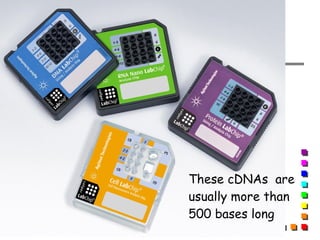
These cDNAs are
usually more than
500 bases long
Applications
Gene expression analysis
Not all the genes in the human genome are
active at all times
used to detect DNA , or detect RNA that
may or may not be translated into proteins.
The process of measuring gene expression
via cDNA is called expression analysis
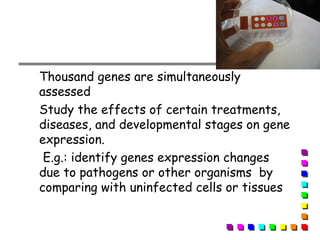
Thousand genes are simultaneously
assessed
Study the effects of certain treatments,
diseases, and developmental stages on gene
expression.
E.g.: identify genes expression changes
due to pathogens or other organisms by
comparing with uninfected cells or tissues
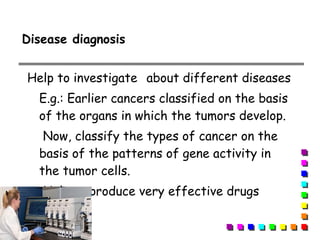
Help to investigate about different diseases
E.g.: Earlier cancers classified on the basis
of the organs in which the tumors develop.
Now, classify the types of cancer on the
basis of the patterns of gene activity in
the tumor cells.
Help to produce very effective drugs
Disease diagnosis
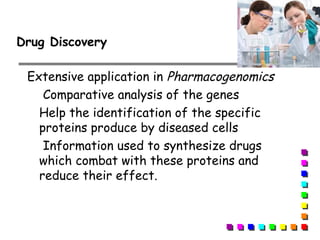
Extensive application in Pharmacogenomics
Comparative analysis of the genes
Help the identification of the specific
proteins produce by diseased cells
Information used to synthesize drugs
which combat with these proteins and
reduce their effect.
Drug Discovery
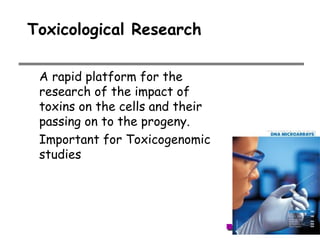
Toxicological Research
A rapid platform for the
research of the impact of
toxins on the cells and their
passing on to the progeny.
Important for Toxicogenomic
studies
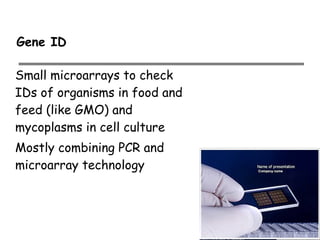
Small microarrays to check
IDs of organisms in food and
feed (like GMO) and
mycoplasms in cell culture
Mostly combining PCR and
microarray technology
Gene ID
Nutrigenomic research
Study variations in the genes related to the
influence of diets.
These variations, known as single
nucleotide polymorphism
E.g.: Studies are followed to reveal,
Effects of calorie restriction on gene
expression
Obesity and high-fat diets
Genes responds to gluten and soy protein
Advantages and disadvantages
Advantages
Provides data for thousands of genes
One experiment instead of many
Fast and easy to obtain results
Huge step closer to discovering cures for
diseases and cancer
Different parts of DNA can be used to
study gene expresion
Disadvantages
Correlations in results do not mean
causation
Very little knowledge is available about
many genes
Just because mRNA is "turned on" doesn't
mean proteins are made 
The findings may lead to unethical medical
procedures
Scientists have no standardized way to
share results
Web links
http://www.gene-chips.com/
http://www.bio.davidson.edu/courses/geno
mics/chip/chip.html
http://www.cs.washington.edu/homes/jbuhl
er/research/array

Dna chips and microarrays

  • 1.
    DNA chips and microarrays Biotechnology(FST 2163) Group no: 02 108018 108019 108078
  • 2.
    Content o Introduction o Principle oTypes of microarray o Applications o Advantages and disadvantages o Summery o References
  • 3.
    Introduction DNA chips andmicroarrays … o Made with thousands of nucleotide attached to a chip o Contains a particular cDNA sequence known as “probe” o Probes are deposited on a solid support, either positively charged nylon or glass slide o Probes occupy a particular “spot” on the chip
  • 4.
  • 5.
    Principle The core principlebehind microarrays is hybridization Samples are labeled using fluorescent dyes At least two samples are hybridized to chip Complementary nucleic acid sequences get pair via hydrogen bonds Washing off of non-specific bonding sequences
  • 6.
    Principle cont… Fluorescently labeledtarget sequences that bind to a probe sequence generate a signal The signal depends on The hybridization conditions, ex: temperature washing after hybridization Total strength of the signal, depends upon the; amount of target sample
  • 7.
    Principle cont… Microarrays userelative quantization in which the intensity of a spot is compared to the intensity of the same spot under a different condition Identity of the spot is known by its position
  • 9.
    Scanning the arrays Laserscanners Excellent spatial resolution Good sensitivity, but can bleach fluorochromes Still rather slow CCD scanners Low resolution Sensitivity easily adjustable (exposure time) Faster and cheaper than lasers In all cases, raw data are images showing fluorescence on surface of chip
  • 10.
    Types of Microarrays Thetypes of DNA microarrays most widely used today can be broadly divided into another two categories cDNA arrays Oligonucleotide arrays.
  • 11.
    Produces by Affymetrix Anoligonucleotide array The most commonly used type of DNA microarray Each array contain hundreds of thousands of probe spots The Affymetrix Gene Chip
  • 12.
    Each of thesespots contain millions of copies of an individual 25 base long DNA oligonucleotide
  • 13.
    cDNA microarrays Each spotcorresponds entirely to a specific gene Measure complementary DNA , as it is more stable than mRNA at large sizes. mRNA from the original sample is reverse transcribed in a laboratory to create an equivalent number of the cDNA
  • 14.
    These cDNAs are usuallymore than 500 bases long
  • 15.
    Applications Gene expression analysis Notall the genes in the human genome are active at all times used to detect DNA , or detect RNA that may or may not be translated into proteins. The process of measuring gene expression via cDNA is called expression analysis
  • 16.
    Thousand genes aresimultaneously assessed Study the effects of certain treatments, diseases, and developmental stages on gene expression. E.g.: identify genes expression changes due to pathogens or other organisms by comparing with uninfected cells or tissues
  • 17.
    Help to investigateabout different diseases E.g.: Earlier cancers classified on the basis of the organs in which the tumors develop. Now, classify the types of cancer on the basis of the patterns of gene activity in the tumor cells. Help to produce very effective drugs Disease diagnosis
  • 18.
    Extensive application inPharmacogenomics Comparative analysis of the genes Help the identification of the specific proteins produce by diseased cells Information used to synthesize drugs which combat with these proteins and reduce their effect. Drug Discovery
  • 19.
    Toxicological Research A rapidplatform for the research of the impact of toxins on the cells and their passing on to the progeny. Important for Toxicogenomic studies
  • 20.
    Small microarrays tocheck IDs of organisms in food and feed (like GMO) and mycoplasms in cell culture Mostly combining PCR and microarray technology Gene ID
  • 21.
    Nutrigenomic research Study variationsin the genes related to the influence of diets. These variations, known as single nucleotide polymorphism
  • 22.
    E.g.: Studies arefollowed to reveal, Effects of calorie restriction on gene expression Obesity and high-fat diets Genes responds to gluten and soy protein
  • 23.
    Advantages and disadvantages Advantages Providesdata for thousands of genes One experiment instead of many Fast and easy to obtain results Huge step closer to discovering cures for diseases and cancer Different parts of DNA can be used to study gene expresion
  • 24.
    Disadvantages Correlations in resultsdo not mean causation Very little knowledge is available about many genes Just because mRNA is "turned on" doesn't mean proteins are made  The findings may lead to unethical medical procedures Scientists have no standardized way to share results
  • 25.