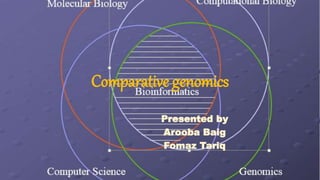
Comparative genomics
Presented by
Arooba Baig
Fomaz Tariq
Genomics
Genomics is an area within genetics that concerns the sequencing and analysis of an
organism’s genome.
Development and application of genetic mapping, sequencing, and computation
(bioinformatics) to analyze the genomes of organisms.
Sub-fields of genomics:
Structural genomics-genetic and physical mapping of genomes.
Functional genomics-analysis of gene function (and non-genes).
Comparative genomics-comparison of genomes across species.
 Includes structural and functional genomics.
 Evolutionary genomics.
Comparative genomics
Comparative genomics is an exciting field of biological research in which
researchers use a variety of tools, including computer-based analysis, to
compare the complete genome sequences of different species
A comparison of gene numbers, gene locations & biological functions of
gene, in the genomes of different organisms, one objective being to
identify groups of genes that play a unique biological role in a particular
organism.
History
• Comparative genomics has a root in the comparison of virus genomes in
the early 1980s.
• For example, small RNA viruses infecting animals (picorna viruses) and
those infecting plants ( cowpea mosaic virus) were compared and turned
out to share significant sequence similarity and, in part, the order of their
genes.
• In 1986, the first comparative genomic study at a larger scale was
published, comparing the genomes of varicella-zoster virus and Epstein-
Barr virus that contained more than 100 genes each
Contd..
• The first complete genome sequence of a cellular organism, that of
Haemophilus influenzae Rd, was published in 1995.
• The second genome sequencing paper was of the small parasitic
bacterium Mycoplasma genitalium published in the same year.
• Saccharomyces cerevisiae, the baker's yeast, was the first eukaryote
to have its complete genome sequence published in 1996.
• After the publication of the roundworm Caenorhabditis elegans genome
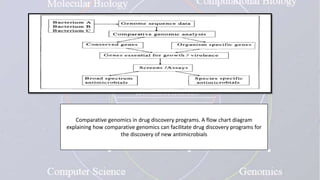
in 1998, and together with the fruit fly Drosophila melanogaster genome
in 2000, Gerald M. Rubin and his team published a paper titled
"Comparative Genomics of the Eukaryotes“.
• In which they compared the genomes of the eukaryotes D. melanogaster,
C. elegans, and S. cerevisiae, as well as the prokaryote H. influenza .
Related Terminologies
• Homology is the relationship of any two characters (such as two proteins that have similar
sequences) that have descended, usually through divergence, from a common ancestral
character
• Homologues Homologues can either be orthologues, paralogues
• Orthologues are homologues that have evolved from a common ancestral gene by
speciation. They usually have similar function
• Paralogues are homologues that are related or produced by duplication within a
genome. They often have evolved to perform different functions
Comparative Genomics Tools
Similarity search programs
• BLAST2 (Basic Local Alignment Search Tool)
• FASTA
• MUMmer (Maximal Unique Match) (Comparisons and analyses at both
Nucleic acid and protein level)
Other alignment programs
• DBA [DNA Block Aligner]
• Blastz
• BLAT/AVID, – WABA [Wobble Aware Bulk Aligner]
• DIALIGN [Diagonal ALIGNment]
• SSAHA [Sequence Search and Alignment by Hashing Algorithm]
Contd..
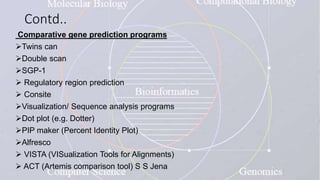
Comparative gene prediction programs
Twins can
Double scan
SGP-1
 Regulatory region prediction
 Consite
Visualization/ Sequence analysis programs
Dot plot (e.g. Dotter)
PIP maker (Percent Identity Plot)
Alfresco
 VISTA (VISualization Tools for Alignments)
 ACT (Artemis comparison tool) S S Jena
Comparative Genomics Tool
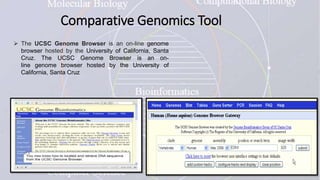
 The UCSC Genome Browser is an on-line genome
browser hosted by the University of California, Santa
Cruz. The UCSC Genome Browser is an on-
line genome browser hosted by the University of
California, Santa Cruz
Synteny Regions
Synteny Regions of two genomes that show considerable similarity in
terms of sequence and conservation of the order of genes.
Genes that are in the same relative position on two different
chromosomes.
Closely related species generally have similar order of genes on
chromosomes.
Synteny can be used to identify genes in one species based on map-
position in another
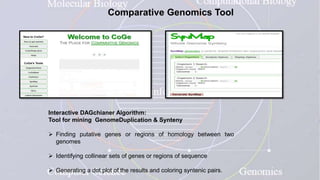
Interactive DAGchianer Algorithm:
Tool for mining GenomeDuplication & Synteny
 Finding putative genes or regions of homology between two
genomes
 Identifying collinear sets of genes or regions of sequence
 Generating a dot plot of the results and coloring syntenic pairs.
Comparative Genomics Tool
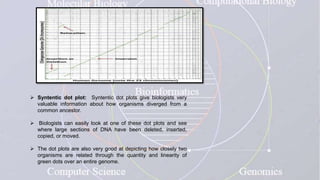
 Syntentic dot plot: Syntentic dot plots give biologists very
valuable information about how organisms diverged from a
common ancestor.
 Biologists can easily look at one of these dot plots and see
where large sections of DNA have been deleted, inserted,
copied, or moved.
 The dot plots are also very good at depicting how closely two
organisms are related through the quantity and linearity of
green dots over an entire genome.
Sequence Similarity Search
The most frequently performed type of sequence comparison is the
sequence similarity search
 Sequence comparisons that implicate function are widely used:
 To determine if newly sequenced cDNA or genomic region encodes gene
of known function.
 Search for similar sequence in other species (or in same species)
Contd..
 Search databases of DNA sequences
 Use computer algorithms to align sequences
 Don’t require perfect matches between sequences
 Most commonly used algorithms:
 BLAST
 FAST-A Homology searches
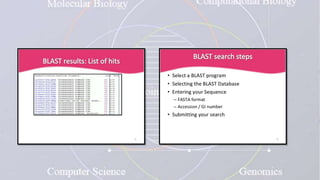
BLAST
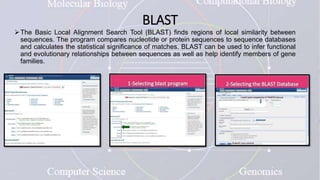
The Basic Local Alignment Search Tool (BLAST) finds regions of local similarity between
sequences. The program compares nucleotide or protein sequences to sequence databases
and calculates the statistical significance of matches. BLAST can be used to infer functional
and evolutionary relationships between sequences as well as help identify members of gene
families.
General Databases Useful for Comparative
Genomics
• Locus Link/Ref Seq:
http://www.ncbi.nih.gov/LocusLink/
• PEDANT-Protein Extraction Description Analysis Tool
http://pedant.gsf.de
• COGs - Cluster of Orthologous Groups (of proteins)
http://www.ncbi.nih.gov/COG/
• KEGG- Kyoto Encyclopedia of Genes and Genomes
http://www.genome.ad.jp/kegg/
• MBGD - Microbial Genome Database
http://mbgd.genome.ad.jp/
• GOLD - Genome Online Database
http://wit.integratedgenomics.com/GOLD/
• TIGR – The Institute of Genome Research
Comparative genomics of Parasites
Comparative genomic process
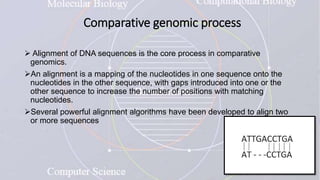
 Alignment of DNA sequences is the core process in comparative
genomics.
An alignment is a mapping of the nucleotides in one sequence onto the
nucleotides in the other sequence, with gaps introduced into one or the
other sequence to increase the number of positions with matching
nucleotides.
Several powerful alignment algorithms have been developed to align two
or more sequences
Methods for comparative genomics
• Comparative analysis of genome structure
• Comparative analysis of coding regions (exon)
• Comparative analysis of non-coding regions (introns)
Comparative analysis of genome structure
Analysis of the global structure of genomes, such as nucleotide
composition, syntenic relationships, and gene ordering offer insight into the
similarities and differences between genomes.
This provide information on the organization and evolution of the
genomes, and highlight the unique features of individual genomes
The structure of different genomes can be compared at three levels:
• Overall nucleotide statistics,
• Genome structure at DNA level
• Genome structure at gene level.
Comparison of genome structure at DNA level
Chromosomal breakage and exchange of chromosomal fragments are
common mode of gene evolution. They can be studied by comparing
genome structures at DNA level.
• Identification of conserved Synteny and genome rearrangement events
• Analysis of breakpoints
• Analysis of content and distribution of DNA repeats
Comparison of genome structure at gene level
Chromosomal breakage and exchange of chromosomal fragments
cause disruption of gene order
Therefore gene order correlates with evolutionary distance between
genomes
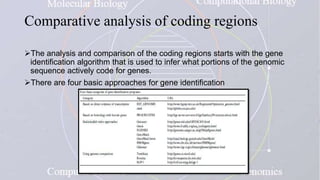
Comparative analysis of coding regions
The analysis and comparison of the coding regions starts with the gene
identification algorithm that is used to infer what portions of the genomic
sequence actively code for genes.
There are four basic approaches for gene identification
Comparative analysis of coding regions
25
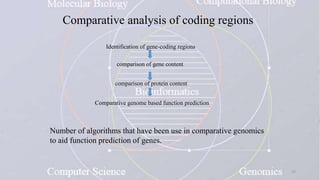
Number of algorithms that have been use in comparative genomics
to aid function prediction of genes.
Identification of gene-coding regions
comparison of gene content
comparison of protein content
Comparative genome based function prediction
Comparison of gene content
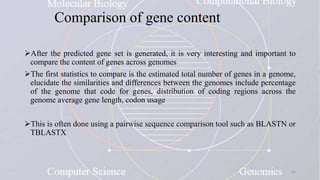
After the predicted gene set is generated, it is very interesting and important to
compare the content of genes across genomes
The first statistics to compare is the estimated total number of genes in a genome,
elucidate the similarities and differences between the genomes include percentage
of the genome that code for genes, distribution of coding regions across the
genome average gene length, codon usage
This is often done using a pairwise sequence comparison tool such as BLASTN or
TBLASTX
26
Comparison of protein content
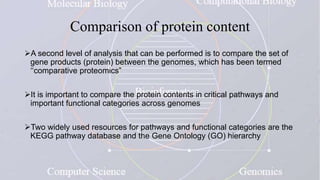
A second level of analysis that can be performed is to compare the set of
gene products (protein) between the genomes, which has been termed
‘‘comparative proteomics”
It is important to compare the protein contents in critical pathways and
important functional categories across genomes
Two widely used resources for pathways and functional categories are the
KEGG pathway database and the Gene Ontology (GO) hierarchy
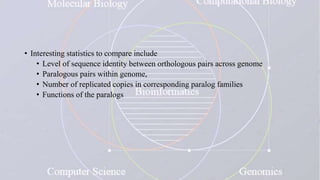
• Interesting statistics to compare include
• Level of sequence identity between orthologous pairs across genome
• Paralogous pairs within genome,
• Number of replicated copies in corresponding paralog families
• Functions of the paralogs
Comparative analysis of noncoding regions
Noncoding regions of the genome gained a lot of attention in recent years
because of its predicted role in regulation of transcription, DNA replication,
and other biological functions
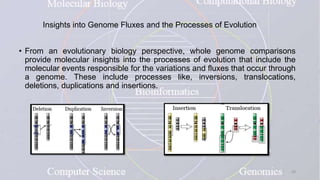
Insights into Genome Fluxes and the Processes of Evolution
• From an evolutionary biology perspective, whole genome comparisons
provide molecular insights into the processes of evolution that include the
molecular events responsible for the variations and fluxes that occur through
a genome. These include processes like, inversions, translocations,
deletions, duplications and insertions.
30
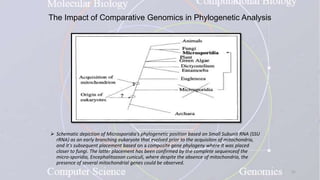
The Impact of Comparative Genomics in Phylogenetic Analysis
 Schematic depiction of Microsporidia's phylogenetic position based on Small Subunit RNA (SSU
rRNA) as an early branching eukaryote that evolved prior to the acquisiton of mitochondria,
and it's subsequent placement based on a composite gene phylogeny where it was placed
closer to fungi. The latter placement has been confirmed by the complete sequenceof the
micro-sporidia, Encephalitozoon cuniculi, where despite the absence of mitochondria, the
presence of several mitochondrial genes could be observed.
31
Contd…
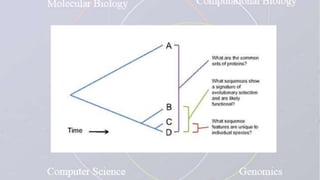
We have learned from homologous sequence alignment that the information that
can be gained by comparing two genomes together is largely dependent upon
the phylogenetic distance between them.
Phylogenetic distance is a measure of the degree of separation between two
organisms or their genomes on an evolutionary scale, usually expressed as the
number of accumulated sequence changes, number of years, or number of
generations.
The more distantly related two organisms are, the less sequence similarity or
shared genomic features will be detected between them.
 Thus, only general insights about classes of shared genes can be gathered by
genomic comparisons at very long phylogenetic distances (e.g., over one billion
years since their separation). Over such very large distances, the order of genes
and the signatures of sequences that regulate their transcription are rarely
conserved
How Are Genomes Compared?
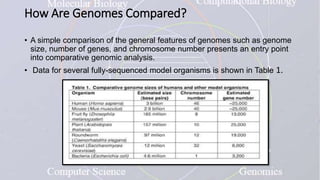
• A simple comparison of the general features of genomes such as genome
size, number of genes, and chromosome number presents an entry point
into comparative genomic analysis.
• Data for several fully-sequenced model organisms is shown in Table 1.
Contd…
• For example, while the tiny flowering plant Arabidopsis thaliana has a
smaller genome than that of the fruit fly Drosophila melanogaster
(157 million base pairs v. 165 million base pairs, respectively)
• It possesses nearly twice as many genes (25,000 v. 13,000).
• In fact A. thaliana has approximately the same number of genes as
humans (~25,000).
• Thus, a very early lesson learned in the "genomic era" is that genome
size does not correlate with evolutionary status, nor is the number of
genes proportionate to genome size.
Contd..
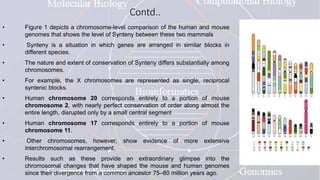
• Figure 1 depicts a chromosome-level comparison of the human and mouse
genomes that shows the level of Synteny between these two mammals
• Synteny is a situation in which genes are arranged in similar blocks in
different species.
• The nature and extent of conservation of Synteny differs substantially among
chromosomes.
• For example, the X chromosomes are represented as single, reciprocal
syntenic blocks.
• Human chromosome 20 corresponds entirely to a portion of mouse
chromosome 2, with nearly perfect conservation of order along almost the
entire length, disrupted only by a small central segment
• Human chromosome 17 corresponds entirely to a portion of mouse
chromosome 11.
• Other chromosomes, however, show evidence of more extensive
interchromosomal rearrangement.
• Results such as these provide an extraordinary glimpse into the
chromosomal changes that have shaped the mouse and human genomes
since their divergence from a common ancestor 75–80 million years ago.
Comparing Human, Chimp, and Mouse Genomes
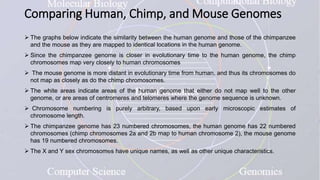
 The graphs below indicate the similarity between the human genome and those of the chimpanzee
and the mouse as they are mapped to identical locations in the human genome.
 Since the chimpanzee genome is closer in evolutionary time to the human genome, the chimp
chromosomes map very closely to human chromosomes
 The mouse genome is more distant in evolutionary time from human, and thus its chromosomes do
not map as closely as do the chimp chromosomes.
 The white areas indicate areas of the human genome that either do not map well to the other
genome, or are areas of centromeres and telomeres where the genome sequence is unknown.
 Chromosome numbering is purely arbitrary, based upon early microscopic estimates of
chromosome length.
 The chimpanzee genome has 23 numbered chromosomes, the human genome has 22 numbered
chromosomes (chimp chromosomes 2a and 2b map to human chromosome 2), the mouse genome
has 19 numbered chromosomes.
 The X and Y sex chromosomes have unique names, as well as other unique characteristics.
Mouse genome mapped
on the human genome
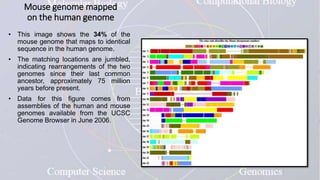
• This image shows the 34% of the
mouse genome that maps to identical
sequence in the human genome.
• The matching locations are jumbled,
indicating rearrangements of the two
genomes since their last common
ancestor, approximately 75 million
years before present.
• Data for this figure comes from
assemblies of the human and mouse
genomes available from the UCSC
Genome Browser in June 2006.
Chimpanzee genome mapped on the human
genome
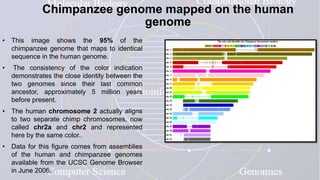
• This image shows the 95% of the
chimpanzee genome that maps to identical
sequence in the human genome.
• The consistency of the color indication
demonstrates the close identity between the
two genomes since their last common
ancestor, approximately 5 million years
before present.
• The human chromosome 2 actually aligns
to two separate chimp chromosomes, now
called chr2a and chr2 and represented
here by the same color..
• Data for this figure comes from assemblies
of the human and chimpanzee genomes
available from the UCSC Genome Browser
in June 2006.
Benefits of comparative genomics
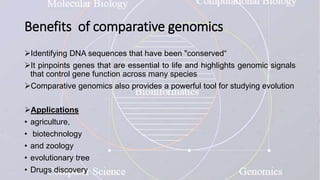
Identifying DNA sequences that have been "conserved“
It pinpoints genes that are essential to life and highlights genomic signals
that control gene function across many species
Comparative genomics also provides a powerful tool for studying evolution
Applications
• agriculture,
• biotechnology
• and zoology
• evolutionary tree
• Drugs discovery
Comparative Genomics in Drug Discovery
Comparative genomic studies throw important light on the
pathogenesis of organisms, throwing up opportunities for
therapeutic intervention as well as help in understanding and
identifying disease genes
One of the most important fallouts of comparative analyses at a
genome-wide scale is in the ability to identify and develop novel
drug targets
Comparative genomics in drug discovery programs. A flow chart diagram
explaining how comparative genomics can facilitate drug discovery programs for
the discovery of new antimicrobials
References
1. http://www.slideshare.net/naripati/comparative-genomics-45921801
2. http://www.genome.gov/11509542
3. http://lib.dr.iastate.edu/cgi/viewcontent.cgi?article=3150&context=etd
4. http://www.ncbi.nlm.nih.gov/pmc/articles/PMC1891719/
5. http://www.powershow.com/view1/1fa4ca-
ZDc1Z/UCSC_Genome_Browser_Tutorial_powerpoint_ppt_presentation
6. http://www.dcode.org/
7. http://blast.ncbi.nlm.nih.gov/Blast.cgi
8. http://www.proteinstructures.com/Sequence/Sequence/sequence-
alignment.html
9. https://www.dnalc.org/view/1241-Breakpoints.html
genomic comparison

genomic comparison

  • 1.
  • 2.
    Genomics Genomics is anarea within genetics that concerns the sequencing and analysis of an organism’s genome. Development and application of genetic mapping, sequencing, and computation (bioinformatics) to analyze the genomes of organisms. Sub-fields of genomics: Structural genomics-genetic and physical mapping of genomes. Functional genomics-analysis of gene function (and non-genes). Comparative genomics-comparison of genomes across species.  Includes structural and functional genomics.  Evolutionary genomics.
  • 3.
    Comparative genomics Comparative genomicsis an exciting field of biological research in which researchers use a variety of tools, including computer-based analysis, to compare the complete genome sequences of different species A comparison of gene numbers, gene locations & biological functions of gene, in the genomes of different organisms, one objective being to identify groups of genes that play a unique biological role in a particular organism.
  • 4.
    History • Comparative genomicshas a root in the comparison of virus genomes in the early 1980s. • For example, small RNA viruses infecting animals (picorna viruses) and those infecting plants ( cowpea mosaic virus) were compared and turned out to share significant sequence similarity and, in part, the order of their genes. • In 1986, the first comparative genomic study at a larger scale was published, comparing the genomes of varicella-zoster virus and Epstein- Barr virus that contained more than 100 genes each
  • 5.
    Contd.. • The firstcomplete genome sequence of a cellular organism, that of Haemophilus influenzae Rd, was published in 1995. • The second genome sequencing paper was of the small parasitic bacterium Mycoplasma genitalium published in the same year. • Saccharomyces cerevisiae, the baker's yeast, was the first eukaryote to have its complete genome sequence published in 1996. • After the publication of the roundworm Caenorhabditis elegans genome in 1998, and together with the fruit fly Drosophila melanogaster genome in 2000, Gerald M. Rubin and his team published a paper titled "Comparative Genomics of the Eukaryotes“. • In which they compared the genomes of the eukaryotes D. melanogaster, C. elegans, and S. cerevisiae, as well as the prokaryote H. influenza .
  • 6.
    Related Terminologies • Homologyis the relationship of any two characters (such as two proteins that have similar sequences) that have descended, usually through divergence, from a common ancestral character • Homologues Homologues can either be orthologues, paralogues • Orthologues are homologues that have evolved from a common ancestral gene by speciation. They usually have similar function • Paralogues are homologues that are related or produced by duplication within a genome. They often have evolved to perform different functions
  • 7.
    Comparative Genomics Tools Similaritysearch programs • BLAST2 (Basic Local Alignment Search Tool) • FASTA • MUMmer (Maximal Unique Match) (Comparisons and analyses at both Nucleic acid and protein level) Other alignment programs • DBA [DNA Block Aligner] • Blastz • BLAT/AVID, – WABA [Wobble Aware Bulk Aligner] • DIALIGN [Diagonal ALIGNment] • SSAHA [Sequence Search and Alignment by Hashing Algorithm]
  • 8.
    Contd.. Comparative gene predictionprograms Twins can Double scan SGP-1  Regulatory region prediction  Consite Visualization/ Sequence analysis programs Dot plot (e.g. Dotter) PIP maker (Percent Identity Plot) Alfresco  VISTA (VISualization Tools for Alignments)  ACT (Artemis comparison tool) S S Jena
  • 9.
    Comparative Genomics Tool The UCSC Genome Browser is an on-line genome browser hosted by the University of California, Santa Cruz. The UCSC Genome Browser is an on- line genome browser hosted by the University of California, Santa Cruz
  • 10.
    Synteny Regions Synteny Regionsof two genomes that show considerable similarity in terms of sequence and conservation of the order of genes. Genes that are in the same relative position on two different chromosomes. Closely related species generally have similar order of genes on chromosomes. Synteny can be used to identify genes in one species based on map- position in another
  • 11.
    Interactive DAGchianer Algorithm: Toolfor mining GenomeDuplication & Synteny  Finding putative genes or regions of homology between two genomes  Identifying collinear sets of genes or regions of sequence  Generating a dot plot of the results and coloring syntenic pairs. Comparative Genomics Tool
  • 13.
     Syntentic dotplot: Syntentic dot plots give biologists very valuable information about how organisms diverged from a common ancestor.  Biologists can easily look at one of these dot plots and see where large sections of DNA have been deleted, inserted, copied, or moved.  The dot plots are also very good at depicting how closely two organisms are related through the quantity and linearity of green dots over an entire genome.
  • 14.
    Sequence Similarity Search Themost frequently performed type of sequence comparison is the sequence similarity search  Sequence comparisons that implicate function are widely used:  To determine if newly sequenced cDNA or genomic region encodes gene of known function.  Search for similar sequence in other species (or in same species)
  • 15.
    Contd..  Search databasesof DNA sequences  Use computer algorithms to align sequences  Don’t require perfect matches between sequences  Most commonly used algorithms:  BLAST  FAST-A Homology searches
  • 16.
    BLAST The Basic LocalAlignment Search Tool (BLAST) finds regions of local similarity between sequences. The program compares nucleotide or protein sequences to sequence databases and calculates the statistical significance of matches. BLAST can be used to infer functional and evolutionary relationships between sequences as well as help identify members of gene families.
  • 18.
    General Databases Usefulfor Comparative Genomics • Locus Link/Ref Seq: http://www.ncbi.nih.gov/LocusLink/ • PEDANT-Protein Extraction Description Analysis Tool http://pedant.gsf.de • COGs - Cluster of Orthologous Groups (of proteins) http://www.ncbi.nih.gov/COG/ • KEGG- Kyoto Encyclopedia of Genes and Genomes http://www.genome.ad.jp/kegg/ • MBGD - Microbial Genome Database http://mbgd.genome.ad.jp/ • GOLD - Genome Online Database http://wit.integratedgenomics.com/GOLD/ • TIGR – The Institute of Genome Research Comparative genomics of Parasites
  • 19.
    Comparative genomic process Alignment of DNA sequences is the core process in comparative genomics. An alignment is a mapping of the nucleotides in one sequence onto the nucleotides in the other sequence, with gaps introduced into one or the other sequence to increase the number of positions with matching nucleotides. Several powerful alignment algorithms have been developed to align two or more sequences
  • 20.
    Methods for comparativegenomics • Comparative analysis of genome structure • Comparative analysis of coding regions (exon) • Comparative analysis of non-coding regions (introns)
  • 21.
    Comparative analysis ofgenome structure Analysis of the global structure of genomes, such as nucleotide composition, syntenic relationships, and gene ordering offer insight into the similarities and differences between genomes. This provide information on the organization and evolution of the genomes, and highlight the unique features of individual genomes The structure of different genomes can be compared at three levels: • Overall nucleotide statistics, • Genome structure at DNA level • Genome structure at gene level.
  • 22.
    Comparison of genomestructure at DNA level Chromosomal breakage and exchange of chromosomal fragments are common mode of gene evolution. They can be studied by comparing genome structures at DNA level. • Identification of conserved Synteny and genome rearrangement events • Analysis of breakpoints • Analysis of content and distribution of DNA repeats
  • 23.
    Comparison of genomestructure at gene level Chromosomal breakage and exchange of chromosomal fragments cause disruption of gene order Therefore gene order correlates with evolutionary distance between genomes
  • 24.
    Comparative analysis ofcoding regions The analysis and comparison of the coding regions starts with the gene identification algorithm that is used to infer what portions of the genomic sequence actively code for genes. There are four basic approaches for gene identification
  • 25.
    Comparative analysis ofcoding regions 25 Number of algorithms that have been use in comparative genomics to aid function prediction of genes. Identification of gene-coding regions comparison of gene content comparison of protein content Comparative genome based function prediction
  • 26.
    Comparison of genecontent After the predicted gene set is generated, it is very interesting and important to compare the content of genes across genomes The first statistics to compare is the estimated total number of genes in a genome, elucidate the similarities and differences between the genomes include percentage of the genome that code for genes, distribution of coding regions across the genome average gene length, codon usage This is often done using a pairwise sequence comparison tool such as BLASTN or TBLASTX 26
  • 27.
    Comparison of proteincontent A second level of analysis that can be performed is to compare the set of gene products (protein) between the genomes, which has been termed ‘‘comparative proteomics” It is important to compare the protein contents in critical pathways and important functional categories across genomes Two widely used resources for pathways and functional categories are the KEGG pathway database and the Gene Ontology (GO) hierarchy
  • 28.
    • Interesting statisticsto compare include • Level of sequence identity between orthologous pairs across genome • Paralogous pairs within genome, • Number of replicated copies in corresponding paralog families • Functions of the paralogs
  • 29.
    Comparative analysis ofnoncoding regions Noncoding regions of the genome gained a lot of attention in recent years because of its predicted role in regulation of transcription, DNA replication, and other biological functions
  • 30.
    Insights into GenomeFluxes and the Processes of Evolution • From an evolutionary biology perspective, whole genome comparisons provide molecular insights into the processes of evolution that include the molecular events responsible for the variations and fluxes that occur through a genome. These include processes like, inversions, translocations, deletions, duplications and insertions. 30
  • 31.
    The Impact ofComparative Genomics in Phylogenetic Analysis  Schematic depiction of Microsporidia's phylogenetic position based on Small Subunit RNA (SSU rRNA) as an early branching eukaryote that evolved prior to the acquisiton of mitochondria, and it's subsequent placement based on a composite gene phylogeny where it was placed closer to fungi. The latter placement has been confirmed by the complete sequenceof the micro-sporidia, Encephalitozoon cuniculi, where despite the absence of mitochondria, the presence of several mitochondrial genes could be observed. 31
  • 33.
    Contd… We have learnedfrom homologous sequence alignment that the information that can be gained by comparing two genomes together is largely dependent upon the phylogenetic distance between them. Phylogenetic distance is a measure of the degree of separation between two organisms or their genomes on an evolutionary scale, usually expressed as the number of accumulated sequence changes, number of years, or number of generations. The more distantly related two organisms are, the less sequence similarity or shared genomic features will be detected between them.  Thus, only general insights about classes of shared genes can be gathered by genomic comparisons at very long phylogenetic distances (e.g., over one billion years since their separation). Over such very large distances, the order of genes and the signatures of sequences that regulate their transcription are rarely conserved
  • 34.
    How Are GenomesCompared? • A simple comparison of the general features of genomes such as genome size, number of genes, and chromosome number presents an entry point into comparative genomic analysis. • Data for several fully-sequenced model organisms is shown in Table 1.
  • 35.
    Contd… • For example,while the tiny flowering plant Arabidopsis thaliana has a smaller genome than that of the fruit fly Drosophila melanogaster (157 million base pairs v. 165 million base pairs, respectively) • It possesses nearly twice as many genes (25,000 v. 13,000). • In fact A. thaliana has approximately the same number of genes as humans (~25,000). • Thus, a very early lesson learned in the "genomic era" is that genome size does not correlate with evolutionary status, nor is the number of genes proportionate to genome size.
  • 36.
    Contd.. • Figure 1depicts a chromosome-level comparison of the human and mouse genomes that shows the level of Synteny between these two mammals • Synteny is a situation in which genes are arranged in similar blocks in different species. • The nature and extent of conservation of Synteny differs substantially among chromosomes. • For example, the X chromosomes are represented as single, reciprocal syntenic blocks. • Human chromosome 20 corresponds entirely to a portion of mouse chromosome 2, with nearly perfect conservation of order along almost the entire length, disrupted only by a small central segment • Human chromosome 17 corresponds entirely to a portion of mouse chromosome 11. • Other chromosomes, however, show evidence of more extensive interchromosomal rearrangement. • Results such as these provide an extraordinary glimpse into the chromosomal changes that have shaped the mouse and human genomes since their divergence from a common ancestor 75–80 million years ago.
  • 37.
    Comparing Human, Chimp,and Mouse Genomes  The graphs below indicate the similarity between the human genome and those of the chimpanzee and the mouse as they are mapped to identical locations in the human genome.  Since the chimpanzee genome is closer in evolutionary time to the human genome, the chimp chromosomes map very closely to human chromosomes  The mouse genome is more distant in evolutionary time from human, and thus its chromosomes do not map as closely as do the chimp chromosomes.  The white areas indicate areas of the human genome that either do not map well to the other genome, or are areas of centromeres and telomeres where the genome sequence is unknown.  Chromosome numbering is purely arbitrary, based upon early microscopic estimates of chromosome length.  The chimpanzee genome has 23 numbered chromosomes, the human genome has 22 numbered chromosomes (chimp chromosomes 2a and 2b map to human chromosome 2), the mouse genome has 19 numbered chromosomes.  The X and Y sex chromosomes have unique names, as well as other unique characteristics.
  • 38.
    Mouse genome mapped onthe human genome • This image shows the 34% of the mouse genome that maps to identical sequence in the human genome. • The matching locations are jumbled, indicating rearrangements of the two genomes since their last common ancestor, approximately 75 million years before present. • Data for this figure comes from assemblies of the human and mouse genomes available from the UCSC Genome Browser in June 2006.
  • 39.
    Chimpanzee genome mappedon the human genome • This image shows the 95% of the chimpanzee genome that maps to identical sequence in the human genome. • The consistency of the color indication demonstrates the close identity between the two genomes since their last common ancestor, approximately 5 million years before present. • The human chromosome 2 actually aligns to two separate chimp chromosomes, now called chr2a and chr2 and represented here by the same color.. • Data for this figure comes from assemblies of the human and chimpanzee genomes available from the UCSC Genome Browser in June 2006.
  • 40.
    Benefits of comparativegenomics Identifying DNA sequences that have been "conserved“ It pinpoints genes that are essential to life and highlights genomic signals that control gene function across many species Comparative genomics also provides a powerful tool for studying evolution Applications • agriculture, • biotechnology • and zoology • evolutionary tree • Drugs discovery
  • 41.
    Comparative Genomics inDrug Discovery Comparative genomic studies throw important light on the pathogenesis of organisms, throwing up opportunities for therapeutic intervention as well as help in understanding and identifying disease genes One of the most important fallouts of comparative analyses at a genome-wide scale is in the ability to identify and develop novel drug targets
  • 42.
    Comparative genomics indrug discovery programs. A flow chart diagram explaining how comparative genomics can facilitate drug discovery programs for the discovery of new antimicrobials
  • 43.
    References 1. http://www.slideshare.net/naripati/comparative-genomics-45921801 2. http://www.genome.gov/11509542 3.http://lib.dr.iastate.edu/cgi/viewcontent.cgi?article=3150&context=etd 4. http://www.ncbi.nlm.nih.gov/pmc/articles/PMC1891719/ 5. http://www.powershow.com/view1/1fa4ca- ZDc1Z/UCSC_Genome_Browser_Tutorial_powerpoint_ppt_presentation 6. http://www.dcode.org/ 7. http://blast.ncbi.nlm.nih.gov/Blast.cgi 8. http://www.proteinstructures.com/Sequence/Sequence/sequence- alignment.html 9. https://www.dnalc.org/view/1241-Breakpoints.html

Editor's Notes

  • #8 The Basic Local Alignment Search Tool (BLAST) finds regions of local similarity between sequences. The program compares nucleotide or protein sequences to sequence databases and calculates the statistical significance of matches. BLAST can be used to infer functional and evolutionary relationships between sequences as well as help identify members of gene families.
  • #10 The UCSC Genome Browser is an on-line genome browser.  It is an interactive website offering access to genome sequence data from a variety of vertebrate and invertebrate species and major model organisms, integrated with a large collection of aligned annotations.
  • #22 e Statistics main menu option allows you to calculate Nucleotide Composition, Nucleotide Pair Frequencies and Codon
  • #34 The distances are often placed on phylogenetic trees, which show the deduced relationships among the organisms
  • #42 no active moiety that hIf one is looking for antibacterial, antifungal, or antiprotozoal proteins to be used as targets, comparative genome analysis can reveal virulence genes, uncharacterized essential genes, species-specific genes, organism-specific genes, while ensuring that the chosen genes have no homologues in humans as been approved by the FDA in any other application