Introduction to Proteomics
Guided By,
Dr C Amruthavalli
Invited Faculty
University of Mysore
Presented By,
SHRYLI K S
YMB17118
IX Semester
UNIVERSITY OF MYSORE
Yuvaraja’s College (Autonomous)
Mysuru- 570 005
Major seminar presented in partial fulfilment of the
requirement of the Award of
M.Sc. in Molecular Biology (5- Year Integrated Course)
Department of Molecular Biology
Yuvaraja’s College (Autonomous)
(A CONSTITUENT AUTONOMOUS COLLEGE OF THE
UNIVERSITY OF MYSORE)
Mysore – 570 005
7th January 2022
06-04-2022 Introduction to Proteomics_Shryli K S 1
Contents
• Introduction
• History
• Objective
• How are the proteins studied?
 Protein detection with antibodies
 Antibody-free protein detection
 High throughput protein profiling
• Protein Databases
• Journals
• Summary
• Conclusion
• References
• Acknowledgement
06-04-2022 Introduction to Proteomics_Shryli K S 2
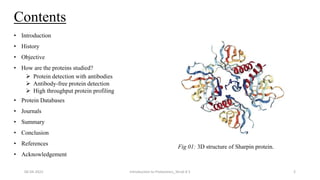
Fig 01: 3D structure of Sharpin protein.
An apple a day keeps the doctor away!
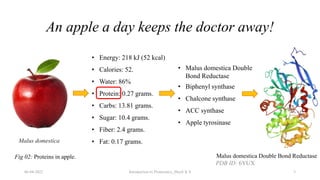
• Energy: 218 kJ (52 kcal)
• Calories: 52.
• Water: 86%
• Protein: 0.27 grams.
• Carbs: 13.81 grams.
• Sugar: 10.4 grams.
• Fiber: 2.4 grams.
• Fat: 0.17 grams.
Malus domestica
• Malus domestica Double
Bond Reductase
• Biphenyl synthase
• Chalcone synthase
• ACC synthase
• Apple tyrosinase
Malus domestica Double Bond Reductase
PDB ID: 6YUX
06-04-2022 Introduction to Proteomics_Shryli K S 3
Fig 02: Proteins in apple.
Introduction
06-04-2022 Introduction to Proteomics_Shryli K S 4
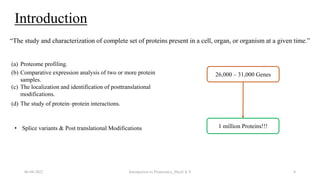
“The study and characterization of complete set of proteins present in a cell, organ, or organism at a given time.”
(a) Proteome profiling.
(b) Comparative expression analysis of two or more protein
samples.
(c) The localization and identification of posttranslational
modifications.
(d) The study of protein–protein interactions.
26,000 – 31,000 Genes
1 million Proteins!!!
• Splice variants & Post translational Modifications
History
06-04-2022 Introduction to Proteomics_Shryli K S 5
• 1975
• Escherichia coli (2-D Gel)
PROTEIN GENOME
+
PROTEOME
(1994)
Fig 03: E. coli
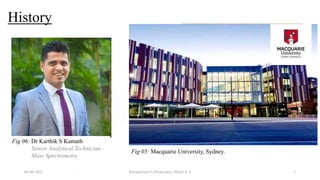
Fig 04: Prof. Marc Wilkins
Fig 05: Macquarie University, Sydney.
Fig 06: Dr Karthik S Kamath
Senior Analytical Technician -
Mass Spectrometry
Objectives of Proteomics
06-04-2022 Introduction to Proteomics_Shryli K S 6
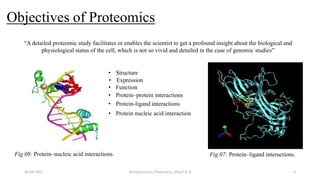
“A detailed proteomic study facilitates or enables the scientist to get a profound insight about the biological and
physiological status of the cell, which is not so vivid and detailed in the case of genomic studies”
• Protein–protein interactions
• Protein-ligand interactions
Fig 07: Protein–ligand interactions.
Fig 08: Protein–nucleic acid interactions.
• Protein nucleic acid interaction
• Structure
• Expression
• Function
How are the Proteins Studied?
06-04-2022 Introduction to Proteomics_Shryli K S 7
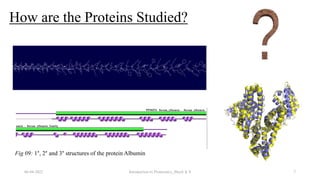
Fig 09: 1°, 2° and 3° structures of the protein Albumin
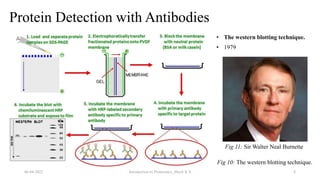
Protein Detection with Antibodies
06-04-2022 Introduction to Proteomics_Shryli K S 8
Fig 10: The western blotting technique.
• The western blotting technique.
• 1979
Fig 11: Sir Walter Neal Burnette
06-04-2022 Introduction to Proteomics_Shryli K S 9
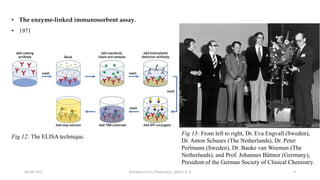
• The enzyme-linked immunosorbent assay.
Fig 13: From left to right, Dr. Eva Engvall (Sweden),
Dr. Anton Schuurs (The Netherlands), Dr. Peter
Perlmann (Sweden), Dr. Bauke van Weemen (The
Netherlands), and Prof. Johannes Büttner (Germany),
President of the German Society of Clinical Chemistry.
• 1971
Fig 12: The ELISA technique.
06-04-2022 Introduction to Proteomics_Shryli K S 10
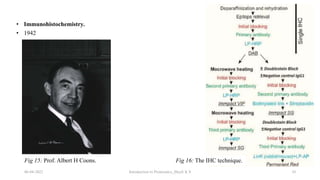
• Immunohistochemistry.
• 1942
Fig 15: Prof. Albert H Coons. Fig 16: The IHC technique.
06-04-2022 Introduction to Proteomics_Shryli K S 11
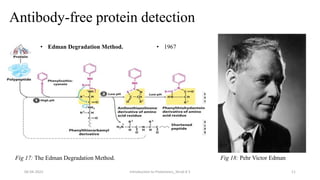
• Edman Degradation Method. • 1967
Fig 17: The Edman Degradation Method. Fig 18: Pehr Victor Edman
Antibody-free protein detection
06-04-2022 Introduction to Proteomics_Shryli K S 12
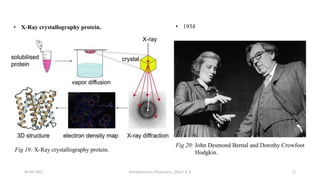
Fig 19: X-Ray crystallography protein.
• X-Ray crystallography protein. • 1934
Fig 20: John Desmond Bernal and Dorothy Crowfoot
Hodgkin.
06-04-2022 Introduction to Proteomics_Shryli K S 13
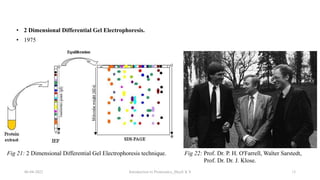
Fig 22: Prof. Dr. P. H. O'Farrell, Walter Sarstedt,
Prof. Dr. Dr. J. Klose.
• 1975
• 2 Dimensional Differential Gel Electrophoresis.
Fig 21: 2 Dimensional Differential Gel Electrophoresis technique.
06-04-2022 Introduction to Proteomics_Shryli K S 14
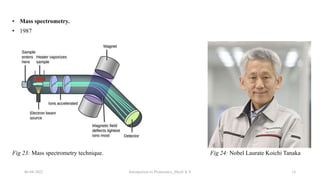
Fig 24: Nobel Laurate Koichi Tanaka
• 1987
• Mass spectrometry.
Fig 23: Mass spectrometry technique.
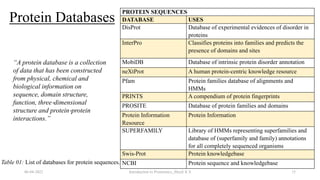
Protein Databases
06-04-2022 Introduction to Proteomics_Shryli K S 15
PROTEIN SEQUENCES
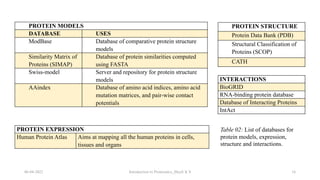
DATABASE USES
DisProt Database of experimental evidences of disorder in
proteins
InterPro Classifies proteins into families and predicts the
presence of domains and sites
MobiDB Database of intrinsic protein disorder annotation
neXtProt A human protein-centric knowledge resource
Pfam Protein families database of alignments and
HMMs
PRINTS A compendium of protein fingerprints
PROSITE Database of protein families and domains
Protein Information
Resource
Protein Information
SUPERFAMILY Library of HMMs representing superfamilies and
database of (superfamily and family) annotations
for all completely sequenced organisms
Swis-Prot Protein knowledgebase
NCBI Protein sequence and knowledgebase
Table 01: List of databases for protein sequences.
“A protein database is a collection
of data that has been constructed
from physical, chemical and
biological information on
sequence, domain structure,
function, three‐dimensional
structure and protein‐protein
interactions.”
06-04-2022 Introduction to Proteomics_Shryli K S 16
PROTEIN MODELS
DATABASE USES
ModBase Database of comparative protein structure
models
Similarity Matrix of
Proteins (SIMAP)
Database of protein similarities computed
using FASTA
Swiss-model Server and repository for protein structure
models
AAindex Database of amino acid indices, amino acid
mutation matrices, and pair-wise contact
potentials
PROTEIN EXPRESSION
Human Protein Atlas Aims at mapping all the human proteins in cells,
tissues and organs
PROTEIN STRUCTURE
Protein Data Bank (PDB)
Structural Classification of
Proteins (SCOP)
CATH
INTERACTIONS
BioGRID
RNA-binding protein database
Database of Interacting Proteins
IntAct
Table 02: List of databases for
protein models, expression,
structure and interactions.
06-04-2022 Introduction to Proteomics_Shryli K S 17
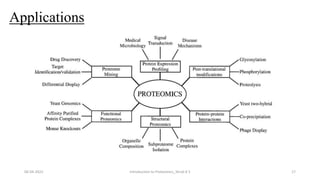
Applications
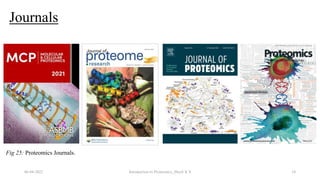
Journals
06-04-2022 Introduction to Proteomics_Shryli K S 18
Fig 25: Proteomics Journals.
Summary
06-04-2022 Introduction to Proteomics_Shryli K S 19
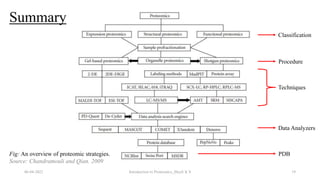
Classification
Procedure
Techniques
Data Analyzers
PDB
Fig: An overview of proteomic strategies.
Source: Chandramouli and Qian. 2009
Conclusion
06-04-2022 Introduction to Proteomics_Shryli K S 20
• 2021: David Julius and Ardem Patapoutian “for their discoveries of receptors for temperature and touch”.
• 2018 :James P. Allison and Tasuku Honjo “for their discovery of cancer therapy by inhibition of negative immune
regulation”
• 2016: Yoshinori Ohsumi “for his discoveries of mechanisms for autophagy”
• 2009: Elizabeth H. Blackburn, Carol W. Greider and Jack W. Szostak “for the discovery of how chromosomes are
protected by telomeres and the enzyme telomerase”
• 2004: Richard Axel and Linda B. Buck “for their discoveries of odorant receptors and the organization of the olfactory
system”
• 2003: Paul C. Lauterbur and Sir Peter Mansfield “for their discoveries concerning magnetic resonance imaging”
• 1992: Edmond H. Fischer and Edwin G. Krebs “for their discoveries concerning reversible protein phosphorylation as
a biological regulatory mechanism”
• 1988: Sir James W. Black, Gertrude B. Elion and George H. Hitchings “for their discoveries of important principles for
drug treatment”
References
06-04-2022 Introduction to Proteomics_Shryli K S 21
• Lynn B Jorde et.al. (2005), Encyclopedia of Genetics, Genomics, Proteomics and Bioinformatics, Wiley, 4046 pgs.
• Michael J. Dunn (2000), From Genome to Proteome: Advances in the Practice and Application of Proteomics, Wiley,551
ps.
• Aslam, B., Basit, M., Nisar, M. A., Khurshid, M., & Rasool, M. H. (2017). Proteomics: Technologies and their applications.
In Journal of Chromatographic Science (Vol. 55, Issue 2). https://doi.org/10.1093/chromsci/bmw167
• Chandramouli, K., & Qian, P.-Y. (2009). Proteomics: Challenges, Techniques and Possibilities to Overcome Biological
Sample Complexity. Human Genomics and Proteomics, 1(1). https://doi.org/10.4061/2009/239204
• Coon, J. J., Syka, J. E. P., Shabanowitz, J., & Hunt, D. F. (2005). Tandem mass spectrometry for peptide and protein
sequence analysis. In BioTechniques (Vol. 38, Issue 4). https://doi.org/10.2144/05384TE01
• Gonçalves-Maia, R. (2012). From X-rays to biomolecular structure: D. Hodgkin, R. Franklin and A. Yonath. Revista Virtual
de Quimica, 4(6). https://doi.org/10.5935/1984-6835.20120059
• Lequin, R. M. (2005). Enzyme immunoassay (EIA)/enzyme-linked immunosorbent assay (ELISA). Clinical Chemistry,
51(12). https://doi.org/10.1373/clinchem.2005.051532
06-04-2022 Introduction to Proteomics_Shryli K S 22
• Lundström, S. L., Zhang, B., Rutishauser, D., Aarsland, D., & Zubarev, R. A. (2017). SpotLight Proteomics: Uncovering
the hidden blood proteome improves diagnostic power of proteomics. Scientific Reports, 7.
https://doi.org/10.1038/srep41929
• Patterson, S. D., & Aebersold, R. H. (2003). Proteomics: The first decade and beyond. In Nature Genetics (Vol. 33, Issue
3S). https://doi.org/10.1038/ng1106
• Popescu, S. C., Popescu, G. v., Bachan, S., Zhang, Z., Seay, M., Gerstein, M., Snyder, M., & Dinesh-Kumar, S. P. (2007).
Differential binding of calmodulin-related proteins to their targets revealed through high-density Arabidopsis protein
microarrays. Proceedings of the National Academy of Sciences of the United States of America, 104(11).
https://doi.org/10.1073/pnas.0611615104
• Shah, T. R., & Misra, A. (2011). Proteomics. Challenges in Delivery of Therapeutic Genomics and Proteomics, 387–427.
https://doi.org/10.1016/B978-0-12-384964-9.00008-6
• Zhu, H., Bilgin, M., & Snyder, M. (2003). Proteomics. In Annual Review of Biochemistry (Vol. 72).
https://doi.org/10.1146/annurev.biochem.72.121801.161511
• Kwon M., Cho S.Y., Paik Y. (2005) Protein Databases. In: Encyclopedic Reference of Genomics and Proteomics in
Molecular Medicine. Springer, Berlin, Heidelberg . https://doi.org/10.1007/3-540-29623-9_3520
Acknowledgements
06-04-2022 Introduction to Proteomics_Shryli K S 23
I would like to thank the department of Molecular Biology for providing me
this opportunity to present my seminar, I thank my guide Dr C Amruthavalli
for her guidance. Thank you all for your patience.
06-04-2022 Introduction to Proteomics_Shryli K S 24
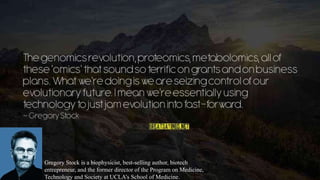
Gregory Stock is a biophysicist, best-selling author, biotech
entrepreneur, and the former director of the Program on Medicine,
Technology and Society at UCLA’s School of Medicine.
06-04-2022 Introduction to Proteomics_Shryli K S 25
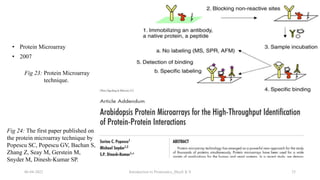
Fig 24: The first paper published on
the protein microarray technique by
Popescu SC, Popescu GV, Bachan S,
Zhang Z, Seay M, Gerstein M,
Snyder M, Dinesh‐Kumar SP.
• 2007
• Protein Microarray
Fig 23: Protein Microarray
technique.
06-04-2022 Introduction to Proteomics_Shryli K S 26
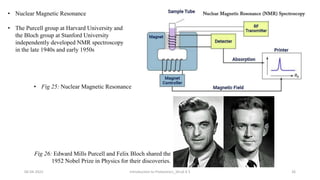
Fig 26: Edward Mills Purcell and Felix Bloch shared the
1952 Nobel Prize in Physics for their discoveries.
• The Purcell group at Harvard University and
the Bloch group at Stanford University
independently developed NMR spectroscopy
in the late 1940s and early 1950s
• Nuclear Magnetic Resonance
• Fig 25: Nuclear Magnetic Resonance

Introduction to proteomics

  • 1.
    Introduction to Proteomics GuidedBy, Dr C Amruthavalli Invited Faculty University of Mysore Presented By, SHRYLI K S YMB17118 IX Semester UNIVERSITY OF MYSORE Yuvaraja’s College (Autonomous) Mysuru- 570 005 Major seminar presented in partial fulfilment of the requirement of the Award of M.Sc. in Molecular Biology (5- Year Integrated Course) Department of Molecular Biology Yuvaraja’s College (Autonomous) (A CONSTITUENT AUTONOMOUS COLLEGE OF THE UNIVERSITY OF MYSORE) Mysore – 570 005 7th January 2022 06-04-2022 Introduction to Proteomics_Shryli K S 1
  • 2.
    Contents • Introduction • History •Objective • How are the proteins studied?  Protein detection with antibodies  Antibody-free protein detection  High throughput protein profiling • Protein Databases • Journals • Summary • Conclusion • References • Acknowledgement 06-04-2022 Introduction to Proteomics_Shryli K S 2 Fig 01: 3D structure of Sharpin protein.
  • 3.
    An apple aday keeps the doctor away! • Energy: 218 kJ (52 kcal) • Calories: 52. • Water: 86% • Protein: 0.27 grams. • Carbs: 13.81 grams. • Sugar: 10.4 grams. • Fiber: 2.4 grams. • Fat: 0.17 grams. Malus domestica • Malus domestica Double Bond Reductase • Biphenyl synthase • Chalcone synthase • ACC synthase • Apple tyrosinase Malus domestica Double Bond Reductase PDB ID: 6YUX 06-04-2022 Introduction to Proteomics_Shryli K S 3 Fig 02: Proteins in apple.
  • 4.
    Introduction 06-04-2022 Introduction toProteomics_Shryli K S 4 “The study and characterization of complete set of proteins present in a cell, organ, or organism at a given time.” (a) Proteome profiling. (b) Comparative expression analysis of two or more protein samples. (c) The localization and identification of posttranslational modifications. (d) The study of protein–protein interactions. 26,000 – 31,000 Genes 1 million Proteins!!! • Splice variants & Post translational Modifications
  • 5.
    History 06-04-2022 Introduction toProteomics_Shryli K S 5 • 1975 • Escherichia coli (2-D Gel) PROTEIN GENOME + PROTEOME (1994) Fig 03: E. coli Fig 04: Prof. Marc Wilkins Fig 05: Macquarie University, Sydney. Fig 06: Dr Karthik S Kamath Senior Analytical Technician - Mass Spectrometry
  • 6.
    Objectives of Proteomics 06-04-2022Introduction to Proteomics_Shryli K S 6 “A detailed proteomic study facilitates or enables the scientist to get a profound insight about the biological and physiological status of the cell, which is not so vivid and detailed in the case of genomic studies” • Protein–protein interactions • Protein-ligand interactions Fig 07: Protein–ligand interactions. Fig 08: Protein–nucleic acid interactions. • Protein nucleic acid interaction • Structure • Expression • Function
  • 7.
    How are theProteins Studied? 06-04-2022 Introduction to Proteomics_Shryli K S 7 Fig 09: 1°, 2° and 3° structures of the protein Albumin
  • 8.
    Protein Detection withAntibodies 06-04-2022 Introduction to Proteomics_Shryli K S 8 Fig 10: The western blotting technique. • The western blotting technique. • 1979 Fig 11: Sir Walter Neal Burnette
  • 9.
    06-04-2022 Introduction toProteomics_Shryli K S 9 • The enzyme-linked immunosorbent assay. Fig 13: From left to right, Dr. Eva Engvall (Sweden), Dr. Anton Schuurs (The Netherlands), Dr. Peter Perlmann (Sweden), Dr. Bauke van Weemen (The Netherlands), and Prof. Johannes Büttner (Germany), President of the German Society of Clinical Chemistry. • 1971 Fig 12: The ELISA technique.
  • 10.
    06-04-2022 Introduction toProteomics_Shryli K S 10 • Immunohistochemistry. • 1942 Fig 15: Prof. Albert H Coons. Fig 16: The IHC technique.
  • 11.
    06-04-2022 Introduction toProteomics_Shryli K S 11 • Edman Degradation Method. • 1967 Fig 17: The Edman Degradation Method. Fig 18: Pehr Victor Edman Antibody-free protein detection
  • 12.
    06-04-2022 Introduction toProteomics_Shryli K S 12 Fig 19: X-Ray crystallography protein. • X-Ray crystallography protein. • 1934 Fig 20: John Desmond Bernal and Dorothy Crowfoot Hodgkin.
  • 13.
    06-04-2022 Introduction toProteomics_Shryli K S 13 Fig 22: Prof. Dr. P. H. O'Farrell, Walter Sarstedt, Prof. Dr. Dr. J. Klose. • 1975 • 2 Dimensional Differential Gel Electrophoresis. Fig 21: 2 Dimensional Differential Gel Electrophoresis technique.
  • 14.
    06-04-2022 Introduction toProteomics_Shryli K S 14 Fig 24: Nobel Laurate Koichi Tanaka • 1987 • Mass spectrometry. Fig 23: Mass spectrometry technique.
  • 15.
    Protein Databases 06-04-2022 Introductionto Proteomics_Shryli K S 15 PROTEIN SEQUENCES DATABASE USES DisProt Database of experimental evidences of disorder in proteins InterPro Classifies proteins into families and predicts the presence of domains and sites MobiDB Database of intrinsic protein disorder annotation neXtProt A human protein-centric knowledge resource Pfam Protein families database of alignments and HMMs PRINTS A compendium of protein fingerprints PROSITE Database of protein families and domains Protein Information Resource Protein Information SUPERFAMILY Library of HMMs representing superfamilies and database of (superfamily and family) annotations for all completely sequenced organisms Swis-Prot Protein knowledgebase NCBI Protein sequence and knowledgebase Table 01: List of databases for protein sequences. “A protein database is a collection of data that has been constructed from physical, chemical and biological information on sequence, domain structure, function, three‐dimensional structure and protein‐protein interactions.”
  • 16.
    06-04-2022 Introduction toProteomics_Shryli K S 16 PROTEIN MODELS DATABASE USES ModBase Database of comparative protein structure models Similarity Matrix of Proteins (SIMAP) Database of protein similarities computed using FASTA Swiss-model Server and repository for protein structure models AAindex Database of amino acid indices, amino acid mutation matrices, and pair-wise contact potentials PROTEIN EXPRESSION Human Protein Atlas Aims at mapping all the human proteins in cells, tissues and organs PROTEIN STRUCTURE Protein Data Bank (PDB) Structural Classification of Proteins (SCOP) CATH INTERACTIONS BioGRID RNA-binding protein database Database of Interacting Proteins IntAct Table 02: List of databases for protein models, expression, structure and interactions.
  • 17.
    06-04-2022 Introduction toProteomics_Shryli K S 17 Applications
  • 18.
    Journals 06-04-2022 Introduction toProteomics_Shryli K S 18 Fig 25: Proteomics Journals.
  • 19.
    Summary 06-04-2022 Introduction toProteomics_Shryli K S 19 Classification Procedure Techniques Data Analyzers PDB Fig: An overview of proteomic strategies. Source: Chandramouli and Qian. 2009
  • 20.
    Conclusion 06-04-2022 Introduction toProteomics_Shryli K S 20 • 2021: David Julius and Ardem Patapoutian “for their discoveries of receptors for temperature and touch”. • 2018 :James P. Allison and Tasuku Honjo “for their discovery of cancer therapy by inhibition of negative immune regulation” • 2016: Yoshinori Ohsumi “for his discoveries of mechanisms for autophagy” • 2009: Elizabeth H. Blackburn, Carol W. Greider and Jack W. Szostak “for the discovery of how chromosomes are protected by telomeres and the enzyme telomerase” • 2004: Richard Axel and Linda B. Buck “for their discoveries of odorant receptors and the organization of the olfactory system” • 2003: Paul C. Lauterbur and Sir Peter Mansfield “for their discoveries concerning magnetic resonance imaging” • 1992: Edmond H. Fischer and Edwin G. Krebs “for their discoveries concerning reversible protein phosphorylation as a biological regulatory mechanism” • 1988: Sir James W. Black, Gertrude B. Elion and George H. Hitchings “for their discoveries of important principles for drug treatment”
  • 21.
    References 06-04-2022 Introduction toProteomics_Shryli K S 21 • Lynn B Jorde et.al. (2005), Encyclopedia of Genetics, Genomics, Proteomics and Bioinformatics, Wiley, 4046 pgs. • Michael J. Dunn (2000), From Genome to Proteome: Advances in the Practice and Application of Proteomics, Wiley,551 ps. • Aslam, B., Basit, M., Nisar, M. A., Khurshid, M., & Rasool, M. H. (2017). Proteomics: Technologies and their applications. In Journal of Chromatographic Science (Vol. 55, Issue 2). https://doi.org/10.1093/chromsci/bmw167 • Chandramouli, K., & Qian, P.-Y. (2009). Proteomics: Challenges, Techniques and Possibilities to Overcome Biological Sample Complexity. Human Genomics and Proteomics, 1(1). https://doi.org/10.4061/2009/239204 • Coon, J. J., Syka, J. E. P., Shabanowitz, J., & Hunt, D. F. (2005). Tandem mass spectrometry for peptide and protein sequence analysis. In BioTechniques (Vol. 38, Issue 4). https://doi.org/10.2144/05384TE01 • Gonçalves-Maia, R. (2012). From X-rays to biomolecular structure: D. Hodgkin, R. Franklin and A. Yonath. Revista Virtual de Quimica, 4(6). https://doi.org/10.5935/1984-6835.20120059 • Lequin, R. M. (2005). Enzyme immunoassay (EIA)/enzyme-linked immunosorbent assay (ELISA). Clinical Chemistry, 51(12). https://doi.org/10.1373/clinchem.2005.051532
  • 22.
    06-04-2022 Introduction toProteomics_Shryli K S 22 • Lundström, S. L., Zhang, B., Rutishauser, D., Aarsland, D., & Zubarev, R. A. (2017). SpotLight Proteomics: Uncovering the hidden blood proteome improves diagnostic power of proteomics. Scientific Reports, 7. https://doi.org/10.1038/srep41929 • Patterson, S. D., & Aebersold, R. H. (2003). Proteomics: The first decade and beyond. In Nature Genetics (Vol. 33, Issue 3S). https://doi.org/10.1038/ng1106 • Popescu, S. C., Popescu, G. v., Bachan, S., Zhang, Z., Seay, M., Gerstein, M., Snyder, M., & Dinesh-Kumar, S. P. (2007). Differential binding of calmodulin-related proteins to their targets revealed through high-density Arabidopsis protein microarrays. Proceedings of the National Academy of Sciences of the United States of America, 104(11). https://doi.org/10.1073/pnas.0611615104 • Shah, T. R., & Misra, A. (2011). Proteomics. Challenges in Delivery of Therapeutic Genomics and Proteomics, 387–427. https://doi.org/10.1016/B978-0-12-384964-9.00008-6 • Zhu, H., Bilgin, M., & Snyder, M. (2003). Proteomics. In Annual Review of Biochemistry (Vol. 72). https://doi.org/10.1146/annurev.biochem.72.121801.161511 • Kwon M., Cho S.Y., Paik Y. (2005) Protein Databases. In: Encyclopedic Reference of Genomics and Proteomics in Molecular Medicine. Springer, Berlin, Heidelberg . https://doi.org/10.1007/3-540-29623-9_3520
  • 23.
    Acknowledgements 06-04-2022 Introduction toProteomics_Shryli K S 23 I would like to thank the department of Molecular Biology for providing me this opportunity to present my seminar, I thank my guide Dr C Amruthavalli for her guidance. Thank you all for your patience.
  • 24.
    06-04-2022 Introduction toProteomics_Shryli K S 24 Gregory Stock is a biophysicist, best-selling author, biotech entrepreneur, and the former director of the Program on Medicine, Technology and Society at UCLA’s School of Medicine.
  • 25.
    06-04-2022 Introduction toProteomics_Shryli K S 25 Fig 24: The first paper published on the protein microarray technique by Popescu SC, Popescu GV, Bachan S, Zhang Z, Seay M, Gerstein M, Snyder M, Dinesh‐Kumar SP. • 2007 • Protein Microarray Fig 23: Protein Microarray technique.
  • 26.
    06-04-2022 Introduction toProteomics_Shryli K S 26 Fig 26: Edward Mills Purcell and Felix Bloch shared the 1952 Nobel Prize in Physics for their discoveries. • The Purcell group at Harvard University and the Bloch group at Stanford University independently developed NMR spectroscopy in the late 1940s and early 1950s • Nuclear Magnetic Resonance • Fig 25: Nuclear Magnetic Resonance