Dr. Nisha Singh
Guide :Dr. S.S. Raut
Introduction
History
Principle
Types of microarrary
Applications
 Advantages
 Limitations
Conclusion
 References
Introduction:
.
]
History: Microarray technology evolved from
Southern blotting
The concept of microarrays was first proposed in
the late 1980s by Augenlicht and his colleagues.
The use of miniaturized microarrays for gene
expression profiling was first reported in 1995, and
a complete eukaryotic genome (Saccharomyces
cerevisiae) on a microarray was published in 1997
by Pat Brown’s group
An array is an orderly arrangement
of samples where matching of known and
unknown DNA samples is done based on base pairing
rules.
An array experiment makes use of common assay
systems such as microplates or standard blotting
membranes.
Microarrays are a way to measure changes in gene
expression of all the genes at ONCE!!
WHAT IS AN ARRAY
]
• Determine what genes are active in a cell and at what
levels
• Compare the gene expression profiles of a control vs
treated
• Determine what genes have increased or decreased in
during an experimental condition
• Determine which genes have biological significance in a
system
• Discovery of new genes, pathways, and cellular
trafficking
• Start with individual genes, e.g. the ~6,200 genes of the yeast
genome
• Amplify all of them using polymerase chain reaction (PCR)
• “Spot” them on a medium, e.g. an ordinary glass microscope
slide
• Each spot is about 100 µm in diameter
• Spotting is done by a robot
7
8
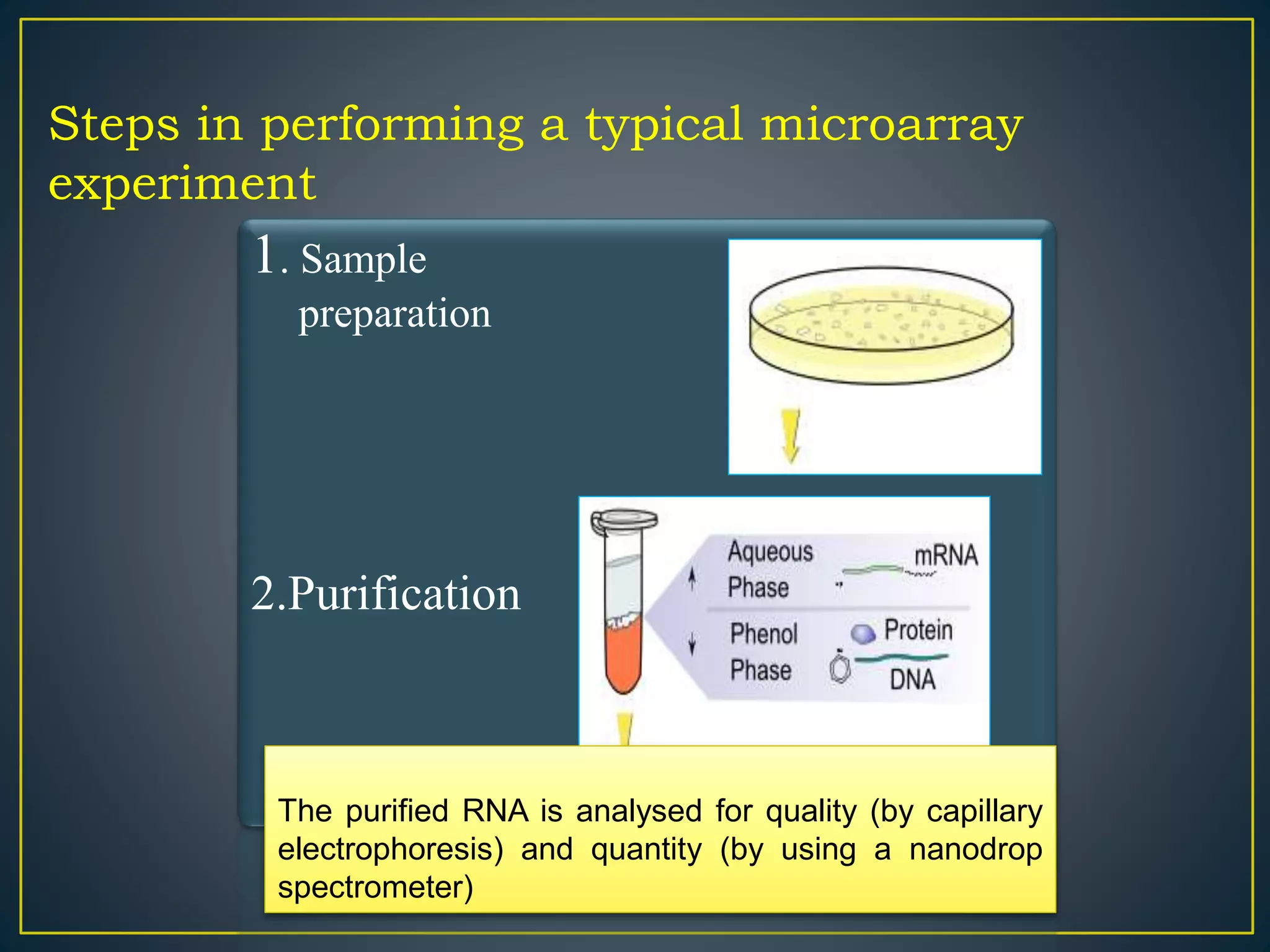
1. Sample
preparation
2.Purification
Steps in performing a typical microarray
experiment
The purified RNA is analysed for quality (by capillary
electrophoresis) and quantity (by using a nanodrop
spectrometer)
10
3. Reverse
Transcription
4. Labelling
The label is added either in the
RT step or in an additional
step after amplification if
present
5.Hibridization
6. Scanning
7.Normalization
and analysis
• Isolate a total RNA containing mRNA that
ideally represents a quantitative copy of
genes expressed at the time of sample
collection.
• Preparation of cDNA from mRNA using a
reverse-transcriptase enzyme.
• Short primer is required to initiate cDNA
synthesis.
• Each cDNA (Sample and Control) is
labelled with fluorescent cyanine dyes (i.e.
Cy3 and Cy5). Sample labeling
• Here, the labelled cDNA
(Sample and Control) are
mixed together.
• Purification
• After purification, the mixed
labelled cDNA is
competitively hybridised
against denatured PCR
product or cDNA molecules
spotted on a glass slide.
Array Hybridisation
• Slide is dried and scanned to
determine how much labelled
cDNA (probe) is bound to each
target spot.
• Hybridized target produces
emissions.
• Microarray software often uses
green spots on the microarray to
represent upregulated genes.
• Red to represent those genes that
are downregulated and yellow to
present in equal abundance Gene chip showing different
type of color spots
16
16
The PixSys 5500 Arraying Robot (Cartesian Technologies)
Vacuum wash station
The print head holds up to 32 pins
in a 8x4 format
Vacuum hold-down platform
(50 slide capacity)
Robotic arm
• DNA microarrays
• MMChips
• Protein microarrays
• Peptide microarrays
• Tissue microarrays
• Cellular microarrays
• Chemical compound microarrays
• Antibody microarrays
• Carbohydrate arrays
• Phenotype microarrays
• Interferometric reflectance imaging sensor (IRIS)
• Reverse Phase Protein Microarrays
The principle of DNA microarrays lies on the hybridization
between the nucleotide. Using this technology the presence of
one genomic or cDNA sequence in 1,00,000 or more sequences
can be screened in a single hybridization.
The property of complementary nucleic acid sequences is to
specifically pair with each other by forming hydrogen bonds
between complementary nucleotide base pairs.
• .
1) Glass cDNA microarrays which involves the micro spotting
of pre-fabricated cDNA fragments on a glass slide.
2) High-density oligonucleotide microarrays often referred
to as a "chip" which involves in situ oligonucleotide
synthesis.
a) A DNA chip can be
manufactured to
contain hundreds of
thousands of synthetic
single-stranded DNA
sequences.
b) Unknown DNA from a
patient is separated into
single strands,
enzymatically cut and
labeled with a
fluorescent dye.
c) The unknown DNA is inserted
into the chip and allowed to
hybridize with the DNA on the
chip.
d) The tagged DNA will bind only
to the complementary DNA on
the chip. The bound DNA will
be detected by its fluorescent
dye and analyzed by a
computer. The red light is a
gene expressed in normal cells;
green is a mutated gene
expressed in tumor cells; and
yellow, in both cells.
• The Invitrogen Human Protein Microarray is a high-density
microarray
• It contains thousands of unique human proteins
• kinases, phophatases, GPCRs, nuclear receptors, and proteases
• -Assay hundreds of native proteins simultaneously
• -Compare protein abundances in a variety of biological
samples
• -GenTel and BD biosciences
• -Antibody or ligand is on the microarray
• Targets DNA not RNA like expression
• Requires amplification of target DNA
• Uses multiple probes sets to determine base change at a
specific nucleotide position in the genomic DNA.
• Use thousand of oligos that “tile” or span the genomic DNA
for characterization.
• Provides sequence and genotyping data including ,Linkage
analysis and single nucleotide polymorphisms
• Enable the analysis of up to 300,000+ bases of double-stranded
sequence (600,000 bases total) on a single Affy array
• Used for large-scale resequencing of organisms genome and
organelles
• Faster and cheaper than sequencing but very limited to few
organisms and/or organelles
• Large potential
Tissue microarrays (also TMAs) consist
of paraffin blocks in which up to 1000
separate tissue cores are assembled in array
fashion to allow multiplex histological analysis
Depending upon the kind of immobilized
sample used construct arrays and the
information fetched, the Microarray
experiments can be categorized in three ways:
• Microarray Expression Analysis
• Microarray for Mutation Analysis
• Comparative Genomic Hybridization
In this experimental setup, the cDNA derived from the
mRNA of known genes is immobilized. The sample has
genes from both the normal as well as the diseased
tissues.
Spots with more intensity are obtained for diseased tissue
gene if the gene is over expressed in the diseased
condition. This expression pattern is then compared to
the expression pattern of a gene responsible for a disease.
For this analysis, the researchers use gDNA. The genes
might differ from each other by as less as a single
nucleotide base
A single base difference between two sequences is known
as Single Nucleotide Polymorphism (SNP) and detecting
them is known as SNP detection
It is used for the identification in the increase or decrease
of the important chromosomal fragments harbouring genes
involved in a disease.
MICROARRAY
AS A GENE
EXPRESSION
PROFILING
TOOL
MICROARRAY AS
A COMPARATIVE
GENOMICS
TOOL
DISEASE
DIAGNOSIS
DRUG
DISCOVERY
TOXICOLOGICAL
RESEARCH
• Gene Discovery: Helps in the identification of new
genes, know about their functioning and expression
levels under different conditions.
• Disease Diagnosis: heart diseases, mental illness,
infectious disease and especially the study of cancer
• classify the types of cancer on the basis of the patterns
of gene activity in the tumour cells..
Drug Discovery:
Microarray technology has extensive application
in Pharmacogenomics.
Comparative analysis of the genes from a diseased and a
normal cell will help the identification of the biochemical
constitution of the proteins synthesized by the diseased
genes.
The researchers can use this information to synthesize
drugs which combat with these proteins and reduce their
effect.
• Toxicological Research:
It provides a robust platform for the research of the impact
of toxins on the cells and their passing on to the progeny.
Toxicogenomics establishes correlation between responses
to toxicants and the changes in the genetic profiles of the
cells exposed to such toxicants
Nutrigenomic research
Study variations in the genes related to the influence of diets.
These variations, known as single nucleotide polymorphism
• E.g.: Studies are followed to reveal,
• Effects of calorie restriction on gene expression
• Obesity and high-fat diets
• Genes responds to gluten and soy protein
Specific oligonucleotides, 35-70 nucleotides, in length are
chemically synthesized
The oligonucleotides are spotted, at defined positions, onto a
glass slide to construct the array
Binding of fluorescently labelled probes to the
oligonucleotides is detected spectrophotometrically
• Housekeeping genes
• 16S rRNA,
• 16S-23S rRNA intergenic transcribed spacer region (ITS),
• rpoB; RNA polymerase Beta
• Hsp60/groEL; Heat shock protein
• recA; Recombinase
• A gyrB; Gyrase Beta
• Virulence genes
• bacterial toxins
• adhesins
• important virulence factors
• facilitate colonisation
• cause tissue damage
Gryadunov et al : developed a biochip for detection of
rifampicin-resistant and isoniazid-resistant strains of M.
tuberculosis .
The newest generation of TB-biochips identifies
mutations responsible for the emerging resistance of M.
tuberculosis so the highly effective second-line
fluoroquinolone antibiotics can be administered
• Using the sequencing array, the scientists were able to correctly
classify, previously unclassifiable samples into existing
meningitis serotypes
• Resequencing microarrays provide results in just 48 hours,
much faster than traditional methods.
• The meningitis resequencing array can now be used to quickly
identify new meningitis strains, as well as for epidemiological
studies and vaccine research.
• Based on publications, microarray approaches can be
summarized into four viral infection groups to focus on:
1)respiratory diseases
2) hemorrhagic fever (HF)
3) neurotropic infection
4) HIV
Detection of etiological agents :
Some influenza microarrays are designed to detect DNA.
For instance, a universal microchip was developed for
genotyping influenza A viruses with two sets of oligonucleotide
probes allowing viruses to be classified by the subtype of
hemagglutinin (H1 - H13, H15, H16) and neuraminidase (N1 -
N9)
Viruses associated with hemorrhagic fever (HF) are mainly found
in the families Arenaviridae, Bunyaviridae, Flaviviridae
Filoviridae.
Based on microarrays, a detection and identification approach
was designed for seven agents of the Flaviviridae family:
yellow fever
West Nile virus (WNV)
Japanese encephalitis
and the dengue 1 - 4 viruses
• A DNA microarray for the detection of 13 specific pathogens in
meningitis and encephalitis cases was developed for the most
common neurotropic viruses including HSV-1, varicella-zoster
virus [VZV], and enteroviruses.
• Also, a microarray comprising of 38 gene targets was
developed for the detection of several other viruses capable of
causing CNS syndromes.
Detect the pathogen but also can measure the amount of virus, a
microarray was developed by combining both methodologies.
The study described an original approach for simultaneous
quantitative identification of these viruses in blood plasma
specimens using real-time PCR with primers immobilized on a
microarray
The identification of resistance biomarkers on HIV-1,including
pathways that may be critical in anti-HIV-1vaccine design.
Studies reported the use of microarrays to identify pathogenic
yeasts and molds by targeting the ITS regions in fungal rRNA
genes
In 2007, Birgit Spiess et al. reported a sensitive DNA microarray to
detect and identify DNA from 14 fungal pathogens in blood,
bronchoalveolar lavage, and tissue samples from high-risk patients.
Aspergillus fumigatus, Aspergillus flavus, Aspergillus terreus,
Candida albicans, Candida dubliniensis, Candida glabrata, Candida lusitaniae,
Candida tropicalis,
Fusarium oxy sporum, Fusarium solani, Mucor racemosus,
Rhizopus microsporus, Scedosporium prolificans, and Trichosporon asahi
• Provides data for thousands of genes.
• One experiment instead of many.
• Fast and easy to obtain results.
• Huge step closer to discovering cures for
diseases and cancer.
• Different parts of DNA can be used to
study gene expresion.
ADVANTAGES
Disadvantages:
• The biggest disadvantage is that they are expensive to create.
• The production of too many results at a time requires long
time for analysis, which is quite complex in nature.
• The DNA chips do not have very long shelf life, which
proves to be another major disadvantage of the technology.
•Very little knowledge is available about many genes
•The findings may lead to unethical medical procedures
•Scientists have no standardized way to share results
The "MicroArray Quality Control (MAQC) Project" is being
conducted by the US Food and Drug Administration (FDA) to
develop standards and quality control metrics which will
eventually allow the use of MicroArray data in drug discovery,
clinical practice and regulatory decision-making
Technology RNASeq Microarray
High run-to run reproducibility Yes Yes
Dynamic Range Comparable to
actual transcript abundance
>8000-fold
Hundred
fold
Able to detect alternative splice site
and novel isoforms
Yes No
De novo analysis of samples without
reference genome
Yes No
Multiplexing Samples in one run Yes No
Required amount of total RNA >100 ng ~1 ug
Re-analyzable data Yes No
Technology RNASeq Microarray
Heterogeneity of read coverage
across an expressed region
Yes No
Well understood sources of
experimental bias
No Yes
Data portable on a flush drive (~4G) No Yes
Data is analyzable by any PC No Yes
Cheaper cost per sample No Yes
Microarray is a recently developed functional genomics
technology that has powerful applications in a wide array of
biological medical sciences, agriculture, biotechnology and
environmental studies. Since many universities research
institutions and industries have established microarray based core
facilities and services, microarrays have become a readily
accessible, widely used technology for investigating biological
systems.
• Ness SA. Basic microarray analysis: strategies for successful
experiments. Methods Mol Biol. 2006;316:13-33. Review. PubMed
PMID: 16671398
• Navigating gene expression using microarrays — a technology
review. Almut Schulze and Julian Downward, NATURE CELL
BIOLOGY, VOL 3, AUGUST 2001
• Russo G, Zegar C, Giordano A. Advantages and limitations of
microarray technology in human cancer. Oncogene. 2003 Sep
29;22(42):6497-507. Review. PubMed PMID: 14528274.
• Augenlicht LH, Wahrman MZ, Halsey H, Anderson L, Taylor J,
Lipkin M. Expression of cloned sequences in biopsies of human
colonic tissue and in colonic carcinoma cells induced to
differentiate in vitro. Cancer Res. 1987 Nov 15;47(22):6017-21.
PubMed PMID: 3664505.
• http://en.wikipedia.org/wiki/DNA_microarray
• http://grf.lshtm.ac.uk/microarrayoverview.htm
• http://learn.genetics.utah.edu/content/labs/microarray
microarrary

microarrary

  • 1.
    Dr. Nisha Singh Guide:Dr. S.S. Raut
  • 2.
    Introduction History Principle Types of microarrary Applications Advantages  Limitations Conclusion  References
  • 3.
    Introduction: . ] History: Microarray technologyevolved from Southern blotting The concept of microarrays was first proposed in the late 1980s by Augenlicht and his colleagues. The use of miniaturized microarrays for gene expression profiling was first reported in 1995, and a complete eukaryotic genome (Saccharomyces cerevisiae) on a microarray was published in 1997 by Pat Brown’s group
  • 5.
    An array isan orderly arrangement of samples where matching of known and unknown DNA samples is done based on base pairing rules. An array experiment makes use of common assay systems such as microplates or standard blotting membranes. Microarrays are a way to measure changes in gene expression of all the genes at ONCE!! WHAT IS AN ARRAY ]
  • 6.
    • Determine whatgenes are active in a cell and at what levels • Compare the gene expression profiles of a control vs treated • Determine what genes have increased or decreased in during an experimental condition • Determine which genes have biological significance in a system • Discovery of new genes, pathways, and cellular trafficking
  • 7.
    • Start withindividual genes, e.g. the ~6,200 genes of the yeast genome • Amplify all of them using polymerase chain reaction (PCR) • “Spot” them on a medium, e.g. an ordinary glass microscope slide • Each spot is about 100 µm in diameter • Spotting is done by a robot 7
  • 8.
  • 9.
    1. Sample preparation 2.Purification Steps inperforming a typical microarray experiment The purified RNA is analysed for quality (by capillary electrophoresis) and quantity (by using a nanodrop spectrometer)
  • 10.
    10 3. Reverse Transcription 4. Labelling Thelabel is added either in the RT step or in an additional step after amplification if present
  • 11.
  • 12.
    • Isolate atotal RNA containing mRNA that ideally represents a quantitative copy of genes expressed at the time of sample collection. • Preparation of cDNA from mRNA using a reverse-transcriptase enzyme. • Short primer is required to initiate cDNA synthesis. • Each cDNA (Sample and Control) is labelled with fluorescent cyanine dyes (i.e. Cy3 and Cy5). Sample labeling
  • 13.
    • Here, thelabelled cDNA (Sample and Control) are mixed together. • Purification • After purification, the mixed labelled cDNA is competitively hybridised against denatured PCR product or cDNA molecules spotted on a glass slide. Array Hybridisation
  • 14.
    • Slide isdried and scanned to determine how much labelled cDNA (probe) is bound to each target spot. • Hybridized target produces emissions. • Microarray software often uses green spots on the microarray to represent upregulated genes. • Red to represent those genes that are downregulated and yellow to present in equal abundance Gene chip showing different type of color spots
  • 16.
    16 16 The PixSys 5500Arraying Robot (Cartesian Technologies) Vacuum wash station The print head holds up to 32 pins in a 8x4 format Vacuum hold-down platform (50 slide capacity) Robotic arm
  • 17.
    • DNA microarrays •MMChips • Protein microarrays • Peptide microarrays • Tissue microarrays • Cellular microarrays • Chemical compound microarrays • Antibody microarrays • Carbohydrate arrays • Phenotype microarrays • Interferometric reflectance imaging sensor (IRIS) • Reverse Phase Protein Microarrays
  • 18.
    The principle ofDNA microarrays lies on the hybridization between the nucleotide. Using this technology the presence of one genomic or cDNA sequence in 1,00,000 or more sequences can be screened in a single hybridization. The property of complementary nucleic acid sequences is to specifically pair with each other by forming hydrogen bonds between complementary nucleotide base pairs. • .
  • 19.
    1) Glass cDNAmicroarrays which involves the micro spotting of pre-fabricated cDNA fragments on a glass slide. 2) High-density oligonucleotide microarrays often referred to as a "chip" which involves in situ oligonucleotide synthesis.
  • 20.
    a) A DNAchip can be manufactured to contain hundreds of thousands of synthetic single-stranded DNA sequences. b) Unknown DNA from a patient is separated into single strands, enzymatically cut and labeled with a fluorescent dye.
  • 21.
    c) The unknownDNA is inserted into the chip and allowed to hybridize with the DNA on the chip. d) The tagged DNA will bind only to the complementary DNA on the chip. The bound DNA will be detected by its fluorescent dye and analyzed by a computer. The red light is a gene expressed in normal cells; green is a mutated gene expressed in tumor cells; and yellow, in both cells.
  • 22.
    • The InvitrogenHuman Protein Microarray is a high-density microarray • It contains thousands of unique human proteins • kinases, phophatases, GPCRs, nuclear receptors, and proteases
  • 23.
    • -Assay hundredsof native proteins simultaneously • -Compare protein abundances in a variety of biological samples • -GenTel and BD biosciences • -Antibody or ligand is on the microarray
  • 24.
    • Targets DNAnot RNA like expression • Requires amplification of target DNA • Uses multiple probes sets to determine base change at a specific nucleotide position in the genomic DNA. • Use thousand of oligos that “tile” or span the genomic DNA for characterization. • Provides sequence and genotyping data including ,Linkage analysis and single nucleotide polymorphisms
  • 25.
    • Enable theanalysis of up to 300,000+ bases of double-stranded sequence (600,000 bases total) on a single Affy array • Used for large-scale resequencing of organisms genome and organelles • Faster and cheaper than sequencing but very limited to few organisms and/or organelles • Large potential
  • 26.
    Tissue microarrays (alsoTMAs) consist of paraffin blocks in which up to 1000 separate tissue cores are assembled in array fashion to allow multiplex histological analysis
  • 27.
    Depending upon thekind of immobilized sample used construct arrays and the information fetched, the Microarray experiments can be categorized in three ways: • Microarray Expression Analysis • Microarray for Mutation Analysis • Comparative Genomic Hybridization
  • 28.
    In this experimentalsetup, the cDNA derived from the mRNA of known genes is immobilized. The sample has genes from both the normal as well as the diseased tissues. Spots with more intensity are obtained for diseased tissue gene if the gene is over expressed in the diseased condition. This expression pattern is then compared to the expression pattern of a gene responsible for a disease.
  • 29.
    For this analysis,the researchers use gDNA. The genes might differ from each other by as less as a single nucleotide base A single base difference between two sequences is known as Single Nucleotide Polymorphism (SNP) and detecting them is known as SNP detection
  • 30.
    It is usedfor the identification in the increase or decrease of the important chromosomal fragments harbouring genes involved in a disease.
  • 31.
    MICROARRAY AS A GENE EXPRESSION PROFILING TOOL MICROARRAYAS A COMPARATIVE GENOMICS TOOL DISEASE DIAGNOSIS DRUG DISCOVERY TOXICOLOGICAL RESEARCH
  • 32.
    • Gene Discovery:Helps in the identification of new genes, know about their functioning and expression levels under different conditions. • Disease Diagnosis: heart diseases, mental illness, infectious disease and especially the study of cancer • classify the types of cancer on the basis of the patterns of gene activity in the tumour cells..
  • 33.
    Drug Discovery: Microarray technologyhas extensive application in Pharmacogenomics. Comparative analysis of the genes from a diseased and a normal cell will help the identification of the biochemical constitution of the proteins synthesized by the diseased genes. The researchers can use this information to synthesize drugs which combat with these proteins and reduce their effect.
  • 34.
    • Toxicological Research: Itprovides a robust platform for the research of the impact of toxins on the cells and their passing on to the progeny. Toxicogenomics establishes correlation between responses to toxicants and the changes in the genetic profiles of the cells exposed to such toxicants
  • 35.
    Nutrigenomic research Study variationsin the genes related to the influence of diets. These variations, known as single nucleotide polymorphism • E.g.: Studies are followed to reveal, • Effects of calorie restriction on gene expression • Obesity and high-fat diets • Genes responds to gluten and soy protein
  • 39.
    Specific oligonucleotides, 35-70nucleotides, in length are chemically synthesized The oligonucleotides are spotted, at defined positions, onto a glass slide to construct the array Binding of fluorescently labelled probes to the oligonucleotides is detected spectrophotometrically
  • 40.
    • Housekeeping genes •16S rRNA, • 16S-23S rRNA intergenic transcribed spacer region (ITS), • rpoB; RNA polymerase Beta • Hsp60/groEL; Heat shock protein • recA; Recombinase • A gyrB; Gyrase Beta • Virulence genes • bacterial toxins • adhesins • important virulence factors • facilitate colonisation • cause tissue damage
  • 41.
    Gryadunov et al: developed a biochip for detection of rifampicin-resistant and isoniazid-resistant strains of M. tuberculosis . The newest generation of TB-biochips identifies mutations responsible for the emerging resistance of M. tuberculosis so the highly effective second-line fluoroquinolone antibiotics can be administered
  • 42.
    • Using thesequencing array, the scientists were able to correctly classify, previously unclassifiable samples into existing meningitis serotypes • Resequencing microarrays provide results in just 48 hours, much faster than traditional methods. • The meningitis resequencing array can now be used to quickly identify new meningitis strains, as well as for epidemiological studies and vaccine research.
  • 43.
    • Based onpublications, microarray approaches can be summarized into four viral infection groups to focus on: 1)respiratory diseases 2) hemorrhagic fever (HF) 3) neurotropic infection 4) HIV
  • 44.
    Detection of etiologicalagents : Some influenza microarrays are designed to detect DNA. For instance, a universal microchip was developed for genotyping influenza A viruses with two sets of oligonucleotide probes allowing viruses to be classified by the subtype of hemagglutinin (H1 - H13, H15, H16) and neuraminidase (N1 - N9)
  • 45.
    Viruses associated withhemorrhagic fever (HF) are mainly found in the families Arenaviridae, Bunyaviridae, Flaviviridae Filoviridae. Based on microarrays, a detection and identification approach was designed for seven agents of the Flaviviridae family: yellow fever West Nile virus (WNV) Japanese encephalitis and the dengue 1 - 4 viruses
  • 46.
    • A DNAmicroarray for the detection of 13 specific pathogens in meningitis and encephalitis cases was developed for the most common neurotropic viruses including HSV-1, varicella-zoster virus [VZV], and enteroviruses. • Also, a microarray comprising of 38 gene targets was developed for the detection of several other viruses capable of causing CNS syndromes.
  • 47.
    Detect the pathogenbut also can measure the amount of virus, a microarray was developed by combining both methodologies. The study described an original approach for simultaneous quantitative identification of these viruses in blood plasma specimens using real-time PCR with primers immobilized on a microarray
  • 48.
    The identification ofresistance biomarkers on HIV-1,including pathways that may be critical in anti-HIV-1vaccine design.
  • 49.
    Studies reported theuse of microarrays to identify pathogenic yeasts and molds by targeting the ITS regions in fungal rRNA genes In 2007, Birgit Spiess et al. reported a sensitive DNA microarray to detect and identify DNA from 14 fungal pathogens in blood, bronchoalveolar lavage, and tissue samples from high-risk patients. Aspergillus fumigatus, Aspergillus flavus, Aspergillus terreus, Candida albicans, Candida dubliniensis, Candida glabrata, Candida lusitaniae, Candida tropicalis, Fusarium oxy sporum, Fusarium solani, Mucor racemosus, Rhizopus microsporus, Scedosporium prolificans, and Trichosporon asahi
  • 50.
    • Provides datafor thousands of genes. • One experiment instead of many. • Fast and easy to obtain results. • Huge step closer to discovering cures for diseases and cancer. • Different parts of DNA can be used to study gene expresion. ADVANTAGES
  • 51.
    Disadvantages: • The biggestdisadvantage is that they are expensive to create. • The production of too many results at a time requires long time for analysis, which is quite complex in nature. • The DNA chips do not have very long shelf life, which proves to be another major disadvantage of the technology. •Very little knowledge is available about many genes •The findings may lead to unethical medical procedures •Scientists have no standardized way to share results
  • 52.
    The "MicroArray QualityControl (MAQC) Project" is being conducted by the US Food and Drug Administration (FDA) to develop standards and quality control metrics which will eventually allow the use of MicroArray data in drug discovery, clinical practice and regulatory decision-making
  • 54.
    Technology RNASeq Microarray Highrun-to run reproducibility Yes Yes Dynamic Range Comparable to actual transcript abundance >8000-fold Hundred fold Able to detect alternative splice site and novel isoforms Yes No De novo analysis of samples without reference genome Yes No Multiplexing Samples in one run Yes No Required amount of total RNA >100 ng ~1 ug Re-analyzable data Yes No
  • 55.
    Technology RNASeq Microarray Heterogeneityof read coverage across an expressed region Yes No Well understood sources of experimental bias No Yes Data portable on a flush drive (~4G) No Yes Data is analyzable by any PC No Yes Cheaper cost per sample No Yes
  • 56.
    Microarray is arecently developed functional genomics technology that has powerful applications in a wide array of biological medical sciences, agriculture, biotechnology and environmental studies. Since many universities research institutions and industries have established microarray based core facilities and services, microarrays have become a readily accessible, widely used technology for investigating biological systems.
  • 57.
    • Ness SA.Basic microarray analysis: strategies for successful experiments. Methods Mol Biol. 2006;316:13-33. Review. PubMed PMID: 16671398 • Navigating gene expression using microarrays — a technology review. Almut Schulze and Julian Downward, NATURE CELL BIOLOGY, VOL 3, AUGUST 2001 • Russo G, Zegar C, Giordano A. Advantages and limitations of microarray technology in human cancer. Oncogene. 2003 Sep 29;22(42):6497-507. Review. PubMed PMID: 14528274. • Augenlicht LH, Wahrman MZ, Halsey H, Anderson L, Taylor J, Lipkin M. Expression of cloned sequences in biopsies of human colonic tissue and in colonic carcinoma cells induced to differentiate in vitro. Cancer Res. 1987 Nov 15;47(22):6017-21. PubMed PMID: 3664505. • http://en.wikipedia.org/wiki/DNA_microarray • http://grf.lshtm.ac.uk/microarrayoverview.htm • http://learn.genetics.utah.edu/content/labs/microarray

Editor's Notes

  • #2 A human organism has over 250 different cell types (e.g., muscle, skin, bone, neuron), most of which have identical genomes, yet they look different and do different jobs It is believed that less than 20% of the genes are‘expressed’ (i.e., making RNA) in a typical cell type Apparently the differences in gene expression is what makes the cells different
  • #3 Micro arrary small dna chip which has single standard dna , use to check expreeion on different tissue in different time duration , make c dna .. See wheater hybridiastion by use diff color probe ,, put in analzer ,, they detect color …all tissuse have same no chromose same typye of genes but there expression is diifernt.. Brain cell work diff liver different,
  • #6 MICROARRAY Device which detect the precence of specific DNA OR RNA in a sample .
  • #7 Just because we sequenced a genome doesn’t mean we know anything about the genes. Thousands of genes remain without an assigned function. Patterns or clusters of genes are more informative regarding total cellular function than looking at one or two genes – can figure out new pathways
  • #33 This will tremendously help the pharmaceutical community to develop more effective drugs as the treatment strategies will be targeted directly to the specific type of cancer
  • #43 But more importantly, was able to classify 12.