NEXT GENERATION SEQUENCING
LOGESWARANKA
P20BIT1013
I MSCBIOTECHNOLOGY
PERIYARUNIVERSITY.
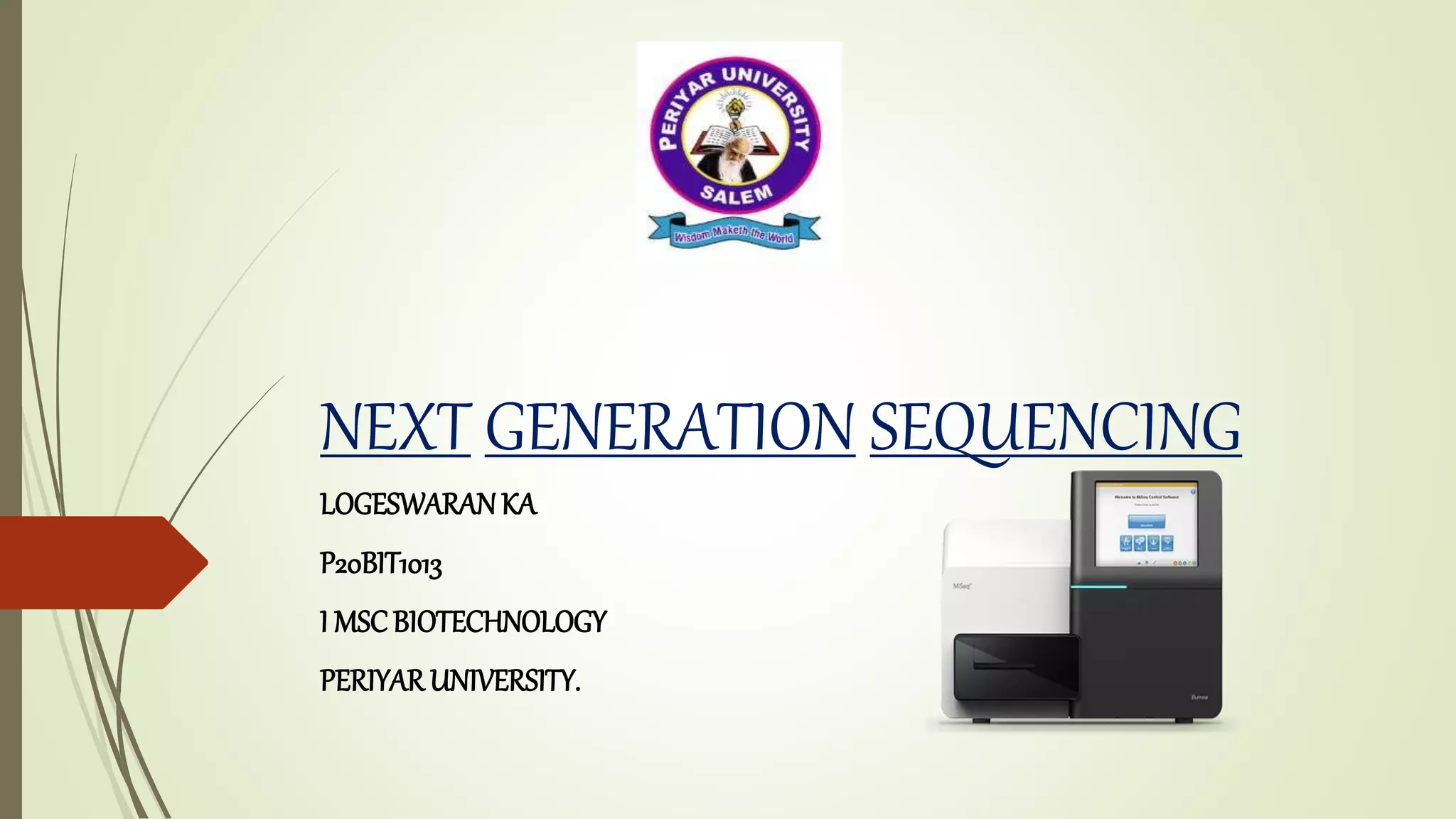
NEXT GENERATION SEQUENCING
 Also Known As “High Throughput Sequencing”.
 One Of The Modern Sequencing Technology.
 It Allows Biological Scientists To Sequence Nucliec Acids
(i.e. DNA, RNA) And Other Biological Compounds.
 “Faster Sequencing Rate” And “Cost Effective” Procedure.
 Improvised Sequencing Technology Of “Sanger Sequencing”.
 “Human Genome Project (HGP)” Is A Stepping Stone For The
Development Of NGS And Other Many Improved Sequencing
Technologies.
TECHNOLOGY
 “Massive Parallel Sequencing (MPS)” Is The Principle Behind
Most Of The Next Generation Sequencing Procedures.
 This Technology Enables Scientists To Perform Reading And
Documentation Of Millions Of DNA Or RNA Fragments
Simultaneously.
 Huge Amount Of Nucleic Acids To Genome Of Entire Organism
Can Be Sequenced In Single Day.
 To Read More About MPS,
https://www.cell.com/ajhg/fulltext/S0002-9297(09)00283-3
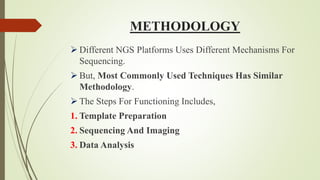
METHODOLOGY
 Different NGS Platforms Uses Different Mechanisms For
Sequencing.
 But, Most Commonly Used Techniques Has Similar
Methodology.
 The Steps For Functioning Includes,
1. Template Preparation
2. Sequencing And Imaging
3. Data Analysis
TEMPLATE PREPARATION
 Refers To Construction And Amplification Of Nucleic
Acid Library.
 Nucleic Acids Are Fragmented And The Ends Of DNA
Is Ligated With Chemically Produced DNA Which (Has
Known Sequence) For Library Construction.
 After Library Construction, Nucleic Acid Amplification Is
Performed.
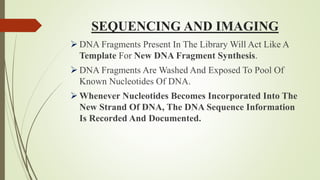
SEQUENCING AND IMAGING
 DNA Fragments Present In The Library Will Act Like A
Template For New DNA Fragment Synthesis.
 DNA Fragments Are Washed And Exposed To Pool Of
Known Nucleotides Of DNA.
 Whenever Nucleotides Becomes Incorporated Into The
New Strand Of DNA, The DNA Sequence Information
Is Recorded And Documented.
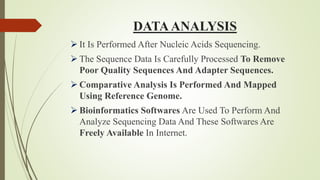
DATAANALYSIS
 It Is Performed After Nucleic Acids Sequencing.
 The Sequence Data Is Carefully Processed To Remove
Poor Quality Sequences And Adapter Sequences.
 Comparative Analysis Is Performed And Mapped
Using Reference Genome.
 Bioinformatics Softwares Are Used To Perform And
Analyze Sequencing Data And These Softwares Are
Freely Available In Internet.
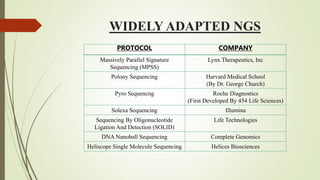
WIDELY ADAPTED NGS
PROTOCOL COMPANY
Massively Parallel Signature
Sequencing (MPSS)
Lynx Therapeutics, Inc
Polony Sequencing Harvard Medical School
(By Dr. George Church)
Pyro Sequencng Roche Diagnostics
(First Developed By 454 Life Sciences)
Solexa Sequencing Illumina
Sequencing By Oligonucleotide
Ligation And Detection (SOLID)
Life Technologies
DNA Nanoball Sequencing Complete Genomics
Heliscope Single Molecule Sequencing Helices Biosciences
APPLICATIONS
 Whole Genome Sequencing To Study Characteristics Of
Wide Range Of Organisms.
 Bacteriology And Virology Studies.
 Epidemiology And Public Health Studies.
 Mutation And Microarray Studies.
 Transcriptome Studies.
 Cancer And Inherited Diseases Studies.
 Metagenomics And Microbiome Research.
REFERENCES
1) https://www.news-medical.net/health/Next-Generation-Sequencing-
The-Basics.aspx
2) https://microbenotes.com/next-generation-sequencing-ngs/
3) https://www.illumina.com/science/technology/next-generation-
sequencing.html
4) https://www.ebi.ac.uk/training/online/courses/functional-genomics-
ii-common-technologies-and-data-analysis-methods/next-
generation-sequencing/
5) https://www.slideshare.net/arundhatimehta50/next-generation-
sequencing-76687162
THANKS FOR LEARNING

Next Generation Sequencing (NGS)

  • 1.
    NEXT GENERATION SEQUENCING LOGESWARANKA P20BIT1013 IMSCBIOTECHNOLOGY PERIYARUNIVERSITY.
  • 2.
    NEXT GENERATION SEQUENCING Also Known As “High Throughput Sequencing”.  One Of The Modern Sequencing Technology.  It Allows Biological Scientists To Sequence Nucliec Acids (i.e. DNA, RNA) And Other Biological Compounds.  “Faster Sequencing Rate” And “Cost Effective” Procedure.  Improvised Sequencing Technology Of “Sanger Sequencing”.  “Human Genome Project (HGP)” Is A Stepping Stone For The Development Of NGS And Other Many Improved Sequencing Technologies.
  • 3.
    TECHNOLOGY  “Massive ParallelSequencing (MPS)” Is The Principle Behind Most Of The Next Generation Sequencing Procedures.  This Technology Enables Scientists To Perform Reading And Documentation Of Millions Of DNA Or RNA Fragments Simultaneously.  Huge Amount Of Nucleic Acids To Genome Of Entire Organism Can Be Sequenced In Single Day.  To Read More About MPS, https://www.cell.com/ajhg/fulltext/S0002-9297(09)00283-3
  • 4.
    METHODOLOGY  Different NGSPlatforms Uses Different Mechanisms For Sequencing.  But, Most Commonly Used Techniques Has Similar Methodology.  The Steps For Functioning Includes, 1. Template Preparation 2. Sequencing And Imaging 3. Data Analysis
  • 5.
    TEMPLATE PREPARATION  RefersTo Construction And Amplification Of Nucleic Acid Library.  Nucleic Acids Are Fragmented And The Ends Of DNA Is Ligated With Chemically Produced DNA Which (Has Known Sequence) For Library Construction.  After Library Construction, Nucleic Acid Amplification Is Performed.
  • 6.
    SEQUENCING AND IMAGING DNA Fragments Present In The Library Will Act Like A Template For New DNA Fragment Synthesis.  DNA Fragments Are Washed And Exposed To Pool Of Known Nucleotides Of DNA.  Whenever Nucleotides Becomes Incorporated Into The New Strand Of DNA, The DNA Sequence Information Is Recorded And Documented.
  • 7.
    DATAANALYSIS  It IsPerformed After Nucleic Acids Sequencing.  The Sequence Data Is Carefully Processed To Remove Poor Quality Sequences And Adapter Sequences.  Comparative Analysis Is Performed And Mapped Using Reference Genome.  Bioinformatics Softwares Are Used To Perform And Analyze Sequencing Data And These Softwares Are Freely Available In Internet.
  • 8.
    WIDELY ADAPTED NGS PROTOCOLCOMPANY Massively Parallel Signature Sequencing (MPSS) Lynx Therapeutics, Inc Polony Sequencing Harvard Medical School (By Dr. George Church) Pyro Sequencng Roche Diagnostics (First Developed By 454 Life Sciences) Solexa Sequencing Illumina Sequencing By Oligonucleotide Ligation And Detection (SOLID) Life Technologies DNA Nanoball Sequencing Complete Genomics Heliscope Single Molecule Sequencing Helices Biosciences
  • 9.
    APPLICATIONS  Whole GenomeSequencing To Study Characteristics Of Wide Range Of Organisms.  Bacteriology And Virology Studies.  Epidemiology And Public Health Studies.  Mutation And Microarray Studies.  Transcriptome Studies.  Cancer And Inherited Diseases Studies.  Metagenomics And Microbiome Research.
  • 10.
    REFERENCES 1) https://www.news-medical.net/health/Next-Generation-Sequencing- The-Basics.aspx 2) https://microbenotes.com/next-generation-sequencing-ngs/ 3)https://www.illumina.com/science/technology/next-generation- sequencing.html 4) https://www.ebi.ac.uk/training/online/courses/functional-genomics- ii-common-technologies-and-data-analysis-methods/next- generation-sequencing/ 5) https://www.slideshare.net/arundhatimehta50/next-generation- sequencing-76687162
  • 11.