PROTEIN MICROARRAY
K.KRUPA SAGAR
M.Pharm 1st year
INTRODUCTION
• Protein micro array(or Protein chip) is a high-
throughput method used to track the interactions
& activities of proteins, to determinate their
functions.
• Protein micro array are rapid, automated,
economical and highly sensitive consuming only
small quantities of samples and reagents.
HISTORY
• Micro array technology was first developed from
an earlier concept called “Ambient analyte
immunoassay” by Roger Ekins in 1989.
• Later transformed into DNA microarray.
• Due to some limitations in DNA microarray ,
this protein microarray was developed to
overcome those limitations.
PRINCIPLE
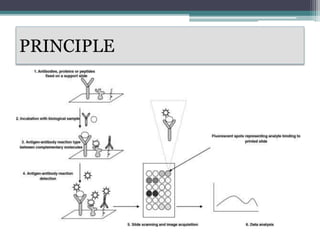
• Protein chip consists of a support surface such
as glass slide, nitrocellulose, bead or
microtitreplate to which array of capture
proteins is bound.
• Probe molecules typically labeled with a
fluorescent dye are added to the array.
• Any reaction between the probe and the
immobilized protein emits a fluorescent
signal and that is read by laser scanner.
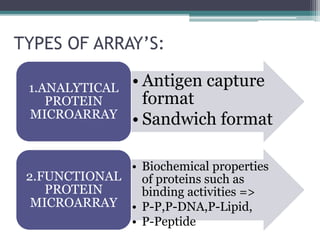
TYPES OF ARRAY’S:
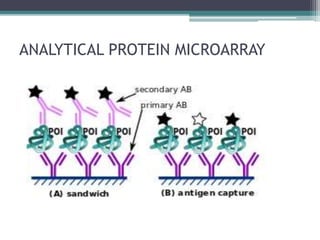
• Antigen capture
format
• Sandwich format
1.ANALYTICAL
PROTEIN
MICROARRAY
• Biochemical properties
of proteins such as
binding activities =>
• P-P,P-DNA,P-Lipid,
• P-Peptide
2.FUNCTIONAL
PROTEIN
MICROARRAY
ANALYTICAL PROTEIN MICROARRAY
FUNCTIONAL PROTEIN
MICROARRAY
• Functional protein microarray (target protein
array) are constructed by immobilizing large
num of proteins to assay enzymatic activity and
to detect antibodies & their functions.
• They differ from analytical protein microarray
by containing full length functional proteins or
protein domains.
• These are used to study the biochemical
activities of entire proteome in a single
experiment.
• The proteins must retain their native or original
structure so that meaningful functional
interactions takes place on the array surface.
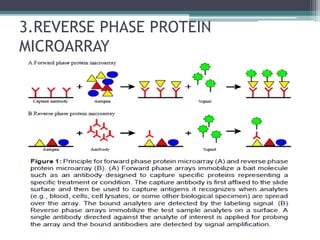
3.REVERSE PHASE PROTEIN
MICROARRAY
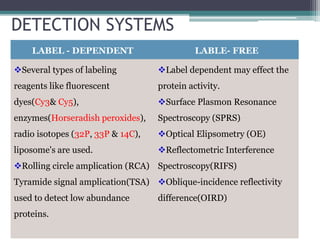
DETECTION SYSTEMS
LABEL - DEPENDENT LABLE- FREE
Several types of labeling
reagents like fluorescent
dyes(Cy3& Cy5),
enzymes(Horseradish peroxides),
radio isotopes (32P, 33P & 14C),
liposome's are used.
Rolling circle amplication (RCA)
Tyramide signal amplication(TSA)
used to detect low abundance
proteins.
Label dependent may effect the
protein activity.
Surface Plasmon Resonance
Spectroscopy (SPRS)
Optical Elipsometry (OE)
Reflectometric Interference
Spectroscopy(RIFS)
Oblique-incidence reflectivity
difference(OIRD)
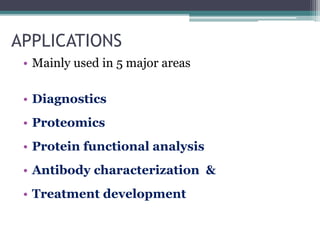
APPLICATIONS
• Mainly used in 5 major areas
• Diagnostics
• Proteomics
• Protein functional analysis
• Antibody characterization &
• Treatment development
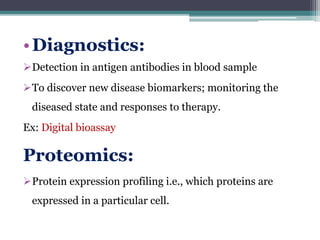
•Diagnostics:
Detection in antigen antibodies in blood sample
To discover new disease biomarkers; monitoring the
diseased state and responses to therapy.
Ex: Digital bioassay
Proteomics:
Protein expression profiling i.e., which proteins are
expressed in a particular cell.
Protein functional analysis:
To identify :-
Protein-protein interactions
Protein- phospholipids interactions
Enzymatic substrates &
Receptor ligands
Antibody characterization:
characterization of cross reactivity, specificity and
mapping epitopes.
Treatment development:
 Development of antigen- specificity therapies for
autoimmunity , cancer and allergies.
 Identification of small molecules that could potentially
used to be as new drugs
Protein micro array

Protein micro array

  • 1.
  • 2.
    INTRODUCTION • Protein microarray(or Protein chip) is a high- throughput method used to track the interactions & activities of proteins, to determinate their functions. • Protein micro array are rapid, automated, economical and highly sensitive consuming only small quantities of samples and reagents.
  • 3.
    HISTORY • Micro arraytechnology was first developed from an earlier concept called “Ambient analyte immunoassay” by Roger Ekins in 1989. • Later transformed into DNA microarray. • Due to some limitations in DNA microarray , this protein microarray was developed to overcome those limitations.
  • 4.
  • 5.
    • Protein chipconsists of a support surface such as glass slide, nitrocellulose, bead or microtitreplate to which array of capture proteins is bound. • Probe molecules typically labeled with a fluorescent dye are added to the array. • Any reaction between the probe and the immobilized protein emits a fluorescent signal and that is read by laser scanner.
  • 6.
    TYPES OF ARRAY’S: •Antigen capture format • Sandwich format 1.ANALYTICAL PROTEIN MICROARRAY • Biochemical properties of proteins such as binding activities => • P-P,P-DNA,P-Lipid, • P-Peptide 2.FUNCTIONAL PROTEIN MICROARRAY
  • 7.
  • 8.
  • 9.
    • Functional proteinmicroarray (target protein array) are constructed by immobilizing large num of proteins to assay enzymatic activity and to detect antibodies & their functions. • They differ from analytical protein microarray by containing full length functional proteins or protein domains.
  • 10.
    • These areused to study the biochemical activities of entire proteome in a single experiment. • The proteins must retain their native or original structure so that meaningful functional interactions takes place on the array surface.
  • 11.
  • 12.
    DETECTION SYSTEMS LABEL -DEPENDENT LABLE- FREE Several types of labeling reagents like fluorescent dyes(Cy3& Cy5), enzymes(Horseradish peroxides), radio isotopes (32P, 33P & 14C), liposome's are used. Rolling circle amplication (RCA) Tyramide signal amplication(TSA) used to detect low abundance proteins. Label dependent may effect the protein activity. Surface Plasmon Resonance Spectroscopy (SPRS) Optical Elipsometry (OE) Reflectometric Interference Spectroscopy(RIFS) Oblique-incidence reflectivity difference(OIRD)
  • 13.
    APPLICATIONS • Mainly usedin 5 major areas • Diagnostics • Proteomics • Protein functional analysis • Antibody characterization & • Treatment development
  • 14.
    •Diagnostics: Detection in antigenantibodies in blood sample To discover new disease biomarkers; monitoring the diseased state and responses to therapy. Ex: Digital bioassay Proteomics: Protein expression profiling i.e., which proteins are expressed in a particular cell.
  • 15.
    Protein functional analysis: Toidentify :- Protein-protein interactions Protein- phospholipids interactions Enzymatic substrates & Receptor ligands
  • 16.
    Antibody characterization: characterization ofcross reactivity, specificity and mapping epitopes. Treatment development:  Development of antigen- specificity therapies for autoimmunity , cancer and allergies.  Identification of small molecules that could potentially used to be as new drugs