: Ujjwal Sirohi
Phd research scholar
Microarray
Stay connected
on
@sirohiujjwal
 This is an old ppt of mine
 Reliable information
 Concern with other materials too
 A DNA microarray (also commonly known as DNA chip or
biochip) is a collection of microscopic DNA spots attached to a
solid surface.
 Scientists use DNA microarray to measure the expression level of
genes simuntaneously or to genotype multiple regions of a
genome.
 Each DNA spot contains picomoles os aspecific DNA aequence
such as probes(or reporters of oligos).
 These can be a short section of a gene or other DNA element that
are used to hybridise a cDNA or cRNA (also called anti-sence
RNA) sample (called target) under high-stringency conditions.
 Probe target hybridisation is usually detected and quantified by
detection of fluorophore-, silver-, or chemiluminescence –labelled
targets to determine relative advance of nucleic acid sequence in
the targets.
 Microarrays are based on the ability of complementary strands of
DNA (or DNA and RNA) to hybridize to one another in solution
with high specificity.
 There are now many variations.We’ll take a quick look at the two
basic types:Affymetrix (high density oligonucleotide) and glass
slide (cDNA, long oligo, etc). Both are conceptually similar, with
differences in manufacture and details of design and analysis.
principle
 The core principle behind microarray is hybridisation b/w two
DNA strands, the property of complementary nucleic acid
sequences to specifically pair with each other by forming hydrogen
bonds b/w complementary nucleotide base pair.
 A high number of complementary base pair in a nucleotide
sequence means tighter non-covalent bonding between the two
strands.
 After washing off non-specific bonding sequences, only strong
paired strands will remain hybridised.
 Fluorescently labeled target sequences that bind to a probe
sequence generate a signal that depends on the hybridisation
condition(such as temperature), and washing after hybridisation.
 Total strength of the signal from the spot(feature), depends
upon the amount of target sample binding to the probes
present on that spot.
 Microarrays use relative quantitation in which the intensity of
a feature is compaired to the intensity of the same feature
under a different condition, and the identity of the feature is
known by its position.
Types of micro array includes
 DNA microarrays, such as cDNA microarrays and oligonucleotide
microarrays, SNPs, CHiP
 MMChips, for surveillance of microRNA populations
 Protein microarrays (protein-protein interactions)
 Tissue microarrays
 Cellular microarrays (also called transfection microarrays
 Chemical compound microarrays
 Antibody microarrays (proteomics)
 Carbohydrate arrays (glycoarrays)
History of DNA microarray
 Microarrays descend from Southern and Northern
blotting. Unknown DNA is transferred to a membrane
and then probed with a known DNA sequence with a
label
 In Microarrays, the known DNA sequence (or probe) is
on the membrane while the unknown labeled DNA (or
target) is hybridized and then washed off so only specific
hybrids remain.
 Dot Blots of different genes in an array were used to
assay gene expression as early as 1987.
 Complete genome of all Saccharomyces cerevisiae ORFs on
a microarray published in 1997 by Lashkari et al.
what can be measured using microarrays?
Amount of mRNA expressed by a gene.
gene expression array, exon array, tiling array
2. Amount of mRNA expressed by an exon.
exon array, tiling array
3. Amount of RNA expressed by a region of DNA.
tiling array
4. Which strand of DNA is expressed.
exon array, tiling array
5. Which of several similar DNA sequences is present in the
genome.
SNP array
6 . How many copies of a gene is present in the genome.
gene expression array, exon array, tiling array
7. Where a known protein has bound to the DNA. (ChIP on chip)
promoter array, tiling array
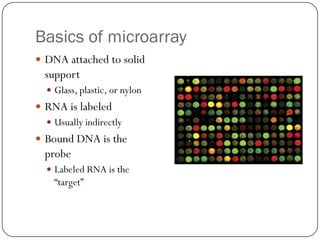
Basics of microarray
 DNA attached to solid
support
 Glass, plastic, or nylon
 RNA is labeled
 Usually indirectly
 Bound DNA is the
probe
 Labeled RNA is the
“target”
Slide based microarray
 For slide-based microarrays, the probe DNA is affixed
directly to the surface of a glass microscope slide.The probe
DNA can range from a medium-length oligonucleotide (e.g.,
60 nt) to an entire cDNA clone or larger. Oligonucleotide
arrays have become more common and can be obtained from
several different commercial vendors.
 The DNA is deposited on the slide by any of a number of
methods, including “printing” with what is essentially an ink-
jet printer and spotting using a robotically controlled set of
fine-tipped metal pins.An example of the latter is seen in the
following slides:
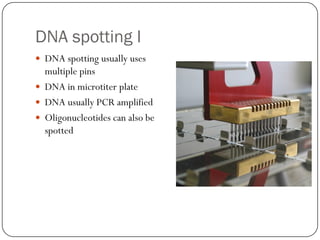
DNA spotting I
 DNA spotting usually uses
multiple pins
 DNA in microtiter plate
 DNA usually PCR amplified
 Oligonucleotides can also be
spotted
Commertial DNA spotter
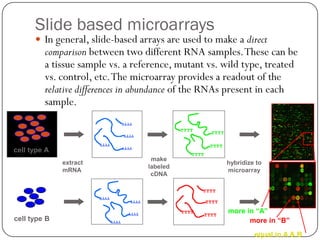
Slide based microarrays
 In general, slide-based arrays are used to make a direct
comparison between two different RNA samples.These can be
a tissue sample vs. a reference, mutant vs. wild type, treated
vs. control, etc.The microarray provides a readout of the
relative differences in abundance of the RNAs present in each
sample.
extract
mRNA
make
labeled
cDNA
hybridize to
microarray
more in “A”
more in “B”
equal in A & B
cell type B
cell type A
cDNA microarrays: key points
• hybridize two samples/chip (i.e., direct comparison of
samples)
• non-standardized production can affect reproducibility (i.e.,
depends a lot on who made them), although there are now
many quality-controlled commercial arrays available
• longer sequences can have cross-hybridization with other
genes
• don’t necessarily need to know all genes in genome: can use
unsequenced ESTs, for instance
Affymatrix gene chips
 Oligonucleotides
 Usually 20–25 bases in length
 10–20 different oligonucleotides for each gene
 Oligonucleotides for each gene selected by computer
program to be the following:
 Unique in genome
 Nonoverlapping
 Composition based on design rules
 Empirically derived
How microarrays are made: Affymatrix
gene chips
 Oligonucleotides synthesized on silicon chip
 One base at a time
 Uses process of photolithography
 Developed for printing computer circuits
Affymatrix gene chips
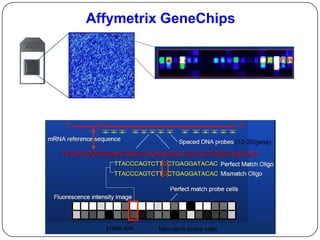
 Each gene is represented by a “probe set” consisting of 12-20
probes of 25 nt each. Each probe has a corresponding
“mismatch” probe with a single base difference at the 13th
nucleotide. Labeled RNA is hybridized to the array, and a
measure of abundance is calculated based on the amount of
hybridization seen for the entire probe set, correcting for
hybridization to the mismatch probes, which indicates
possible non-specific effects.
probe pair Mismatch probe cells
(12-20/gene)
Affymetrix GeneChips
Affymatrix :key points
• can hybridize only one sample/chip (i.e., no direct
comparisons of 2 samples)
• standardized production tends to give good reproducibility
• limited amount of probe sequence can be problematic (miss
alternative splices, bias toward one end of transcript,
dependent on good genome annotation), but can also be
helpful in limiting cross- hybridization
Comparison of microarray hybridisation
 Spotted microarrays
 Competitive hybridization
 Two labeled cDNAs hybridized to same slide
 Affymetrix GeneChips
 One labeled RNA population per chip
 Comparison made between hybridization intensities of same
oligonucleotides on different chips
Uses of microarray
 Gene expression profiling
- Monitoring expression levels for thousands of genes simultaneously.
Three other common applications:
 Array CGH (Comparative genomic hybridization)
-Assessing genome content in different cells or closely related
organisms.
 SNP array (single nucleotide polymorphism)
- Identifying single nucleotide polymorphism among alleles within or
between populations.
 ChIP-on-chip (Chromatin immunoprecipitation)
- Determining protein binding site occupancy throughout the genome.
 Methylation arrays (immonoprecipitate methylated DNA_
-Determining which regions of DNA are methylated to determine
epigenetics
Thank you

Microarray @ujjwal sirohi

  • 1.
    : Ujjwal Sirohi Phdresearch scholar Microarray Stay connected on @sirohiujjwal
  • 2.
     This isan old ppt of mine  Reliable information  Concern with other materials too
  • 3.
     A DNAmicroarray (also commonly known as DNA chip or biochip) is a collection of microscopic DNA spots attached to a solid surface.  Scientists use DNA microarray to measure the expression level of genes simuntaneously or to genotype multiple regions of a genome.  Each DNA spot contains picomoles os aspecific DNA aequence such as probes(or reporters of oligos).  These can be a short section of a gene or other DNA element that are used to hybridise a cDNA or cRNA (also called anti-sence RNA) sample (called target) under high-stringency conditions.
  • 4.
     Probe targethybridisation is usually detected and quantified by detection of fluorophore-, silver-, or chemiluminescence –labelled targets to determine relative advance of nucleic acid sequence in the targets.  Microarrays are based on the ability of complementary strands of DNA (or DNA and RNA) to hybridize to one another in solution with high specificity.  There are now many variations.We’ll take a quick look at the two basic types:Affymetrix (high density oligonucleotide) and glass slide (cDNA, long oligo, etc). Both are conceptually similar, with differences in manufacture and details of design and analysis.
  • 5.
    principle  The coreprinciple behind microarray is hybridisation b/w two DNA strands, the property of complementary nucleic acid sequences to specifically pair with each other by forming hydrogen bonds b/w complementary nucleotide base pair.  A high number of complementary base pair in a nucleotide sequence means tighter non-covalent bonding between the two strands.  After washing off non-specific bonding sequences, only strong paired strands will remain hybridised.  Fluorescently labeled target sequences that bind to a probe sequence generate a signal that depends on the hybridisation condition(such as temperature), and washing after hybridisation.
  • 6.
     Total strengthof the signal from the spot(feature), depends upon the amount of target sample binding to the probes present on that spot.  Microarrays use relative quantitation in which the intensity of a feature is compaired to the intensity of the same feature under a different condition, and the identity of the feature is known by its position.
  • 7.
    Types of microarray includes  DNA microarrays, such as cDNA microarrays and oligonucleotide microarrays, SNPs, CHiP  MMChips, for surveillance of microRNA populations  Protein microarrays (protein-protein interactions)  Tissue microarrays  Cellular microarrays (also called transfection microarrays  Chemical compound microarrays  Antibody microarrays (proteomics)  Carbohydrate arrays (glycoarrays)
  • 8.
    History of DNAmicroarray  Microarrays descend from Southern and Northern blotting. Unknown DNA is transferred to a membrane and then probed with a known DNA sequence with a label  In Microarrays, the known DNA sequence (or probe) is on the membrane while the unknown labeled DNA (or target) is hybridized and then washed off so only specific hybrids remain.  Dot Blots of different genes in an array were used to assay gene expression as early as 1987.  Complete genome of all Saccharomyces cerevisiae ORFs on a microarray published in 1997 by Lashkari et al.
  • 9.
    what can bemeasured using microarrays? Amount of mRNA expressed by a gene. gene expression array, exon array, tiling array 2. Amount of mRNA expressed by an exon. exon array, tiling array 3. Amount of RNA expressed by a region of DNA. tiling array 4. Which strand of DNA is expressed. exon array, tiling array 5. Which of several similar DNA sequences is present in the genome. SNP array 6 . How many copies of a gene is present in the genome. gene expression array, exon array, tiling array 7. Where a known protein has bound to the DNA. (ChIP on chip) promoter array, tiling array
  • 10.
    Basics of microarray DNA attached to solid support  Glass, plastic, or nylon  RNA is labeled  Usually indirectly  Bound DNA is the probe  Labeled RNA is the “target”
  • 11.
    Slide based microarray For slide-based microarrays, the probe DNA is affixed directly to the surface of a glass microscope slide.The probe DNA can range from a medium-length oligonucleotide (e.g., 60 nt) to an entire cDNA clone or larger. Oligonucleotide arrays have become more common and can be obtained from several different commercial vendors.  The DNA is deposited on the slide by any of a number of methods, including “printing” with what is essentially an ink- jet printer and spotting using a robotically controlled set of fine-tipped metal pins.An example of the latter is seen in the following slides:
  • 12.
    DNA spotting I DNA spotting usually uses multiple pins  DNA in microtiter plate  DNA usually PCR amplified  Oligonucleotides can also be spotted
  • 13.
  • 14.
    Slide based microarrays In general, slide-based arrays are used to make a direct comparison between two different RNA samples.These can be a tissue sample vs. a reference, mutant vs. wild type, treated vs. control, etc.The microarray provides a readout of the relative differences in abundance of the RNAs present in each sample. extract mRNA make labeled cDNA hybridize to microarray more in “A” more in “B” equal in A & B cell type B cell type A
  • 15.
    cDNA microarrays: keypoints • hybridize two samples/chip (i.e., direct comparison of samples) • non-standardized production can affect reproducibility (i.e., depends a lot on who made them), although there are now many quality-controlled commercial arrays available • longer sequences can have cross-hybridization with other genes • don’t necessarily need to know all genes in genome: can use unsequenced ESTs, for instance
  • 16.
    Affymatrix gene chips Oligonucleotides  Usually 20–25 bases in length  10–20 different oligonucleotides for each gene  Oligonucleotides for each gene selected by computer program to be the following:  Unique in genome  Nonoverlapping  Composition based on design rules  Empirically derived
  • 17.
    How microarrays aremade: Affymatrix gene chips  Oligonucleotides synthesized on silicon chip  One base at a time  Uses process of photolithography  Developed for printing computer circuits
  • 18.
    Affymatrix gene chips Each gene is represented by a “probe set” consisting of 12-20 probes of 25 nt each. Each probe has a corresponding “mismatch” probe with a single base difference at the 13th nucleotide. Labeled RNA is hybridized to the array, and a measure of abundance is calculated based on the amount of hybridization seen for the entire probe set, correcting for hybridization to the mismatch probes, which indicates possible non-specific effects. probe pair Mismatch probe cells
  • 19.
    probe pair Mismatchprobe cells (12-20/gene) Affymetrix GeneChips
  • 20.
    Affymatrix :key points •can hybridize only one sample/chip (i.e., no direct comparisons of 2 samples) • standardized production tends to give good reproducibility • limited amount of probe sequence can be problematic (miss alternative splices, bias toward one end of transcript, dependent on good genome annotation), but can also be helpful in limiting cross- hybridization
  • 21.
    Comparison of microarrayhybridisation  Spotted microarrays  Competitive hybridization  Two labeled cDNAs hybridized to same slide  Affymetrix GeneChips  One labeled RNA population per chip  Comparison made between hybridization intensities of same oligonucleotides on different chips
  • 22.
    Uses of microarray Gene expression profiling - Monitoring expression levels for thousands of genes simultaneously. Three other common applications:  Array CGH (Comparative genomic hybridization) -Assessing genome content in different cells or closely related organisms.  SNP array (single nucleotide polymorphism) - Identifying single nucleotide polymorphism among alleles within or between populations.  ChIP-on-chip (Chromatin immunoprecipitation) - Determining protein binding site occupancy throughout the genome.  Methylation arrays (immonoprecipitate methylated DNA_ -Determining which regions of DNA are methylated to determine epigenetics
  • 23.