FUNCTIONAL
GENOMIC
5/9/2020 1
By
KAUSHAL KUMAR SAHU
Assistant Professor (Ad Hoc)
Department of Biotechnology
Govt. Digvijay Autonomous P. G. College
Raj-Nandgaon ( C. G. )
 Introduction
 Transcriptome analysis
 Goal of functional genomics
 Why we need functional genomics
 Technique
 1. At DNA level
 2.At RNA level
 3. At protein level
 4. loss of function
 5. functional genomic and bioinformatics
 Application
 Latest research and reviews
 Websites of functional genomics
 Conclusions
 Reference
5/9/2020 2
GENE-
 A unit of heredity which is transferred from a parent
to offspring and is held to determine some
characteristic of the offspring.
 A gene is a sequence of DNA or RNA which codes for
a molecule that has a function
GENOME –
 Entire complement of genetic information.
 Include genes, regulatory sequence , and non coding
DNA.
GENOMICS-
 Discipline of mapping , sequencing, analyzing and
comparing genomes.
5/9/2020 3
5/9/2020 4
 Genomics – it is the study of genomes.
 The field of genomics comprises of two main
areas;
 1. structural genomics
 2. functional genomics
 Structural genomics- deals with genome
structure with a focus on the study of
genome mapping and assembly as well as
genome annotation and comparison.
5/9/2020 5
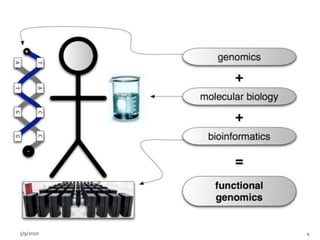
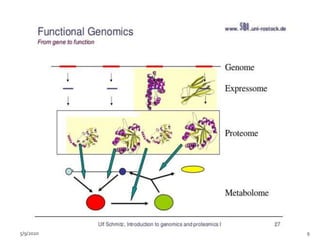
 Functional genomics is a field of molecular biology
that attempts to make use of the vast wealth of
data given by genomic and transcriptomic projects
(such as genome sequencing projects and RNA
sequencing) to describe gene (and protein)
functions and interactions.
 Functional genomics focus on the dynamic aspects
such as gene transcription , translation and ppi.
 It is largely experiment based with a focus on gene
function at the whole genome level using high
throughput approaches.
 The high throughput analysis of all expressed genes
is also termed transcriptome analysis.
5/9/2020 6
 Study of transcriptomes (i.e complete set of
RNA produced by genome at any one time)
 Provide gene expression profile.
 Gene expression identification.
5/9/2020 7
EXPLORATORY STUDIES
 Which genes are
differentially expressed?
 Which genes are co
expressed?
 Which genes interact?
 Which genes show
alternative splicing?
PROGNOSTIC STUDIES
 Which cancer has patient
X?
 Is my drug safe for patient
Y?
 Which treatment is the
most efficients?
5/9/2020 8
5/9/2020 9
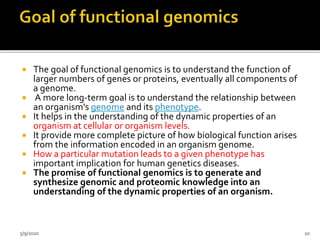
 The goal of functional genomics is to understand the function of
larger numbers of genes or proteins, eventually all components of
a genome.
 A more long-term goal is to understand the relationship between
an organism's genome and its phenotype.
 It helps in the understanding of the dynamic properties of an
organism at cellular or organism levels.
 It provide more complete picture of how biological function arises
from the information encoded in an organism genome.
 How a particular mutation leads to a given phenotype has
important implication for human genetics diseases.
 The promise of functional genomics is to generate and
synthesize genomic and proteomic knowledge into an
understanding of the dynamic properties of an organism.
5/9/2020 10
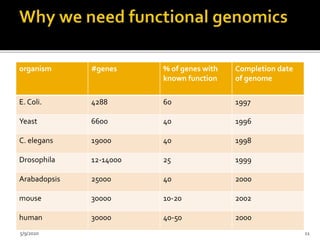
organism #genes % of genes with
known function
Completion date
of genome
E. Coli. 4288 60 1997
Yeast 6600 40 1996
C. elegans 19000 40 1998
Drosophila 12-14000 25 1999
Arabadopsis 25000 40 2000
mouse 30000 10-20 2002
human 30000 40-50 2000
5/9/2020 11
 Functional genomics includes function-
related aspects of the genome itself such as
mutation and polymorphism (such as single
nucleotide polymorphism (SNP) analysis), as
well as measurement of molecular activities
5/9/2020 12
GENETIC INTERACTION MAPPING
 Systematic pair wise deletion of genes or
inhibition of gene expression can be used to
identify genes with related function, even if they
do not interact physically.
THE ENCODE PROJECT
 The ENCODE (Encyclopedia of DNA elements)
project is an in-depth analysis of the human
genome whose goal is to identify all the
functional elements of genomic DNA, in both
coding and noncoding regions.
5/9/2020 13
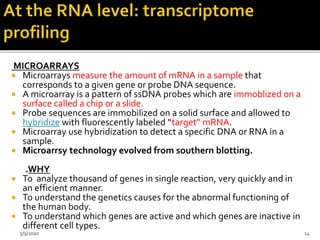
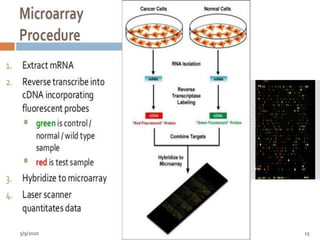
MICROARRAYS
 Microarrays measure the amount of mRNA in a sample that
corresponds to a given gene or probe DNA sequence.
 A microarray is a pattern of ssDNA probes which are immoblized on a
surface called a chip or a slide.
 Probe sequences are immobilized on a solid surface and allowed to
hybridize with fluorescently labeled “target” mRNA.
 Microarray use hybridization to detect a specific DNA or RNA in a
sample.
 Microarrsy technology evolved from southern blotting.
.WHY
 To analyze thousand of genes in single reaction, very quickly and in
an efficient manner.
 To understand the genetics causes for the abnormal functioning of
the human body.
 To understand which genes are active and which genes are inactive in
different cell types.
5/9/2020 14
5/9/2020 15
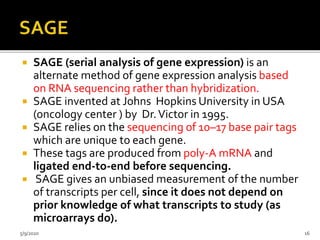
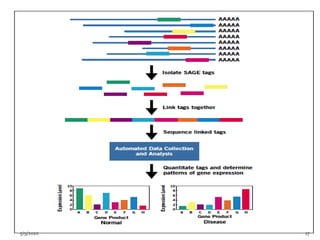
 SAGE (serial analysis of gene expression) is an
alternate method of gene expression analysis based
on RNA sequencing rather than hybridization.
 SAGE invented at Johns Hopkins University in USA
(oncology center ) by Dr.Victor in 1995.
 SAGE relies on the sequencing of 10–17 base pair tags
which are unique to each gene.
 These tags are produced from poly-A mRNA and
ligated end-to-end before sequencing.
 SAGE gives an unbiased measurement of the number
of transcripts per cell, since it does not depend on
prior knowledge of what transcripts to study (as
microarrays do).
5/9/2020 16
5/9/2020 17
 RNA SEQUENCING
 RNA sequencing has taken over microarray and SAGE
technology in recent years and has become the most
efficient way to study transcription and gene
expression.This is typically done by next-generation
sequencing.
 A subset of sequenced RNAs are small RNAs, a class
of non-coding RNA molecules that are key regulators
of transcriptional and post-transcriptional gene
silencing, or RNA silencing.
 Next generation sequencing is the gold standard tool
for non-coding RNA discovery, profiling and
expression analysis.
5/9/2020 18
 YEASTTWO-HYBRID SYSTEM
 A yeast two-hybrid (Y2H) screen tests a "bait" protein against many potential
interacting proteins ("prey") to identify physical protein–protein interactions.This
system is based on a transcription factor, originallyGAL4,[4] whose separate
DNA-binding and transcription activation domains are both required in order for
the protein to cause transcription of a reporter gene.
 In aY2H screen, the "bait" protein is fused to the binding domain of GAL4, and a
library of potential "prey" (interacting) proteins is recombinantly expressed in a
vector with the activation domain.
 AP/MS
 Affinity purification and mass spectrometry (AP/MS) is able to identify proteins
that interact with one another in complexes.
 Complexes of proteins are allowed to form around a particular “bait” protein.The
bait protein is identified using an antibody or a recombinant tag which allows it
to be extracted along with any proteins that have formed a complex with it.
 The proteins are then digested into short peptide fragments and mass
spectrometry is used to identify the proteins based on the mass-to-charge ratios
of those fragments.
5/9/2020 19
Mutagenesis
 Gene function can be investigated by systematically “knocking out”
genes one by one.
 This is done by either deletion or disruption of function (such as by
insertional mutagenesis) and the resulting organisms are screened for
phenotypes that provide clues to the function of the disrupted gene.
RNAi
 RNA interference (RNAi) methods can be used to transiently silence or
knock down gene expression using ~20 base-pair double-stranded RNA
typically delivered by transfection of synthetic ~20-mer short-interfering
RNA molecules (siRNAs) or by virally encoded short-hairpin RNAs
(shRNAs).
 RNAi screens, typically performed in cell culture-based assays or
experimental organisms (such as C. elegans) can be used to
systematically disrupt nearly every gene in a genome or subsets of genes
(sub-genomes); possible functions of disrupted genes can be assigned
based on observed phenotypes.
5/9/2020 20
 Because of the large quantity of data produced
by these techniques and the desire to find
biologically meaningful patterns, bioinformatics
is crucial to analysis of functional genomics data.
 Examples of techniques in this class are data
clustering or principal component analysis for
unsupervised machine learning (class detection)
as well as artificial neural networks or support
vector machines for supervised machine
learning (class prediction, classification).
5/9/2020 21
 Functional genomics deals with function or
expression of genomes.
 Transcriptome: all transcripts an organism
makes at given time.
 Genomic functional profiling: use of
genomics information to block expression
systematically.
5/9/2020 22
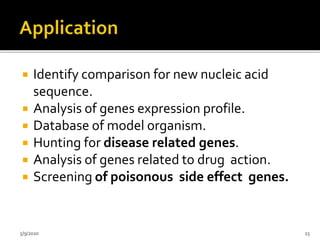
 Identify comparison for new nucleic acid
sequence.
 Analysis of genes expression profile.
 Database of model organism.
 Hunting for disease related genes.
 Analysis of genes related to drug action.
 Screening of poisonous side effect genes.
5/9/2020 23
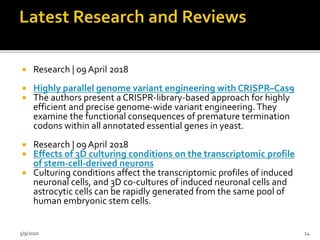
 Research | 09 April 2018
 Highly parallel genome variant engineering with CRISPR–Cas9
 The authors present a CRISPR-library-based approach for highly
efficient and precise genome-wide variant engineering. They
examine the functional consequences of premature termination
codons within all annotated essential genes in yeast.
 Research | 09 April 2018
 Effects of 3D culturing conditions on the transcriptomic profile
of stem-cell-derived neurons
 Culturing conditions affect the transcriptomic profiles of induced
neuronal cells, and 3D co-cultures of induced neuronal cells and
astrocytic cells can be rapidly generated from the same pool of
human embryonic stem cells.
5/9/2020 24
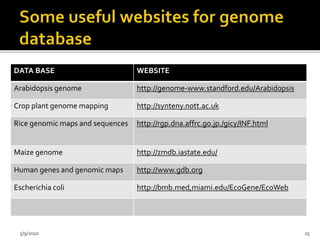
DATA BASE WEBSITE
Arabidopsis genome http://genome-www.standford.edu/Arabidopsis
Crop plant genome mapping http://synteny.nott.ac.uk
Rice genomic maps and sequences http://rgp.dna.affrc.go.jp./gicy/INF.html
Maize genome http://zmdb.iastate.edu/
Human genes and genomic maps http://www.gdb.org
Escherichia coli http://bmb.med,miami.edu/EcoGene/EcoWeb
5/9/2020 25
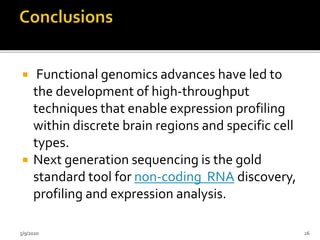
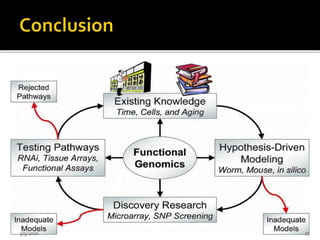
 Functional genomics advances have led to
the development of high-throughput
techniques that enable expression profiling
within discrete brain regions and specific cell
types.
 Next generation sequencing is the gold
standard tool for non-coding RNA discovery,
profiling and expression analysis.
5/9/2020 26
5/9/2020 27
 INTERNET-
 http://www.nature.com/subjects/functional-
genomics
 http://www.bing.com/search?q=functional+geno
mics+latest+researh+and+news+nature&qs=ds&
form=QBRE
 https://en.wikipedia.org/wiki/Functional_genom
ics
 Books –
 1.bioinformatics and functional genomics-[
Jonathan Pevsner]
 B.D. Singh - biotechnology
5/9/2020 28

Functional genomics, and tools

  • 1.
    FUNCTIONAL GENOMIC 5/9/2020 1 By KAUSHAL KUMARSAHU Assistant Professor (Ad Hoc) Department of Biotechnology Govt. Digvijay Autonomous P. G. College Raj-Nandgaon ( C. G. )
  • 2.
     Introduction  Transcriptomeanalysis  Goal of functional genomics  Why we need functional genomics  Technique  1. At DNA level  2.At RNA level  3. At protein level  4. loss of function  5. functional genomic and bioinformatics  Application  Latest research and reviews  Websites of functional genomics  Conclusions  Reference 5/9/2020 2
  • 3.
    GENE-  A unitof heredity which is transferred from a parent to offspring and is held to determine some characteristic of the offspring.  A gene is a sequence of DNA or RNA which codes for a molecule that has a function GENOME –  Entire complement of genetic information.  Include genes, regulatory sequence , and non coding DNA. GENOMICS-  Discipline of mapping , sequencing, analyzing and comparing genomes. 5/9/2020 3
  • 4.
  • 5.
     Genomics –it is the study of genomes.  The field of genomics comprises of two main areas;  1. structural genomics  2. functional genomics  Structural genomics- deals with genome structure with a focus on the study of genome mapping and assembly as well as genome annotation and comparison. 5/9/2020 5
  • 6.
     Functional genomicsis a field of molecular biology that attempts to make use of the vast wealth of data given by genomic and transcriptomic projects (such as genome sequencing projects and RNA sequencing) to describe gene (and protein) functions and interactions.  Functional genomics focus on the dynamic aspects such as gene transcription , translation and ppi.  It is largely experiment based with a focus on gene function at the whole genome level using high throughput approaches.  The high throughput analysis of all expressed genes is also termed transcriptome analysis. 5/9/2020 6
  • 7.
     Study oftranscriptomes (i.e complete set of RNA produced by genome at any one time)  Provide gene expression profile.  Gene expression identification. 5/9/2020 7
  • 8.
    EXPLORATORY STUDIES  Whichgenes are differentially expressed?  Which genes are co expressed?  Which genes interact?  Which genes show alternative splicing? PROGNOSTIC STUDIES  Which cancer has patient X?  Is my drug safe for patient Y?  Which treatment is the most efficients? 5/9/2020 8
  • 9.
  • 10.
     The goalof functional genomics is to understand the function of larger numbers of genes or proteins, eventually all components of a genome.  A more long-term goal is to understand the relationship between an organism's genome and its phenotype.  It helps in the understanding of the dynamic properties of an organism at cellular or organism levels.  It provide more complete picture of how biological function arises from the information encoded in an organism genome.  How a particular mutation leads to a given phenotype has important implication for human genetics diseases.  The promise of functional genomics is to generate and synthesize genomic and proteomic knowledge into an understanding of the dynamic properties of an organism. 5/9/2020 10
  • 11.
    organism #genes %of genes with known function Completion date of genome E. Coli. 4288 60 1997 Yeast 6600 40 1996 C. elegans 19000 40 1998 Drosophila 12-14000 25 1999 Arabadopsis 25000 40 2000 mouse 30000 10-20 2002 human 30000 40-50 2000 5/9/2020 11
  • 12.
     Functional genomicsincludes function- related aspects of the genome itself such as mutation and polymorphism (such as single nucleotide polymorphism (SNP) analysis), as well as measurement of molecular activities 5/9/2020 12
  • 13.
    GENETIC INTERACTION MAPPING Systematic pair wise deletion of genes or inhibition of gene expression can be used to identify genes with related function, even if they do not interact physically. THE ENCODE PROJECT  The ENCODE (Encyclopedia of DNA elements) project is an in-depth analysis of the human genome whose goal is to identify all the functional elements of genomic DNA, in both coding and noncoding regions. 5/9/2020 13
  • 14.
    MICROARRAYS  Microarrays measurethe amount of mRNA in a sample that corresponds to a given gene or probe DNA sequence.  A microarray is a pattern of ssDNA probes which are immoblized on a surface called a chip or a slide.  Probe sequences are immobilized on a solid surface and allowed to hybridize with fluorescently labeled “target” mRNA.  Microarray use hybridization to detect a specific DNA or RNA in a sample.  Microarrsy technology evolved from southern blotting. .WHY  To analyze thousand of genes in single reaction, very quickly and in an efficient manner.  To understand the genetics causes for the abnormal functioning of the human body.  To understand which genes are active and which genes are inactive in different cell types. 5/9/2020 14
  • 15.
  • 16.
     SAGE (serialanalysis of gene expression) is an alternate method of gene expression analysis based on RNA sequencing rather than hybridization.  SAGE invented at Johns Hopkins University in USA (oncology center ) by Dr.Victor in 1995.  SAGE relies on the sequencing of 10–17 base pair tags which are unique to each gene.  These tags are produced from poly-A mRNA and ligated end-to-end before sequencing.  SAGE gives an unbiased measurement of the number of transcripts per cell, since it does not depend on prior knowledge of what transcripts to study (as microarrays do). 5/9/2020 16
  • 17.
  • 18.
     RNA SEQUENCING RNA sequencing has taken over microarray and SAGE technology in recent years and has become the most efficient way to study transcription and gene expression.This is typically done by next-generation sequencing.  A subset of sequenced RNAs are small RNAs, a class of non-coding RNA molecules that are key regulators of transcriptional and post-transcriptional gene silencing, or RNA silencing.  Next generation sequencing is the gold standard tool for non-coding RNA discovery, profiling and expression analysis. 5/9/2020 18
  • 19.
     YEASTTWO-HYBRID SYSTEM A yeast two-hybrid (Y2H) screen tests a "bait" protein against many potential interacting proteins ("prey") to identify physical protein–protein interactions.This system is based on a transcription factor, originallyGAL4,[4] whose separate DNA-binding and transcription activation domains are both required in order for the protein to cause transcription of a reporter gene.  In aY2H screen, the "bait" protein is fused to the binding domain of GAL4, and a library of potential "prey" (interacting) proteins is recombinantly expressed in a vector with the activation domain.  AP/MS  Affinity purification and mass spectrometry (AP/MS) is able to identify proteins that interact with one another in complexes.  Complexes of proteins are allowed to form around a particular “bait” protein.The bait protein is identified using an antibody or a recombinant tag which allows it to be extracted along with any proteins that have formed a complex with it.  The proteins are then digested into short peptide fragments and mass spectrometry is used to identify the proteins based on the mass-to-charge ratios of those fragments. 5/9/2020 19
  • 20.
    Mutagenesis  Gene functioncan be investigated by systematically “knocking out” genes one by one.  This is done by either deletion or disruption of function (such as by insertional mutagenesis) and the resulting organisms are screened for phenotypes that provide clues to the function of the disrupted gene. RNAi  RNA interference (RNAi) methods can be used to transiently silence or knock down gene expression using ~20 base-pair double-stranded RNA typically delivered by transfection of synthetic ~20-mer short-interfering RNA molecules (siRNAs) or by virally encoded short-hairpin RNAs (shRNAs).  RNAi screens, typically performed in cell culture-based assays or experimental organisms (such as C. elegans) can be used to systematically disrupt nearly every gene in a genome or subsets of genes (sub-genomes); possible functions of disrupted genes can be assigned based on observed phenotypes. 5/9/2020 20
  • 21.
     Because ofthe large quantity of data produced by these techniques and the desire to find biologically meaningful patterns, bioinformatics is crucial to analysis of functional genomics data.  Examples of techniques in this class are data clustering or principal component analysis for unsupervised machine learning (class detection) as well as artificial neural networks or support vector machines for supervised machine learning (class prediction, classification). 5/9/2020 21
  • 22.
     Functional genomicsdeals with function or expression of genomes.  Transcriptome: all transcripts an organism makes at given time.  Genomic functional profiling: use of genomics information to block expression systematically. 5/9/2020 22
  • 23.
     Identify comparisonfor new nucleic acid sequence.  Analysis of genes expression profile.  Database of model organism.  Hunting for disease related genes.  Analysis of genes related to drug action.  Screening of poisonous side effect genes. 5/9/2020 23
  • 24.
     Research |09 April 2018  Highly parallel genome variant engineering with CRISPR–Cas9  The authors present a CRISPR-library-based approach for highly efficient and precise genome-wide variant engineering. They examine the functional consequences of premature termination codons within all annotated essential genes in yeast.  Research | 09 April 2018  Effects of 3D culturing conditions on the transcriptomic profile of stem-cell-derived neurons  Culturing conditions affect the transcriptomic profiles of induced neuronal cells, and 3D co-cultures of induced neuronal cells and astrocytic cells can be rapidly generated from the same pool of human embryonic stem cells. 5/9/2020 24
  • 25.
    DATA BASE WEBSITE Arabidopsisgenome http://genome-www.standford.edu/Arabidopsis Crop plant genome mapping http://synteny.nott.ac.uk Rice genomic maps and sequences http://rgp.dna.affrc.go.jp./gicy/INF.html Maize genome http://zmdb.iastate.edu/ Human genes and genomic maps http://www.gdb.org Escherichia coli http://bmb.med,miami.edu/EcoGene/EcoWeb 5/9/2020 25
  • 26.
     Functional genomicsadvances have led to the development of high-throughput techniques that enable expression profiling within discrete brain regions and specific cell types.  Next generation sequencing is the gold standard tool for non-coding RNA discovery, profiling and expression analysis. 5/9/2020 26
  • 27.
  • 28.
     INTERNET-  http://www.nature.com/subjects/functional- genomics http://www.bing.com/search?q=functional+geno mics+latest+researh+and+news+nature&qs=ds& form=QBRE  https://en.wikipedia.org/wiki/Functional_genom ics  Books –  1.bioinformatics and functional genomics-[ Jonathan Pevsner]  B.D. Singh - biotechnology 5/9/2020 28