PADMASHREE DR.D.Y.PATIL COLLEGE
OF PHARMACY AKURDI
TOPIC NAME-
DNA MICROARRAY TECHNIQUE.
SUBJECT NAME –PRINCIPAL OF DRUG DISCOVERY
GUIDED BY- DR. PAWANKUMAR WANKHADE SIR
PRESENTED BY – DHANASHRI PRAKASH SONAVANE
Content:
1. Introduction
2. Principle
3. DNA Microarray technology
4. Principle of DNA microarray technology
5. Type of DNA Microarray technology
6. Application of Microarray technology
7. Advantages and disadvantages
8. reference
Introduction:
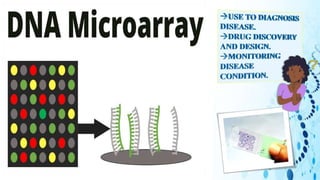
• It Also termed as DNA chips, gene chips, DNA arrays, gene arrays and biochips.
• In it's broadest term, DNA microarray technology may be defined as a high-
throughput and versatile technology used for parallel gene expression analysis for
thousands of genes of known and unknown function, or DNA homology analysis
for detecting polymorphisms and mutations in both prokaryotic and eukaryotic
genomic DNA. However, in its precise and accurate definition DNA microarray is
an orderly arrangement of thousands of identified sequenced genes printed on an
impermeable solid support, usually glass, silicon chips or nylon membrane
• In cDNA microarrays, a set of genetic DNA probes (from several hundreds to
some thousands) are spotted on a slide Two populations of mRNA, tagged with
fluorescent dyes,which are hybridized with the slide spots, and finally the  slide
is read with a scanner.
• DNA microarrays are solid supports usually made up of glass or silicon upon
which DNA is attached in an organized pre-arranged grid design.
• Each spot of DNA, called a probe, represents a single gene.
• Usually a single DNA microarray slide/chip may contain thousands of spots each
representing a single gene and collectively the entire genome of an organism.
• DNA microarrays look at our genes.They can identify the presence or absence of a
gene.
• they can compare our genes with those from another source, and they can see how
our genes are affected by external stimuli.
Principle:
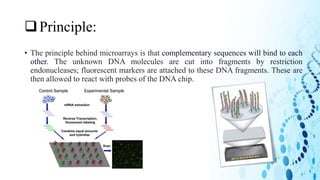
• The principle behind microarrays is that complementary sequences will bind to each
other. The unknown DNA molecules are cut into fragments by restriction
endonucleases; fluorescent markers are attached to these DNA fragments. These are
then allowed to react with probes of the DNA chip.
So what exactly is a DNA Microarray?
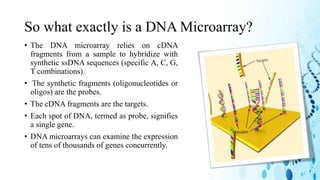
• The DNA microarray relies on cDNA
fragments from a sample to hybridize with
synthetic ssDNA sequences (specific A, C, G,
T combinations).
• The synthetic fragments (oligonucleotides or
oligos) are the probes.
• The cDNA fragments are the targets.
• Each spot of DNA, termed as probe, signifies
a single gene.
• DNA microarrays can examine the expression
of tens of thousands of genes concurrently.
• A DNA microarray is a grid on a
substrate (e.g., glass, silicon).
• Each position in the grid is an “address”
or “feature” as small as 200 nm square.
• Each feature may contain hundreds or
thousands of identical probes (oligos).
• Each array may contain tens of thousands
of features.
• Each feature is looking for a specific
gene sequence of nucleotide bases
• Thousands of specific genes can be
identified simultaneously.
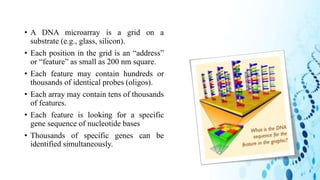
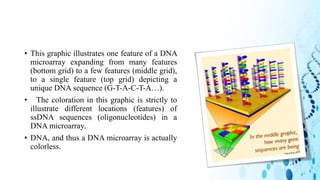
• This graphic illustrates one feature of a DNA
microarray expanding from many features
(bottom grid) to a few features (middle grid),
to a single feature (top grid) depicting a
unique DNA sequence (G-T-A-C-T-A…).
• The coloration in this graphic is strictly to
illustrate different locations (features) of
ssDNA sequences (oligonucleotides) in a
DNA microarray.
• DNA, and thus a DNA microarray is actually
colorless.
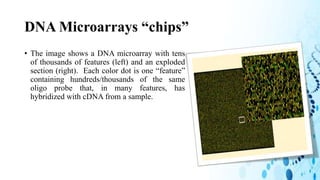
DNA Microarrays “chips”
• The image shows a DNA microarray with tens
of thousands of features (left) and an exploded
section (right). Each color dot is one “feature”
containing hundreds/thousands of the same
oligo probe that, in many features, has
hybridized with cDNA from a sample.
There are 2 types of DNA microarray
1. cDNA based microarray:
• It is also called as spotted DNAArray. cDNA is used for the preparation of chips.
• cDNAs are amplified by PCR.
• It is a high throughput technique.
• Chips are prepared by using cDNA Called cDNA chips or cDNA microarray or
probe DNA.
• Then these immobilized on a solid support made up of nylon filtre of glass slide (1
x 3 inches). The probe DNA are loaded into a a spotting spin by capillary action.
• Small volume of this DNA preparation is spotted on solid surface making physical
contact between these two.DNA is delivered mechanically or in a robotic manner
• It is highly parallel RNA expression assay technique that allows quantitative
analysis of RNAs transcribed from both known and unknown genes.
2. Oligonucleotide based microarray:
• In this type, the spotted probes contains of short, chemically synthesized
sequences, 20-25 mers/gene.
• Shorter probe lengths allows less errors during probe synthesis and enables the
interrogation of small genomic regions, plus polymorphisms
• Despite being easier to produce than dsDNA probes, oligonucleotide probes need
to be carefully designed so that all probes acquire similar melting temperatures
(within 50 c) and eliminate palindromic sequences.
• The probe’s attachment to the glass slides takes place by the covalent linkage as
electrostatic immobilization and cross-linking can result in significant loss of
probes during wash steps due to their small size.
• The coupling of probes to the microarray surface takes place via modified 5′ to 3′
ends on coated slides that provide functional groups (epoxy or aldehyde)
Requirements of DNA microarray:
• DNA chip
• Fluorescent dyes
• Fluorescent labelled target/sample
• Probes
• Scanner
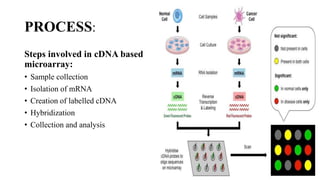
PROCESS:
Steps involved in cDNA based
microarray:
• Sample collection
• Isolation of mRNA
• Creation of labelled cDNA
• Hybridization
• Collection and analysis
1. Sample collection:
• A sample can be any cell/tissue that we desire to conduct our study on.
• Generally, 2 types of samples are collected, i.e. healthy and infected cells, for
comparing and obtaining the results.
2. Isolation of mRNA:
• The extraction of RNA from a sample is performed by using a column or solvent
like phenol-chloroform.
• mRNA is isolated from the extracted RNA leaving behind rRNA and tRNA.
• As mRNA has a poly-A tail, column beads with poly-T tails are employed to bind
mRNA.
• Following the extraction, buffer is used to rinse the column inorder to isolate
mRNA from the beads.
3. Creation of labelled cDNA:
• Reverse transcription of mRNA yields cDNA.
• Both the samples are then integrated with different fluorescent dyes for the
production of fluorescent cDNA strands which allows to differentiate the sample
category of the cDNAs.
4. Hybridization:
• The labelled cDNAs from both the samples are placed on the DNA microarray which
permits the hybridization of each cDNA to its complementary strand.
• Then they are thoroughly washed to remove unpaired sequences.
• Collection and analysis:
• Microarray scanner is used to collect the data.
• The scanner contains a laser, a computer and a camera. The laser is responsible for
exciting the fluorescence of the cDNA, generating signals.
• The camera records the images produced at the time laser scans the array.
• Then computer stores the data and yields results instantly. The data are now
analyzed.
• The distinct intensity of the colors for each spot determines the character of the
gene in that particular spot.
Applications of DNA microarray technique
• DNA microarrays technology has a large impact in many application areas, such as
diagnostic human diseases and treatments (determination of risk factors, monitoring
disease stage and treatment progress, etc.), agricultural development (plant
biotechnology) or quantification of genetically modified organisms, drug discovery
and design.
• Discovery of drugs
• Diagnostics and genetic engineering.
• Alternative splicing detection.
• Proteomics.
• Functional genomics .
• DNA sequencing.
• Gene expression profiling.
• Toxicological research (Toxicogenomics).
Advantages:
✓ Provides data for thousands of genes in real time.
✓ Single experiment generates many results easily.
✓ Fast and easy to obtain results.
✓ Promising for discovering cures to diseases and cancer.
✓ Different parts of DNA can be used to study gene expression.
✓ Provides data for thousands of genes in real time.
Disadvantages:
✓ Single experiment generates many results easily.
✓ Fast and easy to obtain results.
✓ Promising for discovering cures to diseases and cancer.
✓ Different parts of DNA can be used to study gene expression.
References:
1. Bumgarner, Roger. “Overview of DNA microarrays: types, applications, and
their future.” Current protocols in molecular biology vol. Chapter 22 (2013):
Unit 22.1.. doi:10.1002/0471142727.mb2201s101.
DNA  MICROARRAY  TECHNOLOGY FOR  PRINCIPLE OF DRUG DISCOVERY

DNA MICROARRAY TECHNOLOGY FOR PRINCIPLE OF DRUG DISCOVERY

  • 1.
    PADMASHREE DR.D.Y.PATIL COLLEGE OFPHARMACY AKURDI TOPIC NAME- DNA MICROARRAY TECHNIQUE. SUBJECT NAME –PRINCIPAL OF DRUG DISCOVERY GUIDED BY- DR. PAWANKUMAR WANKHADE SIR PRESENTED BY – DHANASHRI PRAKASH SONAVANE
  • 3.
    Content: 1. Introduction 2. Principle 3.DNA Microarray technology 4. Principle of DNA microarray technology 5. Type of DNA Microarray technology 6. Application of Microarray technology 7. Advantages and disadvantages 8. reference
  • 4.
    Introduction: • It Alsotermed as DNA chips, gene chips, DNA arrays, gene arrays and biochips. • In it's broadest term, DNA microarray technology may be defined as a high- throughput and versatile technology used for parallel gene expression analysis for thousands of genes of known and unknown function, or DNA homology analysis for detecting polymorphisms and mutations in both prokaryotic and eukaryotic genomic DNA. However, in its precise and accurate definition DNA microarray is an orderly arrangement of thousands of identified sequenced genes printed on an impermeable solid support, usually glass, silicon chips or nylon membrane • In cDNA microarrays, a set of genetic DNA probes (from several hundreds to some thousands) are spotted on a slide Two populations of mRNA, tagged with fluorescent dyes,which are hybridized with the slide spots, and finally the  slide is read with a scanner.
  • 5.
    • DNA microarraysare solid supports usually made up of glass or silicon upon which DNA is attached in an organized pre-arranged grid design. • Each spot of DNA, called a probe, represents a single gene. • Usually a single DNA microarray slide/chip may contain thousands of spots each representing a single gene and collectively the entire genome of an organism. • DNA microarrays look at our genes.They can identify the presence or absence of a gene. • they can compare our genes with those from another source, and they can see how our genes are affected by external stimuli.
  • 6.
    Principle: • The principlebehind microarrays is that complementary sequences will bind to each other. The unknown DNA molecules are cut into fragments by restriction endonucleases; fluorescent markers are attached to these DNA fragments. These are then allowed to react with probes of the DNA chip.
  • 7.
    So what exactlyis a DNA Microarray? • The DNA microarray relies on cDNA fragments from a sample to hybridize with synthetic ssDNA sequences (specific A, C, G, T combinations). • The synthetic fragments (oligonucleotides or oligos) are the probes. • The cDNA fragments are the targets. • Each spot of DNA, termed as probe, signifies a single gene. • DNA microarrays can examine the expression of tens of thousands of genes concurrently.
  • 8.
    • A DNAmicroarray is a grid on a substrate (e.g., glass, silicon). • Each position in the grid is an “address” or “feature” as small as 200 nm square. • Each feature may contain hundreds or thousands of identical probes (oligos). • Each array may contain tens of thousands of features. • Each feature is looking for a specific gene sequence of nucleotide bases • Thousands of specific genes can be identified simultaneously.
  • 9.
    • This graphicillustrates one feature of a DNA microarray expanding from many features (bottom grid) to a few features (middle grid), to a single feature (top grid) depicting a unique DNA sequence (G-T-A-C-T-A…). • The coloration in this graphic is strictly to illustrate different locations (features) of ssDNA sequences (oligonucleotides) in a DNA microarray. • DNA, and thus a DNA microarray is actually colorless.
  • 10.
    DNA Microarrays “chips” •The image shows a DNA microarray with tens of thousands of features (left) and an exploded section (right). Each color dot is one “feature” containing hundreds/thousands of the same oligo probe that, in many features, has hybridized with cDNA from a sample.
  • 11.
    There are 2types of DNA microarray 1. cDNA based microarray: • It is also called as spotted DNAArray. cDNA is used for the preparation of chips. • cDNAs are amplified by PCR. • It is a high throughput technique. • Chips are prepared by using cDNA Called cDNA chips or cDNA microarray or probe DNA. • Then these immobilized on a solid support made up of nylon filtre of glass slide (1 x 3 inches). The probe DNA are loaded into a a spotting spin by capillary action. • Small volume of this DNA preparation is spotted on solid surface making physical contact between these two.DNA is delivered mechanically or in a robotic manner • It is highly parallel RNA expression assay technique that allows quantitative analysis of RNAs transcribed from both known and unknown genes.
  • 12.
    2. Oligonucleotide basedmicroarray: • In this type, the spotted probes contains of short, chemically synthesized sequences, 20-25 mers/gene. • Shorter probe lengths allows less errors during probe synthesis and enables the interrogation of small genomic regions, plus polymorphisms • Despite being easier to produce than dsDNA probes, oligonucleotide probes need to be carefully designed so that all probes acquire similar melting temperatures (within 50 c) and eliminate palindromic sequences. • The probe’s attachment to the glass slides takes place by the covalent linkage as electrostatic immobilization and cross-linking can result in significant loss of probes during wash steps due to their small size. • The coupling of probes to the microarray surface takes place via modified 5′ to 3′ ends on coated slides that provide functional groups (epoxy or aldehyde)
  • 13.
    Requirements of DNAmicroarray: • DNA chip • Fluorescent dyes • Fluorescent labelled target/sample • Probes • Scanner
  • 14.
    PROCESS: Steps involved incDNA based microarray: • Sample collection • Isolation of mRNA • Creation of labelled cDNA • Hybridization • Collection and analysis
  • 15.
    1. Sample collection: •A sample can be any cell/tissue that we desire to conduct our study on. • Generally, 2 types of samples are collected, i.e. healthy and infected cells, for comparing and obtaining the results. 2. Isolation of mRNA: • The extraction of RNA from a sample is performed by using a column or solvent like phenol-chloroform. • mRNA is isolated from the extracted RNA leaving behind rRNA and tRNA. • As mRNA has a poly-A tail, column beads with poly-T tails are employed to bind mRNA. • Following the extraction, buffer is used to rinse the column inorder to isolate mRNA from the beads.
  • 16.
    3. Creation oflabelled cDNA: • Reverse transcription of mRNA yields cDNA. • Both the samples are then integrated with different fluorescent dyes for the production of fluorescent cDNA strands which allows to differentiate the sample category of the cDNAs. 4. Hybridization: • The labelled cDNAs from both the samples are placed on the DNA microarray which permits the hybridization of each cDNA to its complementary strand. • Then they are thoroughly washed to remove unpaired sequences.
  • 17.
    • Collection andanalysis: • Microarray scanner is used to collect the data. • The scanner contains a laser, a computer and a camera. The laser is responsible for exciting the fluorescence of the cDNA, generating signals. • The camera records the images produced at the time laser scans the array. • Then computer stores the data and yields results instantly. The data are now analyzed. • The distinct intensity of the colors for each spot determines the character of the gene in that particular spot.
  • 18.
    Applications of DNAmicroarray technique • DNA microarrays technology has a large impact in many application areas, such as diagnostic human diseases and treatments (determination of risk factors, monitoring disease stage and treatment progress, etc.), agricultural development (plant biotechnology) or quantification of genetically modified organisms, drug discovery and design. • Discovery of drugs • Diagnostics and genetic engineering. • Alternative splicing detection. • Proteomics. • Functional genomics . • DNA sequencing. • Gene expression profiling. • Toxicological research (Toxicogenomics).
  • 19.
    Advantages: ✓ Provides datafor thousands of genes in real time. ✓ Single experiment generates many results easily. ✓ Fast and easy to obtain results. ✓ Promising for discovering cures to diseases and cancer. ✓ Different parts of DNA can be used to study gene expression. ✓ Provides data for thousands of genes in real time. Disadvantages: ✓ Single experiment generates many results easily. ✓ Fast and easy to obtain results. ✓ Promising for discovering cures to diseases and cancer. ✓ Different parts of DNA can be used to study gene expression.
  • 21.
    References: 1. Bumgarner, Roger.“Overview of DNA microarrays: types, applications, and their future.” Current protocols in molecular biology vol. Chapter 22 (2013): Unit 22.1.. doi:10.1002/0471142727.mb2201s101.