
LYNX THERAPEUTICS’
Massively Parallel
Signature
Sequencing (MPSS)
A DNA SEQUENCING METHOD
HEMA T
MSc BIOCHEMISTRY
DNA Sequencing
Method used to determine the precise
order of the four nucleotide bases –
adenine, guanine, cytosine and thymine -
that make up a strand of DNA.
These bases are responsible for the
genotype and phenotype.
History
Sanger’s studies of insulin first demonstrated the importance of
sequence in biological macromolecules.
2 different DNA sequencing methods have been developed during the
same period
• Sanger’s dideoxy chain-termination sequencing method (method of choice)
• Maxam–Gilbert method
History…
The phi X 174 was the first DNA-based genome to be sequenced in
1977 and then revised slightly in the following year by dideoxy method.
The phi X 174 (or ΦX174) bacteriophage is a single-stranded DNA
(ssDNA) virus that infects Escherichia coli.
Recently several next generation high throughput DNA sequencing
techniques have arrived and are opening fascinating opportunities in
the fields of biology and medicine.
A sequencing can be done by different
methods :
• Maxam – Gilbert sequencing
• Chain-termination methods
• Dye-terminator sequencing
• Large scale sequencing strategies
• New sequencing methods
• High throughput sequencing
High throughput sequencing
High-throughput sequencing technologies are intended to lower the
cost of DNA sequencing and producing thousands or millions of
sequences at once.
• Lynx therapeutics' massively parallel signature sequencing (MPSS)
• Polony sequencing
• Pyrosequencing
• Illumina (Solexa) sequencing
• SOLiD sequencing
• DNA nanoball sequencing
• Helioscope(TM) single molecule sequencing
• Single molecule SMRT(TM) sequencing
• Single molecule real time (RNAP) sequencing
Lynx therapeutics' massively parallel signature
sequencing (MPSS)
• MPSS, the first of the "next-generation" sequencing technologies was developed
in the 1990s by Sydney Brenner.
• At Lynx Therapeutics, a company founded in 1992 by Sydney Brenner and Sam
Eletr.
• MPSS is an ultra high throughput sequencing technology.
• Reveal almost every mRNA transcript in the sample and provide its accurate
expression level.
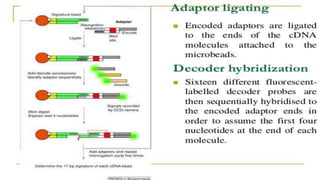
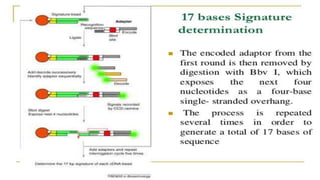
• MPSS was a bead-based method that used a complex approach of adapter ligation
followed by adapter decoding, reading the sequence in increments of four
nucleotides
Massively Parallel Signature Sequencing
(MPSS)
• Massively Parallel Signature Sequencing (MPSS) analyses the level of
gene expression in a sample by counting the number of individual
mRNA molecules produced by each gene.
• MPSS produces data in a digital format.
• MPSS Captures data by counting virtually all mRNA molecules in a
tissue or cell sample.
• All genes are analysed simultaneously, and bioinformatics tools are
used to sort out the number of mRNAs from each gene relative to the
total number of molecules in the sample.
• Even genes that are expressed at low levels can be quantified with
high accuracy.
Principle of MPSS
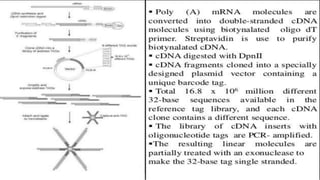
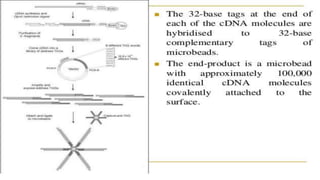
• A sample’s mRNA are first converted to cDNA using reverse
transcriptase, which are fused to a small oligonucleotide "tag" which
allows the cDNA to be PCR amplified and then coupled to
microbeads.
• After several rounds of sequence determination, using hybridization
of fluorescent labeled probes, a sequence signature of ~16-20 bp is
determined from each bead.
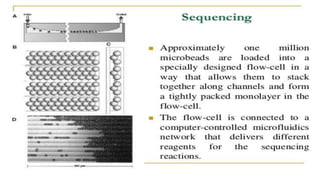
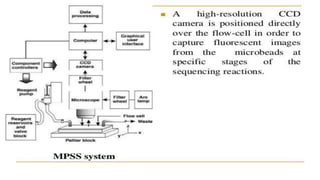
• Fluorescent imaging captures the signal from all of the beads, so DNA
sequences are determined from all the beads in parallel,
approximately 1,000,000 sequence reads are obtained per
experiment.
DNA SEQUENCING PROBLEMS
There are some common automated DNA sequencing problems :-
 Failure of the DNA sequence reaction.
 Mixed signal in the trace ( multiple peaks).
 Short read lengths and poor quality data.
 Excessive free dye peaks “dye blobs” in the trace.
 Primer dimer formation in sequence reaction
 DNA polymerase slippage on the template mononucleotide regions.
THANK YOU

Massively Parallel Signature Sequencing (MPSS)

  • 1.
    LYNX THERAPEUTICS’ Massively Parallel Signature Sequencing(MPSS) A DNA SEQUENCING METHOD HEMA T MSc BIOCHEMISTRY
  • 2.
    DNA Sequencing Method usedto determine the precise order of the four nucleotide bases – adenine, guanine, cytosine and thymine - that make up a strand of DNA. These bases are responsible for the genotype and phenotype.
  • 3.
    History Sanger’s studies ofinsulin first demonstrated the importance of sequence in biological macromolecules. 2 different DNA sequencing methods have been developed during the same period • Sanger’s dideoxy chain-termination sequencing method (method of choice) • Maxam–Gilbert method
  • 4.
    History… The phi X174 was the first DNA-based genome to be sequenced in 1977 and then revised slightly in the following year by dideoxy method. The phi X 174 (or ΦX174) bacteriophage is a single-stranded DNA (ssDNA) virus that infects Escherichia coli. Recently several next generation high throughput DNA sequencing techniques have arrived and are opening fascinating opportunities in the fields of biology and medicine.
  • 5.
    A sequencing canbe done by different methods : • Maxam – Gilbert sequencing • Chain-termination methods • Dye-terminator sequencing • Large scale sequencing strategies • New sequencing methods • High throughput sequencing
  • 6.
    High throughput sequencing High-throughputsequencing technologies are intended to lower the cost of DNA sequencing and producing thousands or millions of sequences at once. • Lynx therapeutics' massively parallel signature sequencing (MPSS) • Polony sequencing • Pyrosequencing • Illumina (Solexa) sequencing • SOLiD sequencing • DNA nanoball sequencing • Helioscope(TM) single molecule sequencing • Single molecule SMRT(TM) sequencing • Single molecule real time (RNAP) sequencing
  • 7.
    Lynx therapeutics' massivelyparallel signature sequencing (MPSS) • MPSS, the first of the "next-generation" sequencing technologies was developed in the 1990s by Sydney Brenner. • At Lynx Therapeutics, a company founded in 1992 by Sydney Brenner and Sam Eletr. • MPSS is an ultra high throughput sequencing technology. • Reveal almost every mRNA transcript in the sample and provide its accurate expression level. • MPSS was a bead-based method that used a complex approach of adapter ligation followed by adapter decoding, reading the sequence in increments of four nucleotides
  • 8.
    Massively Parallel SignatureSequencing (MPSS) • Massively Parallel Signature Sequencing (MPSS) analyses the level of gene expression in a sample by counting the number of individual mRNA molecules produced by each gene. • MPSS produces data in a digital format. • MPSS Captures data by counting virtually all mRNA molecules in a tissue or cell sample. • All genes are analysed simultaneously, and bioinformatics tools are used to sort out the number of mRNAs from each gene relative to the total number of molecules in the sample. • Even genes that are expressed at low levels can be quantified with high accuracy.
  • 9.
    Principle of MPSS •A sample’s mRNA are first converted to cDNA using reverse transcriptase, which are fused to a small oligonucleotide "tag" which allows the cDNA to be PCR amplified and then coupled to microbeads. • After several rounds of sequence determination, using hybridization of fluorescent labeled probes, a sequence signature of ~16-20 bp is determined from each bead. • Fluorescent imaging captures the signal from all of the beads, so DNA sequences are determined from all the beads in parallel, approximately 1,000,000 sequence reads are obtained per experiment.
  • 17.
    DNA SEQUENCING PROBLEMS Thereare some common automated DNA sequencing problems :-  Failure of the DNA sequence reaction.  Mixed signal in the trace ( multiple peaks).  Short read lengths and poor quality data.  Excessive free dye peaks “dye blobs” in the trace.  Primer dimer formation in sequence reaction  DNA polymerase slippage on the template mononucleotide regions.
  • 18.