GENE IDENTIFICATION AND DISCOVERY
GENE IDENTIFICATIONIdentification of important components in genomic DNAIdentification of Genes in a Genomic DNA SequencePrediction of protein-coding genesProkaryotesUnicellular eukaryotesMulticellular eukaryotes
What is a Gene?Fundamental unit of heredityDNA involved in producing a polypeptide; it includes regions preceding and following the coding region (leader and trailer) as well as intervening sequences (introns)Entire DNA sequence including exons, introns, and noncoding transcription-control regions
What Components are Important in Protein Coding Genes?Sequences that initiate transcriptionSequences that process hnRNA to mRNASignals important in translation
Prokaryotic gene predictionProkaryotic gene can be defined simply as the longest ORF for a given region of DNA. Translation of a DNA sequence in all six reading frames is a straightforward taskTranslate tool on the ExPASy server (http://www.expasy.org/tools/dna.html) or the ORF Finder at NCBI (http://www.ncbi.nlm.nih.gov/gorf/gorf.html.)
PROKARYOTES GENE STRUCTURE
PROKARYOTES OPERON
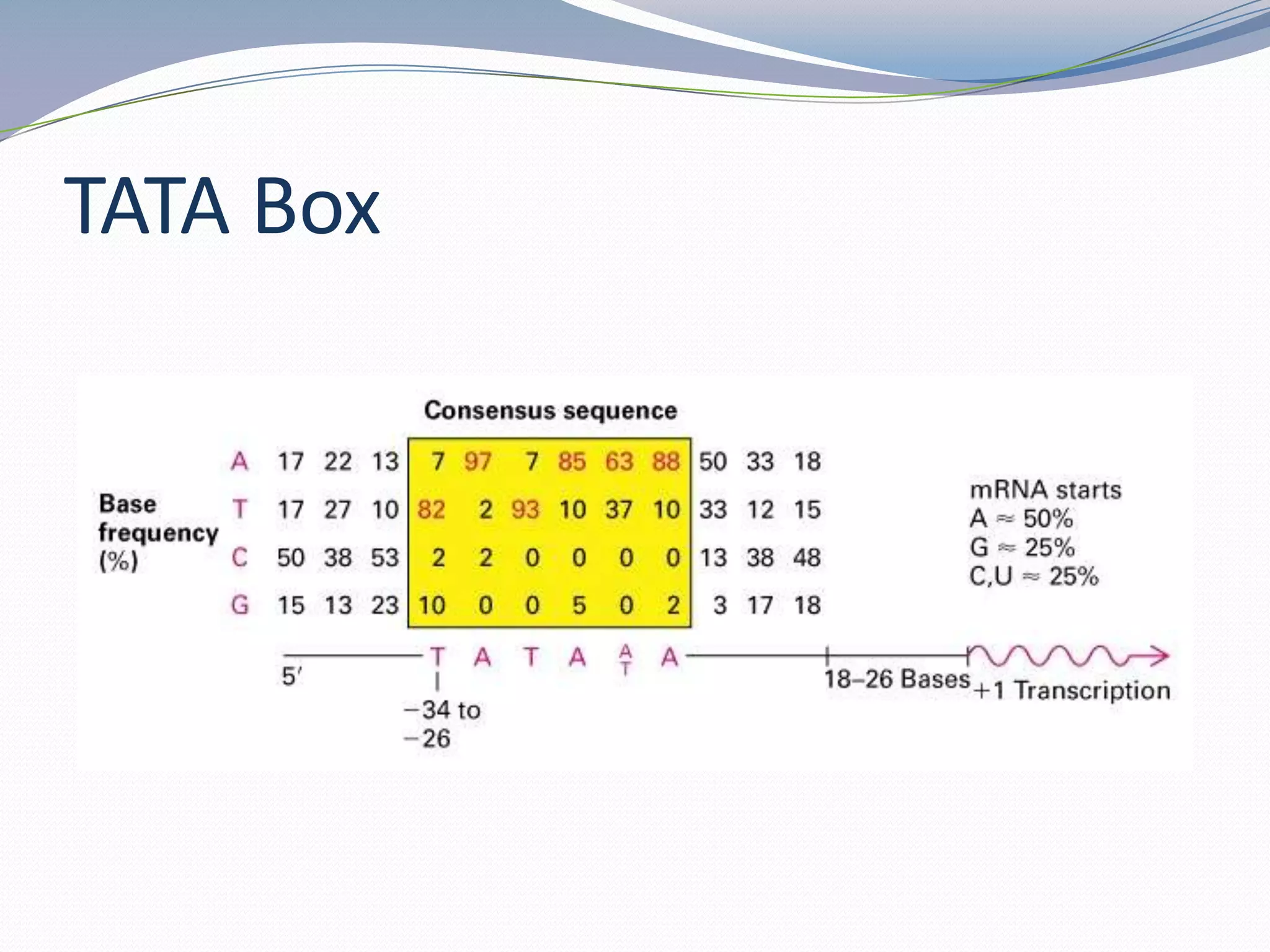
TATA Box
Evidence that a particular ORF actually encodes a proteinThe ORF in question encodes a protein that is similar to previously described ones (search the protein database for homologs of the given sequence).The ORF has a typical GC content, codon frequency, or oligonucleotide composition.The ORF is preceded by a typical ribosome-binding site (search for a Shine-Dalgarno sequence in front of the predicted coding sequence).The ORF is preceded by a typical promoter
Prokaryotic gene predictionFrequency of G and C FramePlot, available at the Japanese Institute of Infectious Diseases (http://www.nih.go.jp/~jun/cgi-bin/frameplot.pl) and at the TIGR web site (http://tigrblast.tigr.org/cmr-blast/GC_Skew.cgi). GeneMark and Glimmer build Markov models of the known coding regions for the given organism and then employ them to estimate the coding potential of uncharacterized ORFs.
EasyGene 1.2 http://servers.binf.ku.dk/cgi-bin/easygene/search
Unicellular eukaryotesGenomes of unicellular eukaryotes are extremely diverse in size, the proportion of the genome that is occupied by protein-encoding genes and the frequency of introns. Smaller the intergenic regions and the fewer introns are there, the easier it is to identify genes. yeast S. cerevisiae, at least 67% of the genome is protein-coding, and only 233 genes (less than 4% of the total) appear to have introns
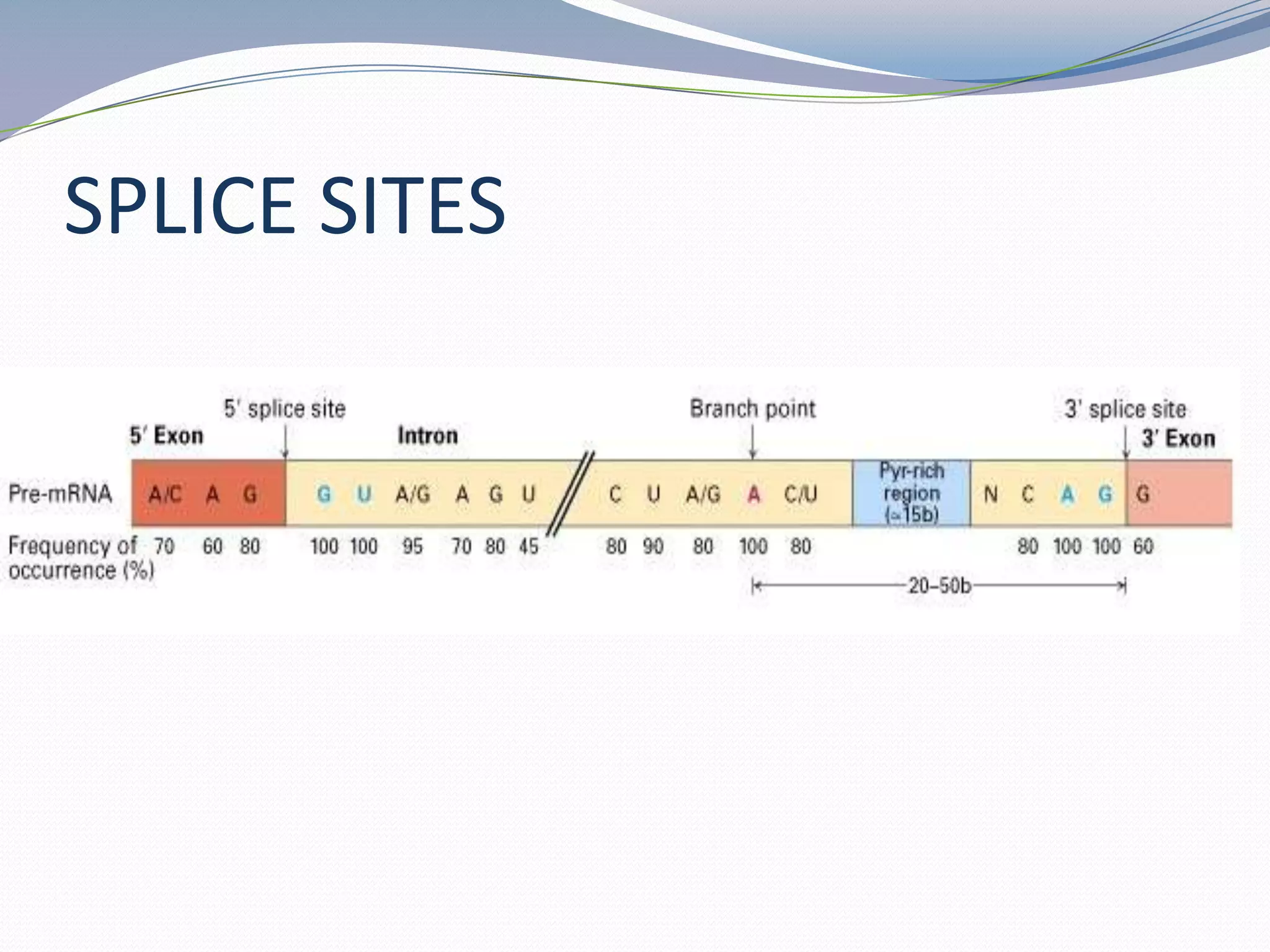
Multicellular eukaryotesCoding regions compose only a minor portion of the gene.Gene prediction should identify all exons and introns, including those in the 5′-untranslated region (5′-UTR) and the 3′-UTR of the mRNA, in order to precisely reconstruct the predominant mRNA species.Correct identification of the exon boundaries relies on the recognition of the splice sites
EUKARYOTES GENE STRUCTURE
SPLICE SITES
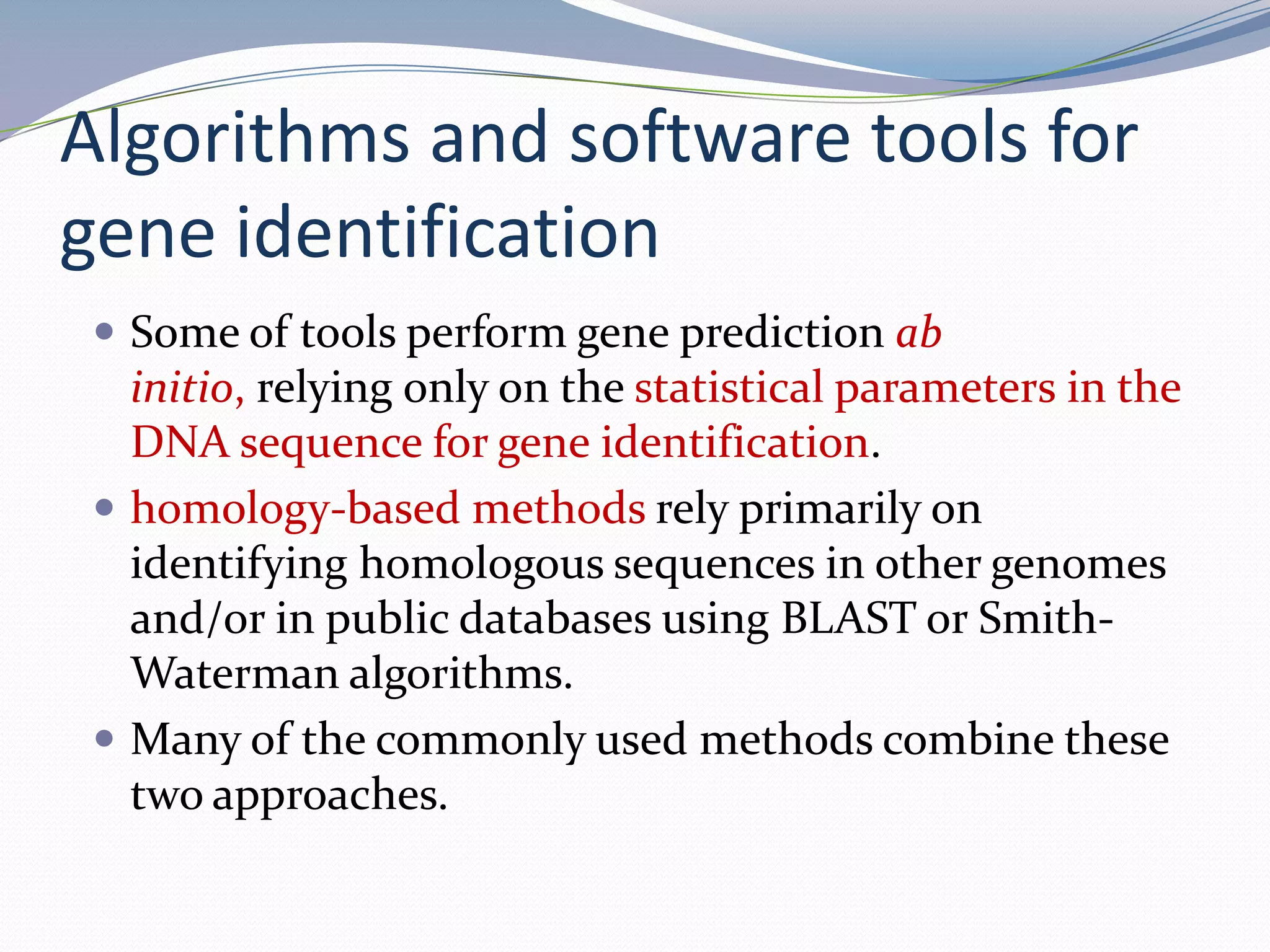
Algorithms and software tools for gene identificationSome of tools perform gene prediction ab initio, relying only on the statistical parameters in the DNA sequence for gene identification. homology-based methods rely primarily on identifying homologous sequences in other genomes and/or in public databases using BLAST or Smith-Waterman algorithms. Many of the commonly used methods combine these two approaches.
Software tools for ab initio gene prediction
Software tools for prediction of splicing sites
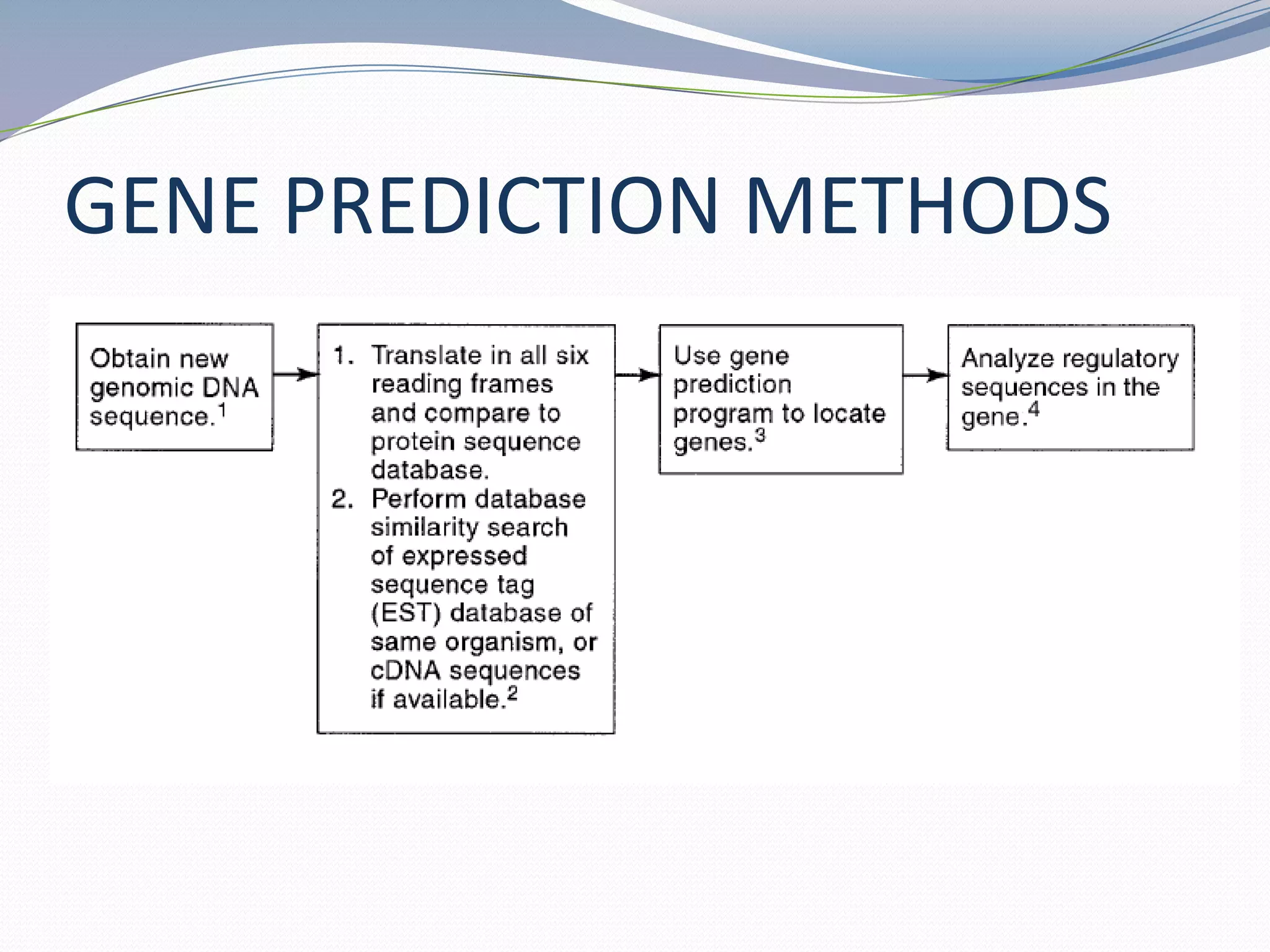
GENE PREDICTION METHODS
FUNCTIONAL CLASSIFICATION OF GENES(I)An early classification scheme for eight related groups of E. coli genes included categories for Enzymes, transport elements, regulators, membranes,  structural elements, protein factors, leader peptides, and carriers. Ninety percent of E. coli genes related by significant sequence similarity fell into these same broad categories
FUNCTIONAL CLASSIFICATION OF GENES(II)The EC numbers formulated by the Enzyme Commission of the International Union of Biochemistry and Molecular Biology provide a detailed way to classify enzymes based on the biochemical reactions they catalyze .The designation ECa.b.c.d(eg. EC 1.4.3.4)gives the following information: 	(a) one of six main classes of biochemical reactions, 	(b) the group of substrate molecule or the nature of chemical bond that is involved in the reaction, 	(c) designation for acceptor molecules (cofactors), and 	(d) specific details of the biochemical reaction.
FUNCTIONAL CLASSIFICATION OF GENES(III)A third measure of functional similarity is based on a physiological characterization of E. coli proteins into 118 possible categories (e.g., DNA synthesis, TCA cycle, etc.)Approximately one-quarter of E. coli genes fall into the same category by this scheme.
FUNCTIONAL CLASSIFICATION OF GENES(IV)Other functional classification schemes for genes include a broader category for genes involved in the same biological process, e.g., a three-group scheme forEnergy-related, Information-related, and Communication-related genes has also been used.By this scheme, plants devote more than one-half of their genome to energy metabolism, whereas animals devote one-half of their genome to communication-related functions
FUNCTIONAL CLASSIFICATION OF GENES(V)Gene Ontology(GO) classification scheme a collaboration among yeast, fly, and mouse informatics groups to develop a general classification scheme useful for several genomes This classification scheme provides a description of gene products based on Function, Biological role, and Cellular location.
The Gene Ontology :http://www.geneontology.org/index.shtml
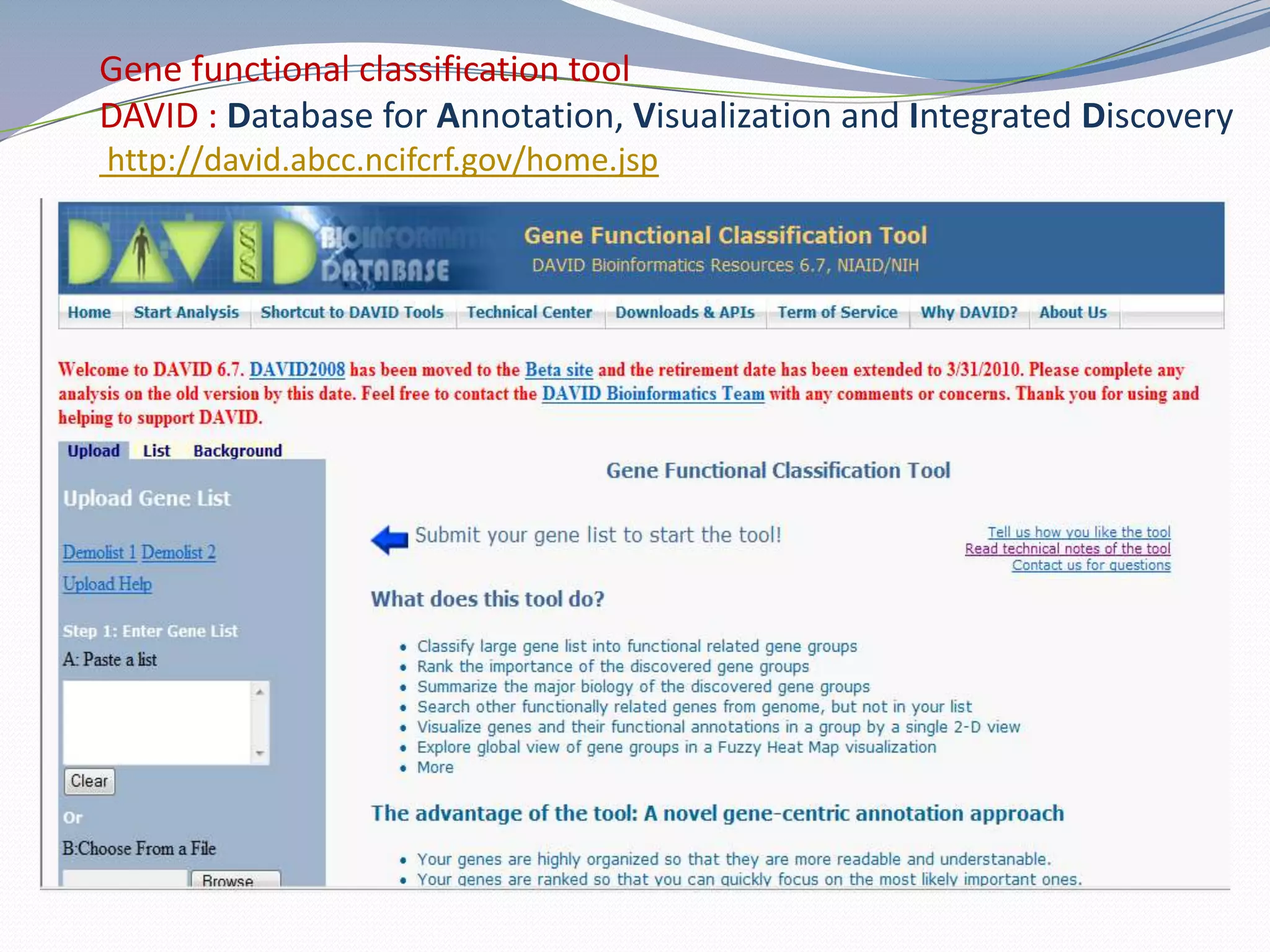
Gene functional classification tool DAVID : Database for Annotation, Visualization and Integrated Discovery http://david.abcc.ncifcrf.gov/home.jsp

Gene identification and discovery

  • 1.
  • 2.
    GENE IDENTIFICATIONIdentification ofimportant components in genomic DNAIdentification of Genes in a Genomic DNA SequencePrediction of protein-coding genesProkaryotesUnicellular eukaryotesMulticellular eukaryotes
  • 3.
    What is aGene?Fundamental unit of heredityDNA involved in producing a polypeptide; it includes regions preceding and following the coding region (leader and trailer) as well as intervening sequences (introns)Entire DNA sequence including exons, introns, and noncoding transcription-control regions
  • 4.
    What Components areImportant in Protein Coding Genes?Sequences that initiate transcriptionSequences that process hnRNA to mRNASignals important in translation
  • 5.
    Prokaryotic gene predictionProkaryoticgene can be defined simply as the longest ORF for a given region of DNA. Translation of a DNA sequence in all six reading frames is a straightforward taskTranslate tool on the ExPASy server (http://www.expasy.org/tools/dna.html) or the ORF Finder at NCBI (http://www.ncbi.nlm.nih.gov/gorf/gorf.html.)
  • 6.
  • 7.
  • 8.
  • 9.
    Evidence that aparticular ORF actually encodes a proteinThe ORF in question encodes a protein that is similar to previously described ones (search the protein database for homologs of the given sequence).The ORF has a typical GC content, codon frequency, or oligonucleotide composition.The ORF is preceded by a typical ribosome-binding site (search for a Shine-Dalgarno sequence in front of the predicted coding sequence).The ORF is preceded by a typical promoter
  • 10.
    Prokaryotic gene predictionFrequencyof G and C FramePlot, available at the Japanese Institute of Infectious Diseases (http://www.nih.go.jp/~jun/cgi-bin/frameplot.pl) and at the TIGR web site (http://tigrblast.tigr.org/cmr-blast/GC_Skew.cgi). GeneMark and Glimmer build Markov models of the known coding regions for the given organism and then employ them to estimate the coding potential of uncharacterized ORFs.
  • 11.
  • 12.
    Unicellular eukaryotesGenomes ofunicellular eukaryotes are extremely diverse in size, the proportion of the genome that is occupied by protein-encoding genes and the frequency of introns. Smaller the intergenic regions and the fewer introns are there, the easier it is to identify genes. yeast S. cerevisiae, at least 67% of the genome is protein-coding, and only 233 genes (less than 4% of the total) appear to have introns
  • 13.
    Multicellular eukaryotesCoding regionscompose only a minor portion of the gene.Gene prediction should identify all exons and introns, including those in the 5′-untranslated region (5′-UTR) and the 3′-UTR of the mRNA, in order to precisely reconstruct the predominant mRNA species.Correct identification of the exon boundaries relies on the recognition of the splice sites
  • 14.
  • 15.
  • 16.
    Algorithms and softwaretools for gene identificationSome of tools perform gene prediction ab initio, relying only on the statistical parameters in the DNA sequence for gene identification. homology-based methods rely primarily on identifying homologous sequences in other genomes and/or in public databases using BLAST or Smith-Waterman algorithms. Many of the commonly used methods combine these two approaches.
  • 17.
    Software tools forab initio gene prediction
  • 18.
    Software tools forprediction of splicing sites
  • 19.
  • 20.
    FUNCTIONAL CLASSIFICATION OFGENES(I)An early classification scheme for eight related groups of E. coli genes included categories for Enzymes, transport elements, regulators, membranes, structural elements, protein factors, leader peptides, and carriers. Ninety percent of E. coli genes related by significant sequence similarity fell into these same broad categories
  • 21.
    FUNCTIONAL CLASSIFICATION OFGENES(II)The EC numbers formulated by the Enzyme Commission of the International Union of Biochemistry and Molecular Biology provide a detailed way to classify enzymes based on the biochemical reactions they catalyze .The designation ECa.b.c.d(eg. EC 1.4.3.4)gives the following information: (a) one of six main classes of biochemical reactions, (b) the group of substrate molecule or the nature of chemical bond that is involved in the reaction, (c) designation for acceptor molecules (cofactors), and (d) specific details of the biochemical reaction.
  • 22.
    FUNCTIONAL CLASSIFICATION OFGENES(III)A third measure of functional similarity is based on a physiological characterization of E. coli proteins into 118 possible categories (e.g., DNA synthesis, TCA cycle, etc.)Approximately one-quarter of E. coli genes fall into the same category by this scheme.
  • 23.
    FUNCTIONAL CLASSIFICATION OFGENES(IV)Other functional classification schemes for genes include a broader category for genes involved in the same biological process, e.g., a three-group scheme forEnergy-related, Information-related, and Communication-related genes has also been used.By this scheme, plants devote more than one-half of their genome to energy metabolism, whereas animals devote one-half of their genome to communication-related functions
  • 24.
    FUNCTIONAL CLASSIFICATION OFGENES(V)Gene Ontology(GO) classification scheme a collaboration among yeast, fly, and mouse informatics groups to develop a general classification scheme useful for several genomes This classification scheme provides a description of gene products based on Function, Biological role, and Cellular location.
  • 25.
    The Gene Ontology:http://www.geneontology.org/index.shtml
  • 26.
    Gene functional classificationtool DAVID : Database for Annotation, Visualization and Integrated Discovery http://david.abcc.ncifcrf.gov/home.jsp