Using Matrices to Transform
Geometric Figures
                   Warm Up
                   Lesson Presentation
                   Lesson Quiz
Warm Up
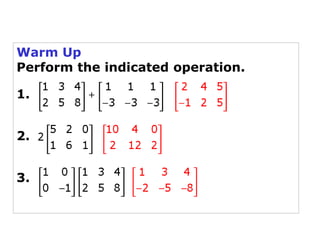
Perform the indicated operation.

1.


2.


3.
Objective
Use matrices to transform a plane
figure.
Vocabulary
translation matrix
reflection matrix
rotation matrix
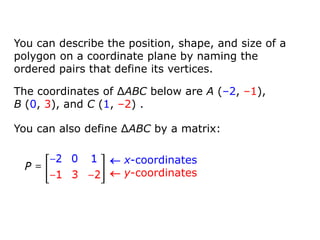
You can describe the position, shape, and size of a
polygon on a coordinate plane by naming the
ordered pairs that define its vertices.

The coordinates of ΔABC below are A (–2, –1),
B (0, 3), and C (1, –2) .

You can also define ΔABC by a matrix:

                  x-coordinates
                  y-coordinates
A translation matrix is a matrix used to
translate coordinates on the coordinate plane.
The matrix sum of a preimage and a translation
matrix gives the coordinates of the translated
image.
Reading Math
The prefix pre- means ―before,‖ so the preimage
is the original figure before any transformations
are applied. The image is the resulting figure
after a transformation.
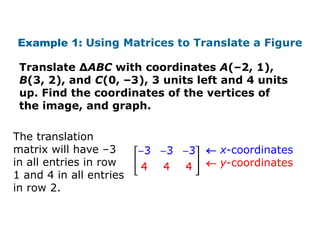
Example 1: Using Matrices to Translate a Figure

 Translate ΔABC with coordinates A(–2, 1),
 B(3, 2), and C(0, –3), 3 units left and 4 units
 up. Find the coordinates of the vertices of
 the image, and graph.

The translation
matrix will have –3               x-coordinates
in all entries in row             y-coordinates
1 and 4 in all entries
in row 2.
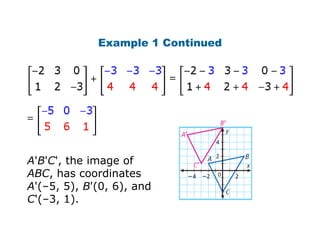
Example 1 Continued


A'B'C', the image of
ABC, has coordinates
A'(–5, 5), B'(0, 6), and
C'(–3, 1).
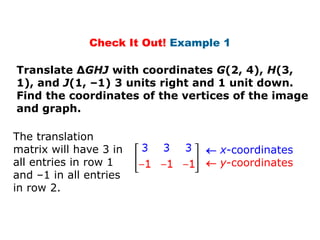
Check It Out! Example 1

Translate ΔGHJ with coordinates G(2, 4), H(3,
1), and J(1, –1) 3 units right and 1 unit down.
Find the coordinates of the vertices of the image
and graph.

The translation
matrix will have 3 in            x-coordinates
all entries in row 1             y-coordinates
and –1 in all entries
in row 2.
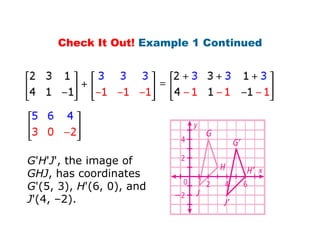
Check It Out! Example 1 Continued


G'H'J', the image of
GHJ, has coordinates
G'(5, 3), H'(6, 0), and
J'(4, –2).
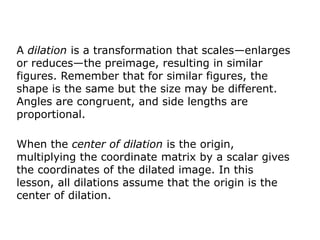
A dilation is a transformation that scales—enlarges
or reduces—the preimage, resulting in similar
figures. Remember that for similar figures, the
shape is the same but the size may be different.
Angles are congruent, and side lengths are
proportional.

When the center of dilation is the origin,
multiplying the coordinate matrix by a scalar gives
the coordinates of the dilated image. In this
lesson, all dilations assume that the origin is the
center of dilation.
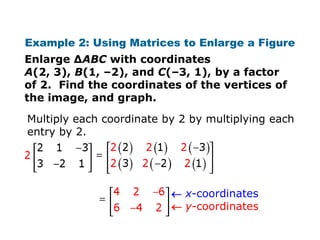
Example 2: Using Matrices to Enlarge a Figure
Enlarge ΔABC with coordinates
A(2, 3), B(1, –2), and C(–3, 1), by a factor
of 2. Find the coordinates of the vertices of
the image, and graph.
Multiply each coordinate by 2 by multiplying each
entry by 2.


                           x-coordinates
                           y-coordinates
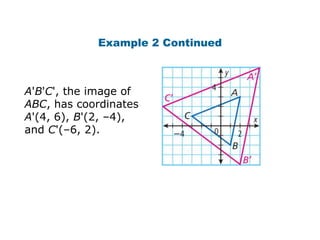
Example 2 Continued


A'B'C', the image of
ABC, has coordinates
A'(4, 6), B'(2, –4),
and C'(–6, 2).
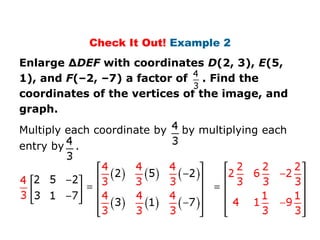
Check It Out! Example 2
Enlarge ΔDEF with coordinates D(2, 3), E(5,
1), and F(–2, –7) a factor of . Find the
coordinates of the vertices of the image, and
graph.
Multiply each coordinate by   by multiplying each
entry by   .
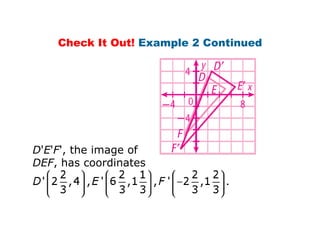
Check It Out! Example 2 Continued


D'E'F', the image of
DEF, has coordinates
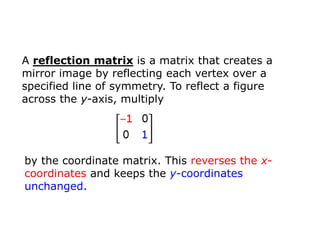
A reflection matrix is a matrix that creates a
mirror image by reflecting each vertex over a
specified line of symmetry. To reflect a figure
across the y-axis, multiply


by the coordinate matrix. This reverses the x-
coordinates and keeps the y-coordinates
unchanged.
Caution
Matrix multiplication is not commutative. So be
sure to keep the transformation matrix on the
left!
Example 3: Using Matrices to Reflect a Figure

Reflect ΔPQR with coordinates
P(2, 2), Q(2, –1), and R(4, 3) across the
y-axis. Find the coordinates of the
vertices of the image, and graph.


    Each x-coordinate is multiplied by –1.

    Each y-coordinate is multiplied by 1.
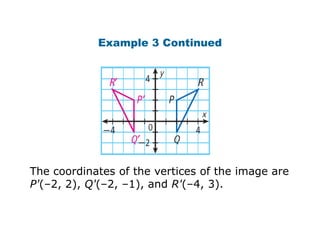
Example 3 Continued


The coordinates of the vertices of the image are
P'(–2, 2), Q'(–2, –1), and R'(–4, 3).
Check It Out! Example 3

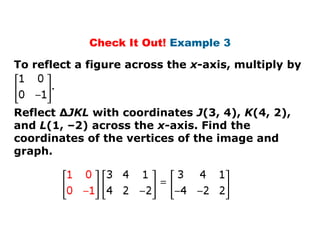
To reflect a figure across the x-axis, multiply by

      .

Reflect ΔJKL with coordinates J(3, 4), K(4, 2),
and L(1, –2) across the x-axis. Find the
coordinates of the vertices of the image and
graph.
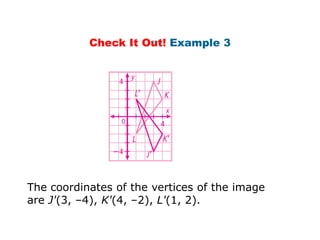
Check It Out! Example 3


The coordinates of the vertices of the image
are J'(3, –4), K'(4, –2), L'(1, 2).
A rotation matrix is a matrix used to rotate a
figure. Example 4 gives several types of rotation
matrices.
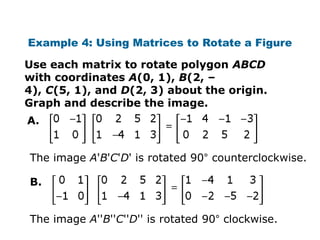
Example 4: Using Matrices to Rotate a Figure

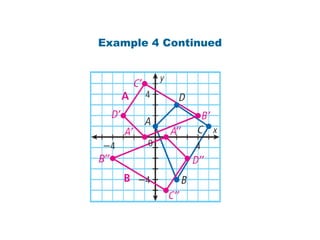
Use each matrix to rotate polygon ABCD
with coordinates A(0, 1), B(2, –
4), C(5, 1), and D(2, 3) about the origin.
Graph and describe the image.
A.


The image A'B'C'D' is rotated 90° counterclockwise.

B.


The image A''B''C''D'' is rotated 90° clockwise.
Example 4 Continued
Check It Out! Example 4


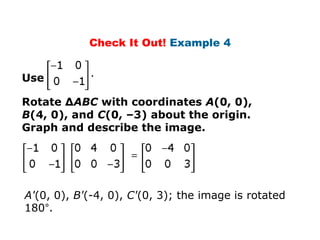
Use

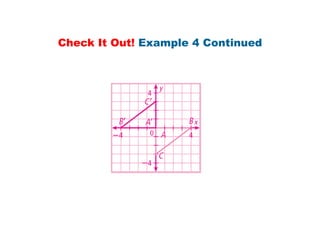
Rotate ΔABC with coordinates A(0, 0),
B(4, 0), and C(0, –3) about the origin.
Graph and describe the image.


A'(0, 0), B'(-4, 0), C'(0, 3); the image is rotated
180°.
Check It Out! Example 4 Continued
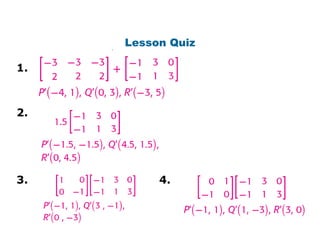
Lesson Quiz

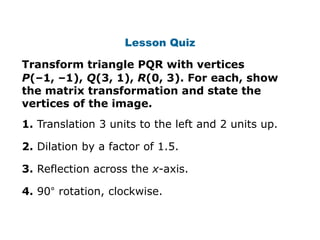
Transform triangle PQR with vertices
P(–1, –1), Q(3, 1), R(0, 3). For each, show
the matrix transformation and state the
vertices of the image.
1. Translation 3 units to the left and 2 units up.

2. Dilation by a factor of 1.5.

3. Reflection across the x-axis.

4. 90° rotation, clockwise.
Lesson Quiz

1.


2.


3.        4.

Matrix transformation

  • 2.
    Using Matrices toTransform Geometric Figures Warm Up Lesson Presentation Lesson Quiz
  • 3.
    Warm Up Perform theindicated operation. 1. 2. 3.
  • 4.
    Objective Use matrices totransform a plane figure.
  • 5.
  • 6.
    You can describethe position, shape, and size of a polygon on a coordinate plane by naming the ordered pairs that define its vertices. The coordinates of ΔABC below are A (–2, –1), B (0, 3), and C (1, –2) . You can also define ΔABC by a matrix:  x-coordinates  y-coordinates
  • 7.
    A translation matrixis a matrix used to translate coordinates on the coordinate plane. The matrix sum of a preimage and a translation matrix gives the coordinates of the translated image.
  • 8.
    Reading Math The prefixpre- means ―before,‖ so the preimage is the original figure before any transformations are applied. The image is the resulting figure after a transformation.
  • 9.
    Example 1: UsingMatrices to Translate a Figure Translate ΔABC with coordinates A(–2, 1), B(3, 2), and C(0, –3), 3 units left and 4 units up. Find the coordinates of the vertices of the image, and graph. The translation matrix will have –3  x-coordinates in all entries in row  y-coordinates 1 and 4 in all entries in row 2.
  • 10.
    Example 1 Continued A'B'C',the image of ABC, has coordinates A'(–5, 5), B'(0, 6), and C'(–3, 1).
  • 11.
    Check It Out!Example 1 Translate ΔGHJ with coordinates G(2, 4), H(3, 1), and J(1, –1) 3 units right and 1 unit down. Find the coordinates of the vertices of the image and graph. The translation matrix will have 3 in  x-coordinates all entries in row 1  y-coordinates and –1 in all entries in row 2.
  • 12.
    Check It Out!Example 1 Continued G'H'J', the image of GHJ, has coordinates G'(5, 3), H'(6, 0), and J'(4, –2).
  • 13.
    A dilation isa transformation that scales—enlarges or reduces—the preimage, resulting in similar figures. Remember that for similar figures, the shape is the same but the size may be different. Angles are congruent, and side lengths are proportional. When the center of dilation is the origin, multiplying the coordinate matrix by a scalar gives the coordinates of the dilated image. In this lesson, all dilations assume that the origin is the center of dilation.
  • 14.
    Example 2: UsingMatrices to Enlarge a Figure Enlarge ΔABC with coordinates A(2, 3), B(1, –2), and C(–3, 1), by a factor of 2. Find the coordinates of the vertices of the image, and graph. Multiply each coordinate by 2 by multiplying each entry by 2.  x-coordinates  y-coordinates
  • 15.
    Example 2 Continued A'B'C',the image of ABC, has coordinates A'(4, 6), B'(2, –4), and C'(–6, 2).
  • 16.
    Check It Out!Example 2 Enlarge ΔDEF with coordinates D(2, 3), E(5, 1), and F(–2, –7) a factor of . Find the coordinates of the vertices of the image, and graph. Multiply each coordinate by by multiplying each entry by .
  • 17.
    Check It Out!Example 2 Continued D'E'F', the image of DEF, has coordinates
  • 18.
    A reflection matrixis a matrix that creates a mirror image by reflecting each vertex over a specified line of symmetry. To reflect a figure across the y-axis, multiply by the coordinate matrix. This reverses the x- coordinates and keeps the y-coordinates unchanged.
  • 19.
    Caution Matrix multiplication isnot commutative. So be sure to keep the transformation matrix on the left!
  • 20.
    Example 3: UsingMatrices to Reflect a Figure Reflect ΔPQR with coordinates P(2, 2), Q(2, –1), and R(4, 3) across the y-axis. Find the coordinates of the vertices of the image, and graph. Each x-coordinate is multiplied by –1. Each y-coordinate is multiplied by 1.
  • 21.
    Example 3 Continued Thecoordinates of the vertices of the image are P'(–2, 2), Q'(–2, –1), and R'(–4, 3).
  • 22.
    Check It Out!Example 3 To reflect a figure across the x-axis, multiply by . Reflect ΔJKL with coordinates J(3, 4), K(4, 2), and L(1, –2) across the x-axis. Find the coordinates of the vertices of the image and graph.
  • 23.
    Check It Out!Example 3 The coordinates of the vertices of the image are J'(3, –4), K'(4, –2), L'(1, 2).
  • 24.
    A rotation matrixis a matrix used to rotate a figure. Example 4 gives several types of rotation matrices.
  • 25.
    Example 4: UsingMatrices to Rotate a Figure Use each matrix to rotate polygon ABCD with coordinates A(0, 1), B(2, – 4), C(5, 1), and D(2, 3) about the origin. Graph and describe the image. A. The image A'B'C'D' is rotated 90° counterclockwise. B. The image A''B''C''D'' is rotated 90° clockwise.
  • 26.
  • 27.
    Check It Out!Example 4 Use Rotate ΔABC with coordinates A(0, 0), B(4, 0), and C(0, –3) about the origin. Graph and describe the image. A'(0, 0), B'(-4, 0), C'(0, 3); the image is rotated 180°.
  • 28.
    Check It Out!Example 4 Continued
  • 29.
    Lesson Quiz Transform trianglePQR with vertices P(–1, –1), Q(3, 1), R(0, 3). For each, show the matrix transformation and state the vertices of the image. 1. Translation 3 units to the left and 2 units up. 2. Dilation by a factor of 1.5. 3. Reflection across the x-axis. 4. 90° rotation, clockwise.
  • 30.