SEQUENCES and  SERIES
SEQUENCES Concept of sequences and series is really study of patterns.
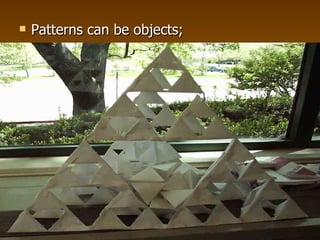
Patterns can be objects;
Nature;
Nature;
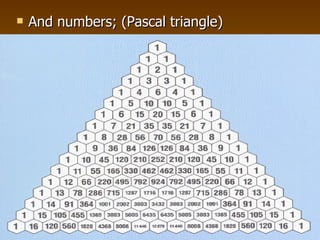
And numbers;
And numbers; (Pascal triangle)
Sometimes it is easy to see patterns and relationships in a string of numbers. For instance;  2, 4, 6, 8, 10, 12, …
In the more difficult cases we need to use formula. This topic teaches us how to use a logical approach in solving problems which involves sequences and series.
Example; find 8 th  term in the given sequence 1, 4, 9, 16, 25, 36, ….
SEQUENCES Definition of Sequence:  A pattern which is defined in the set of  natural numbers  is called a sequence. Note: By the set of natural numbers we mean all positive integers and denote this set by N. That is, N = {1, 2, 3, ...}
We denote the first term by  a 1 , the second term by  a 2 , and so on. Here,  a 1  is the first term a 2  is the second term a 3  is the third term ………………… .......... a n  is the n th  term or general term. We can use another letter instead of letter a. For example, b n , c n , d n , etc. may also be the name for general term of a sequence.
A sequence is represented by  ( a n )  ( a n   must be written inside brackets)  General term of a sequence is represented by  a n   ( a n   must be written without brackets)  for the previous example, if we write the general term, we use  a n   =  n 2 .  If we want to list the terms, we use  ( a n ) = (1, 4, 9, 16, ...,  n 2 , ...)
Note: An expression like  a 2.6  is nonsense since we cannot talk about  2.6 th  term. It is easy to realize that the definition for sequence prevents such potential mistakes. Clearly, expressions like  a 0 ,  a –1  are also out of consideration.
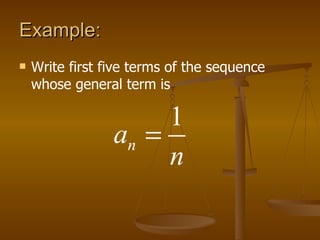
Example:  Write first five terms of the sequence whose general term is
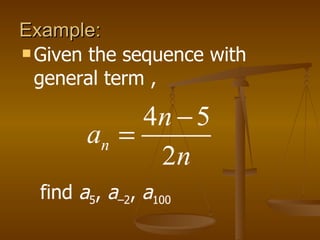
Example:  Given the sequence with general term ,  find  a 5 ,  a –2 ,  a 100
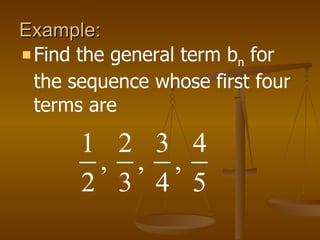
Example:  Find the general term b n  for the sequence whose first four terms are
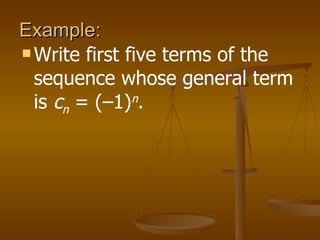
Example:  Write first five terms of the sequence whose general term is  c n   = (–1) n .
Example:  Find the general term  a n  for the sequence whose first four terms are 2, 4, 6, 8.
Example:  Given the sequence with general term  b n   = 2 n  + 3, find  b 5 ,  b 0 , and  b 43 .
Criteria for Existence of a Sequence If there is at least one natural number which makes the general term  undefined , then there is no such sequence. Undefined: denominator is zero or even numbered root is less then zero.
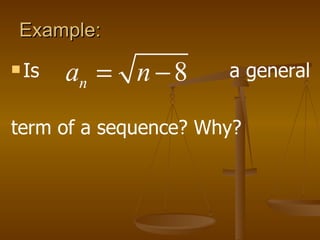
Example:  Is  a general  term of a sequence? Why?
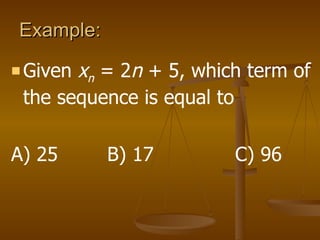
Example:  Given  x n   = 2 n  + 5, which term of the sequence is equal to A) 25  B) 17 C) 96
TYPES OF SEQUENCES Finite Sequence:  If a sequence contains countable number of terms, then it is a finite sequence. Example;  –10, –5, 0, 5, 10, 15, ..., 150 Infinite Sequence:  If a sequence contains infinitely many terms, then it is an infinite sequence. Example;  1, 1, 2, 3, 5, 8, ...
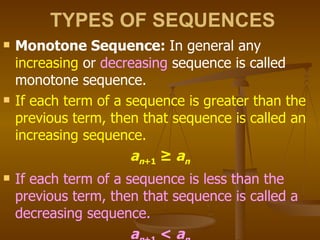
TYPES OF SEQUENCES Monotone Sequence:  In general any  increasing  or  decreasing  sequence is called monotone sequence. If each term of a sequence is greater than the previous term, then that sequence is called an increasing sequence. a n +1  ≥  a n If each term of a sequence is less than the previous term, then that sequence is called a decreasing sequence. a n +1  <  a n
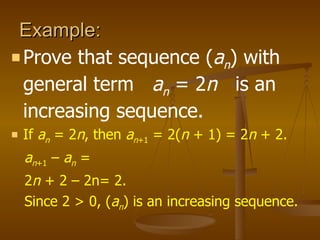
Example:  Prove that sequence ( a n ) with general term  a n   = 2 n  is an increasing sequence. If  a n   = 2 n , then  a n +1  = 2( n  + 1) = 2 n  + 2. a n +1  –  a n   =  2 n  + 2 – 2n= 2.  Since 2 > 0, ( a n ) is an increasing sequence.
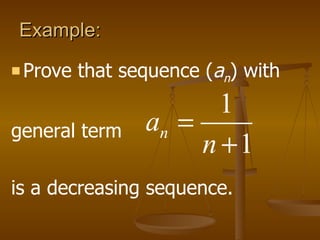
Example:  Prove that sequence ( a n ) with  general term  is a decreasing sequence.
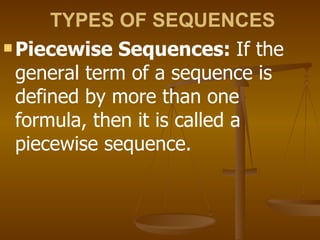
TYPES OF SEQUENCES Piecewise Sequences:  If the general term of a sequence is defined by more than one formula, then it is called a piecewise sequence.
Example:  Write first four terms of the sequence with general term
Example:  Given the sequence with general term a)  find  a 20  b)  find  a 1 c)  which term is equal to 0?
TYPES OF SEQUENCES Recursively Defined Sequences:  Sometimes terms in a sequence may depend on the other terms. Such a sequence is called a recursively defined sequence.
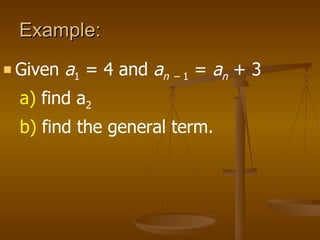
Example:  Given  a 1  = 4 and  a n   – 1  =  a n   + 3 a)  find a 2 b)  find the general term.
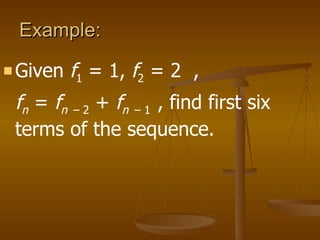
Example:  Given  f 1  = 1,  f 2  = 2  ,  f n   =  f n   – 2  +  f n   – 1  , find first six terms of the sequence.
ARITHMETIC SEQUENCES A sequence is arithmetic if the differences between two consecutive terms are the same. Let's look at the sequence  6, 10, 14, 18, … Obviously the difference between each term is equal to 4
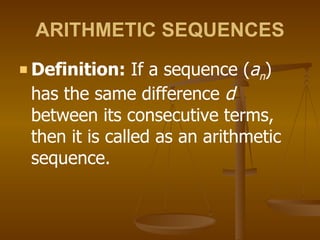
ARITHMETIC SEQUENCES Definition:  If a sequence ( a n ) has the same difference  d  between its consecutive terms, then it is called as an arithmetic sequence.
ARITHMETIC SEQUENCES ( a n ) is arithmetic if  a n+ 1  =  a n  +  d  such than n ∈ N, d ∈ R. Hence  d  is called as the common difference. If  d  is positive, arithmetic sequence is increasing.  If  d  is negative, arithmetic sequence is decreasing.
Example:  State whether the following sequences are arithmetic or not. If so, find the common difference. 7, 10, 13, 16, …  3, –2, –7, 12, …  1, 4, 9, 16, …  6, 6, 6, 6, …
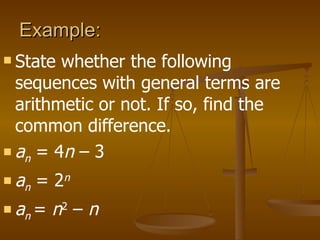
Example:  State whether the following sequences with general terms are arithmetic or not. If so, find the common difference. a n   = 4 n  – 3  a n   = 2 n   a n  =  n 2  –  n
ARITHMETIC SEQUENCES General Term of an arithmetic sequence: If  a n   is arithmetic, then we only know that  a n +1  = a n  +  d .
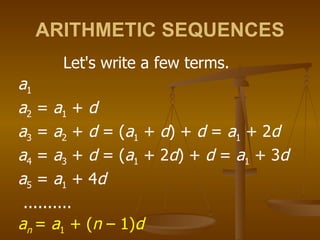
ARITHMETIC SEQUENCES Let's write a few terms. a 1 a 2  =  a 1  +  d a 3  =  a 2  +  d  = ( a 1  +  d ) +  d  =  a 1  + 2 d a 4  =  a 3  +  d  = ( a 1  + 2 d ) +  d  =  a 1  + 3 d a 5  =  a 1  + 4 d .......... a n  =  a 1  + ( n  – 1) d
General term of an arithmetic sequence  a n   with common difference  d  is a n   =  a 1 +( n  – 1) d

Sequences and series

  • 1.
  • 2.
    SEQUENCES Concept ofsequences and series is really study of patterns.
  • 3.
  • 4.
  • 5.
  • 6.
  • 7.
  • 8.
  • 9.
    Sometimes it iseasy to see patterns and relationships in a string of numbers. For instance; 2, 4, 6, 8, 10, 12, …
  • 10.
    In the moredifficult cases we need to use formula. This topic teaches us how to use a logical approach in solving problems which involves sequences and series.
  • 11.
    Example; find 8th term in the given sequence 1, 4, 9, 16, 25, 36, ….
  • 12.
    SEQUENCES Definition ofSequence: A pattern which is defined in the set of natural numbers is called a sequence. Note: By the set of natural numbers we mean all positive integers and denote this set by N. That is, N = {1, 2, 3, ...}
  • 13.
    We denote thefirst term by a 1 , the second term by a 2 , and so on. Here, a 1 is the first term a 2 is the second term a 3 is the third term ………………… .......... a n is the n th term or general term. We can use another letter instead of letter a. For example, b n , c n , d n , etc. may also be the name for general term of a sequence.
  • 14.
    A sequence isrepresented by ( a n ) ( a n must be written inside brackets) General term of a sequence is represented by a n ( a n must be written without brackets) for the previous example, if we write the general term, we use a n = n 2 . If we want to list the terms, we use ( a n ) = (1, 4, 9, 16, ..., n 2 , ...)
  • 15.
    Note: An expressionlike a 2.6 is nonsense since we cannot talk about 2.6 th term. It is easy to realize that the definition for sequence prevents such potential mistakes. Clearly, expressions like a 0 , a –1 are also out of consideration.
  • 16.
    Example: Writefirst five terms of the sequence whose general term is
  • 17.
    Example: Giventhe sequence with general term , find a 5 , a –2 , a 100
  • 18.
    Example: Findthe general term b n for the sequence whose first four terms are
  • 19.
    Example: Writefirst five terms of the sequence whose general term is c n = (–1) n .
  • 20.
    Example: Findthe general term a n for the sequence whose first four terms are 2, 4, 6, 8.
  • 21.
    Example: Giventhe sequence with general term b n = 2 n + 3, find b 5 , b 0 , and b 43 .
  • 22.
    Criteria for Existenceof a Sequence If there is at least one natural number which makes the general term undefined , then there is no such sequence. Undefined: denominator is zero or even numbered root is less then zero.
  • 23.
    Example: Is a general term of a sequence? Why?
  • 24.
    Example: Is a general term of a sequence? Why?
  • 25.
    Example: Given x n = 2 n + 5, which term of the sequence is equal to A) 25 B) 17 C) 96
  • 26.
    TYPES OF SEQUENCESFinite Sequence: If a sequence contains countable number of terms, then it is a finite sequence. Example; –10, –5, 0, 5, 10, 15, ..., 150 Infinite Sequence: If a sequence contains infinitely many terms, then it is an infinite sequence. Example; 1, 1, 2, 3, 5, 8, ...
  • 27.
    TYPES OF SEQUENCESMonotone Sequence: In general any increasing or decreasing sequence is called monotone sequence. If each term of a sequence is greater than the previous term, then that sequence is called an increasing sequence. a n +1 ≥ a n If each term of a sequence is less than the previous term, then that sequence is called a decreasing sequence. a n +1 < a n
  • 28.
    Example: Provethat sequence ( a n ) with general term a n = 2 n is an increasing sequence. If a n = 2 n , then a n +1 = 2( n + 1) = 2 n + 2. a n +1 – a n = 2 n + 2 – 2n= 2. Since 2 > 0, ( a n ) is an increasing sequence.
  • 29.
    Example: Provethat sequence ( a n ) with general term is a decreasing sequence.
  • 30.
    TYPES OF SEQUENCESPiecewise Sequences: If the general term of a sequence is defined by more than one formula, then it is called a piecewise sequence.
  • 31.
    Example: Writefirst four terms of the sequence with general term
  • 32.
    Example: Giventhe sequence with general term a) find a 20 b) find a 1 c) which term is equal to 0?
  • 33.
    TYPES OF SEQUENCESRecursively Defined Sequences: Sometimes terms in a sequence may depend on the other terms. Such a sequence is called a recursively defined sequence.
  • 34.
    Example: Given a 1 = 4 and a n – 1 = a n + 3 a) find a 2 b) find the general term.
  • 35.
    Example: Given f 1 = 1, f 2 = 2 , f n = f n – 2 + f n – 1 , find first six terms of the sequence.
  • 36.
    ARITHMETIC SEQUENCES Asequence is arithmetic if the differences between two consecutive terms are the same. Let's look at the sequence 6, 10, 14, 18, … Obviously the difference between each term is equal to 4
  • 37.
    ARITHMETIC SEQUENCES Definition: If a sequence ( a n ) has the same difference d between its consecutive terms, then it is called as an arithmetic sequence.
  • 38.
    ARITHMETIC SEQUENCES (a n ) is arithmetic if a n+ 1 = a n + d such than n ∈ N, d ∈ R. Hence d is called as the common difference. If d is positive, arithmetic sequence is increasing. If d is negative, arithmetic sequence is decreasing.
  • 39.
    Example: Statewhether the following sequences are arithmetic or not. If so, find the common difference. 7, 10, 13, 16, … 3, –2, –7, 12, … 1, 4, 9, 16, … 6, 6, 6, 6, …
  • 40.
    Example: Statewhether the following sequences with general terms are arithmetic or not. If so, find the common difference. a n = 4 n – 3 a n = 2 n a n = n 2 – n
  • 41.
    ARITHMETIC SEQUENCES GeneralTerm of an arithmetic sequence: If a n is arithmetic, then we only know that a n +1 = a n + d .
  • 42.
    ARITHMETIC SEQUENCES Let'swrite a few terms. a 1 a 2 = a 1 + d a 3 = a 2 + d = ( a 1 + d ) + d = a 1 + 2 d a 4 = a 3 + d = ( a 1 + 2 d ) + d = a 1 + 3 d a 5 = a 1 + 4 d .......... a n = a 1 + ( n – 1) d
  • 43.
    General term ofan arithmetic sequence a n with common difference d is a n = a 1 +( n – 1) d