

MATHEMATICAL INDUCTION
PROVING BY MATHEMATICAL INDUCTION
PreCalculus
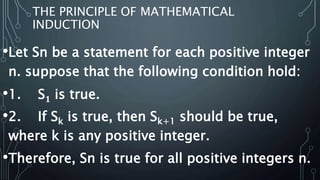
THE PRINCIPLE OF MATHEMATICAL
INDUCTION
•Let Sn be a statement for each positive integer
n. suppose that the following condition hold:
•1. S 𝟏 is true.
•2. If Sk is true, then Sk+1 should be true,
where k is any positive integer.
•Therefore, Sn is true for all positive integers n.
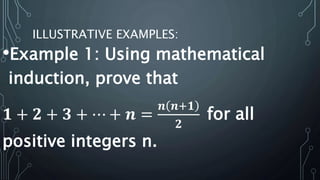
ILLUSTRATIVE EXAMPLES:
•Example 1: Using mathematical
induction, prove that
𝟏 + 𝟐 + 𝟑 + ⋯ + 𝒏 =
𝒏 𝒏+𝟏
𝟐
for all
positive integers n.
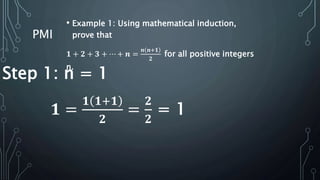
PMI
Step 1: n = 1
𝟏 =
𝟏 𝟏+𝟏
𝟐
=
𝟐
𝟐
= 1
• Example 1: Using mathematical induction,
prove that
𝟏 + 𝟐 + 𝟑 + ⋯ + 𝒏 =
𝒏 𝒏+𝟏
𝟐
for all positive integers
n.
PMI
Step 2: for n = k
𝟏 + 𝟐 + 𝟑 + ⋯ + 𝒌 =
𝒌 𝒌+𝟏
𝟐
and for n = k + 1
𝟏 + 𝟐 + 𝟑 + ⋯ + 𝒌 + (𝒌 + 𝟏) =
(𝒌 + 𝟏) 𝒌 + 𝟐
𝟐
• Example 1: Using mathematical induction,
prove that
𝟏 + 𝟐 + 𝟑 + ⋯ + 𝒏 =
𝒏 𝒏+𝟏
𝟐
for all positive integers
n.
PMI
and for n = k + 1
𝟏 + 𝟐 + 𝟑 + ⋯ + 𝒌 + (𝒌 + 𝟏) =
(𝒌 + 𝟏) 𝒌 + 𝟐
𝟐
𝒌 𝒌+𝟏
𝟐
+ (k + 1) =
(𝒌+𝟏) 𝒌+𝟐
𝟐
• Example 1: Using mathematical induction,
prove that
𝟏 + 𝟐 + 𝟑 + ⋯ + 𝒏 =
𝒏 𝒏+𝟏
𝟐
for all positive integers
n.
PMI
𝒌 𝒌+𝟏
𝟐
+ (k + 1) =
(𝒌+𝟏) 𝒌+𝟐
𝟐
𝒌 𝒌+𝟏 +𝟐(𝒌+𝟏)
𝟐
=
𝒌+𝟏 (𝒌+𝟐)
𝟐
=
(𝒌+𝟏) 𝒌+𝟐
𝟐
• Example 1: Using mathematical induction,
prove that
𝟏 + 𝟐 + 𝟑 + ⋯ + 𝒏 =
𝒏 𝒏+𝟏
𝟐
for all positive integers
n.
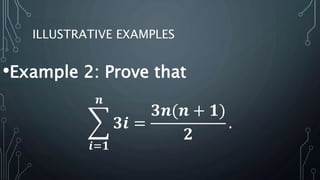
ILLUSTRATIVE EXAMPLES
•Example 2: Prove that
𝒊=𝟏
𝒏
𝟑𝒊 =
𝟑𝒏(𝒏 + 𝟏)
𝟐
.
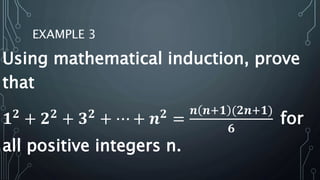
EXAMPLE 3
Using mathematical induction, prove
that
𝟏 𝟐
+ 𝟐 𝟐
+ 𝟑 𝟐
+ ⋯ + 𝒏 𝟐
=
𝒏 𝒏+𝟏 (𝟐𝒏+𝟏)
𝟔
for
all positive integers n.
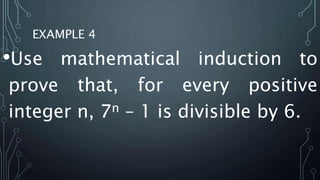
EXAMPLE 4
•Use mathematical induction to
prove that, for every positive
integer n, 7n – 1 is divisible by 6.
EXAMPLE 4
•Part 1
71 −1 = 6 = 6 · 1
71 − 1 is divisible by 6.
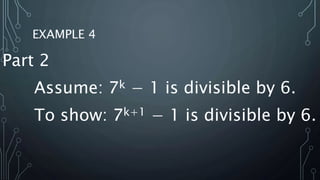
EXAMPLE 4
Part 2
Assume: 7k − 1 is divisible by 6.
To show: 7k+1 − 1 is divisible by 6.
Part 2
To show: 7k+1 − 1 is divisible by 6.
7k+1 − 1 = 7 · 7k − 1
= 6 · 7k + 7k −1
= 6 · 7k + (7k − 1)
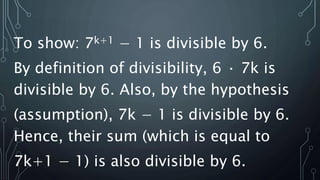
To show: 7k+1 − 1 is divisible by 6.
By definition of divisibility, 6 · 7k is
divisible by 6. Also, by the hypothesis
(assumption), 7k − 1 is divisible by 6.
Hence, their sum (which is equal to
7k+1 − 1) is also divisible by 6.
EXAMPLE 5
•Use mathematical induction to
prove that, for every nonnegative
integer n, 3n-n+3 is divisible by
3.
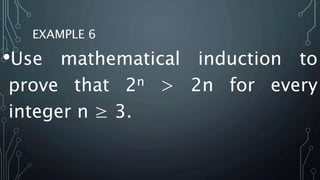
EXAMPLE 6
•Use mathematical induction to
prove that 2n > 2n for every
integer n ≥ 3.
Reference:
• Aoanan, Grace O. et. al. (2018) General
Mathematics for
Senior HS, C&E Publishing, Inc.
• Garces, Ian June L. et. al. (2016) Precalculus
“Teaching
Guide for Senior High School, Commission on
Higher
THANK YOU
www.slideshare.net/reycastro1
@reylkastro2
reylkastro

Mathematical induction

  • 1.
    MATHEMATICAL INDUCTION PROVING BYMATHEMATICAL INDUCTION PreCalculus
  • 2.
    THE PRINCIPLE OFMATHEMATICAL INDUCTION •Let Sn be a statement for each positive integer n. suppose that the following condition hold: •1. S 𝟏 is true. •2. If Sk is true, then Sk+1 should be true, where k is any positive integer. •Therefore, Sn is true for all positive integers n.
  • 3.
    ILLUSTRATIVE EXAMPLES: •Example 1:Using mathematical induction, prove that 𝟏 + 𝟐 + 𝟑 + ⋯ + 𝒏 = 𝒏 𝒏+𝟏 𝟐 for all positive integers n.
  • 4.
    PMI Step 1: n= 1 𝟏 = 𝟏 𝟏+𝟏 𝟐 = 𝟐 𝟐 = 1 • Example 1: Using mathematical induction, prove that 𝟏 + 𝟐 + 𝟑 + ⋯ + 𝒏 = 𝒏 𝒏+𝟏 𝟐 for all positive integers n.
  • 5.
    PMI Step 2: forn = k 𝟏 + 𝟐 + 𝟑 + ⋯ + 𝒌 = 𝒌 𝒌+𝟏 𝟐 and for n = k + 1 𝟏 + 𝟐 + 𝟑 + ⋯ + 𝒌 + (𝒌 + 𝟏) = (𝒌 + 𝟏) 𝒌 + 𝟐 𝟐 • Example 1: Using mathematical induction, prove that 𝟏 + 𝟐 + 𝟑 + ⋯ + 𝒏 = 𝒏 𝒏+𝟏 𝟐 for all positive integers n.
  • 6.
    PMI and for n= k + 1 𝟏 + 𝟐 + 𝟑 + ⋯ + 𝒌 + (𝒌 + 𝟏) = (𝒌 + 𝟏) 𝒌 + 𝟐 𝟐 𝒌 𝒌+𝟏 𝟐 + (k + 1) = (𝒌+𝟏) 𝒌+𝟐 𝟐 • Example 1: Using mathematical induction, prove that 𝟏 + 𝟐 + 𝟑 + ⋯ + 𝒏 = 𝒏 𝒏+𝟏 𝟐 for all positive integers n.
  • 7.
    PMI 𝒌 𝒌+𝟏 𝟐 + (k+ 1) = (𝒌+𝟏) 𝒌+𝟐 𝟐 𝒌 𝒌+𝟏 +𝟐(𝒌+𝟏) 𝟐 = 𝒌+𝟏 (𝒌+𝟐) 𝟐 = (𝒌+𝟏) 𝒌+𝟐 𝟐 • Example 1: Using mathematical induction, prove that 𝟏 + 𝟐 + 𝟑 + ⋯ + 𝒏 = 𝒏 𝒏+𝟏 𝟐 for all positive integers n.
  • 8.
    ILLUSTRATIVE EXAMPLES •Example 2:Prove that 𝒊=𝟏 𝒏 𝟑𝒊 = 𝟑𝒏(𝒏 + 𝟏) 𝟐 .
  • 9.
    EXAMPLE 3 Using mathematicalinduction, prove that 𝟏 𝟐 + 𝟐 𝟐 + 𝟑 𝟐 + ⋯ + 𝒏 𝟐 = 𝒏 𝒏+𝟏 (𝟐𝒏+𝟏) 𝟔 for all positive integers n.
  • 10.
    EXAMPLE 4 •Use mathematicalinduction to prove that, for every positive integer n, 7n – 1 is divisible by 6.
  • 11.
    EXAMPLE 4 •Part 1 71−1 = 6 = 6 · 1 71 − 1 is divisible by 6.
  • 12.
    EXAMPLE 4 Part 2 Assume:7k − 1 is divisible by 6. To show: 7k+1 − 1 is divisible by 6.
  • 13.
    Part 2 To show:7k+1 − 1 is divisible by 6. 7k+1 − 1 = 7 · 7k − 1 = 6 · 7k + 7k −1 = 6 · 7k + (7k − 1)
  • 14.
    To show: 7k+1− 1 is divisible by 6. By definition of divisibility, 6 · 7k is divisible by 6. Also, by the hypothesis (assumption), 7k − 1 is divisible by 6. Hence, their sum (which is equal to 7k+1 − 1) is also divisible by 6.
  • 15.
    EXAMPLE 5 •Use mathematicalinduction to prove that, for every nonnegative integer n, 3n-n+3 is divisible by 3.
  • 16.
    EXAMPLE 6 •Use mathematicalinduction to prove that 2n > 2n for every integer n ≥ 3.
  • 17.
    Reference: • Aoanan, GraceO. et. al. (2018) General Mathematics for Senior HS, C&E Publishing, Inc. • Garces, Ian June L. et. al. (2016) Precalculus “Teaching Guide for Senior High School, Commission on Higher
  • 18.