
FREE FALL
Freely falling

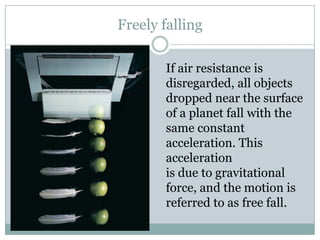
       If air resistance is
       disregarded, all objects
       dropped near the surface
       of a planet fall with the
       same constant
       acceleration. This
       acceleration
       is due to gravitational
       force, and the motion is
       referred to as free fall.
Freely falling

       The acceleration due to
       gravity is denoted with
       the symbols ag
       (generally)
       or g (on Earth’s surface).
       The magnitude of g is
       about 9.81 m/s2.
Acceleration is constant during upward
        and downward motion

              In the photograph on the
              left, the upward
              displacement of the ball
              between each successive
              image is smaller and
              smaller until the ball stops
              and finally begins to move
              with an increasing
              downward velocity, as
              shown on the right.
Formulas
A robot probe drops a camera off the rim of a 239 m
high cliff on Mars, where the free-fall acceleration is
−3.7 m/s2.
a. Find the velocity with which the camera hits the
ground.
b. Find the time required for it to hit the ground.
A flowerpot falls from a windowsill 25.0 m above the
sidewalk.

a. How fast is the flowerpot moving when it strikes the
ground?
b. How much time does a passerby on the sidewalk
below have to move out of the way before the
flowerpot hits the ground?
A tennis ball is thrown vertically upward with an
initial velocity of +8.0 m/s.

a. What will the ball’s speed be when it returns to its
starting point?
b. How long will the ball take to reach its starting
point?
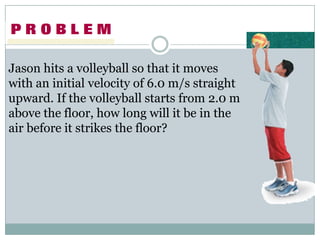
Jason hits a volleyball so that it moves
with an initial velocity of 6.0 m/s straight
upward. If the volleyball starts from 2.0 m
above the floor, how long will it be in the
air before it strikes the floor?

Free fall

  • 1.
  • 2.
    Freely falling If air resistance is disregarded, all objects dropped near the surface of a planet fall with the same constant acceleration. This acceleration is due to gravitational force, and the motion is referred to as free fall.
  • 3.
    Freely falling The acceleration due to gravity is denoted with the symbols ag (generally) or g (on Earth’s surface). The magnitude of g is about 9.81 m/s2.
  • 4.
    Acceleration is constantduring upward and downward motion In the photograph on the left, the upward displacement of the ball between each successive image is smaller and smaller until the ball stops and finally begins to move with an increasing downward velocity, as shown on the right.
  • 5.
  • 6.
    A robot probedrops a camera off the rim of a 239 m high cliff on Mars, where the free-fall acceleration is −3.7 m/s2. a. Find the velocity with which the camera hits the ground. b. Find the time required for it to hit the ground.
  • 7.
    A flowerpot fallsfrom a windowsill 25.0 m above the sidewalk. a. How fast is the flowerpot moving when it strikes the ground? b. How much time does a passerby on the sidewalk below have to move out of the way before the flowerpot hits the ground?
  • 8.
    A tennis ballis thrown vertically upward with an initial velocity of +8.0 m/s. a. What will the ball’s speed be when it returns to its starting point? b. How long will the ball take to reach its starting point?
  • 9.
    Jason hits avolleyball so that it moves with an initial velocity of 6.0 m/s straight upward. If the volleyball starts from 2.0 m above the floor, how long will it be in the air before it strikes the floor?