1
CONIC SECTIONS
SOLO HERMELIN
http://www.solohermelin.com
2
SOLO
Table of Contents
2. Circle
3. Ellipse
4. Parabola
5. Hyperbola
6. Conic sections – Analytic Expressions
7. Conic sections – General Description
CONIC SECTIONS
1. Conic Sections - Introduction
8. References
3
SOLO
A right circular cone is a cone obtained by generators (straight lines) passing through
a circle, and the apex C that is situated on the normal to the circle plane and passing
trough the center of the circle. β is the angle between the cone axis and the generators.
CONIC SECTIONS
Cutting
Plane
generating a
"hyperbola"
Right
Circular
Cone
Cone
Apex
Conical
Section
C
Cone
Axis
Cutting
Plane
generating a
"parabola"
Cutting
Plane
generating a
"ellipse"
Cutting
Plane
generating a
"circle"
Cutting
Plane
generating
two
"lines"
α
β






−= β
π
α
2






−< β
π
α
2






−> β
π
α
2
( )0=α


















−>
−=
−<
lines
line
po
2
2
1
2
int
2
β
π
α
β
π
α
β
π
α
P
F
F
*
Cutting
Plane
(Hyperbola
)
Right
Circular
Cone
Hyperbola
2
Branches
C
β
α
Ellipse
Parabola
Cutting
Plane
(Ellipse)
Cutting
Plane
(Circle)
Cutting
Plane
(Parabola)
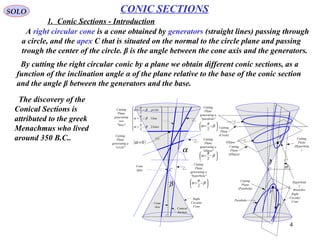
By cutting the right circular conic by a plane we obtain different conic sections, as a
function of the inclination angle α of the plane relative to the base of the conic section
and the angle β between the generators and the base.
The discovery of the
Conical Sections is
attributed to the greek
Menachmus who lived
around 350 B.C..
1. Conic Sections - Introduction
4
SOLO
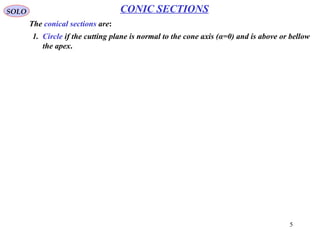
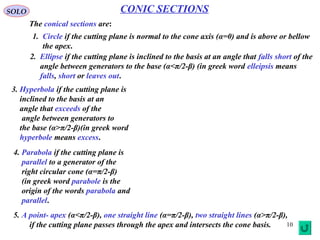
The conical sections are:
CONIC SECTIONS
1. Circle if the cutting plane is normal to the cone axis (α=0) and is above or bellow
the apex.
2. Ellipse if the cutting plane is inclined to the basis at an angle that falls short of the
angle between generators to the base (α<π/2-β) (in greek word elleipsis means
falls, short or leaves out.
3. Hyperbola if the cutting plane is
inclined to the basis at an
angle that exceeds of the
angle between generators to
the base (α>π/2-β)(in greek word
hyperbole means excess.
4. Parabola if the cutting plane is
parallel to a generator of the
right circular cone (α=π/2-β)
(in greek word parabole is the
origin of the words parabola and
parallel.
5. A point- apex (α<π/2-β), one straight line (α=π/2-β), two straight lines (α>π/2-β),
if the cutting plane passes through the apex and intersects the cone basis.
5
SOLO CONIC SECTIONS
Circle if the cutting plane is normal to the cone axis (α=0) and is above or bellow
the apex.
2. Circle
6
SOLO CONIC SECTIONS
3 Ellipse (α < π/2-β)
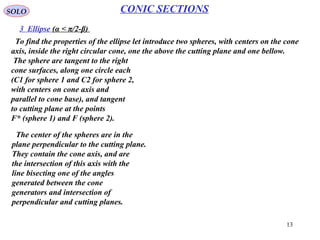
To find the properties of the ellipse let introduce two spheres, with centers on the cone
axis, inside the right circular cone, one the above the cutting plane and one bellow.
The sphere are tangent to the right
cone surfaces, along one circle each
(C1 for sphere 1 and C2 for sphere 2,
with centers on cone axis and
parallel to cone base), and tangent
to cutting plane at the points
F* (sphere 1) and F (sphere 2).
The center of the spheres are in the
plane perpendicular to the cutting plane.
They contain the cone axis, and are
the intersection of this axis with the
line bisecting one of the angles
generated between the cone
generators and intersection of
perpendicular and cutting planes.
7
SOLO CONIC SECTIONS
Ellipse (α < π/2-β) (Continue – 1)
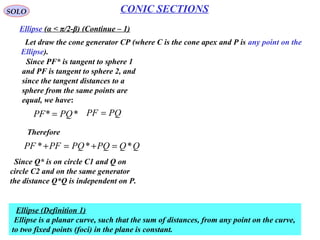
Let draw the cone generator CP (where C is the cone apex and P is any point on the
Ellipse).
Since PF* is tangent to sphere 1
and PF is tangent to sphere 2, and
since the tangent distances to a
sphere from the same points are
equal, we have:
** PQPF = PQPF =
Therefore
QQPQPQPFPF *** =+=+
Since Q* is on circle C1 and Q on
circle C2 and on the same generator
the distance Q*Q is independent on P.
Ellipse (Definition 1)
Ellipse is a planar curve, such that the sum of distances, from any point on the curve,
to two fixed points (foci) in the plane is constant.
8
SOLO CONIC SECTIONS
Ellipse (α < π/2-β) (Continue – 2)
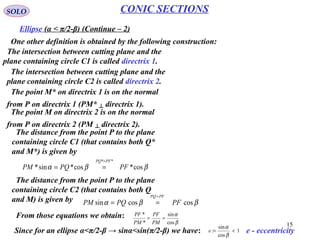
One other definition is obtained by the following construction:
The intersection between cutting plane and the
plane containing circle C1 is called directrix 1.
The intersection between cutting plane and the
plane containing circle C2 is called directrix 2.
The point M* on directrix 1 is on the normal
from P on directrix 1 (PM* ┴ directrix 1).
The point M on directrix 2 is on the normal
from P on directrix 2 (PM ┴ directrix 2).
The distance from the point P to the plane
containing circle C1 (that contains both Q*
and M*) is given by
The distance from the point P to the plane
containing circle C2 (that contains both Q
and M) is given by
ββα cos*cos*sin*
**
PFPQPM
PFPQ =
==
ββα coscossin PFPQPM
PFPQ =
==
From those equations we obtain:
Since for an ellipse α<π/2-β → sinα<sin(π/2-β) we have:
β
α
cos
sin
*
*
==
PM
PF
PM
PF
1
cos
sin
: <=
β
α
e e - eccentricity
9
SOLO CONIC SECTIONS
Ellipse (α < π/2-β) (Continue – 3)
We obtained: 1
cos
sin
*
*
<=== e
PM
PF
PM
PF
β
α
P
F
Q*
Q
Cutting
Plane Right
Circular
Cone
Sphere2 Tangent to
Cone at Q &
Cutting Plane at F
Sphere1 Tangent to
Cone at Q* &
Cutting Plane at F*
Cone
Appex
Circle C1
on the
Cone &
Sphere1
Circle C2
on the
Cone &
Sphere2
R1
R2
C
M*
M
Directrix
2
Directrix
1
α
β
F*
PQPF =
** PQPF =
constQQ
PQPQ
PFPF
=
=+
=+
*
*
*
β
β
α
cos
cos
sin
PF
PQ
PM
=
=
β
β
α
cos*
cos*
sin*
PF
PQ
PM
=
=
1:
cos
sin
*
*
<=== e
PM
PF
PM
PF
β
α
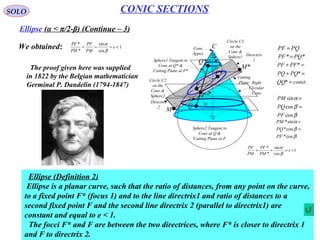
Ellipse (Definition 2)
Ellipse is a planar curve, such that the ratio of distances, from any point on the curve,
to a fixed point F* (focus 1) and to the line directrix1 and ratio of distances to a
second fixed point F and the second line directrix 2 (parallel to directrix1) are
constant and equal to e < 1.
The focci F* and F are between the two directrices, where F* is closer to directrix 1
and F to directrix 2.
The proof given here was supplied
in 1822 by the Belgian mathematician
Germinal P. Dandelin (1794-1847)
10
SOLO CONIC SECTIONS
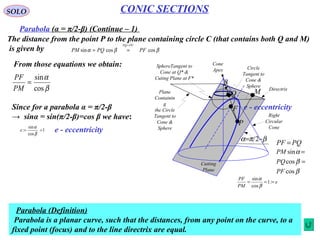
4. Parabola (α = π/2-β)
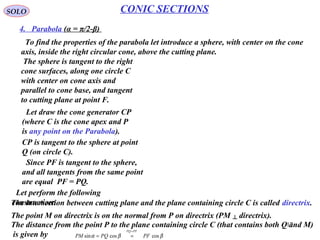
To find the properties of the parabola let introduce a sphere, with center on the cone
axis, inside the right circular cone, above the cutting plane.
The sphere is tangent to the right
cone surfaces, along one circle C
with center on cone axis and
parallel to cone base, and tangent
to cutting plane at point F.
Let draw the cone generator CP
(where C is the cone apex and P
is any point on the Parabola).
CP is tangent to the sphere at point
Q (on circle C).
Since PF is tangent to the sphere,
and all tangents from the same point
are equal PF = PQ.
Let perform the following
construction:The intersection between cutting plane and the plane containing circle C is called directrix.
The point M on directrix is on the normal from P on directrix (PM ┴ directrix).
The distance from the point P to the plane containing circle C (that contains both Q and M)
is given by ββα coscossin PFPQPM
PFPQ =
==
11
SOLO CONIC SECTIONS
Parabola (α = π/2-β) (Continue – 1)
P
F
Q
Cutting
Plane
Right
Circular
Cone
SphereTangent to
Cone at Q* &
Cuting Plane at F*
Cone
Apex
Plane
Containin
g
the Circle
Tangent to
Cone &
Sphere
Circle
Tangent to
Cone &
Sphere
β
βπα −= 2/
M Directrix
PQPF =
β
β
α
cos
cos
sin
PF
PQ
PM
=
=
e
PM
PF
=== :1
cos
sin
β
α
The distance from the point P to the plane containing circle C (that contains both Q and M)
is given by ββα coscossin PFPQPM
PFPQ =
==
β
α
cos
sin
=
PM
PF
From those equations we obtain:
Since for a parabola α = π/2-β
→ sinα = sin(π/2-β)=cos β we have:
e - eccentricity
1
cos
sin
: ==
β
α
e e - eccentricity
Parabola (Definition)
Parabola is a planar curve, such that the distances, from any point on the curve, to a
fixed point (focus) and to the line directrix are equal.
12
SOLO CONIC SECTIONS
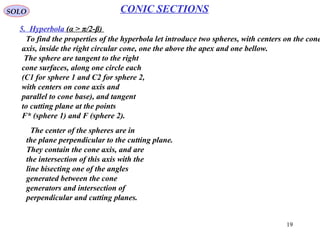
5. Hyperbola (α > π/2-β)
To find the properties of the hyperbola let introduce two spheres, with centers on the cone
axis, inside the right circular cone, one the above the apex and one bellow.
The sphere are tangent to the right
cone surfaces, along one circle each
(C1 for sphere 1 and C2 for sphere 2,
with centers on cone axis and
parallel to cone base), and tangent
to cutting plane at the points
F* (sphere 1) and F (sphere 2).
The center of the spheres are in
the plane perpendicular to the cutting plane.
They contain the cone axis, and are
the intersection of this axis with the
line bisecting one of the angles
generated between the cone
generators and intersection of
perpendicular and cutting planes.
13
SOLO CONIC SECTIONS
Hyperbola (α > π/2-β) (Continue – 1)
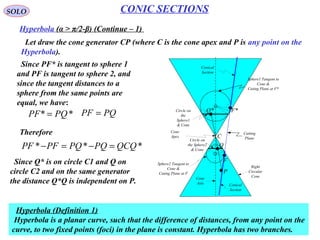
Let draw the cone generator CP (where C is the cone apex and P is any point on the
Hyperbola).
Since PF* is tangent to sphere 1
and PF is tangent to sphere 2, and
since the tangent distances to a
sphere from the same points are
equal, we have:
** PQPF = PQPF =
Therefore
*** QCQPQPQPFPF =−=−
Since Q* is on circle C1 and Q on
circle C2 and on the same generator
the distance Q*Q is independent on P.
P
F
F*
Q
Cutting
Plane
Right
Circular
Cone
Sphere1 Tangent to
Cone &
Cuting Plane at F*
Cone
Apex
Circle on
the Sphere2
& Cone
Sphere2 Tangent to
Cone &
Cuting Plane at F
Circle on
the
Sphere1
& Cone
Conical
Section
Conical
Section
C
Q*
Cone
Axis
Hyperbola (Definition 1)
Hyperbola is a planar curve, such that the difference of distances, from any point on the
curve, to two fixed points (foci) in the plane is constant. Hyperbola has two branches.
14
SOLO CONIC SECTIONS
Hyperbola (α > π/2-β) (Continue – 2)
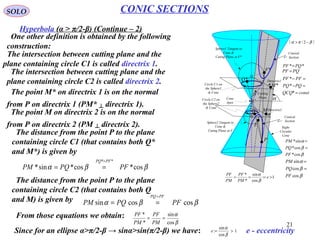
One other definition is obtained by the following
construction:
The intersection between cutting plane and the
plane containing circle C1 is called directrix 1.
The intersection between cutting plane and the
plane containing circle C2 is called directrix 2.
The point M* on directrix 1 is on the normal
from P on directrix 1 (PM* ┴ directrix 1).
The point M on directrix 2 is on the normal
from P on directrix 2 (PM ┴ directrix 2).
The distance from the point P to the plane
containing circle C1 (that contains both Q*
and M*) is given by
The distance from the point P to the plane
containing circle C2 (that contains both Q
and M) is given by
ββα cos*cos*sin*
**
PFPQPM
PFPQ =
==
ββα coscossin PFPQPM
PFPQ =
==
From those equations we obtain:
Since for an ellipse α>π/2-β → sinα>sin(π/2-β) we have:
β
α
cos
sin
*
*
==
PM
PF
PM
PF
1
cos
sin
: >=
β
α
e e - eccentricity
P
F
F*
Q
Cutting
Plane
Right
Circular
Cone
Sphere1 Tangent to
Cone &
Cuting Plane at F*
Cone
Apex
Sphere2 Tangent to
Cone &
Cuting Plane at F
Circle C1 on
the Sphere1
& Cone
Conical
Section
Conical
Section
Q*
CCircle C2 on
the Sphere2
& Cone
PQPF =
** PQPF =
constQCQ
PQPQ
PFPF
=
=−
=−
*
*
*
β
β
α
cos
cos
sin
PF
PQ
PM
=
=
β
β
α
cos*
cos*
sin*
PF
PQ
PM
=
=
( )βπα −> 2/
β
Directrix1
Directrix2M
M*
α
1:
cos
sin
*
*
>=== e
PM
PF
PM
PF
β
α
15
SOLO CONIC SECTIONS
Hyperbola (α < π/2-β) (Continue – 3)
We obtained: 1
cos
sin
*
*
>=== e
PM
PF
PM
PF
β
α
Hyperbola (Definition 2)
Hyperbola is a planar curve, such that the ratio of distances, from any point on the
curve, to a fixed point F* (focus 1) and to the line directrix1 and ratio of distances to a
second fixed point F and the second line directrix 2 (parallel to directrix1) are
constant and equal to e > 1.
The focci F* and F are between the two directrices, where F* is closer to directrix 1
and F to directrix 2.
P
F
F*
Q
Cutting
Plane
Right
Circular
Cone
Sphere1 Tangent to
Cone &
Cuting Plane at F*
Cone
Apex
Sphere2 Tangent to
Cone &
Cuting Plane at F
Circle C1 on
the Sphere1
& Cone
Conical
Section
Conical
Section
Q*
CCircle C2 on
the Sphere2
& Cone
PQPF =
** PQPF =
constQCQ
PQPQ
PFPF
=
=−
=−
*
*
*
β
β
α
cos
cos
sin
PF
PQ
PM
=
=
β
β
α
cos*
cos*
sin*
PF
PQ
PM
=
=
( )βπα −> 2/
β
Directrix1
Directrix2M
M*
α
1:
cos
sin
*
*
>=== e
PM
PF
PM
PF
β
α
16
SOLO CONIC SECTIONS
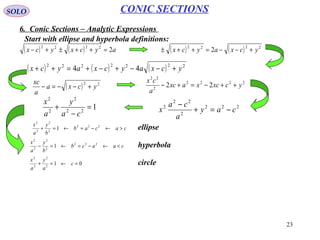
6. Conic Sections – Analytic Expressions
( ) ( ) aycxycx 22222
=++±+− ( ) ( ) 2222
2 ycxaycx +−−=++±
( ) ( ) ( ) 2222222
44 ycxaycxaycx +−−+−+=++
( ) 22
ycxa
a
xc
+−−=−
2222
2
22
22 ycxcxaxc
a
cx
++−=+−
222
2
22
2
cay
a
ca
x −=+
−122
2
2
2
=
−
+
ca
y
a
x
cacab
b
y
a
x
>←−=←=+ 222
2
2
2
2
1
caacb
b
y
a
x
<←−=←=− 222
2
2
2
2
1
012
2
2
2
=←=+ c
a
y
a
x
ellipse
hyperbola
circle
Start with ellipse and hyperbola definitions:
17
SOLO CONIC SECTIONS
Conic Sections – Analytic Expressions (Continue)
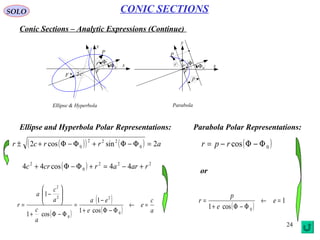
Ellipse and Hyperbola Polar Representations:
Φ
0Φ
P
F
*F
x
y
r
c2
Φ
0Φ
P
F
x
y
r
p
2/p
Ellipse & Hyperbola Parabola
Parabola Polar Representations:
( )( ) ( ) arrcr 2sincos2 0
222
0 =Φ−Φ+Φ−Φ+±
( ) 222
0
2
44cos44 rararcrc +−=+Φ−Φ+
( )
( )
( ) a
c
e
e
ea
a
c
a
c
a
r =←
Φ−Φ+
−
=
Φ−Φ+






−
=
0
2
0
2
2
cos1
1
cos1
1
( )0cos Φ−Φ−= rpr
( )
1
cos1 0
=←
Φ−Φ+
= e
e
p
r
or
18
SOLO CONIC SECTIONS
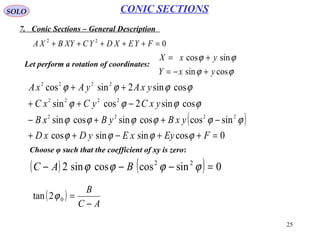
7. Conic Sections – General Description
Let perform a rotation of coordinates:
022
=+++++ FYEXDYCXYBXA
ϕϕ
ϕϕ
cossin
sincos
yxY
yxX
+−=
+=
( )
0cossinsincos
sincoscossincossin
cossin2cossin
cossin2sincos
2222
2222
2222
=++−++
−++−
−++
++
FEyxEyDxD
yxByBxB
yxCyCxC
yxAyAxA
ϕϕϕϕ
ϕϕϕϕϕϕ
ϕϕϕϕ
ϕϕϕϕ
Choose φ such that the coefficient of xy is zero:
( ) ( ) 0sincoscossin2 22
=−−− ϕϕϕϕ BAC
( )
AC
B
−
=02tan ϕ
19
SOLO CONIC SECTIONS
Conic Sections – General Description (Continue – 1)
0cossinsincos
cossincossin
cossin
sincos
0000
00
2
00
2
)
22
0
22
0
22
0
22
=++−++
+−
++
+
FEyxEyDxD
yBxB
yCxC
yAxA
ϕϕϕϕ
ϕϕϕϕ
ϕϕ
ϕϕ
( ) ( )
( ) ( ) 0cossinsincos
cossincossincossinsincos
0000
2
00)
2
0
22
000
2
0
2
=+++−+
+++−+
FyEDxED
yBCAxBCA
ϕϕϕϕ
ϕϕϕϕϕϕϕϕ
( ) ( )
( )
( ) ( )
( )
( )
( )
( )
( )
0
cossincossin2
cossin
cossinsincos2
sincos
cossincossin2
cossin
cossincossin
cossinsincos2
sincos
cossinsincos
2
00)
2
0
2
00
2
000
2
0
2
00
2
00)
2
0
2
00
00)
2
0
2
2
000
2
0
2
00
000
2
0
2
1
1
=+








++
+
−







−+
−
−








++
+
++++








−+
−
+−+
F
BCA
ED
BCA
ED
BCA
ED
yBCA
BCA
ED
xBCA
C
A
ϕϕϕϕ
ϕϕ
ϕϕϕϕ
ϕϕ
ϕϕϕϕ
ϕϕ
ϕϕϕϕ
ϕϕϕϕ
ϕϕ
ϕϕϕϕ
  
  
We obtain
or
or
20
SOLO CONIC SECTIONS
Conic Sections – General Description (Continue – 2)
Let define
( )000
2
0
2
1 cossinsincos: ϕϕϕϕ BCAA −+=
( )00)
2
0
2
1 cossincossin: ϕϕϕϕ BCAC ++=
001
001
cossin:
sincos:
ϕϕ
ϕϕ
EDE
EDD
+=
−=
We can see that CACA +=+ 11
1. If A1 ≠ 0 & C1 ≠ 0. We define
( )
( )
( )
( )
2
00)
2
0
2
00
2
000
2
0
2
00
1
cossincossin2
cossin
cossinsincos2
sincos
:








++
+
−





−+
−
−=
ϕϕϕϕ
ϕϕ
ϕϕϕϕ
ϕϕ
BCA
ED
BCA
ED
FF
If A1, C1, F1 ≠ 0 do not have the same algebraic sign, than the equation is an equation
of an ellipse, circle or hyperbola 1
1
1
2 A
D
xx +=
1
1
1
2C
E
yy +=
The equation becomes: 01
2
11
2
11 =++ FyCxA
If sign A1 = sign C1 ≠ sign F1 & A1 = C1 → circle
If sign A1 = sign C1 ≠ sign F1 & A1 ≠ C1 → ellipse
If sign A1 ≠ sign C1 → hyperbola
21
SOLO CONIC SECTIONS
Conic Sections – General Description (Continue – 3)
2. If A1 = 0 , C1 ≠ 0 & D1 ≠ 0. We define
1
2
1
1
1
2
:
D
C
E
F
xx






−
+=
1
1
1
2
:
C
E
yy +=
Parabola011
2
11 =+ xDyCThe equation becomes:
Parabola011
2
11
=+ yExAThe equation becomes:
3. If A1 ≠ 0 , C1 = 0 & E1 ≠ 0. We define
1
1
1
2
:
A
D
xx +=
1
1
1
1
2
:
E
A
D
F
yy






−
+=
22
SOLO CONIC SECTIONS
Conic Sections – General Description (Continue – 4)
The equation can be rewritten as022
=+++++ FYEXDYCXYBXA
[ ] [ ] 0
1
2
1
2
1
2
1
2
1
2
1
2
1
1
2
1
2
1
2
1
2
1
2
1
2
1
1 =




























=


















++
++
++
Y
X
FED
ECB
DBA
YX
FEYDX
EYCXB
DYBXA
YX
The rotation of coordinates can be written as:




















−=










1100
0cossin
0sincos
1
y
x
Y
X
ϕϕ
ϕϕ
We can write:
[ ]




























=+++++
1
2
1
2
1
2
1
2
1
2
1
2
1
122
Y
X
FED
ECB
DBA
YXFYEXDYCXYBXA
[ ]




















−



























 −
=
1100
0cossin
0sincos
2
1
2
1
2
1
2
1
2
1
2
1
100
0cossin
0sincos
1 y
x
FED
ECB
DBA
yx ϕϕ
ϕϕ
ϕϕ
ϕϕ
[ ] 0
1
2
1
2
1
2
1
2
1
2
1
2
1
1
11
111
111
=




























= y
x
FED
ECB
DBA
yx
23
SOLO CONIC SECTIONS
Conic Sections – General Description (Continue – 5)
Therefore we have










−



























 −
=


















100
0cossin
0sincos
2
1
2
1
2
1
2
1
2
1
2
1
100
0cossin
0sincos
2
1
2
1
2
1
2
1
2
1
2
1
11
111
111
ϕϕ
ϕϕ
ϕϕ
ϕϕ
FED
ECB
DBA
FED
ECB
DBA






−

















 −
=












ϕϕ
ϕϕ
ϕϕ
ϕϕ
cossin
sincos
2
1
2
1
cossin
sincos
2
1
2
1
11
11
CB
BA
CB
BA


















=


















FED
ECB
DBA
FED
ECB
DBA
2
1
2
1
2
1
2
1
2
1
2
1
det
2
1
2
1
2
1
2
1
2
1
2
1
det
11
111
111
2
11
11
4
1
2
1
2
1
det
2
1
2
1
det BCA
CB
BA
CB
BA
−=












=

















→>
→=
→<
−
circleorellipse
parabola
hyperbola
BCA
0
0
0
4
1 2
and
Finally we obtain:
The necessary conditions for different conic sections are:
24
SOLO CONIC SECTIONS
References
1. Battin R.H., “An Introduction to the Mathematics and Methods of Astrodynamics”,
AIAA Education Series, AIAA, Washington. DV., 1987
January 6, 2015 25
SOLO
Technion
Israeli Institute of Technology
1964 – 1968 BSc EE
1968 – 1971 MSc EE
Israeli Air Force
1970 – 1974
RAFAEL
Israeli Armament Development Authority
1974 – 2013
Stanford University
1983 – 1986 PhD AA

Conic sections

  • 1.
  • 2.
    2 SOLO Table of Contents 2.Circle 3. Ellipse 4. Parabola 5. Hyperbola 6. Conic sections – Analytic Expressions 7. Conic sections – General Description CONIC SECTIONS 1. Conic Sections - Introduction 8. References
  • 3.
    3 SOLO A right circularcone is a cone obtained by generators (straight lines) passing through a circle, and the apex C that is situated on the normal to the circle plane and passing trough the center of the circle. β is the angle between the cone axis and the generators. CONIC SECTIONS Cutting Plane generating a "hyperbola" Right Circular Cone Cone Apex Conical Section C Cone Axis Cutting Plane generating a "parabola" Cutting Plane generating a "ellipse" Cutting Plane generating a "circle" Cutting Plane generating two "lines" α β       −= β π α 2       −< β π α 2       −> β π α 2 ( )0=α                   −> −= −< lines line po 2 2 1 2 int 2 β π α β π α β π α P F F * Cutting Plane (Hyperbola ) Right Circular Cone Hyperbola 2 Branches C β α Ellipse Parabola Cutting Plane (Ellipse) Cutting Plane (Circle) Cutting Plane (Parabola) By cutting the right circular conic by a plane we obtain different conic sections, as a function of the inclination angle α of the plane relative to the base of the conic section and the angle β between the generators and the base. The discovery of the Conical Sections is attributed to the greek Menachmus who lived around 350 B.C.. 1. Conic Sections - Introduction
  • 4.
    4 SOLO The conical sectionsare: CONIC SECTIONS 1. Circle if the cutting plane is normal to the cone axis (α=0) and is above or bellow the apex. 2. Ellipse if the cutting plane is inclined to the basis at an angle that falls short of the angle between generators to the base (α<π/2-β) (in greek word elleipsis means falls, short or leaves out. 3. Hyperbola if the cutting plane is inclined to the basis at an angle that exceeds of the angle between generators to the base (α>π/2-β)(in greek word hyperbole means excess. 4. Parabola if the cutting plane is parallel to a generator of the right circular cone (α=π/2-β) (in greek word parabole is the origin of the words parabola and parallel. 5. A point- apex (α<π/2-β), one straight line (α=π/2-β), two straight lines (α>π/2-β), if the cutting plane passes through the apex and intersects the cone basis.
  • 5.
    5 SOLO CONIC SECTIONS Circleif the cutting plane is normal to the cone axis (α=0) and is above or bellow the apex. 2. Circle
  • 6.
    6 SOLO CONIC SECTIONS 3Ellipse (α < π/2-β) To find the properties of the ellipse let introduce two spheres, with centers on the cone axis, inside the right circular cone, one the above the cutting plane and one bellow. The sphere are tangent to the right cone surfaces, along one circle each (C1 for sphere 1 and C2 for sphere 2, with centers on cone axis and parallel to cone base), and tangent to cutting plane at the points F* (sphere 1) and F (sphere 2). The center of the spheres are in the plane perpendicular to the cutting plane. They contain the cone axis, and are the intersection of this axis with the line bisecting one of the angles generated between the cone generators and intersection of perpendicular and cutting planes.
  • 7.
    7 SOLO CONIC SECTIONS Ellipse(α < π/2-β) (Continue – 1) Let draw the cone generator CP (where C is the cone apex and P is any point on the Ellipse). Since PF* is tangent to sphere 1 and PF is tangent to sphere 2, and since the tangent distances to a sphere from the same points are equal, we have: ** PQPF = PQPF = Therefore QQPQPQPFPF *** =+=+ Since Q* is on circle C1 and Q on circle C2 and on the same generator the distance Q*Q is independent on P. Ellipse (Definition 1) Ellipse is a planar curve, such that the sum of distances, from any point on the curve, to two fixed points (foci) in the plane is constant.
  • 8.
    8 SOLO CONIC SECTIONS Ellipse(α < π/2-β) (Continue – 2) One other definition is obtained by the following construction: The intersection between cutting plane and the plane containing circle C1 is called directrix 1. The intersection between cutting plane and the plane containing circle C2 is called directrix 2. The point M* on directrix 1 is on the normal from P on directrix 1 (PM* ┴ directrix 1). The point M on directrix 2 is on the normal from P on directrix 2 (PM ┴ directrix 2). The distance from the point P to the plane containing circle C1 (that contains both Q* and M*) is given by The distance from the point P to the plane containing circle C2 (that contains both Q and M) is given by ββα cos*cos*sin* ** PFPQPM PFPQ = == ββα coscossin PFPQPM PFPQ = == From those equations we obtain: Since for an ellipse α<π/2-β → sinα<sin(π/2-β) we have: β α cos sin * * == PM PF PM PF 1 cos sin : <= β α e e - eccentricity
  • 9.
    9 SOLO CONIC SECTIONS Ellipse(α < π/2-β) (Continue – 3) We obtained: 1 cos sin * * <=== e PM PF PM PF β α P F Q* Q Cutting Plane Right Circular Cone Sphere2 Tangent to Cone at Q & Cutting Plane at F Sphere1 Tangent to Cone at Q* & Cutting Plane at F* Cone Appex Circle C1 on the Cone & Sphere1 Circle C2 on the Cone & Sphere2 R1 R2 C M* M Directrix 2 Directrix 1 α β F* PQPF = ** PQPF = constQQ PQPQ PFPF = =+ =+ * * * β β α cos cos sin PF PQ PM = = β β α cos* cos* sin* PF PQ PM = = 1: cos sin * * <=== e PM PF PM PF β α Ellipse (Definition 2) Ellipse is a planar curve, such that the ratio of distances, from any point on the curve, to a fixed point F* (focus 1) and to the line directrix1 and ratio of distances to a second fixed point F and the second line directrix 2 (parallel to directrix1) are constant and equal to e < 1. The focci F* and F are between the two directrices, where F* is closer to directrix 1 and F to directrix 2. The proof given here was supplied in 1822 by the Belgian mathematician Germinal P. Dandelin (1794-1847)
  • 10.
    10 SOLO CONIC SECTIONS 4.Parabola (α = π/2-β) To find the properties of the parabola let introduce a sphere, with center on the cone axis, inside the right circular cone, above the cutting plane. The sphere is tangent to the right cone surfaces, along one circle C with center on cone axis and parallel to cone base, and tangent to cutting plane at point F. Let draw the cone generator CP (where C is the cone apex and P is any point on the Parabola). CP is tangent to the sphere at point Q (on circle C). Since PF is tangent to the sphere, and all tangents from the same point are equal PF = PQ. Let perform the following construction:The intersection between cutting plane and the plane containing circle C is called directrix. The point M on directrix is on the normal from P on directrix (PM ┴ directrix). The distance from the point P to the plane containing circle C (that contains both Q and M) is given by ββα coscossin PFPQPM PFPQ = ==
  • 11.
    11 SOLO CONIC SECTIONS Parabola(α = π/2-β) (Continue – 1) P F Q Cutting Plane Right Circular Cone SphereTangent to Cone at Q* & Cuting Plane at F* Cone Apex Plane Containin g the Circle Tangent to Cone & Sphere Circle Tangent to Cone & Sphere β βπα −= 2/ M Directrix PQPF = β β α cos cos sin PF PQ PM = = e PM PF === :1 cos sin β α The distance from the point P to the plane containing circle C (that contains both Q and M) is given by ββα coscossin PFPQPM PFPQ = == β α cos sin = PM PF From those equations we obtain: Since for a parabola α = π/2-β → sinα = sin(π/2-β)=cos β we have: e - eccentricity 1 cos sin : == β α e e - eccentricity Parabola (Definition) Parabola is a planar curve, such that the distances, from any point on the curve, to a fixed point (focus) and to the line directrix are equal.
  • 12.
    12 SOLO CONIC SECTIONS 5.Hyperbola (α > π/2-β) To find the properties of the hyperbola let introduce two spheres, with centers on the cone axis, inside the right circular cone, one the above the apex and one bellow. The sphere are tangent to the right cone surfaces, along one circle each (C1 for sphere 1 and C2 for sphere 2, with centers on cone axis and parallel to cone base), and tangent to cutting plane at the points F* (sphere 1) and F (sphere 2). The center of the spheres are in the plane perpendicular to the cutting plane. They contain the cone axis, and are the intersection of this axis with the line bisecting one of the angles generated between the cone generators and intersection of perpendicular and cutting planes.
  • 13.
    13 SOLO CONIC SECTIONS Hyperbola(α > π/2-β) (Continue – 1) Let draw the cone generator CP (where C is the cone apex and P is any point on the Hyperbola). Since PF* is tangent to sphere 1 and PF is tangent to sphere 2, and since the tangent distances to a sphere from the same points are equal, we have: ** PQPF = PQPF = Therefore *** QCQPQPQPFPF =−=− Since Q* is on circle C1 and Q on circle C2 and on the same generator the distance Q*Q is independent on P. P F F* Q Cutting Plane Right Circular Cone Sphere1 Tangent to Cone & Cuting Plane at F* Cone Apex Circle on the Sphere2 & Cone Sphere2 Tangent to Cone & Cuting Plane at F Circle on the Sphere1 & Cone Conical Section Conical Section C Q* Cone Axis Hyperbola (Definition 1) Hyperbola is a planar curve, such that the difference of distances, from any point on the curve, to two fixed points (foci) in the plane is constant. Hyperbola has two branches.
  • 14.
    14 SOLO CONIC SECTIONS Hyperbola(α > π/2-β) (Continue – 2) One other definition is obtained by the following construction: The intersection between cutting plane and the plane containing circle C1 is called directrix 1. The intersection between cutting plane and the plane containing circle C2 is called directrix 2. The point M* on directrix 1 is on the normal from P on directrix 1 (PM* ┴ directrix 1). The point M on directrix 2 is on the normal from P on directrix 2 (PM ┴ directrix 2). The distance from the point P to the plane containing circle C1 (that contains both Q* and M*) is given by The distance from the point P to the plane containing circle C2 (that contains both Q and M) is given by ββα cos*cos*sin* ** PFPQPM PFPQ = == ββα coscossin PFPQPM PFPQ = == From those equations we obtain: Since for an ellipse α>π/2-β → sinα>sin(π/2-β) we have: β α cos sin * * == PM PF PM PF 1 cos sin : >= β α e e - eccentricity P F F* Q Cutting Plane Right Circular Cone Sphere1 Tangent to Cone & Cuting Plane at F* Cone Apex Sphere2 Tangent to Cone & Cuting Plane at F Circle C1 on the Sphere1 & Cone Conical Section Conical Section Q* CCircle C2 on the Sphere2 & Cone PQPF = ** PQPF = constQCQ PQPQ PFPF = =− =− * * * β β α cos cos sin PF PQ PM = = β β α cos* cos* sin* PF PQ PM = = ( )βπα −> 2/ β Directrix1 Directrix2M M* α 1: cos sin * * >=== e PM PF PM PF β α
  • 15.
    15 SOLO CONIC SECTIONS Hyperbola(α < π/2-β) (Continue – 3) We obtained: 1 cos sin * * >=== e PM PF PM PF β α Hyperbola (Definition 2) Hyperbola is a planar curve, such that the ratio of distances, from any point on the curve, to a fixed point F* (focus 1) and to the line directrix1 and ratio of distances to a second fixed point F and the second line directrix 2 (parallel to directrix1) are constant and equal to e > 1. The focci F* and F are between the two directrices, where F* is closer to directrix 1 and F to directrix 2. P F F* Q Cutting Plane Right Circular Cone Sphere1 Tangent to Cone & Cuting Plane at F* Cone Apex Sphere2 Tangent to Cone & Cuting Plane at F Circle C1 on the Sphere1 & Cone Conical Section Conical Section Q* CCircle C2 on the Sphere2 & Cone PQPF = ** PQPF = constQCQ PQPQ PFPF = =− =− * * * β β α cos cos sin PF PQ PM = = β β α cos* cos* sin* PF PQ PM = = ( )βπα −> 2/ β Directrix1 Directrix2M M* α 1: cos sin * * >=== e PM PF PM PF β α
  • 16.
    16 SOLO CONIC SECTIONS 6.Conic Sections – Analytic Expressions ( ) ( ) aycxycx 22222 =++±+− ( ) ( ) 2222 2 ycxaycx +−−=++± ( ) ( ) ( ) 2222222 44 ycxaycxaycx +−−+−+=++ ( ) 22 ycxa a xc +−−=− 2222 2 22 22 ycxcxaxc a cx ++−=+− 222 2 22 2 cay a ca x −=+ −122 2 2 2 = − + ca y a x cacab b y a x >←−=←=+ 222 2 2 2 2 1 caacb b y a x <←−=←=− 222 2 2 2 2 1 012 2 2 2 =←=+ c a y a x ellipse hyperbola circle Start with ellipse and hyperbola definitions:
  • 17.
    17 SOLO CONIC SECTIONS ConicSections – Analytic Expressions (Continue) Ellipse and Hyperbola Polar Representations: Φ 0Φ P F *F x y r c2 Φ 0Φ P F x y r p 2/p Ellipse & Hyperbola Parabola Parabola Polar Representations: ( )( ) ( ) arrcr 2sincos2 0 222 0 =Φ−Φ+Φ−Φ+± ( ) 222 0 2 44cos44 rararcrc +−=+Φ−Φ+ ( ) ( ) ( ) a c e e ea a c a c a r =← Φ−Φ+ − = Φ−Φ+       − = 0 2 0 2 2 cos1 1 cos1 1 ( )0cos Φ−Φ−= rpr ( ) 1 cos1 0 =← Φ−Φ+ = e e p r or
  • 18.
    18 SOLO CONIC SECTIONS 7.Conic Sections – General Description Let perform a rotation of coordinates: 022 =+++++ FYEXDYCXYBXA ϕϕ ϕϕ cossin sincos yxY yxX +−= += ( ) 0cossinsincos sincoscossincossin cossin2cossin cossin2sincos 2222 2222 2222 =++−++ −++− −++ ++ FEyxEyDxD yxByBxB yxCyCxC yxAyAxA ϕϕϕϕ ϕϕϕϕϕϕ ϕϕϕϕ ϕϕϕϕ Choose φ such that the coefficient of xy is zero: ( ) ( ) 0sincoscossin2 22 =−−− ϕϕϕϕ BAC ( ) AC B − =02tan ϕ
  • 19.
    19 SOLO CONIC SECTIONS ConicSections – General Description (Continue – 1) 0cossinsincos cossincossin cossin sincos 0000 00 2 00 2 ) 22 0 22 0 22 0 22 =++−++ +− ++ + FEyxEyDxD yBxB yCxC yAxA ϕϕϕϕ ϕϕϕϕ ϕϕ ϕϕ ( ) ( ) ( ) ( ) 0cossinsincos cossincossincossinsincos 0000 2 00) 2 0 22 000 2 0 2 =+++−+ +++−+ FyEDxED yBCAxBCA ϕϕϕϕ ϕϕϕϕϕϕϕϕ ( ) ( ) ( ) ( ) ( ) ( ) ( ) ( ) ( ) ( ) 0 cossincossin2 cossin cossinsincos2 sincos cossincossin2 cossin cossincossin cossinsincos2 sincos cossinsincos 2 00) 2 0 2 00 2 000 2 0 2 00 2 00) 2 0 2 00 00) 2 0 2 2 000 2 0 2 00 000 2 0 2 1 1 =+         ++ + −        −+ − −         ++ + ++++         −+ − +−+ F BCA ED BCA ED BCA ED yBCA BCA ED xBCA C A ϕϕϕϕ ϕϕ ϕϕϕϕ ϕϕ ϕϕϕϕ ϕϕ ϕϕϕϕ ϕϕϕϕ ϕϕ ϕϕϕϕ       We obtain or or
  • 20.
    20 SOLO CONIC SECTIONS ConicSections – General Description (Continue – 2) Let define ( )000 2 0 2 1 cossinsincos: ϕϕϕϕ BCAA −+= ( )00) 2 0 2 1 cossincossin: ϕϕϕϕ BCAC ++= 001 001 cossin: sincos: ϕϕ ϕϕ EDE EDD += −= We can see that CACA +=+ 11 1. If A1 ≠ 0 & C1 ≠ 0. We define ( ) ( ) ( ) ( ) 2 00) 2 0 2 00 2 000 2 0 2 00 1 cossincossin2 cossin cossinsincos2 sincos :         ++ + −      −+ − −= ϕϕϕϕ ϕϕ ϕϕϕϕ ϕϕ BCA ED BCA ED FF If A1, C1, F1 ≠ 0 do not have the same algebraic sign, than the equation is an equation of an ellipse, circle or hyperbola 1 1 1 2 A D xx += 1 1 1 2C E yy += The equation becomes: 01 2 11 2 11 =++ FyCxA If sign A1 = sign C1 ≠ sign F1 & A1 = C1 → circle If sign A1 = sign C1 ≠ sign F1 & A1 ≠ C1 → ellipse If sign A1 ≠ sign C1 → hyperbola
  • 21.
    21 SOLO CONIC SECTIONS ConicSections – General Description (Continue – 3) 2. If A1 = 0 , C1 ≠ 0 & D1 ≠ 0. We define 1 2 1 1 1 2 : D C E F xx       − += 1 1 1 2 : C E yy += Parabola011 2 11 =+ xDyCThe equation becomes: Parabola011 2 11 =+ yExAThe equation becomes: 3. If A1 ≠ 0 , C1 = 0 & E1 ≠ 0. We define 1 1 1 2 : A D xx += 1 1 1 1 2 : E A D F yy       − +=
  • 22.
    22 SOLO CONIC SECTIONS ConicSections – General Description (Continue – 4) The equation can be rewritten as022 =+++++ FYEXDYCXYBXA [ ] [ ] 0 1 2 1 2 1 2 1 2 1 2 1 2 1 1 2 1 2 1 2 1 2 1 2 1 2 1 1 =                             =                   ++ ++ ++ Y X FED ECB DBA YX FEYDX EYCXB DYBXA YX The rotation of coordinates can be written as:                     −=           1100 0cossin 0sincos 1 y x Y X ϕϕ ϕϕ We can write: [ ]                             =+++++ 1 2 1 2 1 2 1 2 1 2 1 2 1 122 Y X FED ECB DBA YXFYEXDYCXYBXA [ ]                     −                             − = 1100 0cossin 0sincos 2 1 2 1 2 1 2 1 2 1 2 1 100 0cossin 0sincos 1 y x FED ECB DBA yx ϕϕ ϕϕ ϕϕ ϕϕ [ ] 0 1 2 1 2 1 2 1 2 1 2 1 2 1 1 11 111 111 =                             = y x FED ECB DBA yx
  • 23.
    23 SOLO CONIC SECTIONS ConicSections – General Description (Continue – 5) Therefore we have           −                             − =                   100 0cossin 0sincos 2 1 2 1 2 1 2 1 2 1 2 1 100 0cossin 0sincos 2 1 2 1 2 1 2 1 2 1 2 1 11 111 111 ϕϕ ϕϕ ϕϕ ϕϕ FED ECB DBA FED ECB DBA       −                   − =             ϕϕ ϕϕ ϕϕ ϕϕ cossin sincos 2 1 2 1 cossin sincos 2 1 2 1 11 11 CB BA CB BA                   =                   FED ECB DBA FED ECB DBA 2 1 2 1 2 1 2 1 2 1 2 1 det 2 1 2 1 2 1 2 1 2 1 2 1 det 11 111 111 2 11 11 4 1 2 1 2 1 det 2 1 2 1 det BCA CB BA CB BA −=             =                  →> →= →< − circleorellipse parabola hyperbola BCA 0 0 0 4 1 2 and Finally we obtain: The necessary conditions for different conic sections are:
  • 24.
    24 SOLO CONIC SECTIONS References 1.Battin R.H., “An Introduction to the Mathematics and Methods of Astrodynamics”, AIAA Education Series, AIAA, Washington. DV., 1987
  • 25.
    January 6, 201525 SOLO Technion Israeli Institute of Technology 1964 – 1968 BSc EE 1968 – 1971 MSc EE Israeli Air Force 1970 – 1974 RAFAEL Israeli Armament Development Authority 1974 – 2013 Stanford University 1983 – 1986 PhD AA