2-D Geometric Transformations
       In order to manipulate an object in 2-D
space, we must apply various transformation
functions to the object. This allows us to change
the position, size, and orientation of the objects.
There are two complementary points of view
   for describing object movement.
1.) Geometric Transformation : The object
   itself is moved relative to a stationary
   coordinate system or background.
2.) Coordinate transformation : The object
   is held stationary while the coordinate
   system is moved relative to the object.
The Basic geometric transformations are:
 Translation
 Rotation
 Scaling
 Reflection
 Shear
Translation
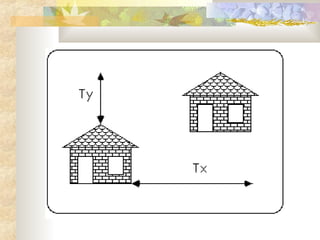
Moving an object is called a translation. We
translate point by moving to the x and y
coordinates, the amount the point should be
shifted in the x and y directions. We translate
an object by translating each vertex in the
object.
               x’ = x + tx
               y’ = y + ty
The translating distance pair( tx, ty) is called a
translation vector or shift vector.
We can also write this equation in a single
Matrix using column vectors:
    P = x1        P’ = x1’          T = tx
          x2             x2’               ty
     or, P’ = P + T
That is, every point on the object is translated
by the same amount.
Rotation
An object can be rotated about the origin by a
specific rotation angle θ & the position (xr,yr)
of the rotation point about which the object is
to be rotated.
Positive values for the rotation angle define
counterclockwise rotations & -ve defines
clockwise direction. This transformation can
also be described as a rotation about the
rotation axis that is perpendicular to the xy
plane.
θ
Φ
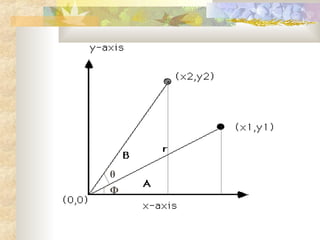
In the fig., r is the constant distance of the
point from the origin, angle Φ is the original
angular position of the point from the
horizontal, & θ is the rotation angle.
We can express the coordinates as:
x2 = r cos(Φ+θ) = r cosΦ cosθ – r sinΦ sinθ
y2 = r sin(Φ+θ) = r cosΦ sinθ + r sinΦ cosθ
The original coordinates of the points in the
polar coordinates are
          x = r cosΦ , y = r sinΦ
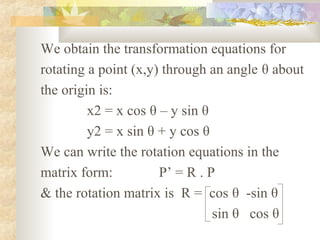
We obtain the transformation equations for
rotating a point (x,y) through an angle θ about
the origin is:
         x2 = x cos θ – y sin θ
         y2 = x sin θ + y cos θ
We can write the rotation equations in the
matrix form:          P’ = R . P
& the rotation matrix is R = cos θ -sin θ
                                sin θ cos θ
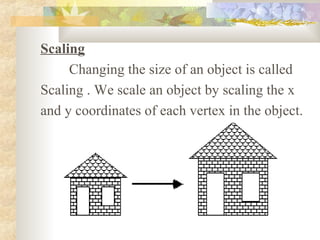
Scaling
     Changing the size of an object is called
Scaling . We scale an object by scaling the x
and y coordinates of each vertex in the object.
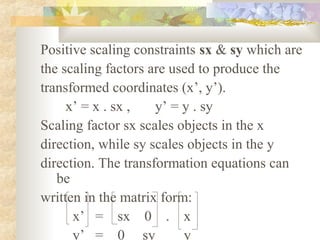
Positive scaling constraints sx & sy which are
the scaling factors are used to produce the
transformed coordinates (x’, y’).
     x’ = x . sx ,   y’ = y . sy
Scaling factor sx scales objects in the x
direction, while sy scales objects in the y
direction. The transformation equations can
   be
written in the matrix form:
      x’ = sx 0 . x
      y’ = 0 sy           y
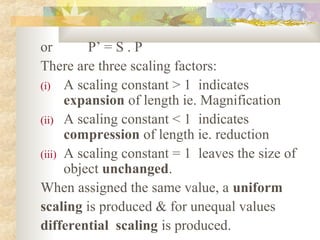
or        P’ = S . P
There are three scaling factors:
(i) A scaling constant > 1 indicates
      expansion of length ie. Magnification
(ii) A scaling constant < 1 indicates
      compression of length ie. reduction
(iii) A scaling constant = 1 leaves the size of
      object unchanged.
When assigned the same value, a uniform
scaling is produced & for unequal values
differential scaling is produced.
Reflection
A reflection is a transformation that produces
a mirror image of an object. Since the
reflection P’ of an object point P is located the
same distance from the mirror as P.
(i) The mirror reflection transformation Mx
     about the x-axis is given by:
                  P’ = Mx (P)
where,     x’ = x & y’ = -y
It can be represented in matrix form as:
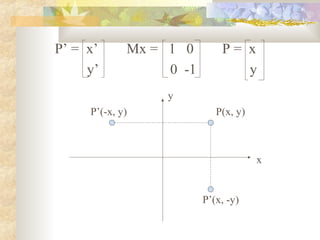
P’ = x’      Mx = 1 0        P= x
     y’           0 -1          y
                  y
     P’(-x, y)              P(x, y)


                                      x


                         P’(x, -y)
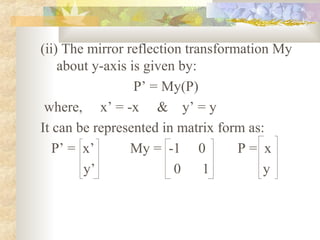
(ii) The mirror reflection transformation My
    about y-axis is given by:
                  P’ = My(P)
 where, x’ = -x & y’ = y
It can be represented in matrix form as:
   P’ = x’       My = -1 0          P= x
        y’               0    1         y
Shear
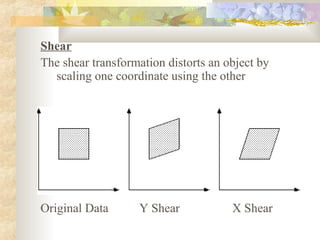
The shear transformation distorts an object by
  scaling one coordinate using the other


Original Data      Y Shear            X Shear
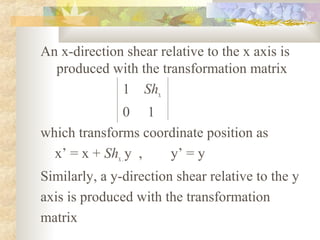
An x-direction shear relative to the x axis is
  produced with the transformation matrix
              1 Shx
                0 1
which transforms coordinate position as
  x’ = x + Shx . y , y’ = y
Similarly, a y-direction shear relative to the y
axis is produced with the transformation
matrix
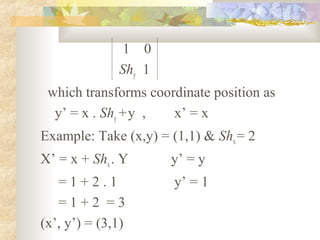
1 0
              Shy 1
 which transforms coordinate position as
  y’ = x . Shy + y ,  x’ = x
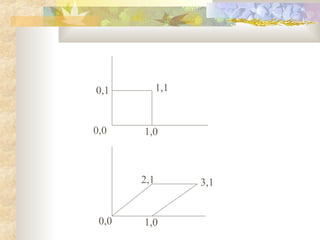
Example: Take (x,y) = (1,1) & Shx = 2
X’ = x + Shx . Y      y’ = y
   =1+2.1              y’ = 1
   =1+2 =3
(x’, y’) = (3,1)
0,1          1,1


0,0    1,0


       2,1         3,1


 0,0   1,0
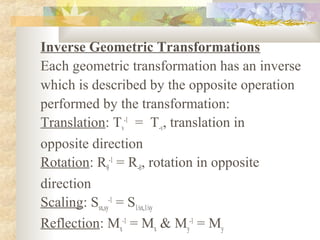
Inverse Geometric Transformations
Each geometric transformation has an inverse
which is described by the opposite operation
performed by the transformation:
Translation: Tv-1 = T-v, translation in
opposite direction
Rotation: Rθ-1 = R-θ, rotation in opposite
direction
Scaling: Ssx,sy-1 = S1/sx,1/sy
Reflection: Mx-1 = Mx & My-1 = My

2 d geometric transformations

  • 1.
    2-D Geometric Transformations In order to manipulate an object in 2-D space, we must apply various transformation functions to the object. This allows us to change the position, size, and orientation of the objects. There are two complementary points of view for describing object movement. 1.) Geometric Transformation : The object itself is moved relative to a stationary coordinate system or background.
  • 2.
    2.) Coordinate transformation: The object is held stationary while the coordinate system is moved relative to the object. The Basic geometric transformations are:  Translation  Rotation  Scaling  Reflection  Shear
  • 3.
    Translation Moving an objectis called a translation. We translate point by moving to the x and y coordinates, the amount the point should be shifted in the x and y directions. We translate an object by translating each vertex in the object. x’ = x + tx y’ = y + ty
  • 5.
    The translating distancepair( tx, ty) is called a translation vector or shift vector. We can also write this equation in a single Matrix using column vectors: P = x1 P’ = x1’ T = tx x2 x2’ ty or, P’ = P + T That is, every point on the object is translated by the same amount.
  • 6.
    Rotation An object canbe rotated about the origin by a specific rotation angle θ & the position (xr,yr) of the rotation point about which the object is to be rotated. Positive values for the rotation angle define counterclockwise rotations & -ve defines clockwise direction. This transformation can also be described as a rotation about the rotation axis that is perpendicular to the xy plane.
  • 7.
  • 8.
    In the fig.,r is the constant distance of the point from the origin, angle Φ is the original angular position of the point from the horizontal, & θ is the rotation angle. We can express the coordinates as: x2 = r cos(Φ+θ) = r cosΦ cosθ – r sinΦ sinθ y2 = r sin(Φ+θ) = r cosΦ sinθ + r sinΦ cosθ The original coordinates of the points in the polar coordinates are x = r cosΦ , y = r sinΦ
  • 9.
    We obtain thetransformation equations for rotating a point (x,y) through an angle θ about the origin is: x2 = x cos θ – y sin θ y2 = x sin θ + y cos θ We can write the rotation equations in the matrix form: P’ = R . P & the rotation matrix is R = cos θ -sin θ sin θ cos θ
  • 10.
    Scaling Changing the size of an object is called Scaling . We scale an object by scaling the x and y coordinates of each vertex in the object.
  • 11.
    Positive scaling constraintssx & sy which are the scaling factors are used to produce the transformed coordinates (x’, y’). x’ = x . sx , y’ = y . sy Scaling factor sx scales objects in the x direction, while sy scales objects in the y direction. The transformation equations can be written in the matrix form: x’ = sx 0 . x y’ = 0 sy y
  • 12.
    or P’ = S . P There are three scaling factors: (i) A scaling constant > 1 indicates expansion of length ie. Magnification (ii) A scaling constant < 1 indicates compression of length ie. reduction (iii) A scaling constant = 1 leaves the size of object unchanged. When assigned the same value, a uniform scaling is produced & for unequal values differential scaling is produced.
  • 13.
    Reflection A reflection isa transformation that produces a mirror image of an object. Since the reflection P’ of an object point P is located the same distance from the mirror as P. (i) The mirror reflection transformation Mx about the x-axis is given by: P’ = Mx (P) where, x’ = x & y’ = -y It can be represented in matrix form as:
  • 14.
    P’ = x’ Mx = 1 0 P= x y’ 0 -1 y y P’(-x, y) P(x, y) x P’(x, -y)
  • 15.
    (ii) The mirrorreflection transformation My about y-axis is given by: P’ = My(P) where, x’ = -x & y’ = y It can be represented in matrix form as: P’ = x’ My = -1 0 P= x y’ 0 1 y
  • 16.
    Shear The shear transformationdistorts an object by scaling one coordinate using the other Original Data Y Shear X Shear
  • 17.
    An x-direction shearrelative to the x axis is produced with the transformation matrix 1 Shx 0 1 which transforms coordinate position as x’ = x + Shx . y , y’ = y Similarly, a y-direction shear relative to the y axis is produced with the transformation matrix
  • 18.
    1 0 Shy 1 which transforms coordinate position as y’ = x . Shy + y , x’ = x Example: Take (x,y) = (1,1) & Shx = 2 X’ = x + Shx . Y y’ = y =1+2.1 y’ = 1 =1+2 =3 (x’, y’) = (3,1)
  • 19.
    0,1 1,1 0,0 1,0 2,1 3,1 0,0 1,0
  • 20.
    Inverse Geometric Transformations Eachgeometric transformation has an inverse which is described by the opposite operation performed by the transformation: Translation: Tv-1 = T-v, translation in opposite direction Rotation: Rθ-1 = R-θ, rotation in opposite direction Scaling: Ssx,sy-1 = S1/sx,1/sy Reflection: Mx-1 = Mx & My-1 = My