MATHEMATICAL
INDUCTION
Prepared by
Edelyn R. Cagas
1 + 3 + 5 + ... + (2n-1) = n2
1. Show it is true for n=1
1 = 12 is True
2. Assume it is true for n=k
1 + 3 + 5 + ... + (2k-1) = k2 is True
Now, prove it is true for "k+1“
1+3+5+...+(2k-1)+ 2(k+1)-1)=(k+1)2 ... ?
We know that 1 + 3 + 5 + ... + (2k-1) =
k2 (the assumption above), so we can do a
replacement for all but the last term:
k2 + (2(k+1)-1) = (k+1)2
Now expand all terms:
k2 + 2k + 2 - 1 = k2 + 2k+1
And simplify:
k2 + 2k + 1 = k2 + 2k + 1
They are the same! So it is true.
So:
1 + 3 + 5 + ... + (2(k+1)-
1) = (k+1)2 is True
1 + 2 + 3 + ... + n = n(n + 1) / 2
let S(n) be the statement 1+2+3+...
n=n(n+1)/2
S(1) is the statement 1=1(1+1/2. Thus S(1) is
true.
We suppose that S(k) is true and prove that
S(k + 1) is true. Thus, we assume that
1 + 2 + 3 + ... + k = k(k + 1) / 2
and prove that
1+2+3+...+k+k+1=(k+1)(k+1+1) / 2
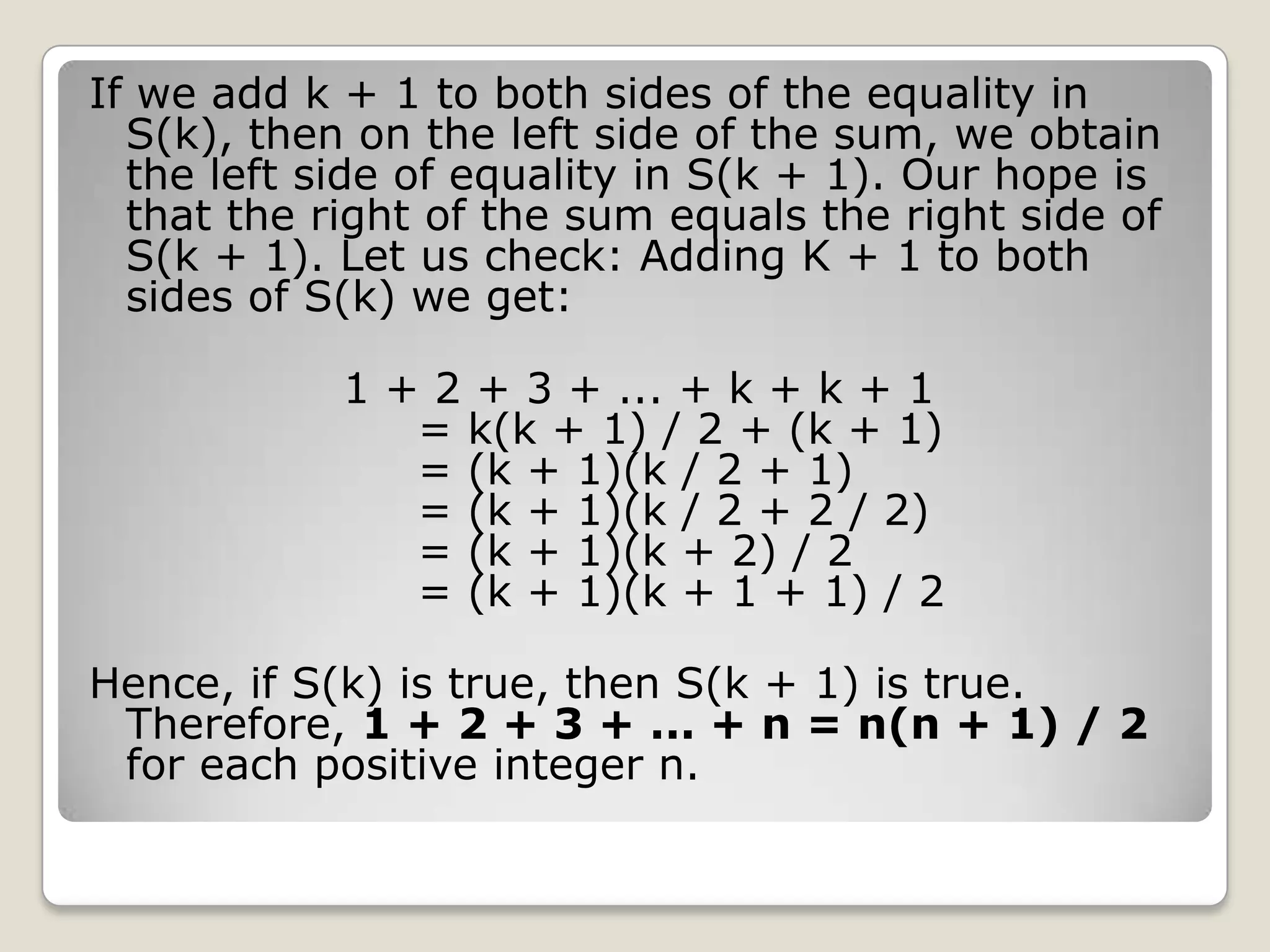
If we add k + 1 to both sides of the equality in
S(k), then on the left side of the sum, we obtain
the left side of equality in S(k + 1). Our hope is
that the right of the sum equals the right side of
S(k + 1). Let us check: Adding K + 1 to both
sides of S(k) we get:
1 + 2 + 3 + ... + k + k + 1
= k(k + 1) / 2 + (k + 1)
= (k + 1)(k / 2 + 1)
= (k + 1)(k / 2 + 2 / 2)
= (k + 1)(k + 2) / 2
= (k + 1)(k + 1 + 1) / 2
Hence, if S(k) is true, then S(k + 1) is true.
Therefore, 1 + 2 + 3 + ... + n = n(n + 1) / 2
for each positive integer n.
1 + 3 + 5 + . . . + (2n − 1) = n2
for any integer n ≥ 1.
Proof:
STEP 1: For n=1 (1.2) is true, since 1 =
12
STEP 2: Suppose (1.2) is true for some n
= k ≥ 1, that is
1 + 3 + 5 + . . . + (2k − 1) = k 2
STEP 3: Prove that (1.2) is true for n=k+1,
that is
1+3+5+...+(2k−1)+(2k+1)?=(k+) 2
We have:
1+3+5+...+(2k−1)+(2k+1)=k 2+(2k+1)=
(k + 1) 2
Sn = 1 + 3 + 5 + 7 + . . . + (2n-1) = n2
First, we must show that the formula works for
n = 1.
1. For n = 1
S1 = 1 = 12
The second part of mathematical induction has two
steps. The first step is to assume that the formula is
valid for some integer k. The second step is to use this
assumption to prove that the formula is valid for the
next integer, k + 1.
2. Assume Sk = 1 + 3 + 5 + 7 + . . . + (2k-1) = k2
is true, show that Sk+1 = (k + 1)2 is true.
Sk+1 = 1+3+5+7. . .+(2k–1)+[2(k+1)–1]
= [1+3+5+7+. . .+(2k–1)]+(2k+2–1)
= Sk+(2k+1)
= k2+2k+1
= (k+1)2
12 + 22 + ... + n2 = n( n + 1 )( 2n + 1 )/6
If n = 0, then LHS = 02 = 0, and RHS = 0 * (0
+ 1)(2*0 + 1)/6 = 0
Hence LHS = RHS.
12 + 22 + ... + n2 = n( n + 1 )( 2n + 1 )/6 ---
Induction Hypothesis
To prove this for n+1, first try to
express LHS for n+1 in terms
of LHS for n, and use the induction
hypothesis.
Here let us try
LHS for n + 1 = 12 + 22 + ... + n2 + (n +
1)2 = ( 12 + 22 + ... + n2 ) + (n + 1)2
Using the induction hypothesis, the last
expression can be rewritten as
n( n + 1 )( 2n + 1 )/6 + (n + 1)2
Factoring (n + 1)/6 out, we get
( n + 1 )( n( 2n + 1 ) + 6 ( n + 1 ) )/6
= ( n + 1 )( 2n2 + 7n + 6 )/6
= ( n + 1 )( n + 2 )( 2n + 3 )/6 ,
which is equal to the RHS for n+1.
Thus LHS = RHS for n+1.
n , n3 + 2n is divisible by 3.
If n = 0, then n3 + 2n = 03 + 2*0 = 0. So it
is divisible by 3.
Induction: Assume that for an arbitrary
natural number n, n3 + 2n is divisible by 3.
--- Induction Hypothesis
To prove this for n+1, first try to
express (n+1)3 + 2( n + 1 ) in terms
of n3 + 2n and use the induction
hypothesis.
(n+1)3+2(n+1)=(n3+3n2+3n+1)+( 2n + 2 )
= ( n3 + 2n ) + ( 3n2 + 3n + 3 )
= ( n3 + 2n ) + 3( n2 + n + 1 )
which is divisible by 3,
because ( n3 + 2n ) is divisible by 3 by the
induction hypothesis.
2 + 4 + ... + 2n = n( n + 1 )
If n=0, then LHS=0, and RHS=0*(0+1)=0
Hence LHS = RHS
Assume that for an arbitrary natural
number n, 0+2+...+2n=n(n+1) ---
Induction Hypothesis
To prove this for n+1, first try to
express LHS for n+1 in terms
of LHS for n, and somehow use the
induction hypothesis.
Here let us try
LHS for n+1=0+2+...+2n+2(n+1)=(0+2+
...+2n)+2(n+1)
Using the induction hypothesis, the last expression
can be rewritten as
n( n + 1 ) + 2(n + 1)
Factoring (n + 1) out, we get
(n + 1)(n + 2) ,
which is equal to the RHS for n+1.
Thus LHS = RHS for n+1.

Mathematical Induction

  • 1.
  • 2.
    1 + 3+ 5 + ... + (2n-1) = n2 1. Show it is true for n=1 1 = 12 is True 2. Assume it is true for n=k 1 + 3 + 5 + ... + (2k-1) = k2 is True Now, prove it is true for "k+1“ 1+3+5+...+(2k-1)+ 2(k+1)-1)=(k+1)2 ... ? We know that 1 + 3 + 5 + ... + (2k-1) = k2 (the assumption above), so we can do a replacement for all but the last term: k2 + (2(k+1)-1) = (k+1)2
  • 3.
    Now expand allterms: k2 + 2k + 2 - 1 = k2 + 2k+1 And simplify: k2 + 2k + 1 = k2 + 2k + 1 They are the same! So it is true. So: 1 + 3 + 5 + ... + (2(k+1)- 1) = (k+1)2 is True
  • 4.
    1 + 2+ 3 + ... + n = n(n + 1) / 2 let S(n) be the statement 1+2+3+... n=n(n+1)/2 S(1) is the statement 1=1(1+1/2. Thus S(1) is true. We suppose that S(k) is true and prove that S(k + 1) is true. Thus, we assume that 1 + 2 + 3 + ... + k = k(k + 1) / 2 and prove that 1+2+3+...+k+k+1=(k+1)(k+1+1) / 2
  • 5.
    If we addk + 1 to both sides of the equality in S(k), then on the left side of the sum, we obtain the left side of equality in S(k + 1). Our hope is that the right of the sum equals the right side of S(k + 1). Let us check: Adding K + 1 to both sides of S(k) we get: 1 + 2 + 3 + ... + k + k + 1 = k(k + 1) / 2 + (k + 1) = (k + 1)(k / 2 + 1) = (k + 1)(k / 2 + 2 / 2) = (k + 1)(k + 2) / 2 = (k + 1)(k + 1 + 1) / 2 Hence, if S(k) is true, then S(k + 1) is true. Therefore, 1 + 2 + 3 + ... + n = n(n + 1) / 2 for each positive integer n.
  • 6.
    1 + 3+ 5 + . . . + (2n − 1) = n2 for any integer n ≥ 1. Proof: STEP 1: For n=1 (1.2) is true, since 1 = 12 STEP 2: Suppose (1.2) is true for some n = k ≥ 1, that is 1 + 3 + 5 + . . . + (2k − 1) = k 2
  • 7.
    STEP 3: Provethat (1.2) is true for n=k+1, that is 1+3+5+...+(2k−1)+(2k+1)?=(k+) 2 We have: 1+3+5+...+(2k−1)+(2k+1)=k 2+(2k+1)= (k + 1) 2
  • 8.
    Sn = 1+ 3 + 5 + 7 + . . . + (2n-1) = n2 First, we must show that the formula works for n = 1. 1. For n = 1 S1 = 1 = 12 The second part of mathematical induction has two steps. The first step is to assume that the formula is valid for some integer k. The second step is to use this assumption to prove that the formula is valid for the next integer, k + 1. 2. Assume Sk = 1 + 3 + 5 + 7 + . . . + (2k-1) = k2 is true, show that Sk+1 = (k + 1)2 is true.
  • 9.
    Sk+1 = 1+3+5+7.. .+(2k–1)+[2(k+1)–1] = [1+3+5+7+. . .+(2k–1)]+(2k+2–1) = Sk+(2k+1) = k2+2k+1 = (k+1)2
  • 10.
    12 + 22+ ... + n2 = n( n + 1 )( 2n + 1 )/6 If n = 0, then LHS = 02 = 0, and RHS = 0 * (0 + 1)(2*0 + 1)/6 = 0 Hence LHS = RHS. 12 + 22 + ... + n2 = n( n + 1 )( 2n + 1 )/6 --- Induction Hypothesis To prove this for n+1, first try to express LHS for n+1 in terms of LHS for n, and use the induction hypothesis. Here let us try LHS for n + 1 = 12 + 22 + ... + n2 + (n + 1)2 = ( 12 + 22 + ... + n2 ) + (n + 1)2
  • 11.
    Using the inductionhypothesis, the last expression can be rewritten as n( n + 1 )( 2n + 1 )/6 + (n + 1)2 Factoring (n + 1)/6 out, we get ( n + 1 )( n( 2n + 1 ) + 6 ( n + 1 ) )/6 = ( n + 1 )( 2n2 + 7n + 6 )/6 = ( n + 1 )( n + 2 )( 2n + 3 )/6 , which is equal to the RHS for n+1. Thus LHS = RHS for n+1.
  • 12.
    n , n3+ 2n is divisible by 3. If n = 0, then n3 + 2n = 03 + 2*0 = 0. So it is divisible by 3. Induction: Assume that for an arbitrary natural number n, n3 + 2n is divisible by 3. --- Induction Hypothesis To prove this for n+1, first try to express (n+1)3 + 2( n + 1 ) in terms of n3 + 2n and use the induction hypothesis.
  • 13.
    (n+1)3+2(n+1)=(n3+3n2+3n+1)+( 2n +2 ) = ( n3 + 2n ) + ( 3n2 + 3n + 3 ) = ( n3 + 2n ) + 3( n2 + n + 1 ) which is divisible by 3, because ( n3 + 2n ) is divisible by 3 by the induction hypothesis.
  • 14.
    2 + 4+ ... + 2n = n( n + 1 ) If n=0, then LHS=0, and RHS=0*(0+1)=0 Hence LHS = RHS Assume that for an arbitrary natural number n, 0+2+...+2n=n(n+1) --- Induction Hypothesis To prove this for n+1, first try to express LHS for n+1 in terms of LHS for n, and somehow use the induction hypothesis.
  • 15.
    Here let ustry LHS for n+1=0+2+...+2n+2(n+1)=(0+2+ ...+2n)+2(n+1) Using the induction hypothesis, the last expression can be rewritten as n( n + 1 ) + 2(n + 1) Factoring (n + 1) out, we get (n + 1)(n + 2) , which is equal to the RHS for n+1. Thus LHS = RHS for n+1.