Rank-Nullity
Theorem
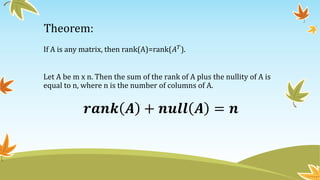
Theorem:
If A is any matrix, then the row space and
column space of A have the same dimension.
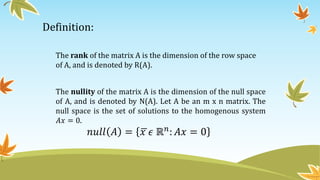
Definition:
The rank of the matrix A is the dimension of the row space
of A, and is denoted by R(A).
The nullity of the matrix A is the dimension of the null space
of A, and is denoted by N(A). Let A be an m x n matrix. The
null space is the set of solutions to the homogenous system
𝐴𝑥 = 0.
𝑛𝑢𝑙𝑙 𝐴 = 𝑥 𝜖 ℝ 𝑛
: 𝐴𝑥 = 0
Rank and Nullity of a 4×6 MatrixExample 1:
Find the rank and nullity of the matrix
𝐴 =
−1
3
2
4
2
−7
−5
−9
0
2
2
2
4
0
4
−4
5
1
6
−4
−3
4
1
7
Solution:
The reduced row-echelon form of A is
1
0
0
0
0
1
0
0
−4
−2
0
0
−28
−12
0
0
−37
−12
0
0
13
5
0
0
Since there are two nonzero rows, the row space and column space are
both two-dimensional, so rank(A)=2.
Rank and Nullity of a 4×6 MatrixExample 1:
The corresponding system of equations will be
𝑥1 −4𝑥3 −28𝑥4 −37𝑥5 +13𝑥6 = 0
𝑥2 −2𝑥3 −12𝑥4 −16𝑥5 +5𝑥6= 0
It follows that the general solution of the system is
𝑥1 = 4𝑟 + 28𝑠 + 37𝑡 − 13𝑢, 𝑋2 = 2𝑟 + 12𝑠 + 16𝑡 − 5𝑢
Where, 𝑥3= 𝑟, 𝑥4 = 𝑠, 𝑥5 = 𝑡, 𝑥6 = 𝑢
or
𝑥1
𝑥2
𝑥3
𝑥4
𝑥5
𝑥6
=𝑟
4
2
1
0
0
0
+ s
28
12
0
1
0
0
+ 𝑡
37
16
0
0
1
0
+ 𝑢
−13
−5
0
0
0
1
So that nullity(A)=4.
Let A be m x n. Then the sum of the rank of A plus the nullity of A is
equal to n, where n is the number of columns of A.
Theorem:
𝒓𝒂𝒏𝒌 𝑨 + 𝒏𝒖𝒍𝒍 𝑨 = 𝒏
If A is any matrix, then rank(A)=rank(𝐴 𝑇
).
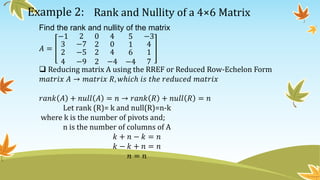
Rank and Nullity of a 4×6 MatrixExample 2:
Find the rank and nullity of the matrix
𝐴 =
−1
3
2
4
2
−7
−5
−9
0
2
2
2
4
0
4
−4
5
1
6
−4
−3
4
1
7
 Reducing matrix A using the RREF or Reduced Row-Echelon Form
𝑚𝑎𝑡𝑟𝑖𝑥 𝐴 → 𝑚𝑎𝑡𝑟𝑖𝑥 𝑅, 𝑤ℎ𝑖𝑐ℎ 𝑖𝑠 𝑡ℎ𝑒 𝑟𝑒𝑑𝑢𝑐𝑒𝑑 𝑚𝑎𝑡𝑟𝑖𝑥
𝑟𝑎𝑛𝑘 𝐴 + 𝑛𝑢𝑙𝑙 𝐴 = 𝑛 → 𝑟𝑎𝑛𝑘 𝑅 + 𝑛𝑢𝑙𝑙 𝑅 = 𝑛
Let rank (R)= k and null(R)=n-k
where k is the number of pivots and;
n is the number of columns of A
𝑘 + 𝑛 − 𝑘 = 𝑛
𝑘 − 𝑘 + 𝑛 = 𝑛
𝑛 = 𝑛
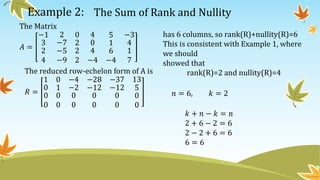
The Sum of Rank and NullityExample 2:
The Matrix
𝐴 =
−1
3
2
4
2
−7
−5
−9
0
2
2
2
4
0
4
−4
5
1
6
−4
−3
4
1
7
has 6 columns, so rank(R)+nullity(R)=6
This is consistent with Example 1, where
we should
showed that
rank(R)=2 and nullity(R)=4
𝑛 = 6, 𝑘 = 2
The reduced row-echelon form of A is
𝑅 =
1
0
0
0
0
1
0
0
−4
−2
0
0
−28
−12
0
0
−37
−12
0
0
13
5
0
0
𝑘 + 𝑛 − 𝑘 = 𝑛
2 + 6 − 2 = 6
2 − 2 + 6 = 6
6 = 6
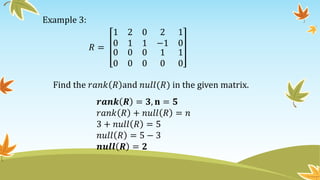
Example 3:
𝑅 =
1
0
2
1
0
1
2
−1
1
0
0 0 0 1 1
0 0 0 0 0
Find the 𝑟𝑎𝑛𝑘 𝑅 and 𝑛𝑢𝑙𝑙(𝑅) in the given matrix.
𝒓𝒂𝒏𝒌 𝑹 = 𝟑, 𝐧 = 𝟓
𝑟𝑎𝑛𝑘 𝑅 + 𝑛𝑢𝑙𝑙 𝑅 = 𝑛
3 + 𝑛𝑢𝑙𝑙 𝑅 = 5
𝑛𝑢𝑙𝑙 𝑅 = 5 − 3
𝒏𝒖𝒍𝒍 𝑹 = 𝟐
Definition 4.4.2.3.
Let 𝕍 and 𝕎 be two vector spaces over 𝔽 and let 𝑇 ∈ ℒ(𝕍, 𝕎).
Then we define
1. 𝑹𝑵𝑮 𝑻 = 𝑻 𝒙 |𝒙 ∈ 𝕍 and call it the range space of T and
2. 𝑵𝑼𝑳𝑳 𝑻 = 𝒙 ∈ 𝕍| 𝑻 𝒙 = 𝟎 and call it the null space of T.
[Range Space and Null Space]
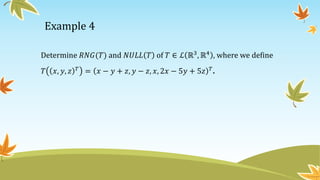
Example 4
Determine 𝑅𝑁𝐺(𝑇) and 𝑁𝑈𝐿𝐿 𝑇 of 𝑇 ∈ ℒ ℝ3, ℝ4 , where we define
𝑇 𝑥, 𝑦, 𝑧 𝑇 = 𝑥 − 𝑦 + 𝑧, 𝑦 − 𝑧, 𝑥, 2𝑥 − 5𝑦 + 5𝑧 𝑇.
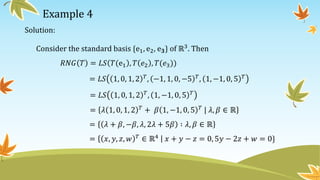
Example 4
Consider the standard basis {e1, e2, e 𝟑} of ℝ3. Then
𝑅𝑁𝐺 𝑇 = 𝐿𝑆 𝑇(e1 , 𝑇 𝑒2 , 𝑇(𝑒3))
= 𝐿𝑆 1, 0, 1, 2 𝑇
, −1, 1, 0, −5 𝑇
, 1, −1, 0, 5 𝑇
= 𝐿𝑆 1, 0, 1, 2 𝑇
, 1, −1, 0, 5 𝑇
= 𝜆 1, 0, 1, 2 𝑇
+ 𝛽 1, −1, 0, 5 𝑇
| 𝜆, 𝛽 ∈ ℝ
= 𝜆 + 𝛽, −𝛽, 𝜆, 2𝜆 + 5𝛽 ∶ 𝜆, 𝛽 ∈ ℝ
= 𝑥, 𝑦, 𝑧, 𝑤 𝑇 ∈ ℝ4 𝑥 + 𝑦 − 𝑧 = 0, 5𝑦 − 2𝑧 + 𝑤 = 0}
Solution:
Example 4
and
𝑁𝑈𝐿𝐿 𝑇 = 𝑥, 𝑦, 𝑧 𝑇
∈ ℝ3
∶ 𝑇 𝑥, 𝑦, 𝑧 𝑇
= 0
= 𝑥, 𝑦, 𝑧 𝑇 ∈ ℝ3 ∶ 𝑥 − 𝑦 + 𝑧, 𝑦 − 𝑧, 𝑥, 2𝑥 − 5𝑦 + 5𝑧 𝑇 = 0
= 𝑥, 𝑦, 𝑧 𝑇 ∈ ℝ3 ∶ 𝑥 − 𝑦 + 𝑧 = 0, 𝑦 − 𝑧 = 0, 𝑥 = 0, 2𝑥 − 5𝑦 + 5𝑧 = 0
= 𝑥, 𝑦, 𝑧 𝑇
∈ ℝ3
∶ 𝑦 − 𝑧 = 0, 𝑥 = 0
= 0, 𝑦, 𝑧 𝑇
∈ ℝ3
∶ 𝑦 𝜖 ℝ = 𝐿𝑆( 0, 1, 1 𝑇
)
Thank you for
Listening!

Rank nullity theorem

  • 1.
  • 2.
    Theorem: If A isany matrix, then the row space and column space of A have the same dimension.
  • 3.
    Definition: The rank ofthe matrix A is the dimension of the row space of A, and is denoted by R(A). The nullity of the matrix A is the dimension of the null space of A, and is denoted by N(A). Let A be an m x n matrix. The null space is the set of solutions to the homogenous system 𝐴𝑥 = 0. 𝑛𝑢𝑙𝑙 𝐴 = 𝑥 𝜖 ℝ 𝑛 : 𝐴𝑥 = 0
  • 4.
    Rank and Nullityof a 4×6 MatrixExample 1: Find the rank and nullity of the matrix 𝐴 = −1 3 2 4 2 −7 −5 −9 0 2 2 2 4 0 4 −4 5 1 6 −4 −3 4 1 7 Solution: The reduced row-echelon form of A is 1 0 0 0 0 1 0 0 −4 −2 0 0 −28 −12 0 0 −37 −12 0 0 13 5 0 0 Since there are two nonzero rows, the row space and column space are both two-dimensional, so rank(A)=2.
  • 5.
    Rank and Nullityof a 4×6 MatrixExample 1: The corresponding system of equations will be 𝑥1 −4𝑥3 −28𝑥4 −37𝑥5 +13𝑥6 = 0 𝑥2 −2𝑥3 −12𝑥4 −16𝑥5 +5𝑥6= 0 It follows that the general solution of the system is 𝑥1 = 4𝑟 + 28𝑠 + 37𝑡 − 13𝑢, 𝑋2 = 2𝑟 + 12𝑠 + 16𝑡 − 5𝑢 Where, 𝑥3= 𝑟, 𝑥4 = 𝑠, 𝑥5 = 𝑡, 𝑥6 = 𝑢 or 𝑥1 𝑥2 𝑥3 𝑥4 𝑥5 𝑥6 =𝑟 4 2 1 0 0 0 + s 28 12 0 1 0 0 + 𝑡 37 16 0 0 1 0 + 𝑢 −13 −5 0 0 0 1 So that nullity(A)=4.
  • 6.
    Let A bem x n. Then the sum of the rank of A plus the nullity of A is equal to n, where n is the number of columns of A. Theorem: 𝒓𝒂𝒏𝒌 𝑨 + 𝒏𝒖𝒍𝒍 𝑨 = 𝒏 If A is any matrix, then rank(A)=rank(𝐴 𝑇 ).
  • 7.
    Rank and Nullityof a 4×6 MatrixExample 2: Find the rank and nullity of the matrix 𝐴 = −1 3 2 4 2 −7 −5 −9 0 2 2 2 4 0 4 −4 5 1 6 −4 −3 4 1 7  Reducing matrix A using the RREF or Reduced Row-Echelon Form 𝑚𝑎𝑡𝑟𝑖𝑥 𝐴 → 𝑚𝑎𝑡𝑟𝑖𝑥 𝑅, 𝑤ℎ𝑖𝑐ℎ 𝑖𝑠 𝑡ℎ𝑒 𝑟𝑒𝑑𝑢𝑐𝑒𝑑 𝑚𝑎𝑡𝑟𝑖𝑥 𝑟𝑎𝑛𝑘 𝐴 + 𝑛𝑢𝑙𝑙 𝐴 = 𝑛 → 𝑟𝑎𝑛𝑘 𝑅 + 𝑛𝑢𝑙𝑙 𝑅 = 𝑛 Let rank (R)= k and null(R)=n-k where k is the number of pivots and; n is the number of columns of A 𝑘 + 𝑛 − 𝑘 = 𝑛 𝑘 − 𝑘 + 𝑛 = 𝑛 𝑛 = 𝑛
  • 8.
    The Sum ofRank and NullityExample 2: The Matrix 𝐴 = −1 3 2 4 2 −7 −5 −9 0 2 2 2 4 0 4 −4 5 1 6 −4 −3 4 1 7 has 6 columns, so rank(R)+nullity(R)=6 This is consistent with Example 1, where we should showed that rank(R)=2 and nullity(R)=4 𝑛 = 6, 𝑘 = 2 The reduced row-echelon form of A is 𝑅 = 1 0 0 0 0 1 0 0 −4 −2 0 0 −28 −12 0 0 −37 −12 0 0 13 5 0 0 𝑘 + 𝑛 − 𝑘 = 𝑛 2 + 6 − 2 = 6 2 − 2 + 6 = 6 6 = 6
  • 9.
    Example 3: 𝑅 = 1 0 2 1 0 1 2 −1 1 0 00 0 1 1 0 0 0 0 0 Find the 𝑟𝑎𝑛𝑘 𝑅 and 𝑛𝑢𝑙𝑙(𝑅) in the given matrix. 𝒓𝒂𝒏𝒌 𝑹 = 𝟑, 𝐧 = 𝟓 𝑟𝑎𝑛𝑘 𝑅 + 𝑛𝑢𝑙𝑙 𝑅 = 𝑛 3 + 𝑛𝑢𝑙𝑙 𝑅 = 5 𝑛𝑢𝑙𝑙 𝑅 = 5 − 3 𝒏𝒖𝒍𝒍 𝑹 = 𝟐
  • 10.
    Definition 4.4.2.3. Let 𝕍and 𝕎 be two vector spaces over 𝔽 and let 𝑇 ∈ ℒ(𝕍, 𝕎). Then we define 1. 𝑹𝑵𝑮 𝑻 = 𝑻 𝒙 |𝒙 ∈ 𝕍 and call it the range space of T and 2. 𝑵𝑼𝑳𝑳 𝑻 = 𝒙 ∈ 𝕍| 𝑻 𝒙 = 𝟎 and call it the null space of T. [Range Space and Null Space]
  • 11.
    Example 4 Determine 𝑅𝑁𝐺(𝑇)and 𝑁𝑈𝐿𝐿 𝑇 of 𝑇 ∈ ℒ ℝ3, ℝ4 , where we define 𝑇 𝑥, 𝑦, 𝑧 𝑇 = 𝑥 − 𝑦 + 𝑧, 𝑦 − 𝑧, 𝑥, 2𝑥 − 5𝑦 + 5𝑧 𝑇.
  • 12.
    Example 4 Consider thestandard basis {e1, e2, e 𝟑} of ℝ3. Then 𝑅𝑁𝐺 𝑇 = 𝐿𝑆 𝑇(e1 , 𝑇 𝑒2 , 𝑇(𝑒3)) = 𝐿𝑆 1, 0, 1, 2 𝑇 , −1, 1, 0, −5 𝑇 , 1, −1, 0, 5 𝑇 = 𝐿𝑆 1, 0, 1, 2 𝑇 , 1, −1, 0, 5 𝑇 = 𝜆 1, 0, 1, 2 𝑇 + 𝛽 1, −1, 0, 5 𝑇 | 𝜆, 𝛽 ∈ ℝ = 𝜆 + 𝛽, −𝛽, 𝜆, 2𝜆 + 5𝛽 ∶ 𝜆, 𝛽 ∈ ℝ = 𝑥, 𝑦, 𝑧, 𝑤 𝑇 ∈ ℝ4 𝑥 + 𝑦 − 𝑧 = 0, 5𝑦 − 2𝑧 + 𝑤 = 0} Solution:
  • 13.
    Example 4 and 𝑁𝑈𝐿𝐿 𝑇= 𝑥, 𝑦, 𝑧 𝑇 ∈ ℝ3 ∶ 𝑇 𝑥, 𝑦, 𝑧 𝑇 = 0 = 𝑥, 𝑦, 𝑧 𝑇 ∈ ℝ3 ∶ 𝑥 − 𝑦 + 𝑧, 𝑦 − 𝑧, 𝑥, 2𝑥 − 5𝑦 + 5𝑧 𝑇 = 0 = 𝑥, 𝑦, 𝑧 𝑇 ∈ ℝ3 ∶ 𝑥 − 𝑦 + 𝑧 = 0, 𝑦 − 𝑧 = 0, 𝑥 = 0, 2𝑥 − 5𝑦 + 5𝑧 = 0 = 𝑥, 𝑦, 𝑧 𝑇 ∈ ℝ3 ∶ 𝑦 − 𝑧 = 0, 𝑥 = 0 = 0, 𝑦, 𝑧 𝑇 ∈ ℝ3 ∶ 𝑦 𝜖 ℝ = 𝐿𝑆( 0, 1, 1 𝑇 )
  • 14.