Matrices MM1 module 3, lecture 1 David Godfrey
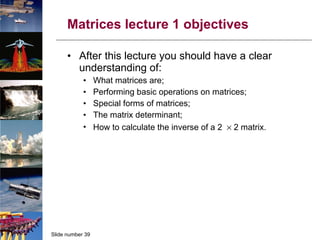
Matrices lecture 1 objectives After this lecture you should have a clear understanding of: What matrices are; Performing basic operations on matrices; Special forms of matrices; The matrix determinant; How to calculate the inverse of a 2     2 matrix.
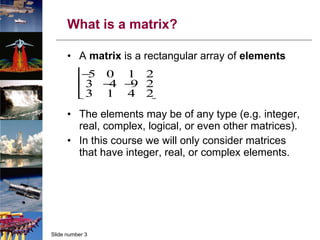
What is a matrix? A  matrix  is a rectangular array of  elements The elements may be of any type (e.g. integer, real, complex, logical, or even other matrices). In this course we will only consider matrices that have integer, real, or complex elements.
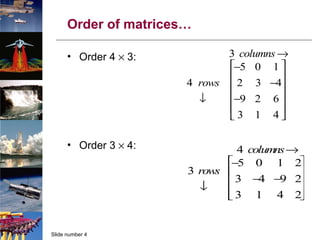
Order of matrices… Order 4    3: Order 3    4:
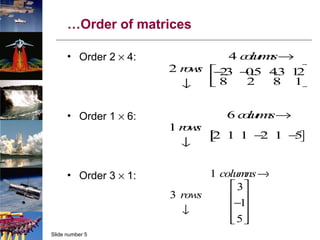
… Order of matrices Order 2    4:  Order 1    6: Order 3    1:
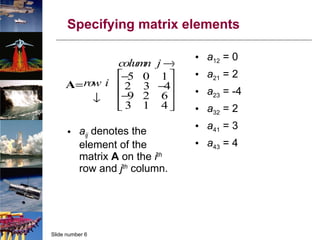
Specifying matrix elements a ij  denotes the element of the matrix  A  on the  i th   row and  j th   column. a 12  = 0 a 21  = 2 a 23  = -4 a 32  = 2 a 41  = 3 a 43  = 4
What are matrices used for? Transformations Transitions Linear equations
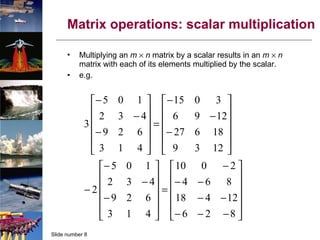
Matrix operations: scalar multiplication Multiplying an  m     n  matrix by a scalar results in an  m     n  matrix with each of its elements multiplied by the scalar. e.g.
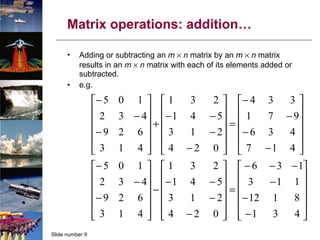
Matrix operations: addition… Adding or subtracting an  m     n  matrix by an  m     n  matrix results in an  m     n  matrix with each of its elements added or subtracted. e.g.
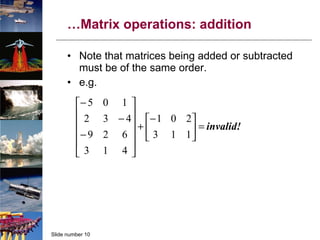
… Matrix operations: addition Note that matrices being added or subtracted must be of the same order. e.g.
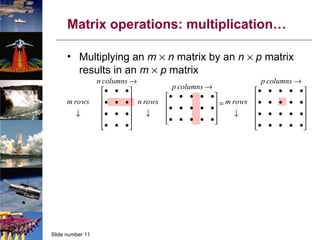
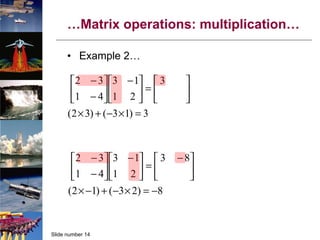
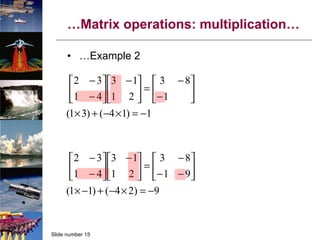
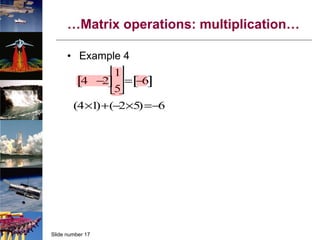
Matrix operations: multiplication… Multiplying an  m     n  matrix by an  n     p  matrix  results in an  m     p  matrix
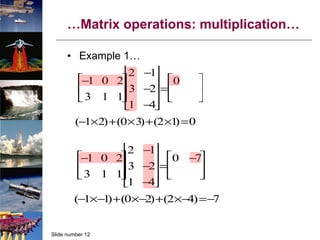
… Matrix operations: multiplication… Example 1…
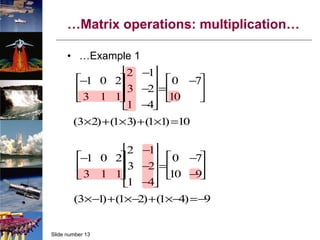
… Matrix operations: multiplication… … Example 1
… Matrix operations: multiplication… Example 2…
… Matrix operations: multiplication… … Example 2
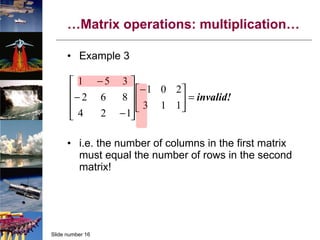
… Matrix operations: multiplication… Example 3 i.e. the number of columns in the first matrix must equal the number of rows in the second matrix!
… Matrix operations: multiplication… Example 4
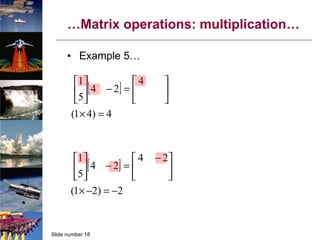
… Matrix operations: multiplication… Example 5…
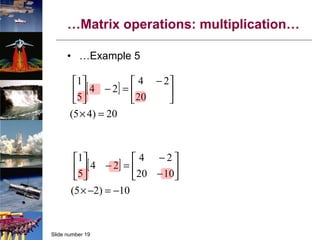
… Matrix operations: multiplication… … Example 5
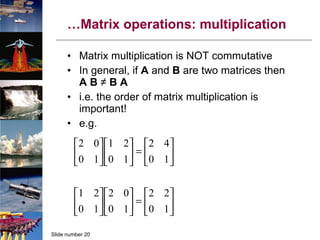
… Matrix operations: multiplication Matrix multiplication is NOT commutative In general, if  A  and  B  are two matrices then  A B  ≠  B A i.e. the order of matrix multiplication is important! e.g.
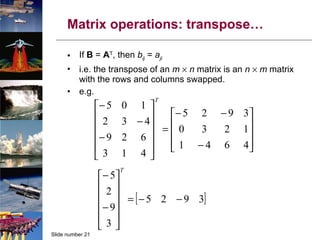
Matrix operations: transpose… If  B  =  A T , then  b ij  =  a ji i.e. the transpose of an  m     n  matrix is an  n     m  matrix with the rows and columns swapped. e.g.
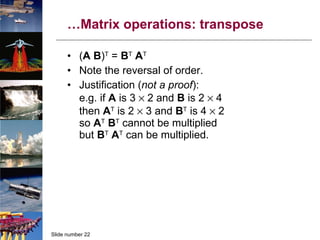
… Matrix operations: transpose ( A B ) T  =  B T   A T Note the reversal of order. Justification ( not a proof ): e.g. if  A  is 3    2 and  B  is 2    4 then  A T  is 2    3 and  B T  is 4    2 so  A T   B T  cannot be multiplied but  B T   A T  can be multiplied.
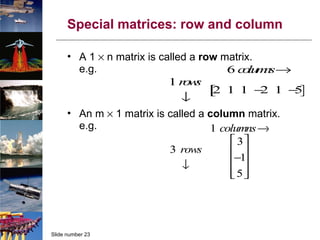
Special matrices: row and column A 1    n matrix is called a  row  matrix. e.g. An m    1 matrix is called a  column  matrix. e.g.
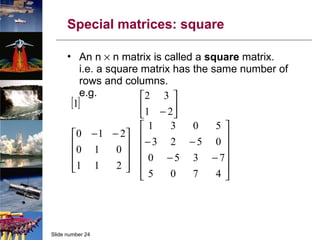
Special matrices: square An n    n matrix is called a  square  matrix. i.e. a square matrix has the same number of rows and columns. e.g.
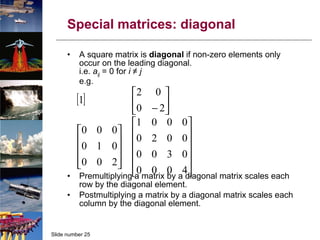
Special matrices: diagonal A square matrix is  diagonal  if non-zero elements only occur on the leading diagonal. i.e.  a ij  = 0 for  i  ≠  j e.g. Premultiplying a matrix by a diagonal matrix scales each row by the diagonal element. Postmultiplying a matrix by a diagonal matrix scales each column by the diagonal element.
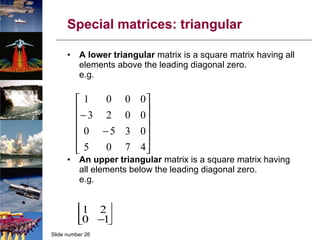
Special matrices: triangular A lower triangular  matrix is a square matrix having all elements above the leading diagonal zero. e.g. An upper triangular  matrix is a square matrix having all elements below the leading diagonal zero. e.g.
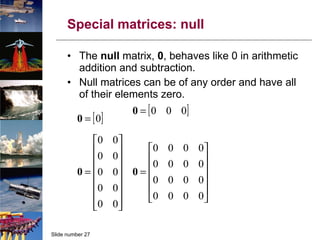
Special matrices: null The  null  matrix,  0 , behaves like 0 in arithmetic addition and subtraction. Null matrices can be of any order and have all of their elements zero.
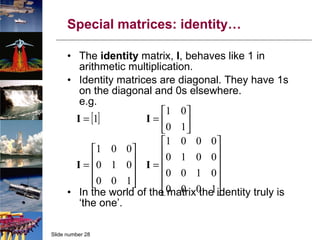
Special matrices: identity… The  identity  matrix,  I , behaves like 1 in arithmetic multiplication. Identity matrices are diagonal. They have 1s on the diagonal and 0s elsewhere. e.g. In the world of the matrix the identity truly is ‘the one’.
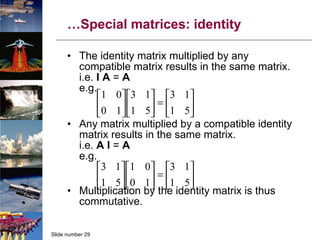
… Special matrices: identity The identity matrix multiplied by any compatible matrix results in the same matrix. i.e.  I   A  =  A e.g. Any matrix multiplied by a compatible identity matrix results in the same matrix. i.e.  A   I  =  A e.g. Multiplication by the identity matrix is thus commutative.
Determinant of a 2  2 matrix… Matrices can represent geometric transformations, such as scaling, rotation, shear, and mirroring. 2    2 matrices can represent geometric transformations in a 2–dimensional space, such as a plane. Determinants of 2    2 matrices give us information about how such transformations change the area of shapes. Determinants are also useful to define the inverse of a matrix.
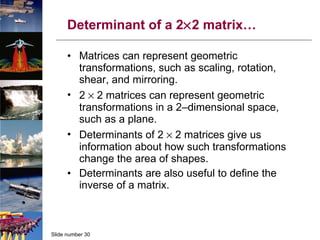
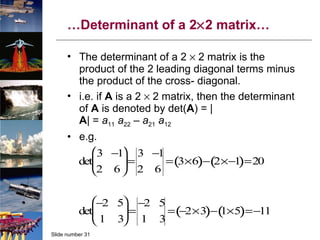
… Determinant of a 2  2 matrix… The determinant of a 2    2 matrix is the product of the 2 leading diagonal terms minus the product of the cross- diagonal. i.e. if  A  is a 2    2 matrix, then the determinant of  A  is denoted by det( A ) = | A | =  a 11   a 22  –  a 21   a 12 e.g.
… Determinant of a 2  2 matrix | A   B | = | A | | B | Note the order is not important. Justification ( not a proof ): We will shortly see that  A  and  B  can represent geometric transformations, and  A   B  represents the combined transformation of  B  followed by  A . The determinant represents the factor by which the area is changed, so the combined transformation changes area by a factor | A   B |. Looking at the individual transformations, the area of the first is changed by a factor | B |, and the second by | A |. The overall transformation is thus changed by a factor | B | | A |, which is the same as | A | | B |.
Inverse of a matrix In arithmetic multiplication the inverse of a number  c  is 1/ c  since c     1/ c  = 1 and 1/ c      c  = 1 For matrices the inverse of a matrix  A  is denoted by  A -1 A   A -1  =  I A -1   A   =  I where  I  is the identity matrix. Multiplication of a matrix by its inverse is thus commutative. We shall only consider the inverse of 2    2 matrices.
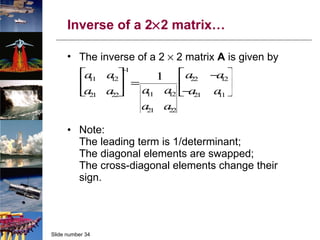
Inverse of a 2  2 matrix… The inverse of a 2    2 matrix  A  is given by Note: The leading term is 1/determinant; The diagonal elements are swapped; The cross-diagonal elements change their sign.
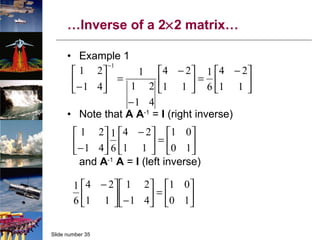
… Inverse of a 2  2 matrix… Example 1 Note that  A   A -1  =  I  (right inverse) and  A -1   A  =  I  (left inverse)
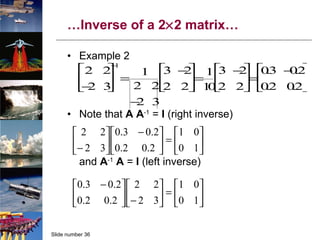
… Inverse of a 2  2 matrix… Example 2 Note that  A   A -1  =  I  (right inverse) and  A -1   A  =  I  (left inverse)
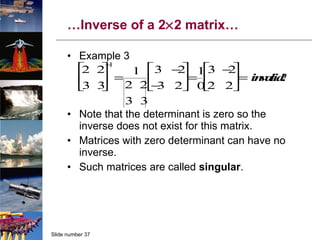
… Inverse of a 2  2 matrix… Example 3 Note that the determinant is zero so the inverse does not exist for this matrix. Matrices with zero determinant can have no inverse. Such matrices are called  singular .
… Inverse of a 2  2 matrix ( A B ) -1  =  B -1   A -1 Note the reversal of order. Justification ( not a proof ): B -1   A -1   A   B  =  B -1  ( A -1   A )  B  =  B -1   B  = I so  B -1   A -1  is the inverse of  A   B i.e. ( A   B ) -1  =  B -1   A -1
Matrices lecture 1 objectives After this lecture you should have a clear understanding of: What matrices are; Performing basic operations on matrices; Special forms of matrices; The matrix determinant; How to calculate the inverse of a 2     2 matrix.

Matrices 1

  • 1.
    Matrices MM1 module3, lecture 1 David Godfrey
  • 2.
    Matrices lecture 1objectives After this lecture you should have a clear understanding of: What matrices are; Performing basic operations on matrices; Special forms of matrices; The matrix determinant; How to calculate the inverse of a 2    2 matrix.
  • 3.
    What is amatrix? A matrix is a rectangular array of elements The elements may be of any type (e.g. integer, real, complex, logical, or even other matrices). In this course we will only consider matrices that have integer, real, or complex elements.
  • 4.
    Order of matrices…Order 4    3: Order 3    4:
  • 5.
    … Order ofmatrices Order 2    4: Order 1    6: Order 3    1:
  • 6.
    Specifying matrix elementsa ij denotes the element of the matrix A on the i th row and j th column. a 12  = 0 a 21  = 2 a 23  = -4 a 32  = 2 a 41  = 3 a 43  = 4
  • 7.
    What are matricesused for? Transformations Transitions Linear equations
  • 8.
    Matrix operations: scalarmultiplication Multiplying an m  n matrix by a scalar results in an m  n matrix with each of its elements multiplied by the scalar. e.g.
  • 9.
    Matrix operations: addition…Adding or subtracting an m     n matrix by an m     n matrix results in an m     n matrix with each of its elements added or subtracted. e.g.
  • 10.
    … Matrix operations:addition Note that matrices being added or subtracted must be of the same order. e.g.
  • 11.
    Matrix operations: multiplication…Multiplying an m     n matrix by an n     p matrix results in an m     p matrix
  • 12.
    … Matrix operations:multiplication… Example 1…
  • 13.
    … Matrix operations:multiplication… … Example 1
  • 14.
    … Matrix operations:multiplication… Example 2…
  • 15.
    … Matrix operations:multiplication… … Example 2
  • 16.
    … Matrix operations:multiplication… Example 3 i.e. the number of columns in the first matrix must equal the number of rows in the second matrix!
  • 17.
    … Matrix operations:multiplication… Example 4
  • 18.
    … Matrix operations:multiplication… Example 5…
  • 19.
    … Matrix operations:multiplication… … Example 5
  • 20.
    … Matrix operations:multiplication Matrix multiplication is NOT commutative In general, if A and B are two matrices then A B ≠ B A i.e. the order of matrix multiplication is important! e.g.
  • 21.
    Matrix operations: transpose…If B = A T , then b ij  =  a ji i.e. the transpose of an m     n matrix is an n     m matrix with the rows and columns swapped. e.g.
  • 22.
    … Matrix operations:transpose ( A B ) T = B T A T Note the reversal of order. Justification ( not a proof ): e.g. if A is 3  2 and B is 2  4 then A T is 2  3 and B T is 4  2 so A T B T cannot be multiplied but B T A T can be multiplied.
  • 23.
    Special matrices: rowand column A 1    n matrix is called a row matrix. e.g. An m    1 matrix is called a column matrix. e.g.
  • 24.
    Special matrices: squareAn n    n matrix is called a square matrix. i.e. a square matrix has the same number of rows and columns. e.g.
  • 25.
    Special matrices: diagonalA square matrix is diagonal if non-zero elements only occur on the leading diagonal. i.e. a ij  = 0 for i  ≠  j e.g. Premultiplying a matrix by a diagonal matrix scales each row by the diagonal element. Postmultiplying a matrix by a diagonal matrix scales each column by the diagonal element.
  • 26.
    Special matrices: triangularA lower triangular matrix is a square matrix having all elements above the leading diagonal zero. e.g. An upper triangular matrix is a square matrix having all elements below the leading diagonal zero. e.g.
  • 27.
    Special matrices: nullThe null matrix, 0 , behaves like 0 in arithmetic addition and subtraction. Null matrices can be of any order and have all of their elements zero.
  • 28.
    Special matrices: identity…The identity matrix, I , behaves like 1 in arithmetic multiplication. Identity matrices are diagonal. They have 1s on the diagonal and 0s elsewhere. e.g. In the world of the matrix the identity truly is ‘the one’.
  • 29.
    … Special matrices:identity The identity matrix multiplied by any compatible matrix results in the same matrix. i.e. I   A = A e.g. Any matrix multiplied by a compatible identity matrix results in the same matrix. i.e. A I = A e.g. Multiplication by the identity matrix is thus commutative.
  • 30.
    Determinant of a2  2 matrix… Matrices can represent geometric transformations, such as scaling, rotation, shear, and mirroring. 2  2 matrices can represent geometric transformations in a 2–dimensional space, such as a plane. Determinants of 2  2 matrices give us information about how such transformations change the area of shapes. Determinants are also useful to define the inverse of a matrix.
  • 31.
    … Determinant ofa 2  2 matrix… The determinant of a 2  2 matrix is the product of the 2 leading diagonal terms minus the product of the cross- diagonal. i.e. if A is a 2  2 matrix, then the determinant of A is denoted by det( A ) = | A | =  a 11   a 22  –  a 21   a 12 e.g.
  • 32.
    … Determinant ofa 2  2 matrix | A B | = | A | | B | Note the order is not important. Justification ( not a proof ): We will shortly see that A and B can represent geometric transformations, and A   B represents the combined transformation of B followed by A . The determinant represents the factor by which the area is changed, so the combined transformation changes area by a factor | A B |. Looking at the individual transformations, the area of the first is changed by a factor | B |, and the second by | A |. The overall transformation is thus changed by a factor | B | | A |, which is the same as | A | | B |.
  • 33.
    Inverse of amatrix In arithmetic multiplication the inverse of a number c is 1/ c since c  1/ c = 1 and 1/ c  c = 1 For matrices the inverse of a matrix A is denoted by A -1 A   A -1 = I A -1 A = I where I is the identity matrix. Multiplication of a matrix by its inverse is thus commutative. We shall only consider the inverse of 2  2 matrices.
  • 34.
    Inverse of a2  2 matrix… The inverse of a 2  2 matrix A is given by Note: The leading term is 1/determinant; The diagonal elements are swapped; The cross-diagonal elements change their sign.
  • 35.
    … Inverse ofa 2  2 matrix… Example 1 Note that A A -1 = I (right inverse) and A -1 A = I (left inverse)
  • 36.
    … Inverse ofa 2  2 matrix… Example 2 Note that A A -1 = I (right inverse) and A -1 A = I (left inverse)
  • 37.
    … Inverse ofa 2  2 matrix… Example 3 Note that the determinant is zero so the inverse does not exist for this matrix. Matrices with zero determinant can have no inverse. Such matrices are called singular .
  • 38.
    … Inverse ofa 2  2 matrix ( A B ) -1 = B -1 A -1 Note the reversal of order. Justification ( not a proof ): B -1 A -1 A B = B -1 ( A -1 A ) B = B -1 B = I so B -1 A -1 is the inverse of A B i.e. ( A   B ) -1 = B -1 A -1
  • 39.
    Matrices lecture 1objectives After this lecture you should have a clear understanding of: What matrices are; Performing basic operations on matrices; Special forms of matrices; The matrix determinant; How to calculate the inverse of a 2    2 matrix.