DHS H2 MATHEMATICS : a revision package NEXT
NEXT
NEXT
NEXT
NEXT
 
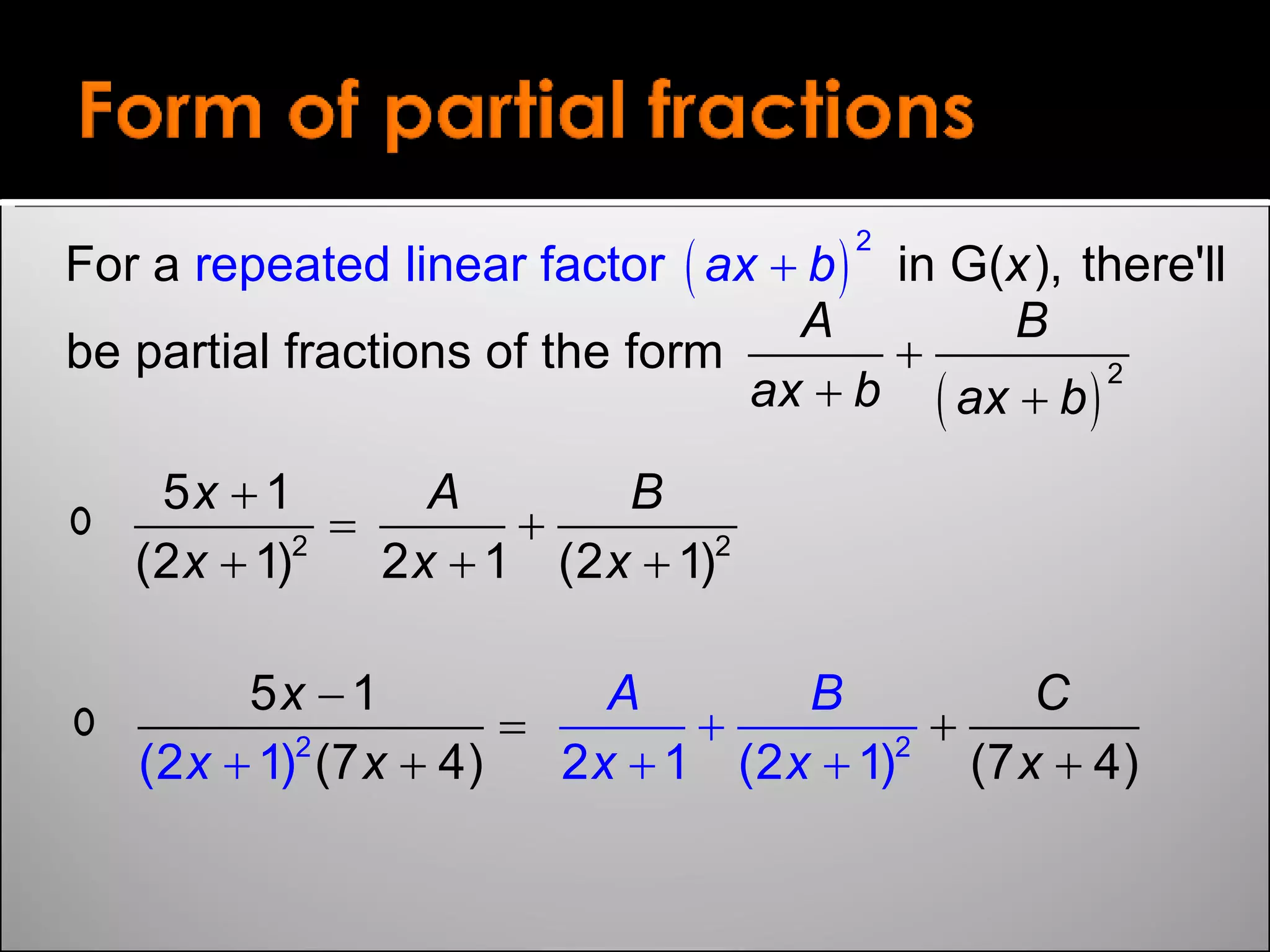
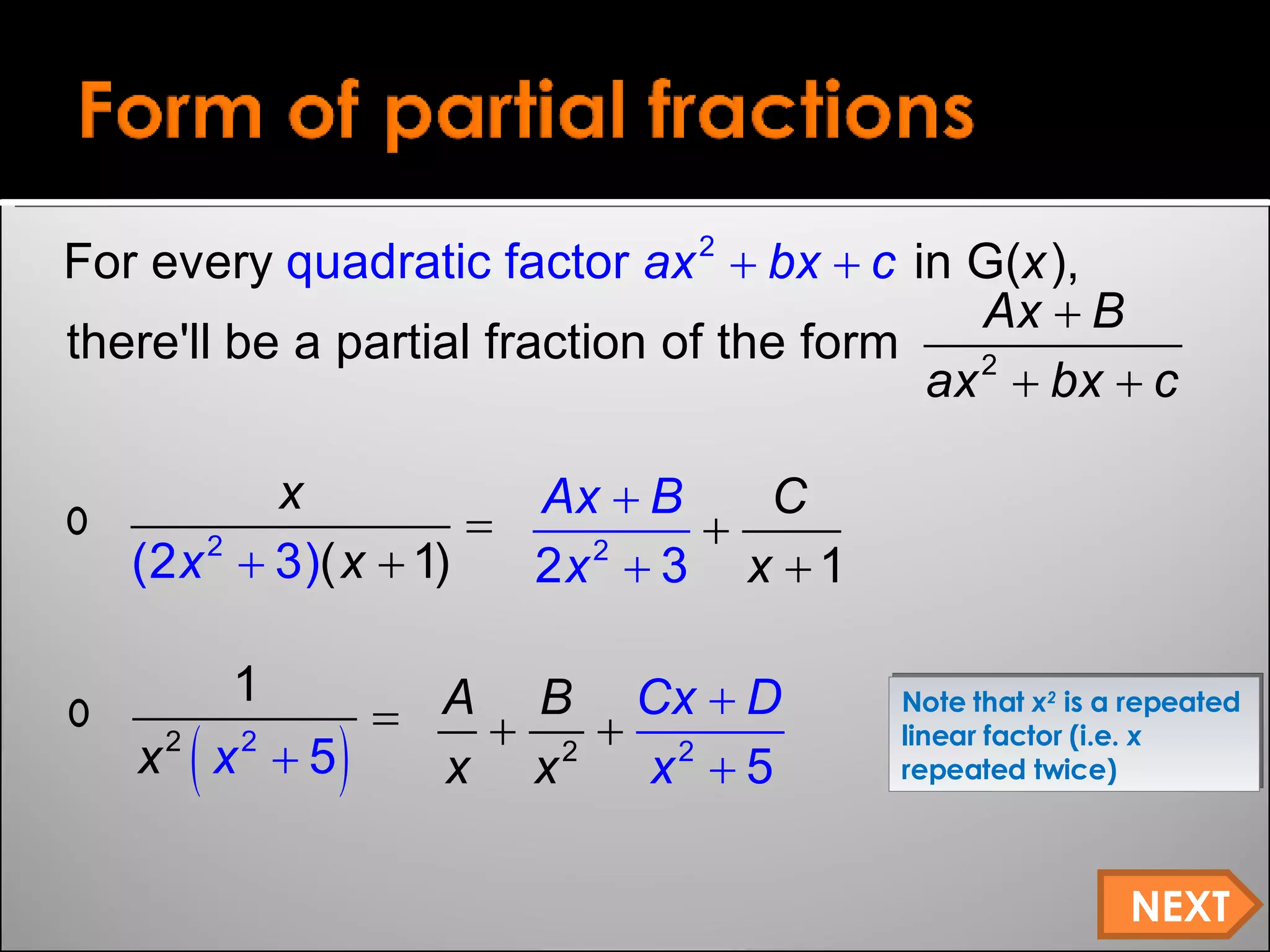
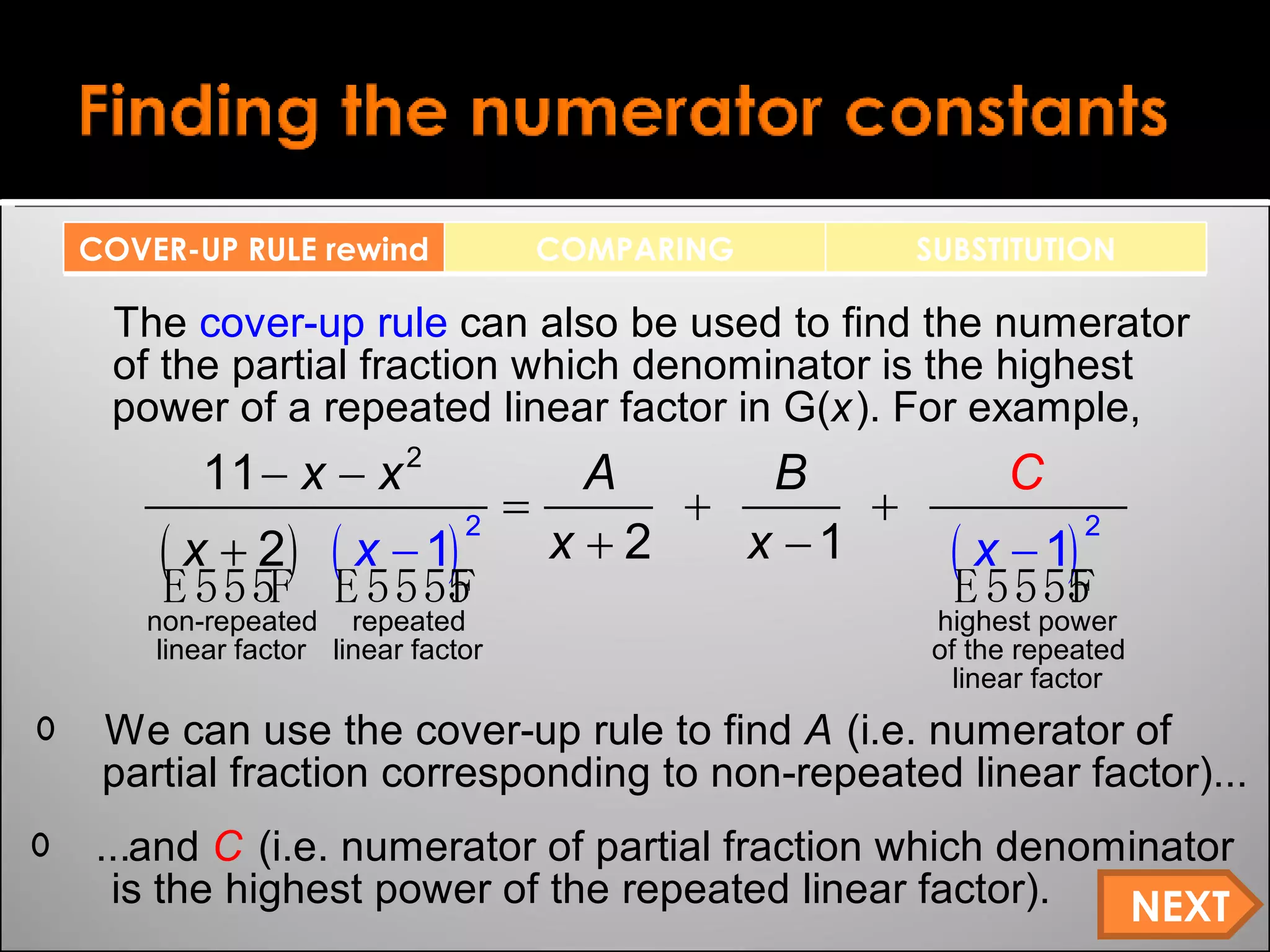
Note that  x 2  is a repeated linear factor (i.e.  x  repeated twice) NEXT
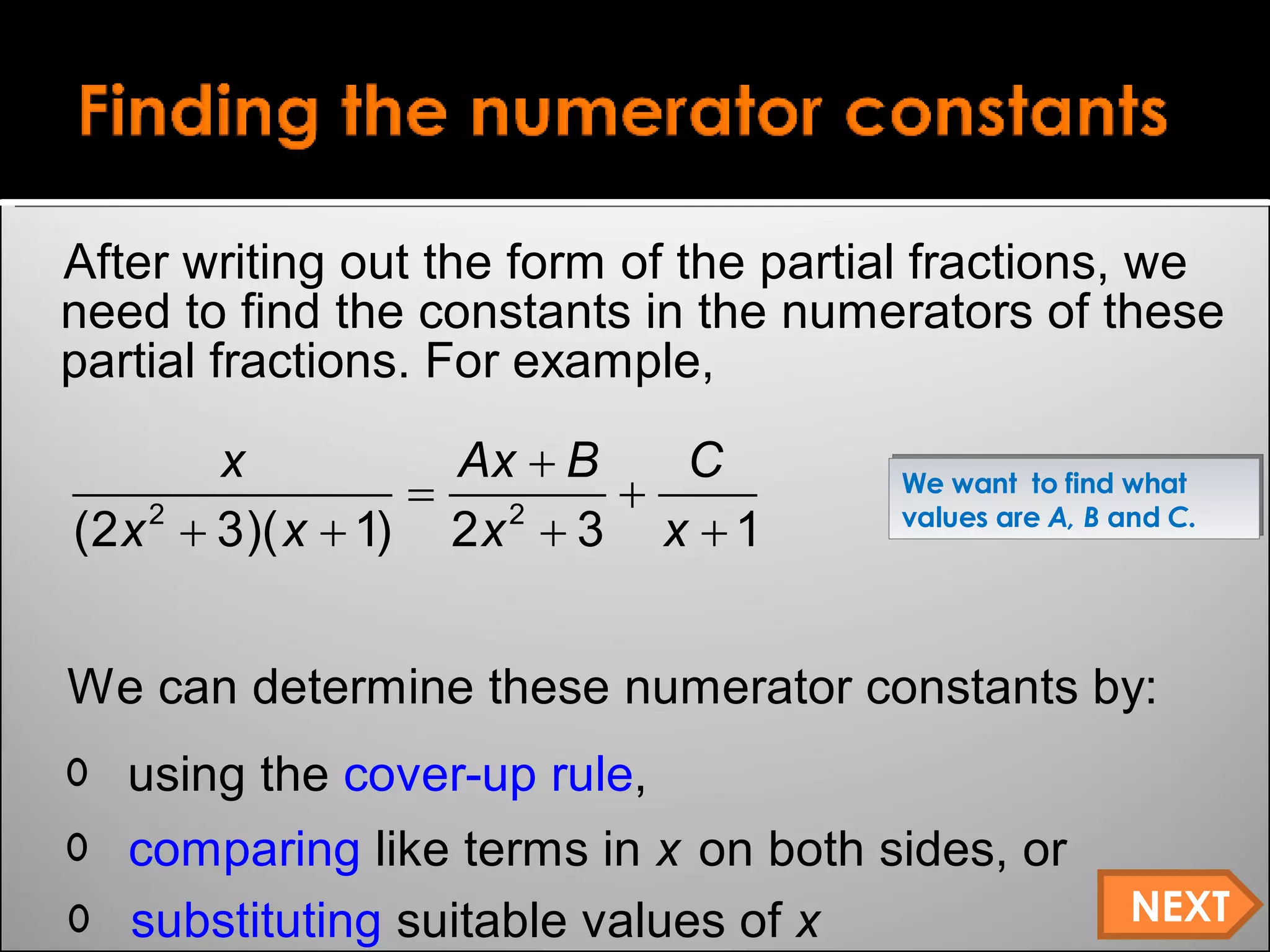
We want  to find what values are  A, B  and  C. NEXT
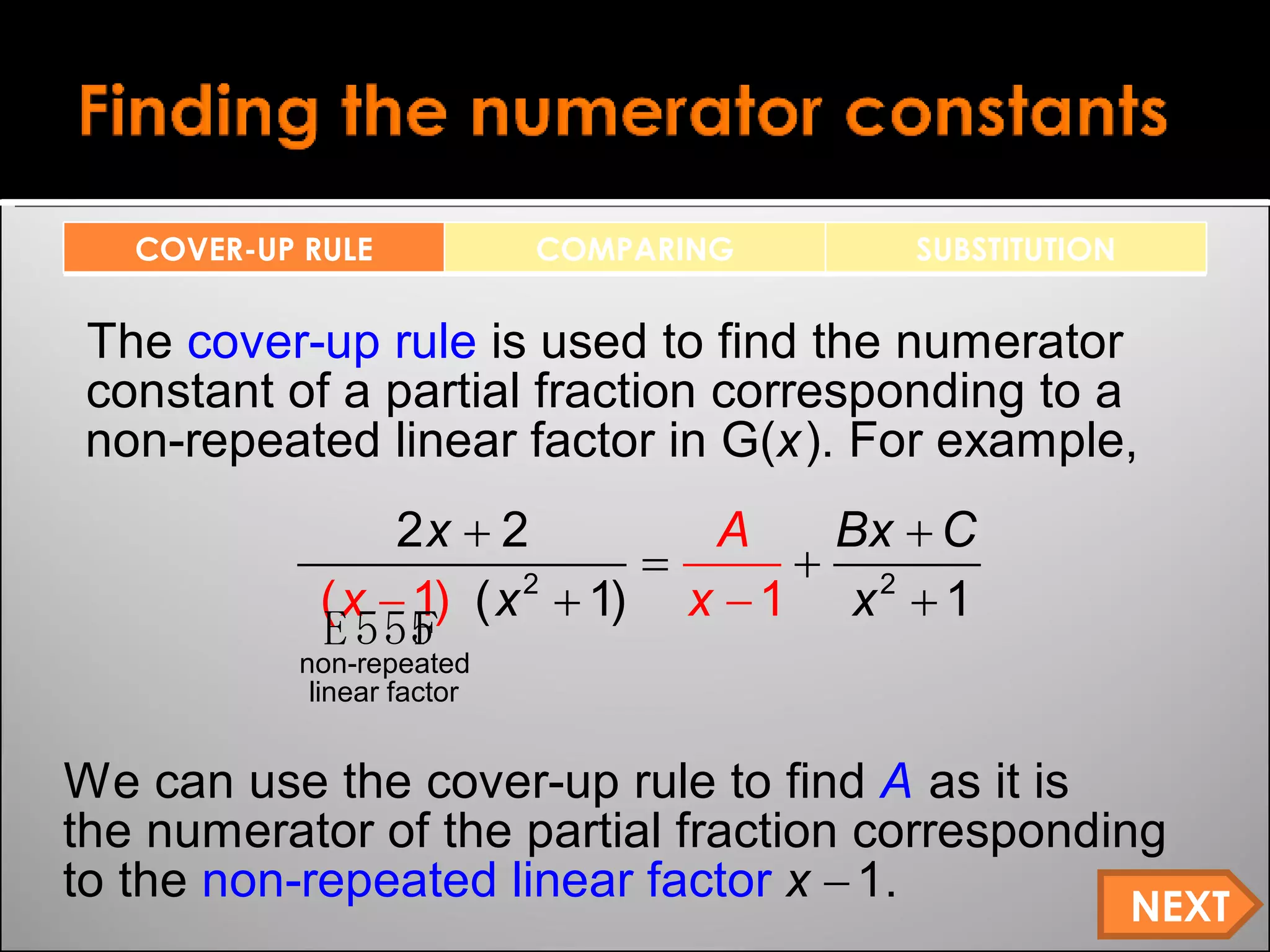
NEXT COVER-UP RULE COMPARING SUBSTITUTION
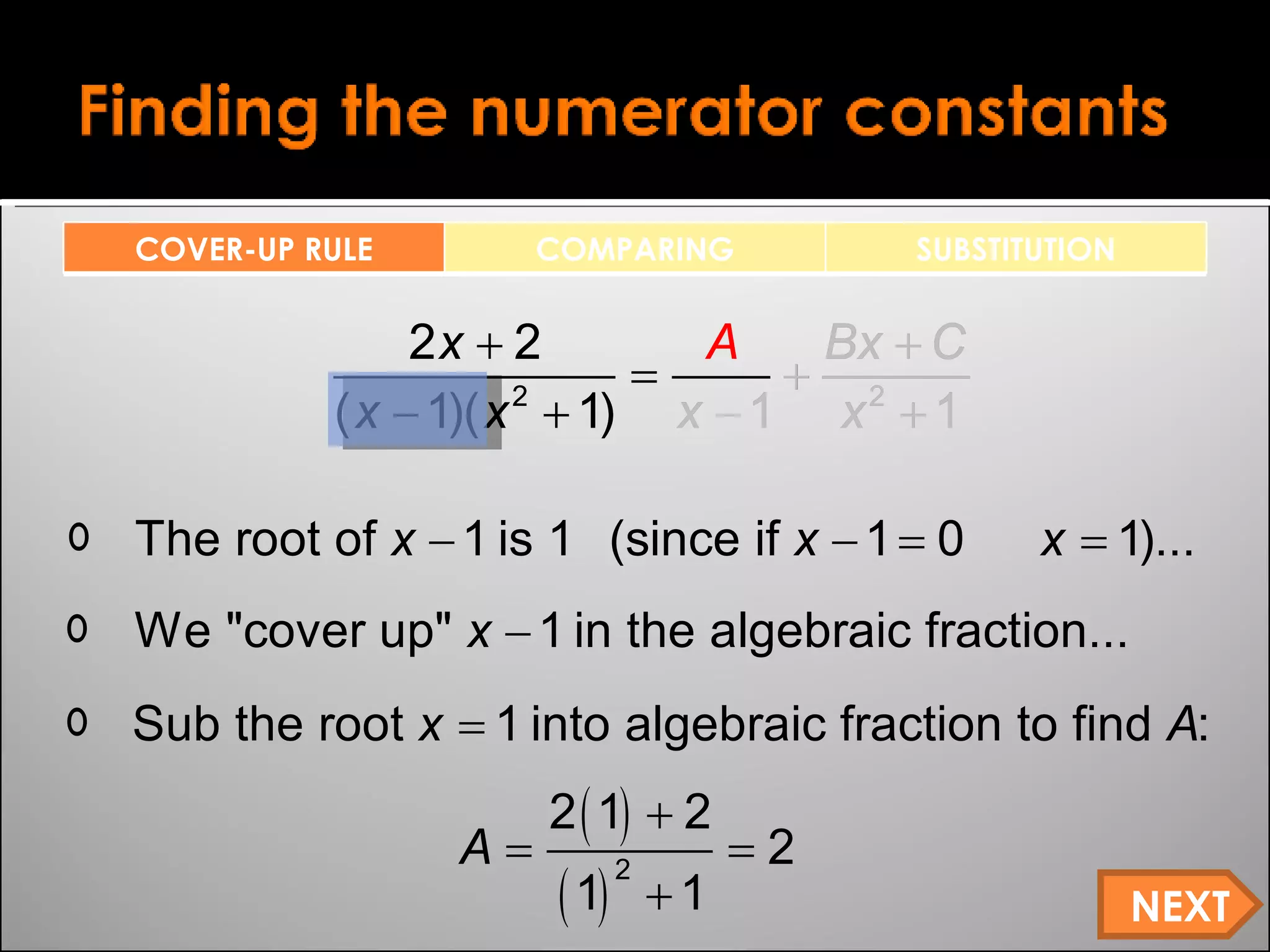
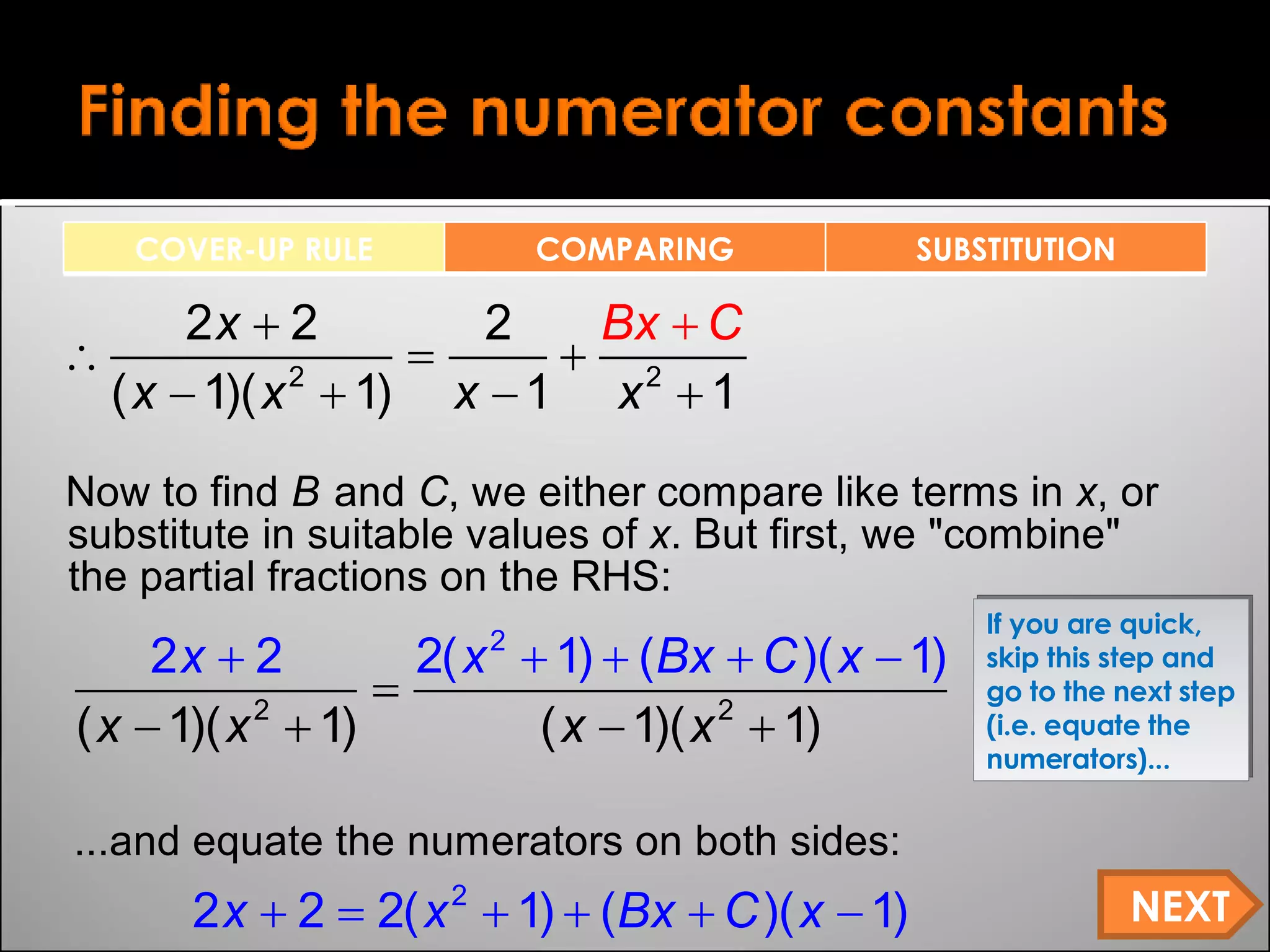
NEXT If you are quick, skip this step and go to the next step (i.e. equate the numerators)... COVER-UP RULE COMPARING SUBSTITUTION
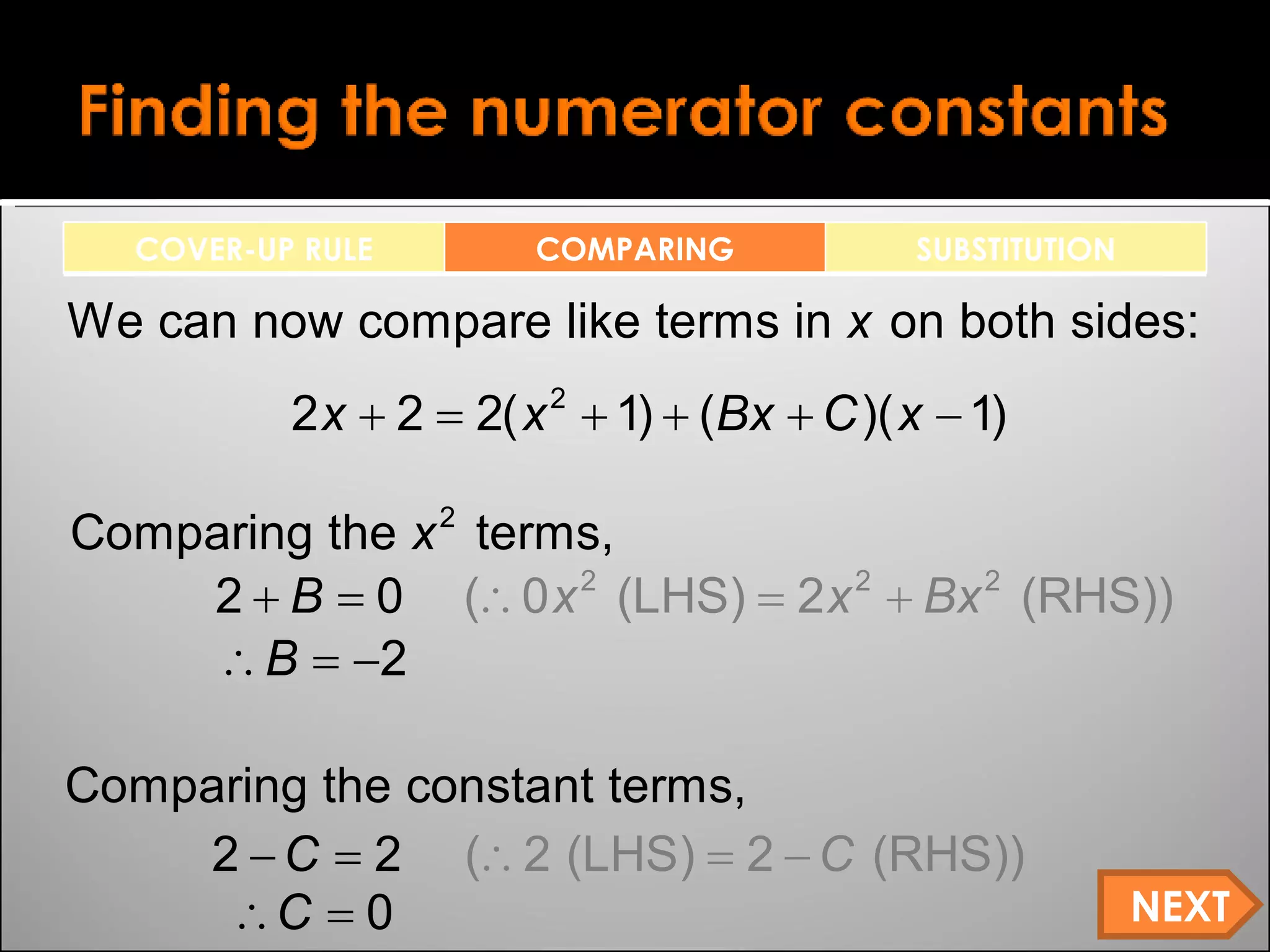
NEXT COVER-UP RULE COMPARING SUBSTITUTION
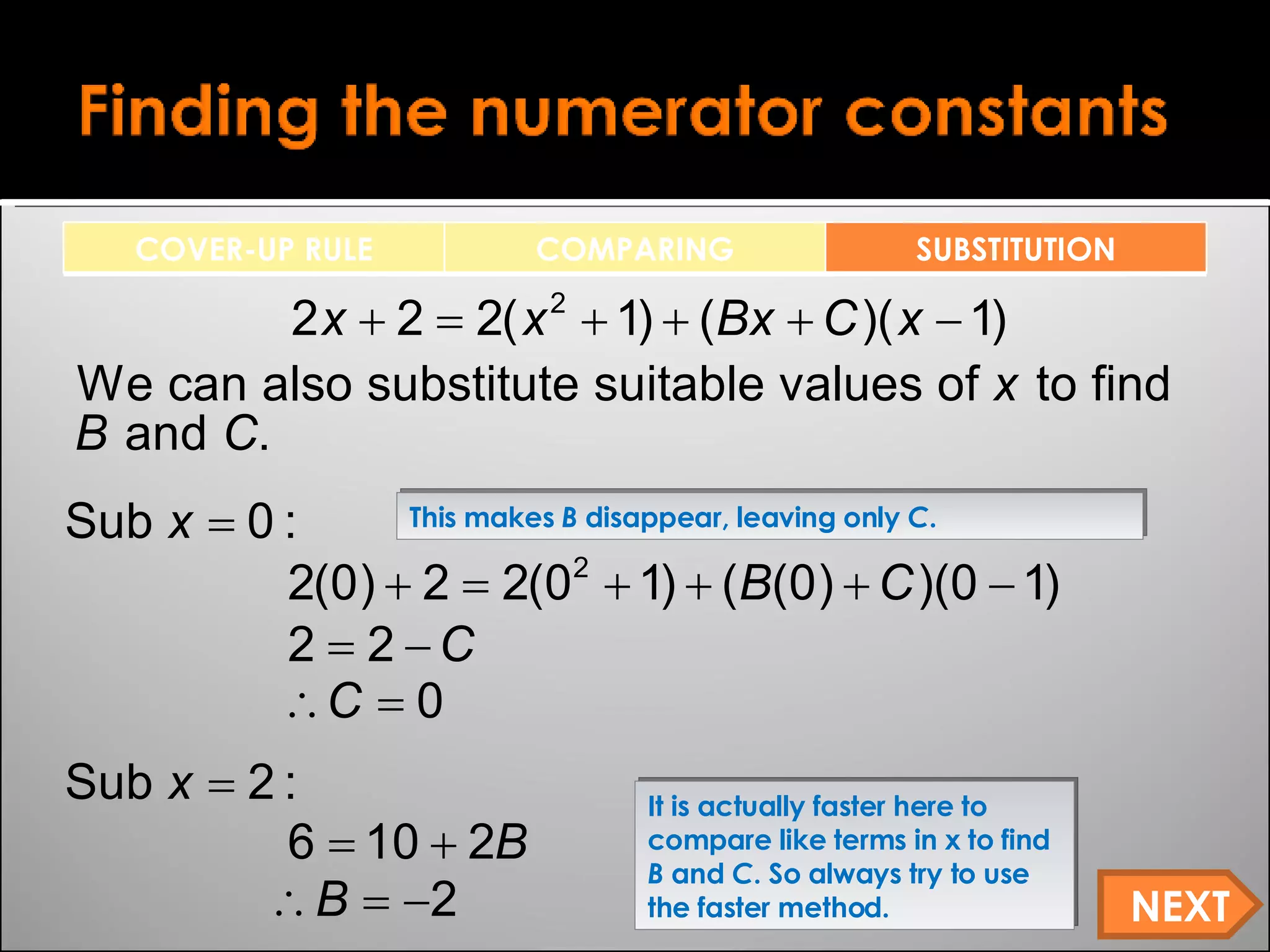
It is actually faster here to compare like terms in x to find  B  and  C . So always try to use the faster method. NEXT This makes  B  disappear, leaving only  C . COVER-UP RULE COMPARING SUBSTITUTION
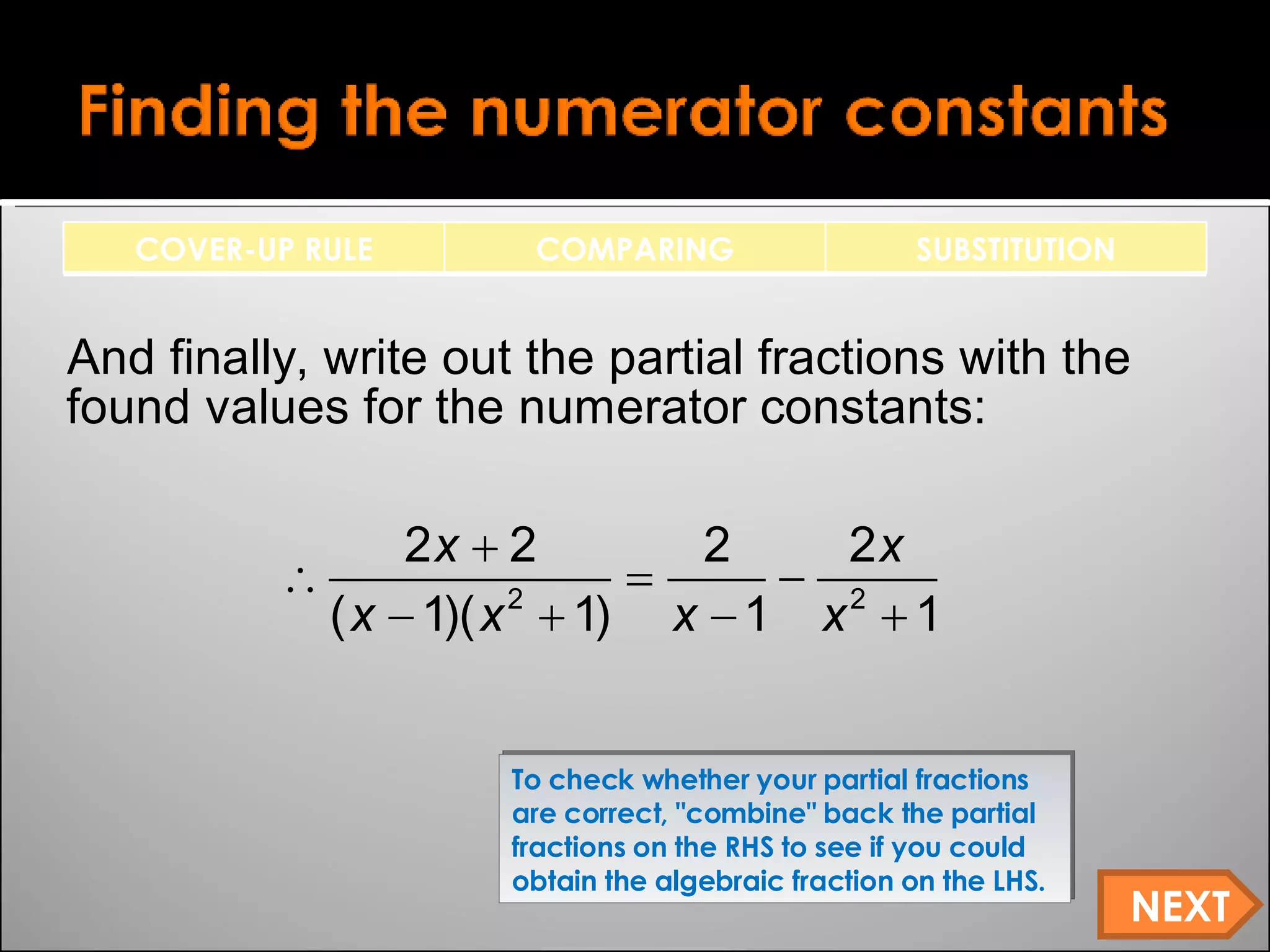
NEXT To check whether your partial fractions are correct, "combine" back the partial fractions on the RHS to see if you could obtain the algebraic fraction on the LHS.  COVER-UP RULE COMPARING SUBSTITUTION
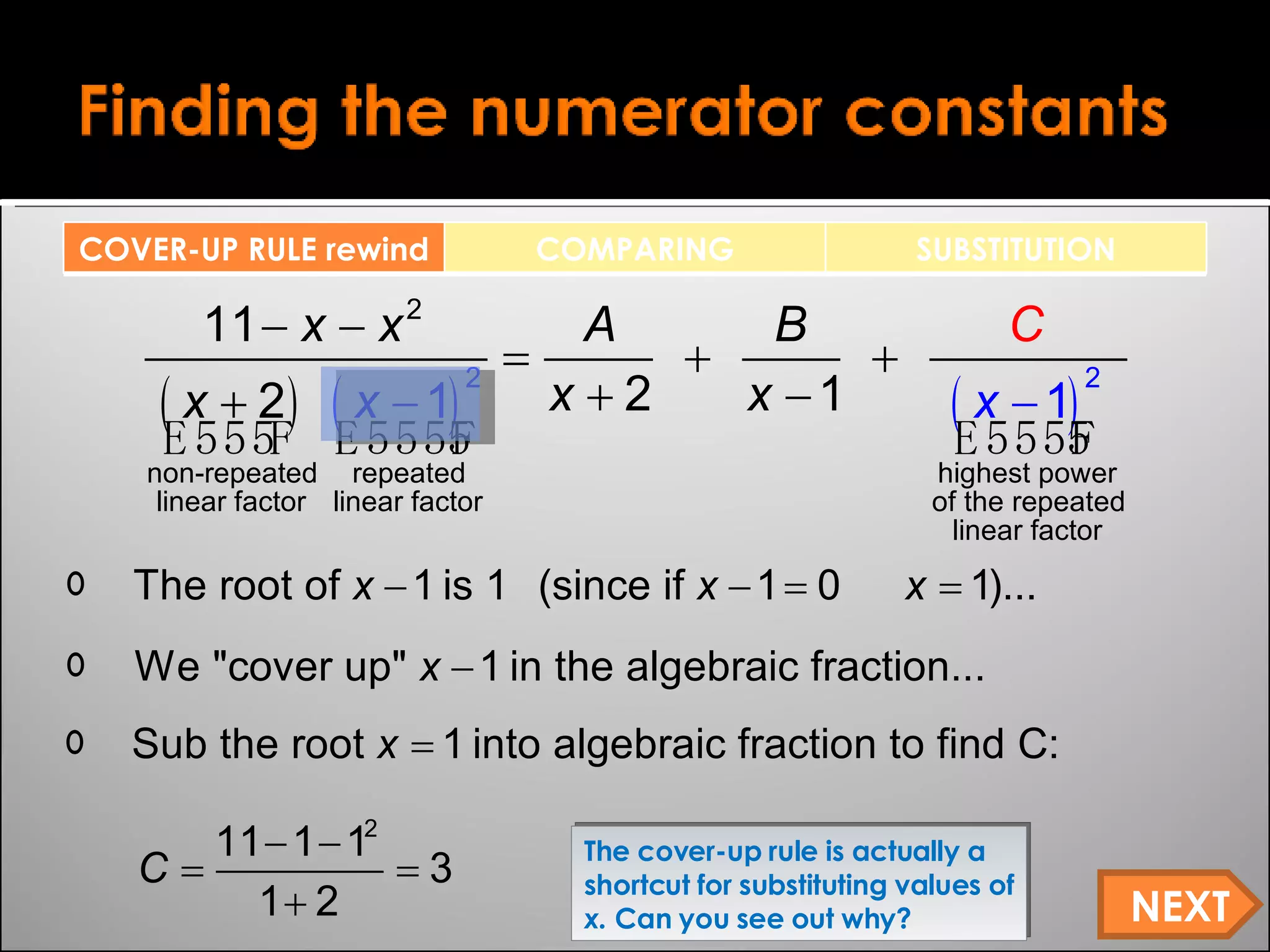
NEXT COVER-UP RULE rewind COMPARING SUBSTITUTION
NEXT The cover-up rule is actually a shortcut for substituting values of  x.  Can you see out why?  COVER-UP RULE rewind COMPARING SUBSTITUTION
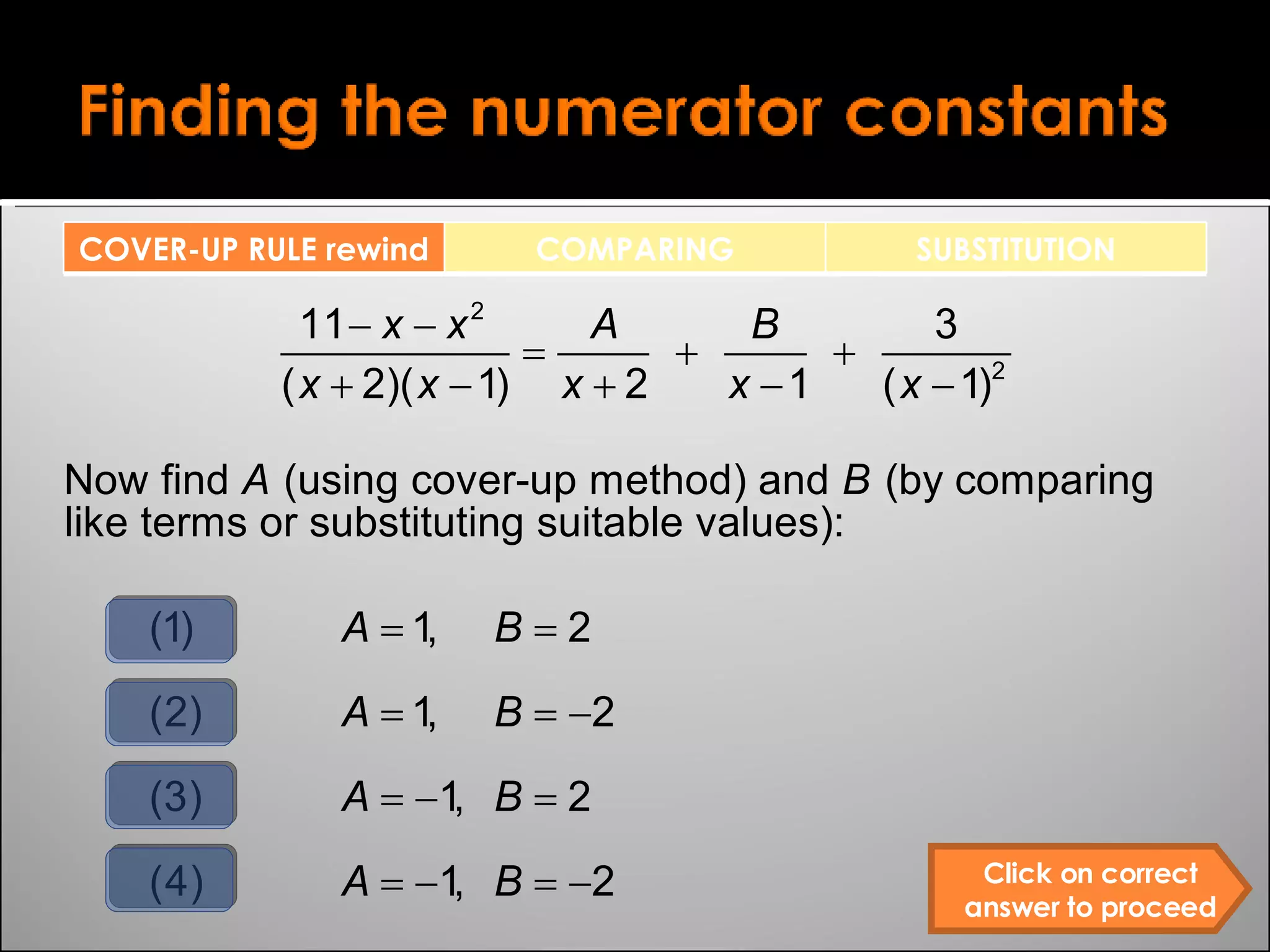
Click on correct answer to proceed COVER-UP RULE rewind COMPARING SUBSTITUTION
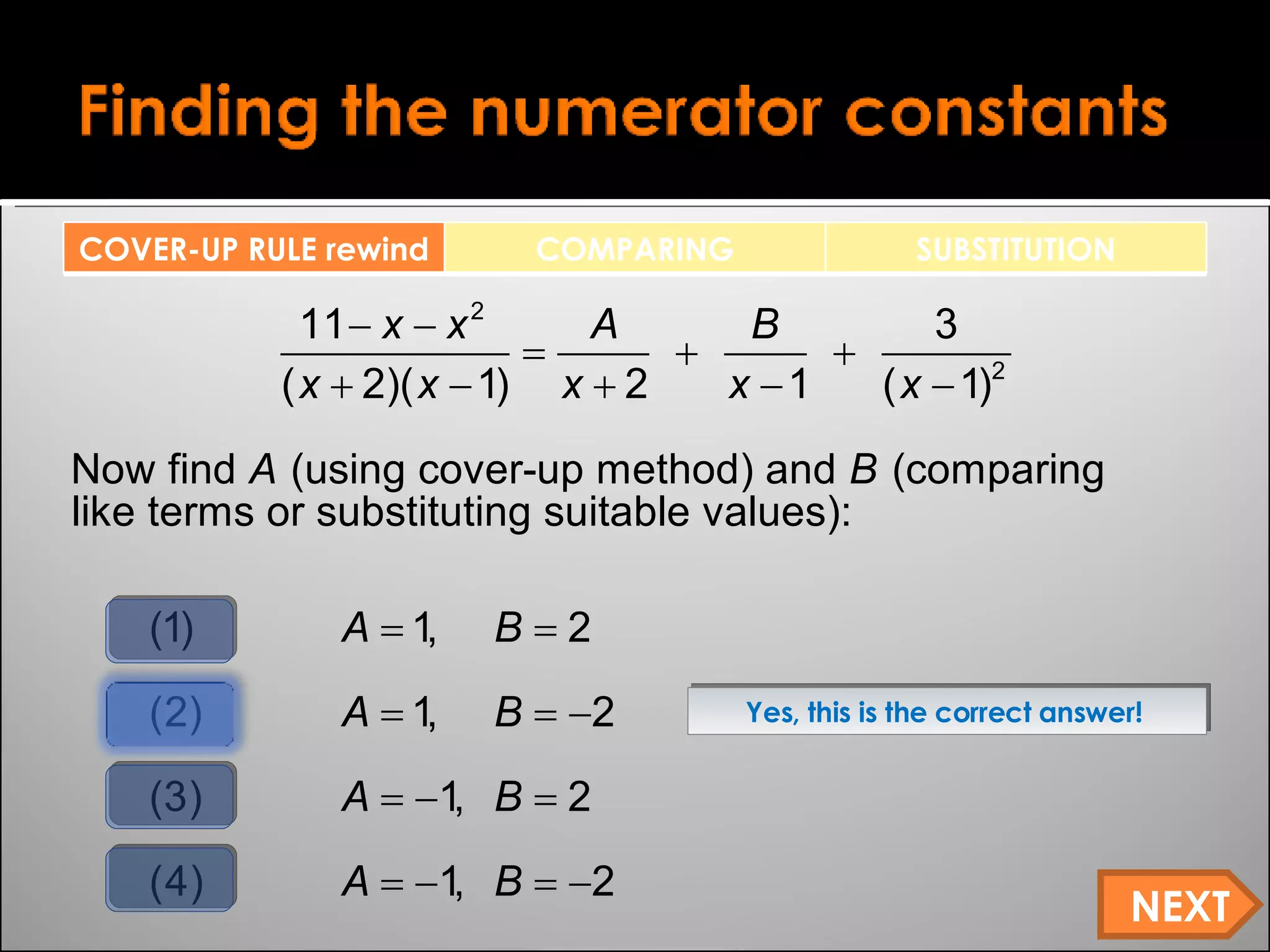
Yes, this is the correct answer!  NEXT COVER-UP RULE rewind COMPARING SUBSTITUTION
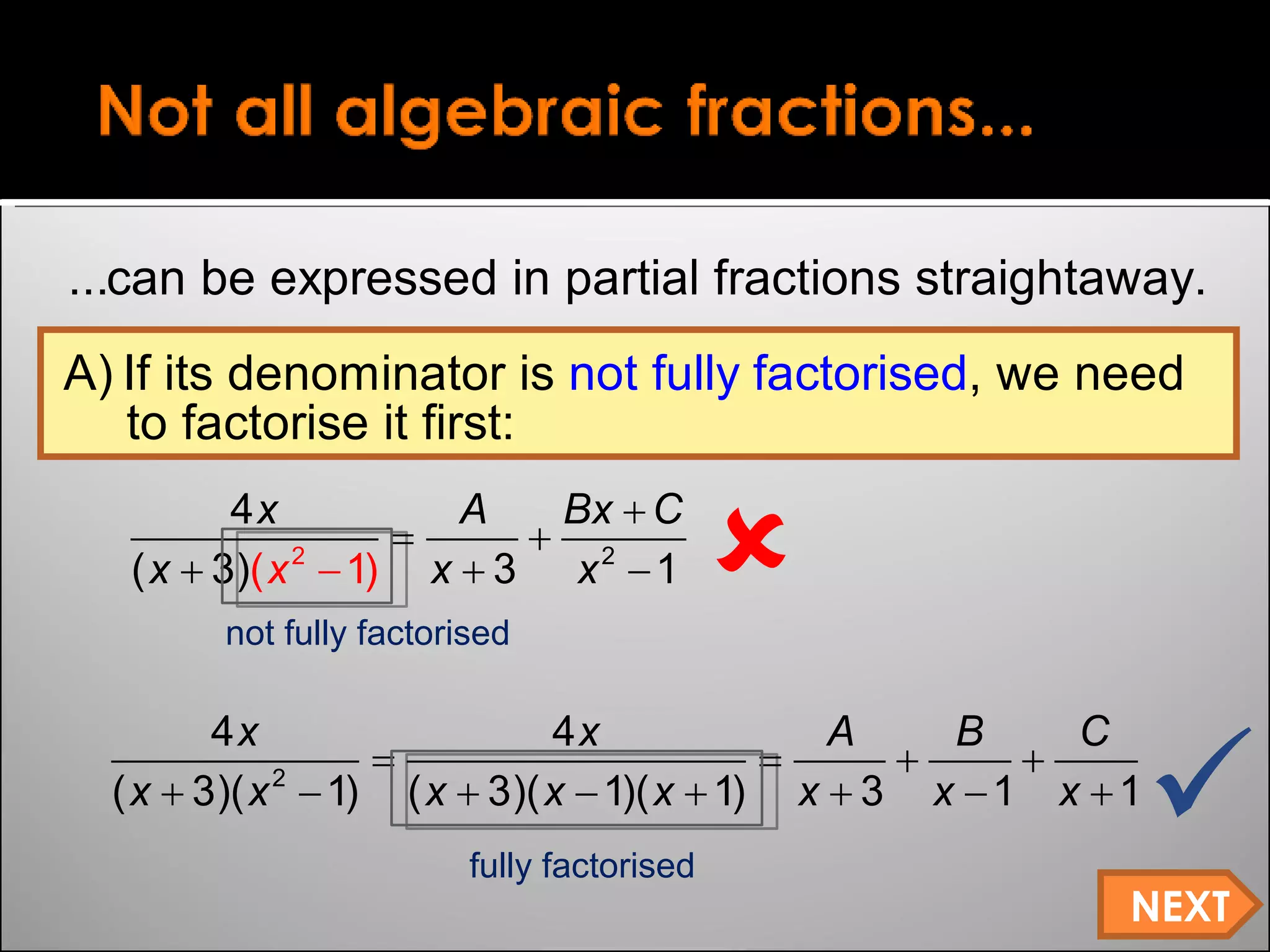
  NEXT not fully factorised fully factorised
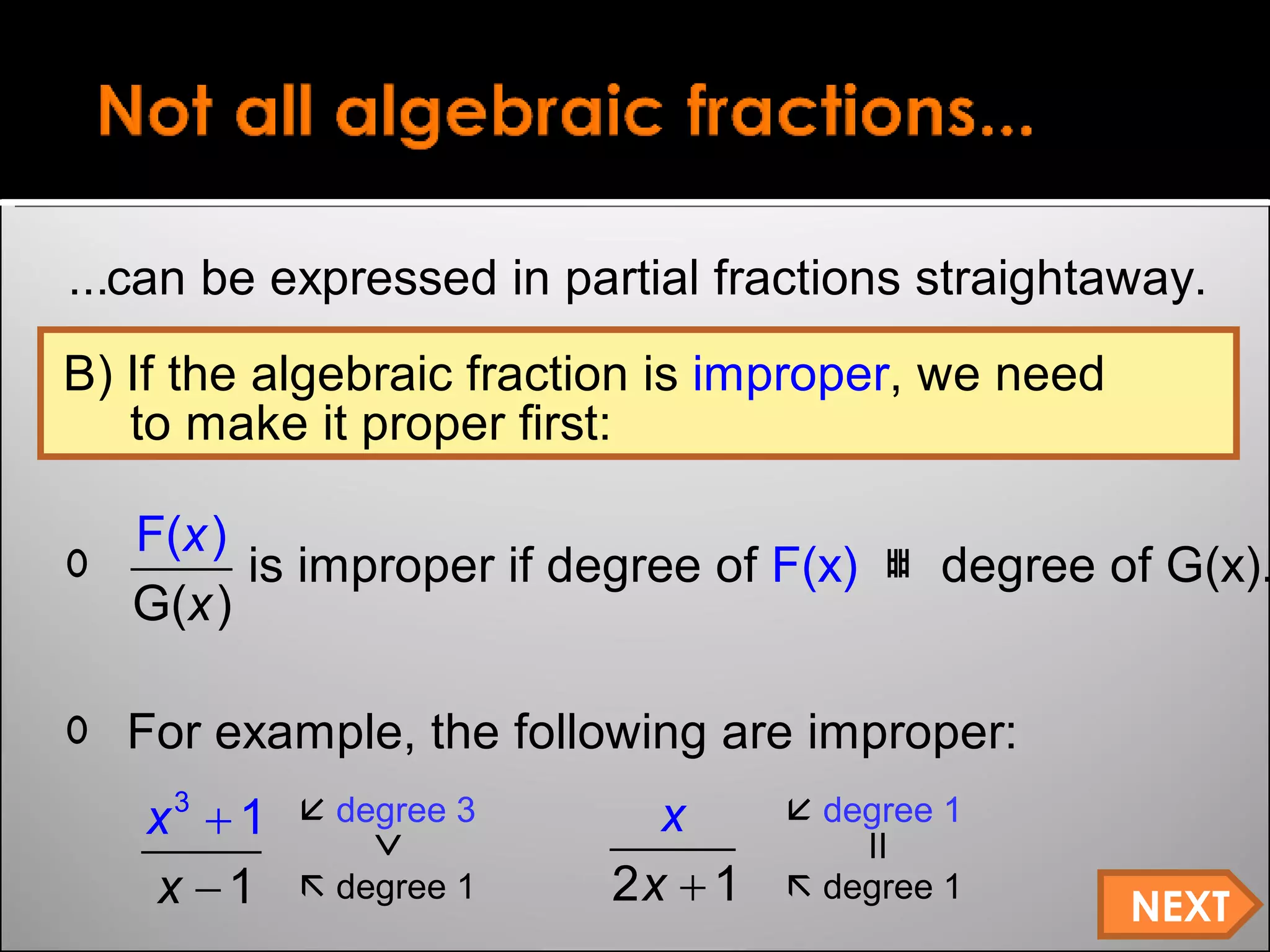
   degree 3    degree 1    degree 1    degree 1  II NEXT
NEXT
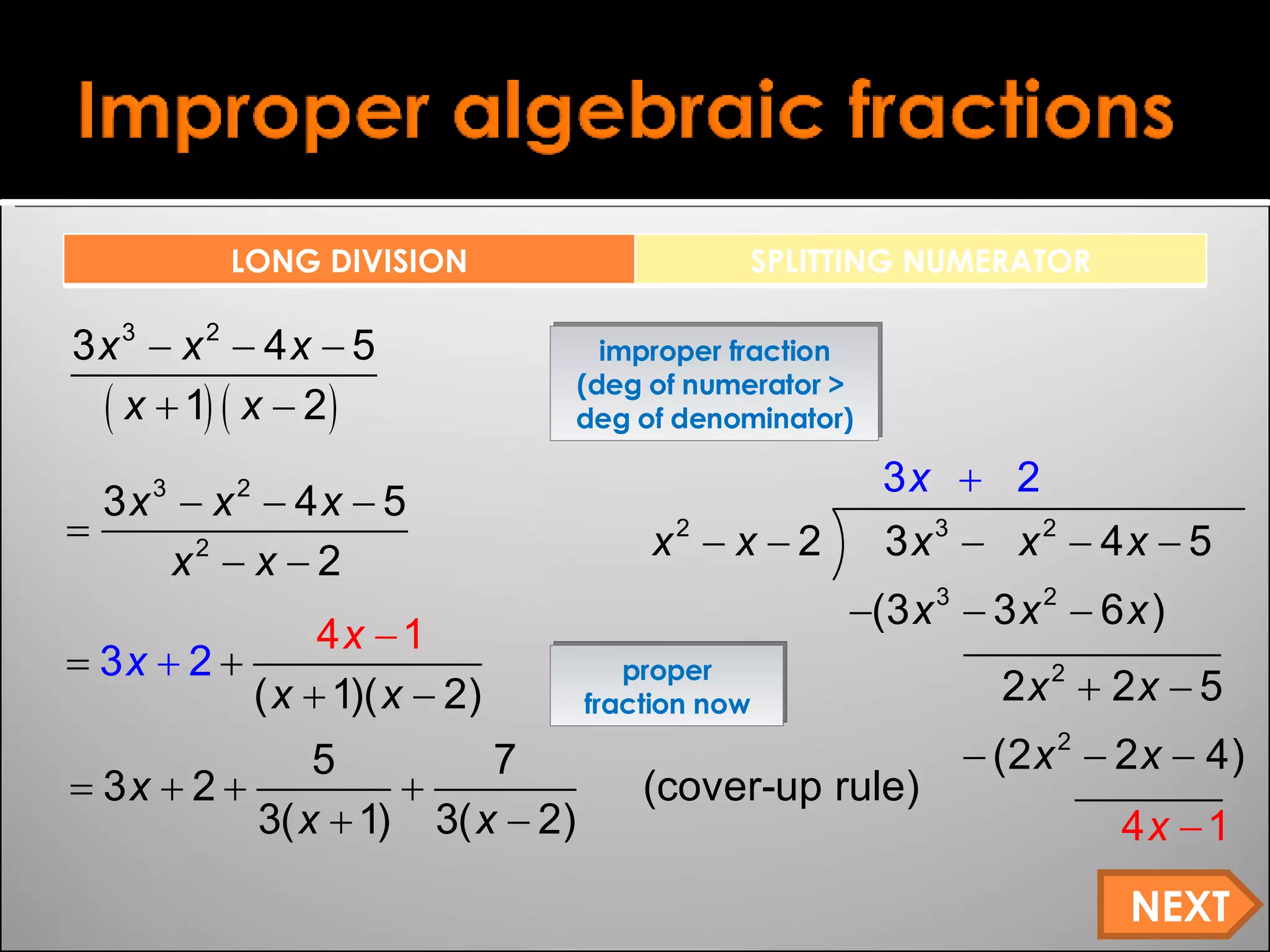
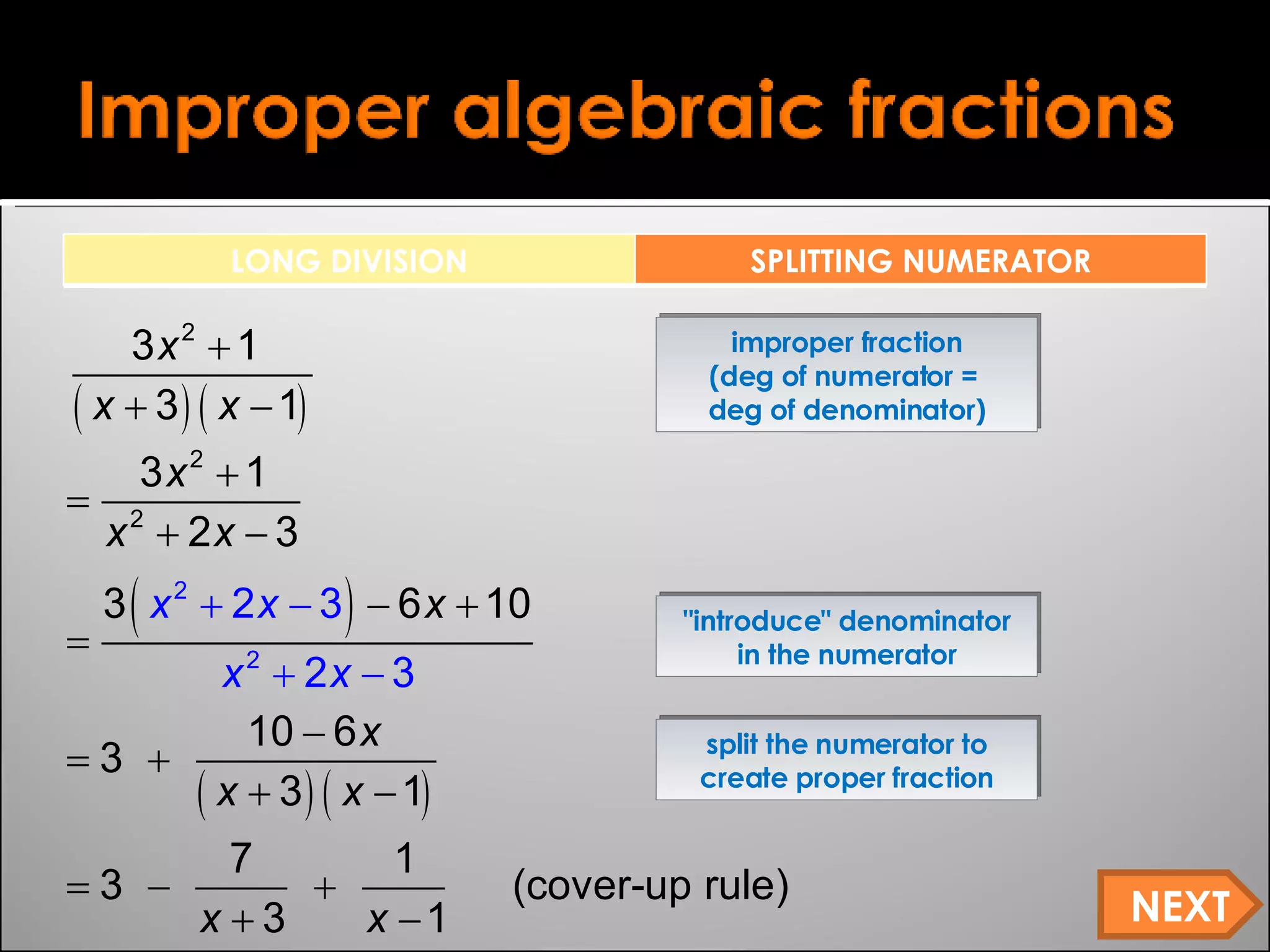
proper fraction now improper fraction (deg of numerator >  deg of denominator) NEXT LONG DIVISION SPLITTING NUMERATOR
"introduce" denominator in the numerator improper fraction (deg of numerator =  deg of denominator) split the numerator to create proper fraction NEXT LONG DIVISION SPLITTING NUMERATOR
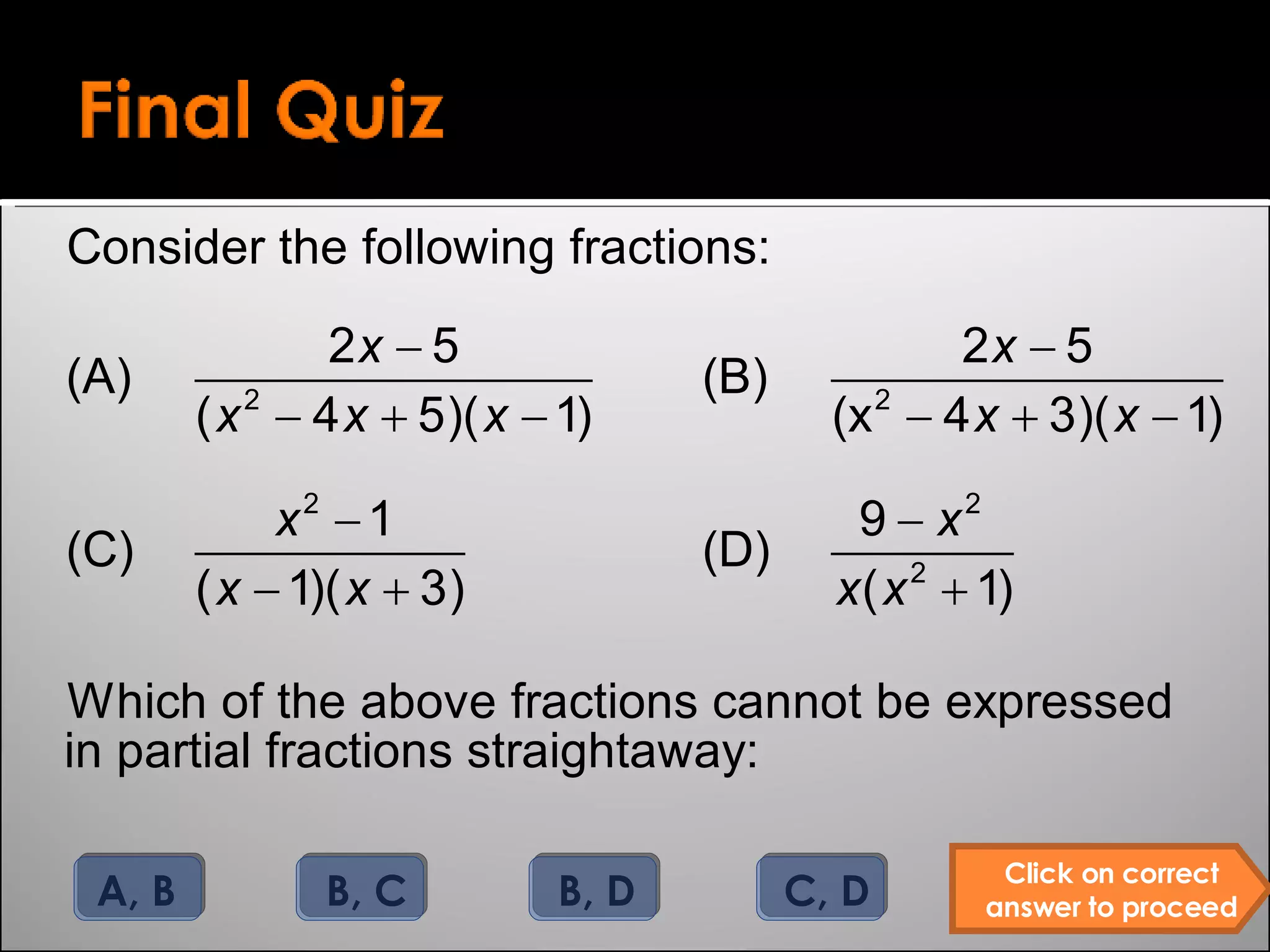
Click on correct answer to proceed A, B B, C B, D C, D
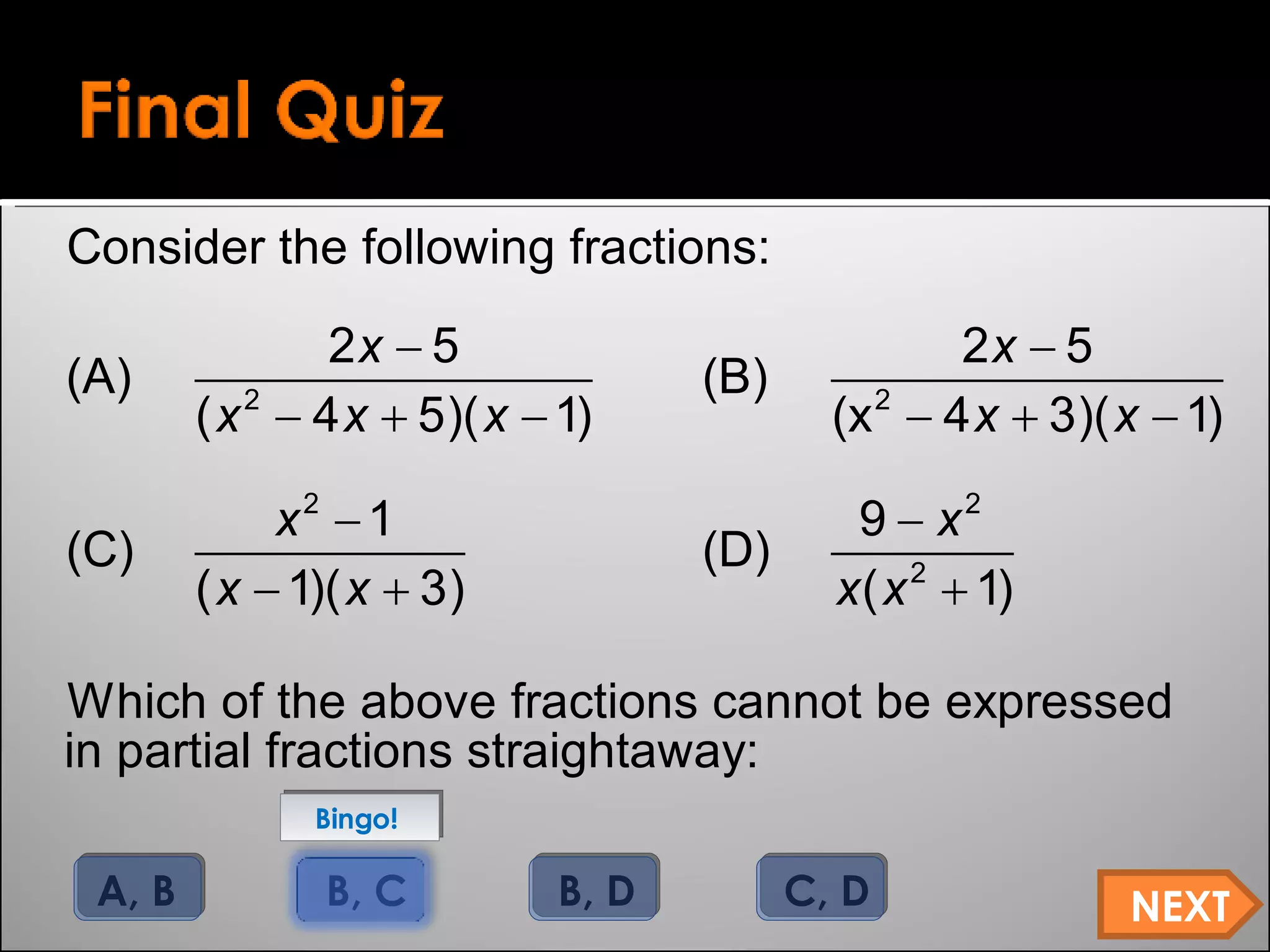
Bingo!  NEXT A, B B, C B, D C, D


Revision Partial Fractions

  • 1.
    DHS H2 MATHEMATICS: a revision package NEXT
  • 2.
  • 3.
  • 4.
  • 5.
  • 6.
  • 7.
    Note that x 2 is a repeated linear factor (i.e. x repeated twice) NEXT
  • 8.
    We want to find what values are A, B and C. NEXT
  • 9.
    NEXT COVER-UP RULECOMPARING SUBSTITUTION
  • 10.
    NEXT COVER-UP RULECOMPARING SUBSTITUTION
  • 11.
    NEXT If youare quick, skip this step and go to the next step (i.e. equate the numerators)... COVER-UP RULE COMPARING SUBSTITUTION
  • 12.
    NEXT COVER-UP RULECOMPARING SUBSTITUTION
  • 13.
    It is actuallyfaster here to compare like terms in x to find B and C . So always try to use the faster method. NEXT This makes B disappear, leaving only C . COVER-UP RULE COMPARING SUBSTITUTION
  • 14.
    NEXT To checkwhether your partial fractions are correct, "combine" back the partial fractions on the RHS to see if you could obtain the algebraic fraction on the LHS. COVER-UP RULE COMPARING SUBSTITUTION
  • 15.
    NEXT COVER-UP RULErewind COMPARING SUBSTITUTION
  • 16.
    NEXT The cover-uprule is actually a shortcut for substituting values of x. Can you see out why? COVER-UP RULE rewind COMPARING SUBSTITUTION
  • 17.
    Click on correctanswer to proceed COVER-UP RULE rewind COMPARING SUBSTITUTION
  • 18.
    Yes, this isthe correct answer! NEXT COVER-UP RULE rewind COMPARING SUBSTITUTION
  • 19.
      NEXTnot fully factorised fully factorised
  • 20.
    degree 3  degree 1  degree 1  degree 1  II NEXT
  • 21.
  • 22.
    proper fraction nowimproper fraction (deg of numerator > deg of denominator) NEXT LONG DIVISION SPLITTING NUMERATOR
  • 23.
    "introduce" denominator inthe numerator improper fraction (deg of numerator = deg of denominator) split the numerator to create proper fraction NEXT LONG DIVISION SPLITTING NUMERATOR
  • 24.
    Click on correctanswer to proceed A, B B, C B, D C, D
  • 25.
    Bingo! NEXTA, B B, C B, D C, D
  • 26.
  • 27.
  • 28.