Direct and Inverse
Variations

Name:- Manpreet Singh
Class:- VIII-J
Direct Variation


When we talk about a direct variation, we
are talking about a relationship where as
x increases,
y increases
or decreases at a CONSTANT RATE.
Direct Variation


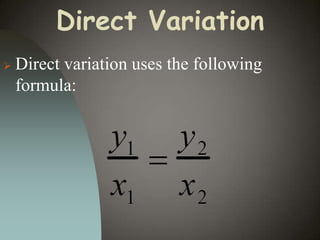
Direct variation uses the following
formula:
Direct Variation
example:
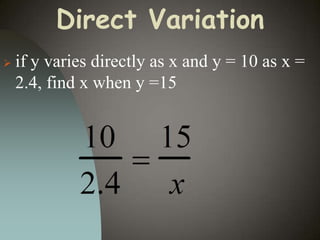
if y varies directly as x
and y = 10 as x = 2.4,
find x when y =15.
what x and y go together?
Direct Variation


If y varies directly as x and y = 10
find x when y =15.



y = 10, x = 2.4
make these y1 and x1



y = 15, and x = ?
make these y2 and x2
Direct Variation


if y varies directly as x and y = 10 as x =
2.4, find x when y =15
Direct Variation


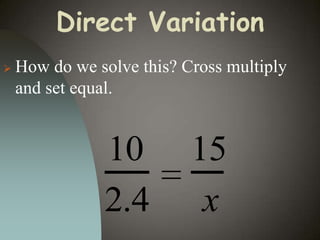
How do we solve this? Cross multiply
and set equal.

10
2.4

15
x
Direct Variation


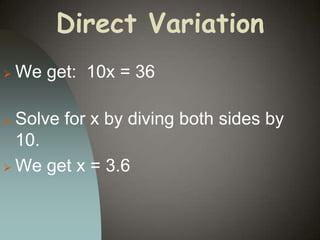
We get: 10x = 36

Solve for x by diving both sides by
10.
 We get x = 3.6

Direct Variation


Let’s do another.



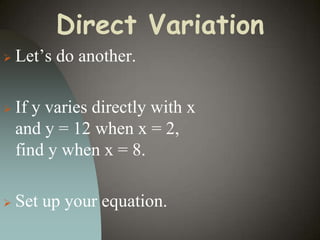
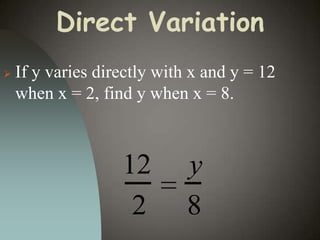
If y varies directly with x
and y = 12 when x = 2,
find y when x = 8.



Set up your equation.
Direct Variation


If y varies directly with x and y = 12
when x = 2, find y when x = 8.

12
2

y
8
Direct Variation

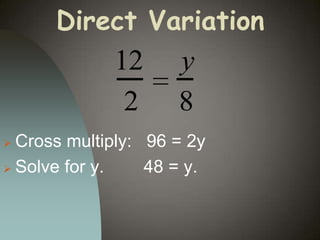
12
2

y
8

Cross multiply: 96 = 2y
 Solve for y.
48 = y.

Inverse Variation


Inverse is very similar to direct, but in an
inverse relationship as one value goes
up, the other goes down. There is not
necessarily a constant rate.
Inverse Variation
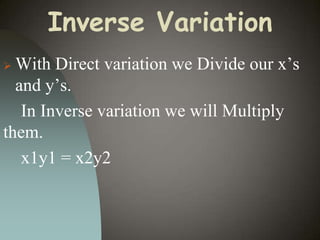
With Direct variation we Divide our x’s
and y’s.
In Inverse variation we will Multiply
them.
x1y1 = x2y2

Inverse Variation


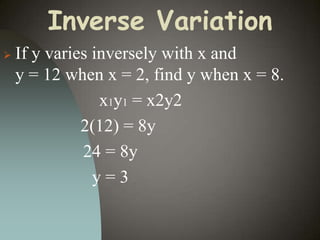
If y varies inversely with x and
y = 12 when x = 2, find y when x = 8.
x1y1 = x2y2
2(12) = 8y
24 = 8y
y=3
Inverse Variation


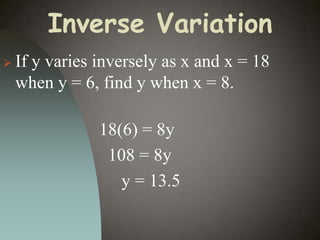
If y varies inversely as x and x = 18
when y = 6, find y when x = 8.
18(6) = 8y
108 = 8y
y = 13.5
Thank You for Watching
This

direct and inverse variations