Determinants and Cramer’s Rule
             Warm Up
             Lesson Presentation
             Lesson Quiz
Warm Up
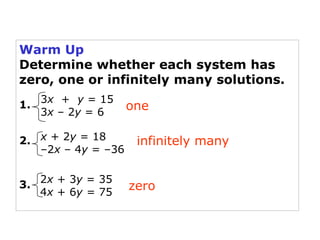
Determine whether each system has
zero, one or infinitely many solutions.
     3x + y = 15
1.
     3x – 2y = 6
                    one

2. x + 2y = 18       infinitely many
   –2x – 4y = –36

     2x + 3y = 35
3.
     4x + 6y = 75
                    zero
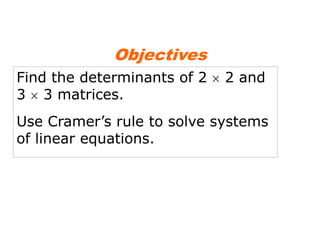
Objectives
Find the determinants of 2   2 and
3 3 matrices.
Use Cramer’s rule to solve systems
of linear equations.
Vocabulary
determinant
coefficient matrix
Cramer’s rule
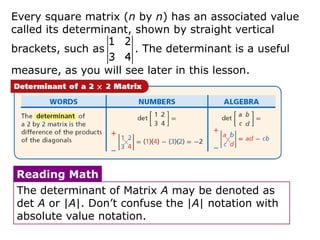
Every square matrix (n by n) has an associated value
called its determinant, shown by straight vertical
brackets, such as      . The determinant is a useful

measure, as you will see later in this lesson.


 Reading Math
 The determinant of Matrix A may be denoted as
 det A or |A|. Don’t confuse the |A| notation with
 absolute value notation.
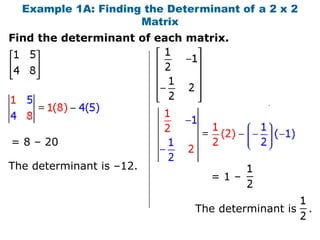
Example 1A: Finding the Determinant of a 2 x 2
                     Matrix
Find the determinant of each matrix.


                                           .


= 8 – 20

The determinant is –12.
                                 =1–


                              The determinant is   .
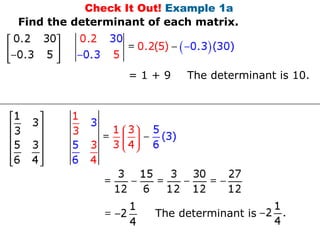
Check It Out! Example 1a
Find the determinant of each matrix.


                  =1+9     The determinant is 10.


                      The determinant is
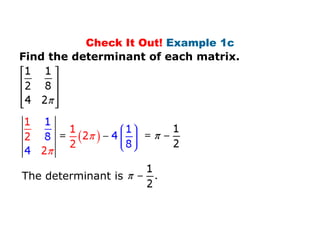
Check It Out! Example 1c
Find the determinant of each matrix.


The determinant is
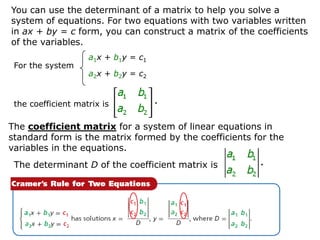
You can use the determinant of a matrix to help you solve a
system of equations. For two equations with two variables written
in ax + by = c form, you can construct a matrix of the coefficients
of the variables.
                    a1x + b1y = c1
 For the system
                    a2x + b2y = c2


 the coefficient matrix is

The coefficient matrix for a system of linear equations in
standard form is the matrix formed by the coefficients for the
variables in the equations.
 The determinant D of the coefficient matrix is
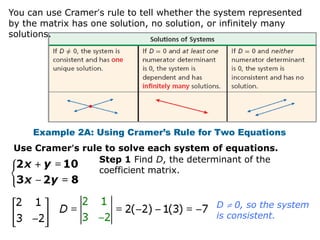
You can use Cramer’s rule to tell whether the system represented
by the matrix has one solution, no solution, or infinitely many
solutions.


     Example 2A: Using Cramer’s Rule for Two Equations
 Use Cramer’s rule to solve each system of equations.
                  Step 1 Find D, the determinant of the
                  coefficient matrix.


                                             D 0, so the system
                                             is consistent.
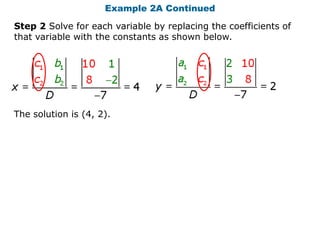
Example 2A Continued

Step 2 Solve for each variable by replacing the coefficients of
that variable with the constants as shown below.


The solution is (4, 2).
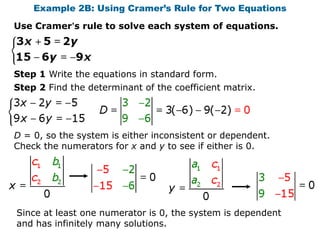
Example 2B: Using Cramer’s Rule for Two Equations
Use Cramer’s rule to solve each system of equations.


Step 1 Write the equations in standard form.
Step 2 Find the determinant of the coefficient matrix.


D = 0, so the system is either inconsistent or dependent.
Check the numerators for x and y to see if either is 0.


Since at least one numerator is 0, the system is dependent
and has infinitely many solutions.
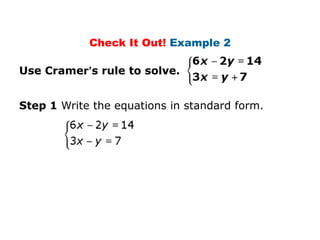
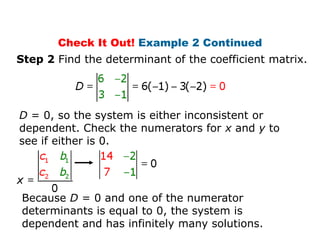
Check It Out! Example 2

Use Cramer’s rule to solve.


Step 1 Write the equations in standard form.
Check It Out! Example 2 Continued
Step 2 Find the determinant of the coefficient matrix.


D = 0, so the system is either inconsistent or
dependent. Check the numerators for x and y to
see if either is 0.


Because D = 0 and one of the numerator
determinants is equal to 0, the system is
dependent and has infinitely many solutions.
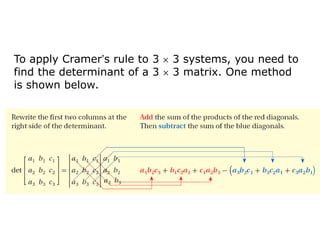
To apply Cramer’s rule to 3   3 systems, you need to
find the determinant of a 3   3 matrix. One method
is shown below.
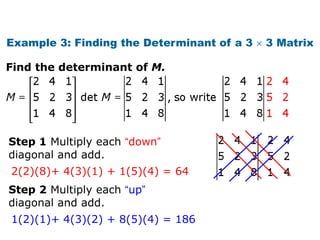
Example 3: Finding the Determinant of a 3   3 Matrix

Find the determinant of M.


Step 1 Multiply each “down”
diagonal and add.
2(2)(8)+ 4(3)(1) + 1(5)(4) = 64
Step 2 Multiply each “up”
diagonal and add.
1(2)(1)+ 4(3)(2) + 8(5)(4) = 186
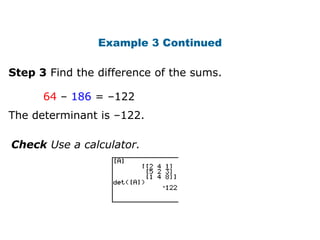
Example 3 Continued

Step 3 Find the difference of the sums.

      64 – 186 = –122
The determinant is –122.

Check Use a calculator.
Check It Out! Example 3


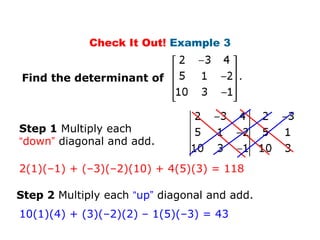
Find the determinant of


Step 1 Multiply each
“down” diagonal and add.

2(1)(–1) + (–3)(–2)(10) + 4(5)(3) = 118

Step 2 Multiply each “up” diagonal and add.
10(1)(4) + (3)(–2)(2) – 1(5)(–3) = 43
Check It Out! Example 3 Continued

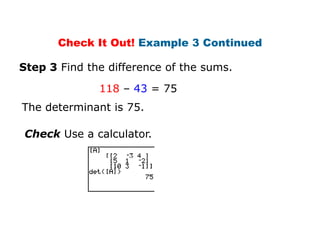
Step 3 Find the difference of the sums.

              118 – 43 = 75
The determinant is 75.

Check Use a calculator.
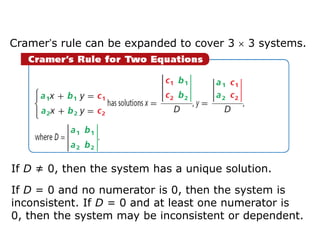
Cramer’s rule can be expanded to cover 3   3 systems.


If D ≠ 0, then the system has a unique solution.

If D = 0 and no numerator is 0, then the system is
inconsistent. If D = 0 and at least one numerator is
0, then the system may be inconsistent or dependent.
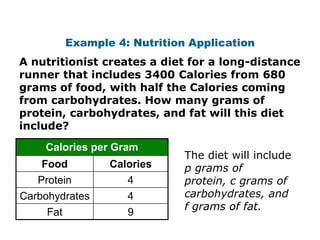
Example 4: Nutrition Application
A nutritionist creates a diet for a long-distance
runner that includes 3400 Calories from 680
grams of food, with half the Calories coming
from carbohydrates. How many grams of
protein, carbohydrates, and fat will this diet
include?
    Calories per Gram
                               The diet will include
    Food          Calories     p grams of
   Protein           4         protein, c grams of
Carbohydrates        4         carbohydrates, and
                               f grams of fat.
     Fat             9
Example 4 Continued


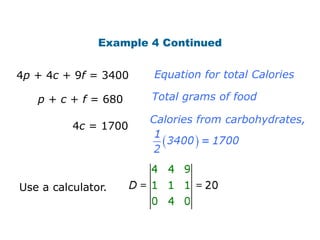
4p + 4c + 9f = 3400    Equation for total Calories

   p + c + f = 680     Total grams of food

                      Calories from carbohydrates,
          4c = 1700


Use a calculator.
Example 4 Continued


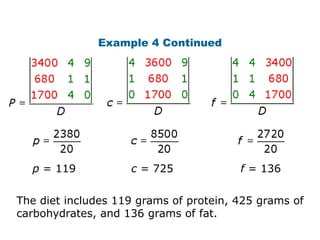
  p = 119           c = 725             f = 136


The diet includes 119 grams of protein, 425 grams of
carbohydrates, and 136 grams of fat.
Check It Out! Example 4
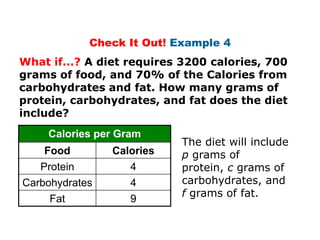
What if...? A diet requires 3200 calories, 700
grams of food, and 70% of the Calories from
carbohydrates and fat. How many grams of
protein, carbohydrates, and fat does the diet
include?
     Calories per Gram
                            The diet will include
    Food        Calories    p grams of
   Protein         4        protein, c grams of
Carbohydrates       4       carbohydrates, and
                            f grams of fat.
     Fat            9
Check It Out! Example 4 Continued


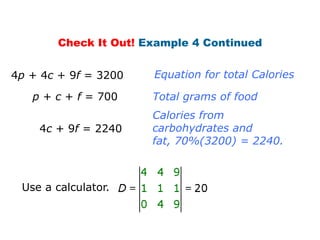
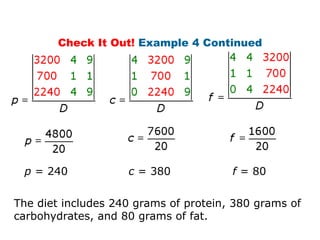
4p + 4c + 9f = 3200   Equation for total Calories

   p + c + f = 700    Total grams of food
                      Calories from
    4c + 9f = 2240    carbohydrates and
                      fat, 70%(3200) = 2240.


 Use a calculator.
Check It Out! Example 4 Continued


 p = 240            c = 380            f = 80


The diet includes 240 grams of protein, 380 grams of
carbohydrates, and 80 grams of fat.
Lesson Quiz
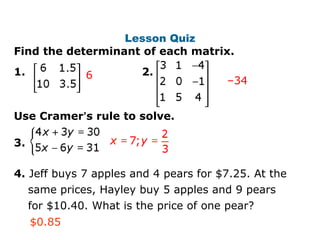
Find the determinant of each matrix.
1.             6         2.
                                        –34


Use Cramer’s rule to solve.

3.

4. Jeff buys 7 apples and 4 pears for $7.25. At the
     same prices, Hayley buy 5 apples and 9 pears
     for $10.40. What is the price of one pear?
     $0.85

Cramers rule

  • 1.
    Determinants and Cramer’sRule Warm Up Lesson Presentation Lesson Quiz
  • 2.
    Warm Up Determine whethereach system has zero, one or infinitely many solutions. 3x + y = 15 1. 3x – 2y = 6 one 2. x + 2y = 18 infinitely many –2x – 4y = –36 2x + 3y = 35 3. 4x + 6y = 75 zero
  • 3.
    Objectives Find the determinantsof 2 2 and 3 3 matrices. Use Cramer’s rule to solve systems of linear equations.
  • 4.
  • 5.
    Every square matrix(n by n) has an associated value called its determinant, shown by straight vertical brackets, such as . The determinant is a useful measure, as you will see later in this lesson. Reading Math The determinant of Matrix A may be denoted as det A or |A|. Don’t confuse the |A| notation with absolute value notation.
  • 6.
    Example 1A: Findingthe Determinant of a 2 x 2 Matrix Find the determinant of each matrix. . = 8 – 20 The determinant is –12. =1– The determinant is .
  • 7.
    Check It Out!Example 1a Find the determinant of each matrix. =1+9 The determinant is 10. The determinant is
  • 8.
    Check It Out!Example 1c Find the determinant of each matrix. The determinant is
  • 9.
    You can usethe determinant of a matrix to help you solve a system of equations. For two equations with two variables written in ax + by = c form, you can construct a matrix of the coefficients of the variables. a1x + b1y = c1 For the system a2x + b2y = c2 the coefficient matrix is The coefficient matrix for a system of linear equations in standard form is the matrix formed by the coefficients for the variables in the equations. The determinant D of the coefficient matrix is
  • 10.
    You can useCramer’s rule to tell whether the system represented by the matrix has one solution, no solution, or infinitely many solutions. Example 2A: Using Cramer’s Rule for Two Equations Use Cramer’s rule to solve each system of equations. Step 1 Find D, the determinant of the coefficient matrix. D 0, so the system is consistent.
  • 11.
    Example 2A Continued Step2 Solve for each variable by replacing the coefficients of that variable with the constants as shown below. The solution is (4, 2).
  • 12.
    Example 2B: UsingCramer’s Rule for Two Equations Use Cramer’s rule to solve each system of equations. Step 1 Write the equations in standard form. Step 2 Find the determinant of the coefficient matrix. D = 0, so the system is either inconsistent or dependent. Check the numerators for x and y to see if either is 0. Since at least one numerator is 0, the system is dependent and has infinitely many solutions.
  • 13.
    Check It Out!Example 2 Use Cramer’s rule to solve. Step 1 Write the equations in standard form.
  • 14.
    Check It Out!Example 2 Continued Step 2 Find the determinant of the coefficient matrix. D = 0, so the system is either inconsistent or dependent. Check the numerators for x and y to see if either is 0. Because D = 0 and one of the numerator determinants is equal to 0, the system is dependent and has infinitely many solutions.
  • 15.
    To apply Cramer’srule to 3 3 systems, you need to find the determinant of a 3 3 matrix. One method is shown below.
  • 16.
    Example 3: Findingthe Determinant of a 3 3 Matrix Find the determinant of M. Step 1 Multiply each “down” diagonal and add. 2(2)(8)+ 4(3)(1) + 1(5)(4) = 64 Step 2 Multiply each “up” diagonal and add. 1(2)(1)+ 4(3)(2) + 8(5)(4) = 186
  • 17.
    Example 3 Continued Step3 Find the difference of the sums. 64 – 186 = –122 The determinant is –122. Check Use a calculator.
  • 18.
    Check It Out!Example 3 Find the determinant of Step 1 Multiply each “down” diagonal and add. 2(1)(–1) + (–3)(–2)(10) + 4(5)(3) = 118 Step 2 Multiply each “up” diagonal and add. 10(1)(4) + (3)(–2)(2) – 1(5)(–3) = 43
  • 19.
    Check It Out!Example 3 Continued Step 3 Find the difference of the sums. 118 – 43 = 75 The determinant is 75. Check Use a calculator.
  • 20.
    Cramer’s rule canbe expanded to cover 3 3 systems. If D ≠ 0, then the system has a unique solution. If D = 0 and no numerator is 0, then the system is inconsistent. If D = 0 and at least one numerator is 0, then the system may be inconsistent or dependent.
  • 21.
    Example 4: NutritionApplication A nutritionist creates a diet for a long-distance runner that includes 3400 Calories from 680 grams of food, with half the Calories coming from carbohydrates. How many grams of protein, carbohydrates, and fat will this diet include? Calories per Gram The diet will include Food Calories p grams of Protein 4 protein, c grams of Carbohydrates 4 carbohydrates, and f grams of fat. Fat 9
  • 22.
    Example 4 Continued 4p+ 4c + 9f = 3400 Equation for total Calories p + c + f = 680 Total grams of food Calories from carbohydrates, 4c = 1700 Use a calculator.
  • 23.
    Example 4 Continued p = 119 c = 725 f = 136 The diet includes 119 grams of protein, 425 grams of carbohydrates, and 136 grams of fat.
  • 24.
    Check It Out!Example 4 What if...? A diet requires 3200 calories, 700 grams of food, and 70% of the Calories from carbohydrates and fat. How many grams of protein, carbohydrates, and fat does the diet include? Calories per Gram The diet will include Food Calories p grams of Protein 4 protein, c grams of Carbohydrates 4 carbohydrates, and f grams of fat. Fat 9
  • 25.
    Check It Out!Example 4 Continued 4p + 4c + 9f = 3200 Equation for total Calories p + c + f = 700 Total grams of food Calories from 4c + 9f = 2240 carbohydrates and fat, 70%(3200) = 2240. Use a calculator.
  • 26.
    Check It Out!Example 4 Continued p = 240 c = 380 f = 80 The diet includes 240 grams of protein, 380 grams of carbohydrates, and 80 grams of fat.
  • 27.
    Lesson Quiz Find thedeterminant of each matrix. 1. 6 2. –34 Use Cramer’s rule to solve. 3. 4. Jeff buys 7 apples and 4 pears for $7.25. At the same prices, Hayley buy 5 apples and 9 pears for $10.40. What is the price of one pear? $0.85