7.4 
Partial 
Fractions 
Copyright © 2011 Pearson, Inc.
What you’ll learn about 
 Partial Fraction Decomposition 
 Denominators with Linear Factors 
 Denominators with Irreducible Quadratic Factors 
 Applications 
… and why 
Partial fraction decompositions are used in calculus in 
integration and can be used to guide the sketch of the 
graph of a rational function. 
Copyright © 2011 Pearson, Inc. Slide 7.4 - 2
Partial Fraction Decomposition of 
f(x)/d(x) 
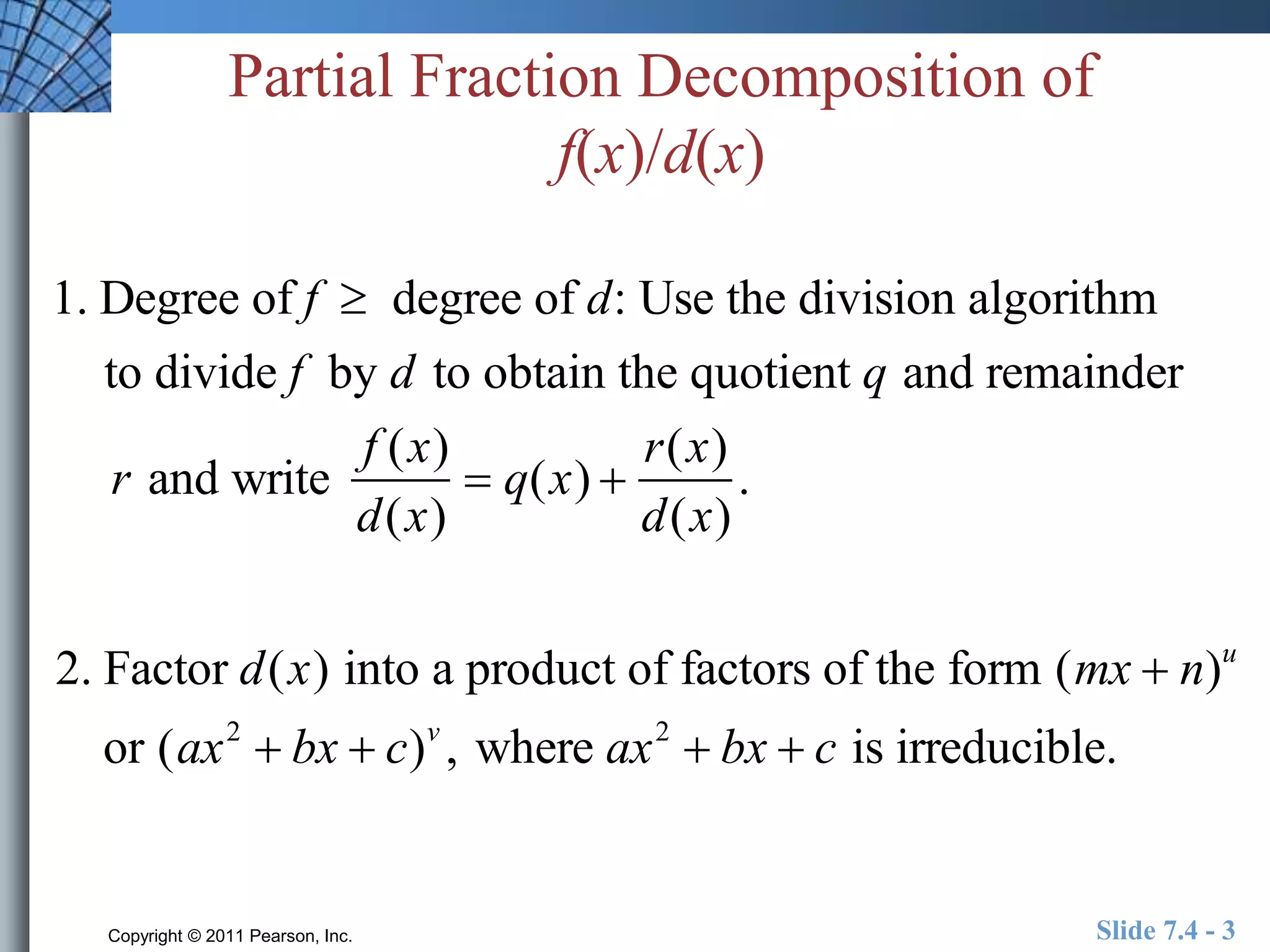
1. Degree of f  degree of d: Use the division algorithm 
to divide f by d to obtain the quotient q and remainder 
r and write 
f (x) 
d(x) 
 q(x)  
r(x) 
d(x) 
. 
2. Factor d(x) into a product of factors of the form (mx  n)u 
or (ax2  bx  c)v , where ax2  bx  c is irreducible. 
Copyright © 2011 Pearson, Inc. Slide 7.4 - 3
Partial Fraction Decomposition of 
f(x)/d(x) 
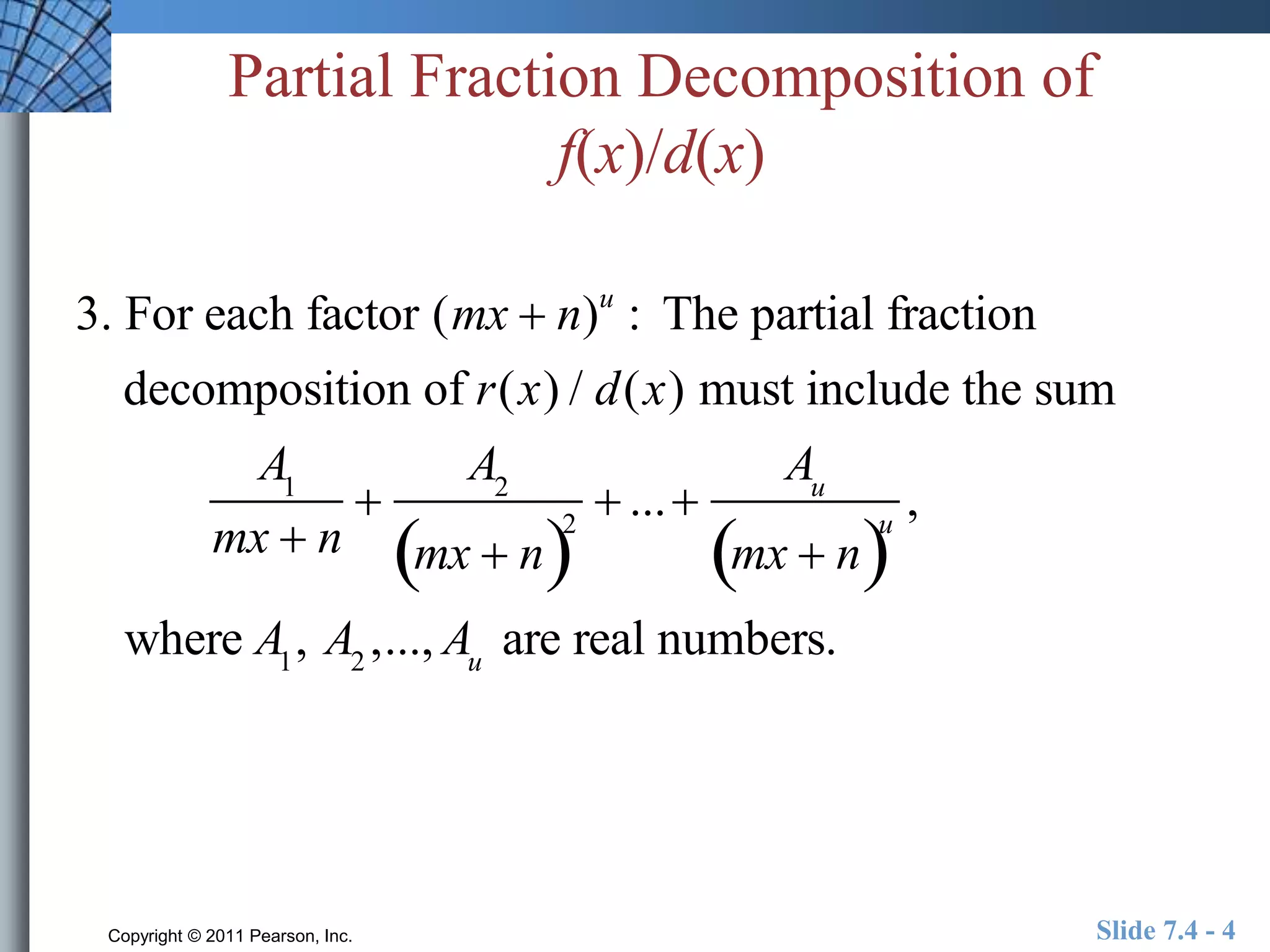
3. For each factor (mx  n)u : The partial fraction 
decomposition of r(x) / d(x) must include the sum 
A1 
mx  n 
 
A2 
mx  n2 
 ...  
Au 
mx  nu 
, 
where A1, A2 ,..., Au are real numbers. 
Copyright © 2011 Pearson, Inc. Slide 7.4 - 4
Partial Fraction Decomposition of 
f(x)/d(x) 
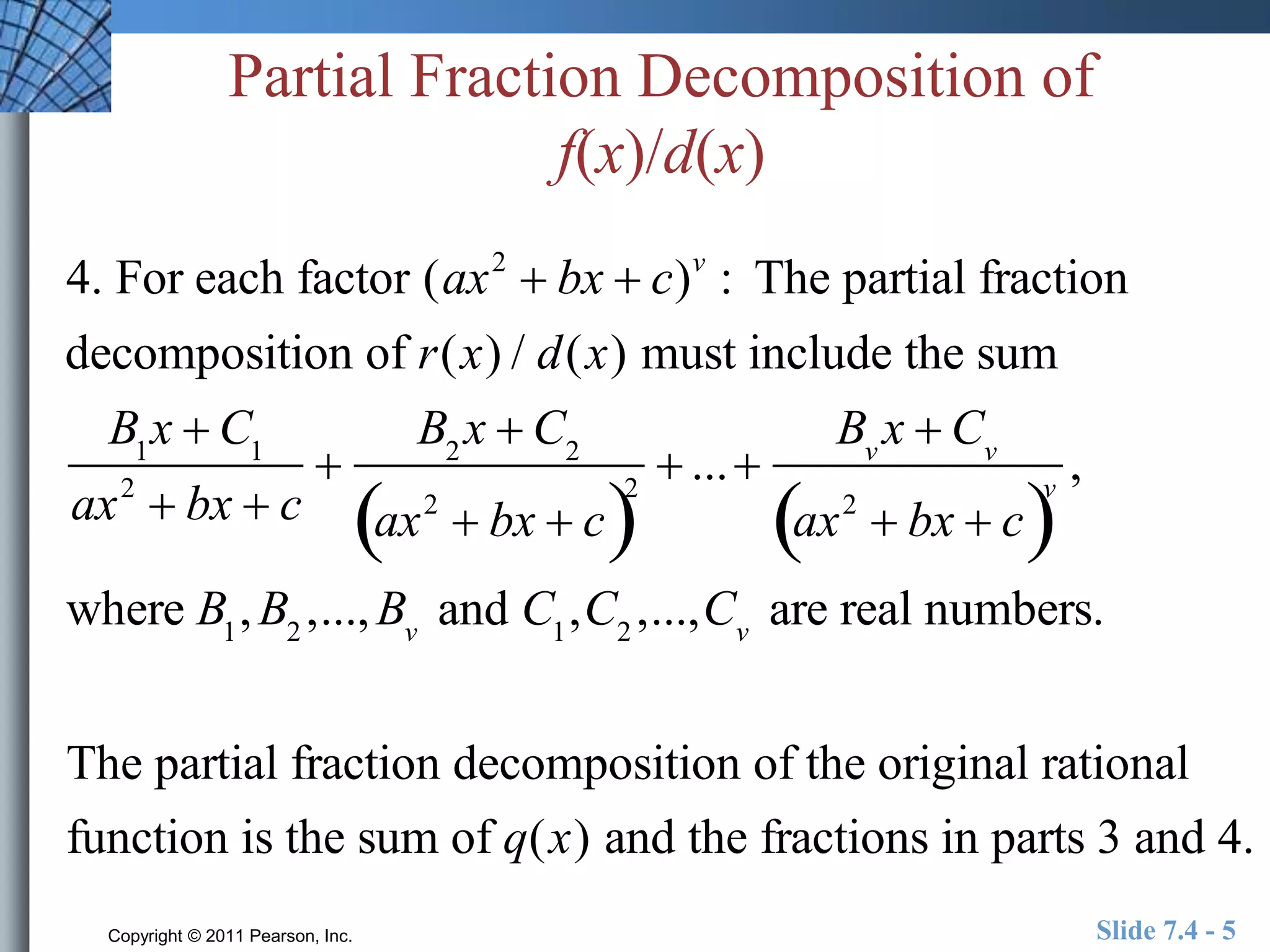
4. For each factor (ax2  bx  c)v : The partial fraction 
decomposition of r(x) / d(x) must include the sum 
Bx  C11 
 
ax2  bx  c 
B2x  C2 
ax2  bx  c2 
 ...  
Bvx  Cv 
ax2   bx  cv 
, 
where B1,B2 ,...,Bv and C1,C2 ,...,Cv are real numbers. 
The partial fraction decomposition of the original rational 
function is the sum of q(x) and the fractions in parts 3 and 4. 
Copyright © 2011 Pearson, Inc. Slide 7.4 - 5
Example Decomposing a Fraction 
with Distinct Linear Factors 
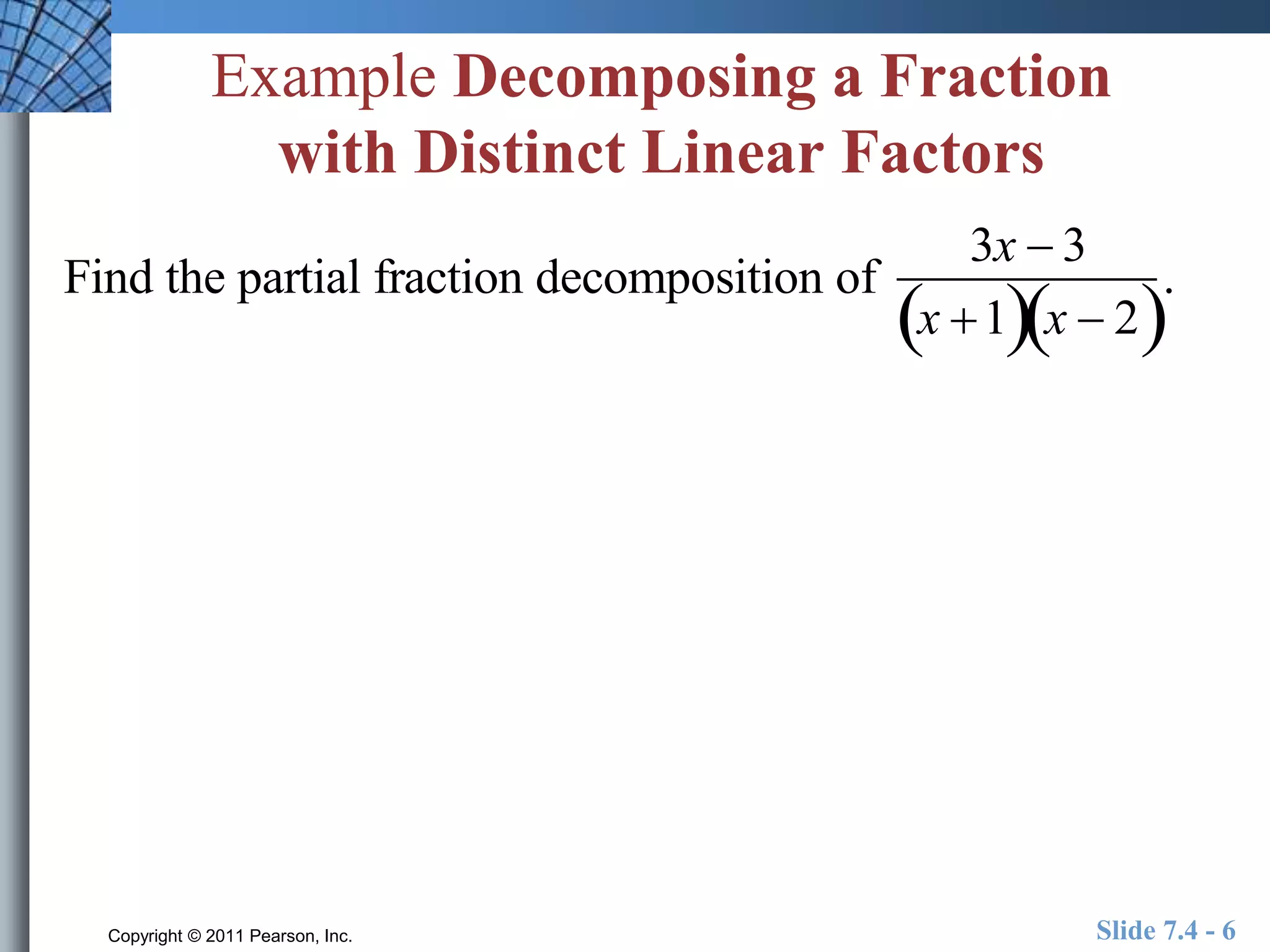
Find the partial fraction decomposition of 
3x  3 
x 1x  2 
. 
Copyright © 2011 Pearson, Inc. Slide 7.4 - 6
Example Decomposing a Fraction 
with Distinct Linear Factors 
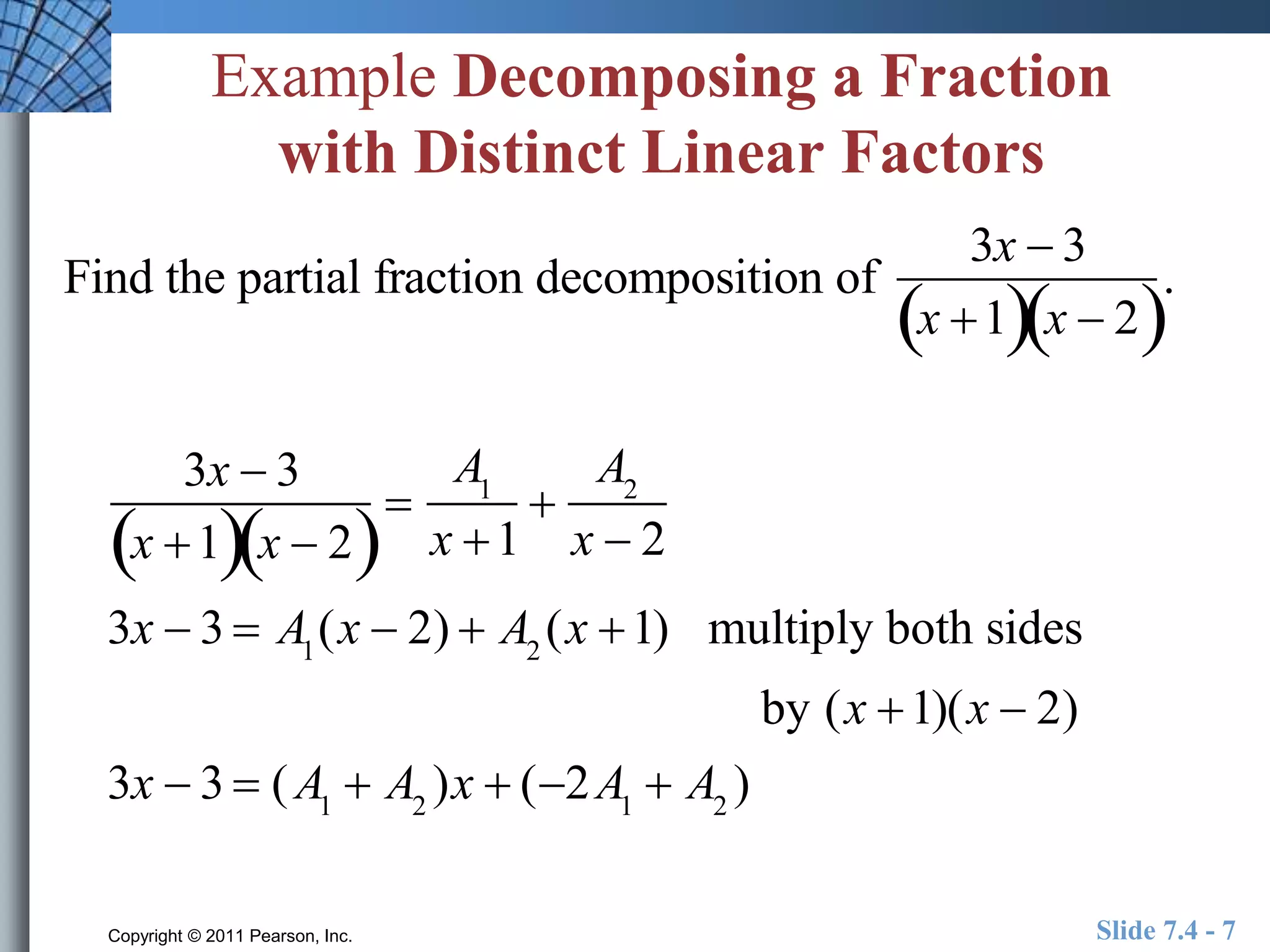
Find the partial fraction decomposition of 
3x  3 
x 1x  2 
 
A1 
x 1 
 
A2 
x  2 
3x  3 
x 1x  2 
3x  3  A1(x  2)  A2 (x 1) multiply both sides 
by (x 1)(x  2) 
3x  3  (A1  A2 )x  (2A1  A2 ) 
. 
Copyright © 2011 Pearson, Inc. Slide 7.4 - 7
Example Decomposing a Fraction 
with Distinct Linear Factors 
Find the partial fraction decomposition of 
3x  3 
x 1x  2 
. 
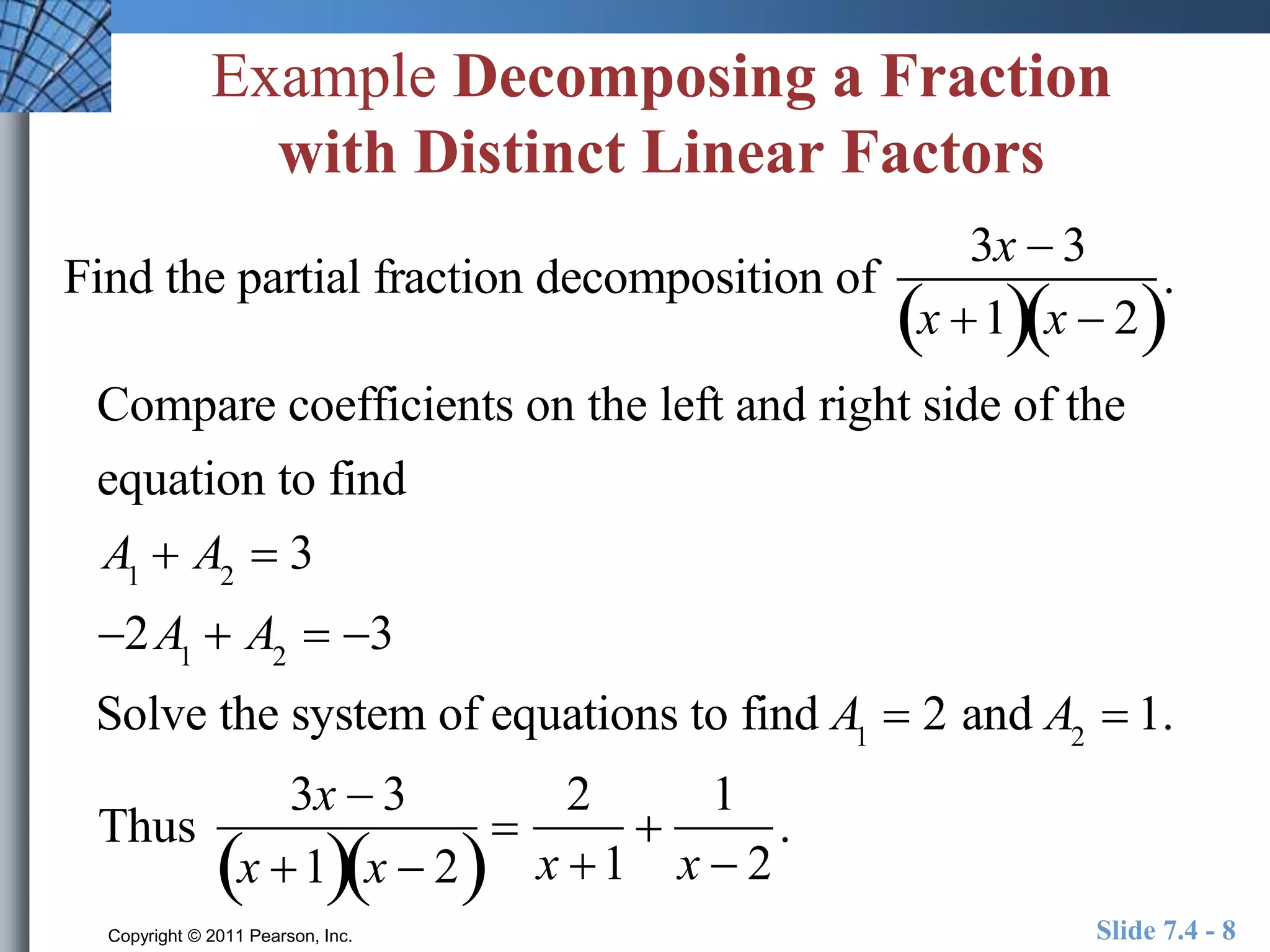
Compare coefficients on the left and right side of the 
equation to find 
A1  A2  3 
2A1  A2  3 
Solve the system of equations to find A1  2 and A2  1. 
Thus 
3x  3 
x 1x  2 
 
2 
x 1 
 
1 
x  2 
. 
Copyright © 2011 Pearson, Inc. Slide 7.4 - 8
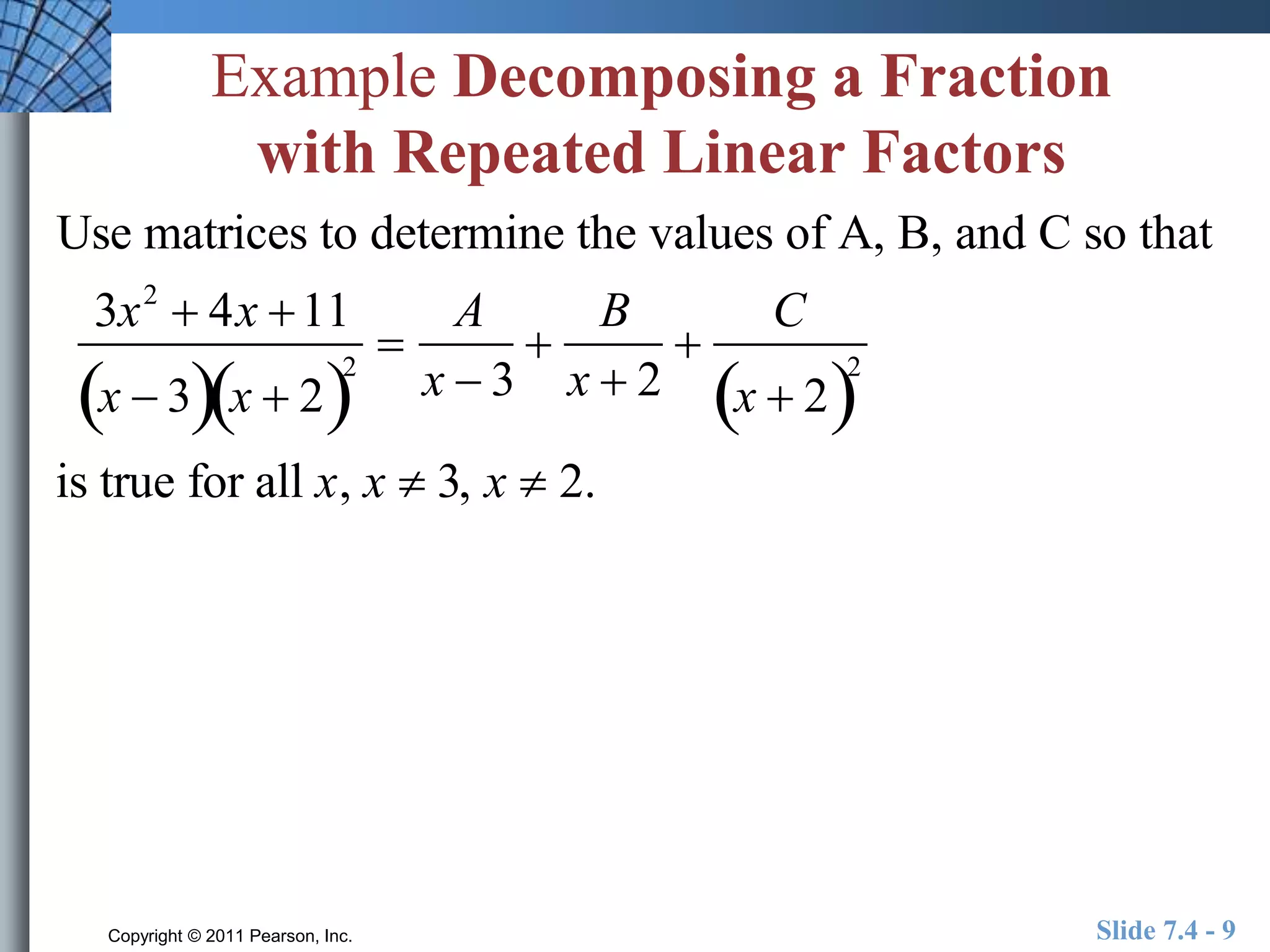
Example Decomposing a Fraction 
with Repeated Linear Factors 
Use matrices to determine the values of A, B, and C so that 
3x2  4x 11 
A 
B 
 
 
 
x  32 
x  2x  3 
x  2 
C 
x  22 
is true for all x, x  3, x  2. 
Copyright © 2011 Pearson, Inc. Slide 7.4 - 9
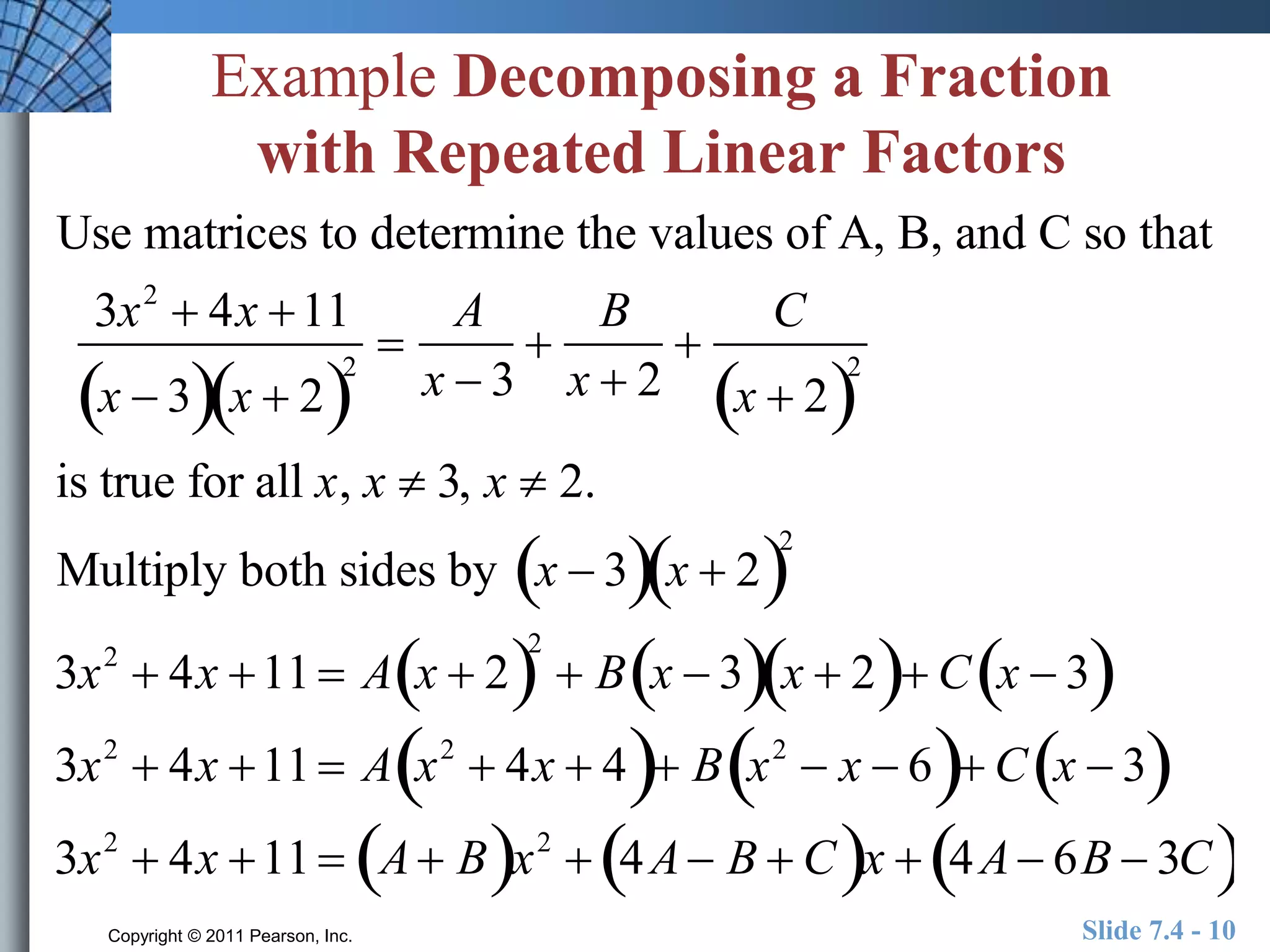
Example Decomposing a Fraction 
with Repeated Linear Factors 
Use matrices to determine the values of A, B, and C so that 
3x2  4x 11 
A 
B 
 
 
 
x  32 
x  2x  3 
x  2 
C 
x  22 
is true for all x, x  3, x  2. 
Multiply both sides by x  3x  22 
3x2  4x 11  Ax  22 
 Bx  3x  2 Cx  3 
3x2  4x 11  A x2   4x  4 B x2   x  6 Cx  3 
3x2  4x 11  A Bx2  4A B  Cx  4A 6B  3C 
Copyright © 2011 Pearson, Inc. Slide 7.4 - 10
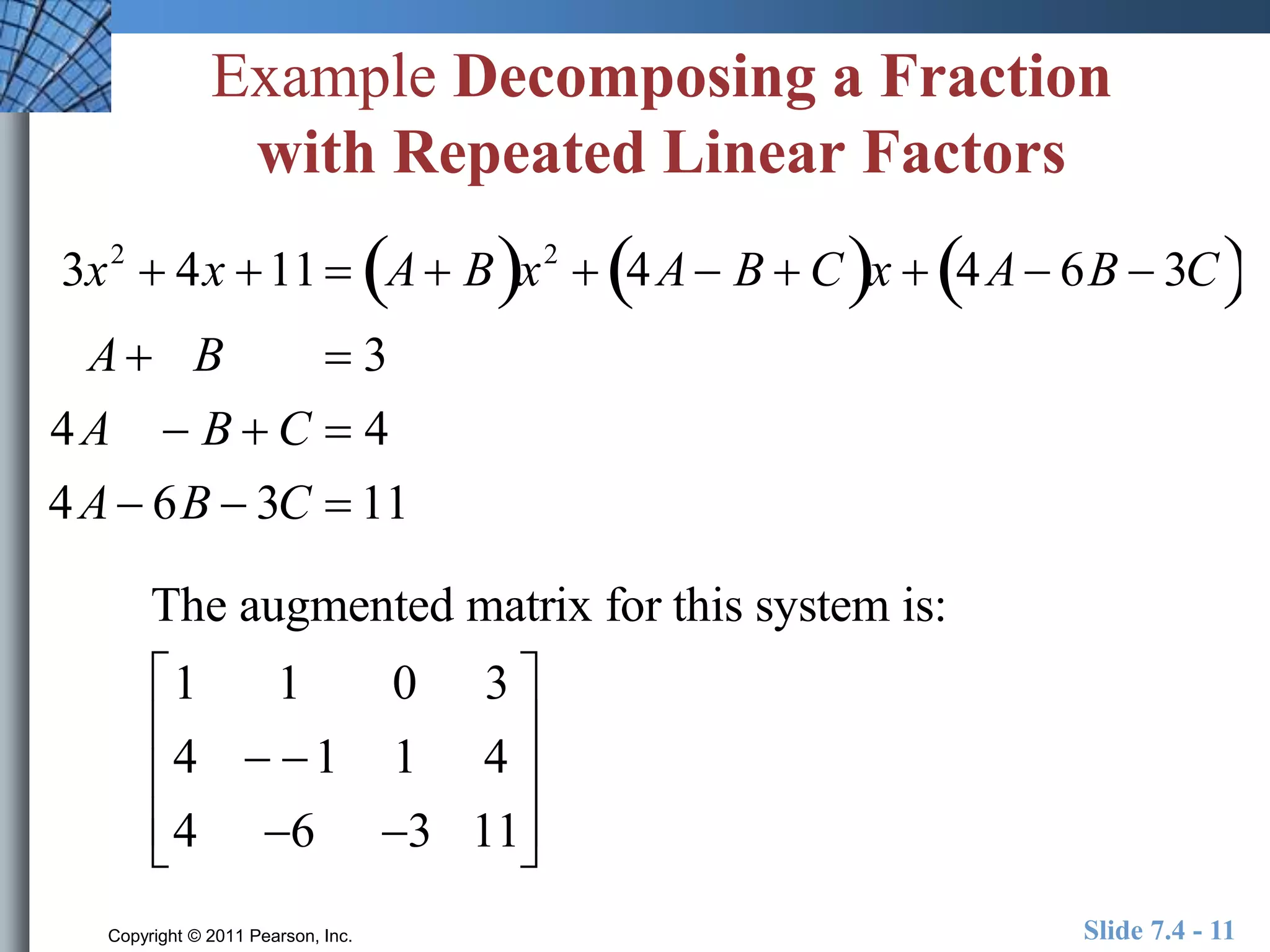
Example Decomposing a Fraction 
with Repeated Linear Factors 
3x2  4x 11  A Bx2  4A B  Cx  4A 6B  3C 
A B  3 
4A  B  C  4 
4A 6B  3C  11 
The augmented matrix for this system is: 
 
1 1 0 3 
 
 
4  1 1 4 
 
4 6 3 11 
 
 
 
 
 
 
Copyright © 2011 Pearson, Inc. Slide 7.4 - 11
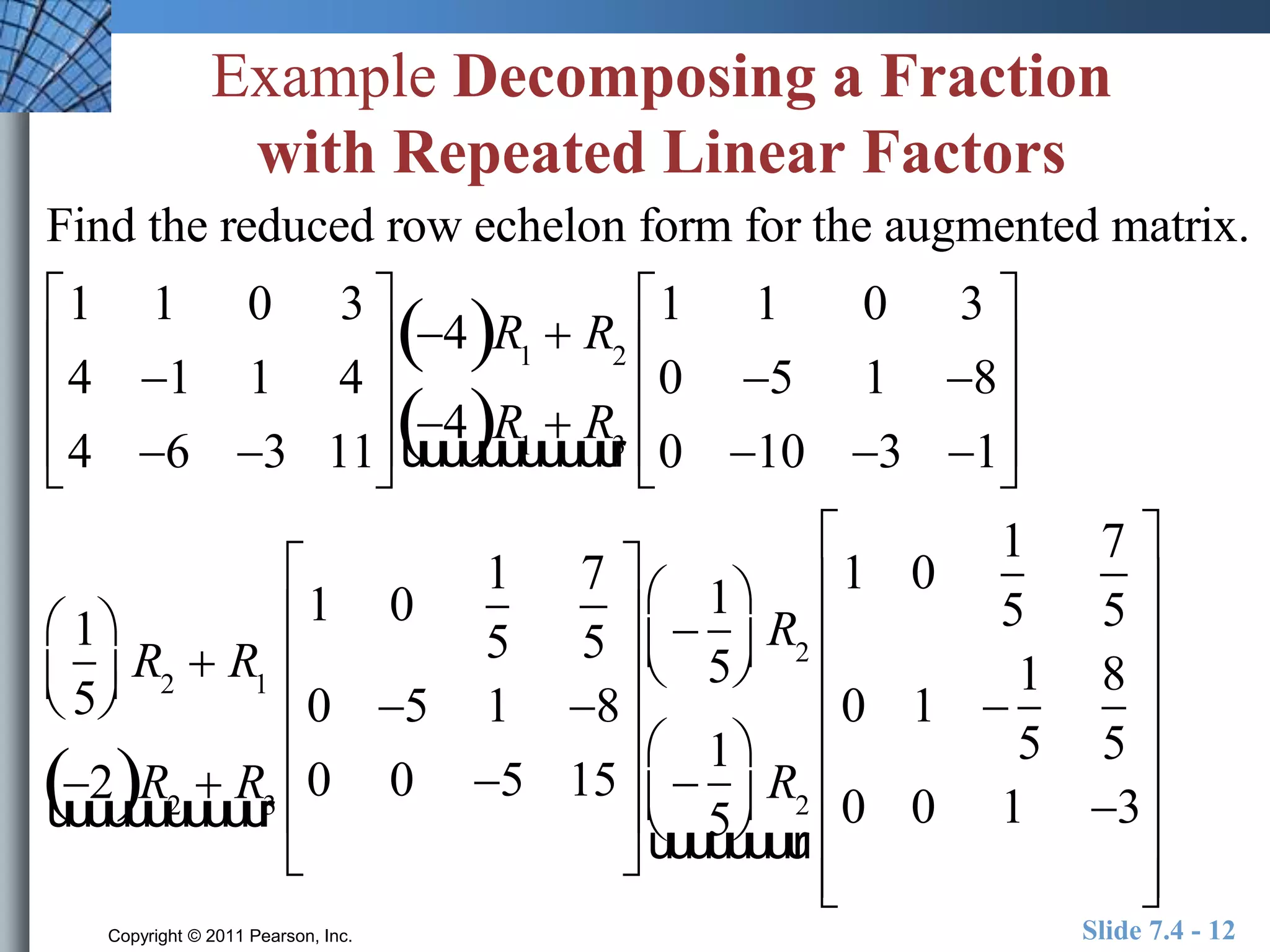
Example Decomposing a Fraction 
with Repeated Linear Factors 
Find the reduced row echelon form for the augmented matrix. 
1 1 0 3 
 
 
 
4 1 1 4 
 
 
 
4 6 3 11 
 
 
 
 
 
 
 
 
 
 
 
 
 
 
 
 
 
 
 
 
 
 
 
 
 
 
 
Copyright © 2011 Pearson, Inc. Slide 7.4 - 12 
 
 
 
 
 
 
 
4R1  R2 
4R1  Ruuuuuuuuuuur3 
1 1 0 3 
0 5 1 8 
0 10 3 1 
 
 
 
 
1 
5 
 
  
 
  
R2  R1 
2R2  Ruuuuuuuuuuur3 
1 0 
1 
5 
7 
5 
0 5 1 8 
0 0 5 15 
 
 
 
 
 
1 
5 
 
  
 
  
R2 
 
1 
5 
 
  
 
  
R2 
uuuuuuuur 
1 0 
1 
5 
7 
5 
0 1  
1 
5 
8 
5 
0 0 1 3 
 
 
 

Example Decomposing a Fraction 
with Repeated Linear Factors 
1 0 
1 
5 
7 
5 
0 1  
1 
5 
8 
5 
 
 
 
 
 
 
 
0 0 1 3 
 
 
 
 
 
 
Copyright © 2011 Pearson, Inc. Slide 7.4 - 13 
 
 
 
 
 
 
 
 
 
 
 
 
1 
5 
 
  
 
  
R3  R1 
1 
5 
 
  
 
 R3  R2 
uuuuuuuuuuuur 
1 0 0 2 
0 1 0 1 
0 0 1 3 
 
 
 
 
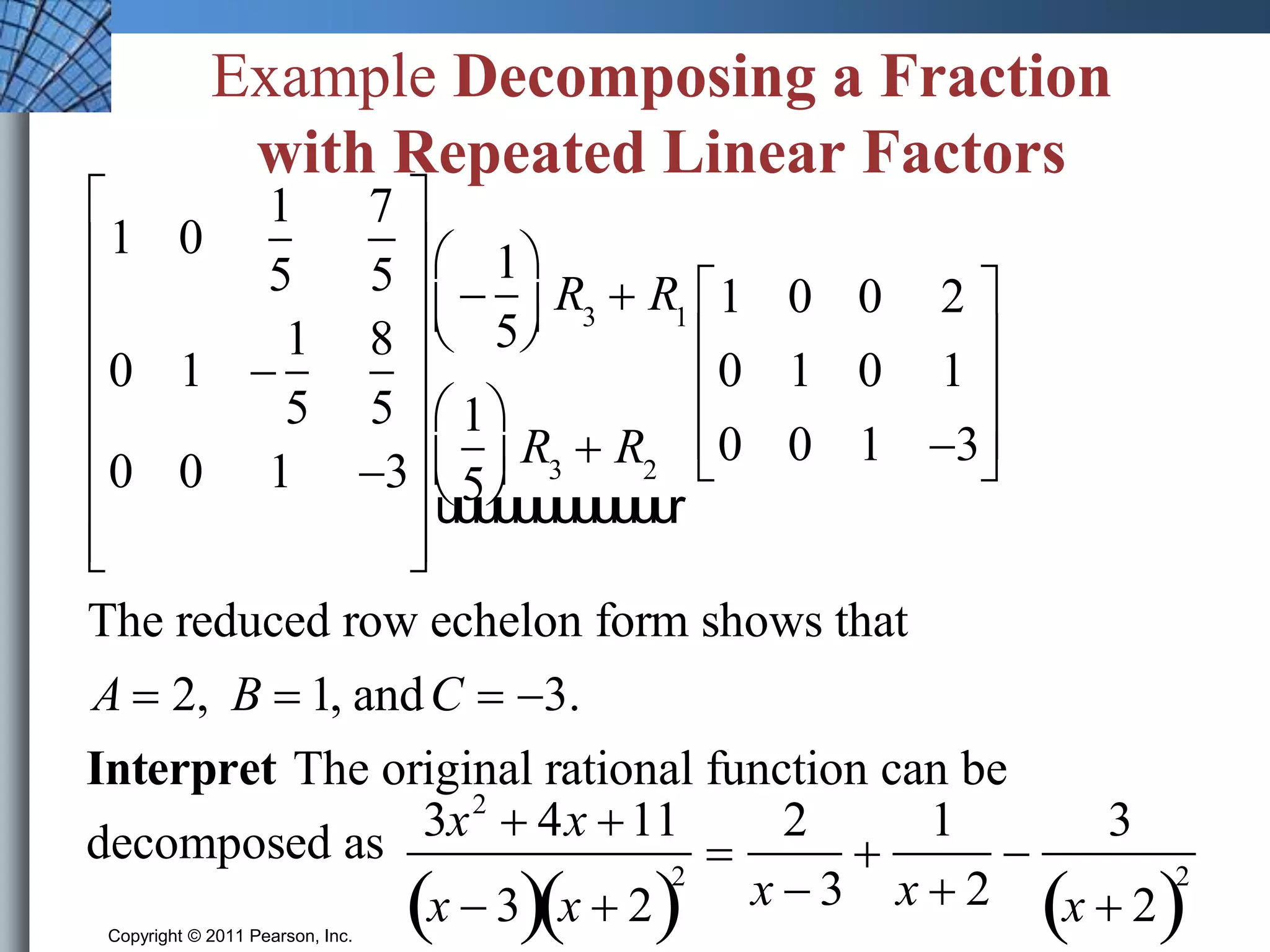
The reduced row echelon form shows that 
A  2, B  1, andC  3. 
Interpret The original rational function can be 
decomposed as 
3x2  4x 11 
x  3x  22 
 
2 
x  3 
 
1 
x  2 
 
3 
x  22
Example Decomposing a Fraction with 
an Irreducible Quadratic Factor 
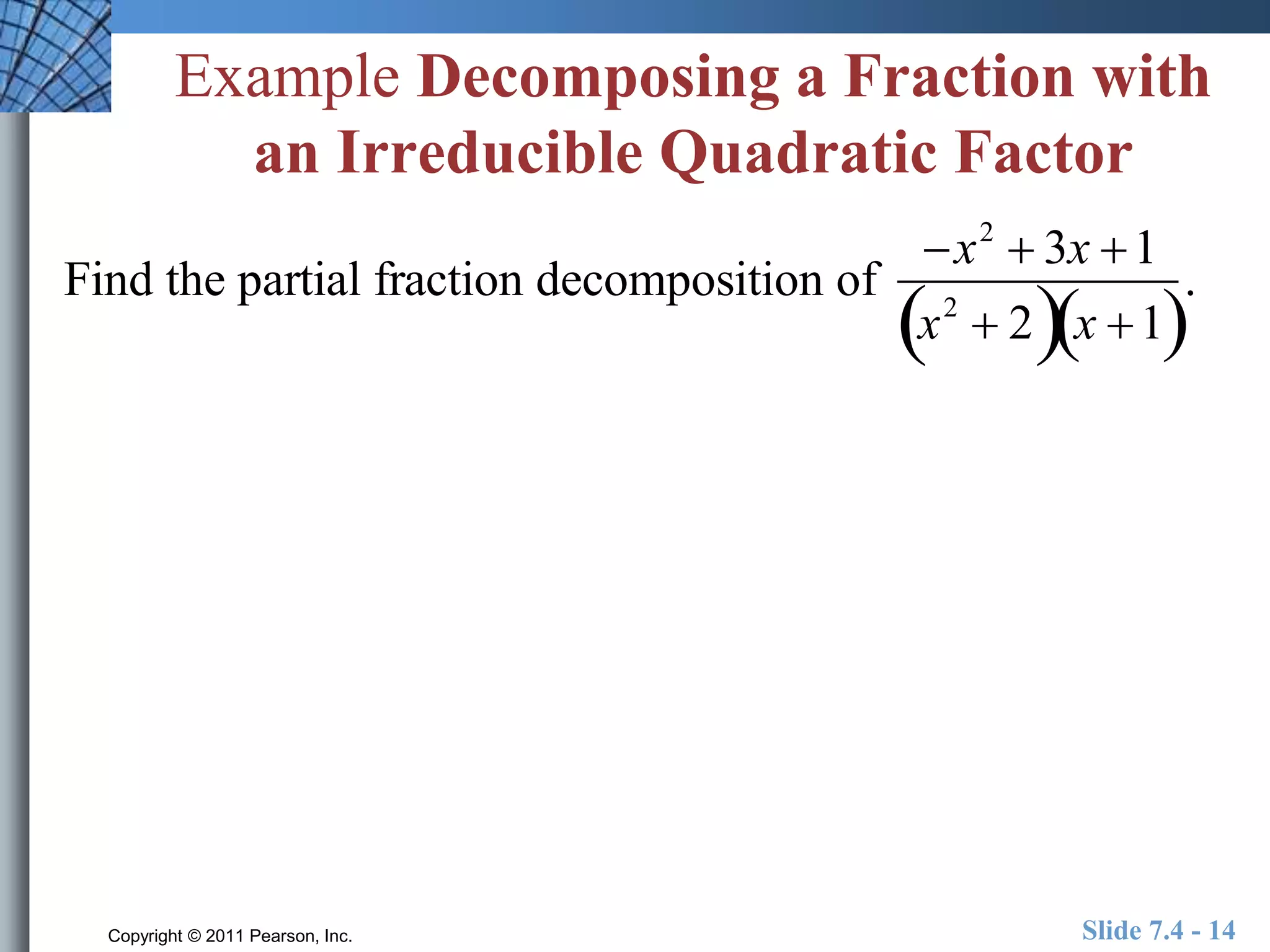
Find the partial fraction decomposition of 
x2  3x 1 
x2  2x 1 
. 
Copyright © 2011 Pearson, Inc. Slide 7.4 - 14
Example Decomposing a Fraction with 
an Irreducible Quadratic Factor 
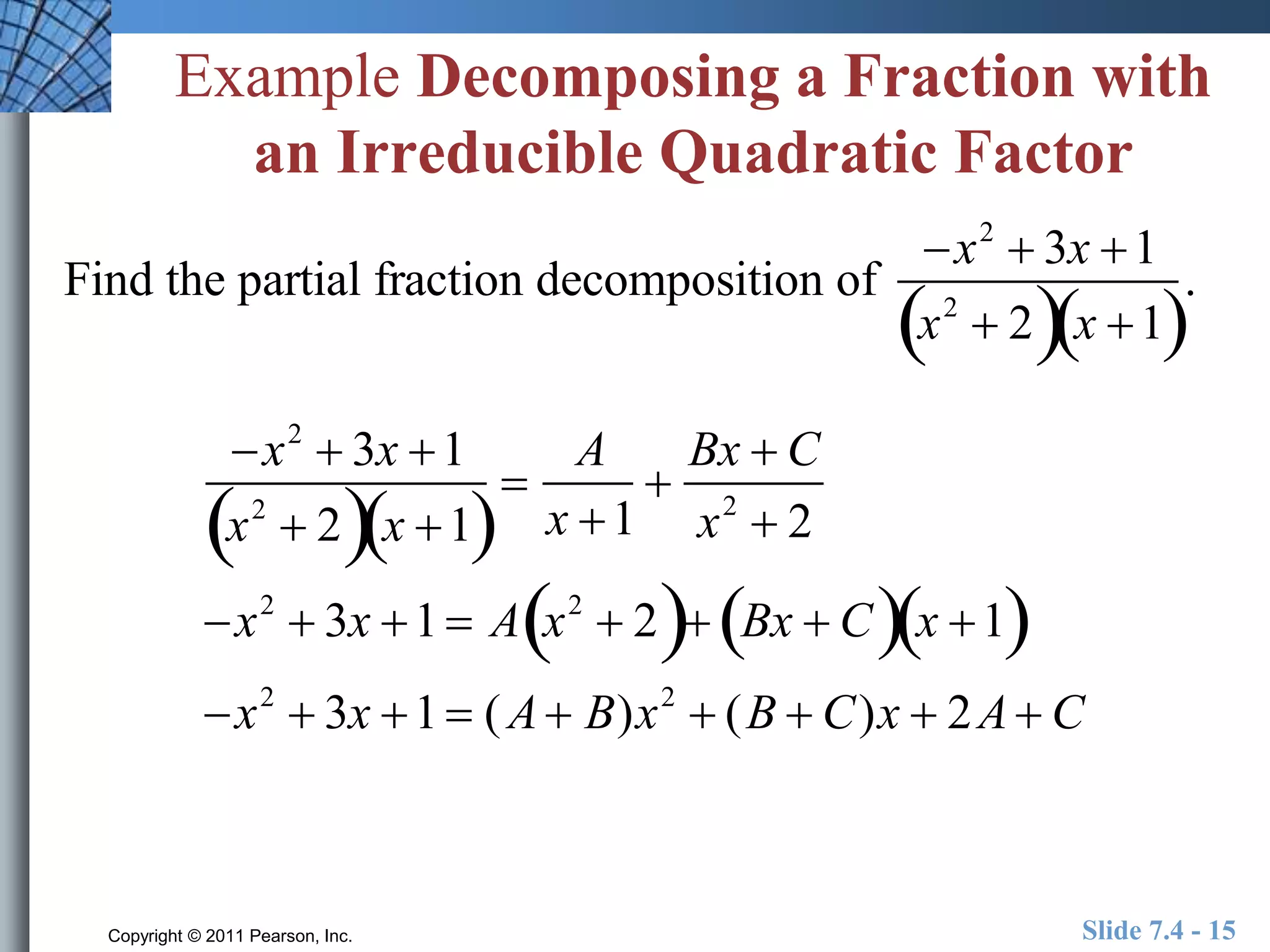
Find the partial fraction decomposition of 
x2  3x 1 
x2  2x 1 
 
A 
x 1 
 
Bx  C 
x2  2 
x2  3x 1 
x2   2x 1 
x2  3x 1  A x2   2 Bx  Cx 1 
x2  3x 1  (A B)x2  (B  C)x  2A C 
. 
Copyright © 2011 Pearson, Inc. Slide 7.4 - 15
Example Decomposing a Fraction with 
an Irreducible Quadratic Factor 
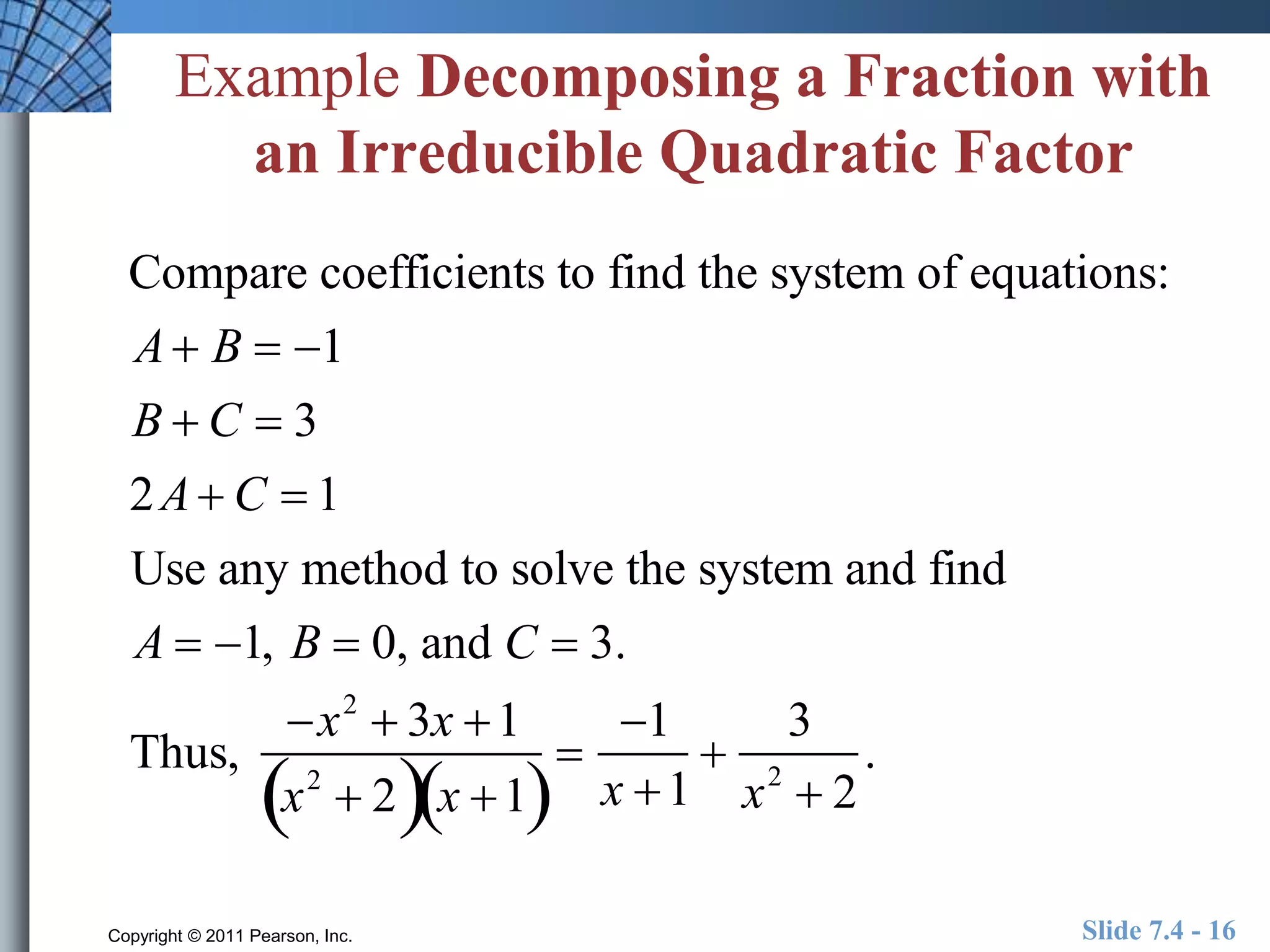
Compare coefficients to find the system of equations: 
A B  1 
B  C  3 
2A C  1 
Use any method to solve the system and find 
A  1, B  0, and C  3. 
Thus, 
x2  3x 1 
x2  2x 1 
 
1 
x 1 
 
3 
x2  2 
. 
Copyright © 2011 Pearson, Inc. Slide 7.4 - 16
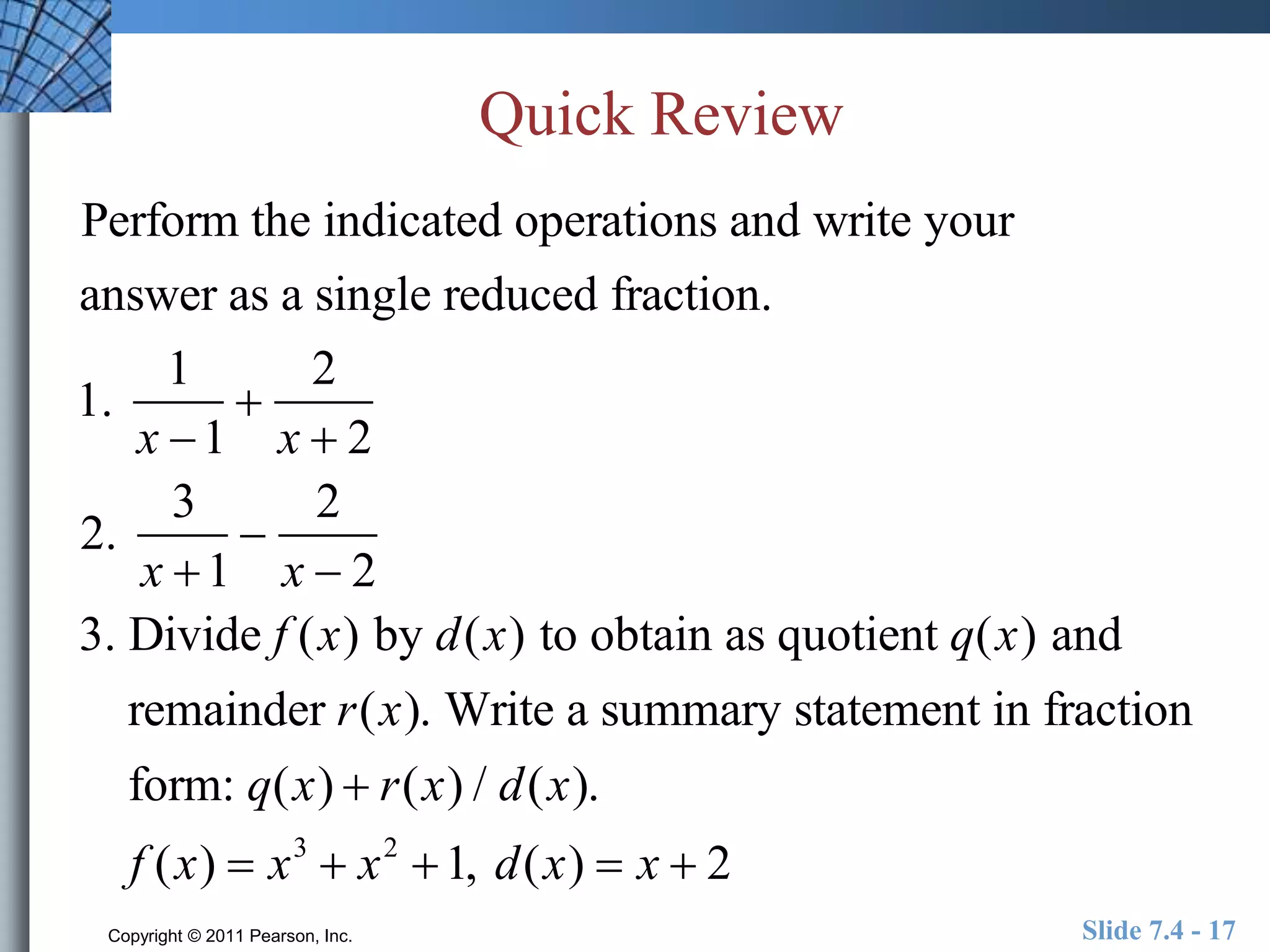
Quick Review 
Perform the indicated operations and write your 
answer as a single reduced fraction. 
1. 
1 
x 1 
 
2 
x  2 
2. 
3 
x 1 
 
2 
x  2 
3. Divide f (x) by d(x) to obtain as quotient q(x) and 
remainder r(x). Write a summary statement in fraction 
form: q(x)  r(x) / d(x). 
f (x)  x3  x2 1, d(x)  x  2 
Copyright © 2011 Pearson, Inc. Slide 7.4 - 17
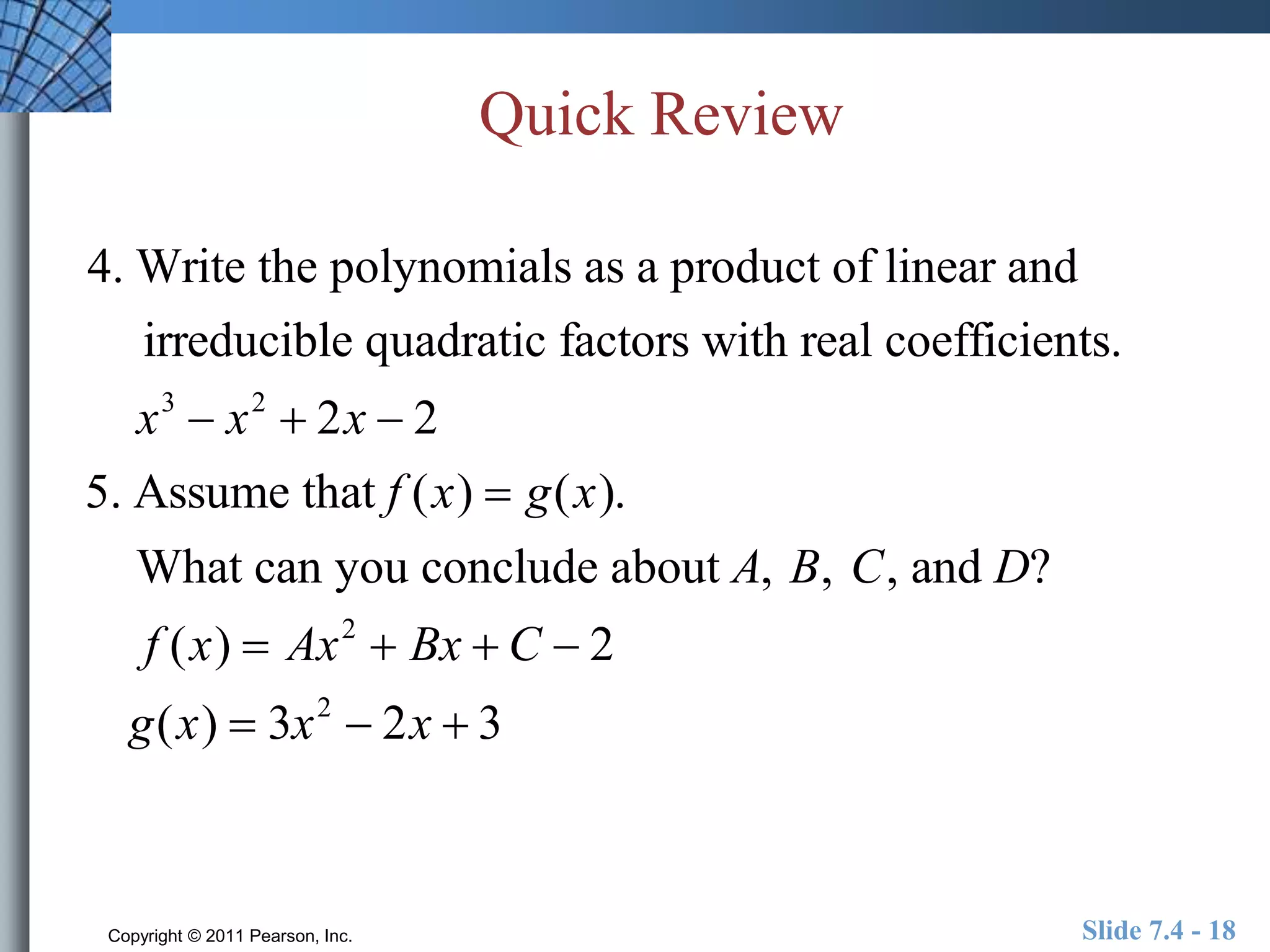
Quick Review 
4. Write the polynomials as a product of linear and 
irreducible quadratic factors with real coefficients. 
x3  x2  2x  2 
5. Assume that f (x)  g(x). 
What can you conclude about A, B, C, and D? 
f (x)  Ax2  Bx  C  2 
g(x)  3x2  2x  3 
Copyright © 2011 Pearson, Inc. Slide 7.4 - 18
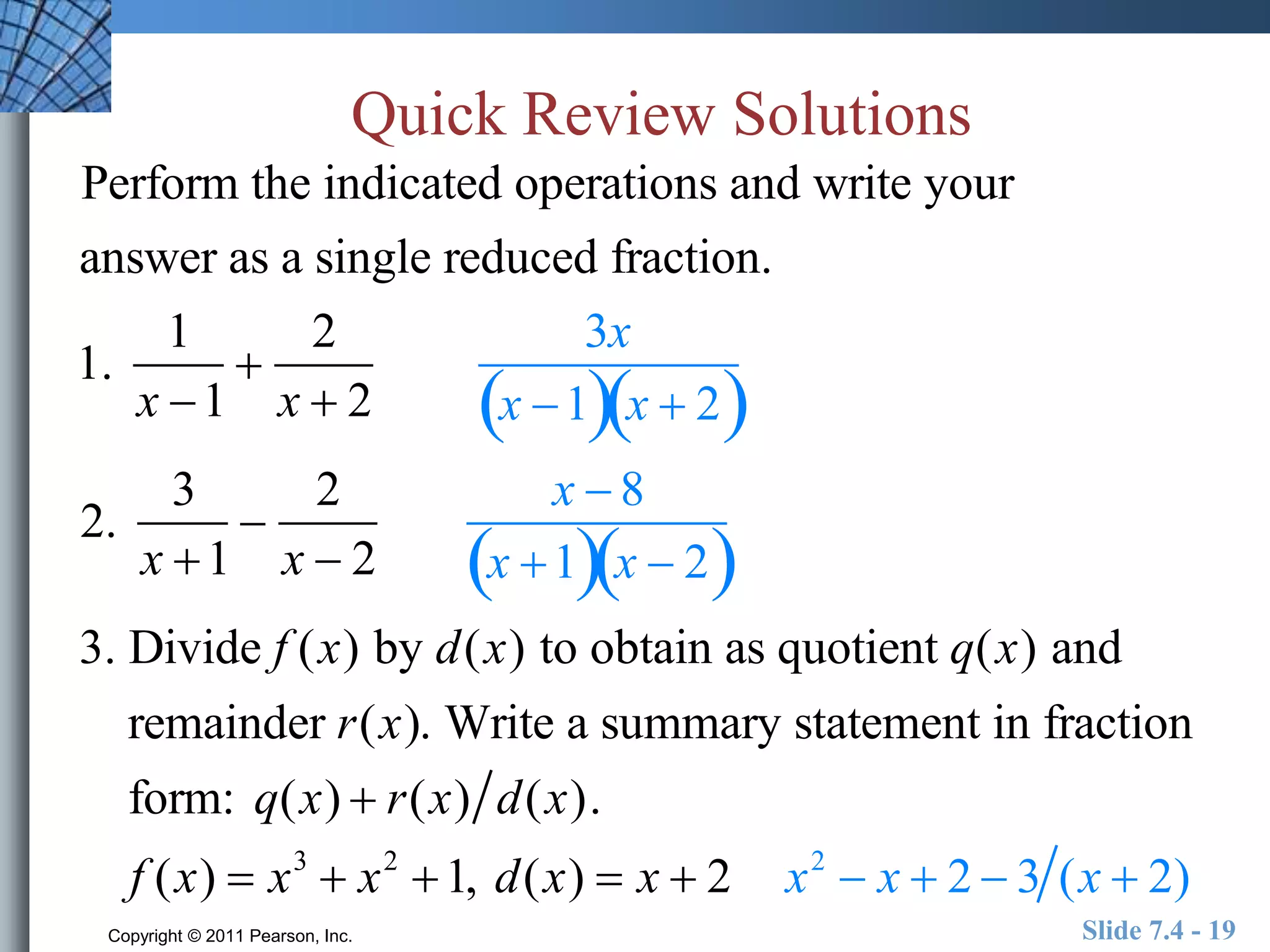
Quick Review Solutions 
Perform the indicated operations and write your 
answer as a single reduced fraction. 
1. 
1 
x 1 
 
2 
x  2 
3x 
x 1x  2 
2. 
3 
x 1 
 
2 
x  2 
x  8 
x 1x  2 
3. Divide f (x) by d(x) to obtain as quotient q(x) and 
remainder r(x). Write a summary statement in fraction 
form: q(x)  r(x) d(x). 
f (x)  x3  x2 1, d(x)  x  2 x2  x  2  3 (x  2) 
Copyright © 2011 Pearson, Inc. Slide 7.4 - 19
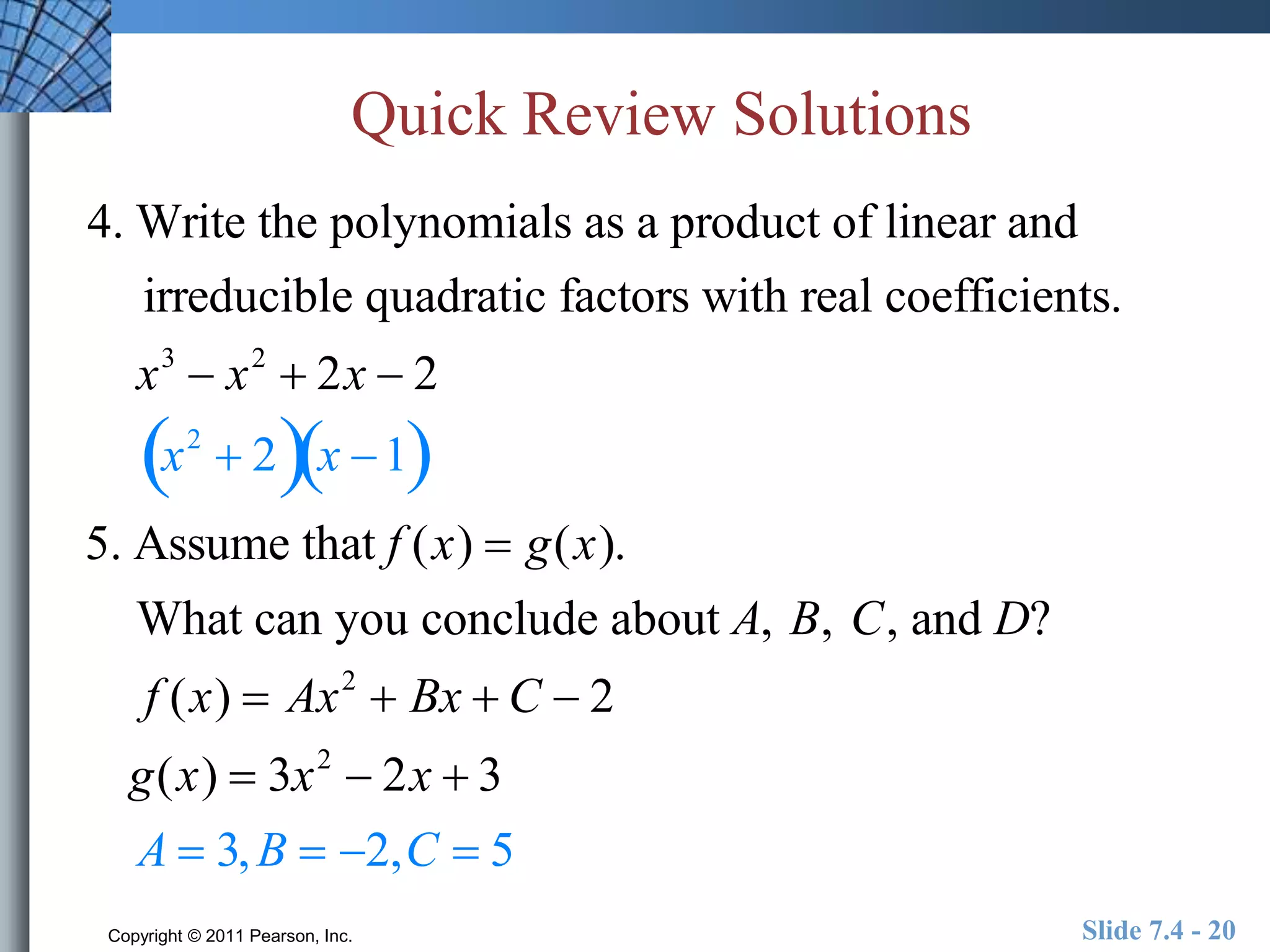
Quick Review Solutions 
4. Write the polynomials as a product of linear and 
irreducible quadratic factors with real coefficients. 
x3  x2  2x  2 
x2  2x 1 
5. Assume that f (x)  g(x). 
What can you conclude about A, B, C, and D? 
f (x)  Ax2  Bx  C  2 
g(x)  3x2  2x  3 
A  3,B  2,C  5 
Copyright © 2011 Pearson, Inc. Slide 7.4 - 20

Unit 7.4

  • 1.
    7.4 Partial Fractions Copyright © 2011 Pearson, Inc.
  • 2.
    What you’ll learnabout  Partial Fraction Decomposition  Denominators with Linear Factors  Denominators with Irreducible Quadratic Factors  Applications … and why Partial fraction decompositions are used in calculus in integration and can be used to guide the sketch of the graph of a rational function. Copyright © 2011 Pearson, Inc. Slide 7.4 - 2
  • 3.
    Partial Fraction Decompositionof f(x)/d(x) 1. Degree of f  degree of d: Use the division algorithm to divide f by d to obtain the quotient q and remainder r and write f (x) d(x)  q(x)  r(x) d(x) . 2. Factor d(x) into a product of factors of the form (mx  n)u or (ax2  bx  c)v , where ax2  bx  c is irreducible. Copyright © 2011 Pearson, Inc. Slide 7.4 - 3
  • 4.
    Partial Fraction Decompositionof f(x)/d(x) 3. For each factor (mx  n)u : The partial fraction decomposition of r(x) / d(x) must include the sum A1 mx  n  A2 mx  n2  ...  Au mx  nu , where A1, A2 ,..., Au are real numbers. Copyright © 2011 Pearson, Inc. Slide 7.4 - 4
  • 5.
    Partial Fraction Decompositionof f(x)/d(x) 4. For each factor (ax2  bx  c)v : The partial fraction decomposition of r(x) / d(x) must include the sum Bx  C11  ax2  bx  c B2x  C2 ax2  bx  c2  ...  Bvx  Cv ax2   bx  cv , where B1,B2 ,...,Bv and C1,C2 ,...,Cv are real numbers. The partial fraction decomposition of the original rational function is the sum of q(x) and the fractions in parts 3 and 4. Copyright © 2011 Pearson, Inc. Slide 7.4 - 5
  • 6.
    Example Decomposing aFraction with Distinct Linear Factors Find the partial fraction decomposition of 3x  3 x 1x  2 . Copyright © 2011 Pearson, Inc. Slide 7.4 - 6
  • 7.
    Example Decomposing aFraction with Distinct Linear Factors Find the partial fraction decomposition of 3x  3 x 1x  2  A1 x 1  A2 x  2 3x  3 x 1x  2 3x  3  A1(x  2)  A2 (x 1) multiply both sides by (x 1)(x  2) 3x  3  (A1  A2 )x  (2A1  A2 ) . Copyright © 2011 Pearson, Inc. Slide 7.4 - 7
  • 8.
    Example Decomposing aFraction with Distinct Linear Factors Find the partial fraction decomposition of 3x  3 x 1x  2 . Compare coefficients on the left and right side of the equation to find A1  A2  3 2A1  A2  3 Solve the system of equations to find A1  2 and A2  1. Thus 3x  3 x 1x  2  2 x 1  1 x  2 . Copyright © 2011 Pearson, Inc. Slide 7.4 - 8
  • 9.
    Example Decomposing aFraction with Repeated Linear Factors Use matrices to determine the values of A, B, and C so that 3x2  4x 11 A B    x  32 x  2x  3 x  2 C x  22 is true for all x, x  3, x  2. Copyright © 2011 Pearson, Inc. Slide 7.4 - 9
  • 10.
    Example Decomposing aFraction with Repeated Linear Factors Use matrices to determine the values of A, B, and C so that 3x2  4x 11 A B    x  32 x  2x  3 x  2 C x  22 is true for all x, x  3, x  2. Multiply both sides by x  3x  22 3x2  4x 11  Ax  22  Bx  3x  2 Cx  3 3x2  4x 11  A x2   4x  4 B x2   x  6 Cx  3 3x2  4x 11  A Bx2  4A B  Cx  4A 6B  3C Copyright © 2011 Pearson, Inc. Slide 7.4 - 10
  • 11.
    Example Decomposing aFraction with Repeated Linear Factors 3x2  4x 11  A Bx2  4A B  Cx  4A 6B  3C A B  3 4A  B  C  4 4A 6B  3C  11 The augmented matrix for this system is:  1 1 0 3   4  1 1 4  4 6 3 11       Copyright © 2011 Pearson, Inc. Slide 7.4 - 11
  • 12.
    Example Decomposing aFraction with Repeated Linear Factors Find the reduced row echelon form for the augmented matrix. 1 1 0 3    4 1 1 4    4 6 3 11                            Copyright © 2011 Pearson, Inc. Slide 7.4 - 12        4R1  R2 4R1  Ruuuuuuuuuuur3 1 1 0 3 0 5 1 8 0 10 3 1     1 5       R2  R1 2R2  Ruuuuuuuuuuur3 1 0 1 5 7 5 0 5 1 8 0 0 5 15      1 5       R2  1 5       R2 uuuuuuuur 1 0 1 5 7 5 0 1  1 5 8 5 0 0 1 3    
  • 13.
    Example Decomposing aFraction with Repeated Linear Factors 1 0 1 5 7 5 0 1  1 5 8 5        0 0 1 3       Copyright © 2011 Pearson, Inc. Slide 7.4 - 13             1 5       R3  R1 1 5      R3  R2 uuuuuuuuuuuur 1 0 0 2 0 1 0 1 0 0 1 3     The reduced row echelon form shows that A  2, B  1, andC  3. Interpret The original rational function can be decomposed as 3x2  4x 11 x  3x  22  2 x  3  1 x  2  3 x  22
  • 14.
    Example Decomposing aFraction with an Irreducible Quadratic Factor Find the partial fraction decomposition of x2  3x 1 x2  2x 1 . Copyright © 2011 Pearson, Inc. Slide 7.4 - 14
  • 15.
    Example Decomposing aFraction with an Irreducible Quadratic Factor Find the partial fraction decomposition of x2  3x 1 x2  2x 1  A x 1  Bx  C x2  2 x2  3x 1 x2   2x 1 x2  3x 1  A x2   2 Bx  Cx 1 x2  3x 1  (A B)x2  (B  C)x  2A C . Copyright © 2011 Pearson, Inc. Slide 7.4 - 15
  • 16.
    Example Decomposing aFraction with an Irreducible Quadratic Factor Compare coefficients to find the system of equations: A B  1 B  C  3 2A C  1 Use any method to solve the system and find A  1, B  0, and C  3. Thus, x2  3x 1 x2  2x 1  1 x 1  3 x2  2 . Copyright © 2011 Pearson, Inc. Slide 7.4 - 16
  • 17.
    Quick Review Performthe indicated operations and write your answer as a single reduced fraction. 1. 1 x 1  2 x  2 2. 3 x 1  2 x  2 3. Divide f (x) by d(x) to obtain as quotient q(x) and remainder r(x). Write a summary statement in fraction form: q(x)  r(x) / d(x). f (x)  x3  x2 1, d(x)  x  2 Copyright © 2011 Pearson, Inc. Slide 7.4 - 17
  • 18.
    Quick Review 4.Write the polynomials as a product of linear and irreducible quadratic factors with real coefficients. x3  x2  2x  2 5. Assume that f (x)  g(x). What can you conclude about A, B, C, and D? f (x)  Ax2  Bx  C  2 g(x)  3x2  2x  3 Copyright © 2011 Pearson, Inc. Slide 7.4 - 18
  • 19.
    Quick Review Solutions Perform the indicated operations and write your answer as a single reduced fraction. 1. 1 x 1  2 x  2 3x x 1x  2 2. 3 x 1  2 x  2 x  8 x 1x  2 3. Divide f (x) by d(x) to obtain as quotient q(x) and remainder r(x). Write a summary statement in fraction form: q(x)  r(x) d(x). f (x)  x3  x2 1, d(x)  x  2 x2  x  2  3 (x  2) Copyright © 2011 Pearson, Inc. Slide 7.4 - 19
  • 20.
    Quick Review Solutions 4. Write the polynomials as a product of linear and irreducible quadratic factors with real coefficients. x3  x2  2x  2 x2  2x 1 5. Assume that f (x)  g(x). What can you conclude about A, B, C, and D? f (x)  Ax2  Bx  C  2 g(x)  3x2  2x  3 A  3,B  2,C  5 Copyright © 2011 Pearson, Inc. Slide 7.4 - 20