BUSINESS
MATHEMATICS


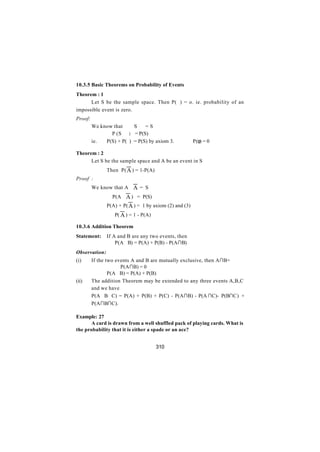
Higher Secondary - First Year


    Untouchability is a sin
    Untouchability is a crime
    Untouchability is inhuman


      Tamilnadu
      Textbook Corporation
      College Road, Chennai - 600 006.
© Government of Tamilnadu
  First Edition - 2004
                                    Chairperson
                 Thiru. V. THIRUGNANASAMBANDAM,
                          Retired Lecturer in Mathematics
                             Govt. Arts College (Men)
                          Nandanam, Chennai - 600 035.

                                     Reviewers
      Thiru. N. RAMESH,                              Dr. M.R. SRINIVASAN,
      Selection Grade Lecturer                           Reader in Statistics
    Department of Mathematics                          Department of Statistics
     Govt. Arts College (Men)                           University of Madras,
   Nandanam, Chennai - 600 035.                          Chennai - 600 005.

                         Thiru. S. GUNASEKARAN,
                                   Headmaster,
                            Govt. Girls Hr. Sec. School,
                           Tiruchengode, Namakkal Dist.

                                      Authors
Thiru. S. RAMACHANDRAN,                           Thiru. S. RAMAN,
      Post Graduate Teacher                       Post Graduate Teacher
 The Chintadripet Hr. Sec. School,       Jaigopal Garodia National Hr. Sec. School
 Chintadripet, Chennai - 600 002.          East Tambaram, Chennai - 600 059.

Thiru. S.T. PADMANABHAN,                        Tmt. K. MEENAKSHI,
       Post Graduate Teacher                      Post Graduate Teacher
    The Hindu Hr. Sec. School,           Ramakrishna Mission Hr. Sec. School (Main)
   Triplicane, Chennai - 600 005.             T. Nagar, Chennai - 600 017.

                             Thiru. V. PRAKASH,
                     Lecturer (S.S.), Department of Statistics,
                                Presidency College,
                                Chennai - 600 005.

Price : Rs.
  This book has been prepared by the Directorate of School Education
              on behalf of the Government of Tamilnadu
This book has been printed on 60 GSM paper

Laser typeset by : JOY GRAPHICS, Chennai - 600 002.

Printed by :
Preface
      This book on Business Mathematics has been written in
conformity with the revised syllabus for the first year of the Higher
Secondary classes.

      The aim of this text book is to provide the students with the
basic knowledge in the subject. We have given in the book the
Definitions, Theorems and Observations, followed by typical problems
and the step by step solution. The society’s increasing business
orientation and the students’ preparedness to meet the future needs
have been taken care of in this book on Business Mathematics.

       This book aims at an exhaustive coverage of the curriculum and
there is definitely an attempt to kindle the students creative ability.

       While preparing for the examination students should not restrict
themselves only to the questions / problems given in the self evaluation.
They must be prepared to answer the questions and problems from the
entire text.

     We welcome suggestions from students, teachers and
academicians so that this book may further be improved upon.

       We thank everyone who has lent a helping hand in the preparation
of this book.

                                                     Chairperson
                                               The Text Book Committee


                                   iii
SYLLABUS
1)   Matrices and Determinants                                 (15 periods)
     Order - Types of matrices - Addition and subtraction of matrices and
     Multiplication of a matrix by a scalar - Product of matrices.
     Evaluation of determinants of order two and three - Properties of
     determinants (Statements only) - Singular and non singular matrices -
     Product of two determinants.

2)   Algebra                                                     (20 periods)
     Partial fractions - Linear non repeated and repeated factors - Quadratic
     non repeated types. Permutations - Applications - Permutation of
     repeated objects - Circular permutaion. Combinations - Applications -
     Mathematical induction - Summation of series using Σn, Σn 2 and Σn 3.
     Binomial theorem for a positive integral index - Binomial coefficients.

3)   Sequences and series                                     (20 periods)
     Harnomic progression - Means of two positive real numbers - Relation
     between A.M., G.M., and H.M. - Sequences in general - Specifying a
     sequence by a rule and by a recursive relation - Compound interest -
     Nominal rate and effective rate - Annuities - immediate and due.

4)   Analytical Geometry                                         (30 periods)
     Locus - Straight lines - Normal form, symmetric form - Length of
     perpendicular from a point to a line - Equation of the bisectors of the
     angle between two lines - Perpendicular and parallel lines - Concurrent
     lines - Circle - Centre radius form - Diameter form - General form -
     Length of tangent from a point to a circle - Equation of tangent - Chord
     of contact of tangents.

5)   Trigonometry                                          (25 periods)
     Standard trigonometric identities - Signs of trigonometric ratios -
     compound angles - Addition formulae - Multiple and submultiple
     angles - Product formulae - Principal solutions - Trigonometric
     equations of the form sin θ = sinα, cosθ = cosα and tanθ = tan α -
     Inverse trigonometric functions.

6)   Functions and their Graphs                               (15 Periods)
     Functions of a real value - Constants and variables - Neighbourhood
     - Representation of functions - Tabular and graphical form - Vertical

                                     iv
line test for functions - Linear functions - Determination of slopes -
     Power function - 2x and ex - Circular functions - Graphs of sinx, ,cosx
     and tanx - Arithmetics of functions (sum, difference, product and
     quotient) Absolute value function, signum function - Step function -
     Inverse of a function - Even and odd functions - Composition of
     functions

7)   Differential calculus                                             (30 periods)
     Limit of a function - Standard forms

      Lt  xn − a n ,     Lt (1+     1 )x ,    Lt  e x −1          Lt           +
                                                                          log(1 x)
                                                              ,                    ,
     x →a  x-a          x →0        x        x →0    x            x →0       x

      Lt    sin θ (statement only)
     x →0     θ
     Continuity of functions - Graphical interpretation - Differentiation -
     Geometrical interpretation - Differtentiation using first principles - Rules
     of differentiation - Chain rule - Logarithmic Differentitation -
     Differentiation of implicit functions - parametric functions - Second
     order derivatives.

8)   Integral calculus                                         (25 periods)
     Integration - Methods of integration - Substitution - Standard forms -
     integration by parts - Definite integral - Integral as the limit of an
     infinite sum (statement only).

9)   Stocks, Shares and Debentures                         (15 periods)
     Basic concepts - Distinction between shares and debentures -
     Mathematical aspects of purchase and sale of shares - Debentures
     with nominal rate.

10) Statistics                                                (15 Periods)
    Measures of central tendency for a continuous frequency distribution
    Mean, Median, Mode Geometric Mean and Harmonic Mean - Measures
    of dispersion for a continuous frequency distribution - Range -
    Standard deviation - Coefficient of variation - Probability - Basic
    concepts - Axiomatic approach - Classical definition - Basic theorems
    - Addition theorem (statement only) - Conditional probability -
    Multiplication theorem (statement only) - Baye’s theorem (statement
    only) - Simple problems.


                                       v
Contents
                                      Page
1.    MATRICES AND DETERMINANTS         1


2.    ALGEBRA                         25


3.    SEQUENCES AND SERIES            54


4.    ANALYTICAL GEOMETRY             89


5.    TRIGONOMETRY                    111


6.    FUNCTIONS AND THEIR GRAPHS      154


7.    DIFFERENTIAL CALCULUS           187


8.    INTEGRAL CALCULUS               229


9.    STOCKS, SHARES AND DEBENTURES   257


10.   STATISTICS                      280


                          vi
MATRICES
                  AND DETERMINANTS                                        1
                          1.1 MATRIX ALGEBRA
       Sir ARTHUR CAYLEY (1821-1895) of England was the first
Mathematician to introduce the term MATRIX in the year 1858. But in the
present day applied Mathematics in overwhelmingly large majority of cases
it is used, as a notation to represent a large number of simultaneous
equations in a compact and convenient manner.
       Matrix Theory has its applications in Operations Research, Economics
and Psychology. Apart from the above, matrices are now indispensible in
all branches of Engineering, Physical and Social Sciences, Business
Management, Statistics and Modern Control systems.

1.1.1 Definition of a Matrix
      A rectangular array of numbers or functions represented by the
symbol

        a 11     a 12     ....a 1n 
                                   
        a 21     a 22    ....a 2n 
        .         .           . 
                                    is called a MATRIX
        .         .           . 
                                   
        .         .           . 
       a                 ....a mn 
        m1       a m2              

       The numbers or functions a ij of this array are called elements, may be
real or complex numbers, where as m and n are positive integers, which
denotes the number of Rows and number of Columns.

For example
             1        2           x2   sinx 
       A=
          2              and B =            
                                            1  are the matrices
                      4 
                                   x
                                           x 


                                          1
1.1.2 Order of a Matrix
       A matrix A with m rows and n columns is said to be of the order m by
n (m x n).
Symbolically
      A = (aij )m x n is a matrix of order m x n. The first subscript i in (aij )
ranging from 1 to m identifies the rows and the second subscript j in (a ij )
ranging from 1 to n identifies the columns.

For example
            1    2        3
       A=
                            is a Matrix of order 2 x 3 and
            4    5        6
                            

            1        2 
       B=
                        is a Matrix of order 2 x 2
            2        4 
                        

          sinθ cosθ 
       C=
          cosθ sinθ  is a Matrix of order 2 x 2
                     
                    
            0        22      30 
                                 
       D = − 4        5     − 67  is a Matrix of order 3 x 3
            78       −8      93 
                                 


1.1.3 Types of Matrices
(i)    SQUARE MATRIX
       When the number of rows is equal to the number of columns, the
matrix is called a Square Matrix.

For example
         5           7
       A=
         6             is a Square Matrix of order 2
                     3
                       
           3     1     5
                         
       B = 4     1     6  is a Square Matrix of order 3
           2           9
                 4       

          sinα    sinβ   sinδ 
                               
       C=  cosα   cosβ   cosδ  is a Square Matrix of order 3
          cosecα cosecβ cosecδ 
                               

                                            2
(ii)    ROW MATRIX
        A matrix having only one row is called Row Matrix
For example
       A    = (2 0 1) is a row matrix of order 1 x 3
       B    = (1 0) is a row matrix or order 1 x 2

(iii)  COLUMN MATRIX
       A matrix having only one column is called Column Matrix.
For example
               2 
                 
        A =  0  is a column matrix of order 3 x 1 and
               1 
                 

            1 
        B =   is a column matrix of order 2 x 1
             0
             

(iv)  ZERO OR NULL MATRIX
      A matrix in which all elements are equal to zero is called Zero or Null
Matrix and is denoted by O.
For example
          0          0
        O=
          0            is a Null Matrix of order 2 x 2 and
                     0
                       
          0 0 0 
        O=
           0 0 0  is a Null Matrix of order 2 x 3
                  
                 

(v)   DIAGONAL MATRIX
      A square Matrix in which all the elements other than main diagonal
elements are zero is called a diagonal matrix
For example
          5          0
        A=
          0            is a Diagonal Matrix of order 2 and
                     9
                       
            1   0     0
                        
        B = 0   2     0  is a Diagonal Matrix of order 3
            0         3
                0       


                                          3
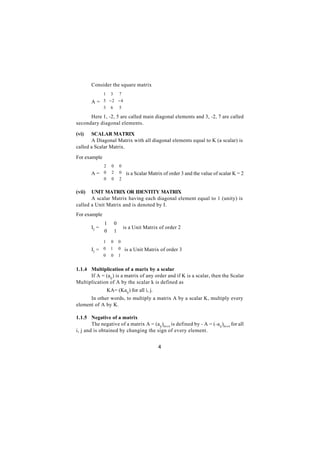
Consider the square matrix
            1 3 7 
                      
        A =  5 − 2 − 4
            3 6 5 
                      
      Here 1, -2, 5 are called main diagonal elements and 3, -2, 7 are called
secondary diagonal elements.

(vi)   SCALAR MATRIX
       A Diagonal Matrix with all diagonal elements equal to K (a scalar) is
called a Scalar Matrix.

For example
            2      0     0
                           
        A = 0      2     0  is a Scalar Matrix of order 3 and the value of scalar K = 2
            0            2
                   0       

(vii)  UNIT MATRIX OR IDENTITY MATRIX
       A scalar Matrix having each diagonal element equal to 1 (unity) is
called a Unit Matrix and is denoted by I.
For example
             1         0
        I2 = 
             0           is a Unit Matrix of order 2
                       1
                         
             1     0    0
                          
        I3 =  0 1       0  is a Unit Matrix of order 3
             0          1
                   0      

1.1.4 Multiplication of a marix by a scalar
      If A = (aij ) is a matrix of any order and if K is a scalar, then the Scalar
Multiplication of A by the scalar k is defined as
                  KA= (Kaij ) for all i, j.
      In other words, to multiply a matrix A by a scalar K, multiply every
element of A by K.

1.1.5 Negative of a matrix
        The negative of a matrix A = (aij )m x n is defined by - A = (-a ij )m x n for all
i, j and is obtained by changing the sign of every element.


                                              4
For example
              2 − 5 7
      If A = 
              0 5 6  then
                      
                     
         −2 5 −7
      -A=
          0 −5 −6
                  
                 

1.1.6 Equality of matrices
      Two matrices are said to equal when
      i) they have the same order and
      ii) the corresponding elements are equal.

1.1.7 Addition of matrices
         Addition of matrices is possible only when they are of same order
(i.e., conformal for addition). When two matrices A and B are of same order,
then their sum (A+B) is obtained by adding the corresponding elements in
both the matrices.

1.1.8 Properties of matrix addition
      Let A, B, C be matrices of the same order. The addition of matrices
obeys the following
      (i)     Commutative law : A + B       = B+A
      (ii)    Associative law : A + (B + C) = (A + B) + C
      (iii)   Distributive law : K(A+B) = KA+KB, where k is scalar.

1.1.9 Subtraction of matrices
        Subtraction of matrices is also possible only when they are of same
order. Let A and B be the two matrices of the same order. The matrix A - B
is obtained by subtracting the elements of B from the corresponding elements
of A.

1.1.10 Multiplication of matrices
       Multiplication of two matrices is possible only when the number of
columns of the first matrix is equal to the number of rows of the second
matrix (i.e. conformable for multiplication)
      Let A = (aij ) be an m x p matrix,
and   let B = (bij ) be an p x n matrix.


                                      5
Then the product AB is a matrix C = (cij ) of order mxn,
      where cij = element in the ith row and jth column of C is found by
multiplying corresponding elements of the ith row of A and jth column of B
and then adding the results.

For example

             3 5 
                                5 − 7
      if A =  2 − 1       B=   
                                 − 2 4 
                                        
             6 7                     2 x 2
                    3 x 2

                3        5 
                                   5 −7
      then AB =  2      − 1       
                                    − 2 4 
                                           
                6
                         7 
                                         

                 3 x 5 + 5x(-2)         3x(-7) + 5x(5)   5        −1 
                                                                       
              =  2 x 5 + (-1) x (-2) 2 x (-7) + (-1) x (4)  =  12 − 18 
                 6 x 5 + 7x (-2)       6x (-7) + 7x (4)   16 − 14 
                                                                       


1.1.11 Properties of matrix multiplication
      (i)     Matrix Multiplication is not commutative i.e. for the two
              matrices A and B, generally AB ≠ BA.

      (ii)    The Multiplication of Matrices is associative
              i.e., (AB) C = A(BC)
      (iii)   Matrix Multiplication is distributive with respect to addition.
              i.e. if, A, B, C are matrices of order mxn, n x k, and n x k
              respectively, then A(B+C) = AB + AC

      (iv)    Let A be a square matrix of order n and I is the unit matrix of
              same order.
              Then        AI = A = I A
      (v)     The product
              AB = O (Null matrix), does not imply that either A = 0 or B = 0
              or both are zero.


                                        6
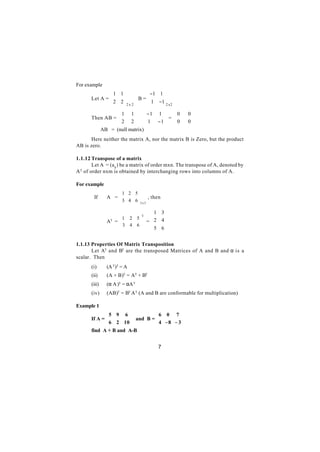
For example
               1 1          −1 1 
       Let A = 
               2 2 
                          B=
                              1 −1
                   2 x 2         2 x 2

                  1 1   −1             1  0     0   
       Then AB = 
                 2 2  1
                                            =        
                                       − 1  0
                                                   0   
                                                         
       ⇒ AB = (null matrix)
       Here neither the matrix A, nor the matrix B is Zero, but the product
AB is zero.

1.1.12 Transpose of a matrix
        Let A = (a ij ) be a matrix of order mxn. The transpose of A, denoted by
A T of order nxm is obtained by interchanging rows into columns of A.

For example
                      1 2 5
        If     A =
                   3 4 6
                               , then
                        2 x 3

                                      1 3
                    1      2
                                 T
                                5       
               AT = 
                    3            = 2
                                 
                                         4
                           4   6   5  6
                                         

1.1.13 Properties Of Matrix Transposition
       Let AT and BT are the transposed Matrices of A and B and α is a
scalar. Then
       (i)     (A T)T = A
       (ii)    (A + B)T = AT + BT
       (iii)   (α A )T = αA T
       (iv)    (AB)T = BT A T (A and B are conformable for multiplication)

Example 1
              5 9 6            6 0 7 
              
       If A =          and B = 
                                           
               6 2 10 
                       
                                            
                                  4 − 8 − 3
       find A + B and A-B


                                          7
Solution :

             5 +6 9 +0        6 + 7  11 9 13
      A+B = 
             6 + 4 2 + (−8) 10+ (−3) = 10 − 6 7 
                                                 
                                                
                  5 −6   9− 0       6− 7        −1 9 −1
      A-B = 
                                              =
                                                  2 10 13 
                                                           
                  6 − 4 2 − (−8 ) 10 − ( −3) 
                                                         

Example 2
             3                 6
      If A = 
             9                   find (i) 3A (ii) - 1
                                2
                                                                          A
                                                    3

Solution :
                 3                 6   9 18 
      (i) 3A = 3 
                 9                   =
                                         27 6 
                                   2
                                       
                                               
                                               

                                         3          6      −1 − 2 
      (ii) - 1    A =- 1                 
                                         9               =
                                                           − 3 - 2 
                                                                     
             3                      3               2           3 


Example 3
                 2         3       5          3 1 2
                                                     
      If A =  4            7       9  and B =  4 2 5 
                 1                 4          6 − 2 7
                           6                         
      show that 5(A+B) = 5A + 5B

Solution :
                   5           4  7              25 20 35 
                                                          
      A+B        = 8           9 14  ∴ 5(A+B) =  40 45 70 
                   7           4 11              35 20 55 
                                                          

                       10 15 25                               15   5   10
                                                                         
      5A         =  20 35 45  and 5B =  20 10 25
                       5       30 20                          30 −10 35
                                                                       

                             25        20    35 
                                                
      ∴ 5A+5B =  40 45 70  ∴ 5(A+B) = 5A + 5B
                             35              55 
                                       20       


                                                           8
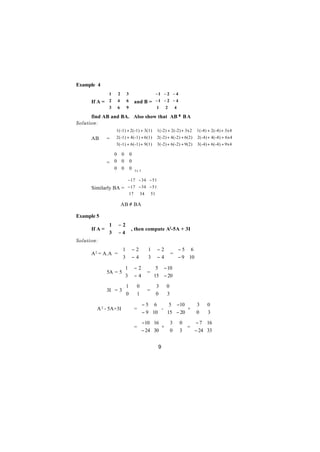
Example 4
             1     2       3           − 1 − 2 − 4
                                                  
      If A =  2    4       6  and B =  − 1 − 2 − 4
             3             9          1         4
                   6                        2     
      find AB and BA. Also show that AB ≠ B A
Solution:
                1(-1) + 2(-1) + 3(1)        1(-2) + 2(-2) + 3x2     1(-4) + 2(-4) + 3x4 
                                                                                        
      AB     =  2(-1) + 4(-1) + 6(1)        2(-2) + 4(-2) + 6(2)    2(-4) + 4(-4) + 6x4 
                3(-1) + 6(-1) + 9(1)        3(-2) + 6(-2) + 9(2)    3(-4) + 6(-4) + 9x4 
                                                                                        

               0       0    0
                             
             = 0       0    0
               0            0 3x 3
                       0     

                      − 17 − 34 − 51
                                    
      Similarly BA =  − 17 − 34 − 51
                      17 34 51 
                                    

                   ∴ AB ≠ BA

Example 5
             1     − 2
      If A = 
             3         , then compute A2-5A + 3I
                   −4
Solution:
                  1          −2       1   − 2  − 5 6 
      A 2 = A.A = 
                  3                            =       
                             −4
                                
                                        3
                                            − 4   − 9 10 
                                                          
                    1         − 2   5 − 10 
             5A = 5 
                    3              =       
                              − 4  15 − 20 
                                            
                    1           0       3      0
             3I = 3 
                    0                  =
                                         0       
                                1              3
                                                   
                                 − 5 6          5 −10           3    0
      ∴ A 2 - 5A+3I            = 
                                  − 9 10  -
                                                
                                                 15 − 20  +
                                                                   
                                                                    0     
                                                                     3
                                                                           
                                 −10 16         3     0   − 7 16 
                               =
                                 − 24 30  +
                                                 
                                                  0       =         
                                                      3   − 24 33 
                                                                     

                                             9
Example 6
     Verify that (AB)T = BT A T when
                                        2          − 3
         1 − 4 2                     
      A=
         4 0 1       and B =  0   1 
                2 x 3         − 4 − 2
                                       3 x 2
Solution :
                                 2    −3
                1 − 4 2  0      
      AB     = 
                4 0 1 
                         
                                 1 
                         − 4 −2

               1x2 + (-4)x0 + 2(-4) 1x(-3) + (-4)x1 + 2x(-2) 
             = 
                4x2 + 0x0 + 1x(-4)                           
                                     4x(-3) + 0x1 + 1x(-2)  
               2+ 0- 8 - 3- 4 - 4         - 6 - 11 
             =
              8 + 0 - 4 -12 + 0 - 2  =
                                          
                                            4 - 14  
                                                   

                                 −6   − 11    −6 4 
                                                T
      ∴ L.H.S. = (AB)T = 
                          4                 =
                                               −11 −14
                                                        
                                      − 14           
                                                     1     4 
                              2 0 − 4                      
      R.H.S. = BT A T       =
                             −3 1 − 2
                                                    − 4   0 
                                                   2
                                                           1 
                                                              
                               −6 4 
                            = 
                               −11 −14
                                       
                                      
      ⇒ L.H.S. = R.H.S

Example 7
       A radio manufacturing company produces three models of radios
say A, B and C. There is an export order of 500 for model A, 1000 for model
B, and 200 for model C. The material and labour (in appropriate units)
needed to produce each model is given by the following table:
                 Material   Labour
       Model A     10      20 
                              
       Model B    8         5
                   12       9
       Model C                
Use marix multiplication to compute the total amount of material and labour
needed to fill the entire export order.


                                           10
Solution:
       Let P denote the matrix expressing material and labour corresponding
to the models A, B, C. Then
           Material   Labour
          10         20  Model A
                        
      P= 8           05  Model B
          12          9  Model C
                        
       Let E denote matrix expressing the number of units ordered for export
in respect of models A, B, C. Then
            A    B C
      E = (500 1000 200)
      ∴ Total amount of material and labour = E x P
                                 10     20 
                                           
               = (500 1000 200)  8       5 
                                 12      9 
                                           
               = (5000 + 8000 + 2400        10000 + 5000 + 1800)
                  Material Labour
               = (15,400   16,800)

Example 8
     Two shops A and B have in stock the following brand of tubelights
                                     Brand
         Shops
                         Bajaj       Philips          Surya
        Shop A           43            62               36
        Shop B           24            18               60

        Shop A places order for 30 Bajaj, 30 Philips, and 20 Surya brand
of tubelights, whereas shop B orders 10, 6, 40 numbers of the three
varieties. Due to the various factors, they receive only half of the
order as supplied by the manufacturers. The cost of each tubelights of
the three types are Rs. 42, Rs. 38 and Rs. 36 respectively. Represent
the following as matrices (i) Initial stock (ii) the order (iii) the supply
(iv) final sotck (v) cost of individual items (column matrix) (vi) total
cost of stock in the shops.


                                       11
Solution:
                                                   43 62 36 
      (i)      The initial stock matrix         P=
                                                   24 18 60 
                                                             
                                                            
                                                   30 30 20 
      (ii)     The order matrix                 Q=
                                                  10 6 40  
                                                            
                                          1   15 15 10 
      (iii)    The supply matrix       R= 2Q= 
                                               5 3 20 
                                                       
                                                   58 77 46 
      (iv)     The final stock matrix S = P + R = 
                                                   29 21 80 
                                                             
                                                            

                                                     42 
                                                     
      (v)      The cost vector                  C =  38 
                                                     36 
                                                     
      (vi)     The total cost stock in the shops

                                           42 
                              58 77 46   
                    T = SC = 
                              29 21 80   38 
                                        
                                         36 
                                           

                                2436 + 2926 + 1656        7018 
                             = 
                                1218 + 798 + 2880        =
                                                           4896 
                                                                  
                                                               


                                 EXERCISE 1.1

               5      3         3             2
               
               7        and B = 
                                 4               then, show that
                                                 6
1)    If A =
                      2                        
      (i) A + B = B + A       (ii) (A T)T = A

             3       1     2          9        2    5 
                                                       
2.    If A =  4      9     8  and B =  0       3    −1 
             2             6          4       −6     2 
                     5                                 
      find     (i) A + B              (iii) 5A and 2B
               (ii) B + A             (iv) 5A + 2B


                                        12
1 − 2           2 4
3)    If A = 
             3      and B = 
                              − 3 0  , find AB and BA.
                                      
                5                  
4)    Find AB and BA when

           − 3 1 − 5         − 2 4 5
                                    
      A =  − 1 5 2  and B =  0 2 1 
           − 2 4 − 3         − 1 6 3
                                    
                                 1 5 
             2 1 0                   
              1 3 − 2  and B = 
      If A =                      7 3  , find AB and BA.
5)                     
                               5 − 2 
                                       

             3     4 
                                  − 2 1 
6)    If A =  1    1  and B =     
                                     3 − 2
                                           
             2
                  − 1
                                         
      verify that (AB) T = BT A T

               2 −1 4          1 0 − 2 
7)    Let A = 
              3        and B = 
                                 3 1 − 5  then
                                           
                  0 2                   
      show that 3 (A+B) = 3A + 3B.

          12 11 
8)    IA= 
      f    9 − 7  , α = 3, β = -7,
                  
                 
      show that (α + β)A = αA + βA.

9)    Verify that α (A + B) = αA + αB where

                  1 2 0             5 3 −1 
                                           
      α = 3, A =  − 1 0 2  and B =  7 2 4 
                  4 3 5            3 1 2 
                                           
              cosα - sinα           cosβ - sinβ 
10)   If A = 
              sinα         and B = 
                                     sinβ cosβ  
                   cosα                         
      prove that (i) AB = BA          (ii) (A+B)2 = A 2 + B2 +2AB.

                                    4
                                     
11)   If A = (3 5 6)1 x 3 , and B =  1         then find AB and BA.
                                    2
                                     3x    1


                                       13
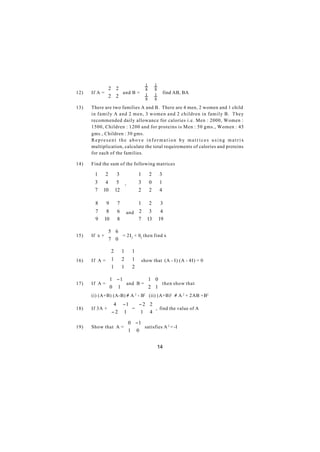
 2 2                   1       1
      If A =      and B =           8       8
12)          2
                2
                                     1       1  find AB, BA
                                      8       8
13)   There are two families A and B. There are 4 men, 2 women and 1 child
      in family A and 2 men, 3 women and 2 children in family B. They
      recommended daily allowance for calories i.e. Men : 2000, Women :
      1500, Children : 1200 and for proteins is Men : 50 gms., Women : 45
      gms., Children : 30 gms.
      Represent the above information by matrices using matrix
      multiplication, calculate the total requirements of calories and proteins
      for each of the families.

14)   Find the sum of the following matrices

      1    2       3           1        2     3
                                               
      3    4       5 ,         3        0     1
      7           12           2              4
          10                            2      

      8     9         7      1          2     3 
                                                
      7     8         6  and  2       3       4 
      9               8      7               19 
           10                        13         

             5 6 
15)   If x + 
                  = 2I2 + 02 then find x
                  
             7 0 

             2          1      1
                                 
16)   If A =  1         2      1  show that (A - I) (A - 4I) = 0
             1                 2
                        1        

              1 − 1                  1 0 
      If A = 
             0      and B =          
                                        2 1  then show that
                 1                          
17)
                                          
      (i) (A+B) (A-B) ≠ A 2 - B2 (ii) (A+B)2 ≠ A 2 + 2AB +B2
                  4     − 1  − 2 2 
      If 3A + 
              − 2          =        , find the value of A
                         1   1 4
18)
                                   
                              0 − 1
      Show that A = 
                    1               satisfies A 2 = -I
                                 0
19)
                                   

                                                14
 cosθ - sin θ                   cos 2θ - sin 2 θ
      If A = 
                                 prove that A 2 = 
                                                     sin 2θ cos 2 θ 
                     sin θ cos θ                                     
20)
                                                                   
                   3    4
21)   If A = 
              - 2 - 3  show that A , A are identity matrices
                       
                                    2   4

                      

                   7 1       2 1         1 2         5 2
      If A = 
             0         , B = 
                                1 3 , C =  4 1  , D =  - 1 3 
                      4                                      
22)
                                                           
      Evluate (i) (A+B) (C+D) (ii) (C+D) (A+B)              (iii) A 2 - B2   (iv) C2 + D2

23)   The number of students studying Business Mathematics, Economics,
      Computer Science and Statistics in a school are given below

                          Business       Economics           Computer Statistics
            Std.
                        Mathematics                          Science
       XI Std.                45                60               55              30
       XII Std.               58                72               40              80

      (i)    Express the above data in the form of a matrix
      (ii) Write the order of the matrix
      (iii) Express standardwise the number of students as a column matrix and
            subjectwise as a row matrix.
      (iv) What is the relationship between (i) and (iii)?


                              1.2 DETERMINANTS

       An important attribute in the study of Matrix Algebra is the concept
of Determinant, ascribed to a square matrix. A knowledge of Determinant
theory is indispensable in the study of Matrix Algebra.

1.2.1 Determinant
       The determinant associated with each square matrix A = (a ij ) is a
scalar and denoted by the symbol det.A or A. The scalar may be real or
complex number, positive, Negative or Zero. A matrix is an array and hasno
numerical value, but a determinant has numerical value.


                                           15
For example
               a                 b   
      when A = 
               c                      then determinant of A is
                                      
                                 d   
                    a        b
      |A|      =                      and the determinant value is = ad - bc
                    c        d

Example 9
                    1       -1
      Evaluate
                    3       - 2
Solution:
       1      -1
       3      - 2
      = 1 x (-2) - 3 x (-1) = -2 + 3 = 1

Example 10
                    2       0         4
      Evaluate 5            − 1       1
               9            7         8

Solution:
       2      0         4
                                  −1       1        5   1          5   −1
       5      −1        1   =2                 -0            +4
       9      7         8         7        8        9   8          9   7

               = 2 (-1 x 8 - 1 x 7) - 0 (5 x 8 -9 x 1) + 4 (5x7 - (-1) x 9)
               = 2 (-8 -7) - 0 (40 - 9) + 4 (35 + 9)
               = -30 - 0 + 176 = 146

1.2.2 Properties Of Determinants
      (i)   The value of determinant is unaltered, when its rows and
            columns are interchanged.
      (ii)  If any two rows (columns) of a determinant are interchanged,
            then the value of the determinant changes only in sign.
      (iii)    If the determinant has two identical rows (columns), then the
               value of the determinant is zero.


                                               16
(iv)    If all the elements in a row or in a (column) of a determinant are
              multiplied by a constant k(k, ≠ 0) then the value of the
              determinant is multiplied by k.
      (v)     The value of the determinant is unaltered when a constant multiple
              of the elements of any row (column), is added to the corresponding
              elements of a different row (column) in a determinant.
      (vi)    If each element of a row (column) of a determinant is expressed
              as the sum of two or more terms, then the determinant is
              expressed as the sum of two or more determinants of the same
              order.
      (vii)   If any two rows or columns of a determinant are proportional,
              then the value of the determinant is zero.

1.2.3 Product of Determinants
      Product of two determinants is possible only when they are of the
same order. Also |AB| = |A| . |B|

Example 11
                                              3     1               5   2
      Evaluate  A  B , if
                                       A=              and B =
                                              5     6               1   3
Solution:
      Multiplying row by column
                      3       1    5      2
      A B=
                      5       6    1      3

                      3 x 5 + 1x 1 3 x 2 + 1 x 3
                  =
                      5 x 5 + 6x 1 5 x 2 + 6 x 3

                      15 + 1 6 + 3     16           9
                  =                  =                = 448 - 279
                      25 + 6 10 + 18   31          28
                  = 169

Example 12
              2   1       3   2     0    0
      Find 3      0       5   0     0    3
           1      0    − 4    0     2    0


                                        17
Solution :
      Multiplying row by column
        2       1          3       2   0      0
        3       0          5       0   0      3
        1       0        − 4       0   2      0

            2 x 2 + 1x 0 + 3 x 0           2x 0 +1x 0+ 3 x 2   2x 0 +1x 3+ 3x 0
       = 3 x 2+ 0x 0 +5x 0                 3x 0 +0 x 0+5 x 2   3x 0+ 0x 3+ 5x 0
            1x 2 +0 x 0− 4x 0              1x 0+ 0x 0 −4 x 2   1x 0+ 0x 3− 4x 0

            4        6         3
       = 6           10        0
            2        − 8       0

       = 4 (0 + 0) -6 (0 - 0) + 3 (-48 - 20)
       = 3 (-68) = - 204

1.2.4 Singular Matrix
       A square matrix A is said to be singular if det. A = 0, otherwise it is a
non-singular matrix.

Example 13
                 1 2
      Show that 
                 2 4  is a singular matrix
                      
                     
Solution:
        1 2
            =4-4=0
        2 4
       ∴ The matrix is singular

Example 14
                2 5 
      Show that 
                 9 10 is a non-singular matrix
                      
                     
Solution :
        2       5
                      = 29 - 45 = -25 ≠ 0
        9       10
       ∴ The given matrix is non singular


                                                  18
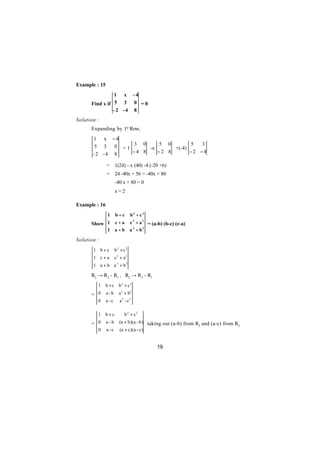
Example : 15
                 1 x −4
      Find x if 5 3 0 = 0
                - 2 -4 8
Solution :
      Expanding by 1st Row,
       1 x −4
        5 3  0 = 1 3 0 -x 5 0 +(-4) 5   3
       -2 -4 8     −4 8   −2 8      −2 −4

               = 1(24) - x (40) -4 (-20 +6)
               = 24 -40x + 56 = -40x + 80
               ⇒ -40 x + 80 = 0
               ∴ x=2

Example : 16
               1      b+c        b2 + c2
      Show 1          c+a        c 2 + a 2 = (a-b) (b-c) (c-a)
               1      a+b        a 2 + b2

Solution :
       1 b+c          b 2 + c2
       1 c+a          c2 + a2
       1 a + b a 2 + b2

      R2 → R2 - R1 , R3 → R3 - R1
         1   b + c b 2 + c2
      = 0      a-b      a 2 + b2
         0     a -c      a2 - c2

         1   b+c            b 2 + c2
      = 0      a -b      (a + b)(a - b) taking out (a-b) from R and (a-c) from R
                                                               2                3
         0     a -c      (a + c)(a - c)


                                               19
1       b + c b2 + c 2
     = (a-b) (a-c)        0           1        a+b
                          0           1         a+c

     = (a-b) (a-c) [a+c-a-b] (Expanding along c1)
     = (a-b) (a-c) (c-b) = (a-b) (b-c) (c-a)


                                              EXERCISE 1.2

                          4 6                           3     2              −2       −4
1)   Evaluate       (i)                          (ii)                (iii)
                          −2 3                          4     5              −1       −6

                1             2           0                                  1         0       0
2)   Evaluate 3           −1              4              3)       Evaluate 0           1       0
              1           2               4                                0           0       1

                         7                       4         3
                                                             
4)   Examine whether A =  3                      2         1  is non-singular
                         5                                 2
                                                 3           

                                           1 − 2 3
                                                     
5)   Examine whether the given matrix A =  − 2 − 1 0  is singular
                                           4 − 2 5
                                                     
              3           2       1                                        1           4   2
6)   Evaluate 0           1       4                      7)       Evaluate 2          −2   4
              3           2       1                                        3          −1   6

                     2                3       5                      2            6    5
8)   If the value of 4                1       0 = -60, then evaluate 4            2    0
                     6                2       7                      6            4    7

                     1 2 3                                1 8 3
9)   If the value of 1 1 3 = 5, then what is the value of 1 7 3
                     2 0 1                                2 12 1


                                                        20
2 + 4 6 +3                      2       6       4      3
10)   Show that                                 =                +
                         1             5             1       5       1      5

                     a - b b -c            c -a
11)   Prove that b - c           c-a       a -b = 0
                     c -a        a-b       b- c

                     b+ c          a        1
12)   Prove that c + a             b        1 =0
                     a + b         c        1

                     1       1         1
13)   Show that 1 1 + x                1        = xy
                     1       1      1+ y


                                       EXERCISE 1.3
Choose the correct answer
1)    [ 0 0 0 ] is a
      (a) Unit matrix                               (b) Scalar matrix
      (c) Null matrix                               (d) Diagonal matrix
2)    [ 6 2 - 3 ] is a matrix of order
      (a) 3 x 3                     (b) 3 x 1
      (c) 1 x 3                     (d) Scalar matrix
      1 0 
3)    
       0 1  is a
            
           
      (a) Unit matrix                               (b) Zero matrix of order 2 x 2
      (c) Unit matrix of 2 x 2                      (c) None of these
               3 − 3          1 2
         
      A=             and B = 
                                    
                2 4                  , then A + B is
4)
                             −1 0 
          4 5                         4 − 1
      (a) 
             
                                 (b) 
                                             
                                              
          3 4                        −1 4 
          4 − 1                          1 0 
      (c) 
               
                                 (d) 
                                               
                                                
         1 4                             0 1 

                                                     21
8       9                −1      3 
      If A = 
              − 3 − 1
                              and B = 
                                       0            , then A - B is
                                                 − 2
5)
                                                 
          7     6               9 6              7 6                  0 0 
      (a) 
                           (b)               (c)                  (d)     
           − 3 − 3
                   
                                       
                                 − 3 1 
                                                         
                                                     0 1 
                                                                                
                                                                            0 0 
              2       4 
6)    If A = 
              − 3 − 3  , then -3A is
                       
                      
           − 6 − 12             − 6 − 12         − 6     12 
      (a) 
                    
                            (b) 
                                               (c)            
                                        15 
                                                                        (d) None of these
           − 9 15              9                  9       9

              2 3 4             1 0 0
                                      
7)    If A =  1 − 1 0  and I =  0 1 0  , t h e n A + 2I is
              5 − 3 1           0 0 1
                                      

           4 3 4                                   3 3 4 
                                                          
      (a)  1 1 0                               (b) 1 0 0 
           5 − 3 3                                 5 −3 2 
                                                          

           4 3 4
                   
      (c)  1 − 1 0                             (d) None of these
           5 − 3 2
                   

       3 5 6   5 −1 0 
8)    
       − 2 1 6 x  3 2 1
                        
                       
          15 12                                     − 3 15 
      a) 
                
                                                (b) 
                                                             
                                                              
         − 4 1                                      8 − 3
      (c) Cannot be multiplied                   (d) None of these
                      1 − 1
9)    The value of 
                            is
                            
                     0 0 
      (a) 4                  (b) 14              (c) -14                (d) None of these
                     1 −1
10)   The value of        is
                     0 0
      (a) 0                  (b) - 1             (c) 1                  (d) None of these


                                            22
1     2                         1           3
11)   If the value of           = -2, then the value of               is
                        3     4                         2           4
      (a) 0                  (b) - 2                  (c) 2               (d) None of these

12)   Det (AB) = | AB | = ?
      (a) A  + B                                  (b) B + A 
      (c) A  x B                                  (d) None of these
                        nd                 nd
13)   The element at 2 Row and 2 Coloumn is denoted by
      (a) a 12         (b) a 32       (c) a 22         (d) a 11

14)   Order of the matrix A = [a ij]3 x 3 is
      (a) 2 x 3         (b) 3 x 3                     (c) 1 x 3           (d) 3 x 1
15)   When the number of rows and the number of coloumns of a matrix are equal,
      the matrix is
      (a) square matrix (b) row matrix       (c) column matrix (d) None of these
16)   If all the elements of a matrix are zeros, then the matrix is a
      (a) unit matrix                        (b) square matrix
      (c) zero matrix                        (d) None of these
17)   A diagonal matrix in which all the diagonal elements are equal is a
      (a) scalar matrix                     (b) column matrix
      (c) unit matrix                       (d) None of these
18)   If any two rows and coloumns of a determinant are identical, the value of
      the determinant is
      (a) 1              (b) 0           (c) -1            (d) unaltered
19)   If there is only one column in a matrix, it is called
      (a) Row matrix                        (b) column matrix
      (c) square matrix                     (d) rectangular
20)   Addition of matrices is
      (a) not commutative                             (b) commutative
      (c) not associative                             (d) distributive
21)   A square matrix A is said to be non-singular if
      (a) | A | ≠ 0    (b) | A | = 0        (c) A = 0                     (d) None of these

                              1       x
22)   The value of x if                 = 0 is
                              5       3

      (a) 5                  (b) 3                    (c) 0               (d) None of these
              3                   5


                                                 23
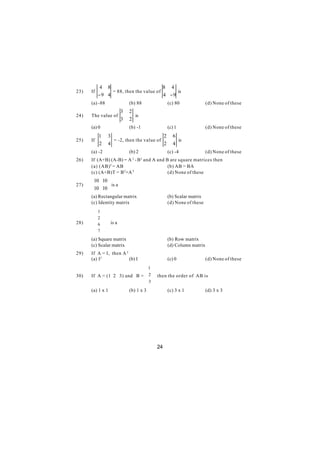
4 8                         8 4
23)   If        = 88, then the value of      is
           −9 4                         4 −9
      (a) -88                  (b) 88            (c) 80              (d) None of these
                           3   2
24)   The value of               is
                           3   2
      (a) 0                    (b) -1            (c) 1               (d) None of these
           1       3                         2     6
25)   If             = -2, then the value of         is
           2       4                         2     4
      (a) -2                   (b) 2             (c) -4              (d) None of these
                                2      2
26)   If (A+B) (A-B) = A - B and A and B are square matrices then
      (a) (AB)T = AB                    (b) AB = BA
      (c) (A+B)T = B T+A T              (d) None of these
      10 10 
27)   
      10 10  is a
             
            
      (a) Rectangular matrix                     (b) Scalar matrix
      (c) Identity matrix                        (d) None of these
          1   
              
          2   
28)       6       is a
              
              
          7   
      (a) Square matrix                          (b) Row matrix
      (c) Scalar matrix                          (d) Column matrix
29)   If A = I, then A 2
      (a) I 2            (b) I                   (c) 0               (d) None of these
                             1 
                              
30)   If A = (1 2 3) and B =  2  then the order of AB is
                              3 
                              
      (a) 1 x 1                (b) 1 x 3         (c) 3 x 1           (d) 3 x 3


                                           24
ALGEBRA                                                2
                         2.1 PARTIAL FRACTION

       We know that two or more rational expressions of the form p/q can
be added and subtracted. In this chapter we are going to learn the process
of writing a single rational expression as a sum or difference of two or more
rational expressions. This process is called splitting up into partial fractions.

(i)     Every rational expression of the form p/q where q is the non-repeated
        product of linear factors like (ax+b) (cx+d), can be represented as a
                                             M               N
        partial fraction of the form:      ax + b
                                                       +   cx + d
                                                                    , where M and N are the
        constants to be determined.
                             2x              A
        For example: (x -1)(2x + 3) =       x -1
                                                       + 2xB 3 , where A and B are to be
                                                            +
        determined.

(ii)    Every rational expression of the form p/q, where q is linear expression
        of the type (ax+b) occurring in multiples say n times i.e., (ax+b)n can
        be represented as a partial fraction of the form:
                        A1         A2                      An
                   (ax+ b) + (ax+b)2      + .......+
                                                        ( ax+b )n
                                1            A         B           C
        For example :                  2 = (x - 1) + (x - 2 ) +
                        ( x -1 )(x −2 )                         (x -2 )2

(iii)   Every rational expression of the form p/q where q is an irreducible
        quadratic expression of the type ax2+bx+c, can be equated to a partial
        fraction of the type

                     Ax + B
                   ax 2 + bx + c

        For example :          2x+7
                                           = Ax + B + C
                        (3x2 +5x+1) (4x+3)  3x 2 + 5x +1 4x + 3


                                            25
Example 1
                                                   4x+1
      Resolve into partial fractions (x-2) (x+1)

Solution:
                         4x +1         A      B
      Step 1:   Let ( x -2 )( x +1) =      +                         ------------------(1)
                                      x -2   x +1
      Step 2:   Taking L.C.M. on R.H.S.
                      4x + 1          A (x + 1 ) + B ( x - 2 )
                 ( x - 2 )( x +1) =      ( x - 2 )( x + 1 )
      Step 3:   Equating the numerator on both sides
                4x+1    = A(x+1) + B(x-2)
                        = Ax+A + Bx-2B
                        = (A+B)x + (A-2B)
      Step 4:   Equating the coefficient of like terms,
                A+B     =4                          -----------------(2)
                A-2B = 1                            -----------------(3)
      Step 5:   Solving the equations (2) and (3) we get
                A = 3 and B = 1
      Step 6:   Substituting the values of A and B in step 1 we get
                       4x+1         3       1
                 ( x - 2) (x+1) = x − 2 + x + 1


Example 2
                                                         1
       Resolve into partial fractions
                                                 (x - 1) (x + 2) 2
Solution:
                               1               A           B            C
      Step 1:   Let                        = x −1 + x + 2 +
                        (x -1 )(x + 2 )2                    (x + 2 )2
      Step 2:   Taking L.C.M. on R.H.S we get
                                   A ( x + 2 ) + B ( x − 1 )( x + 2 )+ C ( x − 1 )
                                                 2
                        1
                                 =
                 (x -1)(x + 2 )2                ( x -1) ( x + 2 )2
      Step 3:   Equating Numerator on either sides we get
                1 = A(x+2)2+B(x-1)(x+2)+C(x-1)
                                                       1
      Step 4:   Puting x = -2 we get C = - 3


                                            26
1
      Step 5:   Puting x = 1 we get A = 9
      Step 6:   Putting x = 0 and substituting the values of A and C in
                step 3 we get
                         1
                B=-9

                             1
      Step 7:   ∴                       =       1    - 1 -           1
                    ( x -1)( x + 2 )2       9 ( x −1) 9(x + 2 ) 3( x +2 )2


Example 3

      Resolve into partial fractions               x 2 +1
                                                 x (x +1)2
Solution:
                         x 2 +1     A    B        C
      Step 1:   Let               = x + x +1 +
                       x ( x +1)2              (x +1 )2
      Step 2:   Taking L.C.M. on R.H.S. we get
                   x 2 +1     A ( x + 1 )2 + Bx ( x + 1 ) + Cx
                            =
                 x ( x +1)2               x ( x + 1 )2

      Step 3:   Equating the Numerator on either sides we get
                x2+1 = A(x+1)2 + Bx (x+1) + Cx
      Step 4:   Putting x = 0 we get A = 1
      Step 5:   Putting x = -1 we get C = -2
      Step 6:   Putting x = 2 and substituting the values of A and C
                in step 3 we get B = 0
                        x 2 +1            1            2        1      2
      Step 7:   ∴                       = x + 0 -             = x -
                      x ( x +1)2             x + 1 ( x + 1 )2       ( x+1)2
Example 4
      Resolve into partial fractions                x2 −2x− 9
                                                 (x + x+6) (x+1)
                                                   2


Solution:
      Step 1:   Let        x2 −2x−9    = Ax + B + x + 1
                                                   C
                       ( x + x+6)(x+1)
                         2                2
                                         x +x + 6
                                                        (Q x2+x+6 cannot be factorised)

                                              27
Step 2:   Taking L.C.M. on R.H.S. we get

                      x 2 −2x−9        (Ax+ B) (x +1) + C(x 2 + x + 6)
                                     =
                 ( x 2 + x +6) (x+1)        (x 2 + x + 6) (x +1)

      Step 3:   Equating the Numerator on either side we get
                x2-2x-9 = (Ax+B)(x+1)+C(x2+x+6)
      Step 4:   Putting x = -1 we get C = −1
      Step 5:   Putting x = 0 and substituting the value of C we get B = -3
      Step 6:   Putting x = 1 and substituting the values of B and C in
                step 3 get A = 2

      Step 7:   ∴      x2 −2x−9      = 22x − 3 - 1
                    (x2 + x+6) (x+1)   x +x +6   x +1

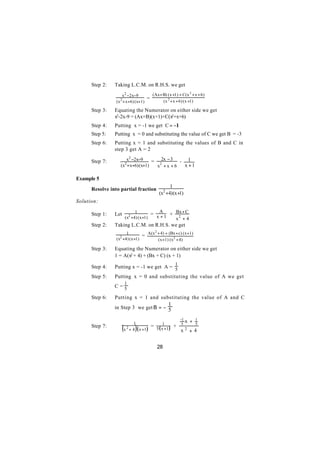
Example 5
                                                    1
      Resolve into partial fraction
                                              (x2 +4) (x +1)
Solution:

                                         = x + 1 + Bx + C
                                1           A
      Step 1:   Let
                          (x2 +4) (x +1)           x2 + 4
      Step 2:   Taking L.C.M. on R.H.S. we get

                                = A(x + 4) + (Bx + c) (x +1)
                                     2
                       1
                 (x2 +4) (x +1)        (x +1) (x 2 + 4)

      Step 3:   Equating the Numerator on either side we get
                1 = A(x2 + 4) + (Bx + C) (x + 1)
                                                        1
      Step 4:   Putting x = -1 we get A = 5
      Step 5:   Putting x = 0 and substituting the value of A we get
                          1
                C=5

      Step 6:   Putting x = 1 and substituting the value of A and C
                                                    1
                in Step 3 we get Β = − 5


                                 1
                                                            -1 x   +   1
                                           = 5 ( x1+1 ) +
                ∴
                      (         )
                                                             5         5
      Step 7:
                          x 2 + 4 ( x +1 )                  x2     +4


                                             28
EXERCISE 2.1

Resolve into partial fractions

1)         x +1                                   2)      2x -15
         x 2 - x- 6                                     x 2 +5 x +6

                                                              x+ 4
                                                        (x −4 ) (x +1)
3)         1                                      4)
           2                                              2
        x -1

                  x +1                                         1
5)                                                6)
        (x − 2 )2 (x + 3 )                              (x −1)( x +2 )2

7)
              x
                                                  8)     2x 2 + 7x + 23
        (x −1)(x +1)2                                   (x −1)(x +3 )2
                 7x 2 - 25x + 6                               x+ 2
        (x                  ) (3x -2 )                  (x −1) (x 2 +1)
9)                                                10)
             2
                 − 2 x -1


                                     2.2 PERMUTATIONS
      This topic deals with the new Mathematical idea of counting without
doing actual counting. That is without listing out particular cases it is
possible to assess the number of cases under certain given conditions.

       Permutations refer to different arrangement of things from a given lot
taken one or more at a time. For example, Permutations made out of a set of
three elements {a,b,c}

(i)   One at a time:              {a}, {b}, {c}                           ...... 3 ways
(ii) Two at a time: {a,b}, {b,a},{b,c}, {c,b}, {a,c}, {c,a}               ...... 6 ways
(iii) Three at a time: {a,b,c}, {a,c,b}, {b,c,a}, {b,a,c}, {c,a,b}, {c,b,a} ......6 ways

2.2.1 Fundamental rules of counting
       There are two fundamental rules of counting based on the simple
principles of multiplication and addition, the former when events occur
independently one after another and latter when either of the events can
occur simultaneously. Some times we have to combine the two depending
on the nature of the problem.


                                                   29
2.2.2 Fundamental principle of counting
        Let us consider an example from our day-to-day life. Sekar was allotted
a roll number for his examination. But he forgot his number. What all he
remembered was that it was a two digit odd number.

       The possible numbers are listed as follows:
       11      21       31        41        51    61      71       81       91
       13      23       33        43        53    63      73       83       93
       15      25       35        45        55    65      75       85       95
       17      27       37        47        57    67      77       87       97
       19      29       39        49        59    69      79       89       99
       So the total number of possible two digit odd numbers = 9x5 = 45

        Let us see whether there is any other method to find the total number
of two digit odd numbers. Now the digit in the unit place can be any one of
the five digits 1,3,5,7,9. This is because our number is an odd number. The
digit in the ten’s place can be any one of the nine digits 1,2,3,4,5,6,7,8,9

       Thus there are five ways to fill up the unit place and nine ways to fill
up the ten’s place. So the total number of two digit odd numbers = 9x5 = 45.
This example illustrates the following principle.

(i)    Multiplication principle
      If one operation can be performed in “m” different ways and another
operation can be performed in “n” different ways then the two operations
together can be performed in ‘m x n’ different ways. This principle is
known as multiplication principle of counting.

(ii)   Addition Principle
      If one operation can be performed in m ways and another operation
can be performed in n ways, then any one of the two operations can be
performed in m+n ways. This principle known as addition principle of
counting.

       Further consider the set {a,b,c,d}


                                       30
From the above set we have to select two elements and we have to
arrange them as follows.

              I Place                         II Place
                                                b
                a                               c
                                                d

                                                a
                b                               c
                                                d

                                                a
                c                               b
                                                d

                                                a
                d                               b
                                                c
       The possible arrangements are
             (a,b), (a,c), (a,d)
             (b,a), (b,c), (b,d)
             (c,a), (c,b), (c,d)
             (d,a), (d,b), (d,c)
       The total number of arrangements are 4 x 3 = 12
       In the above arrangement, the pair (a,b) is different from the pair (b,a)
and so on. There are 12 possible ways of arranging the letters a,b,c,d taking
two at a time.
       i.e Selecting and arranging ‘2’ from ‘4’ can be done in 12 ways. In
otherwords number of permutations of ‘four’ things taken ‘two’ at a time is
4x3 = 12
         In general np r denotes the number of permutations of ‘n’ things taken
‘r’ at a time.
       [‘n’ and ‘r’ are positive integers and r<n]


                                      31
2.2.3 To find the value of npr :
       np means selecting and arranging ‘r’ things from ‘n’ things which is
         r
the same as filling ‘r’ places using ‘n’ things which can be done as follows.
        The first place can be filled by using anyone of ‘n’ things in ‘n’ ways
       The second place can be filled by using any one of the remaining
(n-1) things in (n-1) ways.
        So the first and the second places together can be filled in n(n-1)
ways.
       The third place can be filled in (n-2) ways by using the remaining
(n-2) things.
       So the first, second and the third places together can be filled in n(n-1)
(n-2) ways.
        In general ‘r’ places can be filled in n(n-1)(n-2)....[n-(r-1)] ways.
       So np r = n(n-1) (n-2)...(n-r+1). To simplify the above formula, we are
going to introduce factorial notation.

2.2.4 Factorial notation:
         The product of first ‘n’ natural numbers is called n- factorial denoted by
n ! or |n.
For example:
                5! = 5 x 4 x 3 x 2 x 1
                4! = 4 x 3 x 2 x 1
             ∴ 5! = 5 x 4!
                5! = 5 x 4 x 3!
In general, n! = n(n-1)(n-2)...3.2.1
             ∴ n! = n{(n-1)!}
                       = n(n-1)(n-2)! and so on
         We have np r = n(n-1)(n-2)............(n-r+1)
                           n ( n - 1 )( n − 2 )...... ( n - r + 1 )( n − r )!        n!
                       =                       ( n - r )!                     =   (n - r )!
        {multiplying and dividing by (n-r)!}
                              n!
               ∴ npr = (n-r ) !


                                              32
Observation :
      (i)    o! = 1
               n             n!        n!
       (ii)     po =
                         ( n - 0 ) ! = n! = 1
               n            n!       n ( n -1 )!
       (iii)    p1 =
                         (n - 1 )! = (n -1 )! = n
       (iv)    npn =        n!        n!
                         (n - n ) ! = 0! =n!
      (ie. Selecting and arranging ‘n’ things from ‘n’ things can be
done in n! ways).
       (i.e ‘n’ things can be arranged among themselves in n! ways).

2.2.5 Permutations of repeated things:
       If there are ‘n’ things of which ‘m’ are of one kind and the remaining
(n-m) are of another kind, then the total number of distinct permutations of
‘n’ things
                        n!
               =
                   m !( n - m ) !

       If there are m 1 things of first kind, m 2 things of second kind and
mr things of r th kind such that m 1+m2+.....+mr = n then the total number of
permutations of ‘n’ things
                         n!
               =
                   m1 !m2 !......mr !

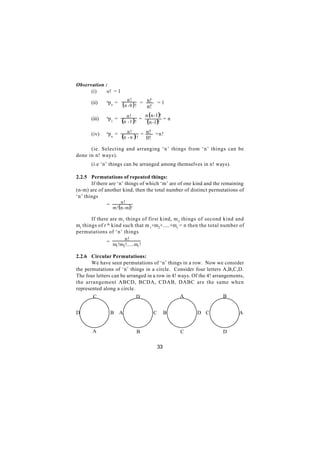
2.2.6 Circular Permutations:
       We have seen permutations of ‘n’ things in a row. Now we consider
the permutations of ‘n’ things in a circle. Consider four letters A,B,C,D.
The four letters can be arranged in a row in 4! ways. Of the 4! arrangements,
the arrangement ABCD, BCDA, CDAB, DABC are the same when
represented along a circle.
       C                    D                    A                   B


D                  B   A                C        B       D C              A


       A                            B                C             D

                                            33
4!
       So the number of permutations of ‘4’ things along a circle is 4 = 3!
       In general, n things can be arranged among themselves in a circle in
(n-1)! ways

Example 6
     Find the value of (i) 10 p1, (ii) 7p4, (iii)      11   p0
Solution:
             10
      i)         p 1 = 10

             7
                         |7     |7   7 x 6 x 5 x4 x 3!
      ii)     p4 =            =    =         3!        =7 x 6 x 5 x 4 = 840
                       |7 - 4   |3
             11
      iii)       p0 = 1

Example 7
       There are 4 trains from Chennai to Madurai and back to Chennai.
In how many ways can a person go from Chennai to Madurai and return in
a different train?
Solution:
      Number of ways of selecting a train from
                                                                     4
      Chennai to Madurai from the four trains                    =    p 1 = 4ways
      Number of ways of selecting a train from
                                                                     3
      Madurai to Chennai from the remaining 3 trains =                p 1 = 3 ways
      ∴ Total number of ways of making the journey = 4 x 3 = 12ways

Example 8
      There is a letter lock with 3 rings each marked with 4 letters and do
not know the key word. How many maximum useless attempts may be made
to open the lock?
Solution:
      To open the lock :
      The number of ways in which the first ring’s
      position can be fixed using the four letters               = 4p 1 = 4 ways
      The number of ways in which the second
      ring’s position can be fixed using the 4 letters           = 4p 1 = 4 ways


                                        34
The number of ways in which the third ring’s
       position can be fixed using the 4 letters         = 4p 1 = 4 ways

       ∴ Total number of attempts                        = 4 x 4 x 4 = 64 ways
       Of these attempts, only one attempt will open the lock.
       ∴ Maximum number of useless attempts            = 64 - 1 = 63

Example 9
        How many number of 4 digits can be formed out of the digits
0,1,2,..........,9 if repetition of digits is not allowed.
Solution:
       The number of ways in which the 1000’s place can be filled
       (0 cannot be in the 1000’s place)                = 9ways

       The number of ways in which the 100’s place 10’s
       place and the unit place filled using the remaining
       9 digits (including zero)                           = 9p 3 = 504 ways
       ∴ Total number of 4 digit numbers formed             = 9 x 504 = 4536

Example 10
       Find the number of arrangements of 6 boys and 4 girls in a line so
that no two girls sit together
Solution:
       Six boys can be arranged among themselves in a line in 6! ways.
After this arrangement we have to arrange the four girls in such a way that
in between two girls there is atleast one boy. So the possible places to fill
with the girls are as follows

       ¨    B    ¨    B   ¨     B   ¨     B   ¨     B   ¨     B ¨

       The four girls can be arranged in the boxes (7 places) which can
be done in 7p 4 ways. So the total number of arrangements = 6! x 7p 4
= 720 x 7 x 6 x 5 x 4 = 604800

Example 11
     A family of 4 brothers and 3 sisters are to be arranged in a row. In
how many ways can they be seated if all the sisters sit together?


                                     35
Solution:
       Consider the 3 sisters as one unit. There are 4 brothers which is
treated as 4 units. Now there are totally 5 units which can be arranged
among themselves in 5! ways. After these arrangements the 3 sisters can
be arranged among themselves in 3! ways.
       ∴ Total number of arrangement = 5! x 3! = 720

Example 12
       Find the sum of all the numbers that can be formed with the
digits 2, 3, 4, 5 taken all at a time.
Solution:
        Number of 4 digit numbers that can be formed using the digits
2, 3, 4, 5 is 4p 4=4! = 24. Out of the 24 numbers the digit 2 appears in the unit
place 6 times, the digit 3 appears in the unit place 6 times and so on. If we
write all the 24 numbers and add, the sum of all the numbers in the unit place

              = 6[2+3+4+5] = 6 x 14 = 84

       Similarly the sum of all the numbers in the 10’s place = 84
       The sum of all the numbers in the 100’s place          = 84
       and the sum of all the numbers in the 1000’s place = 84
       ∴ sum of all the 4 digit numbers     = 84x1000 + 84x100+84x10+84x1
                                            = 84 (1000+100+10+1) = 84 x 1111
                                            = 93324

Example 13
      In how many ways can the letters of the word CONTAMINATION
be arranged?
Solution:
       The number of letters of word CONTAMINATION = 13
       which can be arranged in 13! ways
       Of these arrangements the letter  O occurs 2 times
                                         N occurs 3 times
                                         T occurs 2 times
                                         A occurs 2 times
                                    and I occurs 2 times
                                                      13!
       ∴ The total number of permutations = 2! 3! 2! 2! 2!


                                       36
EXERCISE 2.2

1)     If n p 5 = (42) n p 3 , find n
2)     If 6[n p 3 ] = 7 (n-1)p 3 find n
3)     How many distinct words can be formed using all the letters of the word
       i) ENTERTAINMENT ii) MATHEMATICS iii) MISSISSIPPI
4)     How many even numbers of 4 digits can be formed out of the digits 1,2,3,....9
       if repetition of digits is not allowed?

5)     Find the sum of all numbers that can be formed with the digits 3,4,5,6,7
       taken all at a time.
6)     In how many ways can 7 boys and 4 girls can be arranged in a row so that
       i) all the girls sit together ii) no two girls sit together?

7)     In how many ways can the letters of the word STRANGE be arranged so
       that vowels may appear in the odd places.
8)     In how many ways 5 gentlemen and 3 ladies can be arranged along a round
       table so that no two ladies are together?

9)     Find the number of words that can be formed by considering all possible
       permutations of the letters of the word FATHER. How many of these
       words begin with F and end with R?


                                  2.3 COMBINATIONS

      Combination are selections ie. it inolves only the selection of the
required number of things out of the total number of things. Thus in
combination order does not matter.

      For example, consider a set of three elements {a,b,c} and combination
made out of the set with
                 i) One at a time: {a}, {b}, {c}
                 ii) Two at a time: {a,b}, {b,c}, {c,a}
                 iii) Three at a time: {a,b,c}
       The number of comibnations of n things taken r, (r < n) is denoted

by nc r or   ()
             n
             r

                                               37
2.3.1 To derive the formula for ncr :
        Number of combinations of ‘n’ things taken ‘r’ at a time       = ncr
        Number of permutations of ‘n’ things taken ‘r’ at a time       = np r
        Number of ways ‘r’ things can be arranged among themselves = r!
        Each combination having r things gives rise to r! permutations
              ∴ np r     = (ncr) r!
                            n!
                =>        (n - r )! = ( ncr) r!
                                            n!
                ∴ ncr               = r! (n - r )!


Observation:
                            n!            n!
(i)     nco     = 0! (n - 0 )! =
                                 n! = 1

        n
                        n!       n!
(ii)     cn     = n! (n - n)! =
                                r!0! = 1
        n
(iii)    cr     = ncn-r
(iv)    If ncx = ncy then x = y or x+y = n
                n
        n            pr
(v)      cr =
                    r!


Example14
     Evaluate 8p3 and 8c3
Solution:

        8
                   8!       8!    8x7x6x5!
         p 3 = ( 8 − 3 )! = 5 ! =    5!    = 8 x 7 x 6 = 336

                   8!          8!
        8c3 = 3 ! (8 - 3 )! = 3! 5! = 8x7x6x5! = 8x7x6 = 56
                                        3! 5!    3x2x1

Example 15
     Evaluate 10c8
Solution:
                10                 10x9
                     c8 = 10c2 = 2x1 = 45


                                                  38
Example 16
     I nc8 = nc6, find nc2.
      f
Solution:
                nc8 = nc6 (given)
                => n = 8+6 = 14
                                  14 x 13
            ∴   n c2 = 14c2     = 2 x 1 = 91


Example 17

       If   ( ) ( )
            100
             r
                      =
                          100
                           4r
                              , find ‘r’

Solution:
                100cr           = 100c4r (given)
       =>       r + 4r          = 100
       ∴        r               = 20

Example 18
      Out of 7 consonants and 4 vowels, how many words can be made each
containing 3 consonants and 2 vowels.
Solution:
       Selecting 3 from 7 consonants can be done in 7c3 ways
       Selecting 2 from 4 vowels can be done in 4c2 ways.
       ∴      Total number of words formed = 7c3 x 4c2
                      7x 6x 5    4x 3
                = 3x 2 x 1 x 2 x 1
       ∴        = 35 x 6 = 210

Example 19
       There are 13 persons in a party. If each of them shakes hands with
each other, how many handshakes happen in the party?
Solution:
       Selecting two persons from 13 persons can be done in 13c2 ways.
                                                   13 x 12
       ∴ Total number of hand shakes = 13c2 =       2 x 1 = 78


                                            39
Example 20
       There are 10 points in a plane in which none of the 3 points are
collinear. Find the number of lines that can be drawn using the 10 points.
Solution:
      To draw a line we need atleast two points. Now selecting 2 from 10
can be done in 10c2 ways
                                         10 x 9
      ∴ number of lines drawn = 10c2 = 2 x 1 = 45


Example 21
       A question paper has two parts, part A and part B each with 10
questions. If the student has to choose 8 from part A and 5 from part B, in
how many ways can he choose the questions?
Solution:
      Number of questions in part A = 10.
      Selecting 8 from part A can be done in 10c8 ways = 10c2
      Number of questions in part B = 10
      Selecting 5 from part B can be done in 10c5 ways
      ∴ Total number of ways in which the questions can be selected
               = 10c8 x 10c5 = 45 x 252 = 11340 ways

Example 22
        A committee of seven students is formed selecting from 6 boys and
5 girls such that majority are from boys. How many different committees
can be formed?
Solution:
      Number of students in the committee = 7
      Number of boys                        =6
      Number of girls                       =5
      The selection can be done as follows
                Boy (6)         Girl (5)
                  6               1
                  5               2
                  4               3
      ie. (6B and 1G) or (5B and 2G) or (4B and 3G)


                                    40
The possible ways are 6      (6 ) (15 ) or (6 ) (5 ) or (6 ) (5 )
                                                   5 2          4 3
       ∴The total number of different committees formed
                = 6c6 x 5c1+6c5 x 5c2 + 6c4 x 5c3
                = 1 x 5 + 6 x 10 + 15 x 10 = 215

2.3.2 Pascal’s Triangle
       For n = 0, 1, 2, 3, 4, 5 ... the details can be arranged in the form of a
triangle known as Pascal’s triangle.

       n=0                                               (0 )
                                                          0
       n=1                                       (10 )           (1 )
                                                                  1
       n=2                               (2 )
                                          0              (12 )          (2 )
                                                                         2
       n=3                       (3 )
                                  0              (13 )           (3 )
                                                                  2            (3 )
                                                                                3
       n=4               (4 )
                          0              (14 )           (4 )
                                                          2             (4 )
                                                                         3            (4 )
                                                                                       4
       n=5        (5 )
                   0             (15 )           (5 )
                                                  2              (5 )
                                                                  3            (5 )
                                                                                4            (5 )
                                                                                              5
       Substituting the values we get
       n=0                                                   1
       n=1                                           1              1
       n=2                                   1               2             1
       n=3                           1               3              3             1
       n=4                   1               4               6             4             1
       n=5           1               5               10             10            5             1
       The conclusion arrived at from this triangle named after the French
Mathematician Pascal is as follows. The value of any entry in any row is
equal to sum of the values of the two entries in the preceding row on either
side of it. Hence we get the result.

       (nr+1) (rn-1) (n )
              =
                      r
                         +


                                             41
2.3.3 Using the formula for ncr derive that n                          (r ) + (rn-1) = (nr+1 )
Proof :
      L.H.S. = ncr + ncr-1

                                      n!                 n!
                                                 (r -1!)[n -( r-1)]!
                             =                 +
                                 r! ( n - r )!
                                      n!                n!
                             =                 +
                                 r! ( n - r )!   (r -1!)(n - r +1)!
                                 n! [n - r + 1] + n! ( r )
                             =
                                     r! ( n +1 - r )!
                                 n! [n - r + 1 + r ]    n!( n + 1)
                             =                       =
                                  r! (n - r + 1 )!     r! (n - r + 1)!

                             =      ( n + 1 )! = ( n + 1 )!
                                 r! (n - r + 1 )! r! (n + 1 - r )!

                             = n + 1cr = R.H.S.


                                                EXERCISE 2.3

1)    Evaluate a) 10 c 6                    b)   15
                                                      c 13
            36          36
2)    If         cn =        c n+4, find ‘n’.
      n+2
3)          c n = 45, find n.
4)    A candidate is required to answer 7 questions out of 12 questions which
      are divided into two groups each containing 6 questions. He is not
      permitted to attempt more than 5 questions from each group. In how
      many ways can he choose the 7 questions.

5)    From a set of 9 ladies and 8 gentlemen a group of 5 is to be formed. In
      how many ways the group can be formed so that it contains majority of
      ladies

6)    From a class of 15 students, 10 are to be chosen for an excursion party.
      There are 3 students who decide that either all of them will join or none
      of them will join. In how many ways can they be chosen.
7)    Find the number of diagonals of a hexagon.


                                                             42
8)     A cricket team of 11 players is to be chosen from 20 players including
       6 bowlers and 3 wicket keepers. In how many different ways can a
       team be formed so that the team contains exactly 2 wicket keepers and
       atleast 4 bowlers.


              2.4 MATHEMATICAL INDUCTION
      Many mathematical theorems, formulae which cannot be easily
derived by direct proof are sometimes proved by the indirect method known
as mathematical induction. It consists of three steps.
       (i) Actual verification of the theorem for n = 1
       (ii) Assuming that the theorem is true for some positive integer k(k>1).
            We have to prove that the theorem is true for k+1 which is the
            integer next to k.
       (iii) The conclusion is that the theorem is true for all natural numbers.

2.4.1 Principle of Mathematical Induction:
      Let P(n) be the statement for n ε N. If P(1) is true and P(k+1) is also
true whenever P(k) is true for k > 1 then P(n) is true for all natural numbers.

Example 23
     Using the principle of Mathematical Induction prove that for all
                       n (n +1 )
 ∈
n∈N, 1+2+3+...n =         2
Solution:
                       n (n +1 )
       Let    P(n) =       2
For    L.H.S. n=1, p(1) = 1
                       1 (1 + 1 )
For    R.H.S p(1) =        2      =1
              L.H.S = R.H.S for n = 1
       ∴         P(1) is true.
       Now assume that P(k) is true
                                       k (k +1)
              i.e. 1+2+3+......+k =        2    is true.


                                         43
To prove that p(k+1) is true
       Now    p(k+1)      = p(k) + tk+1
              p(k+1)      = 1+2+3+......k+k+1
                          = p(k) + (k+1)
                             k (k +1)
                          =      2     + k+1

                          = (k+1) [ k +1]
                                      2
                              (k + 1 )(k + 2 )
                          =          2

       => p(k+1) is true whenever p(k) is true. But p(1) is true.
       ∴ p(n) is true for all n∈N.

Example 24
       Show by principle of mathematical induction that 3 2n -1 is
                        ∈
divisible by 8 for all n∈N.
Solution:
        Let P(n) be the given statement
              p(1) =32 - 1 = 9-1=8 which is divisible by 8.
        ∴     p(1) is true.
        Assume that p(k) is true
        ie.,  32k-1 is divisible by 8.
        To prove p(k+1) is true.
        Now p(k+1)          = 32(k+1) - 1 = 32k x 32-1
                            = 9 32k -1
                            = 9(32k) - 9 + 8
                            = 9 [32k-1] + 8
        Which is divisible by 8 as 32k-1 is divisible by 8
        So p(k+1) is true whenever p(k) is true. So by induction p(n) is true
for all n∈N.

                               EXERCISE 2.4
By the principle of mathematical induction prove the following
1)     1+3+5+..... (2k-1) = k2
2)     4+8+12+.......4n = 2n(n+1)


                                         44
3)    1.2 + 2.3 + 3.4 + ........n(n+1) = n (n +1)(n + 2 )
                                                          3

      13 + 23 + ..........n 3 = n (n +1 )
                                 2        2
4)
                                       4

5)    12 + 22 + ..........n 2 = n (n +1)(2n+1)
                                       6

6)    1+4+7+10+..........(3n-2) = n (3n-1)
                                  2
7)    23n - 1 is divisible by 7.


2.4.2 Summation of Series

      We have 1+2+3+......+n = Σn = n(n +1)
                                                          2

               12+2 2+.......+n2 = Σn 2 = n(n +1) (2n +1)
                                                          6


               13+2 3+.......+n3 = Σn 3 = n(n+1) { }
                                                 2
                                                      2

      Thus Σ n = n(n +1)
                           2

               Σ n2 = n(n+1) (2n+1)
                                   6

                        { }
               Σ n3 = n(n+1)
                             2
                               2

       Using the above formula we are going to find the summation when
the nth term of the sequence is given.

Example 25
     Find the sum to n terms of the series whose nth term is n(n+1)(n+4)
Solution :
      tn     = n(n+1)(n+4)
             = n3 + 5n 2 + 4n
      ∴ S n = Σtn = Σ(n 3 + 5n 2 + 4n)
               = Σn 3 + 5 Σn 2 + 4Σn


                                                 45
{
                = n ( n + 1)
                      2
                             2
                                } {
                               +5
                                  n ( n +1 )( 2n + 1)
                                           6
                                                         } { ( )}
                                                          +4
                                                               n n +1
                                                                  2

                = n (n +1 ) [ 3n 2 + 23n + 34]
                       12


Example 26
     Sum to n terms of the series 1 2.3 + 22.5 + 32.7 + ......

Solution:

       The n th term is n2(2n+1) = 2n3+n 2

        ∴ S n = Σ(2n 3+n 2) = 2Σn 3 + Σn 2

                                 n ( n +1)(2n +1)
                    = 2n (n+1) +
                        2     2

                          4              6

                    = n (n +1) [n(n+1) + 2n + 1 ]
                            2                    3

                    = n (n +1)
                            2    (
                                 3n2 + 3n + 2n + 1
                                        3            )
                    = n (n +1) [3n2 + 5n + 1]
                            6


Example 27
     Sum the following series 2+5+10+17+......to n terms

Solution:

       2+5+10+17+.......
       = (1+1) + (1+4) + (1+9) + (1+16)+......
       = (1+1+1+.......n terms) + (12+2 2+.....n2)

       = n+ n (n +1 )( 2n +1 )
                     6

          n
       = 6 [6+2n2+3n+1]

          n
       = 6 [2n2+3n+7]


                                         46
EXERCISE 2.5

Find the sum to n terms of the following series
1)     1.2.3 + 2.3.4 + 3.4.5 + ........
2)     1.22 + 2.32 + 3.42 + ...........
3)     22 + 42 + 62 + ..........(2n)2
4)     2.5 + 5.8 + 8.11 + ..........
5)     12 + 32 + 52 + ..............
6)       1 + (1+2) + (1+2+3) + .........


                        2.5 BINOMIAL THEOREM

2.5.1 Theorem
      If n is a natural number,
      (x+a)n = nC0 xn + nC1 xn-1 a + nC2 xn-2 a 2 + ...... + nCr xn - r a r + .... nCn a n
Proof:
      We shall prove the theorem by the principle of Mathematical
Induction
      Let P(n) denote the statement :
      (x+a)n = nC0 xn + nC1 xn-1 a + nC2 xn-2 a 2 + ......
                  + nCr - 1 xn+1-r a r - 1 + nCr xn - r a r+....... + nCn a n
      Let n = 1, Then LHS of P(1) = x + a
                           RHS of P(1) = 1 . x + 1 . a = x + a = L.H.S. of P (1)
      ∴ P (1) is true
      Let us assume that the statement P (k) be true for k∈N
      i.e. P(k) :
              (x+a)k = kC0 xk + kC1 xk-1 a + kC2 xk-2 a 2 + ......
                  + kCr - 1 xk+1-r a r - 1 + kCr xk-r a r+....... + kCk a k ........ (1)
      is true
              To prove P (k+1) is true
      i.e., (x+a)k+1 = k+1C0 xk+1 + k+1C1 xk a
              + k+1C2 xk-1 a 2 + ... + k+1Cr xk+1-r ar + ... + ... + k+1Ck+1 a k+1 is true.
         (x+a)k+1 = (x+a) (x+a)k
                  = (x + a) [kC0 xk + kC1 xk-1 a + kC2 xk-2 a 2 + ... + kCr - 1 xk+1-r a r-1
                                                      + kCr xk-r a r + .... + kCk ak] using (1)


                                             47
= kC0 xk+1 + kC1 xk a + kC2 xk-1 a 2 + ... + kCr xk+1-r a r + ... +kCk x ak
                              + kC0 xk a + kC1 xk-1 a + ... kCr - 1 xk+1-r a r + ... + kCk a k+1
        = kC0 xk+1 + (kC1 + kC0) xk a + (kC2 + kC1) xk-1 a 2 + ........
                              ........ + (kCr + kCr - 1) xk+1-r a r + ... +kCk a k+1
                              But kCr + kCr - 1 = k+1Cr
                              Put r = 1, 2, ... etc.
               kC + kC = k+1C , kC + kC = k+1C ......
                  1     0         1      2    1          2
               kC = 1 = k+1C ; kC = 1 = k+1C
                  0            0       k             k+1
        ∴ (x+a)k+1 = k+1C0 xk+1 + k+1C1 xk a+ k+2C2 xk-1 a 2 + ......
                                           + k+1Cr xk+1-r a r + ...... + k+1Ck+1 a k+1
        Thus if P (k) is true, then P (k +1) is also true.
        ∴ By the principle of mathematical induction P(n) is true for n ∈ N.
        Thus the Binomial Theorem is proved for n ∈ N.

Observations:
(i)   The expansion of (x+a)n has (n+1) terms.
(ii)    The general term is given by t r + 1 = nCr xn - r a r.
(iii)   In (x+a)n, the power of ‘x’ decreases while the power of ‘a’ increases
        such that the sum of the indices in each term is equal to n.
(iv)    The coefficients of terms equidistant from the beginning and end are
        equal.
(v)     The expansion of (x+a)n has (n+1) terms Let n+1 = N.
        a) when N is odd the middle term is t N+1
                                                         2
        b) when N is even the middle terms are t             N   and t   N +1
                                                             2           2

(vi)    Binomial cooefficients can also be represented by C0, C1, C2, etc.

2.5.2 Binomial coefficients and their properties
      (1+x)n = C0 + C1x + C2 x2 + C3 x3 + ..... + Cnxn .................(1)
      Put x = 1 in (1) we get
             2n = C0 + C1 + C2 + ....... + Cn
      Put x = -1 in (1) we get
             0 = C0 - C1 + C2 - C3 + ..... + (-1)n Cn
      => C0 + C2 + C4 + ....... = C1 + C3 + ....
                                                    n
        => sum of the coefficients of even terms = 2 =2 n-1
                                                                  2
            sum of the coefficients of odd terms = 2n-1

                                             48
Example 28
       Expand (x+ 1 )4
                        x
Solution :

       (x+ 1 )4       = 4C0 x4 + 4C1 x3( 1 ) + 4C2 x2( 1 )2 + 4C3 x( 1 )3 + 4C4( 1 )4
              x                             x            x           x           x

                      = x4 + 4x2 + 6 + 42 + 14
                                        x       x

Example 29
     Expand (x+3y)4
Solution :
      (x+3y)4         = 4C0 x4 + 4C1 x3(3y) + 4C2 x2 (3y)2 + 4C3 x(3y)3 + 4C4(3y)4
                      = x4 + 4x3(3y) + 6x2(9y2) + 4x(27y3) + 81y4
                      = x4 + 12x3y + 54x2y 2 + 108xy 3 + 81y4

Example 30
     Find the 5th term of (2x-3y)7

Solution :
                  tr+1 = 7Cr(2x)7 - r (-3y)r
       ∴          t5 = t4 + 1 = 7C4 (2x)7-4 (-3y)4
                       = 7C3 (2x)3 (3y)4

                      = 7 x 6 x 5 (8x3) (81y4)
                          3x 2 x 1
                      = (35) (8x3) (81y4) = 22680x3y 4

Example 31

       Find the middle term(s) in the expansion of (x- 2 )11
                                                               x
Solution :
      n = 11
      ∴ n+1 = 12 = N = even number
      So middle terms = t N and t ( N +1)
                                 2          2
       ie.,       t6 and t 7


                                            49
(i) Now t6 = t5+1       = 11C5 x11-5 (- 2 )5
                                                          x

                              = 11C5 x6
                                             (-2)     5

                                                 x5
                                       6 5
                              = -11C5 x 52
                                       x
                              = -11C5 2 5 x = (-11C5)(32x)

                                          2 )6
      (ii) t7 = t6 + 1= 11C6 (x)11-6 (-
                                          x

                   = 11C6 x5
                                (-2 )6
                                  x6
                           5 6
                   = 11C6 x 62
                           x

                   = 11C6 64 (x)
Example 32
      Find the coefficient of x10 in the expansion of (2x2 - 3 )11
                                                                       x
Solution :
      General term            = tr + 1 = 11Cr(2x2)11-r (- 3 )r
                                                                  x

                              = 11Cr 2 11-r (x2)11-r
                                                              (-3 )r
                                                               xr
                          = 11Cr 2 11-r x22-2r (-3)r x-r
                          = 11Cr 2 11-r (-3)r x22-3r
      To find the coefficient of x10, the index of x must be equated to 10.
             => 22-3r     = 10
                22-10 = 3r
                    ∴r = 4
      So coefficient of x10 is 11C4 2 11-4 (-3)4 = 11C4 (27) (34)

Example 33
                                                             2
      Find the term independent of x in the expansion of ( 4x - 3 )9
                                                                           3   2x

                                              50
Solution :
                                              2
      General term          = tr + 1 = 9Cr( 4x )9 - r ( -3 )r
                                                 3        2x

                            = 9Cr
                                     4   9 -r
                                              (- 3 )r x (x2)9 - r 1
                                       9 -r x                     xr
                                     3          2r
                                    9 -r
                            = 9Cr 4 9 - r x
                                            (- 3 )r x18-2r x-r
                                  3           2r
                                    9 -r
                            = 9Cr 4 9 - r
                                                 (- 3 )r x18-3r
                                                     r
                                  3                  2

      The term independent of x = constant term = coefficient of x0
      ∴ To find the term independent of x
      The power of x must be equated to zero
             => 18-3r       =0
                ∴r          =6
                                            9 - 6 (-3 )6
      So the term independent of x is 9C6 4 9 - 6
                                          3         26
                     3     (3 )6
             = 9C3 4 3
                   3       (2 )6
                       64    6
             = 9x8x7 x 3 x 3
                 3x2x1     3        64

             = (84) (33) = 84x27 = 2268


                                   EXERCISE 2.6

1)    Find the middle term(s) in the expansion of (x- 2 )11
                                                      x

2)    Find the coefficient of x -8 in the expansion of (x-- 2 )20
                                                            x
                                                                       4 10
3)    Find the term independent of x in the expansion of (x2 -            )
                                                                       x3

4)    Find the 8th term in the expansion of (2x + 1 )9
                                                  y


                                            51
3
5)    Find the middle term in the expansion of (3x- x )9
                                                     6
6)    Find the term independent of x in the expansion of (2x2 + 1 )12
                                                                x
7)    Show that the middle term in the expansion of (1+x) 2n is
       1 . 3 . 5 ... (2n - 1) 2 n . x n
                       n!
                                                                 1 . 3 . 5 ... (2n -1)
8)    Show that the middle term in the expansion of (x+ 1 )2n is
                                                        2x                 n!


                                            EXERCISE 2.7

Choose the correct answer
1)    If n! = 24 then n is
      (a) 4                (b) 3                             (c) 4!       (d) 1
2)    The value of 3! + 2! + 1! + 0! is
      (a) 10              (b) 6                              (c) 7        (d) 9
                   1    1
3)    The value of 4! + 3! is
           5                                 5                    7
      (a) 20                            (b) 24               (c) 12       (d) 1
                                                                              7

4)    The total number of ways of analysing 6 persons around a table is
      (a) 6               (b) 5             (c) 6!            d) 5!
5)    The value of x(x-1) (x-2)! is
      (a) x!               (b) (x-1)!                        (c) (x-2)!   (d) (x+1)!
6)    2 persons can occupy 7 places in ____ ways
      (a) 42             (b) 14             (c) 21                        (d) 7
                           8
7)    The value of p 3 is

      (a) 8 x 7 x 6                     (b) 8 x 7 x 1
                                                    6        (c) 8 x 7    (d) 3 x 2 1
                                            3x2 x
8)    The value of 8C0 is
      (a) 8               (b) 1                              (c) 7        (d) 0
                           10
9)    The value of              C9 is
      (a) 9                             (b) 1                (c) 10 C1    (d) 0
10)   Number of lines that can be drawn using 5 points in which none of 3 points
      are collinear is
      (a) 10               (b) 20            (c) 5              (d) 1


                                                        52
11)      ( ) + ( ) = ( ) then x is
      If 5
         x
                   5
                   4
                         6
                         5
      (a) 5                  (b) 4              (c) 6     (d) 0
        10    10
12)   If c r = c 4r then r is
      (a) 2                 (b) 4               (c) 10    (d) 1
13)   Sum of all the binomial coefficients is
      (a) 2 n              (b) b n              (c) 2n    (d) n
14)   The last term in (x+1)n is
      (a) xn              (b) b n               (c) n     (d) 1
15)   The number of terms in (2x+5) 7 is
      (a) 2              (b) 7                  (c) 8     (d) 14
16)   The middle term in (x+a)8 is
      (a) t 4            (b) t 5                (c) t 6   (d) t 3
17)   The general term in (x+a)n is denoted by
      (a) t n             (b) t r            (c) t r-1    (d) t r+1


                                       53
SEQUENCES AND SERIES                                                 3
       A sequence is defined as a function from the set of natural numbers
N or a subset of it to the set of real numbers R. The domain of a sequence
is N or a subset of N and the codomain is R.

       We use the notation t n to denote the image of the natural number n.
We use {t n} or <tn> to describe a sequence. Also t 1, t2, t3,... are called the
terms of the sequence. The distinctive terms of a sequence constitute its
range. A sequence with finite number of terms is called a finite sequence.
A sequence with infinite number of terms is an infinite sequence.

Examples of finite sequences are

(i)    tn =    n , n < 10
              n +3
       The domain of the sequence is             {1, 2, 3, 4, 5, 6, 7, 8, 9}
       and the range is      {1 , 2 , 3 , 4 , 5 , 6 , 7 , 8 , 9 }
                              4     5   6    7    8    9    10    11   12
(ii)   tn = 2+(-1)n
       The domain is {1, 2, 3,... }
       The range is {1, 3}

Examples of infinite sequences are

(i)    tn = the n th prime number
(ii)   tn = the integral part of + n

       It is not necessary that terms of a sequence follow a definite pattern
or rule. The general term need not be capable of being explicitly expressed
by a formula. If the terms follow a definite rule then the sequence is called
a progression. All progressions are sequences but all sequences need not
be progressions. Examples of progressions are


                                        54
(i)      5, 10, 15, 20, 25,...
       (ii)     1, -1, 1, -1, 1, ...
       (iii)     1    , 2     , 3      , 4   , 5   , ...
                 2        3       4      5     6
       (iv) 1, 1, 2, 3, 5, 8, 13, ...
       (v) 2, 6, 3, 9, 4, 12, ...etc.

       The algebraic sum of the terms of a sequence is called a series.

Thus    3      + 5    + 7      + ... is the series corresponding to the sequence
        2         3       4
 3   , 5       , 7    , ...
 2      3        4

        We shall study sequences in their general form in sequel. Now we
recall two progressions.

       (i)      Arithmetic Progression (A.P.)
       (ii)     Geometric Progression (G.P.)

Arithmetic Progression (A.P.)
       A sequence is said to be in A.P. if its terms continuously increase or
decrease by a fixed number. The fixed number is called the common difference
of the A.P.

       The standard form of an A.P. may be taken as a, a+d, a+2d, a+3d,...
       Here the first term is ‘a’ and the common difference is ‘d’
       The n th term or the general term of the A.P. is tn = a + (n-1) d.

       The sum to n terms of the A.P. is S = n                 [2a + (n-1) d]
                                                           2
       If three numbers a, b, c are in A.P. then b = a + c
                                                                   2

Geometric Progression (G.P.)
       A sequence is said to be in G.P. if every term bears to the preceding
term a constant ratio. The constant ratio is called the common ratio of the
G.P.
       The standard form of a G.P. may be taken as a, ar, ar2, ar3,...


                                             55
Here the first term is ‘a’ and the common ratio is ‘r’. The nth term or
the general term of the G.P. is tn = arn-1

       The sum to n terms of the G.P. is S = a 1- r
                                                    n
                                                              (          )
                                                                  1-r
       If three numbers a, b, c are in G.P. then b2 = ac.


               3.1 HARMONIC PROGRESSION (H.P.)

       The receiprocals of the terms of an A.P. form an H.P.
                                                              1              1        1         1
       Thus if a1, a2, a3, ..., an,... are in A.P. then a , a , a ,..., a ,...
                                                         1   2   3       n

form an H.P.
       Suppose a, b, c be in H.P. Then 1                , 1       , 1             will be in A.P..
                                               a          b             c
                      1   +1
       ∴    1     =   a     c   i.e. b   = 2ac
            b             2                 a+ c


Example 1
       Find the seventh term of the H.P. 1               , 1            , 1 , ...
                                                    5         9              13
Solution:
       Consider the associated A.P., 5, 9, 13, ...
       tn  = a + (n-1) d
       t7  = 5 + (7-1) 4 = 29
       ∴ the seventh term of the given H.P. is 1
                                                              29

Example 2

       If a, b, c be in H.P., prove that b + a + b + c = 2
                                             b -a         b -c
Solution:
       Given that a, b, c are in H.P.

       ∴       b = 2ac                   -----------------(1)
                   a+ c


                                          56
i.e. b           =    2c
             a              a+ c

Applying componendo et dividendo,
        b+a             = 2c + a + c
        b -a                2c - a - c

i.e.    b+a             = 3c + a              -----------------(2)
        b -a                c -a

Again from (1)
        b      = 2a
        c          a +c

Applying componendo et dividendo,
        b+c             = 2a + a + c
        b-c                 2a -a - c

i.e.    b+a             = 3a + c              ----------------(3)
        b -c                a-c

Adding (2) and (3)
                 b+a        + b+c
                 b -a           b-c

       = 3c + a         + 3a + c
            c -a              a-c

       = 3c + a         - 3a + c         =2
            c -a             c -a


Example 3
     If ax = by = cz and a, b, c are in G.P. prove that x, y, z are in H.P.

Solution:
      Given that ax = by = cz = k (say)
                    1                1          1
       ∴a= k x , b= k , c= kz
                                     y
                                                                     ---------- (1)
       Also given that a, b, c are in G.P.
       ∴ b 2 = ac                                                    ----------- (2)

Using (1) in (2)


                                               57
1                    1            1
     (k
            y
                )2      =(   kx      )(   kz      )
                    2        1 +1
                    y
     i.e.   k           =   kx  z

                2            1            1
     i.e. y             = x          + z

                2            z+ x
     i.e. y             =     xz
                y            xz
     i.e. 2             = x+z

                             2xz
     i.e.       y       = x+z

     ∴ x, y, z are in H.P.


                                              EXERCISE 3.1


1)   Find the 4th and 7th terms of the H.P. 1                    ,    4 , 2    , ...
                                                             2       13   9

                                 1                        1
2)   The 9th term of an H.P. is 465 and the 20th term is 388 . Find the 40th
     term of the H.P.

3)   Prove that log 32 , log 6 2 and log 12 2 are in H.P.

4)   If a, b, c are in G.P., prove that log am, log b m and log cm are in H.P.

5)   If 1           (x+y), y, 1           (y+z) are in H.P., prove that x, y, z are in G.P..
            2                        2
6)   The quantities x, y, z are in A.P. as well as in H.P. Prove that they are also
     in G.P.

7)   If 3 numbers a , b, c are in H.P. show that a                    = a -b
                                                 c                      b -c
8)   If the p th term of an H.P. is q and the q th term is p, prove that its (pq)th term
     is unity.

9)   If a, b, c are in A.P., b, c, a are in G.P. then show that c, a, b are in H.P.


                                                      58
3.2 MEANS OF TWO POSITIVE REAL NUMBERS

      Arithmetic Mean of two positive real numbers a and b is defined as

            A.M. = a + b
                           2
      Geometric Mean of two positive real numbers a and b is defined as
            G.M. = +           ab
      Harmonic Mean of two positive real numbers a and b is defined as
            H.M. = 2ab
                       a+ b


Example 4
     Find a) the A.M. of 15 and 25                  b) the G.M. of 9 and 4
          c) the H.M. of 5 and 45

Solution:
                       a+ b   15+ 25                40
      a)    A.M. =      2   =   2    =               2    = 20

      b)    G.M. = + ab = + 9x4                          =6
                       2ab               2x5x45   450
      c)    H.M. = a + b =                5+ 45 = 50 = 9


Example 5
     Insert four Arithmetic Means between 5 and 6
Solution:
      Let 5, x1, x2, x3, x4, 6 be in A.P.
            ∴ t6 = 6
            i.e. 5 + 5d       =6
                       1
      ∴         d= 5

                           1             26
      Hence x1 = 5 + 5              = 5

                  26           1          27
            x2 = 5 + 5               =     5


                                               59
27         1             28
             x3 = 5 + 5                    =     5
                           28   1              29
      and x4 =              5 + 5          = 5

                                                               26           27         28      29
      The required Arithmetic Means are 5 , 5 , 5 , 5

Example 6
                                                                        4                  3
      Insert three Geometric Means between 3                                  and 4
Solution:
             4                        3
      Let 3        , x1, x2, x3, 4             be in G.P..

                       3
      ∴ t5       = 4

             4               3
      i.e. 3      r4 = 4

      ∴ r = 23

                   4                       2
Hence x1     = 3           x 23 =           3

                   2              3
      x2     =      3 x          2
                                    =1

 and x3      = 1 x 23 =               2
                                       3


                                                               2                  3
      The required Geometric Means are                          3
                                                                  , 1,           2

Example 7
                                                                    1                  1
      Insert four Harmonic Means between                            9       and       10

Solution:
                       1                            1
             Let       9     x1, x2, x3, x4, 10         be in H.P..
                   1          1        1            1
      ∴      9, x 1 , x 2 , x 3 , x 4 , 10 are in A.P..


                                                        60
t6 = 10

          i.e.   9 + 5d = 10 ∴ d =               1
                                                 5

            1              1           46
Hence x 1        =9+       5       =    5

           1         46        1            47
           x2    =    5    +   5       =     5

           1         47        1            48
           x3    =    5    +   5       =     5

           1         48        1            49
 and       x4    =    5    +   5       =     5

                                                          5     5     5     5
          The required Harmonic Means are 46 , 47 , 48 , 49 ,


                                            EXERCISE 3.2

1)        Insert 3 Arithmetic Means between 5 and 29.
2)        Insert 5 Geometric Means between 5 and 3645.

3)        Insert 4 Harmonic Means between 1
                                          5
                                                                1
                                                           and 20

4)        The Arithmetic Mean of two numbers is 34 and their Geometric Mean is
          16. Find the two numbers.
5)        Show that the Arithmetic Mean of the roots of x2 - 2ax + b 2 = 0 is the
          Geometric Mean of the roots of x 2 - 2bx + a 2 = 0 and vice versa.


     3.3 RELATION BETWEEN A.M. G.M. AND H.M.

For any two positive unequal real numbers,

          i) A.M > G.M > H.M                ii) G.M. =    (A.M.) x (H.M.)
Proof :
          Denoting the A.M., G.M., and H.M. between two positive unequal
real numbers ‘a’ and ‘b’ by A, G, H respectively,


                                                     61
A = a+ b , G =                 ab , H = 2ab
             2                                          a+b
Now,

       A - G = a+ b - ab = a + b - 2 ab
                     2                              2


            = a + b- 2 a b =
                                               (   a− b   )2   >0
                             2                       2
       ∴ A>G                           ---------- (1)
Also
                                                    ab ( a + b) -2ab
       G-H =         ab - 2ab              =
                                     a+b                 a +b

                     ab (a + b )- 2 ab ab
            =
                             a +b


            =
                         (
                     ab a + b - 2 ab       )
                         a+b


            =
                         (
                     ab a − b          )
                                       2

                                           >0
                       a +b
       ∴ G>H             ---------- (2)
       Combining (1) and (2)
            A>G>H
       Further

       A.H. =    ( a + b ) ( a2ab )
                     2         +b
            = ab
            =    (   ab      )   2


            = G2
            ∴G=                  (A) (H)
       Hence the proof
Observation:
(i)   A.M., G.M., H.M. form a decreasing G.P.
(ii)  If we consider the A.M., G.M. and H.M. of two equal positive real
      numbers each equal to ‘a’ then A.M. = G.M. = H.M. = a.


                                                        62
Example 8
      Verify that the A.M., G.M. and H.M. between 25 and 4 form a
decreasing G.P.

Solution :

       A = a+ b = 25+ 4 = 29
             2          2        2

       G=    ab =      25x4 = 10

       H = 2ab = 2x25x4 = 200
             a+b        25+ 4        29

Now

       A - G = 29 - 10 = 29-10 = 9                    >0
                   2             2           2
       ∴A>G                               ---------- (1)
Also

       G - H = 10 - 200 = 290 - 200 = 90 > 0
                       29          29            29
       ∴G>H                               ---------------- (2)
       Combining (1) and (2)
           A>G>H
Further

       AH =      ( 29 ) (200 )
                    2     29
             = 100 = (10)2
             = G2.
       Hence it is verified that A, G, H form a decreasing GP.

Example 9
       Represent the A.M, G.M. and H.M. geometrically and hence show
that they form a decreasing G.P.
                                                   T


                   O                 A            M        C     B   X


                                           (63)
Solution:
      From a line OX, cut off OA = a units, OB = b units.
      Draw a semicircle on AB as diameter.
      Draw OT the tangent to the circle, TM ⊥ AB.
       Let C be the centre of the semi circle.

Now,
          a+ b = OA+ OB = OC- AC+ OC+ CB = 2OC = OC (
           2       2            2           2         Q AC, CB radii)
       ∴ OC is the A.M. between a and b.
Now
       OT 2      = OA.OB = ab     (Q OT is tangent and OAB is secant)
       i.e. OT = ab
       ∴ OT is the G.M. between a and b.
Now
       OT 2 = OM.OC (Q ∆OTC ||| ∆OMT)
              2          ab
i.e.   OM = OT =               = 2ab
                OC      a+ b      a+ b
                         2

       ∴ OM is the H.M. between a and b.
       From the right angled ∆ OTC,
              OC > OT
       i.e.   A>G                      ------------- (1)
       From the right angled ∆ OTM,
       OT > OM
       i.e. G > H                      ------------- (2)
       combining (1) and (2) we get
       A>G>H                           -------------(3)
Further
       OT 2 = OM.OC ∴ OC, OT and OM form a G.P.
       i.e. A, G, H form a G.P.        -------------(4)
       combining (3) and (4) we get that
       A.M., G.M., H.M. form a decreasing G.P.


                                         64
Example 1 0
       If x, y, z be unequal positive real numbers prove that
       (x+y) (y+z) (z+x) > 8xyz
Solution:

       Consider x, y
       We have A.M. > G.M.
              x+ y
       ∴           >       xy    i.e. (x+y) > 2   xy       ------------(1)
               2
                     Similarly      (y+z) > 2     yz       --------------(2)
                     and            (z+x) > 2 zx           -------------(3)
       Multiplying (1), (2) & (3) vertically,
                     (x+y) (y+z) (z+x) > 2 xy[      ] [2     yz   ] [2   zx   ]
       i.e.          (x+y) (y+z) (z+x) > 8xyz


                                    EXERCISE 3.3

1)     Verify the inequality of the means for the numbers 25 and 36.

2)     If a, b, c are three positive unequal numbers in H.P. then show that
       a 2 + c 2 > 2b 2.

3)     If x is positive and different from 1 then show that x + 1                 >2
                                                                x


         3.4 GENERAL CONCEPT OF SEQUENCES

A sequence can be defined (or specified) by
       (i) a rule               (ii) a recursive relation.

3.4.1 Defining a sequence by a rule
       A sequence can be defined by a rule given by a formula for t n
which indicates how to find t n for a given n.

                                           65
Example 11
     Write out the first four terms of each of the following sequences.
      a) tn = 3n - 2             b) tn =       n2 +1                       c) tn = 2n+ 1
                                                 n                                       2n -1

                                      < 1+( −1) >                                < n+1 > , n > 1
                   n                               n
                  2                                                                   1
      d) tn =                    e)                                        f)
                  n2                        2                                      n-
Solution :
                                           5            10        17                     5               7             9
      a) 1, 4, 7, 10             b) 2,     2       ,     3   ,     4       c) 3,         3           ,   5         ,   7
                   8                                                                             5             3
      d) 2, 1,     9   , 1       e) 0, 1, 0, 1                                 f) 3, 2,          3       ,     2


Example 1 2
     Determine the range of each of the following sequences
     a) < 2n >        b) < 2n - 1 >             c) < 1 + (-1)n >
              n>               n-1 >
     d) < (-1)        e) < (-1)
Solution:
      a)     The set of all positive even integers                         {2, 4, 6, ... }
      b)     The set of all positive odd integers                          {1, 3, 5, ... }
      c)     {0, 2}
      d)     {-1, 1}
      e)     {-1, 1}

Example 1 3
     What can you say about the range of the squence
     tn = n2 - n + 41, n < 40?
Solution:
      The range is
      {41, 43, 47, 53, 61 ... 1601}
      This is the set of all prime numbers from 41 to 1601

Example 1 4
      Find an expression for the nth term of each of the following
sequences
                   1         1         1                           3       5         7               9
      a)     1,    4   ,     9   ,    16   , ...             b)    2   ,   4     ,   6       ,       8       , ...


                                                   66
c)    3, 15, 35, 63, ...                          d) 5, 17, 37, 65, ................
              1          2          3        4                  1           1          1        1
       e)     2     ,-   3    ,     4   ,-   5   , ...   f) -   2   ,       6    ,-   12   ,   20   , ...

Solution:
                     1                                              2n + 1
       a)    tn =   n2
                                                         b) tn =     2n
       c)    tn = 4n 2-1                                 d) tn = 4n 2 + 1
                                                                    (-1 )n
       e)    tn = (-1)n + 1 n n 1
                              +                          f) tn =
                                                                            +n
                                                                        2
                                                                    n


3.4.2 Defining a sequence by a recursive relation.
        A recursive relation is a rule given by a formula which enables us to
calculate any term of the sequence using the previous terms and the given
initial terms of the sequence.

Example 1 5
       Find the first seven terms of the sequence given by the recursive
relation,
       a1 = 1, a2 = 0,     an = 2an-1 - an-2, n>2

Solution:
      a3 = 2a 2-a 1 = 0-1 = -1
      a4 = 2a 3-a 2 = -2-0 = -2
      a5 = 2a 4-a 3 = -4+1 = -3
      a6 = 2a 5-a 4 = -6+2 = -4
      a7 = 2a 6-a 5 = -8+3 = -5
       The first seven terms are 1, 0, -1, -2, -3, -4, -5

Example 1 6
     Find the first 10 terms of the sequence
     a1 = 1, a2 = 1, an+1 = an + an-1, n > 2

Solution:
      a3 = a2+a 1 = 1+1 = 2
       a4 = a3+a 2 = 2+1 = 3


                                                 67
a5 = a4+a 3 = 3+2 = 5
       a6 = a5+a 4 = 5+3 = 8
       a7 = a6+a 5 = 8+5 = 13
       a8 = a7+a 6 = 13+8 = 21
       a9 = a8+a 7 = 21+13 = 34
       a10 = a9+a 8 = 34+21 = 55
       The first ten terms are 1, 1, 2, 3, 5, 8, 13, 21, 34, 55
Observation :
      This type of sequence is called Fibonacci sequence.

Example 1 7
      Show that : (i) tn = 2n+1 - 3 and        (ii) a1 = 1, an = 2an-1 + 3, n > 2
represent the same sequence.
Solution:
      (i)     tn = 2n + 1 - 3
              t1 = 22-3 = 1
              t2 = 23-3 = 5
              t3 = 24-3 = 13
              t4 = 25-3 = 29
              t5 = 26-3 = 61 and so on.
              The sequence is 1, 5, 13, 29, 61...
       (ii)   a1 = 1
              an = 2a n-1+3, n>2
              a2 = 2a 1+3 = 2+3 = 5
              a3 = 2a 2+3 = 10+3 = 13
              a4 = 2a 3+3 = 26+3 = 29
              a5 = 2a 4+3 = 58+3 = 61 and so on.
       The sequence is 1, 5, 13, 29, 61, ...
       i.e. The two sequences are the same.

Observation
        There may be sequences which defy an algebraic representation. For
example, the sequence of prime numbers 2, 3, 5, 7, 11, 13, ... Mathematicians
are still striving hard to represent all prime numbers by a single algebraic
formula. Their attempts have not been successful so far.

                                       68
EXERCISE 3.4

1)    Write out the first 5 terms of each of the following sequences


                                        < ( −n1+)1 >              <        >           < 1−n−1) >
                                                                                           (
                                                  n-1
            < nn!1 >
                                                                                               n
               +                                                      1
      (a)                         (b)                       (c)                  (d)
                                                                      nn                     +1
      (e) < n 22n-1 >             (f) <(-1)n >             (g) <6n-1>

2)    Write out the first 7 terms of the sequence

                    n +3
                      , if n is odd
              =       2

                 3( + 1), if n is even
       tn             n
                      2


3)    Find the range of each of the following sequences
      (a) < 1+(-1)n + 1 >             (b) < (-1)n + 1 >

4)    Find the general term of each of the following sequences
      (a)     1, 4, 9, 16, 25 ...
      (b)     3, 7, 11, 15, 19, 23, ...
      (c)     2.1, 2.01, 2.001, 2.0001, ...
      (d)     0, 3, 8, 15, ...
               10
      (e)       3    , 20 , 30 , 40 , ...
                        9   27   81

5)    Find the first 6 terms of the sequence specified by the recursive relation
                                 a n -1
      (a)     a 1 = 1, a n =            , n>1            (b)a 1 = 5, a n = -2a n-1 , n > 1
                                   2

      (c)     a 1 = 1, a n = 3a n-1 + 1, n > 1           (d) a 1 = 2, a n = 2a n-1 + n, n > 1
      (e)     a 1 = 1, a n = a n-1 +n 2 , n > 1          (f) a 1 = 2, a 2 =1, a n = a n-1 -1, n > 2
      (g)     a 1 = 1, a 2 = 1 a n = (a n-1 )2 +2, n > 2 (h) a 1 = 1, a 2 = -1, a n = a n-2 + 2, n > 2


                       3.5 COMPOUND INTEREST

       In compound interest, the interest for each period is added to the
principal before the interest is calculated for the next period. Thus the
interest earned gets reinvested and in turn earns interest.

                                                 69
The formula to find the amount under compound interest is given by
                                         r
         A = P(1+i)n , where i = 100

Here P = Principal
        A = Amount
        r = Rate of Interest
        i = Interest on unit sum for one year
                                                       A
        Also the present value P is given by     P = (1+i)n

Observation :
(i)     The amounts under compound interest form a G.P.
(ii)    If the interest is paid more than once in a year the rate of interest is
        what is called nominal rate.
                                                                          i
(iii)   If the interest is paid k times a year then i must be replaced by k and
        n by nk.
(iv)    If a certain sum becomes N times in T years then it will become Nn
        times in T x n years.


Example 1 8
     Find the compound interest on Rs. 1,000 for 10 years at 5% per
annum.
Solution:
        A    = P (1+i)n                                Logarithmic calculation
                                                           log 1.05 = 0.0212
             = 1000 (1+0.05)10                                            10   x
             = 1000 (1.05)10                                         0.2120
                                                          log 1000 = 3.0000    +
             = Rs. 1629
                                                                      3.2120
        Compound Interest = A - P
                            = 1629 - 1000                     Antilog 3.2120
                                                                      = 1629
                            = Rs. 629.

                                         70
Example 1 9
       Find the compound interest on Rs. 1,000 for 10 years at 4% p.a.,
the interest being paid quarterly.
Solution:                                         Logarithmic calculation
      A     = P(1+i)n                                  log 1.01 = 0.0043
            = 1000 (1+0.01)40                                         40    x
            = 1000 (1.01)40                                      0.1720
            = Rs. 1486                                log 1000 = 3.0000     +
      Compound interest = A - P                                  3.1720
                              = 1486 - 1000              Antilog 3.1720
                              = Rs. 486.                         = 1486

Example 2 0
       A person deposits a sum of Rs. 10,000 in the name of his new-born
child. The rate of interest is 12% p.a. What is the amount that will accrue
on the 20th birthday of the beneficiary if the interest is compounded
monthly.
                                                  Logarithmic calculation
Solution:                                             log 1.01 = 0.0043
            A    = P(1+i)n                                          240 x
                 = 10000 (1+0.01)240                            1.0320
                                                    log 10000 = 4.0000 +
                 = 10000 (1.01)240
                 = Rs. 1,07,600                                  5.0320
                                                        Antilog 5.0320
                                                             = 1,07,600
Example 2 1
      The population of a city in 1987 was 50,000. The population
increases at the rate of 5% each year. Find the population of the city in
1997.
                                                   Logarithmic calculation
Solution:                                              log 1.05 = 0.0212
            A    = P(1+i)n                                            10 x
                                                                  0.2120
                 = 50000 (1+0.05)10                  log 50000 = 4.6990 +
                 = 50000 (1.05)10                                 4.9110
                                                         Antilog 4.9110
                 = 81,470                                      = 81,470


                                       71
Example 2 2
       A machine depreciates in value each year at the rate of 10% of its
value at the begining of a year. The machine was purchased for Rs. 10,000.
Obtain its value at the end of the 10th year.

Solution:                                         Logarithmic calculation
                                                      log 0.9 =   1 .9542
              A     = P(1-i)n                                         10 x
                                      10
                    = 10000 (1-0.1)
                                                               1 .5420 +
                    = 10000 (0.9)10                 log 10000 = 4.0000
                    = Rs. 3,483                                   3.5420
                                                        Antilog 3.5420
                                                               = 3,483
Example 2 3
       Find the present value of an amount of Rs. 12,000 at the end of
5 years at 5% C.I.                              Logarithmic calculation
Solution:                                           log 1.05 = 0.0212
                                                                    5       x
                  A
       P      = (1+i )n                                        0.1060
                                                                            -
                  12000                           log 12000 = 4.0792
              = (1+ 0.05)5
                                                              0.1060

                  12000                                       3.9732
              = (1.05 )5
                                                      Antilog 3.9732
              = Rs. 9,401                                    = 9,401


Example 24
      What sum will amount to Rs. 5,525 at 10% p.a. compounded
yearly for 13 years.

Solution:

                           A
              P     = (1+i )n


                                           72
Logarithmic calculation
                             5525
                     = (1+ 0.1 )13
                                                      log 1.1 = 0.0414
                                                                    13   x
                         5525                                   0.5382
                     = (1.1 )13
                                                     log 5525 = 3.7423   -
                                                                0.5382   ←
                     = Rs. 1,600
                                                               3.2041
                                                       Antilog 3.2041
                                                              = 1,600
Example 2 5
       At what rate percent p.a. C.I. will Rs. 2,000 amount to Rs. 3,000
in 3 years if the interest is reckoned half yearly.
Solution:
             A       = P (1+i)n
                             i
             3000 = 2000 (1+ 2 )3x2

                        i
             = 2000 (1+ 2 )6
                                                     Logarithmic calculation
                 i
      =>     (1+ 2      ) = 3000
                         6
                            2000
                                                          log 1.5 = 0.1761
                                     1
                                                                        ÷6
                 i                   6
      =>     (1+ 2 ) = (1.5)             = 1.07                    0.02935

                 i                                        Antilog 0.02935
      =>         2
                     = 0.07
                                                                    = 1.07
              r
      i.e.   100
                 = 0.14
      ∴      r       = 14%

Example 2 6
      How long will it take for a given sum of money to triple itself at 13%
C.I.?
Solution:
             A       = P(1+i)n
             3P      = P (1+0.13)n
      i.e.   3       = (1.13)n


                                              73
Taking logarithm,                            Logarithmic calculation
         log 3         = n log 1.13                  log 0.4771 =   1 .6786
                          log3
       i.e.   n        = log1.13 = 0.4771
                                   0 .0531
                                                     log 0.0531 =   2 .7251 -
                                                                   0.9535
                       = 8.984 = 9 years (nearly)
                                                           Antilog 0.9535
                                                                  = 8.984
3.5.1 Effective rate of interest:
       When interest is compounded more than once in a year the rate of
interest is called nominal rate.
       The interest rate, which compounded once in a year gives the same
interest as the nominal rate is called effective rate.
       Obvisously Effective rate > nominal rate.
       Let i be the nominal interest per unit sum per year compounded k
times a year and j the corresponding effective interest on unit sum per year.
Then for the principal P,
                                         i    k
                     P (1+j)     = P (1+ k )

                                       i  k
              i.e.             j = (1+ k ) -1


Example 2 7
      Find the effective rate of interest when the rate of interest is 15%
and the interest is paid half yearly.
Solution:
                             i       k               Logarithmic calculation
              j        = (1+ k ) -1
                                                         log 1.075 = 0.0314
                                                                          2
                       = (1+ 0.15 )2 -1
                              2                                      0.0628
                       = (1 + 0.075)2-1
                                                             Antilog 0.0628
                                 2
                       = (1.075) -1 = 1.155 - 1                     = 1.155

                       = 0.155 = 15.5%


                                             74
Example 2 8
          Find the effective rate of interest for the interest rate 16% if interest
is compounded once in two months.

Solution:
                              i
                   j   = (1 + k )k-1
                                                        Logarithmic calculation

                       = (1+ 0.16 )6 -1                      log 1.027 = 0.0116
                              6                                               6
                       = (1+0.027)6-1                                    0.0696
                       = (1.027)6-1
                                                                Antilog 0.0696
                       = 1.174 - 1                                     = 1.174

                       = 0.174

                       = 17.4%


Example 2 9
          A finance company offers 16% interest compounded annually. A
debenture offers 15% interest compounded monthly. Advise which is
better.
Solution:
          Convert the nominal rate 15% to effective rate.
                             i
               j       = (1+ k )k -1                    Logarithmic calculation

                                                            log 1.0125 = 0.0055
                       = (1+ 0.15 )12-1
                              12                                             12 x
                       = (1+0.0125)12-1                                  0.0660

                       = (1.0125)12-1                            Antilog 0.0660
                       = 1.164 - 1                                      = 1.164
                       = 0.164
                       = 16.4 %
          Comparing, we conclude that 15% compounded monthly is better.

                                          75
EXERCISE 3.5

1)    How much will Rs. 5,000 amount to at 12% p.a. C.I. over 15 years?

2)    Find the C.I. for Rs. 4,800 for 3 years at 4% p.a. when the interest is paid
      i) annually          ii) half yearly

3)    A person invests Rs. 2,000 at 15%. If the interest is compounded monthly,
      what is the amount payable at the end of 25 years?

4)    A machine depreciates in value each year at the rate of 10% of its value at
      the begining of a year. The machine was purchased for Rs. 20,000. Obtain
      the value of the machine at the end of the fourth year.

5)    Find the present value of Rs. 2,000 due in 4 years at 4% C.I.

6)    Mrs. Kalpana receives Rs. 4888 as compound interest by depositing a
      certain sum in a 10% fixed deposit for 5 years. Determine the sum deposited
      by her.

7)    At what rate percent per annum C.I. will Rs. 5000 amount to Rs. 9035
      in 5 years, if C.I. is reckoned quarterly?

8)    In how many years will a sum of money treble itself at 5% C.I. payable
      annually?

9)    Find the effective rate of interest when the interest is 15% paid quarterly

10)   Find the effective rate corresponding to the nominal rate of 12% compounded
      half yearly.


                            3.6 ANNUITIES

       A sequence of equal payments at equal intervals of time is called an
annuity. If the payments are made at the end of each period the annuity is
called immediate annuity or ordinary annuity. If the payments are made at
the begining of each period the annuity is called annuity due. Annuity
generally means ordinary annuity.


                                       76
3.6.1 Immediate Annuity

            .
            a
                        .
                        a
                                   .
                                   a
                                                .
                                                a ...
                                                                    .
                                                                    a
    P       1           2          3            4 ...               n
                                                                Amount A
       If equal payments ‘a’ are made at the end of each year for n years,
then the Amount

                    A= a
                       i
                              [ (1+i) n-1]

Also if P is the present value then

                    P = a [ 1- (1+i)-n]
                        i


3.6.2 Annuity Due

.
a
            .
            a
                         .
                         a
                                    .
                                    a ...
                                                          .
                                                          a
                                                                        .
1           2            3          4 ...                 n    Amount A
P
       If equal payments ‘a’ are made at the beginning of each year for n
years, then the Amount

                A   = a (1+i ) [ (1+i) n-1]
                      i


Also if P is the present value, then

                P   = a (1+i ) [ 1- (1+i)-n]
                      i


Example 3 0
       Find the amount of annuity of Rs. 2,000 payable at the end of each
year for 4 years if money is worth 10% compounded annually.
Solution:

                A   = a [ (1+i)n-1]
                      i

                        2000        4
                    =    0.1 [ (1.1) -1]


                                           77
2000                        Logarithmic calculation
                  =     1    [1.464-1]
                       10
                                                       log 1.1 =0.0414
                  = 20000 [0.464]                                     4 x
                                                                 0.1656
                  = Rs. 9,280
                                                        Antilog 0.1656
                                                                = 1.464
Example 3 1
       Find the amount of an ordinary annuity of 12 monthly payments of
Rs. 1,000 that earn interest at 12% per year compounded monthly.

Solution:
                                                  Logarithmic calculation
             A    = a [(1+i)n-1]
                    i                                log 1.01 = 0.0043
                      1000                                          12 x
                  = 0.01 [(1.01)12-1]
                                                                0.0516
                      2000
                  =     1    [1.127-1]                 Antilog 0.0516
                       100
                                                              = 1.127
                  = 100000 [0.127]
                  = Rs. 12,700

Example 3 2
      A bank pays 8% interest compounded quarterly. Determine the
equal deposits to be made at the end of each quarter for 3 years so as to
receive Rs. 3,000 at the end of 3 years.
                                                   Logarithmic calculation
Solution:
                                                      log 1.02 = 0.0086
             A    = a [ (1+i)n-1]                                    12 x
                    i                                            0.1032
                      a
      i.e.   3000 = 0.02 [ (1.02)12-1]                  Antilog 0.1032
                                                              = 1.2690
      =>     60   = a [1.2690-1]
                                                        log 60 = 1.7782
      =>     60   = a [0.2690]                    log 0.2690 = 1 .4298
                        60                                       2.3484   -
      ∴      a    = 0.2690
                                                        Antilog 2.3484
                  = Rs. 223                                    = 223.0


                                         78
Example 3 3
      What is the present value of an annuity of Rs. 750 p.a. received at
the end of each year for 5 years when the discount rate is 15%.

Solution :                                           Logarithmic calculation
                                                         log 1.15 = 0.0607
             P   = a [1-(1+i)-n]
                   i                                                    -5 x
                                                                    - 0.3035
                     750
                 = 0.15 [1-(1.15)-5]                            =   1 .6965
                                                          Antilog 1 .6965
                 = 75000 [1-0.4972]
                    15                                           = 0.4972
                 = 5000 [0.5028]

                 = Rs. 2514

Example 3 4
       An equipment is purchased on an instalment basis such that
Rs. 5000 is to be paid on the signing of the contract and four yearly
instalments of Rs. 3,000 each payable at the end of first, second, third and
fourth year. If the interest is charged at 5% p.a., find the cash down price.

Solution:

             P   = a [1-(1+i)-n]
                   i                                 Logarithmic calculation

                                                         log 1.05 = 0.0212
                 = 3000 [1-(1.05)-4]
                   0.05                                                 -4     x
                     3000                                           -0.0848
                 =     5    [1-0.8226]
                      100
                                                                =   1 .9152
                     300000
                 =      5   [0.1774]                      Antilog 1 .9152
                                                                 = 0.8226
                 = 60000 [0.1774]
                 = Rs. 10644
       Cash down payment            = Rs. 5,000
       ∴ Cash down price            = Rs. (5000 + 10644) = Rs. 15,644


                                       79
Example 3 5
       A person borrows Rs. 5000 at 8% p.a. interest compounded half
yearly and agrees to pay both the principal and interest at 10 equal
instalments at the end of each of six months. Find the amount of these
instalments.
                                                 Logarithmic calculation
Solution:
                                                    log 1.04 = 0.0170
            P    = a
                   i
                                     -n
                             [1-(1+i) )                           -10 x
                                                                -0.1700
                 a
      5000 = 0.04 [1-(1.04)-10]
                                                           =    1 .8300
                         a
                 = 0.04 [1-0.6761]                   Antilog 1 .8300
                                                            = 0.6761
                         a
                 = 0.04 [0.3239]
                                                     log 200 = 2.3010
      i.e. 200   = a [0.3230]                    log 0.3239 =   1 .5104 -
                         200                                  2.7906
            a    = 0.3239
                                                      Antilog 2.7906
                 = Rs. 617.50                               = 617.50


Example 3 6
      Machine X costs Rs. 15,000 and machine Y costs Rs. 20,000. The
annual income from X and Y are Rs. 4,000 and Rs. 7,000 respectively.
Machine X has a life of 4 years and Y has a life of 7 years. Find which
machine may be purcahsed. (Assume discount rate 8% p.a.)

Solution:                                        Logarithmic calculation

Machine X                                            log 1.08 = 0.0334
                                                                    -4 x
      Present value of outflow = Rs. 15,000
                                                                -0.1336
      Present value of inflows
                                                            =   1 .8664
                     a              -n
                 =   i       [1-(1+i) ]
                                                      Antilog 1 .8664
                   4000                                      = 0.7352
                 = 0.08 [1-(1.08)-4]


                                          80
400000
                      =      8    [1-0.7352]

                      = 50000 [0.2648]
                      Rs. 13,240

      Present inflow is less than present outflow.
      ∴ Net outflow               = Rs. (15,000-13,240)
                                  = Rs. 1760
                                                           Logarithmic calculation
Machine Y
                                                             log 1.08 = 0.0334
      Present value of outflow            = Rs. 20,000
                                                                            -7 x
      Present value of inflows
                                                                         -0.2338
                  a
              =   i       [1-(1+i)-n]                                =   1 .7662
                  7000                                        Antilog 1 .7662
              = 0.08 [1-(1.08)-7]
                                                                     = 0.5837
                  7000
              =     8        [1-0.5837]
                   100
                                                            log 87500 = 4.9420

                  700000                                  log 0.4163 =   1 .6194 +
              =     8    [0.4163]
                                                                       4.5614
              = 87500 [0.4163]                               Antilog = 4.5614
                                                                     = 36,420
              = Rs. 36,420
      Present inflow is more than present outflow
      ∴ Net inflow                = Rs. (36,420-20000)
                                  = Rs. 16,420
      ∴ Machine Y may be purchased


Example 3 7
      If I deposit Rs. 500 every year for a period of 10 years in a bank
which gives C.I. of 5% per year, find out the amount I will receive at the
end of 10 years.


                                            81
Solution:                                         Logarithmic calculation
                      a
              A   =   i      (1+i) [(1+i)n-1]        log 1.05 = 0.0212
                                                                    10 x
                      500
                  = 0.05 (1.05) [(1.05)10-1]
                                                               0.2120
                      525                              Antilog 0.2120
                  = 0.05 [1.629-1]                            = 1.629

                      525
                  =     5      [0.629]
                      100

                      52500
                  =     5   [0.629]

                  = 10500 [0.629]

                  = Rs. 6604.50


Example 3 8
      A sum of Rs. 1,000 is deposited at the beginning of each quarter in
a S.B. account that pays C.I. 8% compounded quarterly. Find the amount
in the account at the end of 3 years.

Solution :                                        Logarithmic calculation
                      a
              A   =   i      (1+i) [ (1+i)n-1]      log 1.02 = 0.0086
                                                                   12 x
                      1000
                  = 0.02 (1.02) [(1.02)12-1]
                                                              0.1032
                      1020                            Antilog 0.1032
                  = 0.02 [1.269-1]                           = 1.269

                  = 1020 [0.269]
                      2
                       100

                      102000
                  =      2   [0.269]

                  = 51000 [0.269]
                  = Rs. 13,719


                                           82
Example 3 9
      What equal payments made at the beginning of each month for
3 years will accumulate to Rs. 4,00,000, if money is worth 15% compounded
monthly.                                              Logarithmic calculation
                                                       log 1.01125 = 0.0055
Solution :
                                                                         36     x
              A    =   a
                               (1+i) [ (1+i)n-1]                     0.1980
                       i
                                                             Antilog 0.1980
                           a                                        = 1.578
           400,000 = 0.0125 (1.0125) [(1.0125)36-1]

      ie. 5000 = a(1.0125) [1.578-1]                   log 1.0125 = 0.0055
                                                      log 0.578 = 1 .7619 +
                   = a (1.0125) (0.578)                            1 .7674
                                                        log 5000 = 3.6990
                          5000
      ∴       a    = (1.0125 )(0. 578 )                                     -
                                                                  1 .7674
                   = Rs. 8,543                                    3.9316
                                                          Antilog 3.9316
                                                                 = 8,543
Example 4 0
      Find the present value of an annuity due of Rs. 200 p.a. payable
annualy for 2 years at 4% p.a.

Solution:
                                                      Logarithmic calculation
                       a
              P    =   i       (1+i) [1-(1+i)-n]
                                                          log 1.04 = 0.0170
                       200                                               -2 x
                   = 0.04 (1.04) [1-(1.04)-2]                       -0.0340
                       208                                        =   1 .9660
                   =    4       [1-0.9247]
                       100
                                                           Antilog 1 .9660
                       20800
                   =     4   [0.0753]                             = 0.9247

                   = 5,200 [0.0753]
                   = Rs. 391.56


                                             83
EXERCISE 3.6

1)    Find the future value of an ordinary annuity of Rs. 1000 a year for 5 years
      at 7% p.a. compounded annually.

2)    A man deposits Rs. 75 at the end of each of six months in a bank which
      pays interest at 8% compounded semi annually. How much is to his credit
      at the end of ten years?

3)    Find the present value of an annuity of Rs. 1200 payable at the end of each
      of six months for 3 years when the interest is earned at 8% p.a. compounded
      semi annually.

4)    What is the present value of an annuity of Rs. 500 p.a. received for 10 years
      when the discount rate is 10% p.a.?

5)    What is the present value of an annuity that pays Rs. 250 per month at the
      end of each month for 5 years, assuming money to be worth 6% compounded
      monthly?

6)    Machine A costs Rs. 25,000 and machine B costs Rs. 40,000. The annual
      income from the machines A and B are Rs.8,000 and Rs. 10,000 respectively.
      Machine A has a life of 5 years and machine B has a life of 7 years. Which
      machine may be purchased, discount rate being 10% p.a.?

7)    A man wishes to pay back his debts of Rs 3,783 due after 3 years by 3 equal
      yearly instalments. Find the amount of each instalment, money being worth
      5% p.a. compounded annually.

8)    A person purchases a house of worth Rs. 98,000 on instalment basis such
      that Rs. 50,000 is to be paid in cash on the signing of the contract and the
      balance in 20 equal instalments which are to be paid at the end of each year.
      Find each instalment to be paid if interest be reckoned 16% p.a. compounded
      annually.

9)    If I deposit Rs. 1,000 every year for a period of 5 years in a bank which
      gives a C.I. of 5% p.a. find out the amount at the end of 5 years.

10)   A sum of Rs. 500 is deposited at the beginning of each year. The rate of
      interest is 6% p.a. compounded annually. Find the amount at the end
      of 10 years.


                                       84
11)    A firm purchases a machine under an instalment plan of Rs. 10,000 p.a. for
       8 years. Payments are made at the beginning of each year. What is the
       present value of the total cash flow of the payments for interest at 20%.?
12)    A bank pays interest at the rate of 8% p.a. compounded quarterly.
       Find how much should be deposited in the bank at the beginning of each
       of 3 months for 5 years in order to accumulate to Rs. 10,000 at the end
       of 5 years.
13)    What equal payments made at the beginning of each year for 10 years will
       pay for a machine priced at Rs. 60,000, if money is worth 5% p.a.
       compounded annually?


                                    EXERCISE 3.7

Choose the correct answer
1)    The progression formed by the reciprocals of the terms of an H.P. is
      (a) A.P.           (b) G.P.           (c) H.P.            (d)none of these

2)      1   , x, 3     are in H.P. then x is equal to
        8         2

       (a) 3                  (b)     4              (c)    5           (d)    6
            13                       13                    13                 13

3)     The Arithmetic Mean between a and b is

       (a) ab                 (b) a+ b               (c)   ab           (d) a - b
            2                      2                                          2
4)     The Geometric Mean between 3 and 27 is
       (a) 15            (b) 12            (c) 19                       (d)none of these
5)     The Harmonic Mean between 10 and 15 is
       (a) 12           (b) 25            (c) 150                       (d) 12.5
6)     The Harmonic Mean between the roots of the equation x 2 - bx + c = 0 is

       (a) 2b                 (b) 2c                 (c) 2bc            (d)none of these
            c                      b                     b+ c

7)     If the Arithmetic Mean and Harmonic Mean of the roots of a qudradratic
       equation are 3
                    2        and 4
                                 3        respectively then the equation is


       (c) x2 - 3x - 4 = 0                 (d) x2 + 2x + 3 = 0


                                             85
8)    The A.M., G.M. and H.M.between two unequal positive numbers are
      themselves in
      (a) G.P.         (b) A.P.        (c) H.P.         (d)none of these
9)    If A, G, H are respectively the A.M., G.M. and H.M between two different
      positive real numbers then
      (a) A > G > H        (b) A < G > H      (c) A < G < H   (d) A>G<H

10)   If A, G, H are respectively the A.M., G.M and H.M. between two different
      positive numbers then
      (a) A = G2 H         (b) G2 = AH        (c) A 2 = GH    (d) A = GH
11)   For two positive real numbers G.M. = 300, H.M. = 180 their A.M. is
      (a) 100             (b) 300          (c) 200           (d) 500

12)   For two positive real numbers, A.M. = 4, G.M. = 2 then the H.M.
      between them is
      (a) 1              (b) 2          (c) 3           (d) 4

                                         (−1)n+1
13)   The fifth term of the sequence <           > is
                                            n
      (a) 1
          5                 (b) - 1             (c) 1
                                                    4               (d) - 1
                                                                          4
                                    5

14)   In the sequence 1000, 995, 990, ... find n for which t n is the first negative
      term.
      (a) 201             (b) 204              (c) 202              (d) 203

15)   The range of the sequence <2+(-1) n > is
      (a) N               (b) R                (c) {3, 4}           (d) {1, 3}
16)   The successive amounts on a principal carrying S.I. for one year, two years,
      three years form.
      (a) an A.P.        (b) a G.P.          (c) an H.P.          (d)none of these

17)   The successive amounts on a principal carrying C.I. forms
      (a) an A.P.        (b) a G.P.          (c) an H.P.        (d)none of these

18)   The compounded interest on Rs. P after T years at R% p.a., compounded
      annually is
                       R                                         R
      (a) Rs. P [ (1+ 100 ) T +1]               (b) Rs. P [ (1+ 100 ) T -1]

                       R                                         R
      (c) Rs. P [ (1+ 100 ) T -100]             (d) Rs. P [ (1+ 100 ) T +100]


                                        86
19)   The compound interest on Rs. 400 for 2 years at 5% p.a. compounded
      annually is
      (a) Rs. 45       (b) Rs. 41        (c) Rs. 20         (d) Rs. 10

20)   The interest on Rs. 24,000 at the rate of 5% C.I. for 3 years.
      (a) Rs. 3,783        (b) Rs. 3,793      (c) Rs. 4,793      d) Rs. 4,783

21)   The difference between S.I. and C.I. on a sum of money at 5% p.a. for
      2 years is Rs. 25. Then the sum is.
      (a) Rs. 10,000      (b) Rs. 8,000    (c) Rs. 9,000   (d) Rs. 2,000
22    If Rs. 7,500 is borrowed at C.I. at the rate of 4% p.a., then the amount
      payable after 2 years is
      (a) Rs. 8,082        (b) Rs. 7,800     (c) Rs. 8,100       (d) Rs. 8,112
23)   Rs. 800 at 5% p.a. C.I. will amount to Rs. 882 in
      (a) 1 year          (b) 2 years         (c) 3 years          (d) 4 years
24)   A sum amounts to Rs. 1352 in 2 years at 4% C.I. Then the sum is
      (a) Rs. 1300      (b) Rs. 1250       (c) Rs. 1260      (d) Rs. 1200
25)   The principal which earns Rs. 132 as compound interest for the second
      year at 10% p.a. is
      (a) Rs. 1000        (b) Rs. 1200     (c) Rs. 1320     (d)none of these
26)   A sum of Rs. 12,000 deposited at CI becomes double after 5 years. After
      20 years it will become
      (a) Rs. 1,20,000     (b) Rs. 1,92,000 (c) Rs. 1,24,000 (d) Rs. 96,000
27)   A sum of money amounts to Rs. 10,648 in 3 years and Rs. 9,680 in 2 years.
      The rate of C.I. is
      (a) 5%              (b)10%           (c) 15%             (d) 20%
28)   The value of a machine depreciates every year at the rate of 10% on its
      value at the begining of that year. If the present value of the machine is Rs.
      729, its worth 3 years ago was
      (a) Rs. 947.10       (b) Rs. 800           (c) Rs. 1000       (d) Rs. 750.87
29)   At compound interest if a certain sum of money doubles in n years then the
      amount will be four fold in
      (a) 2n 2 years       (b) n 2 years      (c) 4n years      (d) 2n years
30)   A sum of money placed at C.I. doubles in 5 years. It will become 8 times in
      (a) 15 years       (b) 9 years         (c) 16 years         (d) 18 years


                                       87
31)   A sum of money at C.I. amounts to thrice itself in 3 years. It will be
      9 times in
      (a) 9 years            (b) 6 years            (c) 12 years   (d) 15 years

32)   If i is the interest per year on a unit sum and the interest is compounded
      k times a year then the corresponding effective rate of interest on unit sum
      per year is given by
                                                i
                                                              i
      (a) (1+ k )i-1         (b) (1+ k ) k -1 (c) (1+ k )k -1 (d)none of these
              i                       i
33)   If i is the interest per year on a unit sum and the interest is compounded
      once in k months in a year then the corresponding effective rate of interest
      on unit sum per year is given by
                    k
                                    ki 12                  12
      (a) (1+ 12 i) 12 -1                             ki
                             b) (1+ 12 ) k -1 (c) (1+ 12 ) k +1 (d) none of these
               k


                                           88
ANALYTICAL GEOMETRY                                             4
       The word “Geometry” is derived from the Greek word “geo” meaning
“earth” and “metron” meaning “measuring”. The need of measuring land is
the origin of geometry.

       The branch of mathematics where algebraic methods are employed
for solving problem in geometry is known as Analytical Geometry. It is
sometimes called cartesian Geometry after the french mathematician Des-
Cartes.

                               4.1 LOCUS
     Locus is the path traced by a moving point under some specified
geometrical condition The moving point is taken as P(x,y).

Equation of a locus:
        Any relation in x and y which is satisfied by every point on the locus
is called the equation of the locus.

For example                                     A    K                             B
(i)   The locus of a point equidistant                                M
                                                P                                  Q
      from two given lines is the line               L
      parallel to each of the two lines and                           N
                                                C                                  D
      midway between them.
(ii)    The locus of a point whose distance from                      a
        a fixed point is constant is a circle with                c       a     p1
        the fixed point as its centre.                                a
                                                                              p2
(iii)   The locus of a point whose distances
        from two points A and B are equal is the
        perpendicular bisector of the line AB.

                                            A                         B

                                     89
Exampe 1
       Find the locus of a point which moves so that its distance from the
point (2,5) is always 7 units.
Solution:
      Let P(x,y) be the moving point. The given fixed point is A(2,5).
      Now, PA = 7
      ∴      PA 2 = 72 = 49
      (ie) (x-2)2 + (y-5)2 = 49
             x2 - 4x + 4 + y2 - 10y + 25 - 49 = 0
      ∴ the locus is x2 + y2 - 4x - 10y - 20 = 0

Example 2
       Find the equation of locus of the point which is equidistant from (2,-3)
and (4,7)
Solution:
        Let P(x,y) be the moving point. Let the given points be A (2, -3)and
B(4, 7).
        Given that PA = PB ∴ PA 2 = PB2
               (x-2)2 + (y+3)2 = (x-4)2 + (y-7)2
        i.e., x + 5y - 13 = 0

Example 3
       A point P moves so that the points P, A(1,-6) and B(2,5) are always
collinear. Find the locus of P.
Solution:
       Let P(x,y) be the moving point. Given that P,A,B are collinear.
              ∴ Area of ∆PAB = 0
       ie      1   [x(-6-5) + 1(5-y) + 2(y+6)] = 0
               2
       ∴      11x - y - 17 = 0 is the required locus.


                                EXERCISE 4.1

1)     Find the locus of a point which moves so that it is always equidistant from
       the two points (2,3) and (-2,0)


                                       90
2)    Find the locus of a point P which moves so that PA = PB where A is (2,3)
      and B is (4,-5)
3)    A point moves so that its distance from the point (-1,0) is always three
      times its distance from the point (0,2). Find its locus.
4)    Find the locus of a point which moves so that its distance from the point
      (3,7) is always 2 units.
5)    A and B are two points (-2,3), (4,-5) Find the equation to the locus point P
      such that PA 2-PB2 = 20
6)    Find the equation to the locus of a point which moves so that its distance
      from the point (0,1) is twice its distance from the x axis.
7)    Find the perpendicular bisector of the straight line joining the points (2,-3)
      and (3,-4)
8)    The distance of a point from the origin is five times its distance from
      the y axis. Find the equation of the locus.
9)    Find the locus of the point which moves such that its distances from the
      points (1,2), (0,-1) are in the ratio 2:1
10)   A point P moves so that P and the points (2,3) and (1,5) are always collinear.
      Find the locus of P.


                     4.2 EQUATION OF LINES

RECALL
                                                 y
       The line AB cuts the axes at D and C A
respectively. θ is the angle made by the line AB C
with the positive direction of x - axis.
       tan θ = slope of the line AB is denoted                               θ
by m. OD is called the x -intercept OC is called            O                D     x
the y - intercept.                                                                B
Slope Point Form:
      Equation of a straight line passing through a given point (x1,y 1) and
having a given slope m is y-y 1 = m(x-x1)

Slope Intercept Form:
      The equation of a straight line with slope ‘m’ and y intercept ‘c’ is
y = mx+c.


                                       91
Two Point Form:
         The equation of a straight line passing through the points (x1,y 1) and
(x2,y 2) is
                  y- y1    x - x1
                         =
                 y 2 − y1 x 2 − x1
        When the two points (x1, y1) and (x2, y2) are given, then the slope of
the line joining them is
                 y2 - y1
                 x 2 − x1


Intercept Form:
         Equation of a line with x intercept a and y intercept b is
                x + y =1
                 a          b

General Form:
         Any equation of the first degree in x, y of the form Ax+By+C = 0
represents equation of a straight line with slope -( A )
                                                                  B

4.2.1 Normal Form:                                    y
        When the length of the | r from               B
the origin to a straight line is p and
the inclination of the | r with x -axis is                        M
                                                  b
α then the equation of the straight
                                                         o -α p
line is                                                90
         x cos α + y sin α = p                           α
                                                 O                    a   A    x
Proof:
         Let AB be the line intersects x axis at A and y axis at B.
         Let OM ⊥ r AB.
         Let OM = p and |XOM = α.
         If the intercepts are a and b then the equation of the straight line is
                 x + y =1             ..................(1)
                 a   b
         From right angled ∆OAM, a
                                 p           = secα => a = p secα


                                        92
from ∆OBM, b
                    p       = Sec(90o-α) => b = p cosec α
              x         y
   ∴ (1) => psec α +         =1
                     pcosecα
      i.e., x cos α + y sin α = p is the equation of a straight line in
normal f orm.

4.2.2 Symmetric form / Parametric form
       If the inclination of a straight line passing through a fixed point A
with x -axis isθ and any point P on the line is at a distance ‘r’ from A then its
equation is
                                                      y                    p(x, y)
        x -x1     y - y1
                =        =r                                         r
         cos θ    sin θ

                                                                             L


                                                  O          B           M       x
Proof:
         Let   A(x1,y 1) be the given point and P(x,y) be any point on the line
               AP = r,
               |PAL = θ
         Draw PM⊥ OX and AL | | to x axis.
                           x-x1                 y - y1
         Then cosθ = A L =      and sinθ = PL =
                         AP         r                 AP         r
                x - x1   y - y1
         =>            =        = r is the required equation.
                cosθ     sin θ

Observation:
(i)   The length of the perpendicular from P(x1,y 1) to the line ax+by+c = 0 is
                         ax1 + by 1 + c
                PN = +                             .P(x , y )
                                                       1     1
                              a 2 +b 2


                                     A             N                 B
                                               ax+by+c = 0

                                          93
(ii)    The length of the perpendicular from the origin to
                                      c
        ax+by+c = 0 is +
                                  a + b2
                                   2

(iii)   Equations of the bisectors of the angles between the straight lines
        ax+by+c = 0 and
                                          ax + by + c        a1x + b1y + c1
        a1x + b1y + c1 = 0 are                          =+
                                            a 2 + b2             a1 +b1
                                                                  2   2


Example 4
      Find the equation of the straight line which has perpendicular
distance 5 units from the origin and the inclination of perpendicular with
the positive direction of x axis is 120o
Solution:
        The equation of the straight line in Normal Form is
        x cos α + y sin α = p
        Given α = 120o and p = 5
        ∴      Equation of the straight line is
               x cos 120o + y sin 120o = 5
        ie     x-y 3 +10 = 0

Example 5
     Find the length of the perpendicular from (3,2) on the line
3x+2y+1 = 0
Solution:
      Length of the perpendicular from (3,2) to the line 3x+2y+1 = 0 is
                   3(3 ) + 2 (2 )+1          14
               +                       =
                       32 + 2 2               13

Example 6
      Find the equation of the bisectors of the angle between 3x+4y+3 = 0
and 4x+3y+1 = 0
Solution:

        The equations of the bisectors is 3x + 4 y + 3 = + 4x + 3y +1
                                                             9 +16            16+ 9
        ie.,   3x+4y+3 = + (4x+3y+1)
        ie.,   x-y-2 = 0 and 7x+7y+4 = 0


                                                   94
EXERCISE 4.2

1)      The portion of a straight line intercepted between the axes is bisected
        at the point (-3,2). Find its equation.
2)      The perpendicular distance of a line from the origin is 5cm and its slope
        is -1. Find the equation of the line.
3)      Find the equation of the straight line which passes through (2,2) and
        have intercepts whose sum is 9
4)      Find the length of the perpendicular from the origin to the line 4x-3y+7 = 0
5)      For what value of K will the length of the perpendicular from (-1,k) to
        the line 5x-12y+13 = 0 be equal to 2.
6)      Find the equation of the line which has perpendicular distance 4 units
        from the origin and the inclination of perpendicular with +ve direction
        of x-axis is 135 o
7)      Find the equation of a line which passes through the point (-2, 3) and
        makes an angles of 30o with the positive direction of x-axis.
8)      Find the equation of the bisectors of the angle between 5x+12y-7 = 0
        and 4x-3y+1 = 0


                             4.3 FAMILY OF LINES

4.3.1. Intersection of two straight lines
       The point of intersection of two staright lines is obtained by solving
their equations.

4.3.2 Concurrent lines
       Three or more straight lines are said to be concurrent when they all
pass through the same point. That point is known as point of concurrency.
Condition for Concurrency of three lines:
      a1x+b1y+c 1 = 0 ................(i) a2x+b2y+c 2 = 0 ................(ii)
      a3x+b3y+c 3 = 0 ................(iii) is
                 a1     b1     c1
                 a2     b2     c2 =0
                 a3     b3     c3


                                            95
4.3.3 Angle between two straight lines
                              y

                                                                       c2
                                                                     x+
                                                                  = m2
                                                       P      y

                                                       φ
                                                  θ2                       θ1

                          x1       o                              y=                x
                                                                       m
                                                                       1   x+
                                                                             c
                                   y1                                           1

Let    φ be the angle between the two straight lines with slopes
       m1 = tan θ1 and
                                          m 1 -m 2
       m2 = tan θ2 . Then tan φ =        1+ m 1 m 2

                                         m 1 -m   2
                            ∴ φ = tan-1 1 + m m
                                             1  2


Observation:
(i)   If m1 = m2 the straight lines are parallel
      i.e., if the straight lines are parallel then their slopes are equal.
(ii)   If m1m2 = -1 then the straight lines are | r. to each other (applicable
       only when the slopes are finite)
       i.e., if the straight lines are perpendicular then the product of their
       slopes is -1.

Example 7
      Show that the lines 3x+4y = 13, 2x-7y+1 = 0 and 5x-y=14 are
concurrent.
Solution:
      3x+4y-13 = 0
      2x-7y +1 = 0 and
      5x-y -14 = 0
Now,
       3   4   − 13
       2 −7     1
       5   − 1 − 14


                                        96
= 3(98+1) - 4 (-28-5)-13 (-2+35)
       = 297 + 132-429
       = 429-429 = 0
       => the given lines are concurrent

Example 8
      Find the equation of a straight line through the intersection of
3x+4y = 7 and x+y-2 = 0 and having slope = 5.
Solution:
      3x+4y = 7 ..........(1)
      x+y = 2 ...............(2)
      Solving (1) and (2) the point of intersection is (1, 1)
      ∴ (x1, y1) = (1, 1) and m = 5
       ∴ equation of the line is      y-1=5(x-1)
       (ie) y-1 = 5x-5
       5x-y-4 = 0

Example 9
      Show that the lines 5x+6y = 20 and 18x-15y = 17 are at right angles.
Solution:
      The given lines are
            5x+6y = 20 ................... (1) and
            18x-15y = 17 ................ (2)

                                (6 ) = - 5
       m1 = Slope of line (1) = - 5
                                          6

       m = Slope of line (2) = - ( 18 ) = 18
        2                                      = 6
                                  -15     15       5

       m1m2 = -5 x 6     = -1 ∴ the lines are at right angles
                6    5


Example 10
       Find the equation of the line passing through (2,-5) and parallel to
the line 4x+3y-5 = 0


                                       97
Solution:
      m = Slope of 4x+3y-5 = 0 is - 4
                                      3

      ∴ slope of the required line || to the given line = - 4 and the line
                                                                        3
      passes through (x1, y1) = (2, -5)

      ∴ Equation of the required line is
             y+5 = - 4      (x-2) => 4x+3y+7 = 0
                        3

Example 11
      Show that the triangle formed by the lnes 4x-3y-8 = 0, 3x-4y+6 = 0
and x+y-9 = 0 is an isosceles triangle

Solution:

                                                      ( -3 )
      The slope of line (1) i.e. 4x-3y-8 = 0 is - 4 = m1

                 = 4 = m1
                    3
                                             ( -4 )
      Slpe of line (2) i.e. 3x-4y+6 = 0 is - 3 = 3
                                                        4
                                                                 = m2

                                             ()
      Slope of line (3) i.e. x+y-9 = 0 is - 1 = -1 = m3
                                            1
      If α is the angle between lines (1) and (3) then

                     m1 -m 3     3
                                   +1    4                   7
                                                             3
             tanα =
                    1+ m1m3
                             =    4 ( -1 ) =
                               1+ 3                         -1
                                                                  =7
                                                             3

             α = tan-1(7)

      If β is the angle between (2) and (3)

                    m2 -m3     4
                                 +1  3                  7
                                                        4
      then tan β =         =    3 ( -1 ) =                       =7
                   1+ m2m3   1+ 4                       1
                                                        4

             β = tan-1(7)
             α = β the given triangle is an isosceles triangle.


                                      98
Example 12
       The fixed cost is Rs. 700 and estimated cost of 100 units is Rs.
1,800. Find the total cost y for producing x units.

Solution:

       Let y = Ax + B gives the linear relation between x and y where y
is the total cost, x the number of units, A and B constants.
       When x = 0, fixed cost
       i.e., y = 700 => O+B = 700
       ∴      B = 700
      When x = 100, y = 1800
      =>     1800 = 100A + 700
      ∴      A = 11
      ∴ The total cost y for producing x units given by the relation.
      y = 11x + 700


Example 13
       As the number of units produced increases from 500 to 1000 the
total cost of production increases from Rs. 6,000 to Rs. 9,000. Find the
relationship between the cost (y) and the number of units produced (x) if
the relationship is linear.

Solution:

      Let y = Ax + B where B is the fixed cost, x the number of units
produced and y the total cost.
      When x = 500, y = 6,000
      =>     500A + B = 6,000    ----------------(1)
      When x = 1000, y = 9,000
      =>     1000A + B = 9,000   ----------------(2)
      Solving (1) and (2) we get A = 6 and B = 3,000
      ∴ The linear relation between x and y is given by y = 6x + 3,000


                                   99
EXERCISE 4.3

1)     Show that the straight lines 4x+3y = 10, 3x-4y = -5 and 5x+y = 7 are
       concurrent.
2)     Find the value of k for which the lines 3x-4y = 7, 4x-5y = 11 and
       2x+3y+k = 0 are concurrent
3)     Find the equation of the straight line through the intersection of the lines
       x+2y+3 = 0 and 3x+y+7 = 0 and | | to 3y-4x = 0
4)     Find the equation of the line perpendicular to 3x+y-1 = 0 and passing
       through the point of intersection of the lines x+2y = 6 and y = x.
5)     The coordinates of 3 points ∆ABC are A(1, 2), B(-1, -3) and C(5, -1). Find
       the equation of the altitude through A.
6)     The total cost y of producing x units is given by the equation 3x-4y+600 = 0
       find the fixed overhead cost and also find the extra cost of producing an
       additional unit.
7)     The fixed cost is Rs. 500 and the estimated cost of 100 units is Rs. 1,200.
       Find the total cost y for producing x units assuming it to be a linear function.
8)     As the number of units manufactured increases from 5000 to 7000, the total
       cost of production increases from Rs. 26,000 to Rs. 34,000. Find the
       relationship between the cost (y) and the number of units made (x) if the
       relationship is linear.
9)     As the number of units manufactured increases from 6000 to 8000, the total
       cost of production increases from Rs. 33,000 to Rs. 40,000. Find the
       relationship between the cost (y) and the number of units made (x) if the
       relationship is linear.


                     4.4 EQUATION OF CIRCLE

        A circle is defined as the locus of a point which                         P
moves so that its distance from a fixed point is always
                                                                            r
a constant. The fixed point is called the centre and the
constant distance is called the radius of the circle. In                  O
the fig. O is the centre and OP = r is the radius of the
circle.

                                        100
4.4.1 Equation of a circle whose centre and radius are given.
Solution:                                              y
                                                                            P(x, y)
          Let C(h, k) be the centre and ‘r’ be               (h, k) r
                                                                C
          the radius of the circle.                                     R
          Let P(x, y) be any point on the circle.
          CP = r => CP 2 = r2
          ie., (x-h)2 + (y-k)2 = r2 is
                                                 O               L          M           x
          the equation of the circle.
Observation :
        If the centre of the circle is at the origin (0, 0), then the equation of
the circle is
                x2 + y2 = r2

4.4.2 The equation of a circle described on the segment joining (x1, y1)
      and (x2, y2) as diameter.
      Let A(x1, y1), B(x2, y2) be the                                         P(x, y)
end points of the diameter of a circle
whose centre is at C.
      Let P(x, y) be any point on the                 A
                                                                 .
                                                                 C                B
                                                (x1, y1)                          (x2, y2)
circumference of the circle.
       |APB = angle in a semicircle = 90 o.
So AP and BP are perpendicular to each
other.
                           y- y
          Slope of AP = x - x 1 = m1 (say)
                              1

                          y-y
          Slope of BP = x - x 2 = m2 (say)
                              2

          Since AP and BP are ⊥ r to each other m1m2 = -1
                  y - y1 y - y 2
          =>      x-x1 x -x 2
                                   = -1

          =>     (x-x1) (x-x2) + (y-y 1) (y-y 2) = 0 is the required equation of the
circle.

                                          101
4.4.3 General form of the equation of a circle
      Consider the equation x2+y 2+2gx+2fy+c = 0
                                       (where g, f,c are constants) -----(1)
      ie.,  (x2+2g x) + (y2+2fy) = -c
      ie.,  (x2+2g x+g2-g 2) + (y2+2fy+f2-f 2) = -c
      =>    (x2+2gx+g2) + (y2+2fy+f2) = g2+f 2 -c
      ie.,  (x+g)2 + (y+f)2 = g2+f 2-c

              [x-(-g)]2 + [y-(-f)]2 =   {g   2
                                                 +f 2− c   }
                                                           2


       Comparing this with the circle (x-h)2 + (y-k) 2 = r2 we see that (1)
represents the equation to a circle with centre (-g, -f) and radius g 2 + f 2 - c

Observation :
(i)   It is a second degree equation in x and y.
(ii)  Coefficient of x2 = coefficient of y2
(iii) There is no xy term
(iv) If g2+f 2-c >0, then circle is a real circle.
(v)   If g2+f 2-c = 0 then circle reduces to a point circle
(vi) If g2+f 2-c < 0 then there is no real circle
(vii) Two or more circles having same centre are called concentric circles.

Example 14
      Find the equation of the circle with centre at (3, 5) and
radius 4 units
Solution:
       Equation of the circle whose centre (h, k) and radius r is
(x-h)2 + (y-k) 2 = r2
       Given centre (h, k) = (3, 5) and r = 4
       ∴ equation of the circle is (x-3)2 + (y-5)2 = 16
       =>       x2+y 2-6x-10y+18 = 0

Example 15
      Find the equation of the circle passing through the point (1, 4) and
having its centre at (2, 3)


                                        102
Solution:
       The distance between the centre and a point on the circumference is
the radius of the circle
       (ie)   r=   (1 - 2)2 + (4 - 3) 2 = 1 + 1 =   2
       Given centre       = (2, 3)
       ∴ equation of the circle is
                                       2
              (x-2)2 + (y-3)2 = 2
       =>     x2+y 2-4x-6y+11 = 0

Example 16
       Find the centre and radius of the circle x2+y 2-6x+8y-24 = 0
Solution:
       Equation of the circle is x2+y 2-6x+8y-24 = 0
       Identifying this with the general form of circle x2+y 2+2gx+2fy+c = 0
       we get 2 g = -6 ;   2f = 8 ;
               g = -3 ;    f = 4 ; c = -24
       ∴ centre = (-g, -f) = (3, -4)

       and radius =     g2 + f 2 − c =       9 + 16 − (− 24 ) = 7


Example 17
       Find the equation of the circle when the coordinates of the end points
of the diameter are (3, 2) and (-7, 8)
Solution:
         The equation of a circle with end points of diamter as (x 1, y 1) and
(x2, y 2) is
               (x-x1) (x-x2) + (y-y1) (y-y2) = 0
         Here (x1, y1) = (3, 2) and
               (x2, y2) = (-7, 8)
       ∴ equation of the circle is
              (x-3) (x+7) + (y-2) (y-8) = 0
              x2+y 2+4x-10y-5 = 0


                                           103
Example 18
       Find the equation of the circle whose centreis (-3, 2) and
circumference is 8 π
Solution :
       Circumference           = 2π r = 8π
                   => r        = 4 units
       Now centre              = (-3, 2) and
              radius           =4
       So equation of the circle is
              (x+3)2 + (y-2)2 = 42
       (ie)   x2+y 2+6x-4y-3 = 0


Example 19
       Find the equation of a circle passing through the points (1, 1),
(2, -1) and (2, 3)

Solution:

       Let the equation of the circle be
              x2+y 2+2gx+2fy+c = 0 ----------------(1)
       Since (1) passes through the points
              (1, 1), (2, -1) and (2, 3) we get
              1+1+2g+2f+c = 0
       (ie)   2g+2f+c = -2                 -----------------(2)
              4+1+4g-2f+c = 0
       (ie)   4g-2f+c = -5                 -----------------(3)
              4+9+4g+6f+c = 0
              4g+6f+c = -13                -----------------(4)

       Solving (2), (3) and (4) we get
              g=- 7          , f = -1, c = 7. Using these values in (1) we get
                         2
               2     2
              x +y -7x-2y+7 = 0 as equation of the circle.


                                            104
EXERCISE 4.4

1)     Find the equation of the circle with centre at (-4, -2) and radius 6 units
2)     Find the equation of the circle passing through (-2, 0) and having its
       centre at (2, 3)
3)     Find the circumference and area of the circle x2 +y 2 -2x+5y+7 = 0
4)     Find the equation of the circle which is concentric with the circle
       x2 +y 2+8x-12y+15 = 0 and which passes through the point (5, 4).
5)     Find the equation of the circle when the coordinates of the end points
       of the diameter are (2, -7) and (6, 5)
6)     Find the equation of the circle passing through the points (5, 2), (2, 1)
       and (1, 4)
7)     A circle passes through the points (4, 1) and (6, 5) and has its centre on
       the line 4x+y = 16. Find the equation of the circle
8)     x+3y = 17 and 3x-y =3 are two diamters of a circle of radius 5 units.
       Find the eqution of the circle.
9)     Find the equation of the circle which has its centre at (2, 3) and which
       passes through the intersection of the lines 3x-2y-1 = 0 and 4x+y-27 = 0.


                                 4.5 TANGENTS

4.5.1 Equation of the Tangent
      Let the equation of the circle be x2+y 2+2gx+2fy+c = 0
      Let P(x1, y1) b e t h e g i v e n p o i n t o n t h e c i r c l e a n d P T b e
      the tangent at P.
      The centre of the circle is C (-g, -f).
      The radius through P(x1, y1) is CP.
      PT is the tangent at P(x1, y1) and                               . C(-g,-f)
      PC is the radius
                         y1+ f
       Slope of CP = x + g                                             P(x1, y1)
                      1                                                            T

                             (
       ∴ Slope of PT is - y + f
                           1
                                 x1 + g
                                          ) {Q PT | r to CP}
                                            105
( )
        ∴ Equation of tangent PT at P(x1, y1) is y-y1 = - x 1 + g (x-x1)
                                                                       y1+ f
                                      2                  2
        =>      yy 1 + f(y-y 1) - y1 +xx1+g(x-x1)-x1 = 0          -----------------(1)
        Since (x1, y1) is a point on the circle
                x12+y 12+2gx1+2fy1+c = 0                          -----------------(2)
       (1) + (2) => xx1 + yy1 + g(x+x1) + f(y+y 1) + c = 0 is the required equation
of the tangent.

Observation:
(i)     From the equation of the circle, changing x2 to xx1, y2 to yy1, x to
        x + x1          y + y1
               and y to        and retaining the constant c we get the equation
          2               2
        of the tangent at the point (x1, y1) as xx1+yy1+g(x+x1)+f(y+y1)+c = 0

(ii)    The equation of the tangent to the circle x2+y 2 = a2 at the point (x1, y 1)
        is xx1 + yy1 = a2

(iii)   The length of the tangent from the point (x1, y1) to the circle
                x2+y 2+2gx+2fy+c = 0 is x1 + y1 + 2gx1 + 2fy1 + c
                                         2    2


(iv)    T h e p o i n t P ( x1, y1 ) l i e s o u t s i d e o n o r i n s i d e t h e c i r c l e

        x2+y 2+2gx+2fy+c = 0 according as x12+y 12+2gx1+2fy1+c
                                                                                  ≥ 0
                                                                                  <

4.5.2 Condition for the straight line y = mx+c to be tangent to the circle
      x2+y 2 = a2 is c2 = a2 (1+m2)
        For the line y = mx+c
        ie., mx-y+c = 0 to be tangent to the circle
        x2+y 2 = a 2, the length of the perpendicular                             .
                                                                                  O(0, 0)
        from the centre of the circle to the straight                            a
        line must be equal to the radius of the
        circle.                                                 N                             T
                 c                                           y=mx+c
        i.e., +      =a
                1+m2
        Squaring both sides we get the condition as c2 = a2 (1+m2)


                                             106
4.5.3 Chord of contact of tangents
       From any point outside a circle two tangents can be drawn to the
circle. The line joining the points of contacts of tangents is called the
chord of contact of tangents.
                          Q (x2, y2)


                    c
                     .                               P (x1, y1)


                           R (x3, y3)

The equation of chord of contact of tangents
       Let the equation of the circle be x2+y 2+2gx+2fy+c = 0
       Let P(x1, y1) be the given point through which the tangents PQ and
PR are drawn. Then QR is the chord of contact of tangents. The equation
of the tangent at Q (x2, y2) is
               xx2+yy2+g(x+x2)+f(y+y2)+c = 0         ------------------(1)
      The equation of tangent at R(x3, y3) is
            xx3+yy3+g(x+x3)+f(y+y3)+c = 0             ------------------(2)
      Since these tangents pass through the point (x1, y 1), (1) and (2) become
             x1x2+y 1y 2+g(x1+x2)+f(y1+y 2)+c = 0   ------------------(3)
             x1x3+y 1y 3+g(x1+x3)+f(y1+y 3)+c = 0     ------------------(4)
      consider xx 1+yy 1 +g(x+x1 )+f(y+y 1)+c = 0. This represents the
equation to a straight line passing through Q and R by virtue of (3) and (4)
and hence is the equation of chord of contact of the point P(x1, y1)

Example 20
       Find the equation of the tangent to the circle x2+y 2-26x+12y+105 =
0 at the point (7, 2)
Solution:
      The equation of tangent to the circle x2+y 2-26x+12y+105 = 0 at (7, 2) is
            x(7)+y(2)-13(x+7)+6(y+2)+105 = 0
             ie., 3x-4y-13 = 0

                                        107
Example 21
         Find the value of p so that 3x+4y-p = 0 is a tangent to the circle
x 2+y 2-64 = 0
Solution:
      The condition for the line y = mx+c to be a tangent to the circle
             x2+y 2 = a2 is c2 = a2(1+m2) ------------ (1)
      For the given line 3x+4y = p,
                                         p
              m=- 3          and c =
                         4               4
      and for the given circle x2+y 2 = 64
              a=         64 = 8
                     p
      (1) => (           )2 = 64[(1+( -3 )2]
                     4                  4
                 2
              p = 16x100 = 1600
      ∴       p = + 1600 = +40

Example 22
       Find the length of the tangent drawn from the point (-1, -3) to the
circle x2+y 2+x+2y+6 = 0
Solution:
      Length of the tangent from (-1, -3) to the circle x2+y 2+x+2y+6 = 0 is

                 (- 1)2 + (- 3 )2 + (- 1) + 2 (- 3 ) + 6 = 3 units

                                    EXERCISE 4.5

1)    Find the equation of tangent to the circle x 2 +y 2 = 10 at (1, 3)
2)    Find the equation of tangent to the circle x 2 +y 2 +2x-3y-8 = 0 at (2, 3)
3)    Find the length of the tangent from (2, -3) to the circle x2+y 2 -8x-9y+12 = 0
4)    Find the condition the that line lx+my+n = 0 is a tangent to the circle
      x2 +y 2 = a 2
5)    Prove that the tangents to the circle x 2 +y 2 = 169 at (5, 12) and (12, -5) are
      ⊥r to each other.
6)    Find the length of the tangent from the point (-2, 3) to the circle
      2x2 +2y 2 = 3


                                             108
EXERCISE 4.6

Choose the correct answer
1)    If P,Q,R are points on the same line with slope of PQ = 2 , then the slope
                                                                 3
      of QR is
      (a) 2                 (b) - 2             (c) 3                (d) - 3
           3                      3                     2                    2

2)    The angle made by the line x+y+7 = 0 with the positive direction of x
      axis is
      (a) 45o           (b) 135o          (c) 210o          (d) 60o
3)    The slope of the line 3x-5y+8 = 0 is
      (a) 3                 (b) - 3             (c) 5                (d) - 5
          5                       5                 3                      3

4)    If the slope of a line is negative then the angle made by the line is
      (a) acute               (b) obtuse         (c) 90o           (d) 0 o

5)    The slope of a linear demand curve is
      (a) positive          (b) negative        (c) 0                (d) ∞
6)    Two lines ax+by+c = 0 and px+qy+r = 0 are ⊥r if
          a     b                  q                  p                       q
      (a) p = q         (b) a = p        (c) a =- q                  (d) a =- p
                             b                b                          b
7)    Slope of the line ⊥r to ax+by+c = 0 is
      (a) - a               (b) - b          (c) b                   (d) a
            b                     a              a                       b
8)    When ax+3y+5 = 0 and 2x+6y+7 = 0 are parallel then the value of ‘a’ is
      (a) 2             (b) -2           (c) 1                (d) 6

9)    The value of ‘a’ for which 2x+3y-7 = 0 and 3x+ay+5 = 0 are ⊥r is
      (a) 2                (b) -2           (c) 3            (d) -3
10)   The centre of the circle x 2 +y 2+6y-9 = 0 is
      (a) (0, 3)           (b) (0, -3)          (c) (3, 0)           (d) (-3, 0)
11)   The equation of the circle with centre at (0, 0) and radius 3 units is
      (a) x2 +y 2 = 3      (b) x2 +y 2 = 9    (c) x2 +y 2 = 3     (d)x2 +y 2 =3    3
12)   The length of the diameter of a circle with centre (1, 2) and passing through
      the point (5, 5) is
      (a) 5                (b) 45              (c) 10               (d) 50


                                       109
13)   If (1, -3) is the centre of the circle x 2 +y 2 +ax+by+9 = 0, its radius is
      (a) 10                 (b) 1                  (c) 5               (d) 19

14)   The area of the circle (x-2) 2 + (y-4)2 = 25 is
      (a) 25               (b) 5                 (c) 10                (d) 25    ^
                                                            2   2
15)   The equation of tangent at (1, 2) to the circle x +y = 5 is
      (a) x+y = 5         (b) x+2y = 5         (c) x-y = 5        (d) x-2y = 5
16)   The length of tangent from (3, 4) to the circle x 2 +y 2 -4x+6y-1 = 0 is
      (a) 7               (b) 6               (c) 5                 (d) 8
17)   If y = 2x+c is a tangent to the circle x 2 +y 2 = 5 then the value of c is
      (a) +   5              (b) + 25             (c) + 5              (d) + 2


                                         110
TRIGONOMETRY                                                5
       The Greeks and Indians saw trigonometry as a tool for the study of
astronomy. Trigonometry, derived from the Greek words “Trigona” and
“Metron”, means measurement of the three angles of a triangle. This was
the original use to which the subject was applied. The subject has been
considerably developed and it has now wider application and uses.

       The first significant trigonometry book was written by Ptolemy
around the second century A.D. George Rheticus (1514-1577) was the first
to define trigonometric functions completely in terms of right angles. Thus
we see that trigonometry is one of the oldest branches of Mathematics and
a powerful tool in higher mathematics.

       Let us recall some important concepts in trigonometry which we have
studied earlier.

Recall
1.     Measurement of angles (Sexagesimal system)
       a)   one right angle     = 90o
       b)   one degree (1o)     = 60' (Minutes)
       c)   one minute (1')     = 60'' (Seconds)

2.     Circular Measure (or) Radian measure                                 A
       Radian : A radian is the magnitude of the angle                  r
       subtended at the centre by an arc of a circle
       equal in length to the radius of the circle. It is               c
                                                                O   1              r
       denoted by 1c . Generally the symbol “c” is
       omitted.                                                         r
       π radian = 180o,     1 radian = 57o 17' 45''
                                                                            B
     Radians        π        π         π        π           π       3 π     2π
                    6        4         3        2                     2

     Degrees      30o       45o       60o      90o      180o        270o    360o


                                      111
3.    Angles may be of any magnitude not necessarily restricted to 90o.
An angle is positive when measured anti clockwise and is negative when
measured clockwise.


              5.1 TRIGONOMETRIC IDENTITIES

       Consider the circle with centre at the                        ↑ y P(x, y)
origin O (0, 0) and radius r units. Let P(x, y) be                     r
any point on the circle. Draw PM ⊥ to OX.                                  y
                                                                        θ
Now, ∆OMP is a right angled triangle with one           ←           O x M
                                                                               →
vertex at the origin of a coordinate system and          x1                      x
one vertex on the positive X-axis. The other
vertex is at P, a point on the circle.
       Let |XOP = θ
                                                                     ↓ y1
                                                                 Fig 5.1
       From ∆OMP, OM = x = side adjacent to θ
                        MP = y = side opposite θ
                        OP = r = length of the hypotenuse of ∆OMP
Now, we define
                                         length of the side opposite θ       y
       Sine function :           θ
                            s i nθ     =                                 =
                                           length of the hypotenuse         r
                                         length of the side adjacent to è
       Cosine function : cos θ       =                                      = x
                                            length of the hypotenuse            r
                                          length of the side opposite è         y
       Tangent function : tan θ      =                                      =
                                         length of the side adjacent to è       x

the sine, cosine and tangent functions respectively.

       i.e.           θ
                 cosecθ     =     1 = r
                                sin θ y

                    θ
                 secθ       =     1 = r
                                cos θ x
                    θ
                 cotθ       =     1 =     x
                                tan θ     y

Observation :
(i)    tanθ = sin θ ; cotθ = cosθ
              cos θ          sin θ


                                      112
(ii)    If the circle is a unit circle then r = 1.

        ∴       Sin θ = y ;   cosec θ = 1
                                                  y

                     cos θ = x ;         sec θ = 1
                                                      x
(iii)   Function              Cofunction
        sine                  cosine
        tangent               cotangent
        secant                cosecant
(iv)    (sinθ)2, (secθ)3, (tanθ)4, ... and in general (sinθ)n are written as sin 2θ,
        sec 3θ, tan 4θ, ... sin nθ respectively. But (cos x) -1 is not written as
        cos -1x, since the meaning for cos-1x is entirely different. (being the
        angle whose cosine is x)

5.1.1 Standard Identities
(i)     s i n2θ + cos 2θ = 1
        Proof: From right angled triangle OMP, (fig 5.1)
                 we have x2 + y2 = r2
                             cos2θ + sin2θ = 1        (                   Q r = 1)
(ii)    1 + tan2θ = sec2θ
                                   2
        Proof : 1 + tan2θ = 1 + y 2
                                         x

                              = x +y =
                                  2
                                    2
                                    2


                                     x
                                                  r2
                                                  x2
                                                          =
                                                              x
                                                                  1
                                                                  2     x
                                                                          ()
                                                                          2
                                                                      = 1 = sec2θ


(iii)   1 + cot2θ = cosec2θ
                                   2
        Proof : 1 + cot2θ = 1 + x 2
                                          y

                              =
                                   y 2+ x 2
                                     y2
                                              =   r2
                                                  y2
                                                          =
                                                               1
                                                              y2
                                                                      =   ( ) = cosec θ
                                                                          1 2
                                                                          y
                                                                                     2


Thus, we have
        (i)      s i n2θ + cos2θ = 1
        (ii)     1 + tan2θ = sec2θ
        (iii)    1 + cot2θ = cosec2θ


                                              113
Example 1
     Show that cos4A - sin4A = 1-2sin2A
Solution:
      cos4A-sin 4A           =   (cos2A + sin 2A) (cos2A-sin 2A)
                             =   cos2A-sin 2A
                             =   1-sin2A-sin 2A
                             =   1-2sin2A

Example 2
     Prove that (sinA+cosA) (1-sinA cosA) = sin3A + cos3A
Solution:
      R.H.S. = sin 3A + cos3A
             = (sinA+cosA) (sin 2A + cos2A - sinA cosA)
             = (sinA + cosA) (1-sinA cosA) = L.H.S.

Example 3
     Show that sec4A - 1 = 2tan2A + tan4A
Solution :
      L.H.S. =     Sec4A-1
             =   (sec2A+1) (sec2A-1)
             =   (1+tan2A+1) (1+tan2A-1)
             =   (2+tan2A) tan2A
             =   2tan2A + tan4A = R.H.S.

Example 4

      Prove that 1 +tan2 A = sin2A = tan2A
                       2        2

                 1+ cot A    cos A
Solution:
                          1 
                          2 
       1+tan A = sec A =  cos A  = sin 2 A = tan2A
             2           2

       1+cot2 A       2
                 cosec A  1  cos 2 A
                          sin 2 A 
                                  

Example 5
                          1
      Prove that                      θ      θ
                     secθ − tanθ = secθ + tanθ


                                        114
Solution:
                     1
      L.H.S. = sec θ - tanθ

      Mutiply numerator and denominator each by (secθ + tanθ)

      =           secθ + tanθ
          (secθ - tanθ ) (secθ + tanθ )
           secθ + tanθ
      =                    = secθ + tanθ. = R.H.S
          sec2 θ - tan 2 θ


Example 6
      Prove that        cotA + tanB = cotA tanB
                        cotB + tanA
Solution :

      L.H.S. = cotA + tanB = cotA + tanB
               cotB+ tanA     tanB + cotA
                                1     1

                  cotA + tanB
                  (                 )
              =
                      cotA + tanB
                       cotA tanB

              = cotA tanB = R.H.S.

Example 7
     Prove that          (sinθ + cosecθ)2 + (cosθ + secθ)2 = tan2θ + cot2θ + 7
                             θ        θ                θ
Solution :
      L.H.S. = ( i + cosecθ)2 + (cosθ + secθ)2
                s nθ
             = sin2θ + cosec2θ + 2sinθcosecθ + cos2θ + sec2θ + 2cosθsecθ
             = (sin2θ + cos2θ) + (1+cot2θ) + 2 + (1+tan2θ) + 2
             = 1 + 6 + tan2θ + cot2θ
             = tan2θ + cot2θ + 7 = R.H.S.

Example 8
      Prove that (1+cotA+tanA)(sinA-cosA) =              secA    - cosecA
                                                       cosec 2 A    sec 2 A
Solution:
      L.H.S. = (1+cotA+tanA)(sinA-cosA)
      = sinA - cosA + cotAsinA - cotA cosA + tanAsinA - tanA cosA


                                          115
2      2
         = sinA - cosA + cosA - cos A + sin A - sinA
                                 sinA   cosA
               2         2
         = sin A - cos A
            cosA      sinA
              secA       cosecA
         =             -
             cosec 2 A    sec 2 A

Recall

              θ                 0o             3 0o         4 5o         6 0o    9 0o
                                               1                1          3
             sinθ            0                                                   1
                                               2                 2        2

                                                 3              1        1
             cosθ            1                                                   0
                                                2                2       2
                                                1
             tanθ            0                              1                3   ∞
                                                 3


Example 9
     If A = 45o, verify that (i) sin2A = 2sinA cosA (ii) cos2A = 1-2sin2A
Solution:
(i)      L.H.S. = sin2A
                = sin90o = 1
         R.H.S. = 2sinA cosA = 2sin45o cos45o

                    =2   ( )( )
                           1
                            2
                                     1
                                      2
               =1
         Hence verified.
(ii)     L.H.S.          = cos2A = cos90o = 0
         R.H.S.          = 1 - 2sin2A = 1-2sin245 o
                         =1-2        ( )
                                     1
                                      2
                                           2


                  = 1-1 = 0
         Hence verified.

Example 10
                                                                     1
         Prove that 4cot245 o - sec260 o + sin330 o =                8


                                                      116
Solution:
      L.H.S. = 4cot245 o - sec260 o + sin 330 o

                   = 4(1)2 - (2)2 + ( 1 )3
                                       2
                     1
                   = 8 = R.H.S.


                                    EXERCISE 5.1

1)    If asin 2 θ + bcos 2 θ = c, show that tan 2 θ = c - b
                                                      a -c
                           1
2)    Prove that cotA+ tanA = sinA cosA

3)    Prove that 1 − tanA        = cotA -1
                 1 + tanA          cotA +1

4)    Prove that       1     +    1     = 2sec 2θ
                    1− sin θ   1+ sin θ

5)    Prove that cosec 4 A - cosec 2A = cot 2 A + cot 4A

6)    Prove that cosecA + cosecA = 2sec 2A
                 cosecA-1 cosecA+ 1
7)    Prove that (1+cotA - cosecA)(1+tanA + secA) = 2

8)    Prove that cosA + sinA = sinA + cosA
                 1-tanA 1-cotA

9)    Show that tan θ + cot θ = 1 + cosecθ secθ
               1- cotθ  1- tan θ
10)   Show that 3(sinx - cosx) 4 + 6(sinx + cosx) 2 + 4(sin 6 x + cos 6 x) = 13
11)   If A = 30o , verify that
      (i)    cos2A = cos 2A - sin 2 A = 2cos 2 A-1 = 1-2sin 2A
      (ii)   sin2A = 2sinA cosA
      (iii)  cos3A = 4cos 3A - 3cosA
      (iv)   sin3A = 3sinA - 4sin 3A
                          2 tanA
      (v)     tan2A =
                         1-tan2 A
                           4
12)   Find the value of 3 cot 2 30 o + 2sin 2 60o - 2cosec 2 60o - 3
                                                                   4    tan 2 30o
13)   Find 4cot 2 45o - sec 2 60o + sin 3 30o


                                           117
π     π       π     π
14)    Find cos 4 cos 3 - sin 4 sin 3

       If secA + tanA = 3 , prove that tanA = 12
                                               5
15)                     2
                              5 sin A-2cosA
16)    If 4tanA = 3, show that sinA+ cosA = 1

17)    If acosθ + bsin θ = c and bcosθ - a sin θ = d show that a 2 +b 2 = c 2 +d 2
                      1                                cosec 2 è - sec 2è
18)    If tanθ =          7   find the value of
                                                      cosec 2 è + sec 2 è
19)    If sec 2 θ = 2+2tanθ, find tanθ
                                                    2
20)    If x = secθ + tanθ, then show that sin θ = x 2 − 1
                                                                    x +1


         5.2 SIGNS OF TRIGONOMETRIC RATIOS

5.2.1 Changes in signs of the Trigonometric ratios of an angle θ as θ
       varies from 0o to 360o
       Consider the circle with centre at the origin O(0,0) and radius r units
Let P(x,y) be any point on the circle.
               ↑ y P(x, y)                                        ↑y
                                                P(x, y)
                 r                                            r
                   θ                                                θ
 ←                             →                ←                            →
x1         O        M              x            1
                                                x         M        O             x


               ↓ y1                                               ↓ y1
        Fig 5.2(a)                     ↑y             Fig 5.2(b)                     ↑y


                              M θ                                        ←
                                                                                 θ   o M        →
                   ←                                →
                x  1                   O                  x             x1                            x
                                   r                                                  r
                     P(x, y)                                                                P(x, y)
                                    ↓y      1                                        ↓ y1
                               Fig 5.2(c)                                    Fig 5.2(d)

                                                    118
Let the revolving line OP=r, makes an angle θ with OX

Case (1)       Let θ be in the first quadrant i.e. 0o < θ < 90o
        From fig 5.2(a) the coordinates of P, both x and y are positive. Therefore
all the trigonometric ratios are positive.

Case (2)       Let θ be in the second quadrant i.e. 90o < θ < 180o
       From fig 5.2(b) the x coordinate of P is negative and y coordinate of
P is positive . Therefore sin θ is positive , cos θ is negative and tan θ is
negative.
Case (3)     Let θ be in the third quadrant i.e. 180o < θ <270o
       From fig 5.2(c), both x and y coordinates of P are negative. Therefore
sinθ and cosθ are negative and tanθ is positive.

Case (4)     Let θ be in the fourth quadrant i.e. 270o < θ < 360o
      From fig 5.2(d), x coordinate of P is positive and y coordinate of P is
negative. Therefore sinθ and tanθ are negative and cosθ is positive.

Thus we have

   Quadrant            θ
                    sinθ       cos θ        θ
                                         tanθ           θ
                                                   cosecθ      sec θ         θ
                                                                          cotθ

        I             +         +            +        +          +         +
        II            +          -           -        +          -         -

       III            -          -           +        -          -         +

       IV             -         +            -        -          +          -

                                                                         S A
A simple way of remembering the signs is by refering this chart:
                                                                         T C
A → In I quadrant All trigonometric ratios are positive

S→     In II quadrant Sinθ and Cosecθ alone are positive and all others are
       negative.

T→     In III quadrant Tanθ and Cotθ alone are positive and all others are
       negative.

C→     In IV quadrant Cosθ and Secθ alone are positive and all others are
       negative.


                                       119
5.2.2 Determination of the quadrant in which the given angle lies
      Let θ be less than 90o Then the angles:
      (90o-θ) lies in first quadrant    (270o-θ) lies in third quadrant
         o+θ) lies in second quadrant
      (90                               (270o+θ) lies in fourth quadrant
           o-θ) lies in second quadrant
      (180                              (360o-θ) lies in fourth quadrant
           o+θ) lies in third quadrant
      (180                              (360o+θ) lies in first quadrant
Observation :
(i)   90 o is taken to lie either in I or II quadrant.
(ii)  180o is taken to lie either in II or III quadrant
(iii) 270o is taken to lie either in III or IV quadrant
(iv) 360o is taken to lie either in IV or I quadrant

Example 11
     Determine the quadrants in which the following angles lie
             (i) 210o         (ii) 315o        (iii) 745o
                                   y                        y
           y  ↑                               ↑                         ↑

     210o                              315o
←              o        →       ←              o      →     ←            o          →
x'                        x     x'                     x    x'                      x
                                                                             745o

              ↓ y'                            ↓ y'                     ↓ y'
      Fig. 5.3(a)                       Fig. 5.3(b)                 Fig. 5.3(c)

From fig 5.3(a)               From fig 5.3(b)         From fig 5.3(c)
210o = 180o + 30o             315o = 270o + 45o       we see that
This is of the form           This is of the form     745o = Two complete rotations
180o + θo                     270o + θo.              plus 25o
∴ 210o lies in                ∴ 315o lies in          745o = 2x360o + 25o
Third quadrant.               Fourth quadrant         ∴ 745o lies in First quadrant.
5.2.3 Trigonometric ratios of angles of any magnitude
       In order to find the values of the trigonometric functions for the
angles more than 90o, we can follow the useful methods given below.
       (i)         Determine the quadrant in which the given angle lies.
                                                           π
                                                           π
       (ii)        Write the given angle in the form k         + θ , k is a positive
                                                           2
                   integer


                                              120
(iii)    Determine the sign of the given trigonometric function S A
                 in that particular quadrant using the chart:               T C
        (iv)     If k is even, trigonometric form of allied angle equals the same
                 function of θ
        (v)      If k is odd, trigonometric form of the allied angle equals the
                 cofunction of θ and vice versa
Observation:                                                                        y
      From fig. 5.4 "- θo" is same as (360o - θo).                              ↑
∴     sin(-θ)= sin(360o-θ) = -sinθ
      cos(-θ) = cosθ                                                                    o
      tan(-θ)    = -tanθ                                         ←                             →x
                                                                x'                      -θ
      cosec(-θ) = -cosecθ                                             360o -θ
      sec (-θ) = secθ
      cot(-θ)    = -cotθ.                                                       ↓ y'
                                                                             Fig 5.4

   Angles −θ       90o −θ 90o +θ    180o −θ 180o +θ 270o −θ 270o +θ 360o −θ 360o +θ
Functions
sine     -sin θ    cosθ    cosθ     sinθ     -sin θ    -cosθ         -cosθ   -sin θ         sinθ
cos      cosθ      sinθ    -sin θ   -cosθ    - cos θ   -sin θ        sinθ    cosθ           cosθ
tan      -tanθ     cotθ    -cotθ    -tanθ    tanθ      cotθ          -cotθ   -tanθ          tanθ
cosec    -cosecθ   secθ    secθ     cosecθ   -cosecθ   -secθ         -secθ   -cosecθ        cosecθ
sec      secθ      cosecθ -cosecθ -secθ      -secθ -cosecθ cosecθ secθ                      secθ
cot      -cotθ     tanθ    -tanθ    -cotθ    cotθ      tanθ          -tanθ   -cotθ          cotθ

Example 12
     Find the values of the following
     (i) sin (120o)     (ii) tan(-210o)             (iii) sec(405o)
                 o)
     (iv) cot(300       (v) cos(-330o)              (vi) cosec(135o) vii) tan 1145o
Solution:
(i)     120o = 90o+30o
        It is of the form 90o+θo ∴120o is in second quadrant
        sin(120o) = sin(90o+30o)

                    = cos 30o =      3
                                    2


                                         121
(ii)      tan(-210o) = -tan(210o)
                              = - tan(180o+30o)
                                                        1
                                   = - tan30o = -
                                                         3

(iii)     sec (405o) = sec[360o+45o] = sec45o =              2
                    o                        o      o
(iv)      cot(300 )                = cot(360 -60 )

                                   = -cot60o = - 1
                                                         3
                        o           o
(v)       cos(-330 ) = cos(330 )
                             = cos(270o+60o)

                                   = sin60o =     3
                                                 2
(vi)      cosec(135o)              = cosec(90o+45o)
                                   = sec45o = 2
(vii)     tan (1145o)              = tan (12x90o + 65o)
                                   = tan65o = tan (90o-25o) = cot25o

Example 13
     Find the following : (i) sin843o (ii) cosec(-757o)                 (iii) cos(-928o)
Solution:
(i)       sin843o    = sin(9x90o+33o)
                     = cos33o
(ii)      cosec(-757o) = -cosec(757o)
                     = -cosec (8x90o+37o) = - cosec 37o
                  o) = cos(928o)
(iii)     cos(-928
                     = cos(10x90o + 28o) = -cos28o
Observation :
            Angles
        Functions           180o           270o                  360o
          sin               0              -1                    0
          cos               -1             0                     1
          tan               0              -∞                    0
          cosec             ∞              -1                    ∞
          sec               -1             ∞                     1
          cot               ∞              0                     ∞


                                             122
EXERCISE 5.2

1)     Prove that : sin420o cos390o - cos(-300o) sin(-330o) = 1
                                                                          2
2)     If A, B, C are the angles of a triangle, show that

                                                                      (2)
       (i) sin(A+B) = sinC (ii) cos(A+B) + cosC = 0 (iii) cos A+ B = sin C
                                                                              2

3)     If A lies between 270o and 360o and cotA = - 24 , find cosA and cosecA.
                                                     7

4)     If sinθ = 11 , find the value of :
                  12
       sec (360o-θ) tan(180o-θ) + cot(90o+θ) sin(270o+θ)
5)     Find the value of sin300o tan330o sec420o
                  sin  ( π - A ) cos (π - A ) tan (π + A )
                         2
                   sin ( π + A ) sin (π - A ) tan (π - A )
6)     Simplify
                          2

7)     Prove that sin1140o cos390o - cos780o sin750o = 1
                                                                 2
                                                  o
8)     Evaluate the following (i) sec 1327            (ii) cot (-1054o)


                        5.3 COMPOUND ANGLES
       In the previous section we have found the trigonometric ratios of
angles such as 90o + θ, 180o + θ, ... which involve only single angles. In this
section we shall express the trigonometric ratios of compound angles.

        When an angle is made up of the algebraic sum of two or more angles,
it is called compound angle. For example A+B, A+B+C, A-2B+3C, etc are
compound angles.

5.3.1 Addition and Subtraction Formulae
      (i)   sin(A+B) = sinAcosB + cosAsinB
      (ii)  sin(A-B) = sinAcosB - cosAsinB
      (iii) cos(A+B) = cosAcosB - sinAsinB
      (iv)  cos(A-B) = cosAcosB + sinAsinB
       (v)    tan(A+B)       = tanA + tanB
                               1 − tanA tanB
       (vi)   tan(A-B)       = tanA − tanB
                               1 + tanA tanB


                                         123
5.3.2 Prove goemetrically :
      cos(A-B) = cosAcosB + sinAsinB
Proof: Consider the unit circle whose centre is at the origin O(0,0).
                                                              )
                                                            B)
                     A )
                                                         (A- y
                   in y                               sin
                ,s                    B)           ),
        (c
           os
              A
                                B,
                                   sin
                                              (A
                                                 -B S.
      Q .                  R(
                           .
                             cos
                                         S(
                                           cos

                  A
←
x'             O
                .      B       .P (1,0)x   ←
                                           x'            O
                                                          . A-B .P (1,0)
                                                                      x


                       Fig. 5.5 (a)                                Fig. 5.5 (b)
                 ↓y'                                      ↓
                                                              y'
      Let P(1,0) be a point on the unit circle
      Let |A and |B be any two angles in standard position
       Let Q and R be the points on the terminal side of angles A and B,
respectively.
      From fig 5.5(a) the co-ordinates of Q and R are found to be,
Q (cosA, sinA) and R (cosB, sinB). Also we have |ROQ = A-B.
       Now move the points Q and R along the circle to the points S and
P respectively in such a way that the distance between P and S is equal
to the distance between R and Q. Therefore we have from Fig. 5.5(b);
|POS = |ROQ = A-B; and
             S[cos(A-B), sin(A-B)]
             Also, PS2 = RQ2
      By the distance formula, we have
      {cos(A-B)-1}2 + sin 2(A-B) = (cosA-cosB)2 + (sinA-sinB)2
      cos2(A-B) - 2cos(A-B) + 1 + sin2(A-B) = cos2A-2cosAcosB +
                                        cos2B + sin2A - 2sinAsinB + sin 2B
             2 - 2cos(A-B)       = 2 - (2cosAcosB + 2sinAsinB)
             ∴ cos(A-B) = cosAcosB + sinAsinB.


                                       124
Corollary (i)
                  cos(A+B) = cos[A-(-B)]
                           = cosAcos(-B) + sinAsin(-B)
                           = cosAcosB + sinA{-sinB}
                  ∴ cos(A+B) = cosAcosB - sinAsinB
Corollary (ii)

                  sin(A+B)   = cos[ π - (A+B)]
                                        2

                             = cos[( π -A) -B]
                                        2

                             = cos( π -A) cosB + sin( π -A) sinB
                                        2                2
                  ∴ sin(A+B) = sinAcosB + cosAsinB
Corollary (iii)
                  sin(A-B)   = sin[A+(-B)]
                             = sinAcos(-B) + cosAsin(-B)
                  ∴ sin(A-B) = sinAcosB - cosAsinB
Corollary (iv)
                                 sin (A + B )
                  tan(A+B)   =
                                 cos(A + B )

                                 sinA cosB +cosAsinB
                             =
                                 cosA cosB - sinA sinB

                                        +
                                   sinA sinB

                                    (        )( )
                                  cosA cosB
                             =
                               1 - cosA sinB
                                    sinA
                                          cosB

                  ∴ tan(A+B) = tanA + tanB
                                 1 - tanA tanB
Corollary (v)
                  tan(A-B)   = tan[A+(-B)]
                                  tanA + tan(-B)
                             =
                                 1 − tanA tan(-B)

                  ∴ tan(A-B) = tanA − tanB
                               1 + tanA tanB

                                            125
Example 14
     Find the values of the following :                  (i) cos15o (ii) tan75o
Solution:
       (i) cos15o = cos(45o-30o)
                  = cos45o cos30o + sin45o sin30o
                       1          3 + 1         1                3 +1
                  =                                  =
                        2        2     2        2            2     2

       (ii) tan75o = tan(45o+30o)
                       tan45 o + tan 30 o
                  =
                      1 − tan45 o tan30 o

                      1+     1
                              3              3 +1
                  =                =
                      1−     1
                              3
                                             3 −1


Example 15
       If A and B be acute angles with cosA = 5 and sinB = 3
                                              13           5
       find cos(A-B)
Solution:

       Given      cosA = 5          ∴ sinA               =         1    −    25
                                                                            169
                              13
                                                                   169 - 25
                                                         =           169    = 12
                                                                              13

       Given      sinB = 3         ∴         cosB        =         1 − 25 = 4
                                                                        9
                             5                                              5
  ∴ cos(A-B) = cosAcosB + sinAsinB

                  = 5        4     + 12        3     = 56
                      13     5          13     5          65

Example 16

       If sinA = 1 , cosB = - 3 and A and B are in second quadrant, then
                  3                 4
find   (i) sin(A+B),       (ii) cos(A+B),           (iii) tan(A+B) and determine the
quadrant in which A+B lies.


                                             126
Solution:

      cosA      =    1 - sin 2 A = - 2 3 2
      (since A is in second quadrant cosA is negative)
      sinB      =    1 - cos 2 B

      sinB      =        7          =         7
                        16                   4
      (Since B is in second quadrant sinB is positive)

                                             (1)
                = sinA =
                                        (                )       −
      ∴ tanA
                                              3
                                                             =         2
                    cosA                    −2       2                4
                                                 3


                = sinB =
                                        ( )  4
                                               7
                                                             = − 7
                                        ( )
      tanB
                  cosB                       −3                       3
                                             4
      Sin(A+B) = sinAcosB + cosAsinB

                                = 1
                                        3    ( -3 ) + ( ) ( )
                                               4
                                                                 -2 2
                                                                   3              4
                                                                                   7


                                =   −        1
                                             4       − 212
                                                         14
                                                                          (
                                                                  = - 1 + 2 14
                                                                              4        12
                                                                                            )
      cos(A+B) = cosAcosB - sinAsinB

                    ( )( )−
                = -2 2
                        3
                                        -3
                                        4
                                                         1
                                                         3       4
                                                                  7


                = 6 2 − 7 is positive
                        12

      tan(A+B) = tanA + tanB
                 1− tanA tanB
                          -1 2 - 1 7
                           4     3
                =
                         4
                        
                            (
                    1 -  -1 2     -1 7 
                                   3    
                                        
                                            )(           )

                =   −   (
                        3 2 +4 7
                         12 − 14
                                             )
                                                      127
Since      sin(A+B) is negative and cos(A+B) is positive (A+B) must
be in the fourth quadrant.

Example 17
     If A+B = 45o prove that (1+tanA)(1+tanB) = 2 and deduce the value
          1o
of tan22 2
Solution:
      Given A+B               = 45o
      ∴     tan(A+B)          = tan45o = 1
               tanA + tanB = 1
               1− tan tanB
=>    tanA + tanB + tanAtanB = 1
      Adding 1 to both sides
      1 + tanA+tanB+tanAtanB = 1+1 = 2
      i.e. (1+tanA) (1+tanB) = 2       -------------------(1)
                              1o                              1o   2
      Putting A = B = 22 2         in (1), we get (1 + tan22 2 ) = 2

                                             1o
                              => 1 + tan22 2      =+     2
                         1o                       1o
      ∴        1+tan22 2      =    2 (since 22 2       is an angle in I quadrant,

                 1o
      1+ tan 22 2     is positive)

                      1o
      ∴        tan22 2        =    2 -1

Example 18
     Prove that cos(60o+A) cos(30o-A) - sin(60o-A) sin(30o-A) = 0
Proof :
       Let  α = 60o+A
            β = 30o-A
      Then the given problem is of the form cos(α+β)
      i.e.  cos[(60o+A)+(30o-A)]
            = cos(60o+30o)
            = cos90o
            =0

                                          128
EXERCISE 5.3
1)    Show that
      (i)   sin(A+B) s n A -B) = sin 2A-sin 2B
                      i(
      (ii)  cos(A+B) cos(A-B) = cos2A-sin 2B
2)    Prove the following : Sin(A-45o) + Cos(45o+A) = 0
3)    Prove that tan75o + cot75o = 4

                   1 , tanφ = 1 , then show that θ+φ = π
4)    If tanθ =
                   2          3                        4
5)    Find the values of : (i) tan105o (ii) sec105o.

                    sin( A− B )   sin ( B- C )   sin( C− A )
6)    Prove that                +              +             =0
                    sinA sinB sinB sinC          sinC sinA
                    cos (x + y )   1− tanx tany
7)    Prove that cos(x - y ) = 1+ tanx tany

8)    If cosA =    − 12
                     13
                          , cosB =
                                     24
                                     25
                                        , A is obtuse and B is acute angle find

      (i) sin(A+B) (ii) cos(A-B)
9)    Prove that sinA + sin(120o+A) + sin(240o+A) = 0
10)   Show that cot15o + cot75o + cot135o = 3
                                                                       1−1
11)   If tanA + tanB = a; cotA + cotB = b, show that cot(A+B) =
                                                                       a b
5.3.3 Multiple angles
       In this section, we shall obtain formulae for the trigonometric func-
tions of 2A and 3A. There are many aspects of integral calculus where
these formulae play a key role.
      We know that sin(A+B) = sinAcosB + cosAsinB and When A=B,
      sin2A = sinAcosA + cosAsinA
      ∴ sin2A = 2sinAcosA
Similarly, if we start with
       cos(A+B) = cosAcosB - sinAsinB and when A=B we obtain
       cos2A = cosAcosA - sinAsinA
      cos2A = cos2A - sin2A
Also, cos2A = cos2A - sin 2A

                                       129
= (1-sin2A) - sin 2A
                = 1-2sin2A
       cos2A = cos2A - sin 2A
                = cos2A - (1-cos2A)
                = 2cos 2A - 1
                                 tanA + tanB
We know that, tan(A+B) =                     . When A=B we obtain
                                1−tanA tanB
                               2tanA
                   tan2A =         2
                              1-tan A
Also we can prove the following
                          2tanA
       (i)     sin2A =
                         1+ tan2 A

                         1- tan2 A
       (ii)    cos2A =
                         1 + tan2 A


Proof: (i)     we have
               sin2A        = 2sinA cosA
                            = 2tanA cos2A
                                2tanA      2tanA
                            =           =
                                sec 2 A   1+ tan2 A
       (ii)    we have
               cos2A        = cos2A - sin 2A

                                cos2A - sin 2A
                                cos2A +sin2A ( Q 1=cos A+sin A)
                                                      2     2
                            =

                                1 -tan 2 A
               cos2A        =
                                1+ tan 2 A

Observation :
                                1- cos2A
       (i)     sin 2A       =        2
                                1+ cos2A
       (ii)    cos2A        =       2

                                1- cos2A
       (iii)   tan2A        = 1+ cos2A


                                        130
5.3.4 To express sin3A, cos3A and tan3A interms of A
      (i) sin3A = sin(2A+A)
                = sin2A cosA + cos2A sinA
                = 2sinA cos2A + (1-2sin2A) sinA
                = 2sinA(1-sin2A) + (1-2sin2A) sinA
      sin3A = 3sinA - 4sin3A
      (ii) cos3A = cos(2A+A)
                 = cos2AcosA - sin2A sinA
                 = (2cos2A-1) cosA - 2sin2A cosA
                 = (2cos2A-1) cosA - 2(1-cos2A)cosA
      cos3A = 4cos3A - 3cosA
      (iii) tan3A = tan(2A+A)

                = tan2A + tanA
                    1- tanA tan2A

                      2tanA           + tanA
                     1- tan 2 A

                                  (            )
                =
                    1- tanA        2tanA
                                  1- tan 2 A


                =
                                         (
                    2tanA + tanA 1- tan2 A         )
                      1- tan2 A - 2tan 2 A

      tan3A = 3tanA − tan A
                         3
                       2
                1- 3tan A

5.3.5 Sub multiple angle

      sinA = sin(2 A ) = 2sin A cos A
                   2          2     2

      cosA = cos(2 A ) = cos2 A - sin2 A
                   2          2        2

            = 2cos2 A - 1
                    2

            = 1 - 2sin2 A
                        2

                            2tan A
                     A             2
      tanA = tan(2     )=
                     2    1 - tan 2 A
                                    2

                                             131
Further,
                                2tan A
(i)     sinA             =             2
                              1 + tan 2 A
                                         2

                              1 - tan 2 A
(ii)    cosA             =              2
                              1 + tan 2 A
                                        2

                 A
(iii)   s i n2           = 1 - cosA
                 2                2
                 A
(iv)    cos 2            = 1+ cosA
                 2                2
                 A
(v)     tan2             = 1 - cosA
                 2             1 + cosA

Example 19
        Prove that sin2A = cotA
                             1-cos2A
Solution:

        L.H.S. = sin2A = 2sinAcosA
                 1- cos2A  2sin 2 A

                         = cosA
                               sinA
                         = cotA = R.H.S.

Example 20
     Find the values of
                        1o                          1o                      1o
      (i) sin22 2                      (ii) cos22 2            (iii) tan22 2
Solution:
                          A        1-cosA
        (i)          sin 2 2 =        2
                                                          1-    1
                                                 o
                          45                                     2
                     sin 2 2           = 1 -cos45 =
                                              2                2     = 2 -4 2

                                  1o         2- 2
                     ∴ sin22 2          =     2


                                                    132
A               1+ cosA
      (ii)     cos2 2             =      2

                              o           2+ 2
        ∴      cos22 1            =        2
                          2
                      A               1− cosA
      (iii)    tan2 2             = 1+ cosA

                   45                 1- cos45o
               tan2 2             =
                                      1+ cos45 o

                                              2 −1            2 −1
                                  =           2 +1
                                                         x    2 −1

                                  =   (   2 −1      )2


                       1o
      ∴        tan22 2            =           2 -1

Example 21
                  1                       1                                          π
      If tanA = 3 , tanB = 7                        prove that 2A+B = 4
Solution:

                                       2tanA      2 (3 )              1
                                                                                     3
                                                 1- (1 )
               tan2A              =         2  =        2                       = 4
                                      1- tan A
                                                     3

                                               + 7                          3    1
                           tan2A + tanB     4
               tan(2A+B) =               =    3   1                                      =1
                           1- tan2A tanB   1-
                                              4   7


                                          π         Q tan45      ο
             => 2A+B              =             (                    = 1)
                                          4
Example 22
                   1- cosB
      If tanA =            , provethat tan2A = tanB, where A and B are
                    sinB
acute angles.
Solution:

                                      1- cosB
      Given      tanA             =
                                       sinB


                                                        133
2 B
                                         2sin     2           B
                                =           B           = tan 2
                                     2sin   2   cos B
                                                    2

                                          B
      ∴           tanA          = tan 2

                                     B
                 => A           = 2
             i.e. 2A            =B
             ∴ tan2A            = tanB

Example 23
                                                               3
      Show that sin20o sin40o sin60o sin80o = 16
Solution
      L.H.S. = sin60o.sin20o.sin(60o-20o).sin(60o+20o)
                            3
                  =     2
                                sin20o [sin 260 o-sin220 o]

                         3 sin20o [ 3 - sin 220 o)
                  =                 4
                        2

                         3       1        o     3  o
                  =              4 [3sin20 -4sin 20 ]
                        2

                         3       1      o
                  =              4 sin60
                        2

                         3       1        3 = 3
                  =              4            16        = R.H.S.
                        2                2

Example 24
     Find the values of sin18o and cos36o
Solution:
         Let θ   = 18o, then 5θ = 5x18 = 90o
                          3θ+2θ = 90o
                           ∴ 2θ = 90o-3θ
        ∴    sin2θ        = sin(90ο-3θ) = cos3θ
             2sinθcosθ = 4cos3θ-3cosθ divide by cosθ on both sides
             2sinθ              = 4cos2θ-3                         Q cosθ ≠ 0)
                                                                   (


                                                134
2sinθ        = 4(1-sin2θ)-3
             2sinθ        = 1-4sin2θ
      ∴ 4sin 2θ + 2sinθ - 1 = 0, which is a quadratic equation in sinθ.


             ∴ sinθ              = − 2 ± 8 4 + 16

                         = − 1± 5
                               4
      since θ = 18o, which is an acute angle, sinθ is +ve
                                       5 −1
             ∴ sin18o            =

                                                               ( )=
                                        4
                                                                       2   5 +1
             cos36o              = 1-2sin218 o         = 1-2    5 −1
                                                                4          4

Example 25
                     cos3A           sin3A
      Prove that cosA + sinA = 4cos2A.

                 cos3A sin3A
      L.H.S. = cosA + sinA

                      sinA cos3A + cosA sin3A   sin( A+ 3A )
                 =                            =
                             cosA sinA          sinA cosA
                        sin4A
                 = sinA cosA

                      2sin2A cos2A
                 =      sinA cosA

                      2 . 2sinA cosA cos2A
                 =
                             sinA cosA
                 = 4cos2A = R.H.S.

Example 26
                     1 + sin θ - cos θ       θ
      Prove that                       = tan
                     1 + sin θ + cos θ       2
Solution:

                 1+ 2sin     θ
                             2        2
                                             (
                                  cos θ - 1- 2sin 2 θ
                                                    2
                                                        )
                             θ
                                  cos θ + 2cos 2 θ - 1
      L.H.S. =
                 1+ 2sin     2        2          2


                                                 135
2sin   θ   (cos θ + sin θ )
                                  (sin 2
                                       θ + cos θ )
                              2        2       2
                   =          θ
                       2cos   2                2
                           θ
                   = tan     = R.H.S.
                           2

                                   EXERCISE 5.4

1)    Prove that tanA + cotA = 2cosec2A

2)    Prove that cos20 o cos40 o cos80 o = 1
                                           8

3)    If tanθ = 1 , tanφ = 1 , then prove that cos2θ = sin4φ
                7          3

4)    If 2cosθ = x+ 1
                    x      then prove that

                                 1
      (i)    c o s 2θ = 1 (x2 + x 2 )
                        2

                                 1
      (ii)   c o s 3θ = 1 (x3 + x 3 )
                        2

                   sin3A +sin 3A
5)    Prove that                  = cotA
                   cos 3A - cos3A

                1+ sin2A
6)    Show that 1-sin2A = tan 2 (45o +A)

             A
7)    If tan 2 = t, then prove that
                              4t
      (i)    sinA + tanA =
                             1- t 4

                                  (1+ t )2
      (ii)   secA + tanA =
                                   1- t 2

8)    Show that cos 2 36o + sin 2 18o = 3
                                        4


      Prove that 11-cos3A = (1+2cosA)2
                  -
10)                  cosA
11)   Prove that   cos2A = tan(45 o -A)
                 1+ sin2A


                                             136
A       A
12)    Prove that (sin 2 - cos 2 )2 = 1-sinA

                   1 - tan 2 (45o - θ)
13)    Show that                          = sin2θ
                   1+ tan 2 (45 o - θ )

                 3
14.    If sinA = 5     find sin3A, cos3A and tan3A

                   cos3A
15.    Show that         = 2cos2A-1
                    cosA
16.    Prove that sec 2 A(1+sec2A) = 2sec2A

5.3.6 Transformation of products into sums or differences
we have
        sin(A+B) = sinA cosB + cosA sinB ..............(1)
        sin(A-B) = sinA cosB - cosA sinB ..............(2)
(1)+(2), gives
        sin(A+B) + sin(A-B) = 2sinA cosB ..............(a)
(1)-(2), gives
        sin(A+B) - sin(A-B) = 2cosA SinB ..............(b)
Also we have
        cos(A+B) = cosAcosB-sinAsinB ..............(3)
        cos(A-B) = cosAcosB+sinAsinB ..............(4)
(3)+(4), gives
        cos(A+B)+cos(A-B) = 2cosAcosB ..............(c)
(4)-(3), gives
        cos(A-B) - cos(A+B) = 2sinA.sinB ..............(d)

Example 27
     Express the following as sum or difference:
     (i) 2sin3 θ cos θ (ii) 2cos2θ cos θ
                                 θ               (iii) 2sin3x sinx
                                             A      A
                θ     θ
       (iv) cos9θ cos7θ (v) cos7 2 cos9 2                (vi) cos5θ sin4 θ
                                                                  θ

       vii) 2cos11A sin13A
Solution:
(i)   2sin3θ cosθ              = sin(3θ+θ) + sin(3θ-θ)
                               = sin4θ+sin2θ
(ii)   2cos2θ cosθ             = cos(2θ+θ) + cos(2θ-θ)
                               = cos3θ + cosθ

                                             137
(iii)   2sin3x sinx        = cos(3x-x) - cos(3x+x)
                           = cos2x-cos4x
                              1
(iv)    cos9θ cos7θ        = 2 [cos(9θ+7θ) + cos(9θ-7θ)]

                              1
                           = 2 [cos16θ+cos2θ]

             A         A      1            A      A      A      A
(v)     cos7 2 cos9 2      = 2 [cos (7 2 +9 2 ) + cos(7 2 -9 2 )]

                              1
                           = 2 [cos8A + cos(-A)]

                              1
                           = 2 [cos8A+cosA]

                              1
(vi)    cos5θ sin4θ        = 2 [sin9θ-sinθ]

(vii)   2cos11A sin13A     = sin(11A+13A) - sin(11A-13A)
                           = sin24A + sin2A

Example 28
     Show that        4cos α cos(120o-α) cos(120o+α) = cos3α.
                                      α           α        α
Solution:
      L.H.S.            α
                  = 2cos 2cos(120o-α) cos(120o+α)
                  = 2cosα.{cos(120o-α+120o+α) + cos(120o-α-120o-α)}
                  = 2cosα{cos240o+cos(-2α)}
                  = 2cosα{cos240o+cos2α}
                             1
                  = 2cosα{- 2 + 2cos2α-1}
                  = 4cos3α-3cosα
                  = cos3α = R.H.S.

5.3.7 Transformation of sums or differences into products
      Putting C = A+B and D = A-B in (a), (b), (c) and (d) of 5.3.6
We get
                                    C+ D          C− D
(i)     sinC + sinD        = 2sin 2         cos    2

                                    C+ D    C− D
(ii)    sinC - sinD        = 2cos    2   sin 2


                                      138
C+ D              C− D
(iii)   cosC + cosD         = 2cos     2         cos     2
                                         C+ D           C− D
(iv)    cosC - cosD         = -2sin 2             sin    2

Example 29
     Express the following as product.
     (i) sin7A+sin5A       (ii) sin5 θ -sin2 θ                           (iii) cos6A+cos8A
              α
     (iv) cos2α-cos4αα    (v) cos10o-cos20o                              (vi) cos55o+cos15o
     (vii) cos65o+sin55o
Solution:
(i)     sin7A + sin5A             (              )
                            = 2sin 7A+5A cos 7A−5A
                                             2              (   2
                                                                            )
                            = 2sin6A cosA

(ii)    sin5θ - sin2θ                (       2
                                                 ) (
                            = 2cos 5θ + 2θ sin 5 2
                                                θ− θ
                                                                2       )
                            = 2cos 7 θ           sin 3 θ
                                         2              2

(iii)   cos6A + cos8A                (
                            = 2cos 6A+8A
                                             2
                                                  ) cos ( 6A−28A )
                            = 2cos7A cos(-A) = 2cos7A cosA

(iv)    cos2α - cos4α             (          2
                                                  ) (
                            = 2sin 4α + 2α sin 4α − 2 α
                                                                    2
                                                                                )
                            = 2sin3α.sinα

(v)     cos10o - cos20o           (  o   o      o
                                                  ) (
                            = 2sin 20 +10 sin 20 −10
                                             2
                                                    o

                                                                    2
                                                                                )
                            = 2sin15o sin5o

(vi)    cos55o +cos15o               (
                                     o   o      o
                            = 2cos 55 +15 cos 55 −15
                                             2
                                                    o
                                                     ) (             2
                                                                                    )
                            = 2cos35o cos20o
              o         o
(vii)   cos65 + sin55       = cos65o + sin(90o-35o)
                            = cos65o+cos35o

                                     (
                                     o    o      o
                            = 2cos 65 + 35 cos 65 −35
                                             2
                                                     ) (
                                                     o

                                                                     2
                                                                                    )
                            = 2cos50o cos15o

                                          139
Example 30
      Prove that (cos α + cosβ )2 + (sinα - sinβ)2 = 4cos 2
                                        α      β                       ( ) α +β
                                                                             2


      cosα + cosβ          = 2cos ( ) cos ( )
                                        α +β
                                          2
                                                      α −β
                                                        2
                                                                           ...............(1)

                           = 2cos ( ) sin ( )
                                        α +β         α −β
      sinα - sinβ                         2            2
                                                                           ...............(2)
(1)2 + (2)2
        (cosα+cosβ)2+(sinα-sinβ)2

              = 4cos2( ) cos ( ) + 4cos ( ) .sin ( )
                        α +β
                          2
                                    2   α −β
                                          2
                                                         2   α+β
                                                              2
                                                                       2    α−β
                                                                             2


              = 4cos (
                    2  ) {cos 2 (α2−β )+ sin 2 (α−β )}
                        α +β
                          2                      2

              = 4cos ( )
                    2   α +β
                          2

Example 31
                                                                   3
      Show that cos2A + cos2(60o+A) + cos2(60o-A) = 2


                               1+ cos2A
      cos2A                =       2              .........(1)

                               1+cos2 (60o + A)
      cos2(60o+A)          =                    ..........(2)
                                       2

                               1+ cos2 (600 - A)
      cos2(60o-A)          =                     ...........(3)
                                       2
(1)+(2)+(3)
       cos2A + cos2(60o+A) + cos2(60o-A)
         1
      = 2 [3 + cos2A + {cos(120o+2A) + cos(120o-2A)}]
         1
      = 2 [3 + cos2A + 2cos120o.cos2A]
         1                     1
      = 2 [3 + cos2A + 2(- 2 )cos2A
         3
      = 2


                                         140
EXERCISE 5.5

1)    Express in the form of a sum or difference
             A       3A
      (i) sin 4 sin 4                  (ii) sin(B+C).sin(B-C)
                                               5A           4A
      (iii) sin(60o +A).sin(120 o +A) (iv) cos 3 cos 3

2)    Express in the form of a product:
      (i) sin52 o -sin32o  (ii) cos6A-cos2A           (iii) sin50o +cos80o
                                                        1
3)    Prove that cos20 o .cos40 o cos60 o cos80 o = 16

4)    Prove that sin(A-B) sinC + sin(B-C) sinA + sin(C-A).sinB = 0
                   cosB - cosA         A+ B
5)    Prove that sinA - sinB = tan      2
6)    Prove that sin50 o - sin70 o + cos80o = 0

7)    Prove that cos18 o + cos162 o + cos234 o + cos306 o = 0

8)                                                  ( )
      Prove that (cosα-cosβ)2 + (sin α-sin β)2 = 4sin 2
                                                                 α-β
                                                                  2

                   (cosα+cosβ) + (sin α+sin β) = 4cos ( )
                                   2              2          2
                                                                  α-β
9)    Prove that                                                   2

10)   Prove that cos40 o + cos80 o + cos160 o = 0

11)   Prove that cos20 o + cos100 o + cos140 o = 0
                                                                             2xy
12)   If sinA + sinB = x, cosA + cosB = y, show that sin(A+B) = x 2 + y 2

                   cos2A - cos3A         A
13)   Prove that sin2A + sin3A = tan 2


                   5.4 TRIGONOMETRIC EQUATIONS

      Equations involving trigonometric functions are known as
trigonometric equations.

      For example: 2sinθ=1; sin 2θ+cosθ-3=0; tan2θ-1=0 etc;
       The values of ‘θ’which satisfy a trigonometric equation are known
as solution of the equation.


                                        141
5.4.1 Principal solution
                                                                     π     π
        Among all solutions, the solution which is in [- 2 , 2 ] for sine
              π           π
ratio , in (- 2 , 2 ) for tan ratio and in [0, π] for cosine ratio is the
principal solution.

Example 32
     Find the principal solution of the following equations:
                            3                                         1
        (i) cos θ = -                        θ
                                     (ii) tanθ =    3   (iii) sinθ = − 2
                                                                 θ
                           2
Solution:
(i)     cosθ = -          3 <0
                         2
        ∴ θ lies in second or third quadrant.
        But θ ∈[0, π].Hence the principal solution is in second quadrant.

        ∴ cosθ = -          3 = cos(180o-30o)
                           2
        = cos150o
                                            π
        ∴ Principal solution θ is 5 6

(ii)    tanθ = 3 > 0
        ∴ θ is in the first or third quadrant
                 π         π
        θ ∈(− 2 , 2 )
        ∴ The solution is in first quadrant
                                 π
        tanθ =        3 = tan 3

        π     π   π
        3 ∈(- 2 , 2 )

                                             π
        ∴ Principal solution is θ =
                                             3
                     1
(iii)   sinθ = - 2 < 0
        ∴ θ lies in third or fourth quadrant


                                              142
π           π
        θ ∈[- 2 , 2 ]
                                                                                     π
        ∴ The principal solution is in fourth quadrant and θ = - 6

5.4.2 General solutions of the Trigonometric equations
                                         π            π
(i)     If s i nθ = sinα ; − 2 < α < 2
                θ      α
        then θ = nπ + (-1)n α ; n∈Z
                     π           ∈
(ii)    If cos θ = cos α ; 0 < α < π
        then θ = 2nπ + α ; n∈Z
                     π         ∈
                                     π            π
(iii)   If tanθ = tanα; - 2 < α < 2
              θ       α
        then θ = nπ + α ; n∈Z
                    π      ∈

Example 33
     Find the general solution of the following equations.
                             1                            1
               θ
        (i) sinθ = 2                     (ii) cos θ = - 2                  θ
                                                                  (iii) tanθ =   3

                θ
        (iv) tanθ = -1                   (v) sinθ = - 23 .
                                                θ
Solution:
                     1                                        π
(i)     sinθ = 2 => sinθ = sin30o = sin 6
        This is of the form sinθ = sinα
                             π
        where α = 6
        ∴ the general solution is θ = nπ + (-1)n.α; n∈Z
                                     π
        i.e. θ = nπ + (-1)n. 6 ; n∈Z

                         1                                        2π
(ii)    cosθ = - 2            => cosθ = cos120o = cos 3

                                 π
        ∴ θ = 2nπ + 2 3 ; n∈Z.

                                                  π
(iii)   tanθ =           3 => tanθ = tan60o = tan 3
                             π ; n∈Z
        ∴ θ = nπ +
                             3

                                                      143
3π
(iv)    tanθ = -1 => tanθ = tan135o = tan
                                                     4
                            3π ; n∈Z
         => θ = nπ +
                             4

                     3 => sinθ = sin(- π )
((v)    sinθ = -
                    2                  3
                                     π ); n∈Z
         => θ = nπ + (-1)n.(-
                                     3
                                 π ; n∈Z
         ie θ = nπ - (-1)n.
                                 3

Example 34
     Find the general solution of the following
                                                1                       4
        (i) sin2θ = 1            (ii) cos 2θ = 4         (iii) cosec2θ = 3

                        1
      (iv) tan2θ = 3
Solution:
                                                         π
(i)     sin 2θ = 1 ∴ sinθ = + 1 => sinθ = sin(+ 2 )

                                 π
        ∴ θ = nπ + (-1)n (+ 2 )

                        π
        i.e. θ = nπ + 2 ; n∈Z.

                1              1             3
(ii)    cos2θ = 4 => 1-sin2θ = 4 => sin 2θ = 4 ∴ sinθ = + 23

                             π
        ∴ sinθ = sin (+ 3 )

                        π
        => θ = nπ + 3 ; n∈Z.

                     4               2
(iii)   cosec2θ =      or cosecθ = +    => sinθ = + 3
                     3                3             2

                        π ; n∈Z.
        ∴ θ = nπ +
                        3

                                           144
1                     1
(iv)   tan2θ = 3 or tanθ = + 3
       => tanθ = tan(+30 o)
                              π
       => tanθ = tan(+ 6 )
                                                    π
       ∴ General solution is θ = nπ + 6 ; n∈Z


                                       EXERCISE 5.6

1)     Find the principal solution of the following:
                                                                                   1
       (i) cosecθ = 2             (ii) secθ = - 2            (iii) cosθ = -
                                                        3                           2
                        1                                                     1
       (iv) tanθ =                (v) cotθ = -1              (vi) sinθ =
                          3                                                    2

2)     Solve:
       (i) cot2 θ = 1             (ii) sec2 θ = 4           (iii) cosec 2 θ = 1
                    3
       (iv) tan2 θ = 3.


       5.5 INVERSE TRIGONOMETRIC FUNCTIONS

      The quantities such as sin -1 x, cos -1 x, tan -1 x etc., are known as
inverse trigonometric functions.
      If sin θ = x, then θ = sin -1 x. Here the symbol sin -1 x denotes the
angle whose sine is x.
        The two quantities sin θ = x and θ = sin -1 x are identical. (Note
that, sin -1 x ≠ (sinx) -1 )
                                   1                                   1
       For example, sinθ = 2            is same as θ = sin -1( 2 )

                                               π                 1         π
       Thus we can write tan-1(1) = 4                   , sin -1( 2 ) = 6          etc.

5.5.1 Important properties of inverse trigonometric functions
1.    (i) sin-1 (sinθ) = θ
                     θ          (iv) cosec-1 (cosecθ) = θ
                                                    θ
               -1 (cos θ ) = θ
      (ii) cos                  (v) sec-1 (secθ) = θ
                                               θ
      (iii) tan-1 (tanθ) = θ
                       θ        (vi) cot-1 (cotθ) = θ
                                               θ


                                              145
2.     (i) sin-1(1 ) = cosec x
                 x
                                           -1    (iv) cosec-1    (1 ) = sin x
                                                                  x
                                                                             -1


       (ii) cos ( x ) = sec x                                 (1 ) = cos x
               -1  1                  -1         (v) sec-1     x
                                                                             -1


       (iii) tan ( x ) = cot x                                (1 ) = tan x
                    1
                   -1                 -1         (vi) cot-1     x
                                                                             -1


3.     (i) sin-1(-x) = -sin-1 x                  (ii) cos -1(-x) = π - cos -1x
       (iii) tan-1(-x) = -tan-1x                 (iv) cosec-1(-x) = -cosec-1x.
                                      ð
4.     (i) sin-1x + cos-1x = 2


       (ii) tan-1x + tan-1y = tan-1 1 -xy       ( )
                                                x+ y


       (iii) tan-1x - tan-1y = tan-1 1+ xy      ( )
                                                x- y


Example 35
     Evaluate the following
                            3                                        3
      (i) sin (cos -1 5 )                        (ii) cos (tan-1 4 )
Solution:
                        3
(i)    Let cos-1 5 = θ              ...............(1)

                            3
         ∴ cosθ = 5

                                                             4
       We know, sinθ                = 1− cos2 θ = 5

                                3
       Now, sin(cos-1 5 )= sinθ ,                        using (1)

                                           4
                                    = 5


(ii)   Let              tan-1   (3 ) = θ ..............(1)
                                 4
                            3
         ∴ tanθ = 4


                                                  146
3                      4
         We can prove tanθ = 4 => cosθ = 5

                           3
         cos (tan-1 4 ) = cosθ                                         using (1)

                                        4
                                 = 5


Example 36

         (i) Prove that: tan-1              (1 ) + tan (13 ) = tan (92 )
                                             7
                                                         1 -1                    -1


                       4                     3                  27
         (ii) cos -1 5         + tan-1 5             = tan-1 11

Proof:

                                                                 1 + 13 
                    (1 ) + tan (13 )
                                                                        1
                                                                   7
(i)      tan   -1                1 -1                     = tan -1
                                                                         1 
                     7                                           1 − 1 13 
                                                                     7    

                                        = tan-1 90    [20 ] = tan (2 )
                                                                   9
                                                                            -1


(ii)     Let cos-1     (4 ) = θ
                        5
                           4                          3
         ∴ cosθ = 5             => tanθ = 4

         ∴ cos-1      (4 ) = tan (3 )
                       5          4
                                            -1


         ∴ cos-1      (4 ) + tan (3 ) = tan
                       5          5
                                            -1                    -1   3
                                                                       4      + tan-1 5
                                                                                        3


                                                                 3+ 3 
                                                                  4   5
                                                          = tan -1
                                                                     3 3 
                                                                1 − 4 5 
                                                                        

                                                          = tan-1 11  (27 )
Example 37
     Prove that
     (i)        s i n-1 (3x-4x3) = 3sin-1x                             (ii)           cos -1 (4x3-3x) = 3cos-1x


                                                           147
Proof:
i)     sin -1(3x-4x3)
       Let x = sinθ        ∴ θ = sin -1x.
              3 = 3sinθ - 4sin 3θ = sin3θ
       3x-4x                                               ...........(1)
Now, sin-1 (3x-4x3)                 = sin-1(sin3θ), using (1)
                                    = 3θ
                                    = 3sin-1x
ii)    cos-1 (4x3-3x)
       Let        x = cosθ ∴ θ = cos-1x
          3 - 3x = 4cos3θ - 3cosθ = cos3θ .........(1)
       4x
Now, cos-1 (4x3-3x)        = cos-1(cos3θ), using (1)
                           = 3θ
                           = 3cos-1x

Example 38

        Solve: tan-1 x- 2 ( x -1 ) + tan ( x+1 ) =
                                            +
                                           -1
                                           x 2
                                                            π
                                                            4
Solution:

                           ( x -1 ) + tan ( xx++12 )
         L.H.S. = tan-1 x - 2                   -1


                                     x -1 + x +1 
                     = tan-1         x - 2 2x + 2 
                                     1 − x 2 −1 
                                           x -4 


                                 ( x-1)( x+2) 2+ ( x+1)( x-2) 
                     = tan-1                  x -4                         2x 2 - 4 
                                                                    = tan-1           
                                         x 2 −4−x2 +1                      −3 
                                              x2 - 4          
             ( x -1 ) + tan ( xx++12 ) = π4
Since, tan-1 x - 2             -1                      , we have


               ( )
                 2
         tan-1 2x - 4
                     -3
                                    = 4
                                       π


                                                     148
( )
              2
      tan-1 2x - 4 = tan-1(1)
               -3
        2
Hence 2x - 4        =1
         -3
      => 2x2 - 4 = -3
      => 2x2 - 1 = 0
                1
      => x2 = 2

                 1
      ∴x =+       2


                                  EXERCISE 5.7


1)
                                           xy -1
      Show that cot -1 x + cot-1 y = cot-1 x + y [ ]
2)                                ( )=
                                 1-x
      Show that tan -1 x + tan-1 1+ x
                                                 π
                                                 4

3)                                               ( ) = nπ + π4
                                                  7
      Prove that tan -1 (5) - tan -1 (3) + tan -1 9                ; n ∈Z


4)                                  [ ]
      Prove that 2tan -1 x = cos -1 1- x
                                         2

                                     1+ x 2
                                                      [Hint: Put x=tanθ]


5)    Prove that 2sin -1 x = sin -1 [2x   1− x 2 ] [ Hint Put x=sinθ]
                                    π
6)    Solve : tan -1 2x+tan -1 3x = 4

                                                   4
7)    Solve : tan-1 (x+1) + tan-1 (x-1) = tan -1 ( 7    )

                          4                3              27
8)    Prove that cos -1 ( 5     ) + tan -1 5     = tan -1 11

                          3                 5                         3
9)    Evaluate cos[sin -1 5       + sin -1 13 ] [Hint: Let A = sin -1 5

                  5
      B = sin -1 13 ]

                          4                  1      π
10)   Prove that tan -1 ( 3     ) - tan -1 ( 7   )= 4


                                           149
EXERCISE 5.8

Choose the correct answer:
1)    If p cosecθ = cot45 o then p is
      (a) cos45 o          (b) tan45 o                      (c) sin45 o                (d) sin θ

2)                              cosθ
        1− cos2θ x 1− sin2 θ - cosec θ     (            )   = .............

      (a) 0                       (b) 1                     c) cos 2 θ - sin 2θ        d) sin 2 θ- cos 2 θ.
3)    (sin60o + cos60o )2 + (sin60 o - cos60o )2 = .............
      (a) 3                 (b) 1                (c) 2                                 (d) 0
              1
4)                     = .............
       sec60o − tan60o

               3 +2                        3 −2
      (a)                         (b)                       (c) 1+ 3                   (d) 1− 3
              2 3                         2 3                     2                          2


                                                  (x ) ( )
                                                        2              2
5)    If x = acos 3 θ; y = bsin 3 θ then                3
                                                            +     y    3
                                                                              is equal to
                                                   a              b
      (a) 2cos 3θ                 (b) 3bsin 3θ              (c) 1                   (d) absin 2 θc o s 2 θ
                              1
6)    The value of                        is
                          sec(-60 o )
      (a) 1                       (b) -2                    (c) 2                      (d) - 1
          2                                                                                  2

7)    Sin(90o +θ) sec(360 o -θ) =
      (a) cosecθ             (b) 1                          (c) -1                     (d) cosθ
8)    s e c (θ-π) =
      (a) secθ                    (b) -cosecθ               (c) cosecθ                 (d) -secθ
                            1
9)    When sinA =              , between 0 o and 360 o the two values of A are
                             2
      (a) 60o and 135 o           (b) 135o and 45 o         (c) 135o and 175 o (d) 45o and 225 o
10)   If cos(2n π + θ) = sin α then
      (a) θ-α = 90o          (b) θ=α                        (c) θ+α=90o                (d) α-θ=90o
       tan15 o - tan75 o
11)                       is equal to
      1 + tan15 o tan75 o
            1+        3                 1+ 2 3
      (a)                         (b)                       (c) − 3                    (d)     3
            1−        3                 1− 2 3


                                                  150
12)   The value of tan 435 o is
            1+     3                   1+ 3                     3 −1
      (a)                       (b)                     (c)             (d) 1
            1−     3                     3 −1                 1− 3

13)   The value of cos9ocos6o - sin9o sin6o is
                                         3 +1
      (a) 0                     (b)                     (c) sin75 o     (d) sin15 o
                                          4

14)   t a n ( π +x) is
              4
                                                                                  π
      (a) 1 + tan x             (b) 1+tanx              (c) -tanx       (d) tan
          1 − tan x                                                               4

      (a) 0                     (b) 1                   (c) ∞           (d) -1

16)   If sinA = 1, then sin2A is equal to
      (a) 2                (b) 1                        (c) 0           (d) -1
17)   The value of sin54 o is
                                        5 −1                    5 +1
      (a) 1 - 4 5               (b)                     (c)             (d) - 5 −1
                                        4                       4             4

      1 - cos15 o
18)               = ................
      1 + cos15 o

      a) sec30 o
                                          15
                                (b) tan 2 2 ( )         (c)tan30 o      (d) tan 2 7 1
                                                                                    2
                                                                                        o


19)   sin 2 40o -sin 2 10 o =
                                            3                                 sin500
      (a) sin80 o               (b)                     (c) sin 2 30o   (d)
                                        2                                        2

                         3tan π − tan 3 π
                              4         4
20)   The value of                              is equal to
                            1-3tan 2 π
                                     4
      (a) -1                    (b) 1                   (c) 0           (d) ∞

21)   The value of 4sin18 o .cos36o is

      (a) 0                     (b)     2
                                            3
                                                        (c) 1           (d)   −   2
                                                                                   3

22)   The principal solution of cosx = 1 is
      (a) x = 1            (b) x = 0                    (c) x = 0o      (d) x = 360o


                                                151
23)   If sinx = 0, then one of the solutions is
                 π                    π                                          π
      (a) x = 3 2           (b) x = 4 3        (c) x = 5π              (d) x = 5 2
24)   If cosx = 0, then one of the soutions is
                                        π                 π
      (a) x = 2π            (b) x = 14 3       (c) x = 21 2            (d) x = 180o

25)   If tanx = 0; then one of the solutions is
                                     π                  π                         π
      (a) x = 0o            (b) x = 2           (c) x = 18             (d) x = -2 3

26)   If sinx = k, where; -1 < k <1 then the principal solution of x may lie in
              π                                                          π
      (a) [0, 2 ]           (b) [-∞, -π]        (c) (0,1)          (d) ( 2 ,∞)

27)   If cosx = k, where -1 < k < 1 then the principal solution of x may lie in
                 π                π
      (a) [-∞, - 2 ]       (b) [ 2 , π]        (c) (-1,1)          (d) (π,∞)

28)   The number of solutions of the equation tanθ = k, k>0 is
      (a) zero           (b) only one       (c) many solutions (d) two

29)   The value of sin -1 (1) + sin -1 (0) is
          π
      (a) 2                     (b) 0               (c) 1              (d) π

30)   sin -1 (3 x ) + cos -1 (3 x ) = _________
                2               2
              π                                                            π
      (a) 3 2                    (b) 6x             (c) 3x             (d) 2


                                                        π
      (a) 1                     (b) -π              (c) 2              (d) π
          -1         -
                     1
32)   sin x - cos (-x) = _____
            π                       π                      π                 π
      (a) - 2                   (b) 2               (c) -3 2           (d) 3 2

33)   sec -1 ( 2 ) + cosec -1 ( 2 ) = _____
               3                3

      (a) - π                   (b) π               (c) π              (d) -π
            2                       2

34)   t a n -1 ( 1 ) + tan -1 ( 1 ) = _____
                 2              3
                     1                                                                1
      (a) sin -1 (      )       (b) sin -1 ( 1 )    (c) tan -1 ( 1 )   (d) tan -1 (      )
                      2                      2                   2                     3


                                              152
35)   The value of cos -1 (-1) + tan -1 (∞) + sin -1 (1) = _____
                                π
      (a) -π             (b) 3 2               (c) 30o             (d) 2π
36)   The value of tan 135 o cos30 o sin180 o cot 225 o is
                                        1
      (a) 1+ 23          (b) 1- 2               (c) 1              (d) 0
37)   When A = 120o , tanA + cotA = ...................
                                   1                      4                 1
      (a) - 4                (b)                  (c)              (d) -
               3                    3                      3                 3

                      sin 5 A − sin 3A
38)   The value of
                      cos 3 A −cos 5 A
      (a) cot4A              (b) tan4A            (c) sin4A        (d) sec4A
39)   The value of secA sin(270 o +A)
      (a) -1              (b) cos 2A              (c) sec 2A       (d) 1
                4
40)   If cosθ = 5    , then the value of tanθ sin θ secθ cosecθ cosθ is

          4                      3                                     12
      (a) 3                  (b) 4                (c) 1            (d) 5


                                            153
FUNCTIONS
                 AND THEIR GRAPHS                                          6
        The concept of function is one of the most important concepts in
Calculus. It is also used frequently in every day life. For instance, the
statement “Each student in the B.Tech course of Anna University will be
assigned a grade at the end of the course” describes function. If we analyse
this statement, we shall find the essential ingrediants of a function.
       For the statement, there is a set of students, a set of possible grades,
and a rule which assigns to each member of the first set a unique member of
the second set. Similarly we can relate set of items in a store and set of
possible prices uniquely. In Economics, it may be ncessary to link cost and
output, or for that matter, profit and output.
      Thus when the quantities are so related that corresponding to any
value of the first quantity there is a definite value of the second, then the
second quantity is called a function of the first.

              6.1. FUNCTION OF A REAL VALUE
(i)    Constant :
       A quantity which retains the same value throughout any mathematical
operation is called a constant. It is conventional to represent constants by
the letters a, b, c etc.
      For example : A radian is a constant angle. Any real number is a
constant.
(ii)    Variable:
        A variable is a quantity which can have different values in a particular
mathematical investigation. It is conventional to represent variables by the
letters x, y, z, etc.
       For example, in the equation 4x+3y = 1, “x” and “y” are variables, for
they represent the co-ordinates of any point on straight line represented by
4x+3y = 1 and thus change their values from point to point.
       There are two kinds of variables:
       (i)   Independent variable (ii) Dependent variable


                                      154
A variable is an independent variable when it can have any arbitrary
value.
       A variable is said to be a dependent variable when its values depend
on the values assumed by some other variable.
        Thus in the equation y = 5x2-2x+3, “x” is the independent variable,
“y” is the dependent variable and “3” is the constant. Also we can say “x”
is called Domain and “y” is called the Range.

6.1.1 Intervals : Closed and Open
        On the “Real line” let A and B
represents two real numbers a and b
respectively, with a < b. All points that lie                  A              B
between A and B are those which correspond                −∞   a              b     ∞
to all real numbers x in value between a and
b such that a < x < b. We can discuss the
entire idea in the following manner.
(i)      Open Interval
         The set {x : a < x < b} is called an open interval denoted by (a, b).

                           −∞      a   (         )b   ∞
         In this interval the end points are not included
        For example : In the open interval (4, 6), 4 is not an element of this
interval, but 5.9 is an element of this interval. 4 and 6 are not elements
of (4, 6)
(ii)     Closed interval
         The set {x : a < x < b} is called a closed interval and is denoted by [a, b].

                            −∞     a[        ]b       ∞
         In the interval [a, b], the end points are included.
         For example : In the interval [4, 6], 4 and 6 are elements of this interval.
         Also we can make a mention about semi closed or semi open intervals.
         i.e.   (a, b] = {x : a < x < b} is called left open
         and    [a, b) = {x : a < x < b} is called right open
         Uniformly, in all these cases b-a = h is called the length of the interval


                                           155
6.1.2   Neighbourhood of a point
       Let a be any real number, Let ∈>0 be arbitrarily small real number.
Then (a-∈, a+∈) is called an “∈” neighbourhood of the point a and denoted
by Na, ∈

For example N3,        1   = (3- 1 , 3+ 1 )
                       4         4         4

                           = {x : 11 < x < 13 }
                                    4          4

                 N2,   1   = (2- 1 , 2+ 1 )
                       5        5         5

                           = {x : 9     < x < 11 }
                                    5           5

6.1.3 Functions

Definition
       A function f from a set A to a set B is a rule which assigns to each
element of A a unique element of B. The set A is called the domain of the
function, while the set B is called the co-domain of the function.

         Thus if f is a function from the set A to the set B we write f : A→B.

         Besides f, we also use the notations F, g, φ etc. to denote functions.

        If a is an element of A, then the unique element in B which f assigns
to a is called the value of f at a or the image of a under f and is denoted by
f(a). The range is the set of all values of the function.

         We can represent functions pictorially as follows :
                                          f : A→B


         a                                                           f(a)

                                         Fig 6.1
        Domain                                                 Co-domain

      We often think of x as representing an arbitrary element of A and y as
representing the corresponding value of f at x.

                                              156
We can write y = f(x) which is read “y is a function of x” or “y is f of
x” The rule of a function gives the value of the function at each element of
the domain. Always the rule is a formula, but it can be other things, such as
a list of ordered pairs, a table, or a set of instructions.
      A function is like a machine into which you can put any number from
the domain and out of which comes the corresponding value in the range.

       consider, f(x) = x3
                      3
       Number from
       the domain     ↓
       goes in                                     Value of the function
                    Rule of the function         at that number comes out
                          f(x)=x3              →            27

                                            fig (6.2)

Let us consider the following equations
       (i)     y = x2-4x+3
       (ii)    y = sin2x
       (iii)   y = mx + c

                     πr2h
       (iv)    V=      3

                           2
       (v)     s = ut + at
                            2
       In (i) we say that y is a function of x
       In (ii) and (iii) y is a function of x. (m and c are constants)
       In (iv) V is a function of r and h. (two variables)
       In (v) s is a function of u, t and a. (three variables)

6.1.4 Tabular representation of a function
       An experimental study of phenomena can result in tables that express
a functional relation between the measured quantities.

       For example, temperature measurements of the air at a meteorological
station on a particular day yield a table.


                                      157
The temperature T (in degrees) is dependent on the time t(in hours)

     t       1         2    3      4     5        6     7     8          9     10
     T      22         21   20     20    17       23    25    26        26.5   27.3

     The table defines T as a function of t denoted by T = f(t).

       Similarly, tables of trigonometric functions, tables of logarithms etc.,
can be viewed as functions in tabular form.

6.1.5 Graphical representation of a function.
      The collection of points in the xy plane whose abscissae are the
values of the independent variable and whose ordinates are the
corresponding values of the function is called a graph of the given
function.

6.1.6 The Vertical Line Test for functions
      Assume that a relation has two ordered pairs with the same first
coordinate, but different second coordinates. The graph of these two
ordered pairs would be points on the same vertical line. This gives us a
method to test whether a graph is the graph of a function.

The test :
      If it is possible for a vertical line to intersect a graph at more than
one point, then the graph is not the graph of a function.

          The following graphs do not represent graph of a function:


              y                          y                          y


x'                          x x'                       x x'                           x


              y'                         y'                         y'

             Fig 6.3                    Fig 6.4                    Fig 6.5


                                        158
From the graphs in fig (6.3), (6.4) and (6.5) we are able to see that the
vertical line meets the curves at more than one point. Hence these graphs
are not the graphs of function.
                          y                                           y


               x'                      x                   x'                      x


                          y'                                          y'
                         Fig 6.6                                     Fig 6.7
      We see in fig(6.6) and (6.7) that no vertical line meet the curves at
more than one point and (6.6) and (6.7) “pass” the vertical line test and
hence are graphs of functions.
Example 1
      (i)           What is the length of the interval 3.5 < x < 7.5?
      (ii)          If H = {x : 3 < x < 5} can 4.7 ∈ H?
      (iii)         If H = {x : -4 < x < 7} can -5 ∈ H?
      (iv)          Is -3 ∈ (-3, 0)?
Solution:
       (i)          Here the interval is [a, b]   = [3.5, 7.5]
                    Length of the interval is b-a = 7.5 - 3.5 = 4
       (ii)         Yes , because 4.7 is a point in between 3 and 5
       (iii)        No, because -5 lies outside the given interval.
       (iv)         In the open interval the end points are not included.
                    Hence -3∉ (-3, 0)

Example 2
     Draw the graph of the function f(x) = 3x-1
Solution:
       Let us assume that y = f(x)
       ∴ We have to drawthe graph of y = 3x-1. We                              y
can choose any number that is possible replacement
for x and then determine y. Thus we get the table.
      x             0     1        2       -1         -2
                                                                x'                     x
      y             -1    2        5       -4         -7
       Now, we plot these poits in the xy plane these
points would form a straight line.                                             y'


                                                159
Example 3
     Draw the graph of f(x) = x2-5                                             y
Solution:       Let y = f(x)
        We select numbers for x and find the                                        y=x2-5
corresponding values for y.                  x'                                              x
        The table gives us the ordered pairs
(0, -5), (-1, 4) and so on.
     x           0        1         2      3         -1      -2      -3        y'

     y           -5       -4        -1     4         -4      -1      4

Example 4
     Given the function f(x) = x2-x+1
     find (i) f(o) (ii) f(-1)    (iii) f(x+1)
Solution:
                 f(x)           = x2-x+1
         (i)     f(o)           = o2-o+1
                                =1
         (ii)    f(-1)          = (-1)2 -(-1)+1 = 3
         (iii)   f(x+1)         = (x+1)2 - (x+1) + 1
                                = x2+2x+1-x-1+1
                                = x2+x+1

Example 5
                                                     x 2 - 4x if x ≥ 2
         Let f : R→R defined by f(x) = 
                  →
                                                      x + 2 if x < 2
         find i) f(-3)        ii) f(5)   iii) f(0)
Solution
         when x = -3;           f(x) = x+2 ∴              f(-3) = -3+2 = -1
         when x = 5 ;           f(x) = x2-4x ∴            f(5) = 25 - 20 = 5
         when x= 0 ;            f(x) = x+2 ∴              f(o) = 0+2 = 2

Example 6
                                                  α β      α    β      α β
      If f(x) = sinx ; g(x) = cosx, show that : f(α+β) = f(α) g(β) + g(α) f(β)
when x, α , β ∈ R
Proof :
                        f(x) = sinx

                                               160
∴ f(α+β) = sin (α+β)               -------------(1)
              f(α) = sinα ; f(β) = sinβ
              g(α) = cosα ; g (β) = cosβ         Qg(x) = cosx]
                                                 [
       Now,
              f(α) . g(β) + g(α) . f(β)
                   = sinα . cosβ + cosα . sinβ
                   = sin (α+β)               --------------(2)
              from (1) and (2), we have
                   f(α+β) = f(α) g(β) + g(α) . f(β)

Example 7
                                        →
      If A = {-2, -1, 0, 1, 2} and f : A→R be defined by f(x) = x2+3 find the
range of f.
Solution :
             f (x) = x2+3
             f (-2) = (-2)2+3 = 4+3 = 7
             f (-1) = (-1)2+3 = 1+3 = 4
             f (0) = 0 + 3 = 3
             f (1) = 12 + 3 = 4
             f (2) = 22 + 3 = 7
       Hence the range is the set {3, 4, 7}

Example 8
                                          1
      If f(x) = 1 - x show that f(-x) = f (x )
                1+x
Solution :

              f(x) = 1 - x
                        1+ x
                        1-( -x )      1+ x = 1
       ∴
                        1+ (- x )            f (x )
              f(-x) =             =
                                      1- x

Example 9
     If f(x, y) = ax2 + bxy2+cx2y + dy3 find (i) f(1, 0)            (ii) f(-1, 1)
Solution:
              f(x, y) = ax2+bxy 2+cx2y+dy3                              ---------------(1)
       To find f(1, 0) ; put x = 1 and y = 0 in (1)
       ∴      f(1, 0)    = a(1)2 + 0 + 0 + 0 = a

                                          161
to find f(-1, 1) ; put x = -1 and y = 1 in (1)
      ∴       f(-1, 1) = a(-1)2 + b(-1)(1)2 + c(-1)2(1) + d(1)3
              f(-1, 1) = a - b + c + d

Example 10
                                  ∈
      If f(x) = x2+3, for-3<x<3, x∈R
              (i) For which values of x, f(x) = 4?
              (ii) What is the domain of f?
Solution:
      (i)     Given f(x) = 4
              ∴ x2+3       = 4 => x2 = 1 => x = + 1
              Thus for x = -1 and 1, f(x) = 4
      (ii)    The domain of f is {x : -3<x<3, x∈R}

Example 11
                                             x -4
      What is the domain of f for f(x) = x + 5 ?
Solution:
                                     -5 -4   -9
      Note that at x = -5 ; f(x) =     0   = 0
      Since we cannot divide by 0 ; x = -5 is not acceptable.
      Therefore x = -5 is not in the domain of f.
      Thus the domain of f is {x : x ∈R ; x ≠ -5}

Example 12
      A group of students wish to charter a bus which holds atmost 45
people to go to an eduactional tour. The bus company requires atleast 30
people to go. It charges Rs. 100 per person if upto 40 people go. If more
                                                          1
than 40 people go, it charges each person Rs. 100 less 5 times the number
more than 40 who go. Find the total cost as a function of the number of
students who go. Also give the domain.
Solution:
      Let x be the number of students who go then 30 <x<45 and x is an
integer
             The formula is
             Total cost = (cost per student) x (number of students)
      If between 30 and 40 students go , the cost per student is Rs. 100/-.

                                     162
∴ The total cost is y = 100x
       If between 41 and 45 students go, the cost per student is

Rs. {100 - 1     (x-40)}
            5

                     = 108- x
                             5

       Then the total cost is y       = (108- x )x
                                                  5
                                                      2
                                      = 108x - x
                                                      5

                          100x ; 30 ≤ x ≤ 40
       So the rule is y =                        where x is a positive integer..
                          108x - 5 ; 41 ≤ x ≤ 45
                                 x2


       The domain is {30, 31, ............, 45}

Example 13
      Find the domain and range of the function given by f(x) = log10 (1+x)
Solution:
        We know, log of a negative number is not defined over R and log0 = -∞
        ∴        log10(1+x) is not real valued for 1+x < 0 or for x<-1 and
                 log (1+x) tends to -∞ as x→-1
                 Hence the domain of f is (-1, ∞)
        i.e. all real values greater than -1. The range of this function is R+
(set of all positive real numbers)

Example 14
      Find the domain of the function f(x) = x 2 - 7x + 12
Solution :
                f(x) =   (x - 3)(x - 4)
                f(x) is a real valued function only when (x-3) (x-4) > 0
                ie when x lies outside ‘3’ and ‘4’
       ∴        The domain of f(x) is x > 4 and x < 3 i.e. [-∞, 3) and (4, ∞]

                                 EXERCISE 6.1
1)     Draw the graph of the line y = 3
                                                              f(x) - f(y)
2)     If f(x) = tanx and f(y) = tany, prove that f(x-y) =
                                                             1 + f(x) f(y)

                                        163
π+ 4
3)    If f(x) = x + tanx , prove that f( π                    )=
                x + sinx                 4                         π +2 2
                   2 4
      If f(x) = 1+x 2 x prove that f( 1
                     +
4)                                                          ) = f(x)
                   x                  x

                                    f ( x+h)−f (x)
5)    If f(x) = x2 -3x+7, find
                                           h

6)    If f(x) = sinx + cosx, find f(0) + f( π                  ) + f(π) + f(3 π   )
                                            2                                 2

7)    Find the domain of g(x) =             1−         1
                                                       x
8)    A travel agency offers a tour. It charges Rs. 100/- per person if fewer than
      25 people go. If 25 people or more, upto a maximum of 110, take the tour,

      they charge each person Rs. 110 less 1 times the number of people who
                                             5
      go. Find the formulae which express the total charge C as a function in
      terms of number of people n who go . Include the domain of each formulae.

9)    Find the domain of the function f(x) =                     x 2 - 5x + 6
10)   Which of the follwing graphs do not represent graph of a function?

          y                                       y                                    y


x'                         x   x'                                      x x'                       x


          y'                                      y'                                   y'

         Fig (i)                                 Fig (ii)                             Fig (iii)


                      y                                                 y


          x'                                 x         x'                               x


                      y'                                                y'

                     Fig (iv)                                          Fig (v)


                                                 164
11)     If f(x) = sinx ; g(x) = cosx,
        show that : f(α-β) = f(α) g (β) - g(α) . f(β) ; α, β, x∈R

12)     For f(x) =    x − 1 ; write the expressions f( 1      ) and f (1x )
                     3x + 5                            x

13)     For f(x) =    x 2 + 4 , write the expression f(2x) and f(0)
14)     Draw the graph of the funtion f(x) = 5x-6
15)     Draw the graphs of the functions f(x) = x 2 and g(x) = 2x2
16)     If f(x) = x2 -4, Draw the graphs of f(x), 2f(x), and -f(x) in the same plane.


     6.2 CONSTANT FUNCTION AND LINEAR FUNCTION

6.2.1. Constant function
       A function whose range consists of just one element is called a
constant function and is written as f(x) = a constant for every x ∈ domain
set.
       For example : f(x) = 2 and f(x) = -3 are constant functions.
                                                                 f : A→B       .a
                                                         1
        The figure 6.8 represents the constant           2                     .b
        function
                                                         3                     .c
                                                         4                     .d
                                                         A                      B
                                                                    Fig 6.8

       We can draw the graph of the constant function f(x) = c, where c
is a constant.

             y
                  y=f(x)         We can easily observe that in fig (6.9); the graph
                                 of the constant function represents a straight
                           y=c
                                 line parellel to x-axis.
x'           O               x

                                 Observation :
             y'                  The relation set H = [(1, 5), (2, 5), (3, 5), (4, 5)}
           Fig 6.9               is a constant function.


                                         165
6.2.2 Linear function
      A Linear function is a function whose rule is of the form f(x) = ax+b,
where a and b are real numbers with a≠ 0.
        We shall see that the graph of a linear function is a straight line.

6.2.3 Slope of the line l
       If l is a line which is not vertical and if P(x1, y1) and Q(x2, y2) are two
distinct points on the line, then the slope of the line usually denoted by m
is given by
                     y -y        Difference in y coordinate
                m = x 2 -x 1 = Difference in x coordinate
                      2 1

      ∴ the linear function f(x) = ax+b, (a≠0) may be written as f(x) = mx+c,
where m is the slope of the line ; and c is the y intercept.

Observation:
(i)   If the slope of the line m is positive, then the line goes upward as it
      goes to the right.
(ii)    If m is negative then the line goes downward as it goes to the right
(iii)   If m = 0 the line is horizontal
(iv)    If m is undefined the line is vertical.

6.2.4 A linear function denotes the equation of a straight line which can
be expressed in the following different forms
        (i)     y = mx+c, (slope - intercept form)
        (ii)    y-y 1 = m(x-x1) : (slope-point form)
                 x       y
        (iii)    a
                     +       = 1; (intercept form)
                         b
                 x -x 1    y- y
        (iv)    x1- x 2
                        = y - y1 ; (two point form)
                           1 2

       Variables of these functions have no powers more than one. The
equations describing the relationship are called first - degree equations or
linear equation.

6.2.5 Application of linear functions
      (i)   Salary of an employee can be expressed as a linear function of
            time.


                                         166
(ii)     The life expectancy of a particular sex may be expressed
                through linear function of year (t)
       (iii)    Linear relationship between price and quantity.

Example 15
       The salary of an exmployee in the year 2002 was Rs. 7,500. In
2004, it will be Rs. 7750. Express salary as a linear function of time and
estimate his salary in the year 2005.
Solution:
       Let S represent Salary (in Rs.) and t represent the year (t)
          year                     Salary (Rs.)
       2002 (t1)                   7,500 (S1)
       2004 (t2)                   7,750 (S2)
       2005 (t)                      ? (S)
       The equation of the straight line representing salary as a linear
function of time is
                      S −S
       S - S1      = t 2 −t 1 (t-t1)
                       2 1

       S - 7500    = 7750 - 7500 (t - 2002)
                      2004 - 2002

       S - 7500    = 250 (t - 2002)
                        2
              S = 7,500 + 125 (t - 2002)
       when t    = 2005
              S = 7500 + 125 (2005 - 2002)
                 = 7500 + 125 (3)
                 = 7500 + 375
                 = 7875
       The estimated salary in the year 2005 is Rs. 7,875.

Example 16
     Find the slope of straight line containing
                                                             y
the points (1, 2) and (3, 6)
                                                              , 2)


Solution:                                                            B(3, 6)
                                                           A(1


       Plot the points (1, 2) and (3, 6) in the xy plane               y 2 - y1 = 4
       and join them.                                            x2 - x1 = 2
                     y −y
       Slope m = x 2 − x 1 = 6 - 2 = 2                                                x
                   2     1   3 -1


                                       167
6.3. POWER FUNCTION
6.3.1 Power function
                                        n
        A function of the form f(x) = ax , where a and n are non-zero constants
is called a power function.
                                                                1
                                        1
       For example f(x) = x4, f(x) =            and f(x) = 3x   2   etc. are power function.
                                       x2

6.3.2 Exponential function
      If a > 0, the exponential function with base a is the function ‘f’
defined by
                  f(x) = ax where x is any real number.
       For different values of the base a, the exponential function f(x) = ax
(and its graph) have different characteristics as described below:

6.3.3 Graph of f(x) = ax, where a>1
       Study of Graph 2X
       In f(x) = ax, let a = 2 ∴ f(x) = 2x
       For different values of x. The corresponding values of 2 x are obtained
as follows:

         x         -3       -2          -1            0             1         2         3
         2x         1         1             1         1             2         4         8
                    8         4             2

                                        y


                                                                y = 2x      (y=a x ; a > 1)


                                                 (0, 1)
                     x'                     O                           x
                                       Fig 6.10

                                            168
Observation:
(i)   Graph of 2x is strictly increasing. To the left of the graph, the x axis is
      an horizontal asymptote
(ii)  The graph comes down closer and closer to the negative side of the
      x-axis.
(iii) Exponential functions describe situations where growth is taking
      place.

6.3.4 Graph of f(x) = ax, when a < 1

            Study of Graph ( 1 )x
                                        2

                         f(x) = ax ; Let a =       1
                                                   2
                                                        ∴ f(x) = (      1
                                                                        2
                                                                            )x

                x            -3         -2             -1           0            1       2       3
        (   1       )x       8          4              2            1                1   1       1
            2                                                                        2   4       8

                                                        y


                                                                 f(x) = ax ; a<1


                                  y=(   1     )x
                                        2
                                                               (0, 1)

                                   x'                      O                     x
                                                       Fig 6.11

Observation :
(i)   The curve is strictly decreasing
(ii)        The graph comes down closer and closer to the positive side of the
            x-axis
(iii)       For different values of a, the graphs of f(x) = ax differ in steepness

(iv)        If a> 1, then 0 <       1       < 1, and the two graphs y = a x and y = (        1   )x are
                                    a                                                        a
            reflections of each other through the y axis

                                                        169
(v)     If a = 1, the graph of f(x) = ax is a horizontal straight line
(vi)    The domain and the range of f(x) = ax is given by R→(0, ∞)
                                                                       y
6.3.5 Graph of f(x) = ex                                                         y = ex
         The most used power function is y = ex,               (0, 1)
where e is an irrational number whose value                                 O
lies between 2 and 3. (e = 2.718 approxi).               x'                               x
So the graph of e x is similar to the graph of
y = 2 x.
                                                                       y'
                                                                  Fig 6.12
6.3.6 Logarithmic Functions
               If 0 < a < 1 or a > 1, then loga x = y if and only if ay = x
        The function f(x) = loga x is not defined for all values of x. Since a is
positive, ay is positive,. Thus with x = a y , we see that, if 0<a<1 or a>1 ; loga x
is defined only for x > 0.
                                                                      y

        If 0 < a < 1 or a > 1, then (i) loga a = 1
        and (ii) loga 1 = 0                                                      y=loga x
                                                         x'                               x
       In the fig. 6.13 the graph of f(x) = loga x                           (1, 0)
is shown. This graph is strictly increasing if
                                                                      y'
a>1 and strictly decreasing if 0<a<1.
                                                                  Fig 6.13
Observation :
(i)   Since loga 1 = 0, the graph of y = loga x crosses the x axis at x = 1
(ii)    The graph comes down closer and closer to the negative side of
        y-axis
(iii)   For different values of a, the graphs of y = loga x differ in steepness
(iv)    The domain and the range of y = loga x is given by (0, ∞)→R
                                                                        x
(v)     The graphs of f(x) = a x and g(x) = loga x are           y y = e
        symmetric about the line y = x                        (0, 1)
                                                                                 y=loga x
(vi)    By the principle of symmetry the graph of
                                                   x'                                 x
        log e x can be obtained by reflecting the                O          (1, 0)
        graph of ex about the line y = x, which is
                                                                       Fig 6.14
        shown clearly in the following diagram.                  y'


                                        170
6.4 CIRCULAR FUNCTIONS
6.4.1 Periodic Functions
       If a variable angle θ is changed to θ+α, α being the least positive
constant, the value of the function of θ remains unchanged, the function
is said to be periodic and α is called the period of the function.
      Since, sin(θ+2π) = sin θ, cos ( θ+2π) = cos θ. We say sin θ and cos θ
are functions each with period 2 π. Also we see that tan (θ+π) = tan θ
hence we say that tan θ is period with π.
       Now, we need only to find the graphs of sine and cosine functions
on an interval of length 2 π, say 0 < θ < 2π or - π                                   <θ < 3 π               and then
                                                                             2                       2
use f( θ+2π) = f(θ) to get the graph everywhere. In determining their
graphs the presentation is simplified if we view these functions as
circular functions.
       We first consider the sine function, Let us see what happens to
sinx as x increases from 0 to 2 π.

6.4.2 Graph of sinx. Consider sine function in 0 <x<2 π

x      0   π        π        π        π   2π       3π     5π   π        7π   5π            4π   3π 5π 7π              11 π
           6        4        3        2    3        4      6             6    4             3    2 3 4                 6

           1        1                              1      1                      1                               1
sinx   0                      3       1    3                   0     -1 -              -    3   -1   - 3     -        -1
           2         2       2            2         2     2           2           2        2          2           2    2


The graph of sinx is drawn as below:


                                                                   y = sinx
                             y
                                  3
                                  2

                         π        1π               π
                     -                         3
                         2            2            2
               -π                 0       π               2π       3π                 4π                 x
                                  -1
                                  -2
                                                        Fig 6.15


                                                        171
Observation:
(i)   The scale on x-axis is different from the scale on the y axis in order to
      show more of the graph.
(ii)    The graph of sinx has no break anywhere i.e. it is continuous.
(iii)   It is clear from the grpah that maximum value of sinx is 1 and the
        minimum value is -1. ie the graph lies entirely between the lines
        y = 1 and y =-1
(iv)    Every value is repeated after an interval of 2π. i.e. the function is
        periodic with 2π.

6.4.3 Graph of f(x) = cosx
      Consider the cosine function. We again use the interval 0< x < 2π

 x         -π         - π           0            π          π             3 π             2π     5π   3π
                        2                        2                           2                    2
 cosx      -1           0           1            0         -1                0            1      0    -1

                            y = cosx                 y

                     (-2π, 1)                            (0, 1)

                            (-3 π , 0)                       (    π       , 0)
                                2                                 2
                x'                           π                                        π
                                        (-   2
                                                 ,0) O                           (3          x
                                                                                          , 0)
                                                                                      2

                            (-π, -1)                                  (π, -1)
                                   y' Fig 6.16
Observation:
(i)   The graph of cosx has no break anywhere i.e. it is continuous
(ii)  It is clear from the graph that the maximum value of cosx is 1 and
      minimum value is -1 ie. the graph lies entirely between the lines y = 1
      andy =-1
(iii) The graph is symmetrical about the y-axis
(iv) The function is periodic with period 2π.

6.4.4 Graph of tanx
        Since division by 0 is undefined tan π is meaningless. In tanx, the
                                                                      2
variable represents any real number. Note that the function value is 0 when
                                                                                      π
x = 0 and the values increase as x increases toward                                   2
                                                                                          .


                                                     172
π
          As we approach             2
                                         , the tangent values become very large. Indeed,
they increase without bound. The dashed vertical lines are not part of the
graph. They are asymptotes. The graph approaches each asymptote, but
                                                                                             π
never reaches it because there are no values of the function for                             2
                                                                                                 , 32π ,
etc.
                                                    y = tanx
                                                     y
                                                      4
                                                      3
                                                      2
                                                      1
                                                                                             2
                          π                     π                  π                     π
        x' -2π       -3   2
                                   -π       -   2
                                                           0       2
                                                                             π       3   2       x
                                                      -1
                                                      -2
                                                      -3
                                                      -4
                                                     y' Fig 6.17
Observation :
(i)   The graph of tan x is discontinuous at points when
                 π            3π
          x =+   2
                      ,+       2
                                   , + 52π ,....
(ii)      tanx may have any numerical value positive or negative
(iii)     tanx is a periodic function with period π.

Example 17
       Is the tangent function periodic? If so, what is its period? What is
its domain and range?
Solution :
      From the graph of y = tanx(fig 6.17), we see that the graph from
    π        π                                                 π            3π
-   2
        to   2
                 repeats in the interval from                  2
                                                                       to    2
                                                                                 consequently, the
tangent function is periodic, with a period π

                                                      173
Domain is {x ; x ≠ π           + kπ, k is an integer}
                               2
        Range is R (set of all real numbers)

Example 18
     What is the domain of the secant function?
Solution :
      The secant and cosine functions are reciprocals. The secant function
is undefined for those numbers for which cosx = 0. The domain of the
secant function is the set of all real numbers except π + kπ , k is an integer..
                                                                 2
               π
ie. {x : x ≠   2
                   + kπ, k is an integer}

Example 19
     What is the period of this function?
                             y
                                        y = f(x)
                                 1


       x'- 6 -5 -4 -3 -2 -1 0                    1   2   3   4       5   6   x

                                             -1
                                        y'    Fig 6.18
Solution:
        In the graph of the function f, the function values repeat every four
units. Hence f(x) = f(x+4) for any x, and if the graph is translated four units
to the left or right, it will coincide with itself. Therefore the period of this
function is 4.

                    6.5 ARITHMETIC OF FUNCTION
6.5.1 Algebraic functions
       Those functions which consist of a finite number of terms involving
powers, and roots of independent variable and the four fundamental
operations of addition, subtraction, multiplication and division are called
algebraic functions.
                            3x + 5 ,    7          2              -3
        For example,                         x , 4x -7x+3,3x-2, 2x etc are algebraic
functions

                                              174
Also, algebraic functions include the rational integral function or
polynomial
            f(x) = a0xn+a 1xn-1+a 2xn-2+....... +an
       where a0, a1, a2, ........, a are constants called coefficients and n is
                                    n
non-negative integer called degree of the polynomial. It is obvious that
this function is defined for all values of x.

6.5.2 Arithmetic operations in the set of functions
      Consider the set of all real valued functions having the same domain
D. Let us denote this set of functions by E.
        Let f, g ∈ E. ie., functions from D into R.
        The arithmetic of functions ; f + g, fg and f ÷ g are defined as follows:
        (f + g) (x) = f(x) + g(x), ∀ x∈D
        (f - g) (x) = f(x) - g(x),
        (fg) (x) = f(x) g(x),
          f         f(x)
        ( g ) (x) =      ; g(x) ≠ 0
                      g(x)

Observation :
(i)   The domain of each of the functions f + g, f - g, fg is the same as the
      common domain D of f and g.
                                   f
(ii)    The domain of the quotient g is the common domain D of the two

        functions f and g excluding the numbers x for which g(x) = 0
(iii)   The product of a function with itself is denoted by f2 and in general
        product of f taken 'n' times is denoted by fn where n is a natural
        number.
6.5.3 Computing the sum of functions
      (i)  For example consider f(x) = 3x+4 ; g(x) =5x-2 be the two linear
           functions then their sum (f+g) (x) is
                 f(x)    = 3x+4
                 g(x) = 5x-2
           (+) ------- ------- (+)
           f(x)+g(x) = (3x+5x) + (4-2)
        ∴ f(x)+g(x) = 8x+2 = (f+g) (x)

        (ii)   Consider f(x) = 3x2-4x+7 and g(x) = x-x+1 be two quadratic
                                                   2

               functions then the sum of

                                      175
f(x) and g(x) is f(x)+g(x)        = (3x2-4x+7) + (x2-x+1)
                                                = (3x2+x2) + (-4x-x) + (7+1)
                              f(x) + g(x)       = 4x2-5x+8 = (f+g) (x)
      (iii)   Consider f(x) = log e x ; g(x) = log e (5x) be two logarithmic
              functions then the sum (f+g) (x) is f(x)+g(x) = loge x + loge 5x
              = loge 5x2. Observe that here f(x) + f(y) ≠ f(x+y)
      (iv)    Consider, f(x) = ex and f(y) = ey be two exponential functions,
              then the sum f(x)+f(y) is ex+e y
      (v)     Consider, f(x) = sinx, g(x) = tanx then the sum f(x)+g(x) is
              sinx + tanx

6.5.4 Computing Difference of functions
      (i)   Consider f(x) = 4x2-3x+1 and g(x) = 2x2+x+5 then (f-g) (x)
            = f(x)-g(x) is (4x2-2x2) + (-3x-x) + (1-5) = 2x2-4x-4
      (ii)  Consider f(x) = e3x and g(x) = e2x then
                (f-g) (x) = f(x) - g(x)
                          = e3x - e2x
      (iii) Consider f(x) - loge 5x and g(x) = loge 3x then
                (f-g) (x) is f(x) - g(x) = loge 5x - loge 3x
                                                     (5x )            5
                                            = loge    3x     = loge   3


6.5.5 Computing the Product of functions
      (i)   Consider f(x) = x+1 and g(x) = x-1 then the product f(x) g(x) is
            (x+1) (x-1) which is equal to x2-1
      (ii)  Consider, f(x) = (x2-x+1) and g(x) = x+1
            then the product f(x) g(x) is
                        (x2-x+1) (x+1)       = x3-x2+x+x2-x+1
                                             = x3+1
      (iii) Consider, f(x) = loga x and g(x) = loga 3x
             then       (fg)x = f(x)g(x) = loga x loga 3x
      (iv) Consider, f(x) = e3x ; g(x) = e5x then the product f(x) g(x) is
                        e3x . e5x = e3x+5x = e8x

6.5.6 Computing the Quotient of functions
      (i) Consider f(x) = e4x and g(x) = e3x
                            f (x )      4x
                   then            is e 3x = e4x-3x = ex
                            g (x )    e


                                      176
(ii)    Consider,      f(x) = x2-5x+6 ; g(x) = x-2 then the quotient
                f (x )
                       is x − 5 x + 6
                           2
                g (x )      (x − 2 )

               which is equal to ( x -3)( x -2 ) = x-3
                                        x −2
Example 20
      Given that f(x) = x 3 and g(x) = 2x+1
      Compute (i) (f+g) (1)        (ii) (f-g) (3)    (iii) (fg) (0)               ÷
                                                                           (iv) (f÷g) (2)
Solution:
      (i)   We know (f+g) (x)= f(x) + g(x)
                ∴          (f+g) (1)= f(1) + g(1)
                                      = (1)3 + 2(1)+1 = 4
      (ii)  We know (f-g) (x) = f(x) - g(x)
                ∴          (f-g) (3) = f(3) - g(3)
                                     = (3)3 - 2(3) - 1 = 20
      (iii) We know (fg)(x) = f(x) g(x)
                ∴          fg(0)     = f(0) g(0)
                                     = (03) (2 x 0 + 1) = 0
      (iv) We know (f÷g) (x) = f(x) ÷ g(x)
                ∴          (f÷g) (2)= f(2) ÷ g(2)
                                     = 23 ÷ [2(2) + 1]

                                        = 23 ÷ 5 = 8
                                                         5


                 6.6 SOME SPECIAL FUNCTIONS
6.6.1 Absolute value function f(x) = |x|
       Finding the absolute value of a number can also be thought of in
terms of a function, the absolute value function f(x) = |x|. The domain of the
absolute value function is the set of real numbers ; the range is the set of
                                                                y
positive real numbers
       The graph has two parts,
                                                                  y=


                                                   f(x) = |x|
                                                                              x
                                                                           y=
                                                                     -x


               For x > 0, f(x) = x
               For x < 0, f(x) = -x                  x'            O         x


Observation :
                                                                      y'
(i)   The graph is symmetrical about the y-axis
(ii)  At x = 0, |x| has a minimum value, 0                        Fig (6.19)


                                          177
6.6.2 Signum function                                                     y
      The signum function is defined as                                            y=1, x>0

                            |x | for x ≠ 0
               y = f(x) =    x
                                                                              O
                            0 for x = 0
                                                          x'                                  x

                                                                y=-1, x<0
                       x = 1 for x > 0
                         x                                               y'
                      
       or      f(x) =  0       for x = 0                             Fig (6.20)
                       − x = -1 for x < 0
                       x
       For x > 0, the graph of y = 1 is a straight line parallel to x-axis at a unit
distance above it. In this graph, the point corresponding to x = 0 is excluded
for x = 0, y = 0, we get the point (0, 0) and for x < 0, the graph y =-1 is a
straight line parallel to x-axis at a unit distance below it. In this graph, the
point corresponding to x= 0 is excluded.
                                                                          y
6.6.3 Step function                                                           3
      The greatest integer function,                                          2
               f(x) = [x], is the greatest integer                            1
       that is less than or equal to x.              x'        -3 -2 -1       O 1    2   3    x
                                                                              -1
In general,                                                                   -2
       For     0 < x<1, we have f(x) = [x] = 0                      -3
               1< x < 2, we have f(x) = [x] = 1                 y'
                                                              Fig (6.21)
               2< x < 3, we have f(x) = [x] = 2
               -2< x < -1, we have f(x) = [x] = -2
               -5< x < -4, we have f(x) = [x] = -5 and so on.

In particular, [4.5] = 4, [-1] = -1, [-3.9] = -4
       We can use the pattern above to graph f(x) for x between any two
integers, and thus graph the function for all real numbers.


                   6.7 INVERSE OF A FUNCTION
6.7.1 One-one function
       If a function relates any two distinct elements of its domain to two
distinct elements of its co-domain, it is called a one-one function. f: A→B


                                         178
shown in fig.6.22 is one-one function.
                                    f : A→B
                              1                .a
                              2                .b
                              3                .c
                              3                .d
                                    fig 6.22

6.7.2 On-to function
      For an ‘onto’ function f: A→B, range is equal to B.
                                 f : A→B
                            1              .a
                               2                .b
                               3                .c
                               4                .d
                                   fig 6.23
6.7.3 Inverse function
        Let f: A→B be a one-one onto mapping, then the maping f -1: B→A
which associates to each element b∈B the element a∈A, such that f(a) = b
is called the inverse mapping of the mapping f: A→B.
                f : A→B                           f -1: B→A
        x1                   y1                  x1                       y1
        x2                   y2                  x2                       y2
        x3                   y3                  x3                       y3
        A      fig 6.24       B                        fig 6.25
                                                 A                         B
 from fig (6.24) f(x1 ) = y 1 e t c .     from fig (6.25) f   -1
                                                                   (y 1 ) = x1 e t c .

Observation :
(i)   If f : A →B is one-one onto, then f -1 : B→A is also one-one and
      onto
(ii)  If f: A →B be one-one and onto, then the inverse mapping of f is
      unique.
(iii) The domain of a function f is the range of f -1 and the range of f
      is the domain of f -1 .
(iv) If f is continuous then f -1 is also continuous.


                                        179
(v)    Interchanging first and second numbers in each ordered pair of a
       relation has the effect of interchanging the x-axis and the y-axis.
       Interchanging the x-axis and the y-axis has the effect of reflecting
       the graph of these points across the diagonal line whose equation
       is y = x.
Example 21
     Given f(x) = 2x+1, find an equation for f-1(x).
     Let   y = 2x+1, interchange x and y

       ∴        x = 2y+1 => y = x -1
                                       2
       Thus f (x) = x -1
                    -1
                     2
6.7.4 Inverse Trignometric functions
      sin -1x, cos-1x, tan-1x are the inverses of sinx, cosx and tanx respectively.
      sin -1x :Suppose -1<x<1. Then y = sin -1x if and only if x = siny and
        - π <y< π
           2             2
           -1
       cos x :           Suppose -1<x<1. Then y = cos-1x if and only if x = cosy and
                         0<y<π
       tan-1x :          Suppose x is any real number. Then y=tan-1x if and only if
                         x = tany and - π <y< π
                                           2         2


                         and - π <y< π , y ≠ 0
                                2       2
       sec -1 x :        Suppose | x | > 1, then y = sec -1 x if and only if and only
                         if x = secy and 0<y<π y ≠ π
                                                         2

                         if x = coty and 0<y<π                     y 2π       y = sin -1x
       Two points symmetric with respect to
a line are called reflections of each other                            π      y=x
across the line. The line is known as a line -2 π             -π -1    11     π       2π
of symmetry.                                 x'                        -1             x
                                                                              y = sin x
(i)    From the fig 6.26 we see that the graph of                      π
       y = sin -1x is the reflection of the
                                                                       -2 π
       graph of y = sinx across the line y = x                    y'          Fig 6.26


                                               180
(ii)   The graphs of y = cos x and y = cos-1x are given in        y
       fig. 6.27 and 6.28 respectively
                                                                2π
                                                                       y = cos-1x

                                                                  π


                          y                                x'     0           x
                                        y=x
                                   1            y =cos x
                                                                −π
x'     −2π        −π           0        π           2π     x
                                   -1
                                               2π               -2 π
                          y'
                                   Fig 6.27                            Fig 6.28
                                                                  y'
                    6.8 MISCELLANEOUS FUNCTIONS

6.8.1 Odd Function
      A function f(x)is said to be odd function if f(-x) = -f(x), for all x
      eg : 1. f(x) = sinx is an odd function
                 consider ; f(-x) = sin(-x) = -sinx = -f(x)
            2. f(x)      = x3 is an odd function ;
                 consider, f(-x) = (-x)3 = -x3 = - f(x)

6.8.2 Even function
      A function f(x) is said to be even function if f(-x) = f(x), for all x
      eg.     1     f(x)   = cosx is an even function
                    consider, f(-x) = cos(-x) = cosx = f(x)
              2. f(x)      = x2 is an even function
                    consider, f(-x) = (-x)2 = x2 = f(x)
Observation :
(i)   If f(x) is an even function then the graph of f(x) is symmetrical about
      y axis
(ii)  There is always a possibility of a function being neither even nor
      odd.
(iii) If f(x) is an odd function then the graph of f(x) is symmetrical about
      origin.


                                         181
6.8.3 Composite Function (Function of a function)
       Let f : A →B and g : B →C be two functions then the function
gof : A→C defined by
          (gof) (x) = g[f(x)], for all x∈A is called composition of the two functions
f and g

                     A                                           C
                                             B
                                 f       y=f(x)      g
                     x
                                                                     z


                                       Fig 6.29
                        i.e., we have z = g(y) = g[f(x)]
Observation :
(i)   In the operation (gof) we operate first by f and then by g.
(ii)  fog ≠ gof in general
(iii) fo(goh) = (fog)oh is always true
(iv) (fof - 1)(x) = x, where f -1 is inverse of ‘f’
(v)   gof is onto if f and g are separately onto.

Example 22
       Prove that f(x) = | x | is even
Proof:
             f(x)        =|x|
       ∴     f(-x) = | -x | = | x | = f(x)
             => f(-x) = f(x)
       Hence f(x) = | x | is even

Example 23
       Prove that f(x) = | x-4 | is neither even nor odd.
Proof :
       f(x) = | x-4 | ∴ f(-x) = | -x-4 |
                          ∴ = | - (x+4) |
                              = | x+4 |
         ∴ f(-x) ≠ f(x) and f(-x) ≠ -f(x)
         ∴ f(x) = | x-4 | is neither even nor odd

                                             182
Example 24
     Prove that f(x) = ex-e -x is an odd function
Proof:
              f(x) = ex-e -x
              f(-x) = e-x-e -(-x)
                    = e-x-e x = -[ex-e -x]
                              = - f(x)
              Hence f(x) = ex-e -x is an odd function

Example 25
                                                            →
       Let f(x) = 1-x ; g(x) = x2+2x both f and g are from R→ R
verify that fog ≠ gof
Solution:
       L.H.S. (fog)x = f(x2+2x)
                       = 1-(x2+2x)
                       = 1-2x-x2
       R.H.S. (gof)x = g(1-x)
                       = (1-x)2 + 2(1-x)
                       = 3-4x+x2
              L.H.S. ≠ R.H.S.
       Hence fog ≠ gof

Example 26
     Let f(x) = 1-x, g(x) = x2+2x and h(x) = x+5. Find (fog) oh
Solution:
              g(x) = x2+2x ∴(fog) x= f[g(x)]
                                   = f(x2+2x)
                                   = 1-2x-x2
                   {(fog) oh} (x) = (fog) (x+5)
                                   = 1-2 (x+5)-(x+5)2
                                   = -34-12x-x2

Example 27
     Suppose f(x) = | x |, g(x) = 2x Find (i) f{g(-5)}   (ii) g{f(-6)}
Solution:
      (i)     f{g(-5)}
              g(x) = 2x ∴g(-5) = 2x(-5) = -10
              f((g(-5)) = f(-10) = |-10| = 10


                                     183
(ii)      g{f(-6)}
                         f(x) = | x |
                     ∴ f(-6) = |-6| = 6
                g{f(-6)} = g(6) = 2 x 6 = 12

Example 28
     f(x) = 2x+7 and g(x) = 3x+b find “b” such that f{g(x)} = g{f(x)}

      L.H.S. f{g(x)}                       R.H.S. g{f(x)}
            f{g(x)} = f{3x+b}                    g{f(x)}= g{2x+7}
                     = 2(3x+b) + 7                      = 3(2x+7) + b
                     = 6x+2b+7                          = 6x+21+b
                     since f{g(x)} = g{f(x)}
        we have      6x+(2b+7) = 6x+(b+21)
             ∴          2b+7        = b+21
                        b           = 21-7
                        b           = 14


                                    EXERCISE 6.2

1)    Prove that (i) f(x) = x 2 + 12x + 36 is neither even nor odd function
                    (ii) f(x) = 2x3 + 3x is an odd function
2)    If f(x) = tanx, verify that
                  2f (x )
                1-{f (x )}2
      f(2x) =


3)
                    1+ x
                                                       ( )
      If φ(x) =log 1- x verify that φ(a) + φ(b) = φ a + b
                                                        1+ ab
4)    If f(x) = logx ; g(x) = x3 , write the expressions for
      a) f{g(2)}           b) g{f(2)}
5)    If f(x) = x3 and g(x) = 2x+1 find the following
      (i) (f+g) (0)          (ii) (f+g) (-2)       (iii) (f-g) (-2)
      (iv) (f-g) (    2)      (v) f(g) (1- 2 )         (vi) (fg) (0.5)
      (vii) (f ÷ g) (0)       (viii) (f ÷ g) (-2) also find the domain of f ÷ g
6)    Given f(x) = sinx, g(x) = cosx compute

      (i)       (f+g) (0) and (f+g) ( π )
                                      2


                                         184
(ii)      (f-g) (- π ) and (f-g) ( π)
                          2

       (iii)     (fg) ( π ) and (fg) (- π )
                        4               4
                                                                     f
       (iv)      (f÷g) (0) and (f÷g) (π) ; Also find the domain of ( g )

7)     Obtain the domains of the following functions

       (i)       1             (ii)      x       (iii)         1
              1+ cosx                 1− cosx            sin2 x-cos2 x

                           (v) 1+ cosx
                 |x |
       (iv)                                   (vi) tanx
               |x | +1         1− cosx
8)     The salary of an employee in the year 1975 was Rs. 1,200. In 1977 it was
       Rs. 1,350. Express salary as a linear function of time and calculate his
       salary in 1978.
9)     The life expectancy of females in 2003 in a country is 70 years. In 1978 it
       was 60 years. Assuming the life expectancy to be a linear function of time,
       make a prediction of the life expectancy of females in that country in the
       year 2013.
10)    For a linear function f, f(-1) = 3 and f(2) = 4
       (i) Find an equation of f
       (ii) Find f(3) (iii) Find a such that f(a) = 100

                                      EXERCISE 6.3
Choose the correct answer
1)    The point in the interval (3, 5] is
      (a) 3                 (b) 5.3              (c) 0                   (d) 4.35
2)    Zero is not a point in the interval
      (a) (-∞, ∞)           (b) -3<x<5           (c) -1<x<1              (d) [-∞, -1]

3)     Which one of the following functions has the property f(x) = f( 1 )
                                                                       x
                   2                       2                   2
       (a) f(x) = x +1         (b) f(x) = x −1 (c) f(x) = 1- x           (d) f(x) = x
                   x                       x                x

4)     For what value of x the function f(x) =       x    is not real valued?
                                                     2

       (a) x < 0               (b) x < 0         (c) x < 2               (d) x < 2

5)     The domain of the function f(x) = x - 4 is
                                           x +3
       (a) {x / x ≠ -3}    (b) { x / x > -3} (c) { }                     (d) R


                                           185
6)    The period of the function f(x) = sinx is 2 π, therefore what is the period of
      the function g(x) = 3sinx?

      (a) 3π              (b) 6π                    (c)2π           (d) π
                                                                        3
7)    The period of the cotangent function is

      (a) 2π              (b) π                     (c) 4π       (d) π
                                                                       2
8)    The reciprocals of sine and cosine functions are periodic of period

      (a) π               (b)      1                (c) 2π          (d) 2
                                  2π                                    π
9)    If f(x) = -2x+4 then f -1 (x) is

      (a) 2x-4            (b) - x        +2         (c) - 1   x+4   (d) 4-2x
                                2                         2
10)   If f(x) = log5 x and g(x) = log x 5 then (fg) (x) is
      (a) log 25 x2       (b) log x 2 25            (c) 1           (d) 0

11)   If f(x) = 2x and g(x) =( 1 )x then the product f(x) . g(x) is
                               2
      (a) 4 x            (b) 0                 (c) 1 x              (d) 1
12)   In a function if the independent variable is acting as an index then the
      function is known as
      (a) exponential function                 (b) logarithmic function
      (c) trigonometric function               (d) Inverse function
13)   The minimum value of the function f(x) = | x | is

      (a) 0               (b) 1                     (c) -1          (d) 1
                                                                        2
                                        |x |
14)   The slope of the graph of f(x) =       ; x>0 is
                                         x
      (a) m=1          (b) m=0                 (c) m=-1       (d) m is undefined
15)   The greatest integer function f(x) = [x], in the range 3 < x<4 has the value
      f(x) = .........
      (a) 1            (b) 3                   (c) 4             (d) 2


                                              186
DIFFERENTIAL CALCULUS                                            7
       Calculus is the branch of Mathematics that concerns itself with the
rate of change of one quantity with respect to another quantity. The
foundations of Calculus were laid by Isaac Newton and Gottfried Wilhelm
V Leibnitz.
 on
       Calculus is divided into two parts: namely, Differential Calculus and
Integral Calculus. In this chapter, we learn what a derivative is, how to
calculate it .


                   7.1 LIMIT OF A FUNCTION
7.1.1  Limiting Process:
       The concept of limit is very important for the formal development of
calculus. Limiting process can be explained by the following illustration:


       Let us inscribe a regular polygon of ‘n’ sides in a unit circle.
Obviously the area of the polygon is less than the area of the unit circle
(π sq.units). Now if we increase the number of sides ‘n’ of the polygon,
area of the polygon increases but still it is less than the area of the unit
circle. Thus as the number of sides of the polygon increases, the area of
the polygon approaches the area of the unit circle.

7.1.2 Limit of a function
       Let f : R→ R be a function. We are interested in finding a real number
l to which the value f(x) of the function f approaches when x approaches a
given number ‘a’.

                                    187
Illustration 1
       Let a function f : R→R be defined as f(x) = 2x + 1 as x→3.

 x → 3+             3.1       3.01       3.001     3.0001     3.00001       ...
 f(x) = 2x + 1      7.2       7.02       7.002     7.0002     7.00002       ...
 | f(x) – 7 |       0.2       0.02       0.002     0.0002     0.00002       ...

        From the above table, we observe that as x→3+ (i.e. x→3 from right
of 3) f(x)→7. Here 7 is called the right hand limit of f(x) as x→3+ .
Further,

   →
 x→3 -              2.9       2.99       2.999     2.9999     2.99999       …
 f(x) = 2x +1       6.8       6.98       6.998     6.9998     6.99998       …
 | f(x) – 7 |       0.2       0.02       0.002     0.0002     0.00002       …

      From this table, we observe that as x→3- (i.e. x    →3 from left of 3)
f(x)→7. Here 7 is called the left hand limit of f(x) as x→3-.
         Thus we find as x→3 from either side, f(x)→7. This means that we
can bring f(x) as close to 7 as we please by taking x sufficiently closer to 3
i.e., the difference
|f(x) – 7 | can be made as small as we please by taking x sufficiently nearer to 3.
        This is denoted by        Lt f ( x ) = 7
                                  x →3


Illustration 2
                                                            x 2 − 4 as x→2.
        Let a function f : R - {2}→R be defined as
                                                             x −2
 x          1.9   1.99    1.999     1.9999     2   2.0001    2.001   2.01     2.1
 f(x)       3.9   3.99    3.999     3.9999     -   4.0001    4.001   4.01     4.1
 |f(x)-4|   0.1   0.01    0.001     0.0001     -   0.0001    0.001   0.01     0.1


       From the above table we observe that as x→2 from the left as well as
from the right, f(x)→ 4, i.e., difference f(x)-4 can be made as small as we
please by taking x sufficiently nearer to 2. Hence 4 is the limit of f(x) as x
approaches 2.

                                         188
i.e Lt f ( x) = 4
                      x →2

        From the above two illustrations we get that if there exists a real
number l such that the difference f(x)-l can be made as small as we
please by taking x sufficiently close to ‘a’ (but not equal to a), then l is said
to be the limit of f(x) as x approaches ‘a’.

       It is denoted by x→ a f (x ) = l.
                         Lt


Observation :
(i)   If we put x = a in f(x), we get the functional value f(a). In general,
      f(a) ≠ l. Even if f(a) is undefined, the limiting value l of f(x) when x→a
      may be defined as a finite number.

(ii)   The limit f(x) as x tends to ‘a’ exists if and only if Lt+ f (x ) and
                                                                   x→ a
        Lt − f (x ) exist and are equal.
       x→ a


7.1.3 Fundamental Theorems on Limits
       (i)      Lt [f(x)+g(x)] = Lt f(x) + Lt g(x)
               x→ a                   x→ a           x→ a


       (ii)     Lt [f(x) -g(x)] = Lt f(x) - Lt g(x)
               x→ a                   x→ a           x→ a

       (iii)    Lt [f(x) . g(x)] = Lt f(x) . Lt g(x)
               x→ a                    x→ a           x→ a

       (iv)     Lt [f(x) / g(x)] = Lt f(x) / Lt g(x) , provided
               x→ a                   x→ a           x→ a

                Lt      g (x)   ≠0
               x→a

       (v)      Lt [c f(x)]          = c   Lt f(x)
               x→ a                        x→ a


7.1.4 Standard results on Limits
                        xn − an
       (i)      Lt                = n a n-1 , n is a rational number..
               x→ a      x −a
                      sinθ
       (ii)    Lt          = 1, θ being in radian measure.
               θ →0     θ

                                           189
a x −1
      (iii)     Lt         = log a
                x→0    x        e


                Lt   ex −1
      (iv)      x →0
                                     =1
                       x

      (v)       Lt (1 + 1/n) n = e
                n →∞

      (vi)      Lt (1+x) 1/x = e
                x →0

                        log 1+ x)
                           (
      (vii)     Lt                = 1
                x →0         x

Example 1
                             x 2 − 4x + 6
      Evaluate           Lt
                        x →2     x +1
Solution:

              x 2 − 4x + 6                Lt (x 2 − 4 x + 6)
                                          x →2
         Lt                         =
         x →2     x +1                           Lt ( x + 1)
                                                 x →2


                                    =
                                          (2)2 − 4(2) + 6          = 2/3
                                                   2 +1

Example 2
                                3 sin 2 x + 2 cos 2 x
      Evaluate          Lt
                       x →π 4   2 sin 2 x − 3 cos 2 x
Solution:

        Lt 3 sin 2 x + 2 cos 2 x
       x →π 4                                               3 sin (π 2 ) + 2 cos(π 2 )
                                                   =
        Lt 2 sin 2 x − 3 cos 2 x                            2 sin (π 2 ) − 3 cos(π 2 )
       x →π 4


                                                        3
                                                   =
                                                        2

Example 3
                                   x 2 − 25
      Evaluate            Lt
                          x→5        x−5


                                                    190
Solution:
                 x2 − 25                                       (x + 5) (x − 5)
      Lt                                    = Lt
      x→5         x− 5                              x →5           (x − 5)
                                            = Lt                ( x + 5 ) = 10
                                                    x →5


Example 4
                                               2 + 3x − 2 − 5x
      Evaluate                     Lt
                                   x →0              4x
Solution:
                       2 + 3x − 2 − 5x
          Lt
          x →0               4x

           Lt         (       2 + 3x −            2 − 5x      )(   2 + 3x +                )
                                                                                      2 − 5x 
      =
           x →0 
                   
                                          4x   (   2 + 3x +              2 − 5x   )          
                                                                                             

                           (2 + 3x ) − (2 − 5 x )
      =    Lt
           x →0            (
                       4x 2 + 3x + 2 − 5 x                 )
                                           8x
      =    Lt
           x →0        4x      (    2 + 3x +          2 − 5x         )
                                   2
      =    Lt
           x →0            2 + 3 x + 2 − 5x
                 2                        1
      =                            =
               2 +         2               2

Example 5

                                          x3 5 − a3 5
      Evaluate                     Lt
                                   x→ a   x1 3 − a 1 3
Solution:

                       x 3 5 − a3 5         x 3 / 5 − a 3 / 5 x 1/ 3 − a 1/ 3 
       Lt                           = Lt                     ÷                
      x→ a             x1 3 − a 1 3   x →a
                                            x−a                    x−a 

                           = 3 a-2/5 ÷ 1 a-2/3 = 9 a-2/5 + 2/3 = 9 a4/15
                                    5                 3                    5                 5


                                                                    191
Example 6
                                 sin 5 x
      Evaluate         Lt
                      x →0       sin 3 x
Solution :

                                                       sin 5 x   
                      sin 5 x                   5x × 5x
                                                                 
                                                                  
             Lt                     =    Lt                      
             x →0     sin 3 x            x →0
                                                 3 x × sin 3 x   
                                                
                                                         3x      
                                                                  

                                           sin 5 x   
                       5                   5x
                                                     
                                                         5
                     =            Lt       sin 3 x    =
                       3          x →0                    3
                                                     
                                           3x
                                                     
                                                      


Example 7
                  x4 −1                          x 3 − a3
      If     Lt         =               Lt                , find the value of a.
             x →1 x − 1                x→ a      x2 − a2
Solution:
                         x4 − 1
      LHS      =    Lt          = 4
                    x →1 x − 1


                             x3 − a3
      RHS =         Lt
                    x→ a     x2 − a 2
                            x3 − a 3
                    Lt
                    x→a      x− a             3a 2         3a
               =                         =            =
                            x2 − a 2           2a           2
                    Lt
                    x→ a     x− a
            3a
      ∴ 4 =
             2
      ∴ a = 8
             3


Example 8
                                   6 − 5x 2
      Evaluate             Lt
                           x→∞   4 x + 15 x 2


                                                     192
Solution:
                                                  6
                                                      −5
              6 − 5x 2                             2
         Lt                                = Lt x
        x →∞ 4 x + 15 x 2                    x→∞ 4
                                                     + 15
                                                 x
        Let y = 1               so that y→0, as x →∞
                        x
                        6y2 − 5
        =      Lt
               y →0     4 y + 15
        =      -5/15        =        - 1/3.

Example 9
                                          12 + 2 2 + 3 2 + ...+ n 2                1
        Show that               Lt                                            =
                            n →∞                     n3                            3
Solution:
                  12 + 2 2 + 3 2 + . . . + n 2                            n (n + 1 ) (2 n + 1 )
         Lt                                    = Lt
        n →∞                 n3                  n→∞                             6n 3
                                     1  n  n + 1  2 n + 1 
                    =    Lt                                
                        n →∞         6  n  n  n 
                                                                 
                                     1         1     1 
                    =    Lt              1  1 +   2 +  
                        n →∞         6         n     n 
        Let y = 1/n so that y→0, as n →∞

                    = Lt
                        y→ 0
                                     1
                                          [(1) (1) (2)]   =
                                                                 1
                                     6                           3


                                               EXERCISE 7.1


1)      Evaluate the following limits
                  x3 + 2                                                       2 sin x + 3 cos x
(i)     Lt                                                (ii)        Lt
        x →2       x +1                                              x →π 4    3 sin x − 4 cos x

                     x 2 − 5x + 6                                                 2− x −   2+ x
(iii)   Lt                                                (iv)       Lt
        x→ 2        x 2 − 7 x + 10                                   x→ 0              x


                                                      193
 x        9                                               tan θ
(v)      Lt            − 2                            (vi)        Lt
        x →3      x −3  x − 3x                                    θ →0       θ

                     x5 8 − a5 8                                             sin 5 x
(vii)    Lt                                             (viii) Lt
        x→ a         x1 3 − a1 3                                    x →0       3x
                     x −1                                                    tan 8 x
(ix)     Lt                                             (x)         Lt
        x→ ∞         x +1                                           x→0      sin 2 x

                 (3 x − 1) (4 x − 2 )                                        5 x 2 + 3x − 6
(xi)     Lt                                             (xii) Lt
        x→ ∞       ( x + 8 ) (x − 1 )                               x→∞      2x 2 − 5x + 1
                       xn − 2n
2)      If Lt                           =        80    find n. (where n is a positive integer)
              x→ 2      x−2
                                   (1 + x )n      −1
3)      Prove that           Lt                         =      n.
                             x→0            x

                            x 7 − 128
4)      If     f(x) =                 , find           Lt      f (x) and f (2), if they exist.
                             x 5 − 32                  x→ 2

                      px + q
5)      If f(x) =            ,     Lt           f(x) = 2 and        Lt     f(x) = 1, prove that f (-2) = 0
                       x+1         x →0                            x →∞


                     7.2 CONTINUITY OF A FUNCTION

7.2.1  Continuity
           In general, a function f(x) is continuous at x = a if its graph has
no break at x = a. If there is any break at the point x = a , then we say the
function is not continuous at the point x = a. If a function is continuous at
all points in an interval it is said to be continuous in the interval.
                                                               y
Illustration 1


                                                                              y=x2


                                   x'                                                  x
                                                               y'


                                                       194
From the graph we see that the graph of y = x2 has no break.
Therefore, it is said to be continuous for all values of x.

Illustration 2
                                                1
                    From the graph of y =                we see that the graph has a
                                            ( x − 2) 2
break at x = 2. Therefore it is said to be discontinuous at x = 2.
                           y


                                                           1
                                                    y=
                                                         (x-2) 2


               x'                                                       x

                           y'
Definition
       A function f(x) is continuous at x = a if
       (i)    f(a) exists.
       (ii)          Lt f(x) exists
                    x→ a

       (iii)         Lt f(x) = f(a).
                    x→ a


Observation:
       If one or more of the above conditions is not satisfied at a point
x = a by the function f(x), then the function is said to be discontinuous
at x = a.

7.2.2 Properties of continuous function:
      If f(x) and g(x) are two functions which are continuous at x = a then
(i)   f(x) + g(x) is continuous at x = a.


                                        195
(ii)    f(x) – g(x) is continuous at x = a.
(iii)   f(x) . g(x) is continuous at x = a.
         f (x)
(iv)           is continuous at x = a, provided g(a) ≠ 0.
         g (x)
                                                              1
(v)     If f(x) is continuous at x = a and f(a) ≠ 0 then           is continuous
                                                            f ( x)
        at x = a.
(vi)    If f(x) is continuous at x = a, then |f(x)| is also continuous at x = a.

Observation:
(i)  Every polynomial function is continuous.
(ii) Every rational function is continuous.
(iii)   Constant function is continuous.
(iv)    Identity function is continuous.

Example 10
                    sin 3 x
                              ;      x≠0
        Let f(x) =  x
                   1
                            ;        x=0
        Is the function continuous at x = 0 ?
Solution:
          Now we shall investigate the three conditions to be satisfied by
f(x) for its continuity at x = 0.
        (i)     f(a) = f(0) = 1 is defined at x = 0.

        (ii)     Lt f(x) = Lt sin 3 x            = 3.
                x →0           x →0    x

        (iii)    Lt f(x) = 3 ≠ f(0) = 1
                x →0

        condition (iii) is not satisfied.
        Hence the function is discontinuous at x = 0.

Example 11
                                                             2
          Find the points of discontinuity of the function x 2 + 6x + 8
                                                                x - 5x + 6


                                           196
Solution:
      The points of discontinuity of the function is obtained when the
denominator vanishes.
       .. 2
      ie,x – 5x + 6 = 0
      ⇒ (x – 3) ( x – 2) = 0
      ⇒ x = 3; x = 2.
      Hence the points of discontinuity of the function are x = 3 and x = 2.

Example 12
       Rs. 10,000 is deposited into a savings account for 3 months at an
interest rate 12% compounded monthly. Draw the graph of the account’s
balance versus time (in months). Where is the graph discontinuous?
Solution :
      At the end of the first month the account’s balance is
             10,000 + 10,000 (.01) = Rs. 10,100.
          At the end of the second month, the account’s balance is
                 10,100 + 10,100(.01) = Rs. 10,201.
          At the end of the third month, the account’s balance is
                 10,201 + 10,201 (.01) = Rs. 10,303.01.
i.e.
       X (time)                 1               2                  3
       Y (Balance)            10,100          10,201          10,303.01
The graph of the account’s balance versus time, t.
                                          Y


                              10,303.01

                                10,201
                  Account's
                   Balance      10,100

                                10,000


                                          0                                Xt
                                                1         2            3
                                                time (in months)
Since the graph has break at t = 1, t = 2, t = 3, it is
discontinuous at t = 1, t =2 and t = 3.

                                              197
Observation:
      These discontinuities occur at the end of each month when interest
is computed and added to the account’s balance.

                                    EXERCISE 7.2

1)     Prove that cos x is continuous
                                                              2x 2 + 6x − 5
2)     Find the points of discontinuity of the function
                                                             12 x 2 + x − 20
3)     Show that a constant function is always continuous.
4)     Show that f(x) = | x | is continuous at the origin.
                            x +2
5)     Prove that f(x) =         is discontinuous at x = 1.
                            x −1
                                                                    x+ 2
6)     Locate the points of discontinuity of the function
                                                               ( x − 3) ( x − 4 )


               7.3 CONCEPT OF DIFFERENTIATION

 7.3.1 Differential coefficient
           Let y denote the function f(x). Corresponding to any change in
the value of x there will be a corresponding change in the value of y. Let ∆x
denote the increment in x. The corresponding increment in y is denoted by
∆y. Since
              y = f(x)
                y+∆y = f (x + ∆x )
                ∆y = f (x + ∆x ) - f(x)
                ∆y       f ( x + ∆x ) − f ( x )
                     =
                ∆x                ∆x
                ∆y
                   is called the incremental ratio.
                ∆x
            ∆y
Now     Lt      is called the differential coefficient (or derivative) of y with
       ∆x →0∆x
                                     dy
respect to x and is denoted by
                                     dx
         dy              ∆y
      ∴        = Lt
         dx       ∆x →0  ∆x

                                             198
The process of obtaining the differential coefficient ( or derivative )
is called differentiation. The notations y , f /(x) , D( f (x) ) are used to
                                             1
denote the differential coefficient of f(x) with respect to x.

7.3.2 Geometrical interpretation of a derivative.
       Let P (a , f (a) ) and Q ( a + h , f (a + h) ) be the two points on the
curve y = f (x)
                                                       y
                                                                         Q


                                                                  P            R
                                                                      y = x2


x'   T                                     S                      L       M        x
                                                       y'

Draw the ordinate PL, QM and draw PR ⊥ MQ.

we have
               PR = LM = h
      and      QR = MQ - LP
                  = f (a+h) – f (a)
              QR       f (a + h) − f (a)
                   =
              PR               h

As Q→P along the curve, the limiting position of PQ is the tangent PT to
the curve at the point P . Also as Q→P along the curve, h→0

         Slope of the tangent PT           =   Lt (slope of PQ)
                                               Q →P

                                     f (a + h ) − f (a )
                                           = Lt
                                             h h→0

∴ The derivative of f at a is the slope of the tangent to the curve
y = f (x) at the  point (a, f(a))


                                           199
7.3.3 Differentiation from first principles.
       The method of finding the differential coefficient of a function
y = f(x) directly from the definition is known as differentiation from first
principles or ab- initio. This process consists of following five steps.

Step (i)      Equating the given function to y i.e., y = f(x)

Step (ii)     In the given function replace x by x + ∆x and calculate the new
              value of the function y + ∆y.

Step (iii)    Obtain ∆y = f(x +∆x) – f(x) and simplify ∆y.
                          ∆y
Step (iv)     Evaluate
                          ∆x
                             ∆y
Step (v)      Find Lt
                   ∆x→0      ∆x

7.3.4 Derivatives of standard functions using first principle

(i)    Derivative of xn, where n is any rational number.

Proof :
       Let y = xn
       Let ∆x be a small arbitrary increment in x and ∆y be the corresponding
increment in y.
       ∴ y + ∆y = (x + ∆x) n
              ∆y = (x + ∆x) n – y
                  = (x + ∆x) n - xn
             ∆y
                   =
                       (x + ∆x )n − x n
             ∆x                ∆x
             dy                   ∆y
       ∴           =    Lt
             dx        ∆x →0      ∆x

                        Lt (x + ∆x) − x
                                   n    n
                   =
                       ∆x →0            ∆x


                   =      Lt
                                       ( x + ∆ x )n − x n
                        ∆x →0           ( x + ∆x) − x

                                             200
dy               Lt          ( x + ∆x) n − x n
∴              =                                          as    ∆x → 0, x + ∆x→ x
       dx          ( x + ∆ x )→ x
                                      ( x + ∆ x) − x

                                                  xn − an
               = n xn-1             ( Q Lt                = nan-1 )
                                          x →a     x−a
       d
       dx
          xn ( )    =      nx n − 1


(ii)   Derivative of sinx
         Let y = sinx

Let    ∆x be a small increment in x and ∆y b e t h e c o r r e s p o n d i n g
       increment in y.

Then y + ∆y = sin(x + ∆x)
            ∆y = sin(x + ∆x) – y
               = sin( x +∆x) – sinx

        ∆y         sin( x + ∆x ) − sin x
               =
        ∆x                  ∆x
                               ∆x  ∆x
                     2 cos x +     sin
               =               2       2
                               ∆x

                                    ∆x
                         ∆ x  sin 2
               = cos x +     .
                          2  ∆x
                                   2

            dy               ∆y
       ∴       =    Lt
            dx     ∆x →0     ∆x
                                                           ∆x
                                                        sin
               =    Lt cos(x + ∆x/2). ∆Lt 0                 2
                   ∆x →0               x→                ∆x
                                                          2


                                                 201
∆x
                                             sin
                    = cosx           Lt           2
                                     ∆x
                                        →0     ∆x
                                      2
                                                2

                    = (cosx).1                     (Q          sinθ
                                                        Lt            = 1)
                                                        θ →0     θ
                    = cosx
        d
           (sin x ) = cos x
        dx

(iii)   Derivative of ex
        Let y = ex
      Let ∆x be a small arbitrary increment in x and ∆y be the corresponding
increment in y.
    Then y + ∆y = ex+∆x
                 ∆y = ex+∆x- y
                 ∆y = ex+∆x - ex
                    = ex (e ∆x – 1 )

             ∆y         e x (e ∆ x - 1)
                    =
             ∆x              ∆x

            dy                   ∆y
        ∴           = Lt
            dx          ∆x →0    ∆x

                         Lt      e x (e ∆ x - 1)
                    =
                        ∆x → 0        ∆x

                                Lt (e ∆ x - 1)
                    = ex
                            ∆x → 0     ∆x

                                          Lt       (e h - 1)
                    = ex 1 (since                            =1)
                                          h→ 0         h
                    = ex

        ∴ d (e x) = ex
            dx


                                                 202
(iv)  Derivative of log x
      Let y = log x
       Let ∆x be a small increment in x and ∆y be the corresponding
increment in y.
           Then y + ∆y = log (x + ∆x)
                    ∆y = log (x + ∆x) - y
                         = log (x + ∆x) - log x
                                     x + ∆x 
                          ∆y = loge         
                                     x 
                                        ∆x 
                               = log e 1 +   
                                           x 

                                            ∆x 
                                log e  1 +
                                              
                      ∆y                    x 
                              =
                      ∆x               ∆x

                      dy                   ∆y
               ∴              = Lt
                      dx         ∆ x →0    ∆x
                                                     ∆x 
                                          log e  1 +    
                              = Lt                    x 
                                 ∆x → 0          ∆x

       put    ∆x = h
               x
       ∴      ∆x = hx and as ∆x→0, h→0.
                           log (1 + h)
                   = hLt 0
              dy
       ∴              →
              dx                 hx
                             loge (1 + h)
                   = 1 hLt 0
                        →
                      x               h
                                              1
                   = 1 hLt 0 log (1 + h) h
                        →
                      x

                   = 1 1
                      x
                                                    1
                   = 1 (Q hLt 0 log (1 + h) h = 1)
                           →
                      x
           d
       ∴      (log x ) = 1
           dx            x


                                           203
Observation :
                                              1
       d (log x) = 1 Lt log (1 + h) h
       dx          x h→ 0

                     = 1 loge e
                         x

(v)      Derivative of a constant
         Let y = k, where k is constant.
      Let ∆x be a small increment in x and ∆y               be the corresponding
increment in y.
Then         y + ∆y = k
                 ∆y = k – y
                    =k–k
                 ∆y = 0
                ∆y
         ∴           =0
                ∆x
                dy        Lt       ∆y
         ∴           =                  =0
                dx       ∆x → 0 ∆ x

                d (any constant) = 0
         ∴
                dx

7.3.5 General Rules for differentiation

Rule 1 Addition Rule

            (u + v ) = du
         d                           dv
                               +        ,    where u and v are functions of x
         dx            dx            dx
Proof:

      Let y = u + v. Let ∆x be a small arbitrary increment in x. Then
∆u, ∆v, ∆y are the corresponding increments in u, v and y respectively.
         Then        y + ∆y = (u + ∆u) + (v + ∆v)
                             ∆y = (u + ∆u) +(v + ∆v) – y
                                   = u + ∆u + v + ∆v – u – v.
                             ∆y = ∆u + ∆v


                                             204
∆y
                ∴                 = ∆ u + ∆v
                          ∆x              ∆x       ∆x
                          dy              Lt       ∆y
                ∴                 =
                          dx          ∆x → 0 ∆ x

                                                   ∆u ∆ v 
                                  = Lt               +    
                                      ∆x → 0       ∆x ∆x 
                                                   ∆u            ∆v
                                  =        Lt         + Lt
                                          ∆x →0    ∆x ∆ x → 0    ∆x

                                  = du + dv
                                          dx           dx
                          dy
                ∴                 = du + dv
                          dx              dx           dx

Observation :
      Obviously this rule can be extended to the algebraic sum of a finite
number of functions of x

Rule 2 Difference rule
      If u and v are differentiable functions of x and y and y = u-v then
                    dy
                         = du - dv
                    dx       dx       dx

Rule 3 Product rule
         d                   dv                   du
            (uv )    =   u            +      v           , where u and v are functions of x
         dx                  dx                   dx
Proof:
         Let y = uv where u and v are separate functions of x.

      Let ∆x be a small increment in x and let ∆u, ∆v, ∆y are the
corresponding increments in u, v, and y respectively.
Then    y + ∆y = (u + ∆u)(v + ∆v)
            ∆y = (u + ∆u)(v + ∆v) - y
                = (u + ∆u)(v + ∆v) – uv
                = u. ∆v + v ∆u + ∆u ∆v


                                                   205
∆y
         ∴            = u ∆v +v ∆ u + ∆ u ∆v
             ∆x            ∆x           ∆x     ∆x
             dy            Lt       ∆y
         ∴            =
             dx           ∆x → 0 ∆ x

                           Lt u        ∆v + Lt v ∆ u + Lt ∆ u ∆v
                      =
                          ∆x → 0       ∆x  ∆x → 0 ∆x   ∆x → 0 ∆ x

                            Lt         ∆v + v Lt ∆ u + Lt ∆ u Lt ∆v
                      =u
                           ∆x → 0      ∆x    ∆x → 0 ∆ x ∆x → 0 ∆ x ∆x → 0

                      = u dv + v du + du (0)               (   Q ∆x→0, ∆v = 0)
                            dx           dx       dx
             dy
                      = u dv + v du
             dx             dx            dx

Observation Extension of product rule
         If y = uvw then
              dy
                      = uv d (w) + wu d (v) + wv d (u)
              dx             dx                   dx              dx

Rule 4        Quotient rule
                                       du     dv
                                   v      − u
                  d u                dx     dx , where u and v are functions of x
                       =
                  dx  v                 v2

Proof:
                  u
    Let y =           where u and v are separate functions of x. Let ∆x be a small
                  v
increment in x and ∆u, ∆v, ∆y are the corresponding increments in u,v and
y respectively.

             Then y + ∆y = u + ∆ u
                                         v + ∆v

                            ∆y = u + ∆ u -y
                                         v + ∆v

                                   = u + ∆u - u
                                         v + ∆v        v

                                         v (u + ∆u)- u(v + ∆v)
                                   =
                                               v(v + ∆v)

                                                  206
v ∆u - u ∆v
                              =
                                      v(v + ∆v)

                                         ∆u       ∆v
                                    v.       − u.
                         ∆y              ∆x       ∆x
                              =
                         ∆x              v 2 + v∆ v


                         dy           Lt         ∆y
                ∴             =
                         dx          ∆x → 0 ∆ x

                                                 ∆u       ∆v
                                            v.       − u.
                              =      Lt          ∆x       ∆x
                                    ∆x →0        v 2 + v∆v


                                    v du - u dx
                                      dx
                                             dv
                              =                        (Since ∆x →0, ∆v = 0)
                                         v2 + 0

                                          du      dv
                                     v.      − u.
                         dy               dx      dx
                               =
                         dx                  v2

Rule 5     Derivative of a scalar Product of a function:
           d                        d
                [c   f ( x )] = c      [ f (x ) ] , where c is constant.
           dx                       dx

Proof:
     Let y = c f(x)
      Let ∆x be a small increment in x and ∆y be the corresponding
increment in y.

         Then        y + ∆y   = c f(x + ∆x)
                        ∆y    = cf(x + ∆x) – y
                        ∆y    = cf(x + ∆x) - c f(x)
                              = c(f(x + ∆x) – f(x))
                       ∆y            c( f ( x + ∆x) − f ( x) )
                              =
                       ∆x                       ∆x


                                              207
dy               Lt         ∆y
                   ∴                         =
                                    dx           ∆x → 0         ∆x

                                                     Lt      c(f (x+∆x) - f(x))
                                             =
                                                 ∆x → 0             ∆x
                                             = c f | (x)
                               d
                   ∴                     (cf(x)) = c f | (x)
                               dx

Standard results
           d
(i)           ( x n)                     = nxn-1
           dx
         d 1                                   1
(ii)                                   = −
         dx  x                                 x2
           d
(iii)         (x)                        = 1
           dx
           d                                         1
(iv)          (        x   )             =
           dx                                    2       x
          d
(v)          (kx)                        = k
          dx
           d
(vi)            (sinx)                   = cosx
           dx
           d
(vii)           (cosx)                   = - sinx
           dx
           d
(viii)          (tanx)                   = sec2x
           dx
           d
(ix)            (cosecx)                 = - cotx .cosecx
           dx
           d
(x)             (secx)                   = secx .tanx
           dx
           d
(xi)          (cotx)                     = - cosec2x
           dx
           d
(xii)           (e x)                    = ex
           dx

(xiii)
           d
           dx
                  (e   ax + b
                                 )       = a         e ax + b

                                                                208
d                        1
(xiv)      (log x)          =
        dx                       x
        d                             1
(xv)       [ log ( x + a )] =
        dx                           x+a
        d
(xvi)      ( Constant ) = 0.
        dx

Example 13
     Differentiate 6x4 – 7 x3 + 3x2 – x + 8 with respect to x.
Solution:
          Let y = 6x4 – 7x3 + 3x2 – x + 8
                   dy
                      = d (6x4) – d (7x3) + d (3x2) – d (x) + d (8)
                   dx   dx        dx        dx        dx      dx

                      = 6 d (x4) –7 d (x3) + 3 d (x2) – d (x) + d (8)
                            dx               dx           dx      dx   dx
                      = 6(4x3) – 7(3x2) + 3(2x) – (1) + 0
                   dy
                      = 24x3 – 21x2 + 6x - 1
                   dx


Example 14
     Find the derivative of              3x2/3 – 2 log e x + ex
Solution:
        Let y = 3x2/3 – 2 log x + ex
                                     e
              dy          d             d             d
                    = 3      (x2/3) – 2    (loge x) +    (e x)
              dx          dx            dx            dx
                    = 3 ( 2 / 3) x –1 / 3 – 2 ( 1 / x ) + ex
                    = 2 x -1/ 3 – 2 / x + ex

Example 15
                                           dy
        If y = cos x + tan x , find               at x = ð
                                           dx           6
Solution:
            y = cos x + tan x
         dy          d              d
               =        ( cos x ) +    ( tan x )
         dx          dx             dx


                                                209
= - sin x + sec2 x
        dy                 π                π
                 (at x =     )=     - sin     + (sec π/6)2
        dx                 6                6

                                =-1 + 4 = 5
                                    2       3      6

Example 16
     Differentiate : cosx . logx with respect to x
Solution:
      Let y         = cosx . logx
            dy                  d                d
                    = cosx         (logx) + logx    (cosx)
            dx                  dx               dx

                    = cosx 1 + (logx) (-sinx)
                                x

                    = cos x - sinx logx
                            x

Example 17
     Differentiate x2 e x logx with respect to x
Solution:
      Let     y     = x2 e x logx
              dy          d                     d                  d
                 = x2 e x    ( logx ) + x2 logx    (e x) + ex logx    (x2)
              dx          dx                    dx                 dx
                    = (x2 e x ) (1/x) + x2 logx (ex ) + ex logx (2x)
                    = x ex + x2 e x logx + 2x ex logx
                    = x ex ( 1 + x logx + 2 logx )

Example 18

      Differentiate x 2 + x + 1
                      2
                                        with respect to x
                           x - x+1
Solution:

                       = x 2+ x +1
                          2
             Let y
                            x -x +1


                                             210
dy            (x   2
                             − x +1   ) dx (x
                                        d       2
                                                            ) (
                                                    + x + 1 − x2 + x +1      ) dx (x
                                                                               d       2
                                                                                           − x+1)
               =
      dx                                             ( x − x + 1)
                                                        2           2


                    (x 2 − x + 1) (2x + 1) - (x 2 + x + 1) (2x - 1)
               =
                                        (x 2 - x + 1) 2

                     2 (1- x 2 )
               =
                   (x 2 - x + 1)2


                                           EXERCISE 7.3

1)   Find from the first principles the derivative of the following functions.
     (i) cosx (ii) tanx (iii) cosecx (iv) √x

2)   Differentiate the following with respect to x.
                                                                            5    2
     (i)      3x4 – 2 x3 + x +8                                   (ii)         - 3 + 5
                                                                            x4  x    x
                     1                                                     3 + 2x − x 2
     (iii)      x+      + ex                                      (iv)
                   3                                                            x
                      x
     (v)      tanx + logx                                         (vi)     x3 e x
              3x3 - 4x2 + 2                                                                b
     (vii)                                                        (viii)     axn +
                     x                                                                     xn
     (ix)     (x2 + 1) (3x 2 - 2)                                 (x) (x2 + 2) sin x
     (xi)     secx tanx                                           (xii) x2 sinx + 2x sinx + e x
     (xiii)   (xz- x + 1)(x2 + x +1)                              (xiv) xn logx
     (xv)     x2 tanx + 2x cotx + 2                               (xvi) √x . secx

                ex
     (xvii)                                                       (xviii) 1 - cosx
              1 +e x                                                         1 + cosx

              3 − 5x                                                             x − 2 3 4 
                                                                           log  e x         
                                                                                 x+2 
     (xix)                                                        (xx)
              3 + 5x                                                                     
                                 2
                1 
     (xxi)  x +
                  
                                                                 (xxii) x 2 log x
                 x
                                                                                  ex
     (xxiii) x tanx + cos x                                       (xxiv)
                                                                                (1 + x )

                                                        211
7.3.6 Derivative of function of a function - Chain Rule.
      If y is a function of u and u is a function of x , then
       dy   dy du
          =
       dx   du dx
      If y is a function of u , u is a function of v and v is a function
                         dy   dy du dv
      of x , then           =          and                so on
                         dx   du dv dx


Example 19
     Differentiate with respect to x
                                                                x
                   (i)        (sinx)                   (ii) e
Solution:
      (i)      y    =        (sinx)               put sinx = u
               y    =        u
               dy                                 du
                  = 1             u -1/2 and             = cosx
               du   2                             dx
               dy   dy du
             ∴ dx = du dx

                    = 1 u –1 / 2 cos x
                         2
                             cos x
                    = 2 (sinx)
                          x
      (ii)     y =e
               dy
                  = d (e
                                      x
                                          )
               dx   dx
                             x   d
                    =e                    ( x )
                                 dx

                         e x
                    =
                         2 x


Example 20
                                      x     -x
      Differentiate              log e x + e-x with respect to x
                                          e -e


                                                  212
Solution:

                   = log e x + e-x
                          x      -x
      Let   y
                               e -e
             y     = log(ex + e-x) – log(ex - e-x)
                dy
                   = d { log (ex + e-x) } - d { log (ex - e-x) }
                dx   dx                     dx

                   = ex − e-x - e x + e-x
                      x    -x    x      -x

                       e +e            e -e

                       (ex - e-x)2 - (ex + e-x)2
                   =
                         (ex + e-x ) (ex - e-x )

                       e2x-2 + e-2x -e2x - 2 - e-2x
                   =
                               e2x - e-2x

                            −4
                   =
                       e 2x − e − 2x

Example 21
     Differentiate log (logx) with respect to x
Solution:
      Let    y     =    log (logx)
                dy
                   = d { log (logx)}
                dx   dx
                         1       d
                   =                (log x)
                       log x     dx
                         1   1
                   =
                       log x x
            dy            1
    ∴              =
            dx         x log x

Example 22
      Differentiate e4x sin 4x with respect to x
Solution:
      Let   y = e4x sin 4x


                                                   213
dy
                            = e4x d ( sin 4x) + sin 4x d (e 4x)
                  dx                   dx                             dx
                            = e4x ( 4 cos4x) + sin 4x (4 e4x)
                            = 4 e4x ( cos 4x + sin 4x )

                                               EXERCISE 7.4
Differentiate the following functions with respect to x

1)         3x 2 − 2x + 2                              2)    ( 8 – 5x )2/3
                   x
3)     sin ( e )                                      4)    e sec x
                                                                  2
5)     log sec x                                      6)    ex
7)     log ( x +           (x   2
                                    + 1) )            8)    cos ( 3x - 2)

9)     log cos x2                                     10)   log {e 2 x     (x - 2) / (x + 2) }
           sin x + cos x                                      cot x
11)    e                                              12)   e
13)    log { (e x / ( 1 + e x ) }                     14)   log ( sin 2 x )

              tan x
15)    e                                              16)   sin x 2
17)    {log ( log ( log x )} n                        18)   cos 2 x
19)    e –x log ( e x + 1)                            20)   log { (1 + x2 ) / (1 – x2 ) }

21)    3
            x3 + x + 1                                22)   sin ( log x )
            log (log x )
23)    x                                              24)   (3 x2 +4 ) 3

7.3.7 Derivative of Inverse Functions
           If y = f (x) is a differentiable function of x such that the inverse
           function x = f -1 (y) is defined then
            dx              1            dy
                       =      , provided    ≠ 0
            dy             dy            dx
                           dx

Standard Results
            d (sin -1 x)                      1
(i)                                    =
            dx                               1- x 2

            d (cos-1 x)                       -1
(ii)                                   =
            dx                               1- x 2


                                                      214
d (tan-1 x)                  1
(iii)                       =
        dx                       (1 + x 2 )

        d (sec-1 x)                  1
(iv)                        =
        dx                       x x2 -1

        d (cosec-1 x)               -1
(v)                         =
        dx                       x x2 -1

        d (cot-1 x)                 -1
(vi)                        =
        dx                       (1 + x 2 )


Example 23
     Differentiate : cos –1 ( 4 x3 - 3x ) with respect to x
Solution :
        Let     y   =   cos –1 ( 4 x3 – 3 x )
        Put     x   =   cos θ
        then    y   =   cos –1 ( 4 cos 3θ – 3 cos θ )
                    =   cos –1 ( cos 3θ )
                y   =   3θ
        ∴       y   =   3 cos-1 x
               dy          −3
                    =
               dx         1− x2

Example 24

        Differentiate tan –1  1 − x  with respect to x
                                    
                                   1 + x 
                              1− x
        Let     y   = tan–1 
                                  
                            1 + x 
        Put     x   = tan θ
                               1 − tan θ 
        ∴       y   = tan–1 
                                        
                              1 + tanθ 

                              tan π / 4 − tan ϑ 
                    = tan–1                       
                              1 + tan π / 4 tan θ 
                                     π       
                    = tan–1  tan  − θ  
                                      
                                 4    


                                              215
π
                  y   =     −θ
                          4
                          π
                  y   =     − tan −1 x
                          4
                  dy       1
       ∴             = -
                  dx     1+ x2

7.3.8 Logarithmic Differentiation
       Let y = f (x ) be a function. The process of taking logarithms on both
sides and differentiating the function is called logarithmic differentiation.

Example 25
                                (2 x + 1)3
       Differentiate                               with respect to x
                           ( x + 2 ) 2 (3 x − 5 )5
Solution:
                               (2 x + 1)3
       Let        y   =
                          ( x + 2 ) 2 (3 x − 5 )5
                            
                      = log 
                                   (2x + 1)3 
                                                  5 
        log y
                             ( x + 2 ) (3 x − 5 ) 
                                       2


                      = 3 log (2x + 1 ) – 2 log ( x + 2 ) – 5 log ( 3x – 5 )
                       Differentiating with respect to x,
       1   dy               3              1            1
         .            =          (2) - 2      (1) - 5        .3
       y   dx             2x + 1         x +2         3x − 5
       1   dy               6      2     15
         .            =         -     -
       y   dx             2x +1   x+2   3x − 5
             dy                 6           2         15   
                      = y        −     −
             dx           2 x + 1 x + 2 3x − 5 
                                                

                              (2 x + 1 )3            6         2      15 
                      =
                          (x + 2 )2 (3 x − 5 )5     2x + 1 − x + 2 − 3x − 5 
                                                                            

Example 26
     Differentiate (sin x)cos x with respect to x


                                                 216
Solution :
      Let    y = (sin x)cos x
      Taking logarithms on both sides
      log    y = cos x log sin x
      Differentiating with respect to x
               dy                    d
           1
             .            = cos x       (log sin x ) + log sin x . d (cos x )
           y   dx                    dx                           dx
                                       1
                          = cos x          . cos x + log sin x ( − sin x )
                                     sin x
                               cos 2 x
                          =            − sin x log sin x
                                sin x

                          = y [cot x cos x − sin x log sin x ]
                     dy
                     dx
                          = (sin x )          [cot x cos x − sin x log sin x ]
                                      cos x


                                              EXERCISE 7.5

Differentiate the following with respect to x
                                                                    3x − x3       
1)    sin   –1
                 (3x - 4x3 )                          2)    tan -1 
                                                                    1 − 3x 2      
                                                                                   
                                                                                  

              1 − x2                                                  2x
3)    cos –1 
              1 + x2     
                                                     4)    Sin –1
                                                                     1+ x 2

                                                                        1 + x 2 − 1
                                                            t a n –1               
                  2x
5)    t a n –1                                        6)
                 1− x 2                                                     x      
                                                                                   

                                                                               x
7)    cot -1 1 + x 2 − x                              8)    t a n –1
                                                                         a − x2
                                                                           2


9)    xx                                              10) (sin x) log x
                −1
11)   xsin           x                                12) (3x – 4)x-2
            x
13)   ex                                              14) xlog x

15)   3
           4 + 5x                                     16) (x2 + 2)5 (3x4 – 5 )4
           4 − 5x


                                                    217
1

17)   xx                                     18) (tan x) cos x

                                                      1+ x2
                x
         1
19)   1 +                                  20)
         x                                          1− x2

21)   x3 x2 + 5                              22) a   x

       (2 x + 3 )2
           x
23)   x                                      24) (sin x) x

7.3.9 Derivative of Implicit Functions
        The functions of the type y = f (x) are called explicit functions. The
functions of the form f ( x,y) = c where c is constant are called implicit
functions.

Example 27
                                                     dy       y
       I xmyn = (x + y)m+n , prove that
        f                                                 =
                                                     dx       x
Solution:
      xm y n = (x + y)m+n
      Taking logarithms,
      m log x + n log y = (m + n) log (x + y)
      Differentiating with respect to x,
          m n dy      m + n      dy 
            +      = 
                      x + y  1 + dx 
                             
          x   y dx                  
                          m + n m + n dy
       ⇒       m
                 +
                   n dy
                        =      +      .
               x   y dx   x+ y   x + y dx

               n dy m + n dy     m + n
       ⇒        .   −          =       −
                                         m
               y dx   x + y dx   x + y   x

               dy  n m + n         m + n
       ⇒              −          =         −
                                             m
               dx  y
                       x+ y 
                                    x+ y    x

               dy  nx + ny − my − ny            mx + nx − mx − my
       ⇒                              =
               dx       y (x + y )                   x(x + y )

               dy  nx − my    nx − my
       ⇒                    =
               dx     y          x

                                            218
nx − my                    
                    = 
           dy                                   y
       ∴                        .
                                                    
                                                     
           dx                   x         nx − my 

                             y
                    =
                             x

                                         EXERCISE 7.6
       dy
Find      of the following
       dx

1)     y 2 = 4ax                                   2) x2 + y 2 = 9
                                                         x2       y2
3)     xy = c 2                                    4)         +         = 1
                                                         a2       b2
        x2   y2
5)         - 2 =1                                  6)     ax2 + 2hxy + by2 = 0
        a2  b
7)     x2 – 2xy + y 2 = 16                         8)     x4 + x2 y 2 + y 4 = 0

9)         x +      y =          a                 10)    xy = y x

11)    x2 + y 2 + x + y + λ = 0                    12)    y = cos ( x + y )

13)    xy = e x-y                                  14)    (cos x) y = ( sin y)x
15)    x2 – xy + y 2 = 1


7.3.10 Differentiation of parametric functions
       Sometimes variables x and y are given as function of another
                                                   dy
variable called parameter. We find                    for the parametric functions as
                                                   dx
given below

       Let x = f(t) ; y              = g(t) then
                        dy               dy   dx
                                     =      ÷
                        dx               dt   dt


Example 28

       If x = a ( θ - sinθ ) ; y = a ( 1 - cosθ ) find dy
                         θ
                                                                           dx


                                                219
Solution:
          dx                                   dy
                 = a ( 1 - cosθ)           ;      = a ( sinθ )
          dθ                                   dθ
          dy
                 =
                      dy
                             ÷        dx
          dx          dθ              dθ
                         a sin θ
                 =
                      a (1 − cos θ)

                      2sin è/2 cosè/2
                 =                    = cot θ/2
                         2sin 2 è/2

                                       EXERCISE 7.7
     dy
Find    for the following functions.
     dx
                                                                        c
1)    x = a cos θ , y = b sin θ                    2)    x = ct , y =
                                                                        t
3)    x = a sec θ , y = b tan θ                    4)    3 x = t3 , 2y = t 2
5)    x = a cos3 θ ,y =a sin 3 θ            6)    x = log t, y = sin t
7)    x = e θ (sin θ + c o s θ ) ; y = e θ (sin θ - c o s θ )
                              1
8)    x =      t , y=t+                            9)    x = cos (log t) ; y = log (cost)
                              t
10)   x = 2cos2 θ ; y = 2 sin 2 θ                  11)   x = at2 , y = 2at

7.3.11 Successive Differentiation
                                                               dy
         Let y be a function of x, and its derivative             is in general another
                                                               dx
                                   dy
function of x. Therefore              can also be differentiated. The derivative of
                                   dx
dy        d  dy 
   namely                        is called the derivative of the second order. It is
dx        dx  dx 
               d2y                                           2
written as             (or) y . Similarly the derivative of d y                  namely d
               dx 2            2
                                                                        dx   2
                                                                                        dx
                                                                      3
d2y      is called the third order derivative and it is written as d y and so on.
        
 dx 2                                                              dx 3
        


                                               220
Derivatives of second and higher orders are called higher derivatives and
the process of finding them is called Successive differentiation.

Example 29
      If y = e x log x            find y
                                           2
Solution:
        y       = ex log x
                         d                  d
        y1      = ex        (log x) + log x    (e x)
                         dx                 dx
                    ex
                =             + log x (ex)
                     x

                = ex  + log x 
                       1
        y                     
            1            x            
                         d 1            1       d
       y        = ex         + log x  +  + logx    (e x)
           2             dx  x           x      dx

                      1    1  1         
        y       = ex  − 2 +  +  + log x  e x
            2          x   x  x         
                              1   1 1        
                = ex  −          + + + log x 
                              x2  x x        
                          2x −1         
                = ex  
                                + log x 
                          x   
                              2
                                          
Example 30
                                                              d 2 y            π
      If x = a (t + sin t) and y = a(1 – cos t), find                 at t =
                                                              dx 2             2
Solution:
        x       = a ( t + sint ) ; y = a ( 1 – cost)
        dx                                 dy
                = a( 1 + cost) ;              = a sint
        dt                                 dt
                = 2a cos2 t/2 ;                = 2a sint/2 cost/2
        dy
                =
                  dy
                              ÷   dx
        dx        dt              dt
                    2a sin t/2 cos t/2
                =
                       2a cos 2 t/2
                = tan t/2

                                               221
d2y    d  dy 
            =        
       dx 2
              dx  dx 
                    1           dt
                =     sec 2 t/2
                    2           dx
                    1                   1
                =     sec 2 t 2 .
                    2             2 a cos 2 t 2

                         1
                =          sec4 t/2
                        4a

       d2y                               1
      
       dx 2   
                                    =       (sec π /4)4
               at t =       π /2        4a

                                           1                    1
                                     =       4 =
                                          4a                    a

Example 31

                (
      If y = x + 1+ x 2          )   m
                                         , prove that ( 1 + x2) y 2 + x y1 – m2y = 0.
Solution:

       y            (
                = x + 1+ x
                                     2
                                         ),
                                          m


       y
           1
                          (
                = m x + 1+ x
                                                  2
                                                      )
                                                      m −1   
                                                             1 +
                                                                  2x 
                                                              2 1+ x 
                                                                     2
                                                                       


                         (
                = m x + 1+ x
                                          2
                                              )
                                              m−1          1+ x2 + x 
                                                          
                                                            1+ x2 
                                                                      
                                                                     


                =
                          (
                        m x + 1+ x2               )
                                                  m


                               1+ x2
                         my
       y        =
           1             1+ x2
      ⇒ ( 1 + x2) (y1)2 = m2y 2
      Differentiating with respect to x, we get
               ( 1 + x2). 2 (y1) (y2) + (y1)2 ( 2x) = 2m2y y 1


                                                          222
Dividing both sides by 2 y 1, we get
             ( 1 + x2 ) y + x y = m2y
                                 2            1

     ⇒           ( 1 + x2 ) y + x y - m2y = 0
                                 2             1


Example 32
                                 1                          1                       d 2y
      Given x = t +                          and y = t -      ; find the value of   
                                                                                     dx 2 
                                                                                           
                                 t                          t                             
at the point t = 2
Solution:
                         1                                 1
       x     = t +                   ;        y    = t-
                         t                                 t
      dx                1                     dy           1
             = 1 -                   ;             = 1+
      dt                t2                    dt           t2

                   t2 −1                               t2 +1
             =                                     =
                     t2                                  t2
      dy
             =
                   dy
                        ÷            dx
      dx           dt                dt

                     t2 +1    t2                           t2 +1
             =             . 2    =
                       t2    t −1                          t2 −1
      d2y             d  dy 
      
       dx 2 
                   =       
                      dx  dx 

                        d        t 2 +1
                                  2
                   =             t −1 
                        dx             

                     
                   = 
                         (                ) ( )
                      t 2 − 1 2 t − t 2 + 1 (2 t ) dt
                                                   
                                                   
                     
                               t −1
                                  2     2
                                           ( )      dx
                                                   

                            
                      − 4t  t 2
                                          ) (          )
                   =      2  2
                     
                        2
                         (
                      t −1  t −1
                             

                          − 4t 3
                   =
                        (t   2
                                 −1   )  3


                                                   223
d2y                         − 4 (2 )
                                               3

               at t = 2   =
       dx 2                       (4 − 1) 3
              

                            = - 32
                                    27

                                    EXERCISE 7.8
                   2
               d y
1)    Find          , when y = ( 4x-1)2
               dx 2
                            d2 y
2)    If y = e -ax, find
                            dx 2
                                         d2 y
3)    If y = log (x + 1), find
                                         dx 2
4)    If x = at2 , y = 2at find y .
                                               2

5)    Find y , when x = a cosθ, y = b sin θ.
               2
                                                                                           d2y
6)    For the parametric equations x = a cos3 θ , y = a sin 3 θ, find
                                                                                           dx 2
                                                     d2y
7)    I f y = A eax - B e -ax prove that                  = a2y
                                                     dx 2
                                           d2y
8)    If y = x2 logx Show that                  = 3 + 2 log x.
                                           dx 2
                                                                        −1
9)    Prove that ( 1 – x2 ) y – x y – y = 0, if y =             e sin        x
                                2          1

10)   Show that x2 y + x y + y = 0, if y = a cos ( logx) + b sin ( logx)
                       2        1
                                      d2y
11)   When y = log x find
                                      dx 2


                                    EXERCISE 7.9
Choose the correct answer

        Lt 2 x + x + 1 is equal to
               2

1)
       x→ 2    x+2
            1                                              11
      (a)             (b) 2                          (c)                         (d)   0
            2                                               4

                                               224
Lt          2x2 - x - 1
2)                             is equal to
      x→ 2         x2 + x -1
      (a) 0                    (b) 1                (c) 5               (d) 2
                     m
       Lt          x -1
3)                        is
      x→ 1         x n -1

      (a) mn                   (b) m + n            (c) m - n           (d) m
                                                                            n

                  (x-2) (x + 4)
4)     Lt                       is equal to
      x→∞           x(x - 9)
      (a) 1                    (b) 0                (c) 9               (d) -4

5)
       Lt
      x → ∞ [(1/x) + 2] is equal to
      (a) ∞                    (b) 0                 (c) 1              (d) 2

       Lt         1 + 2 + 3 + ... + n
6)                                    is
      x→∞              2n2 + 6

                                                    (c) 1                       1
      (a) 2                    (b) 6                                    (d)
                                                        4                       2

        Lt        sin x =
7)
      x→π / 2       x
      (a) π                    (b) π                 (c) 2              (d) None of these
                                   2                     π

              x 2 − 36
8)    If f(x) =        , then f(x) is defined for all real values of x except
                x−6
      when x is equal to
      (a) 36             (b) 6              (c) 0               (d) None of these

                                                              2x 2 − 8
9)    The point of discontinuity for the function                      is
                                                               x−2
      (a) 0                    (b) 8                (c) 2               (d) 4

10)   A function f(x) is said to be continuous at x = a if           Lt   f(x) =
                                                                    x→a
      (a) f (a)                (b) f (-a)           (c) 2 f (a)         (d) f(1/a)

11)   The derivative of 2            x with respect to x is

      (a)     x                (b) 1/2 x            (c) 1/    x         (d) 1/4 x


                                              225
d 1
12)         is
       dx  x 
      (a) log x              (b) 1/x2              (c) -(1/x2)      (d) -(1/x)

                            dy
13)   If y = 2x , then            is equal to
                            dx
      (a) 2x log 2           (b) 2 x               (c) log 2 x      (d) x log 2

14)   If f(x) = x2 + x + 1 , then f / (0) is
      (a) 0                  (b) 3                 (c) 2            (d) 1

       d  1 
15)                 is
       dx  x 3 
                3
      (a) −                  (b) -(1/x3)           (c) -(1/x4)      (d) -(2/x2)
                x4
16)   f(x) = cos x + 5 , then f / (π/2) is
      (a) 5                  (b) -1                (c) 1            (d) 0
                                     dy
17)   If y = 5e x - 3 log x then         is
                                     dx
      (a) 5e x – 3x          (b) 5e x – 3/x        (c) e x - 3/x    (d) 5e x – 1/x

18)
       d
       dx
            (
          e log x    ) is
      (a) log x              (b) e log x           (c) 1/x          (d) 1
                                           dy
19)   If y =         sin x , then             =
                                           dx
             cos x                  sin x                  cos x           cos x
      (a)                    (b)                   (c)              (d)
            2 sin x                2 cos x                  sin x         sin x
       d
20)           (e 4x ) =
       dx
      (a) e 4x               (b)     4e 4x         (c) e x          (d) 4e 4x-1
       d
21)        ( sin 2 x) =
       dx
      (a) 2 sin x            (b) sin 2x            (c) 2 cos x      (d) cos 2x
      d
22.       ( log sec x) =
      dx
      (a) sec x          (b) 1/secx                (c) tan x        (d) sec x tan x


                                             226
dy
23)   If y = 2-x , then                  is equal to
                                   dx
      (a) 2 x-1                   (b) 2-x log 2      (c) 2-x log(1/2)                (d) 2-x log 4

      d
24)      ( t a n-1 2x) is
      dx

                 1                         2                           2x2                    1
      (a)                         (b)                        (c)                     (d)
               1+ x 2                   1 + 4x2                      1 + 4x2               1 + 4x2
                        ax 2           dy
25)   If y =       e           , then             is
                                       dx
      (a) 2axy                    (b) 2ax                    (c) 2ax2                (d) 2ay

      d
26)             (1 + x2 ) 2 is
      dx
      (a) 2x (1 + x2 )            (b) 4x ( 1 + x2 )          (c) x ( 1+x2 ) 3        (d) 4x2

                        log x
27)   If f (x) =              then f /( e) is
                          x
                                                                                             1
      (a) 1/e                     (b) -1                     (c) 0                   (d)
                                                                                             e2

      d
28)      ( x logx) is
      dx
                                                                                            log x
      (a) log x                   (b) 1                      (c) 1+ logx             (d)
                                                                                              x

                                                                           dy
29)   If    x = log sin θ ; y = log cos θ t h e n                               is
                                                                           dx
      (a) - tan2 θ                (b) tan2 θ                 (c) tan θ               (d) - cot2 θ
                                                       dy
30)   If y = x and z = 1/ x then                             is
                                                       dz
            2                               2
      (a) x                       (b) - x                    (c) 1                   (d) - 1/x2
                                                       dy
31)   If x = t2 , and y = 2t then                         is
                                                       dx
      (a) 2t                      (b) 1/t                 (c) 1 + 2t                 (d) 1/2t

                                    d2y
32)   If y = e 2x then                          is
                                    dx 2
      (a) 2y                      (b) 4y                     (c) y                   (d) 0


                                                       227
d2 y
33)   If y = sin mx then              is
                                 dx 2
      (a) - m2 y           (b) m2 y               (c) my            (d) - my
                                         2
                                     d y
34)   If y = 3x3 + x2 + 1 then            is
                                     dx 2
      (a) 18 x             (b) 18 x + 1      (c) 18x + 2            (d) 3x2 + 1

                                  d2 y
35)   If y = log sec x then                  is
                                  dx 2
      (a) sec 2x           (b) tanx               (c) secx tanx     (d) cos x

                       d2y
36)   If   y = e 3x then       at x = 0 is
                       dx 2
      (a) 3          (b) 9              (c) 0                       (d) 1
37)   If y = x log x then y is
                             2
      (a) 1          (b) log x          (c) 1/x                     (d) x

                                       d2y
38)   If y = log ( sin x ) then             is
                                       dx 2
      (a) tanx             (b) cot x              (c) sec2 x        (d) -cosec 2x

39)   If y = x4 then y 3 is
      (a) 4x3              (b) 12x2               (c) 0             (d) 24x
40)   If y = log x then y 2 is
      (a) 1/x              (b) - 1/x2             (c) e x         (d) 1
                           dy
41)   If y 2 = x   then         is
                           dx
      (a) 1                (b) 1/2x               (c) 1 / 2y        (d) 2y

42)
       d
       dx
          (x a ) is ( a ≠ 0)
      (a) a x a-1       (b) ax                    (c) 0             (d) x a-1
        d
43)        (a a ) where a ≠ 0 is
       dx
      (a) 0             (b) a a a-1               (c) 1             (d) a log a
        d
44)        ( log √x) is
       dx
      (a) 1/ √x         (b) 1 / 2x                (c) 1/x           (d) 1/ 2√x


                                         228
INTEGRAL CALCULUS                                              8
      In this second part of the calculus section we shall study about
another process of calculus called Integration. Integration has several
applications in Science and Technology as well as in other fields like
Economics and Commerce.


              8.1 CONCEPT OF INTEGRATION

       In chapter 7 we have dealt with the process of derivatives of functions
f(x). Generally f /(x) will be another function of x. In this chapter, we will
perform an operation that is the reverse process of differentiation. It is
called ‘anti differentiation’ or Integration.

               If
                      d
                        [F ( x )] = f(x)
                     dx
       F(x) is called ‘the integral of f(x) and that is represented symbolically
as
                F(x) =    ∫ f (x ) d x
       The symbol “∫ ” is the sign of integration and the above statement is
read as ‘integral of f(x) with respect to x’ or ‘integral f(x) dx’. f(x) is called
‘integrand’.

       Generally    ∫ f ( x ) dx   = F(x) + C, where C is an arbitrary constant.

∫ f ( x ) dx is called indefinite integral.
              8.2        INTEGRATION TECHNIQUES

Standard results
                                   x n+ 1
       (i)    ∫ xn d x       =               +    C , provided n ≠ -1
                                   n +1

                                            229
1                        x − n +1
(ii)      ∫   xn
                 dx            =
                                       − n +1
                                                + C , provided n ≠ 1

              1
(iii)
          ∫x       dx          =     log x + C

                  dx
(iv)      ∫ x+a                =     log (x+a) + C

(v)       ∫ k.f(x) dx          =     k ∫ f(x)dx + C

(vi)      ∫ k. dx              =     kx + C
(vii)     ∫ ex d x             =     ex + C
                                        ax
(viii) ∫ a x d x               =             +C
                                      loge a

(ix)      ∫ sinx dx            =     - cosx + C
(x)       ∫ cosx dx            =     sinx + C
(xi)      ∫ sec2x dx           =     tanx + C
(xii)     ∫ secx tanx dx       =     secx + C
(xiii)    ∫ cosec2x dx         =     - cotx + C
(xiv) ∫ cotx cosec x dx =            - cosecx + C

(xv)      ∫ [ f1(x) + f2(x)] dx =    ∫ f 1(x) dx + ∫ f 2(x) dx

                   dx
(xvi)
          ∫       1− x2
                               =    sin-1 x + C


                  dx
(xvii)
          ∫1+ x         2
                               =    tan-1x + C

                   dx
(xviii)   ∫x       x 2 −1
                               =    sec –1 x + C


              f / (x ) d x
(xix)
          ∫    f (x )
                               =    log f(x) + C


(xx)      ∫[f(x)]n f '(x)dx    =
                                    [ f ( x )] n +1   +C
                                       n +1


                                    230
Example 1
                                    1
                                          2


      Evaluate             ∫ x − x 
                                   
                                              dx

Solution:

             1
                   2
                                                     1 
                                          ∫x          − 2+
                                                          dx
                                                   2
      ∫  x − x  dx
               
                                     =
                                                    x2 
                                     = ∫ (x2 - 2 + x-2) dx
                                          x3       1
                                     =       − 2x − + C
                                          3        x

Example 2
                               e x − 2x 2 + xe x
      Evaluate             ∫         x2ex
                                                 dx

Solution:
           e x − 2 x 2 + xe x                            ex          2 x2   xe x 
       ∫         x 2e x
                              dx              =        ∫  x 2ex − x 2e x + x2e x  dx
                                                         
                                                         
                                                                                  
                                                                                  
                                                          1              2         1
                                              =        ∫x   2
                                                                dx − ∫
                                                                         ex
                                                                            dx + ∫
                                                                                   x
                                                                                     dx


                                              = ∫x −2 dx -2 ∫e-x dx + ∫ 1 dx
                                                                        x
                                                  -2+ 1
                                              = x2 +1 +2e -x + log x + c
                                                -

                                                         1 +2e -x + log x + c
                                              =    -     x

Example 3
                           x +1
      Evaluate         ∫       x+2
                                     dx


Solution :
            x +1                              x+2
      ∫      x+2
                 dx            =     ∫        x+2
                                                  dx −            ∫
                                                                         dx
                                                                         x+2
                                              (adding and substracting 1 in the numerator)


                                                          231
dx
                              =    ∫   x + 2 dx −         ∫       x+2
                                             1                     −1
                              =   ∫(x+2) 2 dx - ∫ (x+2)             2
                                                                            dx
                                                 3                 1
                              =
                                   2
                                     (x + 2 ) − 2(x + 2 ) + C
                                                 2                 2
                                   3
                                              1 (x + 2 )
                                                           
                              =    2( x + 2 ) 2         − 1 + C
                                                  3        
                                   2
                                     (x + 2 )2       (x − 1 ) + C
                                             1
                              =
                                   3

Example 4
       Evaluate           ∫    1 + sin2x dx

Solution:

        ∫   1+ sin2x dx           =      ∫       sin 2 x + cos 2 x + 2 sin x cos x                     dx

                                         ∫ (sin x + cos x) dx
                                                                            2
                                  =

                                  =      ∫ (sin x + cos x) dx
                                  =     (sinx - cosx) + C

                                       EXERCISE 8.1
Evaluate the following :

        ∫ (4x       −1) dx                                                            7 
                                                          ∫ 5x
                3
1)                                                   2)     
                                                                   4
                                                                        +        x −      
                                                                                                dx
                                                                                       x 

           3              x 
                                                                                   2
                      5                                                    1 
3)      ∫  2x + 8x + x + e 
                            
                                         dx          4)   ∫   
                                                              
                                                              
                                                                  x +          
                                                                             x 
                                                                               
                                                                                       dx


                                                          ∫(5secx. tanx + 2cosec x)
                      3
             1
        ∫x + x
                                                                                            2
5)                        dx                         6)                                           dx
              

        x7 2 + x5 2 + 1                                      x 3 + 3x 2 + 4 
7)   ∫
      
               x
                        
                        
                        
                                  dx                 8)   ∫
                                                           
                                                                      x
                                                                               
                                                                               
                                                                               
                                                                                            dx


                                                  232
                      2                                          x3 + 1
9)    ∫  3e
        
                   x
                       +            
                                    
                            x x2 −1 
                                                dx                10)   ∫
                                                                         
                                                                               x4 
                                                                                    
                                                                                    
                                                                                                 dx
        

11)   ∫ (3 − 2 x )(2 x + 3 )              dx                      12)   ∫      (
                                                                              x 1+       x   )2
                                                                                                      dx

           1                                                              1− x
13)   ∫
       
       
           3
             x
               + 3 cos x − 7 sin                    x
                                                     
                                                     
                                                             dx   14)   ∫     x
                                                                                         dx

              x+2                                                            x+3
15)   ∫        x +3
                            dx                                    16)   ∫     x +1
                                                                                             dx


          x2 − 1                                                          x2
17)   ∫   x2 + 1
                            dx                                    18)   ∫1+ x2           dx


19)   ∫       1 − sin 2 x            dx                           20)
                                                                        ∫       dx
                                                                             1 + cos x

                                                                         ex − x
      ∫ (x         − e − x ) dx                                         ∫ xe x
              −4
21)                                                               22)                    dx


      ∫ (x                             )                                ∫ (3 x + 2 )
               −1
23)                    − x −2 + e x            dx                 24)
                                                                                         2
                                                                                                   dx

      ∫ (x         + e − 2 x + 7 ) dx
                                                                                   1
                                                                        ∫ 1 − sin
              −2
25)                                                               26)                         dx
                                                                                         x

8.2.1 Integration by substitution

Example 5
                                     dx
      Evaluate                   ∫   x +x
Solution:
          x +x                   =          (
                                          x 1+ x         )
      Put 1 + x(            )    = t
       1
                       dx        = dt
      2 x
                    dx                        dx
      ∴   ∫        x +x
                                 =    ∫     x 1+(        x   )
                                                         233
2
                                =       ∫t         dt

                                = 2 log t + C = 2 log 1 + x             (      )   +C

Example 6
                                    1        −1
      Evaluate                  ∫x   2   e        x     dx

Solution :
                           −1
      Put                                = t
                            x
                           1
                                    dx = dt
                           x2
               1          −1
      ∴      ∫x                                    ∫e
                                                        t
                  2   e     x   dx =                            dt

                                         = et + C
                                                      −1
                                         = e                x    + C

Example 7

      Evaluate                  ∫ sec x               dx
Solution :
                                             sec x (sec x + tan x )
       ∫ sec   x          dx        =    ∫      (sec x + tan x )
                                                                    dx

                                          sec 2 x + sec x tan x
                                    =    ∫ (sec x + tan x )                   dx

      Put sec x + tan x = t
      (sec x tan x + sec2x) dx = dt
                                        dt
    ∴ ∫ sec x dx                    =    ∫
                                         t
                                    = log t + C
      Hence sec x ∫                 dx                          = log (sec x + tan x) + C


                                                                 234
EXERCISE 8.2
Evaluate the following

       ∫ (2 x − 3)
                                                                       dx
                                                             ∫ (3 − 2 x )
                              −5
1)                                  dx                 2)                          2


3)     ∫ 5 4x + 3                   dx                 4)    ∫ e 4x +3             dx

                                                             ∫ (3x 2 + 1)(x3 + x − 4)
                 x2
5)     ∫ (x − 1)          3
                              2
                                    dx                 6)                                                  dx


       ∫ x sin (x 2 )
                                                                 sin       x
7)                                  dx                 8)    ∫         x
                                                                                       dx

           (log x ) 2
9)     ∫       x
                                   dx                  10)   ∫ (2 x + 1)                x2 + x        dx


                                                             ∫ (x +1)(x                     )
                 x                                                                           3
       ∫                                                                            + 2x
                                                                               2
11)                                dx                  12)                                       dx
             x2 +1

              2x + 3                                               x2
13)    ∫   x + 3x + 5
            2                            dx            14)   ∫   4 + x6
                                                                                       dx

         e x − e− x                                                dx
15)    ∫ e x + e −x                 dx                 16)   ∫ x log           x
                 2
           sec (log x )                                                1
17)    ∫        x
                                          dx           18)   ∫ ( 2x + 1)           3
                                                                                            dx


                                                             ∫ (1− sec x x)
                          dx                                                2
19)    ∫ x log x          log (log x)
                                                       20)
                                                                   2 tan               4    dx


21)    ∫ cot x                dx                       22) ∫ cosec x d x


                                                             ∫ x 1tan x x
                     dx                                                        -1       2
23)    ∫ x (1 + log x )                                24)                                  dx
                                                                   +               4


             3 + log x                                                 dx
25)    ∫        x
                                         dx            26)   ∫ x(x      4
                                                                          +1       )
                 2
           sec            x tan           x
27)    ∫                    x
                                               dx      28)   ∫    2x + 4                    dx


                                                    235
∫ (x            )                                              ∫ ( 2 x + 1)
                        4
29)
               2
                     − 1 .2 x dx                           30)                         x2 + x + 4   dx

            sec 2 x
31)     ∫ a + b tan x dx                                   32)         ∫ tan x        dx

8.2.2 Six Important Integrals
                 dx                       1        x
(i)     ∫x   2
                 + a2
                                    =
                                          a
                                            tan −1  
                                                   a 
                                                           +       C

                 dx                        1      x− a
(ii)    ∫x   2
                 − a2
                                    =
                                          2a
                                             log      
                                                  x+ a
                                                               +       C

                 dx                        1     a+x
(iii)   ∫a   2
                 − x2
                                    =
                                          2a
                                             log    
                                                 a−x
                                                               +       C

                 dx                          x
(iv)    ∫   a2 − x 2
                                    = sin −1  
                                             a
                                                     +     C


(v)     ∫
                 dx
            x 2 + a2
                                    = log x +(      x2 + a2    )       + C


                                         log (x +              )
                 dx
(vi)    ∫   x −a 2      2
                                    =               x2 − a2            + C

      In the subsequent exercises let us study the application of the above
formulae in evaluation of integrals.

Example 8

        Evaluate            ∫       dx
                                    4 - x2
Solution:


        ∫                           ∫
                   dx                       dx
                                =                  = sin -1 ( x ) + c
                 4- x   2                (2)2 - x2            2

Example 9
                                     dx
        Evaluate                ∫5+x      2


                                                      236
Solution:
            dx                        dx
       ∫5+x      2   =    ∫ ( 5)       2
                                           + x2

                             1          x 
                     =          tan −1 
                                          
                                                                  +    C
                              5         5

Example 10
                              dx
        Evaluate         ∫x   2
                               −7
Solution:
            dx                         dx
       ∫x   2
             −7
                     =    ∫x      2
                                      −    ( 7)       2


                              1   x− 7
                     =        log     
                                  x+ 7                                + C
                          2 7         

Example 11
                                      dx
       Evaluate          ∫        4x 2 − 9
Solution:
                dx
       ∫
                                                              dx
                                              ∫
                                                          (             )
                                      =
            4x − 9
                 2
                                                      4 x2 − 94

                                                  1                dx
                                          =
                                                  2   ∫       x − (3 2 )
                                                               2            2


                                                    log  x +           x 2 − (3 2 ) 
                                                  1
                                                                                        +
                                                                                    2
                                          =                                                   C
                                                  2                                  

                                                                   dx
8.2.3 Integrals of the type                           ∫ ax    2
                                                                   + bx + c

     If the denominator of the integrand is factorisable, then it can be split
into partial fractions. Otherwise the denominator of the integrand can be
written as the sum or difference of squares and then it can be integrated.

                                                              237
Example 1 2

                                    dx
      Evaluate            ∫ 7 + 6x − x       2


Solution:
      7 + 6x – x2 = 7 - (x2 - 6x)
                  = 7 – (x2 – 6x + 9 – 9)
                  = 7 + 9 – (x – 3 )2
                  = 16 – (x-3)2
            dx                                   dx
∴   ∫ 7 + 6x − x      2         =   ∫ (4 ) − (x − 3)
                                             2                  2


                                       1       4 + ( x − 3) 
                                =         log 
                                               4 − (x − 3)                  + C
                                     2 ×4                   
                                     1      x +1 
                                =      log                         +     C
                                     8     7−x
Example 13
                               dx
    Evaluate         ∫x   2
                              + 3x + 2
Solution:
      x2 + 3x + 2 = (x + 1) ( x + 2 )
                       1         A                                B
      Let                     =     +
                 x 2 + 3x + 2   x+1                              x+2
      ⇒        1    = A ( x +2) + B ( x + 1)
      When x = -1 ; A = 1
      When x = -2 ;   B = -1
                      dx                         dx                   dx
      ∴     ∫x   2
                     + 3x + 2
                                         =    ∫ x+1         -       ∫ x+2
                                         = log ( x+1) - log ( x+2) + C
                                                  x+1
                                         = log        + C
                                                  x+2

                                                        px + q
8.2.4 Integrals of the type                      ∫ ax   2
                                                         + bx + c
                                                                               dx   where ax2 + bx + c is
      not factorisable

                                                      238
px + q
          To integrate a function of the form                                            , we write
                                                                             ax + bx + c
                                                                                 2


                      px + q         = A
                                                   d
                                                  dx
                                                        (
                                                     ax 2 + bx + c           )   + B


After finding the values of A and B we integrate the function, in usual
manner.

Example 14
                                    2x + 7
          Evaluate           ∫ 2x   2
                                      +x+3
                                           dx

Solution:
                                           d
          Let     2x + 7            = A      ( 2x2 + x + 3 ) + B
                                          dx
           2x + 7    = A ( 4x + 1 ) + B
Comparing the coefficient of like powers of x , we get
           4A = 2 ; A + B = 7
     ⇒ A = 1/2 ; B = 13 / 2
                      2x + 7                      1 2 ( 4 x + 1 ) + 13 2
          ∴    ∫ 2x   2
                        + x +3
                               dx =           ∫          2x2 + x + 3
                                                                                              dx

                                          1              4x+1          13                              dx
                                      =
                                          2       ∫ 2x   2
                                                           + x +3
                                                                  dx +
                                                                        2                  ∫ 2x    2
                                                                                                       + x +3
                   1                4x+1
          Let I1 = 2         ∫ 2x   2
                                      + x +3
                                             dx                  and             I2 =
                                                                                              13
                                                                                                    ∫ 2x
                                                                                                               dx
                                                                                               2           2
                                                                                                               + x +3
     I1    =
                 1
                 2
                         (
                   log 2 x 2 + x + 3          )     + C1

                 13       dx
                  2 ∫ 2x2 + x + 3
                                                            13                           dx
     I2    =                                        =
                                                             4    ∫ (x + 1 4 )       2
                                                                                         + (3 2 − 1 16     )
                                                            13                   dx
                                                    =
                                                             4   ∫ (x   + 1 4 )2 + (        23 4 ) 2

                                                         13   4         x + 1 4
                                                    =       ×    tan−1         
                                                                        23 4  + C2
                                                          4   23               
                                                                                             x +1 4 
∴∫     2x + 7
     2x + x + 3
       2        dx =
                     1
                       log 2 x 2 + x + 3      (                    )     +
                                                                                 13
                                                                                     tan −1         
                                                                                             23 4  + C
                     2                                                            23                

                                                         239
dx
8.2.5    Integrals of the type                 ∫       ax + bx + c
                                                            2


This type of integrals can be evaluated by expressing ax2 +bx +c as the sum
or difference of squares.

Example 15
                                      dx
        Evaluate       ∫        5 + 4x − x 2
Solution:
      5 + 4x – x2 =         - ( x2 – 4x –5 )
                  =         - ( x2 – 4x + 4 – 4 – 5 )
                  =         - [(x – 2 )2 – 9]
                  =          9 – (x – 2)2
                 dx
        ∫
                                                       dx
                                       =   ∫
             5 + 4x − x                        9 − ( x − 2 )2
                            2


                                                       dx
                                       =   ∫   3 − ( x − 2 )2
                                                   2


                                                        x− 2
                                       = sin −1                             +   C
                                                        3 
Example 16
                                      dx
        Evaluate       ∫    4x    2
                                      + 16x − 20
Solution :
                 4x2 + 16 – 20 = 4 (x2 + 4x – 5 )
                               = 4 [ x2 + 4x + 4 – 4 –5]
                                = 4 [ (x + 2)2 – 9]
                           dx
            ∫
                                                                     dx
                4 x + 16 x − 20
                   2
                                           =    ∫       4[( x + 2 ) 2 − 9 ]
                                               1                     dx
                                           =
                                               2       ∫ (x + 2 )             − 32
                                                                          2


                                           =
                                               1
                                               2
                                                       log      {(x + 2 ) +           x2 + 4x − 5   }   +   C


                                                       240
px + q
8.2.6 Integrals of the type                        ∫        ax 2 + bx + c
                                                                               dx

      To integrate such a function choose A and B such that

      px + q = A d                    (ax2 + bx + c) + B
                             dx
       After finding the values of A and B we integrate the function in
usual manner.

Example 17
                                  2x + 1
  Evaluate           ∫        x + 2x − 1
                                  2
                                                       dx

Solution:

      Let       2x+1 = A
                        d
                       dx
                            x2 + 2x − 1 + B    (                       )
           2x + 1 = A ( 2x +2) + B
Comparing Coefficients of like terms, we get
                 2A = 2      ;    2A + B = 1
             ⇒       A= 1      ;        B = -1
                                                                 1 .(2 x + 2 ) − 1
      ∴
            ∫        2x + 1
                 x + 2 x −1
                  2
                                        dx              =    ∫     x 2 + 2x − 1
                                                                                       dx

                                                                  (2x + 2)                       dx
                                                        =∫                      dx -    ∫
                                                                 x + 2x − 1
                                                                   2
                                                                                            x + 2x − 1
                                                                                             2


                                  (2 x + 2 )
      Let I1 =           ∫
                        x2 + 2x − 1
                                                        dx

      Put       x2 + 2x – 1 = t2
                (2x + 2 ) dx = 2t dt
                         2t
      ∴ I1 =     ∫           t2
                                      d t = 2 dt   ∫
                                         = 2t
                                         =     2 x 2 + 2x −1                 + C1
                                          dx
      Let I2 = -              ∫       x 2 + 2x − 1


                                                            241
= -             ∫
                                       dx
                                                                       (
                                                            = - log (x + 1) +                   x 2 + 2x − 1   )   +C2
                              (x + 1 ) 2
                                            −   ( 2)  2


∴      ∫            2x + 1
             x 2 + 2x − 1
                                     dx = 2                                (
                                                     x 2 + 2 x − 1 - log ( x + 1 ) +               x 2 + 2x −1 + C )
                                                  EXERCISE 8.3
Evaluate the following integrals
                1                                                                       dx
1)     ∫3+ x            2    dx                                   2)           ∫ 2x      2
                                                                                           +1
            dx                                                                      dx
3)     ∫x   2
             −4
                                                                  4)           ∫5−x         2


                dx                                                                          dx
5)     ∫    9 x −1  2
                                                                  6)           ∫    25 + 36 x 2
                dx                                                                       dx
7)     ∫    9 − 4x           2
                                                                  8)           ∫x   2
                                                                                        + 2x + 3

                      dx                                                                    dx
9)     ∫ 9x     2
                     + 6x + 5
                                                                  10)          ∫    x + 4x + 2
                                                                                        2


                    dx                                                                  x+1
11)    ∫    3− x + x             2
                                                                  12)          ∫x   2
                                                                                        + 4x − 5
                                                                                                        dx

                7x − 6                                                                  x+2
13)    ∫x   2
                − 3x + 2
                                      dx                          14)          ∫x   2
                                                                                        − 4x + 3
                                                                                                        dx

                4x + 1                                                                  2x + 4
15)    ∫    2x + x − 3
                    2
                                      dx                          16)          ∫    x 2 + 2x − 1
                                                                                                        dx


8.2.7 Integration by parts
     If u and v are functions of x such that u is differentiable and v
is integrable, then

           ∫u           dv       = uv -         ∫v     du

Observation:
(i)   When the integrand is a product, we try to simplify and use addition
      and subtraction rule. When this is not possible we use integration
      by parts.


                                                            242
(ii)   While doing integration by parts we use 'ILATE' for the relative
       preference of u . Here,
                     I        →               Inverse trigonometic function
                     L →                      Logarithmic function
                     A →                      Algebraic function
                     T →                      Trigonometric function
                     E →                      Exponential function

Example 18

                              ∫ x.e
                                     x
       Evaluate                              dx
Solution :
       Let       u            = x ,              dv = ex dx
                du            = dx ,              v = ex

       ∫ x. e                   = x ex −                ∫e
                x                                            x
                         dx                                        dx
                                          x         x
                                = xe - e + C
                                = ex ( x – 1 ) + C
Example 19
                                   log x
       Evaluate               ∫ (1 + x )     2
                                                  dx

Solution:
                                                                   dx
       Let          u = log x             ;       dv =
                                                                 (1+ x)2
                               1                                     1
                du =                     ;         v = −
                               x                                  (1 + x )

       ∫ (1+ x)                                         1 
             log x                                                    1 1
                         2    dx         = - ( log x )        − ∫−     .                      dx
                                                        1+ x       1+ x x
                                                   1                                      1
                                         = −            (log x )            +    ∫ x (1 + x )      dx
                                                  1+ x 
                                                   1                             1        1 
                                         = −            (log x ) +              ∫x   −            dx
                                                  1+ x                                   1+ x
                                                                         (Resolving into Partial Fractions)

                                                                 243
1
                                   = −                 (log x )       +    log x − log (1 + x )   + C
                                          (1 + x )
                                               1                                   x
                                   = −                 (log x )       +     log            + C
                                          (1 + x )                                1+ x

Example 20
       Evaluate      ∫ x.sin2x            dx
Solution:
              Let u = x              , sin2x dx =                dv
                                          − cos 2 x
                 du = dx             ,              = v
                                             2
                        − x cos 2 x                    cos 2 x
∫ x.sin 2 x   dx =
                             2
                                               +   ∫     2
                                                                  dx

                          − x cos 2 x              1 sin 2 x
                    =                          +     .
                               2                   2    2
                           − x cos 2 x   sin 2 x
                    =                  +         + C
                                2           4
Example 21

                         ∫x                dx , n ≠ -1
                               n
       Evaluate                    logx
Solution:
      Let u = log x ,                dv = xn d x
                1                              x n+1
       du =          dx        ,     v =
                x                              n +1

                                          x n +1                          x n +1 1
        ∫ x log x
           n
                          dx         =
                                          n+1
                                                 log x −          ∫       n+1 x
                                                                                      dx

                                          x n +1
                                                                               ∫ x n dx
                                                           1
                                     =           log x −
                                          n+1            n +1

                                          x n +1           1                      x n+1
                                     =           log x −                                   + C
                                          n+1            n +1                     n+1

                                           x n +1            1 
                                     =             log x −                 + C
                                           n+1             n + 1


                                                    244
EXERCISE 8.4
Evaluate the following

        ∫xe                                                                   ∫ x log x
              −x
1)                     dx                                            2)                            dx

3)      ∫ log x        dx                                            4)       ∫ x ax          dx
                                                                                   log x
        ∫ (log x )
                   2
5)                          dx                                       6)       ∫     x2
                                                                                                   dx

7)      ∫ x cos2 x          dx                                       8)       ∫ x sin 3x            dx

        ∫ cos x dx                                                            ∫ tan
              −1                                                                        −1
9)                                                                   10)                     x dx

        ∫ x sec x tan x                                                       ∫x
                                                                                    2
11)                                   dx                             12)                ex      dx

8.2.8   Standard Integrals

(i)     ∫   x 2 − a2            dx             =
                                                   x
                                                   2
                                                         x2 − a 2 −
                                                                           a2
                                                                            2
                                                                                    (
                                                                              log x +           x 2 − a2     )       +       C


(ii)    ∫    x2 + a2             dx            =
                                                    x
                                                    2
                                                         x 2 + a2 +
                                                                            a2
                                                                            2
                                                                               log x +  (          x2 +a2        )       +   C

                                                    x                       a2               x
        ∫    a2 − x 2                                                                   −1
(iii)                            dx            =          a2 − x 2 +           sin                     +   C
                                                    2                       2                a

Example 22
        Evaluate            ∫    49 − x 2          dx
Solution :

               ∫       49 − x 2                          ∫ (7 )      − x2
                                                                 2
                                          dx       =                          dx

                                                          x                       49                x
                                                   =           49 − x 2 +            sin      −1
                                                                                                           +       C
                                                          2                        2               7 

Example 23
        Evaluate            ∫    16x 2 + 9          dx
Solution :
                                                                    9 
        ∫   16 x 2 + 9               dx    =        ∫    16  x 2 +
                                                            
                                                                       
                                                                    16 
                                                                              dx


                                                           245
2
                                                                       3
                                                  = 4         ∫    x2 + 
                                                                       4
                                                                                           dx


                   = 4
                             
                             x             3 
                                      x2 +  
                                                      2

                                                          +
                                                               (3 4 )  2
                                                                                   
                                                                               log  x +
                                                                                                  3 
                                                                                            x2 +  
                                                                                                         2   
                                                                                                                +
                                                                                                                  C
                             2             4                                                   4        
                                                                   2
                                                                                                            


                   =
                         x
                         2
                                 16 x 2 + 9       +
                                                              9
                                                              8
                                                                           (
                                                                log 4 x + 16 x 2 + 9              )   +       C


Example 24

              Evaluate       ∫     x 2 − 16 dx
Solution :

∫     x 2 − 16                                ∫           x 2 − (4 )
                                                                               2
                         dx              =                                           dx

                                         =
                                              x
                                              2
                                                          x 2 − 16 −           (16
                                                                                 2
                                                                                   log x +       x 2 − 16 )+          C


                                                                  − 16 − 8 log (x +                   − 16 ) +
                                                  x
                                         =                 x2                                    x2                    C
                                                  2

                                              EXERCISE 8.5
Evaluate the following:

1)    ∫       x 2 − 36        dx                                  2)    ∫          16 − x 2 dx

(3)       ∫    25 + x 2          dx                               4)       ∫       x 2 − 25      dx

5)    ∫        4x2 − 5           dx                               6)       ∫       9 x 2 −16      dx

                                 8.3 DEFINITE INTEGRAL
              The definite integral of the continuous function f(x) between the
                                                                   b
limits x = a and x = b is defined as                              ∫ f ( x)          dx =   [ F (x ) ]    b
                                                                                                         a   = F (b) - F (a)
                                                                   a
where ‘a‘ is the lower limit and ‘b’ is the upper limit and F(x) is the
integral of f(x) .


                                                               246
To evaluate the definite integral, integrate the given function as
usual . Then obtain the difference between the values by substituting
the upper limit first and then the lower limit for x.

Example 25

                     ∫ (4x                          )
                      2

                                   + 2x + 1
                               3
     Evaluate                                               dx
                      1

Solution:
                                                                                            2
                                                                        x4          
       ∫ (4 x       + 2 x + 1) dx
       2
                                                                               x2
                3
                                                                 =      4
                                                                        4   +2    + x
       1                                                                      2     1
                                                        = ( 24 + 22 +2) – ( 1 + 1 + 1)
                                                        = ( 16 + 4 + 2 ) – 3
                                                        = 19
Example 26
                              3
                                    2x
      Evaluate                ∫ 1+ x        2
                                                    dx
                              2

Solution:
                                                        10
            3
                                                             dt
                                                        ∫
              2x
            ∫1+ x2                 dx           =
                                                              t
            2
                                                        5

                                                                 Put       1 + x2 = t
                                                                           2x dx = dt
                                                                 When      x=2 ; t= 5
                                                                           x= 3 ; t = 10
                                        = [log t ]10                   =   log 10 - log 5
                                                  5


                                                                 10
                                        =           loge
                                                                  5
                                        =           log 2
                                                             e

Example 27
                          e
      Evaluate        ∫ xlogx               dx
                      1


                                                                 247
Solution:
            In        ∫ x logx dx
                      let u = log x                     dv = x dx

                                        1                                x2
                           du =           dx             v =
                                        x                                2
                                    x2                               x2 1
     ∫ xlog x dx =                  2
                                       logx −                ∫       2 x
                                                                        . dx

                                    x2        1
                                              2∫
                           =           logx −    x                            dx
                                    2
                               2             2
                           = x   log x − 1 x
                                   2                   2 2
                                                                     e
 e
                                     x2         x2 
∫ x log x        dx        =         2  log x −
                                                 4 1
1                                                  

                          e                        e      1
                        =  log             e −       − 0 − 
                          2                        4      4

                        = e x1 − e + 1
                               2        2       4        4
                           1
                       =
                           4

Example 28
                           ð
                           2

                           ∫ sin
                                    2
        Evaluate                        x dx
                           0


                                                     1 − cos 2 x 
             ∫ sin 2 x             dx       =   ∫
                                                          2
                                                                  
                                                                  
                                                                                   dx


                                            = x       − sin2 x
                                                2                4


                                                         248
π
                                                                                π
                2
                  sin x dx =  −
                               x sin 2 x  2
                ∫
                         2
                             2
                                   4 0 
                0


                                                      π
                                             =
                                                      4

Example 29
                             ∞

                             ∫ xe
                                     −x 2
         Evaluate                                dx
                             0

Solution:

                     ∫ xe
                         −x          2
                In                          dx
                                 2
                     put x = t
                     2x dx           = dt
            when x = 0                      ; t = 0
                         x =     ∞          ; t =            ∞
                     ∞                                        ∞
∴                    ∫ xe
                         −x      2                                1
                                                              ∫2e
                                                                       −t
                                            dx       =                      dt
                     0                                        0


                                                                                ∞
                                                 =       1
                                                         2        [−e−t ]0
                                                 =
                                                         1
                                                           [0 + 1]
                                                         2
                                                          1
                                                 =
                                                          2

                                                     EXERCISE 8.6

Evaluate the following


     ∫ (x       + x + 1) dx
     2                                                                      2
                                                                                    5
                                                                            ∫2+x
            2
1)                                                                    2)                dx
     1                                                                      0


                                                                  249
1                                                      1
               dx
      ∫ 1+ x2                                                ∫2
                                                                      x
3)                                                     4)                    dx
      0                                                      0

      3        x                                              1

      ∫e3                                                     ∫
                                                                             2
5)                  dx                                 6)             xe x            dx
      0                                                       0


                                                                 π
       1
           ex                                                    4
7)    ∫ 1 + e 2x
      0
                                dx                     8)        ∫0
                                                                          tan 2 x              dx

          1
                                                                  1 − x2
                                                              1
              x
9)        ∫ 1+ x 4          dx                         10)    ∫1+ x2
                                                              0
                                                                                          dx
          0

          2                                                      4
11)       ∫ log x dx                                   12)       ∫
                                                                 0
                                                                          2x + 4               dx
          1

          π                                                  π
          2                                                  2
                                                                                      cos x
           ∫ cos                                             ∫ (1 + sin x )( 2 + sin x )
                    2
13)                     x       dx                     14)                                          dx
           0                                                 0


      π
      2                                                      e2
                                                                                     dx
15)   ∫
      0
               1 + cos 2 x            dx               16)   ∫ x (1 + log x )
                                                             1
                                                                                                2


           3                                                 1
                    dx
           ∫                                                 ∫x
                                                                                 4
                                                                      3
17)                                                    18)                .e x            dx
           0       9− x     2
                                                             0


8.3.1 Definite Integral as the Limit of the sum

Theorem:
          Let the interval [ a, b ] be divided into n equal parts and let the
width of each part be h, so that nh = b – a ; then
b

∫ f ( x)           dx       =        Lt h[ f (a + h) + f ( a + 2 h) + . . . + f (a + nh )]
                                     n →∞
a
                                     h→ 0


                                                     250
where a + h , a + 2h , a + 3h, . . . a + nh are the points of division obtained
when the interval [ a , b] is divided into n equal parts ; h being the width of
each part.
[ Proof is not required ].

Example 30
                         2

                         ∫x
                              2
         Evaluate                    dx     from the definition of an integral as the limit
                         1
of a sum.
Solution :
    b
                             Lt h[ f ( a + h ) + f (a + 2h ) + ... + f ( a + nh) ]
    ∫    f ( x ) dx =        n →∞
                             h →0
    a


                              Lt h {( a + h) 2 + (a + 2h ) 2 + ... + (a + nh) 2 }
    b

    ∫x
       2
                dx =          n →∞
     a                        h →0


=   Lt h{(a 2 + 2 ah + h 2 ) + (a 2 + 4 ah + 4 h 2 ) + ...(a 2 + 2anh + n 2 h 2 )}
    n→∞
    h→0


=   Lt h { 2 + 2 ah (1 + 2 + 3 + ... + n ) + h 2 (1 2 + 2 2 + 3 2 + ... + n 2 )}
          na
    n→∞
    h→ 0

                                   n (n + 1 ) h 2                        
= Lt h  na        2
                       + 2 ah                 +    n ( n + 1) ( 2 n + 1 ) 
  n→ ∞
  h→ 0
                                       2       6                         


           2

           ∫   x 2 dx = nLt∞ 1  n + 1 . n (n + 1 ) + n ( n + 1) (22 n + 1) 
                                                                           
           1
                         →            n       n                         6n      

                                         n + 1 n ( n + 1) (2 n + 1) 
                        =        Lt  1 +      +                     
                               n →∞        n           6n 3         
                                               1     1
                                        n 3 1 +   2 +  
                        = Lt  1 + 1 + +
                                      1         n     n
                          1
                            →0
                                     n          6n 3       
                          n                                
                                                           

                                                   251
        1     1
                                       1 +   2 +  
                                     1     n     n
                           = Lt  2 + +
                             1
                               →0
                                    n        6        
                             n                        
                                                      

                                       2         7
                           = 2+            =
                                       6         3

                                               EXERCISE 8.7

Evaluate the following definite integrals as limit of sums
             2                                               1

             ∫                                               ∫e
                                                                  x
       1)            x dx                              2)                 dx
             1                                               0

                 2                                            1

                 ∫x                                          ∫x
                    3                                                 2
       3)                   dx                         4)                  dx
                 1                                            0


                                               EXERCISE 8.8
Choose the correct answer
1)     The anti derivative of = 5x4 is
       (a) x4                 (b) x5                                       (c) 4x5 + c    (d) 5x4

2)     ∫3        dx is
       (a) 3                                   (b) x + C                   (c) 3x         (d) 3x + c

            10
3)     ∫     x
                      dx is

                 1                                      1
       (a)                                     (b) −                       (c) 10 log x + C (d) log x + C
                 x                                      x2

       ∫e
             −x
4)                         dx    is
                      -x
       (a) - e + C                             (b) e -x + C                (c) e x + C    (d) -e x + C

5)     ∫ 21          x      dx        is

       (a) 21 x             x                  (b) 14x       x + C (c) x x + C (d)               x +C


                                                        252
∫e
            5x
6)                 dx    is

                                                                  1                       1 5x
      (a) 5x + C                     (b) e 5x + C             (c) 5 e 5x + C       (d)      e
                                                                                          5

7)    ∫ sin ax          dx is
             −1                            1
      (a)       cos ax + C           (b)     cos ax + C (c) sin ax + C (d) cos ax + C
              a                            a

      ∫x
            −2
8)                dx is
            1                                1                      1                     1
      (a)         +     C            (b) -        +     C     (c)      +C         (d) -      +C
            x                                x                      x2                    x2

         1
9)    ∫ 2x       dx is

                                           1                                           1
      (a) log           x +C       (b)       log x          (c) log x + C (d)             log x + C
                                           2                                            2

10)   ∫ e x +4     dx is

                                                            e x+ 4
      (a) e x + C             (b) e x + 4 + C         (c)          + C       (d) e 4x + C
                                                              4
11)   ∫ 2 sec2x         dx is
      (a) 2 tan x + C         (b) sec 2 x tan x + C (c) tan2 x + C (d) tan x + C

12)   ∫ 2 x . 3 −x      dx is equal to

         2                                                          (2 3 )
                                                                         x

      (a) log x + C                                         (b)                  + C
         3                                                        log e 2
                                                                             3


      (c)
             (2 3 ) x                                               2
                                                            (d) log  
                                                                             x


            log x 2 3                                               3
            2
13)   ∫ x +1         dx is equal to

      (a) 2 log (x + 1 ) + C                                (b) 2 log (x + 1)+c
      (c) 4 log (x + 1) + C                                 (d) log (x + 1) + C


                                                 253
∫ (x + 1)
                          8
14)                               dx is equal to
              ( x + 1)        9
                                                        (x + 1)7
        (a)                       +C              (b)                + C (c) (x+1)8 +C (d) (x+1)4 + C
                      9                                    7

              4x 3
15)      ∫x   4
                +1
                   dx is equal to


        (c) log ( x4 + 1 ) + C                                            (d) None of these

16)      ∫ cosec x                dx is equal to
        (a) log (tan x/2) + C                                  (b) log cosec x + C
        (c) log tan x + C                                      (d) log ( cosec x + tanx )

          x4
17)   ∫ 1 + x5            dx is equal to
        (a) log ( 1 + x5 )                                     (b) log ( 1 + x4 ) + C
                                                                     1
        (c) log ( 1 + x5 ) + C                                 (d)     log ( 1 + x5 ) + C
                                                                     5
                  dx
18)      ∫x   2
                   +a2
                       is equal to

                    x                                              1         x
        (a) tan −1    +C                                       (b)    tan −1 + C
                   a                                               a         a
                −1 a                                               1 −1 x
        (c) tan       +C                                       (d)   sin      +C
                   x                                               a       a

         ∫ e [ f ( x) +                       ]
              x
19)                                f / (x )       dx is equal to

        (c) e x + C                                            (d) e -x + C

20)      ∫ e x (sin x + cos x)                     dx is equal to
                  x
        (a) e cosx + c                                         (b) e x sinx cosx + C
        (c) e x + C cosx                                       (d) e x sinx + C
                  dx
21)      ∫ 1 + 4x             2
                                  is equal to

             1                                                       1
        (a)     tan −1 2 x + C                                 (b)     tan −1 x + C
             2                                                       2
            1
        (c)    tan −1 ( x + c )                                (d) tan-1 (2x) + C
            2

                                                                254
∫ (2x + 3)
                    3
22)                       dx is equal to

              (2x + 3)4                                                  (2 x + 3)3
      (a)                 +C                                      (b)           +C
               4                                                          8
          (2x + 3)4 + C                                               (2x + 3)2 + C
      (c)                                                         (d)
              8                                                          16

                                  2
                                       1
23)   The value of                ∫x               dx is
                                  1

      (a) log 2                                (b) 0                      (c) log 3         (d) 2 log 2
                          1

                          ∫x
                                      2
24) The value of                                   dx       is
                          −1

              1                                         1                         2                 2
      (a)                             (b) −                              (c) −              (d)
              3                                         3                         3                 3
                                  0

                                  ∫x
                                           4
25)   The value of                                 dx is
                                  −1

                                                                            1                       1
      (a) 0                    (b) -1                               (c)                    (d) −
                                                                            5                       5


                                  ∫ (x             + 1)
                                  1
                                               2
26)   The value of                                               dx is
                                  0
          4                                        2                              1                          4
      (a)                             (b)                                   (c)                   (d) −
          3                                        3                              3                          3

                              1
                                           x
27)   The value of         ∫1 + x
                              0
                                                   2
                                                             dx    is

                                                                                       1
      (a) log 2                       (b) 2 log 2                           (c) log               (d) log        2
                                                                                       2
                                  4

28)   The value of                ∫x
                                  1
                                                   x         dx     is

              62                                   32                             15                    31
       (a)                            (b)                                   (c)                   (d)
               5                                    5                              4                     5


                                                                   255
π
                         3
29)   The value of       ∫ tan x
                         0
                                                dx        is


                1
      (a) log                (b) log 2                          (c) 2 log 2       (d) log     2
                2
                     π

30)   The value of   ∫ sin x
                     0
                                               dx    is


      (a) 1                  (b) 0                              (c) 2             (d) -2
                         π
                         2
31)   The value of       ∫ cos x
                         0
                                                dx        is


      (a) 0                  (b) 1                              (c) -1            (d) 2
                             0
                              ex
32)   The value of        ∫ x
                          −∞1 + e
                                                dx is


                                                                        1
      (a) 0                  (b) 1                              (c)       log 2   (d) log 2
                                                                        2
                         ∞

                         ∫e
                                 −x
33)   The value of                         dx       is
                         0

      (a) 1                  (b) 0                              (c) ∞             (d) -1
                         4
                                      dx
34)   The value of       ∫       16 − x 2
                                                          is
                         0

            π                      π                                  π                 π
      (a)                    (b)                                (c)               (d)
            4                      3                                  6                 2
                         1
                                   dx
35)   The value of       ∫1 + x
                         −1
                                           2
                                                is


            π                      π                                      π
      (a)                    (b)                                (c) −             (d) π
            2                      4                                      4


                                                          256
STOCKS, SHARES AND
                 DEBENTURES                                                9
        When the capital for a business is very large, a Joint Stock Company
is floated to mobilize the capital. Those who take the initiative to start a
joint stock company are called the promoters of the company. The company
may raise funds for its requirements through the issue of stocks, shares and
debentures. The value notified on their certificates is called Face Value or
Nominal Value or Par Value.

                       9.1 BASIC CONCEPTS
9.1.1 Shares
        The total capital of a company may be divided into small units called
shares. For example, if the required capital of a company is Rs. 5,00,000 and
is divided into 50,000 units of Rs. 10 each, each unit is called a share of face
value Rs. 10. A share may be of any face value depending upon the capital
required and the number of shares into which it is divided. The holders of
the shares are called share holders. The shares can be purchased or sold
only in integral multiples.

9.1.2 Stocks
       The shares may be fully paid or partly paid. A company may
consolidate and convert a number of its fully paid up shares to form a single
stock. Stock being one lump amount can be purchased or sold even in
fractional parts.

9.1.3. Debentures
       The term Debenture is derived from the Latin word ‘debere’ which
means ‘to owe a debt’. A debenture is a loan borrowed by a company from
the public with a guarantee to pay a certain percentage of interest at stated
intervals and to repay the loan at the end of a fixed period.

9.1.4 Dividend
       The profit of the company distributed among the share holders is
called Dividend. Each share holder gets dividend proportionate to the face
value of the shares held. Dividend is usually expressed as a percentage.

                                      257
9.1.5 Stock Exchange
       Stocks, shares and debentures are traded in the Stock Exchanges (or
Stock Markets). The price at which they are available there is called Market
Value or Market Price. They are said to be quotedat premium or at discount
or at par according as their market value is above or below or equal to their
face value.

9.1.6 Yield or Return
       Suppose a person invests Rs. 100 in the stock market for the purchase
of a stock. The consequent annual income he gets from the company is
called yield or return. It is usually expressed as a percentage.

9.1.7 Brokerage
      The purchase or sale of stocks, shares and debentures is done
through agents called Stock Brokers. The charge for their service is called
brokerage. It is based on the face value and is usually expressed as a
percentage. Both the buyer and seller pay the brokerage.

       When stock is purchased, brokerage is added to cost price. When
stock is sold, brokerage is subtracted from the selling price.

9.1.8 Types of Shares
      There are essentially two types of shares
       (i)    Preference shares
       (ii)   Equity shares (ordinary shares)
       Preference share holders have the following preferential rights
       (i)    The right to get a fixed rate of dividend before the payment of
              dividend to the equity holders.
       (ii)   The right to get back their capital before the equity holders in
              case of winding up of the company.

9.1.9 Technical Brevity of Quotation
      By a ‘15% stock at 120’ we mean a stock of face value Rs. 100,
market value Rs. 120 and dividend 15%

                                     258
9.1.10 Distinction Between Shares and Debentures
      The following are the main differences between shares and
debentures.


               SHARES                                 DEBENTURES

1.   Share money forms a part of the 1.         Debentures are mere debts.
     capital of the comapny. The                Debenture holders are just
     share holders are part                     creditors.
     proprietors of the comapny.

2.   Share holders get dividend only 2.         Debenture holders being
     out of profits and in case of              creditors get guaranteed
     insufficient or no profits they            interest, as agreed, whether the
     get nothing.                               company makes profit or not.

3.   Share holders are paid after the 3.        Debenture holders have to be
     debenture holders are paid their           paid first their interest due.
     due first.

4.   T h e d i v i d e n d o n s h a r e s 4.   The interest on debentures is
     depends upon the profit of the             very well fixed at the time of
     company.                                   issue itself.

5.   Shares are not to be paid back 5.          Debentures have to be paid
     by the company                             back at the end of a fixed period.

6.   In case the company is wound 6.            The    debenture  holders
     up, the share holders may lose             invariably get back their
     a part or full of their capital            investment.

7.   Investment in shares is 7.                 The risk is very minimal.
     speculative and has an element
     of risk associated with it.

8.   Share holders have a right to 8.           Debenture holders have no
     attend and vote at the meetings            such rights.
     of the share holders.


                                       259
We shall now take up the study of the mathematical aspects concerning
the purchase and sale of stocks, shares and debentures by the following
examples.

Example 1
      Find the yearly income on 120 shares of 7% stock of face value
Rs. 100
Solution:
      Face Value (Rs.)               Yearly income (Rs.)
            100                               7
            120 x 100                         ?

      Yearly income         = 120 x 100 x 7
                                100
                            = Rs. 840

Example 2
      Find the amount of 8% stock that will give an annual income of
Rs. 80.
Solution:
      Income (Rs.)                          Stock (Rs.)
            8                                    100
            80                                    ?

      Stock         = 80 x 100
                       8
                    = Rs. 1,000

Example 3
      Find the number of shares which will give an annual income of
Rs. 360 from 6% stock of face value Rs. 100.
Solution:
      Income (Rs.)                Stock (Rs.)
              6                      100
              360                       ?


                                        260
Stock        = 360 x 100 = Rs. 6,000
                         6

      ∴ Number of shares = 6000 = 60.
                                 100
Example 4
      Find the rate of dividend which gives an annual income of Rs. 1,200
for 150 shares of face value Rs. 100.
Solution:
      Stock (Rs.)            Income (Rs.)
       150 x 100                1200
        100                       ?

      Income       =     100     x 1200
                       150 x 100
                 = Rs. 8
      Rate of dividend = 8%

Example 5
     Find how much 7% stock at 70 can be bought for Rs. 8,400.
Solution:
      Investment (Rs.)                    Stock (Rs.)
            70                                 100
            8400                                ?

      Stock        = 8,400 x 100
                       70
                   = Rs. 12,000

Example 6
      A person buys a stock for Rs. 9,000 at 10% discount. If the rate of
dividend is 20% find his income.
Solution:
      Investment (Rs.)                            Income (Rs.)
              90                                        20
              9000                                       ?

                                       261
Income    = 9,000 x 20
                    90
                = Rs. 2,000

Example 7
      Find the purchase price of Rs. 9,300, 8 3 % stock at 4% discount.
                                              4
Solution:
        Stock (Rs.)         Purcahse Price (Rs.)
            100                 (100-4) = 96
            9300                    ?

      Purchase Price    = 9,300 x 96
                           100
                        = Rs. 8,928

Example 8
     What should be the price of a 9% stock if money is worth 8%
Solution:
       Income (Rs.)                    Purchase Price (Rs.)
            8                                100
            9                                  ?

      Purchase Price    = 9 x 100
                            8
                        = Rs. 112.50

Example 9
      Sharala bought shares of face value Rs.100 of a 6% stock for Rs.
7,200. If she got an income of Rs. 540, find the purchase value of each
share of the stock.
Solution:
      Income (Rs.)          Purchase Price (Rs.)
            540                   7200
            6                       ?
      Purchase Price    =    6 x 7200
                            540
                        = Rs. 80

                                   262
Example 10
     Find the yield on 20% stock at 80.
Solution:
      Investment (Rs.)               Income (Rs.)
            80                            20
            100                          ?

      Yield     = 100 x 20
                   80
                = 25%

Example 11
     Find the yield on 20% stock at 25% discount.
Solution:
      Investment (Rs.)        Income (Rs.)
        (100-25) = 75              20
            100                     ?

      Yield     = 100 x 20
                   75
                     2
                = 26 3 %


Example 12
     Find the yield on 20% stock at 20% premium.
Solution:
      Investment (Rs.)       Income (Rs.)
            120                  20
            100                   ?

      Yield     = 100 x 20
                   120

                = 16 2   %
                     3


Example 13
     Find the yield on 10% stock of face value Rs. 15 quoted at Rs. 10


                                  263
Solution:
       Investment (Rs.)       Face value (Rs.)
             10                     15
             100                     ?

       Face Value          = 100 x 15
                              10
                           = Rs. 150
Now,
       Face value (Rs.)            Income (Rs.)
             100                     10
             150                      ?

       Yield     = 150 x 10
                    100
                 = 15%

Example 14
     Which is better investment : 7% stock at 80 or 9% stock at 96?
Solution:
       Consider an imaginary investment of Rs. (80 x 96) in each stock.
7% Stock
      Investment (Rs.)                   Income (Rs.)
            80                               7
            80 x 96                          ?

       Income    = 80 x 96 x 7
                      80
                 = Rs. 672

9% Stock
      Investment (Rs.)                   Income (Rs.)
            96                               9
            80 x 96                            ?

       Income    = 80 x 96 x 9
                      96
                 = Rs. 720


                                       264
For the same investment, 9% stock fetches more annual income than
7% stock.
      ∴ 9% stock at 96 is better.

Example 15
     Which is better investment : 20% stock at 140 or 10% stock at 70?
Solution:
      Consider an imaginary investment of Rs. (140 x 70) in each stock.
20% Stock
      Investment (Rs.)         Income (Rs.)
            140                    20
            140 x 70                ?

      Income    = 140 x 70 x 20
                     140
                = Rs. 1,400
10% Stock
      Investment (Rs.)                  Income (Rs.)
            70                              10
            140 x 70                         ?

      Income    = 140 x 70 x 10
                      70
                = Rs. 1,400
      For the same investment, both stocks fetch the same income
      ∴ They are equivalent stocks.

Example 16
       A man bought 6% stock of Rs. 12,000 at 92 and sold it when the
price rose to 96. Find his gain.
Solution:
      Stock (Rs.)               Gain (Rs.)
             100              (96-92) = 4
             12000                   ?
      Gain      = 12000 x 4
                     100
                = Rs. 480

                                     265
Example 17
      How much would a person lose by selling Rs. 4,250 stock at 87 if he
had bought it at 105?
Solution:
         Stock (Rs.)             Loss (Rs.)
             100                (105-87) = 18
             4250                     ?

      Loss         = 4250 x 18
                       100
                   = Rs. 765

Example 18
     Find the brokerage paid by Ram on his sale of Rs. 400 shares of face
value Rs. 25 at 1      % brokerage.
                2
Solution:
      Face Value (Rs.)             Brokerage (Rs.)

             100                             1
                                             2
             400 x 25                    ?

      Brokerage = 400 x 25 x 1
                        100         2
                              = Rs. 50

Example 19
      Shiva paid Rs. 105 to a broker for buying 70 shares of face value
Rs. 100. Find the rate of brokerage.
Solution:
      Face Value (Rs.)             Brokerage (Rs.)
            70 x 100                    105
            100                         ?

      Rate of Brokerage =          100 x 105
                                 70 x 100
                                   1
                              =1   2
                                         %


                                         266
Example 2 0
                                                                           1
     A person buys a stock of face value Rs. 5,000 at a discount of 9      2   %,
                         1
paying brokerage at      2   %. Find the purchase price of the stock.

Solution:
       Face Value (Rs.)                   Purchase Price (Rs.)
                                                  1           1
              100                        (100-9   2       +   2   ) = 91
              5000                                    ?

       Purchase Price         = 5000 x 91
                                 100
                              = Rs. 4,550

Example 21
      A person sells a stock at a premium of 44%. The brokerage paid is
2%. If the face value of the stock is Rs. 20,000, what is the sale proceeds?
Solution:
       Face Value (Rs.)                  Sale Proceeds (Rs.)
             100                          (100+44-2) = 142
             20,000                               ?

       Sale Proceeds          = 20000 x 142
                                   100
                              = Rs. 28,400

Example 22
      A person buys a 15% stock for Rs. 7,500 at a premium of 18%.
Find the face value of the stock purchased and the dividend, brokerage
being 2%.
Solution:
       Purchase Price (Rs.)                  Face Value (Rs.)
         (100+18+2) = 120                         100
             7,500                                 ?

       Face Value = 7500 x 100
                        120
                     = Rs. 6,250

                                          267
Also
         Face value (Rs.)                   Dividend (Rs.)
               100                             15
               6,250                           ?

         Dividend = 6250 x 15
                         100
                    = Rs. 937.50

Example 23
      Ram bought a 9% stock for Rs. 5,400 at a discount of 11%. If he
paid 1% brokerage, find the percentage of his income.
Solution:
         Investment (Rs.)                   Income (Rs.)
          (100-11+1) = 90                      9
                100                            ?

         Income     = 100 x 9
                         90
                    = 10%

Example 24
     Find the investment requierd to get an income of Rs. 1938 from
    1
9   2   % stock at 90. (Brokerage 1%)

Solution:

                1
            9   2                            (90+1) = 91
            1938                                 ?
                         1938
         Investment =         x 91
                          91
                           2

                          1938
                     =        19   x 91
                               2

                     = 1938 x 2           x 91
                                   19
                     = Rs. 18,564

                                             268
Example 25
      Kamal sold Rs. 9,000 worth 7% stock at 80 and invested the proceeds
in 15% stock at 120. Find the change in his income.
Solution:
7% Stock
      Stock (Rs.)               Income (Rs.)
             100                     7
             9000                    ?

       Income    = 9000        x7
                       100
                 = Rs. 630            ----- (1)
Also
       Stock (Rs.)           Sale Proceeds (Rs.)
         100                         80
         9000                        ?

       Sale Proceeds         = 9000 x 80
                                100
                             = Rs. 7,200
15% Srock
      Investment (Rs.)                Income (Rs.)
         120                            15
         7,200                           ?

       Income    = 7200 x 15
                       120
                 = Rs. 900     ------------ (2)
       comparing (1) and (2), we conclude that the change in income
(increase).
       = Rs. 270

Example 26
     A person sells a 20% stock of face value Rs. 5,000 at a premium of
62%. With the money obtained he buys a 15% stock at a discount of 22%
What is the change in his income. (Brokerage 2%)

                                       269
Solution:

20% Stock
        Face Value (Rs.)               Income (Rs.)
              100                          20
              5,000                        ?

        Income    = 5000 x 20
                        100
                  = Rs. 1,000          -------------- (1)

Also,
        Face Value (Rs.)               Sale Proceeds (Rs.)
           100                             (162-2) = 160
           5,000                               ?

        Sale Proceeds         = 5000 x 160
                                 100
                              Rs. 8,000

15% Stock
        Investment (Rs.)               Income (Rs.)
        (100-22+2)= 80                    15
               8,000                      ?

        Income    = 8000 x 15
                        80
                  Rs. 1,500            ------------ (2)

       comapring (1) and (2) we conclude that the change in income
(increase) = Rs. 500.

Example 2 7
      Equal amounts are invested in 12% stock at 89 and 8% stock at 95
(1% brokerage paid in both transactions). If 12% stock brought Rs. 120
more by way of dividend income than the other, find the amount invested in
each stock.

                                          270
Solution:
      Let the amount invested in each stock be Rs. x
12% Stock
      Investment (Rs.)               Income (Rs.)
      (89+1) = 90                 12
          x                       ?
      Income = x x 12
                   90

                = Rs. 2x
                        15

8% Stock
      Investment (Rs.)             Income (Rs.)
         (95+1) = 96                     8
            x                            ?
      Income = x x 8
                   96

                = Rs. x
                        12

      As per the problem,
       2x - x = 120
       15 12
      Multiply by the LCM of 15 and 12 ie. 60
      ie. 8x - 5x = 7200
      ie.     3x = 7200
      ie.      x = Rs. 2,400

Example 2 8
       Mrs. Prema sold Rs. 8,000 worth, 7% stock at 96 and invested the
amount realised in the shares of face value Rs. 100 of a 10% stock by
which her income increased by Rs. 80. Find the purchase price of 10%
stock.
Solution:
7% Stock
        Stock (Rs.)          Income (Rs.)
            100                   7
            8,000                 ?


                                  271
Income    = 8000 x 7
                      100
                 = Rs. 560
Also
       Stock (Rs.)          Sale Proceeds (Rs.)
              100                   96
              8,000                 ?

       Sale proceeds        = 8000 x 96
                               100
                            = Rs. 7,680
10% Stock
       Income = Rs. (560 + 80) = Rs. 640.
       Income (Rs.)          Purchase Price (Rs.)
             640                    7680
             10                       ?

       Purchase Price       = 10     x 7680
                              640
                            = Rs. 120

Example 2 9
       A company has a total capital of Rs. 5,00,000 divided into 1000
preference shares of 6% dividend with par value of Rs. 100 each and 4,000
ordinary shares of par value of Rs. 100 each. The company declares an
annual dividend of Rs. 40,000. Find the dividend received by Mr. Gopal
having 100 preference shares and 200 ordinary shares.

Solution :

       Preference Shares = Rs. (1,000 x 100)
                                     = Rs. 1,00,000
       Ordinary Shares               = Rs. (4,000 x 100)
                                     = Rs. 4,00,000
       Total dividend                = Rs. 40,000


                                        272
Dividend to preference shares
      Shares (Rs.)             Dividend (Rs.)
        100                         6
      1,00,000                      ?
      Dividend = Rs. 6,000
Dividend to ordinary shares
      = Rs. (40,000 - 6,000)
      = Rs. 34,000
Gopal’s Income from preference shares
      Share (Rs.)       Dividend (Rs.)
        1,00,000           6,000
        100 x 100           ?

      Dividend             = 100 x 100 x 6,000
                               100000
                           = Rs. 600
Gopal’s income from ordinary shares
      Share (Rs.)       Dividend (Rs.)
      4,00,000            34,000
      200 x 100              ?

      Dividend             = 200x 100 x 34,000
                                400000
                           = Rs. 1,700
      Total Income received by Gopal
      = Rs. (600 + 1700)
      = Rs. 2,300

Example 30
       The capital of a company is made up of 50,000 preference shares
with a dividend of 16% and 25,000 ordinary shares. The par value of each
of preference and ordinary shares is Rs. 10. The company had a total
profit of Rs. 1,60,000. If Rs. 20,000 were kept in reserve and Rs. 10,000
in depreciation fund, what percent of dividend is paid to the ordinary share
holders.


                                        273
Solution:
      Preference Shares = Rs. (50000 x 10)
                            = Rs. 5,00,000
      Ordinary Shares       = Rs. (25,000 x 10)
                            = Rs. 2,50,000
      Total dividend        = Rs. (1,60,000 - 20,000 - 10,000)
                            = Rs. 1,30,000
Dividend to Preference Shares
      Shares (Rs.)          Dividend (Rs.)
             100                  16
             5,00,000             ?

      Dividend              = 500000 x 16
                                   100
                            = Rs. 80,000
Dividend to ordinary shares
      = Rs. (1,30,000 - 80,000)
      = Rs. 50,000
Now for ordinary shares,
     Share (Rs.)         Dividend (Rs.)
       2,50,000           50,000
       100                   ?

      Dividend              =      100 x 50,000
                                  250000
                            = 20%


9.2 EFFECTIVE RATE OF RETURN ON DEBENTURES
             WITH NOMINAL RATE

       When the interest for a debenture is paid more than once in a year
the debenture is said to have a nominal rate. We can find the corresponding
effective rate using the formula.

      E      = F
                 M   [(1+   k)
                            i k
                                  −1 ]
                                         274
where
      E     = Effective rate of return
      F      = Face value of the debenture
      M      = Corresponding market value of the debenture
      i      = nominal rate on unit sum per year
      k      = the number of times the nominal rate is paid in a year.

Example 3 1
      Find the effective rate of return on 15% debentures of face value
Rs. 100 issued at a premium of 2% interest being paid quarterly.

Solution :

                      [(1 +                 ]
                                                          Logarithmic Calculation
      E      = F
               M              k
                               )
                              i k
                                    −1
                                                          log    1.0375 =     0.0161
             = 100
               102    [(1+    0.15 4
                                4   )   −1      ]                                    4 x
                                                                              --------
                                                                              0.0644
             = 100
               102  [(1+ 0.0375) −1]        4                   antilog
                                                                          =
                                                                              0.0644
                                                                               1.160
             = 100 [( . 0375 ) − 1 ]    4                 log 100         =   2.0000
               102 1                                      log 0.160       =   1 .2041 +
                                                                               --------
             = 100 [1.160-1]                                                   1.2041
               102
                                                          log 102         =    2.0086 -
             = 100 [0.160]                                                     --------
               102
                                                                              1 .1955
             = 0. 1569 = 15.69%                                 antilog       1 .1955
                                                                          = 0.1569
Example 32
      Find the effective rate of return on 16% Water Board bonds of face
value Rs. 1,000 offered at Rs. 990, interest being paid half yearly.
Solution :

      E      = F
                M     [(1 +    )
                              i k
                              k     −1 ]
             = 1000
                990    [(1+   0.16 2
                                2   ) −1]
                                                    275
= 100
                 99   [(1 + 0 . 08 )2
                                        −1  ]      Logarithmic Calculation
                                                   log 1.08       =     0.0334
             = 100
                 99   [(1 . 08 )
                               2
                                   −1   ]                                      2 x
                                                                        --------
                                                                        0.0668
             = 100 [1.166]                             antilog          0.0668
                 99                                               =      1.166

             = 100 [0.166]                         log 100        =     2.0000
                 99                                log 0.166      =     1 .2201 +
             = 0.1677                                                   --------
                                                                        1.2201
             = 16.77 %                             log 99         =     1.9956 -
                                                                        --------
                                                                        1 .2245
                                                             antilog 1 .2245
                                                             = 0.1677

                                   EXERCISE 9.1

1)    Find the yearly income on 300 shares of 10% stock of face value Rs. 25.
2)    Find the amount of 9% stock which will give an annual income of Rs. 90.
3)    Find the number of shares which will give an annual income of Rs. 900 from
      9% stock of face value of Rs. 100.
4)    Find how much of a 9% stock can be bought for Rs. 6,480 at 90.
                                                                            1
5)    Determine the annual income realised by investing Rs. 22,400 a t 7 2        %
      stock at 112.
6)    Find the purchase price of a Rs. 9,000, 8% stock at 4% premium.
7)    Find the percentage income on an investment in 8% stock at 120.
8)    Krishna invested in 12% stock at 80. Find the rate of return.
9)    Find the yield on 15% stock at 120.
10)   Find the yield on 18% stock at 10% discount.
11)   Find the yield on 8% stock at 4% premium.
12)   Which is better investment, 6% stock at 120 or 5% stock at 95?


                                             276
13)   Which is better investment, 18% debentures at 10% premium or 12%
      debentures at 4% discount?

14)   Find the yield on 12% debenture of face value Rs. 70 quoted at a discount
      of 10%

15)   How much money should a person invest in 18%, Rs. 100 debentures
      available at 90 to earn an income of Rs. 8,100 annually.

16)   A person bought shares of face value Rs. 100 of 10% stock by investing Rs.
      8,000 in the market. He gets an income of Rs. 500. Find the purchase price
      of each share bought.

17)   Mr. Sharma bought a 5% stock for Rs. 3,900. If he gets an annual
      income of Rs 150, find the purchase price of the stock.

18)   How much would a person lose by selling Rs. 4,500 stock at 90 if he had
      bought it for 105.

19)   Find the brokerage paid by Mr. Ganesh on his sale of 350 shares of face
                         1
      value Rs. 100 at 1 2   % brokerage.

20)   Mr. Ramesh bought 500 shares of par value Rs. 10. If he paid Rs. 100 as
      brokerage, find the rate of brokerage.

21)   How much of 8% stock at a premium of 9% can be purchased with Rs. 6050
      if brokerage is 1%

22)   A person buys a 10% stock for Rs.1035 at a premium of 14%. Find the face
      value and the dividend, brokerage being 1%.

23)   Mr. James sells 20% stock of face value Rs. 10,000 at 102. With the
      proceeds he buys a 15% stock at 12% discount. Find the change in his
      income. (Brokerage being 2%)

24)   Mrs. Kamini sold Rs. 9,000 worth 7% stock at 80 and invested the sale
      proceeds in 15% stock by which her income increased by Rs. 270. Find the
      purchase price of 15% stock.
25)   Mr. Bhaskar invests Rs. 34,000 partly in 8% stock at 80 and the remaining
           1
      in 7 2 % stock at 90. If his annual income be Rs. 3,000, how much stock
      of each kind does he hold?


                                     277
26)    A company’s total capital of Rs. 3,00,000 consists of 1000 preferential
       shares of 10% stock and remaining equity stock. In a year the company
       decided to distribute Rs. 20,000 as dividend. Find the rate of dividend for
       equity stock if all the shares have a face value of Rs. 100.

27)    A 16% debenture is issued at a discount of 5%. If the interest is paid half
       yearly, find the effective rate of return.


                                 EXERCISE 9.2

Choose the correct answer
1)    A stock of face value 100 is traded at a premium. Then its market price
      may be
      (a) 90              (b) 120             (c) 100         (d)none of these

2)     A share of face value 100 is traded at 110. If 1% brokerage is to be paid then
       the purchase price of the share is
       (a) 109               (b) 111             (c) 100            (d)none of these
3)     A share of face value 100 is traded at 110. If 1% brokerage is to be paid then
       the sale proceeds of the share is
       (a) 109               (b) 111             (c) 100            (d)none of these
4)     The calculation of dividend is based on
       (a) Face value       (b) Market Value (c) Capital            (d)none of these
5)     Rs. 8,100 is invested to purchase a stock at 108. The amount of stock
       purchased is.
       (a) Rs. 7,500       (b) Rs. 7,000     (c) Rs. 7,300    (d) Rs. 7,800
6)     The investment required to buy a stock of Rs. 5,000 at 102 is
       (a) Rs. 6,000      (b) Rs. 5,300      (c) Rs. 5,200       (d) Rs. 5,100
7)     The sale proceeds on the sale of a stock of Rs. 10,000 at a permium of
       10% is
       (a) Rs. 12,000                        (b) Rs. 11,000
       (c) Rs. 6,000                         (d) Rs. 12,500

8)     The yield on 9% stock at 90 is
       (a) 10%            (b) 9%                (c) 6%              (d) 8%
9)     The yield on 14% debenture of face value Rs. 200 quoted at par is
       (a) 14%            (b) 15%            (c) 7%            (d) 28%


                                        278
10)   By investing Rs. 8,000 in the Stock Market for the purchase of the shares
      of face value Rs. 100 of a company, Mr. Ram gets an income of Rs. 200, the
      dividend being 10%. Then the market value of each share is
      (a) Rs. 280          (b) Rs. 250        (c) Rs. 260      (d) Rs. 400

11)   The yield from 9% stock at 90 is
      (a) 6%             (b) 10%             (c) 6.75%          (d) 6.5%

12)   If 3% stock yields 4%, then the market price of the stock is
      (a) Rs. 75           (b) Rs. 133       (c) Rs. 80          (d) Rs. 120


                                     279
STATISTICS                                 10
         10.1 MEASURES OF CENTRAL TENDENCY

        “An average is a value which is typical or representative of a set of
data”                                          - Murray R.Speiegel

       Measures of central tendency which are also known as averages,
gives a single value which represents the entire set of data. The set of data
may have equal or unequal values.

      Measures of central tendency are also known as “Measures of
Location”.

        It is generally observed that the observations (data) on a variable
tend to cluster around some central value. For example, in the data on heights
(in cms) of students, majority of the values may be around 160 cm. This
tendency of clustering around some central value is called as central
tendency. A measure of central tendency tries to estimate this central value.

        Various measures of Averages are
        (i)     Arithmetic Mean
        (ii)    Median
        (iii)   Mode
        (iv)    Geometric Mean
        (v)     Harmonic Mean
       Averages are important in statistics Dr.A.L.Bowley highlighted the
importance of averages in statistics as saying “Statistics may rightly be
called the Science of Averages”.

Recall : Raw Data
       For individual observations x1, x2,... xn
                          Σx
(i)     Mean       = x= n


                                      280
(ii)    Median    = Middle value if ‘n’ is odd
                  = Average of the two middle values if ‘n’ even
(iii)   Mode      = Most frequent value

Example 1
     Find Mean, Median and Mode for the following data
     3, 6, 7, 6, 2, 3, 5, 7, 6, 1, 6, 4, 10, 6
Solution:

        Mean =   x= Σnx
                      3 + 6 + 7 + .... + 4 + 10 + 6
                  =                14               = 5.14
Median :
     Arrange the above values in ascending (descending) order
            1, 2, 3, 3, 4, 5, 6, 6, 6, 6, 6, 7, 7, 10
     Here n     = 14, which is even
     ∴ Median = Average two Middle values
                =6
     Mode       =6(    Q    the values 6 occur five times in the above set of
                   observation)

Grouped data (discrete)
      For the set of values (observation) x1, x2, ... x with corresponding
                                                       n
frequences f1, f2,.....fn
                           Σ fx
                            N , where N = Σf
(i)     Mean      =   x=
(ii)    Median    = the value of x, corresponding to the cumulative frequency
                            N
        just greater than 2
(iii)   Mode       = the value of x, corresponding to a maximum frequency.

Example 2
     Obtain Mean, Median, Mode for the following data
     Value (x)     0       1       2        3        4                 5
     Frequency (f) 8       10      11       15       21                25


                                        281
Solution:
       x      0         1     2      3       4      5
       f      8        10    11     15      21     25       N = Σf = 90
      fx      0        10    22     48      80     125      Σfx = 285
      cf      8        18    29     44      65     90

∴    Mean    = Σ fx
                   N
             = 3.17
Median :
             N = Σf = 90
                 N   90
                 2 = 2 = 45
                                                   N
      the cumulative frequency just greater than 2 = 45 is 65.

      ∴ The value of x corresponding to c.f. 65 is 4.
               ∴ Median = 4
Mode :
       Here the maximum frequency is 25. The value of x, which
corresponding to the maximum frequency (25) is 5.
                 ∴ Mode = 5

10.1.1 Arithmetic Mean for a continuous distribution
       The formula to calculate arithmetic mean under this type is

              x        (Σfd )
              = A+ N x c
      where A = arbitrary value (may or may not chosen from the mid
                 points of class-intervals.
                       x- A
             d    =     c is deviations of each mid values.
             c    = magnitude or length of the class interval.
             N = Σf = total frequency

Example 3
     Calculate Arithmetic mean for the following
     Marks           20-30 30-40 40-50 50-60 60-70 70-80
     No.of Students     5       8      12      15 6   4

                                   282
Solution:

                                                    x- A
      Marks        No. of        Mid value      d= c                   fd
                   Students          x          A=55, c=10

      20-30               5           25           -3                  -15
      30-40               8           35           -2                  -16
      40-50               12          45           -1                  -12
      50-60               15          55           0                   0
      60-70               6           65           1                   6
      70-80               4           75           2                   8

                  N = Σ f = 50                                    Σ fd = -29
      ∴ Arithmetic mean,

              x         ( Σfd )
                  = A+ N x c

                  = 55 + ( 50 x 10) = 49.2
                           -29


Example 4
     Calculate the Arithmetic mean for the following
      Wages in Rs.        : 100-119 120-139 140-159 160-179 180-199
      No.of Workers :          18          21          13          5             3
Solution:
                                                        x- A
      Wages No. of workers          Mid value           d=c                      fd
                      f               x             A=149.5, c=20

      100-119             18         109.5                   -2                 -36
      120-139             21         129.5                   -1                 -21
      140-159             13         149.5                   0                   0
      160-179             5          169.5                   1                   5
      180-199             3          189.5                   2                   6
                  N = Σ f = 60                                              Σ fd = -46


                                      283
x        (Σfd )
                   = A+ N x c

                   = 149.5 + ( 60 x 20) = 134.17
                              -46


10.1.2 Median for continuous frequency distribution
        In case of continuous frequency distribution, Median is obtained by
the following formula.

                        N−m x c 
                   =l+  f       
                         2
      Median
                                
      where l       = lower limit of the Median class.
            m       = c.f. of the preceding (previous)
                      Median class
               f    = frequency of the Median class
               c    = magnitude or length of the class interval
                      corresponding to Median class.
               N    = Σf = total frequency.

Example 5
     Find the Median wage of the following distribution
      Wages (in Rs.) :     20-30     30-40     40-50   50-60   60-70
      No.of labourers:       3          5       20      10      5
Solution :
      Wages                 No. of labourers           Cumulative frequency
                                   f                          c.f.
       20-30                       3                           3
       30-40                       5                           8
       40-50                       20                          28
       50-60                       10                          38
       60-70                       5                           43
                             N = Σ f = 43


                                        284
N    43
       Here 2 = 2 = 21.5
       cumulative frequency just greater than 21.5 is 28 and the
corresponding median class is 40-50

                 ⇒ l = 40, m = 8, f = 20, c = 10

       ∴ Median = l +       (   N
                                2   -m
                                    f
                                       xc     )
                     = 40 +     (21.5-8 x10)
                                  20
                                                        = Rs. 46.75

Example 6
      Calculate the Median weight of persons in an office from the
following data.
       Weight (in kgs.)              :    60-62          63-65    66-68           69-71   72-74
       No.of Persons                 :        20          113         138         130      19
Solution:

       Weight                       No. of persons                     c.f.

        60-62                            20                            20
        63-65                            113                          133
        66-68                            138                          271
        69-71                            130                          401
        72-74                            19                           420
                                N= Σ f = 420

                 N    420
       Here 2 = 2           =210

                                                                              N
       The cumulative frequency (c.f.) just greater than 2 = 210 is 271 and
the corresponding Median class 66 - 68. However this should be changed
to 65.5 - 68.5

       ⇒ l = 65.5 , m = 133 , f = 138 , c = 3


                                                  285
 N−m x c 
       ∴ Median = l +  f       
                        2

                               
                 = 65.5 +   ( 210 - 133 x 3) = 67.2 kgs.
                                138


10.1.3 Mode for continous frequency distribution
        In case of continuous frequency distribution, mode is obtained by
the following formula.


                     (f1 - f 0
       Mode = l + 2f - (f + f ) x c
                    1     0    2
                                      )
       where l =     lower limit of the modal class.
              f1 =   frequency of the modal class.
              f0 =   frequency of the class just preceding the modal class.
              f2 =   frequency of the class just succeeding the modal class.
              c =    class magnitude or the length of the class interval
                     corresponding to the modal class.

Observation :
      Some times mode is estimated from the mean and the median. For a
symmetrical distribution, mean, median and mode coincide. If the distribution
is moderately asymmetrical the mean, median and mode obey the following
empirical relationship due to Karl Pearson.

       Mean - mode = 3(mean - median)

       => mode = 3 median - 2mean.

Example 7
     Calculate the mode for the following data
       Daily wages (in Rs.) :    50-60      60-70   70-80   80-90 90-100
       No. of Workers :            35       60         78    110      80


                                      286
Solution :

      The greatest frequency = 110, which occurs in the class interval
80-90, so modal class interval is 80-90.

      ∴ l = 80, f1 = 110, f0 = 78; f2 = 80; c = 10.


                        (
                    f1 -f 0
      Mode = l + 2f - (f + f ) x c
                   1 0      2
                                            )
                        (  110 -78
                 = 80+ 2(110) - (78 +80) x 10      )
                 = Rs. 85.16

10.1.4 Geometric Mean
      (i)        Geometric mean of n values is the n th root of the product of
                 the n values. That is for the set of n individual
                 observations x 1, x2 .....xn their Geometric mean, denoted by
                 G is

       n   x1 . x2 . x3 ...xn or (x1. x2 .....xn) 1/n

Observation:
            log G = log (x1, x2..........xn)1/n
                         1
                     = n log (x1, x2..........xn)

                               n
             log G = n Σ log xi
                         1
                       i= 1

                         Σ logx
      ⇒ log G =             n

      ∴ Geometric Mean = G = Antilog                ( ) Σ logx
                                                           n


Example : 8
      Find the Geometric Mean of 3, 6, 24, 48.


                                            287
Solution :
       Let x denotes the given observation.

               x                        log x
               3                        0.4771
               6                        0.7782
               24                       1.3802
               48                       1.6812
                             Σ log x= 4.3167

      G.M. = 11.99

      (ii)     In case of discrete frequency distrisbution i.e. if x1, x2....xn occur
               f1, f2, fn times respectively, the Geometric Mean, G is given by

                        (x                                )   1
                              f1
                                   x 2 f 2 ... x n f n        N
               G=            1
               where N = Σf = f1 + f2 + ... +fn

Observation:

      log G = N log
                    1
                                   (x   1
                                         f1
                                              x 2 f 2 ... x n f n   )
                    1
               = N [f 1 log x1 + f2 log x2 + ..... + fn log xn]

                    1
               = N Σ f i log xi

                        Óf i logxi
      ⇒ log G =
                             N

      ∴ G = Antilog            (   Ófi logxi
                                       N         )
Example 9
      Calculate Geometric mean for the data given below
      x        :    10                  15           25             40   50
      f        :    4                   6            10             7    3


                                                       288
Solution :
      x        f         log x                  f logx
      10       4        1.0000                 4.0000
      15       6        1.1761                 7.0566
      25       10       1.3979                 13.9790
      40       7        1.6021                 11.2147
      50       3        1.6990                 5.0970
                    N = Σ f = 30           Σ f logx = 41.3473

      ∴G       = Antilog    (   Óf logx
                                   N
                                           )
               = Antilog       (41.3473 )
                                  30
               = Antilog (1.3782)
               = 23.89

      (iii)    In the case of continuous frequency distribution,

               ∴ G = Antilog          (   Óf logx
                                             N
                                                    )
               where N = Σf and x being the midvalues of the class intervals

Example 10
     Compute the Geometric mean of the following data
      Marks                : 0-10              10-20         20-30     30-40   40-50
      No. of students :           5             7             15        25       8
Solution :
      Marks No. of Students                    Mid value             log x       f log x
                    f                             x
      0 – 10               5                            5          0.6990        3.4950
      10 – 20              7                            15         1.1761        8.2327
      20 – 30             15                            25         1.3979       20.9685
      30 – 40             25                            35         1.5441       38.6025
      40 – 50              8                            45         1. 6532      13.2256
                     N = Σf = 60                                      Σf log x = 84.5243


                                                289
∴G      = Antilog      (  Óf logx
                                  N
                                          )
              = Antilog         ( 84.5243)
                                    60
              = Antilog (1.4087) = 25.63

Observation:
      Geometric Mean is always smaller than arithmetic mean i.e. G.M. ≤
A.M. for a given data

10.1.5 Harmonic Mean
(i)    Harmonic mean of a number of observations is the reciprocal of the
       arithmetic mean of their reciprocals. It is denoted by H.
      Thus, if x1, x2... xn are the observations, their reciprocals are
       1 , 1 , ..., 1 . The total of the reciprocals is = Σ 1
       x1 x2        xn                                      x
                                                              ()        and the

      mean of the reciprocals is = Σ x
                                     1

                                                n

      ∴ the reciprocal of the mean of the reciprocals is =      n
                                                             Σ
                                                                  1 
                                                                   
                                                               x 
               n
      H =
               1 
             Σ 
               x 


      Find the Harmonic Mean of 6, 14, 21, 30
Solution :
             x              1
                            x
              6           0.1667
             14           0.0714
             21           0.0476
             30           0.0333
                  Σ 1 = 0.3190
                      x


                                              290
H =    n         =      4   = 12.54
              Σ1x
                             0.3190

        ∴ Harmonic mean is H = 12.54

(ii)    In case of discrete frequency distribution, i.e. if x1, x2.....xn occur f1,
        f2, .....fn times respectively, the Harmonic mean, H is given by

                     1                     1         N
        H=
              f1 f 2        fn
              x1 + x2 +...+ x n
                                  =
                                       1
                                       N
                                           Σ (x
                                              f )
                                                  =
                                                    Σ f
                                                      x
                                                          ()
                     N
        where N = Σf

Example 12
     Calculate the Harmonic mean from the following data
        x:      10 12             14             16       18   20
        f:      5    18           20             10       6    1
Solution :

        x            f                                f
                                                      x
        10           5                           0.5000
        12           18                          1.5000
        14           20                          1.4286
        16           10                          0.6250
        18           6                           0.3333
        20           1                           0.0500
              N = Σ f= 60                  Σ f = 4.4369
                                             x

        H       = N
                 Σ x 
                  f 
                   
                      60 = 13.52
                =
                    4.4369

(iii)   The Harmonic Mean for continuous frequency distribution is given
        by H = N , where N = Σ f and x = mid values of the class intervals
                 Óf
                  x ()
                                                  291
Example 13
     Calculate the Harmonic mean for the following data.
        Size of items         50-60    60-70    70-80    80-90   90-100
        No. of items           12       15       22       18      10
Solution :
        size             f                x               f
                                                          x
        50-60            12               35            0.2182
        60-70            15               65            0.2308
        70-80            22               75            0.2933
        80-90            18               85            0.2118
        90-100           10               95            0.1053
                    N = Σ f = 77                 Σ f = 1.0594
                                                    x

        H= N =          77 = 72.683
               Σf
                x
                      1.0594


Observation:
(i)     For a given data H.M. ≤ G.M.
(ii)    H.M. ≤ G.M. ≤ A.M.
(iii)   (A.M.) x (H.M.) = (G.M.)2


                                   EXERCISE 10.1

1)      Find the arithmetic mean of the following set of observation
        25, 32, 28, 34, 24, 31, 36, 27, 29, 30.

2)      Calculate the arithmetic mean for the following data.
        Age in Years        :         8         10       12      15       18
        No.of Workers       :         5         7        12      6        10

3)      Calculate the arithmetic mean of number of persons per house. Given
        No. of persons per house:    2        3         4        5        6
        No. of houses            :   10       25        30       25       10


                                        292
4)    Calculate the arithmetic mean by using deviation method.
      Marks               : 40      50       54        60      68                80
      No. of Students     : 10      18       20        39      15                8
5)    From the following data, compute arithmetic mean, median and evaluate the
      mode using emprical relation
      Marks           : 0-10       10-20     20-30    30-40    40-50    50-60
      No. of Students :     5       10        25        30      20        10

6)    Find the arithmetic mean, median and mode for the following frequency
      distribution.
      Class limits: 10-19 20-29 30-39 40-49 50-59 60-69 70-79 80-89
      Frequency :     5      9      14     20    25       15     8      4
7)    Find the median of the following set of observations.
      37, 32, 45, 36, 39, 31, 46, 57, 27, 34, 28, 30, 21

8)    Find the median of 57, 58, 61, 42, 38, 65, 72, 66.
9)    Find the median of the following frequency distribution.
      Daily wages (Rs.) : 5         10       15        20      25                30
      No. of Persons (f) : 7        12       37        25      22                11

10)   The marks obtained by 60 students are given below. Find the median.
      Marks (out of 10):   3       4     5      6     7     8      9      10
      No. of Students:     1       5     6      7     10    15     11     5

11)   Calculate the median from the following data.
      Marks       : 10-25      25-40     40-55      55-70           70-85    85-100
      Frequency :      6          20       44        26                3        1
12)   Find the median for the following data.
Class limits : 1-10 11-20 21-30 31-40 41-50 51-60 61-70 71-80 81-90              91-100
Frequency :     3     7    13    17    12    10     8     8     6                  6

13)   Find the mode for the following set of observations.
      41, 50, 75, 91, 95, 69, 61, 53, 69, 70, 82, 46, 69.
14)   Find the mode of the following:
      Size of Dress        :       22           28        30         32          34
      No. of sets produced:        10           22        48         102         55

15)   Calculate the mode from the following
      Size       :    10      11     12     13       14        15    16     17     18
      Frequency :     10      12     15     19       20         8     4      3      2


                                     293
16)    Find the mode of the following distribution.
       Class limits: 10-15 15-20 20-25 25-30 30-35 35-40 40-45 45-50
       Frequency :     4        12     16     22    10 8    6     4
17)    Calculate the Geometric Mean for the following data.
       35, 386, 153, 125, 118, 1246
18)    Calculate the Geometric Mean for the following data.
       Value      :       10       12        15       20          50
       Frequency :        2        3         10       8           2
19)    The following distribution relates to marks in Accountancy of 60 students.
       Marks      :         0-10     10-20     20-30    30-40    40-50 50-60
       Students :            3         8        15       20       10        4
       Find the Geometric Mean
20)    Calculate the Harmonic mean for the following data.
              2, 4, 6, 8 10
21)    Calculate the Harmonic mean.
       Size        :      6         7          8        9         10       11
       Frequency :        4         6          9        5          2        8
22)    From the following data, compute the value of Harmonic mean.
       Class interval:     10-20   20-30     30-40     40-50 50-60
       Frequency       :    4       6          10       7      3


               10.2 MEASURES OF DISPERSION

“Dispersion is the measure of variation of the items” - A.L.Bowley
       In a group of individual items, all the items are not equal. There is
difference or variation among the items. For example, if we observe the
marks obtained by a group of studens, it could be easily found the difference
or variation among the marks.
       The common averages or measures of central tendency which we
discussed earlier indicate the general magnitude of the data but they do not
reveal the degree of variability in individual items in a group or a distribution.
So to evaluate the degree of variation among the data, certain other measures
called, measures of dispersion is used.
      Measures of Dispersion in particular helps in finding out the
variability or Dispersion/Scatteredness of individual items in a given


                                      294
distribution. The variability (Dispersion or Scatteredness) of the data may
be known with reference to the central value (Common Average) or any
arbitrary value or with reference to other vaues in the distribution. The
mean or even Median and Mode may be same in two or more distribution,
but the composition of individual items in the series may vary widely. For
example, consider the following marks of two students.
           Student I             Student II
                68                  82
                72                  90
                63                  82
                67                  21
                70                  65
               340                 340
           Average 68          Average 68

       It would be wrong to conclude that performance of two students is
the same, because of the fact that the second student has failed in one
paper. Also it may be noted that the variation among the marks of first
student is less than the variation among the marks of the second student.
Since less variation is a desirable characteristic, the first student is almost
equally good in all the subjects.
       It is thus clear that measures of central tendency are insufficient to
reveal the true nature and important characteristics of the data. Therefore
we need some other measures, called measures of Dispersion. Few of them
are Range, Standard Deviation and coefficient of variation.

10.2.1 Range
       Range is the difference between the largest and the smallest of the
values.
Symbollically,
       Range = L - S
       where L =           Largest value
             S =           Smallest value

       Co-efficient of Range is given by = L -S
                                              L+S


                                     295
Example 14
     Find the value of range and its coefficient for the following data
            6     8      5      10        11       12
Solution:
           L =              12    (Largest)
           S =              5     (Smallest)
      ∴ Range =             L-S=7

      Co-efficient of Range = L -S = 0.4118
                                  L+S

Example : 15
     Calculate range and its coefficient from the following distribution.
      Size      20 - 22     23 - 25     26 - 28   29 - 31 32 - 34
      Number       7              9      19        42      27

Solution:

      Given is a continuous distribution. Hence the following method is
adopted.
      Here, L = Midvalue of the highest class

      ∴      L = 32 + 34 = 33
                       2
             S = Mid value of the lowest class

      ∴      S = 20 + 22 = 21
                       2
      ∴ Range = L - S = 12

Co-efficient of Range = L -S = 0.22
                           L +S

10.2.2 Standard Deviation
       Standard Deviation is the root mean square deviation of the values
from their arithmetic mean.
       S.D. is the abbreviation of standard Deviation and it is represented
by the symbol σ (read as sigma). The square of standard deviation is
called variance denoted by σ2


                                      296
(i)       Standard Deviation for the raw data.

                   σ =        Σd 2
                               n
          Where d = x - x
               n = number of observations.

Example 16
     Find the standard deviation for the following data
            75, 73, 70, 77, 72, 75, 76, 72, 74, 76
Solution :

          x          d = x -x             d2
          75             1                 1
          73             -1                1
          70             -4               16
          77             3                 9
          72             -2                4
          75              1                1
          76             2                 4
          72             -2                4
          74             0                 0
           76          2                 4
       Σ x = 740     Σd = 0          Σ d = 44
                                       2


               Σx   740
          x=    n = 10 = 74
          ∴ Standard Deviation,

                   σ =        Σd 2    =        44   = 2.09
                               n               10

(ii)      Standard deviation for the raw data without using Arithmetic mean.
          The formula to calculate S.D in this case

                   σ =        ( )− ( )
                              Σx 2
                               n
                                           Σx 2
                                            n


                                                297
Example : 17
     Find the standard deviation of the following set of observations.
     1, 3, 5, 4, 6, 7, 9, 10, 2.
Solution :
        Let x denotes the given observations
        x      : 1 3 5 4 6 7 9 8 10 2
        x2     : 1 9 25 16 36 49 81 64 100 4
        Here Σx = 55
             Σx2 = 385

        ∴σ       =    (Σnx ) − ( Σnx )2
                          2


                 =    (385) − (55 )2
                       10      10
                                          = 2.87


(iii)   S.D. for the raw data by Deviation Method
        By assuming arbitrary constant, A, the standard deviation is given
by

                 σ=     (Σnd ) − ( Σnd )2
                              2


        where d       =x-A
                 A = arbitrary constant
                 Σd 2 = Sum of the squares of deviations
                 Σd = sum of the deviations
                 n    = number of observations

Example 18
     For the data given below, calculate standard deviation
     25, 32, 53, 62, 41, 59, 48, 31, 33, 24.

Solution:

        Taking        A = 41
        x:       25 32            53        62     41   59    48   31    33   24
        d = x -A -16 -9           12        21      0   18     7   -10   -8   -17
        d2       256 81           144       441     0   324   49   100   64   289


                                              298
Here Σd = - 2
              Σd 2 = 1748

              σ =         ( )− (
                           Σd2
                            n          n
                                        )
                                      Σd 2


                   =      (1748 ) − (10 )2
                            10
                                     -2        = 13.21

(iv)   Standard deviation for the discrete grouped data
       In this case

              σ =         Σ fd 2    where d = x -    x
                            N

Example 19
      Calculate the standard deviation for the following data
      x     6     9      12      15       18
      f:    7     12     13      10       8
Solution:
       x       f          fx       d = x -x     d2       fd2
       6       7         42           -6        36       252
       9      12         108          -3         9       108
       12     13         156           0         0        0
       15     10         150           3         9       90
       18      8         144           6        36       288

             Σ
           N=Σf =50              Σ fx = 600          Σ fd2 = 738

       x=    Σ fx = 600 = 12
              N      50

            σ =        Σfd 2 =     738 = 3.84
                        N           50

(v)    Standard deviation for the continuous grouped data without using
       Assumed Mean.
       In this case

                                   − (ΣN )
                                           2
              σ= c x       Σfd2        fd      where d = x - A
                            N                                  c

                                             299
Example 20
     Compute the standard deviation for the following data
       Class interval : 0-10             10-20 20-30 30-40 40-50 50-60 60-70
       Frequency      : 8                 12    17    14     9     7     4
Solution :
       Taking A = 35

       Class         Frequency                Mid      d = x -A        fd      fd 2
                                                            c
       Intervals         f                   value x

       0-10                8                    5         -3          -24      72
       10-20              12                   15         -2          -24      48
       20-30              17                   25         -1          -17      17
       30-40              14                  A35          0           0       0
       40-50               9                   45          1           9       9
       50-60               7                   55          2          14       28
       60-70               4                   65          3          12       36
                    N= Σ f = 71                                   Σ fd=-30 Σ fd2=210


                                    − (ΣN )
                             Σfd2             2
               σ= c x                   fd
                              N


                                        − ( -71 )
                               210           30   2
                   = 10 x
                                71
                   = 16.67

10.2.3. Coefficient of variation
       Co-efficient of variation denoted by C.V. and is given by
                   C.V.        = ( σ x 100)%
                                    x
Observation:
(i)   Co-efficient of variation is a percentage expression, it is used to
      compare two or more groups.
(ii)   The group which has less coefficient of variation is said to be more
       consistent or more stable, and the group which has more co-efficient
       of variation is said to be more variable or less consistent.


                                             300
Example 21
      Prices of a particular commodity in two cities are given below.
City A :   40      80     70    48   52      72      68     56   64 60
City B :   52      75     55    60   63      69      72     51   57 66
      Which city has more stable price
Solution :
      City A City B           dx =x- x   dy=y- y    d2x=(x- x )2     d2y=(y- y )2
       40          52           -21       -10           441           100
       80          75            19        13           361           169
       70          55             9        -7            81            49
       48          60           -13        -2           169             4
       52          63            -9         1            81             1
       72          69            11         7           121            49
       68          72             7        10            49           100
       56          51            -5       -11            25           121
       64          57             3        -5             9            25
       60          66            -1        -4             1            16
    Σ x=610 Σ y=620                                Σ d2x = 1338    Σ d2y = 634

       x=    Σ x = 610 =61
              n    10

       y = Σ y = 620 = 62
             n      10

                 σx =    1338 = 11.57
                          10

                 σy =     634 = 7.96
                           10
                        σx
      C.V. (x)     =       x 100
                        x

                   = 11.57 = 18.97%
                         61
                         σy
      C.V. (y)     =        x 100
                          y

                   = 7.96 12.84%
                         62


                                         301
Conclusion
      Comparatively, C.V. (y) < C.V (x)
      ⇒ City B has more stable price.

                              EXERCISES 10.2

1)    Find the range and co-efficient of range for the following data.
      a)     12, 8, 9, 10, 4, 14, 15
      b)     35, 40, 52, 29, 51, 46, 27, 30, 30, 23.
2)    Calculate range and its Co-efficient from the following distribution.
      Size       :         60-62     63-65    66-68     69-71    72-74
      Number :              5        18        42        27        8
3)    Find the range and its co-efficient from the following data.
      Wages (in Rs) :      35-45     45-55     55-65    65-75     75-85
      No.of Workers :       18        22        30        6         4
4)    Find the standard deviation of the set of numbers
      3, 8, 6, 10, 12, 9, 11, 10, 12, 7.
5)    Find the S.D. of the following set of observations by using Deviation Method.
      45, 36, 40, 36, 39, 42, 45, 35, 40, 39.
6)    Find the S.D. from the following set of observation by using i) Mean ii)
      Deviation method iii) Direct Method.
      25, 32, 43, 53, 62, 59, 48, 31, 24, 33
7)    Find the standard Deviation for the following data
      x      : 1          2         3         4        5
      f      : 3          7         10        3        2
8)    Calculate the standard deviation for the following
      No.of Goals
      Scored in a Match :         0         1       2    3        4        5
      No.of Matches :             1         2       4    3        0        2
9)    Calculate the S.D. for the following continous frequency distribution.
      Class interval:      4-6        6-8     8-10      10-12   12-14
      Frequency :           10        17       32       21       20

10)   Calculate the S.D. of the following frequency distribution.
      Annual profit (Rs.Crores):     20-40    40-60    60-80      80-100
      No.of Banks          :          10       14        25        48
      Annual profit (Rs.Crores):     100-120 120-140 140-160
      No.of Banks                      33       24        16


                                      302
11)    Calculate the co-efficient of variation of the following
       40 41 45 49 50 51 55 59 60 60

12)    From the following price of gold in a week, find the city in which the price
       was more stable.
       City A : 498        500       505       504       502        509
       City B : 500        505       502       498       496        505

13)    From the following data, find out which share is more stable in its value.
       x : 55 54      52        53     56     58       52     50        51    49
       y: 108 107 105         105     106    107      104 103         104 101


               10.3. CONCEPT OF PROBABILITY

Consider the following experiment
      (i)     A ball is dropped from a certain height.
      (ii)    A spoon full of sugar is added to a cup of milk.
      (iii)   Petrol is poured over fire.
       In each of the above experiments, the result or outcome is certain,
and is known in advance. That is, in experiment (i), the ball is certain to
touch the earth and in (ii) the sugar will certainly dissolve in milk and in (iii)
the petrol is sure to burn.
       But in some of the experiments such as
       (i)    spinning a roulette wheel
       (ii)   drawing a card from a pack of cards.
       (iii)  tossing a coin
       (iv) throwing a die etc.,
       in which the result is uncertain.
       For example, when a coin is tossed everyone knows that there are
two possible out comes, namely head or tail. But no one could say with
certainty which of the two possible outcomes will be obtained. Similarly, in
throwing a die we know that there are six possible outcomes 1 or 2 or 3 or ...
6. But we are not sure of what out come will really be.

      In all, such experiments, that there is an element of chance, called
probability which express the element of chance numerically.


                                       303
The theory of probability was introduced to give a quantification t o
the possibility of certain outcome of the experiment in the face of uncertainty.
       Probability, one of the fundamental tools of statistics, had its formal
beginning with games of chance in the seventeenth century. But soon its
application in all fields of study became obvious and it has been extensively
used in all fields of human activity.

10.3.1 Basic Concepts
(i)    Random Experiment
       Any operation with outcomes is called an experiment.
       A Random experiment is an experiment.
       (i)   in which all outcomes of the experiment are known in advance.
       (ii)  what specific (particular) outcome will result is not known in
             advance, and
       (iii) the experiment can be repeated under identical (same)
             conditions.

(ii)    Event
        All possible outcomes of an experiment are known as events.

(iii) Sample Space
      The set of all possible outcomes of an experiment is known as sample
space of that experiment and is denoted by S.

(iv)   Mutually Exclusive events
       Events are said to be mutually exclusive if the occurrence of one
prevents the occurrence of all other events. That is two or more mutually
exclusive events cannot occur simultaneously, in the same experiment.
For example
       Consider the following events A and B in the experiment of drawing
a card from the pack of 52 cards.
       A      : The card is spade
       B      : The card is hearts.
       These two events A and B are mutually exclusive. Since a card drawn
cannot be both a spade and a hearts.

(v)   Independent events
      Events (two or more) are said to be independent if the occurrence or
non-occurrence of one does not affect the occurrence of the others.


                                      304
For example
       Consider the experiment of tossing a fair coin. The occurrence of the
event Head in the first toss is independent of the occurrence of the event
Head in the second toss, third toss and subsequent tosses.

(vi) Complementary Event
     The event ‘A occurs’ and the event ‘A does not occur’ are called
complementary events. The event ‘A does not occur’ is denoted by A C o r
A or A’ and read as complement of A.

(vii) Equally likely
      Events (two or more) of an experiment are said to be equally likely, if
any one them cannot be expected to occur in preference to the others.

(viii) Favourable events or cases
       The number of outcomes or cases which entail the occurrence of the
event in an experiment is called favourable events or favourable cases.
For example
       consider the experiment in which Two fair dice are rolled.
       In this experiment, the number of cases favorable to the event of
getting a sum 7 is : (1,6) (6,1) (5,2) (2,5), (3,4), (4,3).
       That is there are 6 cases favorable to an event of sum = 7.

(ix)  Exhaustive Events
      The totality of all possible outcomes of any experiment is called an
exhaustive events or exhaustive cases.

10.3.2 Classical Definition of Probability
       If an experiment results in n exhaustive, mutually exclusive and
equally likely cases and m of them are favourable to the occurence of an
event A, then the ratio m/n is called the probability of occurence of the
event A, denoted by P(A).

        ∴ P (A) = m
                     n
Observation :
(i)   O < P(A) < 1
(ii)    If P(A) = 0, then A is an impossible event.


                                     305
The number of favourable cases (m) to the event A, cannot be greater
than the total number of exhaustive cases (n).
               That is 0 < m < n

               ⇒ 0 < m <1
                       n
(iii)   For the sample space S, P(S) = 1. S is called sure event.

Example 22
        A bag contains 3 red, 6 white and 7 blue balls. What is the probability
that two balls drawn are white and blue?
Solution:

        Total number of balls = 3 + 6 + 7 = 16
               Then out of 16 balls, 2 balls can be drawn in 16C2 ways.
        ∴      n = 16C2 = 120
        Let A be the event that the two balls drawn are white and blue.
       Since there are 6 white balls and 7 blue balls, the total number of
cases favourable to the event A is 6C1 x 7C1 = 6 x 7 = 42
       i.e. m = 42

        ∴    P(A) = m      = 42 = 7
                      n      120     20

Example 23
      A coin is tossed twice. Find the probability of getting atleast one
head.
Solution:
        Here the sample space is S = {(H,H), (H,T), (T,H), (T,T)}
        ∴ The total no. of possible outcomes n = 4
       The favourable outcomes for the event ‘at least one head’ are
(H,H), (H,T), (T.H).
        ∴ No. of favourable outcomes m = 3

        ∴ P (getting atleast one head) = 3
                                            4

                                      306
Example 24
      An integer is chosen at random out of the integers 1 to 100.
What is the probability that it is i) a multiple of 5 ii) divisible by 7 iii)
greater than 70.
Solution:
        Total number of possible outcomes = 100C1 = 100
(i)     The favourable outcomes for the event
        “Multiple of 5” are (5, 10, 15, 20, 25, 30, 35, 40, 45, 50, 55…..100)
        ∴ No. of favourable outcomes = 20C1 = 20

        ∴ P (that chosen number is a multiple of 5) =       20       =
                                                                          1
                                                           100            5
(ii)    The favourable outcomes for the event ‘divisible by 7’ are
        (7, 14, 21, 28, 35, 42, 49, 56, 63, 70, 77, 84, 91, 98)
        ∴ No. of favourable outcomes = 14C1 = 14

        ∴ P (that chosen number is divisible by 7) = 14          =
                                                                      7
                                                          100        50
(iii)   No. of favourable outcomes to the event ‘greater than 70’ = 30

        ∴ P (that chosen number is greater than 70) = 30             =
                                                                          3
                                                            100          10

10.3.3 Modern Definition of Probability
       The modern approach to probability is purely axiomatic and it is
based on the set theory.
        In order to study the theory of probability with an axiomatic approach,
it is necessary to define certain basic concepts. They are

(i)    Sample space: Each possible outcome of an experiment that can be
repeated under similar or identical conditions is called a sample point and
the totality of sample points is called the sample space, denoted by S.

(ii)    Event:
        Any subset of a sample space is called an event.


                                       307
(iii)Mutually Exclusive Events:
     Two events A and B are said to be mutually exclusive events if
A ∩B = ϕ, i.e. if, A and B are disjoint sets.

For example,
       consider S = {1,2,3,4,5}
       Let   A = the set of odd numbers = {1,3,5} and
             B = the set of even numbers = {2,4}
             Then A∩B = ϕ
       ∴     events A and B are mutually exclusive.

Observation:
      Statement Meaning interms of set theory
(i)   A ∪B     => Atleast one of the events A or B occurs
(ii)  A ∩B     => Both the events A and B occur
(iii)   A ∩ B => Neither A nor B occurs
(iv)    A ∩ B => Event A occurs and B does not occur

10.3.4 Definition of Probability (Axiomatic)
       Let E be an experiment. Let S be a sample space associated with E.
With every event in S we associate a real number denoted by P(A), called
the probability of the event A satisfying the following axioms.
        Axiom1. P(A) ≥ 0
        Axiom2. P(S) = 1
        Axiom3. If A1, A 2 ... is a sequence of mutually exclusive events in S
                then
                P (A1 ∪ A 2 ∪ ...) = P(A1) + P (A2) +...

Example 25
      Let a sample space be S = {w1, w2, w3}. Which of the following defines
probability space on S?

        (i)     P(w1) = 1,   P(w2) = 2       P(w3) = 1
                                     3                3

        (ii)    P(w1) =   2 , P(w ) = 1 ,    P(w3) = - 2
                                 2
                          3           3                   3

        (iii)   P(w1) = 0,   P(w2) = 2       P(w3) = 1
                                     3                3


                                     308
Solution:

      (i)     Here each P(w1), P (w2) and P (w3) are non-negative.
              ie: P(w1) ≥ 0, P(w2) ≥ 0, P (w3) ≥ 0.
              But P(w1) + P(w2) + P (w3) ≠ 1

      So by axiom 2, this set of probability functions does not define a
      probability space on S.

      (ii)    Since P(w3 ) is negative by axiom 1 the set of probability
              function does not define a probability space on S.

      (iii)   Here all probabilities, P(w1), P(w2) and P(w3) are non-negative.

              Also P(w1) + P(w2) + P(w3) = 0 + 2 + 1          =1
                                                      3   3

      ∴ by axiom 1,2, the set of probability function defines a probability
      space on S.

Example 26
     Let P be a probability function on S = {w1, w2, w3}.

              Find P(w2) if P(w1) = 1 and P(w3) = 1
                                      3                   2
Solution:

      Here P(w1) = 1      and P(w3) = 1       are both non-negative.
                      3                   2
      By axiom 2,
      P (w1) + P(w2) + P (w3) = 1
      ∴ P (w2) = 1 - P(w1) - P (w3)

                 =1-      1 - 1
                          3   2

                 = 1 which is non-negative.
                     6

                 ⇒ P(w2) = 1
                              6


                                      309
10.3.5 Basic Theorems on Probability of Events
Theorem : 1
      Let S be the sample space. Then P( ϕ) = o. ie. probability of an
impossible event is zero.
Proof:
         We know that     S∪ϕ = S
              ∴ P (S∪ϕ) = P(S)
         ie.  P(S) + P(ϕ) = P(S) by axiom 3.         ∴ P(φ) = 0

Theorem : 2
      Let S be the sample space and A be an event in S
               Then P( A ) = 1-P(A)
Proof :
         We know that A∪ A = S
               ∴ P(A∪ A ) = P(S)
               P(A) + P( A ) = 1 by axiom (2) and (3)
               ⇒ P( A ) = 1 - P(A)

10.3.6 Addition Theorem
Statement:     If A and B are any two events, then
                   P(A∪B) = P(A) + P(B) - P(A∩B)
Observation:
(i)      If the two events A and B are mutually exclusive, then A∩B= ϕ
                    ∴ P(A∩B) = 0
         ⇒       P(A∪B) = P(A) + P(B)
(ii)     The addition Theorem may be extended to any three events A,B,C
         and we have
         P(A∪B∪C) = P(A) + P(B) + P(C) - P(A∩B) - P(A ∩C)- P(B∩C) +
         P(A∩B∩C).

Example: 27
       A card is drawn from a well shuffled pack of playing cards. What is
the probability that it is either a spade or an ace?


                                      310
Solution:
       Total number of cards in a pack = 52.
       ∴      The sample space contains 52 sample points, and each and
every sample points has the same probability (equal probability).
       Let A be the event that the card drawn is a spade.
       ∴ P(A) = P(that the drawn card is spade)
                       13   C1
                 =     52        since A consists of 13 sample ie: 13 spade cards.
                            C1

        P(A)     = 13
                      52
      Let B be the event that the card drawn is an ace.
      ∴P(B) = P (that the drawn card is an ace)
                 4
                     C1
             =   52     since B consists of 4 sample points ie: 4 ace cards.
                     C1

             = 4
                 52
       The compound event (A∩B) consists of only one sample point, the
ace of spade.
       ∴ P(A∩B)= P (that the card drawn is ace of spade)

                 = 1
                      52
      Hence, P (A∪B) = P (that the card drawn is either a spade or an ace)
                = P (A) + P(B) - P(A∩B) (by addition theorem)

                 = 13        +    4 - 1     =    16 = 4
                       52        52   52         52   13

             ⇒ P(A∪B) = 4
                                   13
Example 28
       One number, out of 1 to 20 number, is selected at random. What is
the probability that it is either a multiple of 3 or 4
Solution:
      One number is selected at random and that can be done in 20C1 ways.
      ie: Sample space S consists of 20 sample points.
      ⇒ S = {1,2,3,... 20}


                                           311
Let A be the event that the number chosen is multiple of 3.
        Then A = {3,6,9,12,15,18}

        ∴ P (A) = P (that the selected number is multiple of 3} = 6
                                                                       20
        Let B be the event that the number choose is Multiple of 4.
        Then B = {4,8,12,16,20}

        P(B) = P (that the selected number is multiple of 4) = 5
                                                                  20
       The event A∩B consists of only one sample point 12, which is a
multiple of 3 and multiple of 4.
        ⇒ A ∩B = {12}
        P(A∩B) = P (that the selected number is multiple of 3 and multiple of 4}

                = 1
                     20
Hence
      P(A ∪B) = P (that the selected number is either multiple of 3 or
multiple of 4)
               = P(A) + P(B) - P (A∩B)

                 =     6 + 5 - 1     =    10
                      20 20 20            20

        P(A∪B) = 1
                     2

Example 29
     A bag contains 6 black and 5 red balls. Two balls are drawn at
random. What is the probability that they are of the same colour.
Solution:
        Total numberof balls = 11
        number of balls drawn = 2
       ∴ Exhaustive number of cases = 11C2 = 55
       Let A be the event of getting both the balls are black and B be the
event of getting both the balls are red.
        Hence by addition theorem of probability, required probability.
        P (two balls are of same colour) = P(AUB)
               = P(A) + P(B)


                                         312
6          5
                           c2         c2
                 =     11       + 11
                           c2          c2

                 = 15           + 10        = 25 = 5
                       55         55          55         11

Example 30
        A box contains 6 Red, 4 white and 5 black balls. A person draws 4
balls from the box at random. Find the probability that among the balls
drawn there is atleast one ball of each colour.
Solution :
      Total no. of balls = 15
      Number of balls drawn = 4
      ∴ Exhaustive number of cases = 15c4 = 1365
       The required event E that there is atleast one ball of each colour
among the 4 drawn from the box at random can occur in the following mutually
disjoint ways. (R, W, B denotes Red, White and Black balls)
      E = (R = 1, W = 1, B = 2) U (R = 2, W = 1, B = 1) U (R = 1, W = 2, B = 1)
      Hence by addition theorem of probability,
      P(E) = P(R=1, W=1, B=2) + P(R=2, W=1, B=1) + P(R=1, W=2, B=1)
          6
              c1 x 4c1 x 5c2            6
                                            c2 x 4c1 x 5c1         6
                                                                       c1 x 4c2 x 5c1
      =           15              +             15            +           15
                     c4                            c4                          c4

             1
      =   15     [(6 x 4 x 10) + (15 x 4 x 5) + (6 x 6 x 5)]
              c4

             1
      =   15     [240 + 300 + 180] = 720                      = 48
              c4                    1365                          91


10.3.7 Conditional Probability
Definition:
       Let A and B be two events in a sample space S. The conditional
probability of the event B given that A has occurred is defined by
                                      P(A I B)
                 P(B/A) =                      , provided P(A) ≠ 0.
                                       P(A)


                                                        313
Observation:
                                 P(A I B)
(i)    Similarly P(A/B)     =                , if P(B) ≠ 0.
                                   P(B)
(ii)   Whenever we compute P(A/B), P(B/A) we are essentially computing
       it with respect to the restricted sample space.

Example: 31
      Three fair coins are tossed. If the first coin shows a tail, find the
probability of getting all tails
Solution:
       The experiment of tossing three fair coins results the sample space.
       S = {(HHH), (HHT), (HTH), (THH), (THT), (HTT), (TTH), (TTT)}
       ⇒ n(S) = 8.
       Event A = the first coin shows a tail
              = {(THH), (THT), (TTH), (TTT)}
       n(A) = 4.
                n(A)
       P(A) =        = 4 = 1
                n(S)   8   2
        Let B be the event denotes getting all tails: ie:(TTT).
        Let B∩A denotes the compound event of getting all tails and that
the first coin shows tail.
        ⇒∴ B∩A             = {(TTT)}
               n(B∩A)      =1
                                  n(A I B)
       ∴        P(A∩B)      =              = 1 since B∩A = A∩B.
                                    n(S)     8
       Hence by formula.
                      P(A I B)
       P(B/A)     =
                        P(A)

                      1
                      8
       ∴P(B/A) =      1    = 2 = 1
                                 8     4
                      2


Example: 32
      A box contains 4 red and 6 green balls. Two balls are picked out one
by one at random without replacement. What is the probability that the
second ball is green given that the first one is green

                                            314
Solution:
       Define the following events.
       A = {the first ball drawn is green}
       B = {the second ball drawn is green}
       Total number of balls = 4+6 = 10
       Two balls are picked out at random one by one.
       Here we have to compute P(B/A).
       When the first ball is drawn,
       P(A) = P(that the first ball drawn is green)
                    6
                              = 6
                         C1
                =   10
                         C1       10
        Since the first ball(green) pickedout is not replaced, total number of
balls in a box gets reduced to 9 and the total number of green balls reduced
to 5.
                                       6            5
                                           C1           C1
       ∴ P(A∩B)               =    10           x   9            = 6 x 5 =1
                                           C1           C1        10   9   3
       Hence P(B/A) =             P (that the second ball drawn is green given
                                  that the first ball drawn is green)
                                   P(A I B)
                              =
                                     P(A)

                                        1
                                        3
                P(B/A) =                6       = 1 x 10 = 5
                                                    3        6     9
                                       10


10.3.8 Multiplication Theorem for independent events
       If A and B are two independent events then P(A∩B) = P(A) P(B)

Observation:
      For n independent events
      P(A1 ∩ A 2∩ A 3 ... ∩A n) = P(A1) P(A2) P(A3) ... P(An)

Example 33
     In a shotting test the probabilities of hitting the target are
1   for A, 2 for B and 3 for C. If all of them fire at the same target,
2           3                      4
calculate the probabilities that


                                                     315
(i) all the three hit the target
        (ii) only one of them hits the target
        (iii) atleast one of them hits the target

Solution:

        Here P(A) = 1 , P(B) = 2 , P(C) = 3
                          2                    3                       4

        P( A ) = 1- 1 = 1 , P( B ) = 1- 2 = 1 , P( C ) = 1- 3 = 1
                      2       2                        3       3                   4   4

(i)     P (all the three hit the target)= P(A∩B∩C)
                                        = P(A) P(B) P(C)
                                                                   Q A, B, C hits independently)
                                                                   (

                                                   = 1 2 3 = 1
                                                       2 3 4               4
               Let us define the events
        E1 =   {only one of them hits the target}
           = {(A I B I C ) U (A I B I C ) U (A I B I C)}
        E2 = {atleast one of them hits the target}
           = {(A U B U C)}
        Hence
(ii)    P(E1) = P(A ∩ B ∩ C ) + P( A ∩ B ∩ C ) + P( A ∩ B ∩C)

               =1 1 1 + 1 2 1 + 1 1 3
                 2 3 4                2 3 4            2 3 4

               = 1
                  4

(iii)   P(E2) = P (A∪B∪C)
               = P(A) + P(B) + P(C) - P(A∩C) - P(B∩C) - P(C∩A) + P(A∩B∩C)

               = 1 +2 +3 -1 2 -2 3 -1 3 +1 2 3
                  2       3       4    2 3         3 4         2 4         2 3 4

               = 1 +2 +3 -1 -1 -3 +1
                  2       3       4    3   2       8       4

               = 23
                  24


                                                    316
Example 34
     A problem is given to three students A, B, C whose chances of solving
it are respectively 1 , 1 and 1 . What is the probability that the problem
                         2   3      4
is solved.
Solution:

       P(A) = P(that A can solve the problem) = 1
                                                        2

       P(B)      = P(that B can solve the problem) = 1
                                                        3

       P(C)      = P(that C can solve the problem) = 1
                                                        4
       Since A, B, C are independent

       P(A∩B)        = P(A) P(B) = 1 1
                                        2 3

       P(B∩C)        = P(B) P(C) = 1 1
                                       3 4

       P(C∩A)        = P(C) P(A) = 1 1
                                        4 2

       P(A∩B∩C)= P(A) P(B) P(C) = 1 1 1
                                              2 3 4
       ∴ P(that the problem is solved) = P(that atleast one of them solves
the problem)
       = P (AUBUC)
       = P(A) + P(B) + P(C) - P(A∩B) - P(B∩C) - P(C∩A) + P(A∩B∩C)


       = 1 +1 +1 -1 1 -1 1 -1 1 +1 1 1
             2   3   4    2 3    3 4    2 4     2 3 4

       = 12 + 8 + 6 - 4 - 2 - 3 + 1 = 18 = 3
                     24                  24     4

10.3.9 Baye’s Theorem
       Let    S be a sample space
       Let    A 1, A2, ... An be disjoint events in S and B be any arbitrary
event in S with
              P(B) ≠ 0. Then Baye’s theorem says

                                          317
P(A r ) P ( B/A r )
              P   (Ar /B)   =    n
                                Σ P(A r ) P ( B/A r )
                                r=1


Example 35
       There are two identical boxes containing respectively 4 white and 3
red balls, 3 white and 7 red balls. A box is chosen at random and a ball is
drawn from it. Find the probability that the ball is white. If the ball is white,
what is the probability that it is from first box?
Solution:
       Let A1, A2 be the boxes containing 4 white and 3 red balls, 3 white
and 7 red balls.
       i.e         A1                            A2
                4 White                         3 White
               3 Red                           7 Red
              Total 7 Balls                  Total 10 balls

       One box is chosen at random out of two boxes.

       ∴ P(A1) = P(A2) = 1
                                     2
      One ball is drawn from the chosen box. Let B be the event that the
drawn ball is white.
       ∴ P(B/A1) = P(that the drawn ball is white from the Ist Box)

              P(B /A1) = 4
                                7
       ∴ P (B/A2) = P (that the white ball drawn from the IInd Box)

              ⇒ P(B/A2) = 3
                                      10
       P (B) = P (that the drawn ball is white)
             = P(A1) P(B/A1) + P (A2) P(B/A2)

              = 1 4 +1         3
                   2    7   2 10

              = 61
                  140


                                              318
Now by Baye's Theorem, probability that the white ball comes
from the Ist Box is,
                             P(A1 ) P(B/A )
                                         1
        P(B1/A)=
                    P(A1 ) P(B/A ) + P(A2 ) P (B/A2 )
                                1


                        1 4         4
                        2 7        7
                =               =      = 40
                    1 4 + 1 3     4+ 3   61
                    2 7    2 10   7 10


Example 36
       A factory has 3 machines A 1, A 2, A 3 producing 1000, 2000, 3000
bolts per day respectively. A 1 produces 1% defectives, A 2 produces
1.5% and A 3 produces 2% defectives. A bolt is chosen at random at
the end of a day and found defective. What is the probability that it
comes from machine A 1?
Solution:
      P(A1) = P(that the machine A 1 produces bolts)

             = 1000 = 1
                6000    6
      P(A2) = P(that the machine A 2 produces bolts)

             = 2000 = 1
                6000    3
      P(A3) = P(that the machine A 3 produces bolts)

             = 3000 = 1
                6000        2
      Let B be the event that the chosen bolt is defective
      ∴ P(B/A1)= P(that defective bolt from the machine A 1)
                 = .01
      Similarly P(B/A2) = P(that the defective bolt from the machine A 2)
                    = .015 and
             P(B/A3) = P(that the defective bolt from the machine A 3)
                    = .02
             We haev to find P(A 1/B)
      Hence by Baye’s theorem, we get
                                      P(A1 ) P(B/A1 )
      P(A1/B)   =
                    P(A1 ) P(B/A1 ) + P(A 2 ) P(B/A2 ) + P(A3 )P(B/A3 )


                                      319
1 x (.01)
                                6
                  = 1
                      x (.01) + 1 x (.015) + 1 x(.02)
                    6           3            2

                  =          .01       = .01 = 1
                       .01 + .03 + .06    .1   10


Example 37
       In a bolt factory machines A 1, A2, A3 manufacture respectively 25%,
35% and 40% of the total output. Of these 5, 4, 2 percent are defective
bolts. A bolt is drawn at random from the product and is found to be defective.
What is the probability that it was manufactured by machine A2?
Solution:
       P(A1) = P(that the machine A 1 manufacture the bolts)

              = 25 = .25
                 100

       Similarly P(A2)        = 35 = .35 and
                                  100

              P(A3)           = = 40 = .4
                                   100
       Let B be the event that the drawn bolt is defective.
       ∴ P(B/A1)= P(that the defective bolt from the machine A 1)

                  =     5 =.05
                       100

       Similarly P(B/A2) =      4 = .04 and P(B/A )             = 2 = .02
                                                 3
                               100                               100
       we have to find P(A 2/B)
       Hence by Baye’s theorem, we get
                                        P(A 2 ) P(B/A 2 )
       P(A2/B)    =
                       P(A1 ) P(B/A1 ) + P(A) P(B/A 2 ) + P(A 3 )P(B/A 3 )

                                    (.35) (.04)
                  =
                       (.25) (.05) + (.35) (.04) + (.4) (.02)

                  = 28
                       69


                                           320
EXERCISES 10.3

1)    Three coins are tossed. Find the probability of getting (i) no heads (ii) at
      least one head.

2)    A perfect die is tossed twice. Find the probability of getting a total of 9.

3)    A bag contains 4 white and 6 black balls. Two balls are drawn at random.
      What is the probability that (i) both are white (ii) both are black.

4)    A number is chosen out of the numbers {1,2,3,....100} What is the
      probability that it is
            (i) a perfect square (ii) a multiple of 3 or 7.

5)    A bag contains 4 white, 5 black, and 6 red balls. A ball is drawn at random.
      What is the probability that is red or white.

6)    If two dice are thrown simultaneously, what is the probability that the sum
      of the points on two dice is greater than 10?

7)    A person is known to hit the target 3 out of 4 shots where as another person
      is known to hit 2 out of 3 shots. Find the probability of the target being hit
      when they both shoot.

8)    There are 3 boxes containing respectively 1 white, 2 red, 3 black balls;
      2white, 3 red, 1 black ball : 2 white, 1 red, 2 black balls. A box is
      chosen at random and from it two balls are drawn at random. The two
      balls are 1 red and 1 white. What is the probability that they come
      from the second box?

9)    In a company there are three machines A 1, A 2 and A 3 . They produce 20%,
      35% and 45% of the total output respectively. Previous experience shows
      that 2% of the products produced by machines A 1 are defective. Similarly
      defective percentage for machine A 2 and A 3 are 3% and 5% respectively. A
      product is chosen at random and is found to be defective. Find the probability
      that it would have been produced by machine A 3?

10)   Let U 1 , U 2 , U 3 be 3 urns with 2 red and 1 black, 3 red and 2 black, 1 red and
      1 black ball respectively. One of the urns is chosen at random and a ball is
      drawn from it. The colour of the ball is found to be black. What is the
      probability that it has been chosen from U 3?


                                        321
EXERCISE 10.4
Choose the correct answer
1)    Which one is the measure of central tendency
      (a) Range                            (b) Coefficient of Variation
      (c) Median                           (d) None of these
2)    Arithmetic Mean of 2, -2 is
      (a) 2             (b) 0              (c) -2             (d)None of these
3)    Median for 2, 20, 10, 8, 1 is
      (a) 20            (b) 10                  (c) 8            (d) None of these
4)    Mode is
      (a) Most frequent value                   (b) Middlemost value
      (c) First value of the series             (d) None of these
5)    The Geometric mean of 0,2, 8, 10 is
      (a) 2           (b) 10              (c) 0                  (d) None of these
6)    For ‘n’ individual observation, the Harmonic mean is
                                      n
             n                        1                 n
      a)                  (b)                   (c) Σ       1    (d) None of these
            Σx                    Σ1
                                   x                        x

7)    Which of the following is not a measure of dispersion.
      (a) H.M           (b) S.D.          (c) C.V.           (d) None of these
8)    If the mean and variance of a series are 10 and 25, then co-efficient of
      variation is
      (a) 25           (b) 50             (c) 100           (d) None of these
9)    If the S.D. and the C.V. of a series are 5 and 25, then the arithmetic mean is
      (a) 20              (b) 5               (c) 10              (d) None of these

10)   Probability that atleast one of the events A, B occur is
      (a) P(A∪B)         (b) P(A∩B)         (c) P(A/B)         (d) None of these

11)   P(A) + P ( A ) is
      (a) -1            (b) 0                   (c) 1            (d) None of these

12)   If A and B are mutually exclusive events, then P(A ∪B) is
      (a) P(A) + P(B)                     (b) P(A) + P(B) - P(A∩B)
      (c) 0                               (d) None of these
13)   The probability of drawing any one spade card from a pack of cards is.
      (a) 1             (b) 1             (c) 1            d) None of these
          52               13                 4

                                          322
14)   The probability of drawing one white ball from a bag containing 6 red, 8
      black and 10 yellow balls is

      (a) 1              (b) 0              (c) 1                (d) None of these
          52                                    24


            P(AI B)                                 P(AI B)
      (a)                                   (b)             , P(B) = 0
             P(A)                                    P(B)

            P(AI B)
      (c)           , P(B) ≠ 0              (d) None of these
             P(B)
16)   Which is based on all the observations?
      (a) Range         (b) Median         (c) Mean              (d) Mode
17)   Which is not unduly affected by extreme item?
      (a) Median       (b) Mean            (c) Mode              (d) None of these
18)   The emprical relation between mean, median and mode is
      (a) Mean - mode = 3 median          (b) Mean -mode=3 (mean -median)
      (c) Mean - mode = 2 mean            (d) mean = 3 median - mode
19)   Square of S.D. is called
      (a) mean deviation                    (b) quartile deviation
      (c) variance                          (d) range
20)   If A and B are independent event, then P(A I B) is
      (a) P(A) P(B)     (b) P(A) + P(B) (c) P(A/B)               (d) P(B) - P(A)
21)   Which of the following is correct?
      (a) H.M. < G.M. < A.M.                (b) H.M. > G.M. < A.M.
      (c) A.M. < G.M. < H.M.                (d) None of these
22)   Which of the following is correct?
      (a) (A.M. x H.M.)2                    (b) A.M. x H.M. = (G.M.)2

      (c) (H.M. x G.M.) = (A.M.)2           (d) A.M.+ G.M. = H.M.
                                                         2
23)   Probability of sure event is
      (a) 1              (b) 0              (c) -1               (d) S
24)   Probability of an impossible event is
      (a) 1              (b) 0              (c) 2                (d) φ
25)   A single letter is selected at random from the word PROBABILITY The
      probability that it is a vowel is

      (a) 3              (b) 2              (c) 4                (d) 0
          11                 11                 11


                                      323
ANSWERS
                MATRICES AND DETERMINANTS
Exercise 1.1

                   12      3  7                             12   3  7
                                                                      
2)      i) A + B =  4      12 7                         ii)  4   12 7 
                   6       −1 8                             6    −1 8 
                                                                      

                  15 5 10                                   18 4 10 
                                                                       
        iii) 5A =  20 45 40                             iv)  0 6 − 2 
                  10 25 23                                   8 −12 − 4 
                                                                       

              8 4                      14 16 
3)      AB = 
              − 9 12  , BA =
                                       
                                        − 3 6 
                                             

             11 − 40 39                          − 8 38 3 
                                                          
4)      AB =  0 18 −14 , BA =                    − 4 14 1 
              7 −18 −15                          − 9 41 8 
                                                          

                              7 16 −10 
              9 13                   
5)      AB =        , BA = 17 16 − 6 
             12 18 
                            8 −1 4 
                                       

                      12 20 24 
                               
11)     AB = 29, BA =  3 5   6
                       6 10 12 
                               

             1     1             1     1   
        AB =  1         , BA =   2         
               2    2                     2
12)                1             1     1   
             2     2             2     2   
13)     Total requirement of calories and proteins for family A is 12000 and
        320 respectively and for family B is 10900 and 295.
       11 15 16                        -3       - 6              -2      1
             
                                15) 
                                                               18)          
                                                    2                       1
14)  15 15 16
             
       25 35 43                       - 7                         1       

                                                  324
 60             44              58        40                44 6          32      19 
              (i) 
                                           (ii)                        (iii)         (iv)             
                                  32                        34                              0       18 
22)
                  27                             31                          − 5 10                   
                                                                        45           58 
                                                                                        
                  45 60 55 30                                         60           72 
23)           (i) 
                  58 72 40 80
                                                 (ii) 2 x 4     (iii)  55           40 
                                                                     
                                                                        30
                                                                                         
                                                                                     80 
                                                                                         
              (iv) (i) is the transpose of (iii)

Exercise 1.2
1) (i) 24 (ii) 9        (iii) 8                              2) 10     3) 1
4) |A| = 0, A is singular                                    5) A is non-singular
6) 0       7) 0       8) -120                                9) 5

Exercise 1.3
1) (c)                    2) (c)                 3) (a)               4) (c)                   5) (b)
6) (b)                    7) (a)                 8) (c)               9) (d)                   10) (a)
11) (b)                   12) (c)                13) (c)              14) (b)                  15) (a)
16) (c)                   17) (a)                18) (b)              19) (b)                  20) (b)
21) (a)                   22) (b)                23) (a)              24) (a)                  25) (c)
26) (b)                   27) (d)                28) (d)              29) (b)                  30) (a)

                                                      ALGEBRA
Exercise 2.1
          4                   1                        -19        21                     21          21
1) 5 ( x -3 ) + 5(x + 2)                         2) x+ 2 + x + 3                     3) x + 3 + x + 3

          1                1             1               -2                 2                  3
4) 2(x + 2) + 2(x − 2) - x +1                    5) 25(x + 3) + 25(x − 2 ) +
                                                                             5(x − 2 ) 2

       1                  1                              1             1
6) 9(x -1) - 9(x + 2 ) - 1 2 7) 4(x -1) - 4(x+1) + 1 2
                        3(x+ 2)                   2(x+1)

      2               5                      4           x-5                     3           3x +1
8) x −1 -                            9) 3x−2 + 2                      10) 2(x -1) - 2
          (x+3)2                              x -2 x-1                             2(x +1)

Exercise 2.2
                                                 13!                 11!                 11!
1) n = 10                 2) 21 3) (i) 3! 3! 3! (ii) 2! 2! 2! (iii) 4! 4! 2!    4) 1344
5) 6666600                6) (i) 8! 4! (ii) (7!) (8p 4) 7) 1440 8) 1440 9) (i) 720 (ii) 24


                                                               325
Exercise 2.3
1) (i) 210 (ii) 105              2) 16                  3) 8               4) 780
5) 3360                          6) 858                 7) 9               8) 20790

Exercise 2.5
     n(n +1) (n + 2) (n + 3)                       n(n+1) (n +2) (3n +5)
1)             4
                                              2)            12

     2n(n + 1) (2n +1)
3)           3
                                              4) n(3n2+6n+1)

     n                                             n(n +1) (n + 2)
5) 3 (2n2+15n+74)                             6)         6

Exercise 2.6
                              6                         y3
1) 11c5 (-2)5x,        11c6 2                 2) 12c6
                                x                       x3
                                                   144x 2
3) 10c4(256)                                  4)     y7
              17             19
5) 9c4 3x           , -9c5 x                  6) 12c4(2 4)
             16             96

Exercise 2.7
1) (a)                 2) (a)                 3) (b)             4) (b)
5) (a)                 6) (a)                 7) (a)             8) (b)
9) (c)                 10) (a)                11) (a)            12) (a)
13) (a)                14) (b)                15) (c)            16) (b)       17) (d)


                                SEQUENCES AND SERIES
Exercise 3.1
         4         2                      1
1) 23 , 19                       2) 248


Exercise 3.2
1) 11, 17, 23                                           2) 15, 45, 135, 405, 1215
      1            1        1         1
3)    8      , 11      , 14         , 17                4) 4, 64


                                                          326
Exercise 3.4

1) (a) 2, 3 , 2 , 24 , 20
          2   3
                   5    1
                                             (b) 1 ,
                                                 2
                                                         −1,
                                                          3
                                                                    1
                                                                    4
                                                                        ,   −1 ,
                                                                             5
                                                                                   1
                                                                                   6

            1       1        1      1
   c) 1, 4 , 27 , 256 , 3125                 (d) 1, 0, 1 , 0, 1
                                                       2      3

   (e) 2, 16, 96, 512, 2560                  (f) -1, 1, -1, 1, -1
   (g) 5, 11, 17, 23, 29

2) 2, 6, 3, 9, 4, 12, 5            3) (a) {0, 2} b) {-1, 1}

                                        1                       10 n
4) (a) n2       (b) 4n-1 (c) 2+ 10 n         (d) n2-1     (e)
                                                                 3n

5) (a) 1, 1 , 1 , 1
          2   4   8
                                    1    1
                                 , 16 , 32           (b) 5, -10, 20, -40, 80, -160

    (c) 1, 4, 13, 40, 121, 364                       (d) 2, 6, 15, 34, 73, 152
    (e) 1, 5, 14, 30, 55, 91                         (f) 2, 1, 0, -1, -2, -3
    (g) 1, 1, 3, 11, 123, 15131                      (h) 1, -1, 3, 1, 5, 3

Exercise 3.5
1) Rs. 27,350                 2) i) Rs. 5,398     ii) Rs. 5,405   3) Rs. 95, 720
4) Rs. 13,110                 5) Rs. 1,710           6) Rs. 8,000 7) 12%

8) 22 1
      2
                years (nearly)               9) 16.1%           10) 12.4%


Exercise 3.6
1) Rs. 5,757.14              2) Rs. 2,228 3) Rs. 6,279     4) Rs. 3,073
5) Rs. 12,590                6) Machine B may be purchased 7) Rs. 1,198
8) Rs. 8,097                 9) Rs. 5,796 10) Rs. 6,987    11) Rs. 46,050
12) Rs. 403.40               13) Rs. 7,398

Exercise 3.7
1) (a)             2) (a)          3) (b)            4) (d)             5) (a)         6) (b)
7) (b)             8) (a)          9) (a)            10) (b)            11) (d)        12) (a)
13) (a)            14) (c)         15) (d)           16) (a)            17) (b)        18) (b)
19) (b)            20) (a)         21) (a)           22) (d)            23) (b)        24) (b)
25) (b)            26) (b)         27) (b)           28) (c)            29) (d)        30) (a)
31) (b)            32) (c)         33) (b)


                                               327
ANALYTICAL GEOMETRY
Exercise 4.1
1) 8x+6y-9 = 0                2) x-4y-7 = 0
3) 8x2+8y2-2x-36y+35 = 0      4) x2+y 2-6x-14y+54 = 0
5) 3x-4y = 12                 6) x2-3y2-2y+1 = 0
7) x-y-6 = 0                  8) 24x2-y 2 = 0
     2+3y2+2x+12y-1 = 0
9) 3x                         10) 2x+y-7 = 0

Exercise 4.2
1) 2x-3y+12 = 0        2) x-y+5    2 =0
3) x + 2y - 6 = 0 ; 2x + y = 0
   7           3   17
4) 5    5) - 2 or 6       6) 2x-3y+12 = 0      7) x-     3 y + 2 +3   3 =0

8) 9x - 33y + 16 = 0 ; 77x + 21y - 22 = 0
Exercise 4.3

2) k = -33              3) 4x-3y+1 = 0         4) x-2y+2 = 0
5) 3x+y-5 = 0           6) Rs. 0.75            7) y = 7x+500
8) y = 4x+6000          9) 2y = 7x+24000

Exercise 4.4
1) x2+y 2+8x+4y-16 = 0         2) x2+y 2-4x-6y-12 = 0

3) π, π
      4                        4) x2+y 2+8x-12y-33 = 0
5) x2+y 2-8x+2y-23 = 0         6) x2+y 2-6x-6y+13 = 0
7) x2+y 2-6x-8y+15 = 0         8) 5x2+5y2-26x-48y+24 = 0
9) x2+y 2-4x-6y-12 = 0

Exercise 4.5
1) x+3y-10 = 0          2) 2x+y-7 = 0
3) 6 units              4) a2(l2+m2) = n2
   1
6) 2      46

Exercise 4.6
1) (a)       2) (b)            3) (a)          4) (b)          5) (b)        6) (b)
7) (c)       8) (c)            9) (b)          10) (b)         11) (a)       12) (c)
13) (b)      14) (a)           15) (b)         16) (b)         17) (a)


                                         328
TRIGONOMETRY
Exercise 5.1
         31             1              1− 3                      3
12) 12            13) 8          14)    2 2                18) 4              19) 1+      2

Exercise 5.2

3) cosA = 24 , cosecA = −25 4) −1331                                    5) 1          6) cotA
                   25                              7            276
8) (i) -cosec 23o                 (ii) cot 26o

Exercise 5.3

                    3 ) (ii)      2 2                             36               253
5. (i) -(2+                                            8) (i)             (ii) -
                                 1− 3                            325               325

Exercise 5.4
                     117                       − 44                      − 117
14) sin3A = 125                 cos3A = 125 ; tan3A =                      44

Exercise 5.5
          1                 A                          1
1. (i) 2 ( cos 2 - cosA)                        (ii) 2 (cos2C - cos2B)

              1     1                                  1                         A
   (iii) 2 ( 2 + cos2A)                        (iv) 2 (cos3A + cos 3 )

2. (i) 2cos42osin10o              (ii) - 2sin4Asin2A (iii) cos20o

Exercise 5.6
          π                 π              π               π (v) - π                  π
1) (i)            (ii) 5         (iii) 3           (iv)                        (vi)
          6                 6              4               6       4                  4
                        π                                         π                           2π
2) (i) θ = nπ + 3 ; n∈Z                    (ii) θ = 2nπ + 3 ; n∈Z, θ = 2nπ + 3 ; n∈Z

                           π                                π
   (iii) θ = nπ + 2 ; n∈Z iv) θ = nπ + 3 ; n∈Z


Exercise 5.7
                    1                          1                         33
6) x = -1 or 6                   7) x = 2 or -4                       9) 65


                                                           329
Exercise 5.8
1) (d)            2) (a)              3) (c)               4) (a)         5) (c)    6) (a)
7) (b)            8) (d)              9) (b)               10) (c)        11) (c)   12) (b)
13) (c)           14) (a)             15) (d)              16) (c)        17) (c)   18) (b)
19) (d)           20) (a)             21) (c)              22) (c)        23) (c)   24) (c)
25) (a)           26) (a)             27) (b)              28) (c)        29) (a)   30) (d)
31) (c)           32) (a)             33) (b)              34) (a)        35) (d)   36) (d)
37) (a)           38) (a)             39) (a)              40) (b)


                   FUNCTIONS AND THEIR GRAPHS
Exercise 6.1
5) 2x-3+h    6) 0           7) Domain { x / < 0 or x > 1}
       100n ; 0 ≤ n < 25
8) C =  115n - n 2 ; 25 ≤ n                    9) (-∞, 2] and [3, ∞]
               25


12) f( x ) = 1 − x                        = 3x + 5
       1                         1
                             , f(x)                          13) 2 x2 +1 ; + 2
             3 + 5x                             x -1

Exercise 6.2
4)    log 8 ; (log2)3
5)     (i) 1      (ii) -11 (iii) -5 (iv) -1 (v) 41-29 2
                                                 8                             1
       (vi) 0.25            (vii) 0      (viii) 3      ; domain is R-{ - 2 }

6)     (i) 1, 1             (ii) -1, 1
                                                       1
                                                (iii) 2 ,     −1
                                                               2
                                                              π
       (iv) (0, 0) ; The domain is R-{(4n+1) 2 ; n is an integer}
7)     (i) R - {(2n+1)π ; n∈Z}      (ii) R-{2nπ ; n∈Z}
                        π
       (iii) R-{nπ+ 4          ; n∈Z}           (iv) R

                                                                     π
       (v) R-{2nπ ; n∈Z}                        (vi) R-{(2n+1) 2 ; n∈Z}
8)     Rs. 1,425            9) 74 years
                    1          10                      13
10)    i) f(x) = 3 x + 3                 ii) f(3) = 3          (iii) a = 290


                                                 330
Exercise 6.3
1) (d)       2) (d)                      3) (a)               4) (a)                5) (a)            6) (c)
7) (b)       8) (c)                      9) (b)               10) (c)               11) (d)           12) (a)
13) (a)      14) (b)                     15) (b)

                               DIFFERENTIAL CALCULUS

Exercise 7.1
1) (i) 10/3 (ii) - 5 (iii) 1/3                     (iv) - 1/ √2            (v) 2
                             15 7 24
     (vi) 1            (vii)    a                  (viii) 5/3              (ix) 1 (x) 4
                              8
     (xi) 12           (xii) 5 / 2

2) 5                   4) 28 / 5 , f ( 2 ) does not exist.

Exercise 7.2
2)  5/4, - 4/3.                  (6) x = 3 and x = 4

Exercise 7.3
                                                                                                     1
1)    (i)     - sin x             (ii)   sec2 x           (iii)    - cotx cosec x         (iv)
                                                                                                 2       x
                                                          − 20   6   1
2) (i)        12x3 – 6x2 + 1                       (ii)        + 4 − 2
                                                           x5   x   x

      (iii)
                   1
                         −
                                 1
                                      + ex         (iv)
                                                            −1
                                                                  (
                                                               3+ x         2
                                                                                )
               2 x             3x 2 3                       x2
      (v)      sec2 x + 1/x                        (vi) x2 e x ( x + 3 )

      (vii) 15 x 3 2 − 6 x 1 2 − x − 3 2 (viii) n ax 2 n − b
             2                                 x n +1
                                                                      (             )
      (ix) 2x(6x2 + 1) (x) x2 cosx + 2 ( cosx + x sinx)
      (xi)     sec x( 1 + 2 tan2x)(xii) 2sinx ( x - 1) + x cos (x - 2) + ex
      (xiii) 2x (2x2 + 1) (xiv) xn-1 ( 1 + n log x)
      (xv) 2 ( x tanx + cot x) + x( x sec2 x – 2 cosec2 x)

                                                                      ex
      (xvi) sec x ( 2 x tan x + 1)
                                                                  (1 + e )
                                                   (xvii)
                                                                           x 2
               2   x


                                                     331
x        2 x                                           − 30
      (xviii) tan            1 + tan                            (xix)
                            2          2                                    (3 + 5x )2
      (xx) x − 1
            2
                                      (xxi) 1 − 1
                   x2 − 4                       x2
      (xxii) x ( 1 + 2 log x )                      (xxiii) x sec 2 x + tan x – sin x
                          xex
      (xxiv)
                       (1 + x) 2
Exercise 7.4

            3x − 1                                     − 10
1)                                    2)                                      3) ex cos ( ex)
                         3 (8 − 5 x )
                                                                  13
      3x − 2 x + 2
            2

                                                                                            2
    secx (secx tanx) 5) tan x
4) e                                                                          6) 2xe x
               1
7)                         8) - 3 sin(3x-2)                       9) -2x tan(x2)
           x2 + 1

       2(x 2 − 3)
10)                                   11)          esinx + cosx (cosx – sinx)
        x2 −4
                                                      1
12) - cosec2 x. ecotx 13)                                              14)       2 cotx
                                                   1 + ex

                                                                                            17) n [log(log (log x ))]
        1                   tan x
                                                                                                                     n −1
15)          (e                      sec2 x)           16) 2x cos x2
                                                                                                  x. log x. log( log x)
      2 tanx


18) - 2 sin 2x                      19)
                                                1
                                                     −
                                                              (
                                                       log 1 + e x      )                   20)
                                                                                                      4x
                                              1 +e x
                                                           ex                                        1− x 4
                                                                       cos (log x )
       (                   ) (3 x              + 1)
      1 3                   −2 3
21)     x + x +1                          2
                                                            22)
      3                                                                     x
23) xlog (logx) [1+log (logx)                       24) 18 x ( 3x 2 + 4) 2

Exercise 7.5
           3                            3                                     2                        2             2
1)                            2)                                  3)                            4)            5)
      1− x         2                  1+ x 2                                1+ x 2                   1+ x 2        1+ x 2

         1                             1                                         1
       (               )             (             )
6)                           7)                                   8)                            9) xx ( 1 + logx)
      2 1+ x2                       2 1+ x2                                 a − x2
                                                                             2


                                                                       332
b
                                                     cos ec θ
                                                   a


                
10) (sinx)log x  cot x. log x +
                
                                 log sin x 
                                     x     
                                           
                                                           11) xsin-1 x        [  sin-1
                                                                                    x
                                                                                      x
                                                                                          +   log x
                                                                                               1- x2
                                                                                                       ]
                 3 ( x − 2 ) log (3 x − 4 ) 
                                                                   e x .x x (1 + log x)
                                                                         x
12) (3x – 4)x-2             +                               13)
                 3x − 4         x−2        


14) xlogx     ( )
                2 log x
                   x
                                   15)
                                           5 3 4 + 5x 
                                             .
                                                          8       
                                           3 4 − 5 x 16 − 25 x 2 
                                                                 

                                   4  10 x   48 x 3       1x 1           
      (
16) x 2 + 2       ) (3 x
                    5        4
                                    )
                                 −5  2     +         17) x  2 (1 − log x)
                                      x + 2 3x − 5          x            
                                               4


18) (tan x)cos x ( cosec x – sin x log tanx)

               1                1 
                    x
                           1                                          2x
19)  1 +         log  1 +  −       20)
              x          x  1+ x 
                                                             1 + x (1 − x 2 )
                                                                     2              32


      x3 x2 + 5 3        x       4    
21)                   +       −                                    (22)      ax     log a
       (2 x + 3 )2  x x 2 + 5 2 x + 3 
                                      

         2 + log x 
23) x x 
         2 x                    (24) (sin x)x [x cot x + log sin x]
                   


Exercise 7.6

      2a                     − x                 − y                −b2x                  b 2x
1)                      2)                  3)                4)                    5)
       y                      y                   x                 a2y                   a2 y

                                                    − x (2 x 2 + y 2 )                    −
6) − (ax + hy )
                                                                                                  y
                                                     y (x 2 + 2 y 2 )
                                   7) 1       8)                                    9)
       (hx    + by )                                                                          x

                                             2x + 1                sin (x + y )
10) y  x log y − y                11) −                12) −
                         
          x  y log x − x                   2y+1                1 + sin ( x + y )


            log x                         log sin y + y tan x                       y − 2x
13)                                14)                                        15)
      (1 + log x )2                       log cos x − x cot y                       2y− x


                                                       333
Exercise 7.7

1) -
         b
           cot θ       2) -
                                1
                                        3)   a cos ecè 4)         1
         a                      t2           b                    t

                                                                            2(t 2 −1)
5) - tan θ            6) t cos t        7) tan θ                       8)
                                                                              t 3/ 2
       t tant                                  1
9)                     10) -1           11)
      sin(log t )                              t


Exercise 7.8
                                                   1                              1
1) 32                2) a2y             3) -                           4)   -
                                               (1 + x )  2
                                                                                2 at 3
         b                            1                                          1
5) -         cos ec3θ           6)      sec 4 θ cos ec θ               11) −
         a 2
                                     3a                                          x2

Exercise 7.9
1) (c)       2) (b)                     3) (d)               4) (a)             5) (d)    6) (c)
7) (c)       8) (b)                     9) (c)               10) (a)            11) (c)   12) (c)
13) (a)      14) (d)                    15) (a)              16 (b)             17) (b)   18) (d)
19) (a)      20) (b)                    21) (b)              22) (c)            23) (c)   24) (b)
25) (a)      26) (b)                    27) (c)              28) (c)            29) (a)   30) (b)
31) (b)      32) (b)                    33) (a)              34) (c)            35) (a)   36) (b)
37) (c)      38) (d)                    39) (d)              40) (b)            41) (c)   42) (a)
43) (a)      44) (b)

                                 INTEGRAL CALCULUS
Exercise 8.1
                                                               2
(1) x (x3 – 1 ) + C                                (2) x 5 +     x x − 14        x + C
                                                               3
       x4                                                x2
(3)       + 4 x 2 + 5 log x + e x + C              (4)      + log x + 2 x + C
       2                                                 2

       x4    1    3
(5)       −      + x 2 + 3 log x + C (6) 5 sec x - 2 cot x + C
       4    2x 2  2
       2 7           2 5                                  2 72 6 52
(7)      x   2
                 +     x   2
                               + log x + C         (8)      x + x + 8 x1 2 + C
       7             5                                    7    5

                                                    334
1
(9) 3ex + 2 sec-1 (x) + C              (10) log x −         +C
                                                        3x3
            4x 3                              2 32 2 52
(11) 9x -        +C                    (12)     x + x + x2 + C
             3                                3    5
       3 23                                             2 32
(13)     x + 3 sin x + 7 cos x + C     (14) 2 x 1 2 −     x + +C
       2                                                3
       2                                      2
(15)     x x +3 +C                     (16)     (x + 7 ) x + 1 + C
       3                                      3
(17) x – 2tan-1 x + C                  (18) x – tan-1x + C
                                                     x
(19) (sin x + cos x) + C               (20) tan        +C
                                                     2
        1
(21) −      + e −x + C                 (22) log x + e-x + C
       3 x3
               1
(23) log x + + e x + C                 (24) 3x3 + 4x2 + 4x + C
               x
          1
(25) −      − 2e − 2 x + 7 x + C       (26) tan x + sec x + C
          x

Exercise 8.2
            1                                     1
(1)                   +C               (2)              +C
       12(2 − 3 x ) 4                         2(3 − 2x)
                                              e 4x + 3
(3)
        5
          (4 x + 3 )6 5 + C            (4)             +C
       24                                        4

(5)
         2
       3 x −1
                 (
              x2 + 4x + 8 + C      )   (6)
                                              1 3
                                              2
                                                 (
                                                x + x−4             )
                                                                    2
                                                                        +C

         1
(7) −      cos( x 2 ) + C              (8) -2 cos x + C
         2
       1                                       2 2
(9)      (log x ) 3 + C                (10)      ( x + x) 3 2 + C
       3                                       3

(11)       x2 + 1 + C                  (12)
                                               8
                                                 (
                                               1 2
                                                 x + 2x     )   4
                                                                    +C

                                              1        x  3
(13) log ( x3 + 3x + 5 ) + C           (14)     tan −1   + C
                                                        2 
                                              6         


                                        335
(15) log ( ex + e – x ) + C                      (16) log ( log x ) + C
                                                                   1
(17) tan ( log x) + C                            (18) −                    +C
                                                             4 (2 x + 1) 2

(19) log {log (log x )} + C
                                                                    1
                                                 (20)                         +C
                                                            6 (1 − 2 tan x )3
(21) log ( sinx) + C                             (22) - log ( cosec x + cot x ) + C

(23) log ( 1 + log x ) + C                       (24)
                                                        1
                                                        4
                                                            {
                                                          tan −1 x 2     ( )}2
                                                                                 +C

                                                              x4
(25)
           2
             (3 + log x )3 2 + C                 (26)
                                                        1
                                                          log 4   +C
           3                                            4    x +1

(27)       (tan x )       2
                              +C                 (28)
                                                        ( 2 x + 4 )3 2
                                                                     3
                                                                           + C


(29)
           (x   2
                     )
                    −1
                         5

                              +C                 (30)
                                                        2 2
                                                             (
                                                          x + x+4            )  32
                                                                                     +C
                    5                                   3

             log (a + b tan x ) + C
           1
(31)                                             (32)        log sec x + C
           b

Exercise 8.3

1)
     1             x 
           tan −1 
                      +C
                                                2)
                                                      1
                                                         tan−`1      ( 2x ) + C
       3           3                                 2

     1     x − 2                                      1               5 + x
3)     log       +C                            4)       log 
                                                              
                                                                               +C
     4     x + 2                                    2 5               5 − x
                                                                              

5)
     1
     3
                (
       log 3 x + 9 x 2 − 1 + C       )           6)
                                                      1
                                                      6
                                                                 (
                                                        log 6 x + 36 x 2 + 25 + C         )
     1 −1  2 x                                        1          x + 1
7)     sin   + C                               8)        tan −1        +C
     2      3                                          2         2 


9)
     1         3x + 1 
       tan −1          +C                                  {
                                                 10) log ( x + 2 ) +                          }
                                                                                x2 + 4x + 2 + C
     6         2 
                                                                                 x −1
          
            
11) log   x −
                         1
                          +
                                                      1
                                                                     (     1
                                   3 − x + x 2  +C 12) log x 2 + 4 x − 5 − log     ) +C
                       2                           2                   6     x+5


                                                  336
 x− 2
        log ( x 2 − 3 x + 2 ) + log 
      7                        9
13)                                        +C
      2                        2     x −1 
                                          x −3
            log (x 2 − 4 x + 3 ) + 2 log 
          1
14)                                             +C                          15) 2 2x 2 + x − 3 + C
          2                               x−1

16) 2 x 2 + 2 x − 1 + 2 log ( x + 1) +       {                              }
                                                               x 2 + 2x −1 + C

Exercise 8.4
                                                       x2         1
1) - e-x ( x+ 1 ) + C                            2)        log x −  + C        3) x ( log x – 1 ) + C
                                                       2          2

        ax          1 
4)            x −          + C 5) x ( log x )2 – 2x ( log x – 1 ) + C
      log e a 
                  log e a 
                           

6) −
             1
               (log x + 1) + C                   7)
                                                       x sin 2 x cos 2 x
                                                                +        +C
             x                                             2       4

    sin 3 x x cos 3 x
8)         −           +C                                 9)        x cos −1 x − 1 − x 2 + C
       9         3
               1
                             (
10) x tan−1 x − log 1 + x2 + C
               2
                                         )                11) x sec x - log (secx + tanx) + C

12)          ex ( x2 – 2x + 2 ) + C

Exercise 8.5

1)
         x
         2
                                     (
              x 2 − 36 − 18 log x + x 2 − 36 + C                )
      x                      x
2)      16 − x 2 + 8 sin −1   + C
      2                     4

3)
      x
      2
              x 2 + 25 +
                           25
                            2
                                     (
                              log x + 25 + x 2 + C             )
4)
      x
      2
              x 2 − 25 −
                            25
                             2
                               log x +   (            x 2 − 25     )+C
5)
     x
     2
             4x2 − 5 −
                           5
                           4
                                 (
                             log 2 x +                      )
                                                  4x2 − 5 + C


6)
     x
     2
             9 x 2 − 16 −
                            8
                            3
                                     (
                              log 3 x + 9 x 2 − 16 + C              )
                                                            337
Exercise: 8.6
      29                                      π                         1
1)                 2) 5 log 2            3)                     4)
       6                                      4                       log e 2

                        1                                       π                   π
5) 3 (e – 1)       6)     (e − 1)        7) tan –1 (e) −                  8) 1 -
                        2                                       4                   4

9)
      π
      8
                   10)
                          π
                          2
                            −1           11) (log 4)-1                    12)
                                                                                8
                                                                                3
                                                                                    (3   3 −1  )
      π
                   14) log 
                                  4                                            2
13)                                 15)         2                       16)
      4                          3                                            3
      π                   1
17)                18)      (e − 1)
      2                   4

Exercise 8.7
      3                                  15                 1
1)             2) e - 1             3)                 4)
      2                                   4                 3

Exercise 8.8
1) (b)       2) (d)                      3) (c)                 4) (a)              5) (b)          6) (c)
7) (a)       8) (b)                      9) (a)                 10) (b)             11) (a)         12) (b)
13) (a)      14) (a)                     15) (c)                16) (a)             17) (d)         18) (b)
19) (a)      20) (d)                     21) (a)                22) (c)             23) (a)         24) (d)
25) (c)      26) (a)                     27) (d)                28) (a)             29) (b)         30) (c)
31) (b)      32) (d)                     33) (a)                34) (d)             35) (a)


                   STOCKS, SHARES AND DEBENTURES

Exercise 9.1
1) Rs. 750               2) Rs. 1,000                 3) 100         4) Rs. 7,200             5) Rs. 1,500
                                2
6) Rs. 9,360             7) 6   3    % 8) 15%                   9) 12.5%            10) 20%
           9
11) 7     13   %         12) 5% stock at 95                     13) 18% debenture at 110
           1
14) 13     3   %        15) Rs. 40,500                          16) Rs. 160 17) Rs. 130
18) Rs. 675         19) Rs. 525               20) 2%            21) Rs. 5,500 22) Rs. 900, Rs. 90


                                                       338
23) Decrease in income Rs. 333.33             24) Rs. 120
25) Rs. 10,000, Rs. 24,000   26) 5%           27)    17.47%

Exercise 9.2
1) (b)       2) (b)       3) (a)         4) (a)         5) (a)              6) (d)
7) (b)       8) (a)       9) (a)        10) (d)         11) (b)             12) (a)

                               STATISTICS
Exercise 10.1
1) 29.6      2) 13.1        3) 4              4) 58               5) 33
6) 49.3      7) 34          8) 59.5           9) 20               10) 8
11) 48.18    12) 44.67      13) 69            14) 32              15) 13
16) 26.67    17) 183.35     18) 17.07         19) 28.02           20) 4.38
21) 8.229    22) 30.93

Exercise 10.2
1) (a) 11, .58 (b) 29, .39           2) 12, .0896
3) 40, .33     4) S.D = 2.52         5) S.D = 3.25
6) (i) S.D = 13.24    (ii) S.D = 13.24       (iii) 13.24
7) S.D = 1.07         8) S.D = 1.44          9) S.D = 2.47
10) S.D = Rs. 31.87 (Crores)         11) C.V = 13.92
12) C.V(A) = .71, C.V(B) = .67 Since C.V(B) < C.V(A),
    CityB’s price was more stable.
13) C.V =(x) = 5.24, C.V(y) = 1.90, since C.V(y) < C.V(x)
    City y’s share was more stable.

Exercise 10.3

1) 1 , 7        2) 1        3) 2 , 1          4) 1 , 43              5) 2
   8    8          9               15   3         10     100                3

6) 1            7) 11       8) 6              9) 45                  10) 15
   12              12              11             74                        37

Exercise 10.4
1) (c)       2) (b)         3) (c)            4) (a)              5) (c)              6) (c)
7) (a)       8) (b)         9) (a)            10) (a)             11) (c)             12) (a)
13) (c)      14) (b)        15) (c)           16) (c)             17) (a)             18) (b)
19) (c)      20) (a)        21) (a)           22) (b)             23) (a)             24) (b)
25) (c)


                                        339
LOGARITHMS
                                                                               Mean Differences
     00     11     22     33     44     55     66     77     88     99     1   2   3    4    5    6    7    8    9

10   0000   0043   0086   0128   0170   0212   0253   0294   0334   0374   4   8   12   17   21   25   29   33   37
11   0414   0453   0492   0531   0569   0607   0645   0682   0719   0755   4   8   11   15   19   23   26   30   34
12   0792   0828   0864   0899   0934   0969   1004   1038   1072   1106   3   7   10   14   17   21   24   28   31
13   1139   1173   1206   1239   1271   1303   1335   1367   1399   1430   3   6   10   13   16   19   23   26   29
14   1461   1492   1523   1553   1594   1614   1644   1673   1703   1732   3   6    9   12   15   18   21   24   27

15   1761   1790   1818   1847   1875   1903   1931   1959   1987   2014   3   6   8 11 14 17          20   22   25
16   2041   2068   2095   2122   2148   2175   2201   2227   2253   2279   3   5   8 11 13 16          18   21   24
17   2304   2330   2355   2380   2405   2430   2455   2480   2504   2529   2   5   7 10 12 15          17   20   22
18   2553   2577   2601   2625   2648   2672   2695   2718   2742   2765   2   5   7 9 12 14           16   19   21
19   2788   2810   2833   2856   2878   2900   2923   2945   2967   2989   2   4   7 9 11 13           16   18   20

20   3010   3032   3054   3075   3096   3118   3139   3160   3181   3201   2   4   6    8 11 13        15   17   19
21   3222   3243   3263   3284   3304   3324   3345   3365   3385   3404   2   4   6    8 10 12        14   16   18
22   3424   3444   3464   3483   3502   3522   3541   3560   3579   3598   2   4   6    8 10 12        14   15   17
23   3617   3636   3655   3674   3692   3711   3729   3747   3766   3784   2   4   6    7 9 11         13   15   17
24   3802   3820   3838   3856   3874   3892   3909   3927   3945   3962   2   4   5    7 9 11         12   14   16

25   3979   3997   4014   4031   4048   4065   4082   4099   4116   4133   2   3   5    7    9 10      12   14   15
26   4150   4166   4183   5200   4216   4232   4249   4265   4281   4298   2   3   5    7    8 10      11   13   15
27   4314   4330   4346   4362   4378   4393   4409   4425   4440   4456   2   3   5    6    8 9       11   13   14
28   4472   4487   4502   4518   4533   4548   4564   4579   4594   4609   2   3   5    6    8 9       11   12   14
29   4624   4639   4654   4669   4683   4698   4713   4728   4742   4757   1   3   4    6    7 9       10   12   13

30   4771   4786   4800   4814   4829   4843   4857   4871   4886   4900   1   3   4    6    7    9    10   11   13
31   4914   4928   4942   4955   4969   4983   4997   5011   5024   5038   1   3   4    5    7    8    10   11   12
32   5051   5065   5079   5092   5105   5119   5132   5145   5159   5172   1   3   4    5    7    8     9   11   12
33   5185   5198   5211   5224   5237   5250   5263   5276   5289   5302   1   3   4    5    6    8     9   10   12
34   5315   5328   5340   5353   5366   5378   5391   5403   5416   5428   1   3   4    5    6    8     9   10   11

35   5441 5453     5465   5478   5490   5502   5514   5527   5539   5551   1   2   4    5    6    7    9 10 11
36   5563 5575     5587   5599   5611   5623   5635   5647   5658   5670   1   2   4    5    6    7    8 10 11
37   5682 5694     5705   5717   5729   5740   5752   5763   5775   5786   1   2   3    5    6    7    8 9 10
38   57985809      5821   5832   5843   5855   5866   5877   5888   5899   1   2   3    5    6    7    8 9 10
39   5911 5922     5933   5944   5955   5966   5977   5988   5999   6010   1   2   3    4    5    7    8 9 10

40   6021   6031   6042   6053   6064   6075   6085   6096   6107   6117   1   2   3    4    5    6    7    9 10
41   6128   6138   6149   6160   6170   6180   6191   6201   6212   6222   1   2   3    4    5    6    7    8 9
42   6232   6243   6253   6263   6274   6284   6294   6304   6314   6325   1   2   3    4    5    6    7    8 9
43   6335   6345   6355   6365   6375   6385   6395   6405   6415   6425   1   2   3    4    5    6    7    8 9
44   6435   6444   6454   6464   6474   6484   6493   6503   6513   6522   1   2   3    4    5    6    7    8 9

45   6532   6542   6551   6561   6571   6580   6590   6599   6609   6618   1   2   3    4    5    6    7    8    9
46   6628   6637   6646   6656   6665   6675   6684   6693   9702   9712   1   2   3    4    5    6    7    7    8
47   6721   6730   6739   6749   6758   6767   6776   6785   6794   6803   1   2   3    4    5    5    6    7    8
48   6812   6821   6830   6839   6848   6857   6866   6875   6884   6893   1   2   3    4    4    5    6    7    8
49   6902   6911   6920   6928   6937   6946   6955   6964   6972   6981   1   2   3    4    4    5    6    7    8

50   6990   6998   7007   7016   7024   7033   7042   7050   7059   7067   1   2   3    3    4    5    6    7    8
51   7076   7084   7093   7101   7110   7118   7126   7135   7143   7152   1   2   3    3    4    5    6    7    8
52   7160   7168   7177   7185   7193   7202   7210   7218   7226   7235   1   2   2    3    4    5    6    7    7
53   7243   7251   7259   7267   7275   7284   7292   7300   7308   7316   1   2   2    3    4    5    6    6    7
54   7324   7332   7340   7348   7356   7364   7372   7380   7388   7396   1   2   2    3    4    5    6    6    7


                                                    340
LOGARITHMS
                                                                               Mean Differences
     00     11     22     33     44     55     66     77     88     99     1   2   3   4   5   6   7   8   9

55   7404   7412   7419   7427   7435   7443   7451   7459   7466   7474   1   2   2   3   4   5   5   6   7
56   7482   7490   7497   7505   7513   7520   7528   7536   7543   7551   1   2   2   3   4   5   5   6   7
57   7559   7566   7574   7582   7589   7597   7604   7612   7619   7627   1   2   2   3   4   5   5   6   7
58   7634   7642   7649   7657   7664   7672   7679   7686   7694   7701   1   1   2   3   4   4   5   6   7
59   7709   7716   7723   7731   7738   7745   7752   7760   7767   7774   1   1   2   3   4   4   5   6   7

60   7782   7789   7796   7803   7810   7818   7825   7832   7839   7846   1   1   2   3   4   4   5   6   6
61   7853   7860   7868   7875   7882   7889   7896   7903   7910   7917   1   1   2   3   3   4   5   6   6
62   7924   7931   7938   7945   7952   7959   7966   7973   7980   7987   1   1   2   3   3   4   5   6   6
63   7993   8000   8007   8014   8021   8028   8035   8041   8048   8055   1   1   2   3   3   4   5   6   6
64   8062   8069   8075   8082   8089   8096   8102   8109   8116   8122   1   1   2   3   3   4   5   5   6

65   8129   8136   8142   8149   8156   8162   8169   8176   8182   8189   1   1   2   3   3   4   5   5   6
66   8195   8202   8209   8215   8222   8228   8235   8241   8248   8254   1   1   2   3   3   4   5   5   6
67   8261   8267   8274   8280   8287   8293   8299   8306   8312   8319   1   1   2   3   3   4   4   5   6
68   8325   8331   8338   8344   8351   8357   8363   8370   8376   8382   1   1   2   3   3   4   4   5   6
69   8388   8395   8401   8407   8414   8420   8426   8432   8439   8445   1   1   2   3   3   4   4   5   6

70   8451   8457   8463   8470   8476   8482   8488   8494   8500   8506   1   1   2   2   3   4   4   5   6
71   8513   8519   8525   8531   8537   8543   8549   8555   8561   8567   1   1   2   2   3   4   4   5   5
72   8573   8579   8585   8591   8597   8603   8609   8615   8621   8627   1   1   2   2   3   4   4   5   5
73   8633   8639   8645   8651   8657   8663   8669   8675   8681   8686   1   1   2   2   3   4   4   5   5
74   8692   8698   8704   8710   8716   8722   8727   8733   8739   8745   1   1   2   2   3   4   4   5   5

75   8751   8756   8762   8768   8774   8779   8785   8791   8797   8802   1   1   2   2   3   3   4   5   5
76   8808   8814   8820   8825   8831   8837   8842   8848   8854   8859   1   1   2   2   3   3   4   5   5
77   8865   8871   8876   8882   8887   8893   8899   8904   8910   8915   1   1   2   2   3   3   4   4   5
78   8912   8927   8932   8938   8943   8949   8954   8960   8965   8971   1   1   2   2   3   3   4   4   5
79   8976   8982   8987   8993   8998   9004   9009   9015   9020   9025   1   1   2   2   3   3   4   4   5

80   9031   9036   9042   9047   9053   9058   9063   9069   9074   9079   1   1   2   2   3   3   4   4   5
81   9085   9090   9096   9101   9106   9112   9117   9122   9128   9133   1   1   2   2   3   3   4   4   5
82   9138   9143   9149   9154   9159   9165   9170   9175   9180   9186   1   1   2   2   3   3   4   4   5
83   9191   9196   9201   9206   9212   9217   9222   9227   9232   9238   1   1   2   2   3   3   4   4   5
84   9243   9248   9253   9258   9263   9269   9274   9279   9284   9289   1   1   2   2   3   3   4   4   5

85   9294   9299   9304   9309   9315   9320   9325   9330   9335   9340   1   1   2   2   3   3   4   4   5
86   9345   9350   9355   9360   9365   9370   9375   9380   9385   9390   1   1   2   2   3   3   4   4   5
87   9395   9400   9405   9410   9415   9420   9425   9430   9435   9440   0   1   1   2   2   3   3   4   4
88   9445   9450   9455   9460   9465   9469   9474   9479   9484   9489   0   1   1   2   2   3   3   4   4
89   9494   9499   9504   9509   9513   9518   9523   9528   9533   9538   0   1   1   2   2   3   3   4   4

90   9542   9547   9552   9557   9562   9566   9571   9576   9581   9586   0   1   1   2   2   3   3   4   4
91   9590   9595   9600   9605   9609   9614   9619   9624   9628   9633   0   1   1   2   2   3   3   4   4
92   9638   9643   9647   9652   9657   9661   9666   9671   9675   9680   0   1   1   2   2   3   3   4   4
93   9685   9689   9694   9699   9703   9708   9713   9717   9722   9727   0   1   1   2   2   3   3   4   4
94   9731   9736   9741   9745   9750   9754   9759   9764   9768   9773   0   1   1   2   2   3   3   4   4

95   9777   9782   9786   9791   9795   9800   9805   9809   9814   9818   0   1   1   2   2   3   3   4   4
96   9823   9827   9832   9836   9841   9845   9850   9854   9859   9863   0   1   1   2   2   3   3   4   4
97   9868   9872   9877   9881   9886   9890   9894   9899   9903   9908   0   1   1   2   2   3   3   4   4
98   9912   9917   9921   9926   9930   9934   9939   9943   9948   9952   0   1   1   2   2   3   3   4   4
99   9956   9961   9965   9969   9974   9978   9983   9987   9991   9996   0   1   1   2   2   3   3   4   4


                                                    341
ANTI-LOGARITHMS
                                                                                Mean Differences
      00     11     22     33     44     55     66     77     88     99     1   2   3   4   5   6   7   8   9

.00   1000   1002   1005   1007   1009   1012   1014   1016   1019   1021   0   0   1   1   1   1   2   2   2
.01   1023   1026   1028   1030   1033   1035   1038   1040   1042   1045   0   0   1   1   1   1   2   2   2
.02   1047   1050   1052   1054   1057   1059   1062   1064   1067   1069   0   0   1   1   1   1   2   2   2
.03   1072   1074   1076   1079   1081   1084   1086   1089   1091   1094   0   0   1   1   1   1   2   2   2
.04   1096   1099   1102   1104   1107   1109   1112   1114   1117   1119   0   1   1   1   1   2   2   2   2

.05   1122   1125   1127   1130   1132   1135   1138   1140   1143   1146   0   1   1   1   1   2   2   2   2
.06   1148   1151   1153   1156   1159   1161   1164   1167   1169   1172   0   1   1   1   1   2   2   2   2
.07   1175   1178   1180   1183   1186   1189   1191   1194   1197   1199   0   1   1   1   1   2   2   2   2
.08   1202   1205   1208   1211   1213   1216   1219   1222   1225   1227   0   1   1   1   1   2   2   2   3
.09   1230   1233   1236   1239   1242   1245   1247   1250   1253   1256   0   1   1   1   1   2   2   2   3

.10   1259   1262   1265   1268   1271   1274   1276   1279   1282   1285   0   1   1   1   1   2   2   2   3
.11   1288   1291   1294   1297   1300   1303   1306   1309   1312   1315   0   1   1   1   2   2   2   2   3
.12   1318   1321   1324   1327   1330   1334   1337   1340   1343   1346   0   1   1   1   2   2   2   2   3
.13   1349   1352   1355   1358   1361   1365   1368   1371   1374   1377   0   1   1   1   2   2   2   2   3
.14   1380   1384   1387   1390   1393   1396   1400   1403   1406   1409   0   1   1   1   2   2   2   3   3

.15   1413   1416   1419   1422   1426   1429   1432   1435   1439   1442   0   1   1   1   2   2   2   3   3
.16   1445   1449   1452   1455   1459   1462   1466   1469   1472   1476   0   1   1   1   2   2   2   3   3
.17   1479   1483   1486   1489   1493   1496   1500   1503   1507   1510   0   1   1   1   2   2   2   3   3
.18   1514   1517   1521   1524   1528   1531   1535   1538   1542   1545   0   1   1   1   2   2   2   3   3
.19   1549   1552   1556   1560   1563   1567   1570   1574   1578   1581   0   1   1   1   2   2   3   3   3

.20   1585   1589   1592   1596   1600   1603   1607   1611   1614   1618   0   1   1   1   2   2   3   3   3
.21   1622   1626   1629   1633   1637   1641   1644   1648   1652   1656   0   1   1   2   2   2   3   3   3
.22   1660   1663   1667   1671   1675   1679   1683   1687   1690   1694   0   1   1   2   2   2   3   3   3
.23   1698   1702   1706   1710   1714   1718   1722   1726   1730   1734   0   1   1   2   2   2   3   3   4
.24   1738   1742   1746   1750   1754   1758   1762   1766   1770   1774   0   1   1   2   2   2   3   3   4

.25   1778   1782   1786   1791   1795   1799   1803   1807   1811   1816   0   1   1   2   2   3   3   3   4
.26   1820   1824   1828   1832   1837   1841   1845   1849   1854   1858   0   1   1   2   2   3   3   3   4
.27   1862   1866   1871   1875   1879   1884   1888   1892   1897   1901   0   1   1   2   2   3   3   3   4
.28   1905   1910   1914   1919   1923   1928   1932   1936   1941   1945   0   1   1   2   2   3   3   4   4
.29   1950   1954   1959   1963   1968   1972   1977   1982   1986   1991   0   1   1   2   2   3   3   4   4

.30   1995   2000   2004   2009   2014   2018   2023   2028   2032   2037   0   1   1   2   2   3   3   4   4
.31   2042   2046   2051   2056   2061   2065   2070   2075   2080   2084   0   1   1   2   2   3   3   4   4
.32   2089   2094   2099   2104   2109   2113   2118   2123   2128   2133   0   1   1   2   2   3   3   4   4
.33   2138   2143   2148   2153   2158   2163   2168   2173   2178   2183   0   1   1   2   2   3   3   4   4
.34   2188   2193   2198   2203   2208   2213   2218   2223   2228   2234   1   1   2   2   3   3   4   4   5

.35   2239   2244   2249   2254   2259   2265   2270   2275   2280   2286   1   1   2   2   3   3   4   4   5
.36   2291   2296   2301   2307   2312   2317   2323   2328   2333   2339   1   1   2   2   3   3   4   4   5
.37   2344   2350   2355   2360   2366   2371   2377   2382   2388   2393   1   1   2   2   3   3   4   4   5
.38   2399   2404   2410   2415   2421   2427   2432   2438   2443   2449   1   1   2   2   3   3   4   4   5
.39   2455   2460   2466   2472   2477   2483   2489   2495   2500   2506   1   1   2   2   3   3   4   5   5

.40   2512   2518   2523   2529   2535   2541   2547   2553   2559   2564   1   1   2   2   3   3   4   5   5
.41   2570   2576   2582   2588   2594   2600   2606   2612   2618   2624   1   1   2   2   3   4   4   5   5
.42   2630   2636   2642   2648   2655   2661   2667   2673   2679   2685   1   1   2   2   3   4   4   5   6
.43   2692   2698   2704   2710   2716   2723   2729   2735   2742   2748   1   1   2   2   3   4   4   5   6
.44   2754   2761   2767   2773   2780   2786   2793   2799   2805   2812   1   1   2   3   3   4   4   5   6

.45   2818   2825   2831   2838   2844   2851   2858   2864   2871   2877   1   1   2   3   3   4   5   5   6
.46   2884   2891   2897   2904   2911   2917   2924   2931   2938   2944   1   1   2   3   3   4   5   5   6
.47   2951   2958   2965   2972   2979   2985   2992   2999   3006   3013   1   1   2   3   3   4   5   6   6
.48   3020   3027   3034   3041   3048   3055   3062   3069   3076   3083   1   1   2   3   4   4   5   6   6
.49   3090   3097   3105   3112   3119   3126   3133   3141   3148   3155   1   1   2   3   4   4   5   6   7


                                                     342
ANTI-LOGARITHMS
                                                                                Mean Differences
      00     11     22     33     44     55     66     77     88     99     1   2   3   4   5    6    7    8    9

.50   3162   3170   3177   3184   3192   3199   3206   3214   3221   3228   1   2   2   3   4    4    5    6    7
.51   3236   3243   3251   3258   3266   3273   3281   3289   3296   3304   1   2   2   3   4    5    5    6    7
.52   3311   3319   3327   3334   3342   3350   3357   3365   3373   3381   1   2   2   3   4    5    5    6    7
.53   3388   3396   3404   3412   3420   3428   3436   3443   3451   3459   1   2   2   3   4    5    6    6    7
.54   3467   3475   3483   3491   3499   3508   3516   3524   3532   3540   1   2   2   3   4    5    6    6    7

.55   3548   3556   3565   3573   3581   3589   3597   3606   3614   3622   1   2   2   3   4    5    6    7    7
.56   3631   3639   3648   3656   3664   3673   3681   3690   3698   3707   1   2   3   3   4    5    6    7    8
.57   3715   3724   3733   3741   3750   3758   3767   3776   3784   3793   1   2   3   3   4    5    6    7    8
.58   3802   3811   3819   3828   3837   3846   3855   3864   3873   3882   1   2   3   4   4    5    6    7    8
.59   3890   3899   3908   3917   3926   3936   3945   3954   3963   3972   1   2   3   4   5    5    6    7    8

.60   3981   3990   3999   4009   4018   4027   4036   4046   4055   4064   1   2   3   4   5    6    7    7    8
.61   4074   4083   4093   4102   4111   4121   4030   4140   4150   4159   1   2   3   4   5    6    7    8    9
.62   4169   4178   4188   4198   4207   4217   4227   4236   4246   4256   1   2   3   4   5    6    7    8    9
.63   4266   4276   4285   4295   4305   4315   4325   4335   4345   4355   1   2   3   4   5    6    7    8    9
.64   4365   4375   4385   4395   4406   4416   4426   4436   4446   4457   1   2   3   4   5    6    7    8    9

.65   4467   4477   4487   4498   4508   4519   4529   4539   4550   4560   1   2   3   4   5    6    7    8     9
.66   4571   4581   4592   4603   4613   4624   4634   4645   4656   4667   1   2   3   4   5    6    7    8    10
.67   4677   4688   4699   4710   4721   4732   4742   4753   4764   4775   1   2   3   4   5    7    8    9    10
.68   4786   4797   4808   4819   4831   4842   4853   4864   4875   4887   1   2   3   4   6    7    8    9    10
.69   4898   4909   4920   4932   4943   4955   4966   4977   4989   5000   1   2   3   5   6    7    8    9    10

.70   5012   5023   5035   5047   5058   5070   5082   5093   5105   5117   1   2   4   5   6    7    8     9   11
.71   5129   5140   5152   5164   5176   5188   5200   5212   5224   5236   1   2   4   5   6    7    8    10   11
.72   5248   5260   5272   5284   5297   5309   5321   5333   5346   5358   1   2   4   5   6    7    9    10   11
.73   5370   5383   5395   5408   5420   5433   5445   5458   5470   5483   1   3   4   5   6    8    9    10   11
.74   5495   5508   5521   5534   5546   5559   5572   5585   5598   5610   1   3   4   5   6    8    9    10   12

.75   5623   5636   5649   5662   5675   5689   5702   5715   5728   5741   1   3   4   5   7    8     9   10   12
.76   5754   5768   5781   5794   5808   5821   5834   5848   5861   5875   1   3   4   5   7    8     9   11   12
.77   5888   5902   5916   5929   5943   5957   5970   5984   5998   6012   1   3   4   6   7    8    10   11   12
.78   6026   6039   6053   6067   6081   6095   6109   6124   6138   6152   1   3   4   6   7    8    10   11   13
.79   6166   6180   6194   6209   6223   6237   6252   6266   6281   6295   1   3   4   6   7    9    10   12   13

.80   6310   6324   6339   6353   6368   6383   6397   6412   6427   6442   1   3   4   6   7 9       10   12   13
.81   6457   6471   6486   6501   6516   6531   6546   6561   6577   6592   2   3   5   6   8 9       11   12   14
.82   6607   6622   6637   6653   6668   6683   6699   6714   6730   6745   2   3   5   6   8 9       11   12   14
.83   6761   6776   6792   6808   6823   6839   6855   6871   6887   6902   2   3   5   6   8 9       11   13   14
.84   6918   6934   6950   6566   6982   6998   7015   7031   7047   7063   2   3   5   6   8 10      11   13   14

.85   7079   7096   7112   7129   7145   7161   7178   7194   7211   7228   2   3   5   7   8    10   12   13   15
.86   7244   7261   7278   7295   7311   7328   7345   7362   7379   7396   2   3   5   7   8    10   12   14   15
.87   7413   7430   7447   7464   7482   7499   7516   7534   7551   7568   2   3   5   7   9    10   12   14   16
.88   7586   7603   7621   7638   7656   7674   7691   7709   7727   7745   2   4   5   7   9    11   12   14   16
.89   7762   7780   7798   7816   7834   7852   7870   7889   7907   7925   2   4   5   7   9    11   13   14   16

.90   7943   7962   7980   7998   8017   8035   8054   8072   8091   8110   2   4   6   7    9   11   13   15   17
.91   8128   8147   8166   8185   8204   8222   8241   8260   8279   8299   2   4   6   8   10   11   13   15   17
.92   8318   8337   8356   8375   8395   8414   8433   8453   8472   8492   2   4   6   8   10   12   14   15   17
.93   8511   8531   8551   8570   8590   8610   8630   8650   8670   8690   2   4   6   8   10   12   14   16   18
.94   8710   8730   8750   8770   8790   8810   8831   8851   8872   8892   2   4   6   8   10   12   14   16   18

.95   8913   8933   8954   8974   8995   9016   9036   9057   9078   9099   2   4   6   8   10   12   14   17   19
.96   9120   9141   9162   9183   9204   9226   9247   9268   9290   9311   2   4   7   9   11   13   15   17   19
.97   9333   9354   9376   9397   9419   9441   9462   9484   9506   9528   2   4   7   9   11   13   15   17   20
.98   9550   9572   9594   9616   9638   9661   9683   9705   9727   9750   2   4   7   9   11   13   16   18   20
.99   9772   9795   9817   9840   9863   9886   9908   9931   9954   9977   2   5   7   9   11   14   16   18   21


                                                     343

Business maths

  • 1.
    BUSINESS MATHEMATICS Higher Secondary -First Year Untouchability is a sin Untouchability is a crime Untouchability is inhuman Tamilnadu Textbook Corporation College Road, Chennai - 600 006.
  • 2.
    © Government ofTamilnadu First Edition - 2004 Chairperson Thiru. V. THIRUGNANASAMBANDAM, Retired Lecturer in Mathematics Govt. Arts College (Men) Nandanam, Chennai - 600 035. Reviewers Thiru. N. RAMESH, Dr. M.R. SRINIVASAN, Selection Grade Lecturer Reader in Statistics Department of Mathematics Department of Statistics Govt. Arts College (Men) University of Madras, Nandanam, Chennai - 600 035. Chennai - 600 005. Thiru. S. GUNASEKARAN, Headmaster, Govt. Girls Hr. Sec. School, Tiruchengode, Namakkal Dist. Authors Thiru. S. RAMACHANDRAN, Thiru. S. RAMAN, Post Graduate Teacher Post Graduate Teacher The Chintadripet Hr. Sec. School, Jaigopal Garodia National Hr. Sec. School Chintadripet, Chennai - 600 002. East Tambaram, Chennai - 600 059. Thiru. S.T. PADMANABHAN, Tmt. K. MEENAKSHI, Post Graduate Teacher Post Graduate Teacher The Hindu Hr. Sec. School, Ramakrishna Mission Hr. Sec. School (Main) Triplicane, Chennai - 600 005. T. Nagar, Chennai - 600 017. Thiru. V. PRAKASH, Lecturer (S.S.), Department of Statistics, Presidency College, Chennai - 600 005. Price : Rs. This book has been prepared by the Directorate of School Education on behalf of the Government of Tamilnadu This book has been printed on 60 GSM paper Laser typeset by : JOY GRAPHICS, Chennai - 600 002. Printed by :
  • 3.
    Preface This book on Business Mathematics has been written in conformity with the revised syllabus for the first year of the Higher Secondary classes. The aim of this text book is to provide the students with the basic knowledge in the subject. We have given in the book the Definitions, Theorems and Observations, followed by typical problems and the step by step solution. The society’s increasing business orientation and the students’ preparedness to meet the future needs have been taken care of in this book on Business Mathematics. This book aims at an exhaustive coverage of the curriculum and there is definitely an attempt to kindle the students creative ability. While preparing for the examination students should not restrict themselves only to the questions / problems given in the self evaluation. They must be prepared to answer the questions and problems from the entire text. We welcome suggestions from students, teachers and academicians so that this book may further be improved upon. We thank everyone who has lent a helping hand in the preparation of this book. Chairperson The Text Book Committee iii
  • 4.
    SYLLABUS 1) Matrices and Determinants (15 periods) Order - Types of matrices - Addition and subtraction of matrices and Multiplication of a matrix by a scalar - Product of matrices. Evaluation of determinants of order two and three - Properties of determinants (Statements only) - Singular and non singular matrices - Product of two determinants. 2) Algebra (20 periods) Partial fractions - Linear non repeated and repeated factors - Quadratic non repeated types. Permutations - Applications - Permutation of repeated objects - Circular permutaion. Combinations - Applications - Mathematical induction - Summation of series using Σn, Σn 2 and Σn 3. Binomial theorem for a positive integral index - Binomial coefficients. 3) Sequences and series (20 periods) Harnomic progression - Means of two positive real numbers - Relation between A.M., G.M., and H.M. - Sequences in general - Specifying a sequence by a rule and by a recursive relation - Compound interest - Nominal rate and effective rate - Annuities - immediate and due. 4) Analytical Geometry (30 periods) Locus - Straight lines - Normal form, symmetric form - Length of perpendicular from a point to a line - Equation of the bisectors of the angle between two lines - Perpendicular and parallel lines - Concurrent lines - Circle - Centre radius form - Diameter form - General form - Length of tangent from a point to a circle - Equation of tangent - Chord of contact of tangents. 5) Trigonometry (25 periods) Standard trigonometric identities - Signs of trigonometric ratios - compound angles - Addition formulae - Multiple and submultiple angles - Product formulae - Principal solutions - Trigonometric equations of the form sin θ = sinα, cosθ = cosα and tanθ = tan α - Inverse trigonometric functions. 6) Functions and their Graphs (15 Periods) Functions of a real value - Constants and variables - Neighbourhood - Representation of functions - Tabular and graphical form - Vertical iv
  • 5.
    line test forfunctions - Linear functions - Determination of slopes - Power function - 2x and ex - Circular functions - Graphs of sinx, ,cosx and tanx - Arithmetics of functions (sum, difference, product and quotient) Absolute value function, signum function - Step function - Inverse of a function - Even and odd functions - Composition of functions 7) Differential calculus (30 periods) Limit of a function - Standard forms Lt xn − a n , Lt (1+ 1 )x , Lt e x −1 Lt + log(1 x) , , x →a x-a x →0 x x →0 x x →0 x Lt sin θ (statement only) x →0 θ Continuity of functions - Graphical interpretation - Differentiation - Geometrical interpretation - Differtentiation using first principles - Rules of differentiation - Chain rule - Logarithmic Differentitation - Differentiation of implicit functions - parametric functions - Second order derivatives. 8) Integral calculus (25 periods) Integration - Methods of integration - Substitution - Standard forms - integration by parts - Definite integral - Integral as the limit of an infinite sum (statement only). 9) Stocks, Shares and Debentures (15 periods) Basic concepts - Distinction between shares and debentures - Mathematical aspects of purchase and sale of shares - Debentures with nominal rate. 10) Statistics (15 Periods) Measures of central tendency for a continuous frequency distribution Mean, Median, Mode Geometric Mean and Harmonic Mean - Measures of dispersion for a continuous frequency distribution - Range - Standard deviation - Coefficient of variation - Probability - Basic concepts - Axiomatic approach - Classical definition - Basic theorems - Addition theorem (statement only) - Conditional probability - Multiplication theorem (statement only) - Baye’s theorem (statement only) - Simple problems. v
  • 6.
    Contents Page 1. MATRICES AND DETERMINANTS 1 2. ALGEBRA 25 3. SEQUENCES AND SERIES 54 4. ANALYTICAL GEOMETRY 89 5. TRIGONOMETRY 111 6. FUNCTIONS AND THEIR GRAPHS 154 7. DIFFERENTIAL CALCULUS 187 8. INTEGRAL CALCULUS 229 9. STOCKS, SHARES AND DEBENTURES 257 10. STATISTICS 280 vi
  • 7.
    MATRICES AND DETERMINANTS 1 1.1 MATRIX ALGEBRA Sir ARTHUR CAYLEY (1821-1895) of England was the first Mathematician to introduce the term MATRIX in the year 1858. But in the present day applied Mathematics in overwhelmingly large majority of cases it is used, as a notation to represent a large number of simultaneous equations in a compact and convenient manner. Matrix Theory has its applications in Operations Research, Economics and Psychology. Apart from the above, matrices are now indispensible in all branches of Engineering, Physical and Social Sciences, Business Management, Statistics and Modern Control systems. 1.1.1 Definition of a Matrix A rectangular array of numbers or functions represented by the symbol  a 11 a 12 ....a 1n     a 21 a 22 ....a 2n   . . .    is called a MATRIX  . . .     . . .  a ....a mn   m1 a m2  The numbers or functions a ij of this array are called elements, may be real or complex numbers, where as m and n are positive integers, which denotes the number of Rows and number of Columns. For example  1 2   x2 sinx  A=  2  and B =   1  are the matrices  4    x  x  1
  • 8.
    1.1.2 Order ofa Matrix A matrix A with m rows and n columns is said to be of the order m by n (m x n). Symbolically A = (aij )m x n is a matrix of order m x n. The first subscript i in (aij ) ranging from 1 to m identifies the rows and the second subscript j in (a ij ) ranging from 1 to n identifies the columns. For example 1 2 3 A=   is a Matrix of order 2 x 3 and 4 5 6  1 2  B=   is a Matrix of order 2 x 2 2 4    sinθ cosθ  C=  cosθ sinθ  is a Matrix of order 2 x 2     0 22 30    D = − 4 5 − 67  is a Matrix of order 3 x 3  78 −8 93    1.1.3 Types of Matrices (i) SQUARE MATRIX When the number of rows is equal to the number of columns, the matrix is called a Square Matrix. For example 5 7 A= 6  is a Square Matrix of order 2  3  3 1 5   B = 4 1 6  is a Square Matrix of order 3 2 9  4   sinα sinβ sinδ    C= cosα cosβ cosδ  is a Square Matrix of order 3  cosecα cosecβ cosecδ    2
  • 9.
    (ii) ROW MATRIX A matrix having only one row is called Row Matrix For example A = (2 0 1) is a row matrix of order 1 x 3 B = (1 0) is a row matrix or order 1 x 2 (iii) COLUMN MATRIX A matrix having only one column is called Column Matrix. For example  2    A =  0  is a column matrix of order 3 x 1 and  1    1  B =   is a column matrix of order 2 x 1  0   (iv) ZERO OR NULL MATRIX A matrix in which all elements are equal to zero is called Zero or Null Matrix and is denoted by O. For example 0 0 O= 0  is a Null Matrix of order 2 x 2 and  0  0 0 0  O=  0 0 0  is a Null Matrix of order 2 x 3    (v) DIAGONAL MATRIX A square Matrix in which all the elements other than main diagonal elements are zero is called a diagonal matrix For example 5 0 A= 0  is a Diagonal Matrix of order 2 and  9  1 0 0   B = 0 2 0  is a Diagonal Matrix of order 3 0 3  0  3
  • 10.
    Consider the squarematrix 1 3 7    A =  5 − 2 − 4 3 6 5    Here 1, -2, 5 are called main diagonal elements and 3, -2, 7 are called secondary diagonal elements. (vi) SCALAR MATRIX A Diagonal Matrix with all diagonal elements equal to K (a scalar) is called a Scalar Matrix. For example 2 0 0   A = 0 2 0  is a Scalar Matrix of order 3 and the value of scalar K = 2 0 2  0  (vii) UNIT MATRIX OR IDENTITY MATRIX A scalar Matrix having each diagonal element equal to 1 (unity) is called a Unit Matrix and is denoted by I. For example 1 0 I2 =  0  is a Unit Matrix of order 2  1  1 0 0   I3 =  0 1 0  is a Unit Matrix of order 3 0 1  0  1.1.4 Multiplication of a marix by a scalar If A = (aij ) is a matrix of any order and if K is a scalar, then the Scalar Multiplication of A by the scalar k is defined as KA= (Kaij ) for all i, j. In other words, to multiply a matrix A by a scalar K, multiply every element of A by K. 1.1.5 Negative of a matrix The negative of a matrix A = (aij )m x n is defined by - A = (-a ij )m x n for all i, j and is obtained by changing the sign of every element. 4
  • 11.
    For example  2 − 5 7 If A =   0 5 6  then    −2 5 −7 -A=  0 −5 −6    1.1.6 Equality of matrices Two matrices are said to equal when i) they have the same order and ii) the corresponding elements are equal. 1.1.7 Addition of matrices Addition of matrices is possible only when they are of same order (i.e., conformal for addition). When two matrices A and B are of same order, then their sum (A+B) is obtained by adding the corresponding elements in both the matrices. 1.1.8 Properties of matrix addition Let A, B, C be matrices of the same order. The addition of matrices obeys the following (i) Commutative law : A + B = B+A (ii) Associative law : A + (B + C) = (A + B) + C (iii) Distributive law : K(A+B) = KA+KB, where k is scalar. 1.1.9 Subtraction of matrices Subtraction of matrices is also possible only when they are of same order. Let A and B be the two matrices of the same order. The matrix A - B is obtained by subtracting the elements of B from the corresponding elements of A. 1.1.10 Multiplication of matrices Multiplication of two matrices is possible only when the number of columns of the first matrix is equal to the number of rows of the second matrix (i.e. conformable for multiplication) Let A = (aij ) be an m x p matrix, and let B = (bij ) be an p x n matrix. 5
  • 12.
    Then the productAB is a matrix C = (cij ) of order mxn, where cij = element in the ith row and jth column of C is found by multiplying corresponding elements of the ith row of A and jth column of B and then adding the results. For example 3 5     5 − 7 if A =  2 − 1  B=  − 2 4   6 7   2 x 2  3 x 2 3 5     5 −7 then AB =  2 − 1  − 2 4   6  7      3 x 5 + 5x(-2) 3x(-7) + 5x(5)   5 −1      =  2 x 5 + (-1) x (-2) 2 x (-7) + (-1) x (4)  =  12 − 18   6 x 5 + 7x (-2) 6x (-7) + 7x (4)   16 − 14      1.1.11 Properties of matrix multiplication (i) Matrix Multiplication is not commutative i.e. for the two matrices A and B, generally AB ≠ BA. (ii) The Multiplication of Matrices is associative i.e., (AB) C = A(BC) (iii) Matrix Multiplication is distributive with respect to addition. i.e. if, A, B, C are matrices of order mxn, n x k, and n x k respectively, then A(B+C) = AB + AC (iv) Let A be a square matrix of order n and I is the unit matrix of same order. Then AI = A = I A (v) The product AB = O (Null matrix), does not imply that either A = 0 or B = 0 or both are zero. 6
  • 13.
    For example 1 1   −1 1  Let A =  2 2   B=  1 −1  2 x 2  2 x 2  1 1   −1 1  0 0  Then AB =  2 2  1    =     − 1  0   0   ⇒ AB = (null matrix) Here neither the matrix A, nor the matrix B is Zero, but the product AB is zero. 1.1.12 Transpose of a matrix Let A = (a ij ) be a matrix of order mxn. The transpose of A, denoted by A T of order nxm is obtained by interchanging rows into columns of A. For example  1 2 5 If A =  3 4 6  , then  2 x 3  1 3 1 2 T 5   AT =  3  = 2  4  4 6 5 6   1.1.13 Properties Of Matrix Transposition Let AT and BT are the transposed Matrices of A and B and α is a scalar. Then (i) (A T)T = A (ii) (A + B)T = AT + BT (iii) (α A )T = αA T (iv) (AB)T = BT A T (A and B are conformable for multiplication) Example 1 5 9 6  6 0 7   If A =   and B =     6 2 10     4 − 8 − 3 find A + B and A-B 7
  • 14.
    Solution :  5 +6 9 +0 6 + 7  11 9 13 A+B =   6 + 4 2 + (−8) 10+ (−3) = 10 − 6 7          5 −6 9− 0 6− 7   −1 9 −1 A-B =    =  2 10 13    6 − 4 2 − (−8 ) 10 − ( −3)     Example 2 3 6 If A =  9  find (i) 3A (ii) - 1 2 A   3 Solution : 3 6  9 18  (i) 3A = 3  9  =  27 6   2     3 6   −1 − 2  (ii) - 1 A =- 1  9  =  − 3 - 2   3 3  2   3  Example 3 2 3 5 3 1 2     If A =  4 7 9  and B =  4 2 5  1 4 6 − 2 7  6    show that 5(A+B) = 5A + 5B Solution : 5 4 7   25 20 35      A+B = 8 9 14  ∴ 5(A+B) =  40 45 70  7 4 11   35 20 55       10 15 25   15 5 10     5A =  20 35 45  and 5B =  20 10 25  5 30 20   30 −10 35      25 20 35    ∴ 5A+5B =  40 45 70  ∴ 5(A+B) = 5A + 5B  35 55   20  8
  • 15.
    Example 4 1 2 3  − 1 − 2 − 4     If A =  2 4 6  and B =  − 1 − 2 − 4 3 9 1 4  6   2  find AB and BA. Also show that AB ≠ B A Solution:  1(-1) + 2(-1) + 3(1) 1(-2) + 2(-2) + 3x2 1(-4) + 2(-4) + 3x4    AB =  2(-1) + 4(-1) + 6(1) 2(-2) + 4(-2) + 6(2) 2(-4) + 4(-4) + 6x4   3(-1) + 6(-1) + 9(1) 3(-2) + 6(-2) + 9(2) 3(-4) + 6(-4) + 9x4    0 0 0   = 0 0 0 0 0 3x 3  0   − 17 − 34 − 51   Similarly BA =  − 17 − 34 − 51  17 34 51    ∴ AB ≠ BA Example 5 1 − 2 If A =  3  , then compute A2-5A + 3I  −4 Solution: 1 −2 1 − 2  − 5 6  A 2 = A.A =  3    =   −4  3  − 4   − 9 10     1 − 2   5 − 10  5A = 5  3  =   − 4  15 − 20     1 0  3 0 3I = 3  0  =  0   1   3  − 5 6   5 −10  3 0 ∴ A 2 - 5A+3I =   − 9 10  -   15 − 20  +   0       3   −10 16  3 0   − 7 16  =  − 24 30  +   0 =     3   − 24 33     9
  • 16.
    Example 6 Verify that (AB)T = BT A T when  2 − 3  1 − 4 2   A=  4 0 1  and B =  0 1   2 x 3 − 4 − 2  3 x 2 Solution :  2 −3  1 − 4 2  0  AB =   4 0 1    1     − 4 −2 1x2 + (-4)x0 + 2(-4) 1x(-3) + (-4)x1 + 2x(-2)  =   4x2 + 0x0 + 1x(-4)   4x(-3) + 0x1 + 1x(-2)    2+ 0- 8 - 3- 4 - 4   - 6 - 11  = 8 + 0 - 4 -12 + 0 - 2  =    4 - 14        −6 − 11   −6 4  T ∴ L.H.S. = (AB)T =   4  =   −11 −14   − 14     1 4   2 0 − 4   R.H.S. = BT A T = −3 1 − 2   − 4 0     2  1    −6 4  =   −11 −14    ⇒ L.H.S. = R.H.S Example 7 A radio manufacturing company produces three models of radios say A, B and C. There is an export order of 500 for model A, 1000 for model B, and 200 for model C. The material and labour (in appropriate units) needed to produce each model is given by the following table: Material Labour Model A  10 20    Model B 8 5  12 9 Model C   Use marix multiplication to compute the total amount of material and labour needed to fill the entire export order. 10
  • 17.
    Solution: Let P denote the matrix expressing material and labour corresponding to the models A, B, C. Then Material Labour  10 20  Model A   P= 8 05  Model B  12 9  Model C   Let E denote matrix expressing the number of units ordered for export in respect of models A, B, C. Then A B C E = (500 1000 200) ∴ Total amount of material and labour = E x P  10 20    = (500 1000 200)  8 5   12 9    = (5000 + 8000 + 2400 10000 + 5000 + 1800) Material Labour = (15,400 16,800) Example 8 Two shops A and B have in stock the following brand of tubelights Brand Shops Bajaj Philips Surya Shop A 43 62 36 Shop B 24 18 60 Shop A places order for 30 Bajaj, 30 Philips, and 20 Surya brand of tubelights, whereas shop B orders 10, 6, 40 numbers of the three varieties. Due to the various factors, they receive only half of the order as supplied by the manufacturers. The cost of each tubelights of the three types are Rs. 42, Rs. 38 and Rs. 36 respectively. Represent the following as matrices (i) Initial stock (ii) the order (iii) the supply (iv) final sotck (v) cost of individual items (column matrix) (vi) total cost of stock in the shops. 11
  • 18.
    Solution:  43 62 36  (i) The initial stock matrix P=  24 18 60      30 30 20  (ii) The order matrix Q= 10 6 40     1 15 15 10  (iii) The supply matrix R= 2Q=   5 3 20     58 77 46  (iv) The final stock matrix S = P + R =   29 21 80      42    (v) The cost vector C =  38   36    (vi) The total cost stock in the shops  42   58 77 46    T = SC =   29 21 80   38      36     2436 + 2926 + 1656   7018  =   1218 + 798 + 2880  =   4896       EXERCISE 1.1 5 3 3 2  7  and B =   4  then, show that 6 1) If A =  2   (i) A + B = B + A (ii) (A T)T = A 3 1 2 9 2 5      2. If A =  4 9 8  and B =  0 3 −1  2 6 4 −6 2   5    find (i) A + B (iii) 5A and 2B (ii) B + A (iv) 5A + 2B 12
  • 19.
    1 − 2  2 4 3) If A =  3  and B =    − 3 0  , find AB and BA.   5    4) Find AB and BA when  − 3 1 − 5  − 2 4 5     A =  − 1 5 2  and B =  0 2 1   − 2 4 − 3  − 1 6 3     1 5  2 1 0     1 3 − 2  and B =  If A =  7 3  , find AB and BA. 5)    5 − 2    3 4    − 2 1  6) If A =  1 1  and B =   3 − 2  2  − 1    verify that (AB) T = BT A T 2 −1 4  1 0 − 2  7) Let A =  3  and B =    3 1 − 5  then   0 2   show that 3 (A+B) = 3A + 3B. 12 11  8) IA=  f  9 − 7  , α = 3, β = -7,    show that (α + β)A = αA + βA. 9) Verify that α (A + B) = αA + αB where  1 2 0  5 3 −1      α = 3, A =  − 1 0 2  and B =  7 2 4   4 3 5 3 1 2       cosα - sinα   cosβ - sinβ  10) If A =   sinα  and B =    sinβ cosβ    cosα    prove that (i) AB = BA (ii) (A+B)2 = A 2 + B2 +2AB. 4   11) If A = (3 5 6)1 x 3 , and B =  1  then find AB and BA. 2  3x 1 13
  • 20.
     2 2 1 1 If A =   and B = 8 8 12) 2  2  1 1  find AB, BA 8 8 13) There are two families A and B. There are 4 men, 2 women and 1 child in family A and 2 men, 3 women and 2 children in family B. They recommended daily allowance for calories i.e. Men : 2000, Women : 1500, Children : 1200 and for proteins is Men : 50 gms., Women : 45 gms., Children : 30 gms. Represent the above information by matrices using matrix multiplication, calculate the total requirements of calories and proteins for each of the families. 14) Find the sum of the following matrices 1 2 3 1 2 3     3 4 5 , 3 0 1 7 12  2 4  10   2  8 9 7 1 2 3      7 8 6  and  2 3 4  9 8 7 19   10   13  5 6  15) If x +    = 2I2 + 02 then find x  7 0  2 1 1   16) If A =  1 2 1  show that (A - I) (A - 4I) = 0 1 2  1   1 − 1 1 0  If A =  0  and B =   2 1  then show that 1  17)     (i) (A+B) (A-B) ≠ A 2 - B2 (ii) (A+B)2 ≠ A 2 + 2AB +B2  4 − 1  − 2 2  If 3A +  − 2 =  , find the value of A 1   1 4 18)      0 − 1 Show that A =  1  satisfies A 2 = -I 0 19)   14
  • 21.
     cosθ -sin θ  cos 2θ - sin 2 θ If A =    prove that A 2 =   sin 2θ cos 2 θ  sin θ cos θ   20)     3 4 21) If A =   - 2 - 3  show that A , A are identity matrices  2 4   7 1  2 1   1 2  5 2 If A =  0 , B =   1 3 , C =  4 1  , D =  - 1 3  4      22)         Evluate (i) (A+B) (C+D) (ii) (C+D) (A+B) (iii) A 2 - B2 (iv) C2 + D2 23) The number of students studying Business Mathematics, Economics, Computer Science and Statistics in a school are given below Business Economics Computer Statistics Std. Mathematics Science XI Std. 45 60 55 30 XII Std. 58 72 40 80 (i) Express the above data in the form of a matrix (ii) Write the order of the matrix (iii) Express standardwise the number of students as a column matrix and subjectwise as a row matrix. (iv) What is the relationship between (i) and (iii)? 1.2 DETERMINANTS An important attribute in the study of Matrix Algebra is the concept of Determinant, ascribed to a square matrix. A knowledge of Determinant theory is indispensable in the study of Matrix Algebra. 1.2.1 Determinant The determinant associated with each square matrix A = (a ij ) is a scalar and denoted by the symbol det.A or A. The scalar may be real or complex number, positive, Negative or Zero. A matrix is an array and hasno numerical value, but a determinant has numerical value. 15
  • 22.
    For example a b  when A =  c  then determinant of A is   d  a b |A| = and the determinant value is = ad - bc c d Example 9 1 -1 Evaluate 3 - 2 Solution: 1 -1 3 - 2 = 1 x (-2) - 3 x (-1) = -2 + 3 = 1 Example 10 2 0 4 Evaluate 5 − 1 1 9 7 8 Solution: 2 0 4 −1 1 5 1 5 −1 5 −1 1 =2 -0 +4 9 7 8 7 8 9 8 9 7 = 2 (-1 x 8 - 1 x 7) - 0 (5 x 8 -9 x 1) + 4 (5x7 - (-1) x 9) = 2 (-8 -7) - 0 (40 - 9) + 4 (35 + 9) = -30 - 0 + 176 = 146 1.2.2 Properties Of Determinants (i) The value of determinant is unaltered, when its rows and columns are interchanged. (ii) If any two rows (columns) of a determinant are interchanged, then the value of the determinant changes only in sign. (iii) If the determinant has two identical rows (columns), then the value of the determinant is zero. 16
  • 23.
    (iv) If all the elements in a row or in a (column) of a determinant are multiplied by a constant k(k, ≠ 0) then the value of the determinant is multiplied by k. (v) The value of the determinant is unaltered when a constant multiple of the elements of any row (column), is added to the corresponding elements of a different row (column) in a determinant. (vi) If each element of a row (column) of a determinant is expressed as the sum of two or more terms, then the determinant is expressed as the sum of two or more determinants of the same order. (vii) If any two rows or columns of a determinant are proportional, then the value of the determinant is zero. 1.2.3 Product of Determinants Product of two determinants is possible only when they are of the same order. Also |AB| = |A| . |B| Example 11 3 1 5 2 Evaluate  A  B , if  A= and B = 5 6 1 3 Solution: Multiplying row by column 3 1 5 2 A B= 5 6 1 3 3 x 5 + 1x 1 3 x 2 + 1 x 3 = 5 x 5 + 6x 1 5 x 2 + 6 x 3 15 + 1 6 + 3 16 9 = = = 448 - 279 25 + 6 10 + 18 31 28 = 169 Example 12 2 1 3 2 0 0 Find 3 0 5 0 0 3 1 0 − 4 0 2 0 17
  • 24.
    Solution : Multiplying row by column 2 1 3 2 0 0 3 0 5 0 0 3 1 0 − 4 0 2 0 2 x 2 + 1x 0 + 3 x 0 2x 0 +1x 0+ 3 x 2 2x 0 +1x 3+ 3x 0 = 3 x 2+ 0x 0 +5x 0 3x 0 +0 x 0+5 x 2 3x 0+ 0x 3+ 5x 0 1x 2 +0 x 0− 4x 0 1x 0+ 0x 0 −4 x 2 1x 0+ 0x 3− 4x 0 4 6 3 = 6 10 0 2 − 8 0 = 4 (0 + 0) -6 (0 - 0) + 3 (-48 - 20) = 3 (-68) = - 204 1.2.4 Singular Matrix A square matrix A is said to be singular if det. A = 0, otherwise it is a non-singular matrix. Example 13  1 2 Show that   2 4  is a singular matrix    Solution: 1 2 =4-4=0 2 4 ∴ The matrix is singular Example 14 2 5  Show that   9 10 is a non-singular matrix    Solution : 2 5 = 29 - 45 = -25 ≠ 0 9 10 ∴ The given matrix is non singular 18
  • 25.
    Example : 15 1 x −4 Find x if 5 3 0 = 0 - 2 -4 8 Solution : Expanding by 1st Row, 1 x −4 5 3 0 = 1 3 0 -x 5 0 +(-4) 5 3 -2 -4 8 −4 8 −2 8 −2 −4 = 1(24) - x (40) -4 (-20 +6) = 24 -40x + 56 = -40x + 80 ⇒ -40 x + 80 = 0 ∴ x=2 Example : 16 1 b+c b2 + c2 Show 1 c+a c 2 + a 2 = (a-b) (b-c) (c-a) 1 a+b a 2 + b2 Solution : 1 b+c b 2 + c2 1 c+a c2 + a2 1 a + b a 2 + b2 R2 → R2 - R1 , R3 → R3 - R1 1 b + c b 2 + c2 = 0 a-b a 2 + b2 0 a -c a2 - c2 1 b+c b 2 + c2 = 0 a -b (a + b)(a - b) taking out (a-b) from R and (a-c) from R 2 3 0 a -c (a + c)(a - c) 19
  • 26.
    1 b + c b2 + c 2 = (a-b) (a-c) 0 1 a+b 0 1 a+c = (a-b) (a-c) [a+c-a-b] (Expanding along c1) = (a-b) (a-c) (c-b) = (a-b) (b-c) (c-a) EXERCISE 1.2 4 6 3 2 −2 −4 1) Evaluate (i) (ii) (iii) −2 3 4 5 −1 −6 1 2 0 1 0 0 2) Evaluate 3 −1 4 3) Evaluate 0 1 0 1 2 4 0 0 1 7 4 3   4) Examine whether A =  3 2 1  is non-singular 5 2  3   1 − 2 3   5) Examine whether the given matrix A =  − 2 − 1 0  is singular  4 − 2 5   3 2 1 1 4 2 6) Evaluate 0 1 4 7) Evaluate 2 −2 4 3 2 1 3 −1 6 2 3 5 2 6 5 8) If the value of 4 1 0 = -60, then evaluate 4 2 0 6 2 7 6 4 7 1 2 3 1 8 3 9) If the value of 1 1 3 = 5, then what is the value of 1 7 3 2 0 1 2 12 1 20
  • 27.
    2 + 46 +3 2 6 4 3 10) Show that = + 1 5 1 5 1 5 a - b b -c c -a 11) Prove that b - c c-a a -b = 0 c -a a-b b- c b+ c a 1 12) Prove that c + a b 1 =0 a + b c 1 1 1 1 13) Show that 1 1 + x 1 = xy 1 1 1+ y EXERCISE 1.3 Choose the correct answer 1) [ 0 0 0 ] is a (a) Unit matrix (b) Scalar matrix (c) Null matrix (d) Diagonal matrix 2) [ 6 2 - 3 ] is a matrix of order (a) 3 x 3 (b) 3 x 1 (c) 1 x 3 (d) Scalar matrix 1 0  3)   0 1  is a    (a) Unit matrix (b) Zero matrix of order 2 x 2 (c) Unit matrix of 2 x 2 (c) None of these  3 − 3  1 2  A=   and B =    2 4   , then A + B is 4)   −1 0   4 5  4 − 1 (a)     (b)      3 4 −1 4   4 − 1 1 0  (c)     (d)     1 4  0 1  21
  • 28.
    8 9 −1 3  If A =   − 3 − 1  and B =  0  , then A - B is − 2 5)     7 6   9 6 7 6  0 0  (a)    (b)   (c)   (d)    − 3 − 3    − 3 1    0 1    0 0  2 4  6) If A =   − 3 − 3  , then -3A is     − 6 − 12   − 6 − 12  − 6 12  (a)     (b)    (c)   15  (d) None of these  − 9 15  9   9 9  2 3 4  1 0 0     7) If A =  1 − 1 0  and I =  0 1 0  , t h e n A + 2I is  5 − 3 1  0 0 1      4 3 4 3 3 4      (a)  1 1 0  (b) 1 0 0   5 − 3 3 5 −3 2       4 3 4   (c)  1 − 1 0  (d) None of these  5 − 3 2    3 5 6   5 −1 0  8)   − 2 1 6 x  3 2 1         15 12   − 3 15  a)     (b)     − 4 1   8 − 3 (c) Cannot be multiplied (d) None of these  1 − 1 9) The value of    is  0 0  (a) 4 (b) 14 (c) -14 (d) None of these 1 −1 10) The value of is 0 0 (a) 0 (b) - 1 (c) 1 (d) None of these 22
  • 29.
    1 2 1 3 11) If the value of = -2, then the value of is 3 4 2 4 (a) 0 (b) - 2 (c) 2 (d) None of these 12) Det (AB) = | AB | = ? (a) A  + B (b) B + A  (c) A  x B (d) None of these nd nd 13) The element at 2 Row and 2 Coloumn is denoted by (a) a 12 (b) a 32 (c) a 22 (d) a 11 14) Order of the matrix A = [a ij]3 x 3 is (a) 2 x 3 (b) 3 x 3 (c) 1 x 3 (d) 3 x 1 15) When the number of rows and the number of coloumns of a matrix are equal, the matrix is (a) square matrix (b) row matrix (c) column matrix (d) None of these 16) If all the elements of a matrix are zeros, then the matrix is a (a) unit matrix (b) square matrix (c) zero matrix (d) None of these 17) A diagonal matrix in which all the diagonal elements are equal is a (a) scalar matrix (b) column matrix (c) unit matrix (d) None of these 18) If any two rows and coloumns of a determinant are identical, the value of the determinant is (a) 1 (b) 0 (c) -1 (d) unaltered 19) If there is only one column in a matrix, it is called (a) Row matrix (b) column matrix (c) square matrix (d) rectangular 20) Addition of matrices is (a) not commutative (b) commutative (c) not associative (d) distributive 21) A square matrix A is said to be non-singular if (a) | A | ≠ 0 (b) | A | = 0 (c) A = 0 (d) None of these 1 x 22) The value of x if = 0 is 5 3 (a) 5 (b) 3 (c) 0 (d) None of these 3 5 23
  • 30.
    4 8 8 4 23) If = 88, then the value of is −9 4 4 −9 (a) -88 (b) 88 (c) 80 (d) None of these 3 2 24) The value of is 3 2 (a) 0 (b) -1 (c) 1 (d) None of these 1 3 2 6 25) If = -2, then the value of is 2 4 2 4 (a) -2 (b) 2 (c) -4 (d) None of these 2 2 26) If (A+B) (A-B) = A - B and A and B are square matrices then (a) (AB)T = AB (b) AB = BA (c) (A+B)T = B T+A T (d) None of these 10 10  27)  10 10  is a    (a) Rectangular matrix (b) Scalar matrix (c) Identity matrix (d) None of these  1     2  28)  6  is a      7  (a) Square matrix (b) Row matrix (c) Scalar matrix (d) Column matrix 29) If A = I, then A 2 (a) I 2 (b) I (c) 0 (d) None of these 1    30) If A = (1 2 3) and B =  2  then the order of AB is  3    (a) 1 x 1 (b) 1 x 3 (c) 3 x 1 (d) 3 x 3 24
  • 31.
    ALGEBRA 2 2.1 PARTIAL FRACTION We know that two or more rational expressions of the form p/q can be added and subtracted. In this chapter we are going to learn the process of writing a single rational expression as a sum or difference of two or more rational expressions. This process is called splitting up into partial fractions. (i) Every rational expression of the form p/q where q is the non-repeated product of linear factors like (ax+b) (cx+d), can be represented as a M N partial fraction of the form: ax + b + cx + d , where M and N are the constants to be determined. 2x A For example: (x -1)(2x + 3) = x -1 + 2xB 3 , where A and B are to be + determined. (ii) Every rational expression of the form p/q, where q is linear expression of the type (ax+b) occurring in multiples say n times i.e., (ax+b)n can be represented as a partial fraction of the form: A1 A2 An (ax+ b) + (ax+b)2 + .......+ ( ax+b )n 1 A B C For example : 2 = (x - 1) + (x - 2 ) + ( x -1 )(x −2 ) (x -2 )2 (iii) Every rational expression of the form p/q where q is an irreducible quadratic expression of the type ax2+bx+c, can be equated to a partial fraction of the type Ax + B ax 2 + bx + c For example : 2x+7 = Ax + B + C (3x2 +5x+1) (4x+3) 3x 2 + 5x +1 4x + 3 25
  • 32.
    Example 1 4x+1 Resolve into partial fractions (x-2) (x+1) Solution: 4x +1 A B Step 1: Let ( x -2 )( x +1) = + ------------------(1) x -2 x +1 Step 2: Taking L.C.M. on R.H.S. 4x + 1 A (x + 1 ) + B ( x - 2 ) ( x - 2 )( x +1) = ( x - 2 )( x + 1 ) Step 3: Equating the numerator on both sides 4x+1 = A(x+1) + B(x-2) = Ax+A + Bx-2B = (A+B)x + (A-2B) Step 4: Equating the coefficient of like terms, A+B =4 -----------------(2) A-2B = 1 -----------------(3) Step 5: Solving the equations (2) and (3) we get A = 3 and B = 1 Step 6: Substituting the values of A and B in step 1 we get 4x+1 3 1 ( x - 2) (x+1) = x − 2 + x + 1 Example 2 1 Resolve into partial fractions (x - 1) (x + 2) 2 Solution: 1 A B C Step 1: Let = x −1 + x + 2 + (x -1 )(x + 2 )2 (x + 2 )2 Step 2: Taking L.C.M. on R.H.S we get A ( x + 2 ) + B ( x − 1 )( x + 2 )+ C ( x − 1 ) 2 1 = (x -1)(x + 2 )2 ( x -1) ( x + 2 )2 Step 3: Equating Numerator on either sides we get 1 = A(x+2)2+B(x-1)(x+2)+C(x-1) 1 Step 4: Puting x = -2 we get C = - 3 26
  • 33.
    1 Step 5: Puting x = 1 we get A = 9 Step 6: Putting x = 0 and substituting the values of A and C in step 3 we get 1 B=-9 1 Step 7: ∴ = 1 - 1 - 1 ( x -1)( x + 2 )2 9 ( x −1) 9(x + 2 ) 3( x +2 )2 Example 3 Resolve into partial fractions x 2 +1 x (x +1)2 Solution: x 2 +1 A B C Step 1: Let = x + x +1 + x ( x +1)2 (x +1 )2 Step 2: Taking L.C.M. on R.H.S. we get x 2 +1 A ( x + 1 )2 + Bx ( x + 1 ) + Cx = x ( x +1)2 x ( x + 1 )2 Step 3: Equating the Numerator on either sides we get x2+1 = A(x+1)2 + Bx (x+1) + Cx Step 4: Putting x = 0 we get A = 1 Step 5: Putting x = -1 we get C = -2 Step 6: Putting x = 2 and substituting the values of A and C in step 3 we get B = 0 x 2 +1 1 2 1 2 Step 7: ∴ = x + 0 - = x - x ( x +1)2 x + 1 ( x + 1 )2 ( x+1)2 Example 4 Resolve into partial fractions x2 −2x− 9 (x + x+6) (x+1) 2 Solution: Step 1: Let x2 −2x−9 = Ax + B + x + 1 C ( x + x+6)(x+1) 2 2 x +x + 6 (Q x2+x+6 cannot be factorised) 27
  • 34.
    Step 2: Taking L.C.M. on R.H.S. we get x 2 −2x−9 (Ax+ B) (x +1) + C(x 2 + x + 6) = ( x 2 + x +6) (x+1) (x 2 + x + 6) (x +1) Step 3: Equating the Numerator on either side we get x2-2x-9 = (Ax+B)(x+1)+C(x2+x+6) Step 4: Putting x = -1 we get C = −1 Step 5: Putting x = 0 and substituting the value of C we get B = -3 Step 6: Putting x = 1 and substituting the values of B and C in step 3 get A = 2 Step 7: ∴ x2 −2x−9 = 22x − 3 - 1 (x2 + x+6) (x+1) x +x +6 x +1 Example 5 1 Resolve into partial fraction (x2 +4) (x +1) Solution: = x + 1 + Bx + C 1 A Step 1: Let (x2 +4) (x +1) x2 + 4 Step 2: Taking L.C.M. on R.H.S. we get = A(x + 4) + (Bx + c) (x +1) 2 1 (x2 +4) (x +1) (x +1) (x 2 + 4) Step 3: Equating the Numerator on either side we get 1 = A(x2 + 4) + (Bx + C) (x + 1) 1 Step 4: Putting x = -1 we get A = 5 Step 5: Putting x = 0 and substituting the value of A we get 1 C=5 Step 6: Putting x = 1 and substituting the value of A and C 1 in Step 3 we get Β = − 5 1 -1 x + 1 = 5 ( x1+1 ) + ∴ ( ) 5 5 Step 7: x 2 + 4 ( x +1 ) x2 +4 28
  • 35.
    EXERCISE 2.1 Resolve intopartial fractions 1) x +1 2) 2x -15 x 2 - x- 6 x 2 +5 x +6 x+ 4 (x −4 ) (x +1) 3) 1 4) 2 2 x -1 x +1 1 5) 6) (x − 2 )2 (x + 3 ) (x −1)( x +2 )2 7) x 8) 2x 2 + 7x + 23 (x −1)(x +1)2 (x −1)(x +3 )2 7x 2 - 25x + 6 x+ 2 (x ) (3x -2 ) (x −1) (x 2 +1) 9) 10) 2 − 2 x -1 2.2 PERMUTATIONS This topic deals with the new Mathematical idea of counting without doing actual counting. That is without listing out particular cases it is possible to assess the number of cases under certain given conditions. Permutations refer to different arrangement of things from a given lot taken one or more at a time. For example, Permutations made out of a set of three elements {a,b,c} (i) One at a time: {a}, {b}, {c} ...... 3 ways (ii) Two at a time: {a,b}, {b,a},{b,c}, {c,b}, {a,c}, {c,a} ...... 6 ways (iii) Three at a time: {a,b,c}, {a,c,b}, {b,c,a}, {b,a,c}, {c,a,b}, {c,b,a} ......6 ways 2.2.1 Fundamental rules of counting There are two fundamental rules of counting based on the simple principles of multiplication and addition, the former when events occur independently one after another and latter when either of the events can occur simultaneously. Some times we have to combine the two depending on the nature of the problem. 29
  • 36.
    2.2.2 Fundamental principleof counting Let us consider an example from our day-to-day life. Sekar was allotted a roll number for his examination. But he forgot his number. What all he remembered was that it was a two digit odd number. The possible numbers are listed as follows: 11 21 31 41 51 61 71 81 91 13 23 33 43 53 63 73 83 93 15 25 35 45 55 65 75 85 95 17 27 37 47 57 67 77 87 97 19 29 39 49 59 69 79 89 99 So the total number of possible two digit odd numbers = 9x5 = 45 Let us see whether there is any other method to find the total number of two digit odd numbers. Now the digit in the unit place can be any one of the five digits 1,3,5,7,9. This is because our number is an odd number. The digit in the ten’s place can be any one of the nine digits 1,2,3,4,5,6,7,8,9 Thus there are five ways to fill up the unit place and nine ways to fill up the ten’s place. So the total number of two digit odd numbers = 9x5 = 45. This example illustrates the following principle. (i) Multiplication principle If one operation can be performed in “m” different ways and another operation can be performed in “n” different ways then the two operations together can be performed in ‘m x n’ different ways. This principle is known as multiplication principle of counting. (ii) Addition Principle If one operation can be performed in m ways and another operation can be performed in n ways, then any one of the two operations can be performed in m+n ways. This principle known as addition principle of counting. Further consider the set {a,b,c,d} 30
  • 37.
    From the aboveset we have to select two elements and we have to arrange them as follows. I Place II Place b a c d a b c d a c b d a d b c The possible arrangements are (a,b), (a,c), (a,d) (b,a), (b,c), (b,d) (c,a), (c,b), (c,d) (d,a), (d,b), (d,c) The total number of arrangements are 4 x 3 = 12 In the above arrangement, the pair (a,b) is different from the pair (b,a) and so on. There are 12 possible ways of arranging the letters a,b,c,d taking two at a time. i.e Selecting and arranging ‘2’ from ‘4’ can be done in 12 ways. In otherwords number of permutations of ‘four’ things taken ‘two’ at a time is 4x3 = 12 In general np r denotes the number of permutations of ‘n’ things taken ‘r’ at a time. [‘n’ and ‘r’ are positive integers and r<n] 31
  • 38.
    2.2.3 To findthe value of npr : np means selecting and arranging ‘r’ things from ‘n’ things which is r the same as filling ‘r’ places using ‘n’ things which can be done as follows. The first place can be filled by using anyone of ‘n’ things in ‘n’ ways The second place can be filled by using any one of the remaining (n-1) things in (n-1) ways. So the first and the second places together can be filled in n(n-1) ways. The third place can be filled in (n-2) ways by using the remaining (n-2) things. So the first, second and the third places together can be filled in n(n-1) (n-2) ways. In general ‘r’ places can be filled in n(n-1)(n-2)....[n-(r-1)] ways. So np r = n(n-1) (n-2)...(n-r+1). To simplify the above formula, we are going to introduce factorial notation. 2.2.4 Factorial notation: The product of first ‘n’ natural numbers is called n- factorial denoted by n ! or |n. For example: 5! = 5 x 4 x 3 x 2 x 1 4! = 4 x 3 x 2 x 1 ∴ 5! = 5 x 4! 5! = 5 x 4 x 3! In general, n! = n(n-1)(n-2)...3.2.1 ∴ n! = n{(n-1)!} = n(n-1)(n-2)! and so on We have np r = n(n-1)(n-2)............(n-r+1) n ( n - 1 )( n − 2 )...... ( n - r + 1 )( n − r )! n! = ( n - r )! = (n - r )! {multiplying and dividing by (n-r)!} n! ∴ npr = (n-r ) ! 32
  • 39.
    Observation : (i) o! = 1 n n! n! (ii) po = ( n - 0 ) ! = n! = 1 n n! n ( n -1 )! (iii) p1 = (n - 1 )! = (n -1 )! = n (iv) npn = n! n! (n - n ) ! = 0! =n! (ie. Selecting and arranging ‘n’ things from ‘n’ things can be done in n! ways). (i.e ‘n’ things can be arranged among themselves in n! ways). 2.2.5 Permutations of repeated things: If there are ‘n’ things of which ‘m’ are of one kind and the remaining (n-m) are of another kind, then the total number of distinct permutations of ‘n’ things n! = m !( n - m ) ! If there are m 1 things of first kind, m 2 things of second kind and mr things of r th kind such that m 1+m2+.....+mr = n then the total number of permutations of ‘n’ things n! = m1 !m2 !......mr ! 2.2.6 Circular Permutations: We have seen permutations of ‘n’ things in a row. Now we consider the permutations of ‘n’ things in a circle. Consider four letters A,B,C,D. The four letters can be arranged in a row in 4! ways. Of the 4! arrangements, the arrangement ABCD, BCDA, CDAB, DABC are the same when represented along a circle. C D A B D B A C B D C A A B C D 33
  • 40.
    4! So the number of permutations of ‘4’ things along a circle is 4 = 3! In general, n things can be arranged among themselves in a circle in (n-1)! ways Example 6 Find the value of (i) 10 p1, (ii) 7p4, (iii) 11 p0 Solution: 10 i) p 1 = 10 7 |7 |7 7 x 6 x 5 x4 x 3! ii) p4 = = = 3! =7 x 6 x 5 x 4 = 840 |7 - 4 |3 11 iii) p0 = 1 Example 7 There are 4 trains from Chennai to Madurai and back to Chennai. In how many ways can a person go from Chennai to Madurai and return in a different train? Solution: Number of ways of selecting a train from 4 Chennai to Madurai from the four trains = p 1 = 4ways Number of ways of selecting a train from 3 Madurai to Chennai from the remaining 3 trains = p 1 = 3 ways ∴ Total number of ways of making the journey = 4 x 3 = 12ways Example 8 There is a letter lock with 3 rings each marked with 4 letters and do not know the key word. How many maximum useless attempts may be made to open the lock? Solution: To open the lock : The number of ways in which the first ring’s position can be fixed using the four letters = 4p 1 = 4 ways The number of ways in which the second ring’s position can be fixed using the 4 letters = 4p 1 = 4 ways 34
  • 41.
    The number ofways in which the third ring’s position can be fixed using the 4 letters = 4p 1 = 4 ways ∴ Total number of attempts = 4 x 4 x 4 = 64 ways Of these attempts, only one attempt will open the lock. ∴ Maximum number of useless attempts = 64 - 1 = 63 Example 9 How many number of 4 digits can be formed out of the digits 0,1,2,..........,9 if repetition of digits is not allowed. Solution: The number of ways in which the 1000’s place can be filled (0 cannot be in the 1000’s place) = 9ways The number of ways in which the 100’s place 10’s place and the unit place filled using the remaining 9 digits (including zero) = 9p 3 = 504 ways ∴ Total number of 4 digit numbers formed = 9 x 504 = 4536 Example 10 Find the number of arrangements of 6 boys and 4 girls in a line so that no two girls sit together Solution: Six boys can be arranged among themselves in a line in 6! ways. After this arrangement we have to arrange the four girls in such a way that in between two girls there is atleast one boy. So the possible places to fill with the girls are as follows ¨ B ¨ B ¨ B ¨ B ¨ B ¨ B ¨ The four girls can be arranged in the boxes (7 places) which can be done in 7p 4 ways. So the total number of arrangements = 6! x 7p 4 = 720 x 7 x 6 x 5 x 4 = 604800 Example 11 A family of 4 brothers and 3 sisters are to be arranged in a row. In how many ways can they be seated if all the sisters sit together? 35
  • 42.
    Solution: Consider the 3 sisters as one unit. There are 4 brothers which is treated as 4 units. Now there are totally 5 units which can be arranged among themselves in 5! ways. After these arrangements the 3 sisters can be arranged among themselves in 3! ways. ∴ Total number of arrangement = 5! x 3! = 720 Example 12 Find the sum of all the numbers that can be formed with the digits 2, 3, 4, 5 taken all at a time. Solution: Number of 4 digit numbers that can be formed using the digits 2, 3, 4, 5 is 4p 4=4! = 24. Out of the 24 numbers the digit 2 appears in the unit place 6 times, the digit 3 appears in the unit place 6 times and so on. If we write all the 24 numbers and add, the sum of all the numbers in the unit place = 6[2+3+4+5] = 6 x 14 = 84 Similarly the sum of all the numbers in the 10’s place = 84 The sum of all the numbers in the 100’s place = 84 and the sum of all the numbers in the 1000’s place = 84 ∴ sum of all the 4 digit numbers = 84x1000 + 84x100+84x10+84x1 = 84 (1000+100+10+1) = 84 x 1111 = 93324 Example 13 In how many ways can the letters of the word CONTAMINATION be arranged? Solution: The number of letters of word CONTAMINATION = 13 which can be arranged in 13! ways Of these arrangements the letter O occurs 2 times N occurs 3 times T occurs 2 times A occurs 2 times and I occurs 2 times 13! ∴ The total number of permutations = 2! 3! 2! 2! 2! 36
  • 43.
    EXERCISE 2.2 1) If n p 5 = (42) n p 3 , find n 2) If 6[n p 3 ] = 7 (n-1)p 3 find n 3) How many distinct words can be formed using all the letters of the word i) ENTERTAINMENT ii) MATHEMATICS iii) MISSISSIPPI 4) How many even numbers of 4 digits can be formed out of the digits 1,2,3,....9 if repetition of digits is not allowed? 5) Find the sum of all numbers that can be formed with the digits 3,4,5,6,7 taken all at a time. 6) In how many ways can 7 boys and 4 girls can be arranged in a row so that i) all the girls sit together ii) no two girls sit together? 7) In how many ways can the letters of the word STRANGE be arranged so that vowels may appear in the odd places. 8) In how many ways 5 gentlemen and 3 ladies can be arranged along a round table so that no two ladies are together? 9) Find the number of words that can be formed by considering all possible permutations of the letters of the word FATHER. How many of these words begin with F and end with R? 2.3 COMBINATIONS Combination are selections ie. it inolves only the selection of the required number of things out of the total number of things. Thus in combination order does not matter. For example, consider a set of three elements {a,b,c} and combination made out of the set with i) One at a time: {a}, {b}, {c} ii) Two at a time: {a,b}, {b,c}, {c,a} iii) Three at a time: {a,b,c} The number of comibnations of n things taken r, (r < n) is denoted by nc r or () n r 37
  • 44.
    2.3.1 To derivethe formula for ncr : Number of combinations of ‘n’ things taken ‘r’ at a time = ncr Number of permutations of ‘n’ things taken ‘r’ at a time = np r Number of ways ‘r’ things can be arranged among themselves = r! Each combination having r things gives rise to r! permutations ∴ np r = (ncr) r! n! => (n - r )! = ( ncr) r! n! ∴ ncr = r! (n - r )! Observation: n! n! (i) nco = 0! (n - 0 )! = n! = 1 n n! n! (ii) cn = n! (n - n)! = r!0! = 1 n (iii) cr = ncn-r (iv) If ncx = ncy then x = y or x+y = n n n pr (v) cr = r! Example14 Evaluate 8p3 and 8c3 Solution: 8 8! 8! 8x7x6x5! p 3 = ( 8 − 3 )! = 5 ! = 5! = 8 x 7 x 6 = 336 8! 8! 8c3 = 3 ! (8 - 3 )! = 3! 5! = 8x7x6x5! = 8x7x6 = 56 3! 5! 3x2x1 Example 15 Evaluate 10c8 Solution: 10 10x9 c8 = 10c2 = 2x1 = 45 38
  • 45.
    Example 16 I nc8 = nc6, find nc2. f Solution: nc8 = nc6 (given) => n = 8+6 = 14 14 x 13 ∴ n c2 = 14c2 = 2 x 1 = 91 Example 17 If ( ) ( ) 100 r = 100 4r , find ‘r’ Solution: 100cr = 100c4r (given) => r + 4r = 100 ∴ r = 20 Example 18 Out of 7 consonants and 4 vowels, how many words can be made each containing 3 consonants and 2 vowels. Solution: Selecting 3 from 7 consonants can be done in 7c3 ways Selecting 2 from 4 vowels can be done in 4c2 ways. ∴ Total number of words formed = 7c3 x 4c2 7x 6x 5 4x 3 = 3x 2 x 1 x 2 x 1 ∴ = 35 x 6 = 210 Example 19 There are 13 persons in a party. If each of them shakes hands with each other, how many handshakes happen in the party? Solution: Selecting two persons from 13 persons can be done in 13c2 ways. 13 x 12 ∴ Total number of hand shakes = 13c2 = 2 x 1 = 78 39
  • 46.
    Example 20 There are 10 points in a plane in which none of the 3 points are collinear. Find the number of lines that can be drawn using the 10 points. Solution: To draw a line we need atleast two points. Now selecting 2 from 10 can be done in 10c2 ways 10 x 9 ∴ number of lines drawn = 10c2 = 2 x 1 = 45 Example 21 A question paper has two parts, part A and part B each with 10 questions. If the student has to choose 8 from part A and 5 from part B, in how many ways can he choose the questions? Solution: Number of questions in part A = 10. Selecting 8 from part A can be done in 10c8 ways = 10c2 Number of questions in part B = 10 Selecting 5 from part B can be done in 10c5 ways ∴ Total number of ways in which the questions can be selected = 10c8 x 10c5 = 45 x 252 = 11340 ways Example 22 A committee of seven students is formed selecting from 6 boys and 5 girls such that majority are from boys. How many different committees can be formed? Solution: Number of students in the committee = 7 Number of boys =6 Number of girls =5 The selection can be done as follows Boy (6) Girl (5) 6 1 5 2 4 3 ie. (6B and 1G) or (5B and 2G) or (4B and 3G) 40
  • 47.
    The possible waysare 6 (6 ) (15 ) or (6 ) (5 ) or (6 ) (5 ) 5 2 4 3 ∴The total number of different committees formed = 6c6 x 5c1+6c5 x 5c2 + 6c4 x 5c3 = 1 x 5 + 6 x 10 + 15 x 10 = 215 2.3.2 Pascal’s Triangle For n = 0, 1, 2, 3, 4, 5 ... the details can be arranged in the form of a triangle known as Pascal’s triangle. n=0 (0 ) 0 n=1 (10 ) (1 ) 1 n=2 (2 ) 0 (12 ) (2 ) 2 n=3 (3 ) 0 (13 ) (3 ) 2 (3 ) 3 n=4 (4 ) 0 (14 ) (4 ) 2 (4 ) 3 (4 ) 4 n=5 (5 ) 0 (15 ) (5 ) 2 (5 ) 3 (5 ) 4 (5 ) 5 Substituting the values we get n=0 1 n=1 1 1 n=2 1 2 1 n=3 1 3 3 1 n=4 1 4 6 4 1 n=5 1 5 10 10 5 1 The conclusion arrived at from this triangle named after the French Mathematician Pascal is as follows. The value of any entry in any row is equal to sum of the values of the two entries in the preceding row on either side of it. Hence we get the result. (nr+1) (rn-1) (n ) = r + 41
  • 48.
    2.3.3 Using theformula for ncr derive that n (r ) + (rn-1) = (nr+1 ) Proof : L.H.S. = ncr + ncr-1 n! n! (r -1!)[n -( r-1)]! = + r! ( n - r )! n! n! = + r! ( n - r )! (r -1!)(n - r +1)! n! [n - r + 1] + n! ( r ) = r! ( n +1 - r )! n! [n - r + 1 + r ] n!( n + 1) = = r! (n - r + 1 )! r! (n - r + 1)! = ( n + 1 )! = ( n + 1 )! r! (n - r + 1 )! r! (n + 1 - r )! = n + 1cr = R.H.S. EXERCISE 2.3 1) Evaluate a) 10 c 6 b) 15 c 13 36 36 2) If cn = c n+4, find ‘n’. n+2 3) c n = 45, find n. 4) A candidate is required to answer 7 questions out of 12 questions which are divided into two groups each containing 6 questions. He is not permitted to attempt more than 5 questions from each group. In how many ways can he choose the 7 questions. 5) From a set of 9 ladies and 8 gentlemen a group of 5 is to be formed. In how many ways the group can be formed so that it contains majority of ladies 6) From a class of 15 students, 10 are to be chosen for an excursion party. There are 3 students who decide that either all of them will join or none of them will join. In how many ways can they be chosen. 7) Find the number of diagonals of a hexagon. 42
  • 49.
    8) A cricket team of 11 players is to be chosen from 20 players including 6 bowlers and 3 wicket keepers. In how many different ways can a team be formed so that the team contains exactly 2 wicket keepers and atleast 4 bowlers. 2.4 MATHEMATICAL INDUCTION Many mathematical theorems, formulae which cannot be easily derived by direct proof are sometimes proved by the indirect method known as mathematical induction. It consists of three steps. (i) Actual verification of the theorem for n = 1 (ii) Assuming that the theorem is true for some positive integer k(k>1). We have to prove that the theorem is true for k+1 which is the integer next to k. (iii) The conclusion is that the theorem is true for all natural numbers. 2.4.1 Principle of Mathematical Induction: Let P(n) be the statement for n ε N. If P(1) is true and P(k+1) is also true whenever P(k) is true for k > 1 then P(n) is true for all natural numbers. Example 23 Using the principle of Mathematical Induction prove that for all n (n +1 ) ∈ n∈N, 1+2+3+...n = 2 Solution: n (n +1 ) Let P(n) = 2 For L.H.S. n=1, p(1) = 1 1 (1 + 1 ) For R.H.S p(1) = 2 =1 L.H.S = R.H.S for n = 1 ∴ P(1) is true. Now assume that P(k) is true k (k +1) i.e. 1+2+3+......+k = 2 is true. 43
  • 50.
    To prove thatp(k+1) is true Now p(k+1) = p(k) + tk+1 p(k+1) = 1+2+3+......k+k+1 = p(k) + (k+1) k (k +1) = 2 + k+1 = (k+1) [ k +1] 2 (k + 1 )(k + 2 ) = 2 => p(k+1) is true whenever p(k) is true. But p(1) is true. ∴ p(n) is true for all n∈N. Example 24 Show by principle of mathematical induction that 3 2n -1 is ∈ divisible by 8 for all n∈N. Solution: Let P(n) be the given statement p(1) =32 - 1 = 9-1=8 which is divisible by 8. ∴ p(1) is true. Assume that p(k) is true ie., 32k-1 is divisible by 8. To prove p(k+1) is true. Now p(k+1) = 32(k+1) - 1 = 32k x 32-1 = 9 32k -1 = 9(32k) - 9 + 8 = 9 [32k-1] + 8 Which is divisible by 8 as 32k-1 is divisible by 8 So p(k+1) is true whenever p(k) is true. So by induction p(n) is true for all n∈N. EXERCISE 2.4 By the principle of mathematical induction prove the following 1) 1+3+5+..... (2k-1) = k2 2) 4+8+12+.......4n = 2n(n+1) 44
  • 51.
    3) 1.2 + 2.3 + 3.4 + ........n(n+1) = n (n +1)(n + 2 ) 3 13 + 23 + ..........n 3 = n (n +1 ) 2 2 4) 4 5) 12 + 22 + ..........n 2 = n (n +1)(2n+1) 6 6) 1+4+7+10+..........(3n-2) = n (3n-1) 2 7) 23n - 1 is divisible by 7. 2.4.2 Summation of Series We have 1+2+3+......+n = Σn = n(n +1) 2 12+2 2+.......+n2 = Σn 2 = n(n +1) (2n +1) 6 13+2 3+.......+n3 = Σn 3 = n(n+1) { } 2 2 Thus Σ n = n(n +1) 2 Σ n2 = n(n+1) (2n+1) 6 { } Σ n3 = n(n+1) 2 2 Using the above formula we are going to find the summation when the nth term of the sequence is given. Example 25 Find the sum to n terms of the series whose nth term is n(n+1)(n+4) Solution : tn = n(n+1)(n+4) = n3 + 5n 2 + 4n ∴ S n = Σtn = Σ(n 3 + 5n 2 + 4n) = Σn 3 + 5 Σn 2 + 4Σn 45
  • 52.
    { = n ( n + 1) 2 2 } { +5 n ( n +1 )( 2n + 1) 6 } { ( )} +4 n n +1 2 = n (n +1 ) [ 3n 2 + 23n + 34] 12 Example 26 Sum to n terms of the series 1 2.3 + 22.5 + 32.7 + ...... Solution: The n th term is n2(2n+1) = 2n3+n 2 ∴ S n = Σ(2n 3+n 2) = 2Σn 3 + Σn 2 n ( n +1)(2n +1) = 2n (n+1) + 2 2 4 6 = n (n +1) [n(n+1) + 2n + 1 ] 2 3 = n (n +1) 2 ( 3n2 + 3n + 2n + 1 3 ) = n (n +1) [3n2 + 5n + 1] 6 Example 27 Sum the following series 2+5+10+17+......to n terms Solution: 2+5+10+17+....... = (1+1) + (1+4) + (1+9) + (1+16)+...... = (1+1+1+.......n terms) + (12+2 2+.....n2) = n+ n (n +1 )( 2n +1 ) 6 n = 6 [6+2n2+3n+1] n = 6 [2n2+3n+7] 46
  • 53.
    EXERCISE 2.5 Find thesum to n terms of the following series 1) 1.2.3 + 2.3.4 + 3.4.5 + ........ 2) 1.22 + 2.32 + 3.42 + ........... 3) 22 + 42 + 62 + ..........(2n)2 4) 2.5 + 5.8 + 8.11 + .......... 5) 12 + 32 + 52 + .............. 6) 1 + (1+2) + (1+2+3) + ......... 2.5 BINOMIAL THEOREM 2.5.1 Theorem If n is a natural number, (x+a)n = nC0 xn + nC1 xn-1 a + nC2 xn-2 a 2 + ...... + nCr xn - r a r + .... nCn a n Proof: We shall prove the theorem by the principle of Mathematical Induction Let P(n) denote the statement : (x+a)n = nC0 xn + nC1 xn-1 a + nC2 xn-2 a 2 + ...... + nCr - 1 xn+1-r a r - 1 + nCr xn - r a r+....... + nCn a n Let n = 1, Then LHS of P(1) = x + a RHS of P(1) = 1 . x + 1 . a = x + a = L.H.S. of P (1) ∴ P (1) is true Let us assume that the statement P (k) be true for k∈N i.e. P(k) : (x+a)k = kC0 xk + kC1 xk-1 a + kC2 xk-2 a 2 + ...... + kCr - 1 xk+1-r a r - 1 + kCr xk-r a r+....... + kCk a k ........ (1) is true To prove P (k+1) is true i.e., (x+a)k+1 = k+1C0 xk+1 + k+1C1 xk a + k+1C2 xk-1 a 2 + ... + k+1Cr xk+1-r ar + ... + ... + k+1Ck+1 a k+1 is true. (x+a)k+1 = (x+a) (x+a)k = (x + a) [kC0 xk + kC1 xk-1 a + kC2 xk-2 a 2 + ... + kCr - 1 xk+1-r a r-1 + kCr xk-r a r + .... + kCk ak] using (1) 47
  • 54.
    = kC0 xk+1+ kC1 xk a + kC2 xk-1 a 2 + ... + kCr xk+1-r a r + ... +kCk x ak + kC0 xk a + kC1 xk-1 a + ... kCr - 1 xk+1-r a r + ... + kCk a k+1 = kC0 xk+1 + (kC1 + kC0) xk a + (kC2 + kC1) xk-1 a 2 + ........ ........ + (kCr + kCr - 1) xk+1-r a r + ... +kCk a k+1 But kCr + kCr - 1 = k+1Cr Put r = 1, 2, ... etc. kC + kC = k+1C , kC + kC = k+1C ...... 1 0 1 2 1 2 kC = 1 = k+1C ; kC = 1 = k+1C 0 0 k k+1 ∴ (x+a)k+1 = k+1C0 xk+1 + k+1C1 xk a+ k+2C2 xk-1 a 2 + ...... + k+1Cr xk+1-r a r + ...... + k+1Ck+1 a k+1 Thus if P (k) is true, then P (k +1) is also true. ∴ By the principle of mathematical induction P(n) is true for n ∈ N. Thus the Binomial Theorem is proved for n ∈ N. Observations: (i) The expansion of (x+a)n has (n+1) terms. (ii) The general term is given by t r + 1 = nCr xn - r a r. (iii) In (x+a)n, the power of ‘x’ decreases while the power of ‘a’ increases such that the sum of the indices in each term is equal to n. (iv) The coefficients of terms equidistant from the beginning and end are equal. (v) The expansion of (x+a)n has (n+1) terms Let n+1 = N. a) when N is odd the middle term is t N+1 2 b) when N is even the middle terms are t N and t N +1 2 2 (vi) Binomial cooefficients can also be represented by C0, C1, C2, etc. 2.5.2 Binomial coefficients and their properties (1+x)n = C0 + C1x + C2 x2 + C3 x3 + ..... + Cnxn .................(1) Put x = 1 in (1) we get 2n = C0 + C1 + C2 + ....... + Cn Put x = -1 in (1) we get 0 = C0 - C1 + C2 - C3 + ..... + (-1)n Cn => C0 + C2 + C4 + ....... = C1 + C3 + .... n => sum of the coefficients of even terms = 2 =2 n-1 2 sum of the coefficients of odd terms = 2n-1 48
  • 55.
    Example 28 Expand (x+ 1 )4 x Solution : (x+ 1 )4 = 4C0 x4 + 4C1 x3( 1 ) + 4C2 x2( 1 )2 + 4C3 x( 1 )3 + 4C4( 1 )4 x x x x x = x4 + 4x2 + 6 + 42 + 14 x x Example 29 Expand (x+3y)4 Solution : (x+3y)4 = 4C0 x4 + 4C1 x3(3y) + 4C2 x2 (3y)2 + 4C3 x(3y)3 + 4C4(3y)4 = x4 + 4x3(3y) + 6x2(9y2) + 4x(27y3) + 81y4 = x4 + 12x3y + 54x2y 2 + 108xy 3 + 81y4 Example 30 Find the 5th term of (2x-3y)7 Solution : tr+1 = 7Cr(2x)7 - r (-3y)r ∴ t5 = t4 + 1 = 7C4 (2x)7-4 (-3y)4 = 7C3 (2x)3 (3y)4 = 7 x 6 x 5 (8x3) (81y4) 3x 2 x 1 = (35) (8x3) (81y4) = 22680x3y 4 Example 31 Find the middle term(s) in the expansion of (x- 2 )11 x Solution : n = 11 ∴ n+1 = 12 = N = even number So middle terms = t N and t ( N +1) 2 2 ie., t6 and t 7 49
  • 56.
    (i) Now t6= t5+1 = 11C5 x11-5 (- 2 )5 x = 11C5 x6 (-2) 5 x5 6 5 = -11C5 x 52 x = -11C5 2 5 x = (-11C5)(32x) 2 )6 (ii) t7 = t6 + 1= 11C6 (x)11-6 (- x = 11C6 x5 (-2 )6 x6 5 6 = 11C6 x 62 x = 11C6 64 (x) Example 32 Find the coefficient of x10 in the expansion of (2x2 - 3 )11 x Solution : General term = tr + 1 = 11Cr(2x2)11-r (- 3 )r x = 11Cr 2 11-r (x2)11-r (-3 )r xr = 11Cr 2 11-r x22-2r (-3)r x-r = 11Cr 2 11-r (-3)r x22-3r To find the coefficient of x10, the index of x must be equated to 10. => 22-3r = 10 22-10 = 3r ∴r = 4 So coefficient of x10 is 11C4 2 11-4 (-3)4 = 11C4 (27) (34) Example 33 2 Find the term independent of x in the expansion of ( 4x - 3 )9 3 2x 50
  • 57.
    Solution : 2 General term = tr + 1 = 9Cr( 4x )9 - r ( -3 )r 3 2x = 9Cr 4 9 -r (- 3 )r x (x2)9 - r 1 9 -r x xr 3 2r 9 -r = 9Cr 4 9 - r x (- 3 )r x18-2r x-r 3 2r 9 -r = 9Cr 4 9 - r (- 3 )r x18-3r r 3 2 The term independent of x = constant term = coefficient of x0 ∴ To find the term independent of x The power of x must be equated to zero => 18-3r =0 ∴r =6 9 - 6 (-3 )6 So the term independent of x is 9C6 4 9 - 6 3 26 3 (3 )6 = 9C3 4 3 3 (2 )6 64 6 = 9x8x7 x 3 x 3 3x2x1 3 64 = (84) (33) = 84x27 = 2268 EXERCISE 2.6 1) Find the middle term(s) in the expansion of (x- 2 )11 x 2) Find the coefficient of x -8 in the expansion of (x-- 2 )20 x 4 10 3) Find the term independent of x in the expansion of (x2 - ) x3 4) Find the 8th term in the expansion of (2x + 1 )9 y 51
  • 58.
    3 5) Find the middle term in the expansion of (3x- x )9 6 6) Find the term independent of x in the expansion of (2x2 + 1 )12 x 7) Show that the middle term in the expansion of (1+x) 2n is 1 . 3 . 5 ... (2n - 1) 2 n . x n n! 1 . 3 . 5 ... (2n -1) 8) Show that the middle term in the expansion of (x+ 1 )2n is 2x n! EXERCISE 2.7 Choose the correct answer 1) If n! = 24 then n is (a) 4 (b) 3 (c) 4! (d) 1 2) The value of 3! + 2! + 1! + 0! is (a) 10 (b) 6 (c) 7 (d) 9 1 1 3) The value of 4! + 3! is 5 5 7 (a) 20 (b) 24 (c) 12 (d) 1 7 4) The total number of ways of analysing 6 persons around a table is (a) 6 (b) 5 (c) 6! d) 5! 5) The value of x(x-1) (x-2)! is (a) x! (b) (x-1)! (c) (x-2)! (d) (x+1)! 6) 2 persons can occupy 7 places in ____ ways (a) 42 (b) 14 (c) 21 (d) 7 8 7) The value of p 3 is (a) 8 x 7 x 6 (b) 8 x 7 x 1 6 (c) 8 x 7 (d) 3 x 2 1 3x2 x 8) The value of 8C0 is (a) 8 (b) 1 (c) 7 (d) 0 10 9) The value of C9 is (a) 9 (b) 1 (c) 10 C1 (d) 0 10) Number of lines that can be drawn using 5 points in which none of 3 points are collinear is (a) 10 (b) 20 (c) 5 (d) 1 52
  • 59.
    11) ( ) + ( ) = ( ) then x is If 5 x 5 4 6 5 (a) 5 (b) 4 (c) 6 (d) 0 10 10 12) If c r = c 4r then r is (a) 2 (b) 4 (c) 10 (d) 1 13) Sum of all the binomial coefficients is (a) 2 n (b) b n (c) 2n (d) n 14) The last term in (x+1)n is (a) xn (b) b n (c) n (d) 1 15) The number of terms in (2x+5) 7 is (a) 2 (b) 7 (c) 8 (d) 14 16) The middle term in (x+a)8 is (a) t 4 (b) t 5 (c) t 6 (d) t 3 17) The general term in (x+a)n is denoted by (a) t n (b) t r (c) t r-1 (d) t r+1 53
  • 60.
    SEQUENCES AND SERIES 3 A sequence is defined as a function from the set of natural numbers N or a subset of it to the set of real numbers R. The domain of a sequence is N or a subset of N and the codomain is R. We use the notation t n to denote the image of the natural number n. We use {t n} or <tn> to describe a sequence. Also t 1, t2, t3,... are called the terms of the sequence. The distinctive terms of a sequence constitute its range. A sequence with finite number of terms is called a finite sequence. A sequence with infinite number of terms is an infinite sequence. Examples of finite sequences are (i) tn = n , n < 10 n +3 The domain of the sequence is {1, 2, 3, 4, 5, 6, 7, 8, 9} and the range is {1 , 2 , 3 , 4 , 5 , 6 , 7 , 8 , 9 } 4 5 6 7 8 9 10 11 12 (ii) tn = 2+(-1)n The domain is {1, 2, 3,... } The range is {1, 3} Examples of infinite sequences are (i) tn = the n th prime number (ii) tn = the integral part of + n It is not necessary that terms of a sequence follow a definite pattern or rule. The general term need not be capable of being explicitly expressed by a formula. If the terms follow a definite rule then the sequence is called a progression. All progressions are sequences but all sequences need not be progressions. Examples of progressions are 54
  • 61.
    (i) 5, 10, 15, 20, 25,... (ii) 1, -1, 1, -1, 1, ... (iii) 1 , 2 , 3 , 4 , 5 , ... 2 3 4 5 6 (iv) 1, 1, 2, 3, 5, 8, 13, ... (v) 2, 6, 3, 9, 4, 12, ...etc. The algebraic sum of the terms of a sequence is called a series. Thus 3 + 5 + 7 + ... is the series corresponding to the sequence 2 3 4 3 , 5 , 7 , ... 2 3 4 We shall study sequences in their general form in sequel. Now we recall two progressions. (i) Arithmetic Progression (A.P.) (ii) Geometric Progression (G.P.) Arithmetic Progression (A.P.) A sequence is said to be in A.P. if its terms continuously increase or decrease by a fixed number. The fixed number is called the common difference of the A.P. The standard form of an A.P. may be taken as a, a+d, a+2d, a+3d,... Here the first term is ‘a’ and the common difference is ‘d’ The n th term or the general term of the A.P. is tn = a + (n-1) d. The sum to n terms of the A.P. is S = n [2a + (n-1) d] 2 If three numbers a, b, c are in A.P. then b = a + c 2 Geometric Progression (G.P.) A sequence is said to be in G.P. if every term bears to the preceding term a constant ratio. The constant ratio is called the common ratio of the G.P. The standard form of a G.P. may be taken as a, ar, ar2, ar3,... 55
  • 62.
    Here the firstterm is ‘a’ and the common ratio is ‘r’. The nth term or the general term of the G.P. is tn = arn-1 The sum to n terms of the G.P. is S = a 1- r n ( ) 1-r If three numbers a, b, c are in G.P. then b2 = ac. 3.1 HARMONIC PROGRESSION (H.P.) The receiprocals of the terms of an A.P. form an H.P. 1 1 1 1 Thus if a1, a2, a3, ..., an,... are in A.P. then a , a , a ,..., a ,... 1 2 3 n form an H.P. Suppose a, b, c be in H.P. Then 1 , 1 , 1 will be in A.P.. a b c 1 +1 ∴ 1 = a c i.e. b = 2ac b 2 a+ c Example 1 Find the seventh term of the H.P. 1 , 1 , 1 , ... 5 9 13 Solution: Consider the associated A.P., 5, 9, 13, ... tn = a + (n-1) d t7 = 5 + (7-1) 4 = 29 ∴ the seventh term of the given H.P. is 1 29 Example 2 If a, b, c be in H.P., prove that b + a + b + c = 2 b -a b -c Solution: Given that a, b, c are in H.P. ∴ b = 2ac -----------------(1) a+ c 56
  • 63.
    i.e. b = 2c a a+ c Applying componendo et dividendo, b+a = 2c + a + c b -a 2c - a - c i.e. b+a = 3c + a -----------------(2) b -a c -a Again from (1) b = 2a c a +c Applying componendo et dividendo, b+c = 2a + a + c b-c 2a -a - c i.e. b+a = 3a + c ----------------(3) b -c a-c Adding (2) and (3) b+a + b+c b -a b-c = 3c + a + 3a + c c -a a-c = 3c + a - 3a + c =2 c -a c -a Example 3 If ax = by = cz and a, b, c are in G.P. prove that x, y, z are in H.P. Solution: Given that ax = by = cz = k (say) 1 1 1 ∴a= k x , b= k , c= kz y ---------- (1) Also given that a, b, c are in G.P. ∴ b 2 = ac ----------- (2) Using (1) in (2) 57
  • 64.
    1 1 1 (k y )2 =( kx )( kz ) 2 1 +1 y i.e. k = kx z 2 1 1 i.e. y = x + z 2 z+ x i.e. y = xz y xz i.e. 2 = x+z 2xz i.e. y = x+z ∴ x, y, z are in H.P. EXERCISE 3.1 1) Find the 4th and 7th terms of the H.P. 1 , 4 , 2 , ... 2 13 9 1 1 2) The 9th term of an H.P. is 465 and the 20th term is 388 . Find the 40th term of the H.P. 3) Prove that log 32 , log 6 2 and log 12 2 are in H.P. 4) If a, b, c are in G.P., prove that log am, log b m and log cm are in H.P. 5) If 1 (x+y), y, 1 (y+z) are in H.P., prove that x, y, z are in G.P.. 2 2 6) The quantities x, y, z are in A.P. as well as in H.P. Prove that they are also in G.P. 7) If 3 numbers a , b, c are in H.P. show that a = a -b c b -c 8) If the p th term of an H.P. is q and the q th term is p, prove that its (pq)th term is unity. 9) If a, b, c are in A.P., b, c, a are in G.P. then show that c, a, b are in H.P. 58
  • 65.
    3.2 MEANS OFTWO POSITIVE REAL NUMBERS Arithmetic Mean of two positive real numbers a and b is defined as A.M. = a + b 2 Geometric Mean of two positive real numbers a and b is defined as G.M. = + ab Harmonic Mean of two positive real numbers a and b is defined as H.M. = 2ab a+ b Example 4 Find a) the A.M. of 15 and 25 b) the G.M. of 9 and 4 c) the H.M. of 5 and 45 Solution: a+ b 15+ 25 40 a) A.M. = 2 = 2 = 2 = 20 b) G.M. = + ab = + 9x4 =6 2ab 2x5x45 450 c) H.M. = a + b = 5+ 45 = 50 = 9 Example 5 Insert four Arithmetic Means between 5 and 6 Solution: Let 5, x1, x2, x3, x4, 6 be in A.P. ∴ t6 = 6 i.e. 5 + 5d =6 1 ∴ d= 5 1 26 Hence x1 = 5 + 5 = 5 26 1 27 x2 = 5 + 5 = 5 59
  • 66.
    27 1 28 x3 = 5 + 5 = 5 28 1 29 and x4 = 5 + 5 = 5 26 27 28 29 The required Arithmetic Means are 5 , 5 , 5 , 5 Example 6 4 3 Insert three Geometric Means between 3 and 4 Solution: 4 3 Let 3 , x1, x2, x3, 4 be in G.P.. 3 ∴ t5 = 4 4 3 i.e. 3 r4 = 4 ∴ r = 23 4 2 Hence x1 = 3 x 23 = 3 2 3 x2 = 3 x 2 =1 and x3 = 1 x 23 = 2 3 2 3 The required Geometric Means are 3 , 1, 2 Example 7 1 1 Insert four Harmonic Means between 9 and 10 Solution: 1 1 Let 9 x1, x2, x3, x4, 10 be in H.P.. 1 1 1 1 ∴ 9, x 1 , x 2 , x 3 , x 4 , 10 are in A.P.. 60
  • 67.
    t6 = 10 i.e. 9 + 5d = 10 ∴ d = 1 5 1 1 46 Hence x 1 =9+ 5 = 5 1 46 1 47 x2 = 5 + 5 = 5 1 47 1 48 x3 = 5 + 5 = 5 1 48 1 49 and x4 = 5 + 5 = 5 5 5 5 5 The required Harmonic Means are 46 , 47 , 48 , 49 , EXERCISE 3.2 1) Insert 3 Arithmetic Means between 5 and 29. 2) Insert 5 Geometric Means between 5 and 3645. 3) Insert 4 Harmonic Means between 1 5 1 and 20 4) The Arithmetic Mean of two numbers is 34 and their Geometric Mean is 16. Find the two numbers. 5) Show that the Arithmetic Mean of the roots of x2 - 2ax + b 2 = 0 is the Geometric Mean of the roots of x 2 - 2bx + a 2 = 0 and vice versa. 3.3 RELATION BETWEEN A.M. G.M. AND H.M. For any two positive unequal real numbers, i) A.M > G.M > H.M ii) G.M. = (A.M.) x (H.M.) Proof : Denoting the A.M., G.M., and H.M. between two positive unequal real numbers ‘a’ and ‘b’ by A, G, H respectively, 61
  • 68.
    A = a+b , G = ab , H = 2ab 2 a+b Now, A - G = a+ b - ab = a + b - 2 ab 2 2 = a + b- 2 a b = ( a− b )2 >0 2 2 ∴ A>G ---------- (1) Also ab ( a + b) -2ab G-H = ab - 2ab = a+b a +b ab (a + b )- 2 ab ab = a +b = ( ab a + b - 2 ab ) a+b = ( ab a − b ) 2 >0 a +b ∴ G>H ---------- (2) Combining (1) and (2) A>G>H Further A.H. = ( a + b ) ( a2ab ) 2 +b = ab = ( ab ) 2 = G2 ∴G= (A) (H) Hence the proof Observation: (i) A.M., G.M., H.M. form a decreasing G.P. (ii) If we consider the A.M., G.M. and H.M. of two equal positive real numbers each equal to ‘a’ then A.M. = G.M. = H.M. = a. 62
  • 69.
    Example 8 Verify that the A.M., G.M. and H.M. between 25 and 4 form a decreasing G.P. Solution : A = a+ b = 25+ 4 = 29 2 2 2 G= ab = 25x4 = 10 H = 2ab = 2x25x4 = 200 a+b 25+ 4 29 Now A - G = 29 - 10 = 29-10 = 9 >0 2 2 2 ∴A>G ---------- (1) Also G - H = 10 - 200 = 290 - 200 = 90 > 0 29 29 29 ∴G>H ---------------- (2) Combining (1) and (2) A>G>H Further AH = ( 29 ) (200 ) 2 29 = 100 = (10)2 = G2. Hence it is verified that A, G, H form a decreasing GP. Example 9 Represent the A.M, G.M. and H.M. geometrically and hence show that they form a decreasing G.P. T O A M C B X (63)
  • 70.
    Solution: From a line OX, cut off OA = a units, OB = b units. Draw a semicircle on AB as diameter. Draw OT the tangent to the circle, TM ⊥ AB. Let C be the centre of the semi circle. Now, a+ b = OA+ OB = OC- AC+ OC+ CB = 2OC = OC ( 2 2 2 2 Q AC, CB radii) ∴ OC is the A.M. between a and b. Now OT 2 = OA.OB = ab (Q OT is tangent and OAB is secant) i.e. OT = ab ∴ OT is the G.M. between a and b. Now OT 2 = OM.OC (Q ∆OTC ||| ∆OMT) 2 ab i.e. OM = OT = = 2ab OC a+ b a+ b 2 ∴ OM is the H.M. between a and b. From the right angled ∆ OTC, OC > OT i.e. A>G ------------- (1) From the right angled ∆ OTM, OT > OM i.e. G > H ------------- (2) combining (1) and (2) we get A>G>H -------------(3) Further OT 2 = OM.OC ∴ OC, OT and OM form a G.P. i.e. A, G, H form a G.P. -------------(4) combining (3) and (4) we get that A.M., G.M., H.M. form a decreasing G.P. 64
  • 71.
    Example 1 0 If x, y, z be unequal positive real numbers prove that (x+y) (y+z) (z+x) > 8xyz Solution: Consider x, y We have A.M. > G.M. x+ y ∴ > xy i.e. (x+y) > 2 xy ------------(1) 2 Similarly (y+z) > 2 yz --------------(2) and (z+x) > 2 zx -------------(3) Multiplying (1), (2) & (3) vertically, (x+y) (y+z) (z+x) > 2 xy[ ] [2 yz ] [2 zx ] i.e. (x+y) (y+z) (z+x) > 8xyz EXERCISE 3.3 1) Verify the inequality of the means for the numbers 25 and 36. 2) If a, b, c are three positive unequal numbers in H.P. then show that a 2 + c 2 > 2b 2. 3) If x is positive and different from 1 then show that x + 1 >2 x 3.4 GENERAL CONCEPT OF SEQUENCES A sequence can be defined (or specified) by (i) a rule (ii) a recursive relation. 3.4.1 Defining a sequence by a rule A sequence can be defined by a rule given by a formula for t n which indicates how to find t n for a given n. 65
  • 72.
    Example 11 Write out the first four terms of each of the following sequences. a) tn = 3n - 2 b) tn = n2 +1 c) tn = 2n+ 1 n 2n -1 < 1+( −1) > < n+1 > , n > 1 n n 2 1 d) tn = e) f) n2 2 n- Solution : 5 10 17 5 7 9 a) 1, 4, 7, 10 b) 2, 2 , 3 , 4 c) 3, 3 , 5 , 7 8 5 3 d) 2, 1, 9 , 1 e) 0, 1, 0, 1 f) 3, 2, 3 , 2 Example 1 2 Determine the range of each of the following sequences a) < 2n > b) < 2n - 1 > c) < 1 + (-1)n > n> n-1 > d) < (-1) e) < (-1) Solution: a) The set of all positive even integers {2, 4, 6, ... } b) The set of all positive odd integers {1, 3, 5, ... } c) {0, 2} d) {-1, 1} e) {-1, 1} Example 1 3 What can you say about the range of the squence tn = n2 - n + 41, n < 40? Solution: The range is {41, 43, 47, 53, 61 ... 1601} This is the set of all prime numbers from 41 to 1601 Example 1 4 Find an expression for the nth term of each of the following sequences 1 1 1 3 5 7 9 a) 1, 4 , 9 , 16 , ... b) 2 , 4 , 6 , 8 , ... 66
  • 73.
    c) 3, 15, 35, 63, ... d) 5, 17, 37, 65, ................ 1 2 3 4 1 1 1 1 e) 2 ,- 3 , 4 ,- 5 , ... f) - 2 , 6 ,- 12 , 20 , ... Solution: 1 2n + 1 a) tn = n2 b) tn = 2n c) tn = 4n 2-1 d) tn = 4n 2 + 1 (-1 )n e) tn = (-1)n + 1 n n 1 + f) tn = +n 2 n 3.4.2 Defining a sequence by a recursive relation. A recursive relation is a rule given by a formula which enables us to calculate any term of the sequence using the previous terms and the given initial terms of the sequence. Example 1 5 Find the first seven terms of the sequence given by the recursive relation, a1 = 1, a2 = 0, an = 2an-1 - an-2, n>2 Solution: a3 = 2a 2-a 1 = 0-1 = -1 a4 = 2a 3-a 2 = -2-0 = -2 a5 = 2a 4-a 3 = -4+1 = -3 a6 = 2a 5-a 4 = -6+2 = -4 a7 = 2a 6-a 5 = -8+3 = -5 The first seven terms are 1, 0, -1, -2, -3, -4, -5 Example 1 6 Find the first 10 terms of the sequence a1 = 1, a2 = 1, an+1 = an + an-1, n > 2 Solution: a3 = a2+a 1 = 1+1 = 2 a4 = a3+a 2 = 2+1 = 3 67
  • 74.
    a5 = a4+a3 = 3+2 = 5 a6 = a5+a 4 = 5+3 = 8 a7 = a6+a 5 = 8+5 = 13 a8 = a7+a 6 = 13+8 = 21 a9 = a8+a 7 = 21+13 = 34 a10 = a9+a 8 = 34+21 = 55 The first ten terms are 1, 1, 2, 3, 5, 8, 13, 21, 34, 55 Observation : This type of sequence is called Fibonacci sequence. Example 1 7 Show that : (i) tn = 2n+1 - 3 and (ii) a1 = 1, an = 2an-1 + 3, n > 2 represent the same sequence. Solution: (i) tn = 2n + 1 - 3 t1 = 22-3 = 1 t2 = 23-3 = 5 t3 = 24-3 = 13 t4 = 25-3 = 29 t5 = 26-3 = 61 and so on. The sequence is 1, 5, 13, 29, 61... (ii) a1 = 1 an = 2a n-1+3, n>2 a2 = 2a 1+3 = 2+3 = 5 a3 = 2a 2+3 = 10+3 = 13 a4 = 2a 3+3 = 26+3 = 29 a5 = 2a 4+3 = 58+3 = 61 and so on. The sequence is 1, 5, 13, 29, 61, ... i.e. The two sequences are the same. Observation There may be sequences which defy an algebraic representation. For example, the sequence of prime numbers 2, 3, 5, 7, 11, 13, ... Mathematicians are still striving hard to represent all prime numbers by a single algebraic formula. Their attempts have not been successful so far. 68
  • 75.
    EXERCISE 3.4 1) Write out the first 5 terms of each of the following sequences < ( −n1+)1 > < > < 1−n−1) > ( n-1 < nn!1 > n + 1 (a) (b) (c) (d) nn +1 (e) < n 22n-1 > (f) <(-1)n > (g) <6n-1> 2) Write out the first 7 terms of the sequence  n +3 , if n is odd =  2 3( + 1), if n is even tn n 2 3) Find the range of each of the following sequences (a) < 1+(-1)n + 1 > (b) < (-1)n + 1 > 4) Find the general term of each of the following sequences (a) 1, 4, 9, 16, 25 ... (b) 3, 7, 11, 15, 19, 23, ... (c) 2.1, 2.01, 2.001, 2.0001, ... (d) 0, 3, 8, 15, ... 10 (e) 3 , 20 , 30 , 40 , ... 9 27 81 5) Find the first 6 terms of the sequence specified by the recursive relation a n -1 (a) a 1 = 1, a n = , n>1 (b)a 1 = 5, a n = -2a n-1 , n > 1 2 (c) a 1 = 1, a n = 3a n-1 + 1, n > 1 (d) a 1 = 2, a n = 2a n-1 + n, n > 1 (e) a 1 = 1, a n = a n-1 +n 2 , n > 1 (f) a 1 = 2, a 2 =1, a n = a n-1 -1, n > 2 (g) a 1 = 1, a 2 = 1 a n = (a n-1 )2 +2, n > 2 (h) a 1 = 1, a 2 = -1, a n = a n-2 + 2, n > 2 3.5 COMPOUND INTEREST In compound interest, the interest for each period is added to the principal before the interest is calculated for the next period. Thus the interest earned gets reinvested and in turn earns interest. 69
  • 76.
    The formula tofind the amount under compound interest is given by r A = P(1+i)n , where i = 100 Here P = Principal A = Amount r = Rate of Interest i = Interest on unit sum for one year A Also the present value P is given by P = (1+i)n Observation : (i) The amounts under compound interest form a G.P. (ii) If the interest is paid more than once in a year the rate of interest is what is called nominal rate. i (iii) If the interest is paid k times a year then i must be replaced by k and n by nk. (iv) If a certain sum becomes N times in T years then it will become Nn times in T x n years. Example 1 8 Find the compound interest on Rs. 1,000 for 10 years at 5% per annum. Solution: A = P (1+i)n Logarithmic calculation log 1.05 = 0.0212 = 1000 (1+0.05)10 10 x = 1000 (1.05)10 0.2120 log 1000 = 3.0000 + = Rs. 1629 3.2120 Compound Interest = A - P = 1629 - 1000 Antilog 3.2120 = 1629 = Rs. 629. 70
  • 77.
    Example 1 9 Find the compound interest on Rs. 1,000 for 10 years at 4% p.a., the interest being paid quarterly. Solution: Logarithmic calculation A = P(1+i)n log 1.01 = 0.0043 = 1000 (1+0.01)40 40 x = 1000 (1.01)40 0.1720 = Rs. 1486 log 1000 = 3.0000 + Compound interest = A - P 3.1720 = 1486 - 1000 Antilog 3.1720 = Rs. 486. = 1486 Example 2 0 A person deposits a sum of Rs. 10,000 in the name of his new-born child. The rate of interest is 12% p.a. What is the amount that will accrue on the 20th birthday of the beneficiary if the interest is compounded monthly. Logarithmic calculation Solution: log 1.01 = 0.0043 A = P(1+i)n 240 x = 10000 (1+0.01)240 1.0320 log 10000 = 4.0000 + = 10000 (1.01)240 = Rs. 1,07,600 5.0320 Antilog 5.0320 = 1,07,600 Example 2 1 The population of a city in 1987 was 50,000. The population increases at the rate of 5% each year. Find the population of the city in 1997. Logarithmic calculation Solution: log 1.05 = 0.0212 A = P(1+i)n 10 x 0.2120 = 50000 (1+0.05)10 log 50000 = 4.6990 + = 50000 (1.05)10 4.9110 Antilog 4.9110 = 81,470 = 81,470 71
  • 78.
    Example 2 2 A machine depreciates in value each year at the rate of 10% of its value at the begining of a year. The machine was purchased for Rs. 10,000. Obtain its value at the end of the 10th year. Solution: Logarithmic calculation log 0.9 = 1 .9542 A = P(1-i)n 10 x 10 = 10000 (1-0.1) 1 .5420 + = 10000 (0.9)10 log 10000 = 4.0000 = Rs. 3,483 3.5420 Antilog 3.5420 = 3,483 Example 2 3 Find the present value of an amount of Rs. 12,000 at the end of 5 years at 5% C.I. Logarithmic calculation Solution: log 1.05 = 0.0212 5 x A P = (1+i )n 0.1060 - 12000 log 12000 = 4.0792 = (1+ 0.05)5 0.1060 12000 3.9732 = (1.05 )5 Antilog 3.9732 = Rs. 9,401 = 9,401 Example 24 What sum will amount to Rs. 5,525 at 10% p.a. compounded yearly for 13 years. Solution: A P = (1+i )n 72
  • 79.
    Logarithmic calculation 5525 = (1+ 0.1 )13 log 1.1 = 0.0414 13 x 5525 0.5382 = (1.1 )13 log 5525 = 3.7423 - 0.5382 ← = Rs. 1,600 3.2041 Antilog 3.2041 = 1,600 Example 2 5 At what rate percent p.a. C.I. will Rs. 2,000 amount to Rs. 3,000 in 3 years if the interest is reckoned half yearly. Solution: A = P (1+i)n i 3000 = 2000 (1+ 2 )3x2 i = 2000 (1+ 2 )6 Logarithmic calculation i => (1+ 2 ) = 3000 6 2000 log 1.5 = 0.1761 1 ÷6 i 6 => (1+ 2 ) = (1.5) = 1.07 0.02935 i Antilog 0.02935 => 2 = 0.07 = 1.07 r i.e. 100 = 0.14 ∴ r = 14% Example 2 6 How long will it take for a given sum of money to triple itself at 13% C.I.? Solution: A = P(1+i)n 3P = P (1+0.13)n i.e. 3 = (1.13)n 73
  • 80.
    Taking logarithm, Logarithmic calculation log 3 = n log 1.13 log 0.4771 = 1 .6786 log3 i.e. n = log1.13 = 0.4771 0 .0531 log 0.0531 = 2 .7251 - 0.9535 = 8.984 = 9 years (nearly) Antilog 0.9535 = 8.984 3.5.1 Effective rate of interest: When interest is compounded more than once in a year the rate of interest is called nominal rate. The interest rate, which compounded once in a year gives the same interest as the nominal rate is called effective rate. Obvisously Effective rate > nominal rate. Let i be the nominal interest per unit sum per year compounded k times a year and j the corresponding effective interest on unit sum per year. Then for the principal P, i k P (1+j) = P (1+ k ) i k i.e. j = (1+ k ) -1 Example 2 7 Find the effective rate of interest when the rate of interest is 15% and the interest is paid half yearly. Solution: i k Logarithmic calculation j = (1+ k ) -1 log 1.075 = 0.0314 2 = (1+ 0.15 )2 -1 2 0.0628 = (1 + 0.075)2-1 Antilog 0.0628 2 = (1.075) -1 = 1.155 - 1 = 1.155 = 0.155 = 15.5% 74
  • 81.
    Example 2 8 Find the effective rate of interest for the interest rate 16% if interest is compounded once in two months. Solution: i j = (1 + k )k-1 Logarithmic calculation = (1+ 0.16 )6 -1 log 1.027 = 0.0116 6 6 = (1+0.027)6-1 0.0696 = (1.027)6-1 Antilog 0.0696 = 1.174 - 1 = 1.174 = 0.174 = 17.4% Example 2 9 A finance company offers 16% interest compounded annually. A debenture offers 15% interest compounded monthly. Advise which is better. Solution: Convert the nominal rate 15% to effective rate. i j = (1+ k )k -1 Logarithmic calculation log 1.0125 = 0.0055 = (1+ 0.15 )12-1 12 12 x = (1+0.0125)12-1 0.0660 = (1.0125)12-1 Antilog 0.0660 = 1.164 - 1 = 1.164 = 0.164 = 16.4 % Comparing, we conclude that 15% compounded monthly is better. 75
  • 82.
    EXERCISE 3.5 1) How much will Rs. 5,000 amount to at 12% p.a. C.I. over 15 years? 2) Find the C.I. for Rs. 4,800 for 3 years at 4% p.a. when the interest is paid i) annually ii) half yearly 3) A person invests Rs. 2,000 at 15%. If the interest is compounded monthly, what is the amount payable at the end of 25 years? 4) A machine depreciates in value each year at the rate of 10% of its value at the begining of a year. The machine was purchased for Rs. 20,000. Obtain the value of the machine at the end of the fourth year. 5) Find the present value of Rs. 2,000 due in 4 years at 4% C.I. 6) Mrs. Kalpana receives Rs. 4888 as compound interest by depositing a certain sum in a 10% fixed deposit for 5 years. Determine the sum deposited by her. 7) At what rate percent per annum C.I. will Rs. 5000 amount to Rs. 9035 in 5 years, if C.I. is reckoned quarterly? 8) In how many years will a sum of money treble itself at 5% C.I. payable annually? 9) Find the effective rate of interest when the interest is 15% paid quarterly 10) Find the effective rate corresponding to the nominal rate of 12% compounded half yearly. 3.6 ANNUITIES A sequence of equal payments at equal intervals of time is called an annuity. If the payments are made at the end of each period the annuity is called immediate annuity or ordinary annuity. If the payments are made at the begining of each period the annuity is called annuity due. Annuity generally means ordinary annuity. 76
  • 83.
    3.6.1 Immediate Annuity . a . a . a . a ... . a P 1 2 3 4 ... n Amount A If equal payments ‘a’ are made at the end of each year for n years, then the Amount A= a i [ (1+i) n-1] Also if P is the present value then P = a [ 1- (1+i)-n] i 3.6.2 Annuity Due . a . a . a . a ... . a . 1 2 3 4 ... n Amount A P If equal payments ‘a’ are made at the beginning of each year for n years, then the Amount A = a (1+i ) [ (1+i) n-1] i Also if P is the present value, then P = a (1+i ) [ 1- (1+i)-n] i Example 3 0 Find the amount of annuity of Rs. 2,000 payable at the end of each year for 4 years if money is worth 10% compounded annually. Solution: A = a [ (1+i)n-1] i 2000 4 = 0.1 [ (1.1) -1] 77
  • 84.
    2000 Logarithmic calculation = 1 [1.464-1] 10 log 1.1 =0.0414 = 20000 [0.464] 4 x 0.1656 = Rs. 9,280 Antilog 0.1656 = 1.464 Example 3 1 Find the amount of an ordinary annuity of 12 monthly payments of Rs. 1,000 that earn interest at 12% per year compounded monthly. Solution: Logarithmic calculation A = a [(1+i)n-1] i log 1.01 = 0.0043 1000 12 x = 0.01 [(1.01)12-1] 0.0516 2000 = 1 [1.127-1] Antilog 0.0516 100 = 1.127 = 100000 [0.127] = Rs. 12,700 Example 3 2 A bank pays 8% interest compounded quarterly. Determine the equal deposits to be made at the end of each quarter for 3 years so as to receive Rs. 3,000 at the end of 3 years. Logarithmic calculation Solution: log 1.02 = 0.0086 A = a [ (1+i)n-1] 12 x i 0.1032 a i.e. 3000 = 0.02 [ (1.02)12-1] Antilog 0.1032 = 1.2690 => 60 = a [1.2690-1] log 60 = 1.7782 => 60 = a [0.2690] log 0.2690 = 1 .4298 60 2.3484 - ∴ a = 0.2690 Antilog 2.3484 = Rs. 223 = 223.0 78
  • 85.
    Example 3 3 What is the present value of an annuity of Rs. 750 p.a. received at the end of each year for 5 years when the discount rate is 15%. Solution : Logarithmic calculation log 1.15 = 0.0607 P = a [1-(1+i)-n] i -5 x - 0.3035 750 = 0.15 [1-(1.15)-5] = 1 .6965 Antilog 1 .6965 = 75000 [1-0.4972] 15 = 0.4972 = 5000 [0.5028] = Rs. 2514 Example 3 4 An equipment is purchased on an instalment basis such that Rs. 5000 is to be paid on the signing of the contract and four yearly instalments of Rs. 3,000 each payable at the end of first, second, third and fourth year. If the interest is charged at 5% p.a., find the cash down price. Solution: P = a [1-(1+i)-n] i Logarithmic calculation log 1.05 = 0.0212 = 3000 [1-(1.05)-4] 0.05 -4 x 3000 -0.0848 = 5 [1-0.8226] 100 = 1 .9152 300000 = 5 [0.1774] Antilog 1 .9152 = 0.8226 = 60000 [0.1774] = Rs. 10644 Cash down payment = Rs. 5,000 ∴ Cash down price = Rs. (5000 + 10644) = Rs. 15,644 79
  • 86.
    Example 3 5 A person borrows Rs. 5000 at 8% p.a. interest compounded half yearly and agrees to pay both the principal and interest at 10 equal instalments at the end of each of six months. Find the amount of these instalments. Logarithmic calculation Solution: log 1.04 = 0.0170 P = a i -n [1-(1+i) ) -10 x -0.1700 a 5000 = 0.04 [1-(1.04)-10] = 1 .8300 a = 0.04 [1-0.6761] Antilog 1 .8300 = 0.6761 a = 0.04 [0.3239] log 200 = 2.3010 i.e. 200 = a [0.3230] log 0.3239 = 1 .5104 - 200 2.7906 a = 0.3239 Antilog 2.7906 = Rs. 617.50 = 617.50 Example 3 6 Machine X costs Rs. 15,000 and machine Y costs Rs. 20,000. The annual income from X and Y are Rs. 4,000 and Rs. 7,000 respectively. Machine X has a life of 4 years and Y has a life of 7 years. Find which machine may be purcahsed. (Assume discount rate 8% p.a.) Solution: Logarithmic calculation Machine X log 1.08 = 0.0334 -4 x Present value of outflow = Rs. 15,000 -0.1336 Present value of inflows = 1 .8664 a -n = i [1-(1+i) ] Antilog 1 .8664 4000 = 0.7352 = 0.08 [1-(1.08)-4] 80
  • 87.
    400000 = 8 [1-0.7352] = 50000 [0.2648] Rs. 13,240 Present inflow is less than present outflow. ∴ Net outflow = Rs. (15,000-13,240) = Rs. 1760 Logarithmic calculation Machine Y log 1.08 = 0.0334 Present value of outflow = Rs. 20,000 -7 x Present value of inflows -0.2338 a = i [1-(1+i)-n] = 1 .7662 7000 Antilog 1 .7662 = 0.08 [1-(1.08)-7] = 0.5837 7000 = 8 [1-0.5837] 100 log 87500 = 4.9420 700000 log 0.4163 = 1 .6194 + = 8 [0.4163] 4.5614 = 87500 [0.4163] Antilog = 4.5614 = 36,420 = Rs. 36,420 Present inflow is more than present outflow ∴ Net inflow = Rs. (36,420-20000) = Rs. 16,420 ∴ Machine Y may be purchased Example 3 7 If I deposit Rs. 500 every year for a period of 10 years in a bank which gives C.I. of 5% per year, find out the amount I will receive at the end of 10 years. 81
  • 88.
    Solution: Logarithmic calculation a A = i (1+i) [(1+i)n-1] log 1.05 = 0.0212 10 x 500 = 0.05 (1.05) [(1.05)10-1] 0.2120 525 Antilog 0.2120 = 0.05 [1.629-1] = 1.629 525 = 5 [0.629] 100 52500 = 5 [0.629] = 10500 [0.629] = Rs. 6604.50 Example 3 8 A sum of Rs. 1,000 is deposited at the beginning of each quarter in a S.B. account that pays C.I. 8% compounded quarterly. Find the amount in the account at the end of 3 years. Solution : Logarithmic calculation a A = i (1+i) [ (1+i)n-1] log 1.02 = 0.0086 12 x 1000 = 0.02 (1.02) [(1.02)12-1] 0.1032 1020 Antilog 0.1032 = 0.02 [1.269-1] = 1.269 = 1020 [0.269] 2 100 102000 = 2 [0.269] = 51000 [0.269] = Rs. 13,719 82
  • 89.
    Example 3 9 What equal payments made at the beginning of each month for 3 years will accumulate to Rs. 4,00,000, if money is worth 15% compounded monthly. Logarithmic calculation log 1.01125 = 0.0055 Solution : 36 x A = a (1+i) [ (1+i)n-1] 0.1980 i Antilog 0.1980 a = 1.578 400,000 = 0.0125 (1.0125) [(1.0125)36-1] ie. 5000 = a(1.0125) [1.578-1] log 1.0125 = 0.0055 log 0.578 = 1 .7619 + = a (1.0125) (0.578) 1 .7674 log 5000 = 3.6990 5000 ∴ a = (1.0125 )(0. 578 ) - 1 .7674 = Rs. 8,543 3.9316 Antilog 3.9316 = 8,543 Example 4 0 Find the present value of an annuity due of Rs. 200 p.a. payable annualy for 2 years at 4% p.a. Solution: Logarithmic calculation a P = i (1+i) [1-(1+i)-n] log 1.04 = 0.0170 200 -2 x = 0.04 (1.04) [1-(1.04)-2] -0.0340 208 = 1 .9660 = 4 [1-0.9247] 100 Antilog 1 .9660 20800 = 4 [0.0753] = 0.9247 = 5,200 [0.0753] = Rs. 391.56 83
  • 90.
    EXERCISE 3.6 1) Find the future value of an ordinary annuity of Rs. 1000 a year for 5 years at 7% p.a. compounded annually. 2) A man deposits Rs. 75 at the end of each of six months in a bank which pays interest at 8% compounded semi annually. How much is to his credit at the end of ten years? 3) Find the present value of an annuity of Rs. 1200 payable at the end of each of six months for 3 years when the interest is earned at 8% p.a. compounded semi annually. 4) What is the present value of an annuity of Rs. 500 p.a. received for 10 years when the discount rate is 10% p.a.? 5) What is the present value of an annuity that pays Rs. 250 per month at the end of each month for 5 years, assuming money to be worth 6% compounded monthly? 6) Machine A costs Rs. 25,000 and machine B costs Rs. 40,000. The annual income from the machines A and B are Rs.8,000 and Rs. 10,000 respectively. Machine A has a life of 5 years and machine B has a life of 7 years. Which machine may be purchased, discount rate being 10% p.a.? 7) A man wishes to pay back his debts of Rs 3,783 due after 3 years by 3 equal yearly instalments. Find the amount of each instalment, money being worth 5% p.a. compounded annually. 8) A person purchases a house of worth Rs. 98,000 on instalment basis such that Rs. 50,000 is to be paid in cash on the signing of the contract and the balance in 20 equal instalments which are to be paid at the end of each year. Find each instalment to be paid if interest be reckoned 16% p.a. compounded annually. 9) If I deposit Rs. 1,000 every year for a period of 5 years in a bank which gives a C.I. of 5% p.a. find out the amount at the end of 5 years. 10) A sum of Rs. 500 is deposited at the beginning of each year. The rate of interest is 6% p.a. compounded annually. Find the amount at the end of 10 years. 84
  • 91.
    11) A firm purchases a machine under an instalment plan of Rs. 10,000 p.a. for 8 years. Payments are made at the beginning of each year. What is the present value of the total cash flow of the payments for interest at 20%.? 12) A bank pays interest at the rate of 8% p.a. compounded quarterly. Find how much should be deposited in the bank at the beginning of each of 3 months for 5 years in order to accumulate to Rs. 10,000 at the end of 5 years. 13) What equal payments made at the beginning of each year for 10 years will pay for a machine priced at Rs. 60,000, if money is worth 5% p.a. compounded annually? EXERCISE 3.7 Choose the correct answer 1) The progression formed by the reciprocals of the terms of an H.P. is (a) A.P. (b) G.P. (c) H.P. (d)none of these 2) 1 , x, 3 are in H.P. then x is equal to 8 2 (a) 3 (b) 4 (c) 5 (d) 6 13 13 13 13 3) The Arithmetic Mean between a and b is (a) ab (b) a+ b (c) ab (d) a - b 2 2 2 4) The Geometric Mean between 3 and 27 is (a) 15 (b) 12 (c) 19 (d)none of these 5) The Harmonic Mean between 10 and 15 is (a) 12 (b) 25 (c) 150 (d) 12.5 6) The Harmonic Mean between the roots of the equation x 2 - bx + c = 0 is (a) 2b (b) 2c (c) 2bc (d)none of these c b b+ c 7) If the Arithmetic Mean and Harmonic Mean of the roots of a qudradratic equation are 3 2 and 4 3 respectively then the equation is (c) x2 - 3x - 4 = 0 (d) x2 + 2x + 3 = 0 85
  • 92.
    8) The A.M., G.M. and H.M.between two unequal positive numbers are themselves in (a) G.P. (b) A.P. (c) H.P. (d)none of these 9) If A, G, H are respectively the A.M., G.M. and H.M between two different positive real numbers then (a) A > G > H (b) A < G > H (c) A < G < H (d) A>G<H 10) If A, G, H are respectively the A.M., G.M and H.M. between two different positive numbers then (a) A = G2 H (b) G2 = AH (c) A 2 = GH (d) A = GH 11) For two positive real numbers G.M. = 300, H.M. = 180 their A.M. is (a) 100 (b) 300 (c) 200 (d) 500 12) For two positive real numbers, A.M. = 4, G.M. = 2 then the H.M. between them is (a) 1 (b) 2 (c) 3 (d) 4 (−1)n+1 13) The fifth term of the sequence < > is n (a) 1 5 (b) - 1 (c) 1 4 (d) - 1 4 5 14) In the sequence 1000, 995, 990, ... find n for which t n is the first negative term. (a) 201 (b) 204 (c) 202 (d) 203 15) The range of the sequence <2+(-1) n > is (a) N (b) R (c) {3, 4} (d) {1, 3} 16) The successive amounts on a principal carrying S.I. for one year, two years, three years form. (a) an A.P. (b) a G.P. (c) an H.P. (d)none of these 17) The successive amounts on a principal carrying C.I. forms (a) an A.P. (b) a G.P. (c) an H.P. (d)none of these 18) The compounded interest on Rs. P after T years at R% p.a., compounded annually is R R (a) Rs. P [ (1+ 100 ) T +1] (b) Rs. P [ (1+ 100 ) T -1] R R (c) Rs. P [ (1+ 100 ) T -100] (d) Rs. P [ (1+ 100 ) T +100] 86
  • 93.
    19) The compound interest on Rs. 400 for 2 years at 5% p.a. compounded annually is (a) Rs. 45 (b) Rs. 41 (c) Rs. 20 (d) Rs. 10 20) The interest on Rs. 24,000 at the rate of 5% C.I. for 3 years. (a) Rs. 3,783 (b) Rs. 3,793 (c) Rs. 4,793 d) Rs. 4,783 21) The difference between S.I. and C.I. on a sum of money at 5% p.a. for 2 years is Rs. 25. Then the sum is. (a) Rs. 10,000 (b) Rs. 8,000 (c) Rs. 9,000 (d) Rs. 2,000 22 If Rs. 7,500 is borrowed at C.I. at the rate of 4% p.a., then the amount payable after 2 years is (a) Rs. 8,082 (b) Rs. 7,800 (c) Rs. 8,100 (d) Rs. 8,112 23) Rs. 800 at 5% p.a. C.I. will amount to Rs. 882 in (a) 1 year (b) 2 years (c) 3 years (d) 4 years 24) A sum amounts to Rs. 1352 in 2 years at 4% C.I. Then the sum is (a) Rs. 1300 (b) Rs. 1250 (c) Rs. 1260 (d) Rs. 1200 25) The principal which earns Rs. 132 as compound interest for the second year at 10% p.a. is (a) Rs. 1000 (b) Rs. 1200 (c) Rs. 1320 (d)none of these 26) A sum of Rs. 12,000 deposited at CI becomes double after 5 years. After 20 years it will become (a) Rs. 1,20,000 (b) Rs. 1,92,000 (c) Rs. 1,24,000 (d) Rs. 96,000 27) A sum of money amounts to Rs. 10,648 in 3 years and Rs. 9,680 in 2 years. The rate of C.I. is (a) 5% (b)10% (c) 15% (d) 20% 28) The value of a machine depreciates every year at the rate of 10% on its value at the begining of that year. If the present value of the machine is Rs. 729, its worth 3 years ago was (a) Rs. 947.10 (b) Rs. 800 (c) Rs. 1000 (d) Rs. 750.87 29) At compound interest if a certain sum of money doubles in n years then the amount will be four fold in (a) 2n 2 years (b) n 2 years (c) 4n years (d) 2n years 30) A sum of money placed at C.I. doubles in 5 years. It will become 8 times in (a) 15 years (b) 9 years (c) 16 years (d) 18 years 87
  • 94.
    31) A sum of money at C.I. amounts to thrice itself in 3 years. It will be 9 times in (a) 9 years (b) 6 years (c) 12 years (d) 15 years 32) If i is the interest per year on a unit sum and the interest is compounded k times a year then the corresponding effective rate of interest on unit sum per year is given by i i (a) (1+ k )i-1 (b) (1+ k ) k -1 (c) (1+ k )k -1 (d)none of these i i 33) If i is the interest per year on a unit sum and the interest is compounded once in k months in a year then the corresponding effective rate of interest on unit sum per year is given by k ki 12 12 (a) (1+ 12 i) 12 -1 ki b) (1+ 12 ) k -1 (c) (1+ 12 ) k +1 (d) none of these k 88
  • 95.
    ANALYTICAL GEOMETRY 4 The word “Geometry” is derived from the Greek word “geo” meaning “earth” and “metron” meaning “measuring”. The need of measuring land is the origin of geometry. The branch of mathematics where algebraic methods are employed for solving problem in geometry is known as Analytical Geometry. It is sometimes called cartesian Geometry after the french mathematician Des- Cartes. 4.1 LOCUS Locus is the path traced by a moving point under some specified geometrical condition The moving point is taken as P(x,y). Equation of a locus: Any relation in x and y which is satisfied by every point on the locus is called the equation of the locus. For example A K B (i) The locus of a point equidistant M P Q from two given lines is the line L parallel to each of the two lines and N C D midway between them. (ii) The locus of a point whose distance from a a fixed point is constant is a circle with c a p1 the fixed point as its centre. a p2 (iii) The locus of a point whose distances from two points A and B are equal is the perpendicular bisector of the line AB. A B 89
  • 96.
    Exampe 1 Find the locus of a point which moves so that its distance from the point (2,5) is always 7 units. Solution: Let P(x,y) be the moving point. The given fixed point is A(2,5). Now, PA = 7 ∴ PA 2 = 72 = 49 (ie) (x-2)2 + (y-5)2 = 49 x2 - 4x + 4 + y2 - 10y + 25 - 49 = 0 ∴ the locus is x2 + y2 - 4x - 10y - 20 = 0 Example 2 Find the equation of locus of the point which is equidistant from (2,-3) and (4,7) Solution: Let P(x,y) be the moving point. Let the given points be A (2, -3)and B(4, 7). Given that PA = PB ∴ PA 2 = PB2 (x-2)2 + (y+3)2 = (x-4)2 + (y-7)2 i.e., x + 5y - 13 = 0 Example 3 A point P moves so that the points P, A(1,-6) and B(2,5) are always collinear. Find the locus of P. Solution: Let P(x,y) be the moving point. Given that P,A,B are collinear. ∴ Area of ∆PAB = 0 ie 1 [x(-6-5) + 1(5-y) + 2(y+6)] = 0 2 ∴ 11x - y - 17 = 0 is the required locus. EXERCISE 4.1 1) Find the locus of a point which moves so that it is always equidistant from the two points (2,3) and (-2,0) 90
  • 97.
    2) Find the locus of a point P which moves so that PA = PB where A is (2,3) and B is (4,-5) 3) A point moves so that its distance from the point (-1,0) is always three times its distance from the point (0,2). Find its locus. 4) Find the locus of a point which moves so that its distance from the point (3,7) is always 2 units. 5) A and B are two points (-2,3), (4,-5) Find the equation to the locus point P such that PA 2-PB2 = 20 6) Find the equation to the locus of a point which moves so that its distance from the point (0,1) is twice its distance from the x axis. 7) Find the perpendicular bisector of the straight line joining the points (2,-3) and (3,-4) 8) The distance of a point from the origin is five times its distance from the y axis. Find the equation of the locus. 9) Find the locus of the point which moves such that its distances from the points (1,2), (0,-1) are in the ratio 2:1 10) A point P moves so that P and the points (2,3) and (1,5) are always collinear. Find the locus of P. 4.2 EQUATION OF LINES RECALL y The line AB cuts the axes at D and C A respectively. θ is the angle made by the line AB C with the positive direction of x - axis. tan θ = slope of the line AB is denoted θ by m. OD is called the x -intercept OC is called O D x the y - intercept. B Slope Point Form: Equation of a straight line passing through a given point (x1,y 1) and having a given slope m is y-y 1 = m(x-x1) Slope Intercept Form: The equation of a straight line with slope ‘m’ and y intercept ‘c’ is y = mx+c. 91
  • 98.
    Two Point Form: The equation of a straight line passing through the points (x1,y 1) and (x2,y 2) is y- y1 x - x1 = y 2 − y1 x 2 − x1 When the two points (x1, y1) and (x2, y2) are given, then the slope of the line joining them is y2 - y1 x 2 − x1 Intercept Form: Equation of a line with x intercept a and y intercept b is x + y =1 a b General Form: Any equation of the first degree in x, y of the form Ax+By+C = 0 represents equation of a straight line with slope -( A ) B 4.2.1 Normal Form: y When the length of the | r from B the origin to a straight line is p and the inclination of the | r with x -axis is M b α then the equation of the straight o -α p line is 90 x cos α + y sin α = p α O a A x Proof: Let AB be the line intersects x axis at A and y axis at B. Let OM ⊥ r AB. Let OM = p and |XOM = α. If the intercepts are a and b then the equation of the straight line is x + y =1 ..................(1) a b From right angled ∆OAM, a p = secα => a = p secα 92
  • 99.
    from ∆OBM, b p = Sec(90o-α) => b = p cosec α x y ∴ (1) => psec α + =1 pcosecα i.e., x cos α + y sin α = p is the equation of a straight line in normal f orm. 4.2.2 Symmetric form / Parametric form If the inclination of a straight line passing through a fixed point A with x -axis isθ and any point P on the line is at a distance ‘r’ from A then its equation is y p(x, y) x -x1 y - y1 = =r r cos θ sin θ L O B M x Proof: Let A(x1,y 1) be the given point and P(x,y) be any point on the line AP = r, |PAL = θ Draw PM⊥ OX and AL | | to x axis. x-x1 y - y1 Then cosθ = A L = and sinθ = PL = AP r AP r x - x1 y - y1 => = = r is the required equation. cosθ sin θ Observation: (i) The length of the perpendicular from P(x1,y 1) to the line ax+by+c = 0 is ax1 + by 1 + c PN = + .P(x , y ) 1 1 a 2 +b 2 A N B ax+by+c = 0 93
  • 100.
    (ii) The length of the perpendicular from the origin to c ax+by+c = 0 is + a + b2 2 (iii) Equations of the bisectors of the angles between the straight lines ax+by+c = 0 and ax + by + c a1x + b1y + c1 a1x + b1y + c1 = 0 are =+ a 2 + b2 a1 +b1 2 2 Example 4 Find the equation of the straight line which has perpendicular distance 5 units from the origin and the inclination of perpendicular with the positive direction of x axis is 120o Solution: The equation of the straight line in Normal Form is x cos α + y sin α = p Given α = 120o and p = 5 ∴ Equation of the straight line is x cos 120o + y sin 120o = 5 ie x-y 3 +10 = 0 Example 5 Find the length of the perpendicular from (3,2) on the line 3x+2y+1 = 0 Solution: Length of the perpendicular from (3,2) to the line 3x+2y+1 = 0 is 3(3 ) + 2 (2 )+1 14 + = 32 + 2 2 13 Example 6 Find the equation of the bisectors of the angle between 3x+4y+3 = 0 and 4x+3y+1 = 0 Solution: The equations of the bisectors is 3x + 4 y + 3 = + 4x + 3y +1 9 +16 16+ 9 ie., 3x+4y+3 = + (4x+3y+1) ie., x-y-2 = 0 and 7x+7y+4 = 0 94
  • 101.
    EXERCISE 4.2 1) The portion of a straight line intercepted between the axes is bisected at the point (-3,2). Find its equation. 2) The perpendicular distance of a line from the origin is 5cm and its slope is -1. Find the equation of the line. 3) Find the equation of the straight line which passes through (2,2) and have intercepts whose sum is 9 4) Find the length of the perpendicular from the origin to the line 4x-3y+7 = 0 5) For what value of K will the length of the perpendicular from (-1,k) to the line 5x-12y+13 = 0 be equal to 2. 6) Find the equation of the line which has perpendicular distance 4 units from the origin and the inclination of perpendicular with +ve direction of x-axis is 135 o 7) Find the equation of a line which passes through the point (-2, 3) and makes an angles of 30o with the positive direction of x-axis. 8) Find the equation of the bisectors of the angle between 5x+12y-7 = 0 and 4x-3y+1 = 0 4.3 FAMILY OF LINES 4.3.1. Intersection of two straight lines The point of intersection of two staright lines is obtained by solving their equations. 4.3.2 Concurrent lines Three or more straight lines are said to be concurrent when they all pass through the same point. That point is known as point of concurrency. Condition for Concurrency of three lines: a1x+b1y+c 1 = 0 ................(i) a2x+b2y+c 2 = 0 ................(ii) a3x+b3y+c 3 = 0 ................(iii) is a1 b1 c1 a2 b2 c2 =0 a3 b3 c3 95
  • 102.
    4.3.3 Angle betweentwo straight lines y c2 x+ = m2 P y φ θ2 θ1 x1 o y= x m 1 x+ c y1 1 Let φ be the angle between the two straight lines with slopes m1 = tan θ1 and m 1 -m 2 m2 = tan θ2 . Then tan φ = 1+ m 1 m 2 m 1 -m 2 ∴ φ = tan-1 1 + m m 1 2 Observation: (i) If m1 = m2 the straight lines are parallel i.e., if the straight lines are parallel then their slopes are equal. (ii) If m1m2 = -1 then the straight lines are | r. to each other (applicable only when the slopes are finite) i.e., if the straight lines are perpendicular then the product of their slopes is -1. Example 7 Show that the lines 3x+4y = 13, 2x-7y+1 = 0 and 5x-y=14 are concurrent. Solution: 3x+4y-13 = 0 2x-7y +1 = 0 and 5x-y -14 = 0 Now, 3 4 − 13 2 −7 1 5 − 1 − 14 96
  • 103.
    = 3(98+1) -4 (-28-5)-13 (-2+35) = 297 + 132-429 = 429-429 = 0 => the given lines are concurrent Example 8 Find the equation of a straight line through the intersection of 3x+4y = 7 and x+y-2 = 0 and having slope = 5. Solution: 3x+4y = 7 ..........(1) x+y = 2 ...............(2) Solving (1) and (2) the point of intersection is (1, 1) ∴ (x1, y1) = (1, 1) and m = 5 ∴ equation of the line is y-1=5(x-1) (ie) y-1 = 5x-5 5x-y-4 = 0 Example 9 Show that the lines 5x+6y = 20 and 18x-15y = 17 are at right angles. Solution: The given lines are 5x+6y = 20 ................... (1) and 18x-15y = 17 ................ (2) (6 ) = - 5 m1 = Slope of line (1) = - 5 6 m = Slope of line (2) = - ( 18 ) = 18 2 = 6 -15 15 5 m1m2 = -5 x 6 = -1 ∴ the lines are at right angles 6 5 Example 10 Find the equation of the line passing through (2,-5) and parallel to the line 4x+3y-5 = 0 97
  • 104.
    Solution: m = Slope of 4x+3y-5 = 0 is - 4 3 ∴ slope of the required line || to the given line = - 4 and the line 3 passes through (x1, y1) = (2, -5) ∴ Equation of the required line is y+5 = - 4 (x-2) => 4x+3y+7 = 0 3 Example 11 Show that the triangle formed by the lnes 4x-3y-8 = 0, 3x-4y+6 = 0 and x+y-9 = 0 is an isosceles triangle Solution: ( -3 ) The slope of line (1) i.e. 4x-3y-8 = 0 is - 4 = m1 = 4 = m1 3 ( -4 ) Slpe of line (2) i.e. 3x-4y+6 = 0 is - 3 = 3 4 = m2 () Slope of line (3) i.e. x+y-9 = 0 is - 1 = -1 = m3 1 If α is the angle between lines (1) and (3) then m1 -m 3 3 +1 4 7 3 tanα = 1+ m1m3 = 4 ( -1 ) = 1+ 3 -1 =7 3 α = tan-1(7) If β is the angle between (2) and (3) m2 -m3 4 +1 3 7 4 then tan β = = 3 ( -1 ) = =7 1+ m2m3 1+ 4 1 4 β = tan-1(7) α = β the given triangle is an isosceles triangle. 98
  • 105.
    Example 12 The fixed cost is Rs. 700 and estimated cost of 100 units is Rs. 1,800. Find the total cost y for producing x units. Solution: Let y = Ax + B gives the linear relation between x and y where y is the total cost, x the number of units, A and B constants. When x = 0, fixed cost i.e., y = 700 => O+B = 700 ∴ B = 700 When x = 100, y = 1800 => 1800 = 100A + 700 ∴ A = 11 ∴ The total cost y for producing x units given by the relation. y = 11x + 700 Example 13 As the number of units produced increases from 500 to 1000 the total cost of production increases from Rs. 6,000 to Rs. 9,000. Find the relationship between the cost (y) and the number of units produced (x) if the relationship is linear. Solution: Let y = Ax + B where B is the fixed cost, x the number of units produced and y the total cost. When x = 500, y = 6,000 => 500A + B = 6,000 ----------------(1) When x = 1000, y = 9,000 => 1000A + B = 9,000 ----------------(2) Solving (1) and (2) we get A = 6 and B = 3,000 ∴ The linear relation between x and y is given by y = 6x + 3,000 99
  • 106.
    EXERCISE 4.3 1) Show that the straight lines 4x+3y = 10, 3x-4y = -5 and 5x+y = 7 are concurrent. 2) Find the value of k for which the lines 3x-4y = 7, 4x-5y = 11 and 2x+3y+k = 0 are concurrent 3) Find the equation of the straight line through the intersection of the lines x+2y+3 = 0 and 3x+y+7 = 0 and | | to 3y-4x = 0 4) Find the equation of the line perpendicular to 3x+y-1 = 0 and passing through the point of intersection of the lines x+2y = 6 and y = x. 5) The coordinates of 3 points ∆ABC are A(1, 2), B(-1, -3) and C(5, -1). Find the equation of the altitude through A. 6) The total cost y of producing x units is given by the equation 3x-4y+600 = 0 find the fixed overhead cost and also find the extra cost of producing an additional unit. 7) The fixed cost is Rs. 500 and the estimated cost of 100 units is Rs. 1,200. Find the total cost y for producing x units assuming it to be a linear function. 8) As the number of units manufactured increases from 5000 to 7000, the total cost of production increases from Rs. 26,000 to Rs. 34,000. Find the relationship between the cost (y) and the number of units made (x) if the relationship is linear. 9) As the number of units manufactured increases from 6000 to 8000, the total cost of production increases from Rs. 33,000 to Rs. 40,000. Find the relationship between the cost (y) and the number of units made (x) if the relationship is linear. 4.4 EQUATION OF CIRCLE A circle is defined as the locus of a point which P moves so that its distance from a fixed point is always r a constant. The fixed point is called the centre and the constant distance is called the radius of the circle. In O the fig. O is the centre and OP = r is the radius of the circle. 100
  • 107.
    4.4.1 Equation ofa circle whose centre and radius are given. Solution: y P(x, y) Let C(h, k) be the centre and ‘r’ be (h, k) r C the radius of the circle. R Let P(x, y) be any point on the circle. CP = r => CP 2 = r2 ie., (x-h)2 + (y-k)2 = r2 is O L M x the equation of the circle. Observation : If the centre of the circle is at the origin (0, 0), then the equation of the circle is x2 + y2 = r2 4.4.2 The equation of a circle described on the segment joining (x1, y1) and (x2, y2) as diameter. Let A(x1, y1), B(x2, y2) be the P(x, y) end points of the diameter of a circle whose centre is at C. Let P(x, y) be any point on the A . C B (x1, y1) (x2, y2) circumference of the circle. |APB = angle in a semicircle = 90 o. So AP and BP are perpendicular to each other. y- y Slope of AP = x - x 1 = m1 (say) 1 y-y Slope of BP = x - x 2 = m2 (say) 2 Since AP and BP are ⊥ r to each other m1m2 = -1 y - y1 y - y 2 => x-x1 x -x 2 = -1 => (x-x1) (x-x2) + (y-y 1) (y-y 2) = 0 is the required equation of the circle. 101
  • 108.
    4.4.3 General formof the equation of a circle Consider the equation x2+y 2+2gx+2fy+c = 0 (where g, f,c are constants) -----(1) ie., (x2+2g x) + (y2+2fy) = -c ie., (x2+2g x+g2-g 2) + (y2+2fy+f2-f 2) = -c => (x2+2gx+g2) + (y2+2fy+f2) = g2+f 2 -c ie., (x+g)2 + (y+f)2 = g2+f 2-c [x-(-g)]2 + [y-(-f)]2 = {g 2 +f 2− c } 2 Comparing this with the circle (x-h)2 + (y-k) 2 = r2 we see that (1) represents the equation to a circle with centre (-g, -f) and radius g 2 + f 2 - c Observation : (i) It is a second degree equation in x and y. (ii) Coefficient of x2 = coefficient of y2 (iii) There is no xy term (iv) If g2+f 2-c >0, then circle is a real circle. (v) If g2+f 2-c = 0 then circle reduces to a point circle (vi) If g2+f 2-c < 0 then there is no real circle (vii) Two or more circles having same centre are called concentric circles. Example 14 Find the equation of the circle with centre at (3, 5) and radius 4 units Solution: Equation of the circle whose centre (h, k) and radius r is (x-h)2 + (y-k) 2 = r2 Given centre (h, k) = (3, 5) and r = 4 ∴ equation of the circle is (x-3)2 + (y-5)2 = 16 => x2+y 2-6x-10y+18 = 0 Example 15 Find the equation of the circle passing through the point (1, 4) and having its centre at (2, 3) 102
  • 109.
    Solution: The distance between the centre and a point on the circumference is the radius of the circle (ie) r= (1 - 2)2 + (4 - 3) 2 = 1 + 1 = 2 Given centre = (2, 3) ∴ equation of the circle is 2 (x-2)2 + (y-3)2 = 2 => x2+y 2-4x-6y+11 = 0 Example 16 Find the centre and radius of the circle x2+y 2-6x+8y-24 = 0 Solution: Equation of the circle is x2+y 2-6x+8y-24 = 0 Identifying this with the general form of circle x2+y 2+2gx+2fy+c = 0 we get 2 g = -6 ; 2f = 8 ; g = -3 ; f = 4 ; c = -24 ∴ centre = (-g, -f) = (3, -4) and radius = g2 + f 2 − c = 9 + 16 − (− 24 ) = 7 Example 17 Find the equation of the circle when the coordinates of the end points of the diameter are (3, 2) and (-7, 8) Solution: The equation of a circle with end points of diamter as (x 1, y 1) and (x2, y 2) is (x-x1) (x-x2) + (y-y1) (y-y2) = 0 Here (x1, y1) = (3, 2) and (x2, y2) = (-7, 8) ∴ equation of the circle is (x-3) (x+7) + (y-2) (y-8) = 0 x2+y 2+4x-10y-5 = 0 103
  • 110.
    Example 18 Find the equation of the circle whose centreis (-3, 2) and circumference is 8 π Solution : Circumference = 2π r = 8π => r = 4 units Now centre = (-3, 2) and radius =4 So equation of the circle is (x+3)2 + (y-2)2 = 42 (ie) x2+y 2+6x-4y-3 = 0 Example 19 Find the equation of a circle passing through the points (1, 1), (2, -1) and (2, 3) Solution: Let the equation of the circle be x2+y 2+2gx+2fy+c = 0 ----------------(1) Since (1) passes through the points (1, 1), (2, -1) and (2, 3) we get 1+1+2g+2f+c = 0 (ie) 2g+2f+c = -2 -----------------(2) 4+1+4g-2f+c = 0 (ie) 4g-2f+c = -5 -----------------(3) 4+9+4g+6f+c = 0 4g+6f+c = -13 -----------------(4) Solving (2), (3) and (4) we get g=- 7 , f = -1, c = 7. Using these values in (1) we get 2 2 2 x +y -7x-2y+7 = 0 as equation of the circle. 104
  • 111.
    EXERCISE 4.4 1) Find the equation of the circle with centre at (-4, -2) and radius 6 units 2) Find the equation of the circle passing through (-2, 0) and having its centre at (2, 3) 3) Find the circumference and area of the circle x2 +y 2 -2x+5y+7 = 0 4) Find the equation of the circle which is concentric with the circle x2 +y 2+8x-12y+15 = 0 and which passes through the point (5, 4). 5) Find the equation of the circle when the coordinates of the end points of the diameter are (2, -7) and (6, 5) 6) Find the equation of the circle passing through the points (5, 2), (2, 1) and (1, 4) 7) A circle passes through the points (4, 1) and (6, 5) and has its centre on the line 4x+y = 16. Find the equation of the circle 8) x+3y = 17 and 3x-y =3 are two diamters of a circle of radius 5 units. Find the eqution of the circle. 9) Find the equation of the circle which has its centre at (2, 3) and which passes through the intersection of the lines 3x-2y-1 = 0 and 4x+y-27 = 0. 4.5 TANGENTS 4.5.1 Equation of the Tangent Let the equation of the circle be x2+y 2+2gx+2fy+c = 0 Let P(x1, y1) b e t h e g i v e n p o i n t o n t h e c i r c l e a n d P T b e the tangent at P. The centre of the circle is C (-g, -f). The radius through P(x1, y1) is CP. PT is the tangent at P(x1, y1) and . C(-g,-f) PC is the radius y1+ f Slope of CP = x + g P(x1, y1) 1 T ( ∴ Slope of PT is - y + f 1 x1 + g ) {Q PT | r to CP} 105
  • 112.
    ( ) ∴ Equation of tangent PT at P(x1, y1) is y-y1 = - x 1 + g (x-x1) y1+ f 2 2 => yy 1 + f(y-y 1) - y1 +xx1+g(x-x1)-x1 = 0 -----------------(1) Since (x1, y1) is a point on the circle x12+y 12+2gx1+2fy1+c = 0 -----------------(2) (1) + (2) => xx1 + yy1 + g(x+x1) + f(y+y 1) + c = 0 is the required equation of the tangent. Observation: (i) From the equation of the circle, changing x2 to xx1, y2 to yy1, x to x + x1 y + y1 and y to and retaining the constant c we get the equation 2 2 of the tangent at the point (x1, y1) as xx1+yy1+g(x+x1)+f(y+y1)+c = 0 (ii) The equation of the tangent to the circle x2+y 2 = a2 at the point (x1, y 1) is xx1 + yy1 = a2 (iii) The length of the tangent from the point (x1, y1) to the circle x2+y 2+2gx+2fy+c = 0 is x1 + y1 + 2gx1 + 2fy1 + c 2 2 (iv) T h e p o i n t P ( x1, y1 ) l i e s o u t s i d e o n o r i n s i d e t h e c i r c l e x2+y 2+2gx+2fy+c = 0 according as x12+y 12+2gx1+2fy1+c ≥ 0 < 4.5.2 Condition for the straight line y = mx+c to be tangent to the circle x2+y 2 = a2 is c2 = a2 (1+m2) For the line y = mx+c ie., mx-y+c = 0 to be tangent to the circle x2+y 2 = a 2, the length of the perpendicular . O(0, 0) from the centre of the circle to the straight a line must be equal to the radius of the circle. N T c y=mx+c i.e., + =a 1+m2 Squaring both sides we get the condition as c2 = a2 (1+m2) 106
  • 113.
    4.5.3 Chord ofcontact of tangents From any point outside a circle two tangents can be drawn to the circle. The line joining the points of contacts of tangents is called the chord of contact of tangents. Q (x2, y2) c . P (x1, y1) R (x3, y3) The equation of chord of contact of tangents Let the equation of the circle be x2+y 2+2gx+2fy+c = 0 Let P(x1, y1) be the given point through which the tangents PQ and PR are drawn. Then QR is the chord of contact of tangents. The equation of the tangent at Q (x2, y2) is xx2+yy2+g(x+x2)+f(y+y2)+c = 0 ------------------(1) The equation of tangent at R(x3, y3) is xx3+yy3+g(x+x3)+f(y+y3)+c = 0 ------------------(2) Since these tangents pass through the point (x1, y 1), (1) and (2) become x1x2+y 1y 2+g(x1+x2)+f(y1+y 2)+c = 0 ------------------(3) x1x3+y 1y 3+g(x1+x3)+f(y1+y 3)+c = 0 ------------------(4) consider xx 1+yy 1 +g(x+x1 )+f(y+y 1)+c = 0. This represents the equation to a straight line passing through Q and R by virtue of (3) and (4) and hence is the equation of chord of contact of the point P(x1, y1) Example 20 Find the equation of the tangent to the circle x2+y 2-26x+12y+105 = 0 at the point (7, 2) Solution: The equation of tangent to the circle x2+y 2-26x+12y+105 = 0 at (7, 2) is x(7)+y(2)-13(x+7)+6(y+2)+105 = 0 ie., 3x-4y-13 = 0 107
  • 114.
    Example 21 Find the value of p so that 3x+4y-p = 0 is a tangent to the circle x 2+y 2-64 = 0 Solution: The condition for the line y = mx+c to be a tangent to the circle x2+y 2 = a2 is c2 = a2(1+m2) ------------ (1) For the given line 3x+4y = p, p m=- 3 and c = 4 4 and for the given circle x2+y 2 = 64 a= 64 = 8 p (1) => ( )2 = 64[(1+( -3 )2] 4 4 2 p = 16x100 = 1600 ∴ p = + 1600 = +40 Example 22 Find the length of the tangent drawn from the point (-1, -3) to the circle x2+y 2+x+2y+6 = 0 Solution: Length of the tangent from (-1, -3) to the circle x2+y 2+x+2y+6 = 0 is (- 1)2 + (- 3 )2 + (- 1) + 2 (- 3 ) + 6 = 3 units EXERCISE 4.5 1) Find the equation of tangent to the circle x 2 +y 2 = 10 at (1, 3) 2) Find the equation of tangent to the circle x 2 +y 2 +2x-3y-8 = 0 at (2, 3) 3) Find the length of the tangent from (2, -3) to the circle x2+y 2 -8x-9y+12 = 0 4) Find the condition the that line lx+my+n = 0 is a tangent to the circle x2 +y 2 = a 2 5) Prove that the tangents to the circle x 2 +y 2 = 169 at (5, 12) and (12, -5) are ⊥r to each other. 6) Find the length of the tangent from the point (-2, 3) to the circle 2x2 +2y 2 = 3 108
  • 115.
    EXERCISE 4.6 Choose thecorrect answer 1) If P,Q,R are points on the same line with slope of PQ = 2 , then the slope 3 of QR is (a) 2 (b) - 2 (c) 3 (d) - 3 3 3 2 2 2) The angle made by the line x+y+7 = 0 with the positive direction of x axis is (a) 45o (b) 135o (c) 210o (d) 60o 3) The slope of the line 3x-5y+8 = 0 is (a) 3 (b) - 3 (c) 5 (d) - 5 5 5 3 3 4) If the slope of a line is negative then the angle made by the line is (a) acute (b) obtuse (c) 90o (d) 0 o 5) The slope of a linear demand curve is (a) positive (b) negative (c) 0 (d) ∞ 6) Two lines ax+by+c = 0 and px+qy+r = 0 are ⊥r if a b q p q (a) p = q (b) a = p (c) a =- q (d) a =- p b b b 7) Slope of the line ⊥r to ax+by+c = 0 is (a) - a (b) - b (c) b (d) a b a a b 8) When ax+3y+5 = 0 and 2x+6y+7 = 0 are parallel then the value of ‘a’ is (a) 2 (b) -2 (c) 1 (d) 6 9) The value of ‘a’ for which 2x+3y-7 = 0 and 3x+ay+5 = 0 are ⊥r is (a) 2 (b) -2 (c) 3 (d) -3 10) The centre of the circle x 2 +y 2+6y-9 = 0 is (a) (0, 3) (b) (0, -3) (c) (3, 0) (d) (-3, 0) 11) The equation of the circle with centre at (0, 0) and radius 3 units is (a) x2 +y 2 = 3 (b) x2 +y 2 = 9 (c) x2 +y 2 = 3 (d)x2 +y 2 =3 3 12) The length of the diameter of a circle with centre (1, 2) and passing through the point (5, 5) is (a) 5 (b) 45 (c) 10 (d) 50 109
  • 116.
    13) If (1, -3) is the centre of the circle x 2 +y 2 +ax+by+9 = 0, its radius is (a) 10 (b) 1 (c) 5 (d) 19 14) The area of the circle (x-2) 2 + (y-4)2 = 25 is (a) 25 (b) 5 (c) 10 (d) 25 ^ 2 2 15) The equation of tangent at (1, 2) to the circle x +y = 5 is (a) x+y = 5 (b) x+2y = 5 (c) x-y = 5 (d) x-2y = 5 16) The length of tangent from (3, 4) to the circle x 2 +y 2 -4x+6y-1 = 0 is (a) 7 (b) 6 (c) 5 (d) 8 17) If y = 2x+c is a tangent to the circle x 2 +y 2 = 5 then the value of c is (a) + 5 (b) + 25 (c) + 5 (d) + 2 110
  • 117.
    TRIGONOMETRY 5 The Greeks and Indians saw trigonometry as a tool for the study of astronomy. Trigonometry, derived from the Greek words “Trigona” and “Metron”, means measurement of the three angles of a triangle. This was the original use to which the subject was applied. The subject has been considerably developed and it has now wider application and uses. The first significant trigonometry book was written by Ptolemy around the second century A.D. George Rheticus (1514-1577) was the first to define trigonometric functions completely in terms of right angles. Thus we see that trigonometry is one of the oldest branches of Mathematics and a powerful tool in higher mathematics. Let us recall some important concepts in trigonometry which we have studied earlier. Recall 1. Measurement of angles (Sexagesimal system) a) one right angle = 90o b) one degree (1o) = 60' (Minutes) c) one minute (1') = 60'' (Seconds) 2. Circular Measure (or) Radian measure A Radian : A radian is the magnitude of the angle r subtended at the centre by an arc of a circle equal in length to the radius of the circle. It is c O 1 r denoted by 1c . Generally the symbol “c” is omitted. r π radian = 180o, 1 radian = 57o 17' 45'' B Radians π π π π π 3 π 2π 6 4 3 2 2 Degrees 30o 45o 60o 90o 180o 270o 360o 111
  • 118.
    3. Angles may be of any magnitude not necessarily restricted to 90o. An angle is positive when measured anti clockwise and is negative when measured clockwise. 5.1 TRIGONOMETRIC IDENTITIES Consider the circle with centre at the ↑ y P(x, y) origin O (0, 0) and radius r units. Let P(x, y) be r any point on the circle. Draw PM ⊥ to OX. y θ Now, ∆OMP is a right angled triangle with one ← O x M → vertex at the origin of a coordinate system and x1 x one vertex on the positive X-axis. The other vertex is at P, a point on the circle. Let |XOP = θ ↓ y1 Fig 5.1 From ∆OMP, OM = x = side adjacent to θ MP = y = side opposite θ OP = r = length of the hypotenuse of ∆OMP Now, we define length of the side opposite θ y Sine function : θ s i nθ = = length of the hypotenuse r length of the side adjacent to è Cosine function : cos θ = = x length of the hypotenuse r length of the side opposite è y Tangent function : tan θ = = length of the side adjacent to è x the sine, cosine and tangent functions respectively. i.e. θ cosecθ = 1 = r sin θ y θ secθ = 1 = r cos θ x θ cotθ = 1 = x tan θ y Observation : (i) tanθ = sin θ ; cotθ = cosθ cos θ sin θ 112
  • 119.
    (ii) If the circle is a unit circle then r = 1. ∴ Sin θ = y ; cosec θ = 1 y cos θ = x ; sec θ = 1 x (iii) Function Cofunction sine cosine tangent cotangent secant cosecant (iv) (sinθ)2, (secθ)3, (tanθ)4, ... and in general (sinθ)n are written as sin 2θ, sec 3θ, tan 4θ, ... sin nθ respectively. But (cos x) -1 is not written as cos -1x, since the meaning for cos-1x is entirely different. (being the angle whose cosine is x) 5.1.1 Standard Identities (i) s i n2θ + cos 2θ = 1 Proof: From right angled triangle OMP, (fig 5.1) we have x2 + y2 = r2 cos2θ + sin2θ = 1 ( Q r = 1) (ii) 1 + tan2θ = sec2θ 2 Proof : 1 + tan2θ = 1 + y 2 x = x +y = 2 2 2 x r2 x2 = x 1 2 x () 2 = 1 = sec2θ (iii) 1 + cot2θ = cosec2θ 2 Proof : 1 + cot2θ = 1 + x 2 y = y 2+ x 2 y2 = r2 y2 = 1 y2 = ( ) = cosec θ 1 2 y 2 Thus, we have (i) s i n2θ + cos2θ = 1 (ii) 1 + tan2θ = sec2θ (iii) 1 + cot2θ = cosec2θ 113
  • 120.
    Example 1 Show that cos4A - sin4A = 1-2sin2A Solution: cos4A-sin 4A = (cos2A + sin 2A) (cos2A-sin 2A) = cos2A-sin 2A = 1-sin2A-sin 2A = 1-2sin2A Example 2 Prove that (sinA+cosA) (1-sinA cosA) = sin3A + cos3A Solution: R.H.S. = sin 3A + cos3A = (sinA+cosA) (sin 2A + cos2A - sinA cosA) = (sinA + cosA) (1-sinA cosA) = L.H.S. Example 3 Show that sec4A - 1 = 2tan2A + tan4A Solution : L.H.S. = Sec4A-1 = (sec2A+1) (sec2A-1) = (1+tan2A+1) (1+tan2A-1) = (2+tan2A) tan2A = 2tan2A + tan4A = R.H.S. Example 4 Prove that 1 +tan2 A = sin2A = tan2A 2 2 1+ cot A cos A Solution:  1   2  1+tan A = sec A =  cos A  = sin 2 A = tan2A 2 2 1+cot2 A 2 cosec A  1  cos 2 A  sin 2 A    Example 5 1 Prove that θ θ secθ − tanθ = secθ + tanθ 114
  • 121.
    Solution: 1 L.H.S. = sec θ - tanθ Mutiply numerator and denominator each by (secθ + tanθ) = secθ + tanθ (secθ - tanθ ) (secθ + tanθ ) secθ + tanθ = = secθ + tanθ. = R.H.S sec2 θ - tan 2 θ Example 6 Prove that cotA + tanB = cotA tanB cotB + tanA Solution : L.H.S. = cotA + tanB = cotA + tanB cotB+ tanA tanB + cotA 1 1 cotA + tanB ( ) = cotA + tanB cotA tanB = cotA tanB = R.H.S. Example 7 Prove that (sinθ + cosecθ)2 + (cosθ + secθ)2 = tan2θ + cot2θ + 7 θ θ θ Solution : L.H.S. = ( i + cosecθ)2 + (cosθ + secθ)2 s nθ = sin2θ + cosec2θ + 2sinθcosecθ + cos2θ + sec2θ + 2cosθsecθ = (sin2θ + cos2θ) + (1+cot2θ) + 2 + (1+tan2θ) + 2 = 1 + 6 + tan2θ + cot2θ = tan2θ + cot2θ + 7 = R.H.S. Example 8 Prove that (1+cotA+tanA)(sinA-cosA) = secA - cosecA cosec 2 A sec 2 A Solution: L.H.S. = (1+cotA+tanA)(sinA-cosA) = sinA - cosA + cotAsinA - cotA cosA + tanAsinA - tanA cosA 115
  • 122.
    2 2 = sinA - cosA + cosA - cos A + sin A - sinA sinA cosA 2 2 = sin A - cos A cosA sinA secA cosecA = - cosec 2 A sec 2 A Recall θ 0o 3 0o 4 5o 6 0o 9 0o 1 1 3 sinθ 0 1 2 2 2 3 1 1 cosθ 1 0 2 2 2 1 tanθ 0 1 3 ∞ 3 Example 9 If A = 45o, verify that (i) sin2A = 2sinA cosA (ii) cos2A = 1-2sin2A Solution: (i) L.H.S. = sin2A = sin90o = 1 R.H.S. = 2sinA cosA = 2sin45o cos45o =2 ( )( ) 1 2 1 2 =1 Hence verified. (ii) L.H.S. = cos2A = cos90o = 0 R.H.S. = 1 - 2sin2A = 1-2sin245 o =1-2 ( ) 1 2 2 = 1-1 = 0 Hence verified. Example 10 1 Prove that 4cot245 o - sec260 o + sin330 o = 8 116
  • 123.
    Solution: L.H.S. = 4cot245 o - sec260 o + sin 330 o = 4(1)2 - (2)2 + ( 1 )3 2 1 = 8 = R.H.S. EXERCISE 5.1 1) If asin 2 θ + bcos 2 θ = c, show that tan 2 θ = c - b a -c 1 2) Prove that cotA+ tanA = sinA cosA 3) Prove that 1 − tanA = cotA -1 1 + tanA cotA +1 4) Prove that 1 + 1 = 2sec 2θ 1− sin θ 1+ sin θ 5) Prove that cosec 4 A - cosec 2A = cot 2 A + cot 4A 6) Prove that cosecA + cosecA = 2sec 2A cosecA-1 cosecA+ 1 7) Prove that (1+cotA - cosecA)(1+tanA + secA) = 2 8) Prove that cosA + sinA = sinA + cosA 1-tanA 1-cotA 9) Show that tan θ + cot θ = 1 + cosecθ secθ 1- cotθ 1- tan θ 10) Show that 3(sinx - cosx) 4 + 6(sinx + cosx) 2 + 4(sin 6 x + cos 6 x) = 13 11) If A = 30o , verify that (i) cos2A = cos 2A - sin 2 A = 2cos 2 A-1 = 1-2sin 2A (ii) sin2A = 2sinA cosA (iii) cos3A = 4cos 3A - 3cosA (iv) sin3A = 3sinA - 4sin 3A 2 tanA (v) tan2A = 1-tan2 A 4 12) Find the value of 3 cot 2 30 o + 2sin 2 60o - 2cosec 2 60o - 3 4 tan 2 30o 13) Find 4cot 2 45o - sec 2 60o + sin 3 30o 117
  • 124.
    π π π π 14) Find cos 4 cos 3 - sin 4 sin 3 If secA + tanA = 3 , prove that tanA = 12 5 15) 2 5 sin A-2cosA 16) If 4tanA = 3, show that sinA+ cosA = 1 17) If acosθ + bsin θ = c and bcosθ - a sin θ = d show that a 2 +b 2 = c 2 +d 2 1 cosec 2 è - sec 2è 18) If tanθ = 7 find the value of cosec 2 è + sec 2 è 19) If sec 2 θ = 2+2tanθ, find tanθ 2 20) If x = secθ + tanθ, then show that sin θ = x 2 − 1 x +1 5.2 SIGNS OF TRIGONOMETRIC RATIOS 5.2.1 Changes in signs of the Trigonometric ratios of an angle θ as θ varies from 0o to 360o Consider the circle with centre at the origin O(0,0) and radius r units Let P(x,y) be any point on the circle. ↑ y P(x, y) ↑y P(x, y) r r θ θ ← → ← → x1 O M x 1 x M O x ↓ y1 ↓ y1 Fig 5.2(a) ↑y Fig 5.2(b) ↑y M θ ← θ o M → ← → x 1 O x x1 x r r P(x, y) P(x, y) ↓y 1 ↓ y1 Fig 5.2(c) Fig 5.2(d) 118
  • 125.
    Let the revolvingline OP=r, makes an angle θ with OX Case (1) Let θ be in the first quadrant i.e. 0o < θ < 90o From fig 5.2(a) the coordinates of P, both x and y are positive. Therefore all the trigonometric ratios are positive. Case (2) Let θ be in the second quadrant i.e. 90o < θ < 180o From fig 5.2(b) the x coordinate of P is negative and y coordinate of P is positive . Therefore sin θ is positive , cos θ is negative and tan θ is negative. Case (3) Let θ be in the third quadrant i.e. 180o < θ <270o From fig 5.2(c), both x and y coordinates of P are negative. Therefore sinθ and cosθ are negative and tanθ is positive. Case (4) Let θ be in the fourth quadrant i.e. 270o < θ < 360o From fig 5.2(d), x coordinate of P is positive and y coordinate of P is negative. Therefore sinθ and tanθ are negative and cosθ is positive. Thus we have Quadrant θ sinθ cos θ θ tanθ θ cosecθ sec θ θ cotθ I + + + + + + II + - - + - - III - - + - - + IV - + - - + - S A A simple way of remembering the signs is by refering this chart: T C A → In I quadrant All trigonometric ratios are positive S→ In II quadrant Sinθ and Cosecθ alone are positive and all others are negative. T→ In III quadrant Tanθ and Cotθ alone are positive and all others are negative. C→ In IV quadrant Cosθ and Secθ alone are positive and all others are negative. 119
  • 126.
    5.2.2 Determination ofthe quadrant in which the given angle lies Let θ be less than 90o Then the angles: (90o-θ) lies in first quadrant (270o-θ) lies in third quadrant o+θ) lies in second quadrant (90 (270o+θ) lies in fourth quadrant o-θ) lies in second quadrant (180 (360o-θ) lies in fourth quadrant o+θ) lies in third quadrant (180 (360o+θ) lies in first quadrant Observation : (i) 90 o is taken to lie either in I or II quadrant. (ii) 180o is taken to lie either in II or III quadrant (iii) 270o is taken to lie either in III or IV quadrant (iv) 360o is taken to lie either in IV or I quadrant Example 11 Determine the quadrants in which the following angles lie (i) 210o (ii) 315o (iii) 745o y y y ↑ ↑ ↑ 210o 315o ← o → ← o → ← o → x' x x' x x' x 745o ↓ y' ↓ y' ↓ y' Fig. 5.3(a) Fig. 5.3(b) Fig. 5.3(c) From fig 5.3(a) From fig 5.3(b) From fig 5.3(c) 210o = 180o + 30o 315o = 270o + 45o we see that This is of the form This is of the form 745o = Two complete rotations 180o + θo 270o + θo. plus 25o ∴ 210o lies in ∴ 315o lies in 745o = 2x360o + 25o Third quadrant. Fourth quadrant ∴ 745o lies in First quadrant. 5.2.3 Trigonometric ratios of angles of any magnitude In order to find the values of the trigonometric functions for the angles more than 90o, we can follow the useful methods given below. (i) Determine the quadrant in which the given angle lies. π π (ii) Write the given angle in the form k + θ , k is a positive 2 integer 120
  • 127.
    (iii) Determine the sign of the given trigonometric function S A in that particular quadrant using the chart: T C (iv) If k is even, trigonometric form of allied angle equals the same function of θ (v) If k is odd, trigonometric form of the allied angle equals the cofunction of θ and vice versa Observation: y From fig. 5.4 "- θo" is same as (360o - θo). ↑ ∴ sin(-θ)= sin(360o-θ) = -sinθ cos(-θ) = cosθ o tan(-θ) = -tanθ ← →x x' -θ cosec(-θ) = -cosecθ 360o -θ sec (-θ) = secθ cot(-θ) = -cotθ. ↓ y' Fig 5.4 Angles −θ 90o −θ 90o +θ 180o −θ 180o +θ 270o −θ 270o +θ 360o −θ 360o +θ Functions sine -sin θ cosθ cosθ sinθ -sin θ -cosθ -cosθ -sin θ sinθ cos cosθ sinθ -sin θ -cosθ - cos θ -sin θ sinθ cosθ cosθ tan -tanθ cotθ -cotθ -tanθ tanθ cotθ -cotθ -tanθ tanθ cosec -cosecθ secθ secθ cosecθ -cosecθ -secθ -secθ -cosecθ cosecθ sec secθ cosecθ -cosecθ -secθ -secθ -cosecθ cosecθ secθ secθ cot -cotθ tanθ -tanθ -cotθ cotθ tanθ -tanθ -cotθ cotθ Example 12 Find the values of the following (i) sin (120o) (ii) tan(-210o) (iii) sec(405o) o) (iv) cot(300 (v) cos(-330o) (vi) cosec(135o) vii) tan 1145o Solution: (i) 120o = 90o+30o It is of the form 90o+θo ∴120o is in second quadrant sin(120o) = sin(90o+30o) = cos 30o = 3 2 121
  • 128.
    (ii) tan(-210o) = -tan(210o) = - tan(180o+30o) 1 = - tan30o = - 3 (iii) sec (405o) = sec[360o+45o] = sec45o = 2 o o o (iv) cot(300 ) = cot(360 -60 ) = -cot60o = - 1 3 o o (v) cos(-330 ) = cos(330 ) = cos(270o+60o) = sin60o = 3 2 (vi) cosec(135o) = cosec(90o+45o) = sec45o = 2 (vii) tan (1145o) = tan (12x90o + 65o) = tan65o = tan (90o-25o) = cot25o Example 13 Find the following : (i) sin843o (ii) cosec(-757o) (iii) cos(-928o) Solution: (i) sin843o = sin(9x90o+33o) = cos33o (ii) cosec(-757o) = -cosec(757o) = -cosec (8x90o+37o) = - cosec 37o o) = cos(928o) (iii) cos(-928 = cos(10x90o + 28o) = -cos28o Observation : Angles Functions 180o 270o 360o sin 0 -1 0 cos -1 0 1 tan 0 -∞ 0 cosec ∞ -1 ∞ sec -1 ∞ 1 cot ∞ 0 ∞ 122
  • 129.
    EXERCISE 5.2 1) Prove that : sin420o cos390o - cos(-300o) sin(-330o) = 1 2 2) If A, B, C are the angles of a triangle, show that (2) (i) sin(A+B) = sinC (ii) cos(A+B) + cosC = 0 (iii) cos A+ B = sin C 2 3) If A lies between 270o and 360o and cotA = - 24 , find cosA and cosecA. 7 4) If sinθ = 11 , find the value of : 12 sec (360o-θ) tan(180o-θ) + cot(90o+θ) sin(270o+θ) 5) Find the value of sin300o tan330o sec420o sin ( π - A ) cos (π - A ) tan (π + A ) 2 sin ( π + A ) sin (π - A ) tan (π - A ) 6) Simplify 2 7) Prove that sin1140o cos390o - cos780o sin750o = 1 2 o 8) Evaluate the following (i) sec 1327 (ii) cot (-1054o) 5.3 COMPOUND ANGLES In the previous section we have found the trigonometric ratios of angles such as 90o + θ, 180o + θ, ... which involve only single angles. In this section we shall express the trigonometric ratios of compound angles. When an angle is made up of the algebraic sum of two or more angles, it is called compound angle. For example A+B, A+B+C, A-2B+3C, etc are compound angles. 5.3.1 Addition and Subtraction Formulae (i) sin(A+B) = sinAcosB + cosAsinB (ii) sin(A-B) = sinAcosB - cosAsinB (iii) cos(A+B) = cosAcosB - sinAsinB (iv) cos(A-B) = cosAcosB + sinAsinB (v) tan(A+B) = tanA + tanB 1 − tanA tanB (vi) tan(A-B) = tanA − tanB 1 + tanA tanB 123
  • 130.
    5.3.2 Prove goemetrically: cos(A-B) = cosAcosB + sinAsinB Proof: Consider the unit circle whose centre is at the origin O(0,0). ) B) A ) (A- y in y sin ,s B) ), (c os A B, sin (A -B S. Q . R( . cos S( cos A ← x' O . B .P (1,0)x ← x' O . A-B .P (1,0) x Fig. 5.5 (a) Fig. 5.5 (b) ↓y' ↓ y' Let P(1,0) be a point on the unit circle Let |A and |B be any two angles in standard position Let Q and R be the points on the terminal side of angles A and B, respectively. From fig 5.5(a) the co-ordinates of Q and R are found to be, Q (cosA, sinA) and R (cosB, sinB). Also we have |ROQ = A-B. Now move the points Q and R along the circle to the points S and P respectively in such a way that the distance between P and S is equal to the distance between R and Q. Therefore we have from Fig. 5.5(b); |POS = |ROQ = A-B; and S[cos(A-B), sin(A-B)] Also, PS2 = RQ2 By the distance formula, we have {cos(A-B)-1}2 + sin 2(A-B) = (cosA-cosB)2 + (sinA-sinB)2 cos2(A-B) - 2cos(A-B) + 1 + sin2(A-B) = cos2A-2cosAcosB + cos2B + sin2A - 2sinAsinB + sin 2B 2 - 2cos(A-B) = 2 - (2cosAcosB + 2sinAsinB) ∴ cos(A-B) = cosAcosB + sinAsinB. 124
  • 131.
    Corollary (i) cos(A+B) = cos[A-(-B)] = cosAcos(-B) + sinAsin(-B) = cosAcosB + sinA{-sinB} ∴ cos(A+B) = cosAcosB - sinAsinB Corollary (ii) sin(A+B) = cos[ π - (A+B)] 2 = cos[( π -A) -B] 2 = cos( π -A) cosB + sin( π -A) sinB 2 2 ∴ sin(A+B) = sinAcosB + cosAsinB Corollary (iii) sin(A-B) = sin[A+(-B)] = sinAcos(-B) + cosAsin(-B) ∴ sin(A-B) = sinAcosB - cosAsinB Corollary (iv) sin (A + B ) tan(A+B) = cos(A + B ) sinA cosB +cosAsinB = cosA cosB - sinA sinB + sinA sinB ( )( ) cosA cosB = 1 - cosA sinB sinA cosB ∴ tan(A+B) = tanA + tanB 1 - tanA tanB Corollary (v) tan(A-B) = tan[A+(-B)] tanA + tan(-B) = 1 − tanA tan(-B) ∴ tan(A-B) = tanA − tanB 1 + tanA tanB 125
  • 132.
    Example 14 Find the values of the following : (i) cos15o (ii) tan75o Solution: (i) cos15o = cos(45o-30o) = cos45o cos30o + sin45o sin30o 1 3 + 1 1 3 +1 = = 2 2 2 2 2 2 (ii) tan75o = tan(45o+30o) tan45 o + tan 30 o = 1 − tan45 o tan30 o 1+ 1 3 3 +1 = = 1− 1 3 3 −1 Example 15 If A and B be acute angles with cosA = 5 and sinB = 3 13 5 find cos(A-B) Solution: Given cosA = 5 ∴ sinA = 1 − 25 169 13 169 - 25 = 169 = 12 13 Given sinB = 3 ∴ cosB = 1 − 25 = 4 9 5 5 ∴ cos(A-B) = cosAcosB + sinAsinB = 5 4 + 12 3 = 56 13 5 13 5 65 Example 16 If sinA = 1 , cosB = - 3 and A and B are in second quadrant, then 3 4 find (i) sin(A+B), (ii) cos(A+B), (iii) tan(A+B) and determine the quadrant in which A+B lies. 126
  • 133.
    Solution: cosA = 1 - sin 2 A = - 2 3 2 (since A is in second quadrant cosA is negative) sinB = 1 - cos 2 B sinB = 7 = 7 16 4 (Since B is in second quadrant sinB is positive) (1) = sinA = ( ) − ∴ tanA 3 = 2 cosA −2 2 4 3 = sinB = ( ) 4 7 = − 7 ( ) tanB cosB −3 3 4 Sin(A+B) = sinAcosB + cosAsinB = 1 3 ( -3 ) + ( ) ( ) 4 -2 2 3 4 7 = − 1 4 − 212 14 ( = - 1 + 2 14 4 12 ) cos(A+B) = cosAcosB - sinAsinB ( )( )− = -2 2 3 -3 4 1 3 4 7 = 6 2 − 7 is positive 12 tan(A+B) = tanA + tanB 1− tanA tanB -1 2 - 1 7 4 3 =  4  ( 1 -  -1 2 -1 7  3   )( ) = − ( 3 2 +4 7 12 − 14 ) 127
  • 134.
    Since sin(A+B) is negative and cos(A+B) is positive (A+B) must be in the fourth quadrant. Example 17 If A+B = 45o prove that (1+tanA)(1+tanB) = 2 and deduce the value 1o of tan22 2 Solution: Given A+B = 45o ∴ tan(A+B) = tan45o = 1 tanA + tanB = 1 1− tan tanB => tanA + tanB + tanAtanB = 1 Adding 1 to both sides 1 + tanA+tanB+tanAtanB = 1+1 = 2 i.e. (1+tanA) (1+tanB) = 2 -------------------(1) 1o 1o 2 Putting A = B = 22 2 in (1), we get (1 + tan22 2 ) = 2 1o => 1 + tan22 2 =+ 2 1o 1o ∴ 1+tan22 2 = 2 (since 22 2 is an angle in I quadrant, 1o 1+ tan 22 2 is positive) 1o ∴ tan22 2 = 2 -1 Example 18 Prove that cos(60o+A) cos(30o-A) - sin(60o-A) sin(30o-A) = 0 Proof : Let α = 60o+A β = 30o-A Then the given problem is of the form cos(α+β) i.e. cos[(60o+A)+(30o-A)] = cos(60o+30o) = cos90o =0 128
  • 135.
    EXERCISE 5.3 1) Show that (i) sin(A+B) s n A -B) = sin 2A-sin 2B i( (ii) cos(A+B) cos(A-B) = cos2A-sin 2B 2) Prove the following : Sin(A-45o) + Cos(45o+A) = 0 3) Prove that tan75o + cot75o = 4 1 , tanφ = 1 , then show that θ+φ = π 4) If tanθ = 2 3 4 5) Find the values of : (i) tan105o (ii) sec105o. sin( A− B ) sin ( B- C ) sin( C− A ) 6) Prove that + + =0 sinA sinB sinB sinC sinC sinA cos (x + y ) 1− tanx tany 7) Prove that cos(x - y ) = 1+ tanx tany 8) If cosA = − 12 13 , cosB = 24 25 , A is obtuse and B is acute angle find (i) sin(A+B) (ii) cos(A-B) 9) Prove that sinA + sin(120o+A) + sin(240o+A) = 0 10) Show that cot15o + cot75o + cot135o = 3 1−1 11) If tanA + tanB = a; cotA + cotB = b, show that cot(A+B) = a b 5.3.3 Multiple angles In this section, we shall obtain formulae for the trigonometric func- tions of 2A and 3A. There are many aspects of integral calculus where these formulae play a key role. We know that sin(A+B) = sinAcosB + cosAsinB and When A=B, sin2A = sinAcosA + cosAsinA ∴ sin2A = 2sinAcosA Similarly, if we start with cos(A+B) = cosAcosB - sinAsinB and when A=B we obtain cos2A = cosAcosA - sinAsinA cos2A = cos2A - sin2A Also, cos2A = cos2A - sin 2A 129
  • 136.
    = (1-sin2A) -sin 2A = 1-2sin2A cos2A = cos2A - sin 2A = cos2A - (1-cos2A) = 2cos 2A - 1 tanA + tanB We know that, tan(A+B) = . When A=B we obtain 1−tanA tanB 2tanA tan2A = 2 1-tan A Also we can prove the following 2tanA (i) sin2A = 1+ tan2 A 1- tan2 A (ii) cos2A = 1 + tan2 A Proof: (i) we have sin2A = 2sinA cosA = 2tanA cos2A 2tanA 2tanA = = sec 2 A 1+ tan2 A (ii) we have cos2A = cos2A - sin 2A cos2A - sin 2A cos2A +sin2A ( Q 1=cos A+sin A) 2 2 = 1 -tan 2 A cos2A = 1+ tan 2 A Observation : 1- cos2A (i) sin 2A = 2 1+ cos2A (ii) cos2A = 2 1- cos2A (iii) tan2A = 1+ cos2A 130
  • 137.
    5.3.4 To expresssin3A, cos3A and tan3A interms of A (i) sin3A = sin(2A+A) = sin2A cosA + cos2A sinA = 2sinA cos2A + (1-2sin2A) sinA = 2sinA(1-sin2A) + (1-2sin2A) sinA sin3A = 3sinA - 4sin3A (ii) cos3A = cos(2A+A) = cos2AcosA - sin2A sinA = (2cos2A-1) cosA - 2sin2A cosA = (2cos2A-1) cosA - 2(1-cos2A)cosA cos3A = 4cos3A - 3cosA (iii) tan3A = tan(2A+A) = tan2A + tanA 1- tanA tan2A 2tanA + tanA 1- tan 2 A ( ) = 1- tanA 2tanA 1- tan 2 A = ( 2tanA + tanA 1- tan2 A ) 1- tan2 A - 2tan 2 A tan3A = 3tanA − tan A 3 2 1- 3tan A 5.3.5 Sub multiple angle sinA = sin(2 A ) = 2sin A cos A 2 2 2 cosA = cos(2 A ) = cos2 A - sin2 A 2 2 2 = 2cos2 A - 1 2 = 1 - 2sin2 A 2 2tan A A 2 tanA = tan(2 )= 2 1 - tan 2 A 2 131
  • 138.
    Further, 2tan A (i) sinA = 2 1 + tan 2 A 2 1 - tan 2 A (ii) cosA = 2 1 + tan 2 A 2 A (iii) s i n2 = 1 - cosA 2 2 A (iv) cos 2 = 1+ cosA 2 2 A (v) tan2 = 1 - cosA 2 1 + cosA Example 19 Prove that sin2A = cotA 1-cos2A Solution: L.H.S. = sin2A = 2sinAcosA 1- cos2A 2sin 2 A = cosA sinA = cotA = R.H.S. Example 20 Find the values of 1o 1o 1o (i) sin22 2 (ii) cos22 2 (iii) tan22 2 Solution: A 1-cosA (i) sin 2 2 = 2 1- 1 o 45 2 sin 2 2 = 1 -cos45 = 2 2 = 2 -4 2 1o 2- 2 ∴ sin22 2 = 2 132
  • 139.
    A 1+ cosA (ii) cos2 2 = 2 o 2+ 2 ∴ cos22 1 = 2 2 A 1− cosA (iii) tan2 2 = 1+ cosA 45 1- cos45o tan2 2 = 1+ cos45 o 2 −1 2 −1 = 2 +1 x 2 −1 = ( 2 −1 )2 1o ∴ tan22 2 = 2 -1 Example 21 1 1 π If tanA = 3 , tanB = 7 prove that 2A+B = 4 Solution: 2tanA 2 (3 ) 1 3 1- (1 ) tan2A = 2 = 2 = 4 1- tan A 3 + 7 3 1 tan2A + tanB 4 tan(2A+B) = = 3 1 =1 1- tan2A tanB 1- 4 7 π Q tan45 ο => 2A+B = ( = 1) 4 Example 22 1- cosB If tanA = , provethat tan2A = tanB, where A and B are sinB acute angles. Solution: 1- cosB Given tanA = sinB 133
  • 140.
    2 B 2sin 2 B = B = tan 2 2sin 2 cos B 2 B ∴ tanA = tan 2 B => A = 2 i.e. 2A =B ∴ tan2A = tanB Example 23 3 Show that sin20o sin40o sin60o sin80o = 16 Solution L.H.S. = sin60o.sin20o.sin(60o-20o).sin(60o+20o) 3 = 2 sin20o [sin 260 o-sin220 o] 3 sin20o [ 3 - sin 220 o) = 4 2 3 1 o 3 o = 4 [3sin20 -4sin 20 ] 2 3 1 o = 4 sin60 2 3 1 3 = 3 = 4 16 = R.H.S. 2 2 Example 24 Find the values of sin18o and cos36o Solution: Let θ = 18o, then 5θ = 5x18 = 90o 3θ+2θ = 90o ∴ 2θ = 90o-3θ ∴ sin2θ = sin(90ο-3θ) = cos3θ 2sinθcosθ = 4cos3θ-3cosθ divide by cosθ on both sides 2sinθ = 4cos2θ-3 Q cosθ ≠ 0) ( 134
  • 141.
    2sinθ = 4(1-sin2θ)-3 2sinθ = 1-4sin2θ ∴ 4sin 2θ + 2sinθ - 1 = 0, which is a quadratic equation in sinθ. ∴ sinθ = − 2 ± 8 4 + 16 = − 1± 5 4 since θ = 18o, which is an acute angle, sinθ is +ve 5 −1 ∴ sin18o = ( )= 4 2 5 +1 cos36o = 1-2sin218 o = 1-2 5 −1 4 4 Example 25 cos3A sin3A Prove that cosA + sinA = 4cos2A. cos3A sin3A L.H.S. = cosA + sinA sinA cos3A + cosA sin3A sin( A+ 3A ) = = cosA sinA sinA cosA sin4A = sinA cosA 2sin2A cos2A = sinA cosA 2 . 2sinA cosA cos2A = sinA cosA = 4cos2A = R.H.S. Example 26 1 + sin θ - cos θ θ Prove that = tan 1 + sin θ + cos θ 2 Solution: 1+ 2sin θ 2 2 ( cos θ - 1- 2sin 2 θ 2 ) θ cos θ + 2cos 2 θ - 1 L.H.S. = 1+ 2sin 2 2 2 135
  • 142.
    2sin θ (cos θ + sin θ ) (sin 2 θ + cos θ ) 2 2 2 = θ 2cos 2 2 θ = tan = R.H.S. 2 EXERCISE 5.4 1) Prove that tanA + cotA = 2cosec2A 2) Prove that cos20 o cos40 o cos80 o = 1 8 3) If tanθ = 1 , tanφ = 1 , then prove that cos2θ = sin4φ 7 3 4) If 2cosθ = x+ 1 x then prove that 1 (i) c o s 2θ = 1 (x2 + x 2 ) 2 1 (ii) c o s 3θ = 1 (x3 + x 3 ) 2 sin3A +sin 3A 5) Prove that = cotA cos 3A - cos3A 1+ sin2A 6) Show that 1-sin2A = tan 2 (45o +A) A 7) If tan 2 = t, then prove that 4t (i) sinA + tanA = 1- t 4 (1+ t )2 (ii) secA + tanA = 1- t 2 8) Show that cos 2 36o + sin 2 18o = 3 4 Prove that 11-cos3A = (1+2cosA)2 - 10) cosA 11) Prove that cos2A = tan(45 o -A) 1+ sin2A 136
  • 143.
    A A 12) Prove that (sin 2 - cos 2 )2 = 1-sinA 1 - tan 2 (45o - θ) 13) Show that = sin2θ 1+ tan 2 (45 o - θ ) 3 14. If sinA = 5 find sin3A, cos3A and tan3A cos3A 15. Show that = 2cos2A-1 cosA 16. Prove that sec 2 A(1+sec2A) = 2sec2A 5.3.6 Transformation of products into sums or differences we have sin(A+B) = sinA cosB + cosA sinB ..............(1) sin(A-B) = sinA cosB - cosA sinB ..............(2) (1)+(2), gives sin(A+B) + sin(A-B) = 2sinA cosB ..............(a) (1)-(2), gives sin(A+B) - sin(A-B) = 2cosA SinB ..............(b) Also we have cos(A+B) = cosAcosB-sinAsinB ..............(3) cos(A-B) = cosAcosB+sinAsinB ..............(4) (3)+(4), gives cos(A+B)+cos(A-B) = 2cosAcosB ..............(c) (4)-(3), gives cos(A-B) - cos(A+B) = 2sinA.sinB ..............(d) Example 27 Express the following as sum or difference: (i) 2sin3 θ cos θ (ii) 2cos2θ cos θ θ (iii) 2sin3x sinx A A θ θ (iv) cos9θ cos7θ (v) cos7 2 cos9 2 (vi) cos5θ sin4 θ θ vii) 2cos11A sin13A Solution: (i) 2sin3θ cosθ = sin(3θ+θ) + sin(3θ-θ) = sin4θ+sin2θ (ii) 2cos2θ cosθ = cos(2θ+θ) + cos(2θ-θ) = cos3θ + cosθ 137
  • 144.
    (iii) 2sin3x sinx = cos(3x-x) - cos(3x+x) = cos2x-cos4x 1 (iv) cos9θ cos7θ = 2 [cos(9θ+7θ) + cos(9θ-7θ)] 1 = 2 [cos16θ+cos2θ] A A 1 A A A A (v) cos7 2 cos9 2 = 2 [cos (7 2 +9 2 ) + cos(7 2 -9 2 )] 1 = 2 [cos8A + cos(-A)] 1 = 2 [cos8A+cosA] 1 (vi) cos5θ sin4θ = 2 [sin9θ-sinθ] (vii) 2cos11A sin13A = sin(11A+13A) - sin(11A-13A) = sin24A + sin2A Example 28 Show that 4cos α cos(120o-α) cos(120o+α) = cos3α. α α α Solution: L.H.S. α = 2cos 2cos(120o-α) cos(120o+α) = 2cosα.{cos(120o-α+120o+α) + cos(120o-α-120o-α)} = 2cosα{cos240o+cos(-2α)} = 2cosα{cos240o+cos2α} 1 = 2cosα{- 2 + 2cos2α-1} = 4cos3α-3cosα = cos3α = R.H.S. 5.3.7 Transformation of sums or differences into products Putting C = A+B and D = A-B in (a), (b), (c) and (d) of 5.3.6 We get C+ D C− D (i) sinC + sinD = 2sin 2 cos 2 C+ D C− D (ii) sinC - sinD = 2cos 2 sin 2 138
  • 145.
    C+ D C− D (iii) cosC + cosD = 2cos 2 cos 2 C+ D C− D (iv) cosC - cosD = -2sin 2 sin 2 Example 29 Express the following as product. (i) sin7A+sin5A (ii) sin5 θ -sin2 θ (iii) cos6A+cos8A α (iv) cos2α-cos4αα (v) cos10o-cos20o (vi) cos55o+cos15o (vii) cos65o+sin55o Solution: (i) sin7A + sin5A ( ) = 2sin 7A+5A cos 7A−5A 2 ( 2 ) = 2sin6A cosA (ii) sin5θ - sin2θ ( 2 ) ( = 2cos 5θ + 2θ sin 5 2 θ− θ 2 ) = 2cos 7 θ sin 3 θ 2 2 (iii) cos6A + cos8A ( = 2cos 6A+8A 2 ) cos ( 6A−28A ) = 2cos7A cos(-A) = 2cos7A cosA (iv) cos2α - cos4α ( 2 ) ( = 2sin 4α + 2α sin 4α − 2 α 2 ) = 2sin3α.sinα (v) cos10o - cos20o ( o o o ) ( = 2sin 20 +10 sin 20 −10 2 o 2 ) = 2sin15o sin5o (vi) cos55o +cos15o ( o o o = 2cos 55 +15 cos 55 −15 2 o ) ( 2 ) = 2cos35o cos20o o o (vii) cos65 + sin55 = cos65o + sin(90o-35o) = cos65o+cos35o ( o o o = 2cos 65 + 35 cos 65 −35 2 ) ( o 2 ) = 2cos50o cos15o 139
  • 146.
    Example 30 Prove that (cos α + cosβ )2 + (sinα - sinβ)2 = 4cos 2 α β ( ) α +β 2 cosα + cosβ = 2cos ( ) cos ( ) α +β 2 α −β 2 ...............(1) = 2cos ( ) sin ( ) α +β α −β sinα - sinβ 2 2 ...............(2) (1)2 + (2)2 (cosα+cosβ)2+(sinα-sinβ)2 = 4cos2( ) cos ( ) + 4cos ( ) .sin ( ) α +β 2 2 α −β 2 2 α+β 2 2 α−β 2 = 4cos ( 2 ) {cos 2 (α2−β )+ sin 2 (α−β )} α +β 2 2 = 4cos ( ) 2 α +β 2 Example 31 3 Show that cos2A + cos2(60o+A) + cos2(60o-A) = 2 1+ cos2A cos2A = 2 .........(1) 1+cos2 (60o + A) cos2(60o+A) = ..........(2) 2 1+ cos2 (600 - A) cos2(60o-A) = ...........(3) 2 (1)+(2)+(3) cos2A + cos2(60o+A) + cos2(60o-A) 1 = 2 [3 + cos2A + {cos(120o+2A) + cos(120o-2A)}] 1 = 2 [3 + cos2A + 2cos120o.cos2A] 1 1 = 2 [3 + cos2A + 2(- 2 )cos2A 3 = 2 140
  • 147.
    EXERCISE 5.5 1) Express in the form of a sum or difference A 3A (i) sin 4 sin 4 (ii) sin(B+C).sin(B-C) 5A 4A (iii) sin(60o +A).sin(120 o +A) (iv) cos 3 cos 3 2) Express in the form of a product: (i) sin52 o -sin32o (ii) cos6A-cos2A (iii) sin50o +cos80o 1 3) Prove that cos20 o .cos40 o cos60 o cos80 o = 16 4) Prove that sin(A-B) sinC + sin(B-C) sinA + sin(C-A).sinB = 0 cosB - cosA A+ B 5) Prove that sinA - sinB = tan 2 6) Prove that sin50 o - sin70 o + cos80o = 0 7) Prove that cos18 o + cos162 o + cos234 o + cos306 o = 0 8) ( ) Prove that (cosα-cosβ)2 + (sin α-sin β)2 = 4sin 2 α-β 2 (cosα+cosβ) + (sin α+sin β) = 4cos ( ) 2 2 2 α-β 9) Prove that 2 10) Prove that cos40 o + cos80 o + cos160 o = 0 11) Prove that cos20 o + cos100 o + cos140 o = 0 2xy 12) If sinA + sinB = x, cosA + cosB = y, show that sin(A+B) = x 2 + y 2 cos2A - cos3A A 13) Prove that sin2A + sin3A = tan 2 5.4 TRIGONOMETRIC EQUATIONS Equations involving trigonometric functions are known as trigonometric equations. For example: 2sinθ=1; sin 2θ+cosθ-3=0; tan2θ-1=0 etc; The values of ‘θ’which satisfy a trigonometric equation are known as solution of the equation. 141
  • 148.
    5.4.1 Principal solution π π Among all solutions, the solution which is in [- 2 , 2 ] for sine π π ratio , in (- 2 , 2 ) for tan ratio and in [0, π] for cosine ratio is the principal solution. Example 32 Find the principal solution of the following equations: 3 1 (i) cos θ = - θ (ii) tanθ = 3 (iii) sinθ = − 2 θ 2 Solution: (i) cosθ = - 3 <0 2 ∴ θ lies in second or third quadrant. But θ ∈[0, π].Hence the principal solution is in second quadrant. ∴ cosθ = - 3 = cos(180o-30o) 2 = cos150o π ∴ Principal solution θ is 5 6 (ii) tanθ = 3 > 0 ∴ θ is in the first or third quadrant π π θ ∈(− 2 , 2 ) ∴ The solution is in first quadrant π tanθ = 3 = tan 3 π π π 3 ∈(- 2 , 2 ) π ∴ Principal solution is θ = 3 1 (iii) sinθ = - 2 < 0 ∴ θ lies in third or fourth quadrant 142
  • 149.
    π π θ ∈[- 2 , 2 ] π ∴ The principal solution is in fourth quadrant and θ = - 6 5.4.2 General solutions of the Trigonometric equations π π (i) If s i nθ = sinα ; − 2 < α < 2 θ α then θ = nπ + (-1)n α ; n∈Z π ∈ (ii) If cos θ = cos α ; 0 < α < π then θ = 2nπ + α ; n∈Z π ∈ π π (iii) If tanθ = tanα; - 2 < α < 2 θ α then θ = nπ + α ; n∈Z π ∈ Example 33 Find the general solution of the following equations. 1 1 θ (i) sinθ = 2 (ii) cos θ = - 2 θ (iii) tanθ = 3 θ (iv) tanθ = -1 (v) sinθ = - 23 . θ Solution: 1 π (i) sinθ = 2 => sinθ = sin30o = sin 6 This is of the form sinθ = sinα π where α = 6 ∴ the general solution is θ = nπ + (-1)n.α; n∈Z π i.e. θ = nπ + (-1)n. 6 ; n∈Z 1 2π (ii) cosθ = - 2 => cosθ = cos120o = cos 3 π ∴ θ = 2nπ + 2 3 ; n∈Z. π (iii) tanθ = 3 => tanθ = tan60o = tan 3 π ; n∈Z ∴ θ = nπ + 3 143
  • 150.
    3π (iv) tanθ = -1 => tanθ = tan135o = tan 4 3π ; n∈Z => θ = nπ + 4 3 => sinθ = sin(- π ) ((v) sinθ = - 2 3 π ); n∈Z => θ = nπ + (-1)n.(- 3 π ; n∈Z ie θ = nπ - (-1)n. 3 Example 34 Find the general solution of the following 1 4 (i) sin2θ = 1 (ii) cos 2θ = 4 (iii) cosec2θ = 3 1 (iv) tan2θ = 3 Solution: π (i) sin 2θ = 1 ∴ sinθ = + 1 => sinθ = sin(+ 2 ) π ∴ θ = nπ + (-1)n (+ 2 ) π i.e. θ = nπ + 2 ; n∈Z. 1 1 3 (ii) cos2θ = 4 => 1-sin2θ = 4 => sin 2θ = 4 ∴ sinθ = + 23 π ∴ sinθ = sin (+ 3 ) π => θ = nπ + 3 ; n∈Z. 4 2 (iii) cosec2θ = or cosecθ = + => sinθ = + 3 3 3 2 π ; n∈Z. ∴ θ = nπ + 3 144
  • 151.
    1 1 (iv) tan2θ = 3 or tanθ = + 3 => tanθ = tan(+30 o) π => tanθ = tan(+ 6 ) π ∴ General solution is θ = nπ + 6 ; n∈Z EXERCISE 5.6 1) Find the principal solution of the following: 1 (i) cosecθ = 2 (ii) secθ = - 2 (iii) cosθ = - 3 2 1 1 (iv) tanθ = (v) cotθ = -1 (vi) sinθ = 3 2 2) Solve: (i) cot2 θ = 1 (ii) sec2 θ = 4 (iii) cosec 2 θ = 1 3 (iv) tan2 θ = 3. 5.5 INVERSE TRIGONOMETRIC FUNCTIONS The quantities such as sin -1 x, cos -1 x, tan -1 x etc., are known as inverse trigonometric functions. If sin θ = x, then θ = sin -1 x. Here the symbol sin -1 x denotes the angle whose sine is x. The two quantities sin θ = x and θ = sin -1 x are identical. (Note that, sin -1 x ≠ (sinx) -1 ) 1 1 For example, sinθ = 2 is same as θ = sin -1( 2 ) π 1 π Thus we can write tan-1(1) = 4 , sin -1( 2 ) = 6 etc. 5.5.1 Important properties of inverse trigonometric functions 1. (i) sin-1 (sinθ) = θ θ (iv) cosec-1 (cosecθ) = θ θ -1 (cos θ ) = θ (ii) cos (v) sec-1 (secθ) = θ θ (iii) tan-1 (tanθ) = θ θ (vi) cot-1 (cotθ) = θ θ 145
  • 152.
    2. (i) sin-1(1 ) = cosec x x -1 (iv) cosec-1 (1 ) = sin x x -1 (ii) cos ( x ) = sec x (1 ) = cos x -1 1 -1 (v) sec-1 x -1 (iii) tan ( x ) = cot x (1 ) = tan x 1 -1 -1 (vi) cot-1 x -1 3. (i) sin-1(-x) = -sin-1 x (ii) cos -1(-x) = π - cos -1x (iii) tan-1(-x) = -tan-1x (iv) cosec-1(-x) = -cosec-1x. ð 4. (i) sin-1x + cos-1x = 2 (ii) tan-1x + tan-1y = tan-1 1 -xy ( ) x+ y (iii) tan-1x - tan-1y = tan-1 1+ xy ( ) x- y Example 35 Evaluate the following 3 3 (i) sin (cos -1 5 ) (ii) cos (tan-1 4 ) Solution: 3 (i) Let cos-1 5 = θ ...............(1) 3 ∴ cosθ = 5 4 We know, sinθ = 1− cos2 θ = 5 3 Now, sin(cos-1 5 )= sinθ , using (1) 4 = 5 (ii) Let tan-1 (3 ) = θ ..............(1) 4 3 ∴ tanθ = 4 146
  • 153.
    3 4 We can prove tanθ = 4 => cosθ = 5 3 cos (tan-1 4 ) = cosθ using (1) 4 = 5 Example 36 (i) Prove that: tan-1 (1 ) + tan (13 ) = tan (92 ) 7 1 -1 -1 4 3 27 (ii) cos -1 5 + tan-1 5 = tan-1 11 Proof:  1 + 13  (1 ) + tan (13 ) 1 7 (i) tan -1 1 -1 = tan -1 1  7  1 − 1 13   7  = tan-1 90 [20 ] = tan (2 ) 9 -1 (ii) Let cos-1 (4 ) = θ 5 4 3 ∴ cosθ = 5 => tanθ = 4 ∴ cos-1 (4 ) = tan (3 ) 5 4 -1 ∴ cos-1 (4 ) + tan (3 ) = tan 5 5 -1 -1 3 4 + tan-1 5 3  3+ 3  4 5 = tan -1 3 3  1 − 4 5    = tan-1 11 (27 ) Example 37 Prove that (i) s i n-1 (3x-4x3) = 3sin-1x (ii) cos -1 (4x3-3x) = 3cos-1x 147
  • 154.
    Proof: i) sin -1(3x-4x3) Let x = sinθ ∴ θ = sin -1x. 3 = 3sinθ - 4sin 3θ = sin3θ 3x-4x ...........(1) Now, sin-1 (3x-4x3) = sin-1(sin3θ), using (1) = 3θ = 3sin-1x ii) cos-1 (4x3-3x) Let x = cosθ ∴ θ = cos-1x 3 - 3x = 4cos3θ - 3cosθ = cos3θ .........(1) 4x Now, cos-1 (4x3-3x) = cos-1(cos3θ), using (1) = 3θ = 3cos-1x Example 38 Solve: tan-1 x- 2 ( x -1 ) + tan ( x+1 ) = + -1 x 2 π 4 Solution: ( x -1 ) + tan ( xx++12 ) L.H.S. = tan-1 x - 2 -1  x -1 + x +1  = tan-1  x - 2 2x + 2   1 − x 2 −1   x -4   ( x-1)( x+2) 2+ ( x+1)( x-2)  = tan-1  x -4   2x 2 - 4  = tan-1    x 2 −4−x2 +1   −3   x2 - 4  ( x -1 ) + tan ( xx++12 ) = π4 Since, tan-1 x - 2 -1 , we have ( ) 2 tan-1 2x - 4 -3 = 4 π 148
  • 155.
    ( ) 2 tan-1 2x - 4 = tan-1(1) -3 2 Hence 2x - 4 =1 -3 => 2x2 - 4 = -3 => 2x2 - 1 = 0 1 => x2 = 2 1 ∴x =+ 2 EXERCISE 5.7 1) xy -1 Show that cot -1 x + cot-1 y = cot-1 x + y [ ] 2) ( )= 1-x Show that tan -1 x + tan-1 1+ x π 4 3) ( ) = nπ + π4 7 Prove that tan -1 (5) - tan -1 (3) + tan -1 9 ; n ∈Z 4) [ ] Prove that 2tan -1 x = cos -1 1- x 2 1+ x 2 [Hint: Put x=tanθ] 5) Prove that 2sin -1 x = sin -1 [2x 1− x 2 ] [ Hint Put x=sinθ] π 6) Solve : tan -1 2x+tan -1 3x = 4 4 7) Solve : tan-1 (x+1) + tan-1 (x-1) = tan -1 ( 7 ) 4 3 27 8) Prove that cos -1 ( 5 ) + tan -1 5 = tan -1 11 3 5 3 9) Evaluate cos[sin -1 5 + sin -1 13 ] [Hint: Let A = sin -1 5 5 B = sin -1 13 ] 4 1 π 10) Prove that tan -1 ( 3 ) - tan -1 ( 7 )= 4 149
  • 156.
    EXERCISE 5.8 Choose thecorrect answer: 1) If p cosecθ = cot45 o then p is (a) cos45 o (b) tan45 o (c) sin45 o (d) sin θ 2) cosθ 1− cos2θ x 1− sin2 θ - cosec θ ( ) = ............. (a) 0 (b) 1 c) cos 2 θ - sin 2θ d) sin 2 θ- cos 2 θ. 3) (sin60o + cos60o )2 + (sin60 o - cos60o )2 = ............. (a) 3 (b) 1 (c) 2 (d) 0 1 4) = ............. sec60o − tan60o 3 +2 3 −2 (a) (b) (c) 1+ 3 (d) 1− 3 2 3 2 3 2 2 (x ) ( ) 2 2 5) If x = acos 3 θ; y = bsin 3 θ then 3 + y 3 is equal to a b (a) 2cos 3θ (b) 3bsin 3θ (c) 1 (d) absin 2 θc o s 2 θ 1 6) The value of is sec(-60 o ) (a) 1 (b) -2 (c) 2 (d) - 1 2 2 7) Sin(90o +θ) sec(360 o -θ) = (a) cosecθ (b) 1 (c) -1 (d) cosθ 8) s e c (θ-π) = (a) secθ (b) -cosecθ (c) cosecθ (d) -secθ 1 9) When sinA = , between 0 o and 360 o the two values of A are 2 (a) 60o and 135 o (b) 135o and 45 o (c) 135o and 175 o (d) 45o and 225 o 10) If cos(2n π + θ) = sin α then (a) θ-α = 90o (b) θ=α (c) θ+α=90o (d) α-θ=90o tan15 o - tan75 o 11) is equal to 1 + tan15 o tan75 o 1+ 3 1+ 2 3 (a) (b) (c) − 3 (d) 3 1− 3 1− 2 3 150
  • 157.
    12) The value of tan 435 o is 1+ 3 1+ 3 3 −1 (a) (b) (c) (d) 1 1− 3 3 −1 1− 3 13) The value of cos9ocos6o - sin9o sin6o is 3 +1 (a) 0 (b) (c) sin75 o (d) sin15 o 4 14) t a n ( π +x) is 4 π (a) 1 + tan x (b) 1+tanx (c) -tanx (d) tan 1 − tan x 4 (a) 0 (b) 1 (c) ∞ (d) -1 16) If sinA = 1, then sin2A is equal to (a) 2 (b) 1 (c) 0 (d) -1 17) The value of sin54 o is 5 −1 5 +1 (a) 1 - 4 5 (b) (c) (d) - 5 −1 4 4 4 1 - cos15 o 18) = ................ 1 + cos15 o a) sec30 o 15 (b) tan 2 2 ( ) (c)tan30 o (d) tan 2 7 1 2 o 19) sin 2 40o -sin 2 10 o = 3 sin500 (a) sin80 o (b) (c) sin 2 30o (d) 2 2 3tan π − tan 3 π 4 4 20) The value of is equal to 1-3tan 2 π 4 (a) -1 (b) 1 (c) 0 (d) ∞ 21) The value of 4sin18 o .cos36o is (a) 0 (b) 2 3 (c) 1 (d) − 2 3 22) The principal solution of cosx = 1 is (a) x = 1 (b) x = 0 (c) x = 0o (d) x = 360o 151
  • 158.
    23) If sinx = 0, then one of the solutions is π π π (a) x = 3 2 (b) x = 4 3 (c) x = 5π (d) x = 5 2 24) If cosx = 0, then one of the soutions is π π (a) x = 2π (b) x = 14 3 (c) x = 21 2 (d) x = 180o 25) If tanx = 0; then one of the solutions is π π π (a) x = 0o (b) x = 2 (c) x = 18 (d) x = -2 3 26) If sinx = k, where; -1 < k <1 then the principal solution of x may lie in π π (a) [0, 2 ] (b) [-∞, -π] (c) (0,1) (d) ( 2 ,∞) 27) If cosx = k, where -1 < k < 1 then the principal solution of x may lie in π π (a) [-∞, - 2 ] (b) [ 2 , π] (c) (-1,1) (d) (π,∞) 28) The number of solutions of the equation tanθ = k, k>0 is (a) zero (b) only one (c) many solutions (d) two 29) The value of sin -1 (1) + sin -1 (0) is π (a) 2 (b) 0 (c) 1 (d) π 30) sin -1 (3 x ) + cos -1 (3 x ) = _________ 2 2 π π (a) 3 2 (b) 6x (c) 3x (d) 2 π (a) 1 (b) -π (c) 2 (d) π -1 - 1 32) sin x - cos (-x) = _____ π π π π (a) - 2 (b) 2 (c) -3 2 (d) 3 2 33) sec -1 ( 2 ) + cosec -1 ( 2 ) = _____ 3 3 (a) - π (b) π (c) π (d) -π 2 2 34) t a n -1 ( 1 ) + tan -1 ( 1 ) = _____ 2 3 1 1 (a) sin -1 ( ) (b) sin -1 ( 1 ) (c) tan -1 ( 1 ) (d) tan -1 ( ) 2 2 2 3 152
  • 159.
    35) The value of cos -1 (-1) + tan -1 (∞) + sin -1 (1) = _____ π (a) -π (b) 3 2 (c) 30o (d) 2π 36) The value of tan 135 o cos30 o sin180 o cot 225 o is 1 (a) 1+ 23 (b) 1- 2 (c) 1 (d) 0 37) When A = 120o , tanA + cotA = ................... 1 4 1 (a) - 4 (b) (c) (d) - 3 3 3 3 sin 5 A − sin 3A 38) The value of cos 3 A −cos 5 A (a) cot4A (b) tan4A (c) sin4A (d) sec4A 39) The value of secA sin(270 o +A) (a) -1 (b) cos 2A (c) sec 2A (d) 1 4 40) If cosθ = 5 , then the value of tanθ sin θ secθ cosecθ cosθ is 4 3 12 (a) 3 (b) 4 (c) 1 (d) 5 153
  • 160.
    FUNCTIONS AND THEIR GRAPHS 6 The concept of function is one of the most important concepts in Calculus. It is also used frequently in every day life. For instance, the statement “Each student in the B.Tech course of Anna University will be assigned a grade at the end of the course” describes function. If we analyse this statement, we shall find the essential ingrediants of a function. For the statement, there is a set of students, a set of possible grades, and a rule which assigns to each member of the first set a unique member of the second set. Similarly we can relate set of items in a store and set of possible prices uniquely. In Economics, it may be ncessary to link cost and output, or for that matter, profit and output. Thus when the quantities are so related that corresponding to any value of the first quantity there is a definite value of the second, then the second quantity is called a function of the first. 6.1. FUNCTION OF A REAL VALUE (i) Constant : A quantity which retains the same value throughout any mathematical operation is called a constant. It is conventional to represent constants by the letters a, b, c etc. For example : A radian is a constant angle. Any real number is a constant. (ii) Variable: A variable is a quantity which can have different values in a particular mathematical investigation. It is conventional to represent variables by the letters x, y, z, etc. For example, in the equation 4x+3y = 1, “x” and “y” are variables, for they represent the co-ordinates of any point on straight line represented by 4x+3y = 1 and thus change their values from point to point. There are two kinds of variables: (i) Independent variable (ii) Dependent variable 154
  • 161.
    A variable isan independent variable when it can have any arbitrary value. A variable is said to be a dependent variable when its values depend on the values assumed by some other variable. Thus in the equation y = 5x2-2x+3, “x” is the independent variable, “y” is the dependent variable and “3” is the constant. Also we can say “x” is called Domain and “y” is called the Range. 6.1.1 Intervals : Closed and Open On the “Real line” let A and B represents two real numbers a and b respectively, with a < b. All points that lie A B between A and B are those which correspond −∞ a b ∞ to all real numbers x in value between a and b such that a < x < b. We can discuss the entire idea in the following manner. (i) Open Interval The set {x : a < x < b} is called an open interval denoted by (a, b). −∞ a ( )b ∞ In this interval the end points are not included For example : In the open interval (4, 6), 4 is not an element of this interval, but 5.9 is an element of this interval. 4 and 6 are not elements of (4, 6) (ii) Closed interval The set {x : a < x < b} is called a closed interval and is denoted by [a, b]. −∞ a[ ]b ∞ In the interval [a, b], the end points are included. For example : In the interval [4, 6], 4 and 6 are elements of this interval. Also we can make a mention about semi closed or semi open intervals. i.e. (a, b] = {x : a < x < b} is called left open and [a, b) = {x : a < x < b} is called right open Uniformly, in all these cases b-a = h is called the length of the interval 155
  • 162.
    6.1.2 Neighbourhood of a point Let a be any real number, Let ∈>0 be arbitrarily small real number. Then (a-∈, a+∈) is called an “∈” neighbourhood of the point a and denoted by Na, ∈ For example N3, 1 = (3- 1 , 3+ 1 ) 4 4 4 = {x : 11 < x < 13 } 4 4 N2, 1 = (2- 1 , 2+ 1 ) 5 5 5 = {x : 9 < x < 11 } 5 5 6.1.3 Functions Definition A function f from a set A to a set B is a rule which assigns to each element of A a unique element of B. The set A is called the domain of the function, while the set B is called the co-domain of the function. Thus if f is a function from the set A to the set B we write f : A→B. Besides f, we also use the notations F, g, φ etc. to denote functions. If a is an element of A, then the unique element in B which f assigns to a is called the value of f at a or the image of a under f and is denoted by f(a). The range is the set of all values of the function. We can represent functions pictorially as follows : f : A→B a f(a) Fig 6.1 Domain Co-domain We often think of x as representing an arbitrary element of A and y as representing the corresponding value of f at x. 156
  • 163.
    We can writey = f(x) which is read “y is a function of x” or “y is f of x” The rule of a function gives the value of the function at each element of the domain. Always the rule is a formula, but it can be other things, such as a list of ordered pairs, a table, or a set of instructions. A function is like a machine into which you can put any number from the domain and out of which comes the corresponding value in the range. consider, f(x) = x3 3 Number from the domain ↓ goes in Value of the function Rule of the function at that number comes out f(x)=x3 → 27 fig (6.2) Let us consider the following equations (i) y = x2-4x+3 (ii) y = sin2x (iii) y = mx + c πr2h (iv) V= 3 2 (v) s = ut + at 2 In (i) we say that y is a function of x In (ii) and (iii) y is a function of x. (m and c are constants) In (iv) V is a function of r and h. (two variables) In (v) s is a function of u, t and a. (three variables) 6.1.4 Tabular representation of a function An experimental study of phenomena can result in tables that express a functional relation between the measured quantities. For example, temperature measurements of the air at a meteorological station on a particular day yield a table. 157
  • 164.
    The temperature T(in degrees) is dependent on the time t(in hours) t 1 2 3 4 5 6 7 8 9 10 T 22 21 20 20 17 23 25 26 26.5 27.3 The table defines T as a function of t denoted by T = f(t). Similarly, tables of trigonometric functions, tables of logarithms etc., can be viewed as functions in tabular form. 6.1.5 Graphical representation of a function. The collection of points in the xy plane whose abscissae are the values of the independent variable and whose ordinates are the corresponding values of the function is called a graph of the given function. 6.1.6 The Vertical Line Test for functions Assume that a relation has two ordered pairs with the same first coordinate, but different second coordinates. The graph of these two ordered pairs would be points on the same vertical line. This gives us a method to test whether a graph is the graph of a function. The test : If it is possible for a vertical line to intersect a graph at more than one point, then the graph is not the graph of a function. The following graphs do not represent graph of a function: y y y x' x x' x x' x y' y' y' Fig 6.3 Fig 6.4 Fig 6.5 158
  • 165.
    From the graphsin fig (6.3), (6.4) and (6.5) we are able to see that the vertical line meets the curves at more than one point. Hence these graphs are not the graphs of function. y y x' x x' x y' y' Fig 6.6 Fig 6.7 We see in fig(6.6) and (6.7) that no vertical line meet the curves at more than one point and (6.6) and (6.7) “pass” the vertical line test and hence are graphs of functions. Example 1 (i) What is the length of the interval 3.5 < x < 7.5? (ii) If H = {x : 3 < x < 5} can 4.7 ∈ H? (iii) If H = {x : -4 < x < 7} can -5 ∈ H? (iv) Is -3 ∈ (-3, 0)? Solution: (i) Here the interval is [a, b] = [3.5, 7.5] Length of the interval is b-a = 7.5 - 3.5 = 4 (ii) Yes , because 4.7 is a point in between 3 and 5 (iii) No, because -5 lies outside the given interval. (iv) In the open interval the end points are not included. Hence -3∉ (-3, 0) Example 2 Draw the graph of the function f(x) = 3x-1 Solution: Let us assume that y = f(x) ∴ We have to drawthe graph of y = 3x-1. We y can choose any number that is possible replacement for x and then determine y. Thus we get the table. x 0 1 2 -1 -2 x' x y -1 2 5 -4 -7 Now, we plot these poits in the xy plane these points would form a straight line. y' 159
  • 166.
    Example 3 Draw the graph of f(x) = x2-5 y Solution: Let y = f(x) We select numbers for x and find the y=x2-5 corresponding values for y. x' x The table gives us the ordered pairs (0, -5), (-1, 4) and so on. x 0 1 2 3 -1 -2 -3 y' y -5 -4 -1 4 -4 -1 4 Example 4 Given the function f(x) = x2-x+1 find (i) f(o) (ii) f(-1) (iii) f(x+1) Solution: f(x) = x2-x+1 (i) f(o) = o2-o+1 =1 (ii) f(-1) = (-1)2 -(-1)+1 = 3 (iii) f(x+1) = (x+1)2 - (x+1) + 1 = x2+2x+1-x-1+1 = x2+x+1 Example 5 x 2 - 4x if x ≥ 2 Let f : R→R defined by f(x) =  →  x + 2 if x < 2 find i) f(-3) ii) f(5) iii) f(0) Solution when x = -3; f(x) = x+2 ∴ f(-3) = -3+2 = -1 when x = 5 ; f(x) = x2-4x ∴ f(5) = 25 - 20 = 5 when x= 0 ; f(x) = x+2 ∴ f(o) = 0+2 = 2 Example 6 α β α β α β If f(x) = sinx ; g(x) = cosx, show that : f(α+β) = f(α) g(β) + g(α) f(β) when x, α , β ∈ R Proof : f(x) = sinx 160
  • 167.
    ∴ f(α+β) =sin (α+β) -------------(1) f(α) = sinα ; f(β) = sinβ g(α) = cosα ; g (β) = cosβ Qg(x) = cosx] [ Now, f(α) . g(β) + g(α) . f(β) = sinα . cosβ + cosα . sinβ = sin (α+β) --------------(2) from (1) and (2), we have f(α+β) = f(α) g(β) + g(α) . f(β) Example 7 → If A = {-2, -1, 0, 1, 2} and f : A→R be defined by f(x) = x2+3 find the range of f. Solution : f (x) = x2+3 f (-2) = (-2)2+3 = 4+3 = 7 f (-1) = (-1)2+3 = 1+3 = 4 f (0) = 0 + 3 = 3 f (1) = 12 + 3 = 4 f (2) = 22 + 3 = 7 Hence the range is the set {3, 4, 7} Example 8 1 If f(x) = 1 - x show that f(-x) = f (x ) 1+x Solution : f(x) = 1 - x 1+ x 1-( -x ) 1+ x = 1 ∴ 1+ (- x ) f (x ) f(-x) = = 1- x Example 9 If f(x, y) = ax2 + bxy2+cx2y + dy3 find (i) f(1, 0) (ii) f(-1, 1) Solution: f(x, y) = ax2+bxy 2+cx2y+dy3 ---------------(1) To find f(1, 0) ; put x = 1 and y = 0 in (1) ∴ f(1, 0) = a(1)2 + 0 + 0 + 0 = a 161
  • 168.
    to find f(-1,1) ; put x = -1 and y = 1 in (1) ∴ f(-1, 1) = a(-1)2 + b(-1)(1)2 + c(-1)2(1) + d(1)3 f(-1, 1) = a - b + c + d Example 10 ∈ If f(x) = x2+3, for-3<x<3, x∈R (i) For which values of x, f(x) = 4? (ii) What is the domain of f? Solution: (i) Given f(x) = 4 ∴ x2+3 = 4 => x2 = 1 => x = + 1 Thus for x = -1 and 1, f(x) = 4 (ii) The domain of f is {x : -3<x<3, x∈R} Example 11 x -4 What is the domain of f for f(x) = x + 5 ? Solution: -5 -4 -9 Note that at x = -5 ; f(x) = 0 = 0 Since we cannot divide by 0 ; x = -5 is not acceptable. Therefore x = -5 is not in the domain of f. Thus the domain of f is {x : x ∈R ; x ≠ -5} Example 12 A group of students wish to charter a bus which holds atmost 45 people to go to an eduactional tour. The bus company requires atleast 30 people to go. It charges Rs. 100 per person if upto 40 people go. If more 1 than 40 people go, it charges each person Rs. 100 less 5 times the number more than 40 who go. Find the total cost as a function of the number of students who go. Also give the domain. Solution: Let x be the number of students who go then 30 <x<45 and x is an integer The formula is Total cost = (cost per student) x (number of students) If between 30 and 40 students go , the cost per student is Rs. 100/-. 162
  • 169.
    ∴ The totalcost is y = 100x If between 41 and 45 students go, the cost per student is Rs. {100 - 1 (x-40)} 5 = 108- x 5 Then the total cost is y = (108- x )x 5 2 = 108x - x 5 100x ; 30 ≤ x ≤ 40 So the rule is y =  where x is a positive integer.. 108x - 5 ; 41 ≤ x ≤ 45 x2 The domain is {30, 31, ............, 45} Example 13 Find the domain and range of the function given by f(x) = log10 (1+x) Solution: We know, log of a negative number is not defined over R and log0 = -∞ ∴ log10(1+x) is not real valued for 1+x < 0 or for x<-1 and log (1+x) tends to -∞ as x→-1 Hence the domain of f is (-1, ∞) i.e. all real values greater than -1. The range of this function is R+ (set of all positive real numbers) Example 14 Find the domain of the function f(x) = x 2 - 7x + 12 Solution : f(x) = (x - 3)(x - 4) f(x) is a real valued function only when (x-3) (x-4) > 0 ie when x lies outside ‘3’ and ‘4’ ∴ The domain of f(x) is x > 4 and x < 3 i.e. [-∞, 3) and (4, ∞] EXERCISE 6.1 1) Draw the graph of the line y = 3 f(x) - f(y) 2) If f(x) = tanx and f(y) = tany, prove that f(x-y) = 1 + f(x) f(y) 163
  • 170.
    π+ 4 3) If f(x) = x + tanx , prove that f( π )= x + sinx 4 π +2 2 2 4 If f(x) = 1+x 2 x prove that f( 1 + 4) ) = f(x) x x f ( x+h)−f (x) 5) If f(x) = x2 -3x+7, find h 6) If f(x) = sinx + cosx, find f(0) + f( π ) + f(π) + f(3 π ) 2 2 7) Find the domain of g(x) = 1− 1 x 8) A travel agency offers a tour. It charges Rs. 100/- per person if fewer than 25 people go. If 25 people or more, upto a maximum of 110, take the tour, they charge each person Rs. 110 less 1 times the number of people who 5 go. Find the formulae which express the total charge C as a function in terms of number of people n who go . Include the domain of each formulae. 9) Find the domain of the function f(x) = x 2 - 5x + 6 10) Which of the follwing graphs do not represent graph of a function? y y y x' x x' x x' x y' y' y' Fig (i) Fig (ii) Fig (iii) y y x' x x' x y' y' Fig (iv) Fig (v) 164
  • 171.
    11) If f(x) = sinx ; g(x) = cosx, show that : f(α-β) = f(α) g (β) - g(α) . f(β) ; α, β, x∈R 12) For f(x) = x − 1 ; write the expressions f( 1 ) and f (1x ) 3x + 5 x 13) For f(x) = x 2 + 4 , write the expression f(2x) and f(0) 14) Draw the graph of the funtion f(x) = 5x-6 15) Draw the graphs of the functions f(x) = x 2 and g(x) = 2x2 16) If f(x) = x2 -4, Draw the graphs of f(x), 2f(x), and -f(x) in the same plane. 6.2 CONSTANT FUNCTION AND LINEAR FUNCTION 6.2.1. Constant function A function whose range consists of just one element is called a constant function and is written as f(x) = a constant for every x ∈ domain set. For example : f(x) = 2 and f(x) = -3 are constant functions. f : A→B .a 1 The figure 6.8 represents the constant 2 .b function 3 .c 4 .d A B Fig 6.8 We can draw the graph of the constant function f(x) = c, where c is a constant. y y=f(x) We can easily observe that in fig (6.9); the graph of the constant function represents a straight y=c line parellel to x-axis. x' O x Observation : y' The relation set H = [(1, 5), (2, 5), (3, 5), (4, 5)} Fig 6.9 is a constant function. 165
  • 172.
    6.2.2 Linear function A Linear function is a function whose rule is of the form f(x) = ax+b, where a and b are real numbers with a≠ 0. We shall see that the graph of a linear function is a straight line. 6.2.3 Slope of the line l If l is a line which is not vertical and if P(x1, y1) and Q(x2, y2) are two distinct points on the line, then the slope of the line usually denoted by m is given by y -y Difference in y coordinate m = x 2 -x 1 = Difference in x coordinate 2 1 ∴ the linear function f(x) = ax+b, (a≠0) may be written as f(x) = mx+c, where m is the slope of the line ; and c is the y intercept. Observation: (i) If the slope of the line m is positive, then the line goes upward as it goes to the right. (ii) If m is negative then the line goes downward as it goes to the right (iii) If m = 0 the line is horizontal (iv) If m is undefined the line is vertical. 6.2.4 A linear function denotes the equation of a straight line which can be expressed in the following different forms (i) y = mx+c, (slope - intercept form) (ii) y-y 1 = m(x-x1) : (slope-point form) x y (iii) a + = 1; (intercept form) b x -x 1 y- y (iv) x1- x 2 = y - y1 ; (two point form) 1 2 Variables of these functions have no powers more than one. The equations describing the relationship are called first - degree equations or linear equation. 6.2.5 Application of linear functions (i) Salary of an employee can be expressed as a linear function of time. 166
  • 173.
    (ii) The life expectancy of a particular sex may be expressed through linear function of year (t) (iii) Linear relationship between price and quantity. Example 15 The salary of an exmployee in the year 2002 was Rs. 7,500. In 2004, it will be Rs. 7750. Express salary as a linear function of time and estimate his salary in the year 2005. Solution: Let S represent Salary (in Rs.) and t represent the year (t) year Salary (Rs.) 2002 (t1) 7,500 (S1) 2004 (t2) 7,750 (S2) 2005 (t) ? (S) The equation of the straight line representing salary as a linear function of time is S −S S - S1 = t 2 −t 1 (t-t1) 2 1 S - 7500 = 7750 - 7500 (t - 2002) 2004 - 2002 S - 7500 = 250 (t - 2002) 2 S = 7,500 + 125 (t - 2002) when t = 2005 S = 7500 + 125 (2005 - 2002) = 7500 + 125 (3) = 7500 + 375 = 7875 The estimated salary in the year 2005 is Rs. 7,875. Example 16 Find the slope of straight line containing y the points (1, 2) and (3, 6) , 2) Solution: B(3, 6) A(1 Plot the points (1, 2) and (3, 6) in the xy plane y 2 - y1 = 4 and join them. x2 - x1 = 2 y −y Slope m = x 2 − x 1 = 6 - 2 = 2 x 2 1 3 -1 167
  • 174.
    6.3. POWER FUNCTION 6.3.1Power function n A function of the form f(x) = ax , where a and n are non-zero constants is called a power function. 1 1 For example f(x) = x4, f(x) = and f(x) = 3x 2 etc. are power function. x2 6.3.2 Exponential function If a > 0, the exponential function with base a is the function ‘f’ defined by f(x) = ax where x is any real number. For different values of the base a, the exponential function f(x) = ax (and its graph) have different characteristics as described below: 6.3.3 Graph of f(x) = ax, where a>1 Study of Graph 2X In f(x) = ax, let a = 2 ∴ f(x) = 2x For different values of x. The corresponding values of 2 x are obtained as follows: x -3 -2 -1 0 1 2 3 2x 1 1 1 1 2 4 8 8 4 2 y y = 2x (y=a x ; a > 1) (0, 1) x' O x Fig 6.10 168
  • 175.
    Observation: (i) Graph of 2x is strictly increasing. To the left of the graph, the x axis is an horizontal asymptote (ii) The graph comes down closer and closer to the negative side of the x-axis. (iii) Exponential functions describe situations where growth is taking place. 6.3.4 Graph of f(x) = ax, when a < 1 Study of Graph ( 1 )x 2 f(x) = ax ; Let a = 1 2 ∴ f(x) = ( 1 2 )x x -3 -2 -1 0 1 2 3 ( 1 )x 8 4 2 1 1 1 1 2 2 4 8 y f(x) = ax ; a<1 y=( 1 )x 2 (0, 1) x' O x Fig 6.11 Observation : (i) The curve is strictly decreasing (ii) The graph comes down closer and closer to the positive side of the x-axis (iii) For different values of a, the graphs of f(x) = ax differ in steepness (iv) If a> 1, then 0 < 1 < 1, and the two graphs y = a x and y = ( 1 )x are a a reflections of each other through the y axis 169
  • 176.
    (v) If a = 1, the graph of f(x) = ax is a horizontal straight line (vi) The domain and the range of f(x) = ax is given by R→(0, ∞) y 6.3.5 Graph of f(x) = ex y = ex The most used power function is y = ex, (0, 1) where e is an irrational number whose value O lies between 2 and 3. (e = 2.718 approxi). x' x So the graph of e x is similar to the graph of y = 2 x. y' Fig 6.12 6.3.6 Logarithmic Functions If 0 < a < 1 or a > 1, then loga x = y if and only if ay = x The function f(x) = loga x is not defined for all values of x. Since a is positive, ay is positive,. Thus with x = a y , we see that, if 0<a<1 or a>1 ; loga x is defined only for x > 0. y If 0 < a < 1 or a > 1, then (i) loga a = 1 and (ii) loga 1 = 0 y=loga x x' x In the fig. 6.13 the graph of f(x) = loga x (1, 0) is shown. This graph is strictly increasing if y' a>1 and strictly decreasing if 0<a<1. Fig 6.13 Observation : (i) Since loga 1 = 0, the graph of y = loga x crosses the x axis at x = 1 (ii) The graph comes down closer and closer to the negative side of y-axis (iii) For different values of a, the graphs of y = loga x differ in steepness (iv) The domain and the range of y = loga x is given by (0, ∞)→R x (v) The graphs of f(x) = a x and g(x) = loga x are y y = e symmetric about the line y = x (0, 1) y=loga x (vi) By the principle of symmetry the graph of x' x log e x can be obtained by reflecting the O (1, 0) graph of ex about the line y = x, which is Fig 6.14 shown clearly in the following diagram. y' 170
  • 177.
    6.4 CIRCULAR FUNCTIONS 6.4.1Periodic Functions If a variable angle θ is changed to θ+α, α being the least positive constant, the value of the function of θ remains unchanged, the function is said to be periodic and α is called the period of the function. Since, sin(θ+2π) = sin θ, cos ( θ+2π) = cos θ. We say sin θ and cos θ are functions each with period 2 π. Also we see that tan (θ+π) = tan θ hence we say that tan θ is period with π. Now, we need only to find the graphs of sine and cosine functions on an interval of length 2 π, say 0 < θ < 2π or - π <θ < 3 π and then 2 2 use f( θ+2π) = f(θ) to get the graph everywhere. In determining their graphs the presentation is simplified if we view these functions as circular functions. We first consider the sine function, Let us see what happens to sinx as x increases from 0 to 2 π. 6.4.2 Graph of sinx. Consider sine function in 0 <x<2 π x 0 π π π π 2π 3π 5π π 7π 5π 4π 3π 5π 7π 11 π 6 4 3 2 3 4 6 6 4 3 2 3 4 6 1 1 1 1 1 1 sinx 0 3 1 3 0 -1 - - 3 -1 - 3 - -1 2 2 2 2 2 2 2 2 2 2 2 2 The graph of sinx is drawn as below: y = sinx y 3 2 π 1π π - 3 2 2 2 -π 0 π 2π 3π 4π x -1 -2 Fig 6.15 171
  • 178.
    Observation: (i) The scale on x-axis is different from the scale on the y axis in order to show more of the graph. (ii) The graph of sinx has no break anywhere i.e. it is continuous. (iii) It is clear from the grpah that maximum value of sinx is 1 and the minimum value is -1. ie the graph lies entirely between the lines y = 1 and y =-1 (iv) Every value is repeated after an interval of 2π. i.e. the function is periodic with 2π. 6.4.3 Graph of f(x) = cosx Consider the cosine function. We again use the interval 0< x < 2π x -π - π 0 π π 3 π 2π 5π 3π 2 2 2 2 cosx -1 0 1 0 -1 0 1 0 -1 y = cosx y (-2π, 1) (0, 1) (-3 π , 0) ( π , 0) 2 2 x' π π (- 2 ,0) O (3 x , 0) 2 (-π, -1) (π, -1) y' Fig 6.16 Observation: (i) The graph of cosx has no break anywhere i.e. it is continuous (ii) It is clear from the graph that the maximum value of cosx is 1 and minimum value is -1 ie. the graph lies entirely between the lines y = 1 andy =-1 (iii) The graph is symmetrical about the y-axis (iv) The function is periodic with period 2π. 6.4.4 Graph of tanx Since division by 0 is undefined tan π is meaningless. In tanx, the 2 variable represents any real number. Note that the function value is 0 when π x = 0 and the values increase as x increases toward 2 . 172
  • 179.
    π As we approach 2 , the tangent values become very large. Indeed, they increase without bound. The dashed vertical lines are not part of the graph. They are asymptotes. The graph approaches each asymptote, but π never reaches it because there are no values of the function for 2 , 32π , etc. y = tanx y 4 3 2 1 2 π π π π x' -2π -3 2 -π - 2 0 2 π 3 2 x -1 -2 -3 -4 y' Fig 6.17 Observation : (i) The graph of tan x is discontinuous at points when π 3π x =+ 2 ,+ 2 , + 52π ,.... (ii) tanx may have any numerical value positive or negative (iii) tanx is a periodic function with period π. Example 17 Is the tangent function periodic? If so, what is its period? What is its domain and range? Solution : From the graph of y = tanx(fig 6.17), we see that the graph from π π π 3π - 2 to 2 repeats in the interval from 2 to 2 consequently, the tangent function is periodic, with a period π 173
  • 180.
    Domain is {x; x ≠ π + kπ, k is an integer} 2 Range is R (set of all real numbers) Example 18 What is the domain of the secant function? Solution : The secant and cosine functions are reciprocals. The secant function is undefined for those numbers for which cosx = 0. The domain of the secant function is the set of all real numbers except π + kπ , k is an integer.. 2 π ie. {x : x ≠ 2 + kπ, k is an integer} Example 19 What is the period of this function? y y = f(x) 1 x'- 6 -5 -4 -3 -2 -1 0 1 2 3 4 5 6 x -1 y' Fig 6.18 Solution: In the graph of the function f, the function values repeat every four units. Hence f(x) = f(x+4) for any x, and if the graph is translated four units to the left or right, it will coincide with itself. Therefore the period of this function is 4. 6.5 ARITHMETIC OF FUNCTION 6.5.1 Algebraic functions Those functions which consist of a finite number of terms involving powers, and roots of independent variable and the four fundamental operations of addition, subtraction, multiplication and division are called algebraic functions. 3x + 5 , 7 2 -3 For example, x , 4x -7x+3,3x-2, 2x etc are algebraic functions 174
  • 181.
    Also, algebraic functionsinclude the rational integral function or polynomial f(x) = a0xn+a 1xn-1+a 2xn-2+....... +an where a0, a1, a2, ........, a are constants called coefficients and n is n non-negative integer called degree of the polynomial. It is obvious that this function is defined for all values of x. 6.5.2 Arithmetic operations in the set of functions Consider the set of all real valued functions having the same domain D. Let us denote this set of functions by E. Let f, g ∈ E. ie., functions from D into R. The arithmetic of functions ; f + g, fg and f ÷ g are defined as follows: (f + g) (x) = f(x) + g(x), ∀ x∈D (f - g) (x) = f(x) - g(x), (fg) (x) = f(x) g(x), f f(x) ( g ) (x) = ; g(x) ≠ 0 g(x) Observation : (i) The domain of each of the functions f + g, f - g, fg is the same as the common domain D of f and g. f (ii) The domain of the quotient g is the common domain D of the two functions f and g excluding the numbers x for which g(x) = 0 (iii) The product of a function with itself is denoted by f2 and in general product of f taken 'n' times is denoted by fn where n is a natural number. 6.5.3 Computing the sum of functions (i) For example consider f(x) = 3x+4 ; g(x) =5x-2 be the two linear functions then their sum (f+g) (x) is f(x) = 3x+4 g(x) = 5x-2 (+) ------- ------- (+) f(x)+g(x) = (3x+5x) + (4-2) ∴ f(x)+g(x) = 8x+2 = (f+g) (x) (ii) Consider f(x) = 3x2-4x+7 and g(x) = x-x+1 be two quadratic 2 functions then the sum of 175
  • 182.
    f(x) and g(x)is f(x)+g(x) = (3x2-4x+7) + (x2-x+1) = (3x2+x2) + (-4x-x) + (7+1) f(x) + g(x) = 4x2-5x+8 = (f+g) (x) (iii) Consider f(x) = log e x ; g(x) = log e (5x) be two logarithmic functions then the sum (f+g) (x) is f(x)+g(x) = loge x + loge 5x = loge 5x2. Observe that here f(x) + f(y) ≠ f(x+y) (iv) Consider, f(x) = ex and f(y) = ey be two exponential functions, then the sum f(x)+f(y) is ex+e y (v) Consider, f(x) = sinx, g(x) = tanx then the sum f(x)+g(x) is sinx + tanx 6.5.4 Computing Difference of functions (i) Consider f(x) = 4x2-3x+1 and g(x) = 2x2+x+5 then (f-g) (x) = f(x)-g(x) is (4x2-2x2) + (-3x-x) + (1-5) = 2x2-4x-4 (ii) Consider f(x) = e3x and g(x) = e2x then (f-g) (x) = f(x) - g(x) = e3x - e2x (iii) Consider f(x) - loge 5x and g(x) = loge 3x then (f-g) (x) is f(x) - g(x) = loge 5x - loge 3x (5x ) 5 = loge 3x = loge 3 6.5.5 Computing the Product of functions (i) Consider f(x) = x+1 and g(x) = x-1 then the product f(x) g(x) is (x+1) (x-1) which is equal to x2-1 (ii) Consider, f(x) = (x2-x+1) and g(x) = x+1 then the product f(x) g(x) is (x2-x+1) (x+1) = x3-x2+x+x2-x+1 = x3+1 (iii) Consider, f(x) = loga x and g(x) = loga 3x then (fg)x = f(x)g(x) = loga x loga 3x (iv) Consider, f(x) = e3x ; g(x) = e5x then the product f(x) g(x) is e3x . e5x = e3x+5x = e8x 6.5.6 Computing the Quotient of functions (i) Consider f(x) = e4x and g(x) = e3x f (x ) 4x then is e 3x = e4x-3x = ex g (x ) e 176
  • 183.
    (ii) Consider, f(x) = x2-5x+6 ; g(x) = x-2 then the quotient f (x ) is x − 5 x + 6 2 g (x ) (x − 2 ) which is equal to ( x -3)( x -2 ) = x-3 x −2 Example 20 Given that f(x) = x 3 and g(x) = 2x+1 Compute (i) (f+g) (1) (ii) (f-g) (3) (iii) (fg) (0) ÷ (iv) (f÷g) (2) Solution: (i) We know (f+g) (x)= f(x) + g(x) ∴ (f+g) (1)= f(1) + g(1) = (1)3 + 2(1)+1 = 4 (ii) We know (f-g) (x) = f(x) - g(x) ∴ (f-g) (3) = f(3) - g(3) = (3)3 - 2(3) - 1 = 20 (iii) We know (fg)(x) = f(x) g(x) ∴ fg(0) = f(0) g(0) = (03) (2 x 0 + 1) = 0 (iv) We know (f÷g) (x) = f(x) ÷ g(x) ∴ (f÷g) (2)= f(2) ÷ g(2) = 23 ÷ [2(2) + 1] = 23 ÷ 5 = 8 5 6.6 SOME SPECIAL FUNCTIONS 6.6.1 Absolute value function f(x) = |x| Finding the absolute value of a number can also be thought of in terms of a function, the absolute value function f(x) = |x|. The domain of the absolute value function is the set of real numbers ; the range is the set of y positive real numbers The graph has two parts, y= f(x) = |x| x y= -x For x > 0, f(x) = x For x < 0, f(x) = -x x' O x Observation : y' (i) The graph is symmetrical about the y-axis (ii) At x = 0, |x| has a minimum value, 0 Fig (6.19) 177
  • 184.
    6.6.2 Signum function y The signum function is defined as y=1, x>0  |x | for x ≠ 0 y = f(x) =  x O  0 for x = 0 x' x y=-1, x<0  x = 1 for x > 0 x y'  or f(x) =  0 for x = 0 Fig (6.20)  − x = -1 for x < 0  x For x > 0, the graph of y = 1 is a straight line parallel to x-axis at a unit distance above it. In this graph, the point corresponding to x = 0 is excluded for x = 0, y = 0, we get the point (0, 0) and for x < 0, the graph y =-1 is a straight line parallel to x-axis at a unit distance below it. In this graph, the point corresponding to x= 0 is excluded. y 6.6.3 Step function 3 The greatest integer function, 2 f(x) = [x], is the greatest integer 1 that is less than or equal to x. x' -3 -2 -1 O 1 2 3 x -1 In general, -2 For 0 < x<1, we have f(x) = [x] = 0 -3 1< x < 2, we have f(x) = [x] = 1 y' Fig (6.21) 2< x < 3, we have f(x) = [x] = 2 -2< x < -1, we have f(x) = [x] = -2 -5< x < -4, we have f(x) = [x] = -5 and so on. In particular, [4.5] = 4, [-1] = -1, [-3.9] = -4 We can use the pattern above to graph f(x) for x between any two integers, and thus graph the function for all real numbers. 6.7 INVERSE OF A FUNCTION 6.7.1 One-one function If a function relates any two distinct elements of its domain to two distinct elements of its co-domain, it is called a one-one function. f: A→B 178
  • 185.
    shown in fig.6.22is one-one function. f : A→B 1 .a 2 .b 3 .c 3 .d fig 6.22 6.7.2 On-to function For an ‘onto’ function f: A→B, range is equal to B. f : A→B 1 .a 2 .b 3 .c 4 .d fig 6.23 6.7.3 Inverse function Let f: A→B be a one-one onto mapping, then the maping f -1: B→A which associates to each element b∈B the element a∈A, such that f(a) = b is called the inverse mapping of the mapping f: A→B. f : A→B f -1: B→A x1 y1 x1 y1 x2 y2 x2 y2 x3 y3 x3 y3 A fig 6.24 B fig 6.25 A B from fig (6.24) f(x1 ) = y 1 e t c . from fig (6.25) f -1 (y 1 ) = x1 e t c . Observation : (i) If f : A →B is one-one onto, then f -1 : B→A is also one-one and onto (ii) If f: A →B be one-one and onto, then the inverse mapping of f is unique. (iii) The domain of a function f is the range of f -1 and the range of f is the domain of f -1 . (iv) If f is continuous then f -1 is also continuous. 179
  • 186.
    (v) Interchanging first and second numbers in each ordered pair of a relation has the effect of interchanging the x-axis and the y-axis. Interchanging the x-axis and the y-axis has the effect of reflecting the graph of these points across the diagonal line whose equation is y = x. Example 21 Given f(x) = 2x+1, find an equation for f-1(x). Let y = 2x+1, interchange x and y ∴ x = 2y+1 => y = x -1 2 Thus f (x) = x -1 -1 2 6.7.4 Inverse Trignometric functions sin -1x, cos-1x, tan-1x are the inverses of sinx, cosx and tanx respectively. sin -1x :Suppose -1<x<1. Then y = sin -1x if and only if x = siny and - π <y< π 2 2 -1 cos x : Suppose -1<x<1. Then y = cos-1x if and only if x = cosy and 0<y<π tan-1x : Suppose x is any real number. Then y=tan-1x if and only if x = tany and - π <y< π 2 2 and - π <y< π , y ≠ 0 2 2 sec -1 x : Suppose | x | > 1, then y = sec -1 x if and only if and only if x = secy and 0<y<π y ≠ π 2 if x = coty and 0<y<π y 2π y = sin -1x Two points symmetric with respect to a line are called reflections of each other π y=x across the line. The line is known as a line -2 π -π -1 11 π 2π of symmetry. x' -1 x y = sin x (i) From the fig 6.26 we see that the graph of π y = sin -1x is the reflection of the -2 π graph of y = sinx across the line y = x y' Fig 6.26 180
  • 187.
    (ii) The graphs of y = cos x and y = cos-1x are given in y fig. 6.27 and 6.28 respectively 2π y = cos-1x π y x' 0 x y=x 1 y =cos x −π x' −2π −π 0 π 2π x -1 2π -2 π y' Fig 6.27 Fig 6.28 y' 6.8 MISCELLANEOUS FUNCTIONS 6.8.1 Odd Function A function f(x)is said to be odd function if f(-x) = -f(x), for all x eg : 1. f(x) = sinx is an odd function consider ; f(-x) = sin(-x) = -sinx = -f(x) 2. f(x) = x3 is an odd function ; consider, f(-x) = (-x)3 = -x3 = - f(x) 6.8.2 Even function A function f(x) is said to be even function if f(-x) = f(x), for all x eg. 1 f(x) = cosx is an even function consider, f(-x) = cos(-x) = cosx = f(x) 2. f(x) = x2 is an even function consider, f(-x) = (-x)2 = x2 = f(x) Observation : (i) If f(x) is an even function then the graph of f(x) is symmetrical about y axis (ii) There is always a possibility of a function being neither even nor odd. (iii) If f(x) is an odd function then the graph of f(x) is symmetrical about origin. 181
  • 188.
    6.8.3 Composite Function(Function of a function) Let f : A →B and g : B →C be two functions then the function gof : A→C defined by (gof) (x) = g[f(x)], for all x∈A is called composition of the two functions f and g A C B f y=f(x) g x z Fig 6.29 i.e., we have z = g(y) = g[f(x)] Observation : (i) In the operation (gof) we operate first by f and then by g. (ii) fog ≠ gof in general (iii) fo(goh) = (fog)oh is always true (iv) (fof - 1)(x) = x, where f -1 is inverse of ‘f’ (v) gof is onto if f and g are separately onto. Example 22 Prove that f(x) = | x | is even Proof: f(x) =|x| ∴ f(-x) = | -x | = | x | = f(x) => f(-x) = f(x) Hence f(x) = | x | is even Example 23 Prove that f(x) = | x-4 | is neither even nor odd. Proof : f(x) = | x-4 | ∴ f(-x) = | -x-4 | ∴ = | - (x+4) | = | x+4 | ∴ f(-x) ≠ f(x) and f(-x) ≠ -f(x) ∴ f(x) = | x-4 | is neither even nor odd 182
  • 189.
    Example 24 Prove that f(x) = ex-e -x is an odd function Proof: f(x) = ex-e -x f(-x) = e-x-e -(-x) = e-x-e x = -[ex-e -x] = - f(x) Hence f(x) = ex-e -x is an odd function Example 25 → Let f(x) = 1-x ; g(x) = x2+2x both f and g are from R→ R verify that fog ≠ gof Solution: L.H.S. (fog)x = f(x2+2x) = 1-(x2+2x) = 1-2x-x2 R.H.S. (gof)x = g(1-x) = (1-x)2 + 2(1-x) = 3-4x+x2 L.H.S. ≠ R.H.S. Hence fog ≠ gof Example 26 Let f(x) = 1-x, g(x) = x2+2x and h(x) = x+5. Find (fog) oh Solution: g(x) = x2+2x ∴(fog) x= f[g(x)] = f(x2+2x) = 1-2x-x2 {(fog) oh} (x) = (fog) (x+5) = 1-2 (x+5)-(x+5)2 = -34-12x-x2 Example 27 Suppose f(x) = | x |, g(x) = 2x Find (i) f{g(-5)} (ii) g{f(-6)} Solution: (i) f{g(-5)} g(x) = 2x ∴g(-5) = 2x(-5) = -10 f((g(-5)) = f(-10) = |-10| = 10 183
  • 190.
    (ii) g{f(-6)} f(x) = | x | ∴ f(-6) = |-6| = 6 g{f(-6)} = g(6) = 2 x 6 = 12 Example 28 f(x) = 2x+7 and g(x) = 3x+b find “b” such that f{g(x)} = g{f(x)} L.H.S. f{g(x)} R.H.S. g{f(x)} f{g(x)} = f{3x+b} g{f(x)}= g{2x+7} = 2(3x+b) + 7 = 3(2x+7) + b = 6x+2b+7 = 6x+21+b since f{g(x)} = g{f(x)} we have 6x+(2b+7) = 6x+(b+21) ∴ 2b+7 = b+21 b = 21-7 b = 14 EXERCISE 6.2 1) Prove that (i) f(x) = x 2 + 12x + 36 is neither even nor odd function (ii) f(x) = 2x3 + 3x is an odd function 2) If f(x) = tanx, verify that 2f (x ) 1-{f (x )}2 f(2x) = 3) 1+ x ( ) If φ(x) =log 1- x verify that φ(a) + φ(b) = φ a + b 1+ ab 4) If f(x) = logx ; g(x) = x3 , write the expressions for a) f{g(2)} b) g{f(2)} 5) If f(x) = x3 and g(x) = 2x+1 find the following (i) (f+g) (0) (ii) (f+g) (-2) (iii) (f-g) (-2) (iv) (f-g) ( 2) (v) f(g) (1- 2 ) (vi) (fg) (0.5) (vii) (f ÷ g) (0) (viii) (f ÷ g) (-2) also find the domain of f ÷ g 6) Given f(x) = sinx, g(x) = cosx compute (i) (f+g) (0) and (f+g) ( π ) 2 184
  • 191.
    (ii) (f-g) (- π ) and (f-g) ( π) 2 (iii) (fg) ( π ) and (fg) (- π ) 4 4 f (iv) (f÷g) (0) and (f÷g) (π) ; Also find the domain of ( g ) 7) Obtain the domains of the following functions (i) 1 (ii) x (iii) 1 1+ cosx 1− cosx sin2 x-cos2 x (v) 1+ cosx |x | (iv) (vi) tanx |x | +1 1− cosx 8) The salary of an employee in the year 1975 was Rs. 1,200. In 1977 it was Rs. 1,350. Express salary as a linear function of time and calculate his salary in 1978. 9) The life expectancy of females in 2003 in a country is 70 years. In 1978 it was 60 years. Assuming the life expectancy to be a linear function of time, make a prediction of the life expectancy of females in that country in the year 2013. 10) For a linear function f, f(-1) = 3 and f(2) = 4 (i) Find an equation of f (ii) Find f(3) (iii) Find a such that f(a) = 100 EXERCISE 6.3 Choose the correct answer 1) The point in the interval (3, 5] is (a) 3 (b) 5.3 (c) 0 (d) 4.35 2) Zero is not a point in the interval (a) (-∞, ∞) (b) -3<x<5 (c) -1<x<1 (d) [-∞, -1] 3) Which one of the following functions has the property f(x) = f( 1 ) x 2 2 2 (a) f(x) = x +1 (b) f(x) = x −1 (c) f(x) = 1- x (d) f(x) = x x x x 4) For what value of x the function f(x) = x is not real valued? 2 (a) x < 0 (b) x < 0 (c) x < 2 (d) x < 2 5) The domain of the function f(x) = x - 4 is x +3 (a) {x / x ≠ -3} (b) { x / x > -3} (c) { } (d) R 185
  • 192.
    6) The period of the function f(x) = sinx is 2 π, therefore what is the period of the function g(x) = 3sinx? (a) 3π (b) 6π (c)2π (d) π 3 7) The period of the cotangent function is (a) 2π (b) π (c) 4π (d) π 2 8) The reciprocals of sine and cosine functions are periodic of period (a) π (b) 1 (c) 2π (d) 2 2π π 9) If f(x) = -2x+4 then f -1 (x) is (a) 2x-4 (b) - x +2 (c) - 1 x+4 (d) 4-2x 2 2 10) If f(x) = log5 x and g(x) = log x 5 then (fg) (x) is (a) log 25 x2 (b) log x 2 25 (c) 1 (d) 0 11) If f(x) = 2x and g(x) =( 1 )x then the product f(x) . g(x) is 2 (a) 4 x (b) 0 (c) 1 x (d) 1 12) In a function if the independent variable is acting as an index then the function is known as (a) exponential function (b) logarithmic function (c) trigonometric function (d) Inverse function 13) The minimum value of the function f(x) = | x | is (a) 0 (b) 1 (c) -1 (d) 1 2 |x | 14) The slope of the graph of f(x) = ; x>0 is x (a) m=1 (b) m=0 (c) m=-1 (d) m is undefined 15) The greatest integer function f(x) = [x], in the range 3 < x<4 has the value f(x) = ......... (a) 1 (b) 3 (c) 4 (d) 2 186
  • 193.
    DIFFERENTIAL CALCULUS 7 Calculus is the branch of Mathematics that concerns itself with the rate of change of one quantity with respect to another quantity. The foundations of Calculus were laid by Isaac Newton and Gottfried Wilhelm V Leibnitz. on Calculus is divided into two parts: namely, Differential Calculus and Integral Calculus. In this chapter, we learn what a derivative is, how to calculate it . 7.1 LIMIT OF A FUNCTION 7.1.1 Limiting Process: The concept of limit is very important for the formal development of calculus. Limiting process can be explained by the following illustration: Let us inscribe a regular polygon of ‘n’ sides in a unit circle. Obviously the area of the polygon is less than the area of the unit circle (π sq.units). Now if we increase the number of sides ‘n’ of the polygon, area of the polygon increases but still it is less than the area of the unit circle. Thus as the number of sides of the polygon increases, the area of the polygon approaches the area of the unit circle. 7.1.2 Limit of a function Let f : R→ R be a function. We are interested in finding a real number l to which the value f(x) of the function f approaches when x approaches a given number ‘a’. 187
  • 194.
    Illustration 1 Let a function f : R→R be defined as f(x) = 2x + 1 as x→3. x → 3+ 3.1 3.01 3.001 3.0001 3.00001 ... f(x) = 2x + 1 7.2 7.02 7.002 7.0002 7.00002 ... | f(x) – 7 | 0.2 0.02 0.002 0.0002 0.00002 ... From the above table, we observe that as x→3+ (i.e. x→3 from right of 3) f(x)→7. Here 7 is called the right hand limit of f(x) as x→3+ . Further, → x→3 - 2.9 2.99 2.999 2.9999 2.99999 … f(x) = 2x +1 6.8 6.98 6.998 6.9998 6.99998 … | f(x) – 7 | 0.2 0.02 0.002 0.0002 0.00002 … From this table, we observe that as x→3- (i.e. x →3 from left of 3) f(x)→7. Here 7 is called the left hand limit of f(x) as x→3-. Thus we find as x→3 from either side, f(x)→7. This means that we can bring f(x) as close to 7 as we please by taking x sufficiently closer to 3 i.e., the difference |f(x) – 7 | can be made as small as we please by taking x sufficiently nearer to 3. This is denoted by Lt f ( x ) = 7 x →3 Illustration 2 x 2 − 4 as x→2. Let a function f : R - {2}→R be defined as x −2 x 1.9 1.99 1.999 1.9999 2 2.0001 2.001 2.01 2.1 f(x) 3.9 3.99 3.999 3.9999 - 4.0001 4.001 4.01 4.1 |f(x)-4| 0.1 0.01 0.001 0.0001 - 0.0001 0.001 0.01 0.1 From the above table we observe that as x→2 from the left as well as from the right, f(x)→ 4, i.e., difference f(x)-4 can be made as small as we please by taking x sufficiently nearer to 2. Hence 4 is the limit of f(x) as x approaches 2. 188
  • 195.
    i.e Lt f( x) = 4 x →2 From the above two illustrations we get that if there exists a real number l such that the difference f(x)-l can be made as small as we please by taking x sufficiently close to ‘a’ (but not equal to a), then l is said to be the limit of f(x) as x approaches ‘a’. It is denoted by x→ a f (x ) = l. Lt Observation : (i) If we put x = a in f(x), we get the functional value f(a). In general, f(a) ≠ l. Even if f(a) is undefined, the limiting value l of f(x) when x→a may be defined as a finite number. (ii) The limit f(x) as x tends to ‘a’ exists if and only if Lt+ f (x ) and x→ a Lt − f (x ) exist and are equal. x→ a 7.1.3 Fundamental Theorems on Limits (i) Lt [f(x)+g(x)] = Lt f(x) + Lt g(x) x→ a x→ a x→ a (ii) Lt [f(x) -g(x)] = Lt f(x) - Lt g(x) x→ a x→ a x→ a (iii) Lt [f(x) . g(x)] = Lt f(x) . Lt g(x) x→ a x→ a x→ a (iv) Lt [f(x) / g(x)] = Lt f(x) / Lt g(x) , provided x→ a x→ a x→ a Lt g (x) ≠0 x→a (v) Lt [c f(x)] = c Lt f(x) x→ a x→ a 7.1.4 Standard results on Limits xn − an (i) Lt = n a n-1 , n is a rational number.. x→ a x −a sinθ (ii) Lt = 1, θ being in radian measure. θ →0 θ 189
  • 196.
    a x −1 (iii) Lt = log a x→0 x e Lt ex −1 (iv) x →0 =1 x (v) Lt (1 + 1/n) n = e n →∞ (vi) Lt (1+x) 1/x = e x →0 log 1+ x) ( (vii) Lt = 1 x →0 x Example 1 x 2 − 4x + 6 Evaluate Lt x →2 x +1 Solution: x 2 − 4x + 6 Lt (x 2 − 4 x + 6) x →2 Lt = x →2 x +1 Lt ( x + 1) x →2 = (2)2 − 4(2) + 6 = 2/3 2 +1 Example 2 3 sin 2 x + 2 cos 2 x Evaluate Lt x →π 4 2 sin 2 x − 3 cos 2 x Solution: Lt 3 sin 2 x + 2 cos 2 x x →π 4 3 sin (π 2 ) + 2 cos(π 2 ) = Lt 2 sin 2 x − 3 cos 2 x 2 sin (π 2 ) − 3 cos(π 2 ) x →π 4 3 = 2 Example 3 x 2 − 25 Evaluate Lt x→5 x−5 190
  • 197.
    Solution: x2 − 25 (x + 5) (x − 5) Lt = Lt x→5 x− 5 x →5 (x − 5) = Lt ( x + 5 ) = 10 x →5 Example 4 2 + 3x − 2 − 5x Evaluate Lt x →0 4x Solution: 2 + 3x − 2 − 5x Lt x →0 4x Lt  ( 2 + 3x − 2 − 5x )( 2 + 3x + ) 2 − 5x  = x →0   4x ( 2 + 3x + 2 − 5x )   (2 + 3x ) − (2 − 5 x ) = Lt x →0 ( 4x 2 + 3x + 2 − 5 x ) 8x = Lt x →0 4x ( 2 + 3x + 2 − 5x ) 2 = Lt x →0 2 + 3 x + 2 − 5x 2 1 = = 2 + 2 2 Example 5 x3 5 − a3 5 Evaluate Lt x→ a x1 3 − a 1 3 Solution: x 3 5 − a3 5  x 3 / 5 − a 3 / 5 x 1/ 3 − a 1/ 3  Lt = Lt  ÷  x→ a x1 3 − a 1 3 x →a  x−a x−a  = 3 a-2/5 ÷ 1 a-2/3 = 9 a-2/5 + 2/3 = 9 a4/15 5 3 5 5 191
  • 198.
    Example 6 sin 5 x Evaluate Lt x →0 sin 3 x Solution :  sin 5 x  sin 5 x 5x × 5x    Lt = Lt   x →0 sin 3 x x →0  3 x × sin 3 x    3x    sin 5 x  5  5x    5 = Lt  sin 3 x  = 3 x →0 3    3x    Example 7 x4 −1 x 3 − a3 If Lt = Lt , find the value of a. x →1 x − 1 x→ a x2 − a2 Solution: x4 − 1 LHS = Lt = 4 x →1 x − 1 x3 − a3 RHS = Lt x→ a x2 − a 2 x3 − a 3 Lt x→a x− a 3a 2 3a = = = x2 − a 2 2a 2 Lt x→ a x− a 3a ∴ 4 = 2 ∴ a = 8 3 Example 8 6 − 5x 2 Evaluate Lt x→∞ 4 x + 15 x 2 192
  • 199.
    Solution: 6 −5 6 − 5x 2 2 Lt = Lt x x →∞ 4 x + 15 x 2 x→∞ 4 + 15 x Let y = 1 so that y→0, as x →∞ x 6y2 − 5 = Lt y →0 4 y + 15 = -5/15 = - 1/3. Example 9 12 + 2 2 + 3 2 + ...+ n 2 1 Show that Lt = n →∞ n3 3 Solution: 12 + 2 2 + 3 2 + . . . + n 2 n (n + 1 ) (2 n + 1 ) Lt = Lt n →∞ n3 n→∞ 6n 3 1  n  n + 1  2 n + 1  = Lt     n →∞ 6  n  n  n    1   1  1  = Lt 1  1 +   2 +   n →∞ 6   n  n  Let y = 1/n so that y→0, as n →∞ = Lt y→ 0 1 [(1) (1) (2)] = 1 6 3 EXERCISE 7.1 1) Evaluate the following limits x3 + 2 2 sin x + 3 cos x (i) Lt (ii) Lt x →2 x +1 x →π 4 3 sin x − 4 cos x x 2 − 5x + 6 2− x − 2+ x (iii) Lt (iv) Lt x→ 2 x 2 − 7 x + 10 x→ 0 x 193
  • 200.
     x 9  tan θ (v) Lt  − 2  (vi) Lt x →3  x −3 x − 3x  θ →0 θ x5 8 − a5 8 sin 5 x (vii) Lt (viii) Lt x→ a x1 3 − a1 3 x →0 3x x −1 tan 8 x (ix) Lt (x) Lt x→ ∞ x +1 x→0 sin 2 x (3 x − 1) (4 x − 2 ) 5 x 2 + 3x − 6 (xi) Lt (xii) Lt x→ ∞ ( x + 8 ) (x − 1 ) x→∞ 2x 2 − 5x + 1 xn − 2n 2) If Lt = 80 find n. (where n is a positive integer) x→ 2 x−2 (1 + x )n −1 3) Prove that Lt = n. x→0 x x 7 − 128 4) If f(x) = , find Lt f (x) and f (2), if they exist. x 5 − 32 x→ 2 px + q 5) If f(x) = , Lt f(x) = 2 and Lt f(x) = 1, prove that f (-2) = 0 x+1 x →0 x →∞ 7.2 CONTINUITY OF A FUNCTION 7.2.1 Continuity In general, a function f(x) is continuous at x = a if its graph has no break at x = a. If there is any break at the point x = a , then we say the function is not continuous at the point x = a. If a function is continuous at all points in an interval it is said to be continuous in the interval. y Illustration 1 y=x2 x' x y' 194
  • 201.
    From the graphwe see that the graph of y = x2 has no break. Therefore, it is said to be continuous for all values of x. Illustration 2 1 From the graph of y = we see that the graph has a ( x − 2) 2 break at x = 2. Therefore it is said to be discontinuous at x = 2. y 1 y= (x-2) 2 x' x y' Definition A function f(x) is continuous at x = a if (i) f(a) exists. (ii) Lt f(x) exists x→ a (iii) Lt f(x) = f(a). x→ a Observation: If one or more of the above conditions is not satisfied at a point x = a by the function f(x), then the function is said to be discontinuous at x = a. 7.2.2 Properties of continuous function: If f(x) and g(x) are two functions which are continuous at x = a then (i) f(x) + g(x) is continuous at x = a. 195
  • 202.
    (ii) f(x) – g(x) is continuous at x = a. (iii) f(x) . g(x) is continuous at x = a. f (x) (iv) is continuous at x = a, provided g(a) ≠ 0. g (x) 1 (v) If f(x) is continuous at x = a and f(a) ≠ 0 then is continuous f ( x) at x = a. (vi) If f(x) is continuous at x = a, then |f(x)| is also continuous at x = a. Observation: (i) Every polynomial function is continuous. (ii) Every rational function is continuous. (iii) Constant function is continuous. (iv) Identity function is continuous. Example 10  sin 3 x  ; x≠0 Let f(x) =  x 1  ; x=0 Is the function continuous at x = 0 ? Solution: Now we shall investigate the three conditions to be satisfied by f(x) for its continuity at x = 0. (i) f(a) = f(0) = 1 is defined at x = 0. (ii) Lt f(x) = Lt sin 3 x = 3. x →0 x →0 x (iii) Lt f(x) = 3 ≠ f(0) = 1 x →0 condition (iii) is not satisfied. Hence the function is discontinuous at x = 0. Example 11 2 Find the points of discontinuity of the function x 2 + 6x + 8 x - 5x + 6 196
  • 203.
    Solution: The points of discontinuity of the function is obtained when the denominator vanishes. .. 2 ie,x – 5x + 6 = 0 ⇒ (x – 3) ( x – 2) = 0 ⇒ x = 3; x = 2. Hence the points of discontinuity of the function are x = 3 and x = 2. Example 12 Rs. 10,000 is deposited into a savings account for 3 months at an interest rate 12% compounded monthly. Draw the graph of the account’s balance versus time (in months). Where is the graph discontinuous? Solution : At the end of the first month the account’s balance is 10,000 + 10,000 (.01) = Rs. 10,100. At the end of the second month, the account’s balance is 10,100 + 10,100(.01) = Rs. 10,201. At the end of the third month, the account’s balance is 10,201 + 10,201 (.01) = Rs. 10,303.01. i.e. X (time) 1 2 3 Y (Balance) 10,100 10,201 10,303.01 The graph of the account’s balance versus time, t. Y 10,303.01 10,201 Account's Balance 10,100 10,000 0 Xt 1 2 3 time (in months) Since the graph has break at t = 1, t = 2, t = 3, it is discontinuous at t = 1, t =2 and t = 3. 197
  • 204.
    Observation: These discontinuities occur at the end of each month when interest is computed and added to the account’s balance. EXERCISE 7.2 1) Prove that cos x is continuous 2x 2 + 6x − 5 2) Find the points of discontinuity of the function 12 x 2 + x − 20 3) Show that a constant function is always continuous. 4) Show that f(x) = | x | is continuous at the origin. x +2 5) Prove that f(x) = is discontinuous at x = 1. x −1 x+ 2 6) Locate the points of discontinuity of the function ( x − 3) ( x − 4 ) 7.3 CONCEPT OF DIFFERENTIATION 7.3.1 Differential coefficient Let y denote the function f(x). Corresponding to any change in the value of x there will be a corresponding change in the value of y. Let ∆x denote the increment in x. The corresponding increment in y is denoted by ∆y. Since y = f(x) y+∆y = f (x + ∆x ) ∆y = f (x + ∆x ) - f(x) ∆y f ( x + ∆x ) − f ( x ) = ∆x ∆x ∆y is called the incremental ratio. ∆x ∆y Now Lt is called the differential coefficient (or derivative) of y with ∆x →0∆x dy respect to x and is denoted by dx dy ∆y ∴ = Lt dx ∆x →0 ∆x 198
  • 205.
    The process ofobtaining the differential coefficient ( or derivative ) is called differentiation. The notations y , f /(x) , D( f (x) ) are used to 1 denote the differential coefficient of f(x) with respect to x. 7.3.2 Geometrical interpretation of a derivative. Let P (a , f (a) ) and Q ( a + h , f (a + h) ) be the two points on the curve y = f (x) y Q P R y = x2 x' T S L M x y' Draw the ordinate PL, QM and draw PR ⊥ MQ. we have PR = LM = h and QR = MQ - LP = f (a+h) – f (a) QR f (a + h) − f (a) = PR h As Q→P along the curve, the limiting position of PQ is the tangent PT to the curve at the point P . Also as Q→P along the curve, h→0 Slope of the tangent PT = Lt (slope of PQ) Q →P f (a + h ) − f (a ) = Lt h h→0 ∴ The derivative of f at a is the slope of the tangent to the curve y = f (x) at the point (a, f(a)) 199
  • 206.
    7.3.3 Differentiation fromfirst principles. The method of finding the differential coefficient of a function y = f(x) directly from the definition is known as differentiation from first principles or ab- initio. This process consists of following five steps. Step (i) Equating the given function to y i.e., y = f(x) Step (ii) In the given function replace x by x + ∆x and calculate the new value of the function y + ∆y. Step (iii) Obtain ∆y = f(x +∆x) – f(x) and simplify ∆y. ∆y Step (iv) Evaluate ∆x ∆y Step (v) Find Lt ∆x→0 ∆x 7.3.4 Derivatives of standard functions using first principle (i) Derivative of xn, where n is any rational number. Proof : Let y = xn Let ∆x be a small arbitrary increment in x and ∆y be the corresponding increment in y. ∴ y + ∆y = (x + ∆x) n ∆y = (x + ∆x) n – y = (x + ∆x) n - xn ∆y = (x + ∆x )n − x n ∆x ∆x dy ∆y ∴ = Lt dx ∆x →0 ∆x Lt (x + ∆x) − x n n = ∆x →0 ∆x = Lt ( x + ∆ x )n − x n ∆x →0 ( x + ∆x) − x 200
  • 207.
    dy Lt ( x + ∆x) n − x n ∴ = as ∆x → 0, x + ∆x→ x dx ( x + ∆ x )→ x ( x + ∆ x) − x xn − an = n xn-1 ( Q Lt = nan-1 ) x →a x−a d dx xn ( ) = nx n − 1 (ii) Derivative of sinx Let y = sinx Let ∆x be a small increment in x and ∆y b e t h e c o r r e s p o n d i n g increment in y. Then y + ∆y = sin(x + ∆x) ∆y = sin(x + ∆x) – y = sin( x +∆x) – sinx ∆y sin( x + ∆x ) − sin x = ∆x ∆x  ∆x  ∆x 2 cos x +  sin =  2  2 ∆x ∆x  ∆ x  sin 2 = cos x + .  2  ∆x 2 dy ∆y ∴ = Lt dx ∆x →0 ∆x ∆x sin = Lt cos(x + ∆x/2). ∆Lt 0 2 ∆x →0 x→ ∆x 2 201
  • 208.
    ∆x sin = cosx Lt 2 ∆x →0 ∆x 2 2 = (cosx).1 (Q sinθ Lt = 1) θ →0 θ = cosx d (sin x ) = cos x dx (iii) Derivative of ex Let y = ex Let ∆x be a small arbitrary increment in x and ∆y be the corresponding increment in y. Then y + ∆y = ex+∆x ∆y = ex+∆x- y ∆y = ex+∆x - ex = ex (e ∆x – 1 ) ∆y e x (e ∆ x - 1) = ∆x ∆x dy ∆y ∴ = Lt dx ∆x →0 ∆x Lt e x (e ∆ x - 1) = ∆x → 0 ∆x Lt (e ∆ x - 1) = ex ∆x → 0 ∆x Lt (e h - 1) = ex 1 (since =1) h→ 0 h = ex ∴ d (e x) = ex dx 202
  • 209.
    (iv) Derivativeof log x Let y = log x Let ∆x be a small increment in x and ∆y be the corresponding increment in y. Then y + ∆y = log (x + ∆x) ∆y = log (x + ∆x) - y = log (x + ∆x) - log x  x + ∆x  ∆y = loge    x   ∆x  = log e 1 +   x  ∆x  log e  1 +   ∆y  x  = ∆x ∆x dy ∆y ∴ = Lt dx ∆ x →0 ∆x  ∆x  log e  1 +  = Lt  x  ∆x → 0 ∆x put ∆x = h x ∴ ∆x = hx and as ∆x→0, h→0. log (1 + h) = hLt 0 dy ∴ → dx hx loge (1 + h) = 1 hLt 0 → x h 1 = 1 hLt 0 log (1 + h) h → x = 1 1 x 1 = 1 (Q hLt 0 log (1 + h) h = 1) → x d ∴ (log x ) = 1 dx x 203
  • 210.
    Observation : 1 d (log x) = 1 Lt log (1 + h) h dx x h→ 0 = 1 loge e x (v) Derivative of a constant Let y = k, where k is constant. Let ∆x be a small increment in x and ∆y be the corresponding increment in y. Then y + ∆y = k ∆y = k – y =k–k ∆y = 0 ∆y ∴ =0 ∆x dy Lt ∆y ∴ = =0 dx ∆x → 0 ∆ x d (any constant) = 0 ∴ dx 7.3.5 General Rules for differentiation Rule 1 Addition Rule (u + v ) = du d dv + , where u and v are functions of x dx dx dx Proof: Let y = u + v. Let ∆x be a small arbitrary increment in x. Then ∆u, ∆v, ∆y are the corresponding increments in u, v and y respectively. Then y + ∆y = (u + ∆u) + (v + ∆v) ∆y = (u + ∆u) +(v + ∆v) – y = u + ∆u + v + ∆v – u – v. ∆y = ∆u + ∆v 204
  • 211.
    ∆y ∴ = ∆ u + ∆v ∆x ∆x ∆x dy Lt ∆y ∴ = dx ∆x → 0 ∆ x  ∆u ∆ v  = Lt  +  ∆x → 0  ∆x ∆x  ∆u ∆v = Lt + Lt ∆x →0 ∆x ∆ x → 0 ∆x = du + dv dx dx dy ∴ = du + dv dx dx dx Observation : Obviously this rule can be extended to the algebraic sum of a finite number of functions of x Rule 2 Difference rule If u and v are differentiable functions of x and y and y = u-v then dy = du - dv dx dx dx Rule 3 Product rule d dv du (uv ) = u + v , where u and v are functions of x dx dx dx Proof: Let y = uv where u and v are separate functions of x. Let ∆x be a small increment in x and let ∆u, ∆v, ∆y are the corresponding increments in u, v, and y respectively. Then y + ∆y = (u + ∆u)(v + ∆v) ∆y = (u + ∆u)(v + ∆v) - y = (u + ∆u)(v + ∆v) – uv = u. ∆v + v ∆u + ∆u ∆v 205
  • 212.
    ∆y ∴ = u ∆v +v ∆ u + ∆ u ∆v ∆x ∆x ∆x ∆x dy Lt ∆y ∴ = dx ∆x → 0 ∆ x Lt u ∆v + Lt v ∆ u + Lt ∆ u ∆v = ∆x → 0 ∆x ∆x → 0 ∆x ∆x → 0 ∆ x Lt ∆v + v Lt ∆ u + Lt ∆ u Lt ∆v =u ∆x → 0 ∆x ∆x → 0 ∆ x ∆x → 0 ∆ x ∆x → 0 = u dv + v du + du (0) ( Q ∆x→0, ∆v = 0) dx dx dx dy = u dv + v du dx dx dx Observation Extension of product rule If y = uvw then dy = uv d (w) + wu d (v) + wv d (u) dx dx dx dx Rule 4 Quotient rule du dv v − u d u dx dx , where u and v are functions of x   = dx  v  v2 Proof: u Let y = where u and v are separate functions of x. Let ∆x be a small v increment in x and ∆u, ∆v, ∆y are the corresponding increments in u,v and y respectively. Then y + ∆y = u + ∆ u v + ∆v ∆y = u + ∆ u -y v + ∆v = u + ∆u - u v + ∆v v v (u + ∆u)- u(v + ∆v) = v(v + ∆v) 206
  • 213.
    v ∆u -u ∆v = v(v + ∆v) ∆u ∆v v. − u. ∆y ∆x ∆x = ∆x v 2 + v∆ v dy Lt ∆y ∴ = dx ∆x → 0 ∆ x ∆u ∆v v. − u. = Lt ∆x ∆x ∆x →0 v 2 + v∆v v du - u dx dx dv = (Since ∆x →0, ∆v = 0) v2 + 0 du dv v. − u. dy dx dx = dx v2 Rule 5 Derivative of a scalar Product of a function: d d [c f ( x )] = c [ f (x ) ] , where c is constant. dx dx Proof: Let y = c f(x) Let ∆x be a small increment in x and ∆y be the corresponding increment in y. Then y + ∆y = c f(x + ∆x) ∆y = cf(x + ∆x) – y ∆y = cf(x + ∆x) - c f(x) = c(f(x + ∆x) – f(x)) ∆y c( f ( x + ∆x) − f ( x) ) = ∆x ∆x 207
  • 214.
    dy Lt ∆y ∴ = dx ∆x → 0 ∆x Lt c(f (x+∆x) - f(x)) = ∆x → 0 ∆x = c f | (x) d ∴ (cf(x)) = c f | (x) dx Standard results d (i) ( x n) = nxn-1 dx d 1  1 (ii)   = − dx  x  x2 d (iii) (x) = 1 dx d 1 (iv) ( x ) = dx 2 x d (v) (kx) = k dx d (vi) (sinx) = cosx dx d (vii) (cosx) = - sinx dx d (viii) (tanx) = sec2x dx d (ix) (cosecx) = - cotx .cosecx dx d (x) (secx) = secx .tanx dx d (xi) (cotx) = - cosec2x dx d (xii) (e x) = ex dx (xiii) d dx (e ax + b ) = a e ax + b 208
  • 215.
    d 1 (xiv) (log x) = dx x d 1 (xv) [ log ( x + a )] = dx x+a d (xvi) ( Constant ) = 0. dx Example 13 Differentiate 6x4 – 7 x3 + 3x2 – x + 8 with respect to x. Solution: Let y = 6x4 – 7x3 + 3x2 – x + 8 dy = d (6x4) – d (7x3) + d (3x2) – d (x) + d (8) dx dx dx dx dx dx = 6 d (x4) –7 d (x3) + 3 d (x2) – d (x) + d (8) dx dx dx dx dx = 6(4x3) – 7(3x2) + 3(2x) – (1) + 0 dy = 24x3 – 21x2 + 6x - 1 dx Example 14 Find the derivative of 3x2/3 – 2 log e x + ex Solution: Let y = 3x2/3 – 2 log x + ex e dy d d d = 3 (x2/3) – 2 (loge x) + (e x) dx dx dx dx = 3 ( 2 / 3) x –1 / 3 – 2 ( 1 / x ) + ex = 2 x -1/ 3 – 2 / x + ex Example 15 dy If y = cos x + tan x , find at x = ð dx 6 Solution: y = cos x + tan x dy d d = ( cos x ) + ( tan x ) dx dx dx 209
  • 216.
    = - sinx + sec2 x dy π π (at x = )= - sin + (sec π/6)2 dx 6 6 =-1 + 4 = 5 2 3 6 Example 16 Differentiate : cosx . logx with respect to x Solution: Let y = cosx . logx dy d d = cosx (logx) + logx (cosx) dx dx dx = cosx 1 + (logx) (-sinx) x = cos x - sinx logx x Example 17 Differentiate x2 e x logx with respect to x Solution: Let y = x2 e x logx dy d d d = x2 e x ( logx ) + x2 logx (e x) + ex logx (x2) dx dx dx dx = (x2 e x ) (1/x) + x2 logx (ex ) + ex logx (2x) = x ex + x2 e x logx + 2x ex logx = x ex ( 1 + x logx + 2 logx ) Example 18 Differentiate x 2 + x + 1 2 with respect to x x - x+1 Solution: = x 2+ x +1 2 Let y x -x +1 210
  • 217.
    dy (x 2 − x +1 ) dx (x d 2 ) ( + x + 1 − x2 + x +1 ) dx (x d 2 − x+1) = dx ( x − x + 1) 2 2 (x 2 − x + 1) (2x + 1) - (x 2 + x + 1) (2x - 1) = (x 2 - x + 1) 2 2 (1- x 2 ) = (x 2 - x + 1)2 EXERCISE 7.3 1) Find from the first principles the derivative of the following functions. (i) cosx (ii) tanx (iii) cosecx (iv) √x 2) Differentiate the following with respect to x. 5 2 (i) 3x4 – 2 x3 + x +8 (ii) - 3 + 5 x4 x x 1 3 + 2x − x 2 (iii) x+ + ex (iv) 3 x x (v) tanx + logx (vi) x3 e x 3x3 - 4x2 + 2 b (vii) (viii) axn + x xn (ix) (x2 + 1) (3x 2 - 2) (x) (x2 + 2) sin x (xi) secx tanx (xii) x2 sinx + 2x sinx + e x (xiii) (xz- x + 1)(x2 + x +1) (xiv) xn logx (xv) x2 tanx + 2x cotx + 2 (xvi) √x . secx ex (xvii) (xviii) 1 - cosx 1 +e x 1 + cosx 3 − 5x   x − 2 3 4  log  e x     x+2  (xix) (xx) 3 + 5x    2  1  (xxi)  x +    (xxii) x 2 log x  x ex (xxiii) x tanx + cos x (xxiv) (1 + x ) 211
  • 218.
    7.3.6 Derivative offunction of a function - Chain Rule. If y is a function of u and u is a function of x , then dy dy du = dx du dx If y is a function of u , u is a function of v and v is a function dy dy du dv of x , then = and so on dx du dv dx Example 19 Differentiate with respect to x x (i) (sinx) (ii) e Solution: (i) y = (sinx) put sinx = u y = u dy du = 1 u -1/2 and = cosx du 2 dx dy dy du ∴ dx = du dx = 1 u –1 / 2 cos x 2 cos x = 2 (sinx) x (ii) y =e dy = d (e x ) dx dx x d =e ( x ) dx e x = 2 x Example 20 x -x Differentiate log e x + e-x with respect to x e -e 212
  • 219.
    Solution: = log e x + e-x x -x Let y e -e y = log(ex + e-x) – log(ex - e-x) dy = d { log (ex + e-x) } - d { log (ex - e-x) } dx dx dx = ex − e-x - e x + e-x x -x x -x e +e e -e (ex - e-x)2 - (ex + e-x)2 = (ex + e-x ) (ex - e-x ) e2x-2 + e-2x -e2x - 2 - e-2x = e2x - e-2x −4 = e 2x − e − 2x Example 21 Differentiate log (logx) with respect to x Solution: Let y = log (logx) dy = d { log (logx)} dx dx 1 d = (log x) log x dx 1 1 = log x x dy 1 ∴ = dx x log x Example 22 Differentiate e4x sin 4x with respect to x Solution: Let y = e4x sin 4x 213
  • 220.
    dy = e4x d ( sin 4x) + sin 4x d (e 4x) dx dx dx = e4x ( 4 cos4x) + sin 4x (4 e4x) = 4 e4x ( cos 4x + sin 4x ) EXERCISE 7.4 Differentiate the following functions with respect to x 1) 3x 2 − 2x + 2 2) ( 8 – 5x )2/3 x 3) sin ( e ) 4) e sec x 2 5) log sec x 6) ex 7) log ( x + (x 2 + 1) ) 8) cos ( 3x - 2) 9) log cos x2 10) log {e 2 x (x - 2) / (x + 2) } sin x + cos x cot x 11) e 12) e 13) log { (e x / ( 1 + e x ) } 14) log ( sin 2 x ) tan x 15) e 16) sin x 2 17) {log ( log ( log x )} n 18) cos 2 x 19) e –x log ( e x + 1) 20) log { (1 + x2 ) / (1 – x2 ) } 21) 3 x3 + x + 1 22) sin ( log x ) log (log x ) 23) x 24) (3 x2 +4 ) 3 7.3.7 Derivative of Inverse Functions If y = f (x) is a differentiable function of x such that the inverse function x = f -1 (y) is defined then dx 1 dy = , provided ≠ 0 dy dy dx dx Standard Results d (sin -1 x) 1 (i) = dx 1- x 2 d (cos-1 x) -1 (ii) = dx 1- x 2 214
  • 221.
    d (tan-1 x) 1 (iii) = dx (1 + x 2 ) d (sec-1 x) 1 (iv) = dx x x2 -1 d (cosec-1 x) -1 (v) = dx x x2 -1 d (cot-1 x) -1 (vi) = dx (1 + x 2 ) Example 23 Differentiate : cos –1 ( 4 x3 - 3x ) with respect to x Solution : Let y = cos –1 ( 4 x3 – 3 x ) Put x = cos θ then y = cos –1 ( 4 cos 3θ – 3 cos θ ) = cos –1 ( cos 3θ ) y = 3θ ∴ y = 3 cos-1 x dy −3 = dx 1− x2 Example 24 Differentiate tan –1  1 − x  with respect to x   1 + x  1− x Let y = tan–1    1 + x  Put x = tan θ 1 − tan θ  ∴ y = tan–1     1 + tanθ   tan π / 4 − tan ϑ  = tan–1    1 + tan π / 4 tan θ   π  = tan–1  tan  − θ       4  215
  • 222.
    π y = −θ 4 π y = − tan −1 x 4 dy 1 ∴ = - dx 1+ x2 7.3.8 Logarithmic Differentiation Let y = f (x ) be a function. The process of taking logarithms on both sides and differentiating the function is called logarithmic differentiation. Example 25 (2 x + 1)3 Differentiate with respect to x ( x + 2 ) 2 (3 x − 5 )5 Solution: (2 x + 1)3 Let y = ( x + 2 ) 2 (3 x − 5 )5  = log  (2x + 1)3  5  log y  ( x + 2 ) (3 x − 5 )  2 = 3 log (2x + 1 ) – 2 log ( x + 2 ) – 5 log ( 3x – 5 ) Differentiating with respect to x, 1 dy 3 1 1 . = (2) - 2 (1) - 5 .3 y dx 2x + 1 x +2 3x − 5 1 dy 6 2 15 . = - - y dx 2x +1 x+2 3x − 5 dy  6 2 15  = y − − dx  2 x + 1 x + 2 3x − 5   (2 x + 1 )3  6 2 15  = (x + 2 )2 (3 x − 5 )5 2x + 1 − x + 2 − 3x − 5    Example 26 Differentiate (sin x)cos x with respect to x 216
  • 223.
    Solution : Let y = (sin x)cos x Taking logarithms on both sides log y = cos x log sin x Differentiating with respect to x dy d 1 . = cos x (log sin x ) + log sin x . d (cos x ) y dx dx dx 1 = cos x . cos x + log sin x ( − sin x ) sin x cos 2 x = − sin x log sin x sin x = y [cot x cos x − sin x log sin x ] dy dx = (sin x ) [cot x cos x − sin x log sin x ] cos x EXERCISE 7.5 Differentiate the following with respect to x  3x − x3  1) sin –1 (3x - 4x3 ) 2) tan -1   1 − 3x 2      1 − x2  2x 3) cos –1   1 + x2   4) Sin –1   1+ x 2  1 + x 2 − 1 t a n –1   2x 5) t a n –1 6) 1− x 2  x    x 7) cot -1 1 + x 2 − x 8) t a n –1 a − x2 2 9) xx 10) (sin x) log x −1 11) xsin x 12) (3x – 4)x-2 x 13) ex 14) xlog x 15) 3 4 + 5x 16) (x2 + 2)5 (3x4 – 5 )4 4 − 5x 217
  • 224.
    1 17) xx 18) (tan x) cos x 1+ x2 x  1 19) 1 +  20)  x 1− x2 21) x3 x2 + 5 22) a x (2 x + 3 )2 x 23) x 24) (sin x) x 7.3.9 Derivative of Implicit Functions The functions of the type y = f (x) are called explicit functions. The functions of the form f ( x,y) = c where c is constant are called implicit functions. Example 27 dy y I xmyn = (x + y)m+n , prove that f = dx x Solution: xm y n = (x + y)m+n Taking logarithms, m log x + n log y = (m + n) log (x + y) Differentiating with respect to x, m n dy  m + n  dy  + =   x + y  1 + dx   x y dx    m + n m + n dy ⇒ m + n dy = + . x y dx x+ y x + y dx n dy m + n dy m + n ⇒ . − = − m y dx x + y dx x + y x dy  n m + n  m + n ⇒ − = − m dx  y  x+ y   x+ y x dy  nx + ny − my − ny  mx + nx − mx − my ⇒   = dx  y (x + y )  x(x + y ) dy  nx − my  nx − my ⇒   = dx  y  x 218
  • 225.
    nx − my   =  dy y ∴   .    dx  x   nx − my  y = x EXERCISE 7.6 dy Find of the following dx 1) y 2 = 4ax 2) x2 + y 2 = 9 x2 y2 3) xy = c 2 4) + = 1 a2 b2 x2 y2 5) - 2 =1 6) ax2 + 2hxy + by2 = 0 a2 b 7) x2 – 2xy + y 2 = 16 8) x4 + x2 y 2 + y 4 = 0 9) x + y = a 10) xy = y x 11) x2 + y 2 + x + y + λ = 0 12) y = cos ( x + y ) 13) xy = e x-y 14) (cos x) y = ( sin y)x 15) x2 – xy + y 2 = 1 7.3.10 Differentiation of parametric functions Sometimes variables x and y are given as function of another dy variable called parameter. We find for the parametric functions as dx given below Let x = f(t) ; y = g(t) then dy dy dx = ÷ dx dt dt Example 28 If x = a ( θ - sinθ ) ; y = a ( 1 - cosθ ) find dy θ dx 219
  • 226.
    Solution: dx dy = a ( 1 - cosθ) ; = a ( sinθ ) dθ dθ dy = dy ÷ dx dx dθ dθ a sin θ = a (1 − cos θ) 2sin è/2 cosè/2 = = cot θ/2 2sin 2 è/2 EXERCISE 7.7 dy Find for the following functions. dx c 1) x = a cos θ , y = b sin θ 2) x = ct , y = t 3) x = a sec θ , y = b tan θ 4) 3 x = t3 , 2y = t 2 5) x = a cos3 θ ,y =a sin 3 θ 6) x = log t, y = sin t 7) x = e θ (sin θ + c o s θ ) ; y = e θ (sin θ - c o s θ ) 1 8) x = t , y=t+ 9) x = cos (log t) ; y = log (cost) t 10) x = 2cos2 θ ; y = 2 sin 2 θ 11) x = at2 , y = 2at 7.3.11 Successive Differentiation dy Let y be a function of x, and its derivative is in general another dx dy function of x. Therefore can also be differentiated. The derivative of dx dy d  dy  namely   is called the derivative of the second order. It is dx dx  dx  d2y 2 written as (or) y . Similarly the derivative of d y namely d dx 2 2 dx 2 dx 3 d2y  is called the third order derivative and it is written as d y and so on.    dx 2  dx 3   220
  • 227.
    Derivatives of secondand higher orders are called higher derivatives and the process of finding them is called Successive differentiation. Example 29 If y = e x log x find y 2 Solution: y = ex log x d d y1 = ex (log x) + log x (e x) dx dx ex = + log x (ex) x = ex  + log x  1 y   1 x  d 1  1  d y = ex  + log x  +  + logx (e x) 2 dx  x   x  dx  1 1  1  y = ex  − 2 +  +  + log x  e x 2  x x  x   1 1 1  = ex  − + + + log x   x2 x x   2x −1  = ex     + log x   x  2  Example 30 d 2 y π If x = a (t + sin t) and y = a(1 – cos t), find at t = dx 2 2 Solution: x = a ( t + sint ) ; y = a ( 1 – cost) dx dy = a( 1 + cost) ; = a sint dt dt = 2a cos2 t/2 ; = 2a sint/2 cost/2 dy = dy ÷ dx dx dt dt 2a sin t/2 cos t/2 = 2a cos 2 t/2 = tan t/2 221
  • 228.
    d2y d  dy  =   dx 2 dx  dx  1 dt = sec 2 t/2 2 dx 1 1 = sec 2 t 2 . 2 2 a cos 2 t 2 1 = sec4 t/2 4a  d2y  1   dx 2   = (sec π /4)4   at t = π /2 4a 1 1 = 4 = 4a a Example 31 ( If y = x + 1+ x 2 ) m , prove that ( 1 + x2) y 2 + x y1 – m2y = 0. Solution: y ( = x + 1+ x 2 ), m y 1 ( = m x + 1+ x 2 ) m −1  1 + 2x   2 1+ x  2  ( = m x + 1+ x 2 ) m−1  1+ x2 + x    1+ x2     = ( m x + 1+ x2 ) m 1+ x2 my y = 1 1+ x2 ⇒ ( 1 + x2) (y1)2 = m2y 2 Differentiating with respect to x, we get ( 1 + x2). 2 (y1) (y2) + (y1)2 ( 2x) = 2m2y y 1 222
  • 229.
    Dividing both sidesby 2 y 1, we get ( 1 + x2 ) y + x y = m2y 2 1 ⇒ ( 1 + x2 ) y + x y - m2y = 0 2 1 Example 32 1 1 d 2y Given x = t + and y = t - ; find the value of   dx 2   t t   at the point t = 2 Solution: 1 1 x = t + ; y = t- t t dx 1 dy 1 = 1 - ; = 1+ dt t2 dt t2 t2 −1 t2 +1 = = t2 t2 dy = dy ÷ dx dx dt dt t2 +1 t2 t2 +1 = . 2 = t2 t −1 t2 −1 d2y d  dy    dx 2   =     dx  dx  d t 2 +1  2 = t −1  dx    =  ( ) ( )  t 2 − 1 2 t − t 2 + 1 (2 t ) dt     t −1 2 2 ( )  dx     − 4t  t 2 ) ( ) =  2  2  2 (  t −1  t −1  − 4t 3 = (t 2 −1 ) 3 223
  • 230.
    d2y  − 4 (2 ) 3   at t = 2 =  dx 2  (4 − 1) 3   = - 32 27 EXERCISE 7.8 2 d y 1) Find , when y = ( 4x-1)2 dx 2 d2 y 2) If y = e -ax, find dx 2 d2 y 3) If y = log (x + 1), find dx 2 4) If x = at2 , y = 2at find y . 2 5) Find y , when x = a cosθ, y = b sin θ. 2 d2y 6) For the parametric equations x = a cos3 θ , y = a sin 3 θ, find dx 2 d2y 7) I f y = A eax - B e -ax prove that = a2y dx 2 d2y 8) If y = x2 logx Show that = 3 + 2 log x. dx 2 −1 9) Prove that ( 1 – x2 ) y – x y – y = 0, if y = e sin x 2 1 10) Show that x2 y + x y + y = 0, if y = a cos ( logx) + b sin ( logx) 2 1 d2y 11) When y = log x find dx 2 EXERCISE 7.9 Choose the correct answer Lt 2 x + x + 1 is equal to 2 1) x→ 2 x+2 1 11 (a) (b) 2 (c) (d) 0 2 4 224
  • 231.
    Lt 2x2 - x - 1 2) is equal to x→ 2 x2 + x -1 (a) 0 (b) 1 (c) 5 (d) 2 m Lt x -1 3) is x→ 1 x n -1 (a) mn (b) m + n (c) m - n (d) m n (x-2) (x + 4) 4) Lt is equal to x→∞ x(x - 9) (a) 1 (b) 0 (c) 9 (d) -4 5) Lt x → ∞ [(1/x) + 2] is equal to (a) ∞ (b) 0 (c) 1 (d) 2 Lt 1 + 2 + 3 + ... + n 6) is x→∞ 2n2 + 6 (c) 1 1 (a) 2 (b) 6 (d) 4 2 Lt sin x = 7) x→π / 2 x (a) π (b) π (c) 2 (d) None of these 2 π x 2 − 36 8) If f(x) = , then f(x) is defined for all real values of x except x−6 when x is equal to (a) 36 (b) 6 (c) 0 (d) None of these 2x 2 − 8 9) The point of discontinuity for the function is x−2 (a) 0 (b) 8 (c) 2 (d) 4 10) A function f(x) is said to be continuous at x = a if Lt f(x) = x→a (a) f (a) (b) f (-a) (c) 2 f (a) (d) f(1/a) 11) The derivative of 2 x with respect to x is (a) x (b) 1/2 x (c) 1/ x (d) 1/4 x 225
  • 232.
    d 1 12)   is dx  x  (a) log x (b) 1/x2 (c) -(1/x2) (d) -(1/x) dy 13) If y = 2x , then is equal to dx (a) 2x log 2 (b) 2 x (c) log 2 x (d) x log 2 14) If f(x) = x2 + x + 1 , then f / (0) is (a) 0 (b) 3 (c) 2 (d) 1 d  1  15)   is dx  x 3  3 (a) − (b) -(1/x3) (c) -(1/x4) (d) -(2/x2) x4 16) f(x) = cos x + 5 , then f / (π/2) is (a) 5 (b) -1 (c) 1 (d) 0 dy 17) If y = 5e x - 3 log x then is dx (a) 5e x – 3x (b) 5e x – 3/x (c) e x - 3/x (d) 5e x – 1/x 18) d dx ( e log x ) is (a) log x (b) e log x (c) 1/x (d) 1 dy 19) If y = sin x , then = dx cos x sin x cos x cos x (a) (b) (c) (d) 2 sin x 2 cos x sin x sin x d 20) (e 4x ) = dx (a) e 4x (b) 4e 4x (c) e x (d) 4e 4x-1 d 21) ( sin 2 x) = dx (a) 2 sin x (b) sin 2x (c) 2 cos x (d) cos 2x d 22. ( log sec x) = dx (a) sec x (b) 1/secx (c) tan x (d) sec x tan x 226
  • 233.
    dy 23) If y = 2-x , then is equal to dx (a) 2 x-1 (b) 2-x log 2 (c) 2-x log(1/2) (d) 2-x log 4 d 24) ( t a n-1 2x) is dx 1 2 2x2 1 (a) (b) (c) (d) 1+ x 2 1 + 4x2 1 + 4x2 1 + 4x2 ax 2 dy 25) If y = e , then is dx (a) 2axy (b) 2ax (c) 2ax2 (d) 2ay d 26) (1 + x2 ) 2 is dx (a) 2x (1 + x2 ) (b) 4x ( 1 + x2 ) (c) x ( 1+x2 ) 3 (d) 4x2 log x 27) If f (x) = then f /( e) is x 1 (a) 1/e (b) -1 (c) 0 (d) e2 d 28) ( x logx) is dx log x (a) log x (b) 1 (c) 1+ logx (d) x dy 29) If x = log sin θ ; y = log cos θ t h e n is dx (a) - tan2 θ (b) tan2 θ (c) tan θ (d) - cot2 θ dy 30) If y = x and z = 1/ x then is dz 2 2 (a) x (b) - x (c) 1 (d) - 1/x2 dy 31) If x = t2 , and y = 2t then is dx (a) 2t (b) 1/t (c) 1 + 2t (d) 1/2t d2y 32) If y = e 2x then is dx 2 (a) 2y (b) 4y (c) y (d) 0 227
  • 234.
    d2 y 33) If y = sin mx then is dx 2 (a) - m2 y (b) m2 y (c) my (d) - my 2 d y 34) If y = 3x3 + x2 + 1 then is dx 2 (a) 18 x (b) 18 x + 1 (c) 18x + 2 (d) 3x2 + 1 d2 y 35) If y = log sec x then is dx 2 (a) sec 2x (b) tanx (c) secx tanx (d) cos x d2y 36) If y = e 3x then at x = 0 is dx 2 (a) 3 (b) 9 (c) 0 (d) 1 37) If y = x log x then y is 2 (a) 1 (b) log x (c) 1/x (d) x d2y 38) If y = log ( sin x ) then is dx 2 (a) tanx (b) cot x (c) sec2 x (d) -cosec 2x 39) If y = x4 then y 3 is (a) 4x3 (b) 12x2 (c) 0 (d) 24x 40) If y = log x then y 2 is (a) 1/x (b) - 1/x2 (c) e x (d) 1 dy 41) If y 2 = x then is dx (a) 1 (b) 1/2x (c) 1 / 2y (d) 2y 42) d dx (x a ) is ( a ≠ 0) (a) a x a-1 (b) ax (c) 0 (d) x a-1 d 43) (a a ) where a ≠ 0 is dx (a) 0 (b) a a a-1 (c) 1 (d) a log a d 44) ( log √x) is dx (a) 1/ √x (b) 1 / 2x (c) 1/x (d) 1/ 2√x 228
  • 235.
    INTEGRAL CALCULUS 8 In this second part of the calculus section we shall study about another process of calculus called Integration. Integration has several applications in Science and Technology as well as in other fields like Economics and Commerce. 8.1 CONCEPT OF INTEGRATION In chapter 7 we have dealt with the process of derivatives of functions f(x). Generally f /(x) will be another function of x. In this chapter, we will perform an operation that is the reverse process of differentiation. It is called ‘anti differentiation’ or Integration. If d [F ( x )] = f(x) dx F(x) is called ‘the integral of f(x) and that is represented symbolically as F(x) = ∫ f (x ) d x The symbol “∫ ” is the sign of integration and the above statement is read as ‘integral of f(x) with respect to x’ or ‘integral f(x) dx’. f(x) is called ‘integrand’. Generally ∫ f ( x ) dx = F(x) + C, where C is an arbitrary constant. ∫ f ( x ) dx is called indefinite integral. 8.2 INTEGRATION TECHNIQUES Standard results x n+ 1 (i) ∫ xn d x = + C , provided n ≠ -1 n +1 229
  • 236.
    1 x − n +1 (ii) ∫ xn dx = − n +1 + C , provided n ≠ 1 1 (iii) ∫x dx = log x + C dx (iv) ∫ x+a = log (x+a) + C (v) ∫ k.f(x) dx = k ∫ f(x)dx + C (vi) ∫ k. dx = kx + C (vii) ∫ ex d x = ex + C ax (viii) ∫ a x d x = +C loge a (ix) ∫ sinx dx = - cosx + C (x) ∫ cosx dx = sinx + C (xi) ∫ sec2x dx = tanx + C (xii) ∫ secx tanx dx = secx + C (xiii) ∫ cosec2x dx = - cotx + C (xiv) ∫ cotx cosec x dx = - cosecx + C (xv) ∫ [ f1(x) + f2(x)] dx = ∫ f 1(x) dx + ∫ f 2(x) dx dx (xvi) ∫ 1− x2 = sin-1 x + C dx (xvii) ∫1+ x 2 = tan-1x + C dx (xviii) ∫x x 2 −1 = sec –1 x + C f / (x ) d x (xix) ∫ f (x ) = log f(x) + C (xx) ∫[f(x)]n f '(x)dx = [ f ( x )] n +1 +C n +1 230
  • 237.
    Example 1  1 2 Evaluate ∫ x − x    dx Solution:  1 2  1  ∫x − 2+  dx 2 ∫  x − x  dx   =  x2  = ∫ (x2 - 2 + x-2) dx x3 1 = − 2x − + C 3 x Example 2 e x − 2x 2 + xe x Evaluate ∫ x2ex dx Solution: e x − 2 x 2 + xe x  ex 2 x2 xe x  ∫ x 2e x dx = ∫  x 2ex − x 2e x + x2e x  dx     1 2 1 = ∫x 2 dx − ∫ ex dx + ∫ x dx = ∫x −2 dx -2 ∫e-x dx + ∫ 1 dx x -2+ 1 = x2 +1 +2e -x + log x + c - 1 +2e -x + log x + c = - x Example 3 x +1 Evaluate ∫ x+2 dx Solution : x +1 x+2 ∫ x+2 dx = ∫ x+2 dx − ∫ dx x+2 (adding and substracting 1 in the numerator) 231
  • 238.
    dx = ∫ x + 2 dx − ∫ x+2 1 −1 = ∫(x+2) 2 dx - ∫ (x+2) 2 dx 3 1 = 2 (x + 2 ) − 2(x + 2 ) + C 2 2 3 1 (x + 2 )   = 2( x + 2 ) 2  − 1 + C  3  2 (x + 2 )2 (x − 1 ) + C 1 = 3 Example 4 Evaluate ∫ 1 + sin2x dx Solution: ∫ 1+ sin2x dx = ∫ sin 2 x + cos 2 x + 2 sin x cos x dx ∫ (sin x + cos x) dx 2 = = ∫ (sin x + cos x) dx = (sinx - cosx) + C EXERCISE 8.1 Evaluate the following : ∫ (4x −1) dx  7  ∫ 5x 3 1) 2)  4 + x −   dx  x   3 x  2 5  1  3) ∫  2x + 8x + x + e    dx 4) ∫    x +  x   dx ∫(5secx. tanx + 2cosec x) 3  1 ∫x + x 2 5) dx 6) dx    x7 2 + x5 2 + 1  x 3 + 3x 2 + 4  7) ∫   x    dx 8) ∫   x    dx 232
  • 239.
    2   x3 + 1 9) ∫  3e  x +   x x2 −1  dx 10) ∫   x4    dx  11) ∫ (3 − 2 x )(2 x + 3 ) dx 12) ∫ ( x 1+ x )2 dx  1  1− x 13) ∫   3 x + 3 cos x − 7 sin x   dx 14) ∫ x dx x+2 x+3 15) ∫ x +3 dx 16) ∫ x +1 dx x2 − 1 x2 17) ∫ x2 + 1 dx 18) ∫1+ x2 dx 19) ∫ 1 − sin 2 x dx 20) ∫ dx 1 + cos x ex − x ∫ (x − e − x ) dx ∫ xe x −4 21) 22) dx ∫ (x ) ∫ (3 x + 2 ) −1 23) − x −2 + e x dx 24) 2 dx ∫ (x + e − 2 x + 7 ) dx 1 ∫ 1 − sin −2 25) 26) dx x 8.2.1 Integration by substitution Example 5 dx Evaluate ∫ x +x Solution: x +x = ( x 1+ x ) Put 1 + x( ) = t 1 dx = dt 2 x dx dx ∴ ∫ x +x = ∫ x 1+( x ) 233
  • 240.
    2 = ∫t dt = 2 log t + C = 2 log 1 + x ( ) +C Example 6 1 −1 Evaluate ∫x 2 e x dx Solution : −1 Put = t x 1 dx = dt x2 1 −1 ∴ ∫x ∫e t 2 e x dx = dt = et + C −1 = e x + C Example 7 Evaluate ∫ sec x dx Solution : sec x (sec x + tan x ) ∫ sec x dx = ∫ (sec x + tan x ) dx sec 2 x + sec x tan x = ∫ (sec x + tan x ) dx Put sec x + tan x = t (sec x tan x + sec2x) dx = dt dt ∴ ∫ sec x dx = ∫ t = log t + C Hence sec x ∫ dx = log (sec x + tan x) + C 234
  • 241.
    EXERCISE 8.2 Evaluate thefollowing ∫ (2 x − 3) dx ∫ (3 − 2 x ) −5 1) dx 2) 2 3) ∫ 5 4x + 3 dx 4) ∫ e 4x +3 dx ∫ (3x 2 + 1)(x3 + x − 4) x2 5) ∫ (x − 1) 3 2 dx 6) dx ∫ x sin (x 2 ) sin x 7) dx 8) ∫ x dx (log x ) 2 9) ∫ x dx 10) ∫ (2 x + 1) x2 + x dx ∫ (x +1)(x ) x 3 ∫ + 2x 2 11) dx 12) dx x2 +1 2x + 3 x2 13) ∫ x + 3x + 5 2 dx 14) ∫ 4 + x6 dx e x − e− x dx 15) ∫ e x + e −x dx 16) ∫ x log x 2 sec (log x ) 1 17) ∫ x dx 18) ∫ ( 2x + 1) 3 dx ∫ (1− sec x x) dx 2 19) ∫ x log x log (log x) 20) 2 tan 4 dx 21) ∫ cot x dx 22) ∫ cosec x d x ∫ x 1tan x x dx -1 2 23) ∫ x (1 + log x ) 24) dx + 4 3 + log x dx 25) ∫ x dx 26) ∫ x(x 4 +1 ) 2 sec x tan x 27) ∫ x dx 28) ∫ 2x + 4 dx 235
  • 242.
    ∫ (x ) ∫ ( 2 x + 1) 4 29) 2 − 1 .2 x dx 30) x2 + x + 4 dx sec 2 x 31) ∫ a + b tan x dx 32) ∫ tan x dx 8.2.2 Six Important Integrals dx 1 x (i) ∫x 2 + a2 = a tan −1   a  + C dx 1  x− a (ii) ∫x 2 − a2 = 2a log    x+ a + C dx 1 a+x (iii) ∫a 2 − x2 = 2a log   a−x + C dx x (iv) ∫ a2 − x 2 = sin −1   a + C (v) ∫ dx x 2 + a2 = log x +( x2 + a2 ) + C log (x + ) dx (vi) ∫ x −a 2 2 = x2 − a2 + C In the subsequent exercises let us study the application of the above formulae in evaluation of integrals. Example 8 Evaluate ∫ dx 4 - x2 Solution: ∫ ∫ dx dx = = sin -1 ( x ) + c 4- x 2 (2)2 - x2 2 Example 9 dx Evaluate ∫5+x 2 236
  • 243.
    Solution: dx dx ∫5+x 2 = ∫ ( 5) 2 + x2 1  x  = tan −1     + C 5  5 Example 10 dx Evaluate ∫x 2 −7 Solution: dx dx ∫x 2 −7 = ∫x 2 − ( 7) 2 1 x− 7 = log   x+ 7 + C 2 7   Example 11 dx Evaluate ∫ 4x 2 − 9 Solution: dx ∫ dx ∫ ( ) = 4x − 9 2 4 x2 − 94 1 dx = 2 ∫ x − (3 2 ) 2 2 log  x + x 2 − (3 2 )  1   + 2 = C 2   dx 8.2.3 Integrals of the type ∫ ax 2 + bx + c If the denominator of the integrand is factorisable, then it can be split into partial fractions. Otherwise the denominator of the integrand can be written as the sum or difference of squares and then it can be integrated. 237
  • 244.
    Example 1 2 dx Evaluate ∫ 7 + 6x − x 2 Solution: 7 + 6x – x2 = 7 - (x2 - 6x) = 7 – (x2 – 6x + 9 – 9) = 7 + 9 – (x – 3 )2 = 16 – (x-3)2 dx dx ∴ ∫ 7 + 6x − x 2 = ∫ (4 ) − (x − 3) 2 2 1  4 + ( x − 3)  = log   4 − (x − 3)  + C 2 ×4   1  x +1  = log   + C 8 7−x Example 13 dx Evaluate ∫x 2 + 3x + 2 Solution: x2 + 3x + 2 = (x + 1) ( x + 2 ) 1 A B Let = + x 2 + 3x + 2 x+1 x+2 ⇒ 1 = A ( x +2) + B ( x + 1) When x = -1 ; A = 1 When x = -2 ; B = -1 dx dx dx ∴ ∫x 2 + 3x + 2 = ∫ x+1 - ∫ x+2 = log ( x+1) - log ( x+2) + C x+1 = log + C x+2 px + q 8.2.4 Integrals of the type ∫ ax 2 + bx + c dx where ax2 + bx + c is not factorisable 238
  • 245.
    px + q To integrate a function of the form , we write ax + bx + c 2 px + q = A d dx ( ax 2 + bx + c ) + B After finding the values of A and B we integrate the function, in usual manner. Example 14 2x + 7 Evaluate ∫ 2x 2 +x+3 dx Solution: d Let 2x + 7 = A ( 2x2 + x + 3 ) + B dx 2x + 7 = A ( 4x + 1 ) + B Comparing the coefficient of like powers of x , we get 4A = 2 ; A + B = 7 ⇒ A = 1/2 ; B = 13 / 2 2x + 7 1 2 ( 4 x + 1 ) + 13 2 ∴ ∫ 2x 2 + x +3 dx = ∫ 2x2 + x + 3 dx 1 4x+1 13 dx = 2 ∫ 2x 2 + x +3 dx + 2 ∫ 2x 2 + x +3 1 4x+1 Let I1 = 2 ∫ 2x 2 + x +3 dx and I2 = 13 ∫ 2x dx 2 2 + x +3 I1 = 1 2 ( log 2 x 2 + x + 3 ) + C1 13 dx 2 ∫ 2x2 + x + 3 13 dx I2 = = 4 ∫ (x + 1 4 ) 2 + (3 2 − 1 16 ) 13 dx = 4 ∫ (x + 1 4 )2 + ( 23 4 ) 2 13 4  x + 1 4 = × tan−1    23 4  + C2 4 23    x +1 4  ∴∫ 2x + 7 2x + x + 3 2 dx = 1 log 2 x 2 + x + 3 ( ) + 13 tan −1    23 4  + C 2 23   239
  • 246.
    dx 8.2.5 Integrals of the type ∫ ax + bx + c 2 This type of integrals can be evaluated by expressing ax2 +bx +c as the sum or difference of squares. Example 15 dx Evaluate ∫ 5 + 4x − x 2 Solution: 5 + 4x – x2 = - ( x2 – 4x –5 ) = - ( x2 – 4x + 4 – 4 – 5 ) = - [(x – 2 )2 – 9] = 9 – (x – 2)2 dx ∫ dx = ∫ 5 + 4x − x 9 − ( x − 2 )2 2 dx = ∫ 3 − ( x − 2 )2 2  x− 2 = sin −1   + C  3  Example 16 dx Evaluate ∫ 4x 2 + 16x − 20 Solution : 4x2 + 16 – 20 = 4 (x2 + 4x – 5 ) = 4 [ x2 + 4x + 4 – 4 –5] = 4 [ (x + 2)2 – 9] dx ∫ dx 4 x + 16 x − 20 2 = ∫ 4[( x + 2 ) 2 − 9 ] 1 dx = 2 ∫ (x + 2 ) − 32 2 = 1 2 log {(x + 2 ) + x2 + 4x − 5 } + C 240
  • 247.
    px + q 8.2.6Integrals of the type ∫ ax 2 + bx + c dx To integrate such a function choose A and B such that px + q = A d (ax2 + bx + c) + B dx After finding the values of A and B we integrate the function in usual manner. Example 17 2x + 1 Evaluate ∫ x + 2x − 1 2 dx Solution: Let 2x+1 = A d dx x2 + 2x − 1 + B ( ) 2x + 1 = A ( 2x +2) + B Comparing Coefficients of like terms, we get 2A = 2 ; 2A + B = 1 ⇒ A= 1 ; B = -1 1 .(2 x + 2 ) − 1 ∴ ∫ 2x + 1 x + 2 x −1 2 dx = ∫ x 2 + 2x − 1 dx (2x + 2) dx =∫ dx - ∫ x + 2x − 1 2 x + 2x − 1 2 (2 x + 2 ) Let I1 = ∫ x2 + 2x − 1 dx Put x2 + 2x – 1 = t2 (2x + 2 ) dx = 2t dt 2t ∴ I1 = ∫ t2 d t = 2 dt ∫ = 2t = 2 x 2 + 2x −1 + C1 dx Let I2 = - ∫ x 2 + 2x − 1 241
  • 248.
    = - ∫ dx ( = - log (x + 1) + x 2 + 2x − 1 ) +C2 (x + 1 ) 2 − ( 2) 2 ∴ ∫ 2x + 1 x 2 + 2x − 1 dx = 2 ( x 2 + 2 x − 1 - log ( x + 1 ) + x 2 + 2x −1 + C ) EXERCISE 8.3 Evaluate the following integrals 1 dx 1) ∫3+ x 2 dx 2) ∫ 2x 2 +1 dx dx 3) ∫x 2 −4 4) ∫5−x 2 dx dx 5) ∫ 9 x −1 2 6) ∫ 25 + 36 x 2 dx dx 7) ∫ 9 − 4x 2 8) ∫x 2 + 2x + 3 dx dx 9) ∫ 9x 2 + 6x + 5 10) ∫ x + 4x + 2 2 dx x+1 11) ∫ 3− x + x 2 12) ∫x 2 + 4x − 5 dx 7x − 6 x+2 13) ∫x 2 − 3x + 2 dx 14) ∫x 2 − 4x + 3 dx 4x + 1 2x + 4 15) ∫ 2x + x − 3 2 dx 16) ∫ x 2 + 2x − 1 dx 8.2.7 Integration by parts If u and v are functions of x such that u is differentiable and v is integrable, then ∫u dv = uv - ∫v du Observation: (i) When the integrand is a product, we try to simplify and use addition and subtraction rule. When this is not possible we use integration by parts. 242
  • 249.
    (ii) While doing integration by parts we use 'ILATE' for the relative preference of u . Here, I → Inverse trigonometic function L → Logarithmic function A → Algebraic function T → Trigonometric function E → Exponential function Example 18 ∫ x.e x Evaluate dx Solution : Let u = x , dv = ex dx du = dx , v = ex ∫ x. e = x ex − ∫e x x dx dx x x = xe - e + C = ex ( x – 1 ) + C Example 19 log x Evaluate ∫ (1 + x ) 2 dx Solution: dx Let u = log x ; dv = (1+ x)2 1 1 du = ; v = − x (1 + x ) ∫ (1+ x)  1  log x 1 1 2 dx = - ( log x )   − ∫− . dx  1+ x  1+ x x  1  1 = −  (log x ) + ∫ x (1 + x ) dx 1+ x   1  1 1  = −  (log x ) + ∫x −  dx 1+ x   1+ x (Resolving into Partial Fractions) 243
  • 250.
    1 = − (log x ) + log x − log (1 + x ) + C (1 + x ) 1 x = − (log x ) + log + C (1 + x ) 1+ x Example 20 Evaluate ∫ x.sin2x dx Solution: Let u = x , sin2x dx = dv − cos 2 x du = dx , = v 2 − x cos 2 x cos 2 x ∫ x.sin 2 x dx = 2 + ∫ 2 dx − x cos 2 x 1 sin 2 x = + . 2 2 2 − x cos 2 x sin 2 x = + + C 2 4 Example 21 ∫x dx , n ≠ -1 n Evaluate logx Solution: Let u = log x , dv = xn d x 1 x n+1 du = dx , v = x n +1 x n +1 x n +1 1 ∫ x log x n dx = n+1 log x − ∫ n+1 x dx x n +1 ∫ x n dx 1 = log x − n+1 n +1 x n +1 1 x n+1 = log x − + C n+1 n +1 n+1 x n +1  1  =  log x −  + C n+1  n + 1 244
  • 251.
    EXERCISE 8.4 Evaluate thefollowing ∫xe ∫ x log x −x 1) dx 2) dx 3) ∫ log x dx 4) ∫ x ax dx log x ∫ (log x ) 2 5) dx 6) ∫ x2 dx 7) ∫ x cos2 x dx 8) ∫ x sin 3x dx ∫ cos x dx ∫ tan −1 −1 9) 10) x dx ∫ x sec x tan x ∫x 2 11) dx 12) ex dx 8.2.8 Standard Integrals (i) ∫ x 2 − a2 dx = x 2 x2 − a 2 − a2 2 ( log x + x 2 − a2 ) + C (ii) ∫ x2 + a2 dx = x 2 x 2 + a2 + a2 2 log x + ( x2 +a2 ) + C x a2 x ∫ a2 − x 2 −1 (iii) dx = a2 − x 2 + sin   + C 2 2 a Example 22 Evaluate ∫ 49 − x 2 dx Solution : ∫ 49 − x 2 ∫ (7 ) − x2 2 dx = dx x 49  x = 49 − x 2 + sin −1   + C 2 2 7  Example 23 Evaluate ∫ 16x 2 + 9 dx Solution :  9  ∫ 16 x 2 + 9 dx = ∫ 16  x 2 +   16  dx 245
  • 252.
    2 3 = 4 ∫ x2 +  4 dx = 4  x  3  x2 +   2 + (3 4 ) 2  log  x +  3  x2 +   2   +    C 2  4   4   2    = x 2 16 x 2 + 9 + 9 8 ( log 4 x + 16 x 2 + 9 ) + C Example 24 Evaluate ∫ x 2 − 16 dx Solution : ∫ x 2 − 16 ∫ x 2 − (4 ) 2 dx = dx = x 2 x 2 − 16 − (16 2 log x + x 2 − 16 )+ C − 16 − 8 log (x + − 16 ) + x = x2 x2 C 2 EXERCISE 8.5 Evaluate the following: 1) ∫ x 2 − 36 dx 2) ∫ 16 − x 2 dx (3) ∫ 25 + x 2 dx 4) ∫ x 2 − 25 dx 5) ∫ 4x2 − 5 dx 6) ∫ 9 x 2 −16 dx 8.3 DEFINITE INTEGRAL The definite integral of the continuous function f(x) between the b limits x = a and x = b is defined as ∫ f ( x) dx = [ F (x ) ] b a = F (b) - F (a) a where ‘a‘ is the lower limit and ‘b’ is the upper limit and F(x) is the integral of f(x) . 246
  • 253.
    To evaluate thedefinite integral, integrate the given function as usual . Then obtain the difference between the values by substituting the upper limit first and then the lower limit for x. Example 25 ∫ (4x ) 2 + 2x + 1 3 Evaluate dx 1 Solution: 2  x4  ∫ (4 x + 2 x + 1) dx 2 x2 3 =  4 4 +2 + x 1  2 1 = ( 24 + 22 +2) – ( 1 + 1 + 1) = ( 16 + 4 + 2 ) – 3 = 19 Example 26 3 2x Evaluate ∫ 1+ x 2 dx 2 Solution: 10 3 dt ∫ 2x ∫1+ x2 dx = t 2 5 Put 1 + x2 = t 2x dx = dt When x=2 ; t= 5 x= 3 ; t = 10 = [log t ]10 = log 10 - log 5 5 10 = loge 5 = log 2 e Example 27 e Evaluate ∫ xlogx dx 1 247
  • 254.
    Solution: In ∫ x logx dx let u = log x dv = x dx 1 x2 du = dx v = x 2 x2 x2 1 ∫ xlog x dx = 2 logx − ∫ 2 x . dx x2 1 2∫ = logx − x dx 2 2 2 = x log x − 1 x 2 2 2 e e  x2 x2  ∫ x log x dx =  2 log x − 4 1 1   e e  1 =  log e −  − 0 −  2 4  4 = e x1 − e + 1 2 2 4 4 1 = 4 Example 28 ð 2 ∫ sin 2 Evaluate x dx 0  1 − cos 2 x  ∫ sin 2 x dx = ∫  2   dx = x − sin2 x 2 4 248
  • 255.
    π π 2 sin x dx =  − x sin 2 x  2 ∫ 2 2  4 0  0 π = 4 Example 29 ∞ ∫ xe −x 2 Evaluate dx 0 Solution: ∫ xe −x 2 In dx 2 put x = t 2x dx = dt when x = 0 ; t = 0 x = ∞ ; t = ∞ ∞ ∞ ∴ ∫ xe −x 2 1 ∫2e −t dx = dt 0 0 ∞ = 1 2 [−e−t ]0 = 1 [0 + 1] 2 1 = 2 EXERCISE 8.6 Evaluate the following ∫ (x + x + 1) dx 2 2 5 ∫2+x 2 1) 2) dx 1 0 249
  • 256.
    1 1 dx ∫ 1+ x2 ∫2 x 3) 4) dx 0 0 3 x 1 ∫e3 ∫ 2 5) dx 6) xe x dx 0 0 π 1 ex 4 7) ∫ 1 + e 2x 0 dx 8) ∫0 tan 2 x dx 1 1 − x2 1 x 9) ∫ 1+ x 4 dx 10) ∫1+ x2 0 dx 0 2 4 11) ∫ log x dx 12) ∫ 0 2x + 4 dx 1 π π 2 2 cos x ∫ cos ∫ (1 + sin x )( 2 + sin x ) 2 13) x dx 14) dx 0 0 π 2 e2 dx 15) ∫ 0 1 + cos 2 x dx 16) ∫ x (1 + log x ) 1 2 3 1 dx ∫ ∫x 4 3 17) 18) .e x dx 0 9− x 2 0 8.3.1 Definite Integral as the Limit of the sum Theorem: Let the interval [ a, b ] be divided into n equal parts and let the width of each part be h, so that nh = b – a ; then b ∫ f ( x) dx = Lt h[ f (a + h) + f ( a + 2 h) + . . . + f (a + nh )] n →∞ a h→ 0 250
  • 257.
    where a +h , a + 2h , a + 3h, . . . a + nh are the points of division obtained when the interval [ a , b] is divided into n equal parts ; h being the width of each part. [ Proof is not required ]. Example 30 2 ∫x 2 Evaluate dx from the definition of an integral as the limit 1 of a sum. Solution : b Lt h[ f ( a + h ) + f (a + 2h ) + ... + f ( a + nh) ] ∫ f ( x ) dx = n →∞ h →0 a Lt h {( a + h) 2 + (a + 2h ) 2 + ... + (a + nh) 2 } b ∫x 2 dx = n →∞ a h →0 = Lt h{(a 2 + 2 ah + h 2 ) + (a 2 + 4 ah + 4 h 2 ) + ...(a 2 + 2anh + n 2 h 2 )} n→∞ h→0 = Lt h { 2 + 2 ah (1 + 2 + 3 + ... + n ) + h 2 (1 2 + 2 2 + 3 2 + ... + n 2 )} na n→∞ h→ 0  n (n + 1 ) h 2  = Lt h  na 2 + 2 ah + n ( n + 1) ( 2 n + 1 )  n→ ∞ h→ 0  2 6  2 ∫ x 2 dx = nLt∞ 1  n + 1 . n (n + 1 ) + n ( n + 1) (22 n + 1)    1 → n  n 6n   n + 1 n ( n + 1) (2 n + 1)  = Lt  1 + +  n →∞  n 6n 3    1 1  n 3 1 +   2 +   = Lt  1 + 1 + + 1  n n 1 →0  n 6n 3  n     251
  • 258.
     1 1  1 +   2 +   1  n n = Lt  2 + + 1 →0  n 6  n     2 7 = 2+ = 6 3 EXERCISE 8.7 Evaluate the following definite integrals as limit of sums 2 1 ∫ ∫e x 1) x dx 2) dx 1 0 2 1 ∫x ∫x 3 2 3) dx 4) dx 1 0 EXERCISE 8.8 Choose the correct answer 1) The anti derivative of = 5x4 is (a) x4 (b) x5 (c) 4x5 + c (d) 5x4 2) ∫3 dx is (a) 3 (b) x + C (c) 3x (d) 3x + c 10 3) ∫ x dx is 1 1 (a) (b) − (c) 10 log x + C (d) log x + C x x2 ∫e −x 4) dx is -x (a) - e + C (b) e -x + C (c) e x + C (d) -e x + C 5) ∫ 21 x dx is (a) 21 x x (b) 14x x + C (c) x x + C (d) x +C 252
  • 259.
    ∫e 5x 6) dx is 1 1 5x (a) 5x + C (b) e 5x + C (c) 5 e 5x + C (d) e 5 7) ∫ sin ax dx is −1 1 (a) cos ax + C (b) cos ax + C (c) sin ax + C (d) cos ax + C a a ∫x −2 8) dx is 1 1 1 1 (a) + C (b) - + C (c) +C (d) - +C x x x2 x2 1 9) ∫ 2x dx is 1 1 (a) log x +C (b) log x (c) log x + C (d) log x + C 2 2 10) ∫ e x +4 dx is e x+ 4 (a) e x + C (b) e x + 4 + C (c) + C (d) e 4x + C 4 11) ∫ 2 sec2x dx is (a) 2 tan x + C (b) sec 2 x tan x + C (c) tan2 x + C (d) tan x + C 12) ∫ 2 x . 3 −x dx is equal to 2 (2 3 ) x (a) log x + C (b) + C 3 log e 2 3 (c) (2 3 ) x 2 (d) log   x log x 2 3 3 2 13) ∫ x +1 dx is equal to (a) 2 log (x + 1 ) + C (b) 2 log (x + 1)+c (c) 4 log (x + 1) + C (d) log (x + 1) + C 253
  • 260.
    ∫ (x +1) 8 14) dx is equal to ( x + 1) 9 (x + 1)7 (a) +C (b) + C (c) (x+1)8 +C (d) (x+1)4 + C 9 7 4x 3 15) ∫x 4 +1 dx is equal to (c) log ( x4 + 1 ) + C (d) None of these 16) ∫ cosec x dx is equal to (a) log (tan x/2) + C (b) log cosec x + C (c) log tan x + C (d) log ( cosec x + tanx ) x4 17) ∫ 1 + x5 dx is equal to (a) log ( 1 + x5 ) (b) log ( 1 + x4 ) + C 1 (c) log ( 1 + x5 ) + C (d) log ( 1 + x5 ) + C 5 dx 18) ∫x 2 +a2 is equal to x 1 x (a) tan −1 +C (b) tan −1 + C a a a −1 a 1 −1 x (c) tan +C (d) sin +C x a a ∫ e [ f ( x) + ] x 19) f / (x ) dx is equal to (c) e x + C (d) e -x + C 20) ∫ e x (sin x + cos x) dx is equal to x (a) e cosx + c (b) e x sinx cosx + C (c) e x + C cosx (d) e x sinx + C dx 21) ∫ 1 + 4x 2 is equal to 1 1 (a) tan −1 2 x + C (b) tan −1 x + C 2 2 1 (c) tan −1 ( x + c ) (d) tan-1 (2x) + C 2 254
  • 261.
    ∫ (2x +3) 3 22) dx is equal to (2x + 3)4 (2 x + 3)3 (a) +C (b) +C 4 8 (2x + 3)4 + C (2x + 3)2 + C (c) (d) 8 16 2 1 23) The value of ∫x dx is 1 (a) log 2 (b) 0 (c) log 3 (d) 2 log 2 1 ∫x 2 24) The value of dx is −1 1 1 2 2 (a) (b) − (c) − (d) 3 3 3 3 0 ∫x 4 25) The value of dx is −1 1 1 (a) 0 (b) -1 (c) (d) − 5 5 ∫ (x + 1) 1 2 26) The value of dx is 0 4 2 1 4 (a) (b) (c) (d) − 3 3 3 3 1 x 27) The value of ∫1 + x 0 2 dx is 1 (a) log 2 (b) 2 log 2 (c) log (d) log 2 2 4 28) The value of ∫x 1 x dx is 62 32 15 31 (a) (b) (c) (d) 5 5 4 5 255
  • 262.
    π 3 29) The value of ∫ tan x 0 dx is 1 (a) log (b) log 2 (c) 2 log 2 (d) log 2 2 π 30) The value of ∫ sin x 0 dx is (a) 1 (b) 0 (c) 2 (d) -2 π 2 31) The value of ∫ cos x 0 dx is (a) 0 (b) 1 (c) -1 (d) 2 0 ex 32) The value of ∫ x −∞1 + e dx is 1 (a) 0 (b) 1 (c) log 2 (d) log 2 2 ∞ ∫e −x 33) The value of dx is 0 (a) 1 (b) 0 (c) ∞ (d) -1 4 dx 34) The value of ∫ 16 − x 2 is 0 π π π π (a) (b) (c) (d) 4 3 6 2 1 dx 35) The value of ∫1 + x −1 2 is π π π (a) (b) (c) − (d) π 2 4 4 256
  • 263.
    STOCKS, SHARES AND DEBENTURES 9 When the capital for a business is very large, a Joint Stock Company is floated to mobilize the capital. Those who take the initiative to start a joint stock company are called the promoters of the company. The company may raise funds for its requirements through the issue of stocks, shares and debentures. The value notified on their certificates is called Face Value or Nominal Value or Par Value. 9.1 BASIC CONCEPTS 9.1.1 Shares The total capital of a company may be divided into small units called shares. For example, if the required capital of a company is Rs. 5,00,000 and is divided into 50,000 units of Rs. 10 each, each unit is called a share of face value Rs. 10. A share may be of any face value depending upon the capital required and the number of shares into which it is divided. The holders of the shares are called share holders. The shares can be purchased or sold only in integral multiples. 9.1.2 Stocks The shares may be fully paid or partly paid. A company may consolidate and convert a number of its fully paid up shares to form a single stock. Stock being one lump amount can be purchased or sold even in fractional parts. 9.1.3. Debentures The term Debenture is derived from the Latin word ‘debere’ which means ‘to owe a debt’. A debenture is a loan borrowed by a company from the public with a guarantee to pay a certain percentage of interest at stated intervals and to repay the loan at the end of a fixed period. 9.1.4 Dividend The profit of the company distributed among the share holders is called Dividend. Each share holder gets dividend proportionate to the face value of the shares held. Dividend is usually expressed as a percentage. 257
  • 264.
    9.1.5 Stock Exchange Stocks, shares and debentures are traded in the Stock Exchanges (or Stock Markets). The price at which they are available there is called Market Value or Market Price. They are said to be quotedat premium or at discount or at par according as their market value is above or below or equal to their face value. 9.1.6 Yield or Return Suppose a person invests Rs. 100 in the stock market for the purchase of a stock. The consequent annual income he gets from the company is called yield or return. It is usually expressed as a percentage. 9.1.7 Brokerage The purchase or sale of stocks, shares and debentures is done through agents called Stock Brokers. The charge for their service is called brokerage. It is based on the face value and is usually expressed as a percentage. Both the buyer and seller pay the brokerage. When stock is purchased, brokerage is added to cost price. When stock is sold, brokerage is subtracted from the selling price. 9.1.8 Types of Shares There are essentially two types of shares (i) Preference shares (ii) Equity shares (ordinary shares) Preference share holders have the following preferential rights (i) The right to get a fixed rate of dividend before the payment of dividend to the equity holders. (ii) The right to get back their capital before the equity holders in case of winding up of the company. 9.1.9 Technical Brevity of Quotation By a ‘15% stock at 120’ we mean a stock of face value Rs. 100, market value Rs. 120 and dividend 15% 258
  • 265.
    9.1.10 Distinction BetweenShares and Debentures The following are the main differences between shares and debentures. SHARES DEBENTURES 1. Share money forms a part of the 1. Debentures are mere debts. capital of the comapny. The Debenture holders are just share holders are part creditors. proprietors of the comapny. 2. Share holders get dividend only 2. Debenture holders being out of profits and in case of creditors get guaranteed insufficient or no profits they interest, as agreed, whether the get nothing. company makes profit or not. 3. Share holders are paid after the 3. Debenture holders have to be debenture holders are paid their paid first their interest due. due first. 4. T h e d i v i d e n d o n s h a r e s 4. The interest on debentures is depends upon the profit of the very well fixed at the time of company. issue itself. 5. Shares are not to be paid back 5. Debentures have to be paid by the company back at the end of a fixed period. 6. In case the company is wound 6. The debenture holders up, the share holders may lose invariably get back their a part or full of their capital investment. 7. Investment in shares is 7. The risk is very minimal. speculative and has an element of risk associated with it. 8. Share holders have a right to 8. Debenture holders have no attend and vote at the meetings such rights. of the share holders. 259
  • 266.
    We shall nowtake up the study of the mathematical aspects concerning the purchase and sale of stocks, shares and debentures by the following examples. Example 1 Find the yearly income on 120 shares of 7% stock of face value Rs. 100 Solution: Face Value (Rs.) Yearly income (Rs.) 100 7 120 x 100 ? Yearly income = 120 x 100 x 7 100 = Rs. 840 Example 2 Find the amount of 8% stock that will give an annual income of Rs. 80. Solution: Income (Rs.) Stock (Rs.) 8 100 80 ? Stock = 80 x 100 8 = Rs. 1,000 Example 3 Find the number of shares which will give an annual income of Rs. 360 from 6% stock of face value Rs. 100. Solution: Income (Rs.) Stock (Rs.) 6 100 360 ? 260
  • 267.
    Stock = 360 x 100 = Rs. 6,000 6 ∴ Number of shares = 6000 = 60. 100 Example 4 Find the rate of dividend which gives an annual income of Rs. 1,200 for 150 shares of face value Rs. 100. Solution: Stock (Rs.) Income (Rs.) 150 x 100 1200 100 ? Income = 100 x 1200 150 x 100 = Rs. 8 Rate of dividend = 8% Example 5 Find how much 7% stock at 70 can be bought for Rs. 8,400. Solution: Investment (Rs.) Stock (Rs.) 70 100 8400 ? Stock = 8,400 x 100 70 = Rs. 12,000 Example 6 A person buys a stock for Rs. 9,000 at 10% discount. If the rate of dividend is 20% find his income. Solution: Investment (Rs.) Income (Rs.) 90 20 9000 ? 261
  • 268.
    Income = 9,000 x 20 90 = Rs. 2,000 Example 7 Find the purchase price of Rs. 9,300, 8 3 % stock at 4% discount. 4 Solution: Stock (Rs.) Purcahse Price (Rs.) 100 (100-4) = 96 9300 ? Purchase Price = 9,300 x 96 100 = Rs. 8,928 Example 8 What should be the price of a 9% stock if money is worth 8% Solution: Income (Rs.) Purchase Price (Rs.) 8 100 9 ? Purchase Price = 9 x 100 8 = Rs. 112.50 Example 9 Sharala bought shares of face value Rs.100 of a 6% stock for Rs. 7,200. If she got an income of Rs. 540, find the purchase value of each share of the stock. Solution: Income (Rs.) Purchase Price (Rs.) 540 7200 6 ? Purchase Price = 6 x 7200 540 = Rs. 80 262
  • 269.
    Example 10 Find the yield on 20% stock at 80. Solution: Investment (Rs.) Income (Rs.) 80 20 100 ? Yield = 100 x 20 80 = 25% Example 11 Find the yield on 20% stock at 25% discount. Solution: Investment (Rs.) Income (Rs.) (100-25) = 75 20 100 ? Yield = 100 x 20 75 2 = 26 3 % Example 12 Find the yield on 20% stock at 20% premium. Solution: Investment (Rs.) Income (Rs.) 120 20 100 ? Yield = 100 x 20 120 = 16 2 % 3 Example 13 Find the yield on 10% stock of face value Rs. 15 quoted at Rs. 10 263
  • 270.
    Solution: Investment (Rs.) Face value (Rs.) 10 15 100 ? Face Value = 100 x 15 10 = Rs. 150 Now, Face value (Rs.) Income (Rs.) 100 10 150 ? Yield = 150 x 10 100 = 15% Example 14 Which is better investment : 7% stock at 80 or 9% stock at 96? Solution: Consider an imaginary investment of Rs. (80 x 96) in each stock. 7% Stock Investment (Rs.) Income (Rs.) 80 7 80 x 96 ? Income = 80 x 96 x 7 80 = Rs. 672 9% Stock Investment (Rs.) Income (Rs.) 96 9 80 x 96 ? Income = 80 x 96 x 9 96 = Rs. 720 264
  • 271.
    For the sameinvestment, 9% stock fetches more annual income than 7% stock. ∴ 9% stock at 96 is better. Example 15 Which is better investment : 20% stock at 140 or 10% stock at 70? Solution: Consider an imaginary investment of Rs. (140 x 70) in each stock. 20% Stock Investment (Rs.) Income (Rs.) 140 20 140 x 70 ? Income = 140 x 70 x 20 140 = Rs. 1,400 10% Stock Investment (Rs.) Income (Rs.) 70 10 140 x 70 ? Income = 140 x 70 x 10 70 = Rs. 1,400 For the same investment, both stocks fetch the same income ∴ They are equivalent stocks. Example 16 A man bought 6% stock of Rs. 12,000 at 92 and sold it when the price rose to 96. Find his gain. Solution: Stock (Rs.) Gain (Rs.) 100 (96-92) = 4 12000 ? Gain = 12000 x 4 100 = Rs. 480 265
  • 272.
    Example 17 How much would a person lose by selling Rs. 4,250 stock at 87 if he had bought it at 105? Solution: Stock (Rs.) Loss (Rs.) 100 (105-87) = 18 4250 ? Loss = 4250 x 18 100 = Rs. 765 Example 18 Find the brokerage paid by Ram on his sale of Rs. 400 shares of face value Rs. 25 at 1 % brokerage. 2 Solution: Face Value (Rs.) Brokerage (Rs.) 100 1 2 400 x 25 ? Brokerage = 400 x 25 x 1 100 2 = Rs. 50 Example 19 Shiva paid Rs. 105 to a broker for buying 70 shares of face value Rs. 100. Find the rate of brokerage. Solution: Face Value (Rs.) Brokerage (Rs.) 70 x 100 105 100 ? Rate of Brokerage = 100 x 105 70 x 100 1 =1 2 % 266
  • 273.
    Example 2 0 1 A person buys a stock of face value Rs. 5,000 at a discount of 9 2 %, 1 paying brokerage at 2 %. Find the purchase price of the stock. Solution: Face Value (Rs.) Purchase Price (Rs.) 1 1 100 (100-9 2 + 2 ) = 91 5000 ? Purchase Price = 5000 x 91 100 = Rs. 4,550 Example 21 A person sells a stock at a premium of 44%. The brokerage paid is 2%. If the face value of the stock is Rs. 20,000, what is the sale proceeds? Solution: Face Value (Rs.) Sale Proceeds (Rs.) 100 (100+44-2) = 142 20,000 ? Sale Proceeds = 20000 x 142 100 = Rs. 28,400 Example 22 A person buys a 15% stock for Rs. 7,500 at a premium of 18%. Find the face value of the stock purchased and the dividend, brokerage being 2%. Solution: Purchase Price (Rs.) Face Value (Rs.) (100+18+2) = 120 100 7,500 ? Face Value = 7500 x 100 120 = Rs. 6,250 267
  • 274.
    Also Face value (Rs.) Dividend (Rs.) 100 15 6,250 ? Dividend = 6250 x 15 100 = Rs. 937.50 Example 23 Ram bought a 9% stock for Rs. 5,400 at a discount of 11%. If he paid 1% brokerage, find the percentage of his income. Solution: Investment (Rs.) Income (Rs.) (100-11+1) = 90 9 100 ? Income = 100 x 9 90 = 10% Example 24 Find the investment requierd to get an income of Rs. 1938 from 1 9 2 % stock at 90. (Brokerage 1%) Solution: 1 9 2 (90+1) = 91 1938 ? 1938 Investment = x 91 91 2 1938 = 19 x 91 2 = 1938 x 2 x 91 19 = Rs. 18,564 268
  • 275.
    Example 25 Kamal sold Rs. 9,000 worth 7% stock at 80 and invested the proceeds in 15% stock at 120. Find the change in his income. Solution: 7% Stock Stock (Rs.) Income (Rs.) 100 7 9000 ? Income = 9000 x7 100 = Rs. 630 ----- (1) Also Stock (Rs.) Sale Proceeds (Rs.) 100 80 9000 ? Sale Proceeds = 9000 x 80 100 = Rs. 7,200 15% Srock Investment (Rs.) Income (Rs.) 120 15 7,200 ? Income = 7200 x 15 120 = Rs. 900 ------------ (2) comparing (1) and (2), we conclude that the change in income (increase). = Rs. 270 Example 26 A person sells a 20% stock of face value Rs. 5,000 at a premium of 62%. With the money obtained he buys a 15% stock at a discount of 22% What is the change in his income. (Brokerage 2%) 269
  • 276.
    Solution: 20% Stock Face Value (Rs.) Income (Rs.) 100 20 5,000 ? Income = 5000 x 20 100 = Rs. 1,000 -------------- (1) Also, Face Value (Rs.) Sale Proceeds (Rs.) 100 (162-2) = 160 5,000 ? Sale Proceeds = 5000 x 160 100 Rs. 8,000 15% Stock Investment (Rs.) Income (Rs.) (100-22+2)= 80 15 8,000 ? Income = 8000 x 15 80 Rs. 1,500 ------------ (2) comapring (1) and (2) we conclude that the change in income (increase) = Rs. 500. Example 2 7 Equal amounts are invested in 12% stock at 89 and 8% stock at 95 (1% brokerage paid in both transactions). If 12% stock brought Rs. 120 more by way of dividend income than the other, find the amount invested in each stock. 270
  • 277.
    Solution: Let the amount invested in each stock be Rs. x 12% Stock Investment (Rs.) Income (Rs.) (89+1) = 90 12 x ? Income = x x 12 90 = Rs. 2x 15 8% Stock Investment (Rs.) Income (Rs.) (95+1) = 96 8 x ? Income = x x 8 96 = Rs. x 12 As per the problem, 2x - x = 120 15 12 Multiply by the LCM of 15 and 12 ie. 60 ie. 8x - 5x = 7200 ie. 3x = 7200 ie. x = Rs. 2,400 Example 2 8 Mrs. Prema sold Rs. 8,000 worth, 7% stock at 96 and invested the amount realised in the shares of face value Rs. 100 of a 10% stock by which her income increased by Rs. 80. Find the purchase price of 10% stock. Solution: 7% Stock Stock (Rs.) Income (Rs.) 100 7 8,000 ? 271
  • 278.
    Income = 8000 x 7 100 = Rs. 560 Also Stock (Rs.) Sale Proceeds (Rs.) 100 96 8,000 ? Sale proceeds = 8000 x 96 100 = Rs. 7,680 10% Stock Income = Rs. (560 + 80) = Rs. 640. Income (Rs.) Purchase Price (Rs.) 640 7680 10 ? Purchase Price = 10 x 7680 640 = Rs. 120 Example 2 9 A company has a total capital of Rs. 5,00,000 divided into 1000 preference shares of 6% dividend with par value of Rs. 100 each and 4,000 ordinary shares of par value of Rs. 100 each. The company declares an annual dividend of Rs. 40,000. Find the dividend received by Mr. Gopal having 100 preference shares and 200 ordinary shares. Solution : Preference Shares = Rs. (1,000 x 100) = Rs. 1,00,000 Ordinary Shares = Rs. (4,000 x 100) = Rs. 4,00,000 Total dividend = Rs. 40,000 272
  • 279.
    Dividend to preferenceshares Shares (Rs.) Dividend (Rs.) 100 6 1,00,000 ? Dividend = Rs. 6,000 Dividend to ordinary shares = Rs. (40,000 - 6,000) = Rs. 34,000 Gopal’s Income from preference shares Share (Rs.) Dividend (Rs.) 1,00,000 6,000 100 x 100 ? Dividend = 100 x 100 x 6,000 100000 = Rs. 600 Gopal’s income from ordinary shares Share (Rs.) Dividend (Rs.) 4,00,000 34,000 200 x 100 ? Dividend = 200x 100 x 34,000 400000 = Rs. 1,700 Total Income received by Gopal = Rs. (600 + 1700) = Rs. 2,300 Example 30 The capital of a company is made up of 50,000 preference shares with a dividend of 16% and 25,000 ordinary shares. The par value of each of preference and ordinary shares is Rs. 10. The company had a total profit of Rs. 1,60,000. If Rs. 20,000 were kept in reserve and Rs. 10,000 in depreciation fund, what percent of dividend is paid to the ordinary share holders. 273
  • 280.
    Solution: Preference Shares = Rs. (50000 x 10) = Rs. 5,00,000 Ordinary Shares = Rs. (25,000 x 10) = Rs. 2,50,000 Total dividend = Rs. (1,60,000 - 20,000 - 10,000) = Rs. 1,30,000 Dividend to Preference Shares Shares (Rs.) Dividend (Rs.) 100 16 5,00,000 ? Dividend = 500000 x 16 100 = Rs. 80,000 Dividend to ordinary shares = Rs. (1,30,000 - 80,000) = Rs. 50,000 Now for ordinary shares, Share (Rs.) Dividend (Rs.) 2,50,000 50,000 100 ? Dividend = 100 x 50,000 250000 = 20% 9.2 EFFECTIVE RATE OF RETURN ON DEBENTURES WITH NOMINAL RATE When the interest for a debenture is paid more than once in a year the debenture is said to have a nominal rate. We can find the corresponding effective rate using the formula. E = F M [(1+ k) i k −1 ] 274
  • 281.
    where E = Effective rate of return F = Face value of the debenture M = Corresponding market value of the debenture i = nominal rate on unit sum per year k = the number of times the nominal rate is paid in a year. Example 3 1 Find the effective rate of return on 15% debentures of face value Rs. 100 issued at a premium of 2% interest being paid quarterly. Solution : [(1 + ] Logarithmic Calculation E = F M k ) i k −1 log 1.0375 = 0.0161 = 100 102 [(1+ 0.15 4 4 ) −1 ] 4 x -------- 0.0644 = 100 102 [(1+ 0.0375) −1] 4 antilog = 0.0644 1.160 = 100 [( . 0375 ) − 1 ] 4 log 100 = 2.0000 102 1 log 0.160 = 1 .2041 + -------- = 100 [1.160-1] 1.2041 102 log 102 = 2.0086 - = 100 [0.160] -------- 102 1 .1955 = 0. 1569 = 15.69% antilog 1 .1955 = 0.1569 Example 32 Find the effective rate of return on 16% Water Board bonds of face value Rs. 1,000 offered at Rs. 990, interest being paid half yearly. Solution : E = F M [(1 + ) i k k −1 ] = 1000 990 [(1+ 0.16 2 2 ) −1] 275
  • 282.
    = 100 99 [(1 + 0 . 08 )2 −1 ] Logarithmic Calculation log 1.08 = 0.0334 = 100 99 [(1 . 08 ) 2 −1 ] 2 x -------- 0.0668 = 100 [1.166] antilog 0.0668 99 = 1.166 = 100 [0.166] log 100 = 2.0000 99 log 0.166 = 1 .2201 + = 0.1677 -------- 1.2201 = 16.77 % log 99 = 1.9956 - -------- 1 .2245 antilog 1 .2245 = 0.1677 EXERCISE 9.1 1) Find the yearly income on 300 shares of 10% stock of face value Rs. 25. 2) Find the amount of 9% stock which will give an annual income of Rs. 90. 3) Find the number of shares which will give an annual income of Rs. 900 from 9% stock of face value of Rs. 100. 4) Find how much of a 9% stock can be bought for Rs. 6,480 at 90. 1 5) Determine the annual income realised by investing Rs. 22,400 a t 7 2 % stock at 112. 6) Find the purchase price of a Rs. 9,000, 8% stock at 4% premium. 7) Find the percentage income on an investment in 8% stock at 120. 8) Krishna invested in 12% stock at 80. Find the rate of return. 9) Find the yield on 15% stock at 120. 10) Find the yield on 18% stock at 10% discount. 11) Find the yield on 8% stock at 4% premium. 12) Which is better investment, 6% stock at 120 or 5% stock at 95? 276
  • 283.
    13) Which is better investment, 18% debentures at 10% premium or 12% debentures at 4% discount? 14) Find the yield on 12% debenture of face value Rs. 70 quoted at a discount of 10% 15) How much money should a person invest in 18%, Rs. 100 debentures available at 90 to earn an income of Rs. 8,100 annually. 16) A person bought shares of face value Rs. 100 of 10% stock by investing Rs. 8,000 in the market. He gets an income of Rs. 500. Find the purchase price of each share bought. 17) Mr. Sharma bought a 5% stock for Rs. 3,900. If he gets an annual income of Rs 150, find the purchase price of the stock. 18) How much would a person lose by selling Rs. 4,500 stock at 90 if he had bought it for 105. 19) Find the brokerage paid by Mr. Ganesh on his sale of 350 shares of face 1 value Rs. 100 at 1 2 % brokerage. 20) Mr. Ramesh bought 500 shares of par value Rs. 10. If he paid Rs. 100 as brokerage, find the rate of brokerage. 21) How much of 8% stock at a premium of 9% can be purchased with Rs. 6050 if brokerage is 1% 22) A person buys a 10% stock for Rs.1035 at a premium of 14%. Find the face value and the dividend, brokerage being 1%. 23) Mr. James sells 20% stock of face value Rs. 10,000 at 102. With the proceeds he buys a 15% stock at 12% discount. Find the change in his income. (Brokerage being 2%) 24) Mrs. Kamini sold Rs. 9,000 worth 7% stock at 80 and invested the sale proceeds in 15% stock by which her income increased by Rs. 270. Find the purchase price of 15% stock. 25) Mr. Bhaskar invests Rs. 34,000 partly in 8% stock at 80 and the remaining 1 in 7 2 % stock at 90. If his annual income be Rs. 3,000, how much stock of each kind does he hold? 277
  • 284.
    26) A company’s total capital of Rs. 3,00,000 consists of 1000 preferential shares of 10% stock and remaining equity stock. In a year the company decided to distribute Rs. 20,000 as dividend. Find the rate of dividend for equity stock if all the shares have a face value of Rs. 100. 27) A 16% debenture is issued at a discount of 5%. If the interest is paid half yearly, find the effective rate of return. EXERCISE 9.2 Choose the correct answer 1) A stock of face value 100 is traded at a premium. Then its market price may be (a) 90 (b) 120 (c) 100 (d)none of these 2) A share of face value 100 is traded at 110. If 1% brokerage is to be paid then the purchase price of the share is (a) 109 (b) 111 (c) 100 (d)none of these 3) A share of face value 100 is traded at 110. If 1% brokerage is to be paid then the sale proceeds of the share is (a) 109 (b) 111 (c) 100 (d)none of these 4) The calculation of dividend is based on (a) Face value (b) Market Value (c) Capital (d)none of these 5) Rs. 8,100 is invested to purchase a stock at 108. The amount of stock purchased is. (a) Rs. 7,500 (b) Rs. 7,000 (c) Rs. 7,300 (d) Rs. 7,800 6) The investment required to buy a stock of Rs. 5,000 at 102 is (a) Rs. 6,000 (b) Rs. 5,300 (c) Rs. 5,200 (d) Rs. 5,100 7) The sale proceeds on the sale of a stock of Rs. 10,000 at a permium of 10% is (a) Rs. 12,000 (b) Rs. 11,000 (c) Rs. 6,000 (d) Rs. 12,500 8) The yield on 9% stock at 90 is (a) 10% (b) 9% (c) 6% (d) 8% 9) The yield on 14% debenture of face value Rs. 200 quoted at par is (a) 14% (b) 15% (c) 7% (d) 28% 278
  • 285.
    10) By investing Rs. 8,000 in the Stock Market for the purchase of the shares of face value Rs. 100 of a company, Mr. Ram gets an income of Rs. 200, the dividend being 10%. Then the market value of each share is (a) Rs. 280 (b) Rs. 250 (c) Rs. 260 (d) Rs. 400 11) The yield from 9% stock at 90 is (a) 6% (b) 10% (c) 6.75% (d) 6.5% 12) If 3% stock yields 4%, then the market price of the stock is (a) Rs. 75 (b) Rs. 133 (c) Rs. 80 (d) Rs. 120 279
  • 286.
    STATISTICS 10 10.1 MEASURES OF CENTRAL TENDENCY “An average is a value which is typical or representative of a set of data” - Murray R.Speiegel Measures of central tendency which are also known as averages, gives a single value which represents the entire set of data. The set of data may have equal or unequal values. Measures of central tendency are also known as “Measures of Location”. It is generally observed that the observations (data) on a variable tend to cluster around some central value. For example, in the data on heights (in cms) of students, majority of the values may be around 160 cm. This tendency of clustering around some central value is called as central tendency. A measure of central tendency tries to estimate this central value. Various measures of Averages are (i) Arithmetic Mean (ii) Median (iii) Mode (iv) Geometric Mean (v) Harmonic Mean Averages are important in statistics Dr.A.L.Bowley highlighted the importance of averages in statistics as saying “Statistics may rightly be called the Science of Averages”. Recall : Raw Data For individual observations x1, x2,... xn Σx (i) Mean = x= n 280
  • 287.
    (ii) Median = Middle value if ‘n’ is odd = Average of the two middle values if ‘n’ even (iii) Mode = Most frequent value Example 1 Find Mean, Median and Mode for the following data 3, 6, 7, 6, 2, 3, 5, 7, 6, 1, 6, 4, 10, 6 Solution: Mean = x= Σnx 3 + 6 + 7 + .... + 4 + 10 + 6 = 14 = 5.14 Median : Arrange the above values in ascending (descending) order 1, 2, 3, 3, 4, 5, 6, 6, 6, 6, 6, 7, 7, 10 Here n = 14, which is even ∴ Median = Average two Middle values =6 Mode =6( Q the values 6 occur five times in the above set of observation) Grouped data (discrete) For the set of values (observation) x1, x2, ... x with corresponding n frequences f1, f2,.....fn Σ fx N , where N = Σf (i) Mean = x= (ii) Median = the value of x, corresponding to the cumulative frequency N just greater than 2 (iii) Mode = the value of x, corresponding to a maximum frequency. Example 2 Obtain Mean, Median, Mode for the following data Value (x) 0 1 2 3 4 5 Frequency (f) 8 10 11 15 21 25 281
  • 288.
    Solution: x 0 1 2 3 4 5 f 8 10 11 15 21 25 N = Σf = 90 fx 0 10 22 48 80 125 Σfx = 285 cf 8 18 29 44 65 90 ∴ Mean = Σ fx N = 3.17 Median : N = Σf = 90 N 90 2 = 2 = 45 N the cumulative frequency just greater than 2 = 45 is 65. ∴ The value of x corresponding to c.f. 65 is 4. ∴ Median = 4 Mode : Here the maximum frequency is 25. The value of x, which corresponding to the maximum frequency (25) is 5. ∴ Mode = 5 10.1.1 Arithmetic Mean for a continuous distribution The formula to calculate arithmetic mean under this type is x (Σfd ) = A+ N x c where A = arbitrary value (may or may not chosen from the mid points of class-intervals. x- A d = c is deviations of each mid values. c = magnitude or length of the class interval. N = Σf = total frequency Example 3 Calculate Arithmetic mean for the following Marks 20-30 30-40 40-50 50-60 60-70 70-80 No.of Students 5 8 12 15 6 4 282
  • 289.
    Solution: x- A Marks No. of Mid value d= c fd Students x A=55, c=10 20-30 5 25 -3 -15 30-40 8 35 -2 -16 40-50 12 45 -1 -12 50-60 15 55 0 0 60-70 6 65 1 6 70-80 4 75 2 8 N = Σ f = 50 Σ fd = -29 ∴ Arithmetic mean, x ( Σfd ) = A+ N x c = 55 + ( 50 x 10) = 49.2 -29 Example 4 Calculate the Arithmetic mean for the following Wages in Rs. : 100-119 120-139 140-159 160-179 180-199 No.of Workers : 18 21 13 5 3 Solution: x- A Wages No. of workers Mid value d=c fd f x A=149.5, c=20 100-119 18 109.5 -2 -36 120-139 21 129.5 -1 -21 140-159 13 149.5 0 0 160-179 5 169.5 1 5 180-199 3 189.5 2 6 N = Σ f = 60 Σ fd = -46 283
  • 290.
    x (Σfd ) = A+ N x c = 149.5 + ( 60 x 20) = 134.17 -46 10.1.2 Median for continuous frequency distribution In case of continuous frequency distribution, Median is obtained by the following formula.  N−m x c  =l+  f  2 Median   where l = lower limit of the Median class. m = c.f. of the preceding (previous) Median class f = frequency of the Median class c = magnitude or length of the class interval corresponding to Median class. N = Σf = total frequency. Example 5 Find the Median wage of the following distribution Wages (in Rs.) : 20-30 30-40 40-50 50-60 60-70 No.of labourers: 3 5 20 10 5 Solution : Wages No. of labourers Cumulative frequency f c.f. 20-30 3 3 30-40 5 8 40-50 20 28 50-60 10 38 60-70 5 43 N = Σ f = 43 284
  • 291.
    N 43 Here 2 = 2 = 21.5 cumulative frequency just greater than 21.5 is 28 and the corresponding median class is 40-50 ⇒ l = 40, m = 8, f = 20, c = 10 ∴ Median = l + ( N 2 -m f xc ) = 40 + (21.5-8 x10) 20 = Rs. 46.75 Example 6 Calculate the Median weight of persons in an office from the following data. Weight (in kgs.) : 60-62 63-65 66-68 69-71 72-74 No.of Persons : 20 113 138 130 19 Solution: Weight No. of persons c.f. 60-62 20 20 63-65 113 133 66-68 138 271 69-71 130 401 72-74 19 420 N= Σ f = 420 N 420 Here 2 = 2 =210 N The cumulative frequency (c.f.) just greater than 2 = 210 is 271 and the corresponding Median class 66 - 68. However this should be changed to 65.5 - 68.5 ⇒ l = 65.5 , m = 133 , f = 138 , c = 3 285
  • 292.
     N−m xc  ∴ Median = l +  f  2   = 65.5 + ( 210 - 133 x 3) = 67.2 kgs. 138 10.1.3 Mode for continous frequency distribution In case of continuous frequency distribution, mode is obtained by the following formula. (f1 - f 0 Mode = l + 2f - (f + f ) x c 1 0 2 ) where l = lower limit of the modal class. f1 = frequency of the modal class. f0 = frequency of the class just preceding the modal class. f2 = frequency of the class just succeeding the modal class. c = class magnitude or the length of the class interval corresponding to the modal class. Observation : Some times mode is estimated from the mean and the median. For a symmetrical distribution, mean, median and mode coincide. If the distribution is moderately asymmetrical the mean, median and mode obey the following empirical relationship due to Karl Pearson. Mean - mode = 3(mean - median) => mode = 3 median - 2mean. Example 7 Calculate the mode for the following data Daily wages (in Rs.) : 50-60 60-70 70-80 80-90 90-100 No. of Workers : 35 60 78 110 80 286
  • 293.
    Solution : The greatest frequency = 110, which occurs in the class interval 80-90, so modal class interval is 80-90. ∴ l = 80, f1 = 110, f0 = 78; f2 = 80; c = 10. ( f1 -f 0 Mode = l + 2f - (f + f ) x c 1 0 2 ) ( 110 -78 = 80+ 2(110) - (78 +80) x 10 ) = Rs. 85.16 10.1.4 Geometric Mean (i) Geometric mean of n values is the n th root of the product of the n values. That is for the set of n individual observations x 1, x2 .....xn their Geometric mean, denoted by G is n x1 . x2 . x3 ...xn or (x1. x2 .....xn) 1/n Observation: log G = log (x1, x2..........xn)1/n 1 = n log (x1, x2..........xn) n log G = n Σ log xi 1 i= 1 Σ logx ⇒ log G = n ∴ Geometric Mean = G = Antilog ( ) Σ logx n Example : 8 Find the Geometric Mean of 3, 6, 24, 48. 287
  • 294.
    Solution : Let x denotes the given observation. x log x 3 0.4771 6 0.7782 24 1.3802 48 1.6812 Σ log x= 4.3167 G.M. = 11.99 (ii) In case of discrete frequency distrisbution i.e. if x1, x2....xn occur f1, f2, fn times respectively, the Geometric Mean, G is given by (x ) 1 f1 x 2 f 2 ... x n f n N G= 1 where N = Σf = f1 + f2 + ... +fn Observation: log G = N log 1 (x 1 f1 x 2 f 2 ... x n f n ) 1 = N [f 1 log x1 + f2 log x2 + ..... + fn log xn] 1 = N Σ f i log xi Óf i logxi ⇒ log G = N ∴ G = Antilog ( Ófi logxi N ) Example 9 Calculate Geometric mean for the data given below x : 10 15 25 40 50 f : 4 6 10 7 3 288
  • 295.
    Solution : x f log x f logx 10 4 1.0000 4.0000 15 6 1.1761 7.0566 25 10 1.3979 13.9790 40 7 1.6021 11.2147 50 3 1.6990 5.0970 N = Σ f = 30 Σ f logx = 41.3473 ∴G = Antilog ( Óf logx N ) = Antilog (41.3473 ) 30 = Antilog (1.3782) = 23.89 (iii) In the case of continuous frequency distribution, ∴ G = Antilog ( Óf logx N ) where N = Σf and x being the midvalues of the class intervals Example 10 Compute the Geometric mean of the following data Marks : 0-10 10-20 20-30 30-40 40-50 No. of students : 5 7 15 25 8 Solution : Marks No. of Students Mid value log x f log x f x 0 – 10 5 5 0.6990 3.4950 10 – 20 7 15 1.1761 8.2327 20 – 30 15 25 1.3979 20.9685 30 – 40 25 35 1.5441 38.6025 40 – 50 8 45 1. 6532 13.2256 N = Σf = 60 Σf log x = 84.5243 289
  • 296.
    ∴G = Antilog ( Óf logx N ) = Antilog ( 84.5243) 60 = Antilog (1.4087) = 25.63 Observation: Geometric Mean is always smaller than arithmetic mean i.e. G.M. ≤ A.M. for a given data 10.1.5 Harmonic Mean (i) Harmonic mean of a number of observations is the reciprocal of the arithmetic mean of their reciprocals. It is denoted by H. Thus, if x1, x2... xn are the observations, their reciprocals are 1 , 1 , ..., 1 . The total of the reciprocals is = Σ 1 x1 x2 xn x () and the mean of the reciprocals is = Σ x 1 n ∴ the reciprocal of the mean of the reciprocals is = n Σ 1     x  n H =  1  Σ   x  Find the Harmonic Mean of 6, 14, 21, 30 Solution : x 1 x 6 0.1667 14 0.0714 21 0.0476 30 0.0333 Σ 1 = 0.3190 x 290
  • 297.
    H = n = 4 = 12.54 Σ1x 0.3190 ∴ Harmonic mean is H = 12.54 (ii) In case of discrete frequency distribution, i.e. if x1, x2.....xn occur f1, f2, .....fn times respectively, the Harmonic mean, H is given by 1 1 N H= f1 f 2 fn x1 + x2 +...+ x n = 1 N Σ (x f ) = Σ f x () N where N = Σf Example 12 Calculate the Harmonic mean from the following data x: 10 12 14 16 18 20 f: 5 18 20 10 6 1 Solution : x f f x 10 5 0.5000 12 18 1.5000 14 20 1.4286 16 10 0.6250 18 6 0.3333 20 1 0.0500 N = Σ f= 60 Σ f = 4.4369 x H = N Σ x  f    60 = 13.52 = 4.4369 (iii) The Harmonic Mean for continuous frequency distribution is given by H = N , where N = Σ f and x = mid values of the class intervals Óf x () 291
  • 298.
    Example 13 Calculate the Harmonic mean for the following data. Size of items 50-60 60-70 70-80 80-90 90-100 No. of items 12 15 22 18 10 Solution : size f x f x 50-60 12 35 0.2182 60-70 15 65 0.2308 70-80 22 75 0.2933 80-90 18 85 0.2118 90-100 10 95 0.1053 N = Σ f = 77 Σ f = 1.0594 x H= N = 77 = 72.683 Σf x 1.0594 Observation: (i) For a given data H.M. ≤ G.M. (ii) H.M. ≤ G.M. ≤ A.M. (iii) (A.M.) x (H.M.) = (G.M.)2 EXERCISE 10.1 1) Find the arithmetic mean of the following set of observation 25, 32, 28, 34, 24, 31, 36, 27, 29, 30. 2) Calculate the arithmetic mean for the following data. Age in Years : 8 10 12 15 18 No.of Workers : 5 7 12 6 10 3) Calculate the arithmetic mean of number of persons per house. Given No. of persons per house: 2 3 4 5 6 No. of houses : 10 25 30 25 10 292
  • 299.
    4) Calculate the arithmetic mean by using deviation method. Marks : 40 50 54 60 68 80 No. of Students : 10 18 20 39 15 8 5) From the following data, compute arithmetic mean, median and evaluate the mode using emprical relation Marks : 0-10 10-20 20-30 30-40 40-50 50-60 No. of Students : 5 10 25 30 20 10 6) Find the arithmetic mean, median and mode for the following frequency distribution. Class limits: 10-19 20-29 30-39 40-49 50-59 60-69 70-79 80-89 Frequency : 5 9 14 20 25 15 8 4 7) Find the median of the following set of observations. 37, 32, 45, 36, 39, 31, 46, 57, 27, 34, 28, 30, 21 8) Find the median of 57, 58, 61, 42, 38, 65, 72, 66. 9) Find the median of the following frequency distribution. Daily wages (Rs.) : 5 10 15 20 25 30 No. of Persons (f) : 7 12 37 25 22 11 10) The marks obtained by 60 students are given below. Find the median. Marks (out of 10): 3 4 5 6 7 8 9 10 No. of Students: 1 5 6 7 10 15 11 5 11) Calculate the median from the following data. Marks : 10-25 25-40 40-55 55-70 70-85 85-100 Frequency : 6 20 44 26 3 1 12) Find the median for the following data. Class limits : 1-10 11-20 21-30 31-40 41-50 51-60 61-70 71-80 81-90 91-100 Frequency : 3 7 13 17 12 10 8 8 6 6 13) Find the mode for the following set of observations. 41, 50, 75, 91, 95, 69, 61, 53, 69, 70, 82, 46, 69. 14) Find the mode of the following: Size of Dress : 22 28 30 32 34 No. of sets produced: 10 22 48 102 55 15) Calculate the mode from the following Size : 10 11 12 13 14 15 16 17 18 Frequency : 10 12 15 19 20 8 4 3 2 293
  • 300.
    16) Find the mode of the following distribution. Class limits: 10-15 15-20 20-25 25-30 30-35 35-40 40-45 45-50 Frequency : 4 12 16 22 10 8 6 4 17) Calculate the Geometric Mean for the following data. 35, 386, 153, 125, 118, 1246 18) Calculate the Geometric Mean for the following data. Value : 10 12 15 20 50 Frequency : 2 3 10 8 2 19) The following distribution relates to marks in Accountancy of 60 students. Marks : 0-10 10-20 20-30 30-40 40-50 50-60 Students : 3 8 15 20 10 4 Find the Geometric Mean 20) Calculate the Harmonic mean for the following data. 2, 4, 6, 8 10 21) Calculate the Harmonic mean. Size : 6 7 8 9 10 11 Frequency : 4 6 9 5 2 8 22) From the following data, compute the value of Harmonic mean. Class interval: 10-20 20-30 30-40 40-50 50-60 Frequency : 4 6 10 7 3 10.2 MEASURES OF DISPERSION “Dispersion is the measure of variation of the items” - A.L.Bowley In a group of individual items, all the items are not equal. There is difference or variation among the items. For example, if we observe the marks obtained by a group of studens, it could be easily found the difference or variation among the marks. The common averages or measures of central tendency which we discussed earlier indicate the general magnitude of the data but they do not reveal the degree of variability in individual items in a group or a distribution. So to evaluate the degree of variation among the data, certain other measures called, measures of dispersion is used. Measures of Dispersion in particular helps in finding out the variability or Dispersion/Scatteredness of individual items in a given 294
  • 301.
    distribution. The variability(Dispersion or Scatteredness) of the data may be known with reference to the central value (Common Average) or any arbitrary value or with reference to other vaues in the distribution. The mean or even Median and Mode may be same in two or more distribution, but the composition of individual items in the series may vary widely. For example, consider the following marks of two students. Student I Student II 68 82 72 90 63 82 67 21 70 65 340 340 Average 68 Average 68 It would be wrong to conclude that performance of two students is the same, because of the fact that the second student has failed in one paper. Also it may be noted that the variation among the marks of first student is less than the variation among the marks of the second student. Since less variation is a desirable characteristic, the first student is almost equally good in all the subjects. It is thus clear that measures of central tendency are insufficient to reveal the true nature and important characteristics of the data. Therefore we need some other measures, called measures of Dispersion. Few of them are Range, Standard Deviation and coefficient of variation. 10.2.1 Range Range is the difference between the largest and the smallest of the values. Symbollically, Range = L - S where L = Largest value S = Smallest value Co-efficient of Range is given by = L -S L+S 295
  • 302.
    Example 14 Find the value of range and its coefficient for the following data 6 8 5 10 11 12 Solution: L = 12 (Largest) S = 5 (Smallest) ∴ Range = L-S=7 Co-efficient of Range = L -S = 0.4118 L+S Example : 15 Calculate range and its coefficient from the following distribution. Size 20 - 22 23 - 25 26 - 28 29 - 31 32 - 34 Number 7 9 19 42 27 Solution: Given is a continuous distribution. Hence the following method is adopted. Here, L = Midvalue of the highest class ∴ L = 32 + 34 = 33 2 S = Mid value of the lowest class ∴ S = 20 + 22 = 21 2 ∴ Range = L - S = 12 Co-efficient of Range = L -S = 0.22 L +S 10.2.2 Standard Deviation Standard Deviation is the root mean square deviation of the values from their arithmetic mean. S.D. is the abbreviation of standard Deviation and it is represented by the symbol σ (read as sigma). The square of standard deviation is called variance denoted by σ2 296
  • 303.
    (i) Standard Deviation for the raw data. σ = Σd 2 n Where d = x - x n = number of observations. Example 16 Find the standard deviation for the following data 75, 73, 70, 77, 72, 75, 76, 72, 74, 76 Solution : x d = x -x d2 75 1 1 73 -1 1 70 -4 16 77 3 9 72 -2 4 75 1 1 76 2 4 72 -2 4 74 0 0 76 2 4 Σ x = 740 Σd = 0 Σ d = 44 2 Σx 740 x= n = 10 = 74 ∴ Standard Deviation, σ = Σd 2 = 44 = 2.09 n 10 (ii) Standard deviation for the raw data without using Arithmetic mean. The formula to calculate S.D in this case σ = ( )− ( ) Σx 2 n Σx 2 n 297
  • 304.
    Example : 17 Find the standard deviation of the following set of observations. 1, 3, 5, 4, 6, 7, 9, 10, 2. Solution : Let x denotes the given observations x : 1 3 5 4 6 7 9 8 10 2 x2 : 1 9 25 16 36 49 81 64 100 4 Here Σx = 55 Σx2 = 385 ∴σ = (Σnx ) − ( Σnx )2 2 = (385) − (55 )2 10 10 = 2.87 (iii) S.D. for the raw data by Deviation Method By assuming arbitrary constant, A, the standard deviation is given by σ= (Σnd ) − ( Σnd )2 2 where d =x-A A = arbitrary constant Σd 2 = Sum of the squares of deviations Σd = sum of the deviations n = number of observations Example 18 For the data given below, calculate standard deviation 25, 32, 53, 62, 41, 59, 48, 31, 33, 24. Solution: Taking A = 41 x: 25 32 53 62 41 59 48 31 33 24 d = x -A -16 -9 12 21 0 18 7 -10 -8 -17 d2 256 81 144 441 0 324 49 100 64 289 298
  • 305.
    Here Σd =- 2 Σd 2 = 1748 σ = ( )− ( Σd2 n n ) Σd 2 = (1748 ) − (10 )2 10 -2 = 13.21 (iv) Standard deviation for the discrete grouped data In this case σ = Σ fd 2 where d = x - x N Example 19 Calculate the standard deviation for the following data x 6 9 12 15 18 f: 7 12 13 10 8 Solution: x f fx d = x -x d2 fd2 6 7 42 -6 36 252 9 12 108 -3 9 108 12 13 156 0 0 0 15 10 150 3 9 90 18 8 144 6 36 288 Σ N=Σf =50 Σ fx = 600 Σ fd2 = 738 x= Σ fx = 600 = 12 N 50 σ = Σfd 2 = 738 = 3.84 N 50 (v) Standard deviation for the continuous grouped data without using Assumed Mean. In this case − (ΣN ) 2 σ= c x Σfd2 fd where d = x - A N c 299
  • 306.
    Example 20 Compute the standard deviation for the following data Class interval : 0-10 10-20 20-30 30-40 40-50 50-60 60-70 Frequency : 8 12 17 14 9 7 4 Solution : Taking A = 35 Class Frequency Mid d = x -A fd fd 2 c Intervals f value x 0-10 8 5 -3 -24 72 10-20 12 15 -2 -24 48 20-30 17 25 -1 -17 17 30-40 14 A35 0 0 0 40-50 9 45 1 9 9 50-60 7 55 2 14 28 60-70 4 65 3 12 36 N= Σ f = 71 Σ fd=-30 Σ fd2=210 − (ΣN ) Σfd2 2 σ= c x fd N − ( -71 ) 210 30 2 = 10 x 71 = 16.67 10.2.3. Coefficient of variation Co-efficient of variation denoted by C.V. and is given by C.V. = ( σ x 100)% x Observation: (i) Co-efficient of variation is a percentage expression, it is used to compare two or more groups. (ii) The group which has less coefficient of variation is said to be more consistent or more stable, and the group which has more co-efficient of variation is said to be more variable or less consistent. 300
  • 307.
    Example 21 Prices of a particular commodity in two cities are given below. City A : 40 80 70 48 52 72 68 56 64 60 City B : 52 75 55 60 63 69 72 51 57 66 Which city has more stable price Solution : City A City B dx =x- x dy=y- y d2x=(x- x )2 d2y=(y- y )2 40 52 -21 -10 441 100 80 75 19 13 361 169 70 55 9 -7 81 49 48 60 -13 -2 169 4 52 63 -9 1 81 1 72 69 11 7 121 49 68 72 7 10 49 100 56 51 -5 -11 25 121 64 57 3 -5 9 25 60 66 -1 -4 1 16 Σ x=610 Σ y=620 Σ d2x = 1338 Σ d2y = 634 x= Σ x = 610 =61 n 10 y = Σ y = 620 = 62 n 10 σx = 1338 = 11.57 10 σy = 634 = 7.96 10 σx C.V. (x) = x 100 x = 11.57 = 18.97% 61 σy C.V. (y) = x 100 y = 7.96 12.84% 62 301
  • 308.
    Conclusion Comparatively, C.V. (y) < C.V (x) ⇒ City B has more stable price. EXERCISES 10.2 1) Find the range and co-efficient of range for the following data. a) 12, 8, 9, 10, 4, 14, 15 b) 35, 40, 52, 29, 51, 46, 27, 30, 30, 23. 2) Calculate range and its Co-efficient from the following distribution. Size : 60-62 63-65 66-68 69-71 72-74 Number : 5 18 42 27 8 3) Find the range and its co-efficient from the following data. Wages (in Rs) : 35-45 45-55 55-65 65-75 75-85 No.of Workers : 18 22 30 6 4 4) Find the standard deviation of the set of numbers 3, 8, 6, 10, 12, 9, 11, 10, 12, 7. 5) Find the S.D. of the following set of observations by using Deviation Method. 45, 36, 40, 36, 39, 42, 45, 35, 40, 39. 6) Find the S.D. from the following set of observation by using i) Mean ii) Deviation method iii) Direct Method. 25, 32, 43, 53, 62, 59, 48, 31, 24, 33 7) Find the standard Deviation for the following data x : 1 2 3 4 5 f : 3 7 10 3 2 8) Calculate the standard deviation for the following No.of Goals Scored in a Match : 0 1 2 3 4 5 No.of Matches : 1 2 4 3 0 2 9) Calculate the S.D. for the following continous frequency distribution. Class interval: 4-6 6-8 8-10 10-12 12-14 Frequency : 10 17 32 21 20 10) Calculate the S.D. of the following frequency distribution. Annual profit (Rs.Crores): 20-40 40-60 60-80 80-100 No.of Banks : 10 14 25 48 Annual profit (Rs.Crores): 100-120 120-140 140-160 No.of Banks 33 24 16 302
  • 309.
    11) Calculate the co-efficient of variation of the following 40 41 45 49 50 51 55 59 60 60 12) From the following price of gold in a week, find the city in which the price was more stable. City A : 498 500 505 504 502 509 City B : 500 505 502 498 496 505 13) From the following data, find out which share is more stable in its value. x : 55 54 52 53 56 58 52 50 51 49 y: 108 107 105 105 106 107 104 103 104 101 10.3. CONCEPT OF PROBABILITY Consider the following experiment (i) A ball is dropped from a certain height. (ii) A spoon full of sugar is added to a cup of milk. (iii) Petrol is poured over fire. In each of the above experiments, the result or outcome is certain, and is known in advance. That is, in experiment (i), the ball is certain to touch the earth and in (ii) the sugar will certainly dissolve in milk and in (iii) the petrol is sure to burn. But in some of the experiments such as (i) spinning a roulette wheel (ii) drawing a card from a pack of cards. (iii) tossing a coin (iv) throwing a die etc., in which the result is uncertain. For example, when a coin is tossed everyone knows that there are two possible out comes, namely head or tail. But no one could say with certainty which of the two possible outcomes will be obtained. Similarly, in throwing a die we know that there are six possible outcomes 1 or 2 or 3 or ... 6. But we are not sure of what out come will really be. In all, such experiments, that there is an element of chance, called probability which express the element of chance numerically. 303
  • 310.
    The theory ofprobability was introduced to give a quantification t o the possibility of certain outcome of the experiment in the face of uncertainty. Probability, one of the fundamental tools of statistics, had its formal beginning with games of chance in the seventeenth century. But soon its application in all fields of study became obvious and it has been extensively used in all fields of human activity. 10.3.1 Basic Concepts (i) Random Experiment Any operation with outcomes is called an experiment. A Random experiment is an experiment. (i) in which all outcomes of the experiment are known in advance. (ii) what specific (particular) outcome will result is not known in advance, and (iii) the experiment can be repeated under identical (same) conditions. (ii) Event All possible outcomes of an experiment are known as events. (iii) Sample Space The set of all possible outcomes of an experiment is known as sample space of that experiment and is denoted by S. (iv) Mutually Exclusive events Events are said to be mutually exclusive if the occurrence of one prevents the occurrence of all other events. That is two or more mutually exclusive events cannot occur simultaneously, in the same experiment. For example Consider the following events A and B in the experiment of drawing a card from the pack of 52 cards. A : The card is spade B : The card is hearts. These two events A and B are mutually exclusive. Since a card drawn cannot be both a spade and a hearts. (v) Independent events Events (two or more) are said to be independent if the occurrence or non-occurrence of one does not affect the occurrence of the others. 304
  • 311.
    For example Consider the experiment of tossing a fair coin. The occurrence of the event Head in the first toss is independent of the occurrence of the event Head in the second toss, third toss and subsequent tosses. (vi) Complementary Event The event ‘A occurs’ and the event ‘A does not occur’ are called complementary events. The event ‘A does not occur’ is denoted by A C o r A or A’ and read as complement of A. (vii) Equally likely Events (two or more) of an experiment are said to be equally likely, if any one them cannot be expected to occur in preference to the others. (viii) Favourable events or cases The number of outcomes or cases which entail the occurrence of the event in an experiment is called favourable events or favourable cases. For example consider the experiment in which Two fair dice are rolled. In this experiment, the number of cases favorable to the event of getting a sum 7 is : (1,6) (6,1) (5,2) (2,5), (3,4), (4,3). That is there are 6 cases favorable to an event of sum = 7. (ix) Exhaustive Events The totality of all possible outcomes of any experiment is called an exhaustive events or exhaustive cases. 10.3.2 Classical Definition of Probability If an experiment results in n exhaustive, mutually exclusive and equally likely cases and m of them are favourable to the occurence of an event A, then the ratio m/n is called the probability of occurence of the event A, denoted by P(A). ∴ P (A) = m n Observation : (i) O < P(A) < 1 (ii) If P(A) = 0, then A is an impossible event. 305
  • 312.
    The number offavourable cases (m) to the event A, cannot be greater than the total number of exhaustive cases (n). That is 0 < m < n ⇒ 0 < m <1 n (iii) For the sample space S, P(S) = 1. S is called sure event. Example 22 A bag contains 3 red, 6 white and 7 blue balls. What is the probability that two balls drawn are white and blue? Solution: Total number of balls = 3 + 6 + 7 = 16 Then out of 16 balls, 2 balls can be drawn in 16C2 ways. ∴ n = 16C2 = 120 Let A be the event that the two balls drawn are white and blue. Since there are 6 white balls and 7 blue balls, the total number of cases favourable to the event A is 6C1 x 7C1 = 6 x 7 = 42 i.e. m = 42 ∴ P(A) = m = 42 = 7 n 120 20 Example 23 A coin is tossed twice. Find the probability of getting atleast one head. Solution: Here the sample space is S = {(H,H), (H,T), (T,H), (T,T)} ∴ The total no. of possible outcomes n = 4 The favourable outcomes for the event ‘at least one head’ are (H,H), (H,T), (T.H). ∴ No. of favourable outcomes m = 3 ∴ P (getting atleast one head) = 3 4 306
  • 313.
    Example 24 An integer is chosen at random out of the integers 1 to 100. What is the probability that it is i) a multiple of 5 ii) divisible by 7 iii) greater than 70. Solution: Total number of possible outcomes = 100C1 = 100 (i) The favourable outcomes for the event “Multiple of 5” are (5, 10, 15, 20, 25, 30, 35, 40, 45, 50, 55…..100) ∴ No. of favourable outcomes = 20C1 = 20 ∴ P (that chosen number is a multiple of 5) = 20 = 1 100 5 (ii) The favourable outcomes for the event ‘divisible by 7’ are (7, 14, 21, 28, 35, 42, 49, 56, 63, 70, 77, 84, 91, 98) ∴ No. of favourable outcomes = 14C1 = 14 ∴ P (that chosen number is divisible by 7) = 14 = 7 100 50 (iii) No. of favourable outcomes to the event ‘greater than 70’ = 30 ∴ P (that chosen number is greater than 70) = 30 = 3 100 10 10.3.3 Modern Definition of Probability The modern approach to probability is purely axiomatic and it is based on the set theory. In order to study the theory of probability with an axiomatic approach, it is necessary to define certain basic concepts. They are (i) Sample space: Each possible outcome of an experiment that can be repeated under similar or identical conditions is called a sample point and the totality of sample points is called the sample space, denoted by S. (ii) Event: Any subset of a sample space is called an event. 307
  • 314.
    (iii)Mutually Exclusive Events: Two events A and B are said to be mutually exclusive events if A ∩B = ϕ, i.e. if, A and B are disjoint sets. For example, consider S = {1,2,3,4,5} Let A = the set of odd numbers = {1,3,5} and B = the set of even numbers = {2,4} Then A∩B = ϕ ∴ events A and B are mutually exclusive. Observation: Statement Meaning interms of set theory (i) A ∪B => Atleast one of the events A or B occurs (ii) A ∩B => Both the events A and B occur (iii) A ∩ B => Neither A nor B occurs (iv) A ∩ B => Event A occurs and B does not occur 10.3.4 Definition of Probability (Axiomatic) Let E be an experiment. Let S be a sample space associated with E. With every event in S we associate a real number denoted by P(A), called the probability of the event A satisfying the following axioms. Axiom1. P(A) ≥ 0 Axiom2. P(S) = 1 Axiom3. If A1, A 2 ... is a sequence of mutually exclusive events in S then P (A1 ∪ A 2 ∪ ...) = P(A1) + P (A2) +... Example 25 Let a sample space be S = {w1, w2, w3}. Which of the following defines probability space on S? (i) P(w1) = 1, P(w2) = 2 P(w3) = 1 3 3 (ii) P(w1) = 2 , P(w ) = 1 , P(w3) = - 2 2 3 3 3 (iii) P(w1) = 0, P(w2) = 2 P(w3) = 1 3 3 308
  • 315.
    Solution: (i) Here each P(w1), P (w2) and P (w3) are non-negative. ie: P(w1) ≥ 0, P(w2) ≥ 0, P (w3) ≥ 0. But P(w1) + P(w2) + P (w3) ≠ 1 So by axiom 2, this set of probability functions does not define a probability space on S. (ii) Since P(w3 ) is negative by axiom 1 the set of probability function does not define a probability space on S. (iii) Here all probabilities, P(w1), P(w2) and P(w3) are non-negative. Also P(w1) + P(w2) + P(w3) = 0 + 2 + 1 =1 3 3 ∴ by axiom 1,2, the set of probability function defines a probability space on S. Example 26 Let P be a probability function on S = {w1, w2, w3}. Find P(w2) if P(w1) = 1 and P(w3) = 1 3 2 Solution: Here P(w1) = 1 and P(w3) = 1 are both non-negative. 3 2 By axiom 2, P (w1) + P(w2) + P (w3) = 1 ∴ P (w2) = 1 - P(w1) - P (w3) =1- 1 - 1 3 2 = 1 which is non-negative. 6 ⇒ P(w2) = 1 6 309
  • 316.
    10.3.5 Basic Theoremson Probability of Events Theorem : 1 Let S be the sample space. Then P( ϕ) = o. ie. probability of an impossible event is zero. Proof: We know that S∪ϕ = S ∴ P (S∪ϕ) = P(S) ie. P(S) + P(ϕ) = P(S) by axiom 3. ∴ P(φ) = 0 Theorem : 2 Let S be the sample space and A be an event in S Then P( A ) = 1-P(A) Proof : We know that A∪ A = S ∴ P(A∪ A ) = P(S) P(A) + P( A ) = 1 by axiom (2) and (3) ⇒ P( A ) = 1 - P(A) 10.3.6 Addition Theorem Statement: If A and B are any two events, then P(A∪B) = P(A) + P(B) - P(A∩B) Observation: (i) If the two events A and B are mutually exclusive, then A∩B= ϕ ∴ P(A∩B) = 0 ⇒ P(A∪B) = P(A) + P(B) (ii) The addition Theorem may be extended to any three events A,B,C and we have P(A∪B∪C) = P(A) + P(B) + P(C) - P(A∩B) - P(A ∩C)- P(B∩C) + P(A∩B∩C). Example: 27 A card is drawn from a well shuffled pack of playing cards. What is the probability that it is either a spade or an ace? 310
  • 317.
    Solution: Total number of cards in a pack = 52. ∴ The sample space contains 52 sample points, and each and every sample points has the same probability (equal probability). Let A be the event that the card drawn is a spade. ∴ P(A) = P(that the drawn card is spade) 13 C1 = 52 since A consists of 13 sample ie: 13 spade cards. C1 P(A) = 13 52 Let B be the event that the card drawn is an ace. ∴P(B) = P (that the drawn card is an ace) 4 C1 = 52 since B consists of 4 sample points ie: 4 ace cards. C1 = 4 52 The compound event (A∩B) consists of only one sample point, the ace of spade. ∴ P(A∩B)= P (that the card drawn is ace of spade) = 1 52 Hence, P (A∪B) = P (that the card drawn is either a spade or an ace) = P (A) + P(B) - P(A∩B) (by addition theorem) = 13 + 4 - 1 = 16 = 4 52 52 52 52 13 ⇒ P(A∪B) = 4 13 Example 28 One number, out of 1 to 20 number, is selected at random. What is the probability that it is either a multiple of 3 or 4 Solution: One number is selected at random and that can be done in 20C1 ways. ie: Sample space S consists of 20 sample points. ⇒ S = {1,2,3,... 20} 311
  • 318.
    Let A bethe event that the number chosen is multiple of 3. Then A = {3,6,9,12,15,18} ∴ P (A) = P (that the selected number is multiple of 3} = 6 20 Let B be the event that the number choose is Multiple of 4. Then B = {4,8,12,16,20} P(B) = P (that the selected number is multiple of 4) = 5 20 The event A∩B consists of only one sample point 12, which is a multiple of 3 and multiple of 4. ⇒ A ∩B = {12} P(A∩B) = P (that the selected number is multiple of 3 and multiple of 4} = 1 20 Hence P(A ∪B) = P (that the selected number is either multiple of 3 or multiple of 4) = P(A) + P(B) - P (A∩B) = 6 + 5 - 1 = 10 20 20 20 20 P(A∪B) = 1 2 Example 29 A bag contains 6 black and 5 red balls. Two balls are drawn at random. What is the probability that they are of the same colour. Solution: Total numberof balls = 11 number of balls drawn = 2 ∴ Exhaustive number of cases = 11C2 = 55 Let A be the event of getting both the balls are black and B be the event of getting both the balls are red. Hence by addition theorem of probability, required probability. P (two balls are of same colour) = P(AUB) = P(A) + P(B) 312
  • 319.
    6 5 c2 c2 = 11 + 11 c2 c2 = 15 + 10 = 25 = 5 55 55 55 11 Example 30 A box contains 6 Red, 4 white and 5 black balls. A person draws 4 balls from the box at random. Find the probability that among the balls drawn there is atleast one ball of each colour. Solution : Total no. of balls = 15 Number of balls drawn = 4 ∴ Exhaustive number of cases = 15c4 = 1365 The required event E that there is atleast one ball of each colour among the 4 drawn from the box at random can occur in the following mutually disjoint ways. (R, W, B denotes Red, White and Black balls) E = (R = 1, W = 1, B = 2) U (R = 2, W = 1, B = 1) U (R = 1, W = 2, B = 1) Hence by addition theorem of probability, P(E) = P(R=1, W=1, B=2) + P(R=2, W=1, B=1) + P(R=1, W=2, B=1) 6 c1 x 4c1 x 5c2 6 c2 x 4c1 x 5c1 6 c1 x 4c2 x 5c1 = 15 + 15 + 15 c4 c4 c4 1 = 15 [(6 x 4 x 10) + (15 x 4 x 5) + (6 x 6 x 5)] c4 1 = 15 [240 + 300 + 180] = 720 = 48 c4 1365 91 10.3.7 Conditional Probability Definition: Let A and B be two events in a sample space S. The conditional probability of the event B given that A has occurred is defined by P(A I B) P(B/A) = , provided P(A) ≠ 0. P(A) 313
  • 320.
    Observation: P(A I B) (i) Similarly P(A/B) = , if P(B) ≠ 0. P(B) (ii) Whenever we compute P(A/B), P(B/A) we are essentially computing it with respect to the restricted sample space. Example: 31 Three fair coins are tossed. If the first coin shows a tail, find the probability of getting all tails Solution: The experiment of tossing three fair coins results the sample space. S = {(HHH), (HHT), (HTH), (THH), (THT), (HTT), (TTH), (TTT)} ⇒ n(S) = 8. Event A = the first coin shows a tail = {(THH), (THT), (TTH), (TTT)} n(A) = 4. n(A) P(A) = = 4 = 1 n(S) 8 2 Let B be the event denotes getting all tails: ie:(TTT). Let B∩A denotes the compound event of getting all tails and that the first coin shows tail. ⇒∴ B∩A = {(TTT)} n(B∩A) =1 n(A I B) ∴ P(A∩B) = = 1 since B∩A = A∩B. n(S) 8 Hence by formula. P(A I B) P(B/A) = P(A) 1 8 ∴P(B/A) = 1 = 2 = 1 8 4 2 Example: 32 A box contains 4 red and 6 green balls. Two balls are picked out one by one at random without replacement. What is the probability that the second ball is green given that the first one is green 314
  • 321.
    Solution: Define the following events. A = {the first ball drawn is green} B = {the second ball drawn is green} Total number of balls = 4+6 = 10 Two balls are picked out at random one by one. Here we have to compute P(B/A). When the first ball is drawn, P(A) = P(that the first ball drawn is green) 6 = 6 C1 = 10 C1 10 Since the first ball(green) pickedout is not replaced, total number of balls in a box gets reduced to 9 and the total number of green balls reduced to 5. 6 5 C1 C1 ∴ P(A∩B) = 10 x 9 = 6 x 5 =1 C1 C1 10 9 3 Hence P(B/A) = P (that the second ball drawn is green given that the first ball drawn is green) P(A I B) = P(A) 1 3 P(B/A) = 6 = 1 x 10 = 5 3 6 9 10 10.3.8 Multiplication Theorem for independent events If A and B are two independent events then P(A∩B) = P(A) P(B) Observation: For n independent events P(A1 ∩ A 2∩ A 3 ... ∩A n) = P(A1) P(A2) P(A3) ... P(An) Example 33 In a shotting test the probabilities of hitting the target are 1 for A, 2 for B and 3 for C. If all of them fire at the same target, 2 3 4 calculate the probabilities that 315
  • 322.
    (i) all thethree hit the target (ii) only one of them hits the target (iii) atleast one of them hits the target Solution: Here P(A) = 1 , P(B) = 2 , P(C) = 3 2 3 4 P( A ) = 1- 1 = 1 , P( B ) = 1- 2 = 1 , P( C ) = 1- 3 = 1 2 2 3 3 4 4 (i) P (all the three hit the target)= P(A∩B∩C) = P(A) P(B) P(C) Q A, B, C hits independently) ( = 1 2 3 = 1 2 3 4 4 Let us define the events E1 = {only one of them hits the target} = {(A I B I C ) U (A I B I C ) U (A I B I C)} E2 = {atleast one of them hits the target} = {(A U B U C)} Hence (ii) P(E1) = P(A ∩ B ∩ C ) + P( A ∩ B ∩ C ) + P( A ∩ B ∩C) =1 1 1 + 1 2 1 + 1 1 3 2 3 4 2 3 4 2 3 4 = 1 4 (iii) P(E2) = P (A∪B∪C) = P(A) + P(B) + P(C) - P(A∩C) - P(B∩C) - P(C∩A) + P(A∩B∩C) = 1 +2 +3 -1 2 -2 3 -1 3 +1 2 3 2 3 4 2 3 3 4 2 4 2 3 4 = 1 +2 +3 -1 -1 -3 +1 2 3 4 3 2 8 4 = 23 24 316
  • 323.
    Example 34 A problem is given to three students A, B, C whose chances of solving it are respectively 1 , 1 and 1 . What is the probability that the problem 2 3 4 is solved. Solution: P(A) = P(that A can solve the problem) = 1 2 P(B) = P(that B can solve the problem) = 1 3 P(C) = P(that C can solve the problem) = 1 4 Since A, B, C are independent P(A∩B) = P(A) P(B) = 1 1 2 3 P(B∩C) = P(B) P(C) = 1 1 3 4 P(C∩A) = P(C) P(A) = 1 1 4 2 P(A∩B∩C)= P(A) P(B) P(C) = 1 1 1 2 3 4 ∴ P(that the problem is solved) = P(that atleast one of them solves the problem) = P (AUBUC) = P(A) + P(B) + P(C) - P(A∩B) - P(B∩C) - P(C∩A) + P(A∩B∩C) = 1 +1 +1 -1 1 -1 1 -1 1 +1 1 1 2 3 4 2 3 3 4 2 4 2 3 4 = 12 + 8 + 6 - 4 - 2 - 3 + 1 = 18 = 3 24 24 4 10.3.9 Baye’s Theorem Let S be a sample space Let A 1, A2, ... An be disjoint events in S and B be any arbitrary event in S with P(B) ≠ 0. Then Baye’s theorem says 317
  • 324.
    P(A r )P ( B/A r ) P (Ar /B) = n Σ P(A r ) P ( B/A r ) r=1 Example 35 There are two identical boxes containing respectively 4 white and 3 red balls, 3 white and 7 red balls. A box is chosen at random and a ball is drawn from it. Find the probability that the ball is white. If the ball is white, what is the probability that it is from first box? Solution: Let A1, A2 be the boxes containing 4 white and 3 red balls, 3 white and 7 red balls. i.e A1 A2 4 White 3 White 3 Red 7 Red Total 7 Balls Total 10 balls One box is chosen at random out of two boxes. ∴ P(A1) = P(A2) = 1 2 One ball is drawn from the chosen box. Let B be the event that the drawn ball is white. ∴ P(B/A1) = P(that the drawn ball is white from the Ist Box) P(B /A1) = 4 7 ∴ P (B/A2) = P (that the white ball drawn from the IInd Box) ⇒ P(B/A2) = 3 10 P (B) = P (that the drawn ball is white) = P(A1) P(B/A1) + P (A2) P(B/A2) = 1 4 +1 3 2 7 2 10 = 61 140 318
  • 325.
    Now by Baye'sTheorem, probability that the white ball comes from the Ist Box is, P(A1 ) P(B/A ) 1 P(B1/A)= P(A1 ) P(B/A ) + P(A2 ) P (B/A2 ) 1 1 4 4 2 7 7 = = = 40 1 4 + 1 3 4+ 3 61 2 7 2 10 7 10 Example 36 A factory has 3 machines A 1, A 2, A 3 producing 1000, 2000, 3000 bolts per day respectively. A 1 produces 1% defectives, A 2 produces 1.5% and A 3 produces 2% defectives. A bolt is chosen at random at the end of a day and found defective. What is the probability that it comes from machine A 1? Solution: P(A1) = P(that the machine A 1 produces bolts) = 1000 = 1 6000 6 P(A2) = P(that the machine A 2 produces bolts) = 2000 = 1 6000 3 P(A3) = P(that the machine A 3 produces bolts) = 3000 = 1 6000 2 Let B be the event that the chosen bolt is defective ∴ P(B/A1)= P(that defective bolt from the machine A 1) = .01 Similarly P(B/A2) = P(that the defective bolt from the machine A 2) = .015 and P(B/A3) = P(that the defective bolt from the machine A 3) = .02 We haev to find P(A 1/B) Hence by Baye’s theorem, we get P(A1 ) P(B/A1 ) P(A1/B) = P(A1 ) P(B/A1 ) + P(A 2 ) P(B/A2 ) + P(A3 )P(B/A3 ) 319
  • 326.
    1 x (.01) 6 = 1 x (.01) + 1 x (.015) + 1 x(.02) 6 3 2 = .01 = .01 = 1 .01 + .03 + .06 .1 10 Example 37 In a bolt factory machines A 1, A2, A3 manufacture respectively 25%, 35% and 40% of the total output. Of these 5, 4, 2 percent are defective bolts. A bolt is drawn at random from the product and is found to be defective. What is the probability that it was manufactured by machine A2? Solution: P(A1) = P(that the machine A 1 manufacture the bolts) = 25 = .25 100 Similarly P(A2) = 35 = .35 and 100 P(A3) = = 40 = .4 100 Let B be the event that the drawn bolt is defective. ∴ P(B/A1)= P(that the defective bolt from the machine A 1) = 5 =.05 100 Similarly P(B/A2) = 4 = .04 and P(B/A ) = 2 = .02 3 100 100 we have to find P(A 2/B) Hence by Baye’s theorem, we get P(A 2 ) P(B/A 2 ) P(A2/B) = P(A1 ) P(B/A1 ) + P(A) P(B/A 2 ) + P(A 3 )P(B/A 3 ) (.35) (.04) = (.25) (.05) + (.35) (.04) + (.4) (.02) = 28 69 320
  • 327.
    EXERCISES 10.3 1) Three coins are tossed. Find the probability of getting (i) no heads (ii) at least one head. 2) A perfect die is tossed twice. Find the probability of getting a total of 9. 3) A bag contains 4 white and 6 black balls. Two balls are drawn at random. What is the probability that (i) both are white (ii) both are black. 4) A number is chosen out of the numbers {1,2,3,....100} What is the probability that it is (i) a perfect square (ii) a multiple of 3 or 7. 5) A bag contains 4 white, 5 black, and 6 red balls. A ball is drawn at random. What is the probability that is red or white. 6) If two dice are thrown simultaneously, what is the probability that the sum of the points on two dice is greater than 10? 7) A person is known to hit the target 3 out of 4 shots where as another person is known to hit 2 out of 3 shots. Find the probability of the target being hit when they both shoot. 8) There are 3 boxes containing respectively 1 white, 2 red, 3 black balls; 2white, 3 red, 1 black ball : 2 white, 1 red, 2 black balls. A box is chosen at random and from it two balls are drawn at random. The two balls are 1 red and 1 white. What is the probability that they come from the second box? 9) In a company there are three machines A 1, A 2 and A 3 . They produce 20%, 35% and 45% of the total output respectively. Previous experience shows that 2% of the products produced by machines A 1 are defective. Similarly defective percentage for machine A 2 and A 3 are 3% and 5% respectively. A product is chosen at random and is found to be defective. Find the probability that it would have been produced by machine A 3? 10) Let U 1 , U 2 , U 3 be 3 urns with 2 red and 1 black, 3 red and 2 black, 1 red and 1 black ball respectively. One of the urns is chosen at random and a ball is drawn from it. The colour of the ball is found to be black. What is the probability that it has been chosen from U 3? 321
  • 328.
    EXERCISE 10.4 Choose thecorrect answer 1) Which one is the measure of central tendency (a) Range (b) Coefficient of Variation (c) Median (d) None of these 2) Arithmetic Mean of 2, -2 is (a) 2 (b) 0 (c) -2 (d)None of these 3) Median for 2, 20, 10, 8, 1 is (a) 20 (b) 10 (c) 8 (d) None of these 4) Mode is (a) Most frequent value (b) Middlemost value (c) First value of the series (d) None of these 5) The Geometric mean of 0,2, 8, 10 is (a) 2 (b) 10 (c) 0 (d) None of these 6) For ‘n’ individual observation, the Harmonic mean is n n 1 n a) (b) (c) Σ 1 (d) None of these Σx Σ1 x x 7) Which of the following is not a measure of dispersion. (a) H.M (b) S.D. (c) C.V. (d) None of these 8) If the mean and variance of a series are 10 and 25, then co-efficient of variation is (a) 25 (b) 50 (c) 100 (d) None of these 9) If the S.D. and the C.V. of a series are 5 and 25, then the arithmetic mean is (a) 20 (b) 5 (c) 10 (d) None of these 10) Probability that atleast one of the events A, B occur is (a) P(A∪B) (b) P(A∩B) (c) P(A/B) (d) None of these 11) P(A) + P ( A ) is (a) -1 (b) 0 (c) 1 (d) None of these 12) If A and B are mutually exclusive events, then P(A ∪B) is (a) P(A) + P(B) (b) P(A) + P(B) - P(A∩B) (c) 0 (d) None of these 13) The probability of drawing any one spade card from a pack of cards is. (a) 1 (b) 1 (c) 1 d) None of these 52 13 4 322
  • 329.
    14) The probability of drawing one white ball from a bag containing 6 red, 8 black and 10 yellow balls is (a) 1 (b) 0 (c) 1 (d) None of these 52 24 P(AI B) P(AI B) (a) (b) , P(B) = 0 P(A) P(B) P(AI B) (c) , P(B) ≠ 0 (d) None of these P(B) 16) Which is based on all the observations? (a) Range (b) Median (c) Mean (d) Mode 17) Which is not unduly affected by extreme item? (a) Median (b) Mean (c) Mode (d) None of these 18) The emprical relation between mean, median and mode is (a) Mean - mode = 3 median (b) Mean -mode=3 (mean -median) (c) Mean - mode = 2 mean (d) mean = 3 median - mode 19) Square of S.D. is called (a) mean deviation (b) quartile deviation (c) variance (d) range 20) If A and B are independent event, then P(A I B) is (a) P(A) P(B) (b) P(A) + P(B) (c) P(A/B) (d) P(B) - P(A) 21) Which of the following is correct? (a) H.M. < G.M. < A.M. (b) H.M. > G.M. < A.M. (c) A.M. < G.M. < H.M. (d) None of these 22) Which of the following is correct? (a) (A.M. x H.M.)2 (b) A.M. x H.M. = (G.M.)2 (c) (H.M. x G.M.) = (A.M.)2 (d) A.M.+ G.M. = H.M. 2 23) Probability of sure event is (a) 1 (b) 0 (c) -1 (d) S 24) Probability of an impossible event is (a) 1 (b) 0 (c) 2 (d) φ 25) A single letter is selected at random from the word PROBABILITY The probability that it is a vowel is (a) 3 (b) 2 (c) 4 (d) 0 11 11 11 323
  • 330.
    ANSWERS MATRICES AND DETERMINANTS Exercise 1.1 12 3 7 12 3 7     2) i) A + B =  4 12 7  ii)  4 12 7  6 −1 8  6 −1 8      15 5 10  18 4 10      iii) 5A =  20 45 40  iv)  0 6 − 2  10 25 23   8 −12 − 4       8 4  14 16  3) AB =   − 9 12  , BA =   − 3 6      11 − 40 39   − 8 38 3      4) AB =  0 18 −14 , BA =  − 4 14 1   7 −18 −15  − 9 41 8       7 16 −10   9 13    5) AB =   , BA = 17 16 − 6  12 18     8 −1 4    12 20 24    11) AB = 29, BA =  3 5 6  6 10 12    1 1  1 1  AB =  1  , BA = 2  2 2 2 12)  1  1 1  2 2  2 2  13) Total requirement of calories and proteins for family A is 12000 and 320 respectively and for family B is 10900 and 295.  11 15 16  -3 - 6 -2 1   15)    18)   2  1 14)  15 15 16    25 35 43 - 7   1  324
  • 331.
     60 44   58 40   44 6   32 19  (i)    (ii)   (iii)   (iv)   32   34     0 18  22)  27   31   − 5 10     45 58    45 60 55 30  60 72  23) (i)  58 72 40 80  (ii) 2 x 4 (iii)  55 40      30   80   (iv) (i) is the transpose of (iii) Exercise 1.2 1) (i) 24 (ii) 9 (iii) 8 2) 10 3) 1 4) |A| = 0, A is singular 5) A is non-singular 6) 0 7) 0 8) -120 9) 5 Exercise 1.3 1) (c) 2) (c) 3) (a) 4) (c) 5) (b) 6) (b) 7) (a) 8) (c) 9) (d) 10) (a) 11) (b) 12) (c) 13) (c) 14) (b) 15) (a) 16) (c) 17) (a) 18) (b) 19) (b) 20) (b) 21) (a) 22) (b) 23) (a) 24) (a) 25) (c) 26) (b) 27) (d) 28) (d) 29) (b) 30) (a) ALGEBRA Exercise 2.1 4 1 -19 21 21 21 1) 5 ( x -3 ) + 5(x + 2) 2) x+ 2 + x + 3 3) x + 3 + x + 3 1 1 1 -2 2 3 4) 2(x + 2) + 2(x − 2) - x +1 5) 25(x + 3) + 25(x − 2 ) + 5(x − 2 ) 2 1 1 1 1 6) 9(x -1) - 9(x + 2 ) - 1 2 7) 4(x -1) - 4(x+1) + 1 2 3(x+ 2) 2(x+1) 2 5 4 x-5 3 3x +1 8) x −1 - 9) 3x−2 + 2 10) 2(x -1) - 2 (x+3)2 x -2 x-1 2(x +1) Exercise 2.2 13! 11! 11! 1) n = 10 2) 21 3) (i) 3! 3! 3! (ii) 2! 2! 2! (iii) 4! 4! 2! 4) 1344 5) 6666600 6) (i) 8! 4! (ii) (7!) (8p 4) 7) 1440 8) 1440 9) (i) 720 (ii) 24 325
  • 332.
    Exercise 2.3 1) (i)210 (ii) 105 2) 16 3) 8 4) 780 5) 3360 6) 858 7) 9 8) 20790 Exercise 2.5 n(n +1) (n + 2) (n + 3) n(n+1) (n +2) (3n +5) 1) 4 2) 12 2n(n + 1) (2n +1) 3) 3 4) n(3n2+6n+1) n n(n +1) (n + 2) 5) 3 (2n2+15n+74) 6) 6 Exercise 2.6 6 y3 1) 11c5 (-2)5x, 11c6 2 2) 12c6 x x3 144x 2 3) 10c4(256) 4) y7 17 19 5) 9c4 3x , -9c5 x 6) 12c4(2 4) 16 96 Exercise 2.7 1) (a) 2) (a) 3) (b) 4) (b) 5) (a) 6) (a) 7) (a) 8) (b) 9) (c) 10) (a) 11) (a) 12) (a) 13) (a) 14) (b) 15) (c) 16) (b) 17) (d) SEQUENCES AND SERIES Exercise 3.1 4 2 1 1) 23 , 19 2) 248 Exercise 3.2 1) 11, 17, 23 2) 15, 45, 135, 405, 1215 1 1 1 1 3) 8 , 11 , 14 , 17 4) 4, 64 326
  • 333.
    Exercise 3.4 1) (a)2, 3 , 2 , 24 , 20 2 3 5 1 (b) 1 , 2 −1, 3 1 4 , −1 , 5 1 6 1 1 1 1 c) 1, 4 , 27 , 256 , 3125 (d) 1, 0, 1 , 0, 1 2 3 (e) 2, 16, 96, 512, 2560 (f) -1, 1, -1, 1, -1 (g) 5, 11, 17, 23, 29 2) 2, 6, 3, 9, 4, 12, 5 3) (a) {0, 2} b) {-1, 1} 1 10 n 4) (a) n2 (b) 4n-1 (c) 2+ 10 n (d) n2-1 (e) 3n 5) (a) 1, 1 , 1 , 1 2 4 8 1 1 , 16 , 32 (b) 5, -10, 20, -40, 80, -160 (c) 1, 4, 13, 40, 121, 364 (d) 2, 6, 15, 34, 73, 152 (e) 1, 5, 14, 30, 55, 91 (f) 2, 1, 0, -1, -2, -3 (g) 1, 1, 3, 11, 123, 15131 (h) 1, -1, 3, 1, 5, 3 Exercise 3.5 1) Rs. 27,350 2) i) Rs. 5,398 ii) Rs. 5,405 3) Rs. 95, 720 4) Rs. 13,110 5) Rs. 1,710 6) Rs. 8,000 7) 12% 8) 22 1 2 years (nearly) 9) 16.1% 10) 12.4% Exercise 3.6 1) Rs. 5,757.14 2) Rs. 2,228 3) Rs. 6,279 4) Rs. 3,073 5) Rs. 12,590 6) Machine B may be purchased 7) Rs. 1,198 8) Rs. 8,097 9) Rs. 5,796 10) Rs. 6,987 11) Rs. 46,050 12) Rs. 403.40 13) Rs. 7,398 Exercise 3.7 1) (a) 2) (a) 3) (b) 4) (d) 5) (a) 6) (b) 7) (b) 8) (a) 9) (a) 10) (b) 11) (d) 12) (a) 13) (a) 14) (c) 15) (d) 16) (a) 17) (b) 18) (b) 19) (b) 20) (a) 21) (a) 22) (d) 23) (b) 24) (b) 25) (b) 26) (b) 27) (b) 28) (c) 29) (d) 30) (a) 31) (b) 32) (c) 33) (b) 327
  • 334.
    ANALYTICAL GEOMETRY Exercise 4.1 1)8x+6y-9 = 0 2) x-4y-7 = 0 3) 8x2+8y2-2x-36y+35 = 0 4) x2+y 2-6x-14y+54 = 0 5) 3x-4y = 12 6) x2-3y2-2y+1 = 0 7) x-y-6 = 0 8) 24x2-y 2 = 0 2+3y2+2x+12y-1 = 0 9) 3x 10) 2x+y-7 = 0 Exercise 4.2 1) 2x-3y+12 = 0 2) x-y+5 2 =0 3) x + 2y - 6 = 0 ; 2x + y = 0 7 3 17 4) 5 5) - 2 or 6 6) 2x-3y+12 = 0 7) x- 3 y + 2 +3 3 =0 8) 9x - 33y + 16 = 0 ; 77x + 21y - 22 = 0 Exercise 4.3 2) k = -33 3) 4x-3y+1 = 0 4) x-2y+2 = 0 5) 3x+y-5 = 0 6) Rs. 0.75 7) y = 7x+500 8) y = 4x+6000 9) 2y = 7x+24000 Exercise 4.4 1) x2+y 2+8x+4y-16 = 0 2) x2+y 2-4x-6y-12 = 0 3) π, π 4 4) x2+y 2+8x-12y-33 = 0 5) x2+y 2-8x+2y-23 = 0 6) x2+y 2-6x-6y+13 = 0 7) x2+y 2-6x-8y+15 = 0 8) 5x2+5y2-26x-48y+24 = 0 9) x2+y 2-4x-6y-12 = 0 Exercise 4.5 1) x+3y-10 = 0 2) 2x+y-7 = 0 3) 6 units 4) a2(l2+m2) = n2 1 6) 2 46 Exercise 4.6 1) (a) 2) (b) 3) (a) 4) (b) 5) (b) 6) (b) 7) (c) 8) (c) 9) (b) 10) (b) 11) (a) 12) (c) 13) (b) 14) (a) 15) (b) 16) (b) 17) (a) 328
  • 335.
    TRIGONOMETRY Exercise 5.1 31 1 1− 3 3 12) 12 13) 8 14) 2 2 18) 4 19) 1+ 2 Exercise 5.2 3) cosA = 24 , cosecA = −25 4) −1331 5) 1 6) cotA 25 7 276 8) (i) -cosec 23o (ii) cot 26o Exercise 5.3 3 ) (ii) 2 2 36 253 5. (i) -(2+ 8) (i) (ii) - 1− 3 325 325 Exercise 5.4 117 − 44 − 117 14) sin3A = 125 cos3A = 125 ; tan3A = 44 Exercise 5.5 1 A 1 1. (i) 2 ( cos 2 - cosA) (ii) 2 (cos2C - cos2B) 1 1 1 A (iii) 2 ( 2 + cos2A) (iv) 2 (cos3A + cos 3 ) 2. (i) 2cos42osin10o (ii) - 2sin4Asin2A (iii) cos20o Exercise 5.6 π π π π (v) - π π 1) (i) (ii) 5 (iii) 3 (iv) (vi) 6 6 4 6 4 4 π π 2π 2) (i) θ = nπ + 3 ; n∈Z (ii) θ = 2nπ + 3 ; n∈Z, θ = 2nπ + 3 ; n∈Z π π (iii) θ = nπ + 2 ; n∈Z iv) θ = nπ + 3 ; n∈Z Exercise 5.7 1 1 33 6) x = -1 or 6 7) x = 2 or -4 9) 65 329
  • 336.
    Exercise 5.8 1) (d) 2) (a) 3) (c) 4) (a) 5) (c) 6) (a) 7) (b) 8) (d) 9) (b) 10) (c) 11) (c) 12) (b) 13) (c) 14) (a) 15) (d) 16) (c) 17) (c) 18) (b) 19) (d) 20) (a) 21) (c) 22) (c) 23) (c) 24) (c) 25) (a) 26) (a) 27) (b) 28) (c) 29) (a) 30) (d) 31) (c) 32) (a) 33) (b) 34) (a) 35) (d) 36) (d) 37) (a) 38) (a) 39) (a) 40) (b) FUNCTIONS AND THEIR GRAPHS Exercise 6.1 5) 2x-3+h 6) 0 7) Domain { x / < 0 or x > 1} 100n ; 0 ≤ n < 25 8) C =  115n - n 2 ; 25 ≤ n 9) (-∞, 2] and [3, ∞]  25 12) f( x ) = 1 − x = 3x + 5 1 1 , f(x) 13) 2 x2 +1 ; + 2 3 + 5x x -1 Exercise 6.2 4) log 8 ; (log2)3 5) (i) 1 (ii) -11 (iii) -5 (iv) -1 (v) 41-29 2 8 1 (vi) 0.25 (vii) 0 (viii) 3 ; domain is R-{ - 2 } 6) (i) 1, 1 (ii) -1, 1 1 (iii) 2 , −1 2 π (iv) (0, 0) ; The domain is R-{(4n+1) 2 ; n is an integer} 7) (i) R - {(2n+1)π ; n∈Z} (ii) R-{2nπ ; n∈Z} π (iii) R-{nπ+ 4 ; n∈Z} (iv) R π (v) R-{2nπ ; n∈Z} (vi) R-{(2n+1) 2 ; n∈Z} 8) Rs. 1,425 9) 74 years 1 10 13 10) i) f(x) = 3 x + 3 ii) f(3) = 3 (iii) a = 290 330
  • 337.
    Exercise 6.3 1) (d) 2) (d) 3) (a) 4) (a) 5) (a) 6) (c) 7) (b) 8) (c) 9) (b) 10) (c) 11) (d) 12) (a) 13) (a) 14) (b) 15) (b) DIFFERENTIAL CALCULUS Exercise 7.1 1) (i) 10/3 (ii) - 5 (iii) 1/3 (iv) - 1/ √2 (v) 2 15 7 24 (vi) 1 (vii) a (viii) 5/3 (ix) 1 (x) 4 8 (xi) 12 (xii) 5 / 2 2) 5 4) 28 / 5 , f ( 2 ) does not exist. Exercise 7.2 2) 5/4, - 4/3. (6) x = 3 and x = 4 Exercise 7.3 1 1) (i) - sin x (ii) sec2 x (iii) - cotx cosec x (iv) 2 x − 20 6 1 2) (i) 12x3 – 6x2 + 1 (ii) + 4 − 2 x5 x x (iii) 1 − 1 + ex (iv) −1 ( 3+ x 2 ) 2 x 3x 2 3 x2 (v) sec2 x + 1/x (vi) x2 e x ( x + 3 ) (vii) 15 x 3 2 − 6 x 1 2 − x − 3 2 (viii) n ax 2 n − b 2 x n +1 ( ) (ix) 2x(6x2 + 1) (x) x2 cosx + 2 ( cosx + x sinx) (xi) sec x( 1 + 2 tan2x)(xii) 2sinx ( x - 1) + x cos (x - 2) + ex (xiii) 2x (2x2 + 1) (xiv) xn-1 ( 1 + n log x) (xv) 2 ( x tanx + cot x) + x( x sec2 x – 2 cosec2 x) ex (xvi) sec x ( 2 x tan x + 1) (1 + e ) (xvii) x 2 2 x 331
  • 338.
    x 2 x  − 30 (xviii) tan 1 + tan  (xix) 2 2 (3 + 5x )2 (xx) x − 1 2 (xxi) 1 − 1 x2 − 4 x2 (xxii) x ( 1 + 2 log x ) (xxiii) x sec 2 x + tan x – sin x xex (xxiv) (1 + x) 2 Exercise 7.4 3x − 1 − 10 1) 2) 3) ex cos ( ex) 3 (8 − 5 x ) 13 3x − 2 x + 2 2 2 secx (secx tanx) 5) tan x 4) e 6) 2xe x 1 7) 8) - 3 sin(3x-2) 9) -2x tan(x2) x2 + 1 2(x 2 − 3) 10) 11) esinx + cosx (cosx – sinx) x2 −4 1 12) - cosec2 x. ecotx 13) 14) 2 cotx 1 + ex 17) n [log(log (log x ))] 1 tan x n −1 15) (e sec2 x) 16) 2x cos x2 x. log x. log( log x) 2 tanx 18) - 2 sin 2x 19) 1 − ( log 1 + e x ) 20) 4x 1 +e x ex 1− x 4 cos (log x ) ( ) (3 x + 1) 1 3 −2 3 21) x + x +1 2 22) 3 x 23) xlog (logx) [1+log (logx) 24) 18 x ( 3x 2 + 4) 2 Exercise 7.5 3 3 2 2 2 1) 2) 3) 4) 5) 1− x 2 1+ x 2 1+ x 2 1+ x 2 1+ x 2 1 1 1 ( ) ( ) 6) 7) 8) 9) xx ( 1 + logx) 2 1+ x2 2 1+ x2 a − x2 2 332
  • 339.
    b cos ec θ a  10) (sinx)log x  cot x. log x +  log sin x  x   11) xsin-1 x [ sin-1 x x + log x 1- x2 ]  3 ( x − 2 ) log (3 x − 4 )  e x .x x (1 + log x) x 12) (3x – 4)x-2  + 13)  3x − 4 x−2   14) xlogx ( ) 2 log x x 15) 5 3 4 + 5x  . 8  3 4 − 5 x 16 − 25 x 2    4  10 x 48 x 3  1x 1  ( 16) x 2 + 2 ) (3 x 5 4 ) −5  2 +  17) x  2 (1 − log x)  x + 2 3x − 5 x  4 18) (tan x)cos x ( cosec x – sin x log tanx) 1  1  x   1 2x 19)  1 +   log  1 +  − 20)  x   x  1+ x   1 + x (1 − x 2 ) 2 32 x3 x2 + 5 3 x 4  21) + − (22) ax log a (2 x + 3 )2  x x 2 + 5 2 x + 3     2 + log x  23) x x   2 x   (24) (sin x)x [x cot x + log sin x]   Exercise 7.6 2a − x − y −b2x b 2x 1) 2) 3) 4) 5) y y x a2y a2 y − x (2 x 2 + y 2 ) − 6) − (ax + hy ) y y (x 2 + 2 y 2 ) 7) 1 8) 9) (hx + by ) x 2x + 1 sin (x + y ) 10) y  x log y − y  11) − 12) −   x  y log x − x  2y+1 1 + sin ( x + y ) log x log sin y + y tan x y − 2x 13) 14) 15) (1 + log x )2 log cos x − x cot y 2y− x 333
  • 340.
    Exercise 7.7 1) - b cot θ 2) - 1 3) a cos ecè 4) 1 a t2 b t 2(t 2 −1) 5) - tan θ 6) t cos t 7) tan θ 8) t 3/ 2 t tant 1 9) 10) -1 11) sin(log t ) t Exercise 7.8 1 1 1) 32 2) a2y 3) - 4) - (1 + x ) 2 2 at 3 b 1 1 5) - cos ec3θ 6) sec 4 θ cos ec θ 11) − a 2 3a x2 Exercise 7.9 1) (c) 2) (b) 3) (d) 4) (a) 5) (d) 6) (c) 7) (c) 8) (b) 9) (c) 10) (a) 11) (c) 12) (c) 13) (a) 14) (d) 15) (a) 16 (b) 17) (b) 18) (d) 19) (a) 20) (b) 21) (b) 22) (c) 23) (c) 24) (b) 25) (a) 26) (b) 27) (c) 28) (c) 29) (a) 30) (b) 31) (b) 32) (b) 33) (a) 34) (c) 35) (a) 36) (b) 37) (c) 38) (d) 39) (d) 40) (b) 41) (c) 42) (a) 43) (a) 44) (b) INTEGRAL CALCULUS Exercise 8.1 2 (1) x (x3 – 1 ) + C (2) x 5 + x x − 14 x + C 3 x4 x2 (3) + 4 x 2 + 5 log x + e x + C (4) + log x + 2 x + C 2 2 x4 1 3 (5) − + x 2 + 3 log x + C (6) 5 sec x - 2 cot x + C 4 2x 2 2 2 7 2 5 2 72 6 52 (7) x 2 + x 2 + log x + C (8) x + x + 8 x1 2 + C 7 5 7 5 334
  • 341.
    1 (9) 3ex +2 sec-1 (x) + C (10) log x − +C 3x3 4x 3 2 32 2 52 (11) 9x - +C (12) x + x + x2 + C 3 3 5 3 23 2 32 (13) x + 3 sin x + 7 cos x + C (14) 2 x 1 2 − x + +C 2 3 2 2 (15) x x +3 +C (16) (x + 7 ) x + 1 + C 3 3 (17) x – 2tan-1 x + C (18) x – tan-1x + C x (19) (sin x + cos x) + C (20) tan +C 2 1 (21) − + e −x + C (22) log x + e-x + C 3 x3 1 (23) log x + + e x + C (24) 3x3 + 4x2 + 4x + C x 1 (25) − − 2e − 2 x + 7 x + C (26) tan x + sec x + C x Exercise 8.2 1 1 (1) +C (2) +C 12(2 − 3 x ) 4 2(3 − 2x) e 4x + 3 (3) 5 (4 x + 3 )6 5 + C (4) +C 24 4 (5) 2 3 x −1 ( x2 + 4x + 8 + C ) (6) 1 3 2 ( x + x−4 ) 2 +C 1 (7) − cos( x 2 ) + C (8) -2 cos x + C 2 1 2 2 (9) (log x ) 3 + C (10) ( x + x) 3 2 + C 3 3 (11) x2 + 1 + C (12) 8 ( 1 2 x + 2x ) 4 +C 1 x  3 (13) log ( x3 + 3x + 5 ) + C (14) tan −1   + C  2  6   335
  • 342.
    (15) log (ex + e – x ) + C (16) log ( log x ) + C 1 (17) tan ( log x) + C (18) − +C 4 (2 x + 1) 2 (19) log {log (log x )} + C 1 (20) +C 6 (1 − 2 tan x )3 (21) log ( sinx) + C (22) - log ( cosec x + cot x ) + C (23) log ( 1 + log x ) + C (24) 1 4 { tan −1 x 2 ( )}2 +C x4 (25) 2 (3 + log x )3 2 + C (26) 1 log 4 +C 3 4 x +1 (27) (tan x ) 2 +C (28) ( 2 x + 4 )3 2 3 + C (29) (x 2 ) −1 5 +C (30) 2 2 ( x + x+4 ) 32 +C 5 3 log (a + b tan x ) + C 1 (31) (32) log sec x + C b Exercise 8.3 1) 1  x  tan −1    +C  2) 1 tan−`1 ( 2x ) + C 3  3 2 1  x − 2 1  5 + x 3) log  +C 4) log    +C 4  x + 2 2 5  5 − x  5) 1 3 ( log 3 x + 9 x 2 − 1 + C ) 6) 1 6 ( log 6 x + 36 x 2 + 25 + C ) 1 −1  2 x  1  x + 1 7) sin   + C 8) tan −1   +C 2  3  2  2  9) 1  3x + 1  tan −1   +C { 10) log ( x + 2 ) + } x2 + 4x + 2 + C 6  2   x −1   11) log   x − 1 +  1 ( 1 3 − x + x 2  +C 12) log x 2 + 4 x − 5 − log  ) +C  2  2 6  x+5 336
  • 343.
     x− 2 log ( x 2 − 3 x + 2 ) + log  7 9 13) +C 2 2  x −1   x −3 log (x 2 − 4 x + 3 ) + 2 log  1 14)  +C 15) 2 2x 2 + x − 3 + C 2  x−1 16) 2 x 2 + 2 x − 1 + 2 log ( x + 1) + { } x 2 + 2x −1 + C Exercise 8.4 x2  1 1) - e-x ( x+ 1 ) + C 2)  log x −  + C 3) x ( log x – 1 ) + C 2  2 ax  1  4) x −  + C 5) x ( log x )2 – 2x ( log x – 1 ) + C log e a   log e a   6) − 1 (log x + 1) + C 7) x sin 2 x cos 2 x + +C x 2 4 sin 3 x x cos 3 x 8) − +C 9) x cos −1 x − 1 − x 2 + C 9 3 1 ( 10) x tan−1 x − log 1 + x2 + C 2 ) 11) x sec x - log (secx + tanx) + C 12) ex ( x2 – 2x + 2 ) + C Exercise 8.5 1) x 2 ( x 2 − 36 − 18 log x + x 2 − 36 + C ) x  x 2) 16 − x 2 + 8 sin −1   + C 2 4 3) x 2 x 2 + 25 + 25 2 ( log x + 25 + x 2 + C ) 4) x 2 x 2 − 25 − 25 2 log x + ( x 2 − 25 )+C 5) x 2 4x2 − 5 − 5 4 ( log 2 x + ) 4x2 − 5 + C 6) x 2 9 x 2 − 16 − 8 3 ( log 3 x + 9 x 2 − 16 + C ) 337
  • 344.
    Exercise: 8.6 29 π 1 1) 2) 5 log 2 3) 4) 6 4 log e 2 1 π π 5) 3 (e – 1) 6) (e − 1) 7) tan –1 (e) − 8) 1 - 2 4 4 9) π 8 10) π 2 −1 11) (log 4)-1 12) 8 3 (3 3 −1 ) π 14) log  4  2 13)   15) 2 16) 4  3  3 π 1 17) 18) (e − 1) 2 4 Exercise 8.7 3 15 1 1) 2) e - 1 3) 4) 2 4 3 Exercise 8.8 1) (b) 2) (d) 3) (c) 4) (a) 5) (b) 6) (c) 7) (a) 8) (b) 9) (a) 10) (b) 11) (a) 12) (b) 13) (a) 14) (a) 15) (c) 16) (a) 17) (d) 18) (b) 19) (a) 20) (d) 21) (a) 22) (c) 23) (a) 24) (d) 25) (c) 26) (a) 27) (d) 28) (a) 29) (b) 30) (c) 31) (b) 32) (d) 33) (a) 34) (d) 35) (a) STOCKS, SHARES AND DEBENTURES Exercise 9.1 1) Rs. 750 2) Rs. 1,000 3) 100 4) Rs. 7,200 5) Rs. 1,500 2 6) Rs. 9,360 7) 6 3 % 8) 15% 9) 12.5% 10) 20% 9 11) 7 13 % 12) 5% stock at 95 13) 18% debenture at 110 1 14) 13 3 % 15) Rs. 40,500 16) Rs. 160 17) Rs. 130 18) Rs. 675 19) Rs. 525 20) 2% 21) Rs. 5,500 22) Rs. 900, Rs. 90 338
  • 345.
    23) Decrease inincome Rs. 333.33 24) Rs. 120 25) Rs. 10,000, Rs. 24,000 26) 5% 27) 17.47% Exercise 9.2 1) (b) 2) (b) 3) (a) 4) (a) 5) (a) 6) (d) 7) (b) 8) (a) 9) (a) 10) (d) 11) (b) 12) (a) STATISTICS Exercise 10.1 1) 29.6 2) 13.1 3) 4 4) 58 5) 33 6) 49.3 7) 34 8) 59.5 9) 20 10) 8 11) 48.18 12) 44.67 13) 69 14) 32 15) 13 16) 26.67 17) 183.35 18) 17.07 19) 28.02 20) 4.38 21) 8.229 22) 30.93 Exercise 10.2 1) (a) 11, .58 (b) 29, .39 2) 12, .0896 3) 40, .33 4) S.D = 2.52 5) S.D = 3.25 6) (i) S.D = 13.24 (ii) S.D = 13.24 (iii) 13.24 7) S.D = 1.07 8) S.D = 1.44 9) S.D = 2.47 10) S.D = Rs. 31.87 (Crores) 11) C.V = 13.92 12) C.V(A) = .71, C.V(B) = .67 Since C.V(B) < C.V(A), CityB’s price was more stable. 13) C.V =(x) = 5.24, C.V(y) = 1.90, since C.V(y) < C.V(x) City y’s share was more stable. Exercise 10.3 1) 1 , 7 2) 1 3) 2 , 1 4) 1 , 43 5) 2 8 8 9 15 3 10 100 3 6) 1 7) 11 8) 6 9) 45 10) 15 12 12 11 74 37 Exercise 10.4 1) (c) 2) (b) 3) (c) 4) (a) 5) (c) 6) (c) 7) (a) 8) (b) 9) (a) 10) (a) 11) (c) 12) (a) 13) (c) 14) (b) 15) (c) 16) (c) 17) (a) 18) (b) 19) (c) 20) (a) 21) (a) 22) (b) 23) (a) 24) (b) 25) (c) 339
  • 346.
    LOGARITHMS Mean Differences 00 11 22 33 44 55 66 77 88 99 1 2 3 4 5 6 7 8 9 10 0000 0043 0086 0128 0170 0212 0253 0294 0334 0374 4 8 12 17 21 25 29 33 37 11 0414 0453 0492 0531 0569 0607 0645 0682 0719 0755 4 8 11 15 19 23 26 30 34 12 0792 0828 0864 0899 0934 0969 1004 1038 1072 1106 3 7 10 14 17 21 24 28 31 13 1139 1173 1206 1239 1271 1303 1335 1367 1399 1430 3 6 10 13 16 19 23 26 29 14 1461 1492 1523 1553 1594 1614 1644 1673 1703 1732 3 6 9 12 15 18 21 24 27 15 1761 1790 1818 1847 1875 1903 1931 1959 1987 2014 3 6 8 11 14 17 20 22 25 16 2041 2068 2095 2122 2148 2175 2201 2227 2253 2279 3 5 8 11 13 16 18 21 24 17 2304 2330 2355 2380 2405 2430 2455 2480 2504 2529 2 5 7 10 12 15 17 20 22 18 2553 2577 2601 2625 2648 2672 2695 2718 2742 2765 2 5 7 9 12 14 16 19 21 19 2788 2810 2833 2856 2878 2900 2923 2945 2967 2989 2 4 7 9 11 13 16 18 20 20 3010 3032 3054 3075 3096 3118 3139 3160 3181 3201 2 4 6 8 11 13 15 17 19 21 3222 3243 3263 3284 3304 3324 3345 3365 3385 3404 2 4 6 8 10 12 14 16 18 22 3424 3444 3464 3483 3502 3522 3541 3560 3579 3598 2 4 6 8 10 12 14 15 17 23 3617 3636 3655 3674 3692 3711 3729 3747 3766 3784 2 4 6 7 9 11 13 15 17 24 3802 3820 3838 3856 3874 3892 3909 3927 3945 3962 2 4 5 7 9 11 12 14 16 25 3979 3997 4014 4031 4048 4065 4082 4099 4116 4133 2 3 5 7 9 10 12 14 15 26 4150 4166 4183 5200 4216 4232 4249 4265 4281 4298 2 3 5 7 8 10 11 13 15 27 4314 4330 4346 4362 4378 4393 4409 4425 4440 4456 2 3 5 6 8 9 11 13 14 28 4472 4487 4502 4518 4533 4548 4564 4579 4594 4609 2 3 5 6 8 9 11 12 14 29 4624 4639 4654 4669 4683 4698 4713 4728 4742 4757 1 3 4 6 7 9 10 12 13 30 4771 4786 4800 4814 4829 4843 4857 4871 4886 4900 1 3 4 6 7 9 10 11 13 31 4914 4928 4942 4955 4969 4983 4997 5011 5024 5038 1 3 4 5 7 8 10 11 12 32 5051 5065 5079 5092 5105 5119 5132 5145 5159 5172 1 3 4 5 7 8 9 11 12 33 5185 5198 5211 5224 5237 5250 5263 5276 5289 5302 1 3 4 5 6 8 9 10 12 34 5315 5328 5340 5353 5366 5378 5391 5403 5416 5428 1 3 4 5 6 8 9 10 11 35 5441 5453 5465 5478 5490 5502 5514 5527 5539 5551 1 2 4 5 6 7 9 10 11 36 5563 5575 5587 5599 5611 5623 5635 5647 5658 5670 1 2 4 5 6 7 8 10 11 37 5682 5694 5705 5717 5729 5740 5752 5763 5775 5786 1 2 3 5 6 7 8 9 10 38 57985809 5821 5832 5843 5855 5866 5877 5888 5899 1 2 3 5 6 7 8 9 10 39 5911 5922 5933 5944 5955 5966 5977 5988 5999 6010 1 2 3 4 5 7 8 9 10 40 6021 6031 6042 6053 6064 6075 6085 6096 6107 6117 1 2 3 4 5 6 7 9 10 41 6128 6138 6149 6160 6170 6180 6191 6201 6212 6222 1 2 3 4 5 6 7 8 9 42 6232 6243 6253 6263 6274 6284 6294 6304 6314 6325 1 2 3 4 5 6 7 8 9 43 6335 6345 6355 6365 6375 6385 6395 6405 6415 6425 1 2 3 4 5 6 7 8 9 44 6435 6444 6454 6464 6474 6484 6493 6503 6513 6522 1 2 3 4 5 6 7 8 9 45 6532 6542 6551 6561 6571 6580 6590 6599 6609 6618 1 2 3 4 5 6 7 8 9 46 6628 6637 6646 6656 6665 6675 6684 6693 9702 9712 1 2 3 4 5 6 7 7 8 47 6721 6730 6739 6749 6758 6767 6776 6785 6794 6803 1 2 3 4 5 5 6 7 8 48 6812 6821 6830 6839 6848 6857 6866 6875 6884 6893 1 2 3 4 4 5 6 7 8 49 6902 6911 6920 6928 6937 6946 6955 6964 6972 6981 1 2 3 4 4 5 6 7 8 50 6990 6998 7007 7016 7024 7033 7042 7050 7059 7067 1 2 3 3 4 5 6 7 8 51 7076 7084 7093 7101 7110 7118 7126 7135 7143 7152 1 2 3 3 4 5 6 7 8 52 7160 7168 7177 7185 7193 7202 7210 7218 7226 7235 1 2 2 3 4 5 6 7 7 53 7243 7251 7259 7267 7275 7284 7292 7300 7308 7316 1 2 2 3 4 5 6 6 7 54 7324 7332 7340 7348 7356 7364 7372 7380 7388 7396 1 2 2 3 4 5 6 6 7 340
  • 347.
    LOGARITHMS Mean Differences 00 11 22 33 44 55 66 77 88 99 1 2 3 4 5 6 7 8 9 55 7404 7412 7419 7427 7435 7443 7451 7459 7466 7474 1 2 2 3 4 5 5 6 7 56 7482 7490 7497 7505 7513 7520 7528 7536 7543 7551 1 2 2 3 4 5 5 6 7 57 7559 7566 7574 7582 7589 7597 7604 7612 7619 7627 1 2 2 3 4 5 5 6 7 58 7634 7642 7649 7657 7664 7672 7679 7686 7694 7701 1 1 2 3 4 4 5 6 7 59 7709 7716 7723 7731 7738 7745 7752 7760 7767 7774 1 1 2 3 4 4 5 6 7 60 7782 7789 7796 7803 7810 7818 7825 7832 7839 7846 1 1 2 3 4 4 5 6 6 61 7853 7860 7868 7875 7882 7889 7896 7903 7910 7917 1 1 2 3 3 4 5 6 6 62 7924 7931 7938 7945 7952 7959 7966 7973 7980 7987 1 1 2 3 3 4 5 6 6 63 7993 8000 8007 8014 8021 8028 8035 8041 8048 8055 1 1 2 3 3 4 5 6 6 64 8062 8069 8075 8082 8089 8096 8102 8109 8116 8122 1 1 2 3 3 4 5 5 6 65 8129 8136 8142 8149 8156 8162 8169 8176 8182 8189 1 1 2 3 3 4 5 5 6 66 8195 8202 8209 8215 8222 8228 8235 8241 8248 8254 1 1 2 3 3 4 5 5 6 67 8261 8267 8274 8280 8287 8293 8299 8306 8312 8319 1 1 2 3 3 4 4 5 6 68 8325 8331 8338 8344 8351 8357 8363 8370 8376 8382 1 1 2 3 3 4 4 5 6 69 8388 8395 8401 8407 8414 8420 8426 8432 8439 8445 1 1 2 3 3 4 4 5 6 70 8451 8457 8463 8470 8476 8482 8488 8494 8500 8506 1 1 2 2 3 4 4 5 6 71 8513 8519 8525 8531 8537 8543 8549 8555 8561 8567 1 1 2 2 3 4 4 5 5 72 8573 8579 8585 8591 8597 8603 8609 8615 8621 8627 1 1 2 2 3 4 4 5 5 73 8633 8639 8645 8651 8657 8663 8669 8675 8681 8686 1 1 2 2 3 4 4 5 5 74 8692 8698 8704 8710 8716 8722 8727 8733 8739 8745 1 1 2 2 3 4 4 5 5 75 8751 8756 8762 8768 8774 8779 8785 8791 8797 8802 1 1 2 2 3 3 4 5 5 76 8808 8814 8820 8825 8831 8837 8842 8848 8854 8859 1 1 2 2 3 3 4 5 5 77 8865 8871 8876 8882 8887 8893 8899 8904 8910 8915 1 1 2 2 3 3 4 4 5 78 8912 8927 8932 8938 8943 8949 8954 8960 8965 8971 1 1 2 2 3 3 4 4 5 79 8976 8982 8987 8993 8998 9004 9009 9015 9020 9025 1 1 2 2 3 3 4 4 5 80 9031 9036 9042 9047 9053 9058 9063 9069 9074 9079 1 1 2 2 3 3 4 4 5 81 9085 9090 9096 9101 9106 9112 9117 9122 9128 9133 1 1 2 2 3 3 4 4 5 82 9138 9143 9149 9154 9159 9165 9170 9175 9180 9186 1 1 2 2 3 3 4 4 5 83 9191 9196 9201 9206 9212 9217 9222 9227 9232 9238 1 1 2 2 3 3 4 4 5 84 9243 9248 9253 9258 9263 9269 9274 9279 9284 9289 1 1 2 2 3 3 4 4 5 85 9294 9299 9304 9309 9315 9320 9325 9330 9335 9340 1 1 2 2 3 3 4 4 5 86 9345 9350 9355 9360 9365 9370 9375 9380 9385 9390 1 1 2 2 3 3 4 4 5 87 9395 9400 9405 9410 9415 9420 9425 9430 9435 9440 0 1 1 2 2 3 3 4 4 88 9445 9450 9455 9460 9465 9469 9474 9479 9484 9489 0 1 1 2 2 3 3 4 4 89 9494 9499 9504 9509 9513 9518 9523 9528 9533 9538 0 1 1 2 2 3 3 4 4 90 9542 9547 9552 9557 9562 9566 9571 9576 9581 9586 0 1 1 2 2 3 3 4 4 91 9590 9595 9600 9605 9609 9614 9619 9624 9628 9633 0 1 1 2 2 3 3 4 4 92 9638 9643 9647 9652 9657 9661 9666 9671 9675 9680 0 1 1 2 2 3 3 4 4 93 9685 9689 9694 9699 9703 9708 9713 9717 9722 9727 0 1 1 2 2 3 3 4 4 94 9731 9736 9741 9745 9750 9754 9759 9764 9768 9773 0 1 1 2 2 3 3 4 4 95 9777 9782 9786 9791 9795 9800 9805 9809 9814 9818 0 1 1 2 2 3 3 4 4 96 9823 9827 9832 9836 9841 9845 9850 9854 9859 9863 0 1 1 2 2 3 3 4 4 97 9868 9872 9877 9881 9886 9890 9894 9899 9903 9908 0 1 1 2 2 3 3 4 4 98 9912 9917 9921 9926 9930 9934 9939 9943 9948 9952 0 1 1 2 2 3 3 4 4 99 9956 9961 9965 9969 9974 9978 9983 9987 9991 9996 0 1 1 2 2 3 3 4 4 341
  • 348.
    ANTI-LOGARITHMS Mean Differences 00 11 22 33 44 55 66 77 88 99 1 2 3 4 5 6 7 8 9 .00 1000 1002 1005 1007 1009 1012 1014 1016 1019 1021 0 0 1 1 1 1 2 2 2 .01 1023 1026 1028 1030 1033 1035 1038 1040 1042 1045 0 0 1 1 1 1 2 2 2 .02 1047 1050 1052 1054 1057 1059 1062 1064 1067 1069 0 0 1 1 1 1 2 2 2 .03 1072 1074 1076 1079 1081 1084 1086 1089 1091 1094 0 0 1 1 1 1 2 2 2 .04 1096 1099 1102 1104 1107 1109 1112 1114 1117 1119 0 1 1 1 1 2 2 2 2 .05 1122 1125 1127 1130 1132 1135 1138 1140 1143 1146 0 1 1 1 1 2 2 2 2 .06 1148 1151 1153 1156 1159 1161 1164 1167 1169 1172 0 1 1 1 1 2 2 2 2 .07 1175 1178 1180 1183 1186 1189 1191 1194 1197 1199 0 1 1 1 1 2 2 2 2 .08 1202 1205 1208 1211 1213 1216 1219 1222 1225 1227 0 1 1 1 1 2 2 2 3 .09 1230 1233 1236 1239 1242 1245 1247 1250 1253 1256 0 1 1 1 1 2 2 2 3 .10 1259 1262 1265 1268 1271 1274 1276 1279 1282 1285 0 1 1 1 1 2 2 2 3 .11 1288 1291 1294 1297 1300 1303 1306 1309 1312 1315 0 1 1 1 2 2 2 2 3 .12 1318 1321 1324 1327 1330 1334 1337 1340 1343 1346 0 1 1 1 2 2 2 2 3 .13 1349 1352 1355 1358 1361 1365 1368 1371 1374 1377 0 1 1 1 2 2 2 2 3 .14 1380 1384 1387 1390 1393 1396 1400 1403 1406 1409 0 1 1 1 2 2 2 3 3 .15 1413 1416 1419 1422 1426 1429 1432 1435 1439 1442 0 1 1 1 2 2 2 3 3 .16 1445 1449 1452 1455 1459 1462 1466 1469 1472 1476 0 1 1 1 2 2 2 3 3 .17 1479 1483 1486 1489 1493 1496 1500 1503 1507 1510 0 1 1 1 2 2 2 3 3 .18 1514 1517 1521 1524 1528 1531 1535 1538 1542 1545 0 1 1 1 2 2 2 3 3 .19 1549 1552 1556 1560 1563 1567 1570 1574 1578 1581 0 1 1 1 2 2 3 3 3 .20 1585 1589 1592 1596 1600 1603 1607 1611 1614 1618 0 1 1 1 2 2 3 3 3 .21 1622 1626 1629 1633 1637 1641 1644 1648 1652 1656 0 1 1 2 2 2 3 3 3 .22 1660 1663 1667 1671 1675 1679 1683 1687 1690 1694 0 1 1 2 2 2 3 3 3 .23 1698 1702 1706 1710 1714 1718 1722 1726 1730 1734 0 1 1 2 2 2 3 3 4 .24 1738 1742 1746 1750 1754 1758 1762 1766 1770 1774 0 1 1 2 2 2 3 3 4 .25 1778 1782 1786 1791 1795 1799 1803 1807 1811 1816 0 1 1 2 2 3 3 3 4 .26 1820 1824 1828 1832 1837 1841 1845 1849 1854 1858 0 1 1 2 2 3 3 3 4 .27 1862 1866 1871 1875 1879 1884 1888 1892 1897 1901 0 1 1 2 2 3 3 3 4 .28 1905 1910 1914 1919 1923 1928 1932 1936 1941 1945 0 1 1 2 2 3 3 4 4 .29 1950 1954 1959 1963 1968 1972 1977 1982 1986 1991 0 1 1 2 2 3 3 4 4 .30 1995 2000 2004 2009 2014 2018 2023 2028 2032 2037 0 1 1 2 2 3 3 4 4 .31 2042 2046 2051 2056 2061 2065 2070 2075 2080 2084 0 1 1 2 2 3 3 4 4 .32 2089 2094 2099 2104 2109 2113 2118 2123 2128 2133 0 1 1 2 2 3 3 4 4 .33 2138 2143 2148 2153 2158 2163 2168 2173 2178 2183 0 1 1 2 2 3 3 4 4 .34 2188 2193 2198 2203 2208 2213 2218 2223 2228 2234 1 1 2 2 3 3 4 4 5 .35 2239 2244 2249 2254 2259 2265 2270 2275 2280 2286 1 1 2 2 3 3 4 4 5 .36 2291 2296 2301 2307 2312 2317 2323 2328 2333 2339 1 1 2 2 3 3 4 4 5 .37 2344 2350 2355 2360 2366 2371 2377 2382 2388 2393 1 1 2 2 3 3 4 4 5 .38 2399 2404 2410 2415 2421 2427 2432 2438 2443 2449 1 1 2 2 3 3 4 4 5 .39 2455 2460 2466 2472 2477 2483 2489 2495 2500 2506 1 1 2 2 3 3 4 5 5 .40 2512 2518 2523 2529 2535 2541 2547 2553 2559 2564 1 1 2 2 3 3 4 5 5 .41 2570 2576 2582 2588 2594 2600 2606 2612 2618 2624 1 1 2 2 3 4 4 5 5 .42 2630 2636 2642 2648 2655 2661 2667 2673 2679 2685 1 1 2 2 3 4 4 5 6 .43 2692 2698 2704 2710 2716 2723 2729 2735 2742 2748 1 1 2 2 3 4 4 5 6 .44 2754 2761 2767 2773 2780 2786 2793 2799 2805 2812 1 1 2 3 3 4 4 5 6 .45 2818 2825 2831 2838 2844 2851 2858 2864 2871 2877 1 1 2 3 3 4 5 5 6 .46 2884 2891 2897 2904 2911 2917 2924 2931 2938 2944 1 1 2 3 3 4 5 5 6 .47 2951 2958 2965 2972 2979 2985 2992 2999 3006 3013 1 1 2 3 3 4 5 6 6 .48 3020 3027 3034 3041 3048 3055 3062 3069 3076 3083 1 1 2 3 4 4 5 6 6 .49 3090 3097 3105 3112 3119 3126 3133 3141 3148 3155 1 1 2 3 4 4 5 6 7 342
  • 349.
    ANTI-LOGARITHMS Mean Differences 00 11 22 33 44 55 66 77 88 99 1 2 3 4 5 6 7 8 9 .50 3162 3170 3177 3184 3192 3199 3206 3214 3221 3228 1 2 2 3 4 4 5 6 7 .51 3236 3243 3251 3258 3266 3273 3281 3289 3296 3304 1 2 2 3 4 5 5 6 7 .52 3311 3319 3327 3334 3342 3350 3357 3365 3373 3381 1 2 2 3 4 5 5 6 7 .53 3388 3396 3404 3412 3420 3428 3436 3443 3451 3459 1 2 2 3 4 5 6 6 7 .54 3467 3475 3483 3491 3499 3508 3516 3524 3532 3540 1 2 2 3 4 5 6 6 7 .55 3548 3556 3565 3573 3581 3589 3597 3606 3614 3622 1 2 2 3 4 5 6 7 7 .56 3631 3639 3648 3656 3664 3673 3681 3690 3698 3707 1 2 3 3 4 5 6 7 8 .57 3715 3724 3733 3741 3750 3758 3767 3776 3784 3793 1 2 3 3 4 5 6 7 8 .58 3802 3811 3819 3828 3837 3846 3855 3864 3873 3882 1 2 3 4 4 5 6 7 8 .59 3890 3899 3908 3917 3926 3936 3945 3954 3963 3972 1 2 3 4 5 5 6 7 8 .60 3981 3990 3999 4009 4018 4027 4036 4046 4055 4064 1 2 3 4 5 6 7 7 8 .61 4074 4083 4093 4102 4111 4121 4030 4140 4150 4159 1 2 3 4 5 6 7 8 9 .62 4169 4178 4188 4198 4207 4217 4227 4236 4246 4256 1 2 3 4 5 6 7 8 9 .63 4266 4276 4285 4295 4305 4315 4325 4335 4345 4355 1 2 3 4 5 6 7 8 9 .64 4365 4375 4385 4395 4406 4416 4426 4436 4446 4457 1 2 3 4 5 6 7 8 9 .65 4467 4477 4487 4498 4508 4519 4529 4539 4550 4560 1 2 3 4 5 6 7 8 9 .66 4571 4581 4592 4603 4613 4624 4634 4645 4656 4667 1 2 3 4 5 6 7 8 10 .67 4677 4688 4699 4710 4721 4732 4742 4753 4764 4775 1 2 3 4 5 7 8 9 10 .68 4786 4797 4808 4819 4831 4842 4853 4864 4875 4887 1 2 3 4 6 7 8 9 10 .69 4898 4909 4920 4932 4943 4955 4966 4977 4989 5000 1 2 3 5 6 7 8 9 10 .70 5012 5023 5035 5047 5058 5070 5082 5093 5105 5117 1 2 4 5 6 7 8 9 11 .71 5129 5140 5152 5164 5176 5188 5200 5212 5224 5236 1 2 4 5 6 7 8 10 11 .72 5248 5260 5272 5284 5297 5309 5321 5333 5346 5358 1 2 4 5 6 7 9 10 11 .73 5370 5383 5395 5408 5420 5433 5445 5458 5470 5483 1 3 4 5 6 8 9 10 11 .74 5495 5508 5521 5534 5546 5559 5572 5585 5598 5610 1 3 4 5 6 8 9 10 12 .75 5623 5636 5649 5662 5675 5689 5702 5715 5728 5741 1 3 4 5 7 8 9 10 12 .76 5754 5768 5781 5794 5808 5821 5834 5848 5861 5875 1 3 4 5 7 8 9 11 12 .77 5888 5902 5916 5929 5943 5957 5970 5984 5998 6012 1 3 4 6 7 8 10 11 12 .78 6026 6039 6053 6067 6081 6095 6109 6124 6138 6152 1 3 4 6 7 8 10 11 13 .79 6166 6180 6194 6209 6223 6237 6252 6266 6281 6295 1 3 4 6 7 9 10 12 13 .80 6310 6324 6339 6353 6368 6383 6397 6412 6427 6442 1 3 4 6 7 9 10 12 13 .81 6457 6471 6486 6501 6516 6531 6546 6561 6577 6592 2 3 5 6 8 9 11 12 14 .82 6607 6622 6637 6653 6668 6683 6699 6714 6730 6745 2 3 5 6 8 9 11 12 14 .83 6761 6776 6792 6808 6823 6839 6855 6871 6887 6902 2 3 5 6 8 9 11 13 14 .84 6918 6934 6950 6566 6982 6998 7015 7031 7047 7063 2 3 5 6 8 10 11 13 14 .85 7079 7096 7112 7129 7145 7161 7178 7194 7211 7228 2 3 5 7 8 10 12 13 15 .86 7244 7261 7278 7295 7311 7328 7345 7362 7379 7396 2 3 5 7 8 10 12 14 15 .87 7413 7430 7447 7464 7482 7499 7516 7534 7551 7568 2 3 5 7 9 10 12 14 16 .88 7586 7603 7621 7638 7656 7674 7691 7709 7727 7745 2 4 5 7 9 11 12 14 16 .89 7762 7780 7798 7816 7834 7852 7870 7889 7907 7925 2 4 5 7 9 11 13 14 16 .90 7943 7962 7980 7998 8017 8035 8054 8072 8091 8110 2 4 6 7 9 11 13 15 17 .91 8128 8147 8166 8185 8204 8222 8241 8260 8279 8299 2 4 6 8 10 11 13 15 17 .92 8318 8337 8356 8375 8395 8414 8433 8453 8472 8492 2 4 6 8 10 12 14 15 17 .93 8511 8531 8551 8570 8590 8610 8630 8650 8670 8690 2 4 6 8 10 12 14 16 18 .94 8710 8730 8750 8770 8790 8810 8831 8851 8872 8892 2 4 6 8 10 12 14 16 18 .95 8913 8933 8954 8974 8995 9016 9036 9057 9078 9099 2 4 6 8 10 12 14 17 19 .96 9120 9141 9162 9183 9204 9226 9247 9268 9290 9311 2 4 7 9 11 13 15 17 19 .97 9333 9354 9376 9397 9419 9441 9462 9484 9506 9528 2 4 7 9 11 13 15 17 20 .98 9550 9572 9594 9616 9638 9661 9683 9705 9727 9750 2 4 7 9 11 13 16 18 20 .99 9772 9795 9817 9840 9863 9886 9908 9931 9954 9977 2 5 7 9 11 14 16 18 21 343