Moderator : Dr. Vivek Kumar
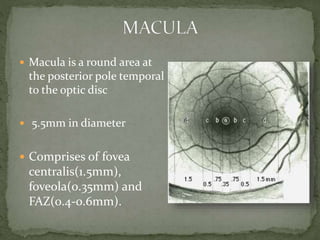
 Macula is a round area at
the posterior pole temporal
to the optic disc
 5.5mm in diameter
 Comprises of fovea
centralis(1.5mm),
foveola(0.35mm) and
FAZ(0.4-0.6mm).
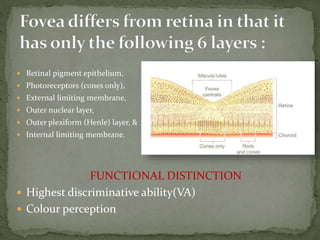
 Retinal pigment epithelium,
 Photoreceptors (cones only),
 External limiting membrane,
 Outer nuclear layer,
 Outer plexiform (Henle) layer, &
 Internal limiting membrane.
FUNCTIONAL DISTINCTION
 Highest discriminative ability(VA)
 Colour perception
 Diagnosis and Follow up of macular diseases
 For evaluating the potential macular function in eyes
with opaque media such as cataract and dense vitreous
hemorrhage
Uses of macular function tests
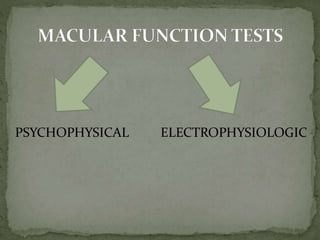
PSYCHOPHYSICAL ELECTROPHYSIOLOGIC
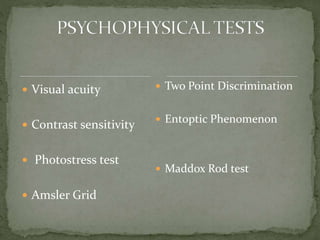
 Visual acuity
 Contrast sensitivity
 Photostress test
 Amsler Grid
 Two Point Discrimination
 Entoptic Phenomenon
 Maddox Rod test
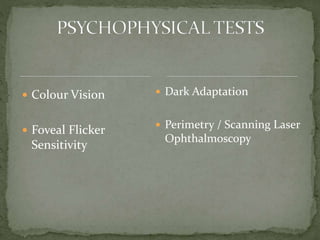
 Colour Vision
 Foveal Flicker
Sensitivity
 Dark Adaptation
 Perimetry / Scanning Laser
Ophthalmoscopy
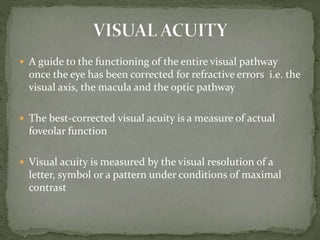
 A guide to the functioning of the entire visual pathway
once the eye has been corrected for refractive errors i.e. the
visual axis, the macula and the optic pathway
 The best-corrected visual acuity is a measure of actual
foveolar function
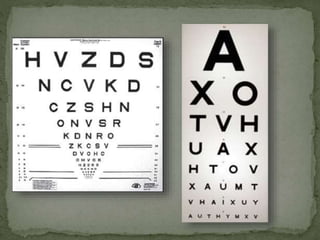
 Visual acuity is measured by the visual resolution of a
letter, symbol or a pattern under conditions of maximal
contrast
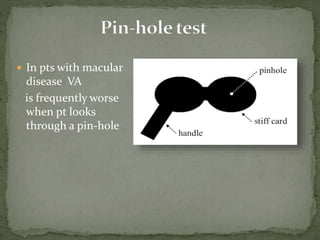
 In pts with macular
disease VA
is frequently worse
when pt looks
through a pin-hole
 Usually normal in eyes with macular diseases
 The defect usually indicates either a lesion of the optic
nerve(APD) or extensive retinal disease
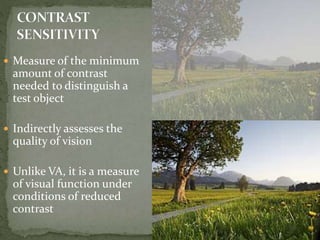
 Measure of the minimum
amount of contrast
needed to distinguish a
test object
 Indirectly assesses the
quality of vision
 Unlike VA, it is a measure
of visual function under
conditions of reduced
contrast
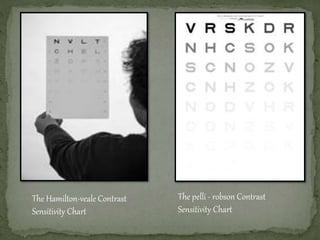
The Hamilton-veale Contrast
Sensitivity Chart
The pelli - robson Contrast
Sensitivity Chart
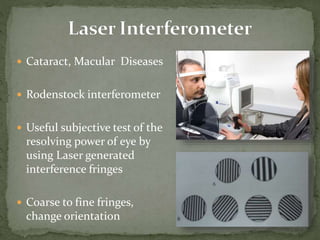
 Cataract, Macular Diseases
 Rodenstock interferometer
 Useful subjective test of the
resolving power of eye by
using Laser generated
interference fringes
 Coarse to fine fringes,
change orientation
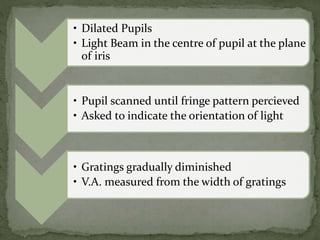
• Dilated Pupils
• Light Beam in the centre of pupil at the plane
of iris
• Pupil scanned until fringe pattern percieved
• Asked to indicate the orientation of light
• Gratings gradually diminished
• V.A. measured from the width of gratings
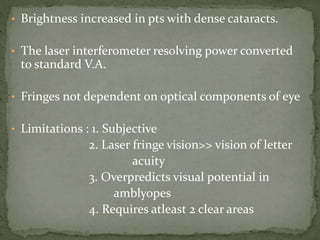
• Brightness increased in pts with dense cataracts.
• The laser interferometer resolving power converted
to standard V.A.
• Fringes not dependent on optical components of eye
• Limitations : 1. Subjective
2. Laser fringe vision>> vision of letter
acuity
3. Overpredicts visual potential in
amblyopes
4. Requires atleast 2 clear areas
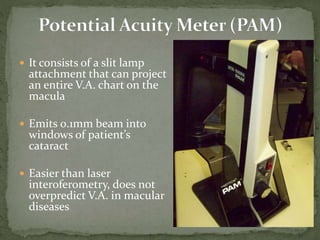
 It consists of a slit lamp
attachment that can project
an entire V.A. chart on the
macula
 Emits 0.1mm beam into
windows of patient’s
cataract
 Easier than laser
interoferometry, does not
overpredict V.A. in macular
diseases
PRINCIPLE
 The test involves exposing the macula to a light source
bright enough to bleach a significant proportion of the
visual pigments
 Return of normal retinal function and sensitivity
depends on the regeneration of the visual pigments
 The patient's pre-stress BCVA is noted
 Occlude one eye while the other eye is subjected to a
bright light from indirect ophthalmoscope light
held 3cm away for 10 seconds
 Photostress recovery time (PSRT) estimated
 Normal PSRT ranges from 8-70 seconds
1. To quantify subtle maculopathies
2. To discriminate between optic neuropathy &
maculopathy
3. To plot the recovery or progression of macular
disease
Often the photostress test will show
changes where other more standard clinical tests
may fail to show any change
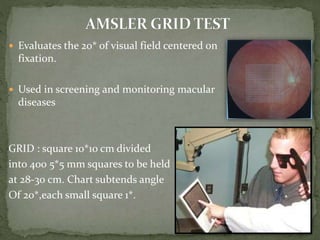
 Evaluates the 20* of visual field centered on
fixation.
 Used in screening and monitoring macular
diseases
GRID : square 10*10 cm divided
into 400 5*5 mm squares to be held
at 28-30 cm. Chart subtends angle
Of 20*,each small square 1*.
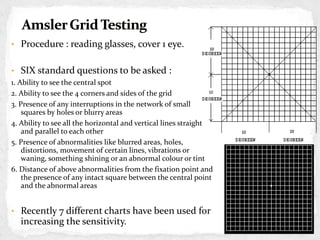
• Procedure : reading glasses, cover 1 eye.
• SIX standard questions to be asked :
1. Ability to see the central spot
2. Ability to see the 4 corners and sides of the grid
3. Presence of any interruptions in the network of small
squares by holes or blurry areas
4. Ability to see all the horizontal and vertical lines straight
and parallel to each other
5. Presence of abnormalities like blurred areas, holes,
distortions, movement of certain lines, vibrations or
waning, something shining or an abnormal colour or tint
6. Distance of above abnormalities from the fixation point and
the presence of any intact square between the central point
and the abnormal areas
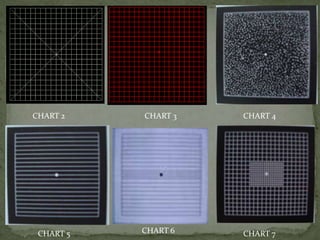
• Recently 7 different charts have been used for
increasing the sensitivity.
CHART 1
CHART 3CHART 2 CHART 4
CHART 5 CHART 6 CHART 7
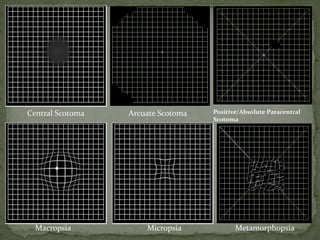
MetamorphopsiaMicropsiaMacropsia
Positive/Absolute Paracentral
Scotoma
Arcuate ScotomaCentral Scotoma
 The central 30-60 degree of visual field processes
trichromatic color vision
 Hereditary dystrophies of posterior pole, non-hereditary
maculopathies & certain optic nerve conditions often
result in acquired color defects
 Congenital: not particularly rare, affect males,
symmetric, involve red-green color & occur as isolated
visual defect
 Acquired: asymmetric, accompanied by other visual
dysfunctions, most commonly show irregularity in color
testing not usually seen in congenital variety. Eg.
 BLUE-YELLOW defect – CSR & RP, or
 RED-GREEN defect – Acquired cone degeneration/optic
neuritis.
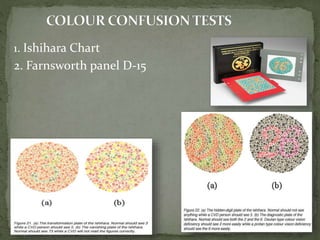
1. Ishihara Chart
2. Farnsworth panel D-15
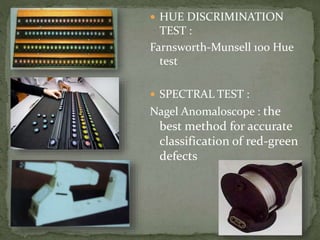
 HUE DISCRIMINATION
TEST :
Farnsworth-Munsell 100 Hue
test
 SPECTRAL TEST :
Nagel Anomaloscope : the
best method for accurate
classification of red-green
defects
 The ability to distinguish two illuminated points of
light suggests good retinal function
 “Rule of 2” : Two illuminated points of 2 mm
diameter size and 2 inches apart are placed 2 feet
away from the patient’s eye. The patient is then
asked to indicate whether he can perceive the two
points separately.
 Visual perceptions that are
produced or influenced by
the native structures of one’s
own eye
 Structures producing – N
anatomic parts/Media
opacities
 Visual elements underlying blood vessels become adapted
to this pattern of illumination
 Focal source (at an unusual angle),pressed firmly against
globe, retinal blood vessel pattern transiently
 Useful in patients with media opacities
 Limitation : intelligent & perceptive patients.
 Series of fast moving, luminous points
or spots seen on looking at a bright and
diffusely illuminated surface with no
contrasting features
 Best seen in background illuminated
by blue light in spectral region of 350-
450nm
 >5 normal
THE BLUE FIELD ENTOPTIC
PHENOMENON
(FLYING SPOTS)
 Abnormal:
(a) failure to see any (b) partial loss in 1 part of the
field, (c) less no.
• More accurate than : Two light discrimination,
color perception &
purkinje vascular entoptic phen.
• Disadvantage : subjective, poorly quantifiable
• D/d : FLOATERS : variable appearance, almost
stationary or drift slowly, dont follow well-defined
paths
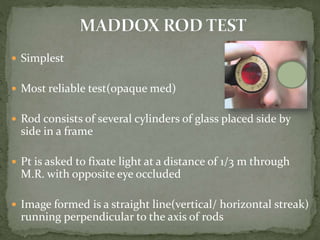
 Simplest
 Most reliable test(opaque med)
 Rod consists of several cylinders of glass placed side by
side in a frame
 Pt is asked to fixate light at a distance of 1/3 m through
M.R. with opposite eye occluded
 Image formed is a straight line(vertical/ horizontal streak)
running perpendicular to the axis of rods
• Any breaks/holes; discoloration/distortion indicates a
macular lesion
• Test various meridians by rotating : may reveal a RD/ a
glaucomatous field defect
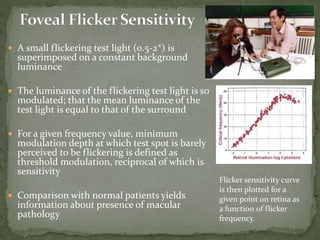
 A small flickering test light (0.5-2*) is
superimposed on a constant background
luminance
 The luminance of the flickering test light is so
modulated; that the mean luminance of the
test light is equal to that of the surround
 For a given frequency value, minimum
modulation depth at which test spot is barely
perceived to be flickering is defined as
threshold modulation, reciprocal of which is
sensitivity
 Comparison with normal patients yields
information about presence of macular
pathology
Flicker sensitivity curve
is then plotted for a
given point on retina as
a function of flicker
frequency.
 Dark adaptation refers to the ability of the visual
system (both rods and cones mechanisms) to recover
sensitivity following exposure to light
 Most primitive model-photometer of Richard Forster
 Hemispherical adaptometers are used nowadays
(Goldman-Weekes by Haag Streit)
 Useful in pts presenting with c/o night blindness as in
hereditary macular degenerations
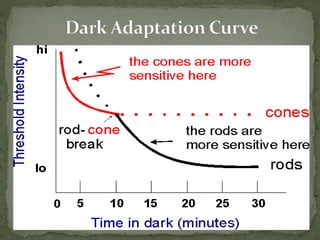
 Normally the whole process of dark adaptation requires
15-30 minutes
 PROCEDURE:
1. Subject exposed to intense light that bleaches
photoreceptors
2. Then Suddenly placed in dark
3. Threshold at which sub just perceives light is plotted
4. Flashes repeated at regular intervals; sensitivity of eye to
light gradually increases
5. By taking a threshold reading every min a curve of
changing threshold Vs time of dark adaptation is
obtained
• Sensitivity curve : a. cone branch
b. rod-cone break
c. rod branch
1. Disorders of pigment degeneration
a. Vitamin A deficiency; b. Fundus albipunctatus
2. Disorders of neural adaptation
3. Chloroquine toxicity
4. Retinitis pigmentosa Type II
5. Tapetoretinal degenerations
6. High myopia
7. Glaucoma
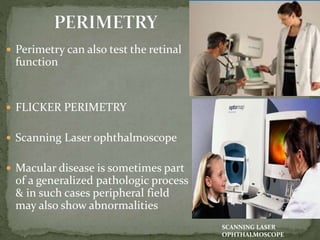
 Perimetry can also test the retinal
function
 FLICKER PERIMETRY
 Scanning Laser ophthalmoscope
 Macular disease is sometimes part
of a generalized pathologic process
& in such cases peripheral field
may also show abnormalities
SCANNING LASER
OPHTHALMOSCOPE
 ELECTRO-RETINOGRAM (E.R.G)
 ELECTRO-OCULOGRAM (E.O.G)
 VISUAL EVOKED POTENTIAL (V.E.P)
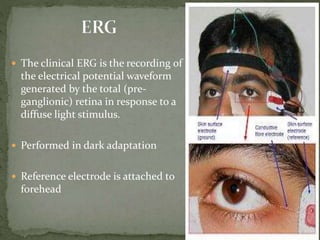
 The clinical ERG is the recording of
the electrical potential waveform
generated by the total (pre-
ganglionic) retina in response to a
diffuse light stimulus.
 Performed in dark adaptation
 Reference electrode is attached to
forehead
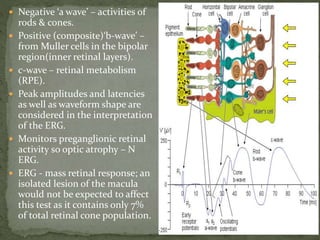
 Negative ‘a wave’ – activities of
rods & cones.
 Positive (composite)‘b-wave’ –
from Muller cells in the bipolar
region(inner retinal layers).
 c-wave – retinal metabolism
(RPE).
 Peak amplitudes and latencies
as well as waveform shape are
considered in the interpretation
of the ERG.
 Monitors preganglionic retinal
activity so optic atrophy – N
ERG.
 ERG - mass retinal response; an
isolated lesion of the macula
would not be expected to affect
this test as it contains only 7%
of total retinal cone population.
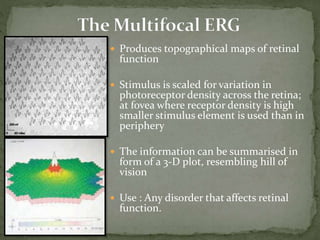
 Produces topographical maps of retinal
function
 Stimulus is scaled for variation in
photoreceptor density across the retina;
at fovea where receptor density is high
smaller stimulus element is used than in
periphery
 The information can be summarised in
form of a 3-D plot, resembling hill of
vision
 Use : Any disorder that affects retinal
function.
1. Vitamin A deficiency & xerosis
2. Retinitis pigmentosa & allied diseases e.g.
(a) Congenital Night Blindness
(b) Oguchi's Disease
(c) Retinitis punctate albicans
3. Prognosis in Cataract
4. Prognosis in Glaucoma
5. Detachment of retina
6. Systemic & retinal vascular conditions
7. Macular diseases
8. Malingering
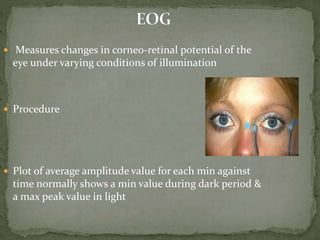
 Measures changes in corneo-retinal potential of the
eye under varying conditions of illumination
 Procedure
 Plot of average amplitude value for each min against
time normally shows a min value during dark period &
a max peak value in light
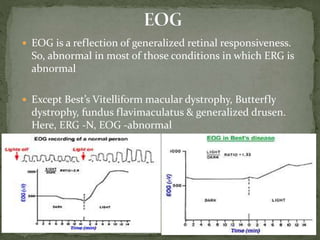
 EOG is a reflection of generalized retinal responsiveness.
So, abnormal in most of those conditions in which ERG is
abnormal
 Except Best’s Vitelliform macular dystrophy, Butterfly
dystrophy, fundus flavimaculatus & generalized drusen.
Here, ERG -N, EOG -abnormal
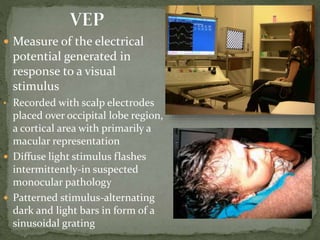
 Measure of the electrical
potential generated in
response to a visual
stimulus
• Recorded with scalp electrodes
placed over occipital lobe region,
a cortical area with primarily a
macular representation
 Diffuse light stimulus flashes
intermittently-in suspected
monocular pathology
 Patterned stimulus-alternating
dark and light bars in form of a
sinusoidal grating
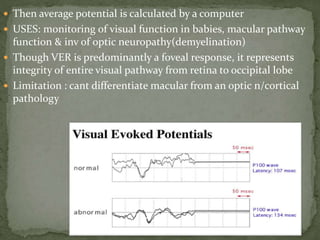
 Then average potential is calculated by a computer
 USES: monitoring of visual function in babies, macular pathway
function & inv of optic neuropathy(demyelination)
 Though VER is predominantly a foveal response, it represents
integrity of entire visual pathway from retina to occipital lobe
 Limitation : cant differentiate macular from an optic n/cortical
pathology
Macular Function Tests

Macular Function Tests

  • 1.
    Moderator : Dr.Vivek Kumar
  • 2.
     Macula isa round area at the posterior pole temporal to the optic disc  5.5mm in diameter  Comprises of fovea centralis(1.5mm), foveola(0.35mm) and FAZ(0.4-0.6mm).
  • 3.
     Retinal pigmentepithelium,  Photoreceptors (cones only),  External limiting membrane,  Outer nuclear layer,  Outer plexiform (Henle) layer, &  Internal limiting membrane. FUNCTIONAL DISTINCTION  Highest discriminative ability(VA)  Colour perception
  • 4.
     Diagnosis andFollow up of macular diseases  For evaluating the potential macular function in eyes with opaque media such as cataract and dense vitreous hemorrhage Uses of macular function tests
  • 5.
  • 6.
     Visual acuity Contrast sensitivity  Photostress test  Amsler Grid  Two Point Discrimination  Entoptic Phenomenon  Maddox Rod test
  • 7.
     Colour Vision Foveal Flicker Sensitivity  Dark Adaptation  Perimetry / Scanning Laser Ophthalmoscopy
  • 8.
     A guideto the functioning of the entire visual pathway once the eye has been corrected for refractive errors i.e. the visual axis, the macula and the optic pathway  The best-corrected visual acuity is a measure of actual foveolar function  Visual acuity is measured by the visual resolution of a letter, symbol or a pattern under conditions of maximal contrast
  • 10.
     In ptswith macular disease VA is frequently worse when pt looks through a pin-hole
  • 11.
     Usually normalin eyes with macular diseases  The defect usually indicates either a lesion of the optic nerve(APD) or extensive retinal disease
  • 12.
     Measure ofthe minimum amount of contrast needed to distinguish a test object  Indirectly assesses the quality of vision  Unlike VA, it is a measure of visual function under conditions of reduced contrast
  • 13.
    The Hamilton-veale Contrast SensitivityChart The pelli - robson Contrast Sensitivity Chart
  • 14.
     Cataract, MacularDiseases  Rodenstock interferometer  Useful subjective test of the resolving power of eye by using Laser generated interference fringes  Coarse to fine fringes, change orientation
  • 15.
    • Dilated Pupils •Light Beam in the centre of pupil at the plane of iris • Pupil scanned until fringe pattern percieved • Asked to indicate the orientation of light • Gratings gradually diminished • V.A. measured from the width of gratings
  • 16.
    • Brightness increasedin pts with dense cataracts. • The laser interferometer resolving power converted to standard V.A. • Fringes not dependent on optical components of eye • Limitations : 1. Subjective 2. Laser fringe vision>> vision of letter acuity 3. Overpredicts visual potential in amblyopes 4. Requires atleast 2 clear areas
  • 17.
     It consistsof a slit lamp attachment that can project an entire V.A. chart on the macula  Emits 0.1mm beam into windows of patient’s cataract  Easier than laser interoferometry, does not overpredict V.A. in macular diseases
  • 18.
    PRINCIPLE  The testinvolves exposing the macula to a light source bright enough to bleach a significant proportion of the visual pigments  Return of normal retinal function and sensitivity depends on the regeneration of the visual pigments
  • 19.
     The patient'spre-stress BCVA is noted  Occlude one eye while the other eye is subjected to a bright light from indirect ophthalmoscope light held 3cm away for 10 seconds  Photostress recovery time (PSRT) estimated  Normal PSRT ranges from 8-70 seconds
  • 20.
    1. To quantifysubtle maculopathies 2. To discriminate between optic neuropathy & maculopathy 3. To plot the recovery or progression of macular disease Often the photostress test will show changes where other more standard clinical tests may fail to show any change
  • 21.
     Evaluates the20* of visual field centered on fixation.  Used in screening and monitoring macular diseases GRID : square 10*10 cm divided into 400 5*5 mm squares to be held at 28-30 cm. Chart subtends angle Of 20*,each small square 1*.
  • 22.
    • Procedure :reading glasses, cover 1 eye. • SIX standard questions to be asked : 1. Ability to see the central spot 2. Ability to see the 4 corners and sides of the grid 3. Presence of any interruptions in the network of small squares by holes or blurry areas 4. Ability to see all the horizontal and vertical lines straight and parallel to each other 5. Presence of abnormalities like blurred areas, holes, distortions, movement of certain lines, vibrations or waning, something shining or an abnormal colour or tint 6. Distance of above abnormalities from the fixation point and the presence of any intact square between the central point and the abnormal areas • Recently 7 different charts have been used for increasing the sensitivity. CHART 1
  • 23.
    CHART 3CHART 2CHART 4 CHART 5 CHART 6 CHART 7
  • 24.
  • 25.
     The central30-60 degree of visual field processes trichromatic color vision  Hereditary dystrophies of posterior pole, non-hereditary maculopathies & certain optic nerve conditions often result in acquired color defects  Congenital: not particularly rare, affect males, symmetric, involve red-green color & occur as isolated visual defect
  • 26.
     Acquired: asymmetric,accompanied by other visual dysfunctions, most commonly show irregularity in color testing not usually seen in congenital variety. Eg.  BLUE-YELLOW defect – CSR & RP, or  RED-GREEN defect – Acquired cone degeneration/optic neuritis.
  • 27.
    1. Ishihara Chart 2.Farnsworth panel D-15
  • 28.
     HUE DISCRIMINATION TEST: Farnsworth-Munsell 100 Hue test  SPECTRAL TEST : Nagel Anomaloscope : the best method for accurate classification of red-green defects
  • 29.
     The abilityto distinguish two illuminated points of light suggests good retinal function  “Rule of 2” : Two illuminated points of 2 mm diameter size and 2 inches apart are placed 2 feet away from the patient’s eye. The patient is then asked to indicate whether he can perceive the two points separately.
  • 30.
     Visual perceptionsthat are produced or influenced by the native structures of one’s own eye  Structures producing – N anatomic parts/Media opacities
  • 31.
     Visual elementsunderlying blood vessels become adapted to this pattern of illumination  Focal source (at an unusual angle),pressed firmly against globe, retinal blood vessel pattern transiently  Useful in patients with media opacities  Limitation : intelligent & perceptive patients.
  • 32.
     Series offast moving, luminous points or spots seen on looking at a bright and diffusely illuminated surface with no contrasting features  Best seen in background illuminated by blue light in spectral region of 350- 450nm  >5 normal THE BLUE FIELD ENTOPTIC PHENOMENON (FLYING SPOTS)
  • 33.
     Abnormal: (a) failureto see any (b) partial loss in 1 part of the field, (c) less no. • More accurate than : Two light discrimination, color perception & purkinje vascular entoptic phen. • Disadvantage : subjective, poorly quantifiable • D/d : FLOATERS : variable appearance, almost stationary or drift slowly, dont follow well-defined paths
  • 34.
     Simplest  Mostreliable test(opaque med)  Rod consists of several cylinders of glass placed side by side in a frame  Pt is asked to fixate light at a distance of 1/3 m through M.R. with opposite eye occluded  Image formed is a straight line(vertical/ horizontal streak) running perpendicular to the axis of rods
  • 35.
    • Any breaks/holes;discoloration/distortion indicates a macular lesion • Test various meridians by rotating : may reveal a RD/ a glaucomatous field defect
  • 36.
     A smallflickering test light (0.5-2*) is superimposed on a constant background luminance  The luminance of the flickering test light is so modulated; that the mean luminance of the test light is equal to that of the surround  For a given frequency value, minimum modulation depth at which test spot is barely perceived to be flickering is defined as threshold modulation, reciprocal of which is sensitivity  Comparison with normal patients yields information about presence of macular pathology Flicker sensitivity curve is then plotted for a given point on retina as a function of flicker frequency.
  • 37.
     Dark adaptationrefers to the ability of the visual system (both rods and cones mechanisms) to recover sensitivity following exposure to light  Most primitive model-photometer of Richard Forster  Hemispherical adaptometers are used nowadays (Goldman-Weekes by Haag Streit)  Useful in pts presenting with c/o night blindness as in hereditary macular degenerations  Normally the whole process of dark adaptation requires 15-30 minutes
  • 38.
     PROCEDURE: 1. Subjectexposed to intense light that bleaches photoreceptors 2. Then Suddenly placed in dark 3. Threshold at which sub just perceives light is plotted 4. Flashes repeated at regular intervals; sensitivity of eye to light gradually increases 5. By taking a threshold reading every min a curve of changing threshold Vs time of dark adaptation is obtained • Sensitivity curve : a. cone branch b. rod-cone break c. rod branch
  • 40.
    1. Disorders ofpigment degeneration a. Vitamin A deficiency; b. Fundus albipunctatus 2. Disorders of neural adaptation 3. Chloroquine toxicity 4. Retinitis pigmentosa Type II 5. Tapetoretinal degenerations 6. High myopia 7. Glaucoma
  • 41.
     Perimetry canalso test the retinal function  FLICKER PERIMETRY  Scanning Laser ophthalmoscope  Macular disease is sometimes part of a generalized pathologic process & in such cases peripheral field may also show abnormalities SCANNING LASER OPHTHALMOSCOPE
  • 42.
     ELECTRO-RETINOGRAM (E.R.G) ELECTRO-OCULOGRAM (E.O.G)  VISUAL EVOKED POTENTIAL (V.E.P)
  • 43.
     The clinicalERG is the recording of the electrical potential waveform generated by the total (pre- ganglionic) retina in response to a diffuse light stimulus.  Performed in dark adaptation  Reference electrode is attached to forehead
  • 44.
     Negative ‘awave’ – activities of rods & cones.  Positive (composite)‘b-wave’ – from Muller cells in the bipolar region(inner retinal layers).  c-wave – retinal metabolism (RPE).  Peak amplitudes and latencies as well as waveform shape are considered in the interpretation of the ERG.  Monitors preganglionic retinal activity so optic atrophy – N ERG.  ERG - mass retinal response; an isolated lesion of the macula would not be expected to affect this test as it contains only 7% of total retinal cone population.
  • 45.
     Produces topographicalmaps of retinal function  Stimulus is scaled for variation in photoreceptor density across the retina; at fovea where receptor density is high smaller stimulus element is used than in periphery  The information can be summarised in form of a 3-D plot, resembling hill of vision  Use : Any disorder that affects retinal function.
  • 46.
    1. Vitamin Adeficiency & xerosis 2. Retinitis pigmentosa & allied diseases e.g. (a) Congenital Night Blindness (b) Oguchi's Disease (c) Retinitis punctate albicans 3. Prognosis in Cataract 4. Prognosis in Glaucoma 5. Detachment of retina 6. Systemic & retinal vascular conditions 7. Macular diseases 8. Malingering
  • 47.
     Measures changesin corneo-retinal potential of the eye under varying conditions of illumination  Procedure  Plot of average amplitude value for each min against time normally shows a min value during dark period & a max peak value in light
  • 48.
     EOG isa reflection of generalized retinal responsiveness. So, abnormal in most of those conditions in which ERG is abnormal  Except Best’s Vitelliform macular dystrophy, Butterfly dystrophy, fundus flavimaculatus & generalized drusen. Here, ERG -N, EOG -abnormal
  • 49.
     Measure ofthe electrical potential generated in response to a visual stimulus • Recorded with scalp electrodes placed over occipital lobe region, a cortical area with primarily a macular representation  Diffuse light stimulus flashes intermittently-in suspected monocular pathology  Patterned stimulus-alternating dark and light bars in form of a sinusoidal grating
  • 50.
     Then averagepotential is calculated by a computer  USES: monitoring of visual function in babies, macular pathway function & inv of optic neuropathy(demyelination)  Though VER is predominantly a foveal response, it represents integrity of entire visual pathway from retina to occipital lobe  Limitation : cant differentiate macular from an optic n/cortical pathology

Editor's Notes