MACULAR
FUNCTION
TESTS
DR.ANKITA MAHAPATRA
2ND YR PG RESIDENT
DEPARTMENT OF OPHTHALMOLOGY
MACULA
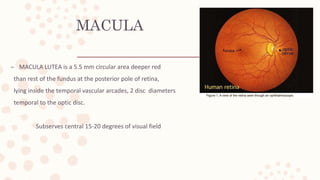
– MACULA LUTEA is a 5.5 mm circular area deeper red
than rest of the fundus at the posterior pole of retina,
lying inside the temporal vascular arcades, 2 disc diameters
temporal to the optic disc.
Subserves central 15-20 degrees of visual field

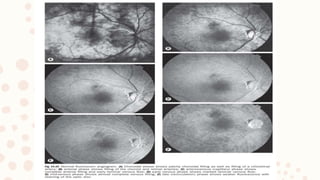
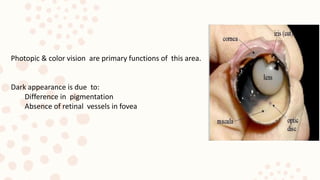
Photopic & color vision are primary functions of this area.
Dark appearance is due to:
Difference in pigmentation
Absence of retinal vessels in fovea
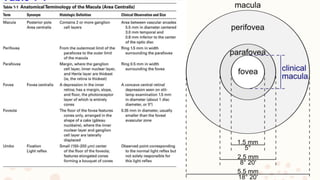
Macula lutea can be divisible into:
Umbo
Foveola
Fovea
Perifoveal region
Parafoveal region
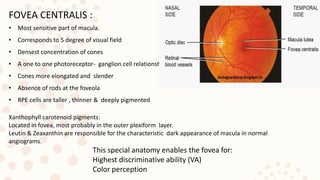
FOVEA CENTRALIS :
• Most sensitive part of macula.
• Corresponds to 5 degree of visual field
• Densest concentration of cones
• A one to one photoreceptor- ganglion cell relationship
• Cones more elongated and slender
• Absence of rods at the foveola
• RPE cells are taller , thinner & deeply pigmented
Xanthophyll carotenoid pigments:
Located in fovea, most probably in the outer plexiform layer.
Leutin & Zeaxanthin are responsible for the characteristic dark appearance of macula in normal
angiograms.
This special anatomy enables the fovea for:
Highest discriminative ability (VA)
Color perception
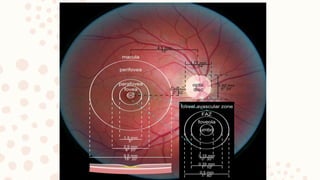
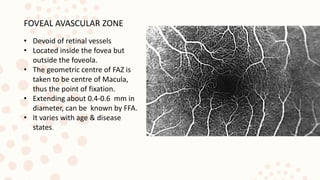
FOVEAL AVASCULAR ZONE
• Devoid of retinal vessels
• Located inside the fovea but
outside the foveola.
• The geometric centre of FAZ is
taken to be centre of Macula,
thus the point of fixation.
• Extending about 0.4-0.6 mm in
diameter, can be known by FFA.
• It varies with age & disease
states.
• Supplied by small twigs of superior and inferior temporal
branches of central retinal artery.
• Cilioretinal artery (branch from ciliary system) occasionally is
seen originating in a hook shape within temporal margin of
disc.
• APPLIED: When present there is retention of central vision in
CRAO.
• Outer 4 layers : Choriocapillaries
• Inner 6 layers : Central Retinal Artery
BLOOD SUPPLY :
MACULAR FUNCTION TEST
Used for :
– Diagnosis & follow up of macular diseases.
– For evaluating the potential macular function in eyes with opaque media such
as cataract and dense vitreous hemorrhage.
CLINICAL ASSESSMENT OF THE
MACULA
SYMPTOMS :
– Central vision impairment
– Metamorphopsia
– Micropsia
– Macropsia
MACULAR
FUNCTION TEST
WITH CLEAR
MEDIA
WITH OPAQUE
MEDIA
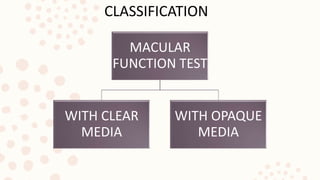
CLASSIFICATION
MFT WITH CLEAR MEDIA
1. Visual Acuity
2. Contrast Sensitivity
3. Slit lamp biomicroscopy
4. Photostress test
5. Colour Vision
6. Amsler grid
7. Two point discrimination
8. Microperimetry
9. FFA
10. OCT
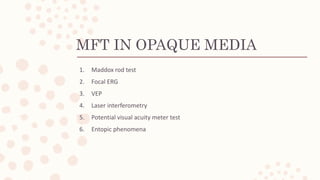
MFT IN OPAQUE MEDIA
1. Maddox rod test
2. Focal ERG
3. VEP
4. Laser interferometry
5. Potential visual acuity meter test
6. Entopic phenomena
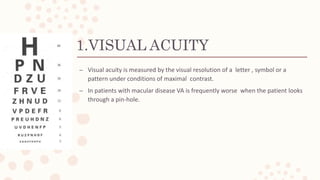
1.VISUAL ACUITY
– Visual acuity is measured by the visual resolution of a letter , symbol or a
pattern under conditions of maximal contrast.
– In patients with macular disease VA is frequently worse when the patient looks
through a pin-hole.
2.Contrast sensitivity
– Contrast sensitivity is a measure of the minimum amount of contrast needed to
distinguish a test object.
– Indirectly assesses the quality of vision.
– Can detect early/subtle visual loss when VA is normal
– USES: To detect retinal conditions like DR, ARMD , Retinitis pigmentosa, CSR,
Glaucoma, Optic neuritis
Optical conditions like refractive error, refractive surgery, cataract and
intraocular lens implantation and normal aging of the eye.
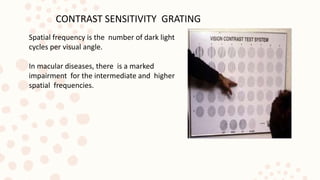
CONTRAST SENSITIVITY GRATING
Spatial frequency is the number of dark light
cycles per visual angle.
In macular diseases, there is a marked
impairment for the intermediate and higher
spatial frequencies.
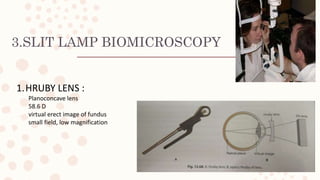
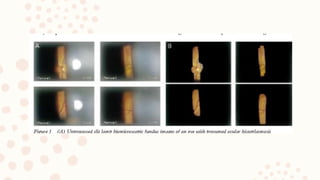
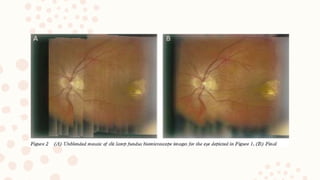
3.SLIT LAMP BIOMICROSCOPY
1.HRUBY LENS :
Planoconcave lens
58.6 D
virtual erect image of fundus
small field, low magnification
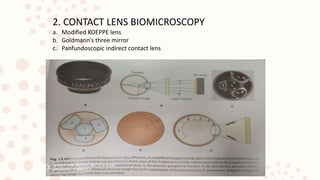
2. CONTACT LENS BIOMICROSCOPY
a. Modified KOEPPE lens
b. Goldmann’s three mirror
c. Panfundoscopic indirect contact lens
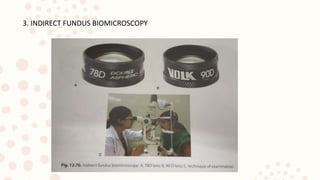
3. INDIRECT FUNDUS BIOMICROSCOPY
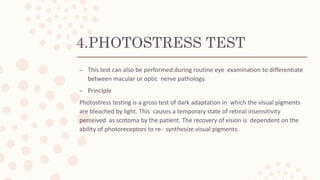
4.PHOTOSTRESS TEST
– This test can also be performed during routine eye examination to differentiate
between macular or optic nerve pathology.
– Principle
Photostress testing is a gross test of dark adaptation in which the visual pigments
are bleached by light. This causes a temporary state of retinal insensitivity
perceived as scotoma by the patient. The recovery of vision is dependent on the
ability of photoreceptors to re- synthesize visual pigments.
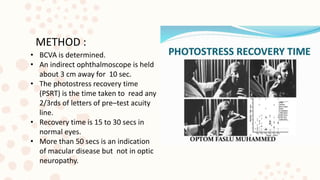
• BCVA is determined.
• An indirect ophthalmoscope is held
about 3 cm away for 10 sec.
• The photostress recovery time
(PSRT) is the time taken to read any
2/3rds of letters of pre–test acuity
line.
• Recovery time is 15 to 30 secs in
normal eyes.
• More than 50 secs is an indication
of macular disease but not in optic
neuropathy.
METHOD :
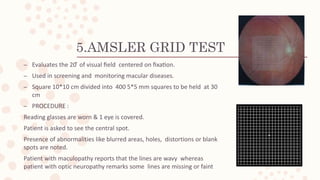
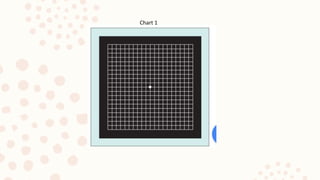
5.AMSLER GRID TEST
– Evaluates the 20 ̊ of visual field centered on fixation.
– Used in screening and monitoring macular diseases.
– Square 10*10 cm divided into 400 5*5 mm squares to be held at 30
cm
– PROCEDURE :
Reading glasses are worn & 1 eye is covered.
Patient is asked to see the central spot.
Presence of abnormalities like blurred areas, holes, distortions or blank
spots are noted.
Patient with maculopathy reports that the lines are wavy whereas
patient with optic neuropathy remarks some lines are missing or faint
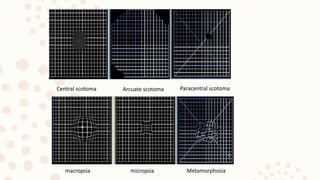
Central scotoma Arcuate scotoma Paracentral scotoma
macropsia micropsia Metamorphosia
Chart 1
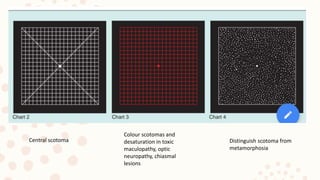
Central scotoma
Colour scotomas and
desaturation in toxic
maculopathy, optic
neuropathy, chiasmal
lesions
Distinguish scotoma from
metamorphosia
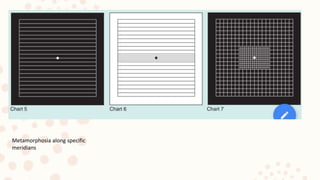
Metamorphosia along specific
meridians
6.TWO POINT DISCRIMINATION
– This test gives an idea about the macular function.
– The patient is asked to look through an opaque disc perforated with two
pinholes (2 mm diameter) behind which a light is held. The holes are 2 inches
apart and are held 2 feet away from the eye.
– If the patient can perceive two lights, it indicates normal macular function.
7.COLOUR VISION
– Colour vision is the function of three populations of retinal cones.
– Blue ( tritan) 414-424 nm
– Green ( deuteran) 522-539nm
– Red (protan) 549-570nm
– Normal person possess all these three cones and called trichromat
– Acquired macular diseases tends to produce blue yellow defects and optic nerve
lesions red green defects.
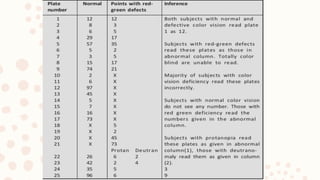
– Deutran anomaly is the most common and those subjects can not differentiate
between red and green colours
TESTS :
1. Pseudo-isochromatic chart test
2. The Lantern Test
3. Farnsworth-Munsell 100 hue test
4. City university colour vision test
5. Nagel’s anomaloscope test
Of these the pseudo-isochromatic chart test is most
widely and frequently used.
8.MICROPERIMETRY
– The principle of microperimetry rests on the possibility to see —in real time—
the retina under examination (by infrared light) and to project a defined light
stimulus over an individual, selected location.
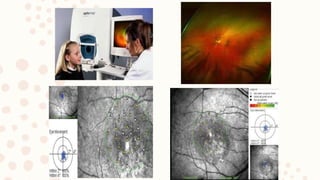
– SLO Microperimetry was the first technique which allowed to obtain a
fundus-related sensitivity map.
– It uses a near infrared diode laser (675nm) beam that rapidly scans the
posterior pole.
– The reflected light is detected by a confocal photodiode and the digitized image
is stored in a computer.
LIMITATIONS :
• SLO fundus perimeter did notallow to perform fully automatic examination.
• Automatic follow-up examination to evaluate exactly the same retinal points tested
during baseline microperimetry was not available with this instrument.
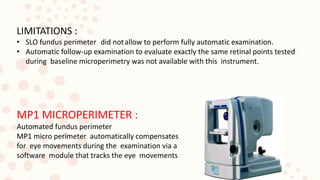
MP1 MICROPERIMETER :
Automated fundus perimeter
MP1 micro perimeter automatically compensates
for eye movements during the examination via a
software module that tracks the eye movements
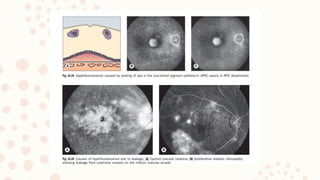
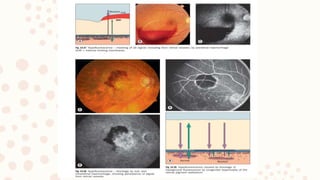
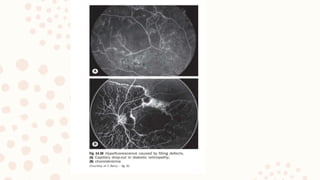
9.FLUORESCEIN ANGIOGRAPHY
FFA is a very useful tool in diagnosing macular disorders
– e.g. diabetic maculopathy, CSR and can reveal the functionality of the lesion
e.g. ischemic maculopathy
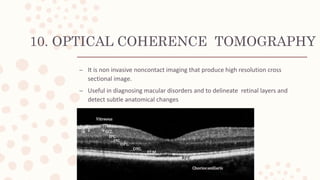
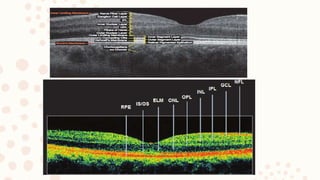
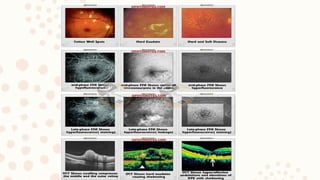
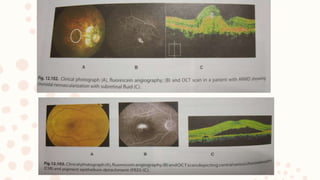
10. OPTICAL COHERENCE TOMOGRAPHY
– It is non invasive noncontact imaging that produce high resolution cross
sectional image.
– Useful in diagnosing macular disorders and to delineate retinal layers and
detect subtle anatomical changes
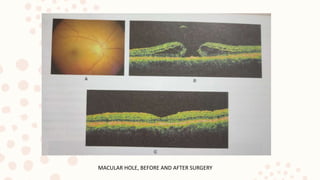
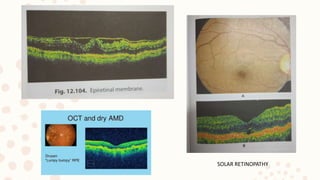
MACULAR HOLE, BEFORE AND AFTER SURGERY
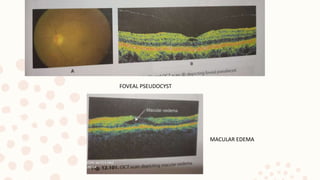
FOVEAL PSEUDOCYST
MACULAR EDEMA
SOLAR RETINOPATHY
MFT IN OPAQUE
MEDIA
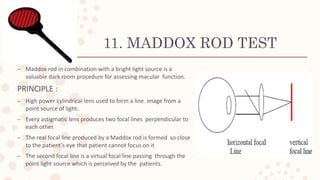
11. MADDOX ROD TEST
– Maddox rod in combination with a bright light source is a
valuable dark room procedure for assessing macular function.
PRINCIPLE :
– High power cylindrical lens used to form a line image from a
point source of light.
– Every astigmatic lens produces two focal lines perpendicular to
each other.
– The real focal line produced by a Maddox rod is formed so close
to the patient’s eye that patient cannot focus on it
– The second focal line is a virtual focal line passing through the
point light source which is perceived by the patients.
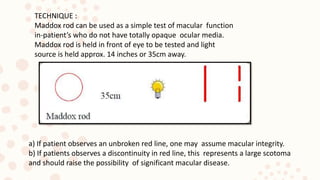
TECHNIQUE :
Maddox rod can be used as a simple test of macular function
in-patient’s who do not have totally opaque ocular media.
Maddox rod is held in front of eye to be tested and light
source is held approx. 14 inches or 35cm away.
a) If patient observes an unbroken red line, one may assume macular integrity.
b) If patients observes a discontinuity in red line, this represents a large scotoma
and should raise the possibility of significant macular disease.
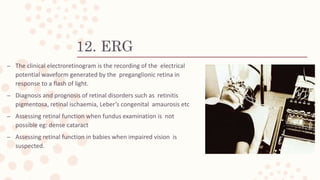
12. ERG
– The clinical electroretinogram is the recording of the electrical
potential waveform generated by the preganglionic retina in
response to a flash of light.
– Diagnosis and prognosis of retinal disorders such as retinitis
pigmentosa, retinal ischaemia, Leber’s congenital amaurosis etc
– Assessing retinal function when fundus examination is not
possible eg: dense cataract
– Assessing retinal function in babies when impaired vision is
suspected.
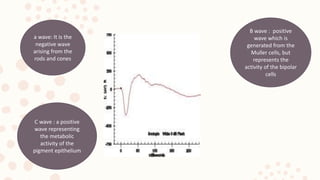
a wave: It is the
negative wave
arising from the
rods and cones
B wave : positive
wave which is
generated from the
Muller cells, but
represents the
activity of the bipolar
cells
C wave : a positive
wave representing
the metabolic
activity of the
pigment epithelium
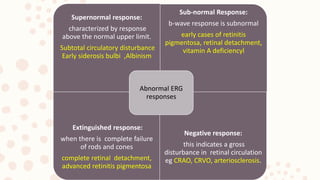
Supernormal response:
characterized by response
above the normal upper limit.
Subtotal circulatory disturbance
Early siderosis bulbi ,Albinism
Sub-normal Response:
b-wave response is subnormal
early cases of retinitis
pigmentosa, retinal detachment,
vitamin A deficiencyl
Extinguished response:
when there is complete failure
of rods and cones
complete retinal detachment,
advanced retinitis pigmentosa
Negative response:
this indicates a gross
disturbance in retinal circulation
eg CRAO, CRVO, arteriosclerosis.
Abnormal ERG
responses
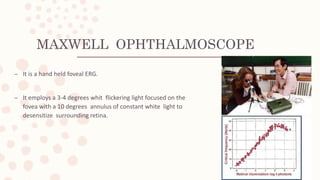
MAXWELL OPHTHALMOSCOPE
– It is a hand held foveal ERG.
– It employs a 3-4 degrees whit flickering light focused on the
fovea with a 10 degrees annulus of constant white light to
desensitize surrounding retina.
13. VEP
– VEP is a measure of the electrical potential generated in response to a visual
stimulus.
– It represents integrity of entire visual pathway from retina to occipital lobe so
can not differentiate between macula,ON and cortical pathology.
– Two types of stimulus either by flash of light or by patterned stimuli .
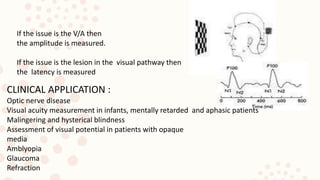
If the issue is the V/A then
the amplitude is measured.
If the issue is the lesion in the visual pathway then
the latency is measured
CLINICAL APPLICATION :
Optic nerve disease
Visual acuity measurement in infants, mentally retarded and aphasic patients
Malingering and hysterical blindness
Assessment of visual potential in patients with opaque
media
Amblyopia
Glaucoma
Refraction
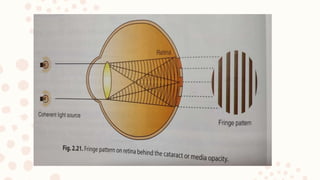
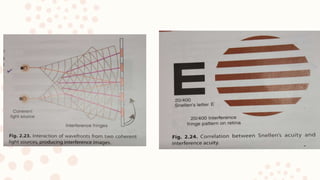
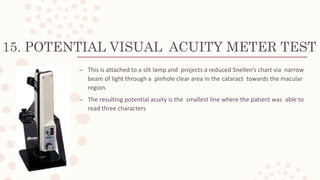
14. LASER INTERFEROMETRY
– Utilizes coherent white light or helium-neon laser generated interference
stripes or fringes that are projected onto the retina through the ocular media.
– Brightness is increased in patients with dense cataracts.
– The laser interferometer resolving power is converted to standard visual acuity.
– LIMITATIONS :
1. Subjective.
2. Laser fringe vision>vision of letter acuity.
3. Over predicts visual potential in amblyopes
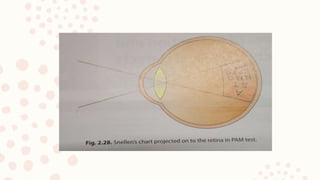
15. POTENTIAL VISUAL ACUITY METER TEST
– This is attached to a slit lamp and projects a reduced Snellen’s chart via narrow
beam of light through a pinhole clear area in the cataract towards the macular
region.
– The resulting potential acuity is the smallest line where the patient was able to
read three characters
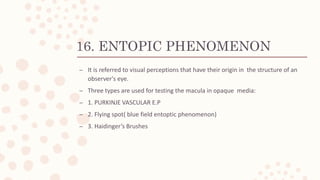
16. ENTOPIC PHENOMENON
– It is referred to visual perceptions that have their origin in the structure of an
observer's eye.
– Three types are used for testing the macula in opaque media:
– 1. PURKINJE VASCULAR E.P
– 2. Flying spot( blue field entoptic phenomenon)
– 3. Haidinger’s Brushes
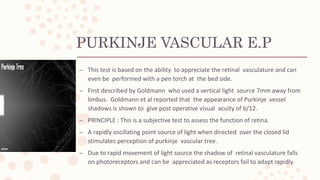
PURKINJE VASCULAR E.P
– This test is based on the ability to appreciate the retinal vasculature and can
even be performed with a pen torch at the bed side.
– First described by Goldmann who used a vertical light source 7mm away from
limbus. Goldmann et al reported that the appearance of Purkinje vessel
shadows is shown to give post operative visual acuity of 6/12.
– PRINCIPLE : This is a subjective test to assess the function of retina.
– A rapidly oscillating point source of light when directed over the closed lid
stimulates perception of purkinje vascular tree.
– Due to rapid movement of light source the shadow of retinal vasculature falls
on photoreceptors and can be appreciated as receptors fail to adapt rapidly.
METHODS :
This test is useful in comparing two eyes of one patient.
The involved eye with opaque media is compared with assumed
normal eye.
The patient’s ability to detect shadow images of the retinal
vasculature provides a rough indication of attached retina.
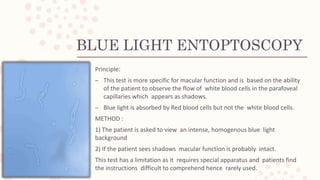
BLUE LIGHT ENTOPTOSCOPY
Principle:
– This test is more specific for macular function and is based on the ability
of the patient to observe the flow of white blood cells in the parafoveal
capillaries which appears as shadows.
– Blue light is absorbed by Red blood cells but not the white blood cells.
METHOD :
1) The patient is asked to view an intense, homogenous blue light
background
2) If the patient sees shadows macular function is probably intact.
This test has a limitation as it requires special apparatus and patients find
the instructions difficult to comprehend hence rarely used.
THANK
YOU

Macular function test

  • 1.
    MACULAR FUNCTION TESTS DR.ANKITA MAHAPATRA 2ND YRPG RESIDENT DEPARTMENT OF OPHTHALMOLOGY
  • 2.
    MACULA – MACULA LUTEAis a 5.5 mm circular area deeper red than rest of the fundus at the posterior pole of retina, lying inside the temporal vascular arcades, 2 disc diameters temporal to the optic disc. Subserves central 15-20 degrees of visual field
  • 3.
    Photopic & colorvision are primary functions of this area. Dark appearance is due to: Difference in pigmentation Absence of retinal vessels in fovea
  • 4.
    Macula lutea canbe divisible into: Umbo Foveola Fovea Perifoveal region Parafoveal region
  • 6.
    FOVEA CENTRALIS : •Most sensitive part of macula. • Corresponds to 5 degree of visual field • Densest concentration of cones • A one to one photoreceptor- ganglion cell relationship • Cones more elongated and slender • Absence of rods at the foveola • RPE cells are taller , thinner & deeply pigmented Xanthophyll carotenoid pigments: Located in fovea, most probably in the outer plexiform layer. Leutin & Zeaxanthin are responsible for the characteristic dark appearance of macula in normal angiograms. This special anatomy enables the fovea for: Highest discriminative ability (VA) Color perception
  • 7.
    FOVEAL AVASCULAR ZONE •Devoid of retinal vessels • Located inside the fovea but outside the foveola. • The geometric centre of FAZ is taken to be centre of Macula, thus the point of fixation. • Extending about 0.4-0.6 mm in diameter, can be known by FFA. • It varies with age & disease states.
  • 8.
    • Supplied bysmall twigs of superior and inferior temporal branches of central retinal artery. • Cilioretinal artery (branch from ciliary system) occasionally is seen originating in a hook shape within temporal margin of disc. • APPLIED: When present there is retention of central vision in CRAO. • Outer 4 layers : Choriocapillaries • Inner 6 layers : Central Retinal Artery BLOOD SUPPLY :
  • 9.
    MACULAR FUNCTION TEST Usedfor : – Diagnosis & follow up of macular diseases. – For evaluating the potential macular function in eyes with opaque media such as cataract and dense vitreous hemorrhage.
  • 10.
    CLINICAL ASSESSMENT OFTHE MACULA SYMPTOMS : – Central vision impairment – Metamorphopsia – Micropsia – Macropsia
  • 11.
  • 12.
    MFT WITH CLEARMEDIA 1. Visual Acuity 2. Contrast Sensitivity 3. Slit lamp biomicroscopy 4. Photostress test 5. Colour Vision 6. Amsler grid 7. Two point discrimination 8. Microperimetry 9. FFA 10. OCT
  • 13.
    MFT IN OPAQUEMEDIA 1. Maddox rod test 2. Focal ERG 3. VEP 4. Laser interferometry 5. Potential visual acuity meter test 6. Entopic phenomena
  • 14.
    1.VISUAL ACUITY – Visualacuity is measured by the visual resolution of a letter , symbol or a pattern under conditions of maximal contrast. – In patients with macular disease VA is frequently worse when the patient looks through a pin-hole.
  • 15.
    2.Contrast sensitivity – Contrastsensitivity is a measure of the minimum amount of contrast needed to distinguish a test object. – Indirectly assesses the quality of vision. – Can detect early/subtle visual loss when VA is normal – USES: To detect retinal conditions like DR, ARMD , Retinitis pigmentosa, CSR, Glaucoma, Optic neuritis Optical conditions like refractive error, refractive surgery, cataract and intraocular lens implantation and normal aging of the eye.
  • 17.
    CONTRAST SENSITIVITY GRATING Spatialfrequency is the number of dark light cycles per visual angle. In macular diseases, there is a marked impairment for the intermediate and higher spatial frequencies.
  • 18.
    3.SLIT LAMP BIOMICROSCOPY 1.HRUBYLENS : Planoconcave lens 58.6 D virtual erect image of fundus small field, low magnification
  • 19.
    2. CONTACT LENSBIOMICROSCOPY a. Modified KOEPPE lens b. Goldmann’s three mirror c. Panfundoscopic indirect contact lens
  • 20.
    3. INDIRECT FUNDUSBIOMICROSCOPY
  • 23.
    4.PHOTOSTRESS TEST – Thistest can also be performed during routine eye examination to differentiate between macular or optic nerve pathology. – Principle Photostress testing is a gross test of dark adaptation in which the visual pigments are bleached by light. This causes a temporary state of retinal insensitivity perceived as scotoma by the patient. The recovery of vision is dependent on the ability of photoreceptors to re- synthesize visual pigments.
  • 24.
    • BCVA isdetermined. • An indirect ophthalmoscope is held about 3 cm away for 10 sec. • The photostress recovery time (PSRT) is the time taken to read any 2/3rds of letters of pre–test acuity line. • Recovery time is 15 to 30 secs in normal eyes. • More than 50 secs is an indication of macular disease but not in optic neuropathy. METHOD :
  • 25.
    5.AMSLER GRID TEST –Evaluates the 20 ̊ of visual field centered on fixation. – Used in screening and monitoring macular diseases. – Square 10*10 cm divided into 400 5*5 mm squares to be held at 30 cm – PROCEDURE : Reading glasses are worn & 1 eye is covered. Patient is asked to see the central spot. Presence of abnormalities like blurred areas, holes, distortions or blank spots are noted. Patient with maculopathy reports that the lines are wavy whereas patient with optic neuropathy remarks some lines are missing or faint
  • 26.
    Central scotoma Arcuatescotoma Paracentral scotoma macropsia micropsia Metamorphosia
  • 27.
  • 28.
    Central scotoma Colour scotomasand desaturation in toxic maculopathy, optic neuropathy, chiasmal lesions Distinguish scotoma from metamorphosia
  • 29.
  • 30.
    6.TWO POINT DISCRIMINATION –This test gives an idea about the macular function. – The patient is asked to look through an opaque disc perforated with two pinholes (2 mm diameter) behind which a light is held. The holes are 2 inches apart and are held 2 feet away from the eye. – If the patient can perceive two lights, it indicates normal macular function.
  • 31.
    7.COLOUR VISION – Colourvision is the function of three populations of retinal cones. – Blue ( tritan) 414-424 nm – Green ( deuteran) 522-539nm – Red (protan) 549-570nm – Normal person possess all these three cones and called trichromat – Acquired macular diseases tends to produce blue yellow defects and optic nerve lesions red green defects. – Deutran anomaly is the most common and those subjects can not differentiate between red and green colours
  • 32.
    TESTS : 1. Pseudo-isochromaticchart test 2. The Lantern Test 3. Farnsworth-Munsell 100 hue test 4. City university colour vision test 5. Nagel’s anomaloscope test Of these the pseudo-isochromatic chart test is most widely and frequently used.
  • 34.
    8.MICROPERIMETRY – The principleof microperimetry rests on the possibility to see —in real time— the retina under examination (by infrared light) and to project a defined light stimulus over an individual, selected location. – SLO Microperimetry was the first technique which allowed to obtain a fundus-related sensitivity map. – It uses a near infrared diode laser (675nm) beam that rapidly scans the posterior pole. – The reflected light is detected by a confocal photodiode and the digitized image is stored in a computer.
  • 36.
    LIMITATIONS : • SLOfundus perimeter did notallow to perform fully automatic examination. • Automatic follow-up examination to evaluate exactly the same retinal points tested during baseline microperimetry was not available with this instrument. MP1 MICROPERIMETER : Automated fundus perimeter MP1 micro perimeter automatically compensates for eye movements during the examination via a software module that tracks the eye movements
  • 37.
    9.FLUORESCEIN ANGIOGRAPHY FFA isa very useful tool in diagnosing macular disorders – e.g. diabetic maculopathy, CSR and can reveal the functionality of the lesion e.g. ischemic maculopathy
  • 42.
    10. OPTICAL COHERENCETOMOGRAPHY – It is non invasive noncontact imaging that produce high resolution cross sectional image. – Useful in diagnosing macular disorders and to delineate retinal layers and detect subtle anatomical changes
  • 44.
    MACULAR HOLE, BEFOREAND AFTER SURGERY
  • 45.
  • 48.
  • 49.
  • 50.
    11. MADDOX RODTEST – Maddox rod in combination with a bright light source is a valuable dark room procedure for assessing macular function. PRINCIPLE : – High power cylindrical lens used to form a line image from a point source of light. – Every astigmatic lens produces two focal lines perpendicular to each other. – The real focal line produced by a Maddox rod is formed so close to the patient’s eye that patient cannot focus on it – The second focal line is a virtual focal line passing through the point light source which is perceived by the patients.
  • 51.
    TECHNIQUE : Maddox rodcan be used as a simple test of macular function in-patient’s who do not have totally opaque ocular media. Maddox rod is held in front of eye to be tested and light source is held approx. 14 inches or 35cm away. a) If patient observes an unbroken red line, one may assume macular integrity. b) If patients observes a discontinuity in red line, this represents a large scotoma and should raise the possibility of significant macular disease.
  • 52.
    12. ERG – Theclinical electroretinogram is the recording of the electrical potential waveform generated by the preganglionic retina in response to a flash of light. – Diagnosis and prognosis of retinal disorders such as retinitis pigmentosa, retinal ischaemia, Leber’s congenital amaurosis etc – Assessing retinal function when fundus examination is not possible eg: dense cataract – Assessing retinal function in babies when impaired vision is suspected.
  • 53.
    a wave: Itis the negative wave arising from the rods and cones B wave : positive wave which is generated from the Muller cells, but represents the activity of the bipolar cells C wave : a positive wave representing the metabolic activity of the pigment epithelium
  • 54.
    Supernormal response: characterized byresponse above the normal upper limit. Subtotal circulatory disturbance Early siderosis bulbi ,Albinism Sub-normal Response: b-wave response is subnormal early cases of retinitis pigmentosa, retinal detachment, vitamin A deficiencyl Extinguished response: when there is complete failure of rods and cones complete retinal detachment, advanced retinitis pigmentosa Negative response: this indicates a gross disturbance in retinal circulation eg CRAO, CRVO, arteriosclerosis. Abnormal ERG responses
  • 55.
    MAXWELL OPHTHALMOSCOPE – Itis a hand held foveal ERG. – It employs a 3-4 degrees whit flickering light focused on the fovea with a 10 degrees annulus of constant white light to desensitize surrounding retina.
  • 56.
    13. VEP – VEPis a measure of the electrical potential generated in response to a visual stimulus. – It represents integrity of entire visual pathway from retina to occipital lobe so can not differentiate between macula,ON and cortical pathology. – Two types of stimulus either by flash of light or by patterned stimuli .
  • 57.
    If the issueis the V/A then the amplitude is measured. If the issue is the lesion in the visual pathway then the latency is measured CLINICAL APPLICATION : Optic nerve disease Visual acuity measurement in infants, mentally retarded and aphasic patients Malingering and hysterical blindness Assessment of visual potential in patients with opaque media Amblyopia Glaucoma Refraction
  • 58.
    14. LASER INTERFEROMETRY –Utilizes coherent white light or helium-neon laser generated interference stripes or fringes that are projected onto the retina through the ocular media. – Brightness is increased in patients with dense cataracts. – The laser interferometer resolving power is converted to standard visual acuity. – LIMITATIONS : 1. Subjective. 2. Laser fringe vision>vision of letter acuity. 3. Over predicts visual potential in amblyopes
  • 61.
    15. POTENTIAL VISUALACUITY METER TEST – This is attached to a slit lamp and projects a reduced Snellen’s chart via narrow beam of light through a pinhole clear area in the cataract towards the macular region. – The resulting potential acuity is the smallest line where the patient was able to read three characters
  • 63.
    16. ENTOPIC PHENOMENON –It is referred to visual perceptions that have their origin in the structure of an observer's eye. – Three types are used for testing the macula in opaque media: – 1. PURKINJE VASCULAR E.P – 2. Flying spot( blue field entoptic phenomenon) – 3. Haidinger’s Brushes
  • 64.
    PURKINJE VASCULAR E.P –This test is based on the ability to appreciate the retinal vasculature and can even be performed with a pen torch at the bed side. – First described by Goldmann who used a vertical light source 7mm away from limbus. Goldmann et al reported that the appearance of Purkinje vessel shadows is shown to give post operative visual acuity of 6/12. – PRINCIPLE : This is a subjective test to assess the function of retina. – A rapidly oscillating point source of light when directed over the closed lid stimulates perception of purkinje vascular tree. – Due to rapid movement of light source the shadow of retinal vasculature falls on photoreceptors and can be appreciated as receptors fail to adapt rapidly.
  • 65.
    METHODS : This testis useful in comparing two eyes of one patient. The involved eye with opaque media is compared with assumed normal eye. The patient’s ability to detect shadow images of the retinal vasculature provides a rough indication of attached retina.
  • 66.
    BLUE LIGHT ENTOPTOSCOPY Principle: –This test is more specific for macular function and is based on the ability of the patient to observe the flow of white blood cells in the parafoveal capillaries which appears as shadows. – Blue light is absorbed by Red blood cells but not the white blood cells. METHOD : 1) The patient is asked to view an intense, homogenous blue light background 2) If the patient sees shadows macular function is probably intact. This test has a limitation as it requires special apparatus and patients find the instructions difficult to comprehend hence rarely used.
  • 67.