Suhail Wahab Khalil
              BSVS 4th Year,
Isra School Of Optometry.
Amsler Grid
Used since : 1945 AD
Developed by :Marc Amsler, swiss ophthalmologist.
Looks like a graph paper with multiple small sized
 boxes on it having a centre dark spot.
Amsler Grid
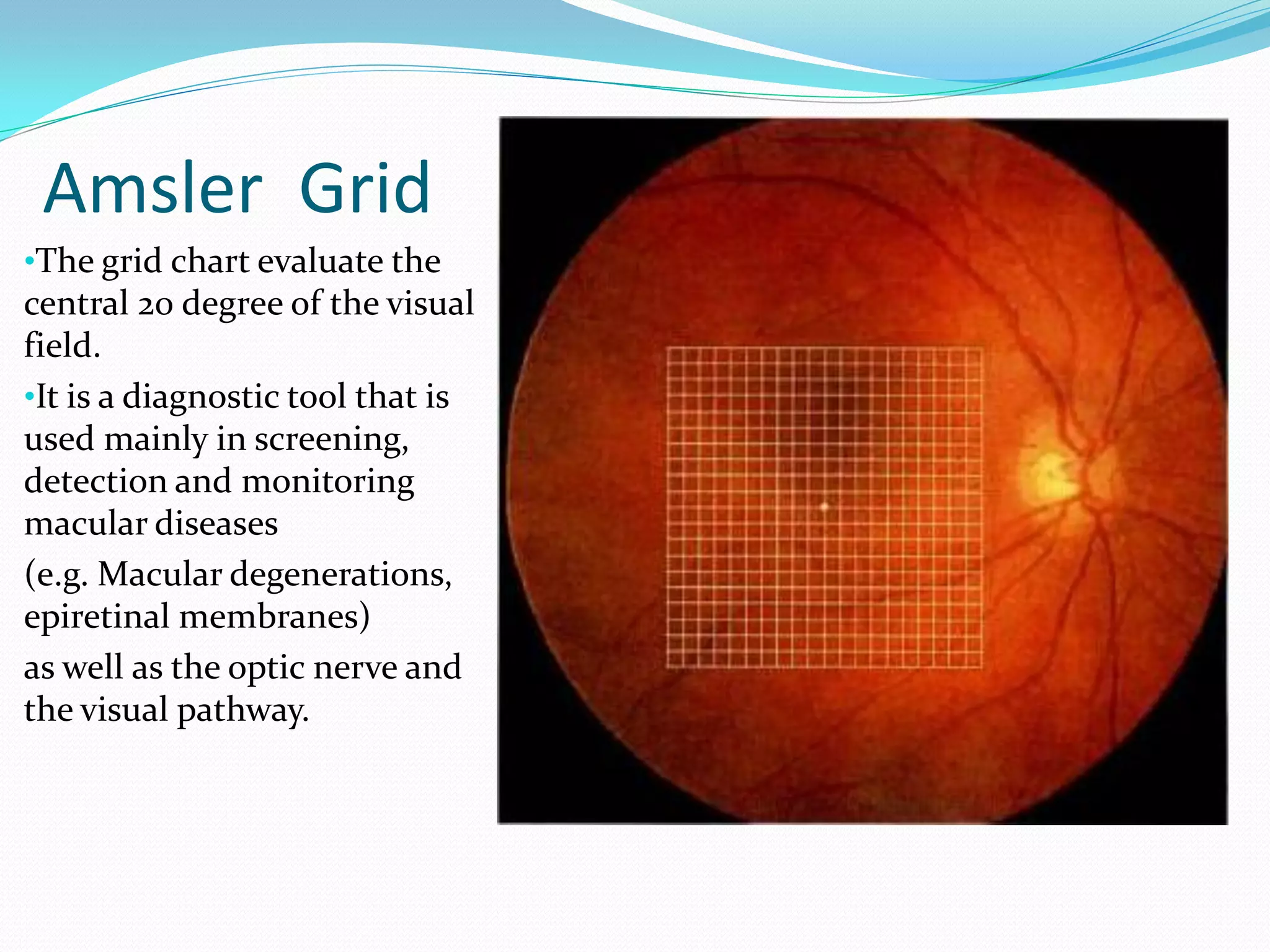
•The grid chart evaluate the
central 20 degree of the visual
field.
•It is a diagnostic tool that is
used mainly in screening,
detection and monitoring
macular diseases
(e.g. Macular degenerations,
epiretinal membranes)
as well as the optic nerve and
the visual pathway.
Availability
 Original Amsler’s grid was black and white.
 Available in
       Black on white
       White on black.
 A colour version with a blue and yellow grid is more
 sensitive and can be used to test for a wide variety of
 visual pathway abnormalities, associated with retina,
 the optic nerve & pituitary gland.
Procedure
 The patient is made to wear his reading glasses if any,
    holds the chart at 16 inches(40cm) away infront of the
    eye.
   Patient looks with each eye separately by covering one
    eye.
   He is asked to focus at the small dot in the centre of the
    grid.
   While he is looking at the dot, ask him to report if any
    line on the grid is
    (distorted, broken, blurred area, missing area, dark area,
    corners, sides).
   Mark the area of abnormality, if any on the chart and
    refer to the ophthalmologist.
There are seven
 charts, each consisting
 of a 10cm square.


It is most commonly
used. It comprises a
high contrast white
grid on a black
background. The
outer grid encloses
400 smaller 5mm
squares. When viewed
about one-third of a
meter, each small
square subtends an
angle of a 1 degree.
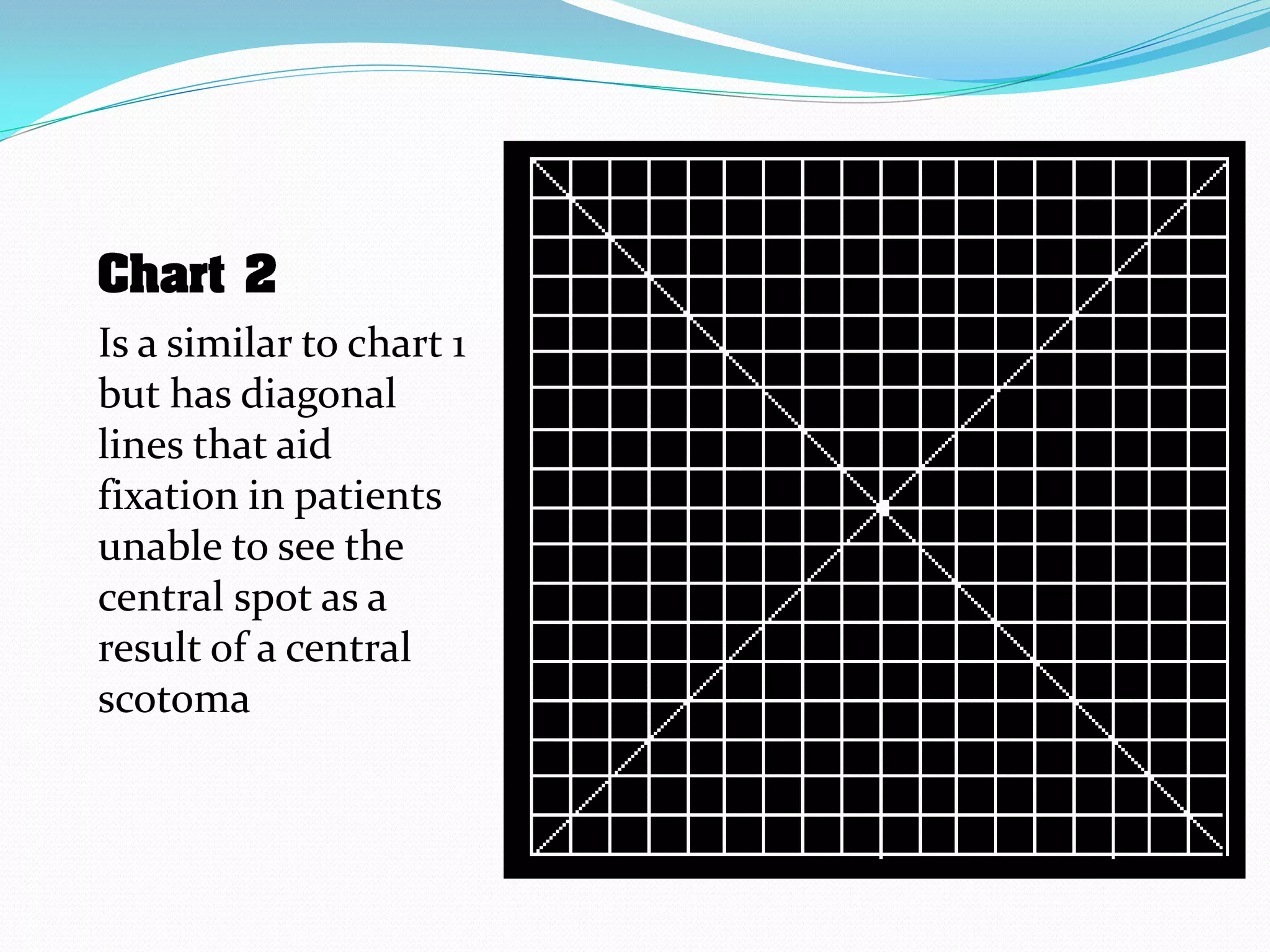
Is a similar to chart 1
but has diagonal
lines that aid
fixation in patients
unable to see the
central spot as a
result of a central
scotoma
Is to identical to chart
1 but has red squares.
The red on black
design aim to
stimulate long
wavelength foveal
cones. It is used to
detect colour
scotomas and
desaturation that may
occur in toxic
maculopathies , optic
neuropathies and
chiasmal lesions.
Consisting only of
random dots is used
mainly to
distinguish scotoma
from
metamorphosia, as
there is no form to
be distorted.
Consisting of
horizontal lines and
is designed to detect
metamorphosia
along specific
meridian. It is of
particular value in
the evaluation of
patients with
reading difficulties.
It a similar to chart 5
but has a white
background and the
central lines are
closer together
enabling more
detailed evaluation.
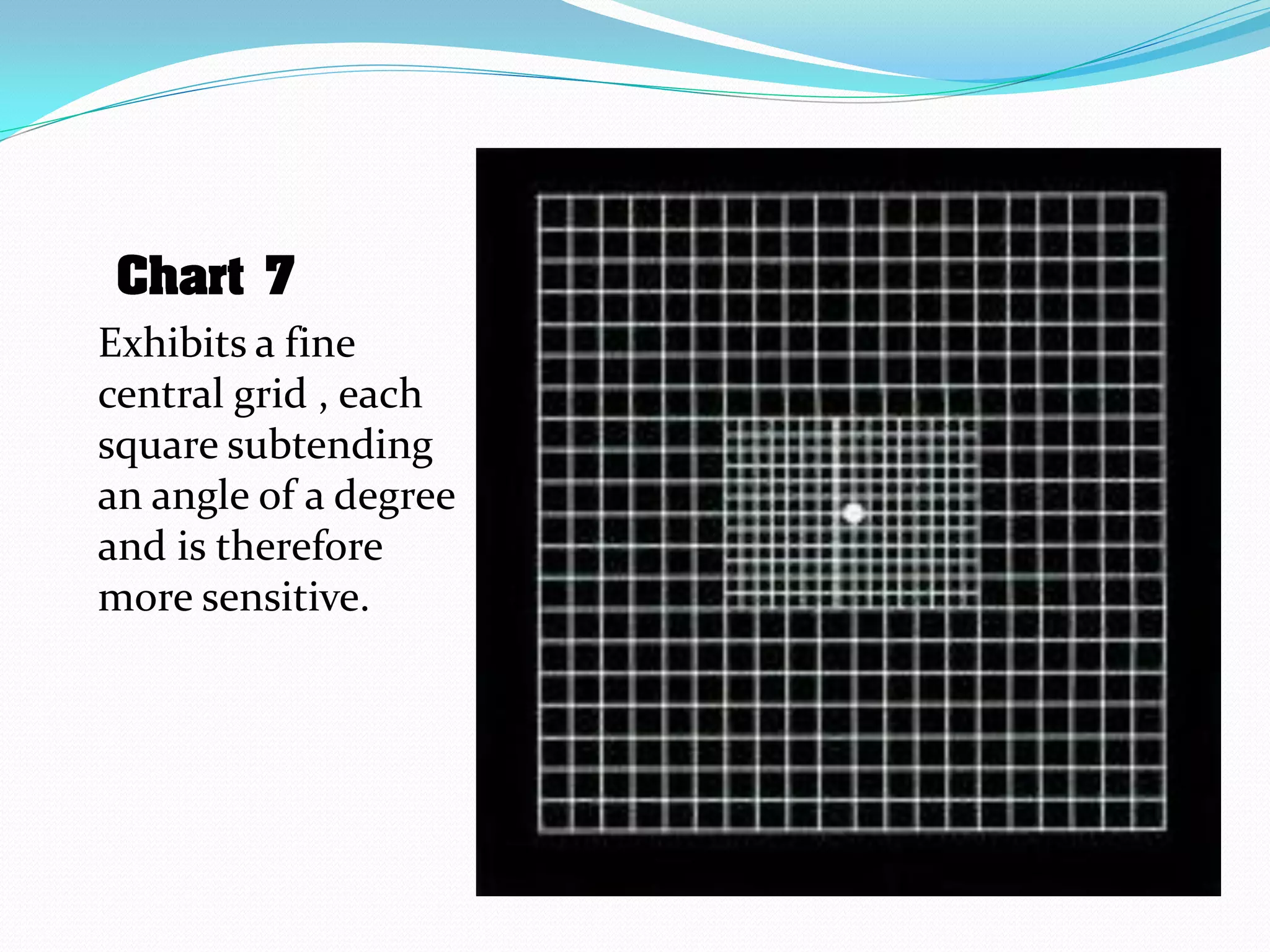
Exhibits a fine
central grid , each
square subtending
an angle of a degree
and is therefore
more sensitive.
MACULAR
EDEMA
TUMOR
METAMORPHOSIA
SCOTOMA
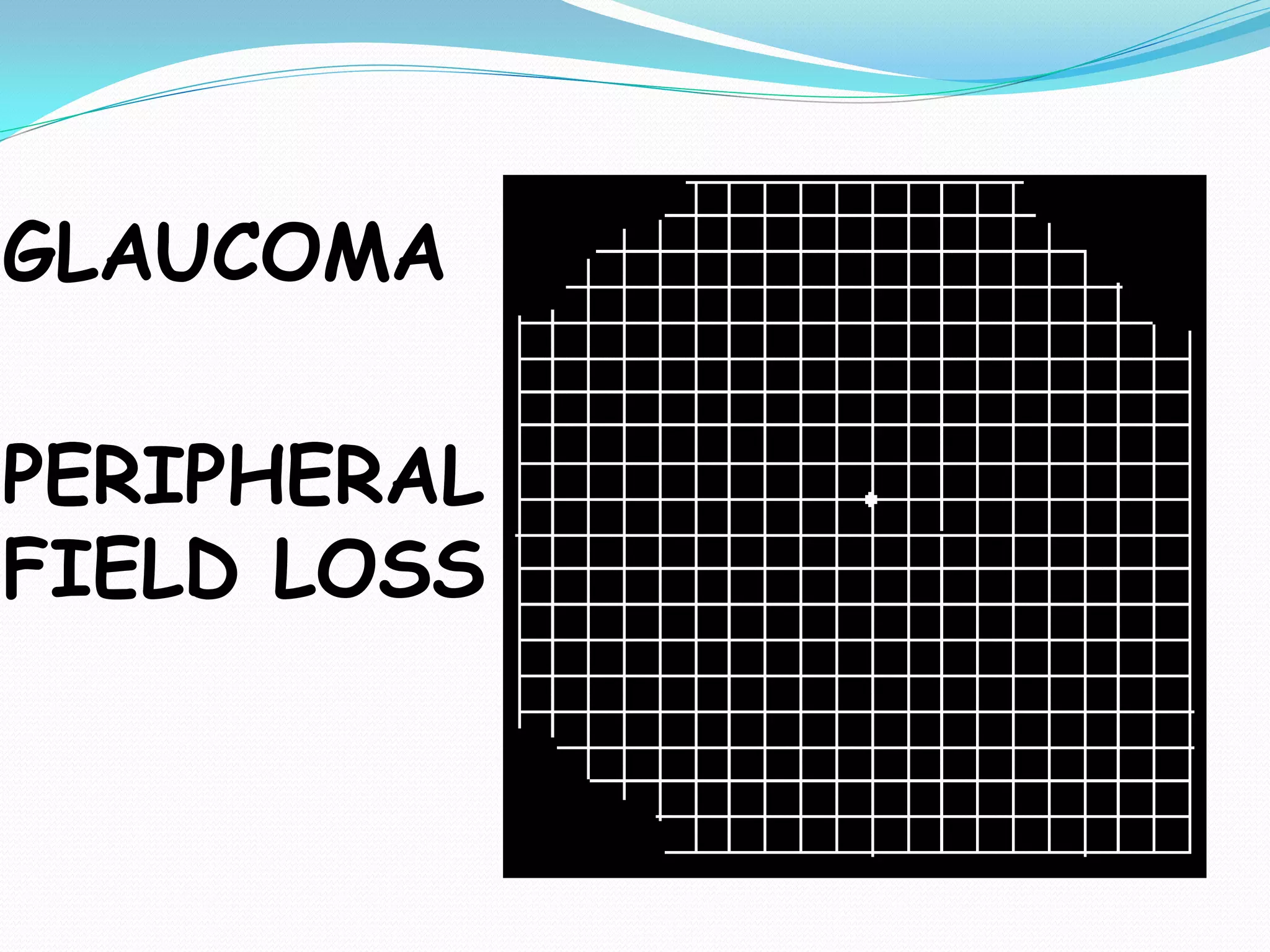
GLAUCOMA

PERIPHERAL
FIELD LOSS
Thank You
     (for Bearing with Me)


  still any   Question ???

Amsler grid

  • 1.
    Suhail Wahab Khalil BSVS 4th Year, Isra School Of Optometry.
  • 2.
    Amsler Grid Used since: 1945 AD Developed by :Marc Amsler, swiss ophthalmologist. Looks like a graph paper with multiple small sized boxes on it having a centre dark spot.
  • 3.
    Amsler Grid •The gridchart evaluate the central 20 degree of the visual field. •It is a diagnostic tool that is used mainly in screening, detection and monitoring macular diseases (e.g. Macular degenerations, epiretinal membranes) as well as the optic nerve and the visual pathway.
  • 5.
    Availability  Original Amsler’sgrid was black and white.  Available in  Black on white  White on black.  A colour version with a blue and yellow grid is more sensitive and can be used to test for a wide variety of visual pathway abnormalities, associated with retina, the optic nerve & pituitary gland.
  • 6.
    Procedure  The patientis made to wear his reading glasses if any, holds the chart at 16 inches(40cm) away infront of the eye.  Patient looks with each eye separately by covering one eye.  He is asked to focus at the small dot in the centre of the grid.  While he is looking at the dot, ask him to report if any line on the grid is (distorted, broken, blurred area, missing area, dark area, corners, sides).  Mark the area of abnormality, if any on the chart and refer to the ophthalmologist.
  • 7.
    There are seven charts, each consisting of a 10cm square. It is most commonly used. It comprises a high contrast white grid on a black background. The outer grid encloses 400 smaller 5mm squares. When viewed about one-third of a meter, each small square subtends an angle of a 1 degree.
  • 8.
    Is a similarto chart 1 but has diagonal lines that aid fixation in patients unable to see the central spot as a result of a central scotoma
  • 9.
    Is to identicalto chart 1 but has red squares. The red on black design aim to stimulate long wavelength foveal cones. It is used to detect colour scotomas and desaturation that may occur in toxic maculopathies , optic neuropathies and chiasmal lesions.
  • 10.
    Consisting only of randomdots is used mainly to distinguish scotoma from metamorphosia, as there is no form to be distorted.
  • 11.
    Consisting of horizontal linesand is designed to detect metamorphosia along specific meridian. It is of particular value in the evaluation of patients with reading difficulties.
  • 12.
    It a similarto chart 5 but has a white background and the central lines are closer together enabling more detailed evaluation.
  • 13.
    Exhibits a fine centralgrid , each square subtending an angle of a degree and is therefore more sensitive.
  • 14.
  • 15.
  • 16.
  • 17.
  • 18.
  • 19.
    Thank You (for Bearing with Me) still any Question ???