VISUAL ACUITY MEASUREMENT,
CONTRAST SENSITIVITY
PRESENTER : DR.OM PATEL
MODERATOR : DR.ALKA
VISUAL ACUITY PRINCIPLES
• The visual acuity is determined by the smallest
retinal image the form of which can be
appreciated
• For discriminating the form of an object its
parts must be differentiated
• It is necessary that two individual cones must
be stimulated with one between them
remaining unstimulated
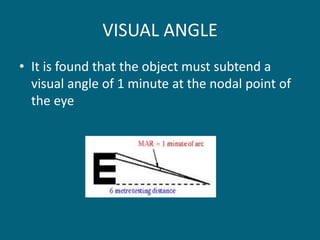
VISUAL ANGLE
• It is found that the object must subtend a
visual angle of 1 minute at the nodal point of
the eye
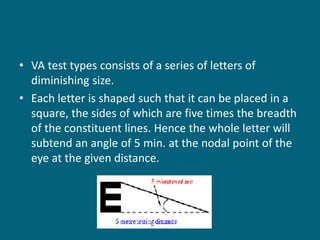
• VA test types consists of a series of letters of
diminishing size.
• Each letter is shaped such that it can be placed in a
square, the sides of which are five times the breadth
of the constituent lines. Hence the whole letter will
subtend an angle of 5 min. at the nodal point of the
eye at the given distance.
COMPONENTS OF VISUAL
ACUITY
• Detection or visibility
• Resolution
• Recognition
1. Detection or Visibility
• Ability to determine whether or not an object is
present in an otherwise empty visual field is
termed visibility.
• This depends upon the specification of stimulus
such as size, shape, & illumination.
• A black dot against a white background can be
detected if its diameter is of the order of 30 sec
or more
2. Resolution (Ordinary VA)
• Discrimination of two spatially separated
targets is termed resolution
• It is essentially an assessment of function of
the fovea centralis
• This component of VA is measured clinically
using Snellen’s or other test types
3. Recognition
• Virtue by which an individual identifies the
test patterns with which he had some
experience
• It involves cognitive component in addition to
spatial resolution
• E.g. Identification of faces
MEASUREMENT OF VISUAL ACUITY
• The visual acuity is a highly complex function
• In clinical practice, VA is considered
synonymous with the measurement of
minimum resolvable only
• Hence, examination with various VA charts is
quite satisfactory, although incomplete
MEASUREMENT OF VISUAL ACUITY IN ADULTS
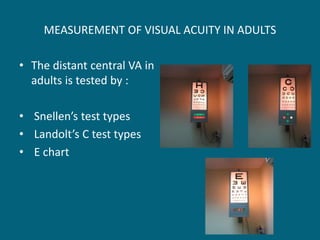
• The distant central VA in
adults is tested by :
• Snellen’s test types
• Landolt’s C test types
• E chart
SNELLEN’S TEST TYPE
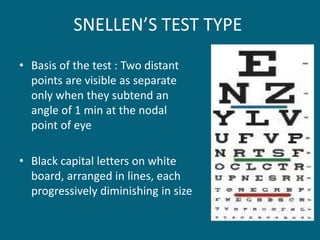
• Basis of the test : Two distant
points are visible as separate
only when they subtend an
angle of 1 min at the nodal
point of eye
• Black capital letters on white
board, arranged in lines, each
progressively diminishing in size
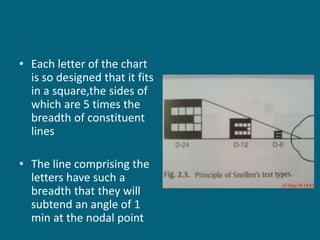
• Each letter of the chart
is so designed that it fits
in a square,the sides of
which are 5 times the
breadth of constituent
lines
• The line comprising the
letters have such a
breadth that they will
subtend an angle of 1
min at the nodal point
METHOD
• Patient seated at 6 meters from the chart
• Illumination is 20 foot candles
• Each eye is tested separately.
• VA is recorded as a fraction (6/60, 6/36,
6/24,6/12,6/9, 6/6)
Numerator: distance of the pt. from the chart
Denominator: smallest letters accurately read
• If pt. cannot see the top line from 6m, he is asked to
slowly move towards the chart till he can read the top
line(5/60, 4/60, 3/60, 2/60, 1/60)
• If the pt. is unable to see even from 1m, he is asked to
count fingers of the examiner
• When the pt. fails to count fingers, the examiner moves
his hands close to the pt’s face & asks whether he could
appreciate the movements or not. (HM +/-)
• When the patient cannot appreciate hand movements,
perception to light is noted.
(PL +/-) with projection of rays in four quadrants.
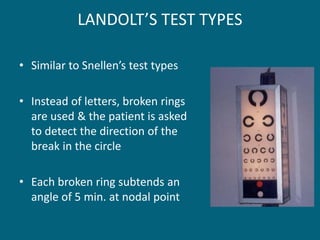
LANDOLT’S TEST TYPES
• Similar to Snellen’s test types
• Instead of letters, broken rings
are used & the patient is asked
to detect the direction of the
break in the circle
• Each broken ring subtends an
angle of 5 min. at nodal point
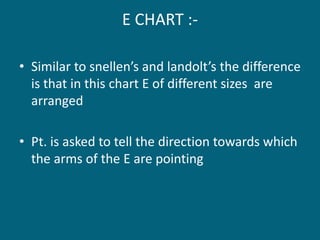
E CHART :-
• Similar to snellen’s and landolt’s the difference
is that in this chart E of different sizes are
arranged
• Pt. is asked to tell the direction towards which
the arms of the E are pointing
SNELLEN’S EQUIVALENT
• In U.S., the metric system is not usually
employed & the values are converted to feet
• ( 6m = 20 feet)
VA 6/6 = 20/20
VA 6/60 = 20/200
VA 3/60 = 20/400
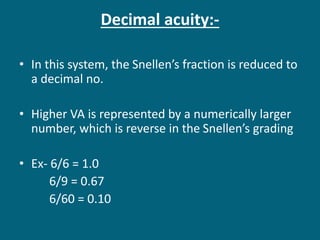
Decimal acuity:-
• In this system, the Snellen’s fraction is reduced to
a decimal no.
• Higher VA is represented by a numerically larger
number, which is reverse in the Snellen’s grading
• Ex- 6/6 = 1.0
6/9 = 0.67
6/60 = 0.10
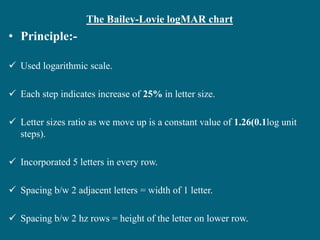
The Bailey-Lovie logMAR chart
• Principle:-
 Used logarithmic scale.
 Each step indicates increase of 25% in letter size.
 Letter sizes ratio as we move up is a constant value of 1.26(0.1log unit
steps).
 Incorporated 5 letters in every row.
 Spacing b/w 2 adjacent letters = width of 1 letter.
 Spacing b/w 2 hz rows = height of the letter on lower row.
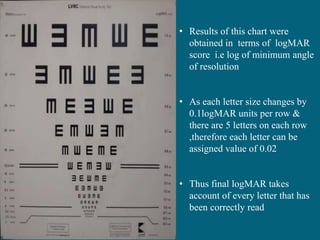
• Results of this chart were
obtained in terms of logMAR
score i.e log of minimum angle
of resolution
• As each letter size changes by
0.1logMAR units per row &
there are 5 letters on each row
,therefore each letter can be
assigned value of 0.02
• Thus final logMAR takes
account of every letter that has
been correctly read
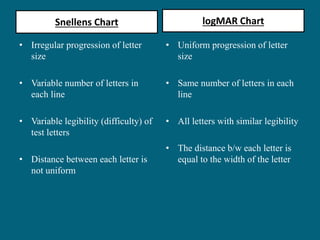
Snellens Chart
• Irregular progression of letter
size
• Variable number of letters in
each line
• Variable legibility (difficulty) of
test letters
• Distance between each letter is
not uniform
logMAR Chart
• Uniform progression of letter
size
• Same number of letters in each
line
• All letters with similar legibility
• The distance b/w each letter is
equal to the width of the letter
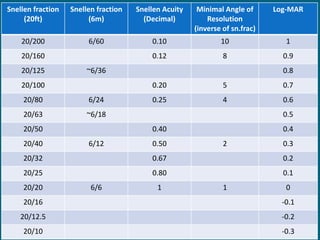
Snellen fraction
(20ft)
Snellen fraction
(6m)
Snellen Acuity
(Decimal)
Minimal Angle of
Resolution
(inverse of sn.frac)
Log-MAR
20/200 6/60 0.10 10 1
20/160 0.12 8 0.9
20/125 ~6/36 0.8
20/100 0.20 5 0.7
20/80 6/24 0.25 4 0.6
20/63 ~6/18 0.5
20/50 0.40 0.4
20/40 6/12 0.50 2 0.3
20/32 0.67 0.2
20/25 0.80 0.1
20/20 6/6 1 1 0
20/16 -0.1
20/12.5 -0.2
20/10 -0.3
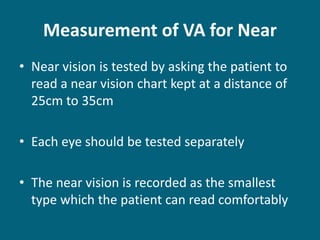
Measurement of VA for Near
• Near vision is tested by asking the patient to
read a near vision chart kept at a distance of
25cm to 35cm
• Each eye should be tested separately
• The near vision is recorded as the smallest
type which the patient can read comfortably
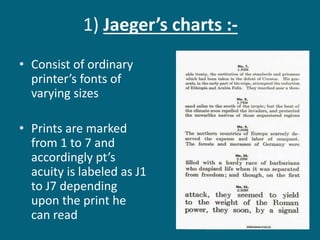
1) Jaeger’s charts :-
• Consist of ordinary
printer’s fonts of
varying sizes
• Prints are marked
from 1 to 7 and
accordingly pt’s
acuity is labeled as J1
to J7 depending
upon the print he
can read
(2) Roman test types :-
• Consists of Times Roman fonts with standard
spacing.
• -The near vision is recorded as N5, N6, N8,
N10, N12, N18, N36 and N48.
(3) Snellen’s near vision test types :-
• Constructed on the same principles as of the
distant types.
• The graded thickness of the letters is about
1/17 of the distant vision chart letter.
• The letter equivalent to 6/6 line subtend an
angle of 5 min. at he average reading distance.
VISUAL ACUITY MEASUREMENTS IN
CHILDREN
• OBJECTIVE TESTS
Preverbal children ( < 2 ½ yrs )
• SUBJECTIVE TESTS
Verbal children ( > 2 ½ yrs )
OBJECTIVE TESTS
• Fixation & following behaviour
• Preferential looking test ( PLT)
• Optokinetic Nystagmus (OKN)
• Visual evoked potential (VEP)
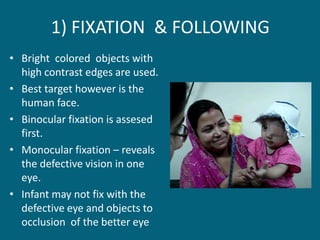
1) FIXATION & FOLLOWING
• Bright colored objects with
high contrast edges are used.
• Best target however is the
human face.
• Binocular fixation is assesed
first.
• Monocular fixation – reveals
the defective vision in one
eye.
• Infant may not fix with the
defective eye and objects to
occlusion of the better eye
• Quality of fixation behaviour – C S M
C – Central – foveal fixation
S - Steady – no nystagmus
M – Maintained – fixation after a blink
QUANTITATIVE METHODS
• Methods to detect the resolution acuity
• More sophisticated method of visual assesment
than mere fixation assesment.
• Include -
PREFERENTIAL LOOKING TEST
OPTOKINETIC NYSTAGMUS
VISUAL EVOKED POTENTIAL
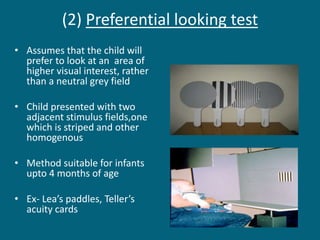
(2) Preferential looking test
• Assumes that the child will
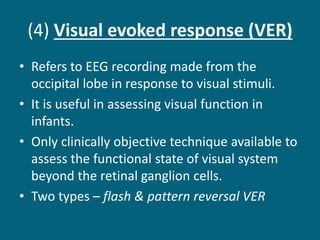
prefer to look at an area of
higher visual interest, rather
than a neutral grey field
• Child presented with two
adjacent stimulus fields,one
which is striped and other
homogenous
• Method suitable for infants
upto 4 months of age
• Ex- Lea’s paddles, Teller’s
acuity cards
Procedure
• On a screen homogenous
surface is projected on
one side & black and
white strips on the other
• These two stimuli are
alternated randomly
• The eyes of the infant are
observed and the
movements recorded
PROCEDURE
• Gradually the fineness of stripes is reduced
unless there is no longer correlation between
direction of gaze & location of the striped
pattern.
• Visual acuity ranges from 6/240 in
newborn,6/60 at 3 months and 6/6 at 36
months
(3) Optokinetic Nystagmus Test (OKN)
• Nystagmus is elicited by
passing a succession of black
and white stripes through the
patient’s field of vision
• The visual angle subtended by
the smallest strip which elicits
an eye movement is a
measure of VA
• OKN acuity is 6/120 in
newborns,6/20 at 2
months,6/6 by 20-30 months
(4) Visual evoked response (VER)
• Refers to EEG recording made from the
occipital lobe in response to visual stimuli.
• It is useful in assessing visual function in
infants.
• Only clinically objective technique available to
assess the functional state of visual system
beyond the retinal ganglion cells.
• Two types – flash & pattern reversal VER
Visual evoked response (VER)
• Flash VER tells about the integrity of macular
and visual pathway
• Pattern reversal VER uses some patterned
stimulus like checkerboard
• The pattern of stimulus is changed and so it
gives an idea of form sense
• VER studies shown VA in infants to be 6/120 at
1 month,6/60 at 2 months & 6/6 at 1 yr of
age.
SUBJECTIVE TESTS
• Optotype-
symbol whose identification implies VA
• Eg; Lea’s symbols ,HOTV, Snellen’s chart,
Landolt-C ,E chart.
• These tests are employed in verbal children.
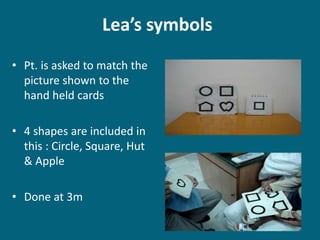
Lea’s symbols
• Pt. is asked to match the
picture shown to the
hand held cards
• 4 shapes are included in
this : Circle, Square, Hut
& Apple
• Done at 3m
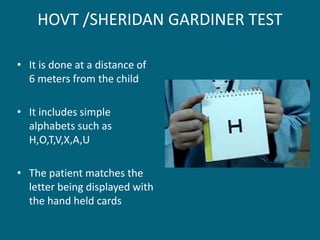
HOVT /SHERIDAN GARDINER TEST
• It is done at a distance of
6 meters from the child
• It includes simple
alphabets such as
H,O,T,V,X,A,U
• The patient matches the
letter being displayed with
the hand held cards
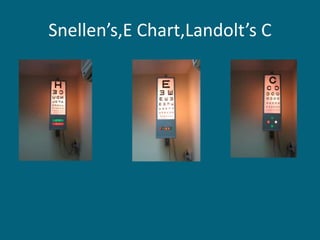
Snellen’s,E Chart,Landolt’s C
IN SUMMARY
• INFANTS -
Fixation methods
Preferential looking test
Optokinetic nystagmus
Visual evoked potential
• TODDLERS - LEA’S SYMBOLS
HOTV TEST
• CHILDREN > 5 YRS & ADULTS-
SNELLEN’S CHART
LANDOLT’S C CHART
E – CHART
ETDRS
Visual Acuity Measurement, Contrast Sensitivity

Visual Acuity Measurement, Contrast Sensitivity

  • 1.
    VISUAL ACUITY MEASUREMENT, CONTRASTSENSITIVITY PRESENTER : DR.OM PATEL MODERATOR : DR.ALKA
  • 2.
    VISUAL ACUITY PRINCIPLES •The visual acuity is determined by the smallest retinal image the form of which can be appreciated • For discriminating the form of an object its parts must be differentiated • It is necessary that two individual cones must be stimulated with one between them remaining unstimulated
  • 3.
    VISUAL ANGLE • Itis found that the object must subtend a visual angle of 1 minute at the nodal point of the eye
  • 4.
    • VA testtypes consists of a series of letters of diminishing size. • Each letter is shaped such that it can be placed in a square, the sides of which are five times the breadth of the constituent lines. Hence the whole letter will subtend an angle of 5 min. at the nodal point of the eye at the given distance.
  • 5.
    COMPONENTS OF VISUAL ACUITY •Detection or visibility • Resolution • Recognition
  • 6.
    1. Detection orVisibility • Ability to determine whether or not an object is present in an otherwise empty visual field is termed visibility. • This depends upon the specification of stimulus such as size, shape, & illumination. • A black dot against a white background can be detected if its diameter is of the order of 30 sec or more
  • 7.
    2. Resolution (OrdinaryVA) • Discrimination of two spatially separated targets is termed resolution • It is essentially an assessment of function of the fovea centralis • This component of VA is measured clinically using Snellen’s or other test types
  • 8.
    3. Recognition • Virtueby which an individual identifies the test patterns with which he had some experience • It involves cognitive component in addition to spatial resolution • E.g. Identification of faces
  • 9.
    MEASUREMENT OF VISUALACUITY • The visual acuity is a highly complex function • In clinical practice, VA is considered synonymous with the measurement of minimum resolvable only • Hence, examination with various VA charts is quite satisfactory, although incomplete
  • 10.
    MEASUREMENT OF VISUALACUITY IN ADULTS • The distant central VA in adults is tested by : • Snellen’s test types • Landolt’s C test types • E chart
  • 11.
    SNELLEN’S TEST TYPE •Basis of the test : Two distant points are visible as separate only when they subtend an angle of 1 min at the nodal point of eye • Black capital letters on white board, arranged in lines, each progressively diminishing in size
  • 12.
    • Each letterof the chart is so designed that it fits in a square,the sides of which are 5 times the breadth of constituent lines • The line comprising the letters have such a breadth that they will subtend an angle of 1 min at the nodal point
  • 13.
    METHOD • Patient seatedat 6 meters from the chart • Illumination is 20 foot candles • Each eye is tested separately. • VA is recorded as a fraction (6/60, 6/36, 6/24,6/12,6/9, 6/6) Numerator: distance of the pt. from the chart Denominator: smallest letters accurately read
  • 14.
    • If pt.cannot see the top line from 6m, he is asked to slowly move towards the chart till he can read the top line(5/60, 4/60, 3/60, 2/60, 1/60) • If the pt. is unable to see even from 1m, he is asked to count fingers of the examiner • When the pt. fails to count fingers, the examiner moves his hands close to the pt’s face & asks whether he could appreciate the movements or not. (HM +/-) • When the patient cannot appreciate hand movements, perception to light is noted. (PL +/-) with projection of rays in four quadrants.
  • 15.
    LANDOLT’S TEST TYPES •Similar to Snellen’s test types • Instead of letters, broken rings are used & the patient is asked to detect the direction of the break in the circle • Each broken ring subtends an angle of 5 min. at nodal point
  • 16.
    E CHART :- •Similar to snellen’s and landolt’s the difference is that in this chart E of different sizes are arranged • Pt. is asked to tell the direction towards which the arms of the E are pointing
  • 17.
    SNELLEN’S EQUIVALENT • InU.S., the metric system is not usually employed & the values are converted to feet • ( 6m = 20 feet) VA 6/6 = 20/20 VA 6/60 = 20/200 VA 3/60 = 20/400
  • 18.
    Decimal acuity:- • Inthis system, the Snellen’s fraction is reduced to a decimal no. • Higher VA is represented by a numerically larger number, which is reverse in the Snellen’s grading • Ex- 6/6 = 1.0 6/9 = 0.67 6/60 = 0.10
  • 19.
    The Bailey-Lovie logMARchart • Principle:-  Used logarithmic scale.  Each step indicates increase of 25% in letter size.  Letter sizes ratio as we move up is a constant value of 1.26(0.1log unit steps).  Incorporated 5 letters in every row.  Spacing b/w 2 adjacent letters = width of 1 letter.  Spacing b/w 2 hz rows = height of the letter on lower row.
  • 20.
    • Results ofthis chart were obtained in terms of logMAR score i.e log of minimum angle of resolution • As each letter size changes by 0.1logMAR units per row & there are 5 letters on each row ,therefore each letter can be assigned value of 0.02 • Thus final logMAR takes account of every letter that has been correctly read
  • 21.
    Snellens Chart • Irregularprogression of letter size • Variable number of letters in each line • Variable legibility (difficulty) of test letters • Distance between each letter is not uniform logMAR Chart • Uniform progression of letter size • Same number of letters in each line • All letters with similar legibility • The distance b/w each letter is equal to the width of the letter
  • 22.
    Snellen fraction (20ft) Snellen fraction (6m) SnellenAcuity (Decimal) Minimal Angle of Resolution (inverse of sn.frac) Log-MAR 20/200 6/60 0.10 10 1 20/160 0.12 8 0.9 20/125 ~6/36 0.8 20/100 0.20 5 0.7 20/80 6/24 0.25 4 0.6 20/63 ~6/18 0.5 20/50 0.40 0.4 20/40 6/12 0.50 2 0.3 20/32 0.67 0.2 20/25 0.80 0.1 20/20 6/6 1 1 0 20/16 -0.1 20/12.5 -0.2 20/10 -0.3
  • 23.
    Measurement of VAfor Near • Near vision is tested by asking the patient to read a near vision chart kept at a distance of 25cm to 35cm • Each eye should be tested separately • The near vision is recorded as the smallest type which the patient can read comfortably
  • 24.
    1) Jaeger’s charts:- • Consist of ordinary printer’s fonts of varying sizes • Prints are marked from 1 to 7 and accordingly pt’s acuity is labeled as J1 to J7 depending upon the print he can read
  • 25.
    (2) Roman testtypes :- • Consists of Times Roman fonts with standard spacing. • -The near vision is recorded as N5, N6, N8, N10, N12, N18, N36 and N48.
  • 26.
    (3) Snellen’s nearvision test types :- • Constructed on the same principles as of the distant types. • The graded thickness of the letters is about 1/17 of the distant vision chart letter. • The letter equivalent to 6/6 line subtend an angle of 5 min. at he average reading distance.
  • 27.
    VISUAL ACUITY MEASUREMENTSIN CHILDREN • OBJECTIVE TESTS Preverbal children ( < 2 ½ yrs ) • SUBJECTIVE TESTS Verbal children ( > 2 ½ yrs )
  • 28.
    OBJECTIVE TESTS • Fixation& following behaviour • Preferential looking test ( PLT) • Optokinetic Nystagmus (OKN) • Visual evoked potential (VEP)
  • 29.
    1) FIXATION &FOLLOWING • Bright colored objects with high contrast edges are used. • Best target however is the human face. • Binocular fixation is assesed first. • Monocular fixation – reveals the defective vision in one eye. • Infant may not fix with the defective eye and objects to occlusion of the better eye
  • 30.
    • Quality offixation behaviour – C S M C – Central – foveal fixation S - Steady – no nystagmus M – Maintained – fixation after a blink
  • 31.
    QUANTITATIVE METHODS • Methodsto detect the resolution acuity • More sophisticated method of visual assesment than mere fixation assesment. • Include - PREFERENTIAL LOOKING TEST OPTOKINETIC NYSTAGMUS VISUAL EVOKED POTENTIAL
  • 32.
    (2) Preferential lookingtest • Assumes that the child will prefer to look at an area of higher visual interest, rather than a neutral grey field • Child presented with two adjacent stimulus fields,one which is striped and other homogenous • Method suitable for infants upto 4 months of age • Ex- Lea’s paddles, Teller’s acuity cards
  • 33.
    Procedure • On ascreen homogenous surface is projected on one side & black and white strips on the other • These two stimuli are alternated randomly • The eyes of the infant are observed and the movements recorded
  • 34.
    PROCEDURE • Gradually thefineness of stripes is reduced unless there is no longer correlation between direction of gaze & location of the striped pattern. • Visual acuity ranges from 6/240 in newborn,6/60 at 3 months and 6/6 at 36 months
  • 35.
    (3) Optokinetic NystagmusTest (OKN) • Nystagmus is elicited by passing a succession of black and white stripes through the patient’s field of vision • The visual angle subtended by the smallest strip which elicits an eye movement is a measure of VA • OKN acuity is 6/120 in newborns,6/20 at 2 months,6/6 by 20-30 months
  • 36.
    (4) Visual evokedresponse (VER) • Refers to EEG recording made from the occipital lobe in response to visual stimuli. • It is useful in assessing visual function in infants. • Only clinically objective technique available to assess the functional state of visual system beyond the retinal ganglion cells. • Two types – flash & pattern reversal VER
  • 37.
    Visual evoked response(VER) • Flash VER tells about the integrity of macular and visual pathway • Pattern reversal VER uses some patterned stimulus like checkerboard • The pattern of stimulus is changed and so it gives an idea of form sense • VER studies shown VA in infants to be 6/120 at 1 month,6/60 at 2 months & 6/6 at 1 yr of age.
  • 38.
    SUBJECTIVE TESTS • Optotype- symbolwhose identification implies VA • Eg; Lea’s symbols ,HOTV, Snellen’s chart, Landolt-C ,E chart. • These tests are employed in verbal children.
  • 39.
    Lea’s symbols • Pt.is asked to match the picture shown to the hand held cards • 4 shapes are included in this : Circle, Square, Hut & Apple • Done at 3m
  • 40.
    HOVT /SHERIDAN GARDINERTEST • It is done at a distance of 6 meters from the child • It includes simple alphabets such as H,O,T,V,X,A,U • The patient matches the letter being displayed with the hand held cards
  • 41.
  • 42.
    IN SUMMARY • INFANTS- Fixation methods Preferential looking test Optokinetic nystagmus Visual evoked potential
  • 43.
    • TODDLERS -LEA’S SYMBOLS HOTV TEST • CHILDREN > 5 YRS & ADULTS- SNELLEN’S CHART LANDOLT’S C CHART E – CHART ETDRS

Editor's Notes

  • #30 Kanski fixation and following in squint chapter