IOL power calculation
FORMULAE
Generations!
• First – SRK 1 & Binkhorst formula
• Second – SRK2
• Third – SRK T , Hoffer Q , Holladay
• Fourth – Holladay 2 , Haigis
• Theoretical formulae – based on mathematical
principles revolving around the schematic eye
• Regression formulae – working backwards on
post operative outcomes
• 3rd and 4th generation – mix of both.
A closer look
1. SRK formula
• P = IOL Power
• K = avg central corneal power in Diopters
• L = axial length in mm.
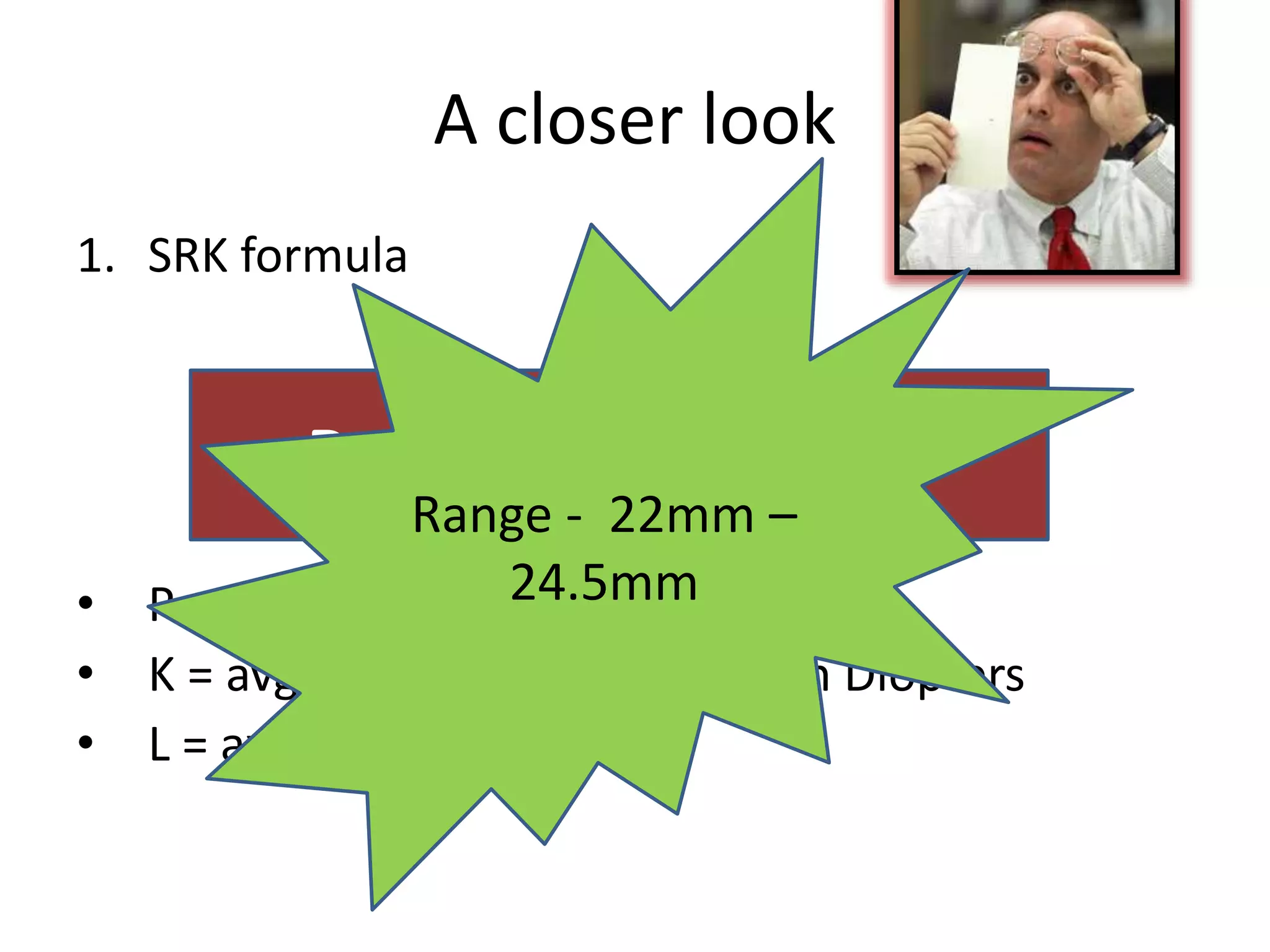
P = A – 0.9K – 2.5L
Range - 22mm –
24.5mm
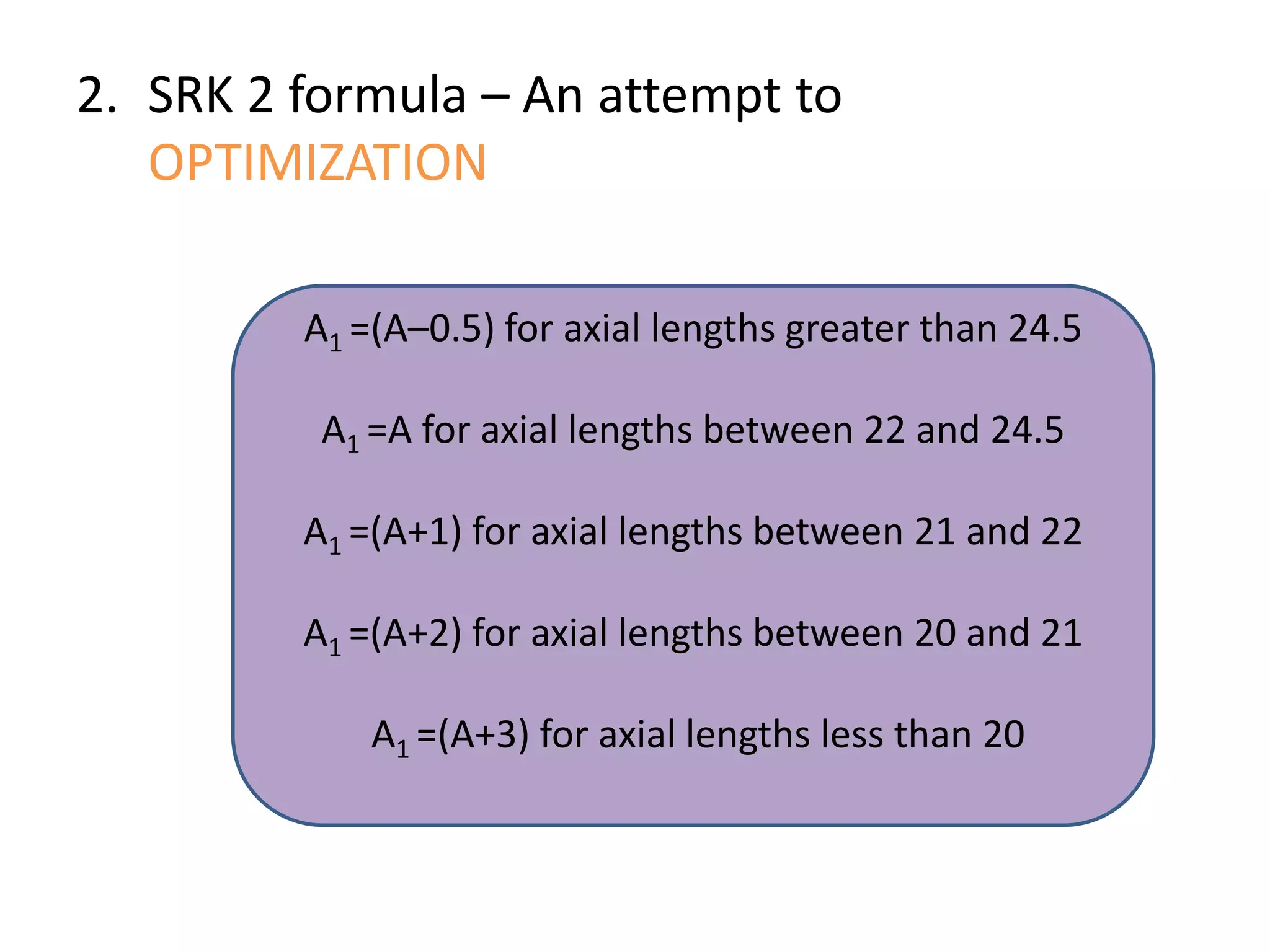
2. SRK 2 formula – An attempt to
OPTIMIZATION
A1 =(A–0.5) for axial lengths greater than 24.5
A1 =A for axial lengths between 22 and 24.5
A1 =(A+1) for axial lengths between 21 and 22
A1 =(A+2) for axial lengths between 20 and 21
A1 =(A+3) for axial lengths less than 20
Why Optimize??
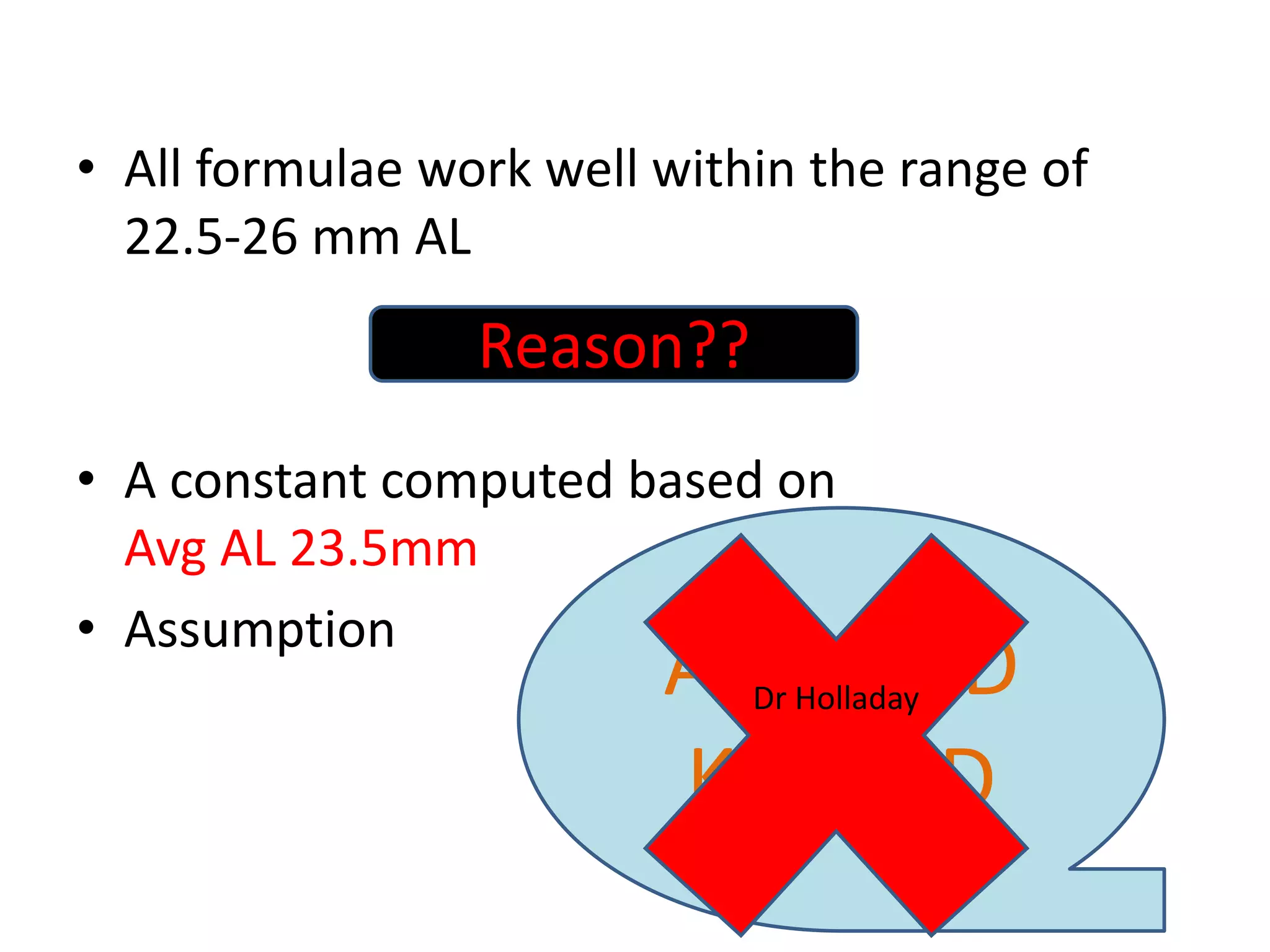
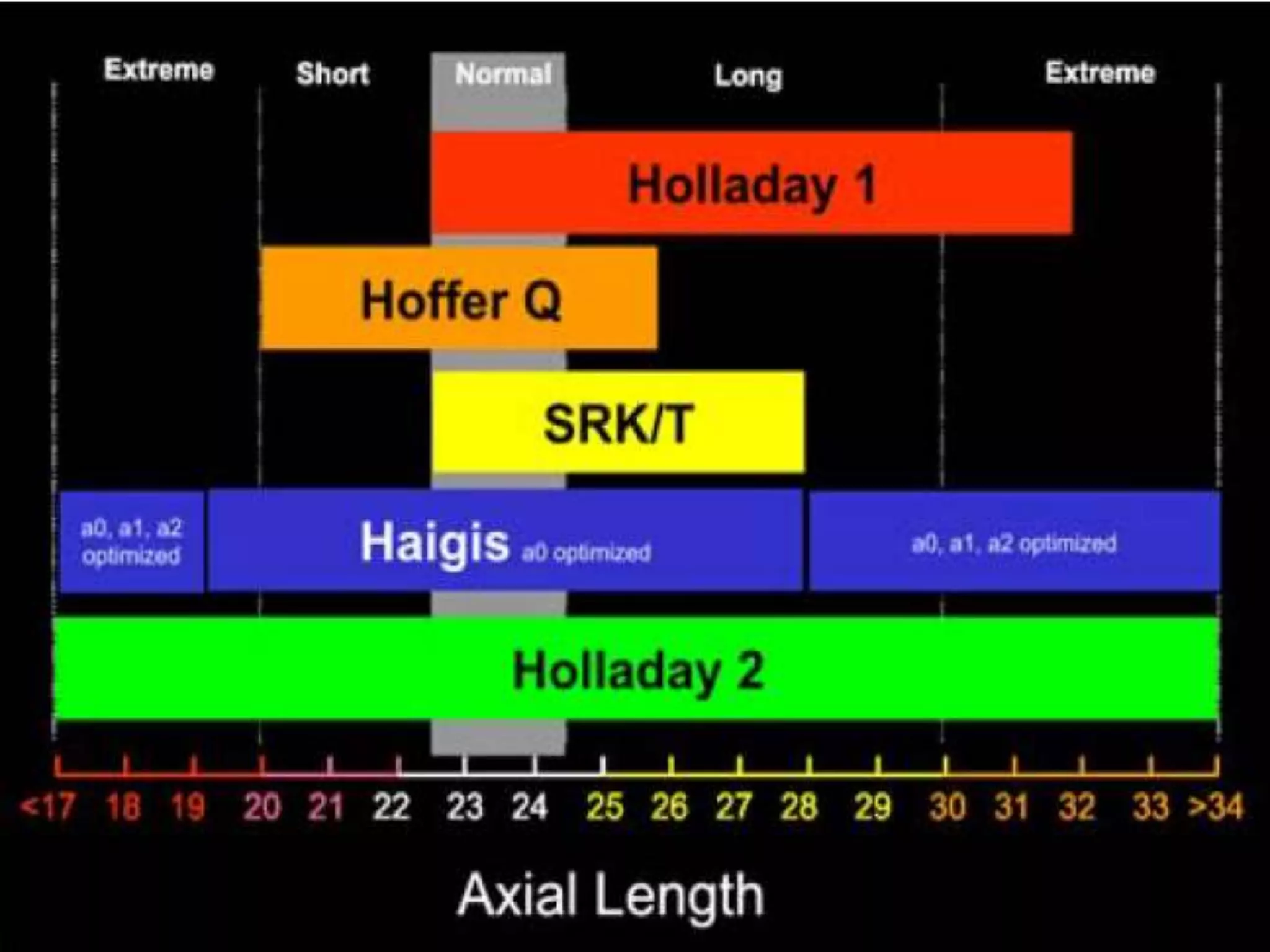
• All formulae work well within the range of
22.5-26 mm AL
• A constant computed based on
Avg AL 23.5mm
• Assumption
Reason??
AL α ACD
K α ACD
Dr Holladay
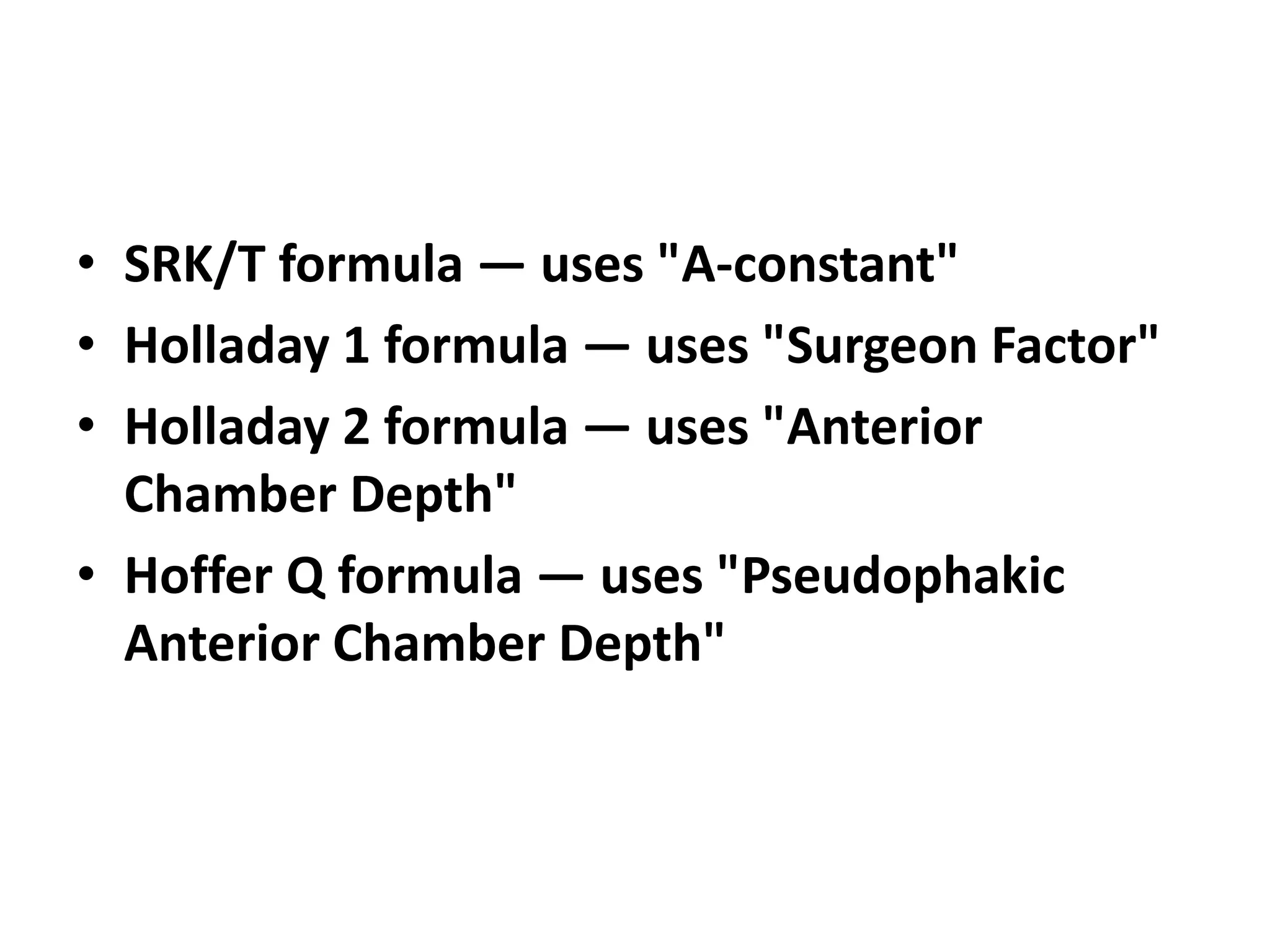
• SRK/T formula — uses "A-constant"
• Holladay 1 formula — uses "Surgeon Factor"
• Holladay 2 formula — uses "Anterior
Chamber Depth"
• Hoffer Q formula — uses "Pseudophakic
Anterior Chamber Depth"
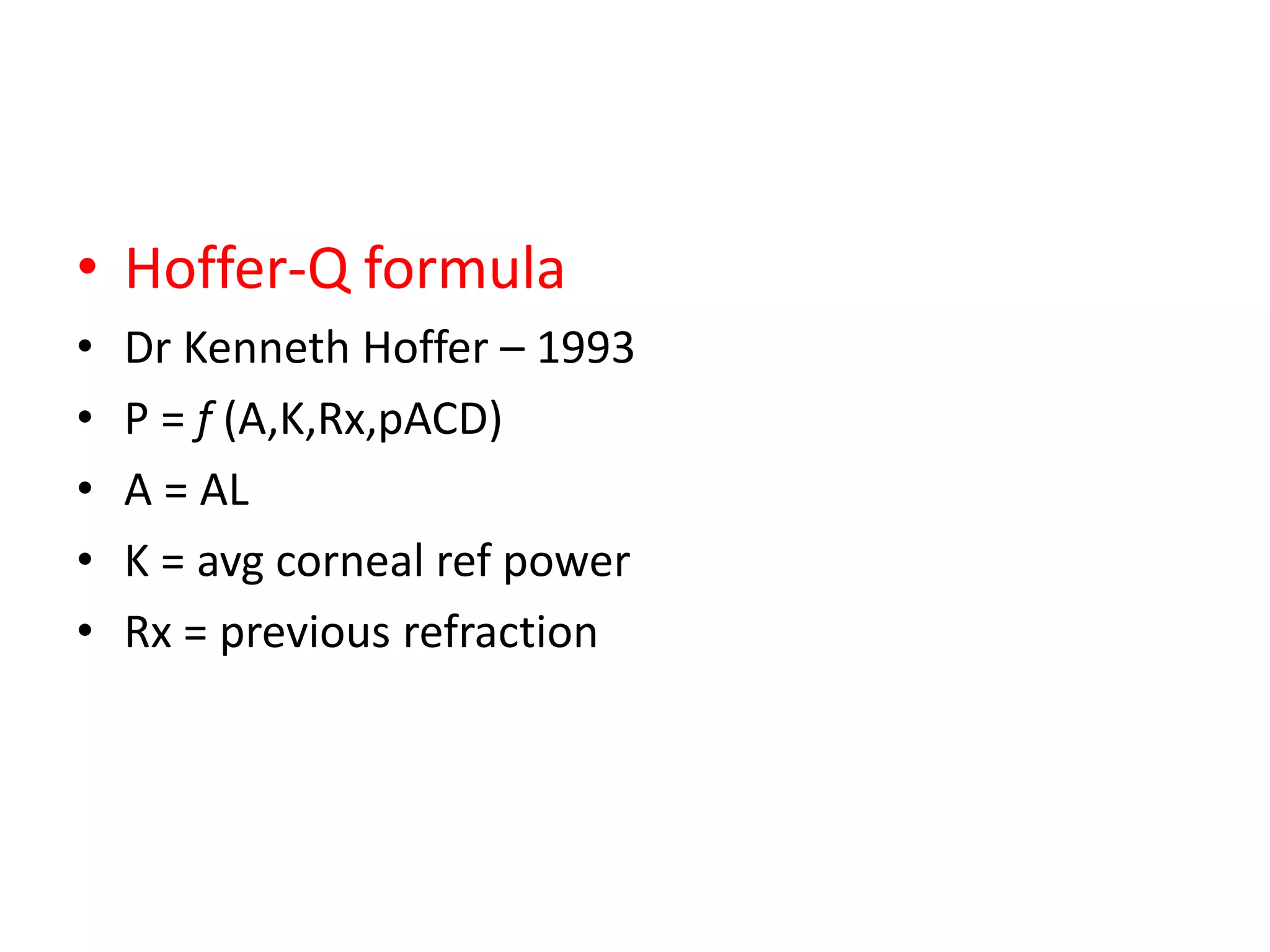
• Hoffer-Q formula
• Dr Kenneth Hoffer – 1993
• P = f (A,K,Rx,pACD)
• A = AL
• K = avg corneal ref power
• Rx = previous refraction
• pACD = The personalized ACD (pACD) is set
equal to the manufacturer's ACD-constant, if
the calculation was selected to be based on
the ACD-constant. In case the A-constant was
chosen, pACD is derived from the A-constant
[HOFFER, 1998] according to [HOLLADAY et al,
1988]
pACD = ACD-const = 0.58357 * A-const -
63.896 .
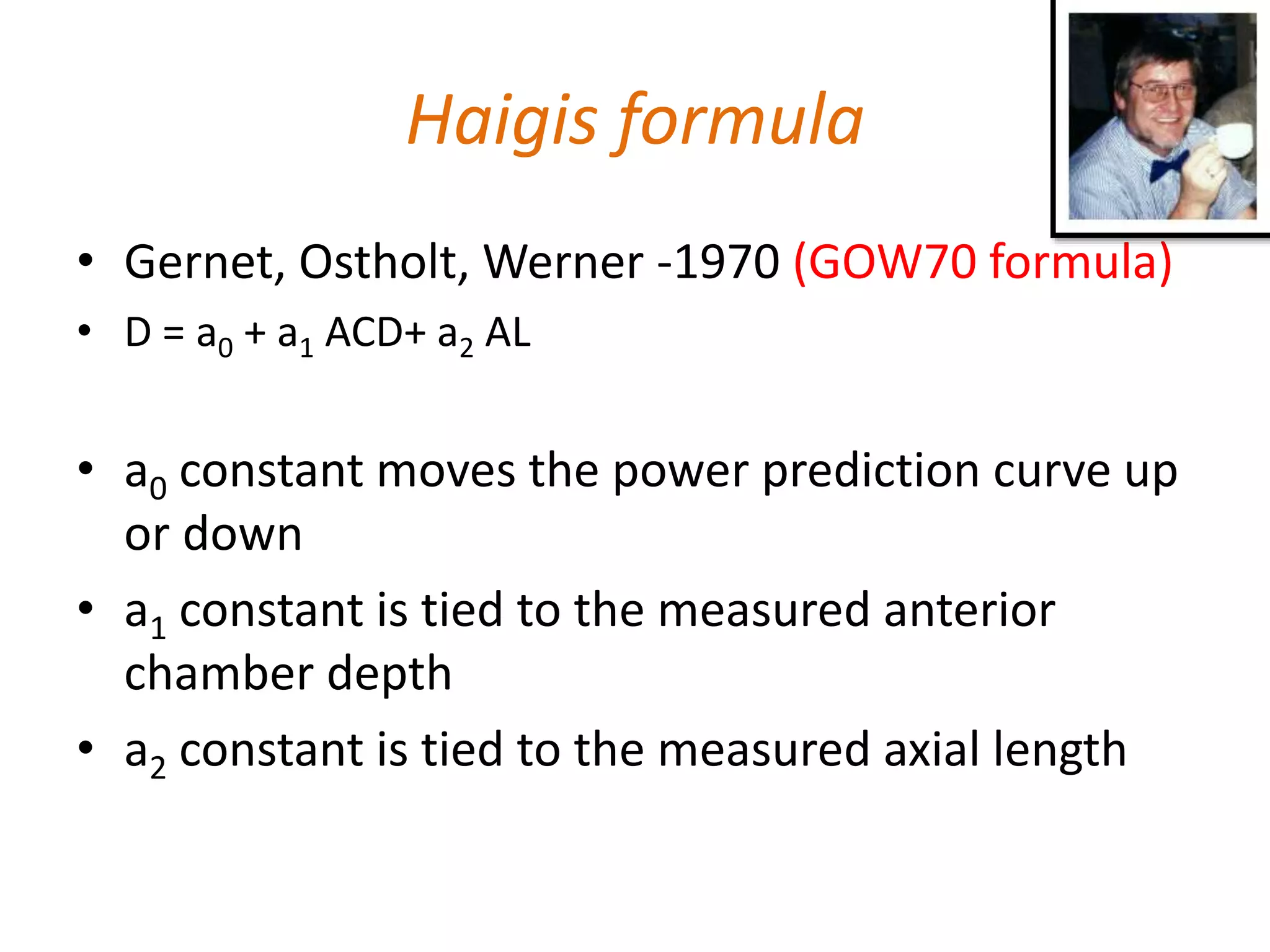
Haigis formula
• Gernet, Ostholt, Werner -1970 (GOW70 formula)
• D = a0 + a1 ACD+ a2 AL
• a0 constant moves the power prediction curve up
or down
• a1 constant is tied to the measured anterior
chamber depth
• a2 constant is tied to the measured axial length
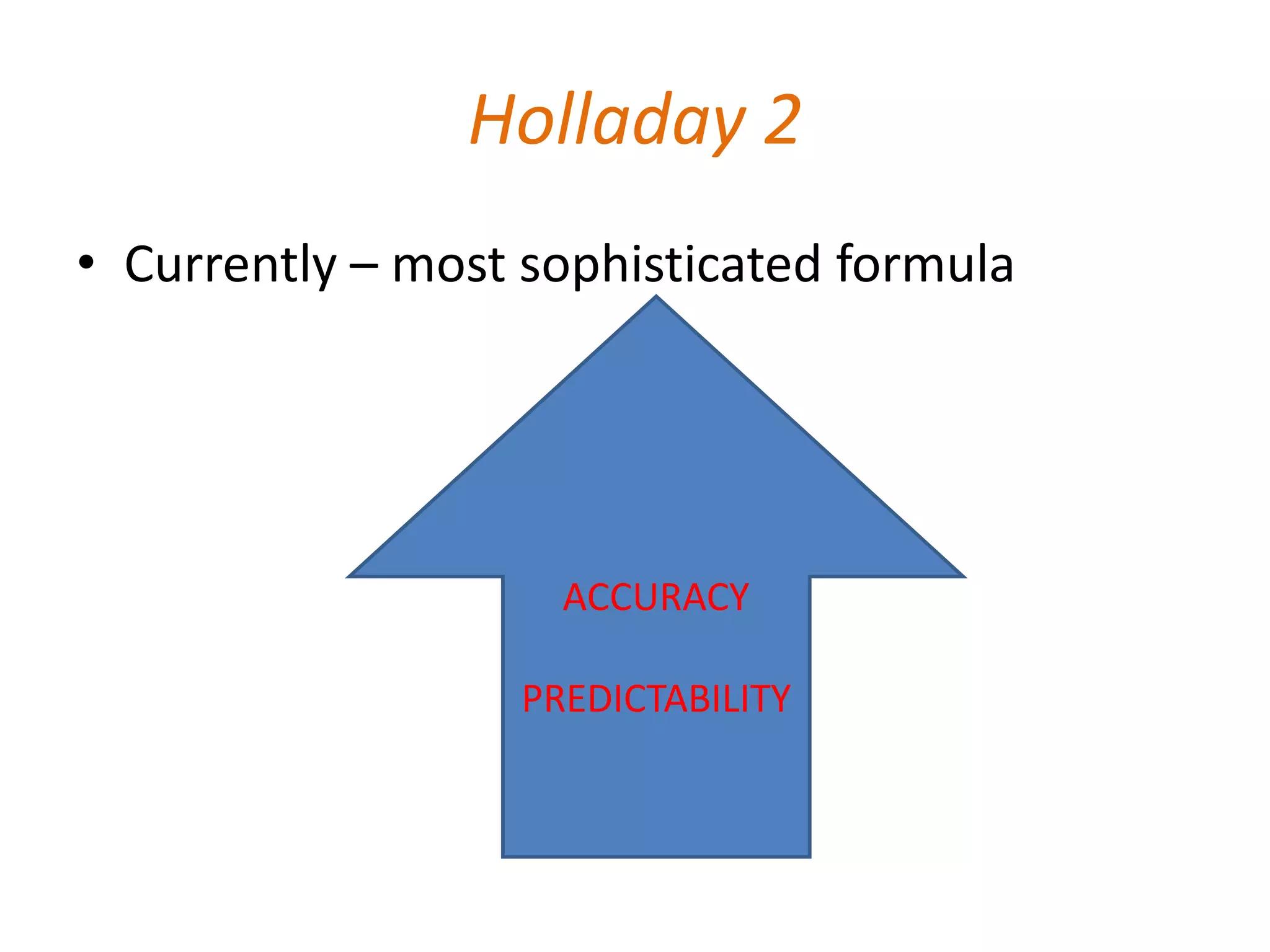
Holladay 2
• Currently – most sophisticated formula
ACCURACY
PREDICTABILITY
2 reasons for success
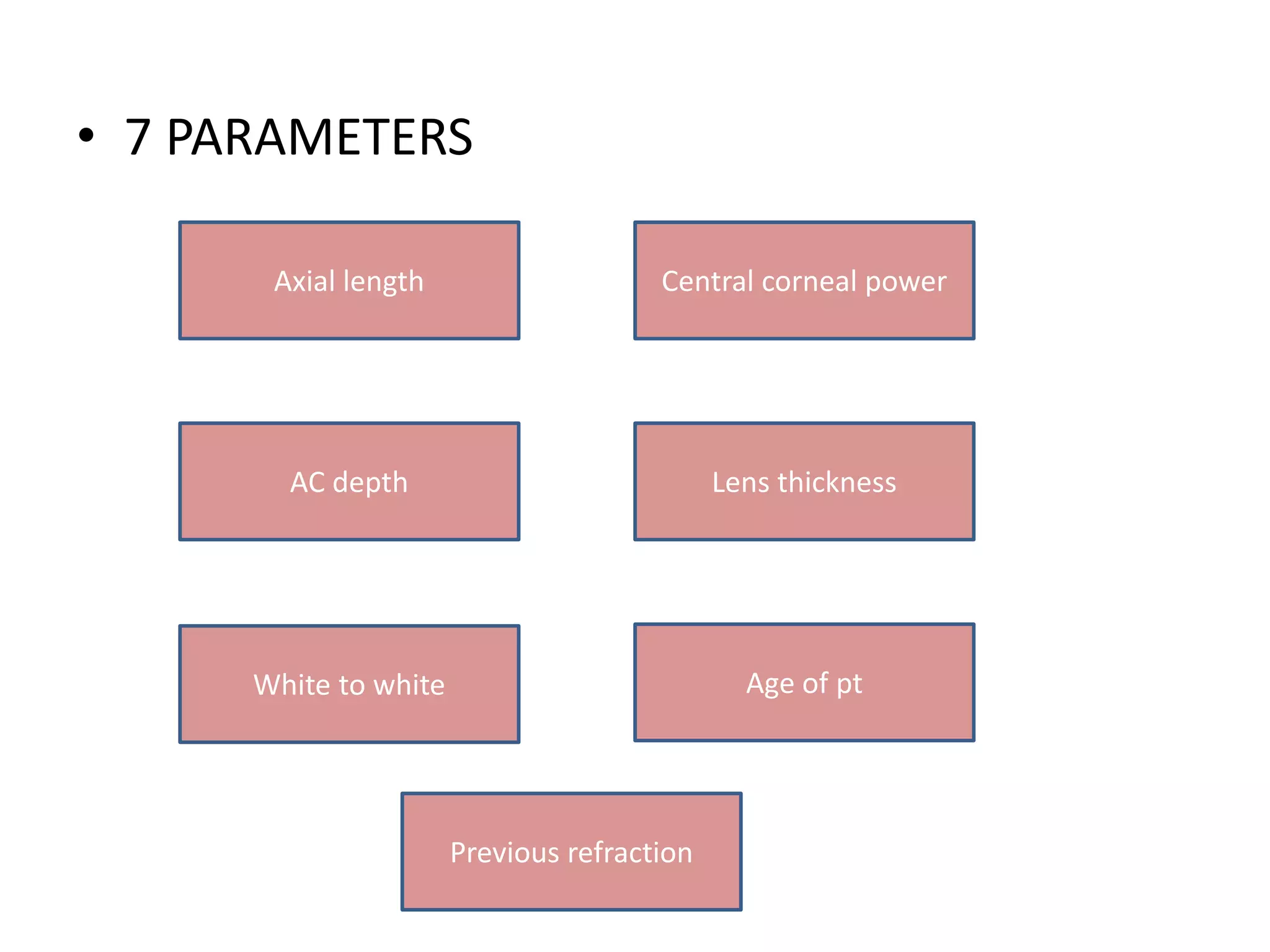
• 7 PARAMETERS
Axial length
White to white
AC depth
Previous refraction
Age of pt
Lens thickness
Central corneal power
Effective lens position
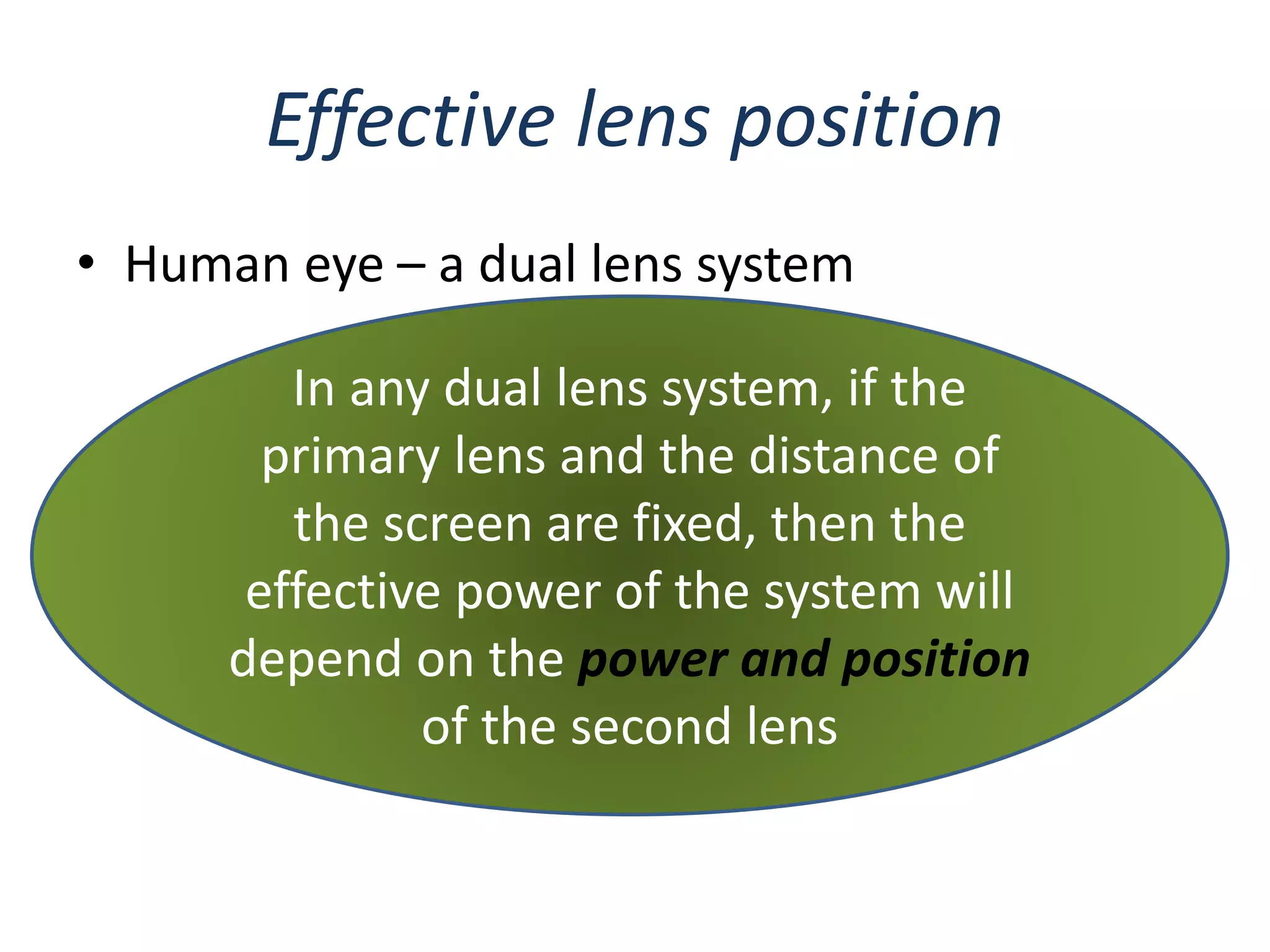
• Human eye – a dual lens system
In any dual lens system, if the
primary lens and the distance of
the screen are fixed, then the
effective power of the system will
depend on the power and position
of the second lens
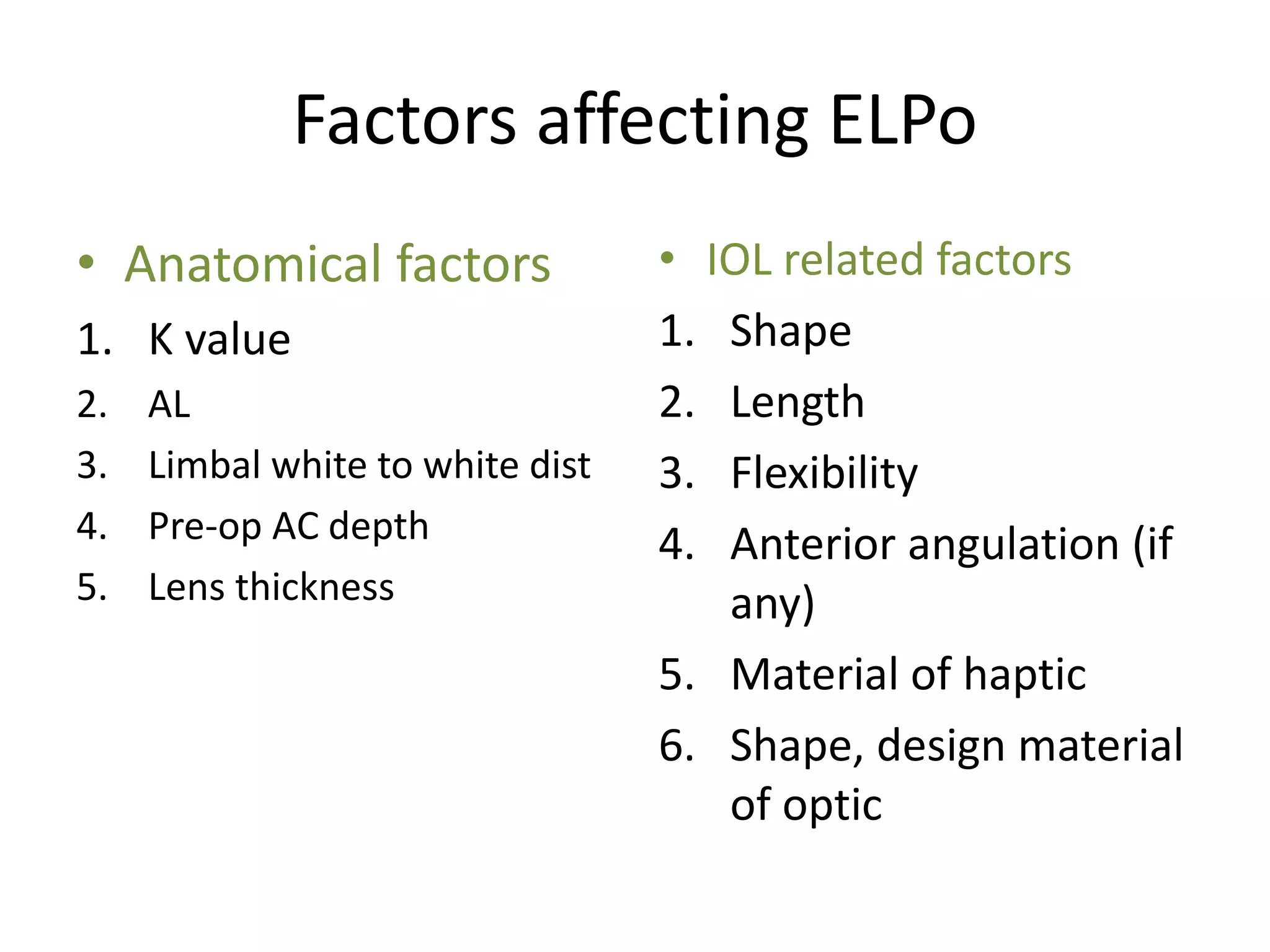
Factors affecting ELPo
• Anatomical factors
1. K value
2. AL
3. Limbal white to white dist
4. Pre-op AC depth
5. Lens thickness
• IOL related factors
1. Shape
2. Length
3. Flexibility
4. Anterior angulation (if
any)
5. Material of haptic
6. Shape, design material
of optic
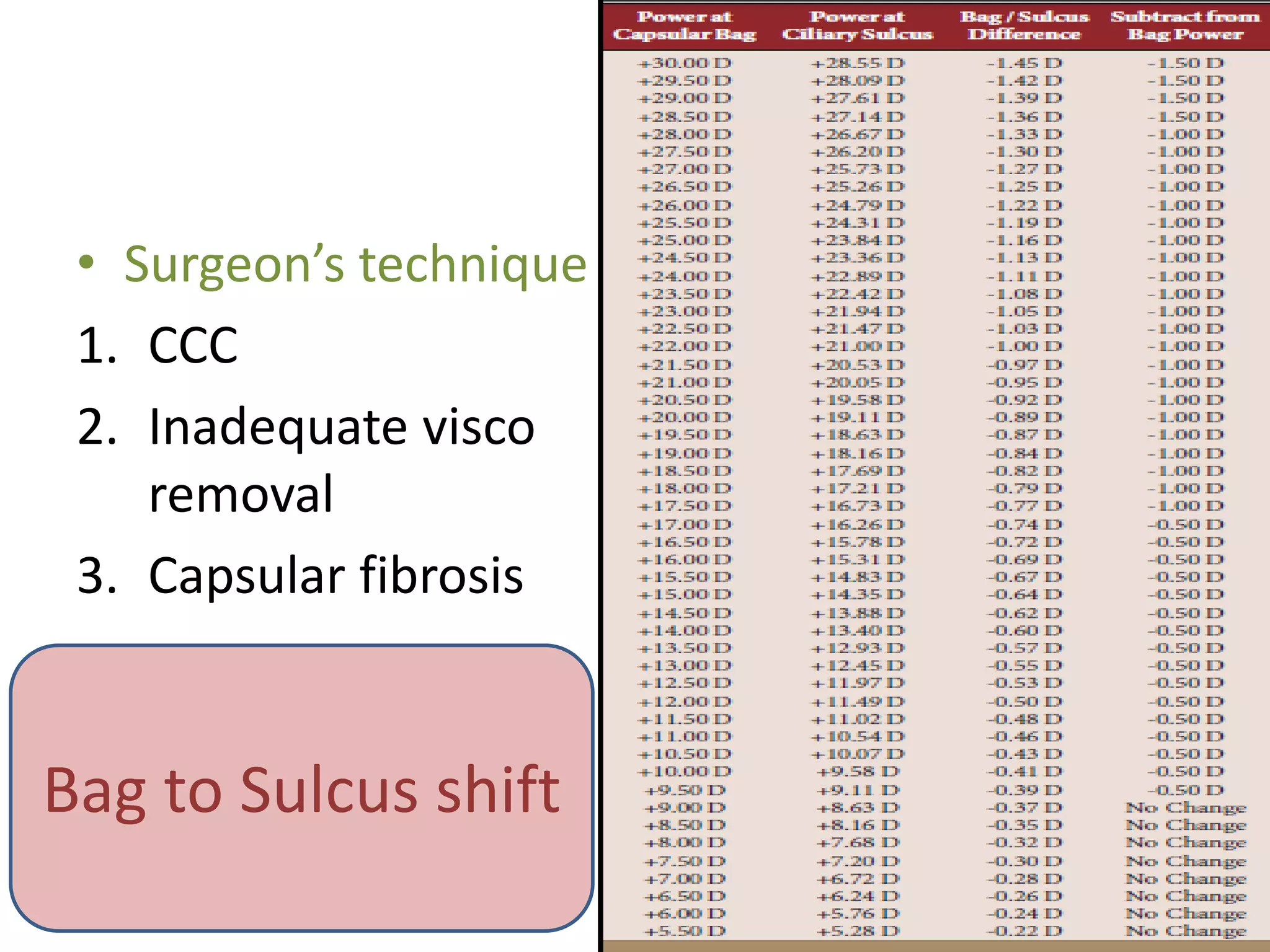
• Surgeon’s technique
1. CCC
2. Inadequate visco
removal
3. Capsular fibrosis
Bag to Sulcus shift
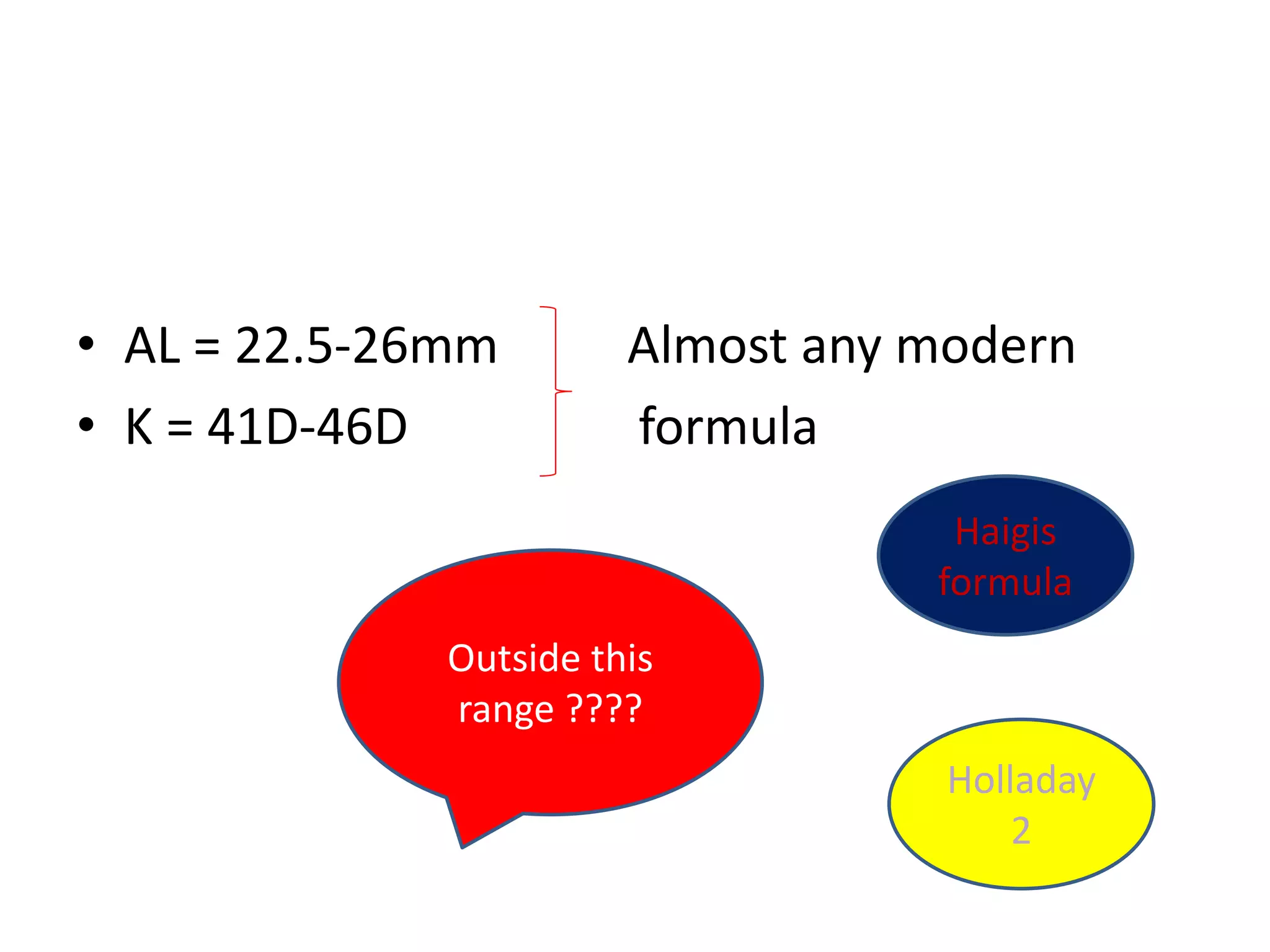
• AL = 22.5-26mm Almost any modern
• K = 41D-46D formula
Outside this
range ????
Haigis
formula
Holladay
2
Special cases
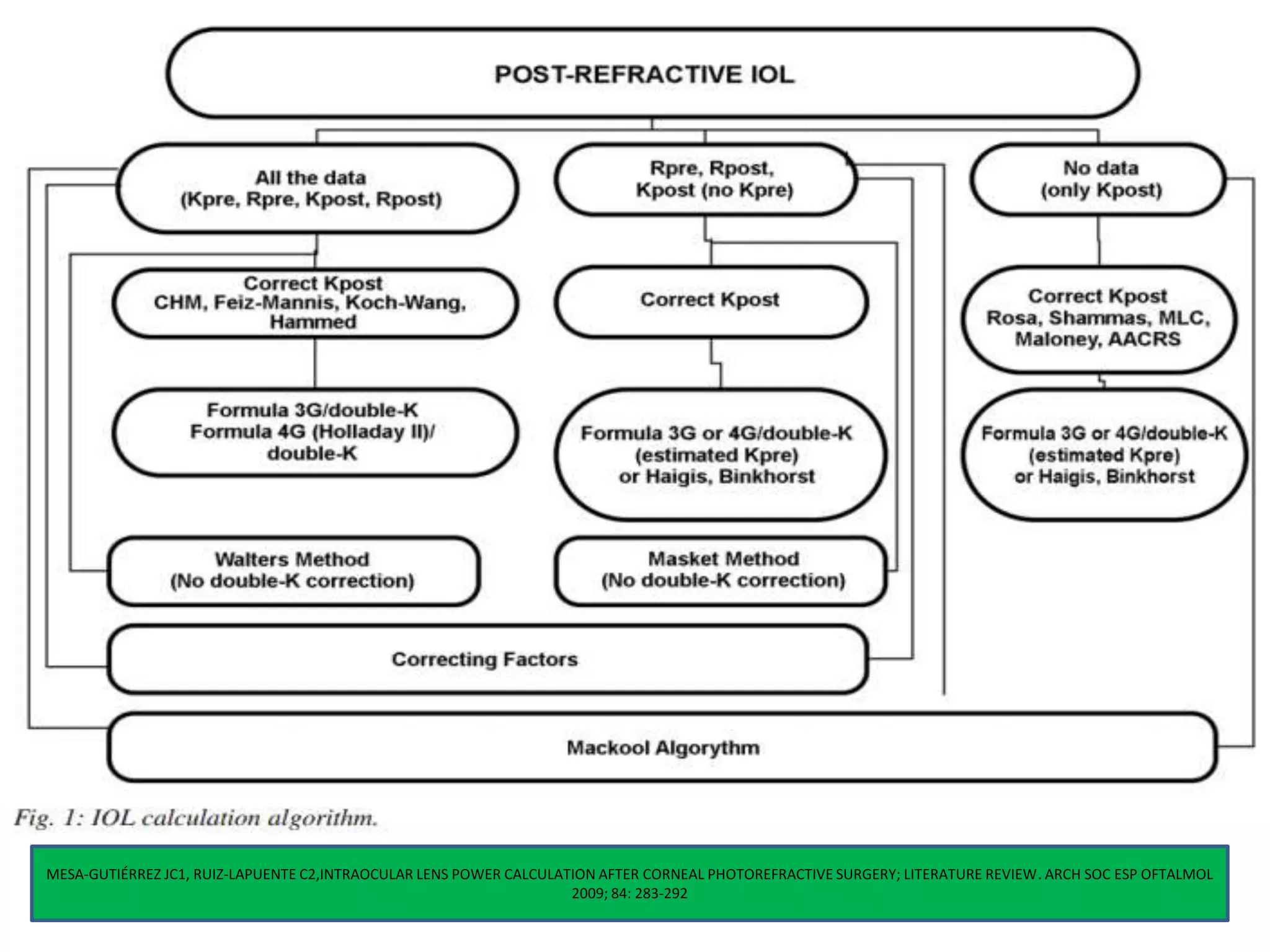
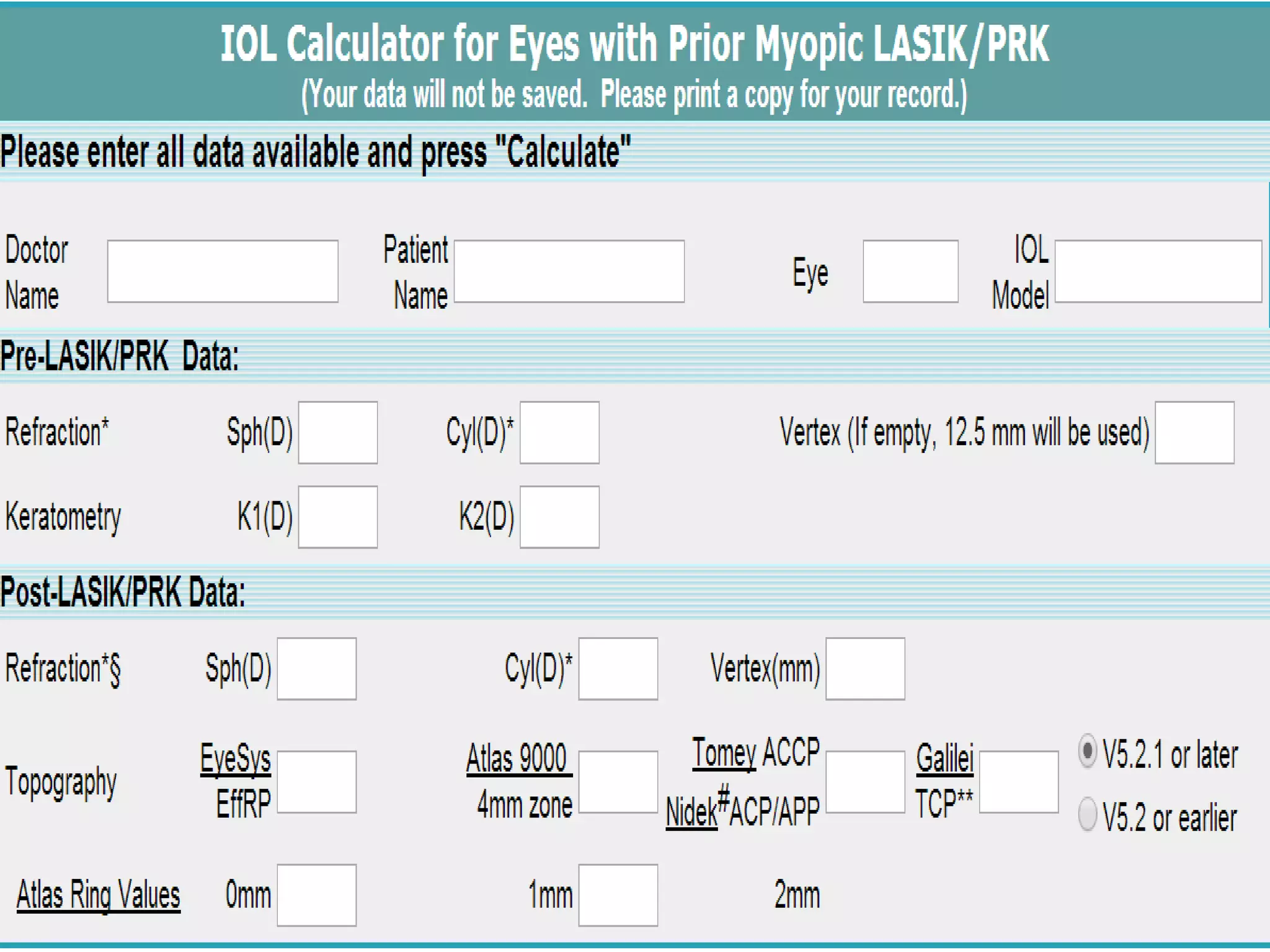
Post ref sx IOL calculation
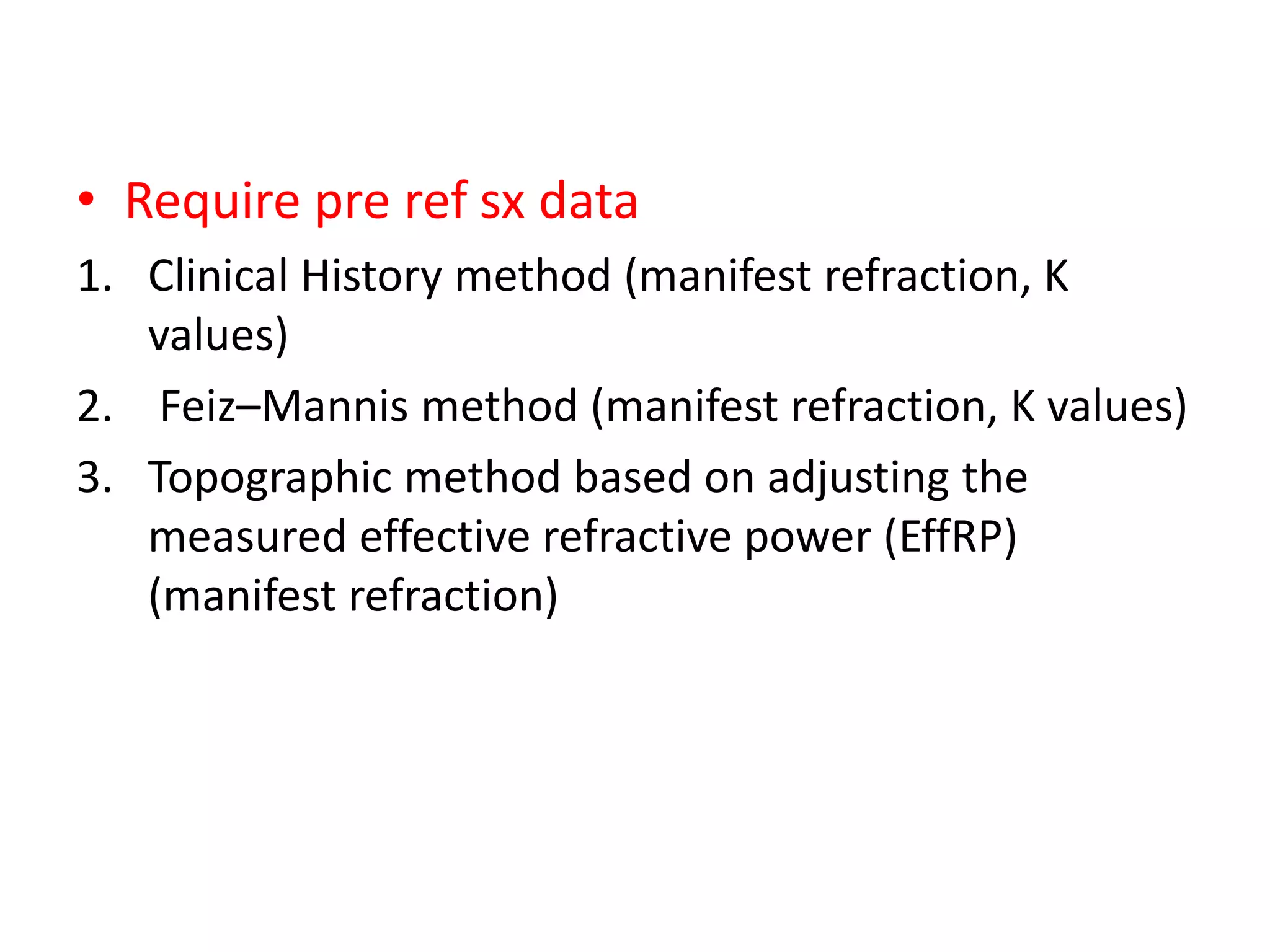
• Require pre ref sx data
1. Clinical History method (manifest refraction, K
values)
2. Feiz–Mannis method (manifest refraction, K values)
3. Topographic method based on adjusting the
measured effective refractive power (EffRP)
(manifest refraction)
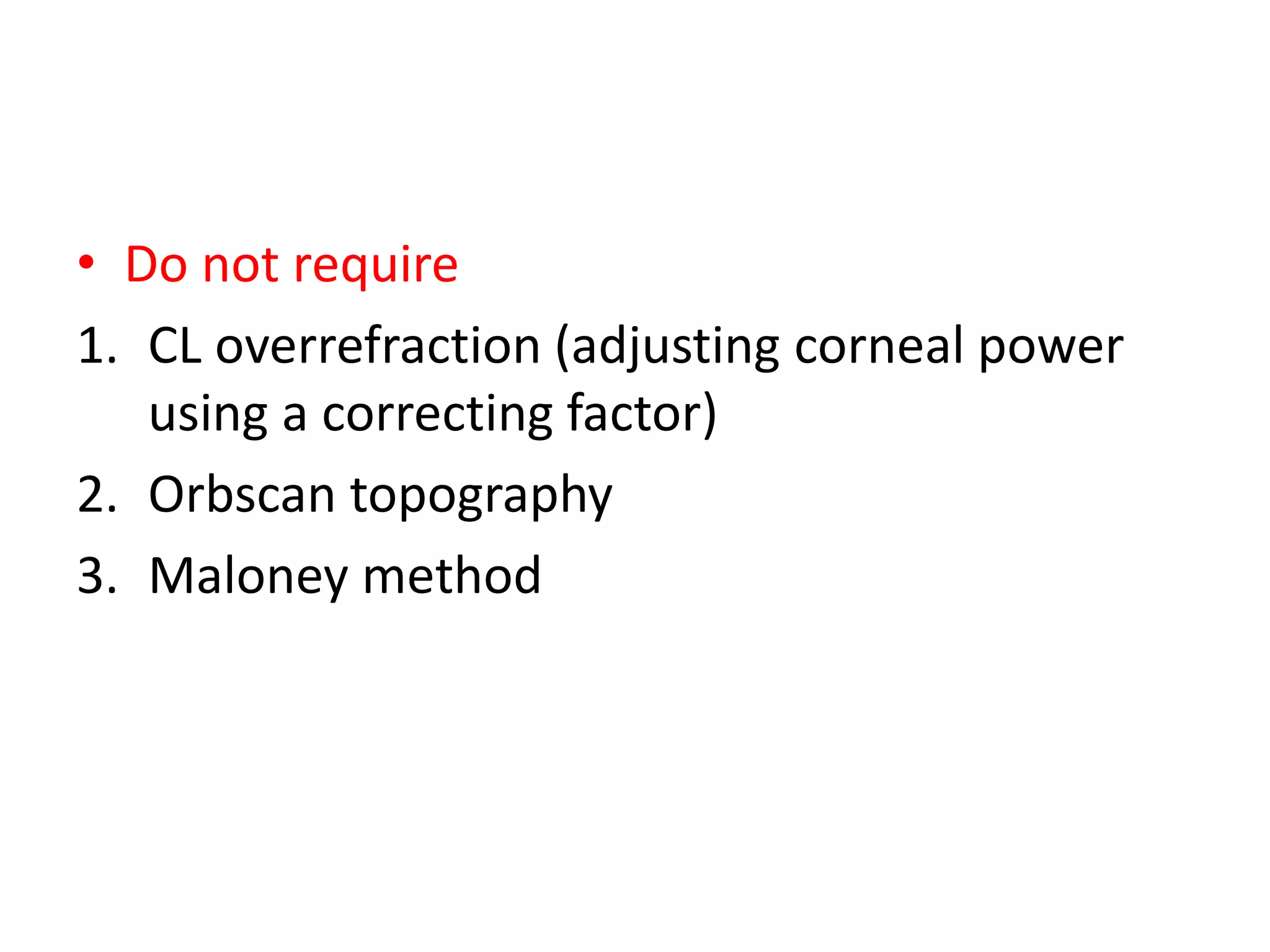
• Do not require
1. CL overrefraction (adjusting corneal power
using a correcting factor)
2. Orbscan topography
3. Maloney method
MESA-GUTIƉRREZ JC1, RUIZ-LAPUENTE C2,INTRAOCULAR LENS POWER CALCULATION AFTER CORNEAL PHOTOREFRACTIVE SURGERY; LITERATURE REVIEW. ARCH SOC ESP OFTALMOL
2009; 84: 283-292
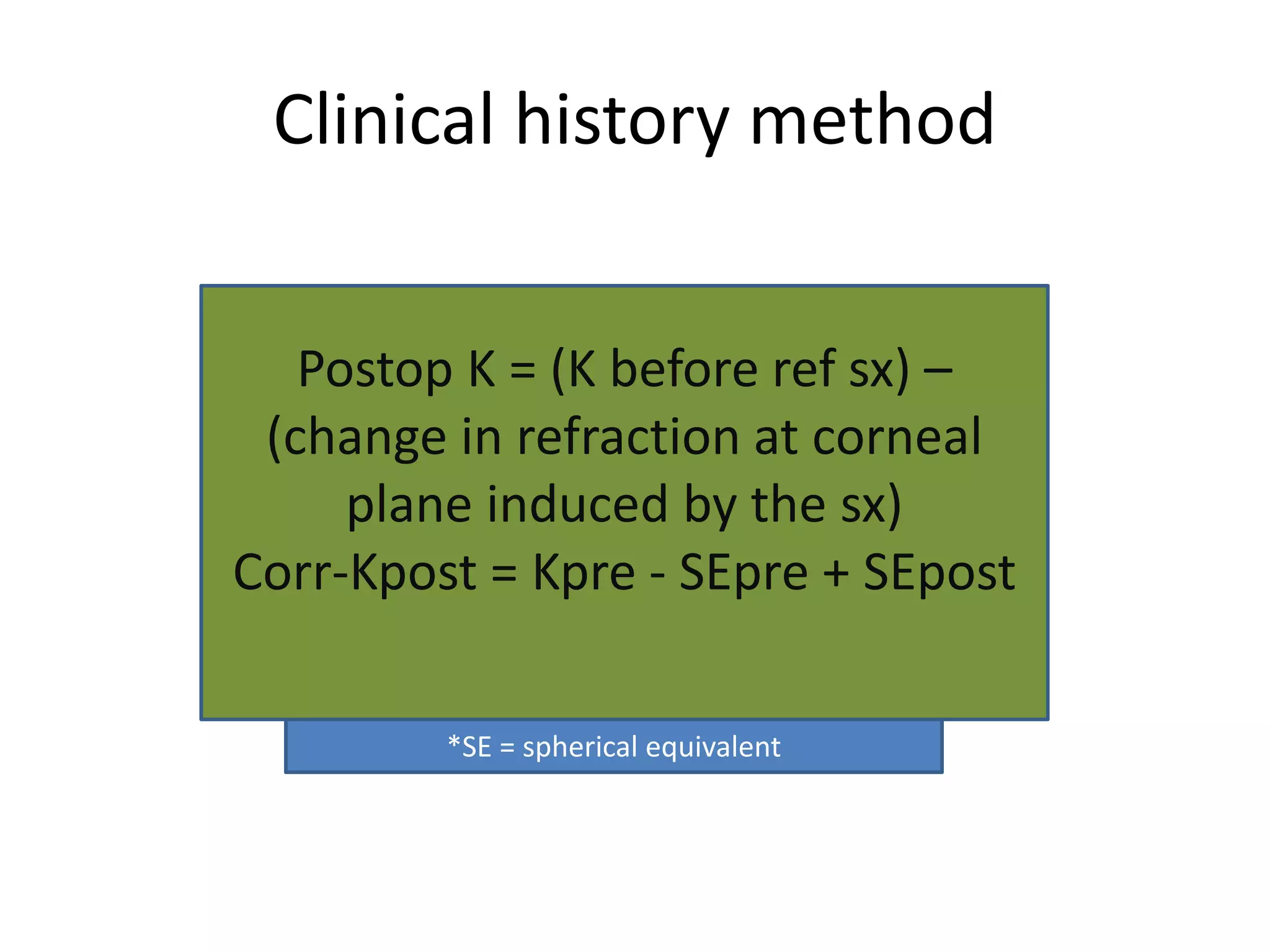
Clinical history method
Postop K = (K before ref sx) –
(change in refraction at corneal
plane induced by the sx)
Corr-Kpost = Kpre - SEpre + SEpost
*SE = spherical equivalent
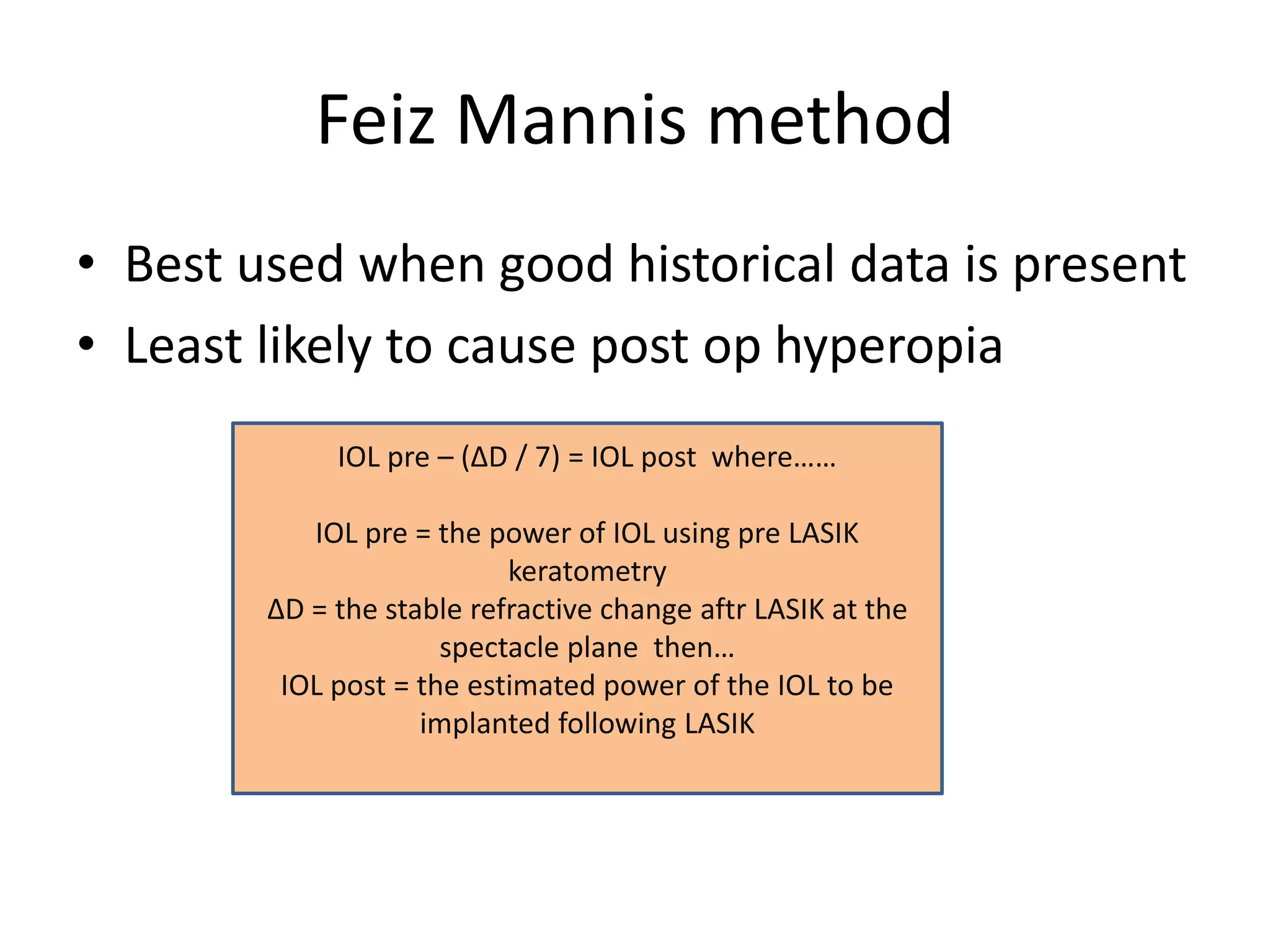
Feiz Mannis method
• Best used when good historical data is present
• Least likely to cause post op hyperopia
IOL pre – (āˆ†D / 7) = IOL post where……
IOL pre = the power of IOL using pre LASIK
keratometry
āˆ†D = the stable refractive change aftr LASIK at the
spectacle plane then…
IOL post = the estimated power of the IOL to be
implanted following LASIK
• It is helpful to keep in mind that the sign
convention for the change in refractive error
(ΔD) following myopic LASIK is a negative
number. Using the above formula, the new
calculated IOL power will always result in a
larger number.
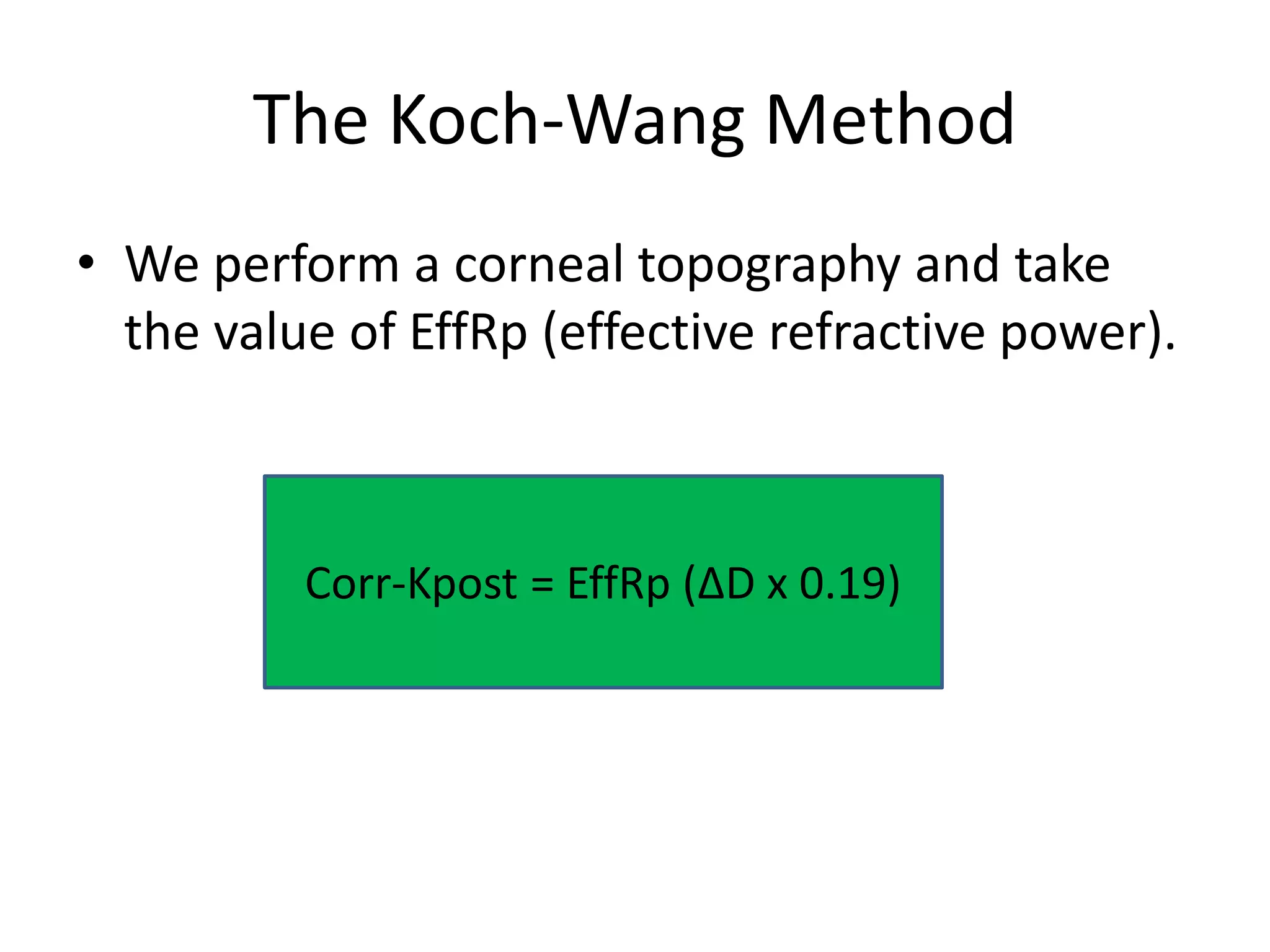
The Koch-Wang Method
• We perform a corneal topography and take
the value of EffRp (effective refractive power).
Corr-Kpost = EffRp (ΔD x 0.19)
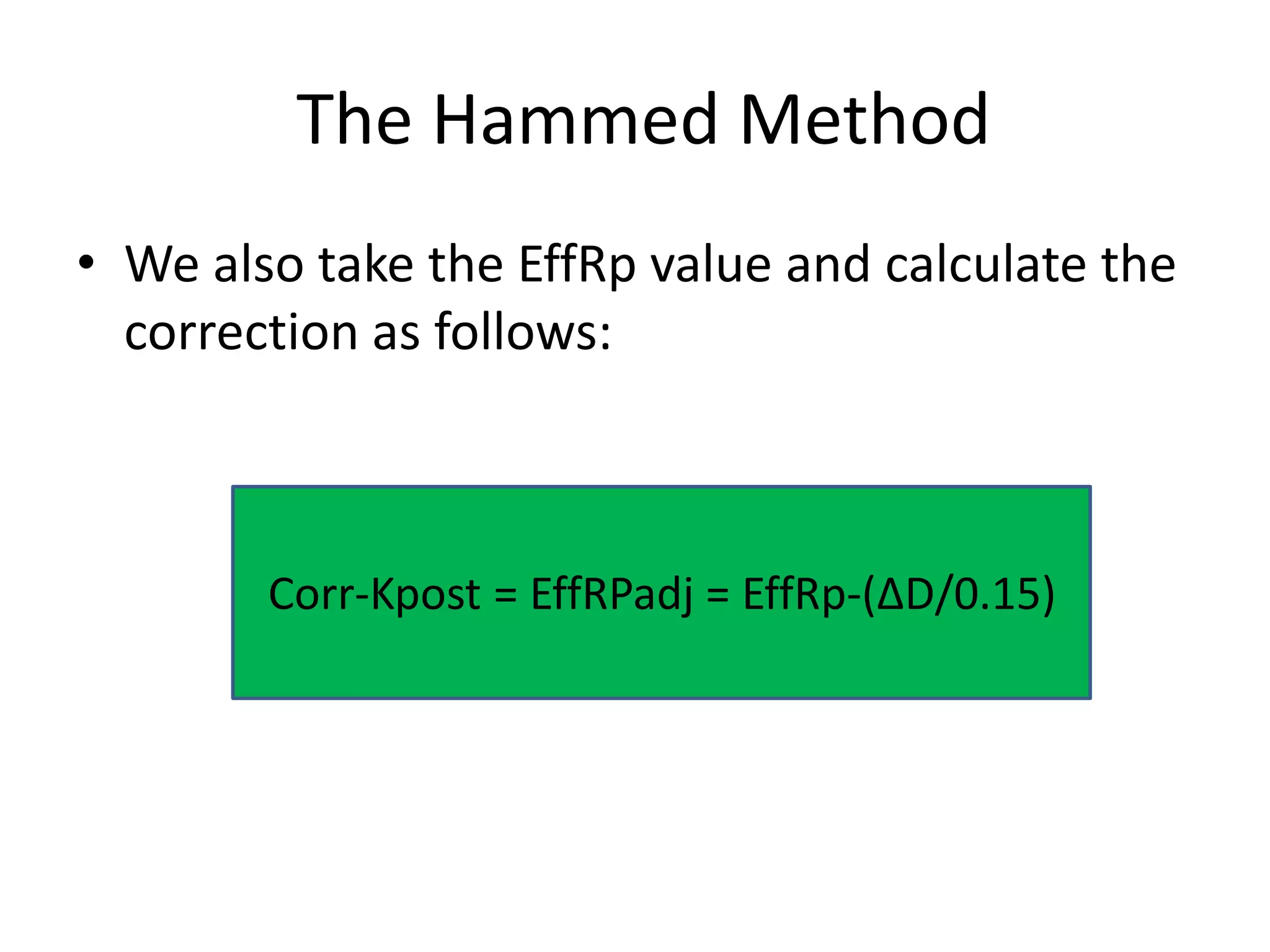
The Hammed Method
• We also take the EffRp value and calculate the
correction as follows:
Corr-Kpost = EffRPadj = EffRp-(ΔD/0.15)
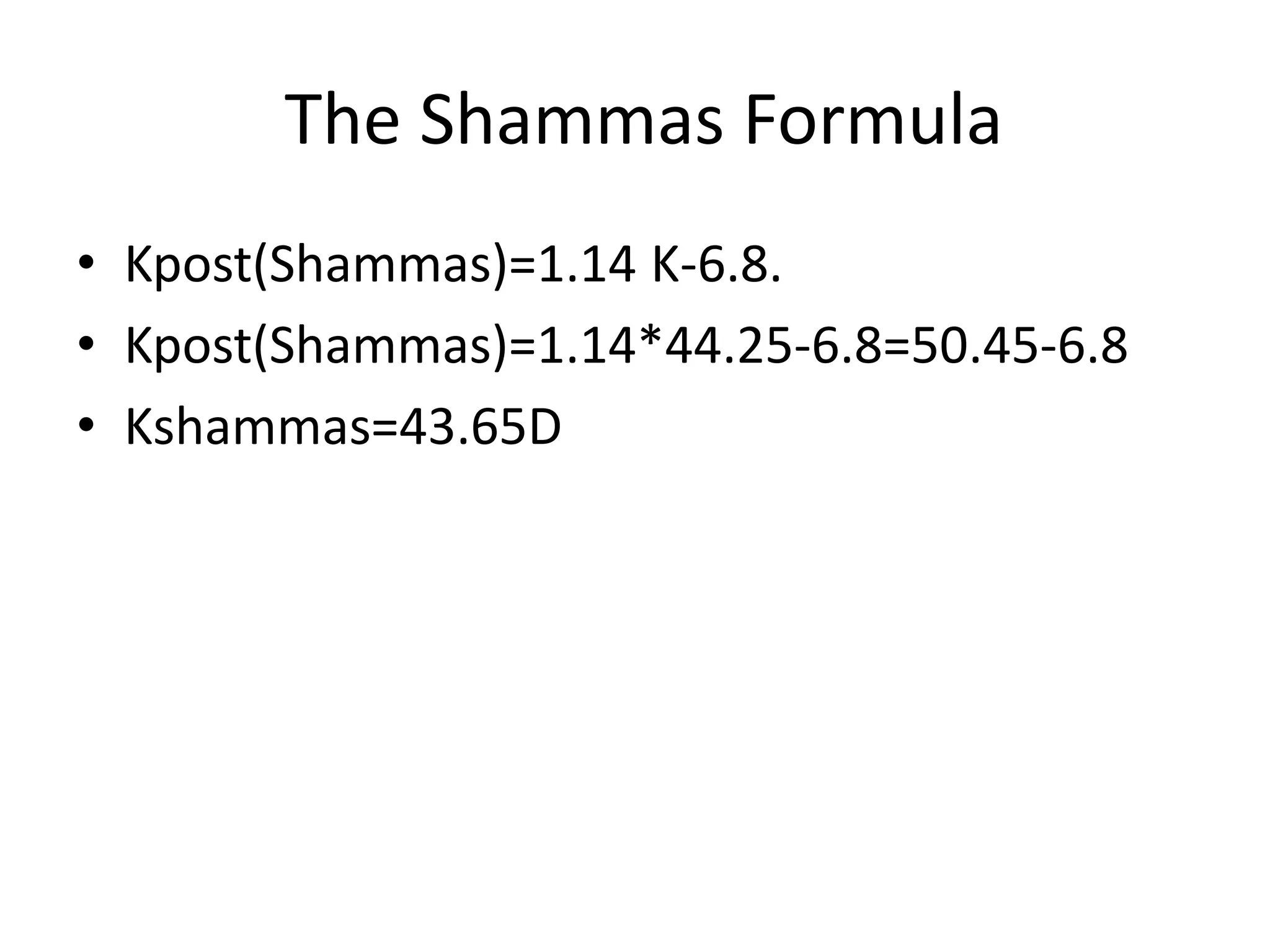
The Shammas Formula
• Kpost(Shammas)=1.14 K-6.8.
• Kpost(Shammas)=1.14*44.25-6.8=50.45-6.8
• Kshammas=43.65D
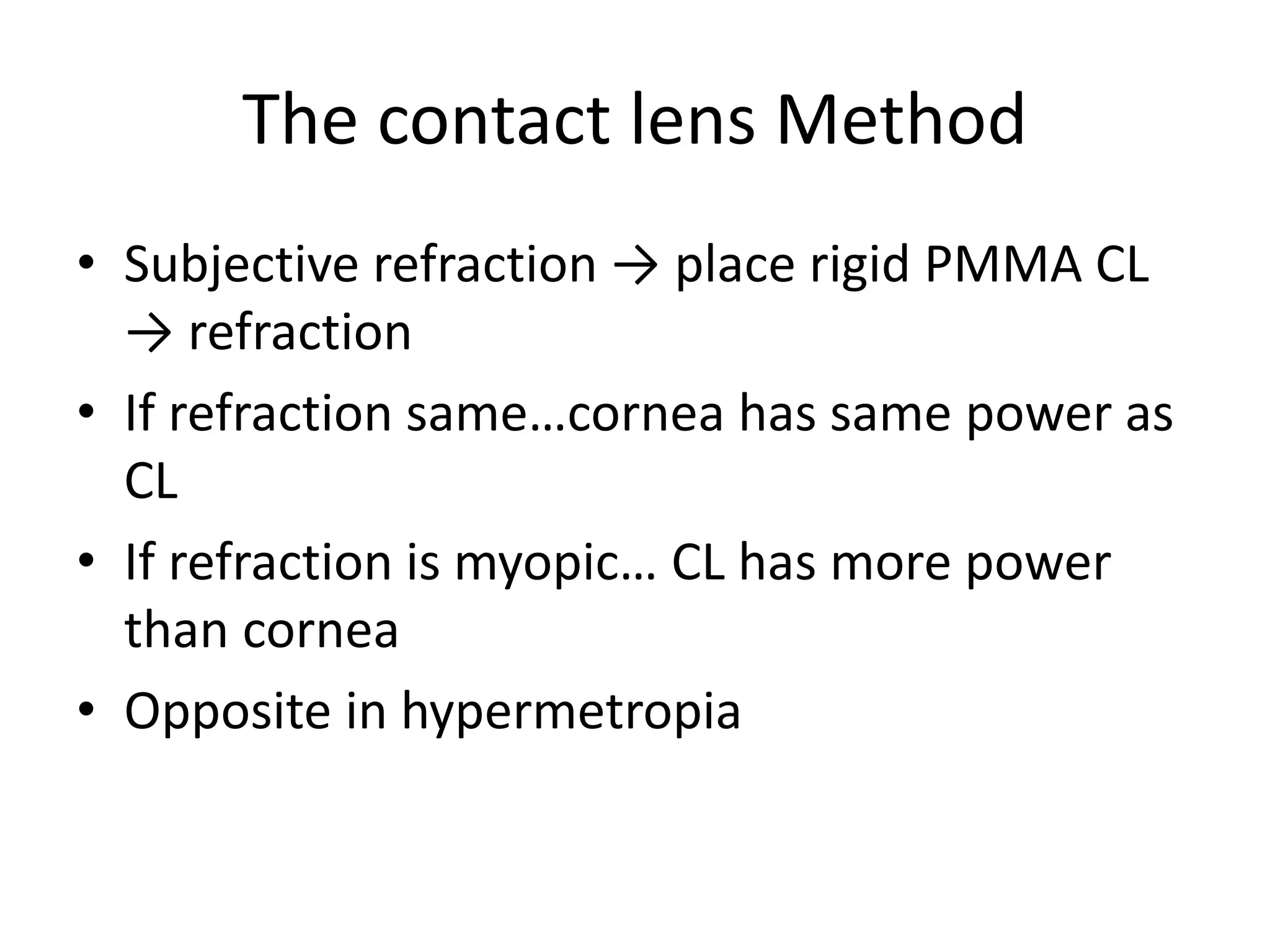
The contact lens Method
• Subjective refraction → place rigid PMMA CL
→ refraction
• If refraction same…cornea has same power as
CL
• If refraction is myopic… CL has more power
than cornea
• Opposite in hypermetropia
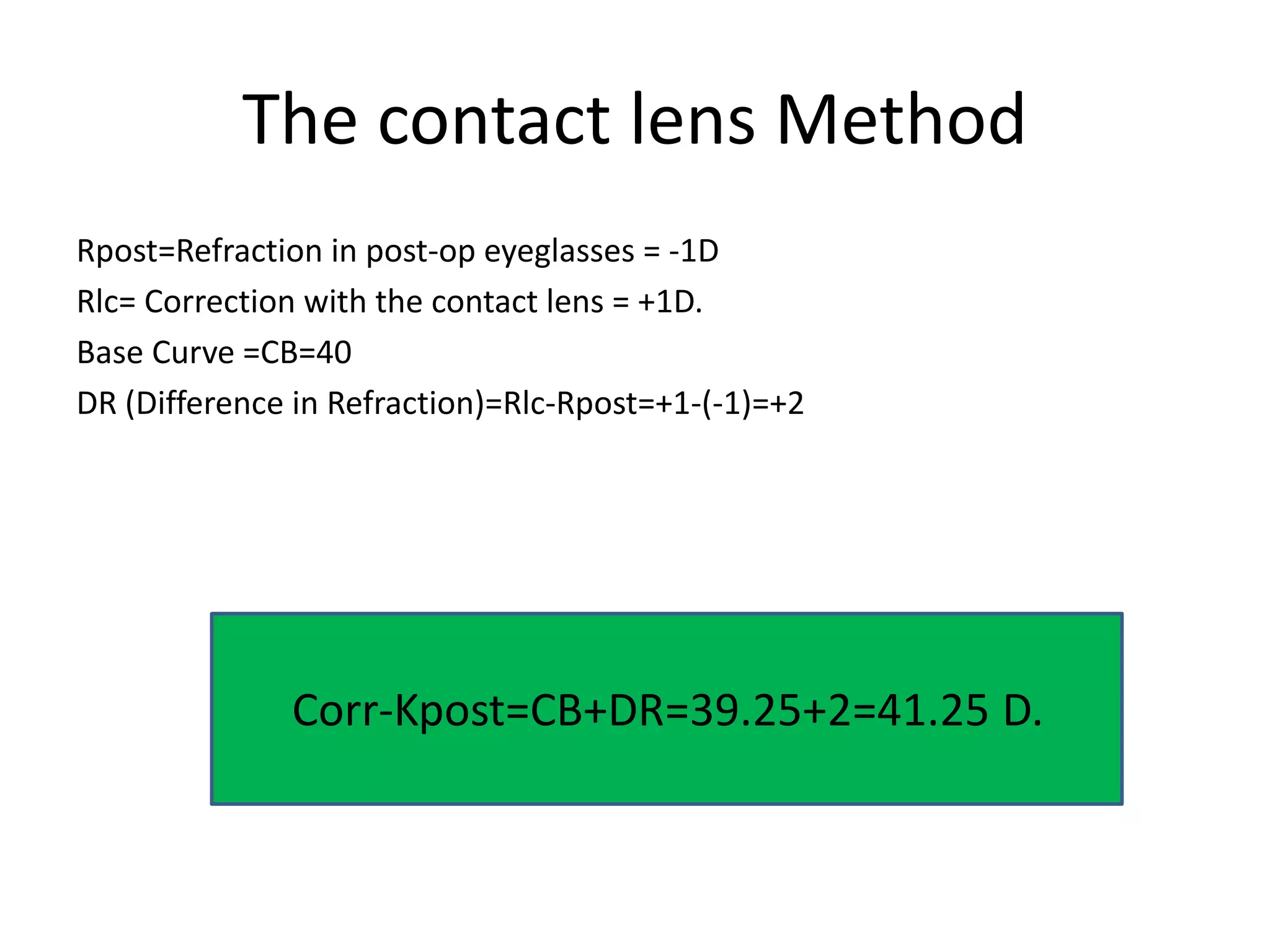
The contact lens Method
Rpost=Refraction in post-op eyeglasses = -1D
Rlc= Correction with the contact lens = +1D.
Base Curve =CB=40
DR (Difference in Refraction)=Rlc-Rpost=+1-(-1)=+2
Corr-Kpost=CB+DR=39.25+2=41.25 D.
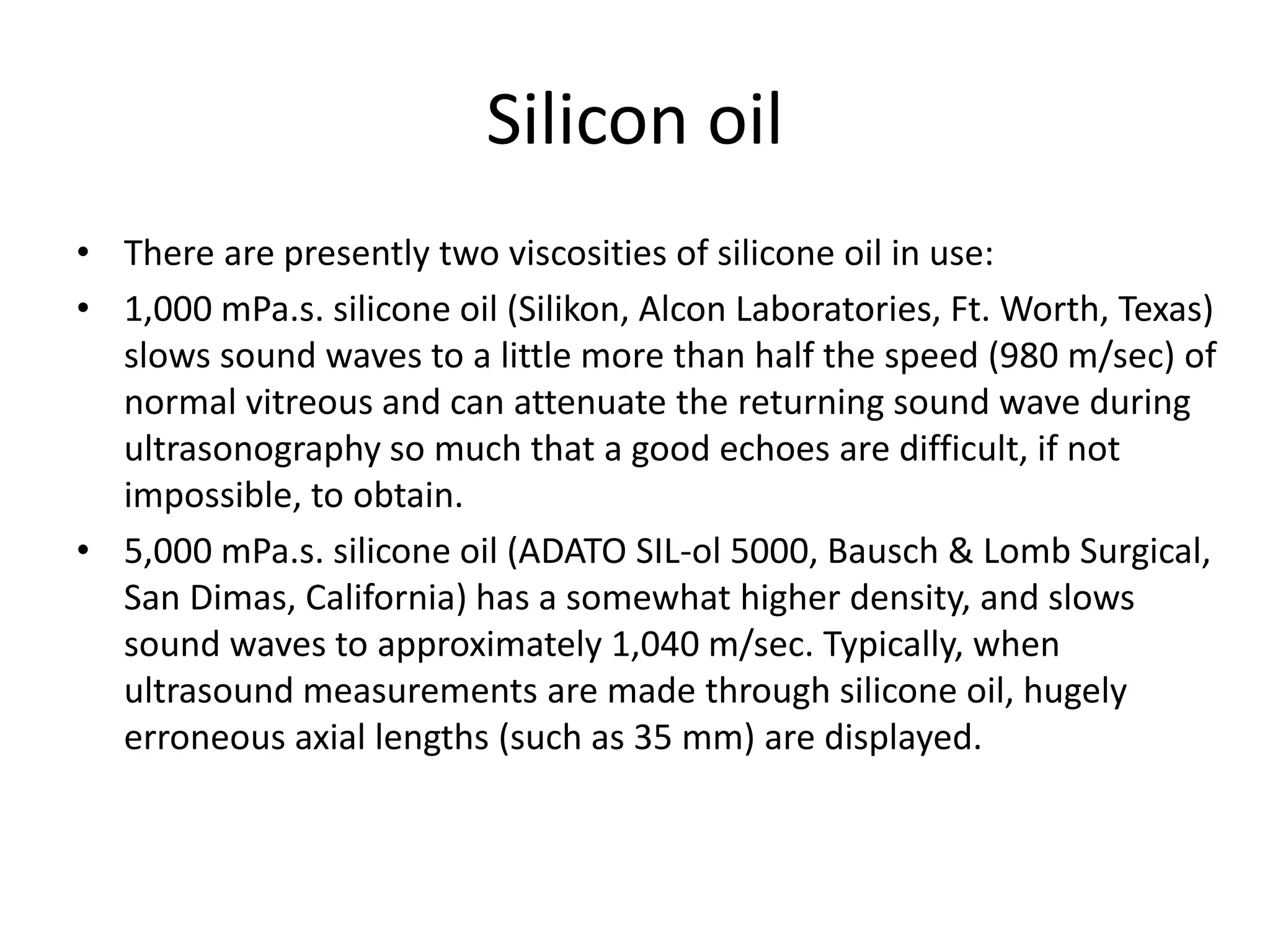
Silicon oil
• There are presently two viscosities of silicone oil in use:
• 1,000 mPa.s. silicone oil (Silikon, Alcon Laboratories, Ft. Worth, Texas)
slows sound waves to a little more than half the speed (980 m/sec) of
normal vitreous and can attenuate the returning sound wave during
ultrasonography so much that a good echoes are difficult, if not
impossible, to obtain.
• 5,000 mPa.s. silicone oil (ADATO SIL-ol 5000, Bausch & Lomb Surgical,
San Dimas, California) has a somewhat higher density, and slows
sound waves to approximately 1,040 m/sec. Typically, when
ultrasound measurements are made through silicone oil, hugely
erroneous axial lengths (such as 35 mm) are displayed.
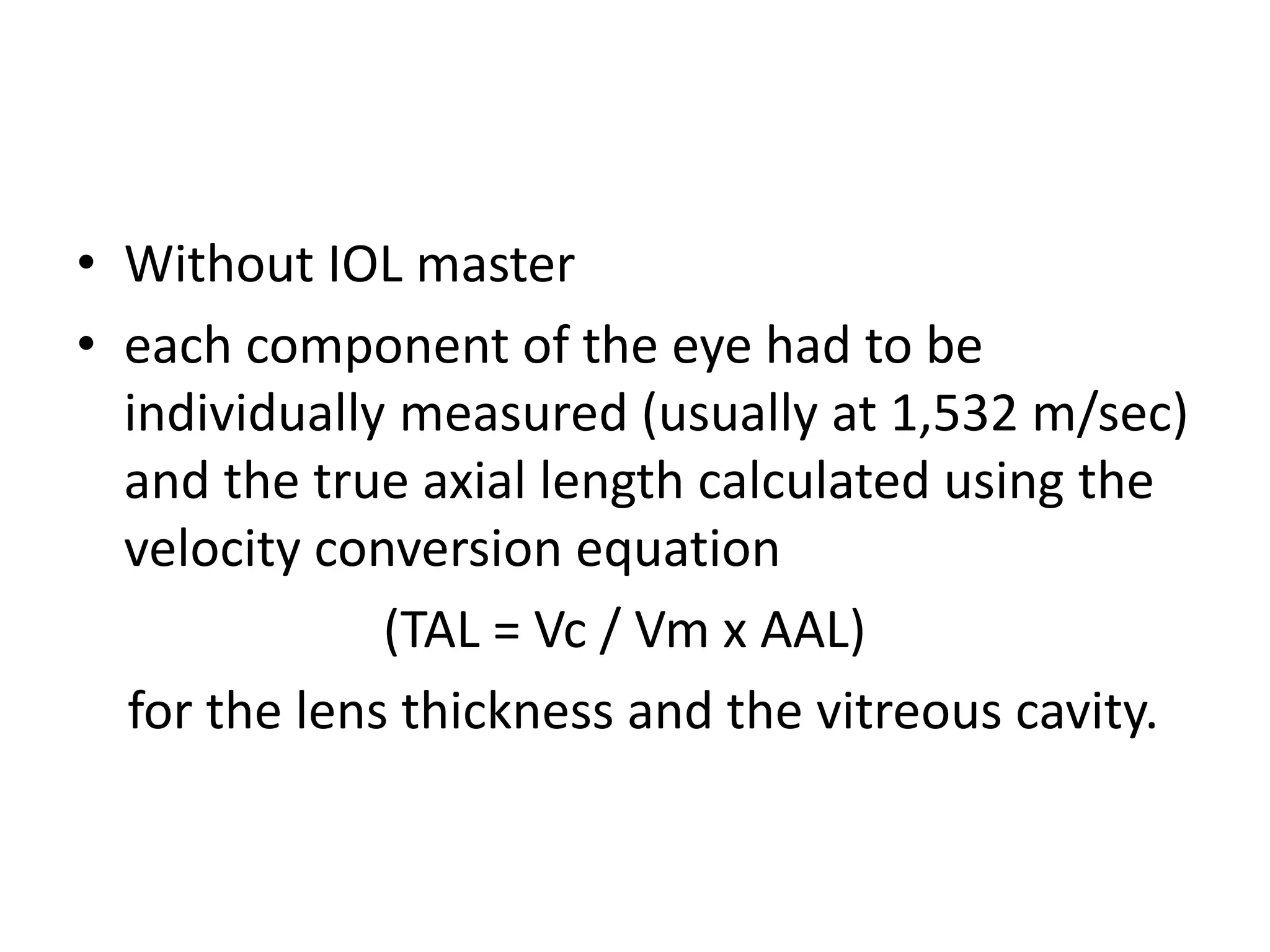
• Without IOL master
• each component of the eye had to be
individually measured (usually at 1,532 m/sec)
and the true axial length calculated using the
velocity conversion equation
(TAL = Vc / Vm x AAL)
for the lens thickness and the vitreous cavity.
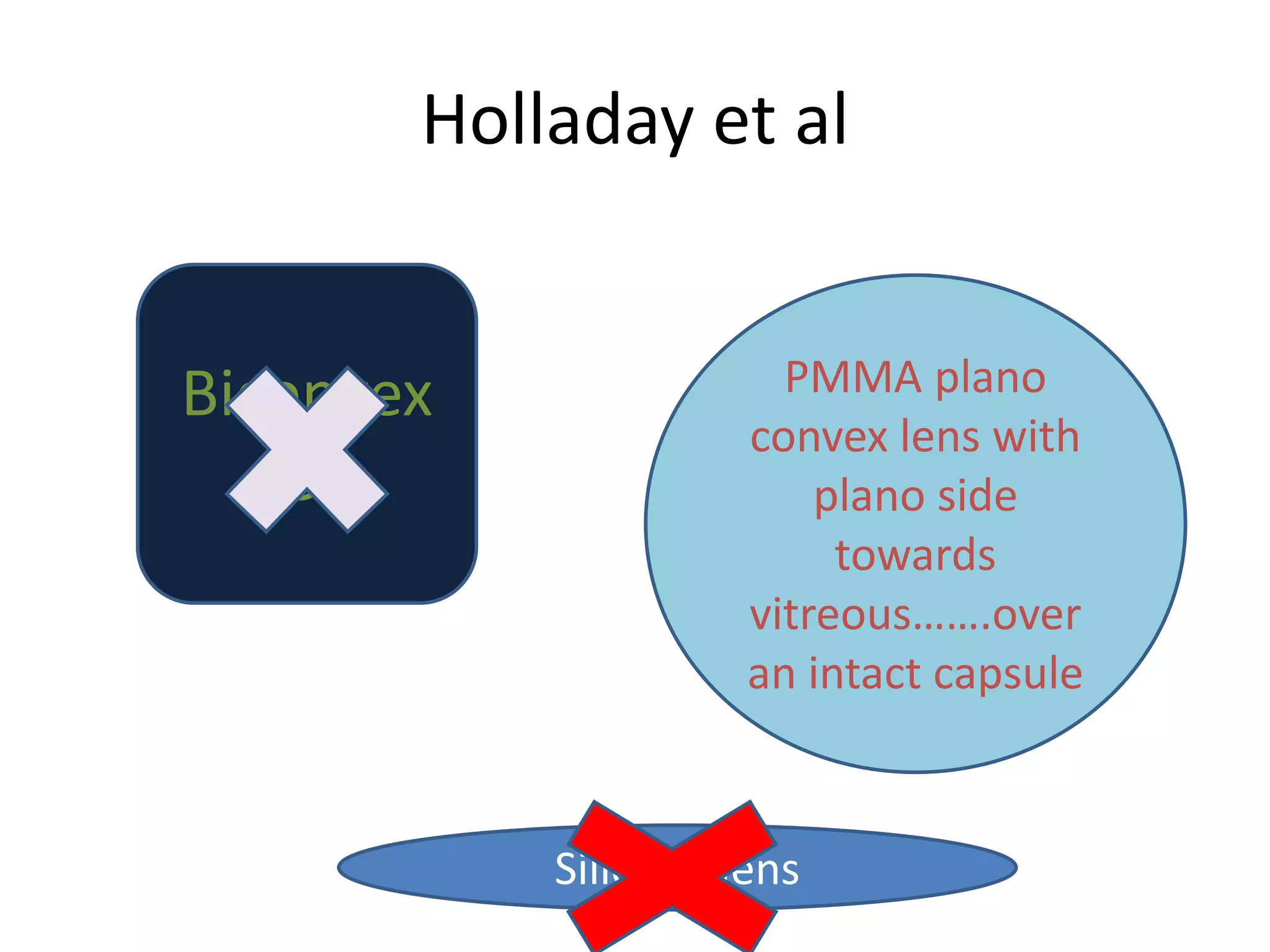
Holladay et al
Biconvex
IOL
PMMA plano
convex lens with
plano side
towards
vitreous…….over
an intact capsule
Silicone lens
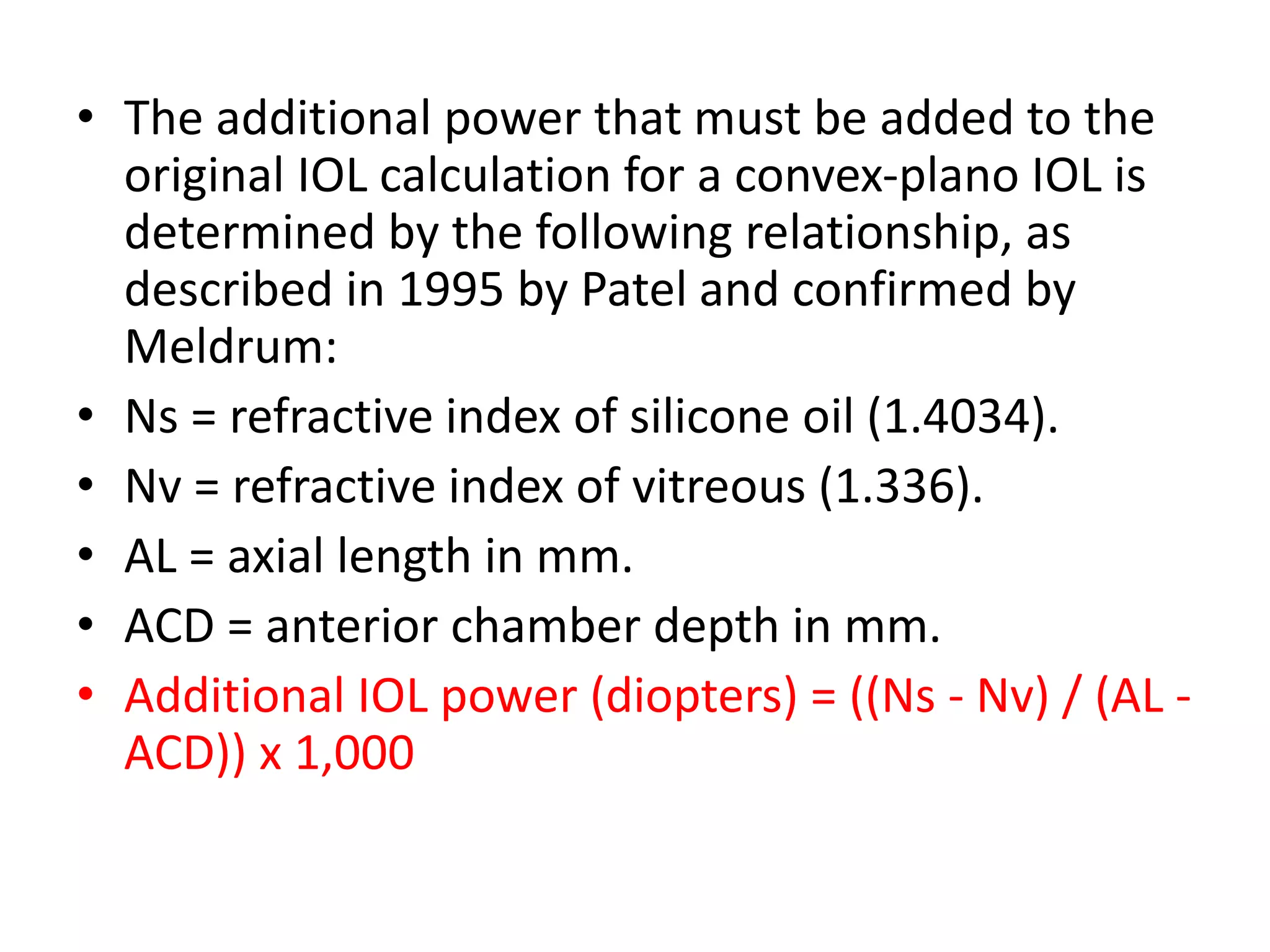
• The additional power that must be added to the
original IOL calculation for a convex-plano IOL is
determined by the following relationship, as
described in 1995 by Patel and confirmed by
Meldrum:
• Ns = refractive index of silicone oil (1.4034).
• Nv = refractive index of vitreous (1.336).
• AL = axial length in mm.
• ACD = anterior chamber depth in mm.
• Additional IOL power (diopters) = ((Ns - Nv) / (AL -
ACD)) x 1,000
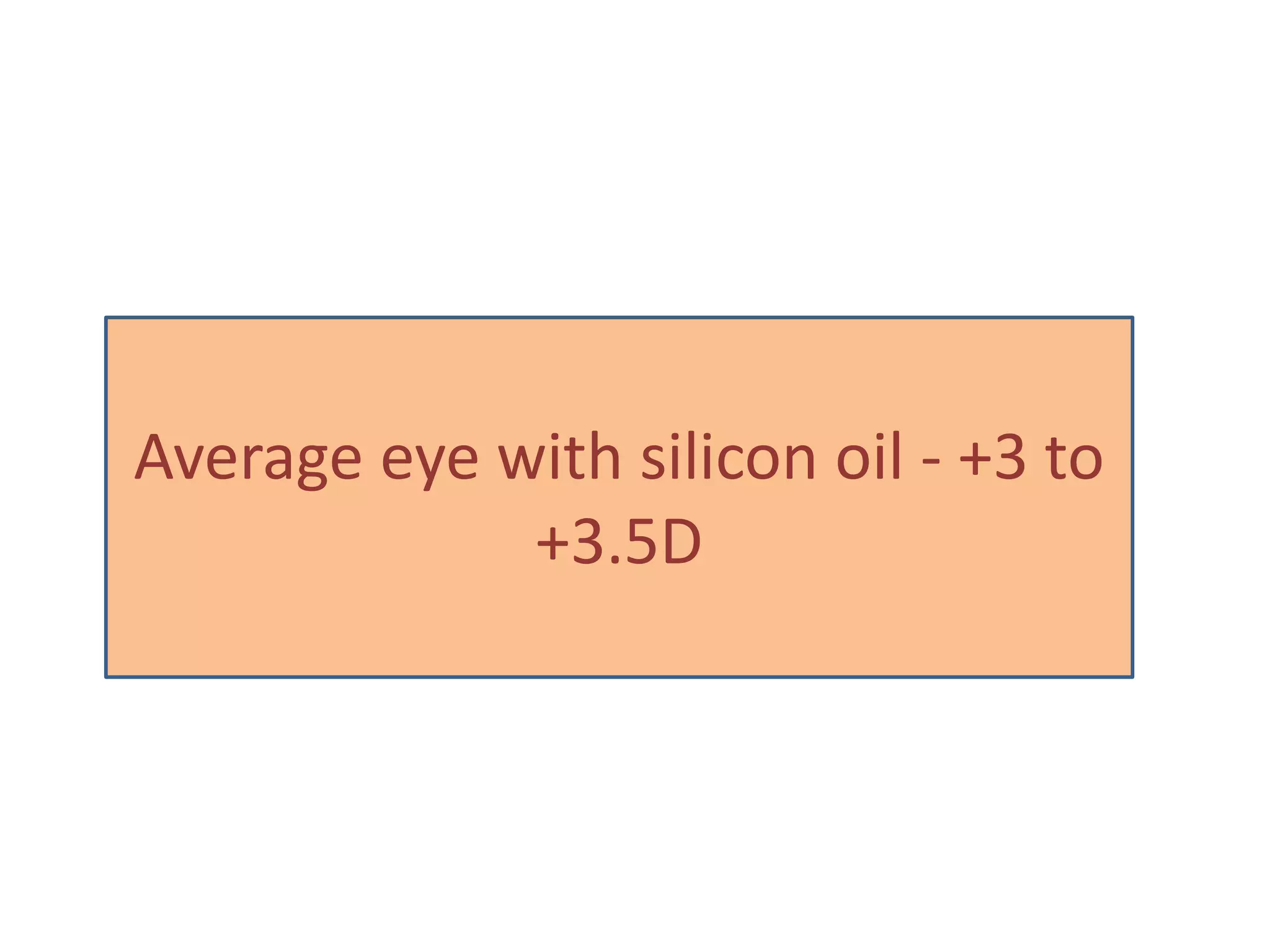
Average eye with silicon oil - +3 to
+3.5D
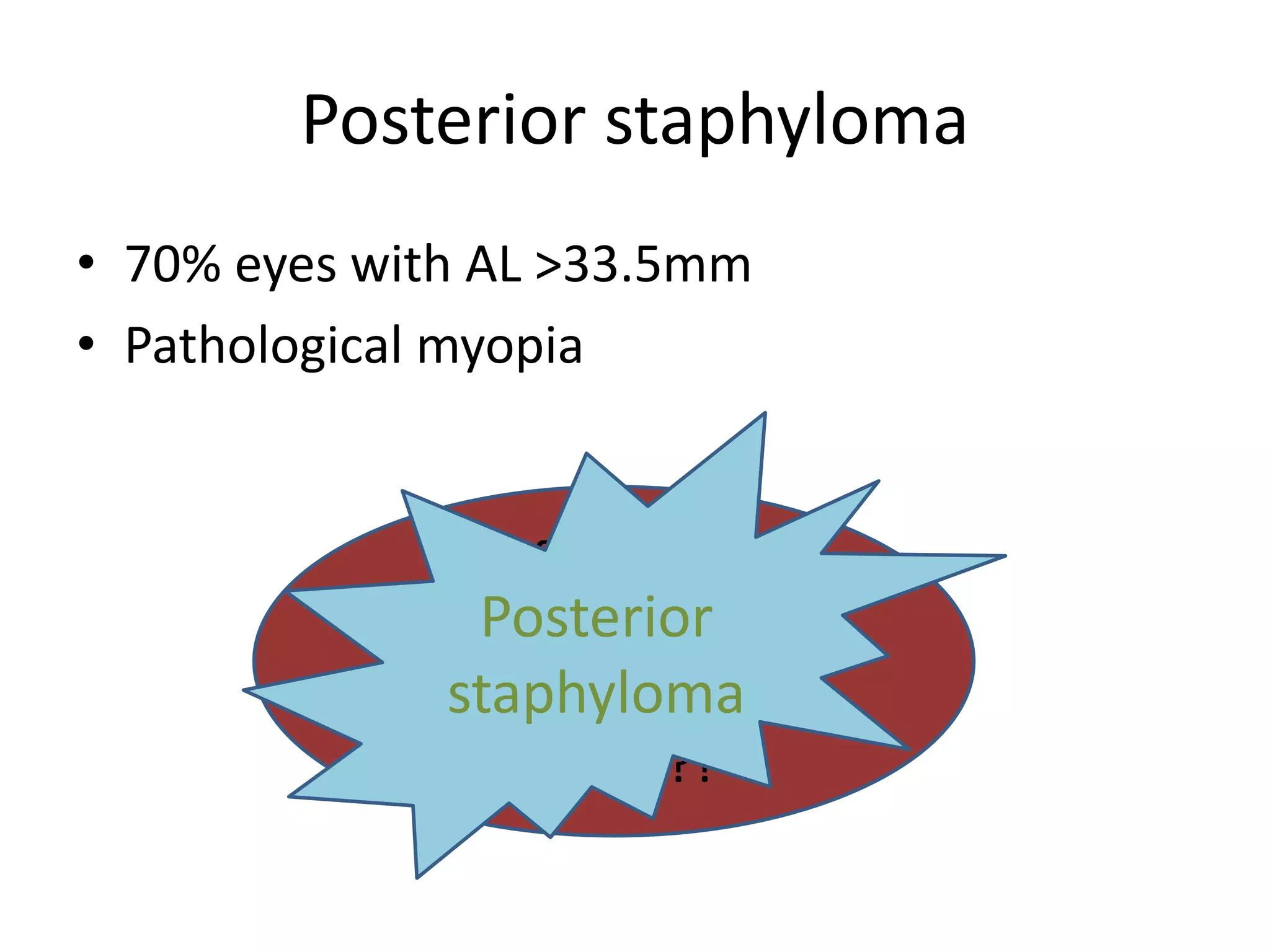
Posterior staphyloma
• 70% eyes with AL >33.5mm
• Pathological myopia
Difficulty in
obtaining posterior
retinal spike
????????
Posterior
staphyloma
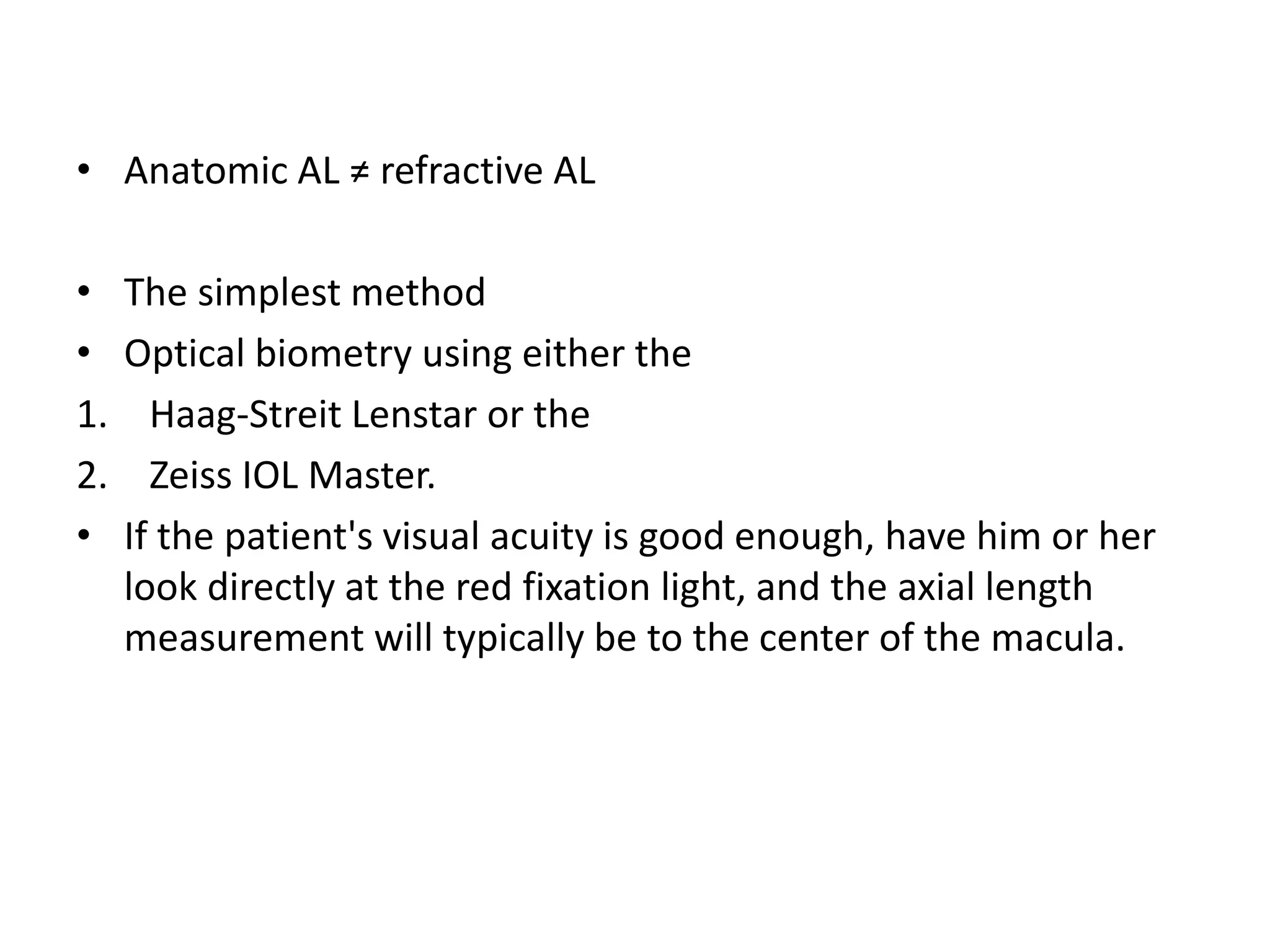
• Anatomic AL ≠ refractive AL
• The simplest method
• Optical biometry using either the
1. Haag-Streit Lenstar or the
2. Zeiss IOL Master.
• If the patient's visual acuity is good enough, have him or her
look directly at the red fixation light, and the axial length
measurement will typically be to the center of the macula.

IOL power calculation formulae

  • 1.
  • 2.
    Generations! • First –SRK 1 & Binkhorst formula • Second – SRK2 • Third – SRK T , Hoffer Q , Holladay • Fourth – Holladay 2 , Haigis
  • 3.
    • Theoretical formulae– based on mathematical principles revolving around the schematic eye • Regression formulae – working backwards on post operative outcomes • 3rd and 4th generation – mix of both.
  • 4.
    A closer look 1.SRK formula • P = IOL Power • K = avg central corneal power in Diopters • L = axial length in mm. P = A – 0.9K – 2.5L Range - 22mm – 24.5mm
  • 5.
    2. SRK 2formula – An attempt to OPTIMIZATION A1 =(A–0.5) for axial lengths greater than 24.5 A1 =A for axial lengths between 22 and 24.5 A1 =(A+1) for axial lengths between 21 and 22 A1 =(A+2) for axial lengths between 20 and 21 A1 =(A+3) for axial lengths less than 20
  • 6.
  • 7.
    • All formulaework well within the range of 22.5-26 mm AL • A constant computed based on Avg AL 23.5mm • Assumption Reason?? AL α ACD K α ACD Dr Holladay
  • 8.
    • SRK/T formula— uses "A-constant" • Holladay 1 formula — uses "Surgeon Factor" • Holladay 2 formula — uses "Anterior Chamber Depth" • Hoffer Q formula — uses "Pseudophakic Anterior Chamber Depth"
  • 9.
    • Hoffer-Q formula •Dr Kenneth Hoffer – 1993 • P = f (A,K,Rx,pACD) • A = AL • K = avg corneal ref power • Rx = previous refraction
  • 10.
    • pACD =The personalized ACD (pACD) is set equal to the manufacturer's ACD-constant, if the calculation was selected to be based on the ACD-constant. In case the A-constant was chosen, pACD is derived from the A-constant [HOFFER, 1998] according to [HOLLADAY et al, 1988] pACD = ACD-const = 0.58357 * A-const - 63.896 .
  • 11.
    Haigis formula • Gernet,Ostholt, Werner -1970 (GOW70 formula) • D = a0 + a1 ACD+ a2 AL • a0 constant moves the power prediction curve up or down • a1 constant is tied to the measured anterior chamber depth • a2 constant is tied to the measured axial length
  • 12.
    Holladay 2 • Currently– most sophisticated formula ACCURACY PREDICTABILITY
  • 13.
  • 14.
    • 7 PARAMETERS Axiallength White to white AC depth Previous refraction Age of pt Lens thickness Central corneal power
  • 16.
    Effective lens position •Human eye – a dual lens system In any dual lens system, if the primary lens and the distance of the screen are fixed, then the effective power of the system will depend on the power and position of the second lens
  • 17.
    Factors affecting ELPo •Anatomical factors 1. K value 2. AL 3. Limbal white to white dist 4. Pre-op AC depth 5. Lens thickness • IOL related factors 1. Shape 2. Length 3. Flexibility 4. Anterior angulation (if any) 5. Material of haptic 6. Shape, design material of optic
  • 18.
    • Surgeon’s technique 1.CCC 2. Inadequate visco removal 3. Capsular fibrosis Bag to Sulcus shift
  • 19.
    • AL =22.5-26mm Almost any modern • K = 41D-46D formula Outside this range ???? Haigis formula Holladay 2
  • 22.
  • 23.
    Post ref sxIOL calculation
  • 24.
    • Require preref sx data 1. Clinical History method (manifest refraction, K values) 2. Feiz–Mannis method (manifest refraction, K values) 3. Topographic method based on adjusting the measured effective refractive power (EffRP) (manifest refraction)
  • 25.
    • Do notrequire 1. CL overrefraction (adjusting corneal power using a correcting factor) 2. Orbscan topography 3. Maloney method
  • 26.
    MESA-GUTIƉRREZ JC1, RUIZ-LAPUENTEC2,INTRAOCULAR LENS POWER CALCULATION AFTER CORNEAL PHOTOREFRACTIVE SURGERY; LITERATURE REVIEW. ARCH SOC ESP OFTALMOL 2009; 84: 283-292
  • 27.
    Clinical history method PostopK = (K before ref sx) – (change in refraction at corneal plane induced by the sx) Corr-Kpost = Kpre - SEpre + SEpost *SE = spherical equivalent
  • 28.
    Feiz Mannis method •Best used when good historical data is present • Least likely to cause post op hyperopia IOL pre – (āˆ†D / 7) = IOL post where…… IOL pre = the power of IOL using pre LASIK keratometry āˆ†D = the stable refractive change aftr LASIK at the spectacle plane then… IOL post = the estimated power of the IOL to be implanted following LASIK
  • 29.
    • It ishelpful to keep in mind that the sign convention for the change in refractive error (Ī”D) following myopic LASIK is a negative number. Using the above formula, the new calculated IOL power will always result in a larger number.
  • 30.
    The Koch-Wang Method •We perform a corneal topography and take the value of EffRp (effective refractive power). Corr-Kpost = EffRp (Ī”D x 0.19)
  • 31.
    The Hammed Method •We also take the EffRp value and calculate the correction as follows: Corr-Kpost = EffRPadj = EffRp-(Ī”D/0.15)
  • 32.
    The Shammas Formula •Kpost(Shammas)=1.14 K-6.8. • Kpost(Shammas)=1.14*44.25-6.8=50.45-6.8 • Kshammas=43.65D
  • 33.
    The contact lensMethod • Subjective refraction → place rigid PMMA CL → refraction • If refraction same…cornea has same power as CL • If refraction is myopic… CL has more power than cornea • Opposite in hypermetropia
  • 34.
    The contact lensMethod Rpost=Refraction in post-op eyeglasses = -1D Rlc= Correction with the contact lens = +1D. Base Curve =CB=40 DR (Difference in Refraction)=Rlc-Rpost=+1-(-1)=+2 Corr-Kpost=CB+DR=39.25+2=41.25 D.
  • 38.
    Silicon oil • Thereare presently two viscosities of silicone oil in use: • 1,000 mPa.s. silicone oil (Silikon, Alcon Laboratories, Ft. Worth, Texas) slows sound waves to a little more than half the speed (980 m/sec) of normal vitreous and can attenuate the returning sound wave during ultrasonography so much that a good echoes are difficult, if not impossible, to obtain. • 5,000 mPa.s. silicone oil (ADATO SIL-ol 5000, Bausch & Lomb Surgical, San Dimas, California) has a somewhat higher density, and slows sound waves to approximately 1,040 m/sec. Typically, when ultrasound measurements are made through silicone oil, hugely erroneous axial lengths (such as 35 mm) are displayed.
  • 39.
    • Without IOLmaster • each component of the eye had to be individually measured (usually at 1,532 m/sec) and the true axial length calculated using the velocity conversion equation (TAL = Vc / Vm x AAL) for the lens thickness and the vitreous cavity.
  • 40.
    Holladay et al Biconvex IOL PMMAplano convex lens with plano side towards vitreous…….over an intact capsule Silicone lens
  • 41.
    • The additionalpower that must be added to the original IOL calculation for a convex-plano IOL is determined by the following relationship, as described in 1995 by Patel and confirmed by Meldrum: • Ns = refractive index of silicone oil (1.4034). • Nv = refractive index of vitreous (1.336). • AL = axial length in mm. • ACD = anterior chamber depth in mm. • Additional IOL power (diopters) = ((Ns - Nv) / (AL - ACD)) x 1,000
  • 42.
    Average eye withsilicon oil - +3 to +3.5D
  • 43.
    Posterior staphyloma • 70%eyes with AL >33.5mm • Pathological myopia Difficulty in obtaining posterior retinal spike ???????? Posterior staphyloma
  • 44.
    • Anatomic AL≠ refractive AL • The simplest method • Optical biometry using either the 1. Haag-Streit Lenstar or the 2. Zeiss IOL Master. • If the patient's visual acuity is good enough, have him or her look directly at the red fixation light, and the axial length measurement will typically be to the center of the macula.