OCT Angiography
DR. ANURAAG SINGH
09-02-2019
 OCT-Angiography is a new, non-invasive diagnostic method through
which the vascular structures of the retina and choroid may be visualized
in three dimensions without the need for contrast agent injection.
 Through acquisition software and more advanced hardware, OCT-
Angiography enables imaging of the retinal vascular flow.
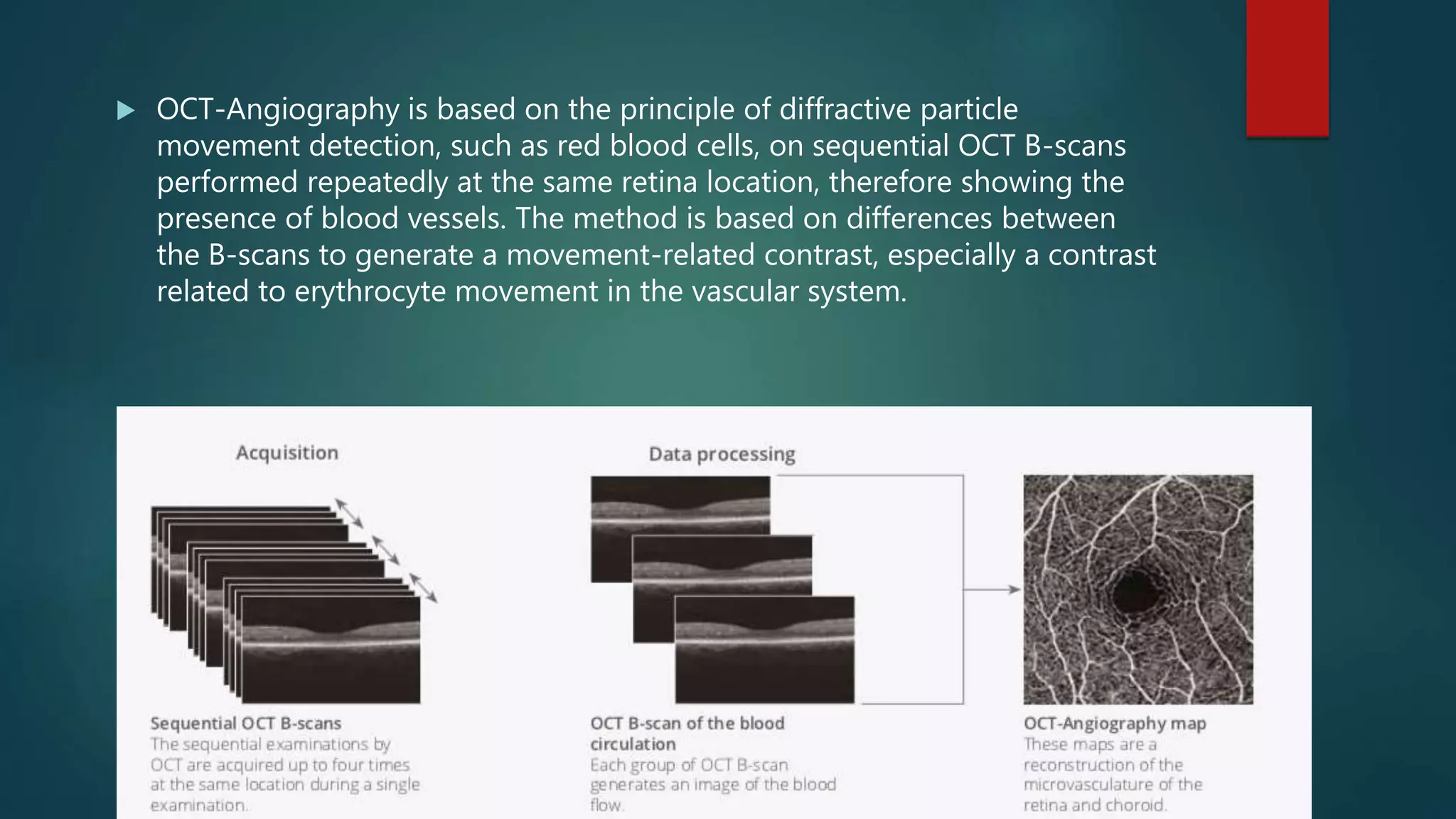
 OCT-Angiography is based on the principle of diffractive particle
movement detection, such as red blood cells, on sequential OCT B-scans
performed repeatedly at the same retina location, therefore showing the
presence of blood vessels. The method is based on differences between
the B-scans to generate a movement-related contrast, especially a contrast
related to erythrocyte movement in the vascular system.
 To generate the image of the retinal microvascularization, each B-scan of the examination
pattern is consecutively repeated several times.
 The contrast comparisons on consecutive B-scans at the same location reveal some areas with
a contrast change over time and some areas with a constant contrast.
 The temporal change in contrast in a specific location is attributed to the movement of
erythrocytes, which therefore indicates the location of the vessels.
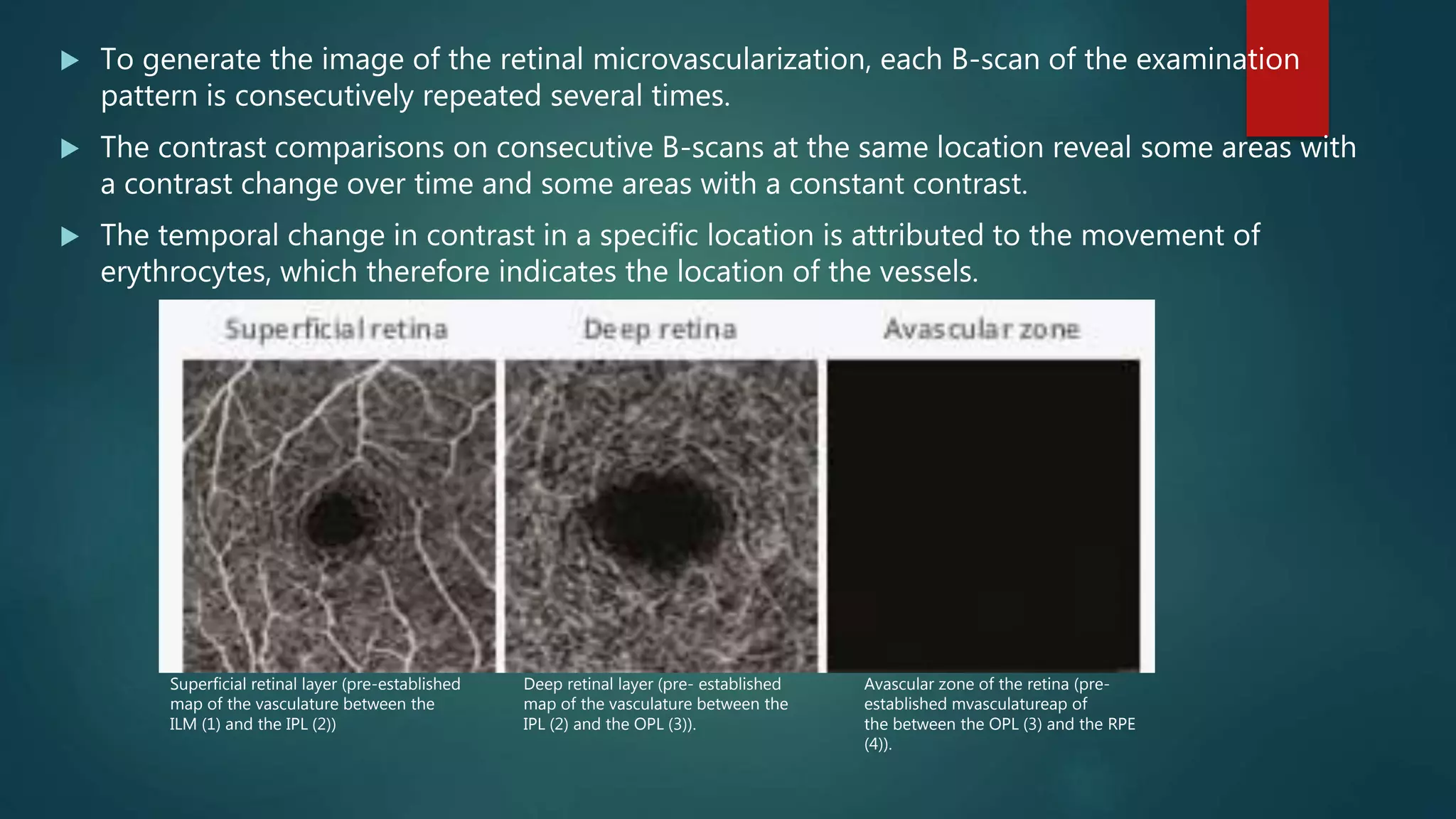
Avascular zone of the retina (pre-
established mvasculatureap of
the between the OPL (3) and the RPE
(4)).
Deep retinal layer (pre- established
map of the vasculature between the
IPL (2) and the OPL (3)).
Superficial retinal layer (pre-established
map of the vasculature between the
ILM (1) and the IPL (2))
 As every OCTA obtained is essentially a cube scan, it is a three-dimensional (3D)
assessment of the retinal vasculature unlike traditional fluorescein or ICG
angiography, which is two dimensional.
 Evaluate the scans from the inner retinal surface right down to the choroid in a
continuous manner.
 OCTA machines have taken the cube and split it into slabs to reflect a known
anatomic layer of the retinal vasculature, referred to as autoseg- mentation.
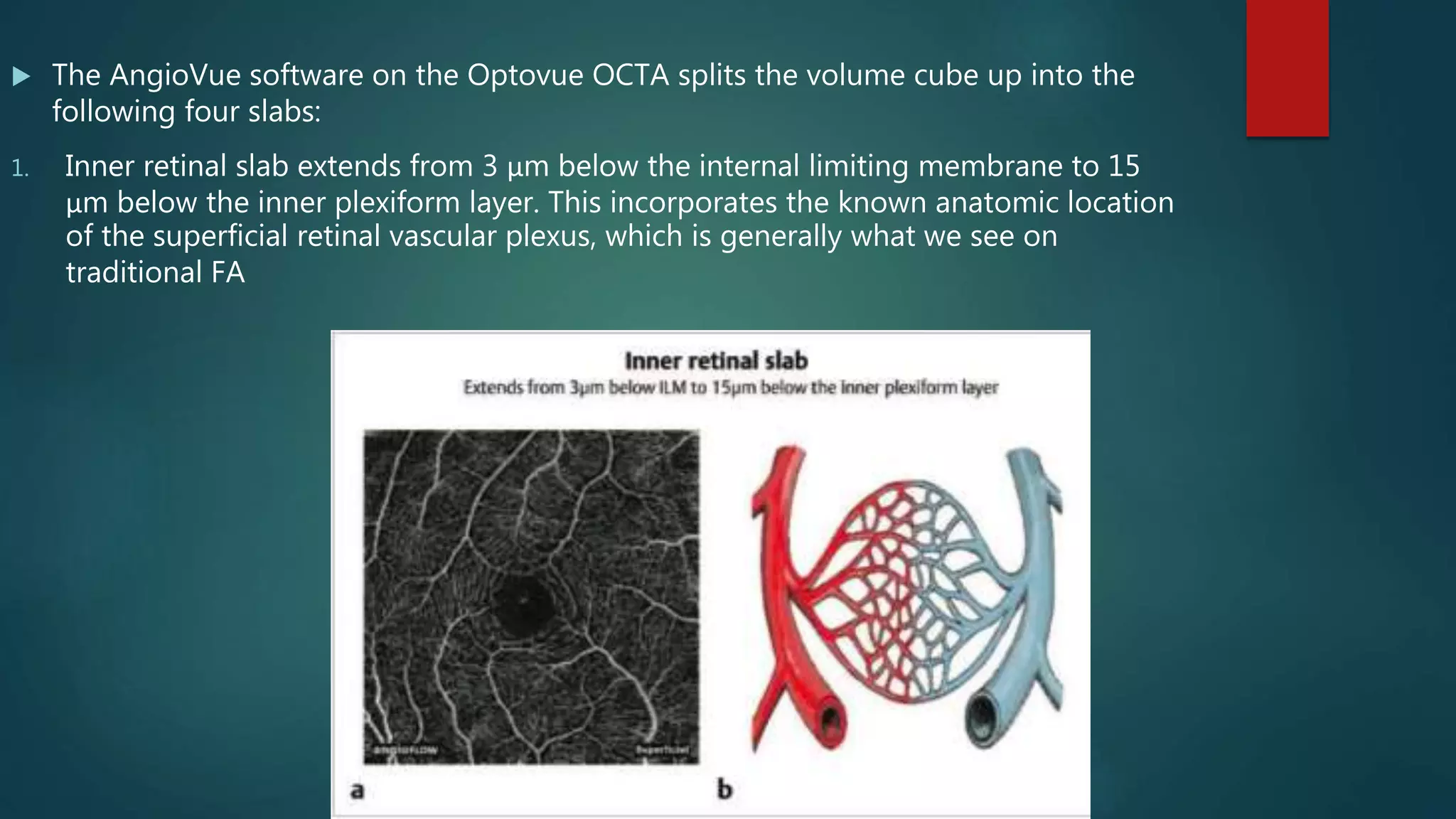
 The AngioVue software on the Optovue OCTA splits the volume cube up into the
following four slabs:
1. Inner retinal slab extends from 3 μm below the internal limiting membrane to 15
μm below the inner plexiform layer. This incorporates the known anatomic location
of the superficial retinal vascular plexus, which is generally what we see on
traditional FA
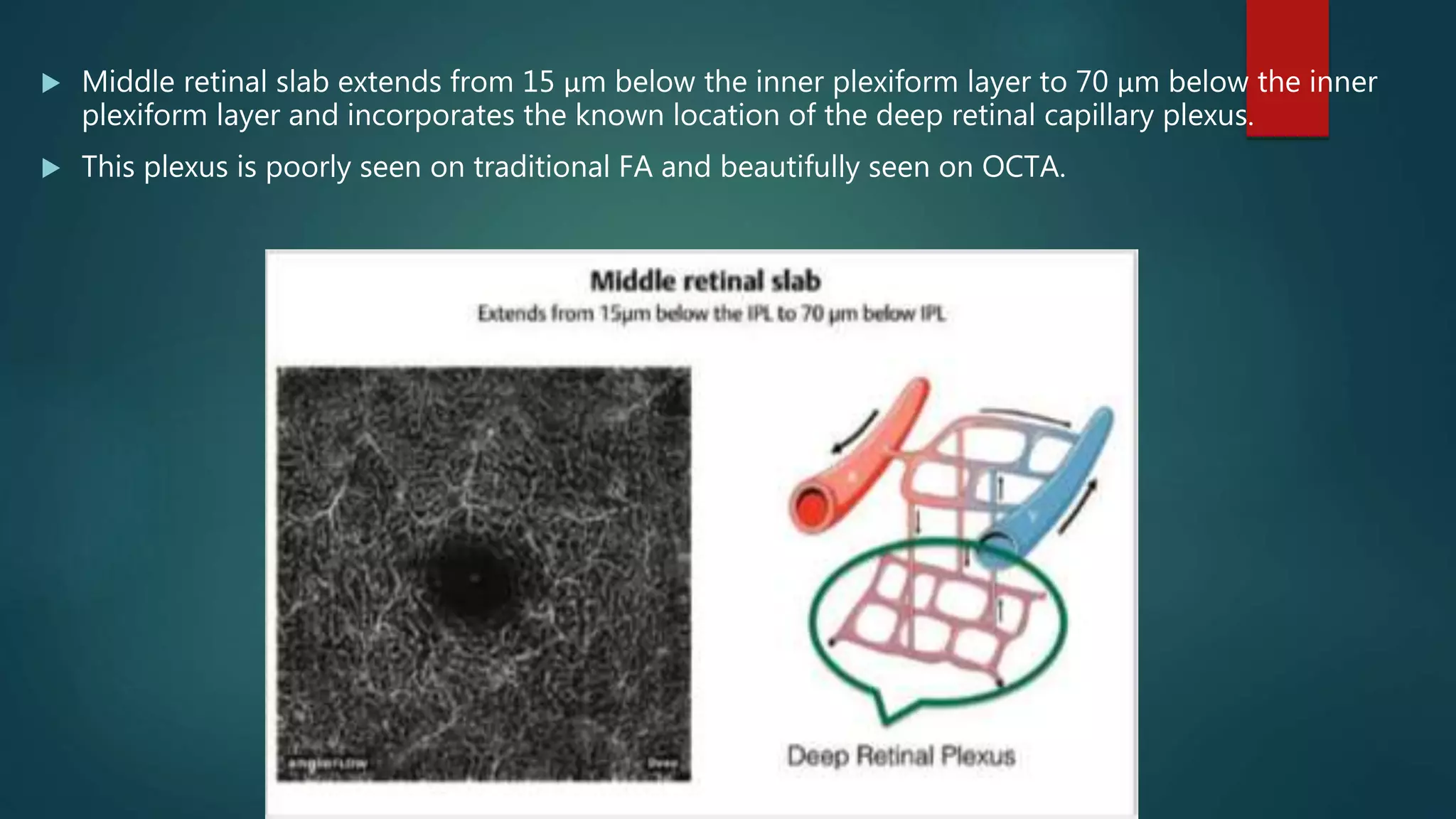
 Middle retinal slab extends from 15 μm below the inner plexiform layer to 70 μm below the inner
plexiform layer and incorporates the known location of the deep retinal capillary plexus.
 This plexus is poorly seen on traditional FA and beautifully seen on OCTA.
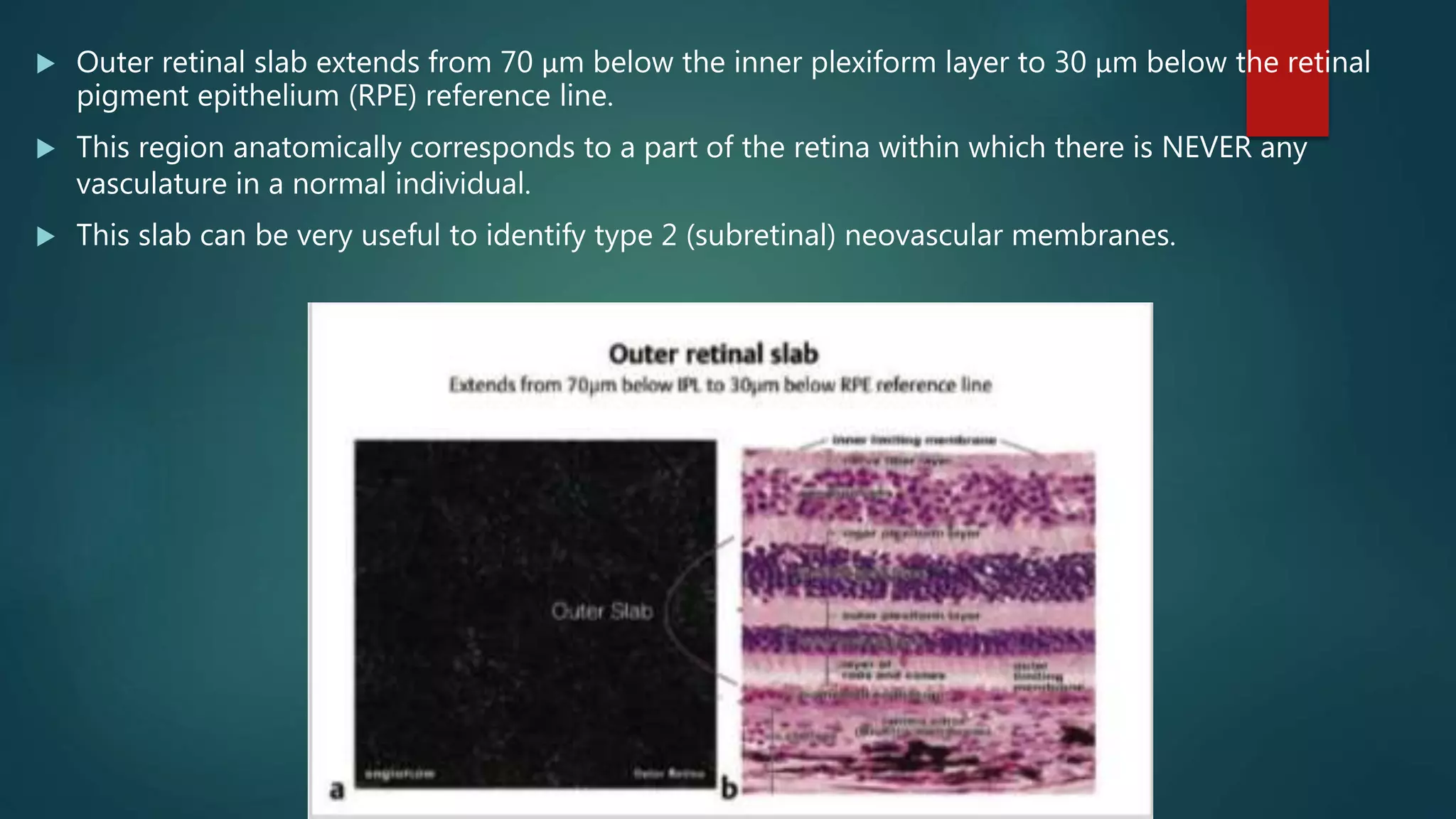
 Outer retinal slab extends from 70 μm below the inner plexiform layer to 30 μm below the retinal
pigment epithelium (RPE) reference line.
 This region anatomically corresponds to a part of the retina within which there is NEVER any
vasculature in a normal individual.
 This slab can be very useful to identify type 2 (subretinal) neovascular membranes.
 Choriocapillaris extends from 30 μm below the RPE reference to 60 μm below the RPE reference.
 It incorporates the choriocapillaris and allows detection of early type 1 (sub-RPE) choroidal
neovascular membranes.
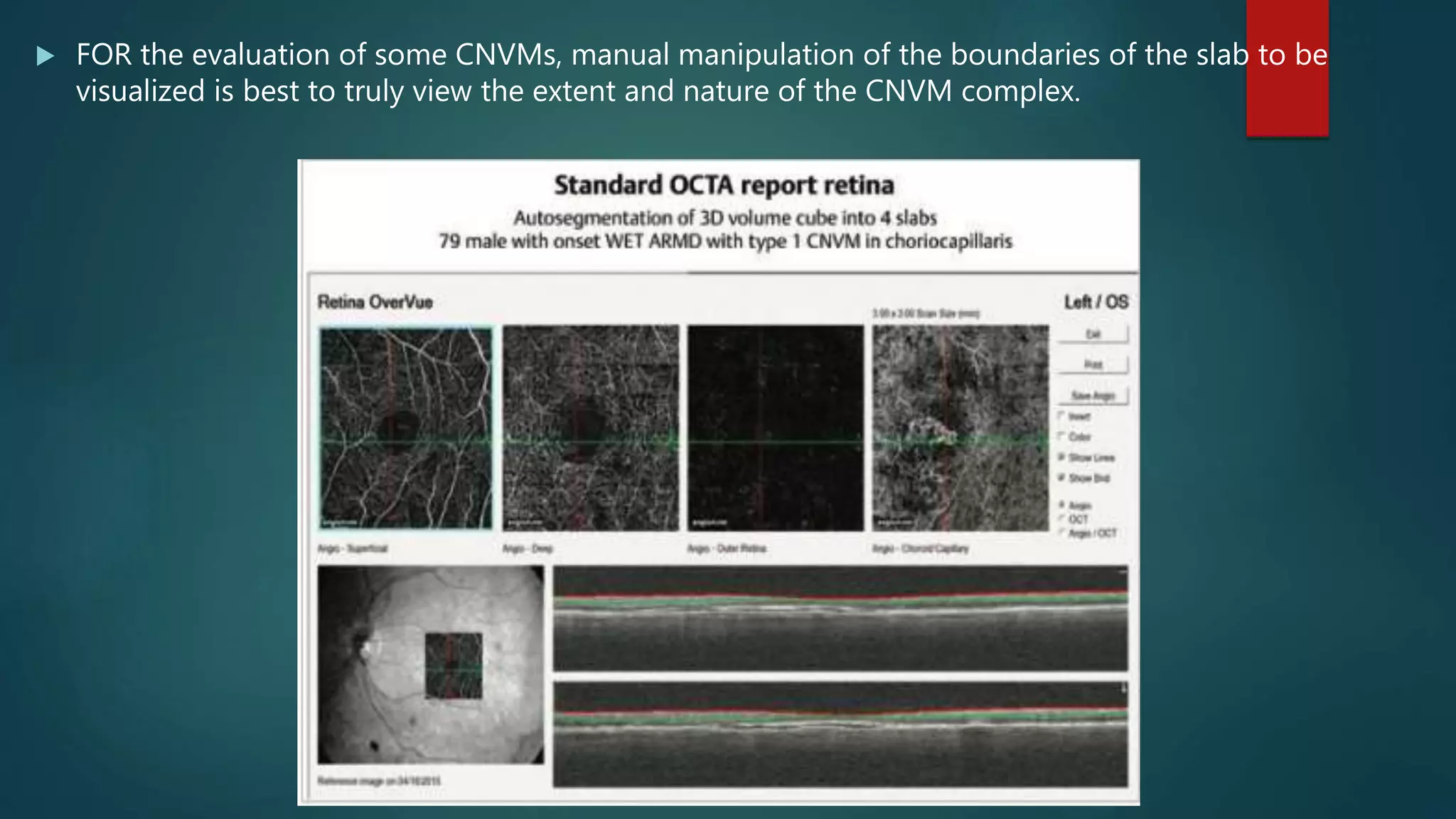
 FOR the evaluation of some CNVMs, manual manipulation of the boundaries of the slab to be
visualized is best to truly view the extent and nature of the CNVM complex.
Optic nerve head.
 Optic nerve head and peripapillary retina.
 These scans feature an autosegmentation (four zones)
1. The optic nerve head.
2. Above the optic nerve head or vitreous, which can be used to evaluate for the
presence of new vessels of the disc or a vascularized hyaloid artery.
3. Radial peripapillary capillaries, which can be evaluated for ischemia and its
potential role in glaucoma. These capillaries are seen in exquisite detail on OCTA,
while poorly viewed on traditional fluorescein and ICG angiography.
4. Choroid/lamina cribrosa.
Terminologies
 Amplitude/Magnitude/Intensity Variance - These refer to methods which detect
motion or flow by looking for change in the OCT signal over time as measured by
the variance or decorrelation of signal amplitude (aka magnitude), intensity, or
their log transforms.
 Phase Variance - Phase variance uses changes in the phase of the OCT signal as
the means of detecting flow.
 Split-spectrum Amplitude-decorrelation Angiography (SSADA) is an efficient
algorithm which improves the signal-to-noise ratio of flow detection by
maximizing the extraction of flow information from speckle variation. This is
achieved by splitting the OCT spectrum, which increases the number of usable
image frames and reduces noise from axial bulk motion.
 Amplitude Decorrelation or Flow Signal
 Decorrelation is a way to quantify variations in the OCT signal amplitude without being
affected by the average signal strength.
 The decorrelation value ranges from 0 (no variation) to 1 (maximum variation).
 A higher decorrelation value implies higher flow velocity, up to a limit.
 The slowest flow that can be detected by SSADA is the sensitivity limit, while the saturation
limit is the fastest flow beyond which the decorrelation value cannot increase further.
 The linear range lies between the sensitivity and saturation limits.
 The decorrelation value is also referred to as the flow signal in OCT angiography.
Analysis in OCTA
 Segmentation
 OCT angiography produces volumetric flow information. To allow for rapid identification and
interpretation of pathological vascular features, segmentation of key anatomic layers is required .
 En Face Projection
En face projection produces two-dimensional (2D) views of segmented tissue layers
 Slabs and Slices
 These refer to the tissue volume used for en face projection.
 Slabs refer to thick tissue sections such as the inner retina or outer retina, whereas slices refer to
thin sections of a few microns used to examine fine details.

 Nonvascular Flow Signal
 In OCT angiography, background bulk tissue motion can generally be subtracted
because it is associated with a uniform decorrelation.
 However, the decorrelation signal in some very highly backscattering structures
can still rise above the background in some instances.
 These include the RPE, hard exudates, regions of pigment accumulation,
thrombosed aneurysms, and retinal hemorrhages.
 Flow Projection Artifact
 Shadowgraphic flow projection artifacts are the result of fluctuating shadows cast
by flowing blood in a superficial vascular bed that cause variation of the OCT signal
in deeper layers.
 Flow Index and Vessel Density
1. The flow index is calculated as the average decorrelation value (which is correlated
with flow velocity) in the selected region.
2. The vessel density is calculated as the percentage area occupied by vessels in the
selected region
 Avascular Area
 Avascular area is a significant area (larger than the normal gap between capillaries)
devoid of flow signal on an en face angiogram.
 Nonperfusion (Capillary Dropout) Area
 Nonperfusion area refers to an avascular area that should normally be vascular.
 For example, on an OCT angiogram of the macula, any retinal avascular area outside of the FAZ
considered retinal nonperfusion (capillary dropout) area.
 Neovascularization Area
 Neovascularization area is the sum of pixel areas in a pathologic neovascular net identified on an
en face OCT angiogram.
 In proliferative diabetic retinopathy, the area is of vessel growth above the ILM.
 In age-related macular degeneration, the area is of neovascularization in the outer retina
Current Optical Coherence Tomography
Angiography Clinical Systems
 Zeiss AngioPlex (Carl Zeiss Meditec, Dublin, CA)
 Optovue Angioview (Optovue, Inc., Fremont, CA)
 Nidek AngioScan (Nidek Company Ltd, Gamagori, Japan)
 Topcon DRI OCT Triton (Topcon Corporation, Tokyo, Japan).
Optovue AngioVue system
 The underlying technology IS SDOCT widefield imaging system.

 Utilizes an 840-nm light source with a bandwidth of 50 nm and has an A-scan rate
of 70,000 scans per second.
 Axial resolution of 5 μm, transverse resolution of 15μm, and an A-scan depth of
approximately 3mm.
 The system acquires three-dimensional (3D) data acquisition volumes consisting of
304 × 304 A-scans in approximately 3 seconds.
Opto Angiovue system
 AngioVue Dual Trac Motion Correction Technology (MCT) provides
enhanced flow visual- ization and ultraprecise-motion correction.
 During the OCTA capture, infrared (IR) video is used for tracking on
each fast-X and fast-Y scans so that each OCTA image will have
minimum eye motion artifacts.
 The tracking improves patient comfort by allowing blinks and fixation
drifts during acquisition.
 Before motion correction, the system utilizes a split-spectrum amplitude-
decorrelation angiography (SSADA) algorithm to extract the OCTA information from
each fast-X and fast-Y OCTA scan.
 The SSADA algorithm detects motion in the blood vessels by measuring the
variation in the reflected OCT signal amplitude between consecutive scans.
 The decorrelation (1-correlation) of the signal amplitude between consecutive B-
scans is then calculated allowing for evaluation of the contrast between tissue with
motion and that without motion, that is, blood flow.
Carl Zeiss Meditec AngioPlex
 The Carl Zeiss Meditec AngioPlex system is based on an upgraded Cirrus 5000
instrument.
 This SDOCT system has an A-scan rate of 68,000 A-scans per second with a light
source centered on 840 nm with a bandwidth of 90 nm.
 The system has an axial resolution of 5 μm, transverse resolution of 15 μm, and an
A-scan depth of 2.0 mm.
 The system incorporates a retinal tracking technology to track and compensate for
eye movements in real time, and using a proprietary algorithm allows the device to
rescan areas that may have been affected by motion.
 This system also allows for registration between visits so that the exact same area
can be imaged on consecutive visits.
 OCTA analysis shows six en face slabs representing –
 The inner capillary plexus
 outer capillary plexus
 outer retina (which should normally be avascular)
 choriocapillaris
 choroid vasculature
 the vitreoretinal interface (which should also normally be avascular)
 The AngioPlex device uses the optical microangiography (OMAG) algorithm to
generate the final en face OCTA images instead of the SSADA algorithm.
Nidek RS-3000 Advance
Optical Coherence Tomography
 The AngioScan software uses the tracing highdefinition (HD) function of the RS-
3000 to track eye movements, to insure the sequential images are taken from the
same place.
 The scan size ranges from 3 mm to a maximum of 9 mm.
 Using a composite function, a wide-angle panoramic OCT image up to 12 × 9
mm2 is also possible.
 The resulting image can be imaged en face and with false color representing the
depths of the vascular channels.
Topcon DRI OCT Triton
 The Topcon DRI OCT Triton is an SSOCT system that has a number of advantages
over SDOCT systems.
 The DRI OCT uses a 1,050-nm light source with a 100,000 A-scan per second scan
rate.
 Longer wavelength light source compared to SDOCT devices
 Improved penetration into tissue (image the choroid better)
 More comfortable for the patient given it is in the IR spectrum and is not visible to
the patient.
 The DRI OCT uses yet another proprietary algorithm to produce the OCTA
images—OCTA ratio analysis (OCTARA).
 The faster speed of the SSOCT system allows for each B-scan position to be
scanned four times.
 The system suppresses motion artifacts by averaging multiple registered B-scans.
FFA / ICGA vs OCTA
 Scans can be acquired in a few seconds and does not require intravenous injection
 Fluorescein or ICG angiography requires multiple image frames taken over several minutes and can
cause nausea, vomiting and rarely anaphylaxis.
 The fast and noninvasive nature of OCT angiography also means that follow-up scans can be
conducted more frequently
 Dye leakage in fluorescein angiography is the hallmark of important vascular abnormalities such as
neovascularization and microaneurysms.
 OCT angiography does not employ a dye and cannot evaluate leakage.
 OCT angiography detects vascular abnormalities by other methods based on depth and vascular
pattern
 Dye leakage and staining do not occur in OCT angiography, the boundaries, and
therefore areas, of capillary dropout and neovascularization can be more precisely
measured.
 Conventional angiography is two- dimensional, which makes it difficult to
distinguish vascular abnormalities within different layers.
 The 3D nature of OCT angiography allows for separate evaluation of abnormalities
in the retinal and choroidal circulations.
OCTA in Clinical Use
 ARMD
 CNVM
 Diabetic Retinopathy
 Arterial and Venous occlusive disease
 CSCR
 Mac Tel 2
 Glaucoma
 Anterior Segment ( Cornea, Conjunctiva, Iris )
Type 1 Neo. AMD
Fundus – Macular drusen
Early phase – hyperfluorescence of drusen
Late phase – Hyperfluorescent stain with no
obvious leak
OCT – Drusenoid PED with mild SRF
OCTA – CNVM complex deep to RPE
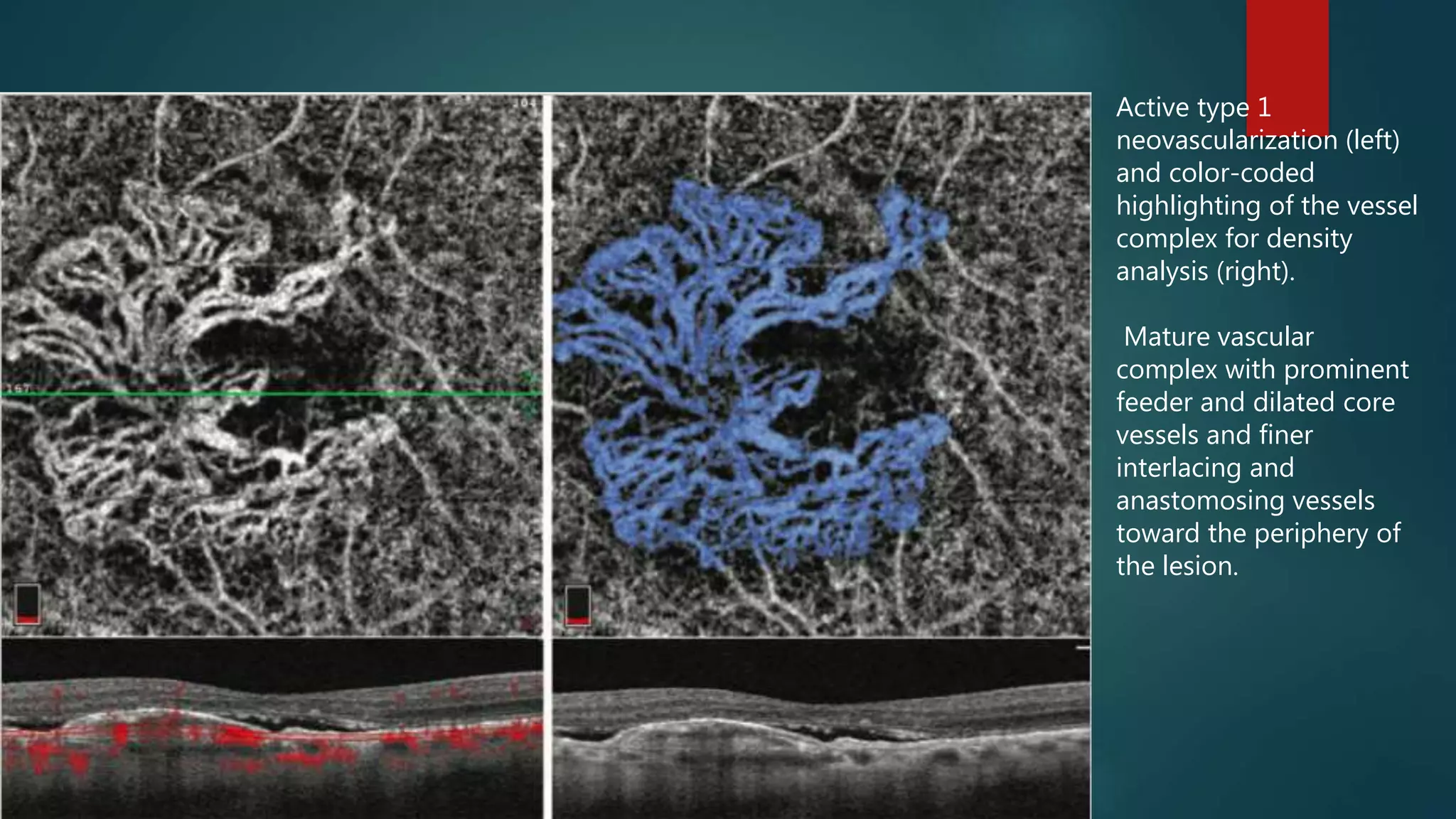
Active type 1
neovascularization (left)
and color-coded
highlighting of the vessel
complex for density
analysis (right).
Mature vascular
complex with prominent
feeder and dilated core
vessels and finer
interlacing and
anastomosing vessels
toward the periphery of
the lesion.
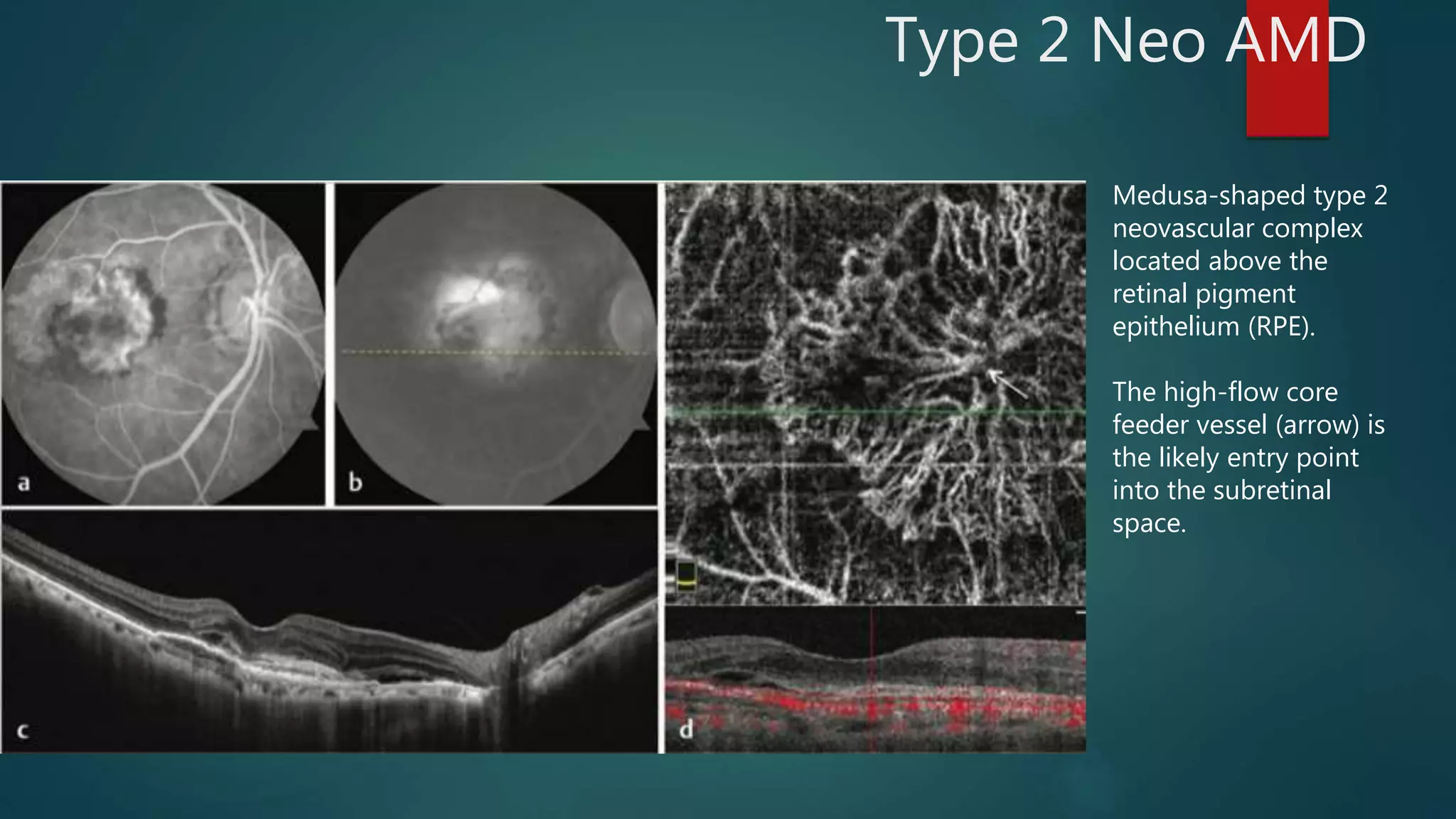
Type 2 Neo AMD
Medusa-shaped type 2
neovascular complex
located above the
retinal pigment
epithelium (RPE).
The high-flow core
feeder vessel (arrow) is
the likely entry point
into the subretinal
space.
Type 3 Neovascular AMD
 Type 3 neovascularization is the second most common form of neovascular AMD
comprising 30 to 40% of neovascular lesions in AMD.
 This entity encompasses two separate terms previously used to describe this form
of neovascularization: RAP lesion and occult chorioretinal anastomosis.
 Based on SD-OCT imaging Type 3 neovascularization was proposed to represent
the intraretinal location of a neovascular lesion.
 Subsequent studies have shown that these lesions typically originate from the deep
retinal capillary plexus.
 A subtle “hot spot” with FA or ICGA or only an intraretinal density with SD-OCT may
be appreciated.
 OCTA has, for the first time, identified the microvascular morphology of type 3
lesions
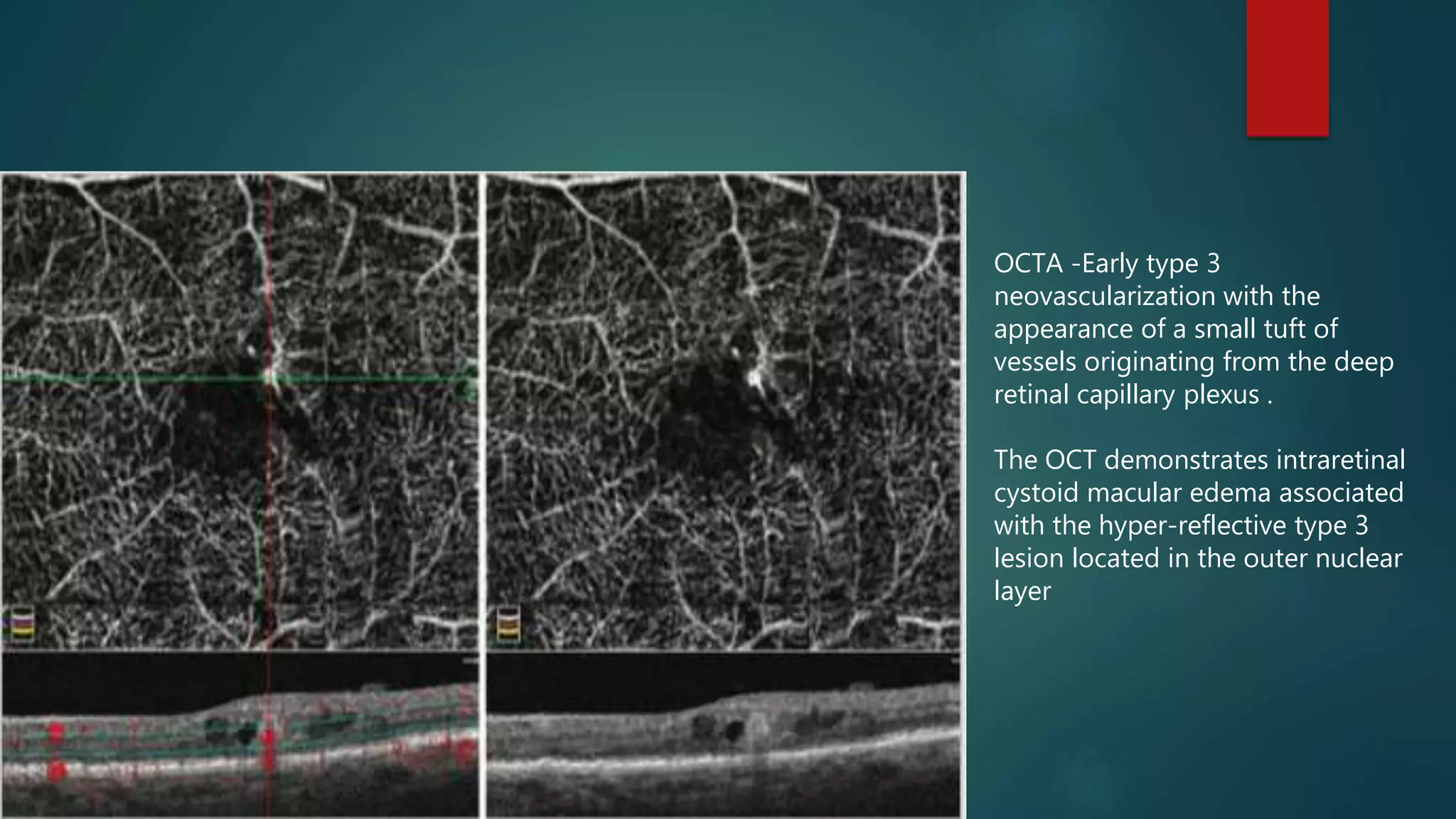
 A small, high-flow vascular tuft of smaller cali- ber vessels originating from the
deep retinal capil- lary plexus of the outer retina
 In some cases, the type 3 neovascular complex extends posteriorly through the RPE
and may be associated with a large PED .
 In contrast to chronic type 1 and 2 neovascular complexes that tend to horizontally
radiate and branch out in a seafan pattern.
OCTA -Early type 3
neovascularization with the
appearance of a small tuft of
vessels originating from the deep
retinal capillary plexus .
The OCT demonstrates intraretinal
cystoid macular edema associated
with the hyper-reflective type 3
lesion located in the outer nuclear
layer
Type 3 neovascular lesion originating from the
deep retinal capillary plexus.
9 weeks after anti-VEGF (anti–vascular endothelial
growth factor) injection demonstrates resolution of
the tuft of small vessels .
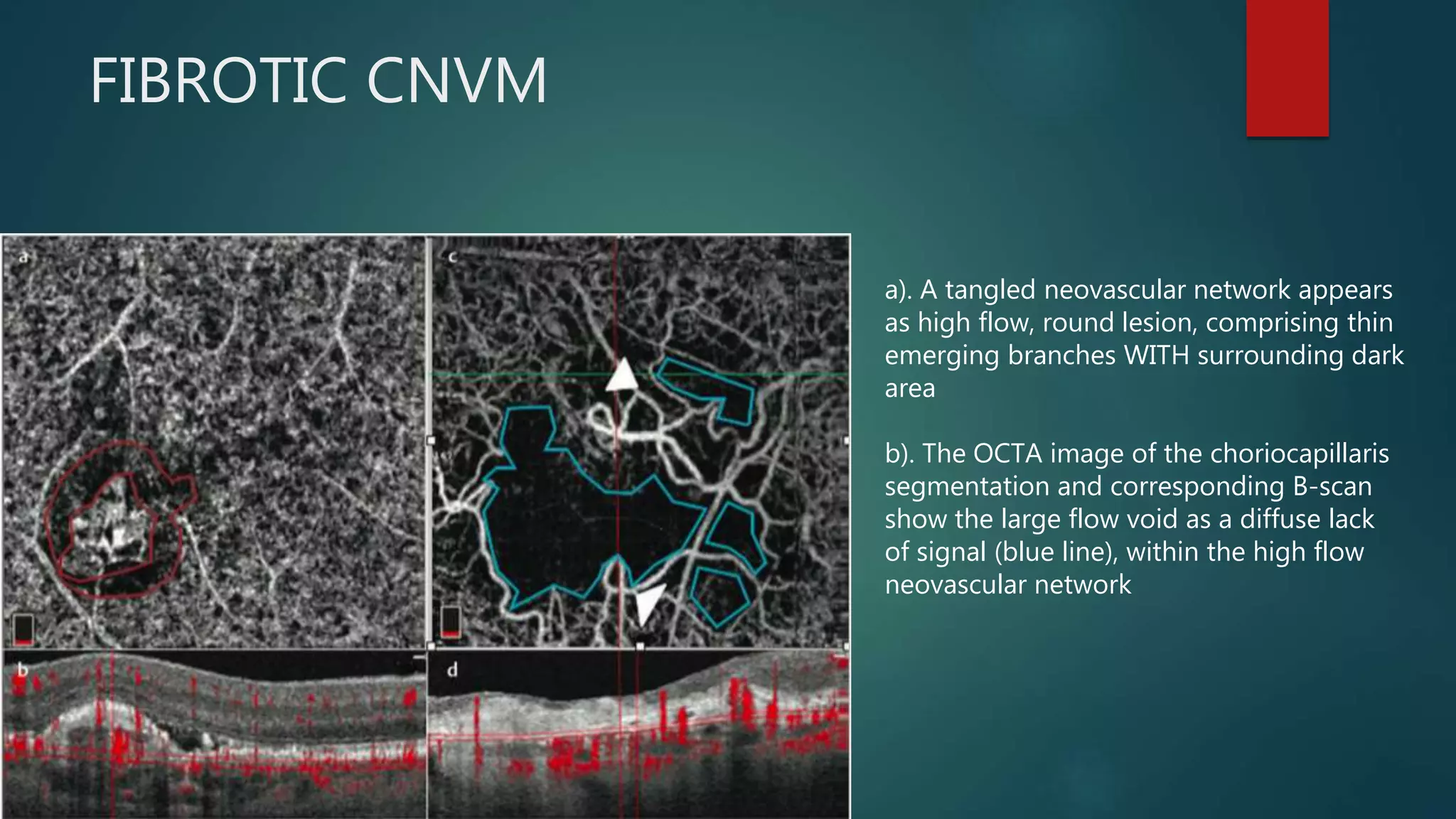
FIBROTIC CNVM
a). A tangled neovascular network appears
as high flow, round lesion, comprising thin
emerging branches WITH surrounding dark
area
b). The OCTA image of the choriocapillaris
segmentation and corresponding B-scan
show the large flow void as a diffuse lack
of signal (blue line), within the high flow
neovascular network
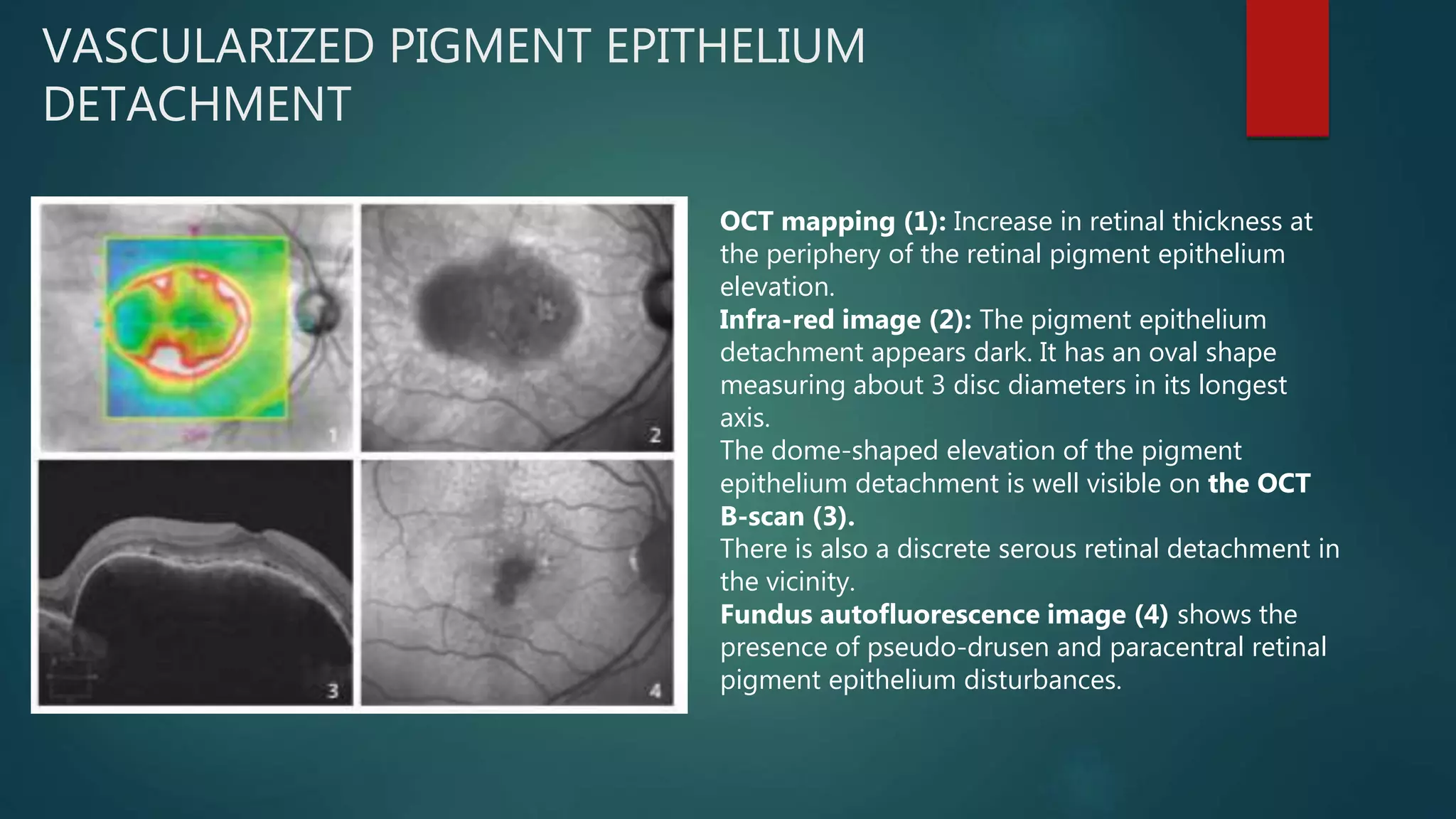
VASCULARIZED PIGMENT EPITHELIUM
DETACHMENT
OCT mapping (1): Increase in retinal thickness at
the periphery of the retinal pigment epithelium
elevation.
Infra-red image (2): The pigment epithelium
detachment appears dark. It has an oval shape
measuring about 3 disc diameters in its longest
axis.
The dome-shaped elevation of the pigment
epithelium detachment is well visible on the OCT
B-scan (3).
There is also a discrete serous retinal detachment in
the vicinity.
Fundus autofluorescence image (4) shows the
presence of pseudo-drusen and paracentral retinal
pigment epithelium disturbances.
PED
(A,B) OCT-Angiography: The image of the neovascularization may be seen on the
scan passing beneath the retinal pigment epithelium.
The neovascularization is clearly visible on the dark background. The darkness is
explained by the distance between the layers of the retinal pigment epithelium and the
choroidal plane
POLYPOIDAL VASCULOPATHY
The OCT B-scan (5) confirms the presence of exudates with
localized elevation of the retinal pigment epithelium connecting
through a right angle with the remaining retinal pigment
epithelium.
There is a serous retinal detachment.
Color photo (1) shows a rounded appearance of the macular
reflection. This appearance is more visible on fundus
autofluorescence (2).
In the intermediate phases of the indocyanine green
angiography (3,4), the polyps are well individualized.
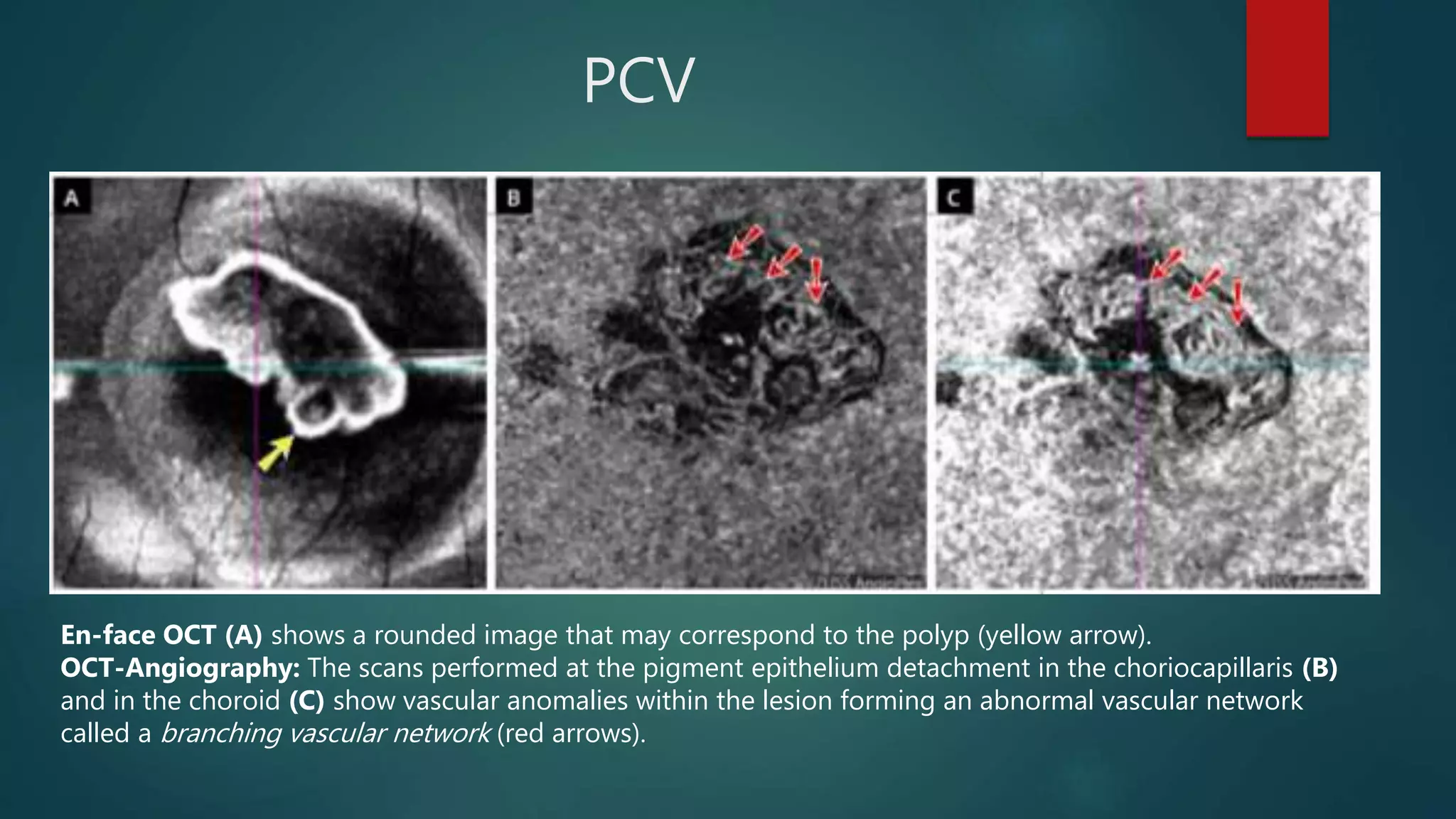
PCV
En-face OCT (A) shows a rounded image that may correspond to the polyp (yellow arrow).
OCT-Angiography: The scans performed at the pigment epithelium detachment in the choriocapillaris (B)
and in the choroid (C) show vascular anomalies within the lesion forming an abnormal vascular network
called a branching vascular network (red arrows).
NPDR
OCTA shows vascular remodelling bordering the FAZ, capillary tortuosity, narrowing of capillary lumens, dilation
of its terminals adjacent to FAZ at the superficial vascular plexus.
NPDR
LIMITATION
Not all
microaneurysms are
perceived in both
superficial and deep
capillary networks,
most probably
because OCTA is
limited by the principle
of slowest detectable
flow.
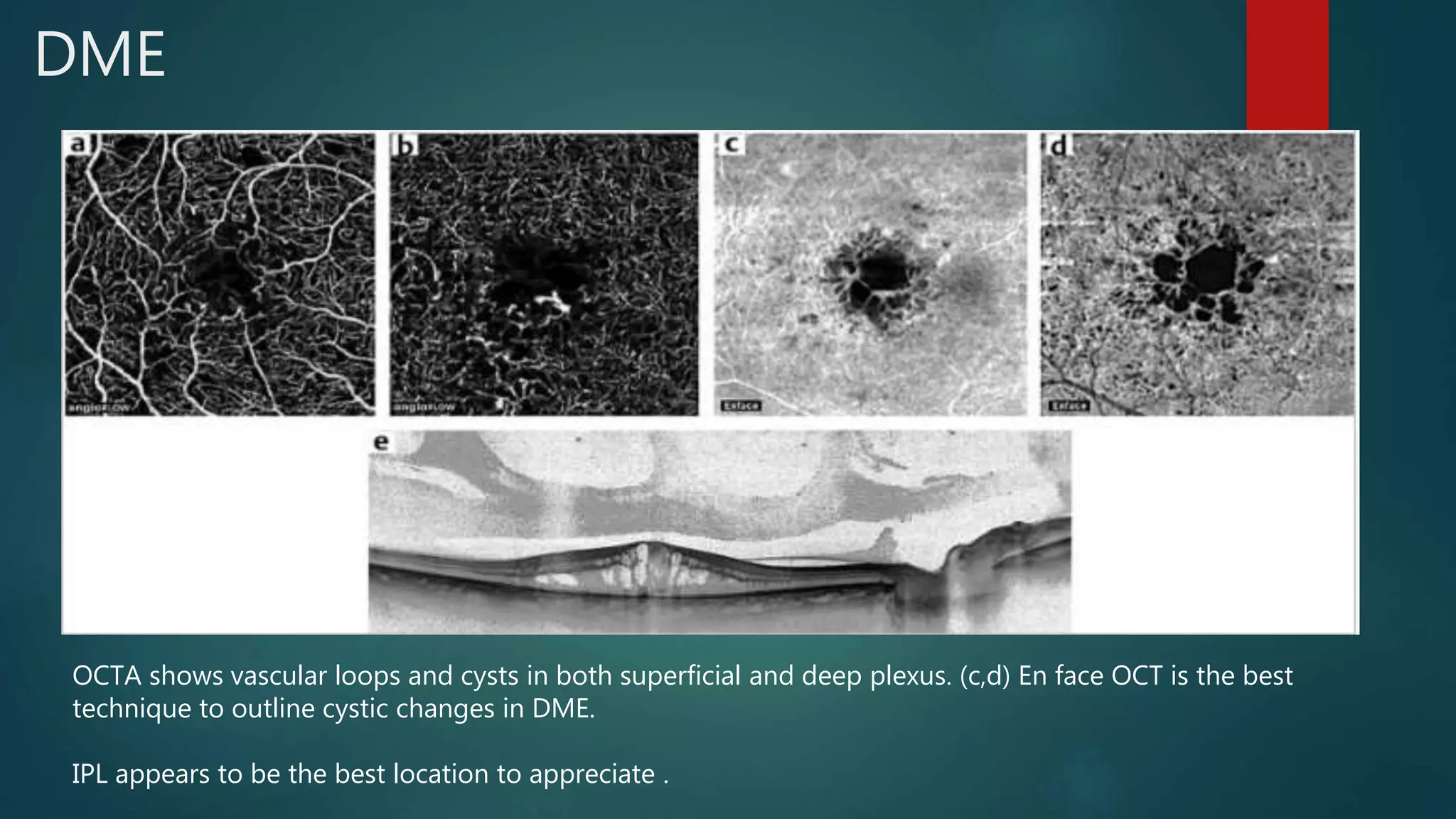
DME
OCTA shows vascular loops and cysts in both superficial and deep plexus. (c,d) En face OCT is the best
technique to outline cystic changes in DME.
IPL appears to be the best location to appreciate .
IRMA
Intraretinal microvascular
abnormalities are observed
on OCTA with reduced
capillary density and
adjacent nonperfusion.
(SEVERE NPDR)
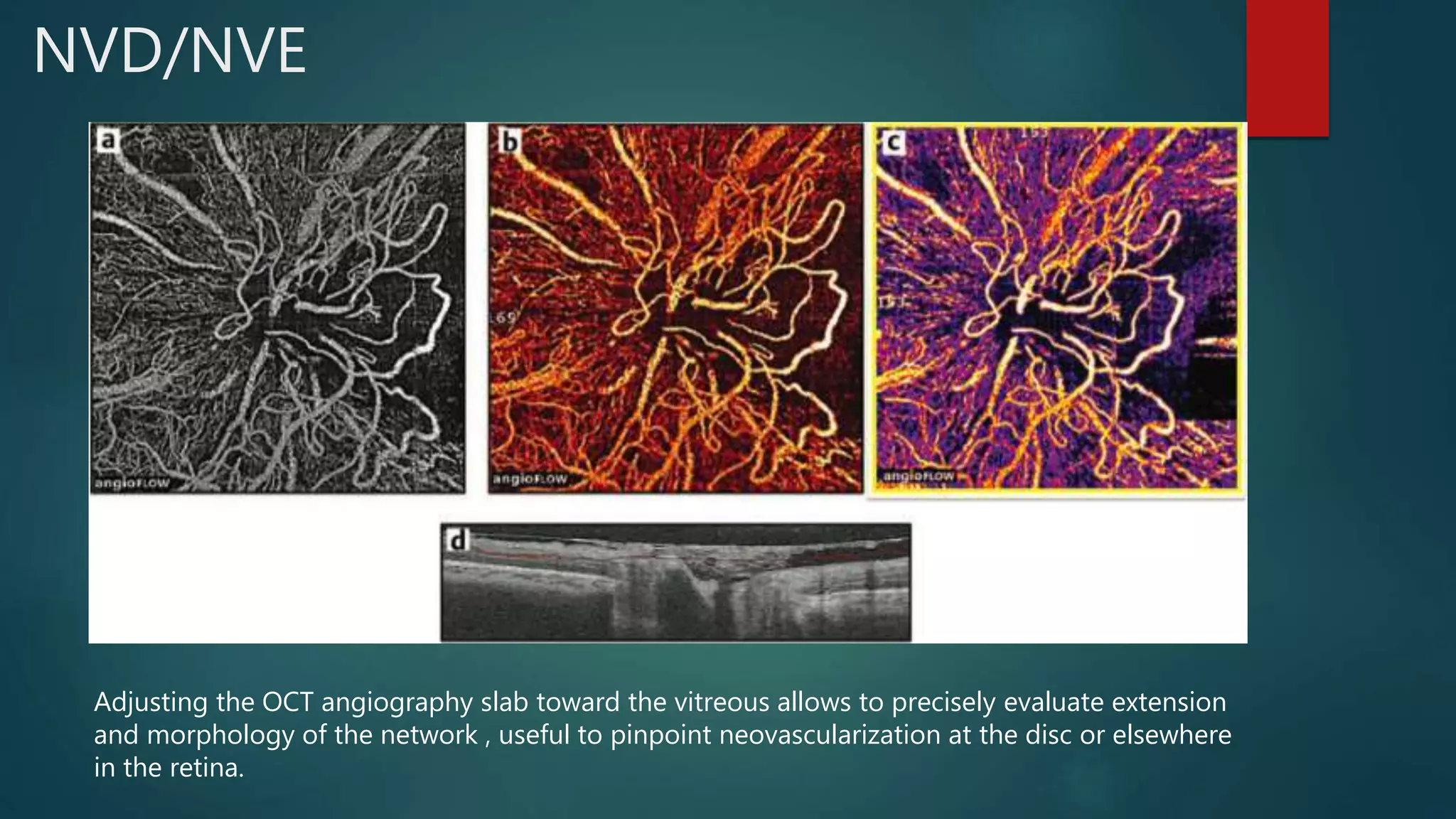
NVD/NVE
Adjusting the OCT angiography slab toward the vitreous allows to precisely evaluate extension
and morphology of the network , useful to pinpoint neovascularization at the disc or elsewhere
in the retina.
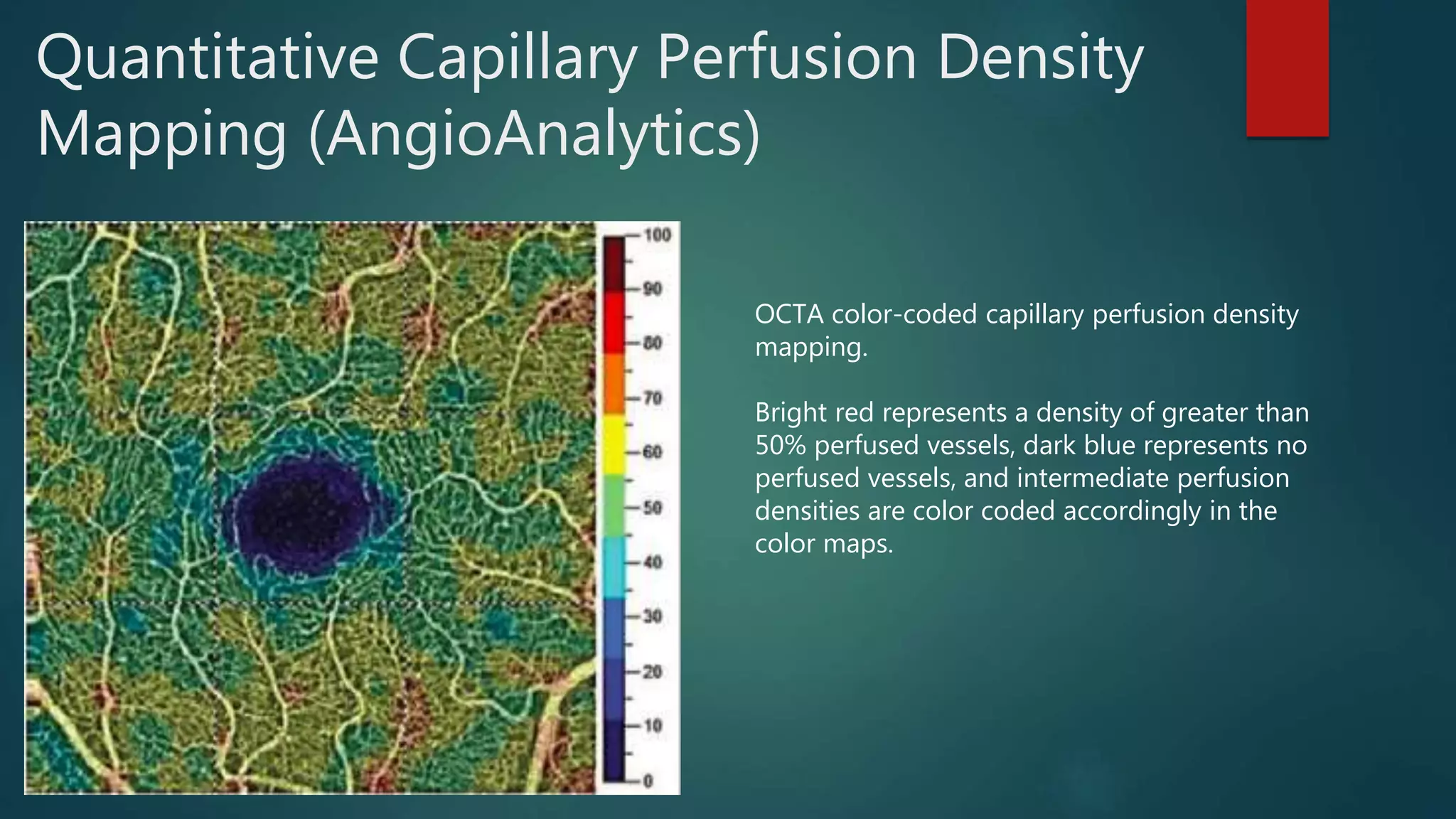
Quantitative Capillary Perfusion Density
Mapping (AngioAnalytics)
OCTA color-coded capillary perfusion density
mapping.
Bright red represents a density of greater than
50% perfused vessels, dark blue represents no
perfused vessels, and intermediate perfusion
densities are color coded accordingly in the
color maps.
Capillary Perfusion Density Mapping
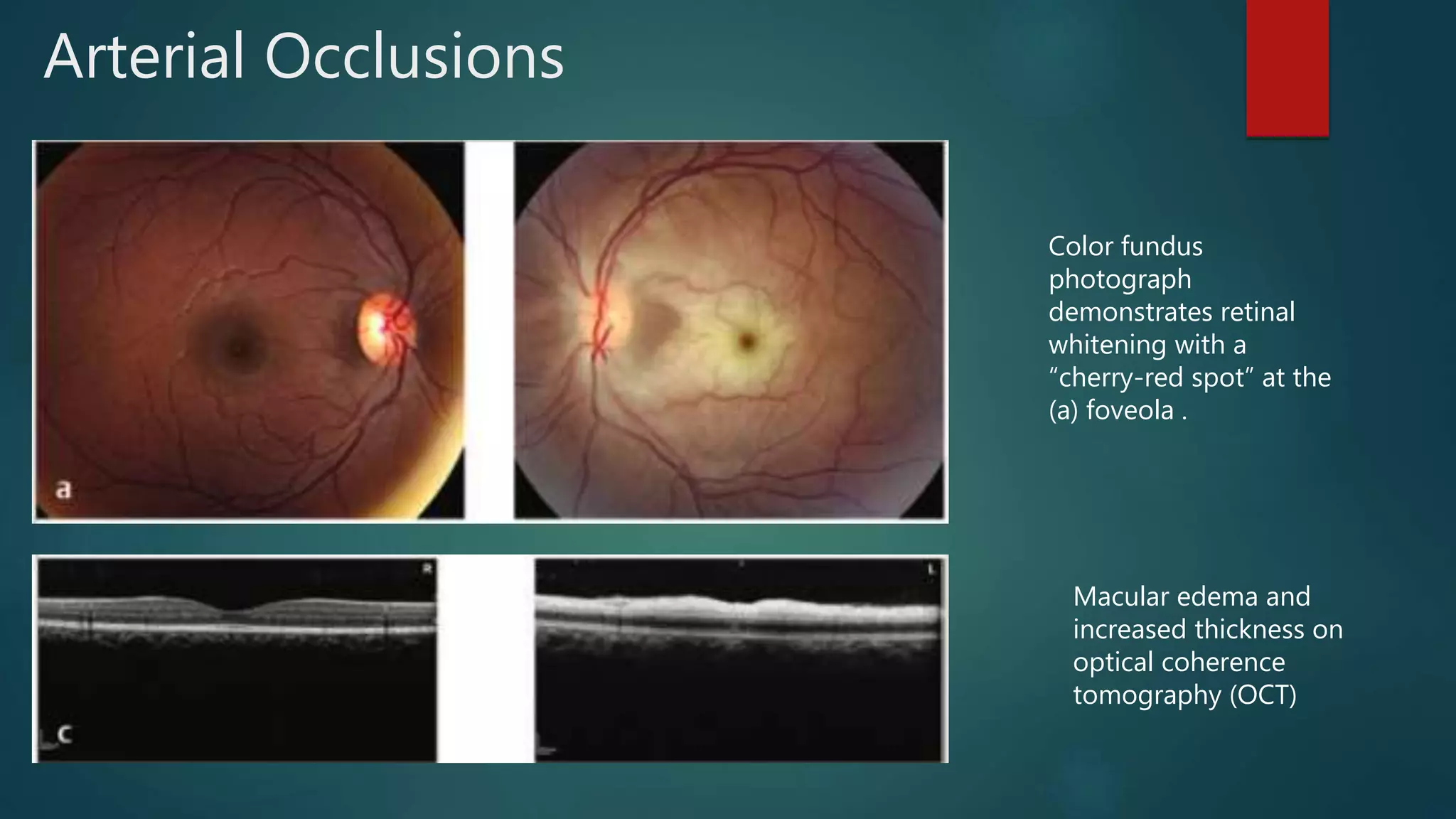
Arterial Occlusions
Color fundus
photograph
demonstrates retinal
whitening with a
“cherry-red spot” at the
(a) foveola .
Macular edema and
increased thickness on
optical coherence
tomography (OCT)
CRAO
Decreased arterial perfusion is
evident in the macula on FFA by
comparing areas of
hypofluorescence to the fellow eye.
OCT angiography of similar regions
demonstrates flow void with more
capillary detail. This further enables
enhanced visualization of the foveal
avascular zone.
BRAO
Chronic BRAO
OCT reveals inner
retinal atrophy
inferotemporal to the
macula.
OCTA shows decreased
capillary perfusion in
both retinal capillary
networks .
Arteries and arterioles
remain perfused over
areas of ischemia.
The extent of capillary nonperfusion appears less in the (c, d) superficial capillary
network slabs compared to the (e, f) deep.
Cotton wool spots
Optical coherence tomography
angiography of a
cotton wool spot demonstrating
capillary flow void at the
superficial vascular network.
The area of decreased perfusion
appears smaller in the
deep capillary plexus.
Vein occlusion
ST BRVO
OCTA at the level of the (d) superficial
and
(e) deep vascular networks showing
enlargement of the FAZ (blue dashed
line) and disruption of its normal
contour.
Nonperfused areas
(red asterisks)
vascular loops/tortuosity
microaneurysms (yellow circles).
CRVO with CME
a).(OCT) showing hyporeflective areas that
represent intraretinal cysts.
(b) OCT en face
(c) OCT angiography at the level of the
deep vascular network showing lack of
OCT signal in well-defined rounded or
oblong areas with smooth borders
corresponding to the intraretinal cysts
Ischemic BRVO
(a) Magnified fluorescein angiography of
a localized area, superior to the
macula.
(b) OCTA superficial vascular network.
Vascular tortuosity, formation of
collaterals, and areas of capillary
nonperfusion
(c) Manual selection followed by
automatic calculation of the capillary
dropout/nonflow areas at the level of the
superficial vascular network.
(d) The vascular density is automatically
calculated in the whole scan and in each
grid pattern area.
(a) Multiple areas of leakage corresponding to
preretinal neovascularization are observed
in the fluorescein angiogram.
(b) A 3 × 3 mm OCTA of the corresponding
yellow dashed square in (a) showing details
of a preretinal neovascularization complex
(green arrowhead) that was completely
obscured by dye leakage in the fluorescein
angiographic image
CSCR
OCTA scan at the level of the outer
retina shows trace flow as a result
of projection artifacts from the
superficial and deep capillary flow.
OCTA at the level of the
choriocapillaris demonstrating an
area of increased choroidal flow
among a dark area (yellow trace)
that corresponds to the overlying
SRD.
CSCR related CNVM
Late frame fluorescein angiogram showing the CNV as
an area of subretinal dye leakage (arrow).
(OCT) scan through the fovea showing serous retinal
detachment with an irregular retinal pigment epithelium
detachment.
OCTA scan at the level of the outer retina showing the
presence of a distinct vascular network representing a
CNV.
The CNV could also be seen on the OCTA scan taken at
the choriocapillaris level.
OCTA in Macular Telangiectasia Type 2
The blue reflectance image shows a
temporomacular crescent of inner
retinal whitening characteristic of the
disease.
FFA mild hyperfluorescence is visible
on the temporal side of the fovea
(arrows) without clear visibility of
telangiectasia.
(d) OCTA segmented at (SCP) show a
slightly tortuous venule.
(f) Deep capillary plexus (DCP) with
small dilated capillaries temporal to
the fovea (arrows). (h) En face
(nonflow) image showing the
parafoveal inner cysts .
Late atrophic stage of macular
telangiectasia type 2 (MacTel2).
(OCT) B-scan showing a large central cystic cavity
with a partially open roof and a profound loss of
retinal tissue.
(b) OCT angiogram of the superficial capillary
plexus showing an enlargement of the foveal
avascular zone (FAZ) adjacent to an area of
capillary void (ellipse).
(d) OCT angiogram of the deep capillary plexus
showing the abrupt emergence of a dilated
venule at the edge of the cystic space.
Optical Coherence Tomography Angiography
and Glaucoma
 Vascular dysregulation of the optic nerve head and the peripapillary retina has been
a risk factor for the development and progression of glaucoma.
 Using optical coherence tomography (OCT) angiography, vessel density and
perfusion in various layers of the optic nerve head and the peripapillary retina can
be analyzed and measured separately.
 Recently, it has been shown that sector vessel density measured in the retinal nerve
fiber layer may decrease prior to the development of clinically significant retinal
nerve fiber layer thinning and visual field deterioration
OCTA in glaucoma
Healthy right eye
A,d En face optical coherence tomography angiography image of the radial peripapillary capillaries layer
(b) en face structural OCT of the retinal nerve fiber layer
(c) the vessel density and flow density measurement report,
(a,c) En face vessel density
(b) retinal nerve fiber layer images
The corresponding visual field of an advanced glaucomatous
eye
Other retinal and choridal disease
 Adult-Onset Foveomacular Vitelliform Dystrophy
 High Myopia ( CNVM, Lacqer cracks, Chorioretinal atrophy)
 Uveitis, Retinal Vasculitis
 Secondary CNVM
 Ocular Oncology (Melanocytoma , CHRPE, Choroidal Nevus , Choroidal Melanoma
 Choroidal Metastasis
 Choroidal Hemangioma
 Choroidal Osteoma
 Radiation Retinopathy
OCTA for Anterior Segment Vasculature
 The ocular surface and iris vasculature are not easily accessible, and fluorescein
angiography is rarely performed for such evaluations and cannot be easily
repeated.
 OCTA can be repeated over time as often as needed.
 Incredible potential for following disease evolution and monitoring treatment
efficacy.
 Corneal neovascularization is a potentially severe complication in various corneal
diseases and a high-risk factor for corneal rejection following keratoplasty.
 The conjunctiva assessment
 The tumor development
 Bleb formation after glaucoma surgery
 Early detection of iris neovascularization is also a major goal when monitoring
ischemic diseases of the retina
Technique and difficulty
 To obtain a scan of the anterior segment in the AngioVue OCTA system ,the
anterior segment optical adaptor lens (L-CAM) is used.
 A specific anterior module (angiocornea) is used to perform anterior segment
scans.
 Anterior segment OCTA does not tolerate any eye movement of the patient
because even micromovements create transverse artifacts on the final images.
 Scans cannot be performed when patients are unable to fixate, or have
continuous eye or eyelid movements such as nystagmus or symptoms causing
abnormal blinking rate or blepharospasm.
OCTA in corneal diseases
Infectious keratitis with intense
neovascularization.
(b) Optical coherence tomography angiography showing blood vessels invading the cornea
OCTA for Conjunctival Vessel Assessment:
Application in Glaucoma Surgery
 OCTA is also helpful for documenting the vascular patterns in conjunctival
inflammation or wound healing
 Monitoring bleb formation and evaluating proper functioning of the filtering bleb.
 Investigative tool to study the conjunctival and episcleral vasculature changes after
trabeculectomy
 Postoperative: the vasculature alterations include much higher vascular density,
dilated and tortuous vessels, and vascular anastomoses.
OCTA of
(a) conjunctival
vessels before
glaucoma surgery
(b) the bleb vessels
at 7 days
postoperative.
A cystic bleb with no blood vessel In the cystic
area on OCTA
 Post-mitomycin C ischemic blebs
 OCTA shows avascular zones.
 Avascular spaces between dense vascular networks may reflect the presence of
aqueous humor and are therefore indicating proper wound healing and bleb
formation.
 Absence of free vessel intervals and increased vessel density may reflect
inflammatory states and early stages of bleb scarring and loss of functionality
Iris Vessels
 Previously studied by fluorescein angiography (cannot be easily repeated).
 OCTA of the iris appears to be able to demonstrate vessels difficult to photograph
or to clinically observe by slit-lamp examination
 The iris angiograms show radial iris vessel patterns in normal lightcolored Eyes.
 In darker iris, the pigment pro- duces shadowing and artifacts that obscure the
vasculature .
Normal iris vasculature on En face OCTA
Rubeosis iridis on OCTA
Recent advances
 Spectral-domain optical coherence tomography angiography (SD-
OCTA) devices are widely used to evaluate retinal and choroidal
diseases .
 Visualization of vascular structures beneath the retinal pigment
epithelium (RPE) using shorter wavelength spectral-domain devices
is limited
 Longer wavelength SS-OCT technology may provide a solution for
imaging through media opacities and better visualizing the choroid .
Alogrithms
 Zhang et al proposed a novel feature space-based optical microangiography
method (fsO- MAG) in which the flow and static background are differentiated in
the feature space, leading to the suppression of angiographic signals from the static
background.
 Variable interscan time analysis (VISTA), proposed by Choi and Moult et al is a tool
that has been used to differentiate blood flow speeds on OCTA.
VISTA
 The VISTA analysis can be visualized using color coding in which the color of the
pixel rep- resents the erythrocyte flow at a given location.
 The hue value of each VISTA pixel is a ratio of the OCTA signal obtained from the
1.5-ms interscan time to the OCTA signal from the 3-ms interscan time.
 Blue pixels indicate slower speeds and red pixels indicate faster speeds.
NPDR
In this image, flow speeds of the vasculature in the
superficial plexus are visualized using a color
encoded images
red - relatively high flow
blue relatively low flow
Total Retinal Blood Flow
 Fourier-domain OCT utilizes optical phase information to precisely measure
Doppler velocity.
 It measures the axial flow velocity, which is the velocity component in the
direction of the OCT probe beam.
 It provides quantitative measurement of high flow velocities in the retinal vessels
of the optic disc, and is done by scanning multiple con- centric circles around the
optic disc.
TRBF
 This technique has been used to investigate TRBF in several ocular diseases, including DR, retinal
vein occlusions, uveitis, and glaucoma.
 In eyes with vein occlusions, the TRBF was reduced in the eye with the vascular occlusion, when
compared to both the fellow eye and the normal age- matched eyes.
Conclusion
 OCTA has rapidly expanded as an imaging modality that has been used to qualitatively and
quantitatively describe changes in retinal and choroidal vasculature associated pathology.
 It also has the potential to enhance our understanding of the disease mechanism, since
microvascular changes can be correlated to structural features.
 Currently, OCTA is widely used in the clinical setting to guide treatment or diagnosis decisions
THANK YOU

OCT Angiography

  • 1.
  • 2.
     OCT-Angiography isa new, non-invasive diagnostic method through which the vascular structures of the retina and choroid may be visualized in three dimensions without the need for contrast agent injection.  Through acquisition software and more advanced hardware, OCT- Angiography enables imaging of the retinal vascular flow.
  • 3.
     OCT-Angiography isbased on the principle of diffractive particle movement detection, such as red blood cells, on sequential OCT B-scans performed repeatedly at the same retina location, therefore showing the presence of blood vessels. The method is based on differences between the B-scans to generate a movement-related contrast, especially a contrast related to erythrocyte movement in the vascular system.
  • 4.
     To generatethe image of the retinal microvascularization, each B-scan of the examination pattern is consecutively repeated several times.  The contrast comparisons on consecutive B-scans at the same location reveal some areas with a contrast change over time and some areas with a constant contrast.  The temporal change in contrast in a specific location is attributed to the movement of erythrocytes, which therefore indicates the location of the vessels. Avascular zone of the retina (pre- established mvasculatureap of the between the OPL (3) and the RPE (4)). Deep retinal layer (pre- established map of the vasculature between the IPL (2) and the OPL (3)). Superficial retinal layer (pre-established map of the vasculature between the ILM (1) and the IPL (2))
  • 5.
     As everyOCTA obtained is essentially a cube scan, it is a three-dimensional (3D) assessment of the retinal vasculature unlike traditional fluorescein or ICG angiography, which is two dimensional.  Evaluate the scans from the inner retinal surface right down to the choroid in a continuous manner.  OCTA machines have taken the cube and split it into slabs to reflect a known anatomic layer of the retinal vasculature, referred to as autoseg- mentation.
  • 6.
     The AngioVuesoftware on the Optovue OCTA splits the volume cube up into the following four slabs: 1. Inner retinal slab extends from 3 μm below the internal limiting membrane to 15 μm below the inner plexiform layer. This incorporates the known anatomic location of the superficial retinal vascular plexus, which is generally what we see on traditional FA
  • 7.
     Middle retinalslab extends from 15 μm below the inner plexiform layer to 70 μm below the inner plexiform layer and incorporates the known location of the deep retinal capillary plexus.  This plexus is poorly seen on traditional FA and beautifully seen on OCTA.
  • 8.
     Outer retinalslab extends from 70 μm below the inner plexiform layer to 30 μm below the retinal pigment epithelium (RPE) reference line.  This region anatomically corresponds to a part of the retina within which there is NEVER any vasculature in a normal individual.  This slab can be very useful to identify type 2 (subretinal) neovascular membranes.
  • 9.
     Choriocapillaris extendsfrom 30 μm below the RPE reference to 60 μm below the RPE reference.  It incorporates the choriocapillaris and allows detection of early type 1 (sub-RPE) choroidal neovascular membranes.
  • 10.
     FOR theevaluation of some CNVMs, manual manipulation of the boundaries of the slab to be visualized is best to truly view the extent and nature of the CNVM complex.
  • 11.
    Optic nerve head. Optic nerve head and peripapillary retina.  These scans feature an autosegmentation (four zones) 1. The optic nerve head. 2. Above the optic nerve head or vitreous, which can be used to evaluate for the presence of new vessels of the disc or a vascularized hyaloid artery. 3. Radial peripapillary capillaries, which can be evaluated for ischemia and its potential role in glaucoma. These capillaries are seen in exquisite detail on OCTA, while poorly viewed on traditional fluorescein and ICG angiography. 4. Choroid/lamina cribrosa.
  • 12.
    Terminologies  Amplitude/Magnitude/Intensity Variance- These refer to methods which detect motion or flow by looking for change in the OCT signal over time as measured by the variance or decorrelation of signal amplitude (aka magnitude), intensity, or their log transforms.  Phase Variance - Phase variance uses changes in the phase of the OCT signal as the means of detecting flow.  Split-spectrum Amplitude-decorrelation Angiography (SSADA) is an efficient algorithm which improves the signal-to-noise ratio of flow detection by maximizing the extraction of flow information from speckle variation. This is achieved by splitting the OCT spectrum, which increases the number of usable image frames and reduces noise from axial bulk motion.
  • 13.
     Amplitude Decorrelationor Flow Signal  Decorrelation is a way to quantify variations in the OCT signal amplitude without being affected by the average signal strength.  The decorrelation value ranges from 0 (no variation) to 1 (maximum variation).  A higher decorrelation value implies higher flow velocity, up to a limit.  The slowest flow that can be detected by SSADA is the sensitivity limit, while the saturation limit is the fastest flow beyond which the decorrelation value cannot increase further.  The linear range lies between the sensitivity and saturation limits.  The decorrelation value is also referred to as the flow signal in OCT angiography.
  • 14.
    Analysis in OCTA Segmentation  OCT angiography produces volumetric flow information. To allow for rapid identification and interpretation of pathological vascular features, segmentation of key anatomic layers is required .  En Face Projection En face projection produces two-dimensional (2D) views of segmented tissue layers  Slabs and Slices  These refer to the tissue volume used for en face projection.  Slabs refer to thick tissue sections such as the inner retina or outer retina, whereas slices refer to thin sections of a few microns used to examine fine details. 
  • 15.
     Nonvascular FlowSignal  In OCT angiography, background bulk tissue motion can generally be subtracted because it is associated with a uniform decorrelation.  However, the decorrelation signal in some very highly backscattering structures can still rise above the background in some instances.  These include the RPE, hard exudates, regions of pigment accumulation, thrombosed aneurysms, and retinal hemorrhages.
  • 16.
     Flow ProjectionArtifact  Shadowgraphic flow projection artifacts are the result of fluctuating shadows cast by flowing blood in a superficial vascular bed that cause variation of the OCT signal in deeper layers.  Flow Index and Vessel Density 1. The flow index is calculated as the average decorrelation value (which is correlated with flow velocity) in the selected region. 2. The vessel density is calculated as the percentage area occupied by vessels in the selected region  Avascular Area  Avascular area is a significant area (larger than the normal gap between capillaries) devoid of flow signal on an en face angiogram.
  • 17.
     Nonperfusion (CapillaryDropout) Area  Nonperfusion area refers to an avascular area that should normally be vascular.  For example, on an OCT angiogram of the macula, any retinal avascular area outside of the FAZ considered retinal nonperfusion (capillary dropout) area.  Neovascularization Area  Neovascularization area is the sum of pixel areas in a pathologic neovascular net identified on an en face OCT angiogram.  In proliferative diabetic retinopathy, the area is of vessel growth above the ILM.  In age-related macular degeneration, the area is of neovascularization in the outer retina
  • 18.
    Current Optical CoherenceTomography Angiography Clinical Systems  Zeiss AngioPlex (Carl Zeiss Meditec, Dublin, CA)  Optovue Angioview (Optovue, Inc., Fremont, CA)  Nidek AngioScan (Nidek Company Ltd, Gamagori, Japan)  Topcon DRI OCT Triton (Topcon Corporation, Tokyo, Japan).
  • 19.
    Optovue AngioVue system The underlying technology IS SDOCT widefield imaging system.   Utilizes an 840-nm light source with a bandwidth of 50 nm and has an A-scan rate of 70,000 scans per second.  Axial resolution of 5 μm, transverse resolution of 15μm, and an A-scan depth of approximately 3mm.  The system acquires three-dimensional (3D) data acquisition volumes consisting of 304 × 304 A-scans in approximately 3 seconds.
  • 20.
    Opto Angiovue system AngioVue Dual Trac Motion Correction Technology (MCT) provides enhanced flow visual- ization and ultraprecise-motion correction.  During the OCTA capture, infrared (IR) video is used for tracking on each fast-X and fast-Y scans so that each OCTA image will have minimum eye motion artifacts.  The tracking improves patient comfort by allowing blinks and fixation drifts during acquisition.
  • 21.
     Before motioncorrection, the system utilizes a split-spectrum amplitude- decorrelation angiography (SSADA) algorithm to extract the OCTA information from each fast-X and fast-Y OCTA scan.  The SSADA algorithm detects motion in the blood vessels by measuring the variation in the reflected OCT signal amplitude between consecutive scans.  The decorrelation (1-correlation) of the signal amplitude between consecutive B- scans is then calculated allowing for evaluation of the contrast between tissue with motion and that without motion, that is, blood flow.
  • 22.
    Carl Zeiss MeditecAngioPlex  The Carl Zeiss Meditec AngioPlex system is based on an upgraded Cirrus 5000 instrument.  This SDOCT system has an A-scan rate of 68,000 A-scans per second with a light source centered on 840 nm with a bandwidth of 90 nm.  The system has an axial resolution of 5 μm, transverse resolution of 15 μm, and an A-scan depth of 2.0 mm.  The system incorporates a retinal tracking technology to track and compensate for eye movements in real time, and using a proprietary algorithm allows the device to rescan areas that may have been affected by motion.  This system also allows for registration between visits so that the exact same area can be imaged on consecutive visits.
  • 23.
     OCTA analysisshows six en face slabs representing –  The inner capillary plexus  outer capillary plexus  outer retina (which should normally be avascular)  choriocapillaris  choroid vasculature  the vitreoretinal interface (which should also normally be avascular)  The AngioPlex device uses the optical microangiography (OMAG) algorithm to generate the final en face OCTA images instead of the SSADA algorithm.
  • 24.
    Nidek RS-3000 Advance OpticalCoherence Tomography  The AngioScan software uses the tracing highdefinition (HD) function of the RS- 3000 to track eye movements, to insure the sequential images are taken from the same place.  The scan size ranges from 3 mm to a maximum of 9 mm.  Using a composite function, a wide-angle panoramic OCT image up to 12 × 9 mm2 is also possible.  The resulting image can be imaged en face and with false color representing the depths of the vascular channels.
  • 25.
    Topcon DRI OCTTriton  The Topcon DRI OCT Triton is an SSOCT system that has a number of advantages over SDOCT systems.  The DRI OCT uses a 1,050-nm light source with a 100,000 A-scan per second scan rate.  Longer wavelength light source compared to SDOCT devices  Improved penetration into tissue (image the choroid better)  More comfortable for the patient given it is in the IR spectrum and is not visible to the patient.
  • 26.
     The DRIOCT uses yet another proprietary algorithm to produce the OCTA images—OCTA ratio analysis (OCTARA).  The faster speed of the SSOCT system allows for each B-scan position to be scanned four times.  The system suppresses motion artifacts by averaging multiple registered B-scans.
  • 27.
    FFA / ICGAvs OCTA  Scans can be acquired in a few seconds and does not require intravenous injection  Fluorescein or ICG angiography requires multiple image frames taken over several minutes and can cause nausea, vomiting and rarely anaphylaxis.  The fast and noninvasive nature of OCT angiography also means that follow-up scans can be conducted more frequently  Dye leakage in fluorescein angiography is the hallmark of important vascular abnormalities such as neovascularization and microaneurysms.  OCT angiography does not employ a dye and cannot evaluate leakage.  OCT angiography detects vascular abnormalities by other methods based on depth and vascular pattern
  • 28.
     Dye leakageand staining do not occur in OCT angiography, the boundaries, and therefore areas, of capillary dropout and neovascularization can be more precisely measured.  Conventional angiography is two- dimensional, which makes it difficult to distinguish vascular abnormalities within different layers.  The 3D nature of OCT angiography allows for separate evaluation of abnormalities in the retinal and choroidal circulations.
  • 29.
    OCTA in ClinicalUse  ARMD  CNVM  Diabetic Retinopathy  Arterial and Venous occlusive disease  CSCR  Mac Tel 2  Glaucoma  Anterior Segment ( Cornea, Conjunctiva, Iris )
  • 30.
    Type 1 Neo.AMD Fundus – Macular drusen Early phase – hyperfluorescence of drusen Late phase – Hyperfluorescent stain with no obvious leak OCT – Drusenoid PED with mild SRF OCTA – CNVM complex deep to RPE
  • 31.
    Active type 1 neovascularization(left) and color-coded highlighting of the vessel complex for density analysis (right). Mature vascular complex with prominent feeder and dilated core vessels and finer interlacing and anastomosing vessels toward the periphery of the lesion.
  • 32.
    Type 2 NeoAMD Medusa-shaped type 2 neovascular complex located above the retinal pigment epithelium (RPE). The high-flow core feeder vessel (arrow) is the likely entry point into the subretinal space.
  • 33.
    Type 3 NeovascularAMD  Type 3 neovascularization is the second most common form of neovascular AMD comprising 30 to 40% of neovascular lesions in AMD.  This entity encompasses two separate terms previously used to describe this form of neovascularization: RAP lesion and occult chorioretinal anastomosis.  Based on SD-OCT imaging Type 3 neovascularization was proposed to represent the intraretinal location of a neovascular lesion.  Subsequent studies have shown that these lesions typically originate from the deep retinal capillary plexus.
  • 34.
     A subtle“hot spot” with FA or ICGA or only an intraretinal density with SD-OCT may be appreciated.  OCTA has, for the first time, identified the microvascular morphology of type 3 lesions  A small, high-flow vascular tuft of smaller cali- ber vessels originating from the deep retinal capil- lary plexus of the outer retina  In some cases, the type 3 neovascular complex extends posteriorly through the RPE and may be associated with a large PED .  In contrast to chronic type 1 and 2 neovascular complexes that tend to horizontally radiate and branch out in a seafan pattern.
  • 35.
    OCTA -Early type3 neovascularization with the appearance of a small tuft of vessels originating from the deep retinal capillary plexus . The OCT demonstrates intraretinal cystoid macular edema associated with the hyper-reflective type 3 lesion located in the outer nuclear layer
  • 36.
    Type 3 neovascularlesion originating from the deep retinal capillary plexus. 9 weeks after anti-VEGF (anti–vascular endothelial growth factor) injection demonstrates resolution of the tuft of small vessels .
  • 37.
    FIBROTIC CNVM a). Atangled neovascular network appears as high flow, round lesion, comprising thin emerging branches WITH surrounding dark area b). The OCTA image of the choriocapillaris segmentation and corresponding B-scan show the large flow void as a diffuse lack of signal (blue line), within the high flow neovascular network
  • 38.
    VASCULARIZED PIGMENT EPITHELIUM DETACHMENT OCTmapping (1): Increase in retinal thickness at the periphery of the retinal pigment epithelium elevation. Infra-red image (2): The pigment epithelium detachment appears dark. It has an oval shape measuring about 3 disc diameters in its longest axis. The dome-shaped elevation of the pigment epithelium detachment is well visible on the OCT B-scan (3). There is also a discrete serous retinal detachment in the vicinity. Fundus autofluorescence image (4) shows the presence of pseudo-drusen and paracentral retinal pigment epithelium disturbances.
  • 39.
    PED (A,B) OCT-Angiography: Theimage of the neovascularization may be seen on the scan passing beneath the retinal pigment epithelium. The neovascularization is clearly visible on the dark background. The darkness is explained by the distance between the layers of the retinal pigment epithelium and the choroidal plane
  • 40.
    POLYPOIDAL VASCULOPATHY The OCTB-scan (5) confirms the presence of exudates with localized elevation of the retinal pigment epithelium connecting through a right angle with the remaining retinal pigment epithelium. There is a serous retinal detachment. Color photo (1) shows a rounded appearance of the macular reflection. This appearance is more visible on fundus autofluorescence (2). In the intermediate phases of the indocyanine green angiography (3,4), the polyps are well individualized.
  • 41.
    PCV En-face OCT (A)shows a rounded image that may correspond to the polyp (yellow arrow). OCT-Angiography: The scans performed at the pigment epithelium detachment in the choriocapillaris (B) and in the choroid (C) show vascular anomalies within the lesion forming an abnormal vascular network called a branching vascular network (red arrows).
  • 42.
    NPDR OCTA shows vascularremodelling bordering the FAZ, capillary tortuosity, narrowing of capillary lumens, dilation of its terminals adjacent to FAZ at the superficial vascular plexus.
  • 43.
    NPDR LIMITATION Not all microaneurysms are perceivedin both superficial and deep capillary networks, most probably because OCTA is limited by the principle of slowest detectable flow.
  • 44.
    DME OCTA shows vascularloops and cysts in both superficial and deep plexus. (c,d) En face OCT is the best technique to outline cystic changes in DME. IPL appears to be the best location to appreciate .
  • 45.
    IRMA Intraretinal microvascular abnormalities areobserved on OCTA with reduced capillary density and adjacent nonperfusion. (SEVERE NPDR)
  • 46.
    NVD/NVE Adjusting the OCTangiography slab toward the vitreous allows to precisely evaluate extension and morphology of the network , useful to pinpoint neovascularization at the disc or elsewhere in the retina.
  • 47.
    Quantitative Capillary PerfusionDensity Mapping (AngioAnalytics) OCTA color-coded capillary perfusion density mapping. Bright red represents a density of greater than 50% perfused vessels, dark blue represents no perfused vessels, and intermediate perfusion densities are color coded accordingly in the color maps.
  • 48.
  • 49.
    Arterial Occlusions Color fundus photograph demonstratesretinal whitening with a “cherry-red spot” at the (a) foveola . Macular edema and increased thickness on optical coherence tomography (OCT)
  • 50.
    CRAO Decreased arterial perfusionis evident in the macula on FFA by comparing areas of hypofluorescence to the fellow eye. OCT angiography of similar regions demonstrates flow void with more capillary detail. This further enables enhanced visualization of the foveal avascular zone.
  • 51.
    BRAO Chronic BRAO OCT revealsinner retinal atrophy inferotemporal to the macula. OCTA shows decreased capillary perfusion in both retinal capillary networks . Arteries and arterioles remain perfused over areas of ischemia. The extent of capillary nonperfusion appears less in the (c, d) superficial capillary network slabs compared to the (e, f) deep.
  • 52.
    Cotton wool spots Opticalcoherence tomography angiography of a cotton wool spot demonstrating capillary flow void at the superficial vascular network. The area of decreased perfusion appears smaller in the deep capillary plexus.
  • 53.
    Vein occlusion ST BRVO OCTAat the level of the (d) superficial and (e) deep vascular networks showing enlargement of the FAZ (blue dashed line) and disruption of its normal contour. Nonperfused areas (red asterisks) vascular loops/tortuosity microaneurysms (yellow circles).
  • 54.
    CRVO with CME a).(OCT)showing hyporeflective areas that represent intraretinal cysts. (b) OCT en face (c) OCT angiography at the level of the deep vascular network showing lack of OCT signal in well-defined rounded or oblong areas with smooth borders corresponding to the intraretinal cysts
  • 55.
    Ischemic BRVO (a) Magnifiedfluorescein angiography of a localized area, superior to the macula. (b) OCTA superficial vascular network. Vascular tortuosity, formation of collaterals, and areas of capillary nonperfusion (c) Manual selection followed by automatic calculation of the capillary dropout/nonflow areas at the level of the superficial vascular network. (d) The vascular density is automatically calculated in the whole scan and in each grid pattern area.
  • 56.
    (a) Multiple areasof leakage corresponding to preretinal neovascularization are observed in the fluorescein angiogram. (b) A 3 × 3 mm OCTA of the corresponding yellow dashed square in (a) showing details of a preretinal neovascularization complex (green arrowhead) that was completely obscured by dye leakage in the fluorescein angiographic image
  • 57.
    CSCR OCTA scan atthe level of the outer retina shows trace flow as a result of projection artifacts from the superficial and deep capillary flow. OCTA at the level of the choriocapillaris demonstrating an area of increased choroidal flow among a dark area (yellow trace) that corresponds to the overlying SRD.
  • 58.
    CSCR related CNVM Lateframe fluorescein angiogram showing the CNV as an area of subretinal dye leakage (arrow). (OCT) scan through the fovea showing serous retinal detachment with an irregular retinal pigment epithelium detachment. OCTA scan at the level of the outer retina showing the presence of a distinct vascular network representing a CNV. The CNV could also be seen on the OCTA scan taken at the choriocapillaris level.
  • 59.
    OCTA in MacularTelangiectasia Type 2 The blue reflectance image shows a temporomacular crescent of inner retinal whitening characteristic of the disease. FFA mild hyperfluorescence is visible on the temporal side of the fovea (arrows) without clear visibility of telangiectasia. (d) OCTA segmented at (SCP) show a slightly tortuous venule. (f) Deep capillary plexus (DCP) with small dilated capillaries temporal to the fovea (arrows). (h) En face (nonflow) image showing the parafoveal inner cysts .
  • 60.
    Late atrophic stageof macular telangiectasia type 2 (MacTel2). (OCT) B-scan showing a large central cystic cavity with a partially open roof and a profound loss of retinal tissue. (b) OCT angiogram of the superficial capillary plexus showing an enlargement of the foveal avascular zone (FAZ) adjacent to an area of capillary void (ellipse). (d) OCT angiogram of the deep capillary plexus showing the abrupt emergence of a dilated venule at the edge of the cystic space.
  • 61.
    Optical Coherence TomographyAngiography and Glaucoma  Vascular dysregulation of the optic nerve head and the peripapillary retina has been a risk factor for the development and progression of glaucoma.  Using optical coherence tomography (OCT) angiography, vessel density and perfusion in various layers of the optic nerve head and the peripapillary retina can be analyzed and measured separately.  Recently, it has been shown that sector vessel density measured in the retinal nerve fiber layer may decrease prior to the development of clinically significant retinal nerve fiber layer thinning and visual field deterioration
  • 62.
    OCTA in glaucoma Healthyright eye A,d En face optical coherence tomography angiography image of the radial peripapillary capillaries layer (b) en face structural OCT of the retinal nerve fiber layer (c) the vessel density and flow density measurement report,
  • 63.
    (a,c) En facevessel density (b) retinal nerve fiber layer images The corresponding visual field of an advanced glaucomatous eye
  • 64.
    Other retinal andchoridal disease  Adult-Onset Foveomacular Vitelliform Dystrophy  High Myopia ( CNVM, Lacqer cracks, Chorioretinal atrophy)  Uveitis, Retinal Vasculitis  Secondary CNVM  Ocular Oncology (Melanocytoma , CHRPE, Choroidal Nevus , Choroidal Melanoma  Choroidal Metastasis  Choroidal Hemangioma  Choroidal Osteoma  Radiation Retinopathy
  • 65.
    OCTA for AnteriorSegment Vasculature  The ocular surface and iris vasculature are not easily accessible, and fluorescein angiography is rarely performed for such evaluations and cannot be easily repeated.  OCTA can be repeated over time as often as needed.  Incredible potential for following disease evolution and monitoring treatment efficacy.  Corneal neovascularization is a potentially severe complication in various corneal diseases and a high-risk factor for corneal rejection following keratoplasty.
  • 66.
     The conjunctivaassessment  The tumor development  Bleb formation after glaucoma surgery  Early detection of iris neovascularization is also a major goal when monitoring ischemic diseases of the retina
  • 67.
    Technique and difficulty To obtain a scan of the anterior segment in the AngioVue OCTA system ,the anterior segment optical adaptor lens (L-CAM) is used.  A specific anterior module (angiocornea) is used to perform anterior segment scans.  Anterior segment OCTA does not tolerate any eye movement of the patient because even micromovements create transverse artifacts on the final images.  Scans cannot be performed when patients are unable to fixate, or have continuous eye or eyelid movements such as nystagmus or symptoms causing abnormal blinking rate or blepharospasm.
  • 68.
  • 69.
    Infectious keratitis withintense neovascularization. (b) Optical coherence tomography angiography showing blood vessels invading the cornea
  • 70.
    OCTA for ConjunctivalVessel Assessment: Application in Glaucoma Surgery  OCTA is also helpful for documenting the vascular patterns in conjunctival inflammation or wound healing  Monitoring bleb formation and evaluating proper functioning of the filtering bleb.  Investigative tool to study the conjunctival and episcleral vasculature changes after trabeculectomy  Postoperative: the vasculature alterations include much higher vascular density, dilated and tortuous vessels, and vascular anastomoses.
  • 71.
    OCTA of (a) conjunctival vesselsbefore glaucoma surgery (b) the bleb vessels at 7 days postoperative.
  • 72.
    A cystic blebwith no blood vessel In the cystic area on OCTA
  • 73.
     Post-mitomycin Cischemic blebs  OCTA shows avascular zones.  Avascular spaces between dense vascular networks may reflect the presence of aqueous humor and are therefore indicating proper wound healing and bleb formation.  Absence of free vessel intervals and increased vessel density may reflect inflammatory states and early stages of bleb scarring and loss of functionality
  • 74.
    Iris Vessels  Previouslystudied by fluorescein angiography (cannot be easily repeated).  OCTA of the iris appears to be able to demonstrate vessels difficult to photograph or to clinically observe by slit-lamp examination  The iris angiograms show radial iris vessel patterns in normal lightcolored Eyes.  In darker iris, the pigment pro- duces shadowing and artifacts that obscure the vasculature .
  • 75.
    Normal iris vasculatureon En face OCTA
  • 76.
  • 77.
    Recent advances  Spectral-domainoptical coherence tomography angiography (SD- OCTA) devices are widely used to evaluate retinal and choroidal diseases .  Visualization of vascular structures beneath the retinal pigment epithelium (RPE) using shorter wavelength spectral-domain devices is limited  Longer wavelength SS-OCT technology may provide a solution for imaging through media opacities and better visualizing the choroid .
  • 78.
    Alogrithms  Zhang etal proposed a novel feature space-based optical microangiography method (fsO- MAG) in which the flow and static background are differentiated in the feature space, leading to the suppression of angiographic signals from the static background.  Variable interscan time analysis (VISTA), proposed by Choi and Moult et al is a tool that has been used to differentiate blood flow speeds on OCTA.
  • 79.
    VISTA  The VISTAanalysis can be visualized using color coding in which the color of the pixel rep- resents the erythrocyte flow at a given location.  The hue value of each VISTA pixel is a ratio of the OCTA signal obtained from the 1.5-ms interscan time to the OCTA signal from the 3-ms interscan time.  Blue pixels indicate slower speeds and red pixels indicate faster speeds.
  • 80.
    NPDR In this image,flow speeds of the vasculature in the superficial plexus are visualized using a color encoded images red - relatively high flow blue relatively low flow
  • 81.
    Total Retinal BloodFlow  Fourier-domain OCT utilizes optical phase information to precisely measure Doppler velocity.  It measures the axial flow velocity, which is the velocity component in the direction of the OCT probe beam.  It provides quantitative measurement of high flow velocities in the retinal vessels of the optic disc, and is done by scanning multiple con- centric circles around the optic disc.
  • 82.
    TRBF  This techniquehas been used to investigate TRBF in several ocular diseases, including DR, retinal vein occlusions, uveitis, and glaucoma.  In eyes with vein occlusions, the TRBF was reduced in the eye with the vascular occlusion, when compared to both the fellow eye and the normal age- matched eyes.
  • 83.
    Conclusion  OCTA hasrapidly expanded as an imaging modality that has been used to qualitatively and quantitatively describe changes in retinal and choroidal vasculature associated pathology.  It also has the potential to enhance our understanding of the disease mechanism, since microvascular changes can be correlated to structural features.  Currently, OCTA is widely used in the clinical setting to guide treatment or diagnosis decisions
  • 84.

Editor's Notes

  • #12 w
  • #31 of (a) right and (b) left eyes illustrate macular drusen. (c) Early-phase fluorescein angiogram (FA) of the left eye shows hyperfluorescence of the macular drusen nasal to the fovea. (d) Late-phase FA demonstrates hyperfluorescent staining without clear evidence of dye leakage nasal to the macula. (e) Spectral domain optical coherence tomography (SD-OCT) imaged along the yellow dashed line seen in (d) illustrates macular drusen or drusenoid pigment epithelial detachment (PED) with overlying mild subretinal fluid. (f) A 6 × 6 mm optical coherence tomography angiography (OCTA) and co-registered B-scan. OCTA clearly demonstrates choroidal neovascularization consistent with a type 1 neovascular complex deep to the retinal pigment epithelium (RPE).
  • #33 (a) Early-phase fluorescein angiogram (FA) of the right eye illustrates a predominantly classic, lacy, and well- defined hyperfluorescent membrane with surrounding hemorrhage. (b) Late-phase FA shows leakage of the classic component indicative of type 2 neovascularization. (c) Spectral domain optical coherence tomography (SD-OCT) imaged along the yellow dashed line seen in (b) demonstrates subretinal hyper-reflective material associated with subretinal fluid and a temporal pigment epithelial detachment (PED). (d) A 3 × 3 mm OCTA with co-registered B-scan illustrates a medusa-shaped type 2 neovascular complex located above the retinal pigment epithelium (RPE). The high-flow core feeder vessel (arrow) is the likely entry point into the subretinal space.