Cover test
Presenter
jyoti shah
Optometrist
COVER TEST IS QUALITATIVE MEASUREMENT OF
STRABISMUS.
PREREQUISITES OF COVER TEST
patient should be co-operative enough to fixate a
target.
Should have sufficient vision to see target
Should have central fixation in both eyes .
Latent nystagmus should not be present.
Methods of cover test
1.Direct cover test
Aim : it conforms the presence of a manifest squint.
Procedure
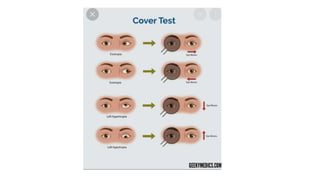
Fixate with both eye at a point
Normal looking eye is covered and movement of uncovered
eye is noticed.
 if uncovered eye takes the fixation in opposite direction
,manifest squint is present.
No movement indicates
pseudo strabismus
Gross eccentric fixation
No vison in the deviated eye
Cover uncover test
AIM : it establishes the presence and type of heterophoria .
Procedure:
Performed after direct test conforms absent of manifest
deviation
 one eye covered with occluder and other is made to fixate.
In presence of heterophoria the eye under cover
deviates(fusion is interrupted)
Cover is moved quickly and direction of movement tells the
type of heterophoria
Alternate cover test
it is performed to establish whether the squint is unilateral or
alternate and also to differentiate concomitant squint from
paralytic squint .
Procedure :
Pt. is asked to fixate alternately ,placing occluder alternately.
It is important to place occluder alternately several times to
dissociate the eye and maximize the deviation.
Occluder should be transferred quickly from one eye to other to
prevent fusion.
Observations:
In presence of alternate squint either eye fixates and opposite
eye under cover deviates and maintains the position of
deviation on removing the cover.
In presence of unilateral squint , after removal of cover always
normal eye takes up the fixation and opposite deviates.
In concomitant squint ,primary deviation is equal to secondary
deviation and in paralytic squint secondary deviation is greater
then primary
Limitations
A small heterophoria
A small angle of esotropia
A microtropia
A monofixation syndrome
A cyclodeviation
Thank you

Cover test.pptx

  • 1.
  • 2.
    COVER TEST ISQUALITATIVE MEASUREMENT OF STRABISMUS. PREREQUISITES OF COVER TEST patient should be co-operative enough to fixate a target. Should have sufficient vision to see target Should have central fixation in both eyes . Latent nystagmus should not be present.
  • 3.
    Methods of covertest 1.Direct cover test Aim : it conforms the presence of a manifest squint. Procedure Fixate with both eye at a point Normal looking eye is covered and movement of uncovered eye is noticed.  if uncovered eye takes the fixation in opposite direction ,manifest squint is present.
  • 5.
    No movement indicates pseudostrabismus Gross eccentric fixation No vison in the deviated eye
  • 6.
    Cover uncover test AIM: it establishes the presence and type of heterophoria . Procedure: Performed after direct test conforms absent of manifest deviation  one eye covered with occluder and other is made to fixate. In presence of heterophoria the eye under cover deviates(fusion is interrupted) Cover is moved quickly and direction of movement tells the type of heterophoria
  • 7.
    Alternate cover test itis performed to establish whether the squint is unilateral or alternate and also to differentiate concomitant squint from paralytic squint . Procedure : Pt. is asked to fixate alternately ,placing occluder alternately. It is important to place occluder alternately several times to dissociate the eye and maximize the deviation. Occluder should be transferred quickly from one eye to other to prevent fusion.
  • 8.
    Observations: In presence ofalternate squint either eye fixates and opposite eye under cover deviates and maintains the position of deviation on removing the cover. In presence of unilateral squint , after removal of cover always normal eye takes up the fixation and opposite deviates. In concomitant squint ,primary deviation is equal to secondary deviation and in paralytic squint secondary deviation is greater then primary
  • 9.
    Limitations A small heterophoria Asmall angle of esotropia A microtropia A monofixation syndrome A cyclodeviation
  • 10.