{
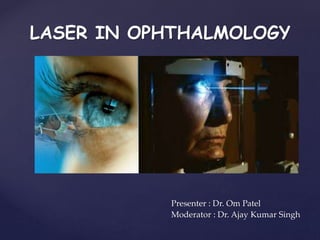
LASER IN OPHTHALMOLOGY
Presenter : Dr. Om Patel
Moderator : Dr. Ajay Kumar Singh
INTRODUCTION
LASER is an acronym for:
 L : Light
 A : Amplification (by)
 S : Stimulated
 E : Emission (of)
 R : Radiation
Term coined by Gordon Gould (1959)
LASER PHYSICS
Light as electromagnetic waves, emitting radiant energy
in tiny package called ‘quanta’/photon. Each photon has
a characteristic frequency and its energy is
proportional to its frequency
Three basic ways for photons and atoms to interact:
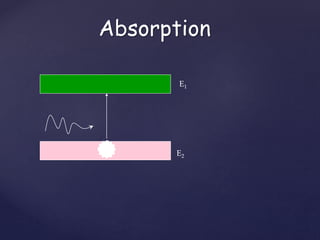
 Absorption
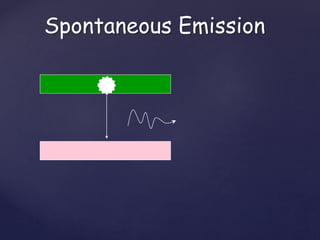
 Spontaneous Emission
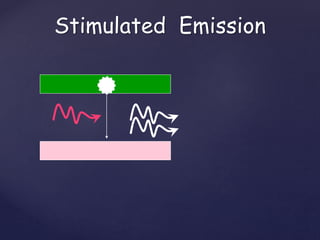
 Stimulated Emission
3 Mechanisms of Light Emission
Atomic systems in thermal equilibrium with their
surrounding, the emission of light is the result of:
Absorption
And subsequently, spontaneous emission of energy
There is another process whereby the atom in an upper
energy level can be triggered or stimulated in phase with
the an incoming photon. This process is:
Stimulated emission
Is an important process for laser action
1. Absorption
2. Spontaneous Emission
3. Stimulated Emission
Therefore 3 process
of light emission:
Absorption
E1
E2
Spontaneous Emission
Stimulated Emission
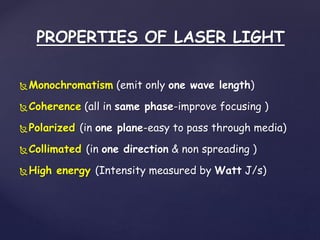
PROPERTIES OF LASER LIGHT
Monochromatism (emit only one wave length)
Coherence (all in same phase-improve focusing )
Polarized (in one plane-easy to pass through media)
Collimated (in one direction & non spreading )
High energy (Intensity measured by Watt J/s)
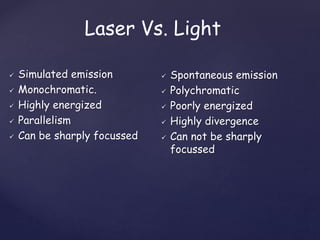
Laser Vs. Light
 Simulated emission
 Monochromatic.
 Highly energized
 Parallelism
 Can be sharply focussed
 Spontaneous emission
 Polychromatic
 Poorly energized
 Highly divergence
 Can not be sharply
focussed
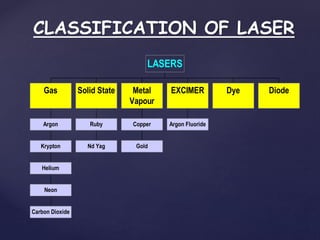
CLASSIFICATION OF LASER
Carbon Dioxide
Neon
Helium
Krypton
Argon
Gas
Nd Yag
Ruby
Solid State
Gold
Copper
Metal
Vapour
Argon Fluoride
EXCIMER Dye Diode
LASERS
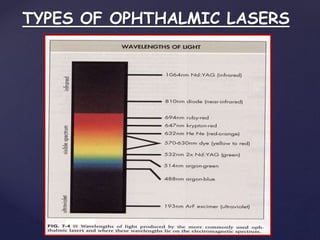
TYPES OF OPHTHALMIC LASERS
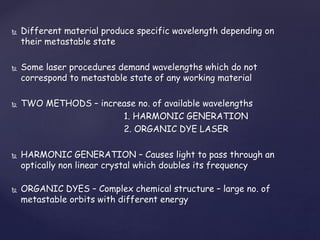
 Different material produce specific wavelength depending on
their metastable state
 Some laser procedures demand wavelengths which do not
correspond to metastable state of any working material
 TWO METHODS – increase no. of available wavelengths
1. HARMONIC GENERATION
2. ORGANIC DYE LASER
 HARMONIC GENERATION – Causes light to pass through an
optically non linear crystal which doubles its frequency
 ORGANIC DYES – Complex chemical structure – large no. of
metastable orbits with different energy
Nd:YAG laser
 (Neodymium-doped yttrium aluminum garnet) is a crystal that is used
as a lasing medium for solid-state lasers
 Nd:YAG lasers typically emit light with a wavelength of 1064 nm, in
the infrared
Applications
 Correct posterior capsular opacification
 Peripheral iridotomy in patients with angle-closure glaucoma
 Frequency-doubled Nd:YAG lasers (wavelength 532 nm) are used for
pan-retinal photocoagulation in patients with diabetic retinopathy
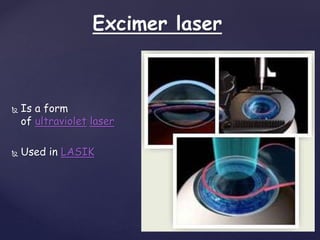
Excimer laser
 Is a form
of ultraviolet laser
 Used in LASIK
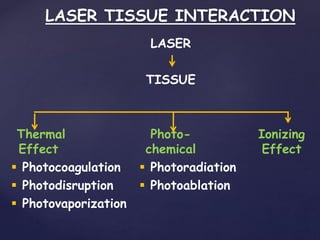
LASER TISSUE INTERACTION
LASER VARIABLE:
 Wavelength
 Spot Size
 Power
 Exposure time
TISSUE VARIABLE:
 Transparency
 Pigmentation
 Water Content
THREE TYPE OF OCULAR PIGMENT
Haemoglobin:
absorbs blue, green and yellow with minimal red wavelength
absorption, useful to coagulate the blood vessels
Xanthophyll:
Macular area
Maximum absorption is blue. minimally absorbs yellow or red
wavelengths
Melanin:
RPE, Choroid
absorbs green, yellow, red and infrared wavelengths
Pan Retinal Photocoagulation, and Destruction of RPE
Effective retinal photocoagulation depends on how well light penetrates
the ocular media and how well the light is absorbed by pigment in the
target tissue
LASER TISSUE INTERACTION
LASER
TISSUE
Thermal
Effect
Photo-
chemical
Ionizing
Effect
 Photocoagulation  Photoradiation
 Photodisruption  Photoablation
 Photovaporization
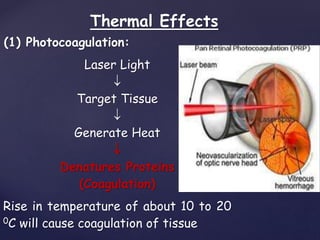
Thermal Effects
(1) Photocoagulation:
Laser Light

Target Tissue

Generate Heat

Denatures Proteins
(Coagulation)
Rise in temperature of about 10 to 20
0C will cause coagulation of tissue
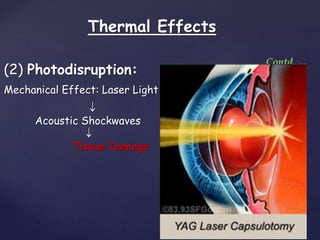
Thermal Effects
(2) Photodisruption:
Mechanical Effect: Laser Light

Acoustic Shockwaves

Tissue Damage
Contd. …
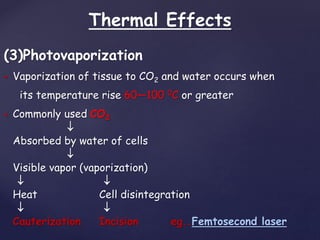
Thermal Effects
(3)Photovaporization
 Vaporization of tissue to CO2 and water occurs when
its temperature rise 60—100 0C or greater
 Commonly used CO2

Absorbed by water of cells

Visible vapor (vaporization)
 
Heat Cell disintegration
 
Cauterization Incision eg..Femtosecond laser
Photochemical effects
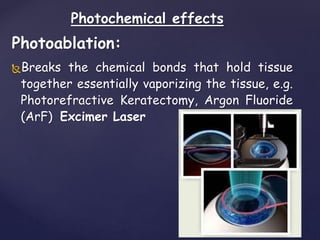
Photoablation:
Breaks the chemical bonds that hold tissue
together essentially vaporizing the tissue, e.g.
Photorefractive Keratectomy, Argon Fluoride
(ArF) Excimer Laser
PHOTOCHEMICAL EFFECT
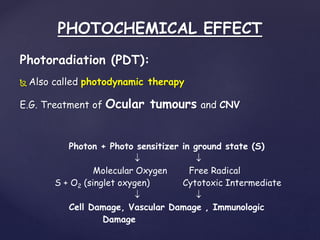
Photoradiation (PDT):
 Also called photodynamic therapy
E.G. Treatment of Ocular tumours and CNV
Photon + Photo sensitizer in ground state (S)
 
Molecular Oxygen Free Radical
S + O2 (singlet oxygen) Cytotoxic Intermediate
 
Cell Damage, Vascular Damage , Immunologic
Damage
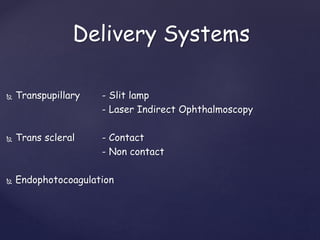
Delivery Systems
 Transpupillary - Slit lamp
- Laser Indirect Ophthalmoscopy
 Trans scleral - Contact
- Non contact
 Endophotocoagulation
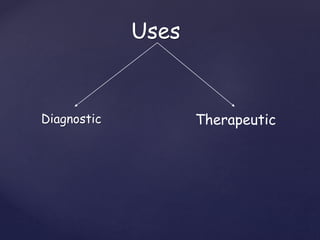
Uses
Diagnostic Therapeutic
Diagnostic Uses
 Scanning Laser Ophthalmoscopy
 Laser Interferometry
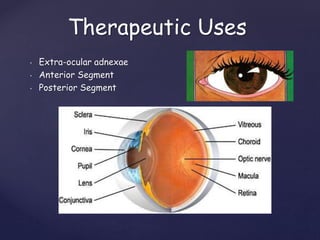
Therapeutic Uses
• Extra-ocular adnexae
• Anterior Segment
• Posterior Segment
i. Removal of lid masses
ii. Orbitotomies
iii. Blepharoplasty, Aesthetics (smoothen wrinkles)
iv. Capillary hemangioma, Portwine stain
Therapeutic Uses
A. Extraocular Adnexae
LASER IN ANTERIOR SEGMENT
CORNEA:
Laser in Keratorefractive Surgery:
 Photo Refractive Keratectomy (PRK)
 Laser in situ Keratomileusis (LASIK)
 Laser Subepithelial Keratectomy (LASEK)
Laser Thermal Keratoplasty
Corneal Neovascularization
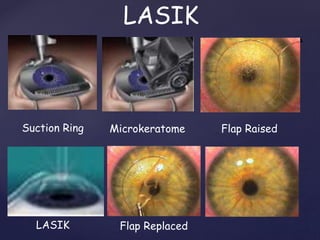
LASIK
SURYA
Suction Ring Microkeratome Flap Raised
LASIK Flap Replaced
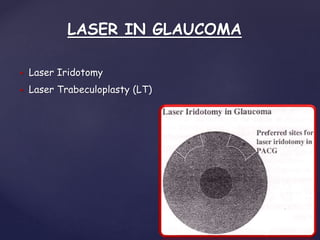
LASER IN GLAUCOMA
 Laser Iridotomy
 Laser Trabeculoplasty (LT)
LASER IN LENS
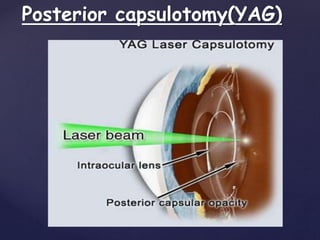
 Posterior capsulotomy(YAG)
 Laser phacoemulcification
LASER IN VITREOUS
 Viterous membranes
 Viterous traction bands
Posterior capsulotomy(YAG)
LASER TREATMENT OF
FUNDUS DISORDERS
 Diabetic Retinopathy
 Retinal Vascular Diseases
 Choroidal Neovascularization (CNV)
 Clinical Significant Macular Edema (CSME)
 Central Serous Retinopathy (CSR)
 Retinal Break/Detachment
 Tumour
Panretinal Photocoagulation
 PRP place laser spots in the peripheral retina for
360 degrees sparing the central 30 degrees of
the retina
POWER, SIZE, NUMBER, AND SESSIONS
 Recommendations in the ETDRS for an initial
treatment consisted of 1,200 to 1,600 burns of
moderate intensity, 500-Îźm size, one-half to one-
spot diameter spacing at 0.1-second duration,
divided over at least two sessions
 Proliferative diabetic retinopathy
 Neovascularisation of iris
 Severe non proliferative diabetic retinopathy
associated with-poor compliance for follow up-before
cataract surgery-renal failure-one eyed patient
 Central retinal vein occlusion, branch retinal vein
occlusion
Indications
Focal or Grid Photocoagulation
 Macular edema from diabetes or branch vein occlusion
 Retinopathy of prematurity(ROP)
 Closure of retinal microvascular abnormalities such as
microaneurysms, telangiectasia and perivascular leakage
 Focal ablation of extrafoveal choroidal neovascular
membrane
 Creation of chorioretinal adhesions surrounding retinal
breaks and detached areas
 Treatment of ocular tumors
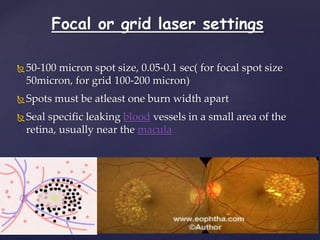
Focal or grid laser settings
50-100 micron spot size, 0.05-0.1 sec( for focal spot size
50micron, for grid 100-200 micron)
Spots must be atleast one burn width apart
Seal specific leaking blood vessels in a small area of the
retina, usually near the macula
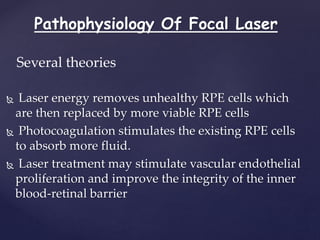
Pathophysiology Of Focal Laser
 Laser energy removes unhealthy RPE cells which
are then replaced by more viable RPE cells
 Photocoagulation stimulates the existing RPE cells
to absorb more fluid.
 Laser treatment may stimulate vascular endothelial
proliferation and improve the integrity of the inner
blood-retinal barrier
Several theories
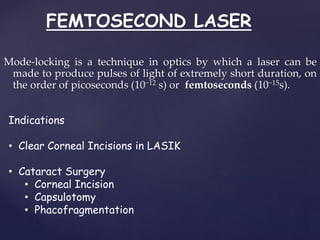
FEMTOSECOND LASER
Mode-locking is a technique in optics by which a laser can be
made to produce pulses of light of extremely short duration, on
the order of picoseconds (10−12 s) or femtoseconds (10−15s).
Indications
• Clear Corneal Incisions in LASIK
• Cataract Surgery
• Corneal Incision
• Capsulotomy
• Phacofragmentation
 Chemical : Some lasers require hazardous or toxic substances
to operate (i.e., chemical dye, Excimer lasers)
 Electrical : Most lasers utilize high voltages that can be
hazardous
LASER HAZARDS
 Fire : The solvents used in dye lasers are flammable.
High voltage pulse or flash lamps may cause ignition.
Flammable materials may be ignited by direct beams or
specular reflections from high power continuous wave
 Skin :
 Acute exposure to high levels of optical radiation may
cause skin burns; while carcinogenesis may occur for
ultraviolet wavelengths (290-320 nm)
LASER HAZARDS
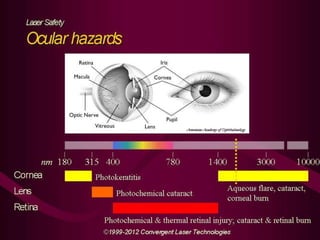
 Ocular :
 Acute exposure of the eye to lasers can cause corneal or
retinal burns (or both)
 Chronic exposure to excessive levels may cause corneal or
lenticular opacities (cataracts) or retinal injury
 Laser light in the visible to near infrared spectrum can cause
damage to the retina resulting in scotoma (blind spot in the
fovea). This wave band is also know as the "retinal hazard
region".
 Laser light in the ultraviolet (290 – 400 nm) spectrum can cause
damage to the cornea and/or to the lens.
Ocular Hazards
Thank You

Laser in ophthalmology

  • 1.
    { LASER IN OPHTHALMOLOGY Presenter: Dr. Om Patel Moderator : Dr. Ajay Kumar Singh
  • 2.
    INTRODUCTION LASER is anacronym for:  L : Light  A : Amplification (by)  S : Stimulated  E : Emission (of)  R : Radiation Term coined by Gordon Gould (1959)
  • 3.
    LASER PHYSICS Light aselectromagnetic waves, emitting radiant energy in tiny package called ‘quanta’/photon. Each photon has a characteristic frequency and its energy is proportional to its frequency Three basic ways for photons and atoms to interact:  Absorption  Spontaneous Emission  Stimulated Emission
  • 4.
    3 Mechanisms ofLight Emission Atomic systems in thermal equilibrium with their surrounding, the emission of light is the result of: Absorption And subsequently, spontaneous emission of energy There is another process whereby the atom in an upper energy level can be triggered or stimulated in phase with the an incoming photon. This process is: Stimulated emission Is an important process for laser action 1. Absorption 2. Spontaneous Emission 3. Stimulated Emission Therefore 3 process of light emission:
  • 5.
  • 6.
  • 7.
  • 8.
    PROPERTIES OF LASERLIGHT Monochromatism (emit only one wave length) Coherence (all in same phase-improve focusing ) Polarized (in one plane-easy to pass through media) Collimated (in one direction & non spreading ) High energy (Intensity measured by Watt J/s)
  • 9.
    Laser Vs. Light Simulated emission  Monochromatic.  Highly energized  Parallelism  Can be sharply focussed  Spontaneous emission  Polychromatic  Poorly energized  Highly divergence  Can not be sharply focussed
  • 10.
    CLASSIFICATION OF LASER CarbonDioxide Neon Helium Krypton Argon Gas Nd Yag Ruby Solid State Gold Copper Metal Vapour Argon Fluoride EXCIMER Dye Diode LASERS
  • 11.
  • 12.
     Different materialproduce specific wavelength depending on their metastable state  Some laser procedures demand wavelengths which do not correspond to metastable state of any working material  TWO METHODS – increase no. of available wavelengths 1. HARMONIC GENERATION 2. ORGANIC DYE LASER  HARMONIC GENERATION – Causes light to pass through an optically non linear crystal which doubles its frequency  ORGANIC DYES – Complex chemical structure – large no. of metastable orbits with different energy
  • 13.
    Nd:YAG laser  (Neodymium-dopedyttrium aluminum garnet) is a crystal that is used as a lasing medium for solid-state lasers  Nd:YAG lasers typically emit light with a wavelength of 1064 nm, in the infrared Applications  Correct posterior capsular opacification  Peripheral iridotomy in patients with angle-closure glaucoma  Frequency-doubled Nd:YAG lasers (wavelength 532 nm) are used for pan-retinal photocoagulation in patients with diabetic retinopathy
  • 14.
    Excimer laser  Isa form of ultraviolet laser  Used in LASIK
  • 15.
    LASER TISSUE INTERACTION LASERVARIABLE:  Wavelength  Spot Size  Power  Exposure time TISSUE VARIABLE:  Transparency  Pigmentation  Water Content
  • 16.
    THREE TYPE OFOCULAR PIGMENT Haemoglobin: absorbs blue, green and yellow with minimal red wavelength absorption, useful to coagulate the blood vessels Xanthophyll: Macular area Maximum absorption is blue. minimally absorbs yellow or red wavelengths Melanin: RPE, Choroid absorbs green, yellow, red and infrared wavelengths Pan Retinal Photocoagulation, and Destruction of RPE Effective retinal photocoagulation depends on how well light penetrates the ocular media and how well the light is absorbed by pigment in the target tissue
  • 17.
    LASER TISSUE INTERACTION LASER TISSUE Thermal Effect Photo- chemical Ionizing Effect Photocoagulation  Photoradiation  Photodisruption  Photoablation  Photovaporization
  • 18.
    Thermal Effects (1) Photocoagulation: LaserLight  Target Tissue  Generate Heat  Denatures Proteins (Coagulation) Rise in temperature of about 10 to 20 0C will cause coagulation of tissue
  • 19.
    Thermal Effects (2) Photodisruption: MechanicalEffect: Laser Light  Acoustic Shockwaves  Tissue Damage Contd. …
  • 20.
    Thermal Effects (3)Photovaporization  Vaporizationof tissue to CO2 and water occurs when its temperature rise 60—100 0C or greater  Commonly used CO2  Absorbed by water of cells  Visible vapor (vaporization)   Heat Cell disintegration   Cauterization Incision eg..Femtosecond laser
  • 21.
    Photochemical effects Photoablation: Breaks thechemical bonds that hold tissue together essentially vaporizing the tissue, e.g. Photorefractive Keratectomy, Argon Fluoride (ArF) Excimer Laser
  • 22.
    PHOTOCHEMICAL EFFECT Photoradiation (PDT): Also called photodynamic therapy E.G. Treatment of Ocular tumours and CNV Photon + Photo sensitizer in ground state (S)   Molecular Oxygen Free Radical S + O2 (singlet oxygen) Cytotoxic Intermediate   Cell Damage, Vascular Damage , Immunologic Damage
  • 23.
    Delivery Systems  Transpupillary- Slit lamp - Laser Indirect Ophthalmoscopy  Trans scleral - Contact - Non contact  Endophotocoagulation
  • 24.
  • 25.
    Diagnostic Uses  ScanningLaser Ophthalmoscopy  Laser Interferometry
  • 26.
    Therapeutic Uses • Extra-ocularadnexae • Anterior Segment • Posterior Segment
  • 27.
    i. Removal oflid masses ii. Orbitotomies iii. Blepharoplasty, Aesthetics (smoothen wrinkles) iv. Capillary hemangioma, Portwine stain Therapeutic Uses A. Extraocular Adnexae
  • 28.
    LASER IN ANTERIORSEGMENT CORNEA: Laser in Keratorefractive Surgery:  Photo Refractive Keratectomy (PRK)  Laser in situ Keratomileusis (LASIK)  Laser Subepithelial Keratectomy (LASEK) Laser Thermal Keratoplasty Corneal Neovascularization
  • 29.
    LASIK SURYA Suction Ring MicrokeratomeFlap Raised LASIK Flap Replaced
  • 30.
    LASER IN GLAUCOMA Laser Iridotomy  Laser Trabeculoplasty (LT)
  • 31.
    LASER IN LENS Posterior capsulotomy(YAG)  Laser phacoemulcification LASER IN VITREOUS  Viterous membranes  Viterous traction bands
  • 32.
  • 33.
    LASER TREATMENT OF FUNDUSDISORDERS  Diabetic Retinopathy  Retinal Vascular Diseases  Choroidal Neovascularization (CNV)  Clinical Significant Macular Edema (CSME)  Central Serous Retinopathy (CSR)  Retinal Break/Detachment  Tumour
  • 34.
    Panretinal Photocoagulation  PRPplace laser spots in the peripheral retina for 360 degrees sparing the central 30 degrees of the retina POWER, SIZE, NUMBER, AND SESSIONS  Recommendations in the ETDRS for an initial treatment consisted of 1,200 to 1,600 burns of moderate intensity, 500-μm size, one-half to one- spot diameter spacing at 0.1-second duration, divided over at least two sessions
  • 35.
     Proliferative diabeticretinopathy  Neovascularisation of iris  Severe non proliferative diabetic retinopathy associated with-poor compliance for follow up-before cataract surgery-renal failure-one eyed patient  Central retinal vein occlusion, branch retinal vein occlusion Indications
  • 36.
    Focal or GridPhotocoagulation  Macular edema from diabetes or branch vein occlusion  Retinopathy of prematurity(ROP)  Closure of retinal microvascular abnormalities such as microaneurysms, telangiectasia and perivascular leakage  Focal ablation of extrafoveal choroidal neovascular membrane  Creation of chorioretinal adhesions surrounding retinal breaks and detached areas  Treatment of ocular tumors
  • 37.
    Focal or gridlaser settings 50-100 micron spot size, 0.05-0.1 sec( for focal spot size 50micron, for grid 100-200 micron) Spots must be atleast one burn width apart Seal specific leaking blood vessels in a small area of the retina, usually near the macula
  • 38.
    Pathophysiology Of FocalLaser  Laser energy removes unhealthy RPE cells which are then replaced by more viable RPE cells  Photocoagulation stimulates the existing RPE cells to absorb more fluid.  Laser treatment may stimulate vascular endothelial proliferation and improve the integrity of the inner blood-retinal barrier Several theories
  • 39.
    FEMTOSECOND LASER Mode-locking isa technique in optics by which a laser can be made to produce pulses of light of extremely short duration, on the order of picoseconds (10−12 s) or femtoseconds (10−15s). Indications • Clear Corneal Incisions in LASIK • Cataract Surgery • Corneal Incision • Capsulotomy • Phacofragmentation
  • 40.
     Chemical :Some lasers require hazardous or toxic substances to operate (i.e., chemical dye, Excimer lasers)  Electrical : Most lasers utilize high voltages that can be hazardous LASER HAZARDS
  • 41.
     Fire :The solvents used in dye lasers are flammable. High voltage pulse or flash lamps may cause ignition. Flammable materials may be ignited by direct beams or specular reflections from high power continuous wave  Skin :  Acute exposure to high levels of optical radiation may cause skin burns; while carcinogenesis may occur for ultraviolet wavelengths (290-320 nm) LASER HAZARDS
  • 42.
     Ocular : Acute exposure of the eye to lasers can cause corneal or retinal burns (or both)  Chronic exposure to excessive levels may cause corneal or lenticular opacities (cataracts) or retinal injury  Laser light in the visible to near infrared spectrum can cause damage to the retina resulting in scotoma (blind spot in the fovea). This wave band is also know as the "retinal hazard region".  Laser light in the ultraviolet (290 – 400 nm) spectrum can cause damage to the cornea and/or to the lens. Ocular Hazards
  • 44.