Dr. MAMTA
Dept of ophthalmology
RNT Medical college, Udaipur
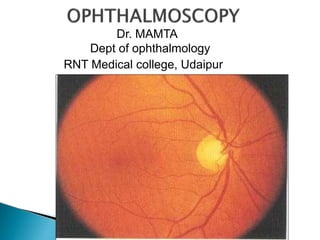
Ophthalmoscopy is a clinical examination of
the interior of the eye by means of an
ophthalmoscope.
 It is primarily done to assess the state of
fundus and detect the opacities of ocular
media.
 The ophthalmoscope was invented by von
Helmholtz in 1850.
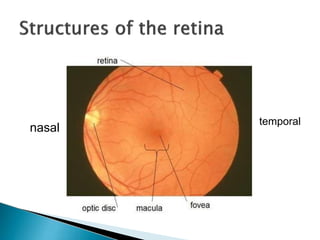
nasal
temporal
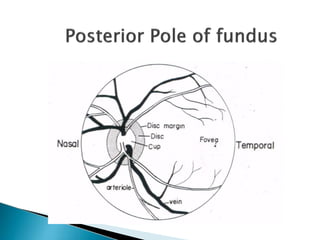
DISC: LOCATION –nasal to geometric axis
DIAMETER – 1.5mm [1 disc diameter]
COLO
R
SHAPE
– Pale pink
– Circular
EDGES – Regular
CUP
:
TERMINATION OF
ALL LAYERS EXCEPT
NFL
C/D ratio – 0.3 to 0.5
 RETINAL SYSTEM :
CENTRAL RETINAL
ARTERY
AND
CENTRAL RETINAL VEIN
Arterioles
Venules
Capillaries
 CILIARY SYSTEM : POST.CILIARY
ARTERIES
Choriocapillaries
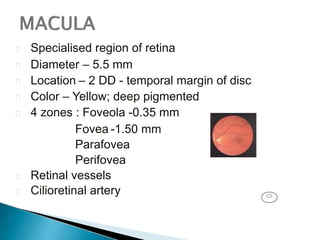
 Specialised region of retina
 Diameter – 5.5 mm
 Location – 2 DD - temporal margin of disc
 Color – Yellow; deep pigmented
 4 zones : Foveola -0.35 mm
Fovea -1.50 mm
Parafovea
Perifovea
 Retinal vessels
 Cilioretinal artery
 Ophthalmoscopic methods of examination
are-
(1)Distant direct ophthalmoscopy
(2)Direct ophthalmoscopy
(3) Indirect ophthalmoscopy
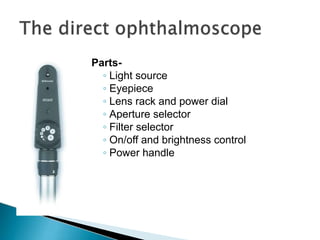
Parts-
◦ Light source
◦ Eyepiece
◦ Lens rack and power dial
◦ Aperture selector
◦ Filter selector
◦ On/off and brightness control
◦ Power handle
 For a good view of fundus the pupil should be
dilated by instilling few drops of short acting
mydriatic drug (e.g. combination of tropicamide
and phenylephrine )
 The subject should be examined in sitting or
lying down position.
 Examination room should be semidark.
 keep the eye as still as possible.
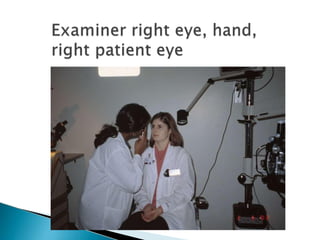
For examining right eye of the patient,
 Examiner should stand on right side of the
patient.
 Hold the instrument in his right hand.
 Use examiner’s right eye.
If examining left eye, stand on left side, hold
instrument in left hand use left eye.
 Viewing should begin about half meter away
from the eye.
 First see the “Red reflex”
 Initially the lens power in the instrument should
be set to zero, and if refractive error present in
patient or examiner, e.g. if the patient is myopic
then set the (-ve )lens, if the examiner or
patient is hypermetropic then set the lens to
(+ve) lens. If both patient & examiner have
refractive error then sum together their powers.
 Rotate the lens dial until the optic disc is focused
clearly.
(Red numbers/negative numbers in myopia or
short-sightedness.
Green numbers/positive numbers in hyperopia or
far-sightedness.)
 Examine the optic disc for:
Shape – normally round or slightly oval
Clarity of the outline-clear outline or rim
Colour-pale pink contrast to rich red of rest of
fundus.
 Examine the macula last.
 To locate the macula, focus on the disc, then
move 2 disc diameters temporally. The macula is
darker in colour than the surrounding fundus,
and devoid of blood vessels.
 May also ask the patient to look at the light, this
automatically puts the macula into full view.
 It should be performed routinely before the
direct ophthalmoscope, as it gives a lot of
useful information.
 It can be performed with the help of a self-
illuminated ophthalmoscope or a simple plain
mirror with a hole at the centre.
Procedure- The light is thrown into patients eye
sitting in a semi-darkroom, from a distance of
20-25 cm and the features of the red glow in the
pupillary area are noted.
 1. To diagnose opacities in the refractive media-
any opacity in the refractive media is seen as a
black shadow in the red glow.
 2. To differentiate between a mole and a hole
of the iris- a small hole and mole on the iris
appears as a black spot on oblique illumination
 3. To recognise detached retina or a tumour
arising from the fundus is seen as a greyish
reflex.
 It is the most commonly practised method for
routine fundus examination.
 It works on the basic optical principle of glass
plate ophthalmoscope introduced by von
helmholtz.
 A convergent beam of light is reflected into the
patients pupil. The emergent rays from any
point of the patients fundus reach the observers
retina through the viewing hole in the
ophthalmoscope.
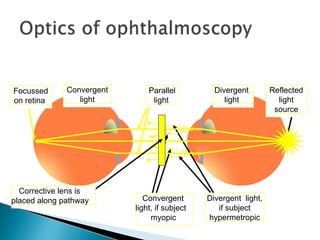
 The emergent rays from the patients eye are
parallel and brought to focus on the retina of the
emmetropic observer when accommodation is
relaxed.
 In hypermetropic patient,the emergent rays will be
divergent and with the help of convex lens can be
brought to focus on the observers retina.
 In myopic patient,the rays will be convergent
and use concave lens for focus on the observers
retina.
Divergent light,
if subject
hypermetropic
Reflected
light
source
Convergent
light, if subject
myopic
Divergent
light
Convergent
light
Parallel
light
Focussed
on retina
Corrective lens is
placed along pathway
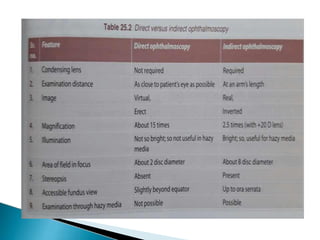
 The image is erect, virtual and about 15 times
magnified in emmetropes.
 Technique- should be performed in a semi-
darkroom with the patient seated and looking
straight ahead , while the observer standing or
seated slightly over to the side of the eye to be
examined by the observer with his or her right
eye and left with the left.
 The observer should reflect beam of light from
the ophthalmoscope into patients pupil. Once the
red reflex is seen the observer should move as
close to the patients eye as possible.
 Once the retina is focused the details should be
examined systematically starting from
disc,blood vessels, the four quadrant of the
general background and the macula.
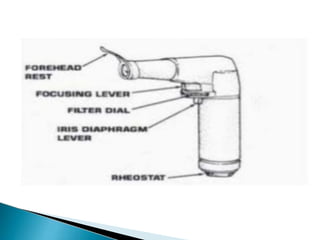
Monocular Indirect Ophthalmoscopy
It consists of-
 Illumination rheostat at its base,
 Focusing lever for image refinement,
 Filter dial with red free and yellow filters,
 Forehead rest for proper observer head
positioning, and
 Iris diaphragm lever to adjust the illumination
beam diameter.
 Optics- an internal relay lens system re-
inverts the initially inverted image to a real
erect one, which is then magnified. This image
is focusable using the focusing lever.
Indications are-
 Need for an increased field of view
 Small pupils
 Uncooperative children
 Patients intolerance of bright light of
binocular indirect ophthalmoscope.
 Extent of view- although vitreous base views are
possible with monocular IO, its greatest
effectiveness extends anteriorly to the
peripheral equatorial region.
 Advantage- field of view similar to IO and,
 Erect real image similar to DO.
 Disadvantage –are lack of stereopsis,
 Limited illumination and,
 Fixed magnification.
 It is very popular method for examination of
posterior segment introduced by Nagel in 1864.
 PRINCIPLE- To make the eye highly myopic by
placing a strong convex lens in front of patients
eye so that the emergent rays from an area of the
fundus are brought to the focus as a real,inverted
image between the lens and the observers eye.
 An inverted reverse real image
 Magnification = 2 to 4 X
 Field of view = 40 to 50 degrees
 Optimal working distance = 40 to 50 cms
 Good illumination & stereopsis
 Ease of use with scleral indentor
 Lenses from 14 to 30 D range
 CHARACTERISTICS- Magnification of image
depends upon the dioptric power of convex
lens, position of the lens in relation of the
eyeball and refractive state of eyeball.
 About 5 times magnification is obtained with
+13 D lens.
 With a stronger lens,image will be smaller, but
brighter and field of vision will be more.
(1) Dark room
(2) source of light and concave mirror or self
illuminated indirect ophthalmoscope
(3) Convex lens
(4) pupils of the patient should be dilated.
 The patient is made to lie in the supine
position, with one pillow on a bed or couch and
instructed to keep both eyes open.
 The examiner throws the light into patients eye
from an arms distance.
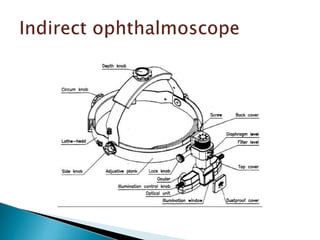
 In practise, Binocular ophthalmoscope with
head band or that mounted on the spectacle
frame is employed most frequently.
 Keeping his or her eyes on the reflex, the
examiner then interposes the condensing lens in
the path of beam of light, close to the patient
eye, and then slowly moves the lens away from
eye until the image of retina is clearly seen.
 The examiner moves around the head of the
patient to examine different quadrants of the
fundus.
 He or she has to stand opposite to clock hour
position to be examined.
 By asking the patient to look in extreme gaze,
and using of scleral indenter, the whole peripheral
retina up to ora serrata can be examined.
 Scleral indentation- helps in making prominent
the barely perceptible lesions, done with the
depressor placed on patients lid.
 Examiner should move the scleral depressor in a
direction opposite to that in which he or she wishes
the depression to appear.
 Scleral depressor should be rolled gently and
tangentially over the eye surface.
 The temporal part of upper lid is sufficiently lax so
depressor can be placed inferiorly in the horizontal
meridian.
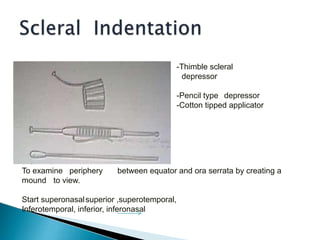
-Thimble scleral
depressor
-Pencil type depressor
-Cotton tipped applicator
To examine periphery between equator and ora serrata by creating a
mound to view.
Start superonasalsuperior ,superotemporal,
Inferotemporal, inferior, inferonasal
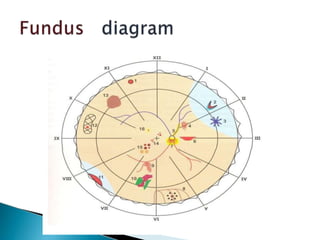
 FUNDUS DRAWING-
 The image seen with IO is vertically inverted and
laterally reversed; top of the retinal chart is placed
towards the foot end of the patient [i.e.upside down]
 Fundus drawing is made on a special Amsler
chart,which has 12 clock hours marked and has
three concentric circles made on it-
 Innermost circle,middle circle and outermost circle
represents to the equator,the ora serrata and,the
midpoint of pars plana respectively.
-Technique is difficult and can be mastered by
hours of practice.
-Magnification is less compare to DO.
-It is impossible with very small pupil.
-Patient is usually more uncomfortable with
intense light of IO and with scleral
indentation.
-Reflex sneezing can occur on exposure to
bright light.
Advantages of Indirect system
• Image not affected by the patients refractive power
• In eyes with nystagmus
• Delivery of LASER
• Binocular examination of fundus up-to the periphery
• Large field of view allow for the panoramic view
• Better Resolution
• Use in operating room for cryo/scleral buckling
• Better view in presence of media opacities
• Increased illumination
• Reduced distortion
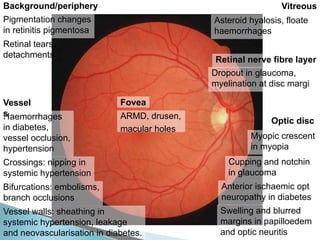
Dropout in glaucoma,
myelination at disc margi
Cupping and notchin
in glaucoma
Swelling and blurred
margins in papilloedem
and optic neuritis
Vessel walls: sheathing in
systemic hypertension, leakage
and neovascularisation in diabetes.
Crossings: nipping in
systemic hypertension
Bifurcations: embolisms,
branch occlusions
Pigmentation changes
in retinitis pigmentosa
Haemorrhages
in diabetes,
vessel occlusion,
hypertension
Myopic crescent
in myopia
ARMD, drusen,
macular holes
Retinal tears,
detachments
Anterior ischaemic opt
neuropathy in diabetes
Vessel
s
Optic disc
Fovea
Background/periphery
Retinal nerve fibre layer
Vitreous
Asteroid hyalosis, floate
haemorrhages
THANK YOU

OPTHALMOSCOPY.pdf

  • 1.
    Dr. MAMTA Dept ofophthalmology RNT Medical college, Udaipur
  • 2.
    Ophthalmoscopy is aclinical examination of the interior of the eye by means of an ophthalmoscope.  It is primarily done to assess the state of fundus and detect the opacities of ocular media.  The ophthalmoscope was invented by von Helmholtz in 1850.
  • 3.
  • 5.
    DISC: LOCATION –nasalto geometric axis DIAMETER – 1.5mm [1 disc diameter] COLO R SHAPE – Pale pink – Circular EDGES – Regular CUP : TERMINATION OF ALL LAYERS EXCEPT NFL C/D ratio – 0.3 to 0.5
  • 6.
     RETINAL SYSTEM: CENTRAL RETINAL ARTERY AND CENTRAL RETINAL VEIN Arterioles Venules Capillaries  CILIARY SYSTEM : POST.CILIARY ARTERIES Choriocapillaries
  • 7.
     Specialised regionof retina  Diameter – 5.5 mm  Location – 2 DD - temporal margin of disc  Color – Yellow; deep pigmented  4 zones : Foveola -0.35 mm Fovea -1.50 mm Parafovea Perifovea  Retinal vessels  Cilioretinal artery
  • 8.
     Ophthalmoscopic methodsof examination are- (1)Distant direct ophthalmoscopy (2)Direct ophthalmoscopy (3) Indirect ophthalmoscopy
  • 9.
    Parts- ◦ Light source ◦Eyepiece ◦ Lens rack and power dial ◦ Aperture selector ◦ Filter selector ◦ On/off and brightness control ◦ Power handle
  • 10.
     For agood view of fundus the pupil should be dilated by instilling few drops of short acting mydriatic drug (e.g. combination of tropicamide and phenylephrine )  The subject should be examined in sitting or lying down position.  Examination room should be semidark.  keep the eye as still as possible.
  • 11.
    For examining righteye of the patient,  Examiner should stand on right side of the patient.  Hold the instrument in his right hand.  Use examiner’s right eye. If examining left eye, stand on left side, hold instrument in left hand use left eye.
  • 12.
     Viewing shouldbegin about half meter away from the eye.  First see the “Red reflex”  Initially the lens power in the instrument should be set to zero, and if refractive error present in patient or examiner, e.g. if the patient is myopic then set the (-ve )lens, if the examiner or patient is hypermetropic then set the lens to (+ve) lens. If both patient & examiner have refractive error then sum together their powers.
  • 13.
     Rotate thelens dial until the optic disc is focused clearly. (Red numbers/negative numbers in myopia or short-sightedness. Green numbers/positive numbers in hyperopia or far-sightedness.)  Examine the optic disc for: Shape – normally round or slightly oval Clarity of the outline-clear outline or rim Colour-pale pink contrast to rich red of rest of fundus.
  • 14.
     Examine themacula last.  To locate the macula, focus on the disc, then move 2 disc diameters temporally. The macula is darker in colour than the surrounding fundus, and devoid of blood vessels.  May also ask the patient to look at the light, this automatically puts the macula into full view.
  • 16.
     It shouldbe performed routinely before the direct ophthalmoscope, as it gives a lot of useful information.  It can be performed with the help of a self- illuminated ophthalmoscope or a simple plain mirror with a hole at the centre. Procedure- The light is thrown into patients eye sitting in a semi-darkroom, from a distance of 20-25 cm and the features of the red glow in the pupillary area are noted.
  • 17.
     1. Todiagnose opacities in the refractive media- any opacity in the refractive media is seen as a black shadow in the red glow.  2. To differentiate between a mole and a hole of the iris- a small hole and mole on the iris appears as a black spot on oblique illumination  3. To recognise detached retina or a tumour arising from the fundus is seen as a greyish reflex.
  • 18.
     It isthe most commonly practised method for routine fundus examination.  It works on the basic optical principle of glass plate ophthalmoscope introduced by von helmholtz.  A convergent beam of light is reflected into the patients pupil. The emergent rays from any point of the patients fundus reach the observers retina through the viewing hole in the ophthalmoscope.
  • 19.
     The emergentrays from the patients eye are parallel and brought to focus on the retina of the emmetropic observer when accommodation is relaxed.  In hypermetropic patient,the emergent rays will be divergent and with the help of convex lens can be brought to focus on the observers retina.  In myopic patient,the rays will be convergent and use concave lens for focus on the observers retina.
  • 20.
    Divergent light, if subject hypermetropic Reflected light source Convergent light,if subject myopic Divergent light Convergent light Parallel light Focussed on retina Corrective lens is placed along pathway
  • 21.
     The imageis erect, virtual and about 15 times magnified in emmetropes.  Technique- should be performed in a semi- darkroom with the patient seated and looking straight ahead , while the observer standing or seated slightly over to the side of the eye to be examined by the observer with his or her right eye and left with the left.
  • 22.
     The observershould reflect beam of light from the ophthalmoscope into patients pupil. Once the red reflex is seen the observer should move as close to the patients eye as possible.  Once the retina is focused the details should be examined systematically starting from disc,blood vessels, the four quadrant of the general background and the macula.
  • 23.
    Monocular Indirect Ophthalmoscopy Itconsists of-  Illumination rheostat at its base,  Focusing lever for image refinement,  Filter dial with red free and yellow filters,  Forehead rest for proper observer head positioning, and  Iris diaphragm lever to adjust the illumination beam diameter.
  • 25.
     Optics- aninternal relay lens system re- inverts the initially inverted image to a real erect one, which is then magnified. This image is focusable using the focusing lever. Indications are-  Need for an increased field of view  Small pupils  Uncooperative children  Patients intolerance of bright light of binocular indirect ophthalmoscope.
  • 26.
     Extent ofview- although vitreous base views are possible with monocular IO, its greatest effectiveness extends anteriorly to the peripheral equatorial region.  Advantage- field of view similar to IO and,  Erect real image similar to DO.  Disadvantage –are lack of stereopsis,  Limited illumination and,  Fixed magnification.
  • 27.
     It isvery popular method for examination of posterior segment introduced by Nagel in 1864.  PRINCIPLE- To make the eye highly myopic by placing a strong convex lens in front of patients eye so that the emergent rays from an area of the fundus are brought to the focus as a real,inverted image between the lens and the observers eye.
  • 29.
     An invertedreverse real image  Magnification = 2 to 4 X  Field of view = 40 to 50 degrees  Optimal working distance = 40 to 50 cms  Good illumination & stereopsis  Ease of use with scleral indentor  Lenses from 14 to 30 D range
  • 30.
     CHARACTERISTICS- Magnificationof image depends upon the dioptric power of convex lens, position of the lens in relation of the eyeball and refractive state of eyeball.  About 5 times magnification is obtained with +13 D lens.  With a stronger lens,image will be smaller, but brighter and field of vision will be more.
  • 31.
    (1) Dark room (2)source of light and concave mirror or self illuminated indirect ophthalmoscope (3) Convex lens (4) pupils of the patient should be dilated.
  • 32.
     The patientis made to lie in the supine position, with one pillow on a bed or couch and instructed to keep both eyes open.  The examiner throws the light into patients eye from an arms distance.  In practise, Binocular ophthalmoscope with head band or that mounted on the spectacle frame is employed most frequently.
  • 33.
     Keeping hisor her eyes on the reflex, the examiner then interposes the condensing lens in the path of beam of light, close to the patient eye, and then slowly moves the lens away from eye until the image of retina is clearly seen.
  • 34.
     The examinermoves around the head of the patient to examine different quadrants of the fundus.  He or she has to stand opposite to clock hour position to be examined.  By asking the patient to look in extreme gaze, and using of scleral indenter, the whole peripheral retina up to ora serrata can be examined.
  • 35.
     Scleral indentation-helps in making prominent the barely perceptible lesions, done with the depressor placed on patients lid.  Examiner should move the scleral depressor in a direction opposite to that in which he or she wishes the depression to appear.  Scleral depressor should be rolled gently and tangentially over the eye surface.  The temporal part of upper lid is sufficiently lax so depressor can be placed inferiorly in the horizontal meridian.
  • 36.
    -Thimble scleral depressor -Pencil typedepressor -Cotton tipped applicator To examine periphery between equator and ora serrata by creating a mound to view. Start superonasalsuperior ,superotemporal, Inferotemporal, inferior, inferonasal
  • 37.
     FUNDUS DRAWING- The image seen with IO is vertically inverted and laterally reversed; top of the retinal chart is placed towards the foot end of the patient [i.e.upside down]  Fundus drawing is made on a special Amsler chart,which has 12 clock hours marked and has three concentric circles made on it-  Innermost circle,middle circle and outermost circle represents to the equator,the ora serrata and,the midpoint of pars plana respectively.
  • 40.
    -Technique is difficultand can be mastered by hours of practice. -Magnification is less compare to DO. -It is impossible with very small pupil. -Patient is usually more uncomfortable with intense light of IO and with scleral indentation. -Reflex sneezing can occur on exposure to bright light.
  • 41.
    Advantages of Indirectsystem • Image not affected by the patients refractive power • In eyes with nystagmus • Delivery of LASER • Binocular examination of fundus up-to the periphery • Large field of view allow for the panoramic view
  • 42.
    • Better Resolution •Use in operating room for cryo/scleral buckling • Better view in presence of media opacities • Increased illumination • Reduced distortion
  • 44.
    Dropout in glaucoma, myelinationat disc margi Cupping and notchin in glaucoma Swelling and blurred margins in papilloedem and optic neuritis Vessel walls: sheathing in systemic hypertension, leakage and neovascularisation in diabetes. Crossings: nipping in systemic hypertension Bifurcations: embolisms, branch occlusions Pigmentation changes in retinitis pigmentosa Haemorrhages in diabetes, vessel occlusion, hypertension Myopic crescent in myopia ARMD, drusen, macular holes Retinal tears, detachments Anterior ischaemic opt neuropathy in diabetes Vessel s Optic disc Fovea Background/periphery Retinal nerve fibre layer Vitreous Asteroid hyalosis, floate haemorrhages
  • 45.