MYOPIA 
PRESENTER – DR. OM PATEL 
MODERATOR – DR. SURYAKANT JHA
MYOPIA 
 SHORT SIGHTEDNESS 
 Condition in which incident parallel rays come to a 
focus anterior to the light sensitive layer of retina 
with accomodation at rest.
OPTICS OF MYOPIA 
 The optical system is too powerful for its axial 
length 
 Image of distant object on retina is made up of 
circle of diffusion formed by divergent beam since 
the parallel rays of light coming from the infinity 
are focused in front of the retina
Far point is finite point in front of eye
OPTICS OF MYOPIA 
 Accommodation in uncorrected myopes is not 
developed normally 
May suffer from convergence insufficiency 
and exophoria 
 Early presbyopia
ETIOLOGICAL CLASSIFICATION 
 Axial : most commonest 
 1mm = 3D 
 Curvatural : 
 Increased corneal or lens curvature 
 1mm = 6D
ETIOLOGICAL CLASSIFICATION 
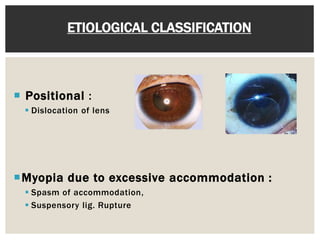
 Positional : 
 Dislocation of lens 
Myopia due to excessive accommodation : 
 Spasm of accommodation, 
 Suspensory lig. Rupture
ETIOLOGICAL CLASSIFICATION 
 Index myopia : 
 Change in the R.I. of the crystalline lens 
eg : Nuclear Sclerosis, 
Incipient Cataract, 
Diabetes.
DEGREE OF MYOPIA 
Low Myopia(<3D) 
Medium Myopia(3-6D) 
High Myopia(>6D)
CLINICAL VARIETIES 
 Congenital myopia 
 Simple or developmental myopia 
 Pathological or degenerative myopia
CONGENITAL MYOPIA 
 Frequently associated with 
 Premature babies 
 Marfan’s syndrome 
 Homocystinuria 
 Since birth,Diagnosed by 2-3 years 
 Increased axial length, overall globe size 
 If unilateral may produce amblyopia, strabismus 
 Bilateral – difficulty in distant vision, holds things closer 
 Usually error is 8-10 D, remains constant
CONGENITAL MYOPIA 
Associated wi th 
 Cataract 
 Micropthalmos 
 Aniridia 
 Megalocornea 
 Congenital separation of retina 
Management 
 Early full correction 
 Retinoscopy under full di latation
SIMPLE MYOPIA 
 Developmental myopia- commonest variety 
 School myopia (school going age 8-12 years) 
 Physiological, not associated with any eye disease 
 Normal biological variation in development 
 Rarely present from birth, rather hypermetropia 
followed by myopia
CLINICAL PICTURE 
Symptoms 
 Poor vision for distance(short sightedness) 
 Asthenopic symptoms 
 Half shutting of eyes
Signs 
 Prominent eyeballs 
 Anterior chamber - deeper than normal 
 Pupils- Large, sluggishly reacting 
 Fundus- normal; rarely temporal myopic crescent may be 
seen 
 Magnitude of refractive error 
 Increasing at rate -0.5 +- 0.30/ year. 
 Does not exceed -6 to -8 D 
Diagnosis 
Confirmed by performing retinoscopy
PATHOLOGICAL MYOPIA 
 Degenerative/ progressive myopia 
 Rapidly progressive myopia associated with 
degenerative changes 
 Starts in childhood at 5-10 years of age
ETIO-PATHOGENESIS 
Genetic factors (play major role) 
General growth process(minor) 
More growth of retina 
Stretching of sclera 
Increase axial length 
Degeneration of choroid 
Degeneration of retina 
Degeneration of vitreous
 Defective vision 
 Muscae volitantes 
SYMPTOMS 
 Floating black opacities in front of eyes 
 Degenerated liquified vitreous
 Prominent eye balls 
SIGNS 
 Elongation of eye ball mainly affects posterior pole 
and surrounding area 
 Cornea-large 
 Anterior chamber –deep 
 Pupils-slightly large,react sluggishly to light 
 Lens 
 Opacities at the posterior pole due to aberration of 
lenticular metabolism 
 Anterior dislocation due to overstretching
Fundus examination: 
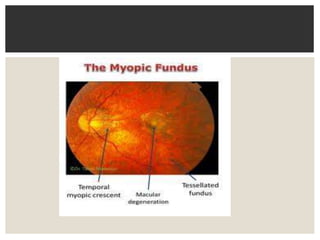
Optic disc 
 Large and pale 
 Temporal edge presents a characteristic MYOPIC CRESCENT 
 SUPER TRACTION CRESCENT may be present on nasal side 
(retina pulled over disc margin) 
 Peripapillary crescent encircling the disc may be present, where 
choroid and retina is distracted away from disc margin
Degenerative changes in retina and choroid 
 White atrophic patches at macula with a little 
heaping of pigment around them
• FOSTER-FUCH’S 
SPOT: 
• Dark red circular 
patch due to sub-retinal 
neo 
vascularization 
and choroidal 
haemorrhage 
• Present at macula 
• CYSTOID 
DEGENERATION 
– at periphery
 Posterior staphyloma 
 Due to ectasia of sclera at posterior pole 
 It may be apparent as an excavation with vessels 
bending backward over margins
 Degenerative changes in vitreous 
 Liquefaction 
 Vitreous opacities 
 Posterior vitreous detachment(PVD)- Weiss’ reflex
 Visual fields 
 Contraction 
 Ring scotoma may be seen 
 ERG reveals subnormal electroretinogram due to 
chorioretinal atrophy
COMPLICATIONS 
 Retinal detachment 
 Complicated cataract 
 Vitreous haemorrhage 
 Choroidal haemorrhage 
 Strabismus fixus convergence
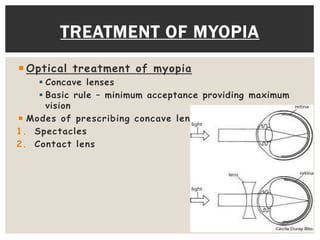
TREATMENT OF MYOPIA 
Optical treatment of myopia 
 Concave lenses 
 Basic rule – minimum acceptance providing maximum 
vision 
 Modes of prescribing concave lens- 
1. Spectacles 
2. Contact lens
 Contact lenses are used in case of high myopia as they 
avoid peripheral distortion and minification produced 
by strong concave spectacle lens
SURGICAL TREATMENT OF 
 Radial keratotomy 
 Photo-Refractive keratectomy (PRK) 
 LASIK 
 Fucala’s lens extraction 
 ICL (Implantable Collamer Lens) or Phakic IOL 
 ICR ( Intra Corneal Ring implantation) 
 Orthokeratology 
MYOPIA
SURGICAL TREATMENT OF 
MYOPIA 
 Radial keratotomy 
 Obsolete now a days 
 Making deep radial incisions in peripheral part of 
cornea leaving the central a 4mm optical zone 
 These incisions on healing ; flatten the central 
cornea thereby reducing its refractive power 
 Correct low to moderate myopia(2-6D) 
DISADVANTAGES: 
 Cornea is weakened – globe rupture in sports persons 
 Uneven healing – irregular astigmatism 
 Patient may feel glare at night
Photo refractive 
keratectomy (PRK) 
 A central optical zone 
of anterior corneal 
stroma is photoablated 
using excimer laser 
(193nm uv flash) to 
cause flattening of 
central cornea 
 Correction for -2 to - 
6D of myopia
Disadvantages: 
• Post operative recovery is slow 
• Pain and discomfort 
• Residual corneal haze in centre affecting vision 
• Expensive
LASER ASSISTED IN-SITU 
KERATOMILEUSIS(LASIK) 
 Refractory surgery of choice for myopia of upto -12D
Flap of 130-160 micron thickness of 
anterior corneal tissue is raised 
Midstromal tissue is ablated 
directly with an excimer laser beam 
ultimately flattening the cornea
PATIENT SELECTION 
CRITERIA 
1. Patients >20 years 
2. Stable refraction for at least 12 months 
3. Absence of corneal pathology 
 Absolute contraindication for LASIK 
 Corneal thickness <450 micrometers 
 Presence of ectasia
ADVANCES IN LASIK 
 Customised(C)-LASIK: 
 Based on wave front 
technology 
 Corrects spherical, 
cylindrical and other 
aberations present in eye 
 Gives vision beyond 6/6 
i.e.,6/5 or 6/4
 Epi-(E) LASIK: 
 Only epithelial sheet is 
separated with Epiedge 
Epikeratome 
 Devoid of complications 
related to corneal 
stromal flap
ADVANTAGES OF LASIK 
 Minimal or no postoperative pain 
 Recovery of vision is very early as compared to PRK 
 No risk of perforation during surgery and rupture of 
globe due to trauma like RK 
 No residual haze unlike PRK where subepithelial 
scarring may occur 
 LASIK is effective in correcting myopia of -12D
DISADVANTAGES 
 Expensive 
 Requires greater surgical skill than RK and PRK 
 Flap related complications 
 Intraoperative flap amputation 
 Wrinkling of flap on repositioning 
 Postoperative flap dislocation/subluxation 
 Epithelization of flap – bed interface 
 Irregular astigmatism
EXTRACTION OF CLEAR 
CRYSTALLINE LENS 
 Fucala’s operation 
 Myopia of -16D to -18D in unilateral cases 
 Clear lens extraction with intraocular lens implantation 
of appropriate power is the refractive surgery for 
myopia of >-12D
PHAKIC INTRAOCULAR LENS 
(ICL) 
 Intraocular contact lens implantation for correction of 
myopia of >-12D 
 Special type of IOL is implanted in anterior chamber 
or posterior chamber anterior to natural crystalline 
lens
INTRACORNEAL RING (ICR) 
IMPLANTATION 
 Into the peripheral cornea at approximately 2/3rd 
stromal depth 
 Flattening of central cornea, decreasing myopia 
 Advantage: reversible procedure
ORTHOKERATOLOGY 
 A non-surgical reversible method of moulding the 
cornea with overnight wear unique rigid gas permeable 
contact lenses 
 Myopia correction upto -5D 
 Used in patients below 18 years of age
Myopia

Myopia

  • 1.
    MYOPIA PRESENTER –DR. OM PATEL MODERATOR – DR. SURYAKANT JHA
  • 2.
    MYOPIA  SHORTSIGHTEDNESS  Condition in which incident parallel rays come to a focus anterior to the light sensitive layer of retina with accomodation at rest.
  • 3.
    OPTICS OF MYOPIA  The optical system is too powerful for its axial length  Image of distant object on retina is made up of circle of diffusion formed by divergent beam since the parallel rays of light coming from the infinity are focused in front of the retina
  • 4.
    Far point isfinite point in front of eye
  • 5.
    OPTICS OF MYOPIA  Accommodation in uncorrected myopes is not developed normally May suffer from convergence insufficiency and exophoria  Early presbyopia
  • 6.
    ETIOLOGICAL CLASSIFICATION Axial : most commonest  1mm = 3D  Curvatural :  Increased corneal or lens curvature  1mm = 6D
  • 7.
    ETIOLOGICAL CLASSIFICATION Positional :  Dislocation of lens Myopia due to excessive accommodation :  Spasm of accommodation,  Suspensory lig. Rupture
  • 8.
    ETIOLOGICAL CLASSIFICATION Index myopia :  Change in the R.I. of the crystalline lens eg : Nuclear Sclerosis, Incipient Cataract, Diabetes.
  • 9.
    DEGREE OF MYOPIA Low Myopia(<3D) Medium Myopia(3-6D) High Myopia(>6D)
  • 10.
    CLINICAL VARIETIES Congenital myopia  Simple or developmental myopia  Pathological or degenerative myopia
  • 11.
    CONGENITAL MYOPIA Frequently associated with  Premature babies  Marfan’s syndrome  Homocystinuria  Since birth,Diagnosed by 2-3 years  Increased axial length, overall globe size  If unilateral may produce amblyopia, strabismus  Bilateral – difficulty in distant vision, holds things closer  Usually error is 8-10 D, remains constant
  • 12.
    CONGENITAL MYOPIA Associatedwi th  Cataract  Micropthalmos  Aniridia  Megalocornea  Congenital separation of retina Management  Early full correction  Retinoscopy under full di latation
  • 13.
    SIMPLE MYOPIA Developmental myopia- commonest variety  School myopia (school going age 8-12 years)  Physiological, not associated with any eye disease  Normal biological variation in development  Rarely present from birth, rather hypermetropia followed by myopia
  • 14.
    CLINICAL PICTURE Symptoms  Poor vision for distance(short sightedness)  Asthenopic symptoms  Half shutting of eyes
  • 15.
    Signs  Prominenteyeballs  Anterior chamber - deeper than normal  Pupils- Large, sluggishly reacting  Fundus- normal; rarely temporal myopic crescent may be seen  Magnitude of refractive error  Increasing at rate -0.5 +- 0.30/ year.  Does not exceed -6 to -8 D Diagnosis Confirmed by performing retinoscopy
  • 16.
    PATHOLOGICAL MYOPIA Degenerative/ progressive myopia  Rapidly progressive myopia associated with degenerative changes  Starts in childhood at 5-10 years of age
  • 17.
    ETIO-PATHOGENESIS Genetic factors(play major role) General growth process(minor) More growth of retina Stretching of sclera Increase axial length Degeneration of choroid Degeneration of retina Degeneration of vitreous
  • 18.
     Defective vision  Muscae volitantes SYMPTOMS  Floating black opacities in front of eyes  Degenerated liquified vitreous
  • 19.
     Prominent eyeballs SIGNS  Elongation of eye ball mainly affects posterior pole and surrounding area  Cornea-large  Anterior chamber –deep  Pupils-slightly large,react sluggishly to light  Lens  Opacities at the posterior pole due to aberration of lenticular metabolism  Anterior dislocation due to overstretching
  • 20.
    Fundus examination: Opticdisc  Large and pale  Temporal edge presents a characteristic MYOPIC CRESCENT  SUPER TRACTION CRESCENT may be present on nasal side (retina pulled over disc margin)  Peripapillary crescent encircling the disc may be present, where choroid and retina is distracted away from disc margin
  • 23.
    Degenerative changes inretina and choroid  White atrophic patches at macula with a little heaping of pigment around them
  • 24.
    • FOSTER-FUCH’S SPOT: • Dark red circular patch due to sub-retinal neo vascularization and choroidal haemorrhage • Present at macula • CYSTOID DEGENERATION – at periphery
  • 26.
     Posterior staphyloma  Due to ectasia of sclera at posterior pole  It may be apparent as an excavation with vessels bending backward over margins
  • 27.
     Degenerative changesin vitreous  Liquefaction  Vitreous opacities  Posterior vitreous detachment(PVD)- Weiss’ reflex
  • 28.
     Visual fields  Contraction  Ring scotoma may be seen  ERG reveals subnormal electroretinogram due to chorioretinal atrophy
  • 29.
    COMPLICATIONS  Retinaldetachment  Complicated cataract  Vitreous haemorrhage  Choroidal haemorrhage  Strabismus fixus convergence
  • 30.
    TREATMENT OF MYOPIA Optical treatment of myopia  Concave lenses  Basic rule – minimum acceptance providing maximum vision  Modes of prescribing concave lens- 1. Spectacles 2. Contact lens
  • 31.
     Contact lensesare used in case of high myopia as they avoid peripheral distortion and minification produced by strong concave spectacle lens
  • 32.
    SURGICAL TREATMENT OF  Radial keratotomy  Photo-Refractive keratectomy (PRK)  LASIK  Fucala’s lens extraction  ICL (Implantable Collamer Lens) or Phakic IOL  ICR ( Intra Corneal Ring implantation)  Orthokeratology MYOPIA
  • 33.
    SURGICAL TREATMENT OF MYOPIA  Radial keratotomy  Obsolete now a days  Making deep radial incisions in peripheral part of cornea leaving the central a 4mm optical zone  These incisions on healing ; flatten the central cornea thereby reducing its refractive power  Correct low to moderate myopia(2-6D) DISADVANTAGES:  Cornea is weakened – globe rupture in sports persons  Uneven healing – irregular astigmatism  Patient may feel glare at night
  • 35.
    Photo refractive keratectomy(PRK)  A central optical zone of anterior corneal stroma is photoablated using excimer laser (193nm uv flash) to cause flattening of central cornea  Correction for -2 to - 6D of myopia
  • 36.
    Disadvantages: • Postoperative recovery is slow • Pain and discomfort • Residual corneal haze in centre affecting vision • Expensive
  • 37.
    LASER ASSISTED IN-SITU KERATOMILEUSIS(LASIK)  Refractory surgery of choice for myopia of upto -12D
  • 38.
    Flap of 130-160micron thickness of anterior corneal tissue is raised Midstromal tissue is ablated directly with an excimer laser beam ultimately flattening the cornea
  • 40.
    PATIENT SELECTION CRITERIA 1. Patients >20 years 2. Stable refraction for at least 12 months 3. Absence of corneal pathology  Absolute contraindication for LASIK  Corneal thickness <450 micrometers  Presence of ectasia
  • 41.
    ADVANCES IN LASIK  Customised(C)-LASIK:  Based on wave front technology  Corrects spherical, cylindrical and other aberations present in eye  Gives vision beyond 6/6 i.e.,6/5 or 6/4
  • 42.
     Epi-(E) LASIK:  Only epithelial sheet is separated with Epiedge Epikeratome  Devoid of complications related to corneal stromal flap
  • 44.
    ADVANTAGES OF LASIK  Minimal or no postoperative pain  Recovery of vision is very early as compared to PRK  No risk of perforation during surgery and rupture of globe due to trauma like RK  No residual haze unlike PRK where subepithelial scarring may occur  LASIK is effective in correcting myopia of -12D
  • 45.
    DISADVANTAGES  Expensive  Requires greater surgical skill than RK and PRK  Flap related complications  Intraoperative flap amputation  Wrinkling of flap on repositioning  Postoperative flap dislocation/subluxation  Epithelization of flap – bed interface  Irregular astigmatism
  • 46.
    EXTRACTION OF CLEAR CRYSTALLINE LENS  Fucala’s operation  Myopia of -16D to -18D in unilateral cases  Clear lens extraction with intraocular lens implantation of appropriate power is the refractive surgery for myopia of >-12D
  • 47.
    PHAKIC INTRAOCULAR LENS (ICL)  Intraocular contact lens implantation for correction of myopia of >-12D  Special type of IOL is implanted in anterior chamber or posterior chamber anterior to natural crystalline lens
  • 48.
    INTRACORNEAL RING (ICR) IMPLANTATION  Into the peripheral cornea at approximately 2/3rd stromal depth  Flattening of central cornea, decreasing myopia  Advantage: reversible procedure
  • 49.
    ORTHOKERATOLOGY  Anon-surgical reversible method of moulding the cornea with overnight wear unique rigid gas permeable contact lenses  Myopia correction upto -5D  Used in patients below 18 years of age