Moderator: Dr.GKG.Prasad
Presenter Dr.Vaibhav
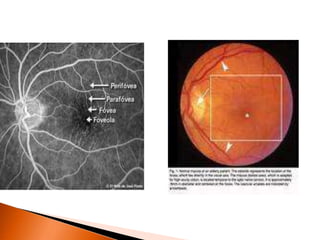
 Macula is a round area at the posterior pole
temporal to the optic disc 5.5mm in diameter.
 Recently term area centralis has been given to
this.
 It corresponds to 15 degrees of visual
field,photopic vision,colour vision.
 It is yellowish color derived from the presence
of xanthophyll pigment
 Fovea centralis is the central depressed part
of macula.1.85mm diameter,0.25 mm thick.
 Most sensitive part of retina.
Foveola forms the central part
Umbo is the tiny depression in the centre of
foveola
Foveal avascular zone is located inside the
fovea but outside the foveola.
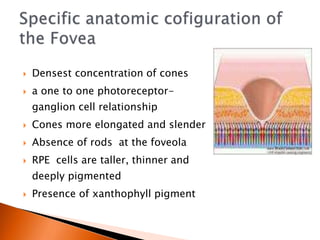
 Densest concentration of cones
 a one to one photoreceptor-
ganglion cell relationship
 Cones more elongated and slender
 Absence of rods at the foveola
 RPE cells are taller, thinner and
deeply pigmented
 Presence of xanthophyll pigment
This special anatomy enable the
fovea for:
 highest discriminative ability(VA)
 color perception
 Diagnosis and Follow up of macular diseases
 For evaluating the potential macular function
in eyes with opaque media such as cataract
and dense vitreous hemorrhage
Uses of macular function tests
Symptoms
• Central vision impairment
• Metamorphopsia
• Micropsia
• Macropsia
 Tests utilizing gross recognisation responses.
 Based on entoptic phenomenon
 Interference fringe techniques
 Based on hyperacuity
 Electrophysiological tests
 Direct visualisation & assessment of anatomic
integrity.
 Psycho physical tests
1. Visual acuity
2. Colour vision
3. Photostess test
4. Amslers grid test
5. Two point discrimination test
6. Entoptic imagery
7. Maddox rod test
8. Perinauds near vision chart testing
9. Self illuminated near vision chart
 Visual evoked potential
 Electro retinogram.
 Slitlamp examination.
 OCT
 Presence or absence of perception of light
 history
 They utilise gross recognisation response.
 A. Two light discrimination test:
 The ability to distinguish two illuminated
points of light 2mm diameter in size 2 inches
apart placed 2 feet away suggests good
functions.
 < or equal to 12.5cm- VA of HM/PL
 < or equal to 7.5cm-VA of CF to 6/60
 <5cm –VA >6/60
 Pinhole increases the depth of focus and
limits scattering effect of corneal scars,
lenticular opacities.
 In macular disorders pinhole worsens the
visual acuity.
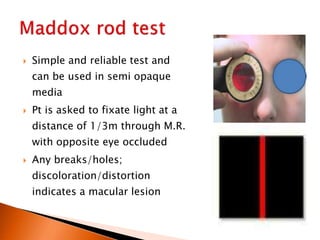
 Simple and reliable test and
can be used in semi opaque
media
 Pt is asked to fixate light at a
distance of 1/3m through M.R.
with opposite eye occluded
 Any breaks/holes;
discoloration/distortion
indicates a macular lesion
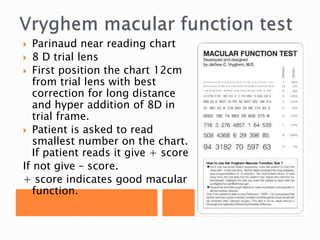
 Parinaud near reading chart
 8 D trial lens
 First position the chart 12cm
from trial lens with best
correction for long distance
and hyper addition of 8D in
trial frame.
 Patient is asked to read
smallest number on the chart.
If patient reads it give + score
If not give – score.
+ score indicates good macular
function.
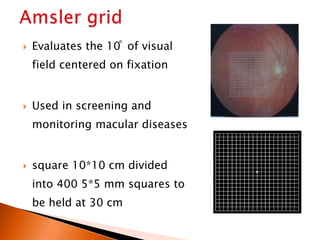
 Evaluates the 10 ̊ of visual
field centered on fixation
 Used in screening and
monitoring macular diseases
 square 10*10 cm divided
into 400 5*5 mm squares to
be held at 30 cm
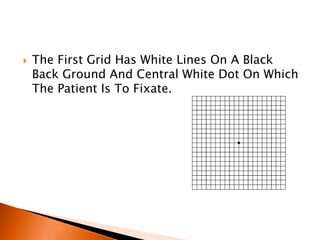
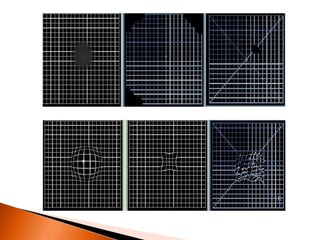
 The First Grid Has White Lines On A Black
Back Ground And Central White Dot On Which
The Patient Is To Fixate.
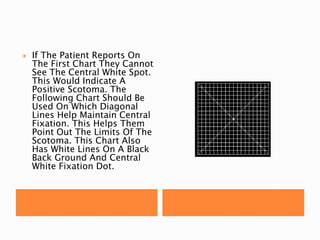
 If The Patient Reports On
The First Chart They Cannot
See The Central White Spot.
This Would Indicate A
Positive Scotoma. The
Following Chart Should Be
Used On Which Diagonal
Lines Help Maintain Central
Fixation. This Helps Them
Point Out The Limits Of The
Scotoma. This Chart Also
Has White Lines On A Black
Back Ground And Central
White Fixation Dot.
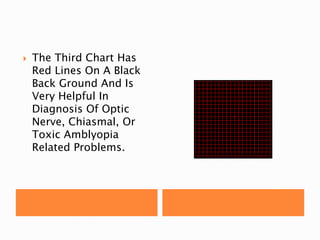
 The Third Chart Has
Red Lines On A Black
Back Ground And Is
Very Helpful In
Diagnosis Of Optic
Nerve, Chiasmal, Or
Toxic Amblyopia
Related Problems.
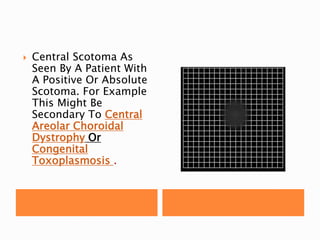
 Central Scotoma As
Seen By A Patient With
A Positive Or Absolute
Scotoma. For Example
This Might Be
Secondary To Central
Areolar Choroidal
Dystrophy Or
Congenital
Toxoplasmosis .
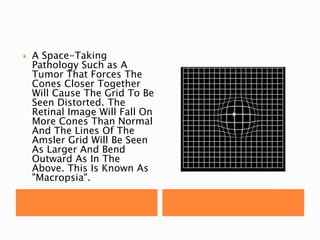
 A Space-Taking
Pathology Such as A
Tumor That Forces The
Cones Closer Together
Will Cause The Grid To Be
Seen Distorted. The
Retinal Image Will Fall On
More Cones Than Normal
And The Lines Of The
Amsler Grid Will Be Seen
As Larger And Bend
Outward As In The
Above. This Is Known As
"Macropsia".
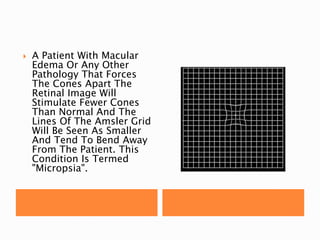
 A Patient With Macular
Edema Or Any Other
Pathology That Forces
The Cones Apart The
Retinal Image Will
Stimulate Fewer Cones
Than Normal And The
Lines Of The Amsler Grid
Will Be Seen As Smaller
And Tend To Bend Away
From The Patient. This
Condition Is Termed
"Micropsia".
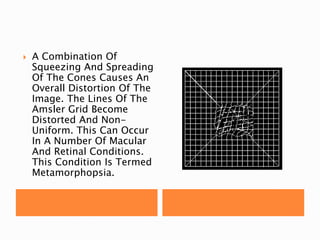
 A Combination Of
Squeezing And Spreading
Of The Cones Causes An
Overall Distortion Of The
Image. The Lines Of The
Amsler Grid Become
Distorted And Non-
Uniform. This Can Occur
In A Number Of Macular
And Retinal Conditions.
This Condition Is Termed
Metamorphopsia.
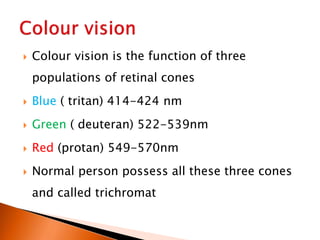
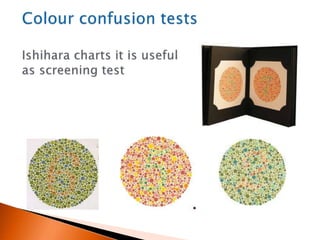
 Colour vision is the function of three
populations of retinal cones
 Blue ( tritan) 414-424 nm
 Green ( deuteran) 522-539nm
 Red (protan) 549-570nm
 Normal person possess all these three cones
and called trichromat
 Acquired macular diseases tends to produce
blue yellow defects and optic nerve lesions
red green defects
 Deutran anomaly is the most common and
those subjects can not differentiate between
red and green colours
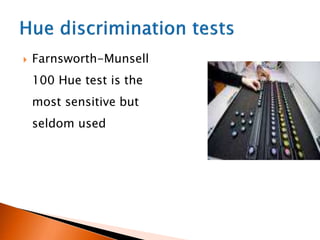
 Farnsworth-Munsell
100 Hue test is the
most sensitive but
seldom used
 It is refer to visual perceptions that have their
origin in the structure of an observer's eye.
 Three types are used for testing the macula in
opaque media
 1/ PURKINJE VASCULAR E.P
 2/ Flying spot( blue field entoptic phenomenon)
 3/Haidinger’s Brushes
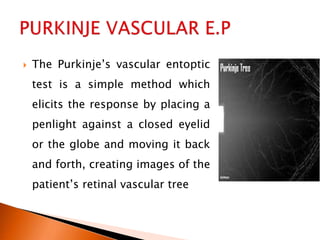
 The Purkinje’s vascular entoptic
test is a simple method which
elicits the response by placing a
penlight against a closed eyelid
or the globe and moving it back
and forth, creating images of the
patient’s retinal vascular tree
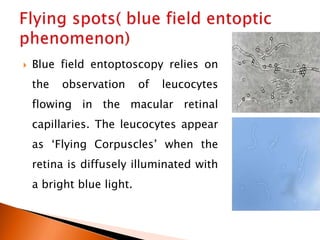
 Blue field entoptoscopy relies on
the observation of leucocytes
flowing in the macular retinal
capillaries. The leucocytes appear
as ‘Flying Corpuscles’ when the
retina is diffusely illuminated with
a bright blue light.
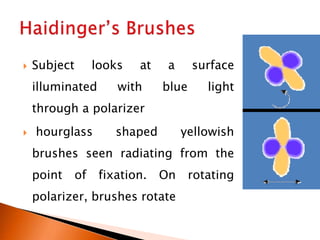
 Subject looks at a surface
illuminated with blue light
through a polarizer
 hourglass shaped yellowish
brushes seen radiating from the
point of fixation. On rotating
polarizer, brushes rotate
 Phenomenon caused by variations in
absorption of plane polarized light by
oriented molecules of xanthophyll
pigment in foveal retina
 Used to sensitize the fovea in
amblyopic child with eccentric fixation
 limited by the patient’s subjective
interpretation
 May yield false negatives if the retina cannot
be sufficiently illuminated through a dense
cataract
 Utilizes coherent white light or helium-neon
laser generated interference stripes or fringes
that are projected onto the retina through the
ocular media.
 Useful in mild to moderate media opacities.
 Principle: light interference.
 Projection of target directly on macula after
bypassing the opacities of media is done
 Since these are not the images in usual sense
they are not affected by ordinary optical
defects, defects of focus, and imperfections of
refraction what ever observer sees depends
only on the ability of retina to conduct signals
from photoreceptors into nervous system.
 1. subjective
 2. Laser fringe vision>vision of letter acuity.
 3. over predicts visual potential in amblyopes
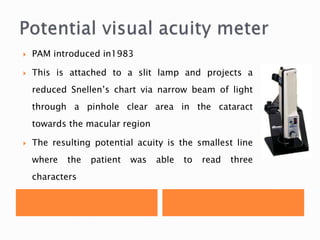
 PAM introduced in1983
 This is attached to a slit lamp and projects a
reduced Snellen’s chart via narrow beam of light
through a pinhole clear area in the cataract
towards the macular region
 The resulting potential acuity is the smallest line
where the patient was able to read three
characters
 Subjective
 methods that require an alert and cooperative
patient and skilled compassionate examiner
 But it is easier than laser interferometry
 Hyperacuity: visual performance that is a level
above achieved by measurement of visual
acuity.
 Physiological basis of use of hyperacuity as
macular function test is vernial hyperacuity is
highly dependent on retinal stimulus location
with lowest threshold being at macula.
 PHP relies on the concept of hyperacuity
which is the ability to discern a subtle
misalignment of an object.
 This can be explained by the fact that an
extended edge will stimulate an array of
cones and when there is a break in this line
the fovea can perceive it.
 Stereo acuity: detection of difference in depth
or distance of pair or more objects in space
 Vernial acuity: consists of targets like butting
vertical lines,2 dots or vertical lines separated
by gap, misalignment is to be recognised.
 Oscillatory displacement threshold: tasks
requires smallest change in position of
oscillating object, judged in relation to 2
stationary reference bars.
 These are objective
 Stimulus is presented and a response
parameter is measured by
electrophysiological means.
 One of the most effective modes for macular
function assesment in total media opacities.
 VEP Measure of the electrical potential
generated in response to a visual stimulus
 it represents integrity of entire visual pathway
from retina to occipital lobe so can not
differentiate between macula ,ON and cortical
pathology
 It measures the cortically evoked electrical
activity providing about integrity of optic
nerve and primary visual cortex.
 There is a large representation of macula in
occiptal cortex.
 Types: flash VEP & pattern VEP.
 Pattern VEP has a measure denoted as P100 a
positive wave at 100 milli sec.
 This wave occurs more than 100 milli sec
indicates delay due to optic nerve
demyelination.
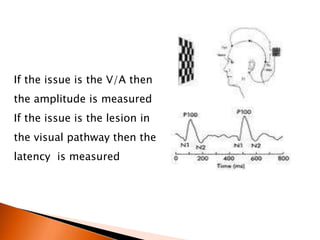
If the issue is the V/A then
the amplitude is measured
If the issue is the lesion in
the visual pathway then the
latency is measured
 ERG is only abnormal when a large area of
retina is functionally impaired
 Focal ERG needs a stimulus localized to one
area without scattering of light to stimulate
the rest of the retina
 This is the ERG response to a pattern
stimulus
 Luminance is constant but contrast reversing
of pattern is seen.
 N35,P50,P95 waves are analysed.
 This is abnormal in macular disorders
irrespective of peripheral retinal function.
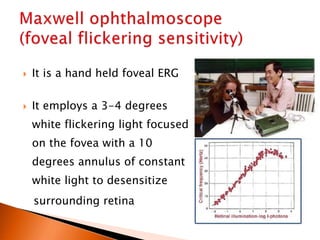
 It is a hand held foveal ERG
 It employs a 3-4 degrees
white flickering light focused
on the fovea with a 10
degrees annulus of constant
white light to desensitize
surrounding retina
 The luminance of flickering test light is
sinusoidally modulated i.e. it increases and
decreases in in a sinusoidal fashion above
and below the mean luminance.
 For each temporal frequency value the
threshold is the minimum modulation depth
at which detection of flicker occurs.
 The reciprocal of threshold is sensitivity.
 This is highly sensitive macular function test.
 It is a simple clinical test that can differntiate
between retinal (macular) & post retinal (optic
nerve disease)
 Introduced by bailliart in 1954.
 Principle:
 Basis of test is to utilise induced fatigue of
macula.
 It is a gross test of dark adaptation in which
visual pigments are bleached by light.
 Causes a temporary state of retinal
insensitivity perceived by patient as scotoma.
 Recovery of vision is dependent on ability of
photoreceptors to resynthesise visual
pigments.
 A) best corrected distance visual acuity is
determined.
 B) pt fixes light of pentorch held at 3cm away.
 C) photo stress recovery time:time taken to
read any 3 letter of pretest acuity line & is
normally between between 15 and 30 sec.
 Test is performed on other presumably
normal eye & results are compared.
 It is prolonged in relation to normal eye in
macular diseases (50 sec or more) but not in
optic neuropathy.
 Advantages:
 It is easiest to perform
 Opd procedure
 Gives fairly accurate results
 Doesn’t need expensive instruments.
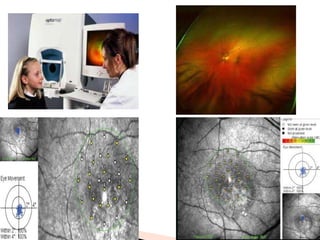
 The principle of microperimetry rests on the
possibility to see —in real time— the retina
under examination (by infrared light) and to
project a defined light stimulus over an
individual, selected location
 SLO microperimetry was the first technique
which allowed to obtain a fundus-related
sensitivity map
 SLO uses a near infrared diode laser
(675nm)beam that rapidly scan the posterior
pole.
 The reflected light is detected by a confocal
photodiode and the digitized image is stored in
a computer
 SLO fundus perimeter did not allow to
perform fully automatic examination.
 Moreover, automatic follow-up examination
to evaluate exactly the same retinal points
tested during baseline microperimetry was
not available with this instrument.
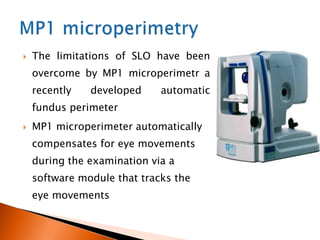
 The limitations of SLO have been
overcome by MP1 microperimetr a
recently developed automatic
fundus perimeter
 MP1 microperimeter automatically
compensates for eye movements
during the examination via a
software module that tracks the
eye movements
 To know the anatomical integrity of macula.
 Can perform cross sectional images of biological
tissues within less than 10micron resolution.
 OCT scan protocols in macula:
1. Line scan
2. Radial line
3. Macular thickness map
4. Fast macular thickness map
5. Raster lines
6. Macular scan
 Evaluation of the macular function of a
patient with opaque media is a challenging
problem commonly faced by us
 No single test is infallible
Macularfunctiontests seminar

Macularfunctiontests seminar

  • 1.
  • 2.
     Macula isa round area at the posterior pole temporal to the optic disc 5.5mm in diameter.  Recently term area centralis has been given to this.  It corresponds to 15 degrees of visual field,photopic vision,colour vision.  It is yellowish color derived from the presence of xanthophyll pigment
  • 3.
     Fovea centralisis the central depressed part of macula.1.85mm diameter,0.25 mm thick.  Most sensitive part of retina. Foveola forms the central part Umbo is the tiny depression in the centre of foveola Foveal avascular zone is located inside the fovea but outside the foveola.
  • 5.
     Densest concentrationof cones  a one to one photoreceptor- ganglion cell relationship  Cones more elongated and slender  Absence of rods at the foveola  RPE cells are taller, thinner and deeply pigmented  Presence of xanthophyll pigment
  • 6.
    This special anatomyenable the fovea for:  highest discriminative ability(VA)  color perception
  • 7.
     Diagnosis andFollow up of macular diseases  For evaluating the potential macular function in eyes with opaque media such as cataract and dense vitreous hemorrhage Uses of macular function tests
  • 8.
    Symptoms • Central visionimpairment • Metamorphopsia • Micropsia • Macropsia
  • 9.
     Tests utilizinggross recognisation responses.  Based on entoptic phenomenon  Interference fringe techniques  Based on hyperacuity  Electrophysiological tests  Direct visualisation & assessment of anatomic integrity.
  • 10.
     Psycho physicaltests 1. Visual acuity 2. Colour vision 3. Photostess test 4. Amslers grid test 5. Two point discrimination test 6. Entoptic imagery 7. Maddox rod test 8. Perinauds near vision chart testing 9. Self illuminated near vision chart
  • 11.
     Visual evokedpotential  Electro retinogram.
  • 12.
     Slitlamp examination. OCT  Presence or absence of perception of light  history
  • 13.
     They utilisegross recognisation response.  A. Two light discrimination test:  The ability to distinguish two illuminated points of light 2mm diameter in size 2 inches apart placed 2 feet away suggests good functions.  < or equal to 12.5cm- VA of HM/PL  < or equal to 7.5cm-VA of CF to 6/60  <5cm –VA >6/60
  • 14.
     Pinhole increasesthe depth of focus and limits scattering effect of corneal scars, lenticular opacities.  In macular disorders pinhole worsens the visual acuity.
  • 15.
     Simple andreliable test and can be used in semi opaque media  Pt is asked to fixate light at a distance of 1/3m through M.R. with opposite eye occluded  Any breaks/holes; discoloration/distortion indicates a macular lesion
  • 16.
     Parinaud nearreading chart  8 D trial lens  First position the chart 12cm from trial lens with best correction for long distance and hyper addition of 8D in trial frame.  Patient is asked to read smallest number on the chart. If patient reads it give + score If not give – score. + score indicates good macular function.
  • 17.
     Evaluates the10 ̊ of visual field centered on fixation  Used in screening and monitoring macular diseases  square 10*10 cm divided into 400 5*5 mm squares to be held at 30 cm
  • 18.
     The FirstGrid Has White Lines On A Black Back Ground And Central White Dot On Which The Patient Is To Fixate.
  • 19.
     If ThePatient Reports On The First Chart They Cannot See The Central White Spot. This Would Indicate A Positive Scotoma. The Following Chart Should Be Used On Which Diagonal Lines Help Maintain Central Fixation. This Helps Them Point Out The Limits Of The Scotoma. This Chart Also Has White Lines On A Black Back Ground And Central White Fixation Dot.
  • 20.
     The ThirdChart Has Red Lines On A Black Back Ground And Is Very Helpful In Diagnosis Of Optic Nerve, Chiasmal, Or Toxic Amblyopia Related Problems.
  • 21.
     Central ScotomaAs Seen By A Patient With A Positive Or Absolute Scotoma. For Example This Might Be Secondary To Central Areolar Choroidal Dystrophy Or Congenital Toxoplasmosis .
  • 22.
     A Space-Taking PathologySuch as A Tumor That Forces The Cones Closer Together Will Cause The Grid To Be Seen Distorted. The Retinal Image Will Fall On More Cones Than Normal And The Lines Of The Amsler Grid Will Be Seen As Larger And Bend Outward As In The Above. This Is Known As "Macropsia".
  • 23.
     A PatientWith Macular Edema Or Any Other Pathology That Forces The Cones Apart The Retinal Image Will Stimulate Fewer Cones Than Normal And The Lines Of The Amsler Grid Will Be Seen As Smaller And Tend To Bend Away From The Patient. This Condition Is Termed "Micropsia".
  • 24.
     A CombinationOf Squeezing And Spreading Of The Cones Causes An Overall Distortion Of The Image. The Lines Of The Amsler Grid Become Distorted And Non- Uniform. This Can Occur In A Number Of Macular And Retinal Conditions. This Condition Is Termed Metamorphopsia.
  • 26.
     Colour visionis the function of three populations of retinal cones  Blue ( tritan) 414-424 nm  Green ( deuteran) 522-539nm  Red (protan) 549-570nm  Normal person possess all these three cones and called trichromat
  • 27.
     Acquired maculardiseases tends to produce blue yellow defects and optic nerve lesions red green defects  Deutran anomaly is the most common and those subjects can not differentiate between red and green colours
  • 29.
     Farnsworth-Munsell 100 Huetest is the most sensitive but seldom used
  • 30.
     It isrefer to visual perceptions that have their origin in the structure of an observer's eye.  Three types are used for testing the macula in opaque media  1/ PURKINJE VASCULAR E.P  2/ Flying spot( blue field entoptic phenomenon)  3/Haidinger’s Brushes
  • 31.
     The Purkinje’svascular entoptic test is a simple method which elicits the response by placing a penlight against a closed eyelid or the globe and moving it back and forth, creating images of the patient’s retinal vascular tree
  • 32.
     Blue fieldentoptoscopy relies on the observation of leucocytes flowing in the macular retinal capillaries. The leucocytes appear as ‘Flying Corpuscles’ when the retina is diffusely illuminated with a bright blue light.
  • 33.
     Subject looksat a surface illuminated with blue light through a polarizer  hourglass shaped yellowish brushes seen radiating from the point of fixation. On rotating polarizer, brushes rotate
  • 34.
     Phenomenon causedby variations in absorption of plane polarized light by oriented molecules of xanthophyll pigment in foveal retina  Used to sensitize the fovea in amblyopic child with eccentric fixation
  • 35.
     limited bythe patient’s subjective interpretation  May yield false negatives if the retina cannot be sufficiently illuminated through a dense cataract
  • 36.
     Utilizes coherentwhite light or helium-neon laser generated interference stripes or fringes that are projected onto the retina through the ocular media.  Useful in mild to moderate media opacities.  Principle: light interference.
  • 37.
     Projection oftarget directly on macula after bypassing the opacities of media is done  Since these are not the images in usual sense they are not affected by ordinary optical defects, defects of focus, and imperfections of refraction what ever observer sees depends only on the ability of retina to conduct signals from photoreceptors into nervous system.
  • 38.
     1. subjective 2. Laser fringe vision>vision of letter acuity.  3. over predicts visual potential in amblyopes
  • 39.
     PAM introducedin1983  This is attached to a slit lamp and projects a reduced Snellen’s chart via narrow beam of light through a pinhole clear area in the cataract towards the macular region  The resulting potential acuity is the smallest line where the patient was able to read three characters
  • 40.
     Subjective  methodsthat require an alert and cooperative patient and skilled compassionate examiner  But it is easier than laser interferometry
  • 41.
     Hyperacuity: visualperformance that is a level above achieved by measurement of visual acuity.  Physiological basis of use of hyperacuity as macular function test is vernial hyperacuity is highly dependent on retinal stimulus location with lowest threshold being at macula.
  • 42.
     PHP relieson the concept of hyperacuity which is the ability to discern a subtle misalignment of an object.  This can be explained by the fact that an extended edge will stimulate an array of cones and when there is a break in this line the fovea can perceive it.
  • 43.
     Stereo acuity:detection of difference in depth or distance of pair or more objects in space  Vernial acuity: consists of targets like butting vertical lines,2 dots or vertical lines separated by gap, misalignment is to be recognised.  Oscillatory displacement threshold: tasks requires smallest change in position of oscillating object, judged in relation to 2 stationary reference bars.
  • 44.
     These areobjective  Stimulus is presented and a response parameter is measured by electrophysiological means.  One of the most effective modes for macular function assesment in total media opacities.
  • 45.
     VEP Measureof the electrical potential generated in response to a visual stimulus  it represents integrity of entire visual pathway from retina to occipital lobe so can not differentiate between macula ,ON and cortical pathology
  • 46.
     It measuresthe cortically evoked electrical activity providing about integrity of optic nerve and primary visual cortex.  There is a large representation of macula in occiptal cortex.  Types: flash VEP & pattern VEP.  Pattern VEP has a measure denoted as P100 a positive wave at 100 milli sec.  This wave occurs more than 100 milli sec indicates delay due to optic nerve demyelination.
  • 47.
    If the issueis the V/A then the amplitude is measured If the issue is the lesion in the visual pathway then the latency is measured
  • 48.
     ERG isonly abnormal when a large area of retina is functionally impaired  Focal ERG needs a stimulus localized to one area without scattering of light to stimulate the rest of the retina
  • 49.
     This isthe ERG response to a pattern stimulus  Luminance is constant but contrast reversing of pattern is seen.  N35,P50,P95 waves are analysed.  This is abnormal in macular disorders irrespective of peripheral retinal function.
  • 50.
     It isa hand held foveal ERG  It employs a 3-4 degrees white flickering light focused on the fovea with a 10 degrees annulus of constant white light to desensitize surrounding retina
  • 51.
     The luminanceof flickering test light is sinusoidally modulated i.e. it increases and decreases in in a sinusoidal fashion above and below the mean luminance.
  • 52.
     For eachtemporal frequency value the threshold is the minimum modulation depth at which detection of flicker occurs.  The reciprocal of threshold is sensitivity.  This is highly sensitive macular function test.
  • 53.
     It isa simple clinical test that can differntiate between retinal (macular) & post retinal (optic nerve disease)  Introduced by bailliart in 1954.
  • 54.
     Principle:  Basisof test is to utilise induced fatigue of macula.  It is a gross test of dark adaptation in which visual pigments are bleached by light.  Causes a temporary state of retinal insensitivity perceived by patient as scotoma.  Recovery of vision is dependent on ability of photoreceptors to resynthesise visual pigments.
  • 55.
     A) bestcorrected distance visual acuity is determined.  B) pt fixes light of pentorch held at 3cm away.  C) photo stress recovery time:time taken to read any 3 letter of pretest acuity line & is normally between between 15 and 30 sec.  Test is performed on other presumably normal eye & results are compared.  It is prolonged in relation to normal eye in macular diseases (50 sec or more) but not in optic neuropathy.
  • 56.
     Advantages:  Itis easiest to perform  Opd procedure  Gives fairly accurate results  Doesn’t need expensive instruments.
  • 57.
     The principleof microperimetry rests on the possibility to see —in real time— the retina under examination (by infrared light) and to project a defined light stimulus over an individual, selected location
  • 58.
     SLO microperimetrywas the first technique which allowed to obtain a fundus-related sensitivity map  SLO uses a near infrared diode laser (675nm)beam that rapidly scan the posterior pole.  The reflected light is detected by a confocal photodiode and the digitized image is stored in a computer
  • 60.
     SLO fundusperimeter did not allow to perform fully automatic examination.  Moreover, automatic follow-up examination to evaluate exactly the same retinal points tested during baseline microperimetry was not available with this instrument.
  • 61.
     The limitationsof SLO have been overcome by MP1 microperimetr a recently developed automatic fundus perimeter  MP1 microperimeter automatically compensates for eye movements during the examination via a software module that tracks the eye movements
  • 62.
     To knowthe anatomical integrity of macula.  Can perform cross sectional images of biological tissues within less than 10micron resolution.  OCT scan protocols in macula: 1. Line scan 2. Radial line 3. Macular thickness map 4. Fast macular thickness map 5. Raster lines 6. Macular scan
  • 63.
     Evaluation ofthe macular function of a patient with opaque media is a challenging problem commonly faced by us  No single test is infallible