Learning Objectives
1. Lightand it’s properties relevant to optics
2. How to assess visual acuity and color vision
3.
Electromagnetic Spectrum
• Light/Electromagneticwaves are radiations in which charged
particles move.
• Can be thought of as waves or particles called photons travelliing
through different media.
•The colour ofany object is determined by the wavelengths
emitted or reflected from the surface.
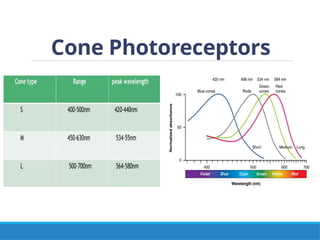
•A congenital colour vision defect occurs if a cone pigment is
absent or if there is a shift in its spectral sensitivity.
•Deuteranopia, protanopia and tritanopia indicate absence of
green, red and blue cone function.
•Deuteranomaly, protanomaly and tritanomaly indicate a shift
in the corresponding cone sensitivity.
Color vision
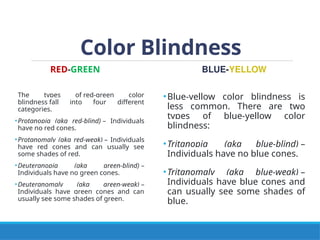
RED-GREEN
The types ofred-green color
blindness fall into four different
categories.
•Protanopia (aka red-blind) – Individuals
have no red cones.
•Protanomaly (aka red-weak) – Individuals
have red cones and can usually see
some shades of red.
•Deuteranopia (aka green-blind) –
Individuals have no green cones.
•Deuteranomaly (aka green-weak) –
Individuals have green cones and can
usually see some shades of green.
BLUE-YELLOW
•Blue-yellow color blindness is
less common. There are two
types of blue-yellow color
blindness:
•Tritanopia (aka blue-blind) –
Individuals have no blue cones.
•Tritanomaly (aka blue-weak) –
Individuals have blue cones and
can usually see some shades of
blue.
Color Blindness
9.
Clinical testing ofcolor vision
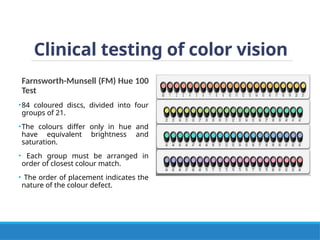
Farnsworth-Munsell (FM) Hue 100
Test
•84 coloured discs, divided into four
groups of 21.
•The colours differ only in hue and
have equivalent brightness and
saturation.
• Each group must be arranged in
order of closest colour match.
• The order of placement indicates the
nature of the colour defect.
10.
D-15 Test
•Uses coloursfrom all parts of the spectrum
•Colors must be arranged in order from a
single reference colour.
•The test does not distinguish mild colour
defects.
Lanthony New Color Test
•Tests hue discrimination and can be used by
children.
Clinical testing of color vision
11.
Ishihara Pseudoisochromatic TestPlates.
•Mainly detection of red–green color deficiencies.
•38,24,14 or 10 pseudoisochromatic plates.
Clinical testing of color vision
12.
Fluorescence
•Fluorescence is theproperty of a molecule to
spontaneously emit light of a longer wavelength
when stimulated by light of a shorter
wavelength.
•For example, the orange dye fluorescein sodium
when excited by blue light (465–490 nm) emits
yellow–green light (520–530 nm) .
•Indocyanine green (ICG) dye is a fluorescent
substance which absorbs 805 nm and emits 835
nm infrared radiation.
Filter system for fundus fluorescein angiography.
13.
Wave theory oflight
Light leaving a point source. (a) Light represented as rays; (b) light
represented as waves; (c) light represented as wave fronts.
14.
Wave motion: phasedifference.
Wave motion
Light waves that are out of phase are called incoherent, while light composed of waves
exactly in phase is termed coherent.
Wave theory of light
Diffraction
The intensity ofthe light falling on zone AB is reduced to some
extent by interference between the primary and secondary waves.
The light falling on zone BC is derived from secondary waves
alone and is of much lower intensity.
When light passes through a circular aperture, a circular
diffraction pattern is produced. This consists of a bright
central disc surrounded by alternate dark and light rings. The
central bright zone is known as the Airy disc.
17.
Resolving power -acuity
•Resolving power refers to the smallest angle of
separation (w) between two points which
allows the formation of two discernible images
by an optical system.
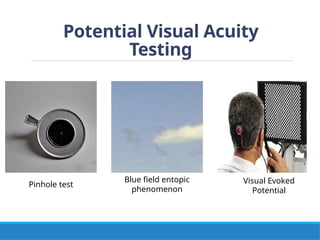
VA testing inchildren
•Fixation behavior and testing – Central, steady and
maintained (CSM).
•Fixation preference – black and white grating presented
with plain and preferential looking recorded e.g Lea’s
gratings.
•Visually directed reaching develops between 2 and 5
months of age
•Visual Evoked Potential - measure of cortical activity
generated in response to stimulus, checker board or
square wave grating. In young children flash or patterned
VEP can also be used to record the visual acuity. VA of 6/6
(20/20) is achieved in VEP by 6-12 months of age.
20.
VA testing inchildren
Catford drum test
• It is an objective method to evaluate the objective visual acuity
by inducing optokinetic nystagmus.
• The motor driven drum consist of separated black dots of
various sizes on a white background projected through a
screen measuring 4*6 cm.
• These dots can be rotated from left to right and then back
from right to left in a rotating manner.
• The visual acuity is assessed by reducing the size of the dot
until the smallest dot is found that can no longer induce
optokinetic nystagmus.
• The end point is converted to given Snellen's equivalent.
• The drum has been calibrated between the visual acuity of
20/20 to 20/600 of Snellen's acuity based on the dot size at 60
cm.
21.
VA testing inchildren
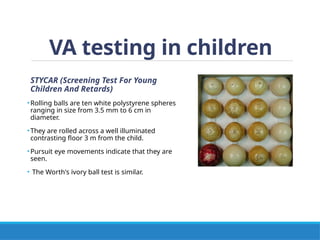
STYCAR (Screening Test For Young
Children And Retards)
•Rolling balls are ten white polystyrene spheres
ranging in size from 3.5 mm to 6 cm in
diameter.
•They are rolled across a well illuminated
contrasting floor 3 m from the child.
•Pursuit eye movements indicate that they are
seen.
• The Worth's ivory ball test is similar.
22.
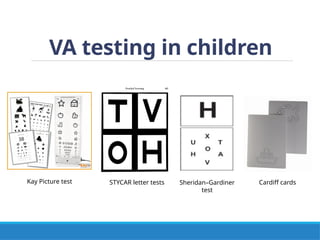
VA testing inchildren
Kay Picture test STYCAR letter tests Sheridan–Gardiner
test
Cardiff cards
23.
Snellen Visual Acuity
Thetest is based on the theory that the
smallest object which can be resolved by the
eye subtends the same visual angle at the
nodal point of the eye as a cone
photoreceptor, i.e. one minute of arc.
24.
LogMAR Visual AcuityCharts
More precise than the Snellen test because
they have a regular progression in the size
and spacing of the letters from one line to
the next and the same number of letters
on every line (e.g. the Bailey–Lovie test).
25.
Near Visual AcuityTesting
• Done at a distance of 25–33 cm
• Near acuity charts usually comprise unrelated words or
passages of text.
• The British N uses letters each of which is equal to 1/72
inch and blocks are sized in multiples of this, e.g. the
blocks bearing N5 letters measure 5/72 inches in height.
• Times Roman is used as the standard
• Jaeger text types are a less satisfactory alternative
because they do not follow a logical progression in size.
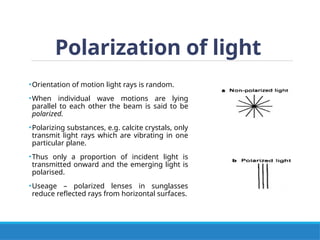
Polarization of light
•Orientationof motion light rays is random.
•When individual wave motions are lying
parallel to each other the beam is said to be
polarized.
•Polarizing substances, e.g. calcite crystals, only
transmit light rays which are vibrating in one
particular plane.
•Thus only a proportion of incident light is
transmitted onward and the emerging light is
polarised.
•Useage – polarized lenses in sunglasses
reduce reflected rays from horizontal surfaces.
29.
Birefringence
•Some substances havea molecular structure which
transmits light waves lying parallel to its structure but
which selectively slows and therefore redirects light waves
vibrating in a plane perpendicular to its structure.
•Crystals of quartz have this property, which is known as
birefringence.
•Because they split incident unpolarised light into two
polarised beams travelling in different directions, they
have two refractive indices.
•Useage - identify crystals in gout/hyperurecemia based on
birefringence patterns.
30.
Dichroism
•The molecular structureof dichroic
substances completely blocks transmission
of light waves not aligned with its structure
by absorption.
•Thus, only one beam of polarised light
emerges, much weakened in intensity
compared with the incident non-polarised
light.
•Useage- Tourmaline and polaroid (the latter
made from fine iodine and quinine sulphate
crystals embedded in plastic) are dichroic
substances, polaroid being commonly used
in sunglasses.
31.
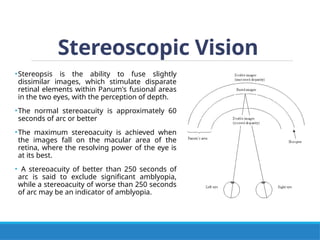
Stereoscopic Vision
•Stereopsis isthe ability to fuse slightly
dissimilar images, which stimulate disparate
retinal elements within Panum's fusional areas
in the two eyes, with the perception of depth.
•The normal stereoacuity is approximately 60
seconds of arc or better
•The maximum stereoacuity is achieved when
the images fall on the macular area of the
retina, where the resolving power of the eye is
at its best.
• A stereoacuity of better than 250 seconds of
arc is said to exclude significant amblyopia,
while a stereoacuity of worse than 250 seconds
of arc may be an indicator of amblyopia.
32.
Clinical tests ofstereoacuity
Titmus test with Wirt Fly plate Frisby test Lang stereotest TNO test
33.
Radiometry and Photometry
•Radiometryquantifies radiant energy in all parts of the
electromagnetic spectrum.
•Radiometry measures light in terms of how much is emitted from a
source (radiant flux), its intensity (radiant intensity) and the amount
falling on a surface (irradiance) or reflected from it (radiance).
•Photometry quantifies part of the spectrum in terms of the visual
response it produces.
•Measurements are luminous flux, luminous intensity, illuminance
and luminance
•The peak photopic sensitivity of the eye is to the wavelength of 555
nm (yellow–green), the eye is progressively less sensitive to
wavelengths towards each end of the visible spectrum.
34.
• The totalflow of light emitted in all directions from a source is termed either the radiant flux, if
measured in watts, or luminous flux, if measured in lumens
• Intensity of light emitted from a source is a measurement of the flow of light per unit solid
angle of space extending away from it. It is called either the radiant intensity if measured in
watts per steradian or luminous intensity if measured in candelas (lumens per steradian).
• A steradian is the unit of solid angle (resembling a cone) and defined as the angle at the centre
of a sphere which subtends an area on the surface of the sphere measuring the square of the
radius (r).
• When radiant flux is incident on a surface, the surface is said to be irradiated. The flux incident
per unit area at any point is called irradiance and is measured in watts per square metre.
• The photometric equivalent of irradiance is illuminance, which measures the luminous flux
incident on an illuminated surface. The unit of illuminance is the lux (lumen per square metre).
Radiometry and Photometry
35.
•The luminance atany point on the surface is defined as the luminous
intensity per unit projected area in a given direction. Luminance is
measured in candelas per square metre
•The radiometric equivalent, radiance, is measured in watts per
steradian per square metre.
•Candela measures light reflected or emitted in only one direction
and not the total amount leaving the surface in all directions.
•A luminous flux of one lumen per square metre corresponds to a
luminance of one apostilb.
Radiometry and Photometry
Take home message
•Lightis a part of electromagnetic spectrum
•Various properties of light are used in different ways to
assess, diagnose and treat ocular conditions.
•Color vision and visual acuity may be check in a number of
reliable and standardized ways.