Section 4-4
Proving Congruence: SSS, SAS
Essential Questions
How do you use the SSS Postulate to test for triangle
congruence?
How do you use the SAS Postulate to test for triangle
congruence?
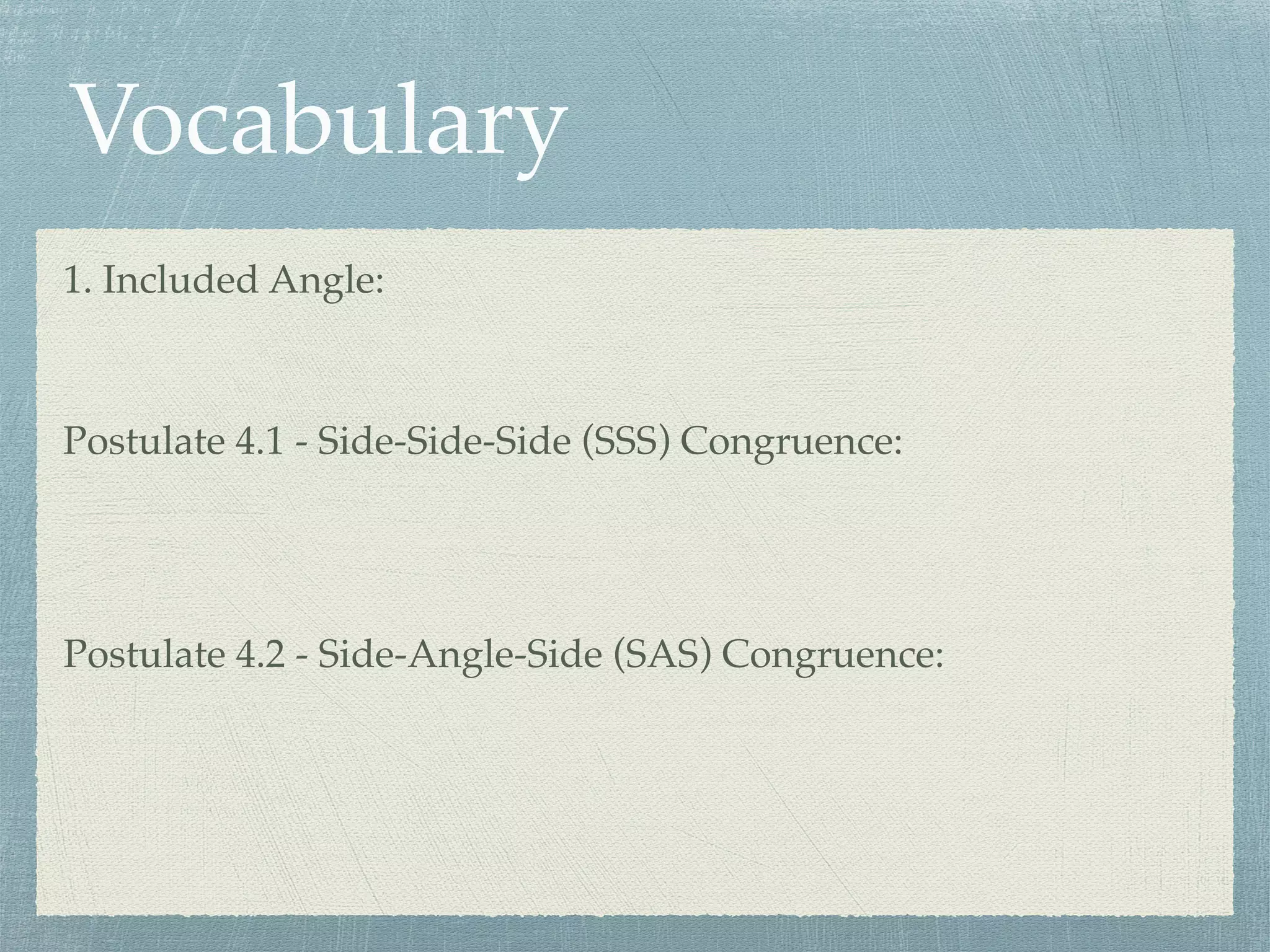
Vocabulary
1. Included Angle:
Postulate 4.1 - Side-Side-Side (SSS) Congruence:
Postulate 4.2 - Side-Angle-Side (SAS) Congruence:
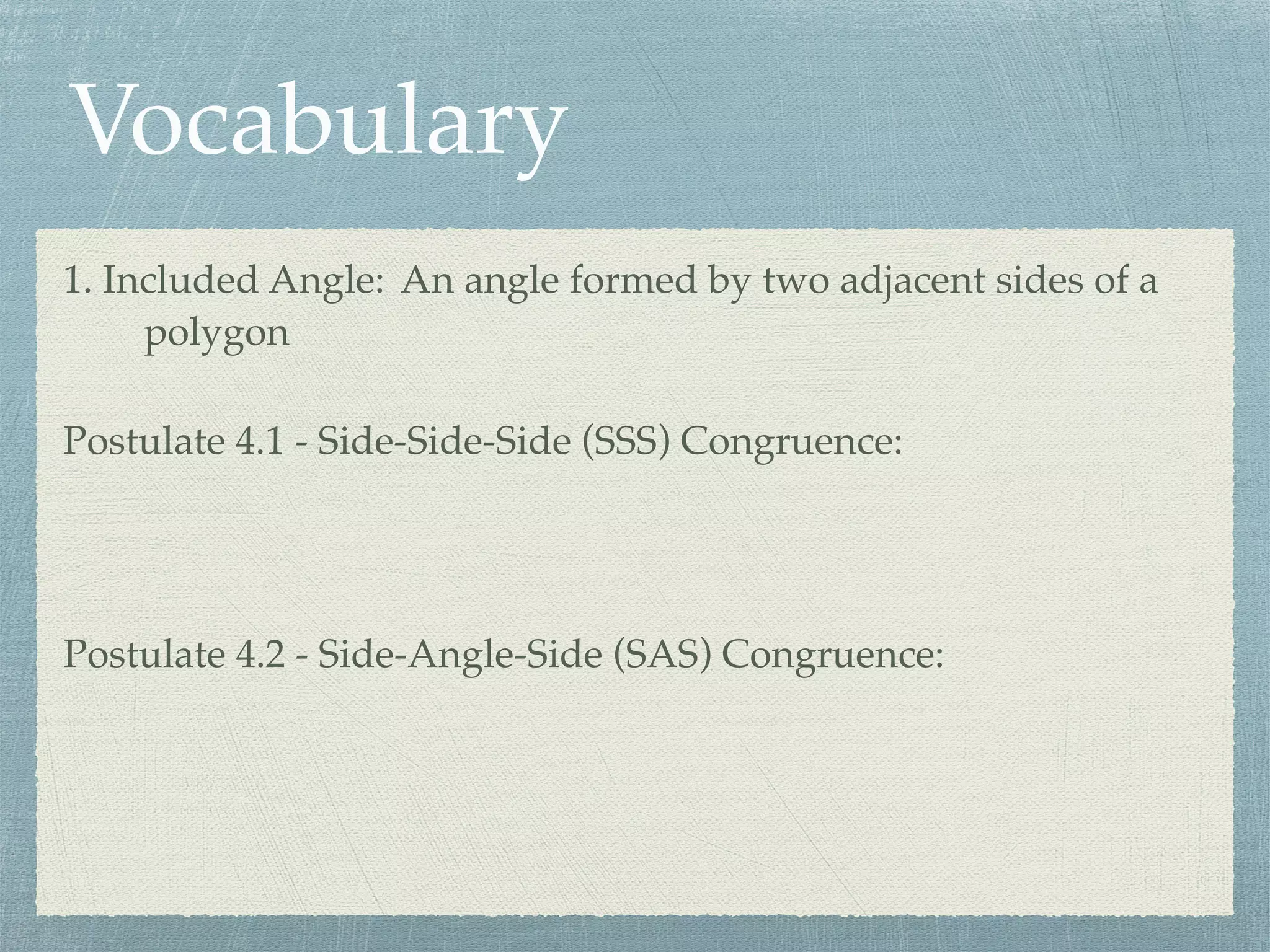
Vocabulary
1. Included Angle: An angle formed by two adjacent sides of a
polygon
Postulate 4.1 - Side-Side-Side (SSS) Congruence:
Postulate 4.2 - Side-Angle-Side (SAS) Congruence:
Vocabulary
1. Included Angle: An angle formed by two adjacent sides of a
polygon
Postulate 4.1 - Side-Side-Side (SSS) Congruence: If three sides
of one triangle are congruent to three corresponding sides of
a second, then the triangles are congruent
Postulate 4.2 - Side-Angle-Side (SAS) Congruence:
Vocabulary
1. Included Angle: An angle formed by two adjacent sides of a
polygon
Postulate 4.1 - Side-Side-Side (SSS) Congruence: If three sides
of one triangle are congruent to three corresponding sides of
a second, then the triangles are congruent
Postulate 4.2 - Side-Angle-Side (SAS) Congruence: If two sides
and the included angle of one triangle are congruent to two
corresponding sides and included angle of a second triangle,
then the triangles are congruent
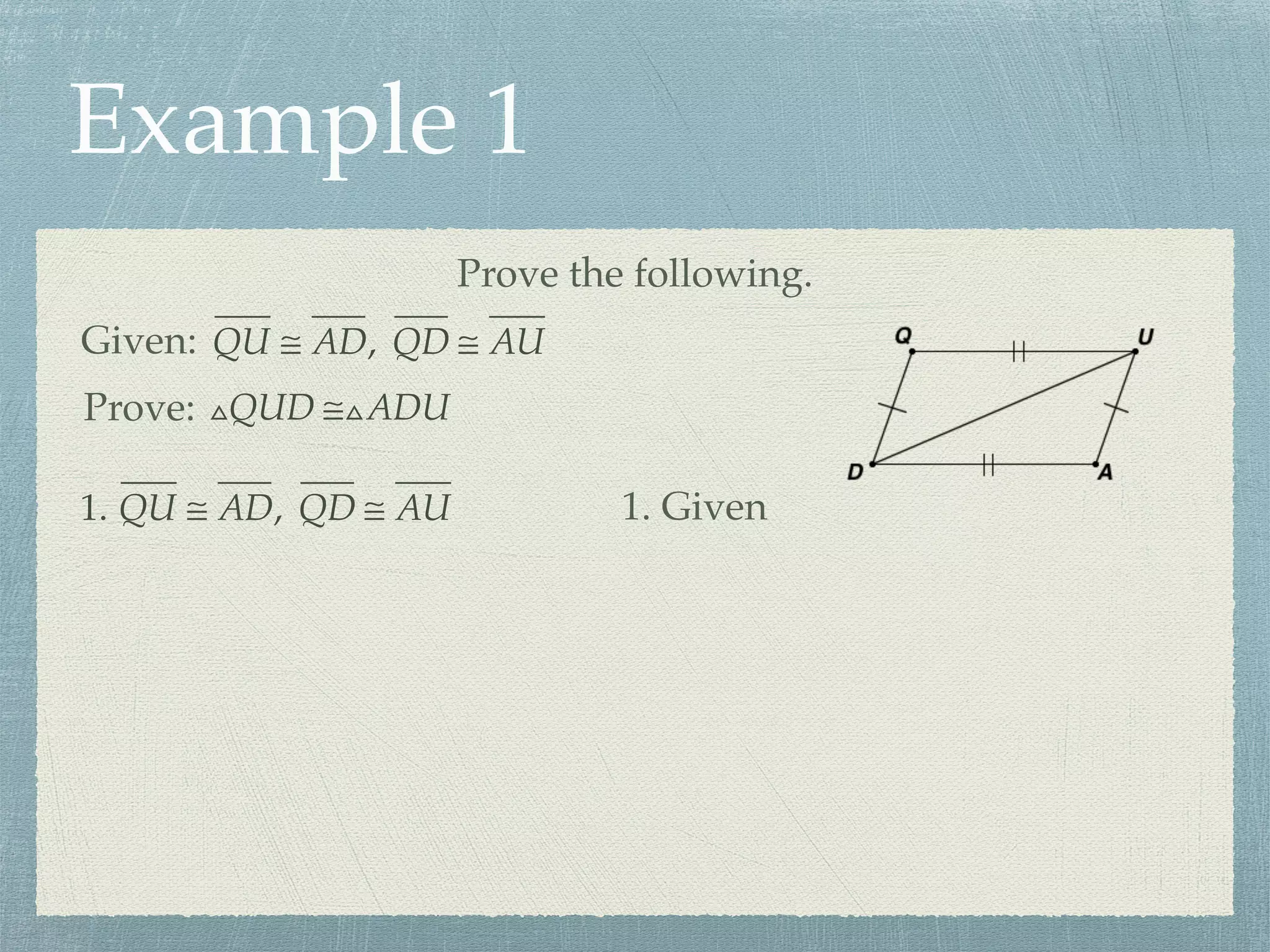
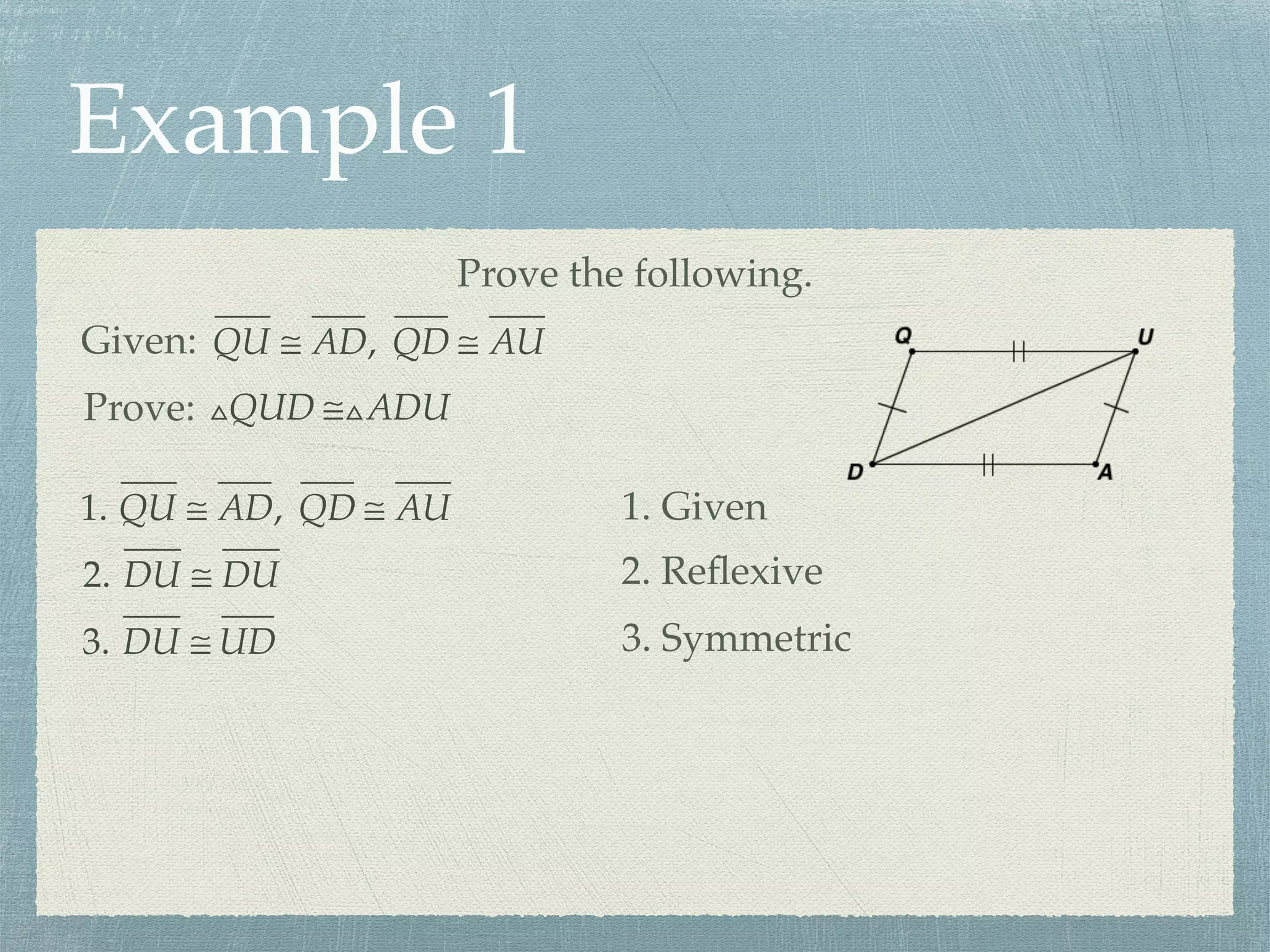
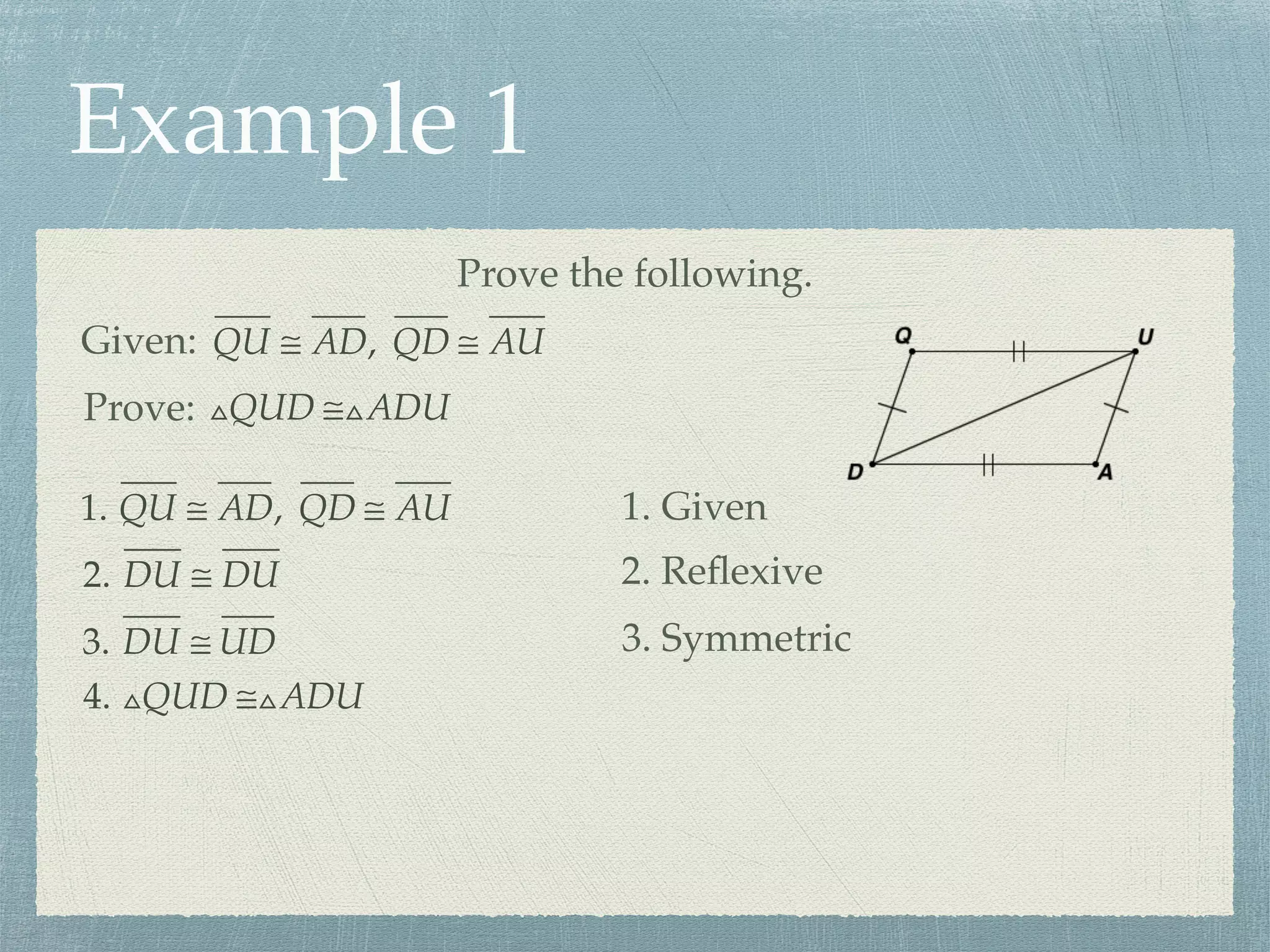
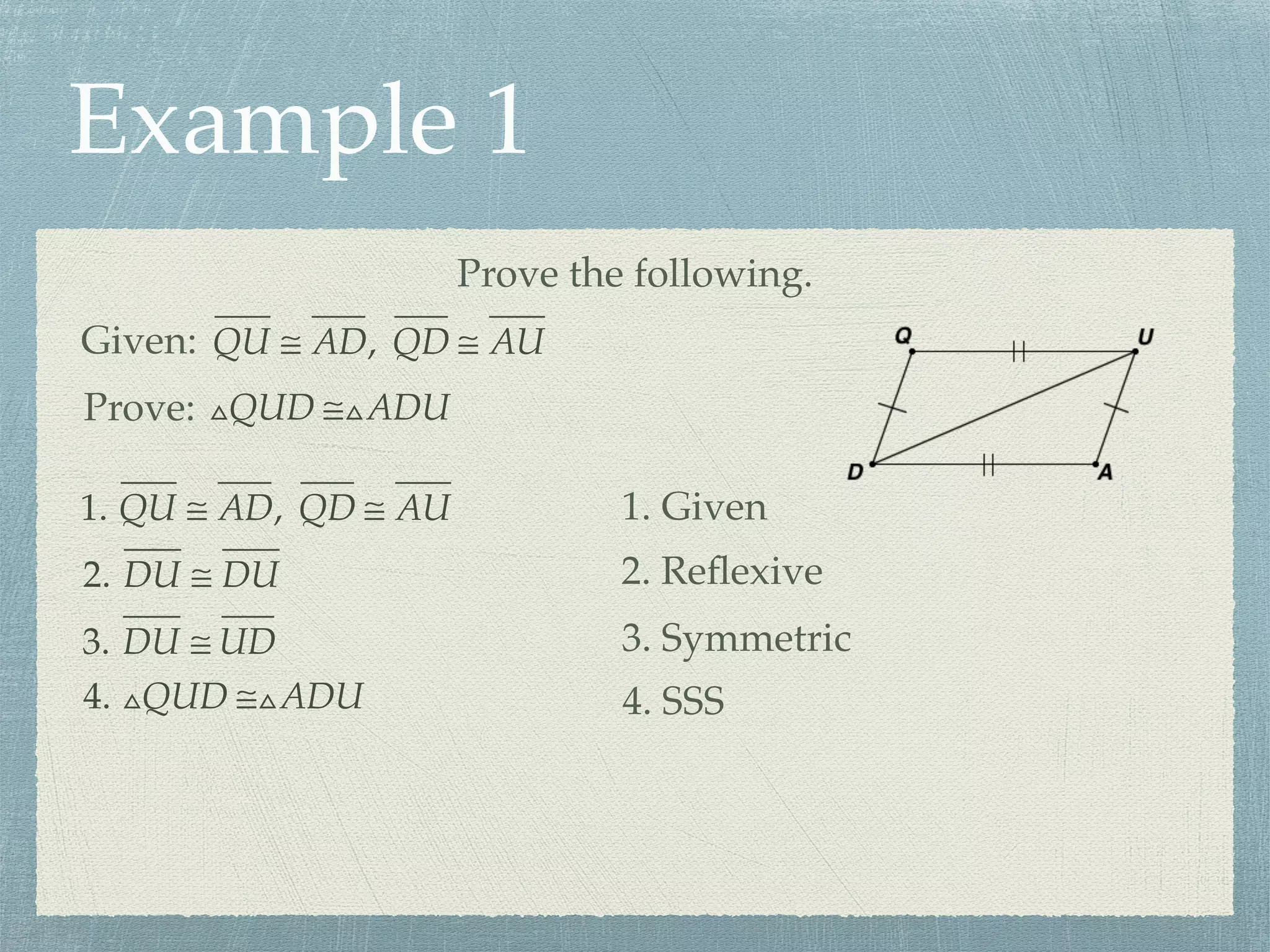
Example 1
Prove the following.
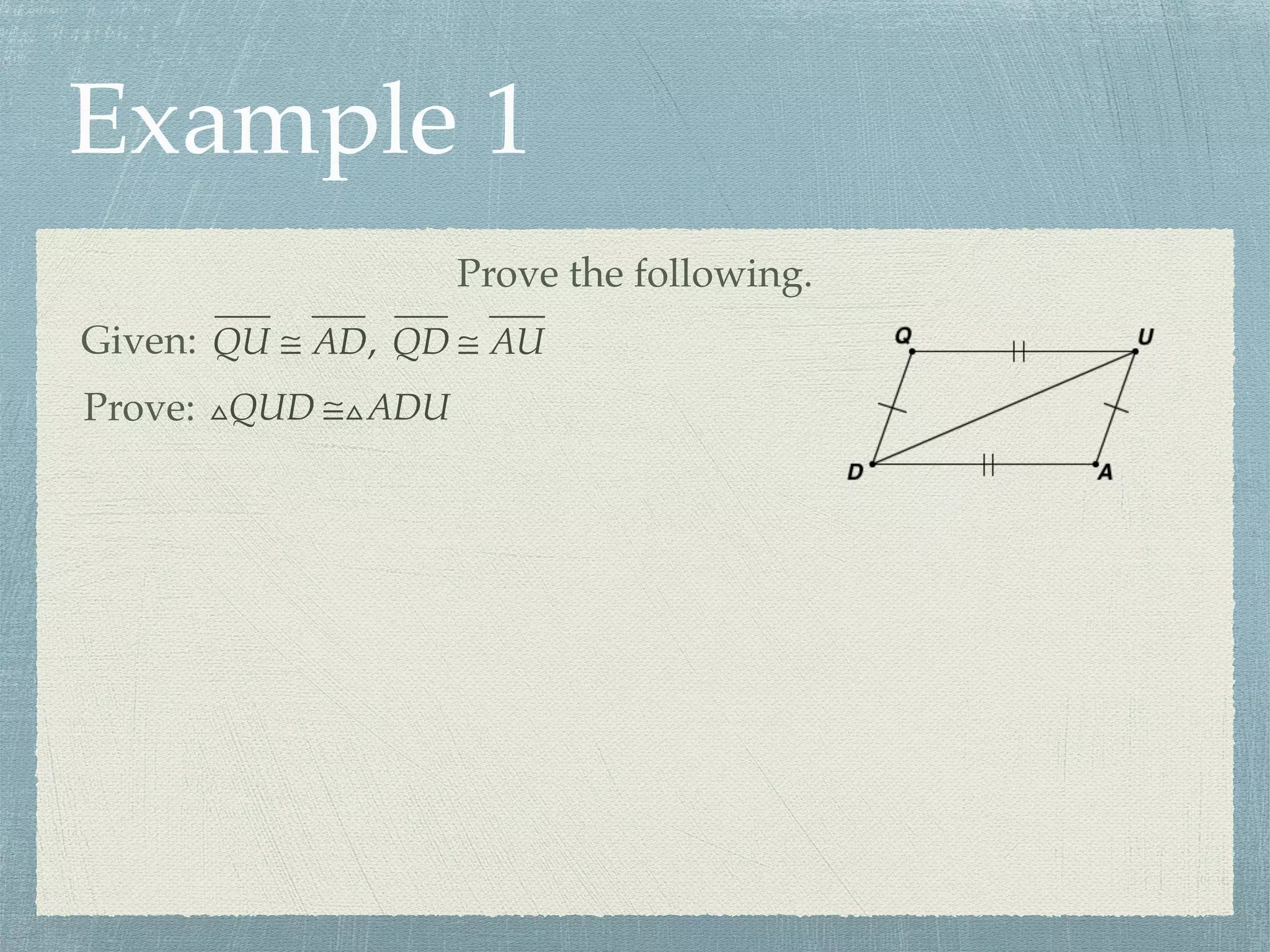
Given: QU ≅ AD, QD ≅ AU
Prove: △QUD ≅△ADU
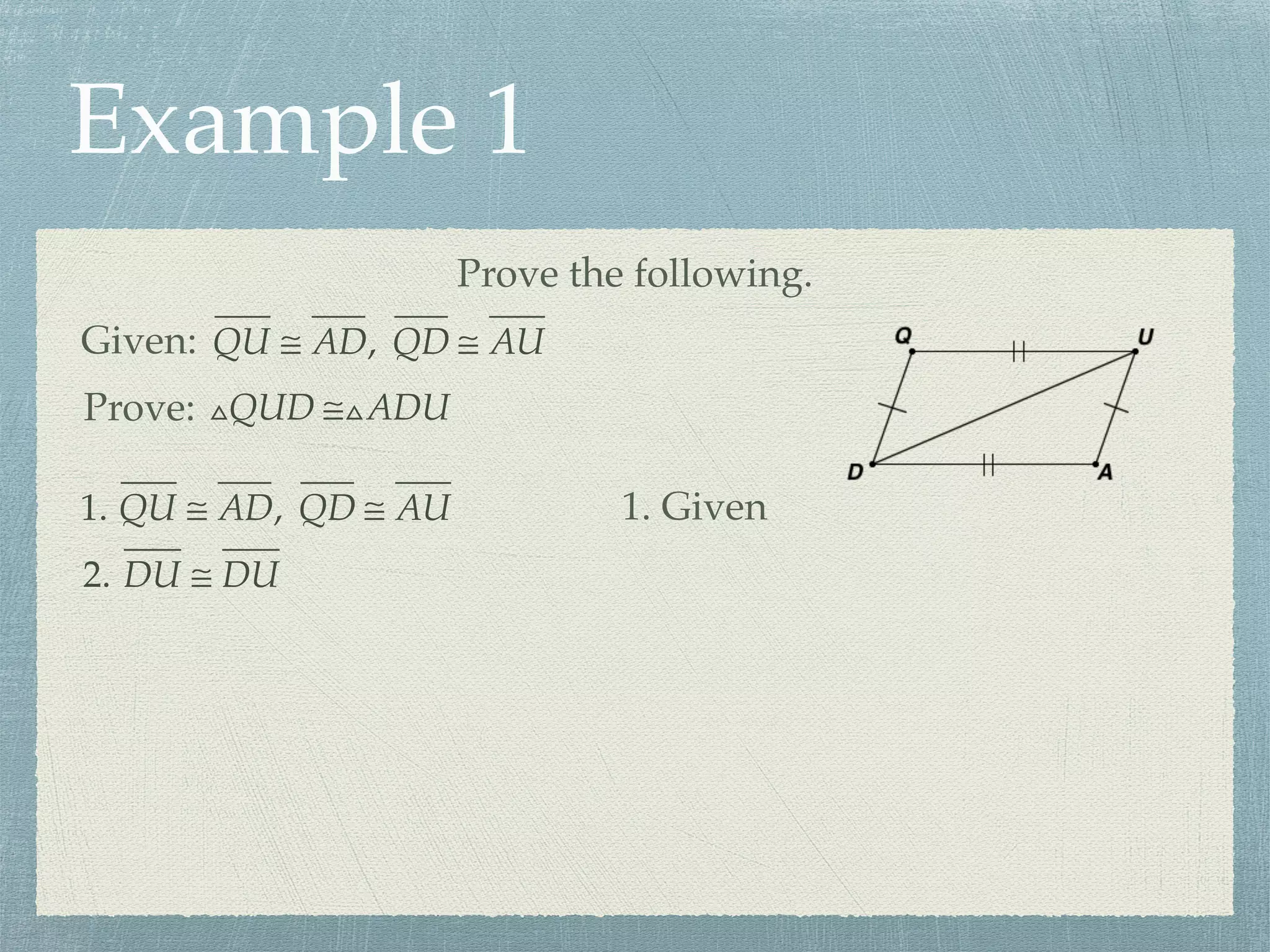
Example 1
Prove the following.
Given: QU ≅ AD, QD ≅ AU
Prove: △QUD ≅△ADU
1. QU ≅ AD, QD ≅ AU
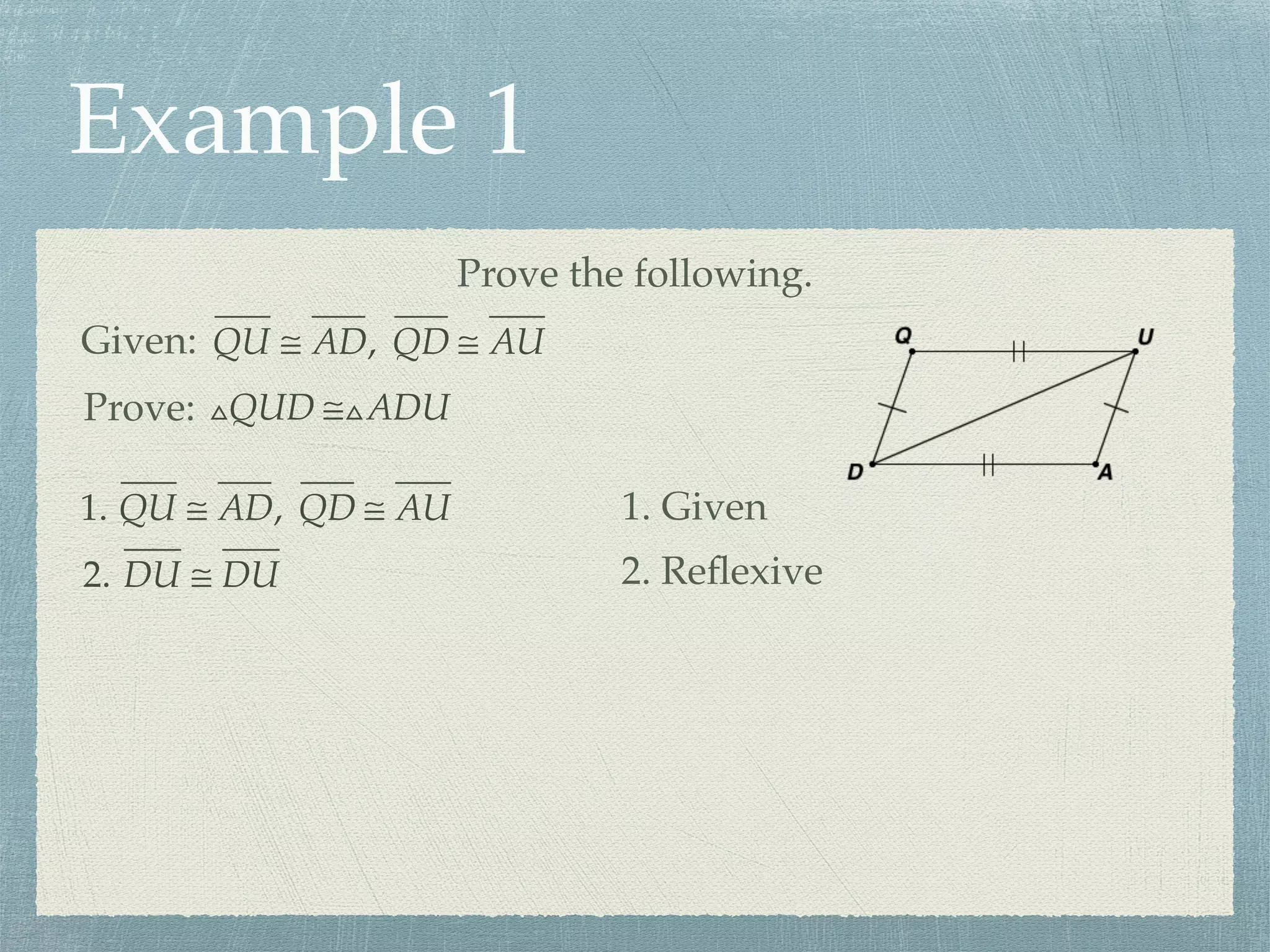
Example 1
Prove the following.
Given: QU ≅ AD, QD ≅ AU
Prove: △QUD ≅△ADU
1. QU ≅ AD, QD ≅ AU 1. Given
Example 1
Prove the following.
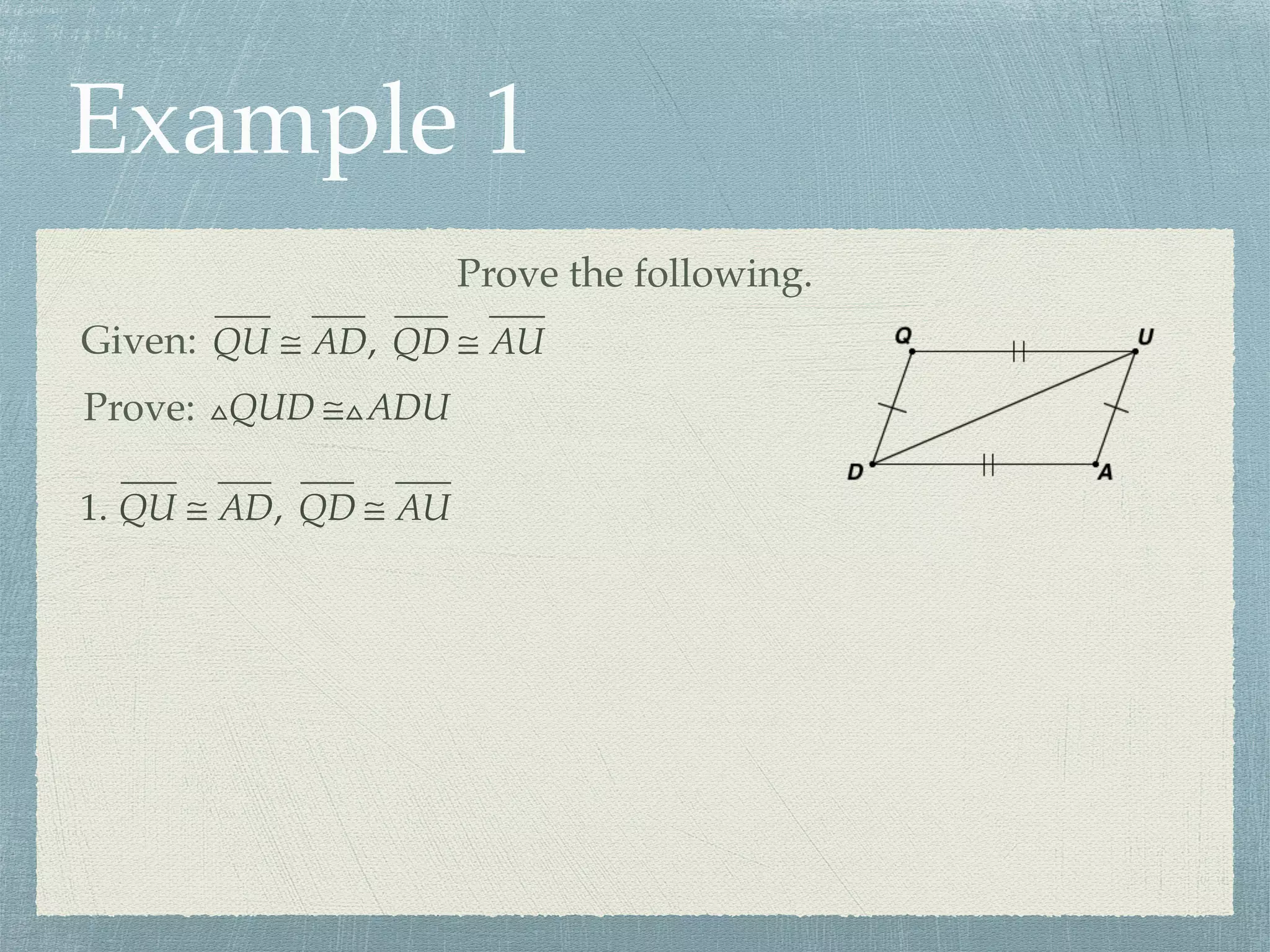
Given: QU ≅ AD, QD ≅ AU
Prove: △QUD ≅△ADU
1. QU ≅ AD, QD ≅ AU 1. Given
2. DU ≅ DU
Example 1
Prove the following.
Given: QU ≅ AD, QD ≅ AU
Prove: △QUD ≅△ADU
1. QU ≅ AD, QD ≅ AU 1. Given
2. DU ≅ DU 2. Reflexive
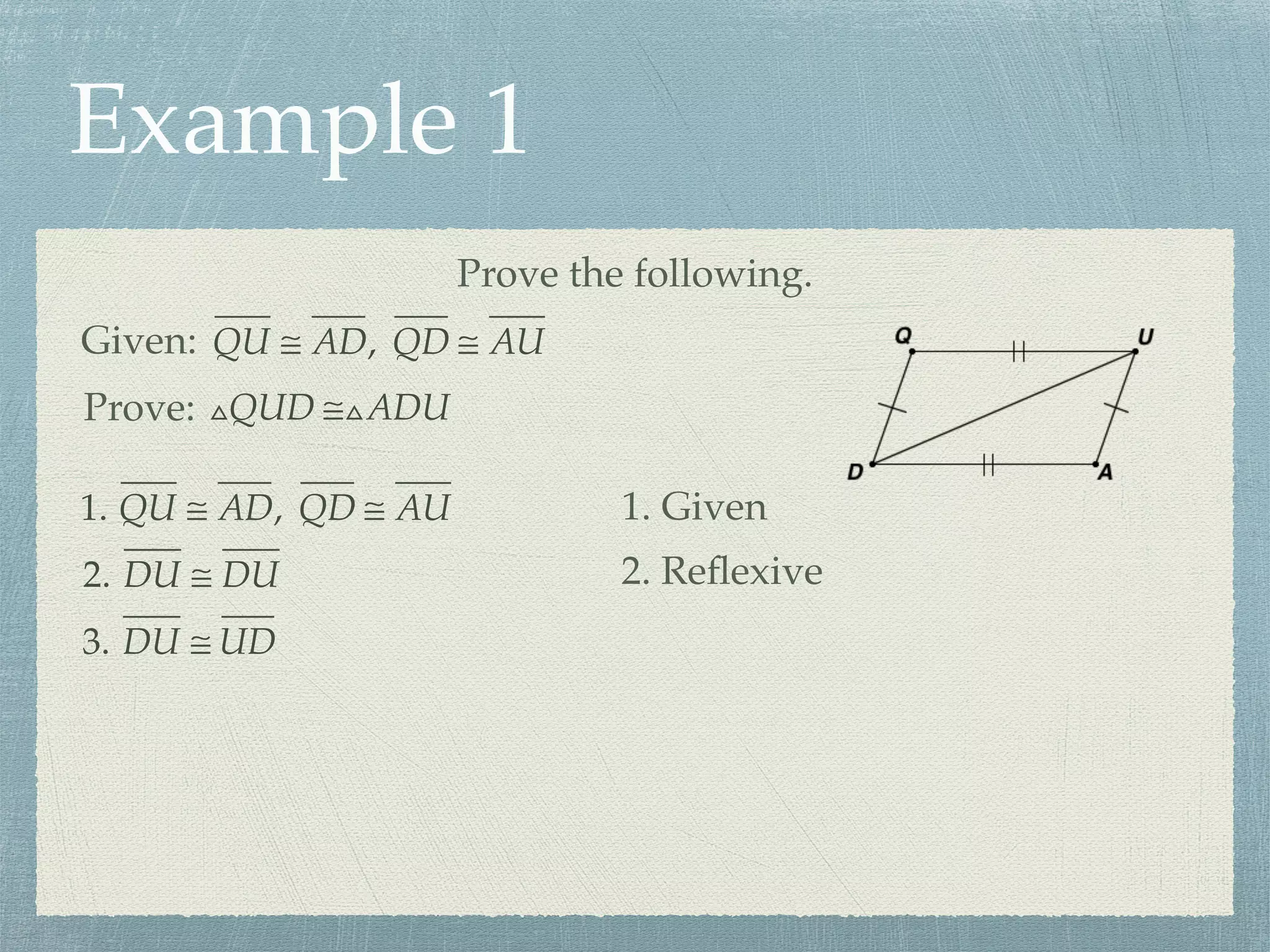
Example 1
Prove the following.
Given: QU ≅ AD, QD ≅ AU
Prove: △QUD ≅△ADU
1. QU ≅ AD, QD ≅ AU 1. Given
2. DU ≅ DU 2. Reflexive
3. DU ≅ UD
Example 1
Prove the following.
Given: QU ≅ AD, QD ≅ AU
Prove: △QUD ≅△ADU
1. QU ≅ AD, QD ≅ AU 1. Given
2. DU ≅ DU 2. Reflexive
3. DU ≅ UD 3. Symmetric
Example 1
Prove the following.
Given: QU ≅ AD, QD ≅ AU
Prove: △QUD ≅△ADU
1. QU ≅ AD, QD ≅ AU 1. Given
2. DU ≅ DU 2. Reflexive
3. DU ≅ UD 3. Symmetric
4. △QUD ≅△ADU
Example 1
Prove the following.
Given: QU ≅ AD, QD ≅ AU
Prove: △QUD ≅△ADU
1. QU ≅ AD, QD ≅ AU 1. Given
2. DU ≅ DU 2. Reflexive
3. DU ≅ UD 3. Symmetric
4. △QUD ≅△ADU 4. SSS
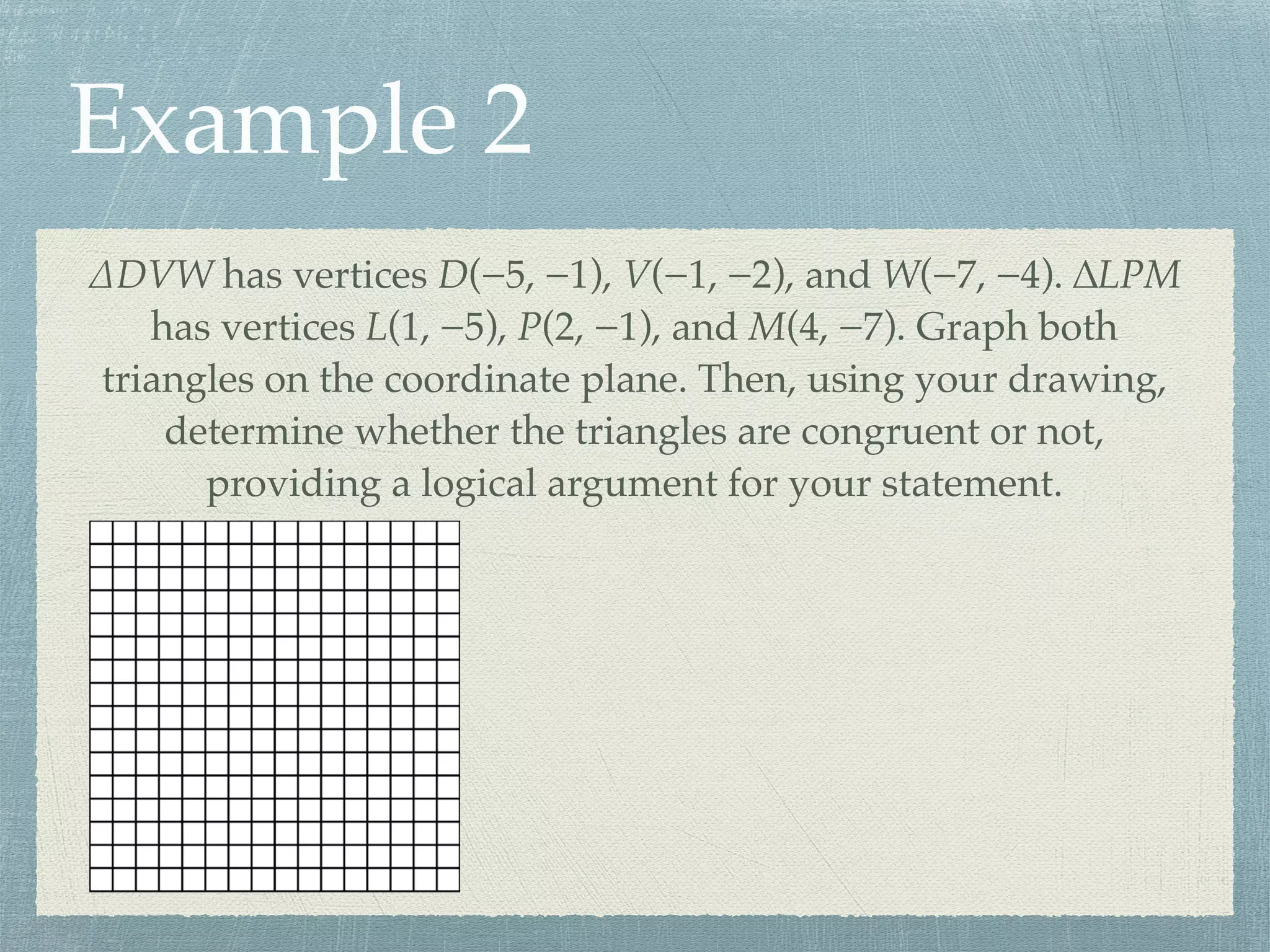
Example 2
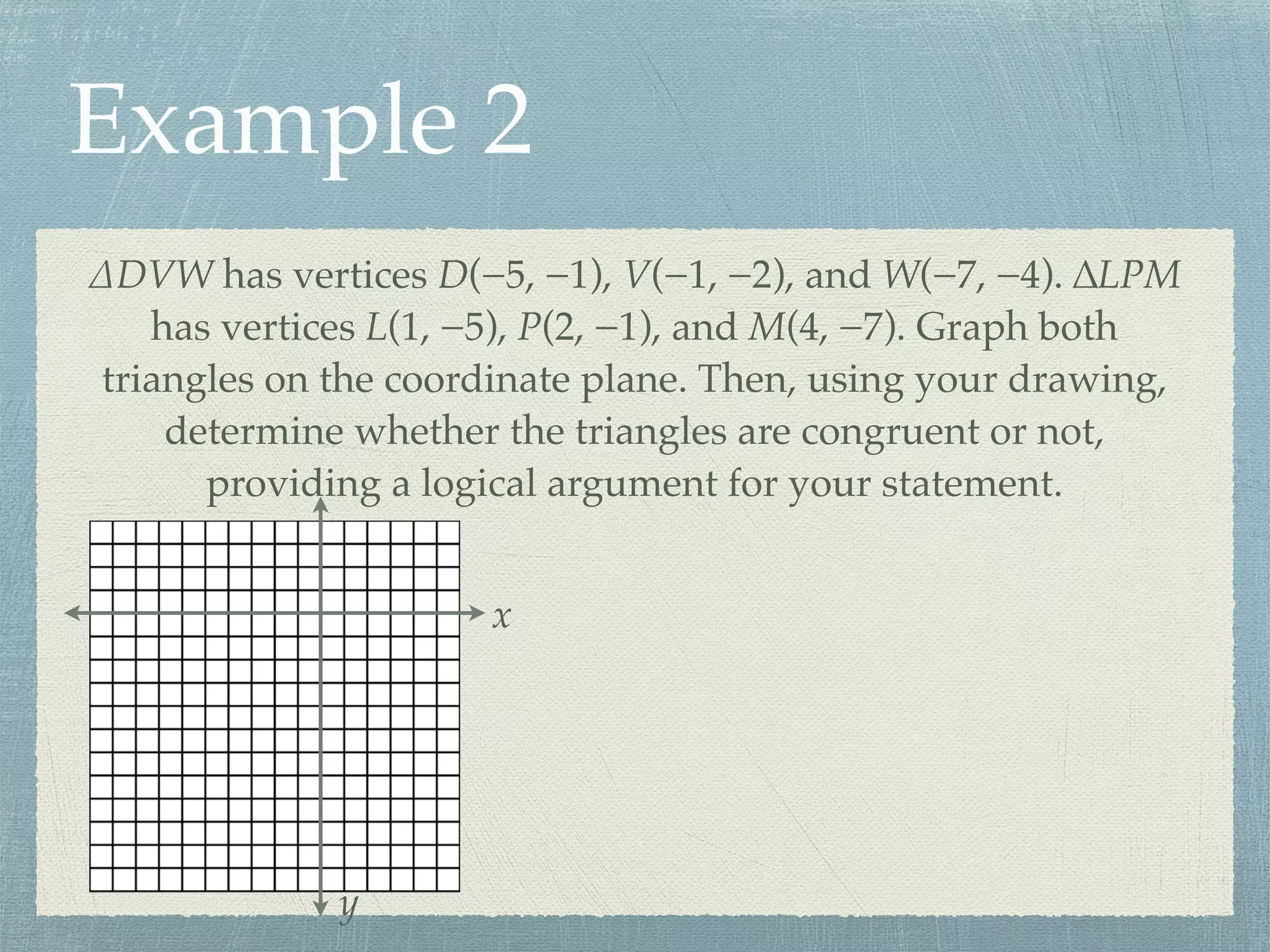
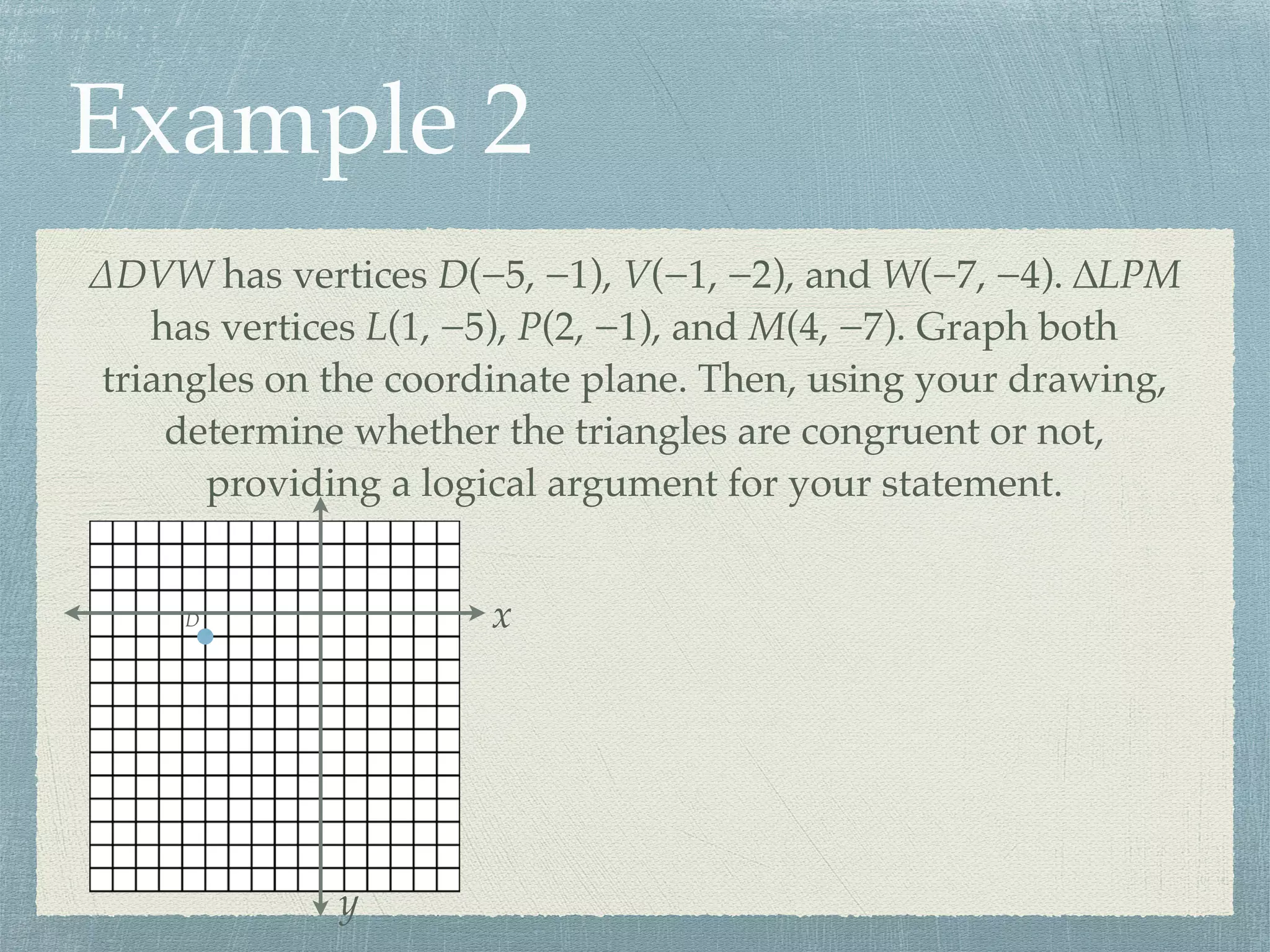
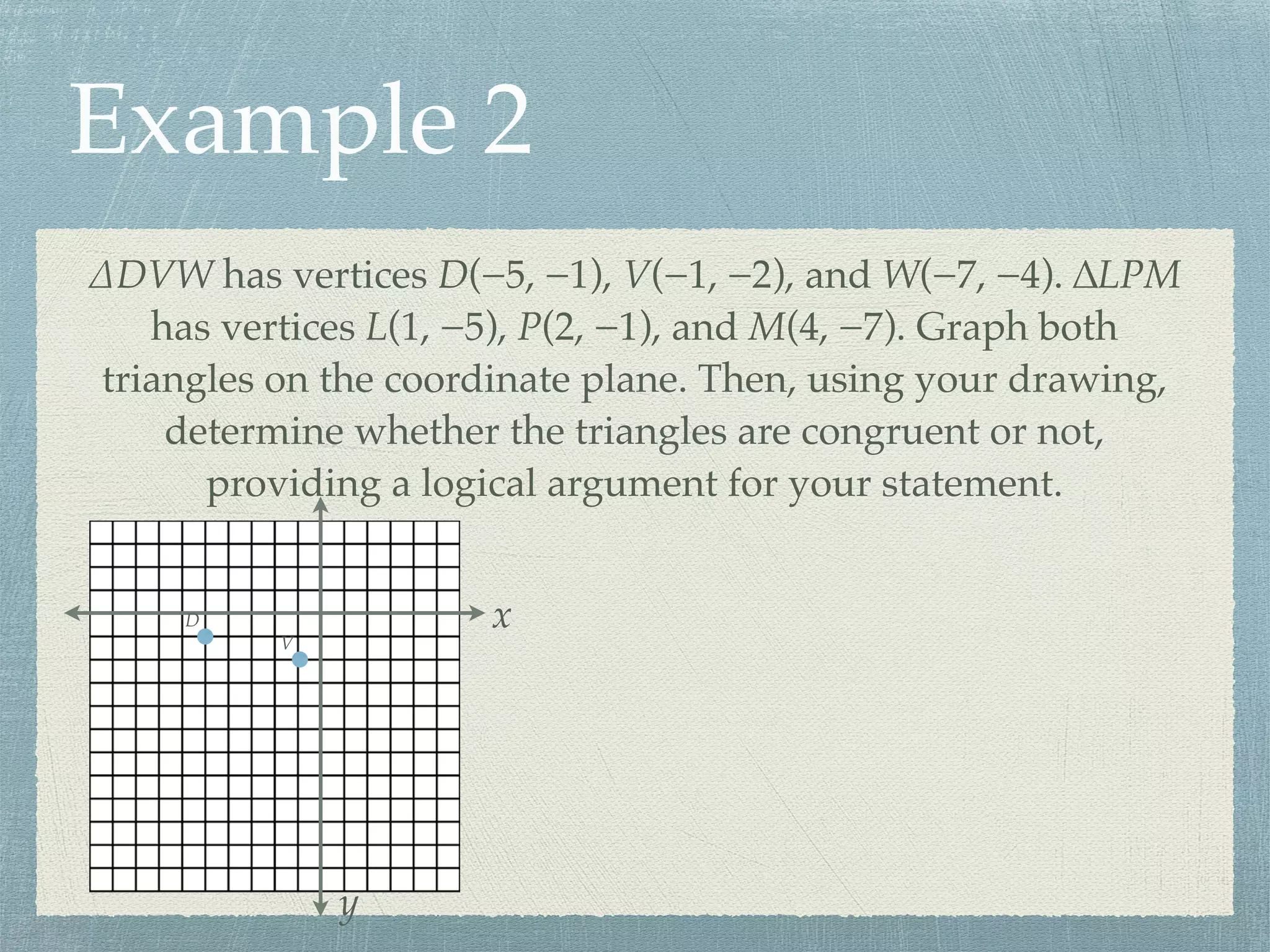
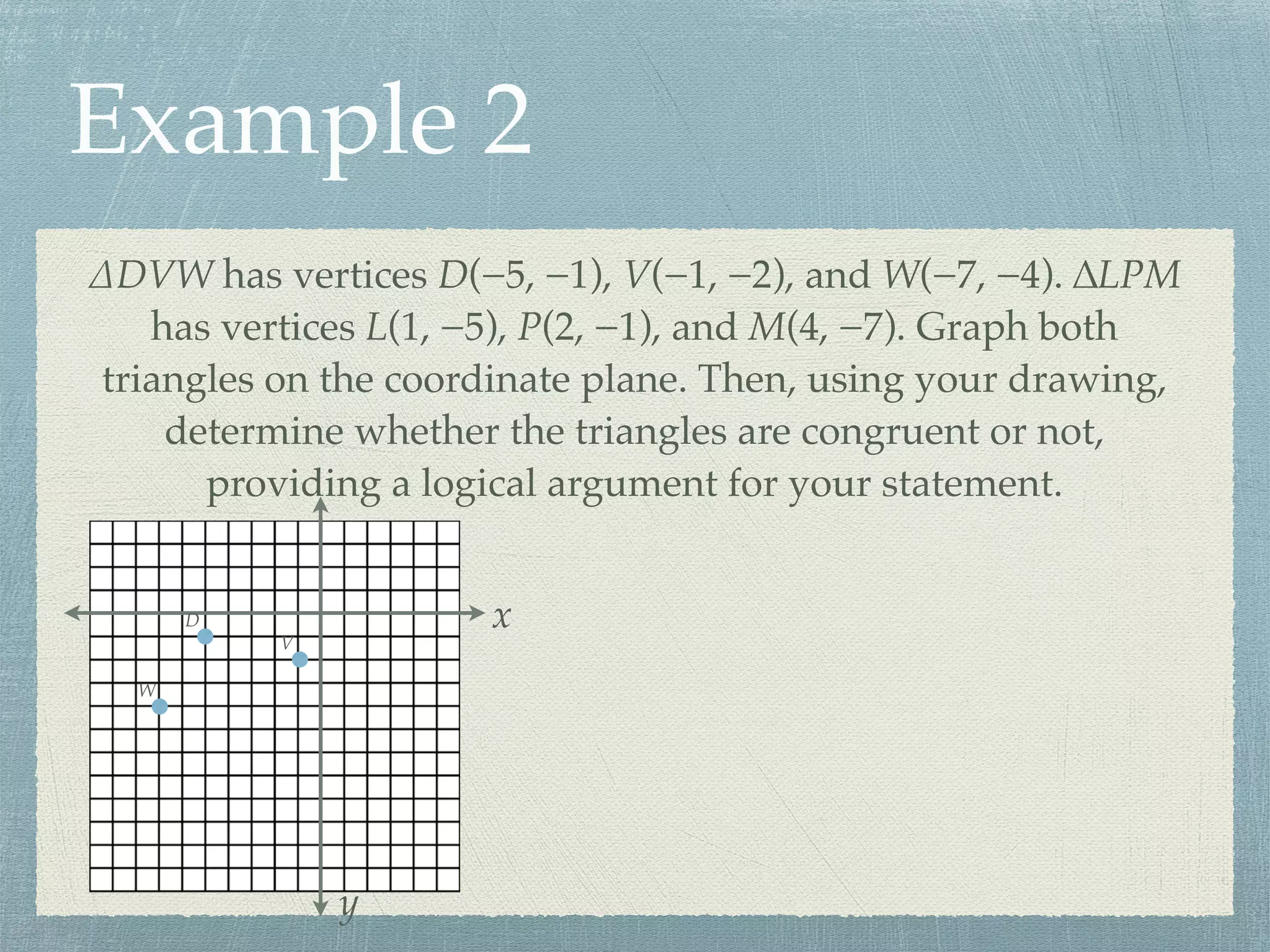
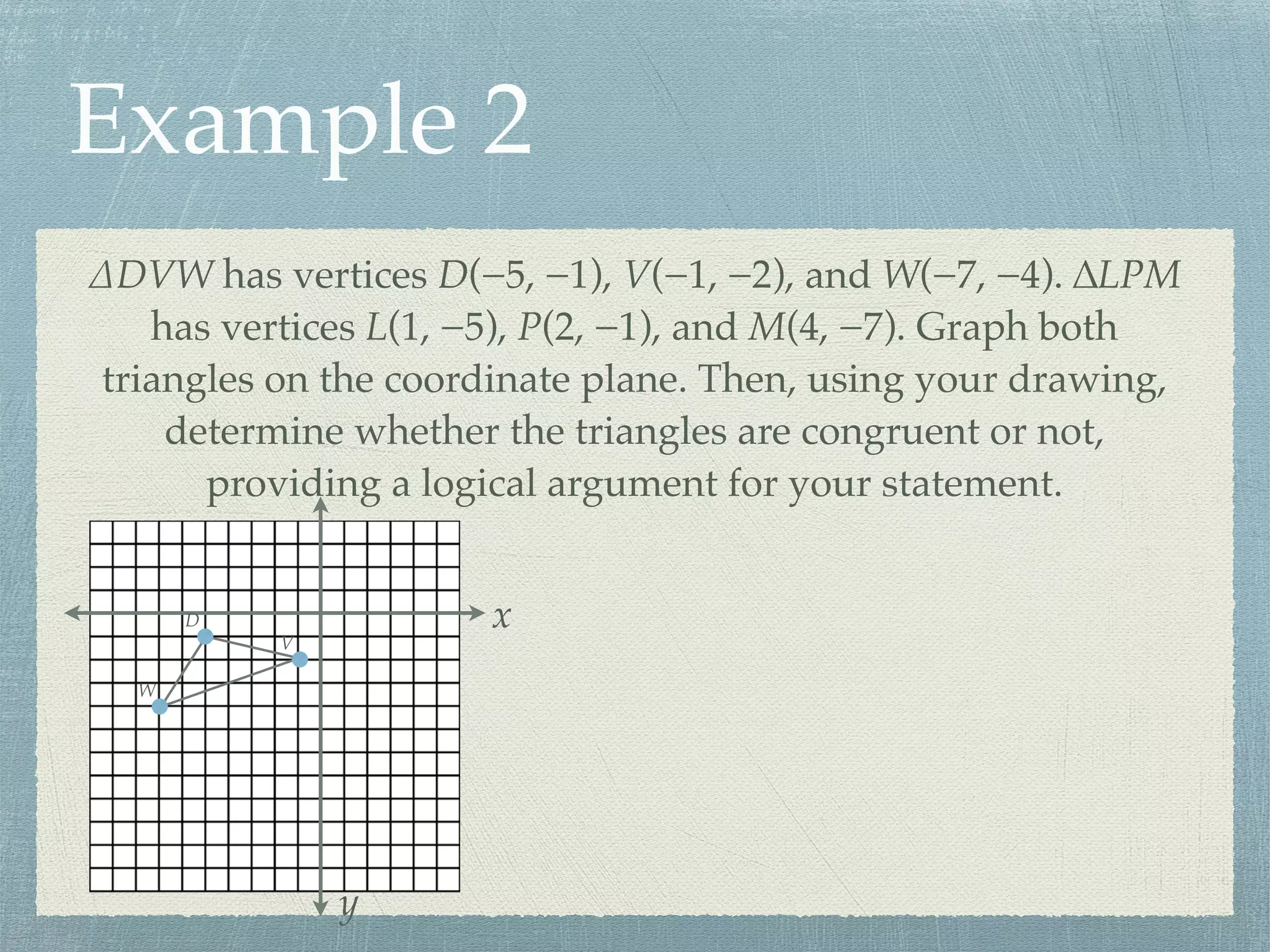
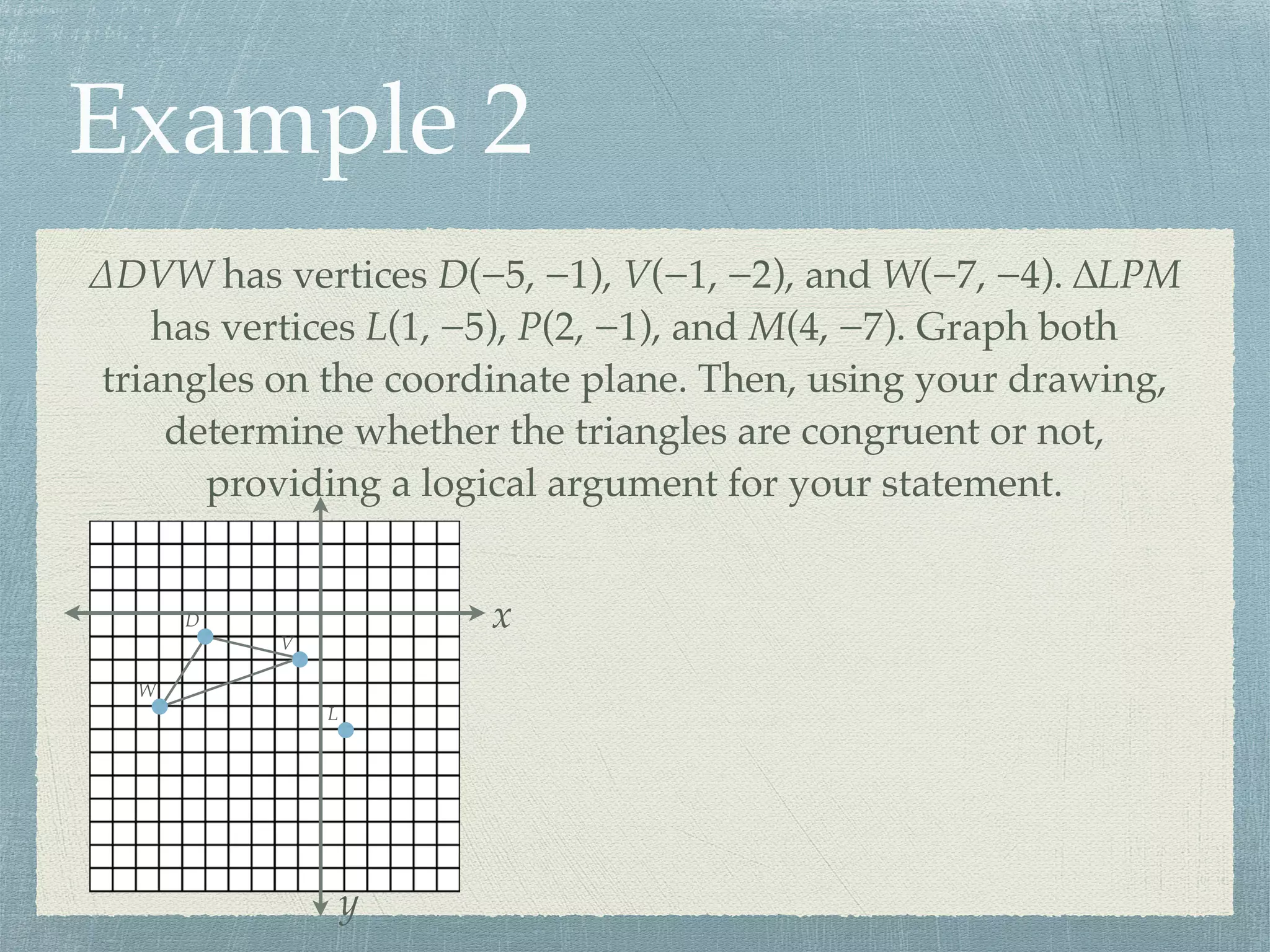
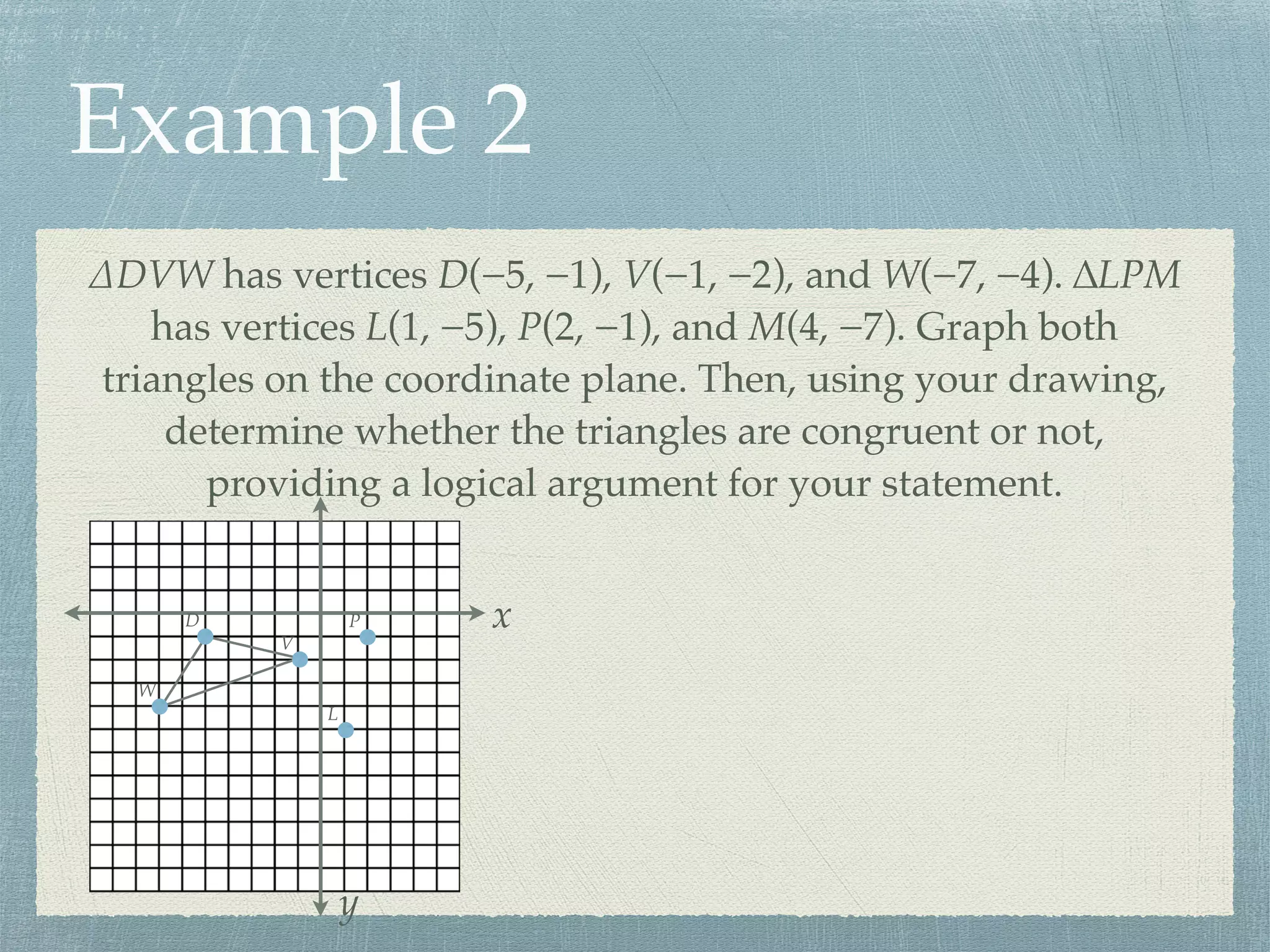
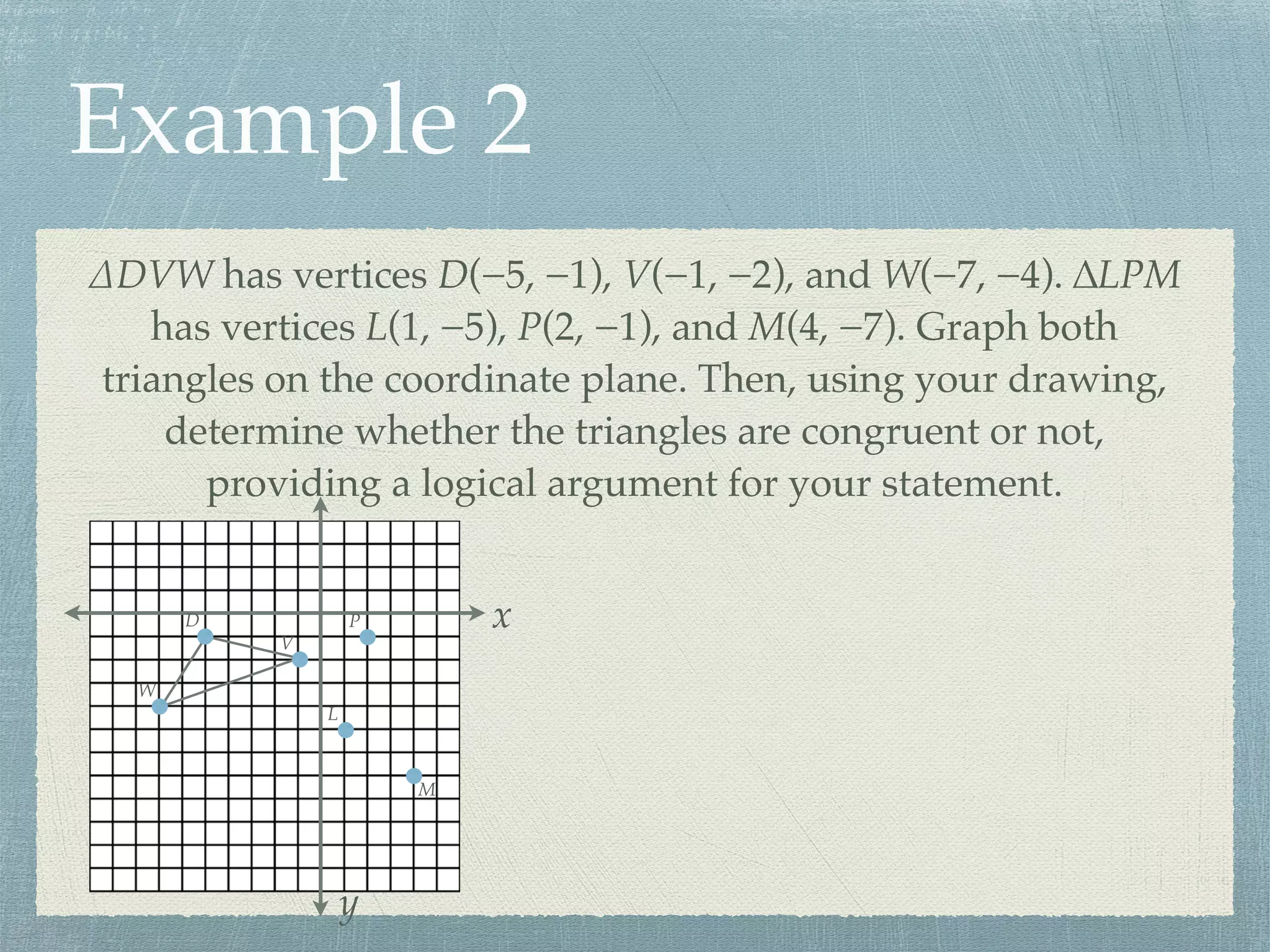
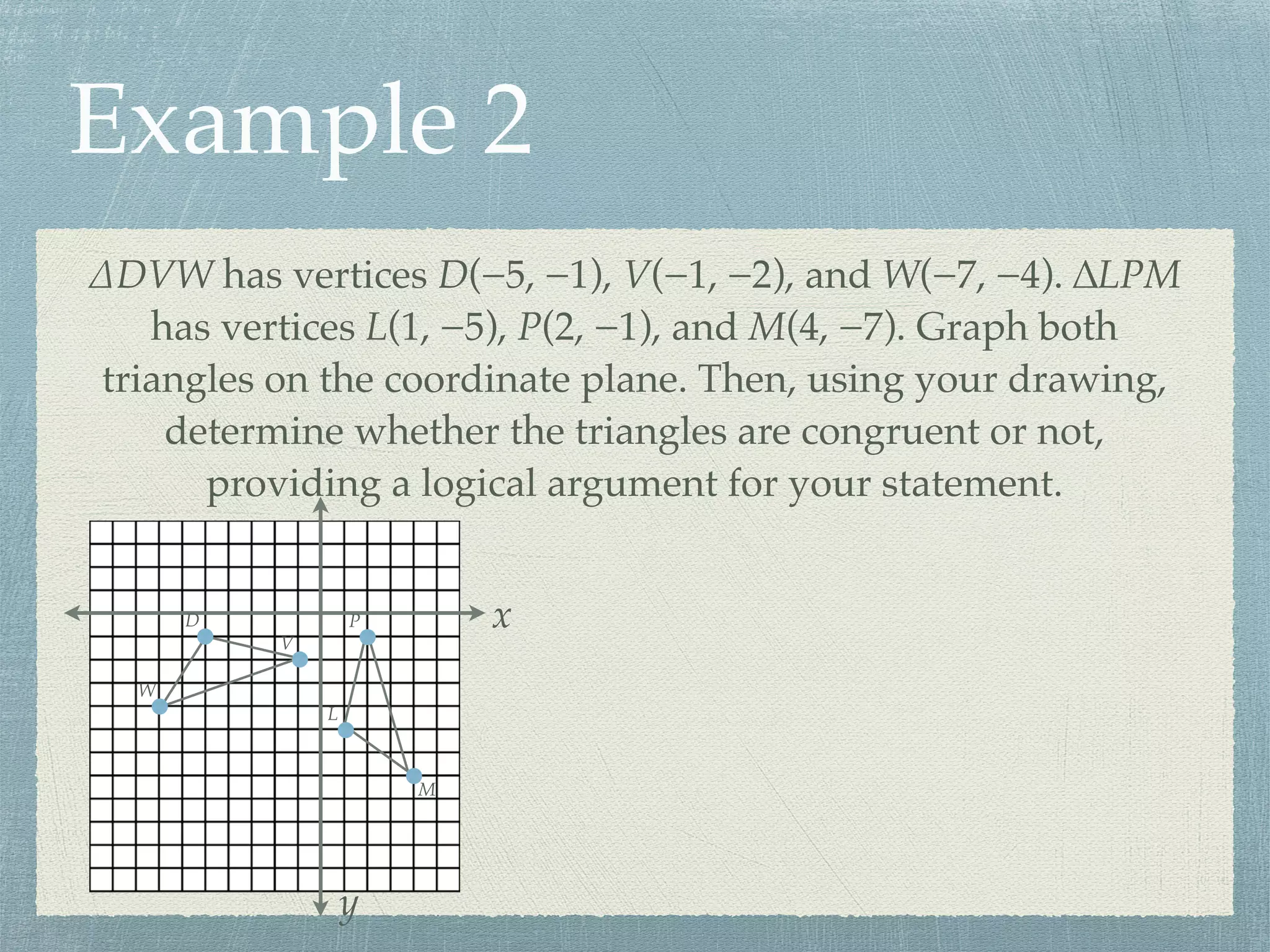
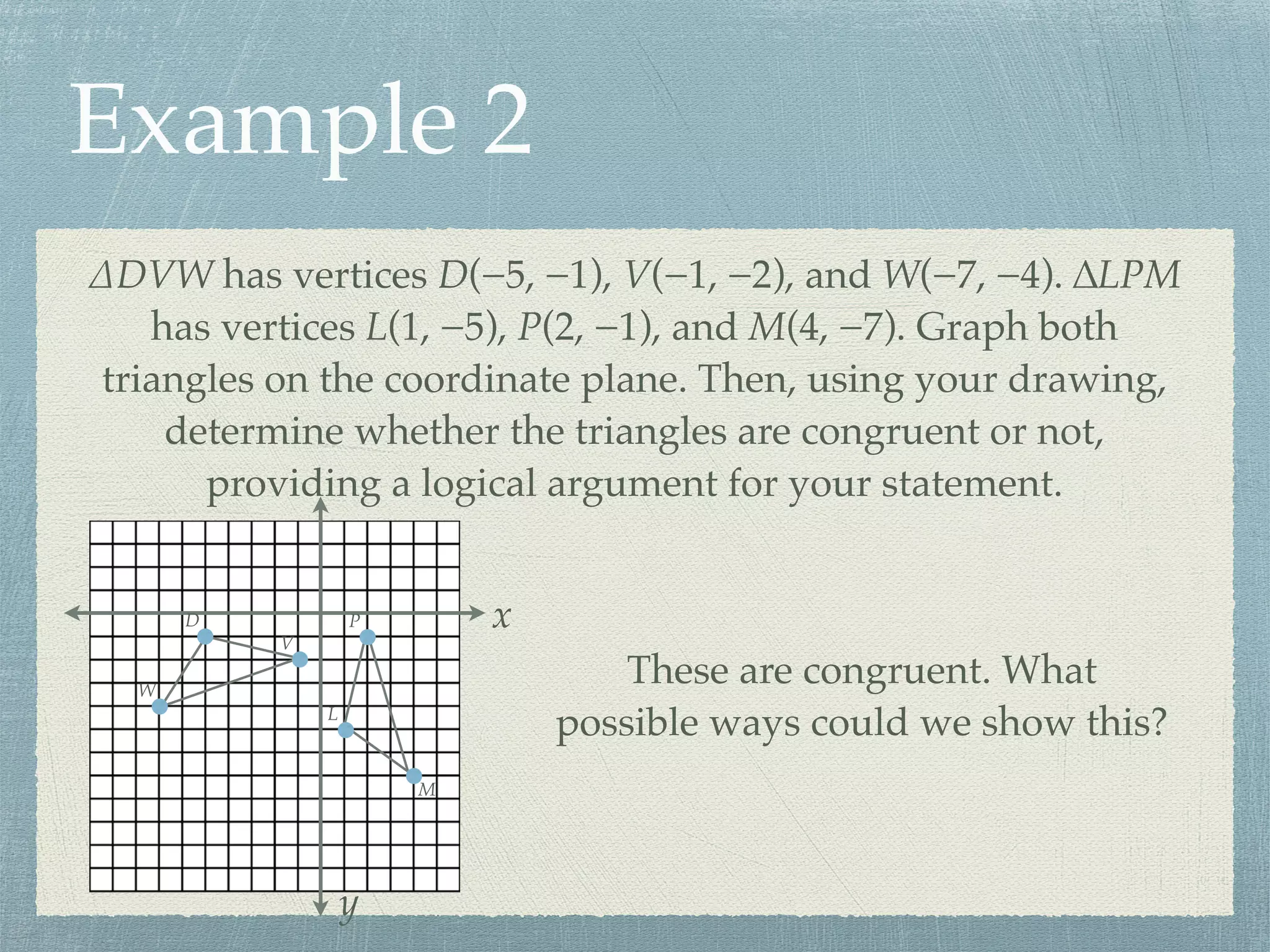
∆DVW has vertices D(−5, −1), V(−1, −2), and W(−7, −4). ∆LPM
has vertices L(1, −5), P(2, −1), and M(4, −7). Graph both
triangles on the coordinate plane. Then, using your drawing,
determine whether the triangles are congruent or not,
providing a logical argument for your statement.
Example 2
∆DVW has vertices D(−5, −1), V(−1, −2), and W(−7, −4). ∆LPM
has vertices L(1, −5), P(2, −1), and M(4, −7). Graph both
triangles on the coordinate plane. Then, using your drawing,
determine whether the triangles are congruent or not,
providing a logical argument for your statement.
x
y
Example 2
∆DVW has vertices D(−5, −1), V(−1, −2), and W(−7, −4). ∆LPM
has vertices L(1, −5), P(2, −1), and M(4, −7). Graph both
triangles on the coordinate plane. Then, using your drawing,
determine whether the triangles are congruent or not,
providing a logical argument for your statement.
x
y
D
Example 2
∆DVW has vertices D(−5, −1), V(−1, −2), and W(−7, −4). ∆LPM
has vertices L(1, −5), P(2, −1), and M(4, −7). Graph both
triangles on the coordinate plane. Then, using your drawing,
determine whether the triangles are congruent or not,
providing a logical argument for your statement.
x
y
D
V
Example 2
∆DVW has vertices D(−5, −1), V(−1, −2), and W(−7, −4). ∆LPM
has vertices L(1, −5), P(2, −1), and M(4, −7). Graph both
triangles on the coordinate plane. Then, using your drawing,
determine whether the triangles are congruent or not,
providing a logical argument for your statement.
x
y
D
V
W
Example 2
∆DVW has vertices D(−5, −1), V(−1, −2), and W(−7, −4). ∆LPM
has vertices L(1, −5), P(2, −1), and M(4, −7). Graph both
triangles on the coordinate plane. Then, using your drawing,
determine whether the triangles are congruent or not,
providing a logical argument for your statement.
x
y
D
V
W
Example 2
∆DVW has vertices D(−5, −1), V(−1, −2), and W(−7, −4). ∆LPM
has vertices L(1, −5), P(2, −1), and M(4, −7). Graph both
triangles on the coordinate plane. Then, using your drawing,
determine whether the triangles are congruent or not,
providing a logical argument for your statement.
x
y
D
V
W
L
Example 2
∆DVW has vertices D(−5, −1), V(−1, −2), and W(−7, −4). ∆LPM
has vertices L(1, −5), P(2, −1), and M(4, −7). Graph both
triangles on the coordinate plane. Then, using your drawing,
determine whether the triangles are congruent or not,
providing a logical argument for your statement.
x
y
D
V
W
L
P
Example 2
∆DVW has vertices D(−5, −1), V(−1, −2), and W(−7, −4). ∆LPM
has vertices L(1, −5), P(2, −1), and M(4, −7). Graph both
triangles on the coordinate plane. Then, using your drawing,
determine whether the triangles are congruent or not,
providing a logical argument for your statement.
x
y
D
V
W
L
P
M
Example 2
∆DVW has vertices D(−5, −1), V(−1, −2), and W(−7, −4). ∆LPM
has vertices L(1, −5), P(2, −1), and M(4, −7). Graph both
triangles on the coordinate plane. Then, using your drawing,
determine whether the triangles are congruent or not,
providing a logical argument for your statement.
x
y
D
V
W
L
P
M
Example 2
∆DVW has vertices D(−5, −1), V(−1, −2), and W(−7, −4). ∆LPM
has vertices L(1, −5), P(2, −1), and M(4, −7). Graph both
triangles on the coordinate plane. Then, using your drawing,
determine whether the triangles are congruent or not,
providing a logical argument for your statement.
x
y
D
V
W
L
P
M
These are congruent. What
possible ways could we show this?
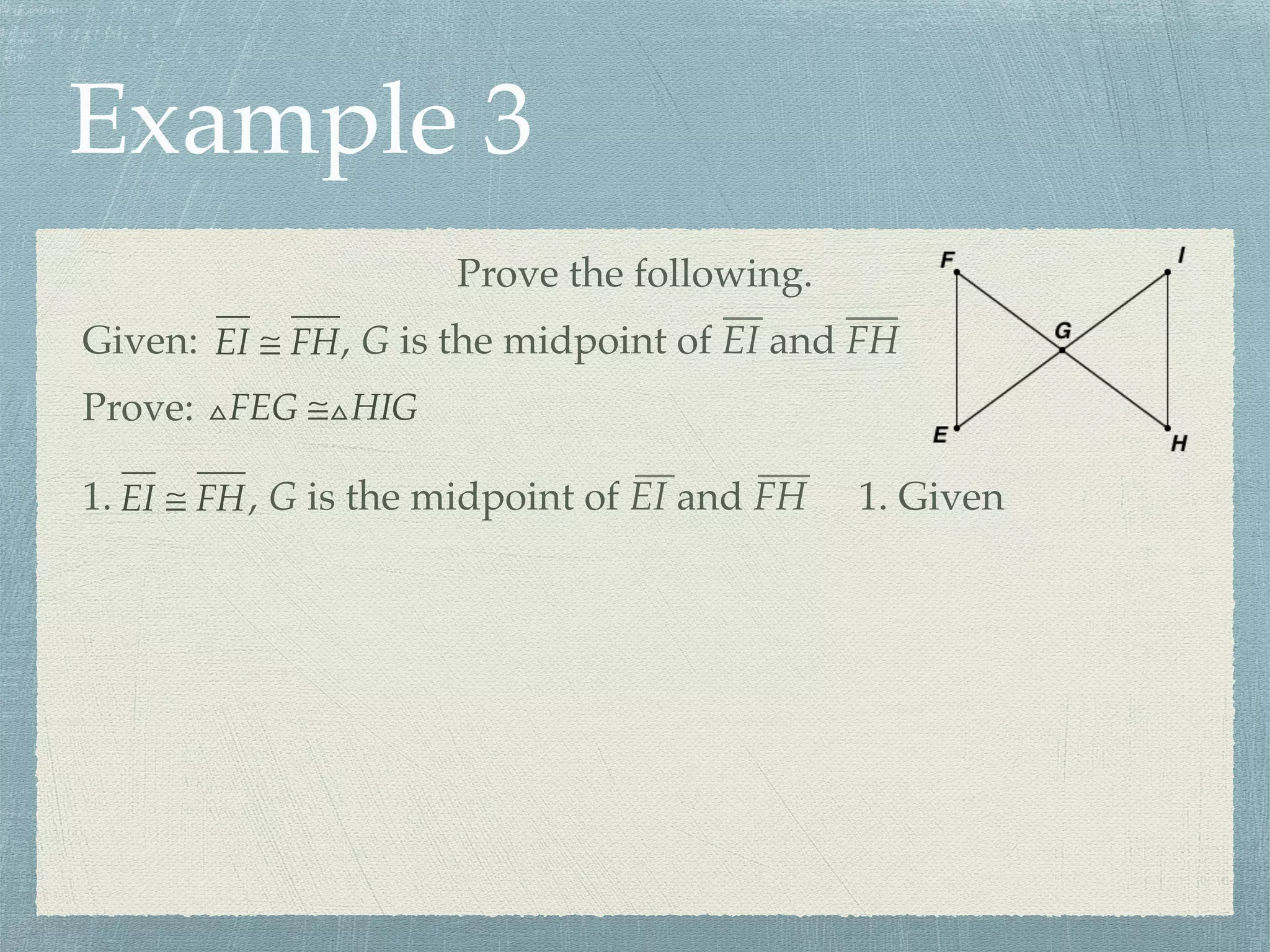
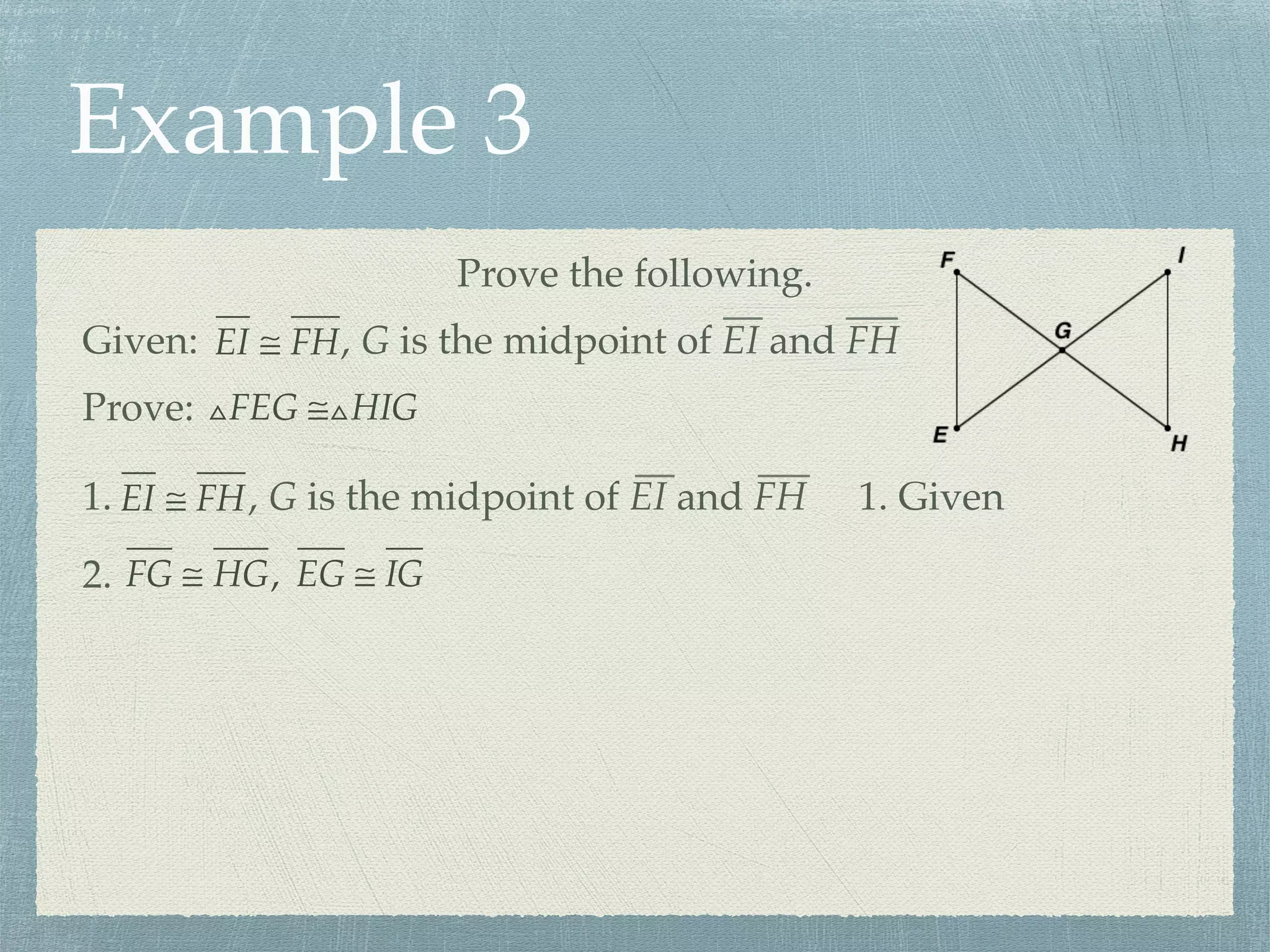
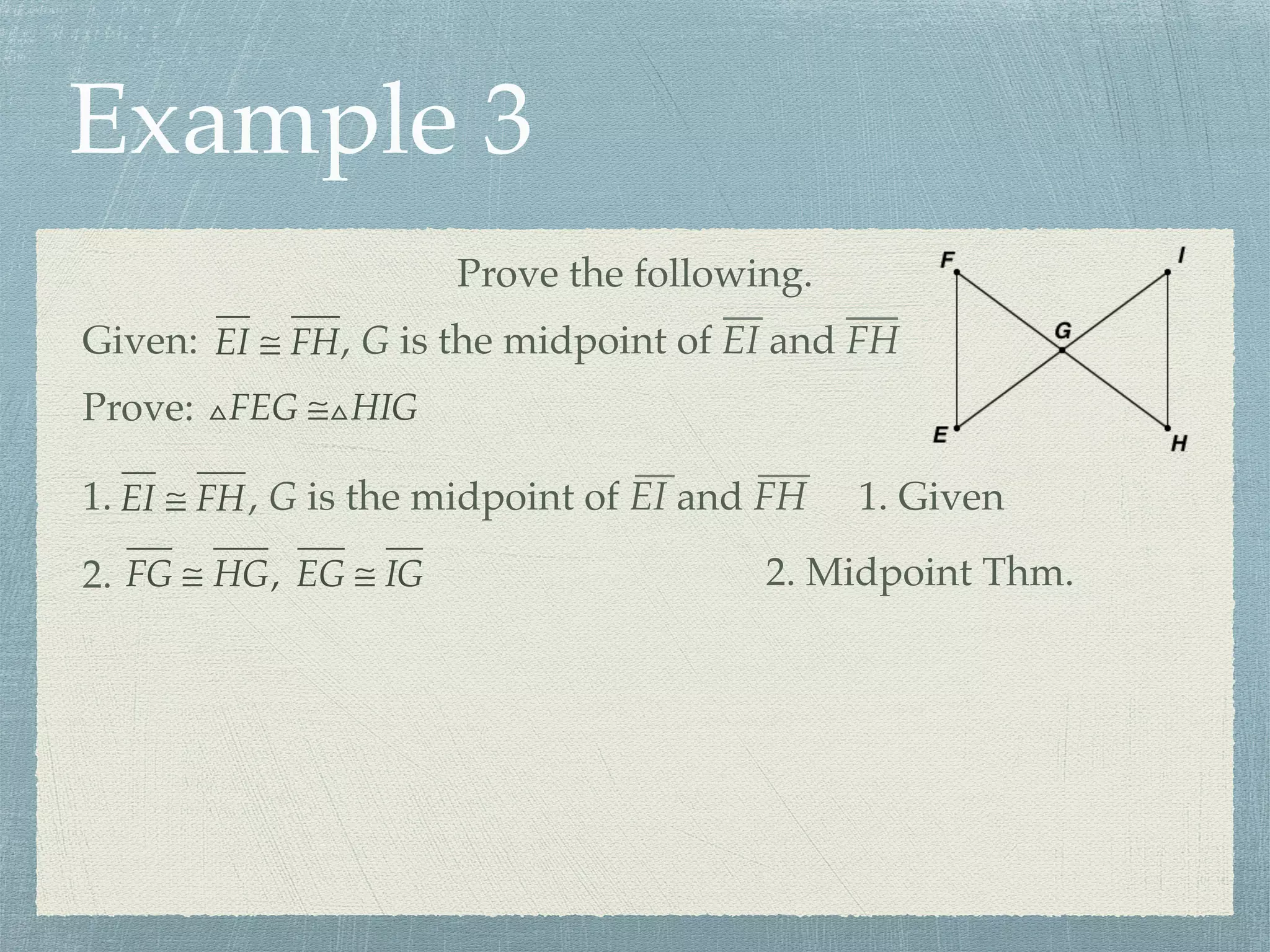
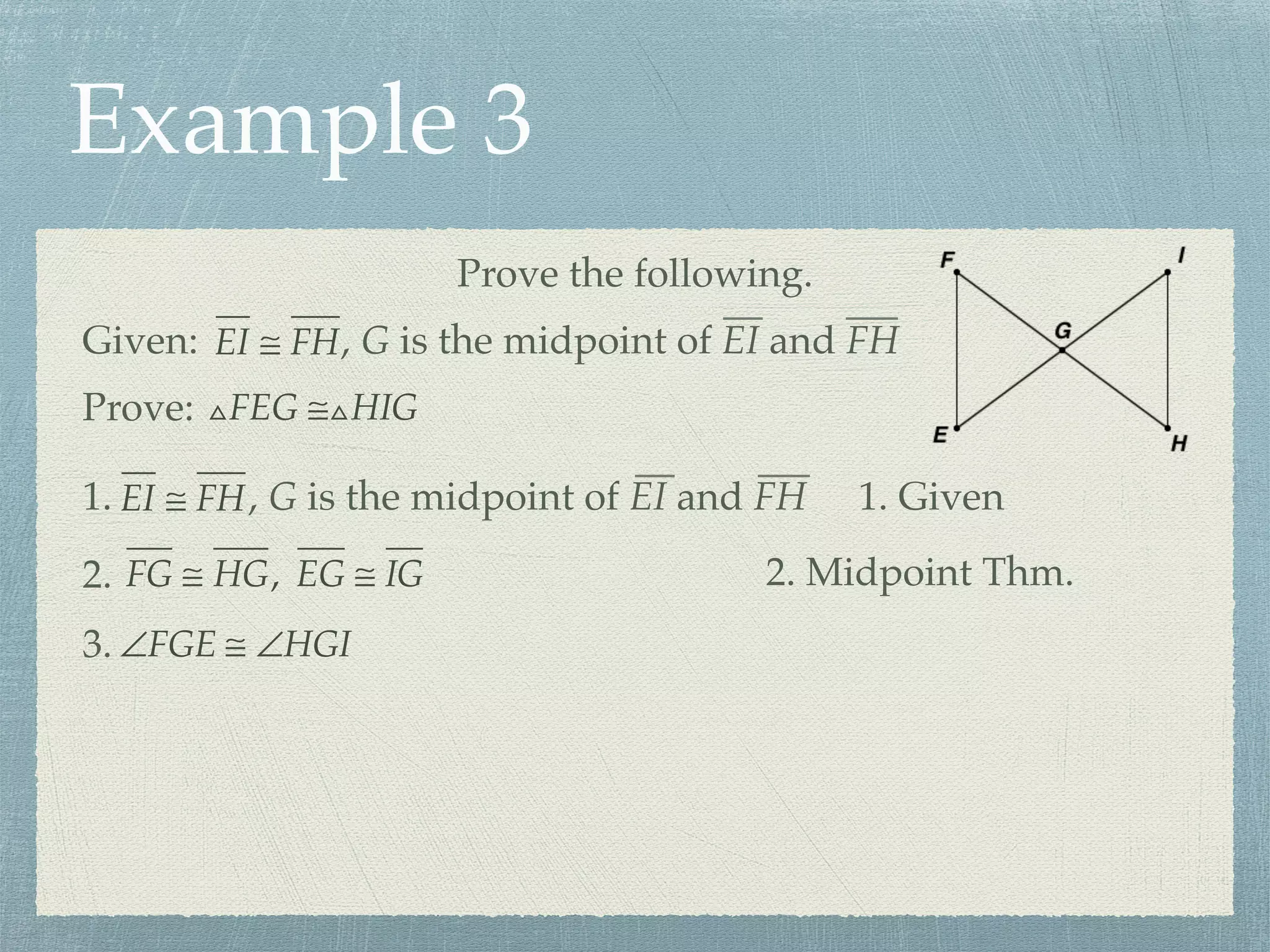
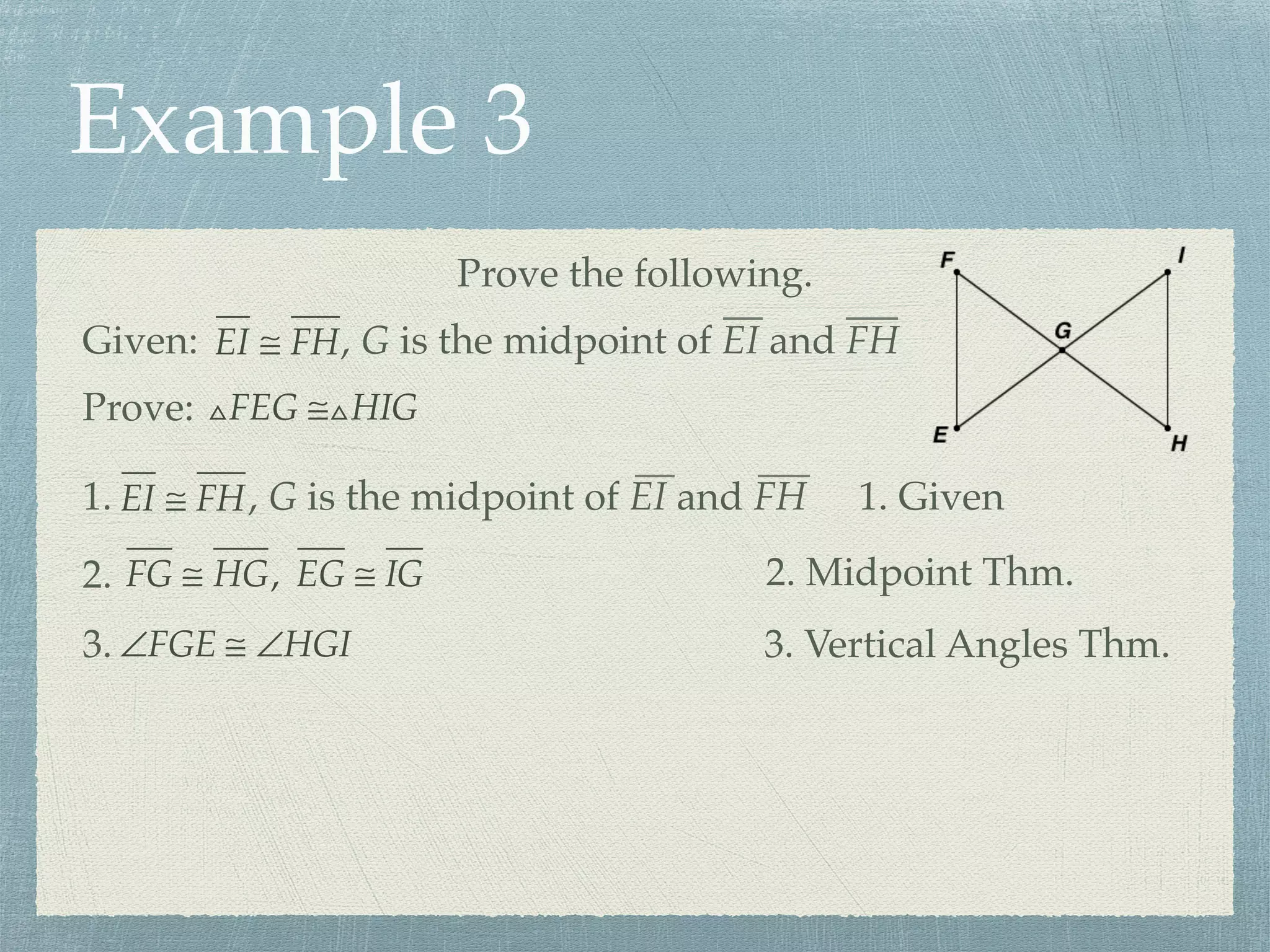
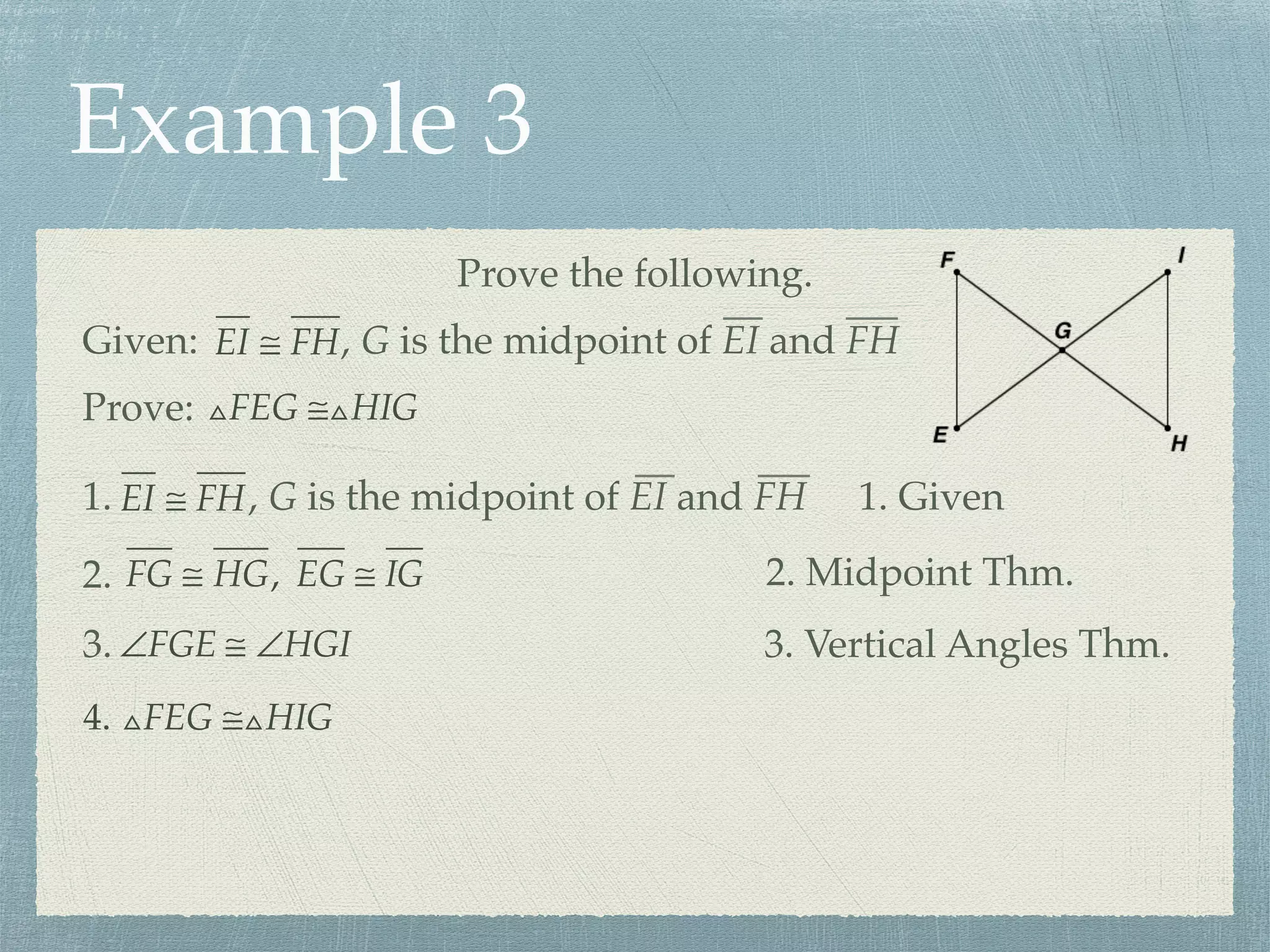
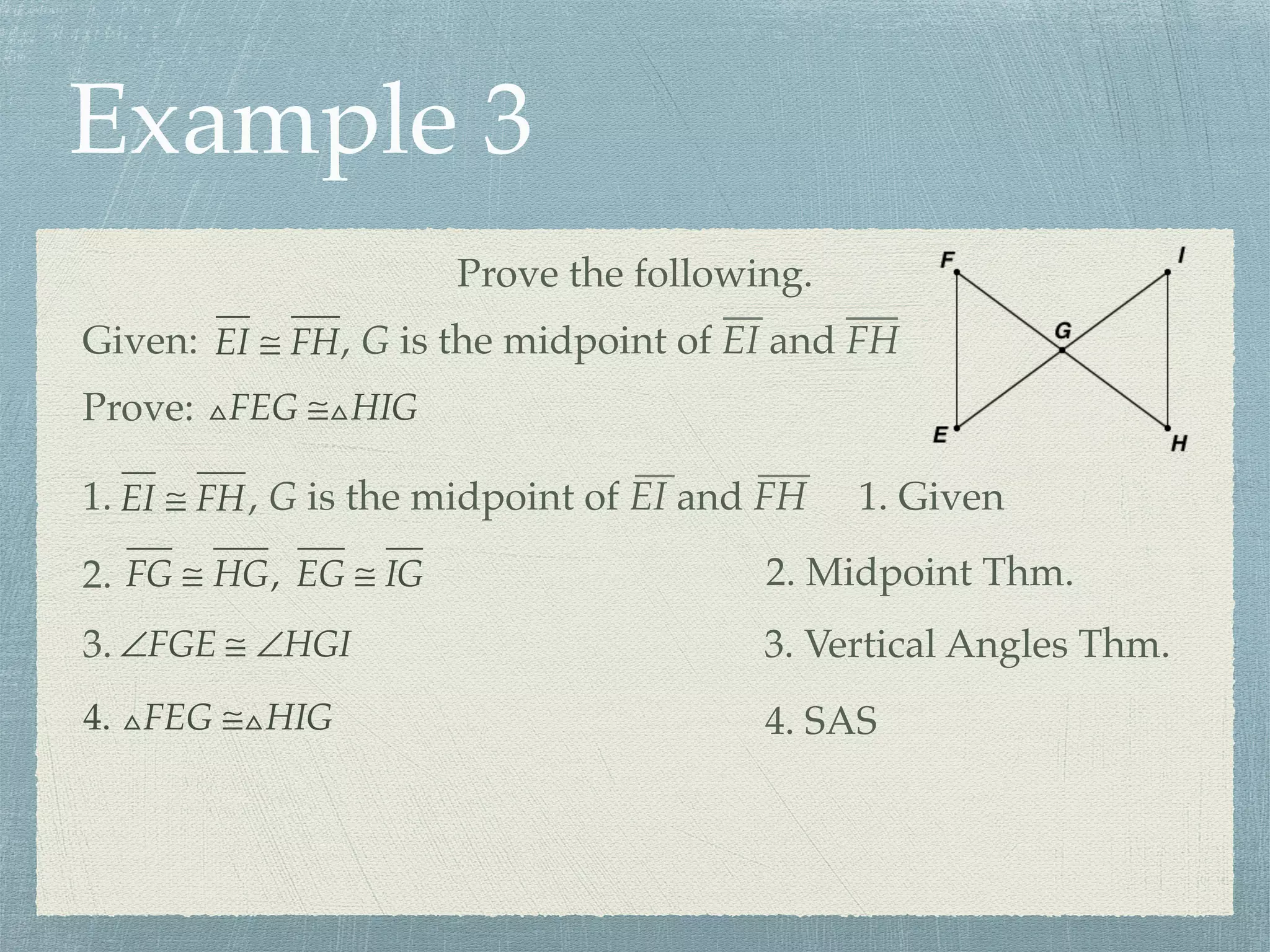
Example 3
Prove the following.
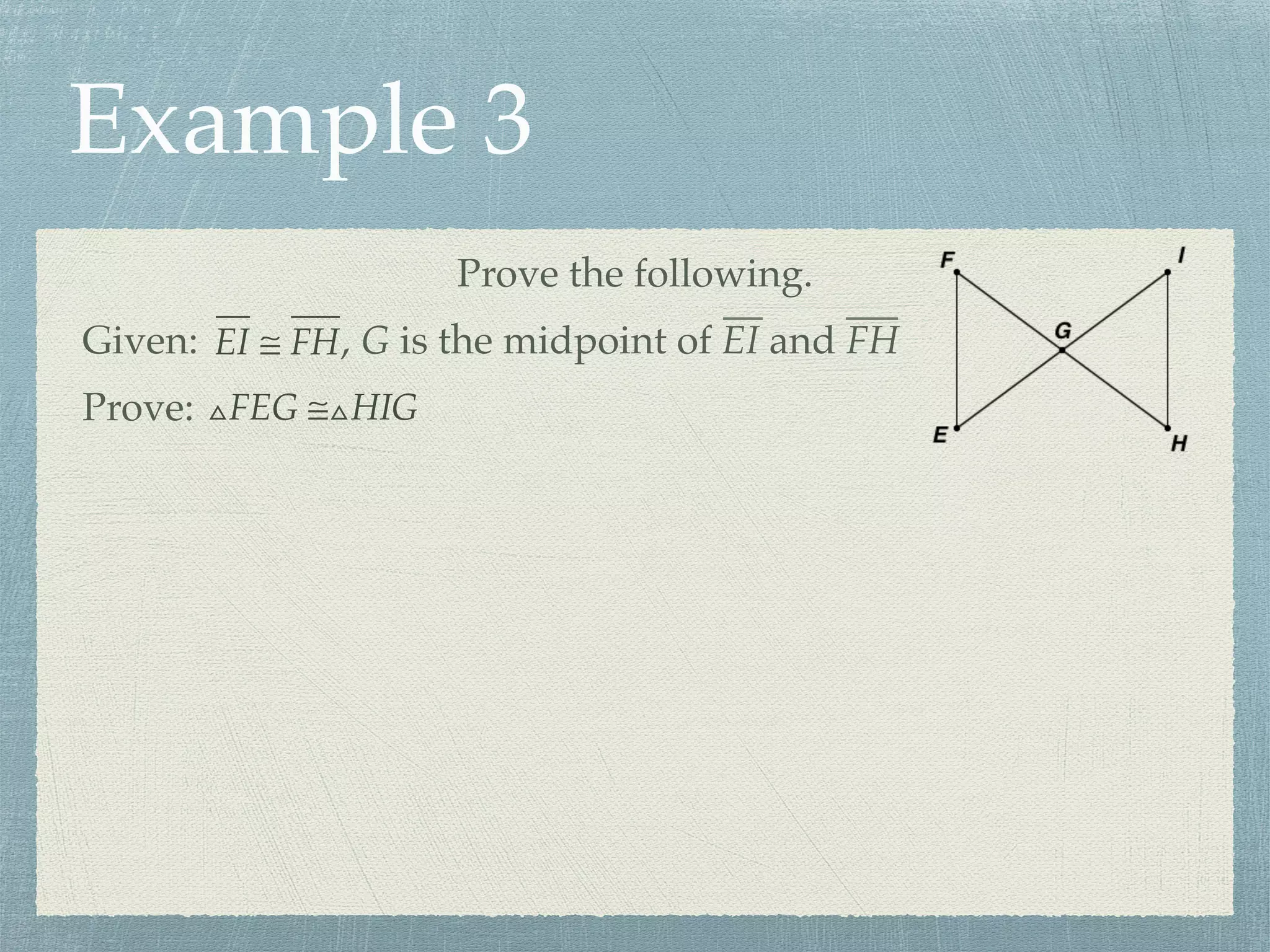
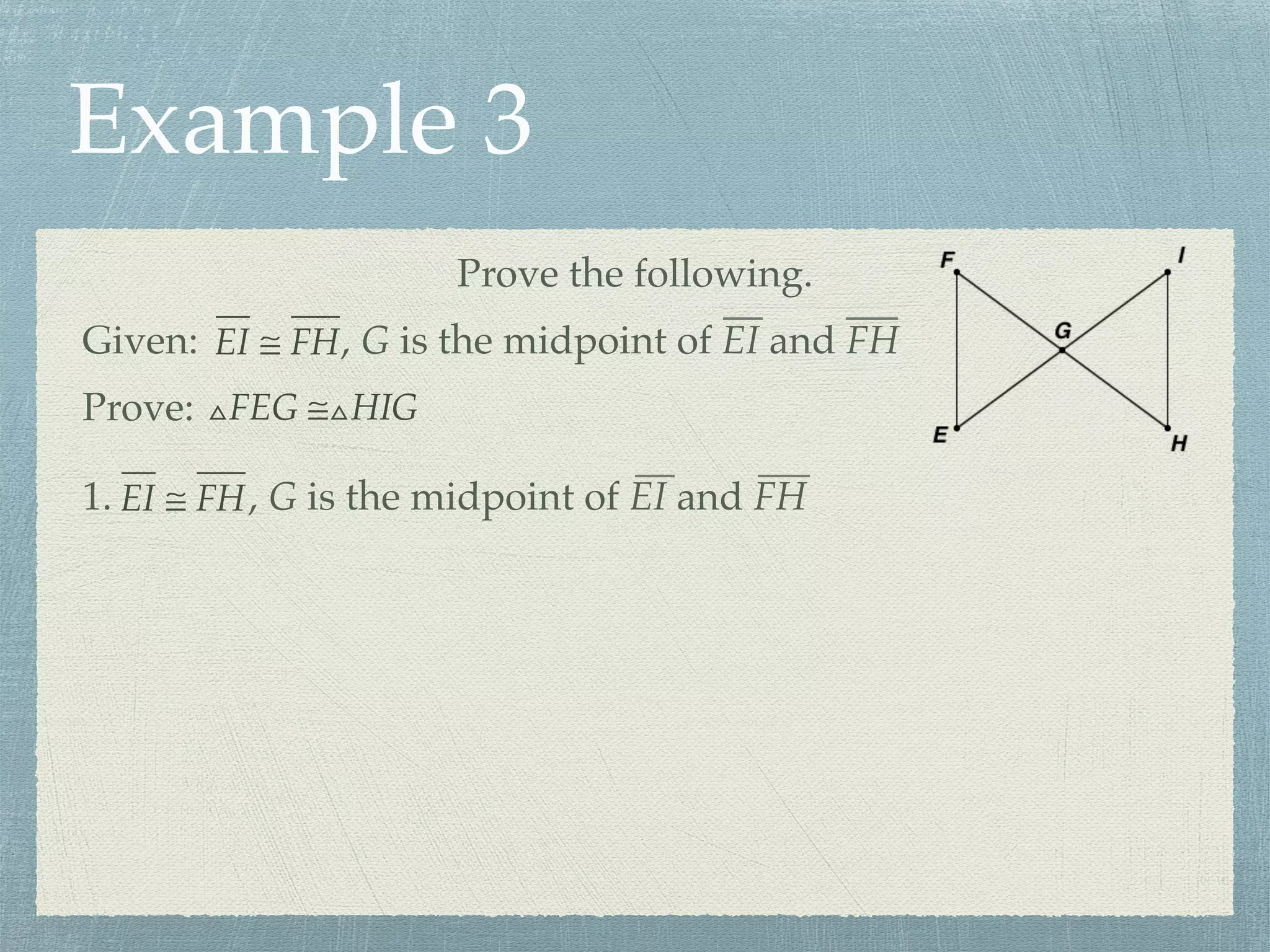
Prove: △FEG ≅△HIG
Given: EI ≅ FH, G is the midpoint of EI and FH
Example 3
Prove the following.
Prove: △FEG ≅△HIG
Given: EI ≅ FH, G is the midpoint of EI and FH
1. EI ≅ FH, G is the midpoint of EI and FH
Example 3
Prove the following.
Prove: △FEG ≅△HIG
Given: EI ≅ FH, G is the midpoint of EI and FH
1. EI ≅ FH, G is the midpoint of EI and FH 1. Given
Example 3
Prove the following.
Prove: △FEG ≅△HIG
Given: EI ≅ FH, G is the midpoint of EI and FH
1. EI ≅ FH, G is the midpoint of EI and FH 1. Given
FG ≅ HG, EG ≅ IG2.
Example 3
Prove the following.
Prove: △FEG ≅△HIG
Given: EI ≅ FH, G is the midpoint of EI and FH
1. EI ≅ FH, G is the midpoint of EI and FH 1. Given
FG ≅ HG, EG ≅ IG2. 2. Midpoint Thm.
Example 3
Prove the following.
Prove: △FEG ≅△HIG
Given: EI ≅ FH, G is the midpoint of EI and FH
1. EI ≅ FH, G is the midpoint of EI and FH 1. Given
FG ≅ HG, EG ≅ IG2. 2. Midpoint Thm.
∠FGE ≅ ∠HGI3.
Example 3
Prove the following.
Prove: △FEG ≅△HIG
Given: EI ≅ FH, G is the midpoint of EI and FH
1. EI ≅ FH, G is the midpoint of EI and FH 1. Given
FG ≅ HG, EG ≅ IG2. 2. Midpoint Thm.
∠FGE ≅ ∠HGI3. 3. Vertical Angles Thm.
Example 3
Prove the following.
Prove: △FEG ≅△HIG
Given: EI ≅ FH, G is the midpoint of EI and FH
1. EI ≅ FH, G is the midpoint of EI and FH 1. Given
FG ≅ HG, EG ≅ IG2. 2. Midpoint Thm.
∠FGE ≅ ∠HGI3. 3. Vertical Angles Thm.
4. △FEG ≅△HIG
Example 3
Prove the following.
Prove: △FEG ≅△HIG
Given: EI ≅ FH, G is the midpoint of EI and FH
1. EI ≅ FH, G is the midpoint of EI and FH 1. Given
FG ≅ HG, EG ≅ IG2. 2. Midpoint Thm.
∠FGE ≅ ∠HGI3. 3. Vertical Angles Thm.
4. △FEG ≅△HIG 4. SAS
Problem Set
Problem Set
p. 266 #1-19 odd, 31, 39, 41
"Doubt whom you will, but never yourself." - Christine Bovee

Geometry Section 4-4 1112

  • 1.
  • 2.
    Essential Questions How doyou use the SSS Postulate to test for triangle congruence? How do you use the SAS Postulate to test for triangle congruence?
  • 3.
    Vocabulary 1. Included Angle: Postulate4.1 - Side-Side-Side (SSS) Congruence: Postulate 4.2 - Side-Angle-Side (SAS) Congruence:
  • 4.
    Vocabulary 1. Included Angle:An angle formed by two adjacent sides of a polygon Postulate 4.1 - Side-Side-Side (SSS) Congruence: Postulate 4.2 - Side-Angle-Side (SAS) Congruence:
  • 5.
    Vocabulary 1. Included Angle:An angle formed by two adjacent sides of a polygon Postulate 4.1 - Side-Side-Side (SSS) Congruence: If three sides of one triangle are congruent to three corresponding sides of a second, then the triangles are congruent Postulate 4.2 - Side-Angle-Side (SAS) Congruence:
  • 6.
    Vocabulary 1. Included Angle:An angle formed by two adjacent sides of a polygon Postulate 4.1 - Side-Side-Side (SSS) Congruence: If three sides of one triangle are congruent to three corresponding sides of a second, then the triangles are congruent Postulate 4.2 - Side-Angle-Side (SAS) Congruence: If two sides and the included angle of one triangle are congruent to two corresponding sides and included angle of a second triangle, then the triangles are congruent
  • 7.
    Example 1 Prove thefollowing. Given: QU ≅ AD, QD ≅ AU Prove: △QUD ≅△ADU
  • 8.
    Example 1 Prove thefollowing. Given: QU ≅ AD, QD ≅ AU Prove: △QUD ≅△ADU 1. QU ≅ AD, QD ≅ AU
  • 9.
    Example 1 Prove thefollowing. Given: QU ≅ AD, QD ≅ AU Prove: △QUD ≅△ADU 1. QU ≅ AD, QD ≅ AU 1. Given
  • 10.
    Example 1 Prove thefollowing. Given: QU ≅ AD, QD ≅ AU Prove: △QUD ≅△ADU 1. QU ≅ AD, QD ≅ AU 1. Given 2. DU ≅ DU
  • 11.
    Example 1 Prove thefollowing. Given: QU ≅ AD, QD ≅ AU Prove: △QUD ≅△ADU 1. QU ≅ AD, QD ≅ AU 1. Given 2. DU ≅ DU 2. Reflexive
  • 12.
    Example 1 Prove thefollowing. Given: QU ≅ AD, QD ≅ AU Prove: △QUD ≅△ADU 1. QU ≅ AD, QD ≅ AU 1. Given 2. DU ≅ DU 2. Reflexive 3. DU ≅ UD
  • 13.
    Example 1 Prove thefollowing. Given: QU ≅ AD, QD ≅ AU Prove: △QUD ≅△ADU 1. QU ≅ AD, QD ≅ AU 1. Given 2. DU ≅ DU 2. Reflexive 3. DU ≅ UD 3. Symmetric
  • 14.
    Example 1 Prove thefollowing. Given: QU ≅ AD, QD ≅ AU Prove: △QUD ≅△ADU 1. QU ≅ AD, QD ≅ AU 1. Given 2. DU ≅ DU 2. Reflexive 3. DU ≅ UD 3. Symmetric 4. △QUD ≅△ADU
  • 15.
    Example 1 Prove thefollowing. Given: QU ≅ AD, QD ≅ AU Prove: △QUD ≅△ADU 1. QU ≅ AD, QD ≅ AU 1. Given 2. DU ≅ DU 2. Reflexive 3. DU ≅ UD 3. Symmetric 4. △QUD ≅△ADU 4. SSS
  • 16.
    Example 2 ∆DVW hasvertices D(−5, −1), V(−1, −2), and W(−7, −4). ∆LPM has vertices L(1, −5), P(2, −1), and M(4, −7). Graph both triangles on the coordinate plane. Then, using your drawing, determine whether the triangles are congruent or not, providing a logical argument for your statement.
  • 17.
    Example 2 ∆DVW hasvertices D(−5, −1), V(−1, −2), and W(−7, −4). ∆LPM has vertices L(1, −5), P(2, −1), and M(4, −7). Graph both triangles on the coordinate plane. Then, using your drawing, determine whether the triangles are congruent or not, providing a logical argument for your statement. x y
  • 18.
    Example 2 ∆DVW hasvertices D(−5, −1), V(−1, −2), and W(−7, −4). ∆LPM has vertices L(1, −5), P(2, −1), and M(4, −7). Graph both triangles on the coordinate plane. Then, using your drawing, determine whether the triangles are congruent or not, providing a logical argument for your statement. x y D
  • 19.
    Example 2 ∆DVW hasvertices D(−5, −1), V(−1, −2), and W(−7, −4). ∆LPM has vertices L(1, −5), P(2, −1), and M(4, −7). Graph both triangles on the coordinate plane. Then, using your drawing, determine whether the triangles are congruent or not, providing a logical argument for your statement. x y D V
  • 20.
    Example 2 ∆DVW hasvertices D(−5, −1), V(−1, −2), and W(−7, −4). ∆LPM has vertices L(1, −5), P(2, −1), and M(4, −7). Graph both triangles on the coordinate plane. Then, using your drawing, determine whether the triangles are congruent or not, providing a logical argument for your statement. x y D V W
  • 21.
    Example 2 ∆DVW hasvertices D(−5, −1), V(−1, −2), and W(−7, −4). ∆LPM has vertices L(1, −5), P(2, −1), and M(4, −7). Graph both triangles on the coordinate plane. Then, using your drawing, determine whether the triangles are congruent or not, providing a logical argument for your statement. x y D V W
  • 22.
    Example 2 ∆DVW hasvertices D(−5, −1), V(−1, −2), and W(−7, −4). ∆LPM has vertices L(1, −5), P(2, −1), and M(4, −7). Graph both triangles on the coordinate plane. Then, using your drawing, determine whether the triangles are congruent or not, providing a logical argument for your statement. x y D V W L
  • 23.
    Example 2 ∆DVW hasvertices D(−5, −1), V(−1, −2), and W(−7, −4). ∆LPM has vertices L(1, −5), P(2, −1), and M(4, −7). Graph both triangles on the coordinate plane. Then, using your drawing, determine whether the triangles are congruent or not, providing a logical argument for your statement. x y D V W L P
  • 24.
    Example 2 ∆DVW hasvertices D(−5, −1), V(−1, −2), and W(−7, −4). ∆LPM has vertices L(1, −5), P(2, −1), and M(4, −7). Graph both triangles on the coordinate plane. Then, using your drawing, determine whether the triangles are congruent or not, providing a logical argument for your statement. x y D V W L P M
  • 25.
    Example 2 ∆DVW hasvertices D(−5, −1), V(−1, −2), and W(−7, −4). ∆LPM has vertices L(1, −5), P(2, −1), and M(4, −7). Graph both triangles on the coordinate plane. Then, using your drawing, determine whether the triangles are congruent or not, providing a logical argument for your statement. x y D V W L P M
  • 26.
    Example 2 ∆DVW hasvertices D(−5, −1), V(−1, −2), and W(−7, −4). ∆LPM has vertices L(1, −5), P(2, −1), and M(4, −7). Graph both triangles on the coordinate plane. Then, using your drawing, determine whether the triangles are congruent or not, providing a logical argument for your statement. x y D V W L P M These are congruent. What possible ways could we show this?
  • 27.
    Example 3 Prove thefollowing. Prove: △FEG ≅△HIG Given: EI ≅ FH, G is the midpoint of EI and FH
  • 28.
    Example 3 Prove thefollowing. Prove: △FEG ≅△HIG Given: EI ≅ FH, G is the midpoint of EI and FH 1. EI ≅ FH, G is the midpoint of EI and FH
  • 29.
    Example 3 Prove thefollowing. Prove: △FEG ≅△HIG Given: EI ≅ FH, G is the midpoint of EI and FH 1. EI ≅ FH, G is the midpoint of EI and FH 1. Given
  • 30.
    Example 3 Prove thefollowing. Prove: △FEG ≅△HIG Given: EI ≅ FH, G is the midpoint of EI and FH 1. EI ≅ FH, G is the midpoint of EI and FH 1. Given FG ≅ HG, EG ≅ IG2.
  • 31.
    Example 3 Prove thefollowing. Prove: △FEG ≅△HIG Given: EI ≅ FH, G is the midpoint of EI and FH 1. EI ≅ FH, G is the midpoint of EI and FH 1. Given FG ≅ HG, EG ≅ IG2. 2. Midpoint Thm.
  • 32.
    Example 3 Prove thefollowing. Prove: △FEG ≅△HIG Given: EI ≅ FH, G is the midpoint of EI and FH 1. EI ≅ FH, G is the midpoint of EI and FH 1. Given FG ≅ HG, EG ≅ IG2. 2. Midpoint Thm. ∠FGE ≅ ∠HGI3.
  • 33.
    Example 3 Prove thefollowing. Prove: △FEG ≅△HIG Given: EI ≅ FH, G is the midpoint of EI and FH 1. EI ≅ FH, G is the midpoint of EI and FH 1. Given FG ≅ HG, EG ≅ IG2. 2. Midpoint Thm. ∠FGE ≅ ∠HGI3. 3. Vertical Angles Thm.
  • 34.
    Example 3 Prove thefollowing. Prove: △FEG ≅△HIG Given: EI ≅ FH, G is the midpoint of EI and FH 1. EI ≅ FH, G is the midpoint of EI and FH 1. Given FG ≅ HG, EG ≅ IG2. 2. Midpoint Thm. ∠FGE ≅ ∠HGI3. 3. Vertical Angles Thm. 4. △FEG ≅△HIG
  • 35.
    Example 3 Prove thefollowing. Prove: △FEG ≅△HIG Given: EI ≅ FH, G is the midpoint of EI and FH 1. EI ≅ FH, G is the midpoint of EI and FH 1. Given FG ≅ HG, EG ≅ IG2. 2. Midpoint Thm. ∠FGE ≅ ∠HGI3. 3. Vertical Angles Thm. 4. △FEG ≅△HIG 4. SAS
  • 36.
  • 37.
    Problem Set p. 266#1-19 odd, 31, 39, 41 "Doubt whom you will, but never yourself." - Christine Bovee