UNIT 4.2 TRIANGLE CONGRUENCE
BY SSS AND SAS
Warm Up
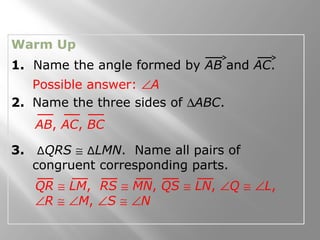
1. Name the angle formed by AB and AC.
2. Name the three sides of ∆ABC.
3. ∆QRS ≅ ∆LMN. Name all pairs of
congruent corresponding parts.
Possible answer: ∠A
QR ≅ LM, RS ≅ MN, QS ≅ LN, ∠Q ≅ ∠L,
∠R ≅ ∠M, ∠S ≅ ∠N
AB, AC, BC
Apply SSS and SAS to construct
triangles and solve problems.
Prove triangles congruent by using SSS
and SAS.
Objectives
triangle rigidity
included angle
Vocabulary
In Lesson 4-3, you proved triangles
congruent by showing that all six pairs
of corresponding parts were congruent.
The property of triangle rigidity gives
you a shortcut for proving two triangles
congruent. It states that if the side
lengths of a triangle are given, the
triangle can have only one shape.
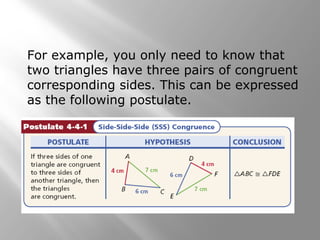
For example, you only need to know that
two triangles have three pairs of congruent
corresponding sides. This can be expressed
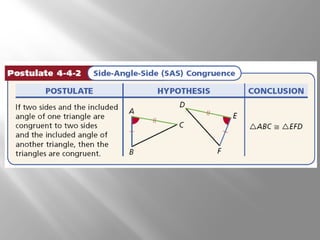
as the following postulate.
Adjacent triangles share a side, so you
can apply the Reflexive Property to get
a pair of congruent parts.
Remember!
Example 1: Using SSS to Prove Triangle Congruence
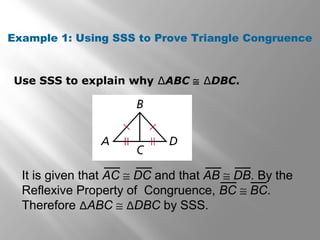
Use SSS to explain why ∆ABC ≅ ∆DBC.
It is given that AC ≅ DC and that AB ≅ DB. By the
Reflexive Property of Congruence, BC ≅ BC.
Therefore ∆ABC ≅ ∆DBC by SSS.
Check It Out! Example 1
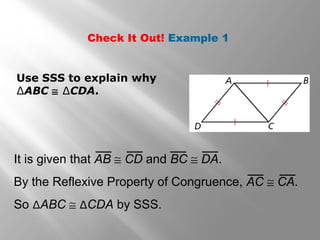
Use SSS to explain why
∆ABC ≅ ∆CDA.
It is given that AB ≅ CD and BC ≅ DA.
By the Reflexive Property of Congruence, AC ≅ CA.
So ∆ABC ≅ ∆CDA by SSS.
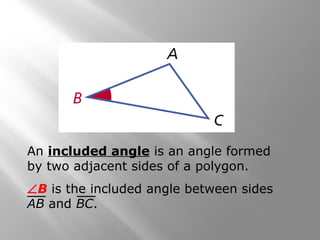
An included angle is an angle formed
by two adjacent sides of a polygon.
∠B is the included angle between sides
AB and BC.
It can also be shown that only two
pairs of congruent corresponding sides
are needed to prove the congruence of
two triangles if the included angles are
also congruent.
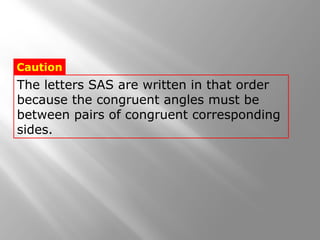
The letters SAS are written in that order
because the congruent angles must be
between pairs of congruent corresponding
sides.
Caution
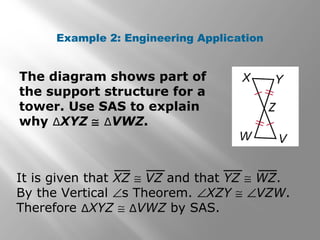
Example 2: Engineering Application
The diagram shows part of
the support structure for a
tower. Use SAS to explain
why ∆XYZ ≅ ∆VWZ.
It is given that XZ ≅ VZ and that YZ ≅ WZ.
By the Vertical ∠s Theorem. ∠XZY ≅ ∠VZW.
Therefore ∆XYZ ≅ ∆VWZ by SAS.
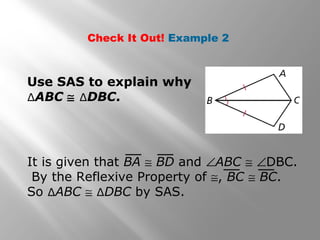
Check It Out! Example 2
Use SAS to explain why
∆ABC ≅ ∆DBC.
It is given that BA ≅ BD and ∠ABC ≅ ∠DBC.
By the Reflexive Property of ≅, BC ≅ BC.
So ∆ABC ≅ ∆DBC by SAS.
The SAS Postulate guarantees
that if you are given the lengths of
two sides and the measure of the
included angles, you can construct
one and only one triangle.
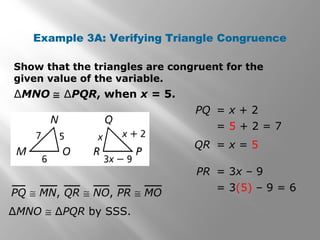
Example 3A: Verifying Triangle Congruence
Show that the triangles are congruent for the
given value of the variable.
∆MNO ≅ ∆PQR, when x = 5.
∆MNO ≅ ∆PQR by SSS.
PQ = x + 2
= 5 + 2 = 7
PQ ≅ MN, QR ≅ NO, PR ≅ MO
QR = x = 5
PR = 3x – 9
= 3(5) – 9 = 6
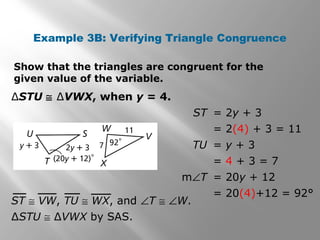
Example 3B: Verifying Triangle Congruence
∆STU ≅ ∆VWX, when y = 4.
∆STU ≅ ∆VWX by SAS.
ST = 2y + 3
= 2(4) + 3 = 11
TU = y + 3
= 4 + 3 = 7
m∠T = 20y + 12
= 20(4)+12 = 92°
ST ≅ VW, TU ≅ WX, and ∠T ≅ ∠W.
Show that the triangles are congruent for the
given value of the variable.
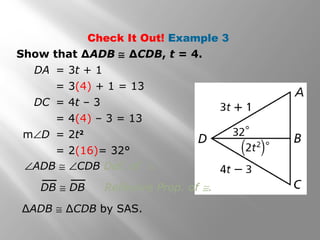
Check It Out! Example 3
Show that ∆ADB ≅ ∆CDB, t = 4.
DA = 3t + 1
= 3(4) + 1 = 13
DC = 4t – 3
= 4(4) – 3 = 13
m∠D = 2t2
= 2(16)= 32°
∆ADB ≅ ∆CDB by SAS.
DB ≅ DB Reflexive Prop. of ≅.
∠ADB ≅ ∠CDB Def. of ≅.
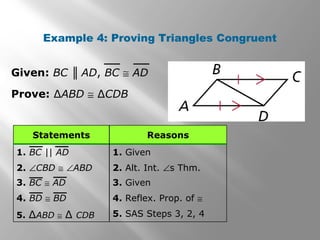
Example 4: Proving Triangles Congruent
Given: BC ║ AD, BC ≅ AD
Prove: ∆ABD ≅ ∆CDB
ReasonsStatements
5. SAS Steps 3, 2, 45. ∆ABD ≅ ∆ CDB
4. Reflex. Prop. of ≅
3. Given
2. Alt. Int. ∠s Thm.2. ∠CBD ≅ ∠ABD
1. Given1. BC || AD
3. BC ≅ AD
4. BD ≅ BD
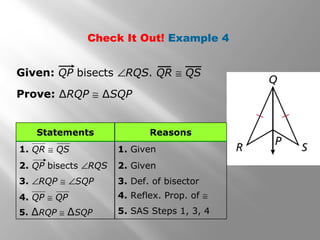
Check It Out! Example 4
Given: QP bisects ∠RQS. QR ≅ QS
Prove: ∆RQP ≅ ∆SQP
ReasonsStatements
5. SAS Steps 1, 3, 45. ∆RQP ≅ ∆SQP
4. Reflex. Prop. of ≅
1. Given
3. Def. of bisector3. ∠RQP ≅ ∠SQP
2. Given2. QP bisects ∠RQS
1. QR ≅ QS
4. QP ≅ QP
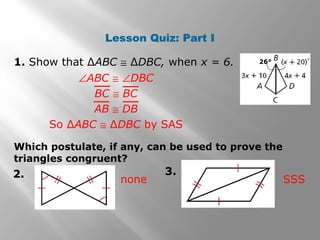
Lesson Quiz: Part I
1. Show that ∆ABC ≅ ∆DBC, when x = 6.
∠ABC ≅ ∠DBC
BC ≅ BC
AB ≅ DB
So ∆ABC ≅ ∆DBC by SAS
Which postulate, if any, can be used to prove the
triangles congruent?
2. 3.
none SSS
26°
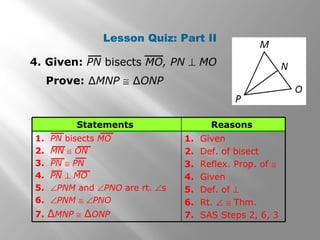
Lesson Quiz: Part II
4. Given: PN bisects MO, PN ⊥ MO
Prove: ∆MNP ≅ ∆ONP
1. Given
2. Def. of bisect
3. Reflex. Prop. of ≅
4. Given
5. Def. of ⊥
6. Rt. ∠ ≅ Thm.
7. SAS Steps 2, 6, 3
1. PN bisects MO
2. MN ≅ ON
3. PN ≅ PN
4. PN ⊥ MO
5. ∠PNM and ∠PNO are rt. ∠s
6. ∠PNM ≅ ∠PNO
7. ∆MNP ≅ ∆ONP
ReasonsStatements
All rights belong to their
respective owners.
Copyright Disclaimer Under
Section 107 of the
Copyright Act 1976,
allowance is made for "fair
use" for purposes such as
criticism, comment, news
reporting, TEACHING,
scholarship, and research.
Fair use is a use permitted
by copyright statute that
might otherwise be
infringing.
Non-profit, EDUCATIONAL
or personal use tips the
balance in favor of fair use.

Geometry 201 unit 4.2

  • 1.
    UNIT 4.2 TRIANGLECONGRUENCE BY SSS AND SAS
  • 2.
    Warm Up 1. Namethe angle formed by AB and AC. 2. Name the three sides of ∆ABC. 3. ∆QRS ≅ ∆LMN. Name all pairs of congruent corresponding parts. Possible answer: ∠A QR ≅ LM, RS ≅ MN, QS ≅ LN, ∠Q ≅ ∠L, ∠R ≅ ∠M, ∠S ≅ ∠N AB, AC, BC
  • 3.
    Apply SSS andSAS to construct triangles and solve problems. Prove triangles congruent by using SSS and SAS. Objectives
  • 4.
  • 5.
    In Lesson 4-3,you proved triangles congruent by showing that all six pairs of corresponding parts were congruent. The property of triangle rigidity gives you a shortcut for proving two triangles congruent. It states that if the side lengths of a triangle are given, the triangle can have only one shape.
  • 6.
    For example, youonly need to know that two triangles have three pairs of congruent corresponding sides. This can be expressed as the following postulate.
  • 7.
    Adjacent triangles sharea side, so you can apply the Reflexive Property to get a pair of congruent parts. Remember!
  • 8.
    Example 1: UsingSSS to Prove Triangle Congruence Use SSS to explain why ∆ABC ≅ ∆DBC. It is given that AC ≅ DC and that AB ≅ DB. By the Reflexive Property of Congruence, BC ≅ BC. Therefore ∆ABC ≅ ∆DBC by SSS.
  • 9.
    Check It Out!Example 1 Use SSS to explain why ∆ABC ≅ ∆CDA. It is given that AB ≅ CD and BC ≅ DA. By the Reflexive Property of Congruence, AC ≅ CA. So ∆ABC ≅ ∆CDA by SSS.
  • 10.
    An included angleis an angle formed by two adjacent sides of a polygon. ∠B is the included angle between sides AB and BC.
  • 11.
    It can alsobe shown that only two pairs of congruent corresponding sides are needed to prove the congruence of two triangles if the included angles are also congruent.
  • 13.
    The letters SASare written in that order because the congruent angles must be between pairs of congruent corresponding sides. Caution
  • 14.
    Example 2: EngineeringApplication The diagram shows part of the support structure for a tower. Use SAS to explain why ∆XYZ ≅ ∆VWZ. It is given that XZ ≅ VZ and that YZ ≅ WZ. By the Vertical ∠s Theorem. ∠XZY ≅ ∠VZW. Therefore ∆XYZ ≅ ∆VWZ by SAS.
  • 15.
    Check It Out!Example 2 Use SAS to explain why ∆ABC ≅ ∆DBC. It is given that BA ≅ BD and ∠ABC ≅ ∠DBC. By the Reflexive Property of ≅, BC ≅ BC. So ∆ABC ≅ ∆DBC by SAS.
  • 16.
    The SAS Postulateguarantees that if you are given the lengths of two sides and the measure of the included angles, you can construct one and only one triangle.
  • 17.
    Example 3A: VerifyingTriangle Congruence Show that the triangles are congruent for the given value of the variable. ∆MNO ≅ ∆PQR, when x = 5. ∆MNO ≅ ∆PQR by SSS. PQ = x + 2 = 5 + 2 = 7 PQ ≅ MN, QR ≅ NO, PR ≅ MO QR = x = 5 PR = 3x – 9 = 3(5) – 9 = 6
  • 18.
    Example 3B: VerifyingTriangle Congruence ∆STU ≅ ∆VWX, when y = 4. ∆STU ≅ ∆VWX by SAS. ST = 2y + 3 = 2(4) + 3 = 11 TU = y + 3 = 4 + 3 = 7 m∠T = 20y + 12 = 20(4)+12 = 92° ST ≅ VW, TU ≅ WX, and ∠T ≅ ∠W. Show that the triangles are congruent for the given value of the variable.
  • 19.
    Check It Out!Example 3 Show that ∆ADB ≅ ∆CDB, t = 4. DA = 3t + 1 = 3(4) + 1 = 13 DC = 4t – 3 = 4(4) – 3 = 13 m∠D = 2t2 = 2(16)= 32° ∆ADB ≅ ∆CDB by SAS. DB ≅ DB Reflexive Prop. of ≅. ∠ADB ≅ ∠CDB Def. of ≅.
  • 20.
    Example 4: ProvingTriangles Congruent Given: BC ║ AD, BC ≅ AD Prove: ∆ABD ≅ ∆CDB ReasonsStatements 5. SAS Steps 3, 2, 45. ∆ABD ≅ ∆ CDB 4. Reflex. Prop. of ≅ 3. Given 2. Alt. Int. ∠s Thm.2. ∠CBD ≅ ∠ABD 1. Given1. BC || AD 3. BC ≅ AD 4. BD ≅ BD
  • 21.
    Check It Out!Example 4 Given: QP bisects ∠RQS. QR ≅ QS Prove: ∆RQP ≅ ∆SQP ReasonsStatements 5. SAS Steps 1, 3, 45. ∆RQP ≅ ∆SQP 4. Reflex. Prop. of ≅ 1. Given 3. Def. of bisector3. ∠RQP ≅ ∠SQP 2. Given2. QP bisects ∠RQS 1. QR ≅ QS 4. QP ≅ QP
  • 22.
    Lesson Quiz: PartI 1. Show that ∆ABC ≅ ∆DBC, when x = 6. ∠ABC ≅ ∠DBC BC ≅ BC AB ≅ DB So ∆ABC ≅ ∆DBC by SAS Which postulate, if any, can be used to prove the triangles congruent? 2. 3. none SSS 26°
  • 23.
    Lesson Quiz: PartII 4. Given: PN bisects MO, PN ⊥ MO Prove: ∆MNP ≅ ∆ONP 1. Given 2. Def. of bisect 3. Reflex. Prop. of ≅ 4. Given 5. Def. of ⊥ 6. Rt. ∠ ≅ Thm. 7. SAS Steps 2, 6, 3 1. PN bisects MO 2. MN ≅ ON 3. PN ≅ PN 4. PN ⊥ MO 5. ∠PNM and ∠PNO are rt. ∠s 6. ∠PNM ≅ ∠PNO 7. ∆MNP ≅ ∆ONP ReasonsStatements
  • 24.
    All rights belongto their respective owners. Copyright Disclaimer Under Section 107 of the Copyright Act 1976, allowance is made for "fair use" for purposes such as criticism, comment, news reporting, TEACHING, scholarship, and research. Fair use is a use permitted by copyright statute that might otherwise be infringing. Non-profit, EDUCATIONAL or personal use tips the balance in favor of fair use.