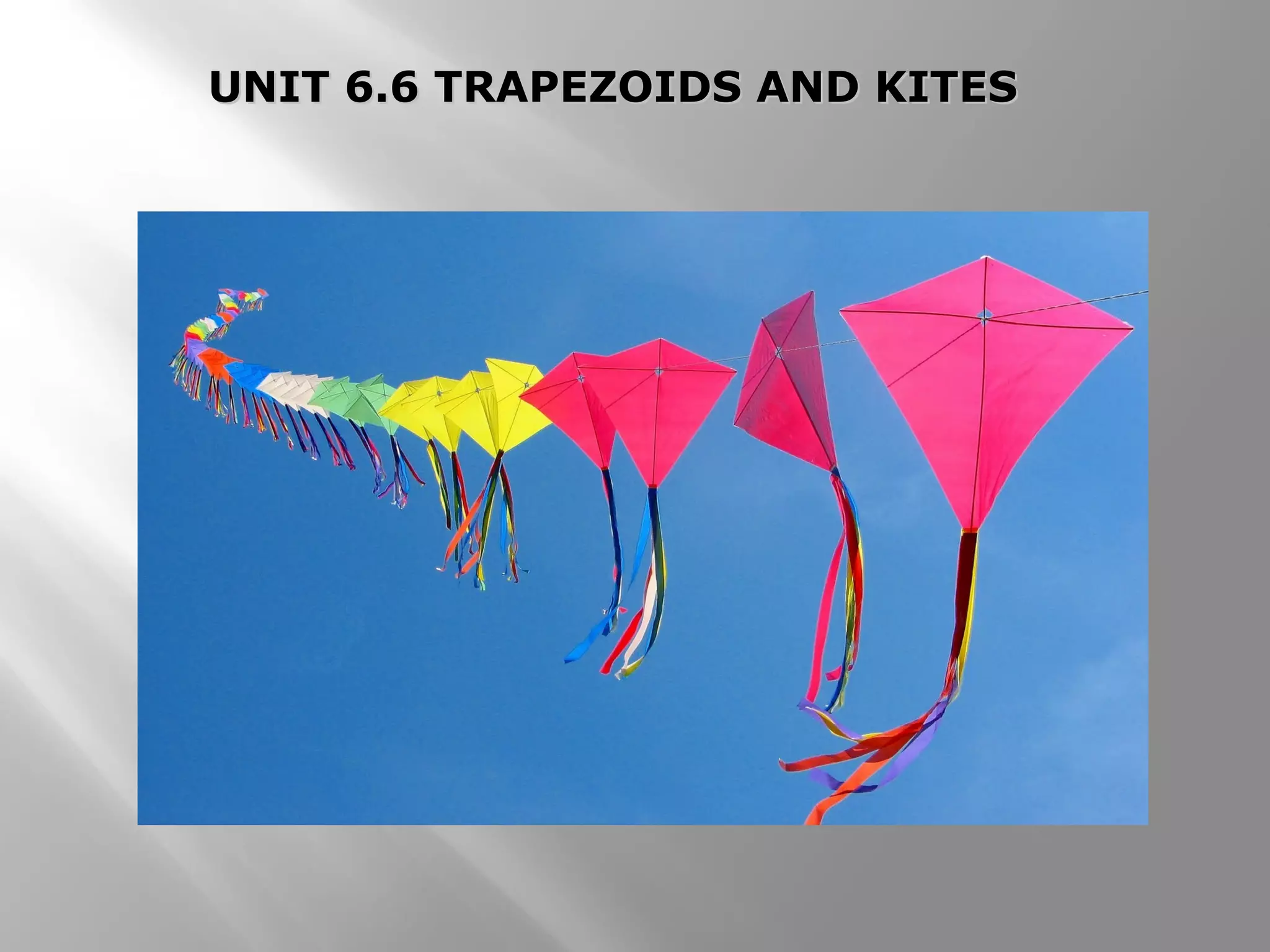

UUNNIITT 66..66 TTRRAAPPEEZZOOIIDDSS AANNDD KKIITTEESS
Poperties of Kites and Trapezoids 
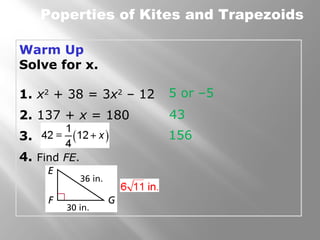
Warm Up 
Solve for x. 
1. x2 + 38 = 3x2 – 12 
2. 137 + x = 180 
3. 
4. Find FE. 
5 or –5 
43 
156
Objectives 
Use properties of kites to solve 
problems. 
Use properties of trapezoids to solve 
problems.
Vocabulary 
kite 
trapezoid 
base of a trapezoid 
leg of a trapezoid 
base angle of a trapezoid 
isosceles trapezoid 
midsegment of a trapezoid
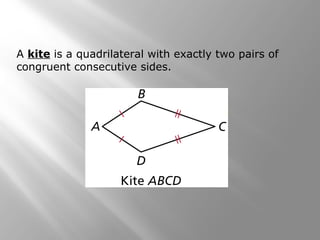
A kite is a quadrilateral with exactly two pairs of 
congruent consecutive sides.
Example 1: Problem-Solving Application 
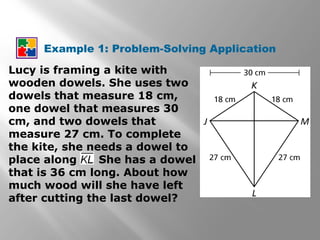
Lucy is framing a kite with 
wooden dowels. She uses two 
dowels that measure 18 cm, 
one dowel that measures 30 
cm, and two dowels that 
measure 27 cm. To complete 
the kite, she needs a dowel to 
place along . She has a dowel 
that is 36 cm long. About how 
much wood will she have left 
after cutting the last dowel?
Example 1 Continued 
11 Understand the Problem 
The answer will be the amount of wood Lucy has 
left after cutting the dowel. 
22 Make a Plan 
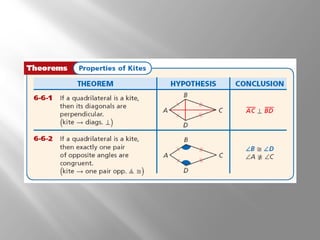
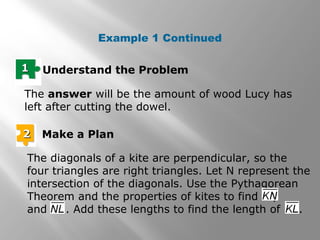
The diagonals of a kite are perpendicular, so the 
four triangles are right triangles. Let N represent the 
intersection of the diagonals. Use the Pythagorean 
Theorem and the properties of kites to find , 
and . Add these lengths to find the length of .
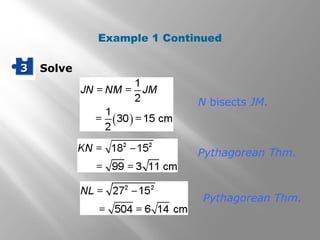
33 Solve 
Example 1 Continued 
N bisects JM. 
Pythagorean Thm. 
Pythagorean Thm.
Example 1 Continued 
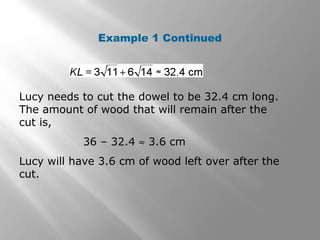
Lucy needs to cut the dowel to be 32.4 cm long. 
The amount of wood that will remain after the 
cut is, 
36 – 32.4 » 3.6 cm 
Lucy will have 3.6 cm of wood left over after the 
cut.
Example 1 Continued 
44 Look Back 
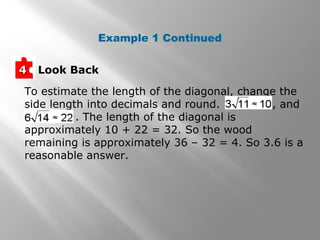
To estimate the length of the diagonal, change the 
side length into decimals and round. , and 
. The length of the diagonal is 
approximately 10 + 22 = 32. So the wood 
remaining is approximately 36 – 32 = 4. So 3.6 is a 
reasonable answer.
Check It Out! Example 1 
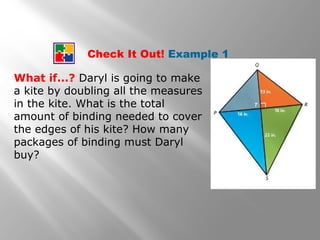
What if...? Daryl is going to make 
a kite by doubling all the measures 
in the kite. What is the total 
amount of binding needed to cover 
the edges of his kite? How many 
packages of binding must Daryl 
buy?
Check It Out! Example 1 Continued 
11 Understand the Problem 
The answer has two parts. 
• the total length of binding Daryl needs 
• the number of packages of binding Daryl must 
buy
Check It Out! Example 1 Continued 
22 Make a Plan 
The diagonals of a kite are perpendicular, so the 
four triangles are right triangles. Use the 
Pythagorean Theorem and the properties of 
kites to find the unknown side lengths. Add 
these lengths to find the perimeter of the kite.
Check It Out! Example 1 Continued 
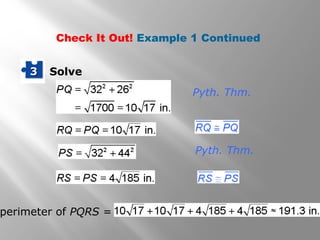
33 Solve 
Pyth. Thm. 
Pyth. Thm. 
perimeter of PQRS =
Check It Out! Example 1 Continued 
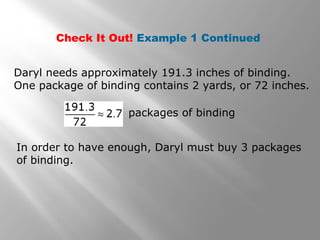
Daryl needs approximately 191.3 inches of binding. 
One package of binding contains 2 yards, or 72 inches. 
packages of binding 
In order to have enough, Daryl must buy 3 packages 
of binding.
Check It Out! Example 1 Continued 
44 Look Back 
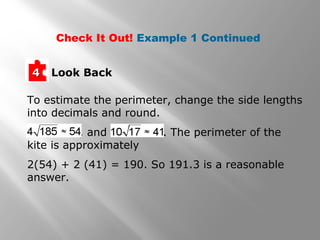
To estimate the perimeter, change the side lengths 
into decimals and round. 
, and . The perimeter of the 
kite is approximately 
2(54) + 2 (41) = 190. So 191.3 is a reasonable 
answer.
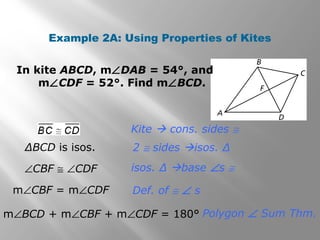
Example 2A: Using Properties of Kites 
In kite ABCD, mÐDAB = 54°, and 
mÐCDF = 52°. Find mÐBCD. 
Kite  cons. sides @ 
ΔBCD is isos. 2 @ sides isos. Δ 
isos. Δ base Ðs @ 
Def. of @ Ð s 
Polygon Ð Sum Thm. 
ÐCBF @ ÐCDF 
mÐCBF = mÐCDF 
mÐBCD + mÐCBF + mÐCDF = 180°
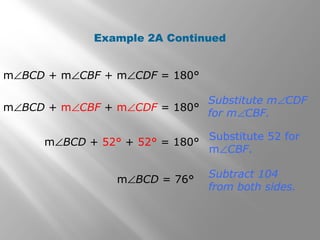
Example 2A Continued 
Substitute mÐCDF 
for mÐCBF. 
Substitute 52 for 
mÐCBF. 
Subtract 104 
from both sides. 
mÐBCD + mÐCBF + mÐCDF = 180° 
mÐBCD + 52° + 52° = 180° 
mÐBCD = 76°
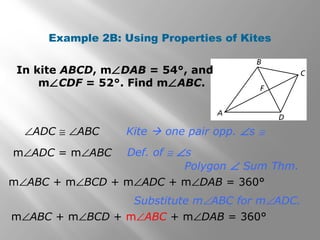
Example 2B: Using Properties of Kites 
In kite ABCD, mÐDAB = 54°, and 
mÐCDF = 52°. Find mÐABC. 
Kite  one pair opp. Ðs @ 
Def. of @ Ðs 
Polygon Ð Sum Thm. 
ÐADC @ ÐABC 
mÐADC = mÐABC 
mÐABC + mÐBCD + mÐADC + mÐDAB = 360° 
Substitute mÐABC for mÐADC. 
mÐABC + mÐBCD + mÐABC + mÐDAB = 360°
Example 2B Continued 
mÐABC + mÐBCD + mÐABC + mÐDAB = 360° 
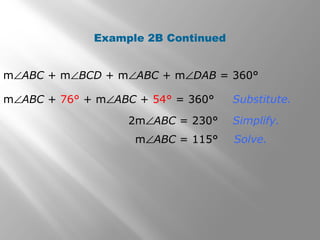
mÐABC + 76° + mÐABC + 54° = 360° 
Substitute. 
Simplify. 
2mÐABC = 230° 
mÐABC = 115° Solve.
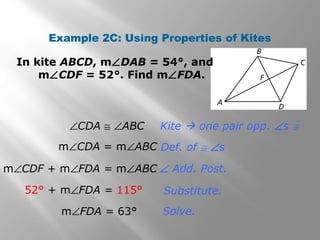
Example 2C: Using Properties of Kites 
In kite ABCD, mÐDAB = 54°, and 
mÐCDF = 52°. Find mÐFDA. 
Kite  one pair opp. Ðs @ 
Def. of @ Ðs 
Ð Add. Post. 
Substitute. 
Solve. 
ÐCDA @ ÐABC 
mÐCDA = mÐABC 
mÐCDF + mÐFDA = mÐABC 
52° + mÐFDA = 115° 
mÐFDA = 63°
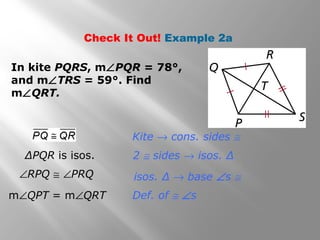
Check It Out! Example 2a 
In kite PQRS, mÐPQR = 78°, 
and mÐTRS = 59°. Find 
mÐQRT. 
Kite ® cons. sides @ 
ΔPQR is isos. 2 @ sides ® isos. Δ 
isos. Δ ® base Ðs @ 
Def. of @ Ðs 
ÐRPQ @ ÐPRQ 
mÐQPT = mÐQRT
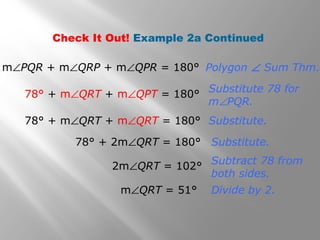
Check It Out! Example 2a Continued 
Polygon Ð Sum Thm. 
Substitute 78 for 
mÐPQR. 
mÐPQR + mÐQRP + mÐQPR = 180° 
78° + mÐQRT + mÐQPT = 180° 
78° + mÐQRT + mÐQRT = 180° Substitute. 
78° + 2mÐQRT = 180° 
2mÐQRT = 102° 
mÐQRT = 51° 
Substitute. 
Subtract 78 from 
both sides. 
Divide by 2.
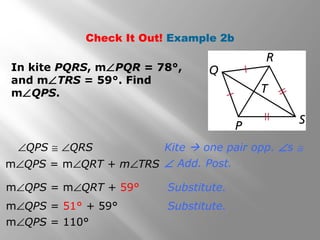
Check It Out! Example 2b 
In kite PQRS, mÐPQR = 78°, 
and mÐTRS = 59°. Find 
mÐQPS. 
Kite  one pair opp. Ðs @ 
Ð Add. Post. 
Substitute. 
Substitute. 
ÐQPS @ ÐQRS 
mÐQPS = mÐQRT + mÐTRS 
mÐQPS = mÐQRT + 59° 
mÐQPS = 51° + 59° 
mÐQPS = 110°
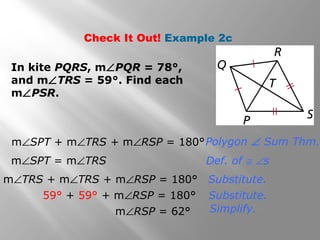
Check It Out! Example 2c 
Polygon Ð Sum Thm. 
Def. of @ Ðs 
Substitute. 
Substitute. 
Simplify. 
In kite PQRS, mÐPQR = 78°, 
and mÐTRS = 59°. Find each 
mÐPSR. 
mÐSPT + mÐTRS + mÐRSP = 180° 
mÐSPT = mÐTRS 
mÐTRS + mÐTRS + mÐRSP = 180° 
59° + 59° + mÐRSP = 180° 
mÐRSP = 62°
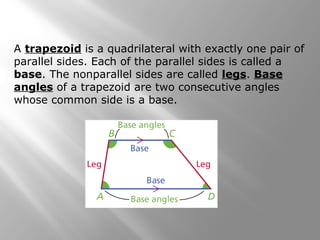
A trapezoid is a quadrilateral with exactly one pair of 
parallel sides. Each of the parallel sides is called a 
base. The nonparallel sides are called legs. Base 
angles of a trapezoid are two consecutive angles 
whose common side is a base.
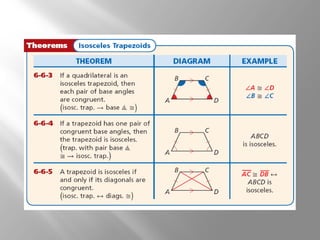
If the legs of a trapezoid are congruent, the trapezoid 
is an isosceles trapezoid. The following theorems 
state the properties of an isosceles trapezoid.
Reading Math 
Theorem 6-6-5 is a biconditional statement. So it 
is true both “forward” and “backward.”
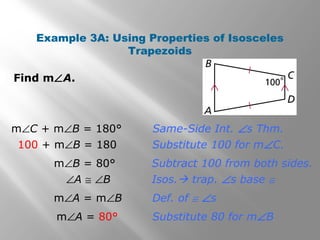
Example 3A: Using Properties of Isosceles 
Trapezoids 
Isos. trap. Ðs base @ 
Find mÐA. 
Same-Side Int. Ðs Thm. 
Substitute 100 for mÐC. 
Subtract 100 from both sides. 
Def. of @ Ðs 
Substitute 80 for mÐB 
mÐC + mÐB = 180° 
100 + mÐB = 180 
mÐB = 80° 
ÐA @ ÐB 
mÐA = mÐB 
mÐA = 80°
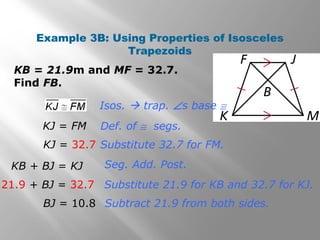
Example 3B: Using Properties of Isosceles 
Trapezoids 
KB = 21.9m and MF = 32.7. 
Find FB. 
Isos.  trap. Ðs base @ 
Def. of @ segs. 
Substitute 32.7 for FM. 
Seg. Add. Post. 
Substitute 21.9 for KB and 32.7 for KJ. 
Subtract 21.9 from both sides. 
KJ = FM 
KJ = 32.7 
KB + BJ = KJ 
21.9 + BJ = 32.7 
BJ = 10.8
Example 3B Continued 
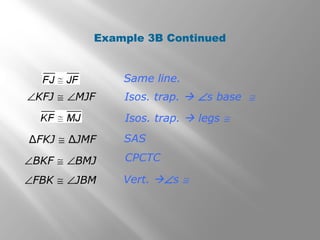
Same line. 
Isos. trap.  Ðs base @ 
Isos. trap.  legs @ 
SAS 
CPCTC 
Vert. Ðs @ 
ÐKFJ @ ÐMJF 
ΔFKJ @ ΔJMF 
ÐBKF @ ÐBMJ 
ÐFBK @ ÐJBM
Example 3B Continued 
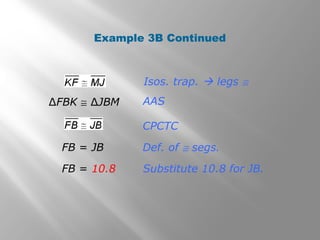
Isos. trap.  legs @ 
AAS 
CPCTC 
Def. of @ segs. 
Substitute 10.8 for JB. 
ΔFBK @ ΔJBM 
FB = JB 
FB = 10.8
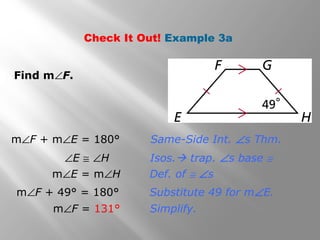
Check It Out! Example 3a 
Same-Side Int. Ðs Thm. 
Isos. trap. Ðs base @ 
Def. of @ Ðs 
Substitute 49 for mÐE. 
mÐF + mÐE = 180° 
ÐE @ ÐH 
mÐE = mÐH 
mÐF + 49° = 180° 
mÐF = 131° 
Simplify. 
Find mÐF.
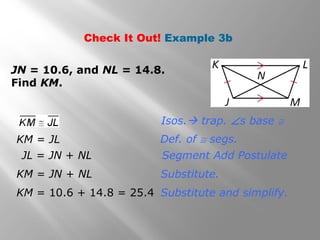
Check It Out! Example 3b 
JN = 10.6, and NL = 14.8. 
Find KM. 
Isos. trap. Ðs base @ 
Def. of @ segs. 
Segment Add Postulate 
Substitute. 
Substitute and simplify. 
KM = JL 
JL = JN + NL 
KM = JN + NL 
KM = 10.6 + 14.8 = 25.4
Example 4A: Applying Conditions for Isosceles 
Trapezoids 
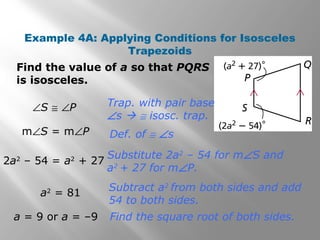
Find the value of a so that PQRS 
is isosceles. 
a = 9 or a = –9 
Trap. with pair base 
Ðs  @ isosc. trap. 
Def. of @ Ðs 
Substitute 2a2 – 54 for mÐS and 
a2 + 27 for mÐP. 
Subtract a2 from both sides and add 
54 to both sides. 
Find the square root of both sides. 
ÐS @ ÐP 
mÐS = mÐP 
2a2 – 54 = a2 + 27 
a2 = 81
Example 4B: Applying Conditions for Isosceles 
Trapezoids 
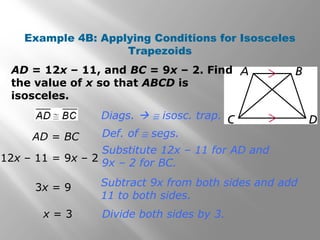
AD = 12x – 11, and BC = 9x – 2. Find 
the value of x so that ABCD is 
isosceles. 
Diags.  @ isosc. trap. 
Def. of @ segs. 
Substitute 12x – 11 for AD and 
9x – 2 for BC. 
Subtract 9x from both sides and add 
11 to both sides. 
Divide both sides by 3. 
AD = BC 
12x – 11 = 9x – 2 
3x = 9 
x = 3
Check It Out! Example 4 
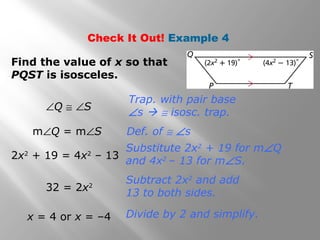
Find the value of x so that 
PQST is isosceles. 
Trap. with pair base 
ÐQ @ ÐS Ðs  @ isosc. trap. 
Def. of @ Ðs 
Substitute 2x2 + 19 for mÐQ 
and 4x2 – 13 for mÐS. 
Subtract 2x2 and add 
13 to both sides. 
mÐQ = mÐS 
2x2 + 19 = 4x2 – 13 
32 = 2x2 
x = 4 or x = –4 Divide by 2 and simplify.
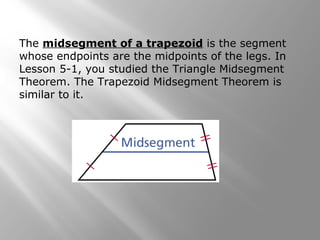
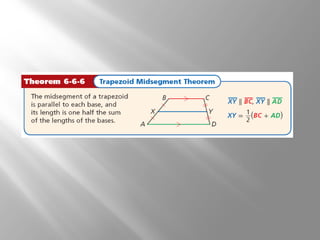
The midsegment of a trapezoid is the segment 
whose endpoints are the midpoints of the legs. In 
Lesson 5-1, you studied the Triangle Midsegment 
Theorem. The Trapezoid Midsegment Theorem is 
similar to it.
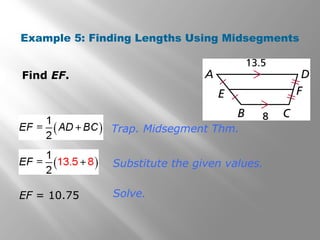
Example 5: Finding Lengths Using Midsegments 
Find EF. 
Trap. Midsegment Thm. 
Substitute the given values. 
EF = 10.75 Solve.
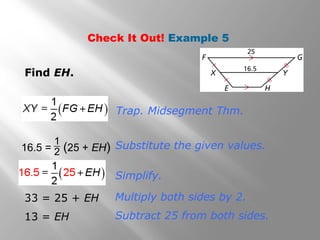
Check It Out! Example 5 
Find EH. 
Trap. Midsegment Thm. 
Substitute the given values. 
Simplify. 
16.5 = 1 (25 + EH) 2 
33 = 25 + EH Multiply both sides by 2. 
13 = EH Subtract 25 from both sides.
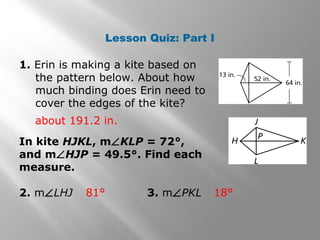
Lesson Quiz: Part I 
1. Erin is making a kite based on 
the pattern below. About how 
much binding does Erin need to 
cover the edges of the kite? 
about 191.2 in. 
In kite HJKL, mÐKLP = 72°, 
and mÐHJP = 49.5°. Find each 
measure. 
2. mÐLHJ 3. mÐPKL 
81° 18°
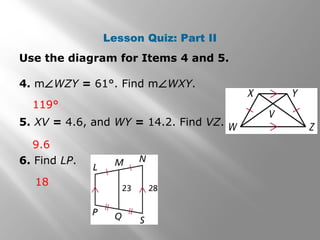
Lesson Quiz: Part II 
Use the diagram for Items 4 and 5. 
4. mÐWZY = 61°. Find mÐWXY. 
119° 
5. XV = 4.6, and WY = 14.2. Find VZ. 
9.6 
6. Find LP. 
18
All rights belong to their 
respective owners. 
Copyright Disclaimer Under 
Section 107 of the 
Copyright Act 1976, 
allowance is made for "fair 
use" for purposes such as 
criticism, comment, news 
reporting, TEACHING, 
scholarship, and research. 
Fair use is a use permitted 
by copyright statute that 
might otherwise be 
infringing. 
Non-profit, EDUCATIONAL 
or personal use tips the 
balance in favor of fair use.

Geometry unit 6.6

  • 1.
  • 2.
    Poperties of Kitesand Trapezoids Warm Up Solve for x. 1. x2 + 38 = 3x2 – 12 2. 137 + x = 180 3. 4. Find FE. 5 or –5 43 156
  • 3.
    Objectives Use propertiesof kites to solve problems. Use properties of trapezoids to solve problems.
  • 4.
    Vocabulary kite trapezoid base of a trapezoid leg of a trapezoid base angle of a trapezoid isosceles trapezoid midsegment of a trapezoid
  • 5.
    A kite isa quadrilateral with exactly two pairs of congruent consecutive sides.
  • 7.
    Example 1: Problem-SolvingApplication Lucy is framing a kite with wooden dowels. She uses two dowels that measure 18 cm, one dowel that measures 30 cm, and two dowels that measure 27 cm. To complete the kite, she needs a dowel to place along . She has a dowel that is 36 cm long. About how much wood will she have left after cutting the last dowel?
  • 8.
    Example 1 Continued 11 Understand the Problem The answer will be the amount of wood Lucy has left after cutting the dowel. 22 Make a Plan The diagonals of a kite are perpendicular, so the four triangles are right triangles. Let N represent the intersection of the diagonals. Use the Pythagorean Theorem and the properties of kites to find , and . Add these lengths to find the length of .
  • 9.
    33 Solve Example1 Continued N bisects JM. Pythagorean Thm. Pythagorean Thm.
  • 10.
    Example 1 Continued Lucy needs to cut the dowel to be 32.4 cm long. The amount of wood that will remain after the cut is, 36 – 32.4 » 3.6 cm Lucy will have 3.6 cm of wood left over after the cut.
  • 11.
    Example 1 Continued 44 Look Back To estimate the length of the diagonal, change the side length into decimals and round. , and . The length of the diagonal is approximately 10 + 22 = 32. So the wood remaining is approximately 36 – 32 = 4. So 3.6 is a reasonable answer.
  • 12.
    Check It Out!Example 1 What if...? Daryl is going to make a kite by doubling all the measures in the kite. What is the total amount of binding needed to cover the edges of his kite? How many packages of binding must Daryl buy?
  • 13.
    Check It Out!Example 1 Continued 11 Understand the Problem The answer has two parts. • the total length of binding Daryl needs • the number of packages of binding Daryl must buy
  • 14.
    Check It Out!Example 1 Continued 22 Make a Plan The diagonals of a kite are perpendicular, so the four triangles are right triangles. Use the Pythagorean Theorem and the properties of kites to find the unknown side lengths. Add these lengths to find the perimeter of the kite.
  • 15.
    Check It Out!Example 1 Continued 33 Solve Pyth. Thm. Pyth. Thm. perimeter of PQRS =
  • 16.
    Check It Out!Example 1 Continued Daryl needs approximately 191.3 inches of binding. One package of binding contains 2 yards, or 72 inches. packages of binding In order to have enough, Daryl must buy 3 packages of binding.
  • 17.
    Check It Out!Example 1 Continued 44 Look Back To estimate the perimeter, change the side lengths into decimals and round. , and . The perimeter of the kite is approximately 2(54) + 2 (41) = 190. So 191.3 is a reasonable answer.
  • 18.
    Example 2A: UsingProperties of Kites In kite ABCD, mÐDAB = 54°, and mÐCDF = 52°. Find mÐBCD. Kite  cons. sides @ ΔBCD is isos. 2 @ sides isos. Δ isos. Δ base Ðs @ Def. of @ Ð s Polygon Ð Sum Thm. ÐCBF @ ÐCDF mÐCBF = mÐCDF mÐBCD + mÐCBF + mÐCDF = 180°
  • 19.
    Example 2A Continued Substitute mÐCDF for mÐCBF. Substitute 52 for mÐCBF. Subtract 104 from both sides. mÐBCD + mÐCBF + mÐCDF = 180° mÐBCD + mÐCBF + mÐCDF = 180° mÐBCD + 52° + 52° = 180° mÐBCD = 76°
  • 20.
    Example 2B: UsingProperties of Kites In kite ABCD, mÐDAB = 54°, and mÐCDF = 52°. Find mÐABC. Kite  one pair opp. Ðs @ Def. of @ Ðs Polygon Ð Sum Thm. ÐADC @ ÐABC mÐADC = mÐABC mÐABC + mÐBCD + mÐADC + mÐDAB = 360° Substitute mÐABC for mÐADC. mÐABC + mÐBCD + mÐABC + mÐDAB = 360°
  • 21.
    Example 2B Continued mÐABC + mÐBCD + mÐABC + mÐDAB = 360° mÐABC + 76° + mÐABC + 54° = 360° Substitute. Simplify. 2mÐABC = 230° mÐABC = 115° Solve.
  • 22.
    Example 2C: UsingProperties of Kites In kite ABCD, mÐDAB = 54°, and mÐCDF = 52°. Find mÐFDA. Kite  one pair opp. Ðs @ Def. of @ Ðs Ð Add. Post. Substitute. Solve. ÐCDA @ ÐABC mÐCDA = mÐABC mÐCDF + mÐFDA = mÐABC 52° + mÐFDA = 115° mÐFDA = 63°
  • 23.
    Check It Out!Example 2a In kite PQRS, mÐPQR = 78°, and mÐTRS = 59°. Find mÐQRT. Kite ® cons. sides @ ΔPQR is isos. 2 @ sides ® isos. Δ isos. Δ ® base Ðs @ Def. of @ Ðs ÐRPQ @ ÐPRQ mÐQPT = mÐQRT
  • 24.
    Check It Out!Example 2a Continued Polygon Ð Sum Thm. Substitute 78 for mÐPQR. mÐPQR + mÐQRP + mÐQPR = 180° 78° + mÐQRT + mÐQPT = 180° 78° + mÐQRT + mÐQRT = 180° Substitute. 78° + 2mÐQRT = 180° 2mÐQRT = 102° mÐQRT = 51° Substitute. Subtract 78 from both sides. Divide by 2.
  • 25.
    Check It Out!Example 2b In kite PQRS, mÐPQR = 78°, and mÐTRS = 59°. Find mÐQPS. Kite  one pair opp. Ðs @ Ð Add. Post. Substitute. Substitute. ÐQPS @ ÐQRS mÐQPS = mÐQRT + mÐTRS mÐQPS = mÐQRT + 59° mÐQPS = 51° + 59° mÐQPS = 110°
  • 26.
    Check It Out!Example 2c Polygon Ð Sum Thm. Def. of @ Ðs Substitute. Substitute. Simplify. In kite PQRS, mÐPQR = 78°, and mÐTRS = 59°. Find each mÐPSR. mÐSPT + mÐTRS + mÐRSP = 180° mÐSPT = mÐTRS mÐTRS + mÐTRS + mÐRSP = 180° 59° + 59° + mÐRSP = 180° mÐRSP = 62°
  • 27.
    A trapezoid isa quadrilateral with exactly one pair of parallel sides. Each of the parallel sides is called a base. The nonparallel sides are called legs. Base angles of a trapezoid are two consecutive angles whose common side is a base.
  • 28.
    If the legsof a trapezoid are congruent, the trapezoid is an isosceles trapezoid. The following theorems state the properties of an isosceles trapezoid.
  • 30.
    Reading Math Theorem6-6-5 is a biconditional statement. So it is true both “forward” and “backward.”
  • 31.
    Example 3A: UsingProperties of Isosceles Trapezoids Isos. trap. Ðs base @ Find mÐA. Same-Side Int. Ðs Thm. Substitute 100 for mÐC. Subtract 100 from both sides. Def. of @ Ðs Substitute 80 for mÐB mÐC + mÐB = 180° 100 + mÐB = 180 mÐB = 80° ÐA @ ÐB mÐA = mÐB mÐA = 80°
  • 32.
    Example 3B: UsingProperties of Isosceles Trapezoids KB = 21.9m and MF = 32.7. Find FB. Isos.  trap. Ðs base @ Def. of @ segs. Substitute 32.7 for FM. Seg. Add. Post. Substitute 21.9 for KB and 32.7 for KJ. Subtract 21.9 from both sides. KJ = FM KJ = 32.7 KB + BJ = KJ 21.9 + BJ = 32.7 BJ = 10.8
  • 33.
    Example 3B Continued Same line. Isos. trap.  Ðs base @ Isos. trap.  legs @ SAS CPCTC Vert. Ðs @ ÐKFJ @ ÐMJF ΔFKJ @ ΔJMF ÐBKF @ ÐBMJ ÐFBK @ ÐJBM
  • 34.
    Example 3B Continued Isos. trap.  legs @ AAS CPCTC Def. of @ segs. Substitute 10.8 for JB. ΔFBK @ ΔJBM FB = JB FB = 10.8
  • 35.
    Check It Out!Example 3a Same-Side Int. Ðs Thm. Isos. trap. Ðs base @ Def. of @ Ðs Substitute 49 for mÐE. mÐF + mÐE = 180° ÐE @ ÐH mÐE = mÐH mÐF + 49° = 180° mÐF = 131° Simplify. Find mÐF.
  • 36.
    Check It Out!Example 3b JN = 10.6, and NL = 14.8. Find KM. Isos. trap. Ðs base @ Def. of @ segs. Segment Add Postulate Substitute. Substitute and simplify. KM = JL JL = JN + NL KM = JN + NL KM = 10.6 + 14.8 = 25.4
  • 37.
    Example 4A: ApplyingConditions for Isosceles Trapezoids Find the value of a so that PQRS is isosceles. a = 9 or a = –9 Trap. with pair base Ðs  @ isosc. trap. Def. of @ Ðs Substitute 2a2 – 54 for mÐS and a2 + 27 for mÐP. Subtract a2 from both sides and add 54 to both sides. Find the square root of both sides. ÐS @ ÐP mÐS = mÐP 2a2 – 54 = a2 + 27 a2 = 81
  • 38.
    Example 4B: ApplyingConditions for Isosceles Trapezoids AD = 12x – 11, and BC = 9x – 2. Find the value of x so that ABCD is isosceles. Diags.  @ isosc. trap. Def. of @ segs. Substitute 12x – 11 for AD and 9x – 2 for BC. Subtract 9x from both sides and add 11 to both sides. Divide both sides by 3. AD = BC 12x – 11 = 9x – 2 3x = 9 x = 3
  • 39.
    Check It Out!Example 4 Find the value of x so that PQST is isosceles. Trap. with pair base ÐQ @ ÐS Ðs  @ isosc. trap. Def. of @ Ðs Substitute 2x2 + 19 for mÐQ and 4x2 – 13 for mÐS. Subtract 2x2 and add 13 to both sides. mÐQ = mÐS 2x2 + 19 = 4x2 – 13 32 = 2x2 x = 4 or x = –4 Divide by 2 and simplify.
  • 40.
    The midsegment ofa trapezoid is the segment whose endpoints are the midpoints of the legs. In Lesson 5-1, you studied the Triangle Midsegment Theorem. The Trapezoid Midsegment Theorem is similar to it.
  • 42.
    Example 5: FindingLengths Using Midsegments Find EF. Trap. Midsegment Thm. Substitute the given values. EF = 10.75 Solve.
  • 43.
    Check It Out!Example 5 Find EH. Trap. Midsegment Thm. Substitute the given values. Simplify. 16.5 = 1 (25 + EH) 2 33 = 25 + EH Multiply both sides by 2. 13 = EH Subtract 25 from both sides.
  • 44.
    Lesson Quiz: PartI 1. Erin is making a kite based on the pattern below. About how much binding does Erin need to cover the edges of the kite? about 191.2 in. In kite HJKL, mÐKLP = 72°, and mÐHJP = 49.5°. Find each measure. 2. mÐLHJ 3. mÐPKL 81° 18°
  • 45.
    Lesson Quiz: PartII Use the diagram for Items 4 and 5. 4. mÐWZY = 61°. Find mÐWXY. 119° 5. XV = 4.6, and WY = 14.2. Find VZ. 9.6 6. Find LP. 18
  • 46.
    All rights belongto their respective owners. Copyright Disclaimer Under Section 107 of the Copyright Act 1976, allowance is made for "fair use" for purposes such as criticism, comment, news reporting, TEACHING, scholarship, and research. Fair use is a use permitted by copyright statute that might otherwise be infringing. Non-profit, EDUCATIONAL or personal use tips the balance in favor of fair use.