Section 3-6
                            Perpendiculars and Distance


Thursday, January 5, 2012
Essential Questions

             n      How do you find the distance between a point and
                     a line?


             n      How do you find the distance between parallel
                     lines?


Thursday, January 5, 2012
Vocabulary
     1. Equidistant:


     2. Distance Between a Point and a Line:


     3. Distance Between Parallel Lines:


Thursday, January 5, 2012
Vocabulary
     1. Equidistant: The distance between any two lines as
        measured along a perpendicular is the same; this
        occurs with parallel lines
     2. Distance Between a Point and a Line:


     3. Distance Between Parallel Lines:


Thursday, January 5, 2012
Vocabulary
     1. Equidistant: The distance between any two lines as
        measured along a perpendicular is the same; this
        occurs with parallel lines
     2. Distance Between a Point and a Line: The length
        of the segment perpendicular to the line with the
        point one endpoint on the segment
     3. Distance Between Parallel Lines:


Thursday, January 5, 2012
Vocabulary
     1. Equidistant: The distance between any two lines as
        measured along a perpendicular is the same; this
        occurs with parallel lines
     2. Distance Between a Point and a Line: The length
        of the segment perpendicular to the line with the
        point one endpoint on the segment
     3. Distance Between Parallel Lines: The length of the
        segment perpendicular to the two parallel lines with
        the endpoints on either of the parallel lines

Thursday, January 5, 2012
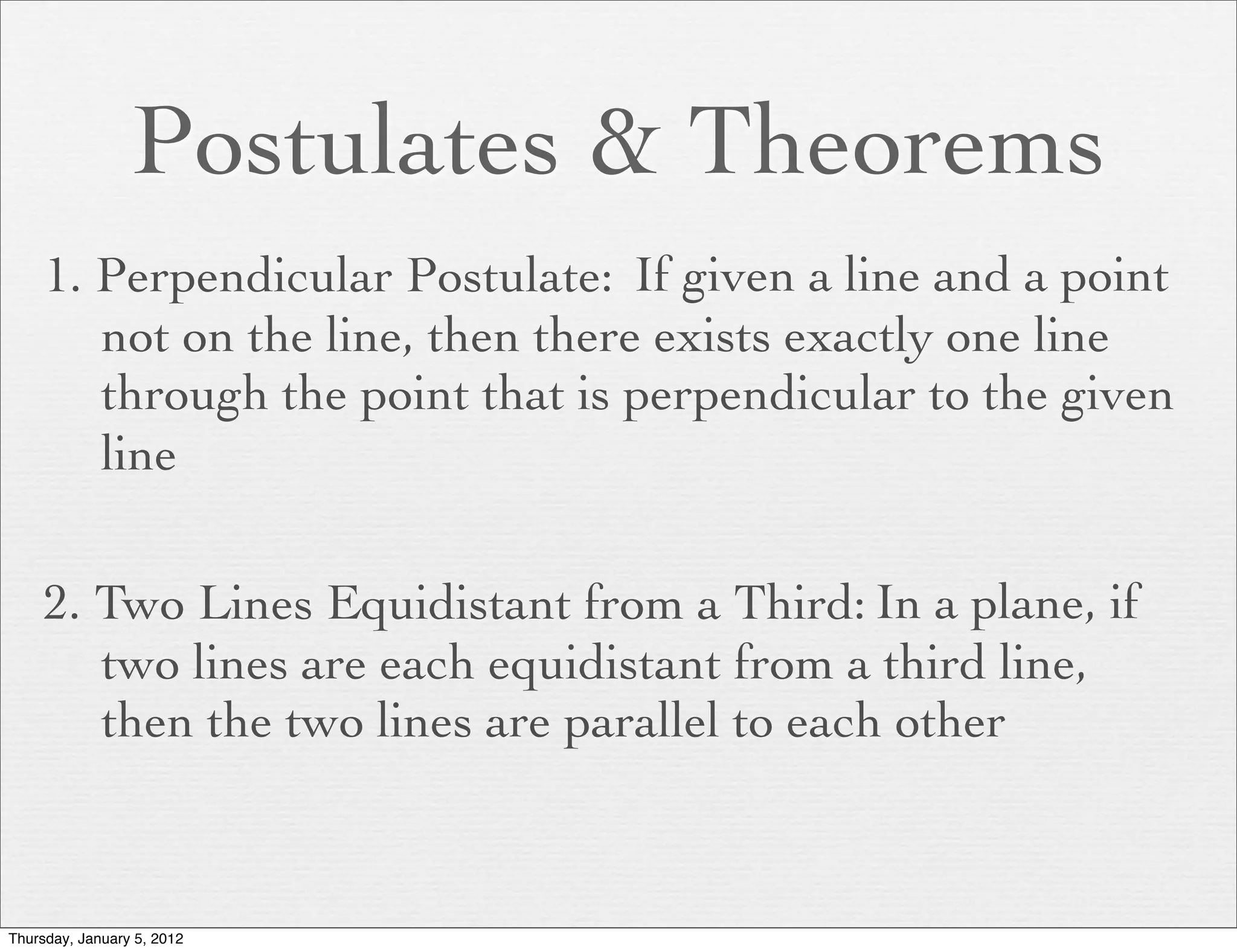
Postulates & Theorems
     1. Perpendicular Postulate:


     2. Two Lines Equidistant from a Third:


Thursday, January 5, 2012
Postulates & Theorems
     1. Perpendicular Postulate: If given a line and a point
        not on the line, then there exists exactly one line
        through the point that is perpendicular to the given
        line

     2. Two Lines Equidistant from a Third:


Thursday, January 5, 2012
Postulates & Theorems
     1. Perpendicular Postulate: If given a line and a point
        not on the line, then there exists exactly one line
        through the point that is perpendicular to the given
        line

     2. Two Lines Equidistant from a Third: In a plane, if
        two lines are each equidistant from a third line,
        then the two lines are parallel to each other


Thursday, January 5, 2012
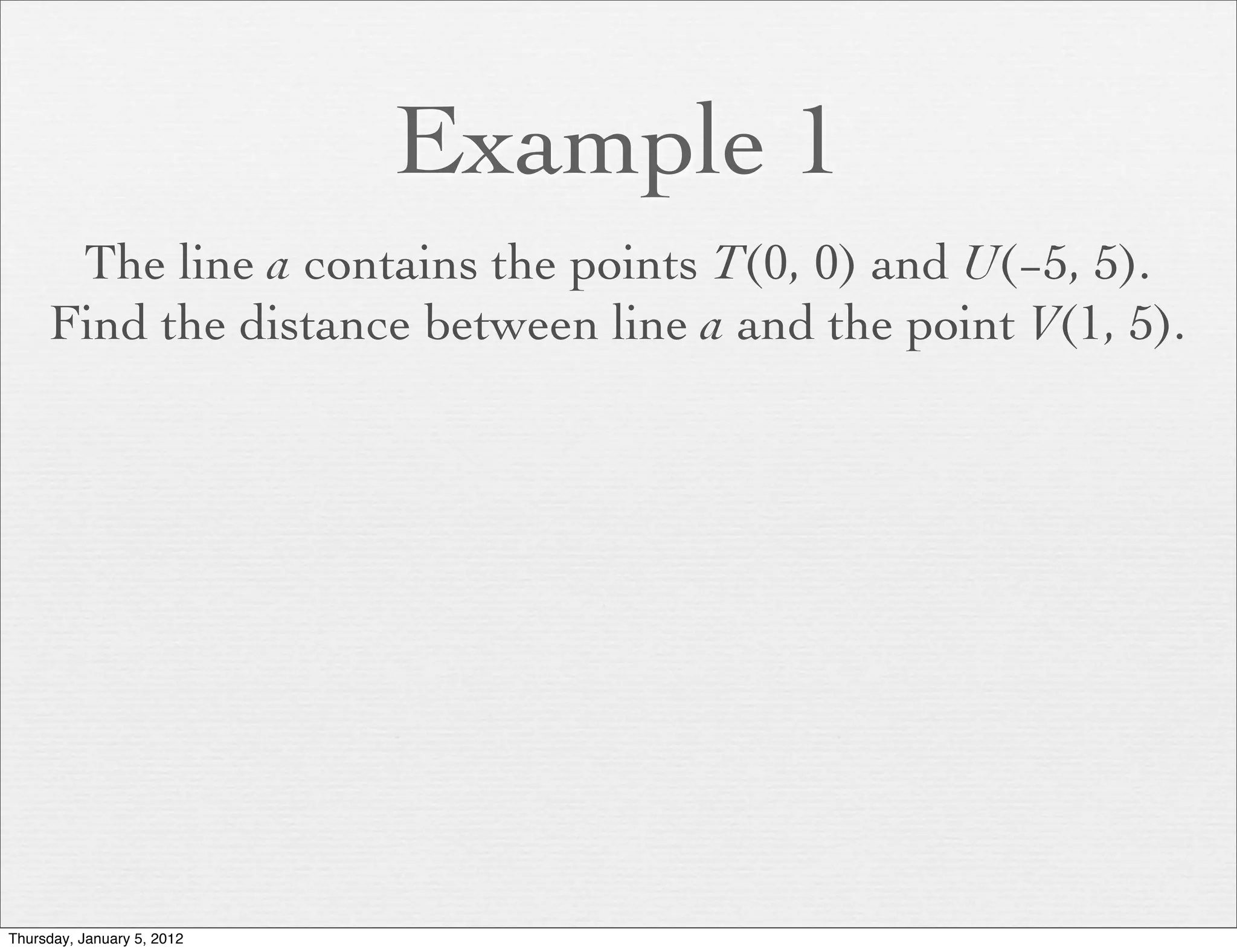
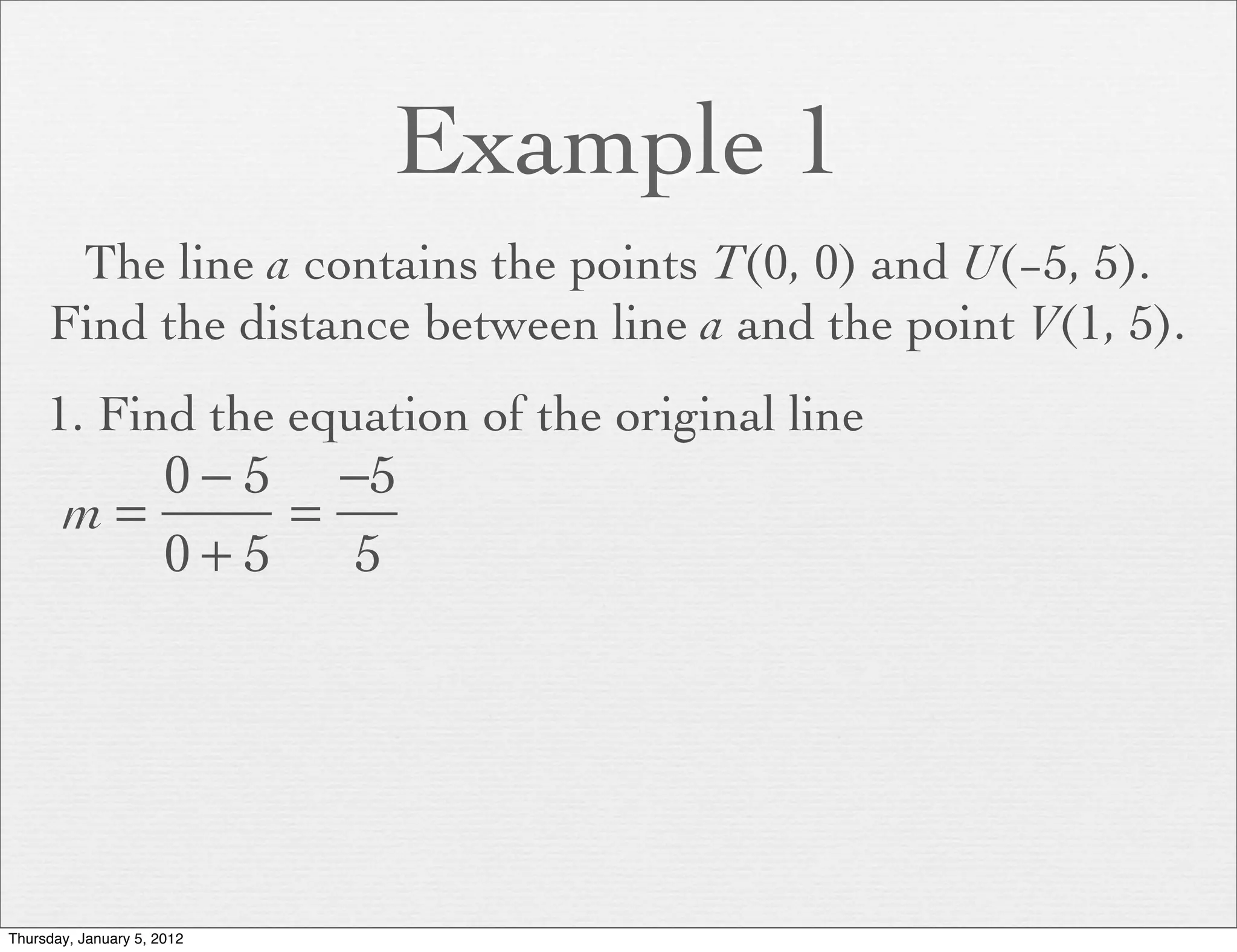
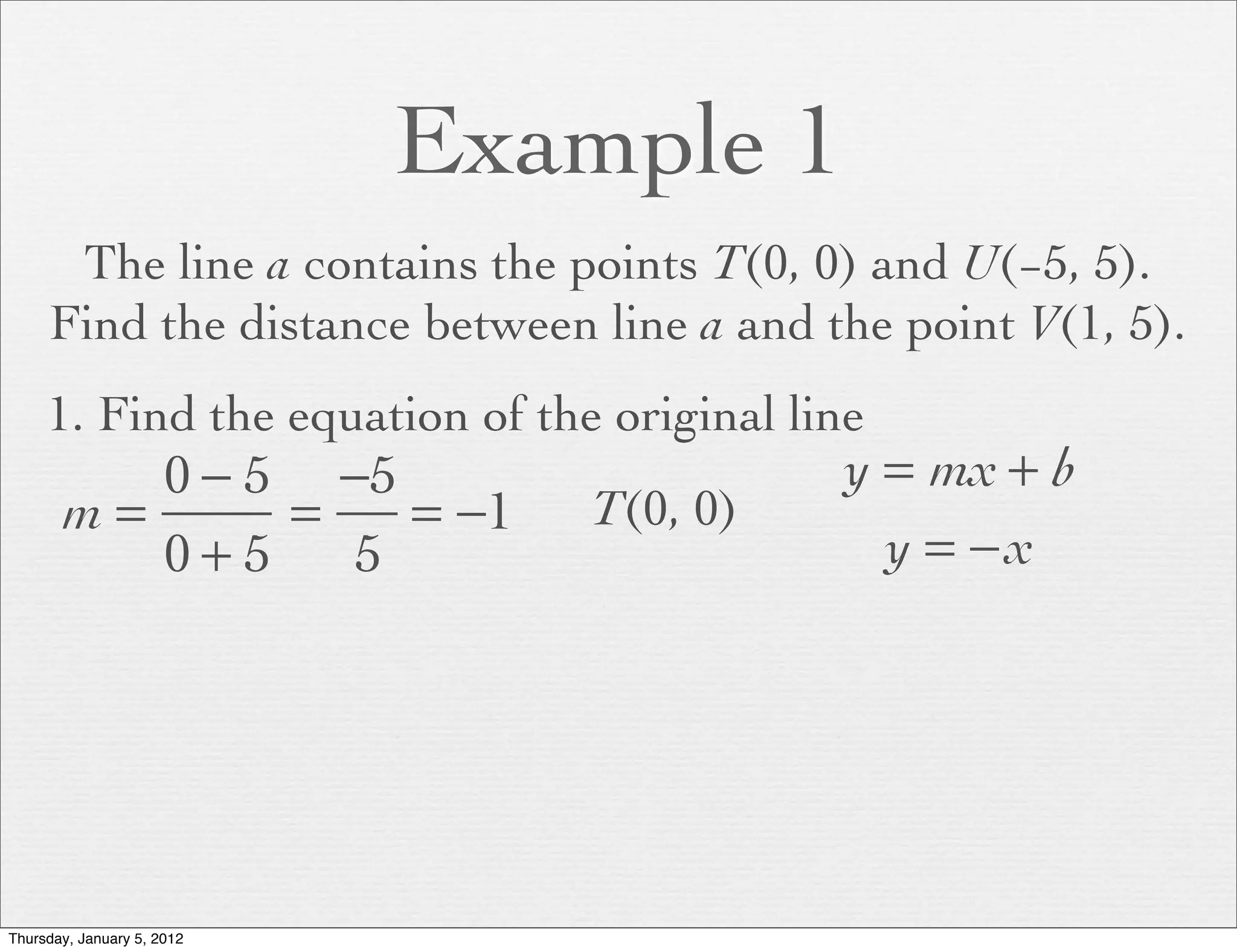
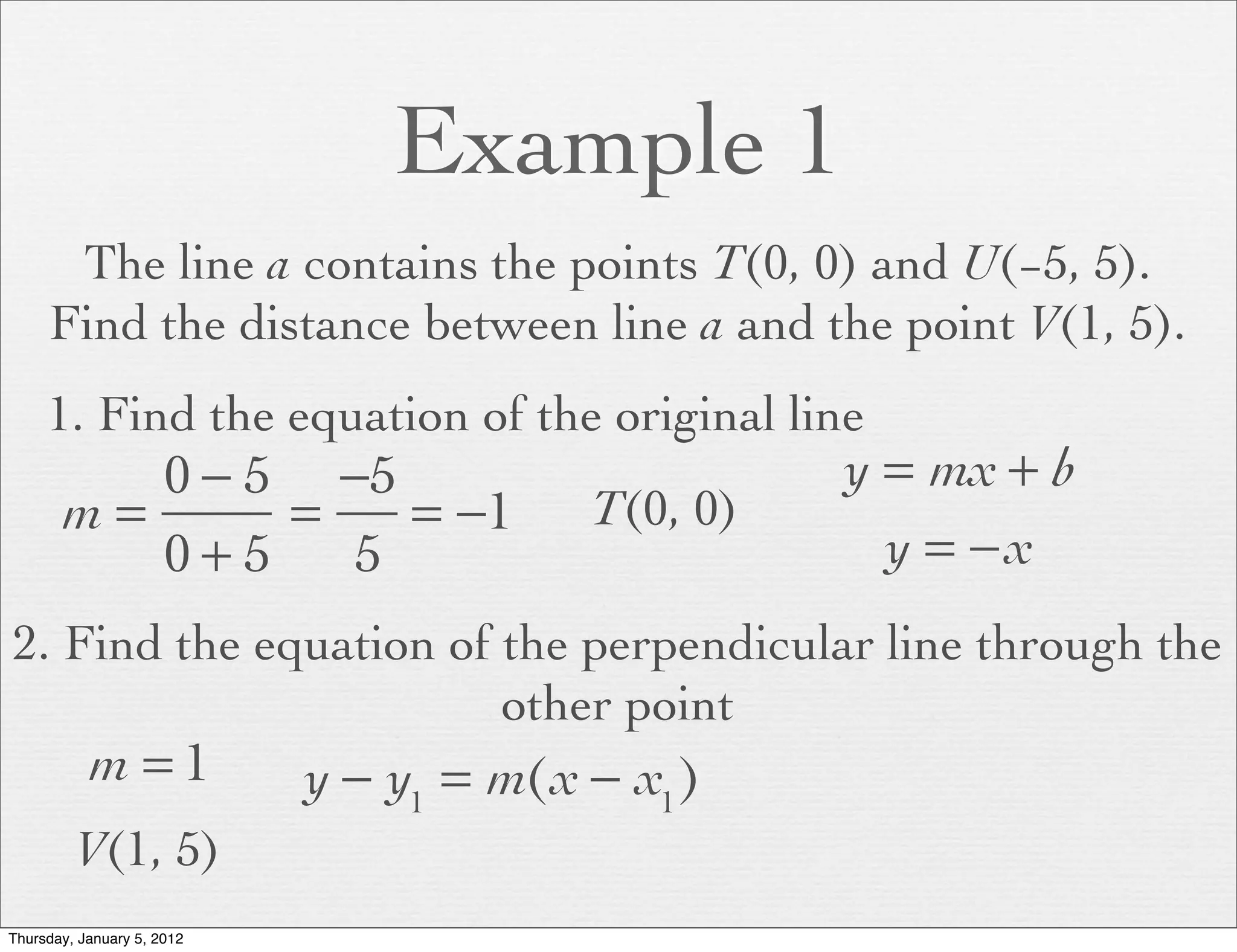
Example 1
      The line a contains the points T(0, 0) and U(−5, 5).
     Find the distance between line a and the point V(1, 5).


Thursday, January 5, 2012
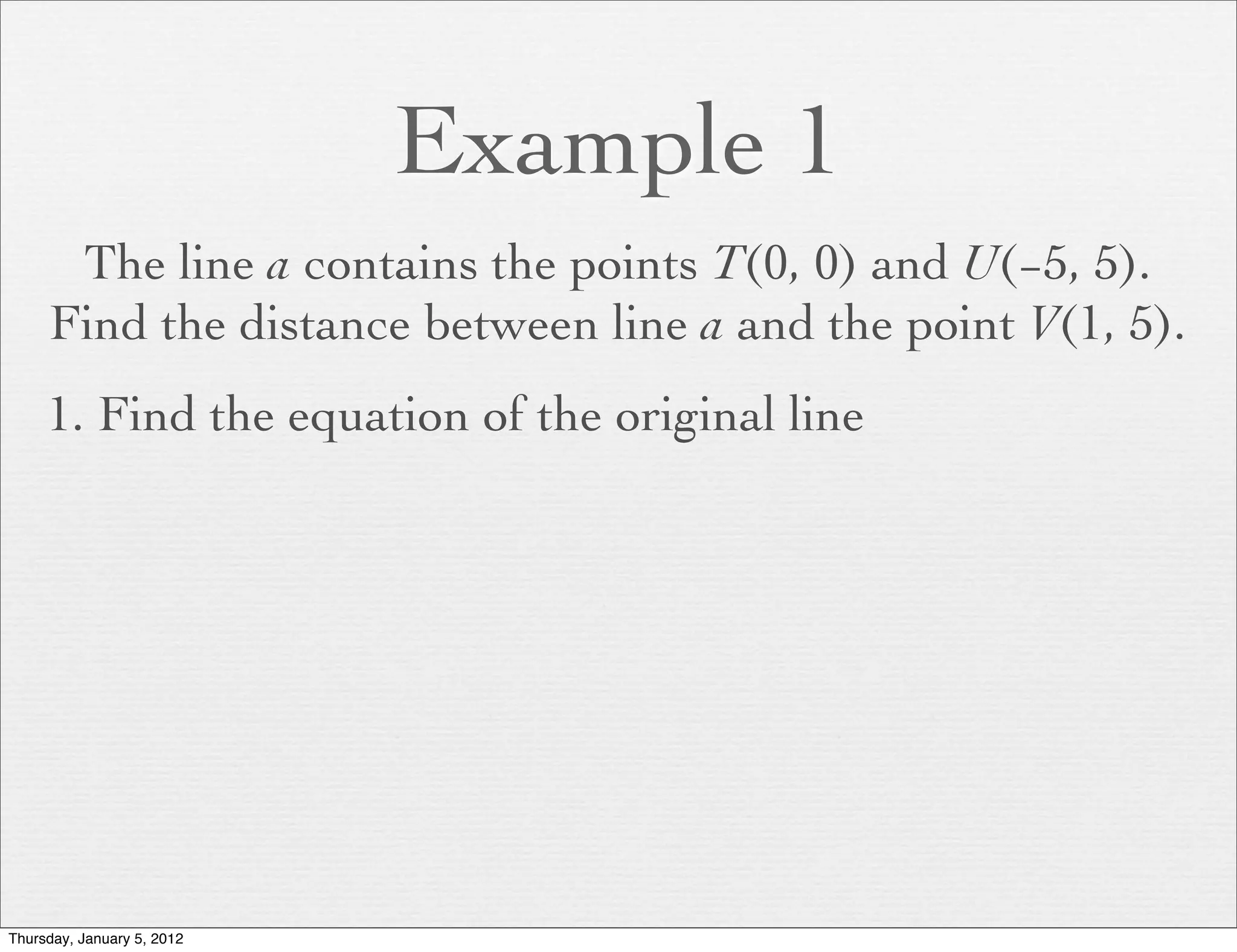
Example 1
      The line a contains the points T(0, 0) and U(−5, 5).
     Find the distance between line a and the point V(1, 5).
     1. Find the equation of the original line


Thursday, January 5, 2012
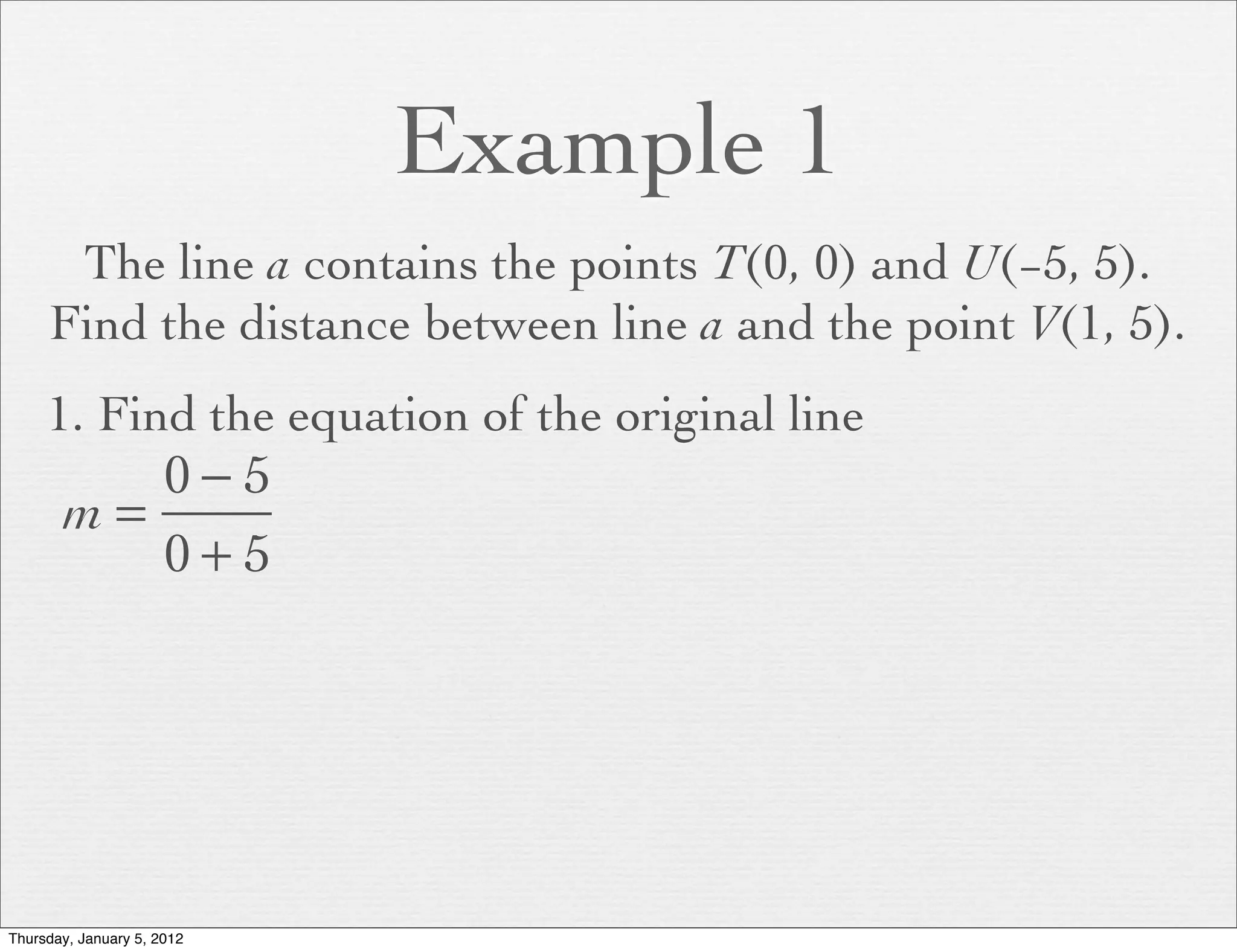
Example 1
      The line a contains the points T(0, 0) and U(−5, 5).
     Find the distance between line a and the point V(1, 5).
     1. Find the equation of the original line
          0−5
       m=
          0+5


Thursday, January 5, 2012
Example 1
      The line a contains the points T(0, 0) and U(−5, 5).
     Find the distance between line a and the point V(1, 5).
     1. Find the equation of the original line
          0 − 5 −5
       m=      =
          0+5    5


Thursday, January 5, 2012
Example 1
      The line a contains the points T(0, 0) and U(−5, 5).
     Find the distance between line a and the point V(1, 5).
     1. Find the equation of the original line
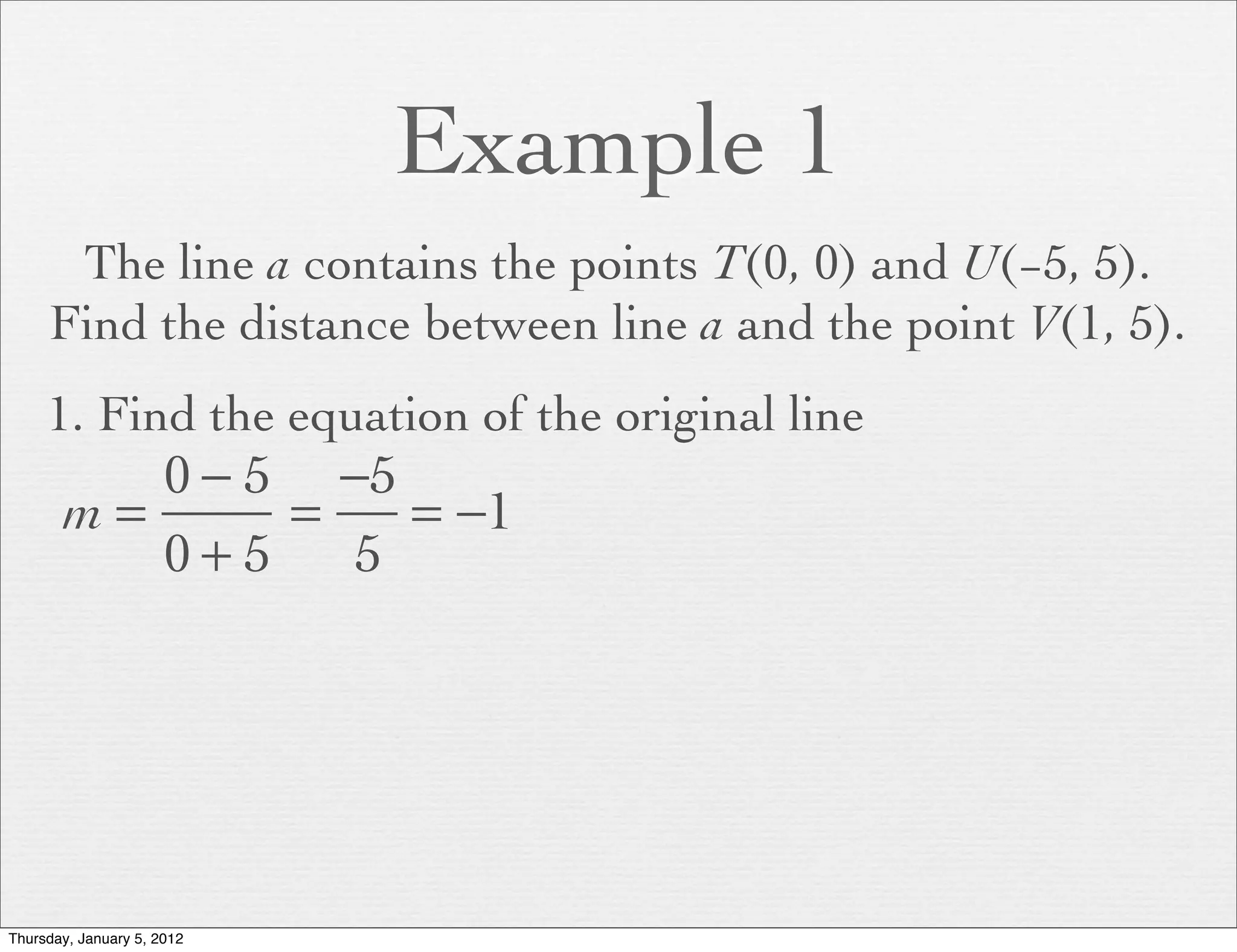
          0 − 5 −5
       m=      =   = −1
          0+5    5


Thursday, January 5, 2012
Example 1
      The line a contains the points T(0, 0) and U(−5, 5).
     Find the distance between line a and the point V(1, 5).
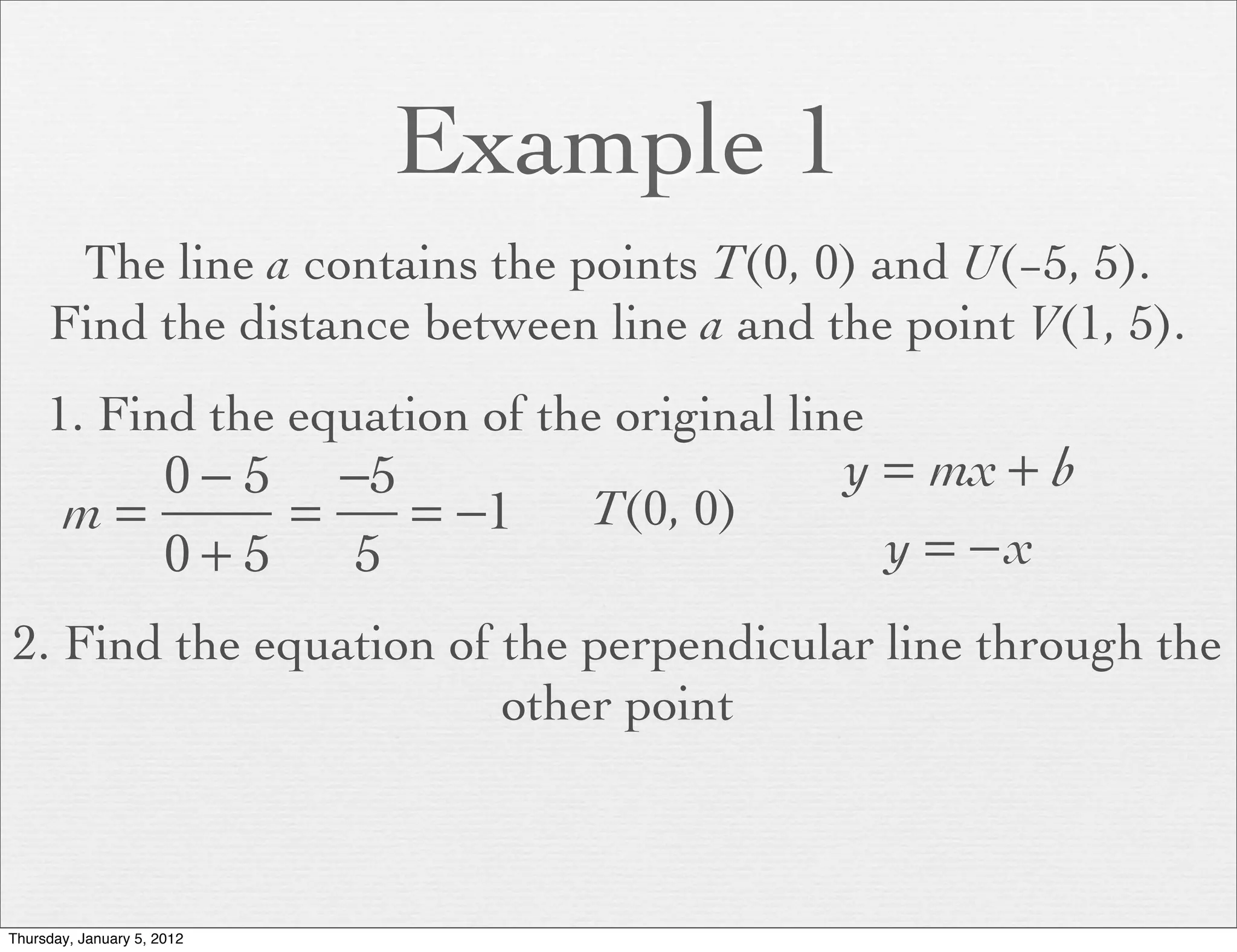
     1. Find the equation of the original line
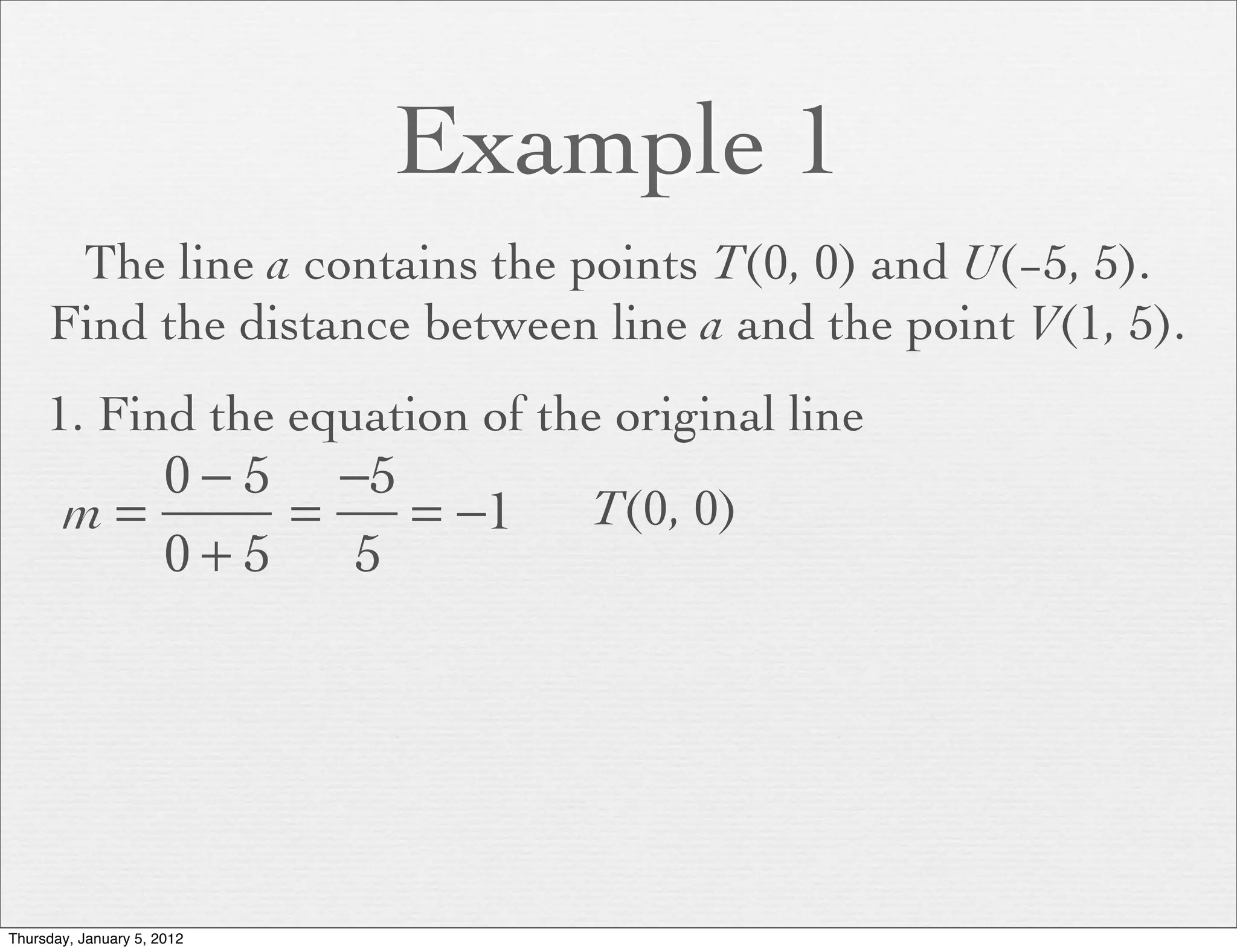
          0 − 5 −5
       m=      =   = −1         T(0, 0)
          0+5    5


Thursday, January 5, 2012
Example 1
      The line a contains the points T(0, 0) and U(−5, 5).
     Find the distance between line a and the point V(1, 5).
     1. Find the equation of the original line
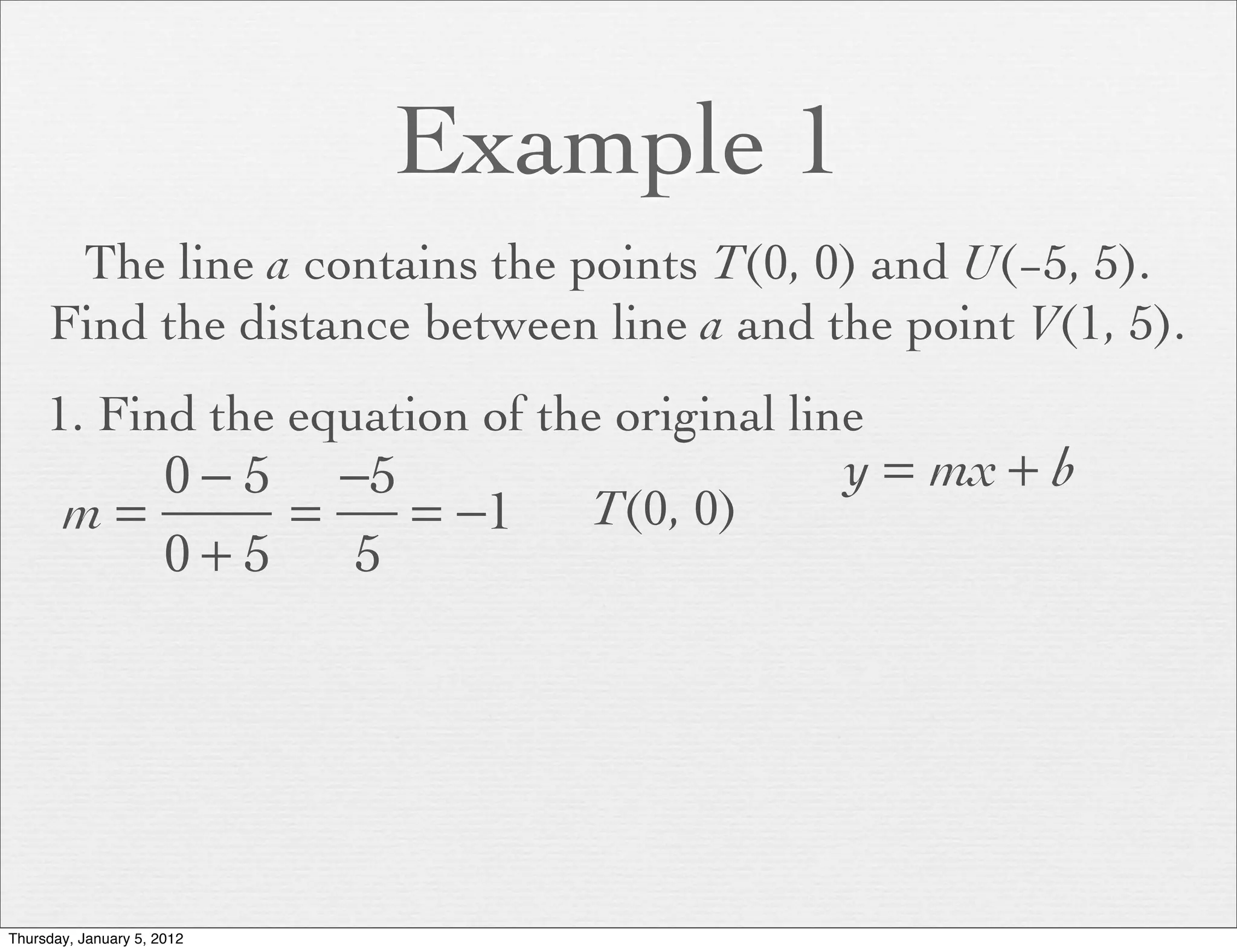
          0 − 5 −5                          y = mx + b
       m=      =   = −1         T(0, 0)
          0+5    5


Thursday, January 5, 2012
Example 1
      The line a contains the points T(0, 0) and U(−5, 5).
     Find the distance between line a and the point V(1, 5).
     1. Find the equation of the original line
          0 − 5 −5                          y = mx + b
       m=      =   = −1         T(0, 0)
          0+5    5                            y = −x


Thursday, January 5, 2012
Example 1
      The line a contains the points T(0, 0) and U(−5, 5).
     Find the distance between line a and the point V(1, 5).
     1. Find the equation of the original line
          0 − 5 −5                          y = mx + b
       m=      =   = −1         T(0, 0)
          0+5    5                            y = −x
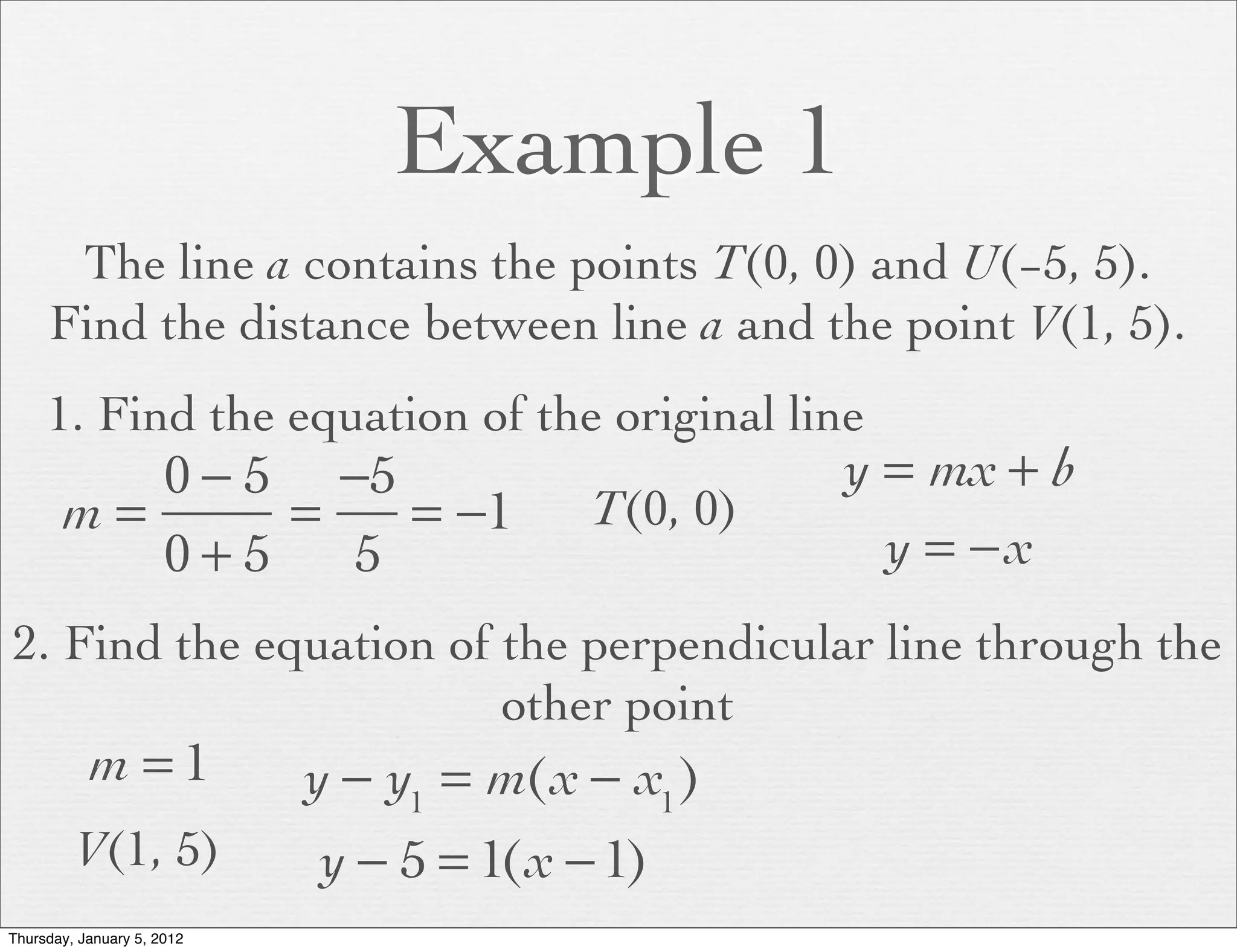
2. Find the equation of the perpendicular line through the
                        other point


Thursday, January 5, 2012
Example 1
      The line a contains the points T(0, 0) and U(−5, 5).
     Find the distance between line a and the point V(1, 5).
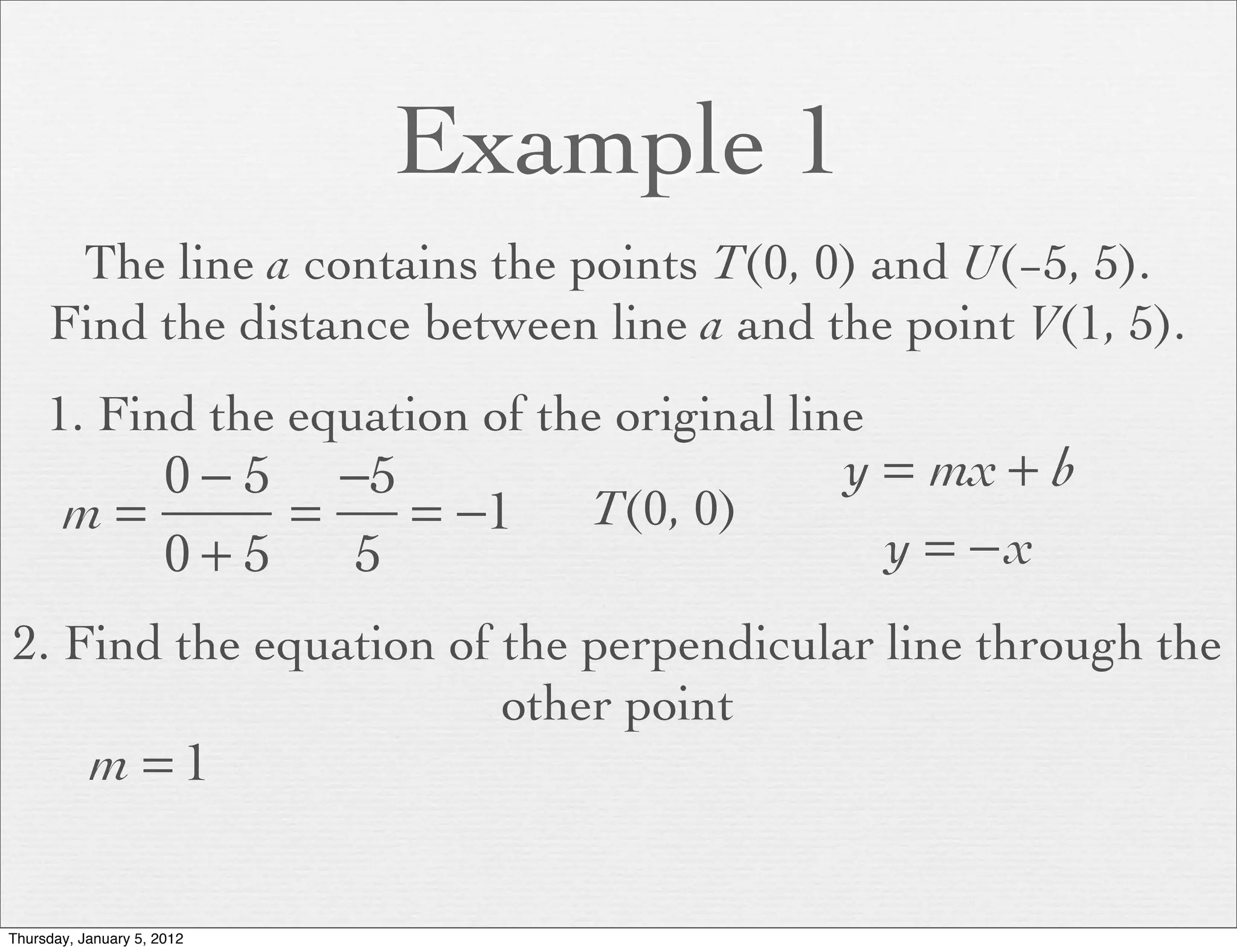
     1. Find the equation of the original line
          0 − 5 −5                          y = mx + b
       m=      =   = −1         T(0, 0)
          0+5    5                            y = −x
2. Find the equation of the perpendicular line through the
                        other point
           m =1


Thursday, January 5, 2012
Example 1
      The line a contains the points T(0, 0) and U(−5, 5).
     Find the distance between line a and the point V(1, 5).
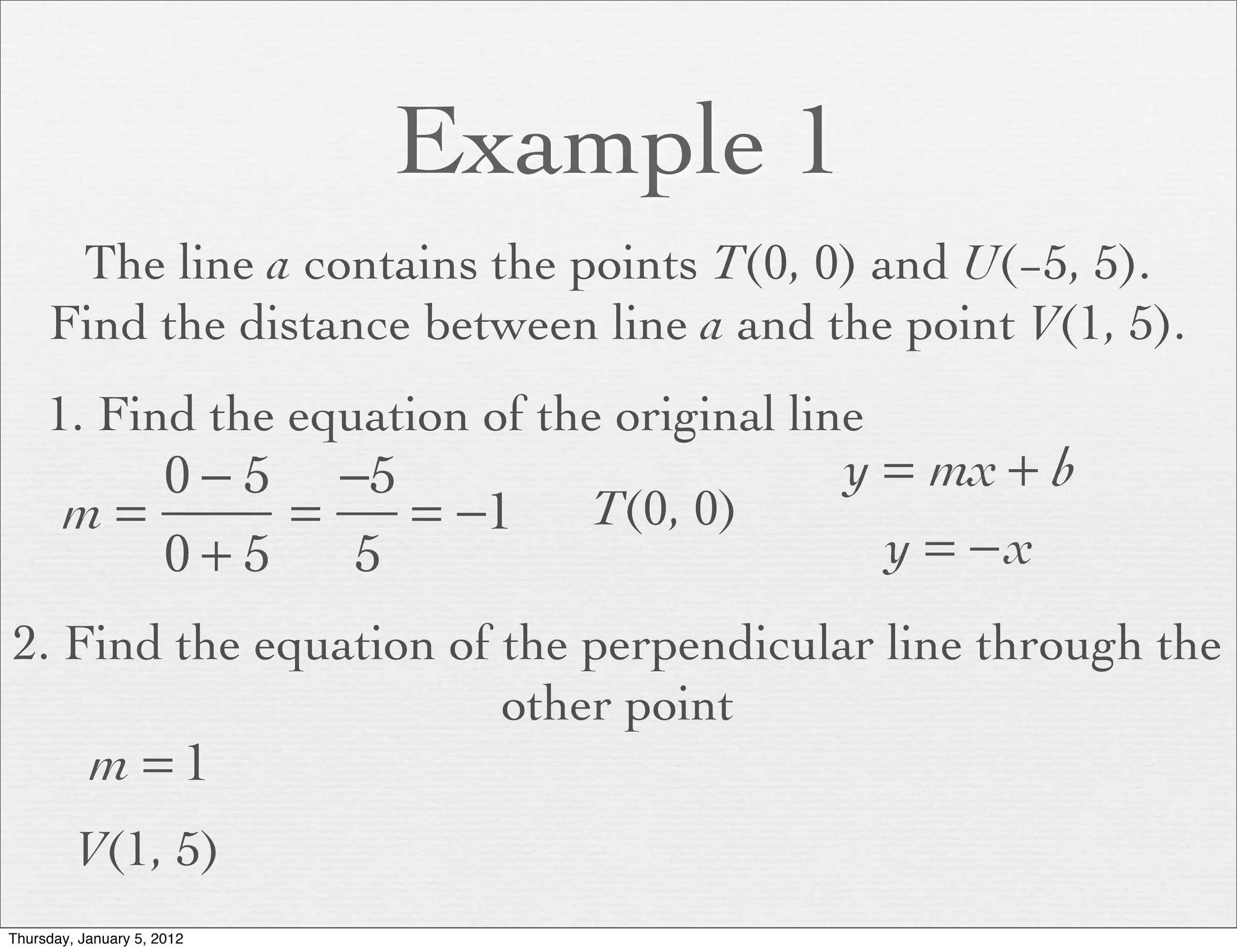
     1. Find the equation of the original line
          0 − 5 −5                          y = mx + b
       m=      =   = −1         T(0, 0)
          0+5    5                            y = −x
2. Find the equation of the perpendicular line through the
                        other point
           m =1
         V(1, 5)
Thursday, January 5, 2012
Example 1
      The line a contains the points T(0, 0) and U(−5, 5).
     Find the distance between line a and the point V(1, 5).
     1. Find the equation of the original line
          0 − 5 −5                                 y = mx + b
       m=      =   = −1                  T(0, 0)
          0+5    5                                   y = −x
2. Find the equation of the perpendicular line through the
                        other point
           m =1             y − y1 = m(x − x1 )
         V(1, 5)
Thursday, January 5, 2012
Example 1
      The line a contains the points T(0, 0) and U(−5, 5).
     Find the distance between line a and the point V(1, 5).
     1. Find the equation of the original line
          0 − 5 −5                                 y = mx + b
       m=      =   = −1                  T(0, 0)
          0+5    5                                   y = −x
2. Find the equation of the perpendicular line through the
                        other point
           m =1             y − y1 = m(x − x1 )
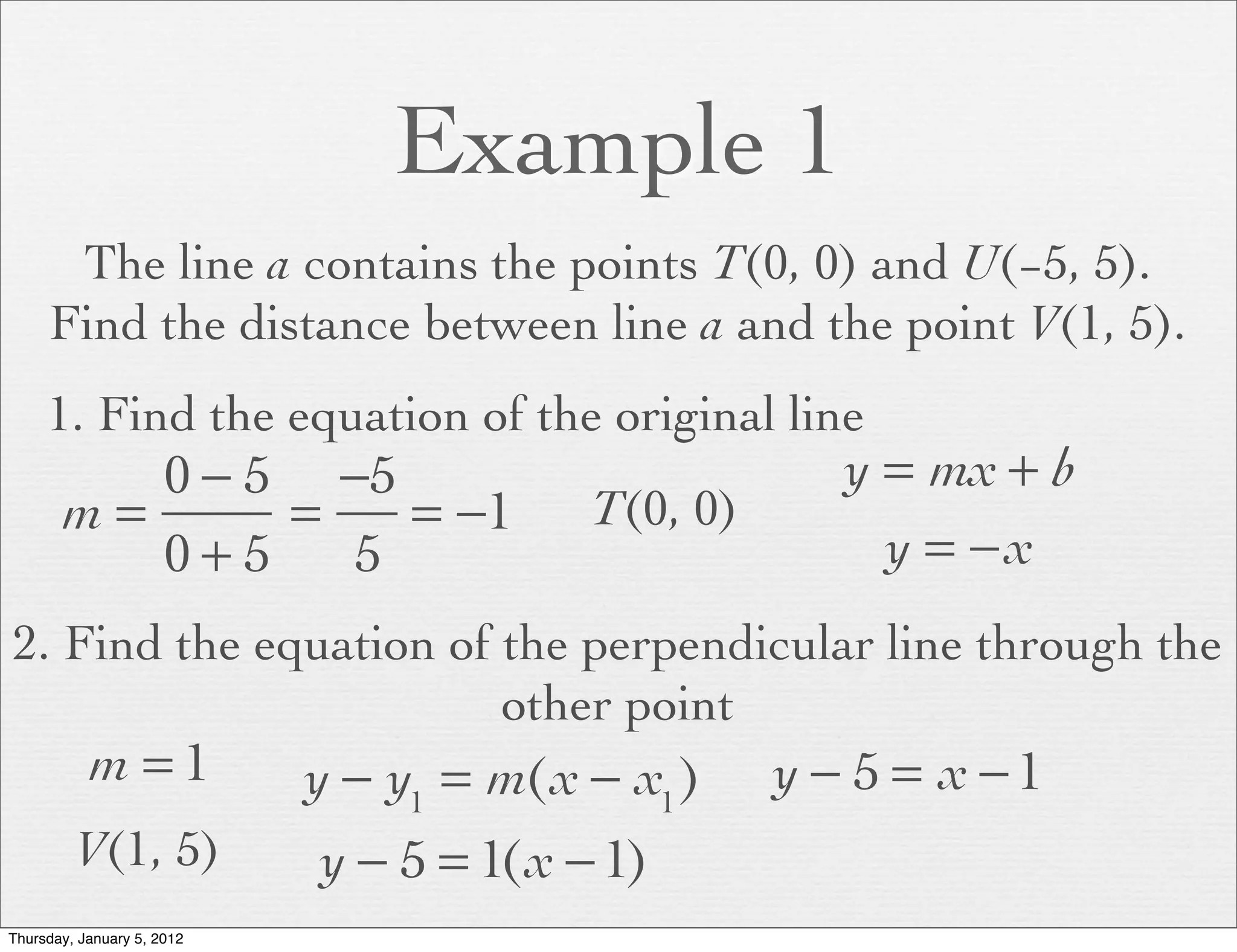
         V(1, 5)            y − 5 = 1(x − 1)
Thursday, January 5, 2012
Example 1
      The line a contains the points T(0, 0) and U(−5, 5).
     Find the distance between line a and the point V(1, 5).
     1. Find the equation of the original line
          0 − 5 −5                                    y = mx + b
       m=      =   = −1                  T(0, 0)
          0+5    5                                      y = −x
2. Find the equation of the perpendicular line through the
                        other point
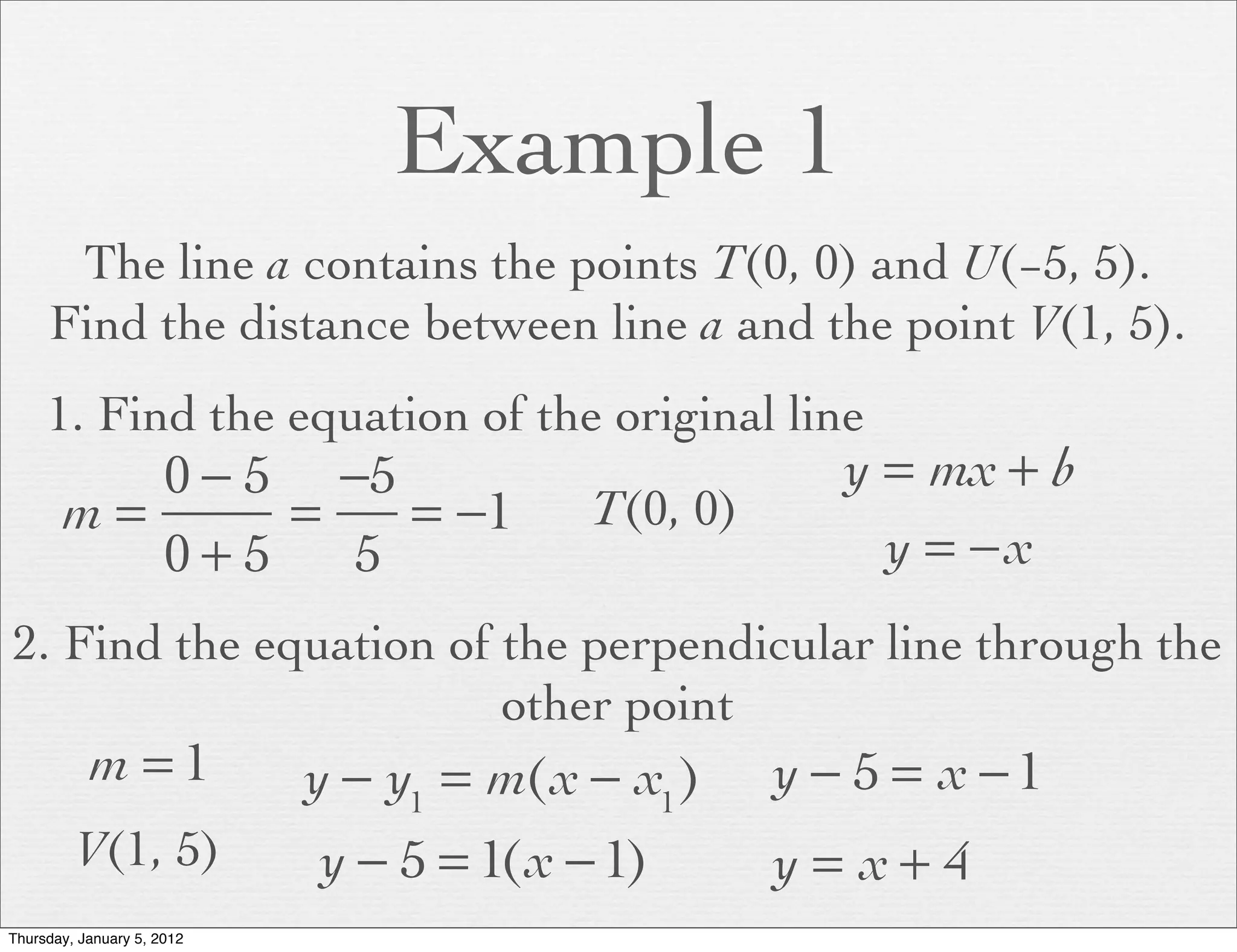
           m =1             y − y1 = m(x − x1 )    y − 5 = x −1
         V(1, 5)            y − 5 = 1(x − 1)
Thursday, January 5, 2012
Example 1
      The line a contains the points T(0, 0) and U(−5, 5).
     Find the distance between line a and the point V(1, 5).
     1. Find the equation of the original line
          0 − 5 −5                                    y = mx + b
       m=      =   = −1                  T(0, 0)
          0+5    5                                      y = −x
2. Find the equation of the perpendicular line through the
                        other point
           m =1             y − y1 = m(x − x1 )    y − 5 = x −1
         V(1, 5)            y − 5 = 1(x − 1)       y = x+ 4
Thursday, January 5, 2012
Example 1

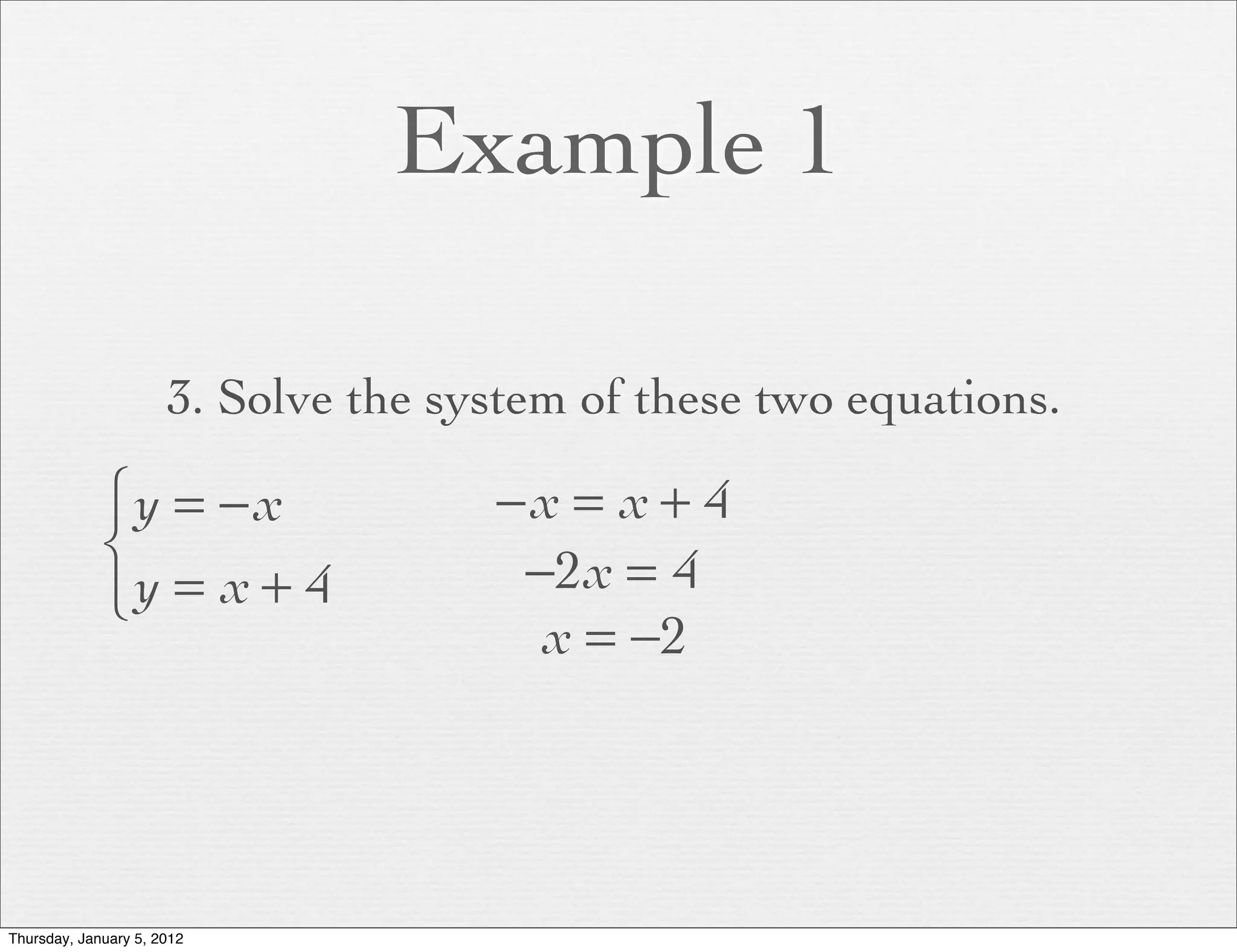
                      3. Solve the system of these two equations.


Thursday, January 5, 2012
Example 1

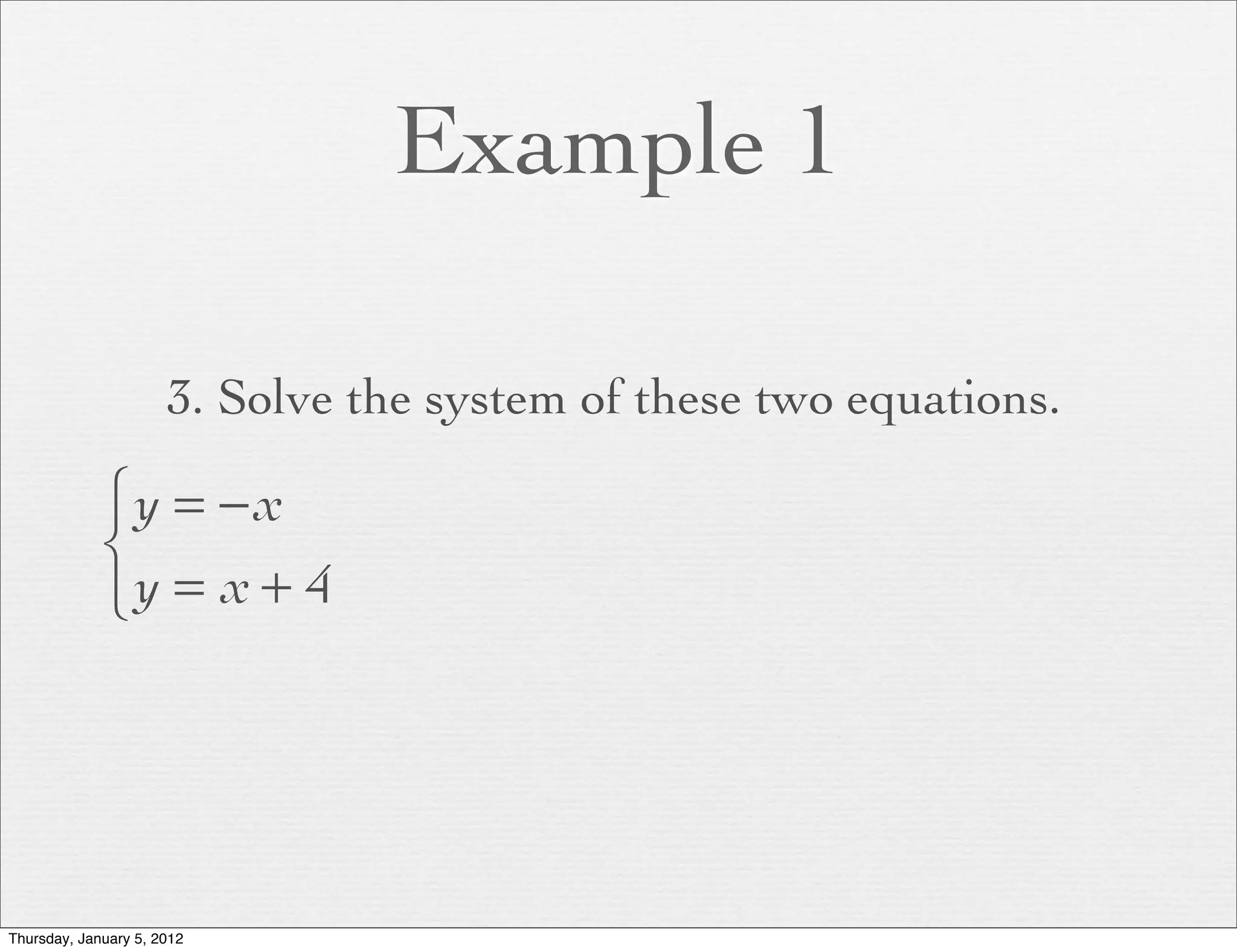
                      3. Solve the system of these two equations.
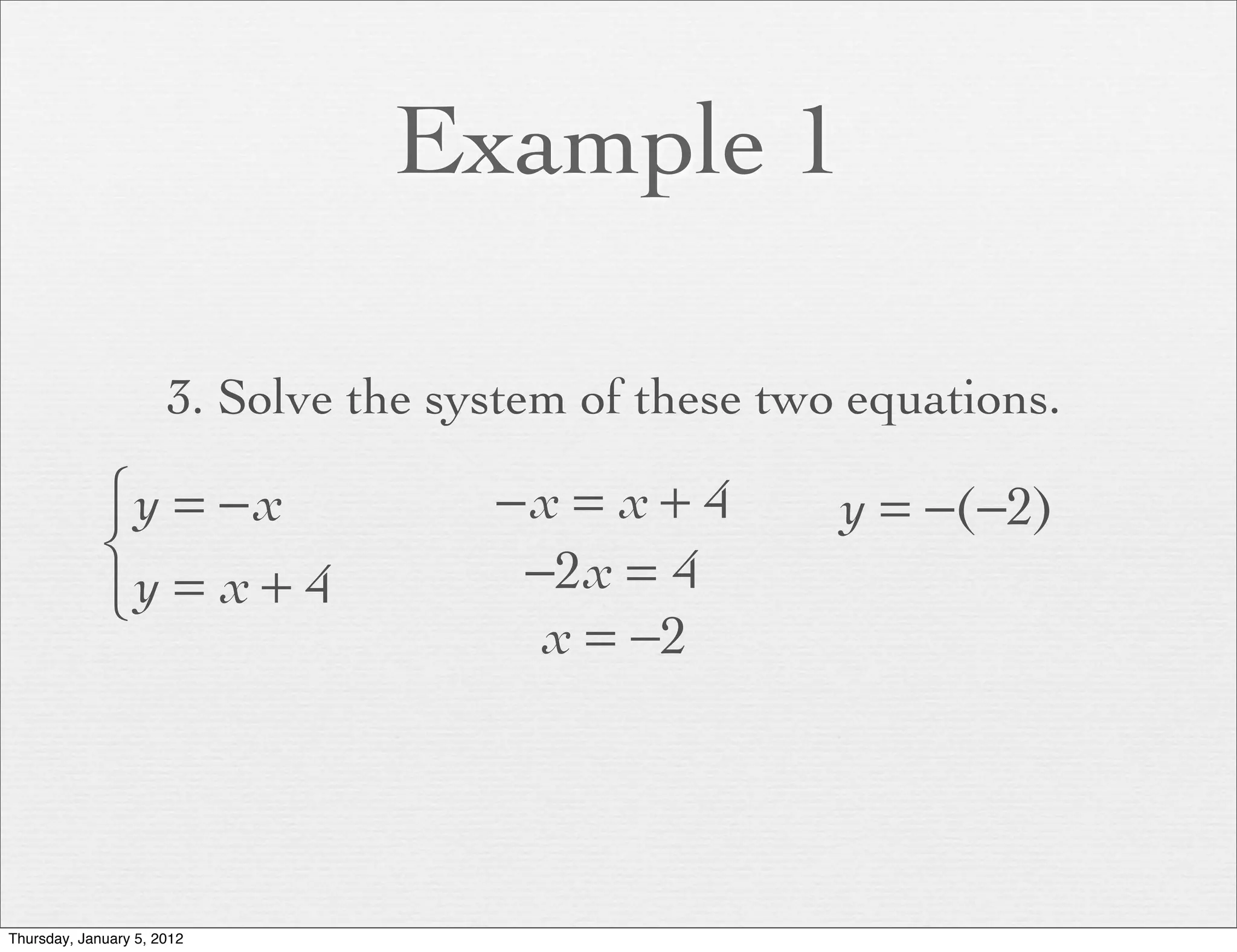
             ⎧y = − x
             ⎨
             ⎩y = x + 4


Thursday, January 5, 2012
Example 1

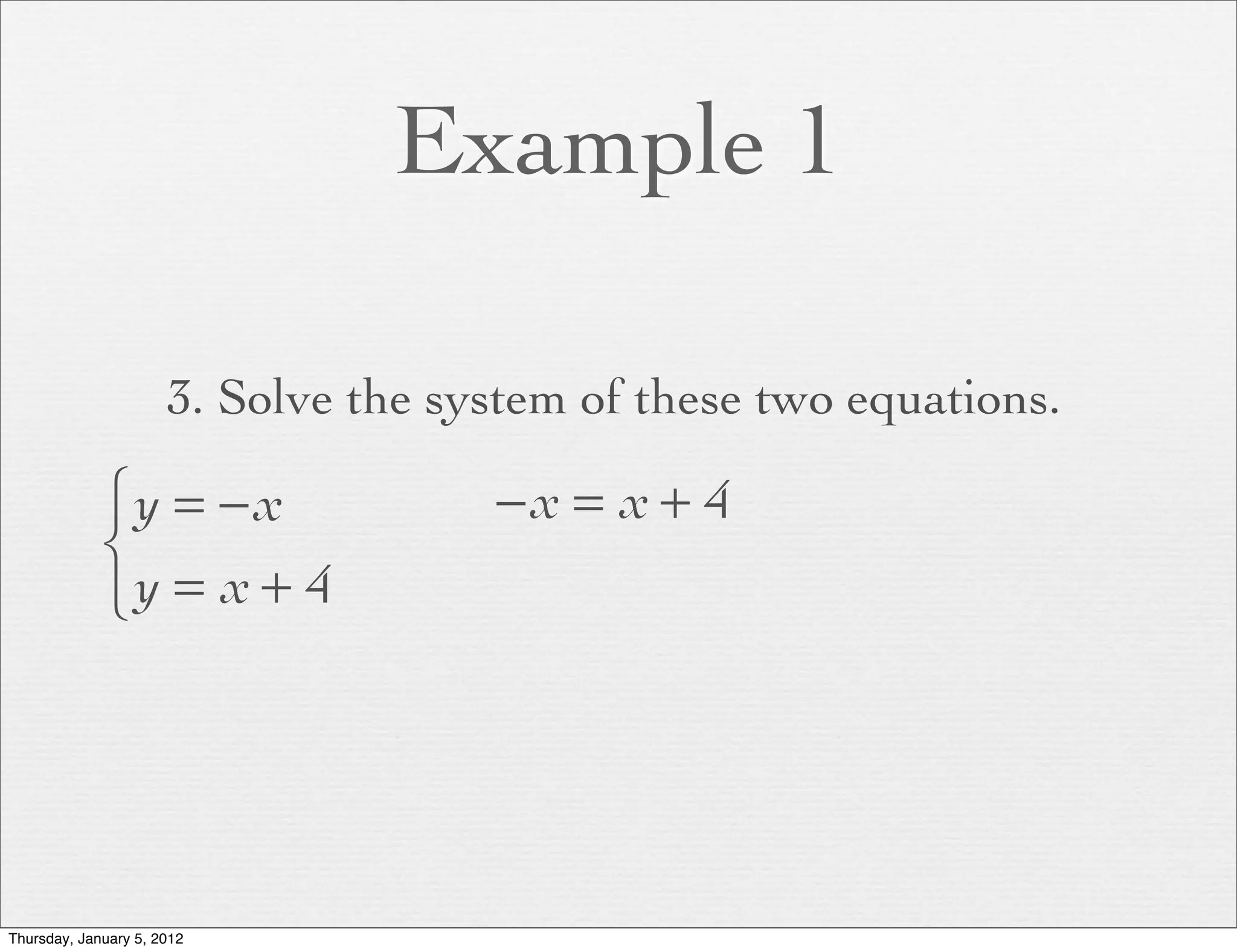
                      3. Solve the system of these two equations.
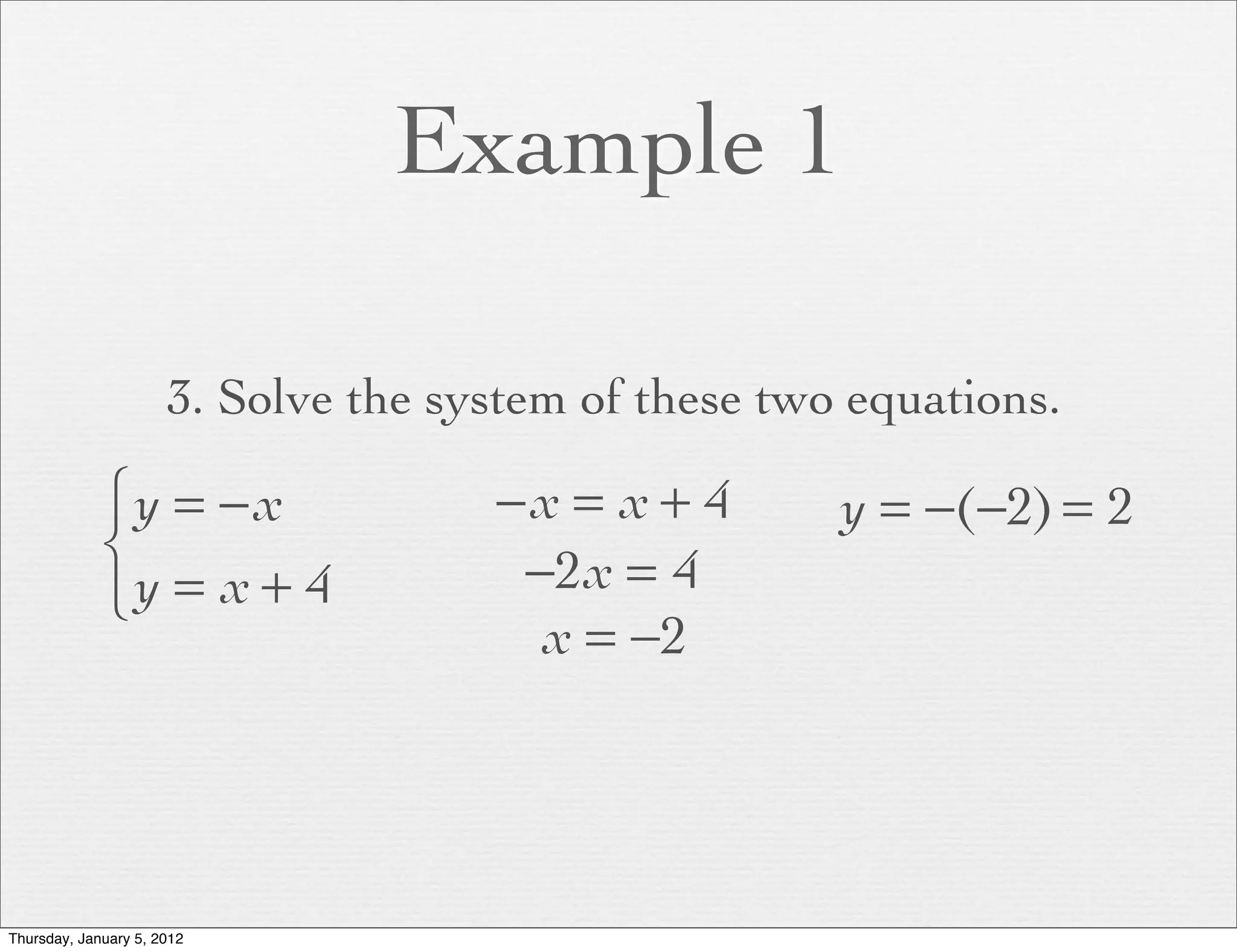
             ⎧y = − x                −x = x + 4
             ⎨
             ⎩y = x + 4


Thursday, January 5, 2012
Example 1

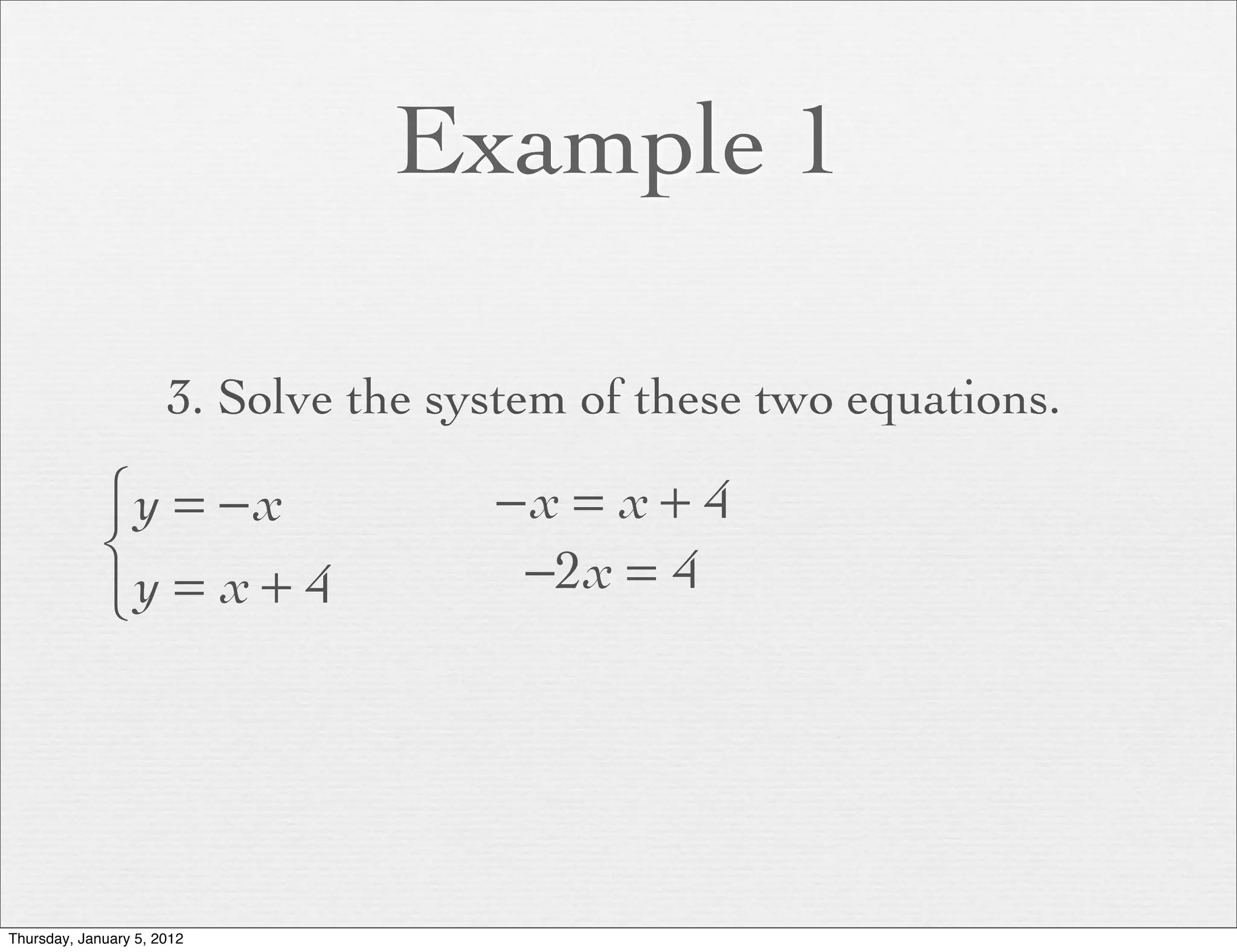
                      3. Solve the system of these two equations.
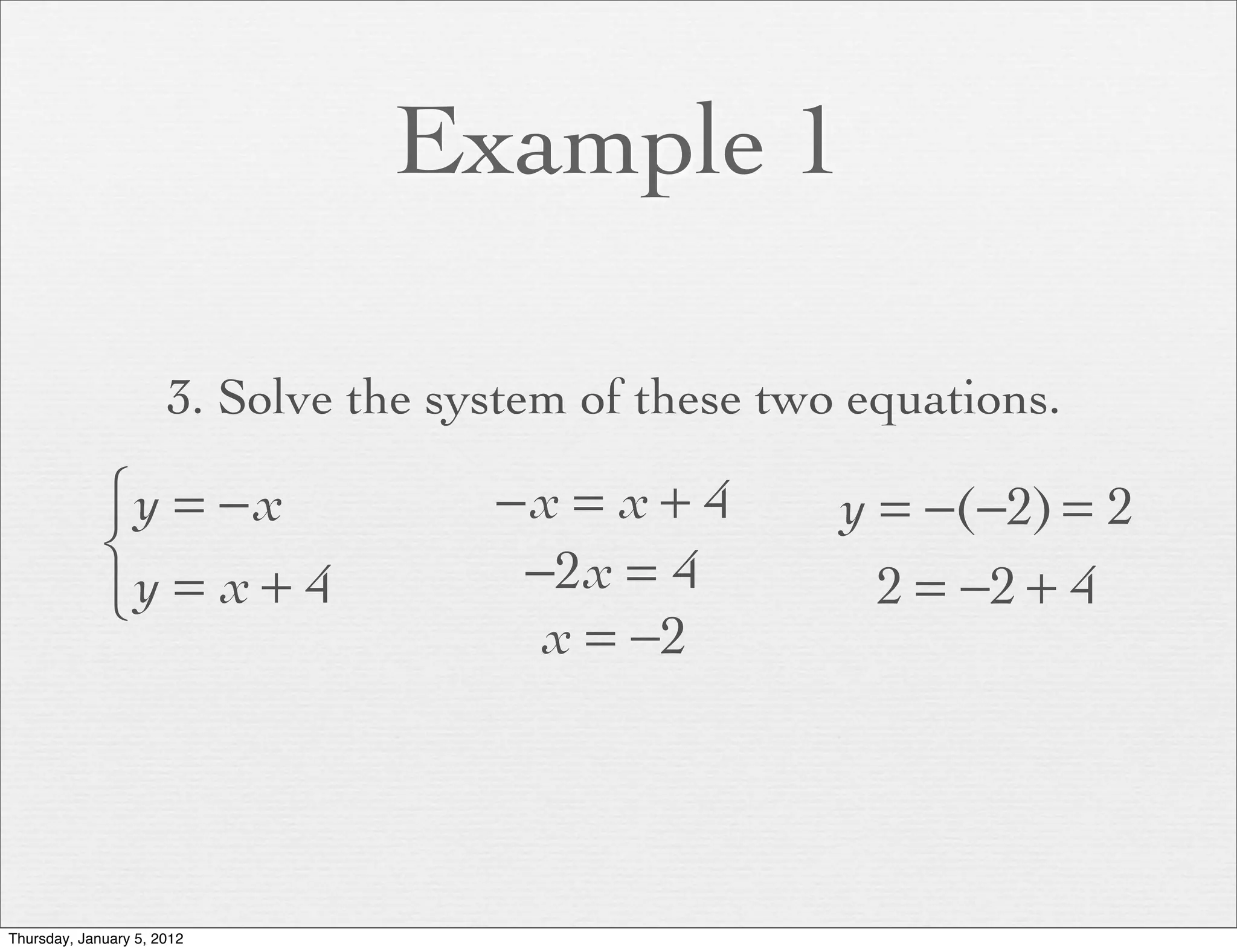
             ⎧y = − x                −x = x + 4
             ⎨                        −2x = 4
             ⎩y = x + 4


Thursday, January 5, 2012
Example 1

                      3. Solve the system of these two equations.

             ⎧y = − x                −x = x + 4
             ⎨                        −2x = 4
             ⎩y = x + 4
                                       x = −2


Thursday, January 5, 2012
Example 1

                      3. Solve the system of these two equations.
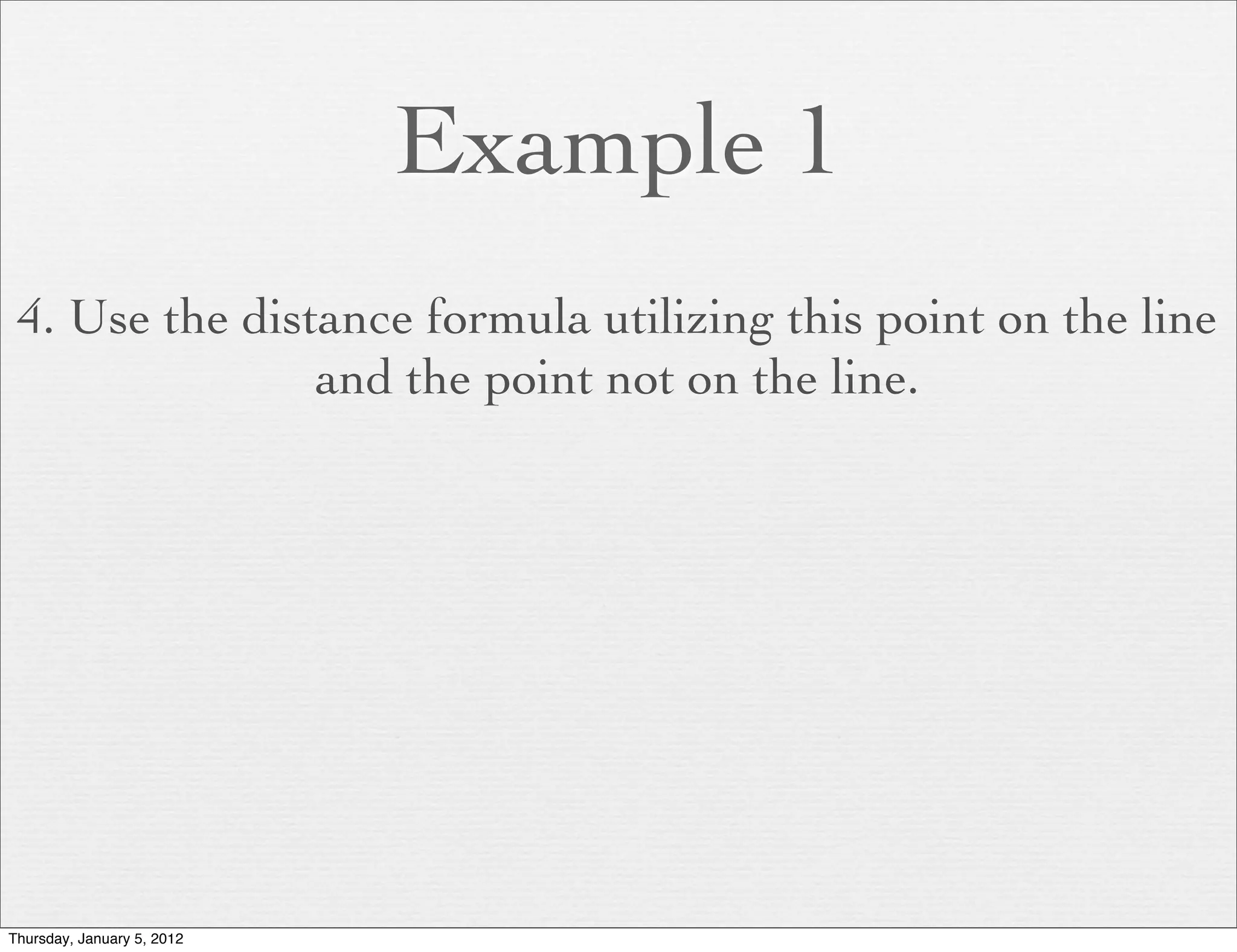
             ⎧y = − x                −x = x + 4       y = −(−2)
             ⎨                        −2x = 4
             ⎩y = x + 4
                                       x = −2


Thursday, January 5, 2012
Example 1

                      3. Solve the system of these two equations.
             ⎧y = − x                −x = x + 4       y = −(−2) = 2
             ⎨                        −2x = 4
             ⎩y = x + 4
                                       x = −2


Thursday, January 5, 2012
Example 1

                      3. Solve the system of these two equations.
             ⎧y = − x                −x = x + 4       y = −(−2) = 2
             ⎨                        −2x = 4
             ⎩y = x + 4                                 2 = −2 + 4
                                       x = −2


Thursday, January 5, 2012
Example 1

                      3. Solve the system of these two equations.
             ⎧y = − x                −x = x + 4       y = −(−2) = 2
             ⎨                        −2x = 4
             ⎩y = x + 4                                 2 = −2 + 4
                                       x = −2
                                                          (−2,2)


Thursday, January 5, 2012
Example 1
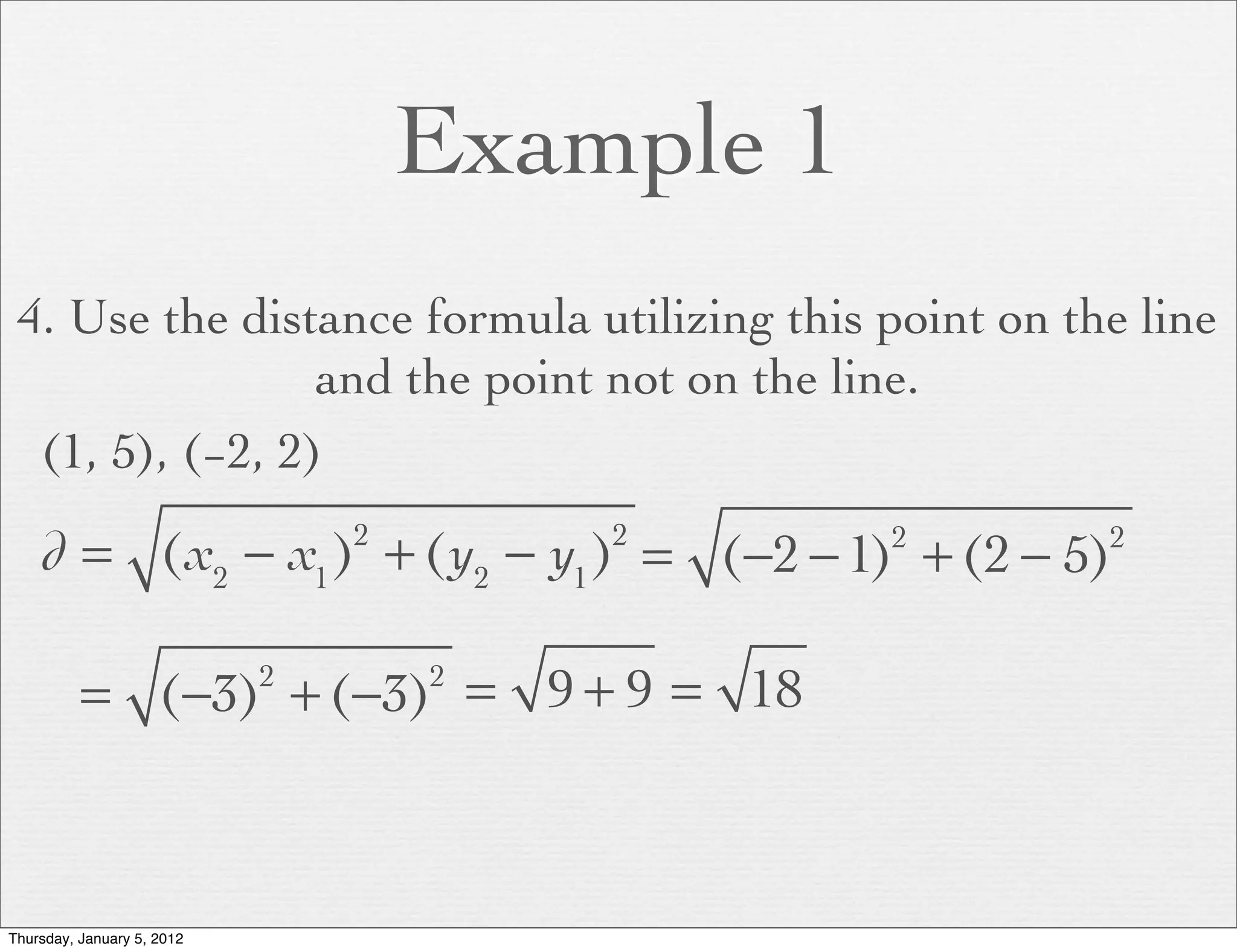
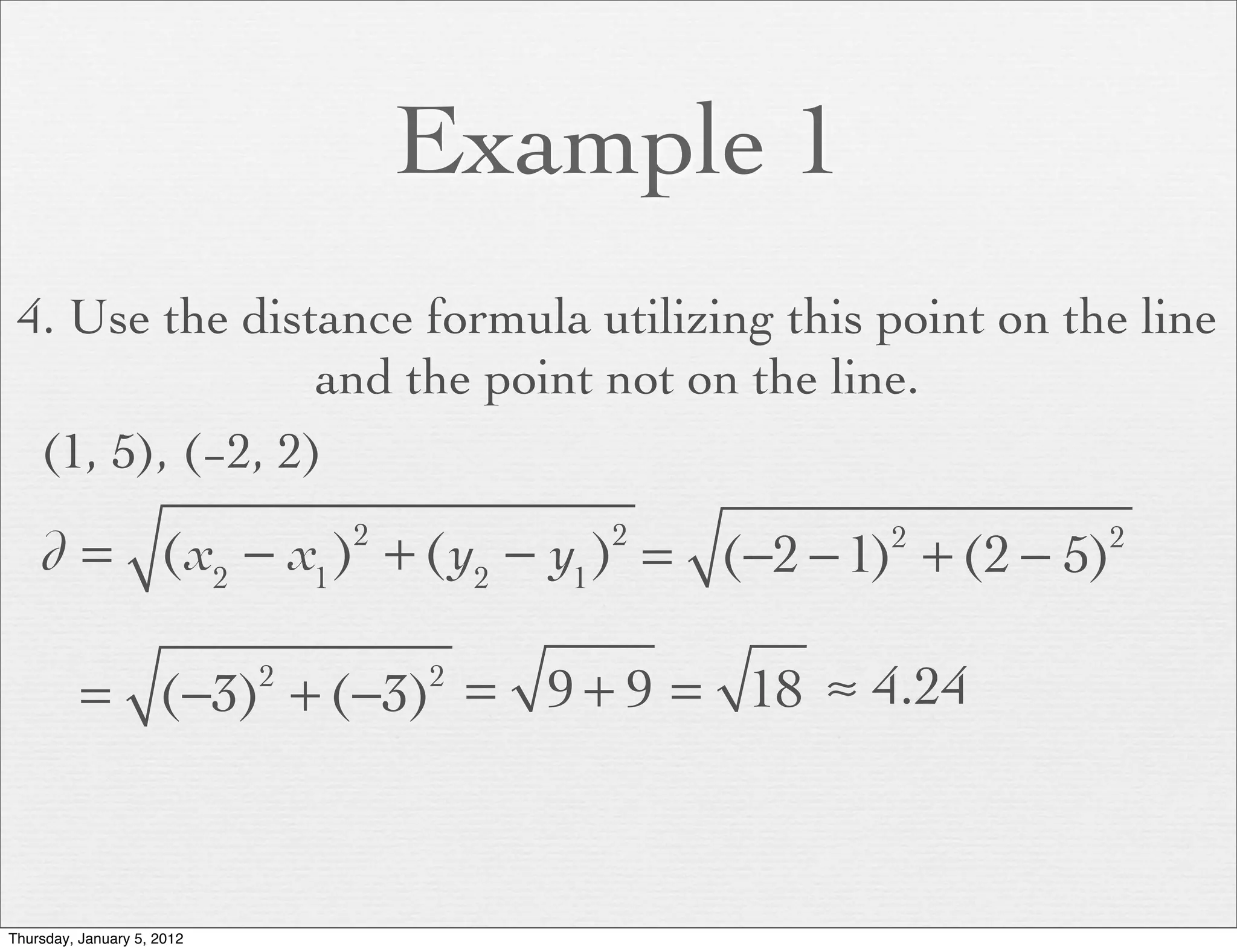
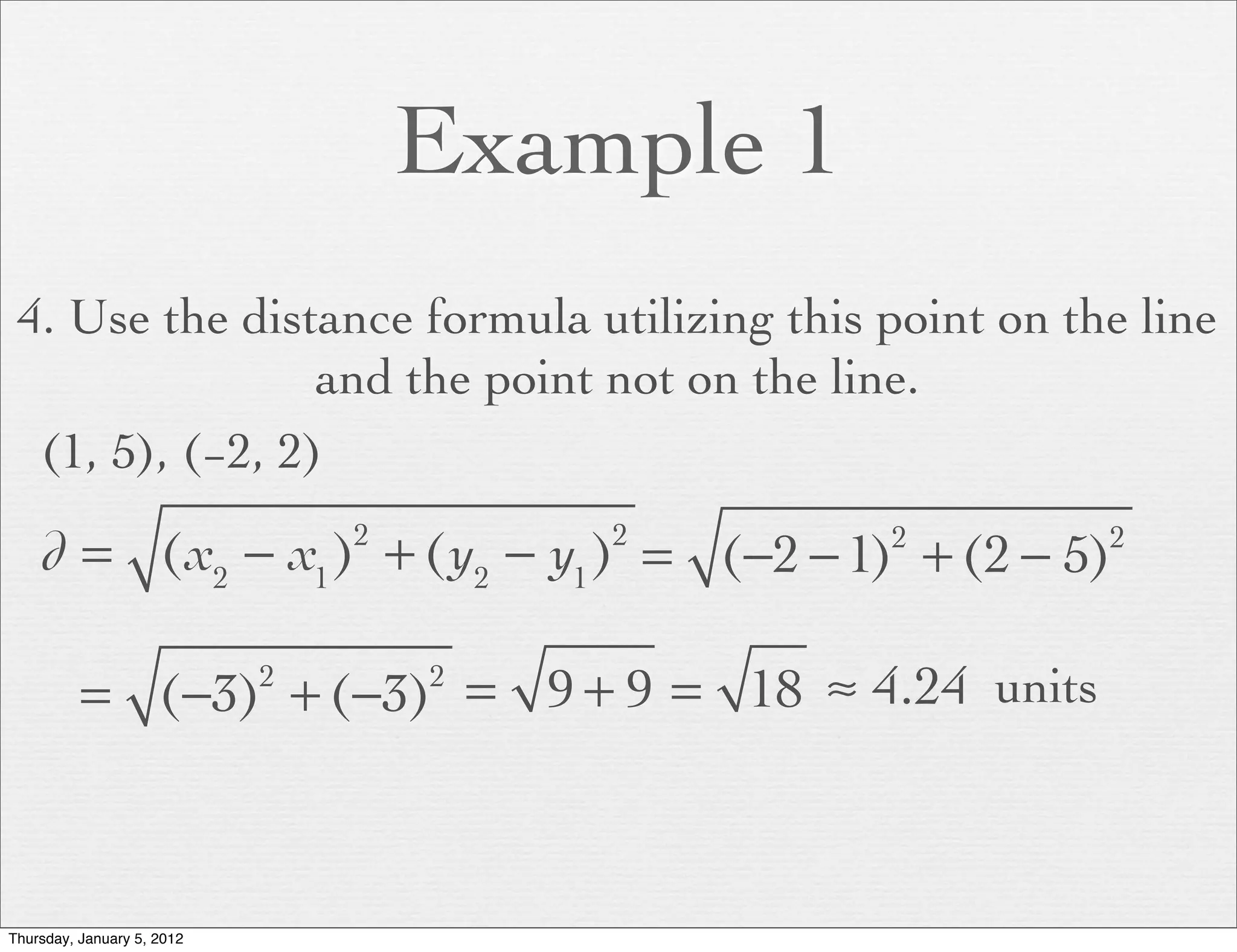
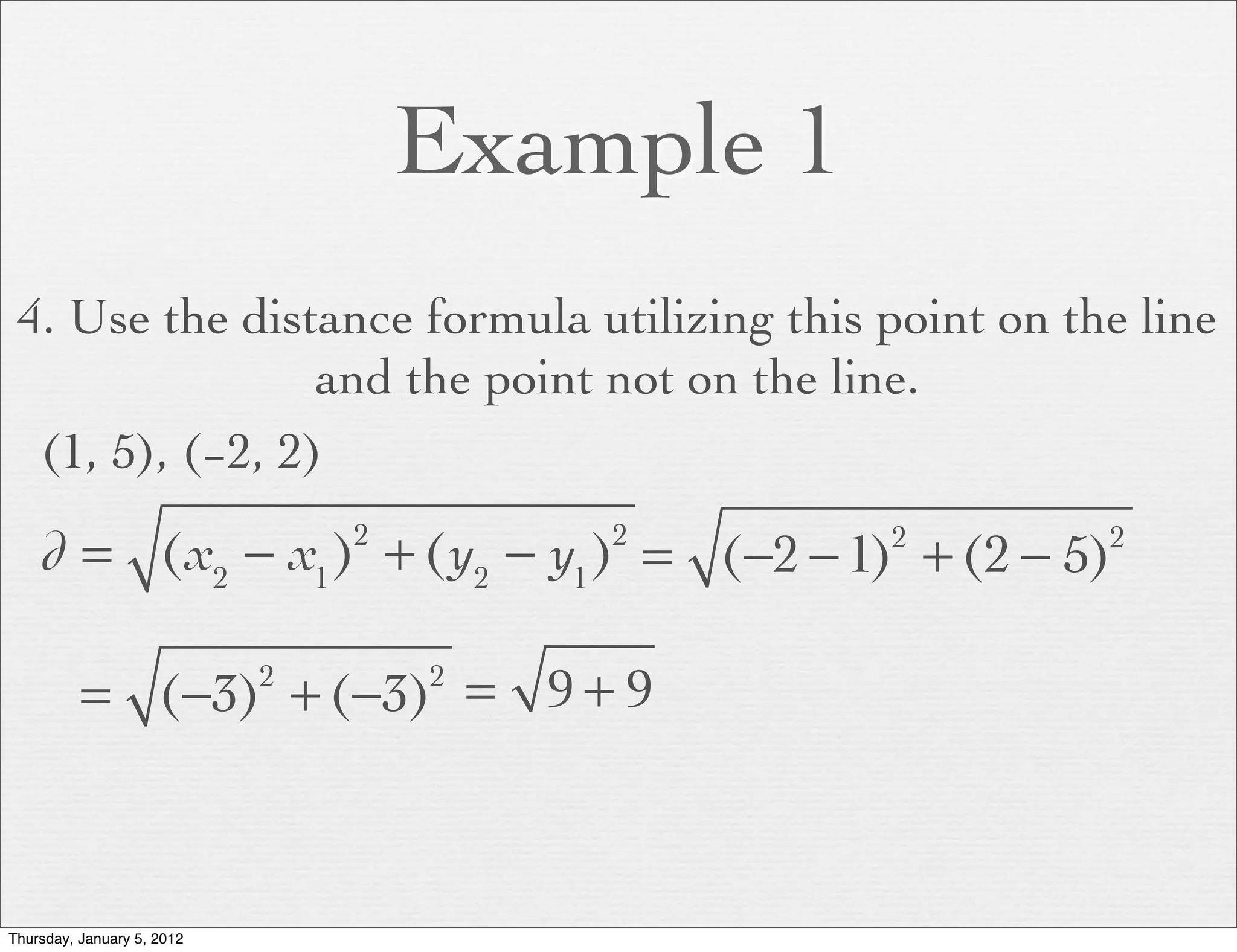
 4. Use the distance formula utilizing this point on the line
                and the point not on the line.


Thursday, January 5, 2012
Example 1
 4. Use the distance formula utilizing this point on the line
                 and the point not on the line.
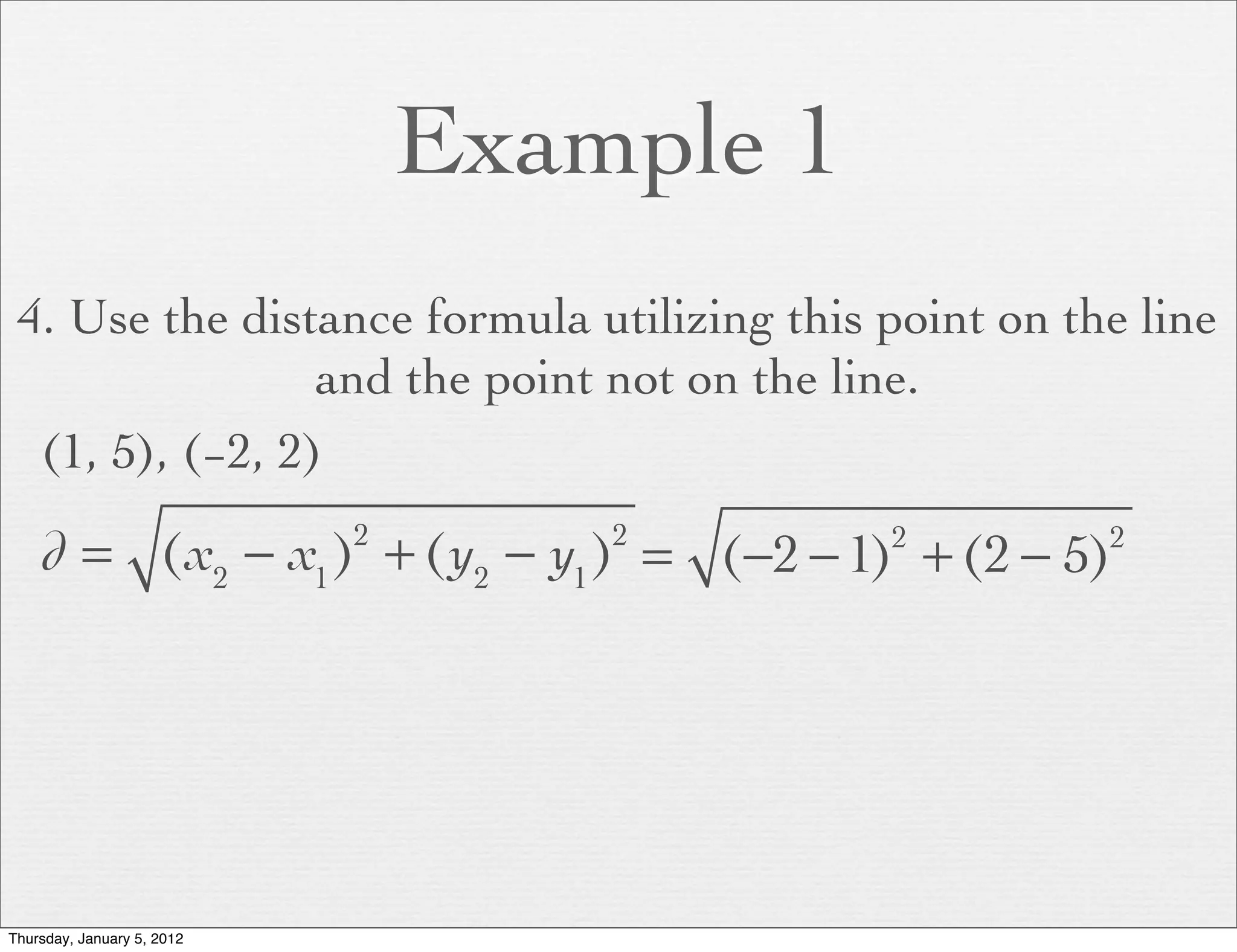
  (1, 5), (−2, 2)


Thursday, January 5, 2012
Example 1
 4. Use the distance formula utilizing this point on the line
                 and the point not on the line.
  (1, 5), (−2, 2)

    d = (x2 − x1 ) + (y2 − y1 )
                            2       2


Thursday, January 5, 2012
Example 1
 4. Use the distance formula utilizing this point on the line
                 and the point not on the line.
  (1, 5), (−2, 2)

    d = (x2 − x1 ) + (y2 − y1 ) = (−2 − 1) + (2 − 5)
                            2       2       2          2


Thursday, January 5, 2012
Example 1
 4. Use the distance formula utilizing this point on the line
                 and the point not on the line.
  (1, 5), (−2, 2)

    d = (x2 − x1 ) + (y2 − y1 ) = (−2 − 1) + (2 − 5)
                                2       2       2      2


          = (−3) + (−3)     2       2


Thursday, January 5, 2012
Example 1
 4. Use the distance formula utilizing this point on the line
                 and the point not on the line.
  (1, 5), (−2, 2)

    d = (x2 − x1 ) + (y2 − y1 ) = (−2 − 1) + (2 − 5)
                                2       2       2      2


          = (−3) + (−3) = 9 + 9
                            2       2


Thursday, January 5, 2012
Example 1
 4. Use the distance formula utilizing this point on the line
                 and the point not on the line.
  (1, 5), (−2, 2)

    d = (x2 − x1 ) + (y2 − y1 ) = (−2 − 1) + (2 − 5)
                                2       2       2      2


          = (−3) + (−3) = 9 + 9 = 18
                            2       2


Thursday, January 5, 2012
Example 1
 4. Use the distance formula utilizing this point on the line
                 and the point not on the line.
  (1, 5), (−2, 2)

    d = (x2 − x1 ) + (y2 − y1 ) = (−2 − 1) + (2 − 5)
                                2       2       2      2


          = (−3) + (−3) = 9 + 9 = 18 ≈ 4.24
                            2       2


Thursday, January 5, 2012
Example 1
 4. Use the distance formula utilizing this point on the line
                 and the point not on the line.
  (1, 5), (−2, 2)

    d = (x2 − x1 ) + (y2 − y1 ) = (−2 − 1) + (2 − 5)
                                2       2       2      2


          = (−3) + (−3) = 9 + 9 = 18 ≈ 4.24 units
                            2       2


Thursday, January 5, 2012
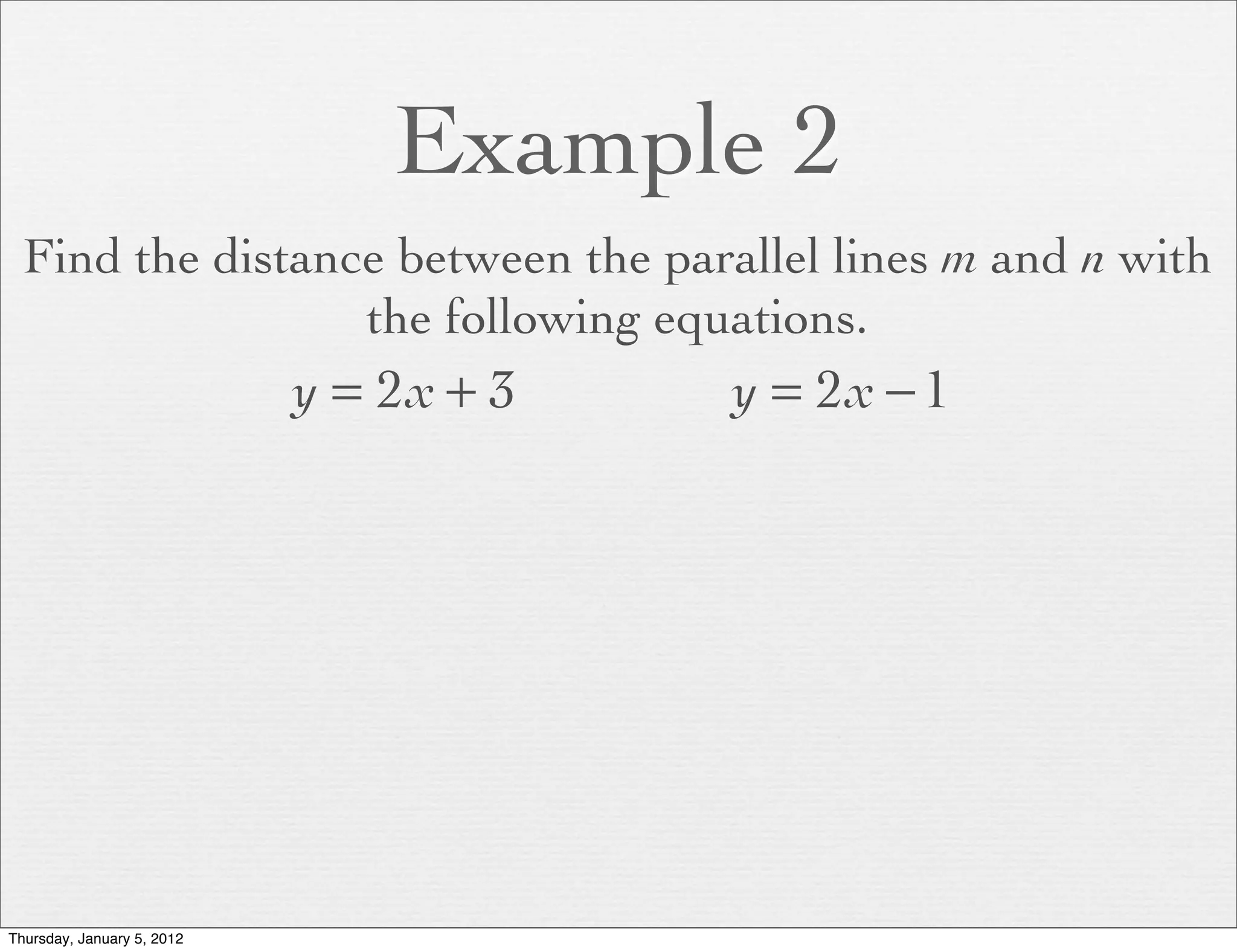
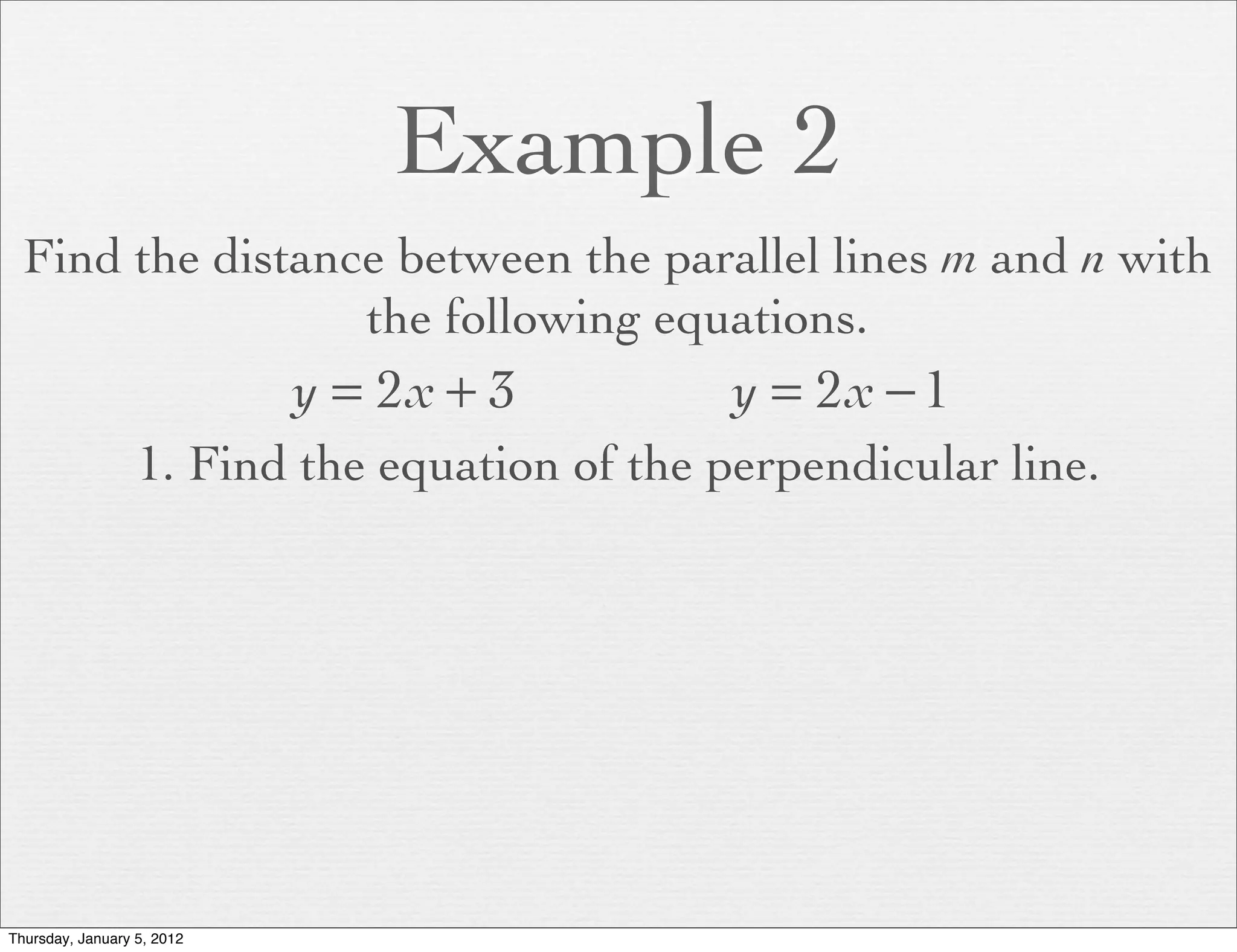
Example 2
  Find the distance between the parallel lines m and n with
                  the following equations.
                            y = 2x + 3   y = 2x − 1


Thursday, January 5, 2012
Example 2
  Find the distance between the parallel lines m and n with
                  the following equations.
                            y = 2x + 3         y = 2x − 1
                  1. Find the equation of the perpendicular line.


Thursday, January 5, 2012
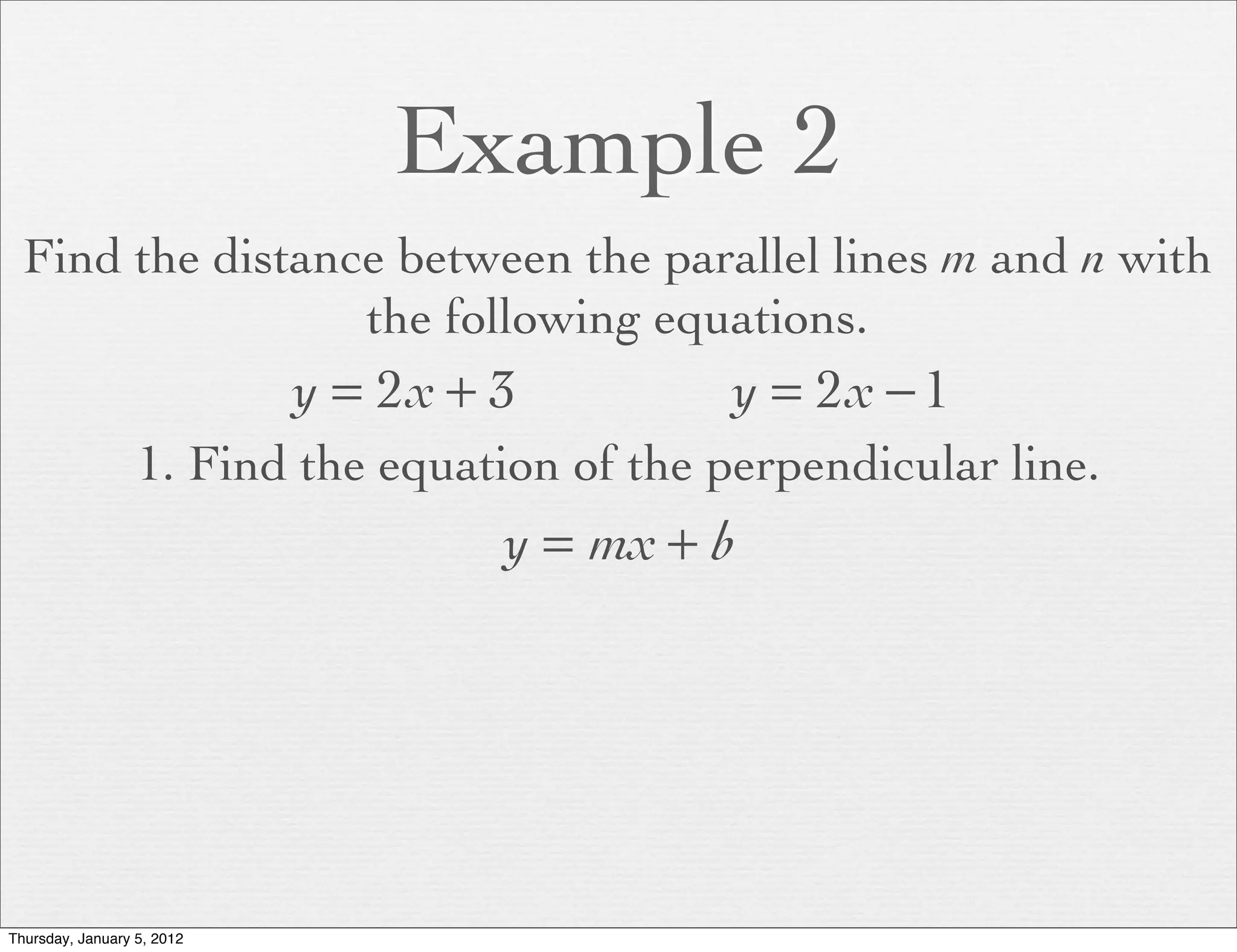
Example 2
  Find the distance between the parallel lines m and n with
                  the following equations.
                            y = 2x + 3         y = 2x − 1
                  1. Find the equation of the perpendicular line.
                                     y = mx + b


Thursday, January 5, 2012
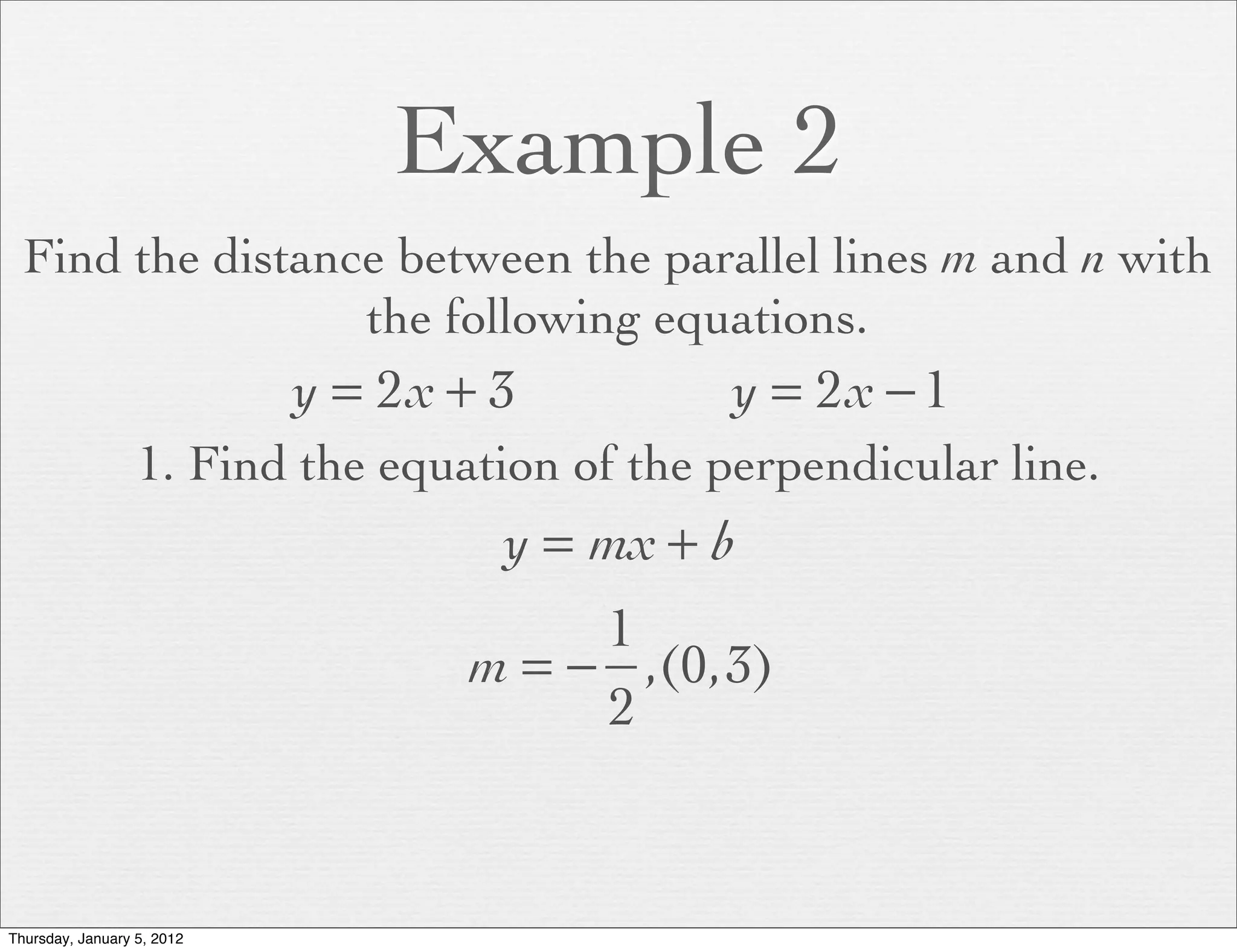
Example 2
  Find the distance between the parallel lines m and n with
                  the following equations.
                            y = 2x + 3         y = 2x − 1
                  1. Find the equation of the perpendicular line.
                                     y = mx + b
                                        1
                                   m = − ,(0,3)
                                        2


Thursday, January 5, 2012
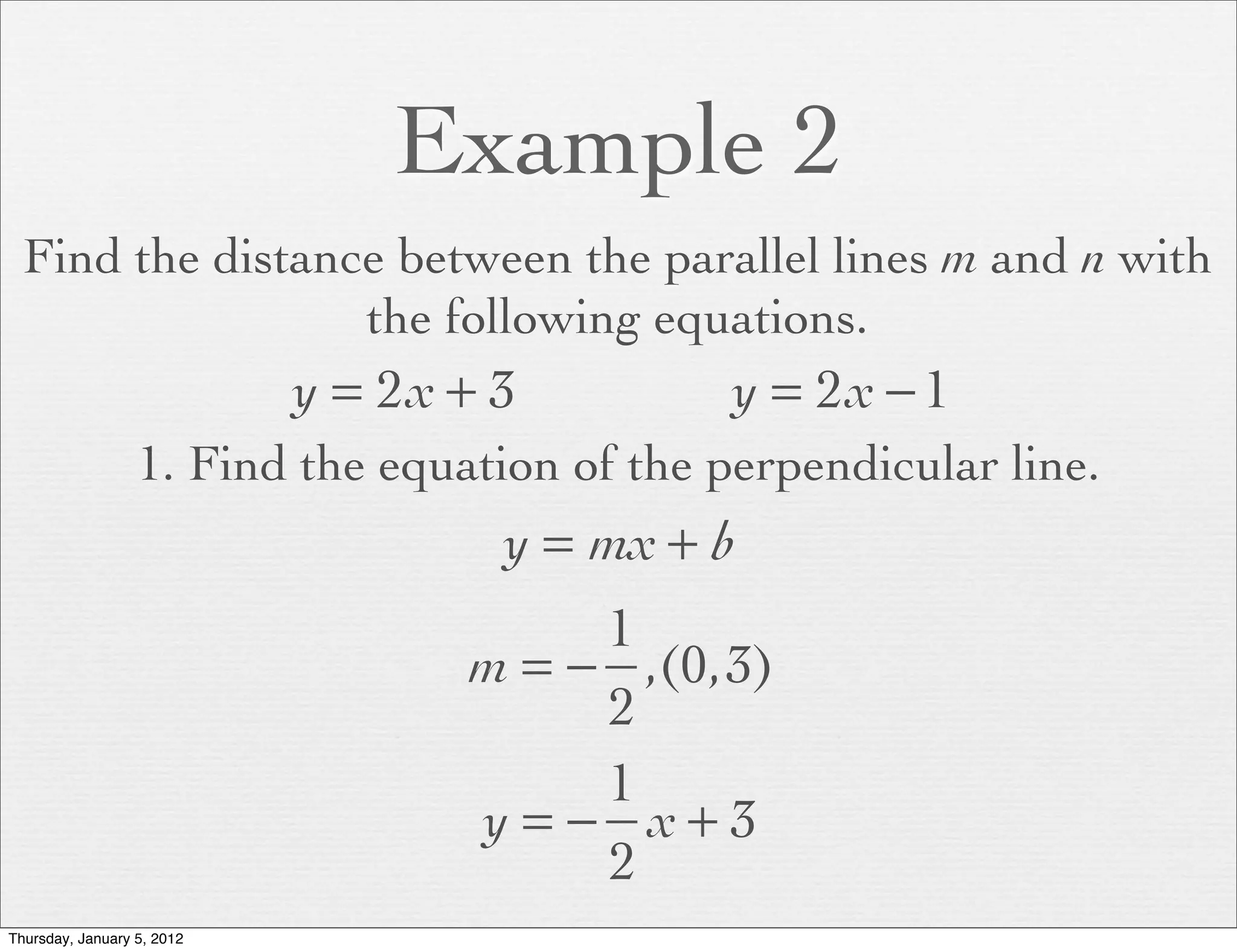
Example 2
  Find the distance between the parallel lines m and n with
                  the following equations.
                            y = 2x + 3         y = 2x − 1
                  1. Find the equation of the perpendicular line.
                                     y = mx + b
                                        1
                                   m = − ,(0,3)
                                        2
                                        1
                                   y = − x+3
                                        2
Thursday, January 5, 2012
Example 2
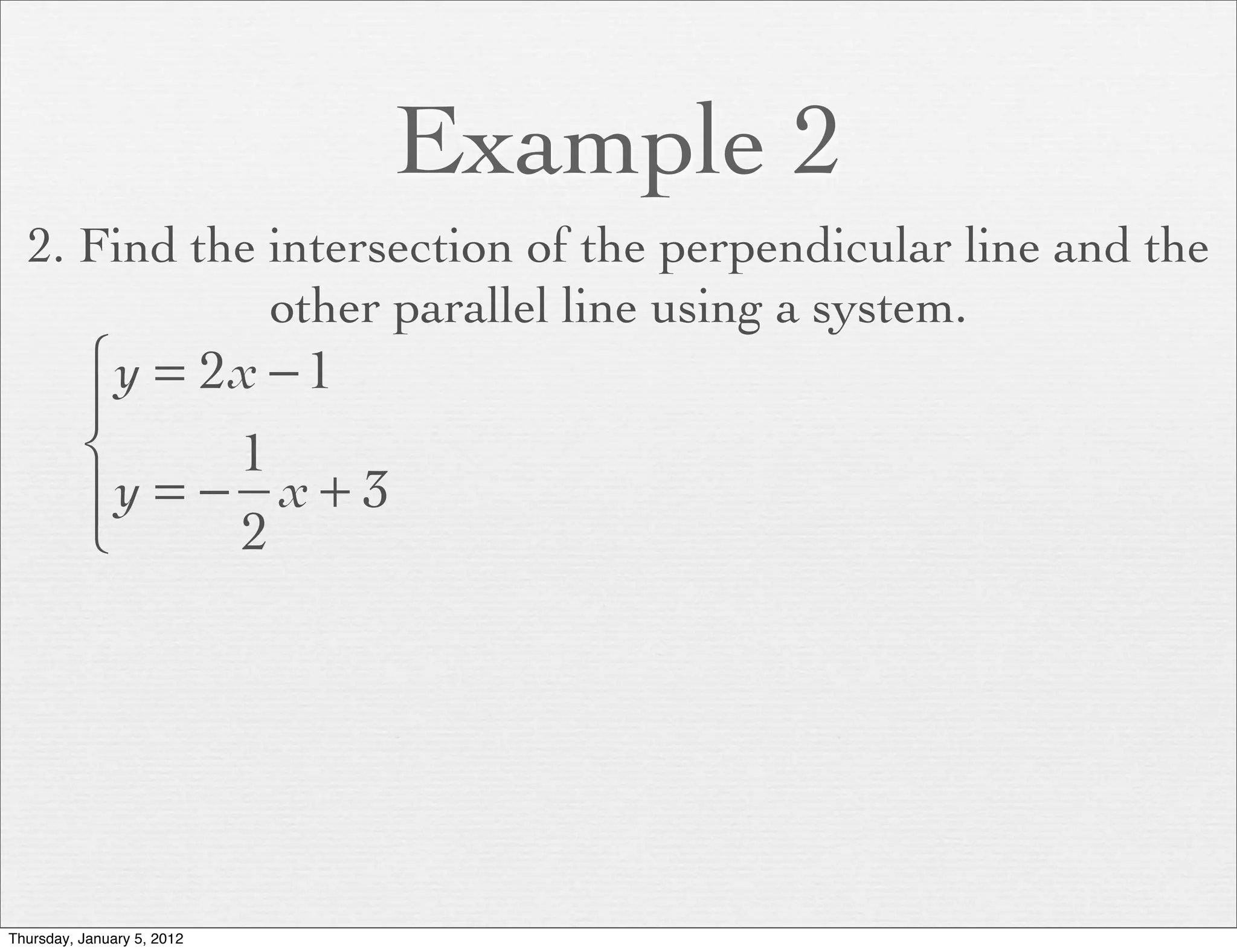
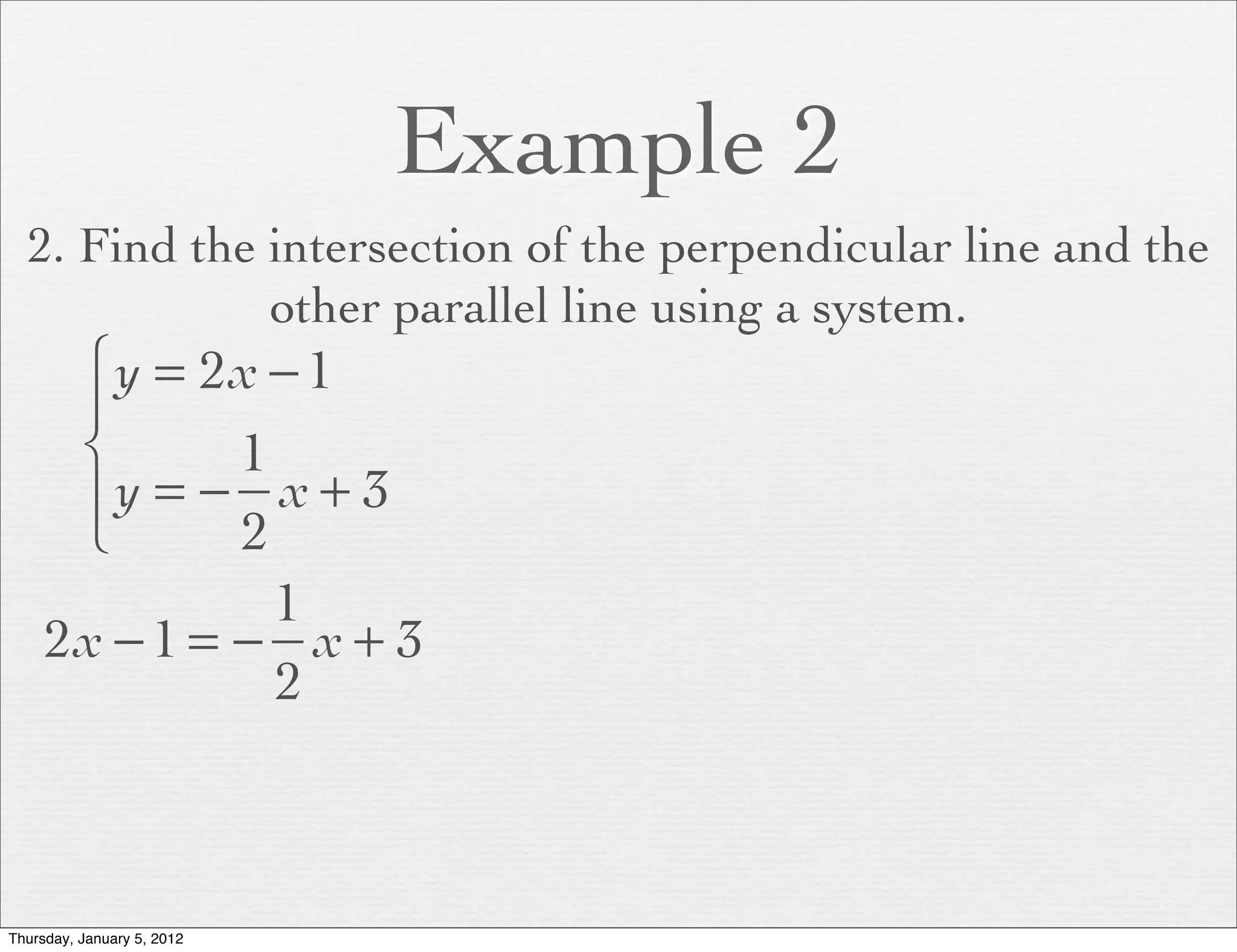
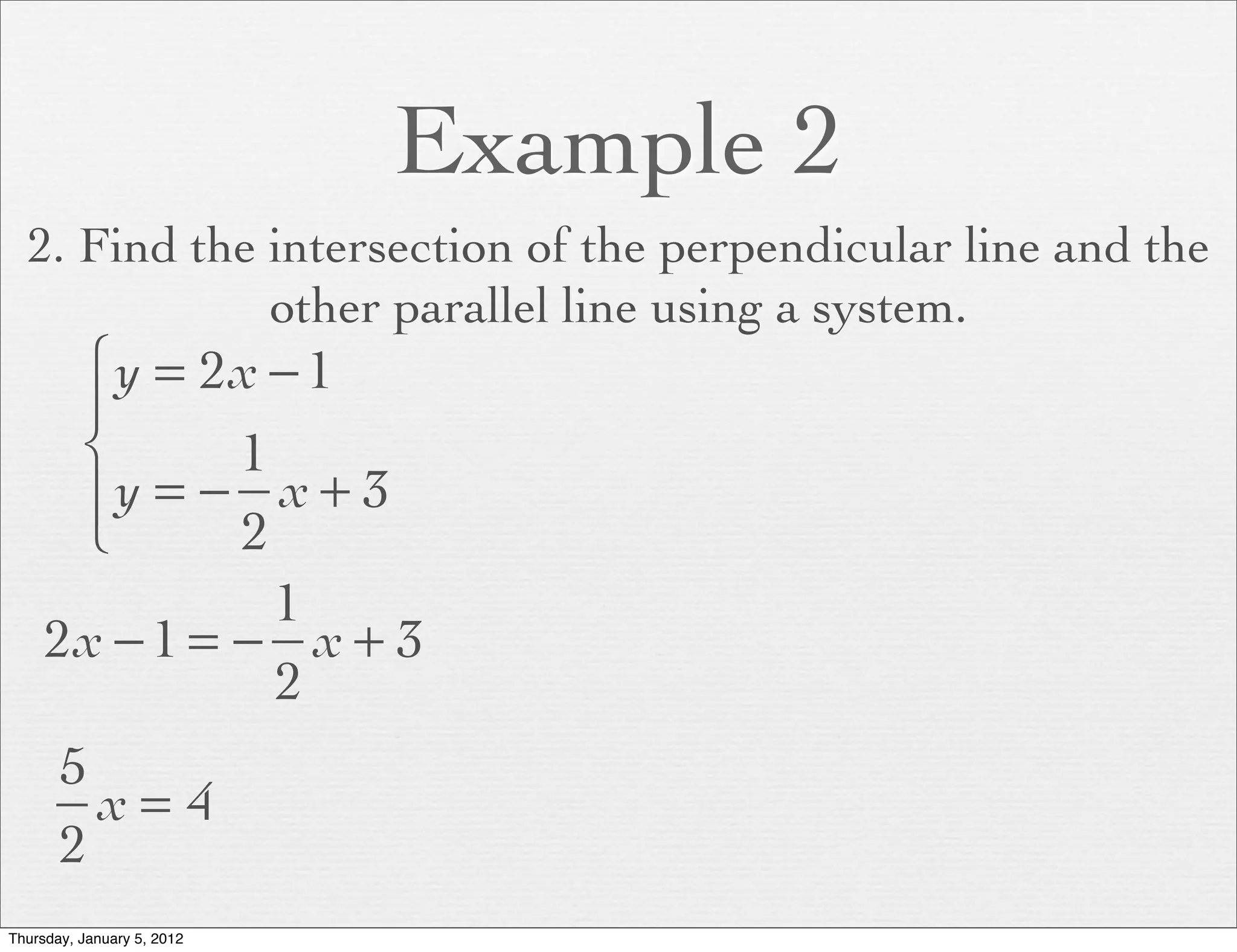
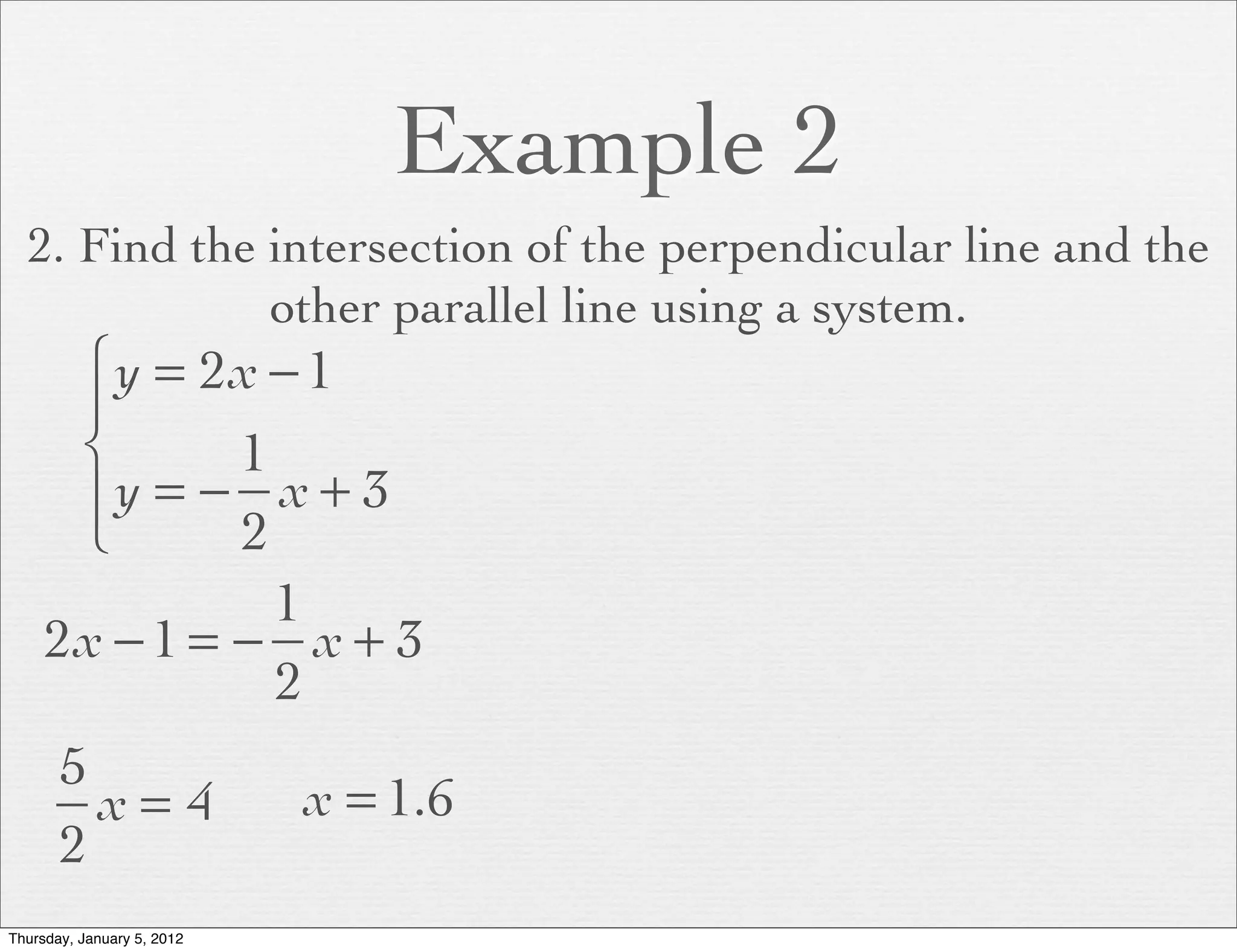
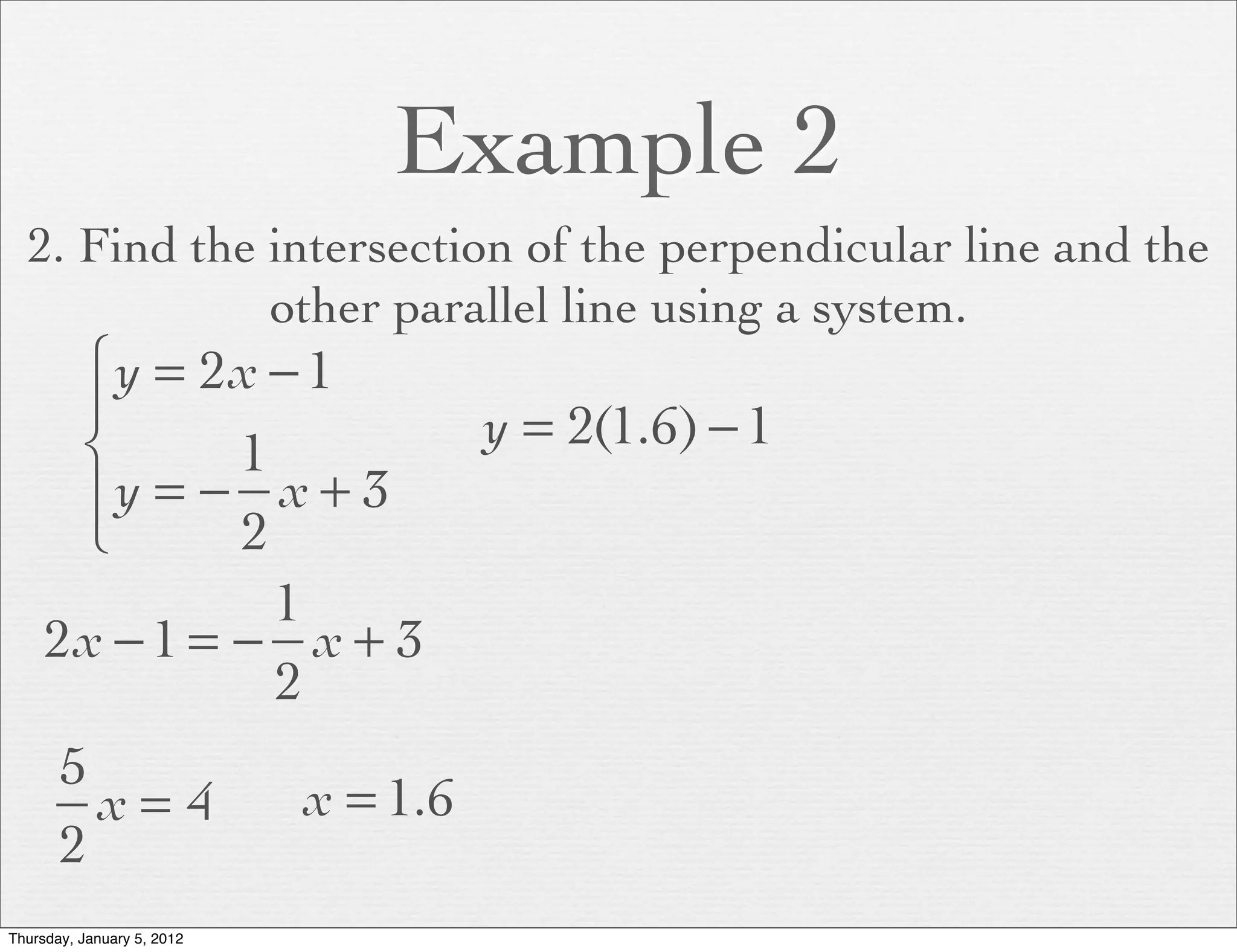
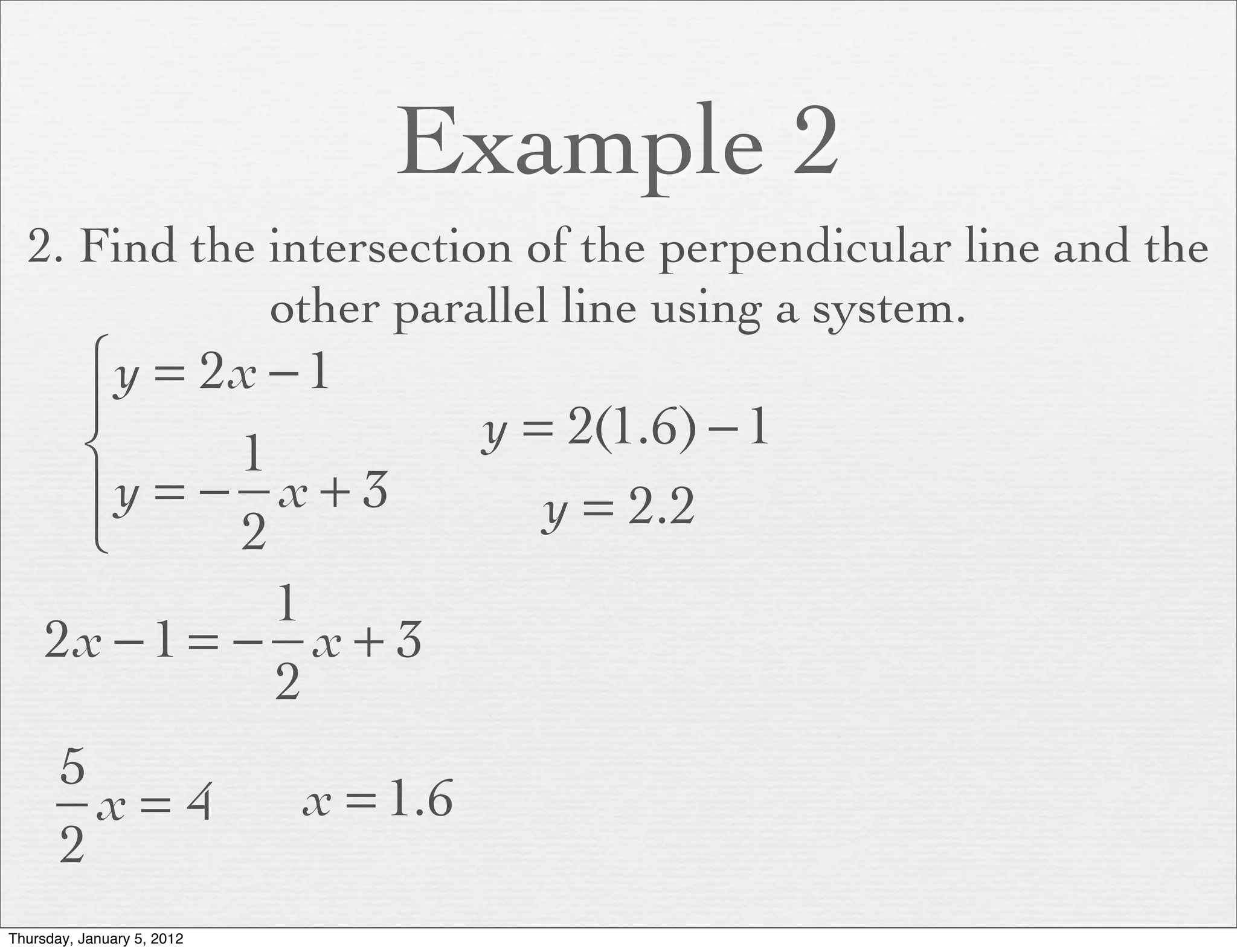
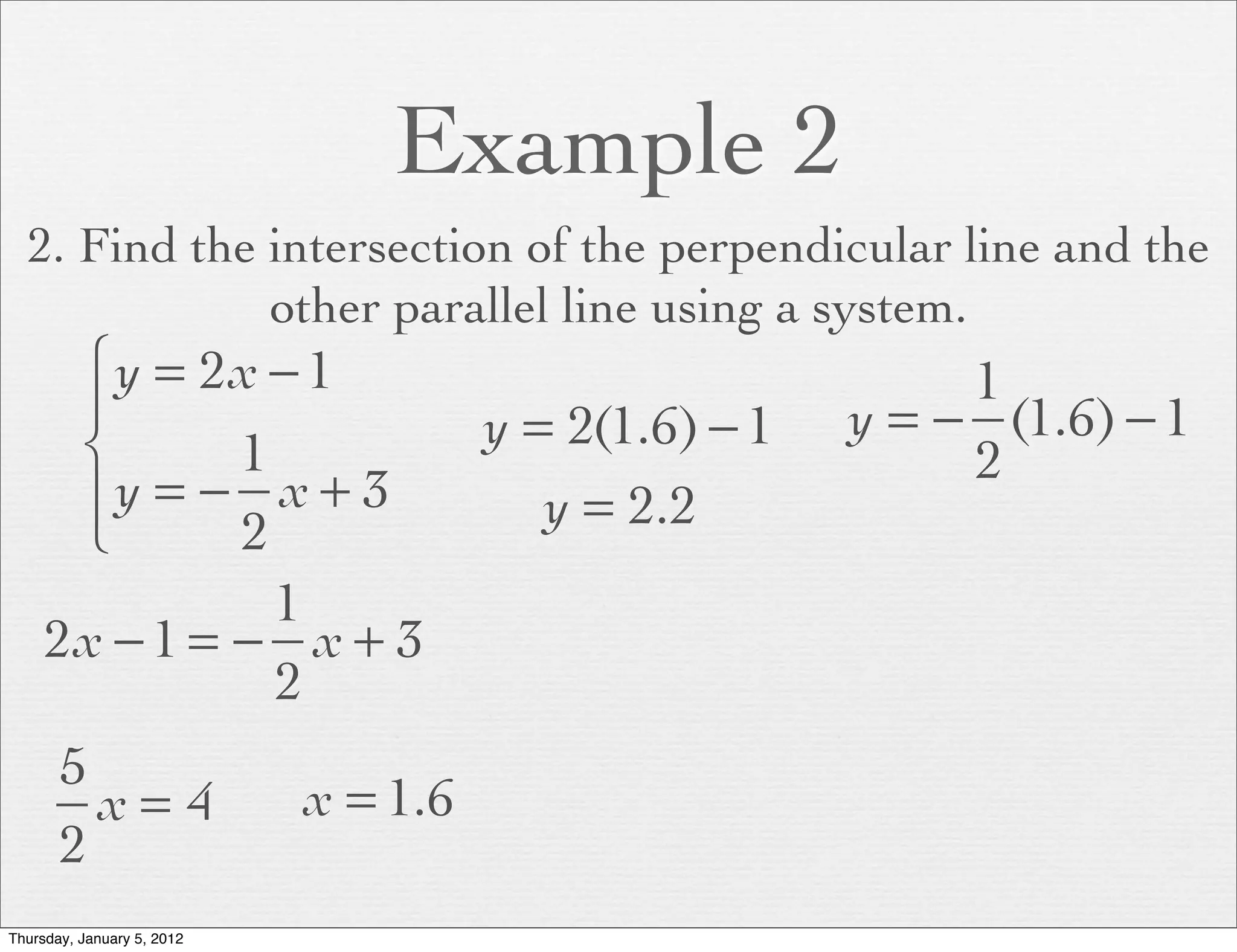
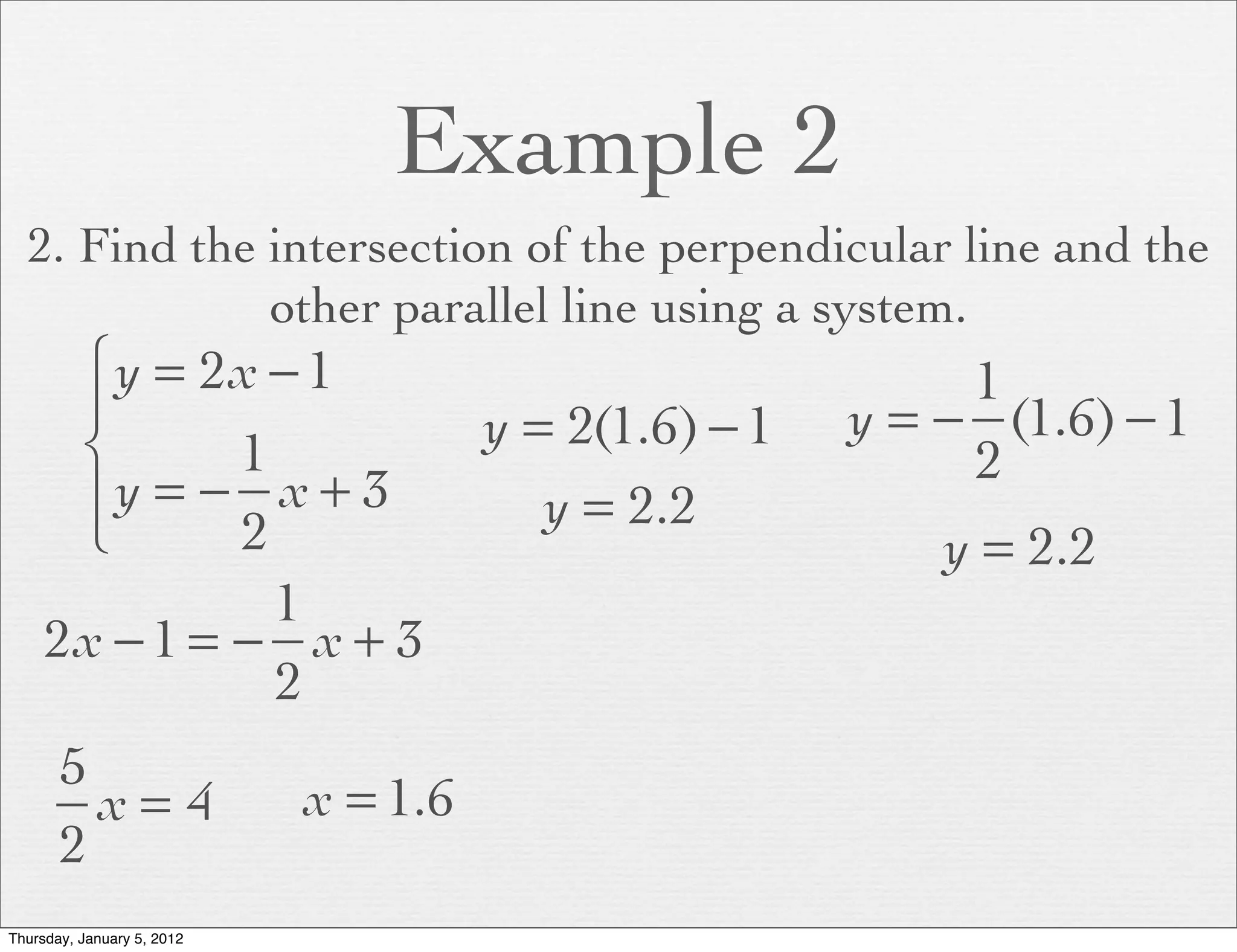
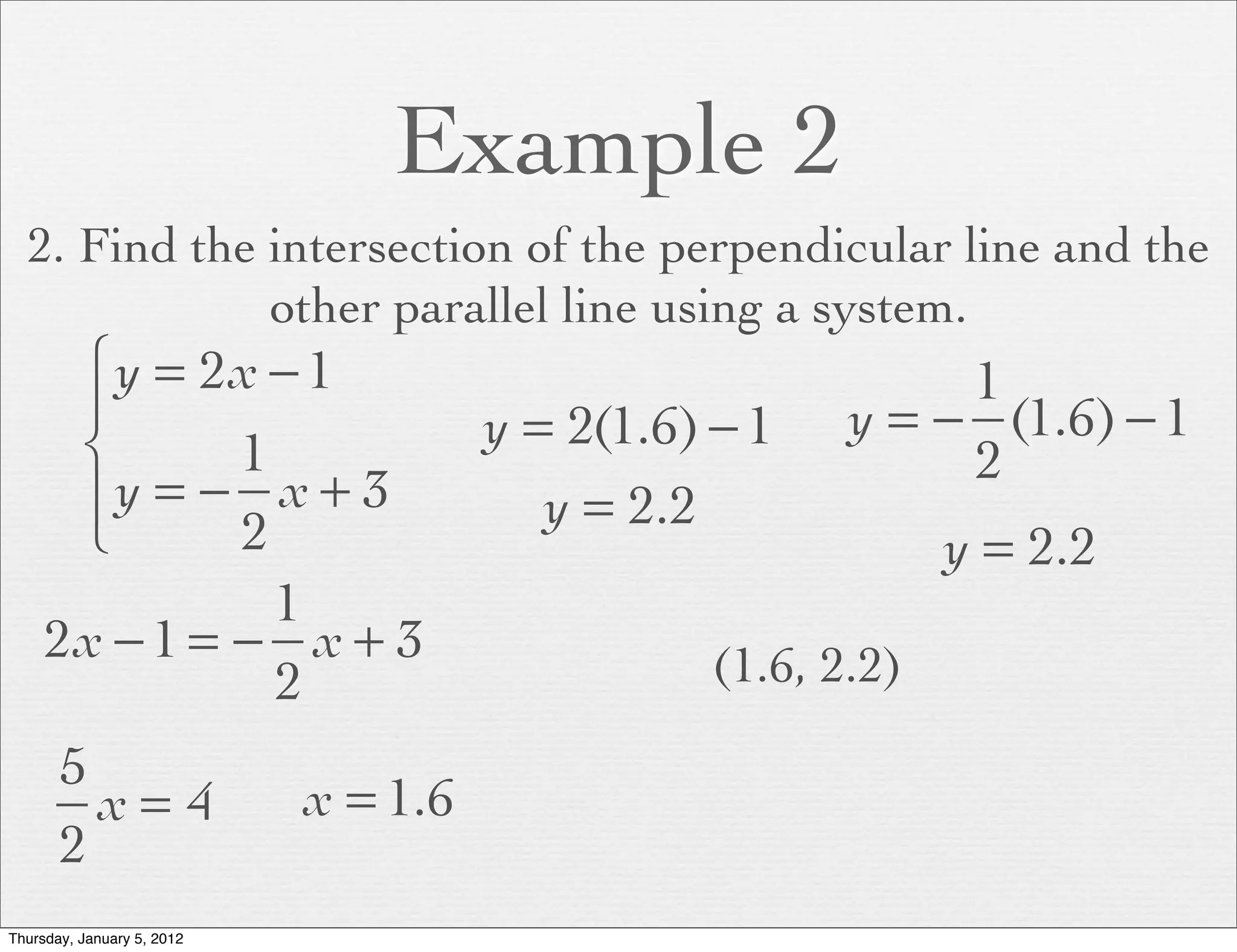
  2. Find the intersection of the perpendicular line and the
              other parallel line using a system.


Thursday, January 5, 2012
Example 2
  2. Find the intersection of the perpendicular line and the
              other parallel line using a system.
          ⎧ y = 2x − 1
          ⎪
          ⎨      1
          ⎪y = − x + 3
          ⎩      2


Thursday, January 5, 2012
Example 2
  2. Find the intersection of the perpendicular line and the
              other parallel line using a system.
      ⎧ y = 2x − 1
      ⎪
      ⎨       1
      ⎪y = − x + 3
      ⎩       2
                1
     2x − 1 = − x + 3
                2


Thursday, January 5, 2012
Example 2
  2. Find the intersection of the perpendicular line and the
              other parallel line using a system.
      ⎧ y = 2x − 1
      ⎪
      ⎨       1
      ⎪y = − x + 3
      ⎩       2
                1
     2x − 1 = − x + 3
                2
       5
         x= 4
       2
Thursday, January 5, 2012
Example 2
  2. Find the intersection of the perpendicular line and the
              other parallel line using a system.
      ⎧ y = 2x − 1
      ⎪
      ⎨       1
      ⎪y = − x + 3
      ⎩       2
                1
     2x − 1 = − x + 3
                2
       5
         x= 4               x = 1.6
       2
Thursday, January 5, 2012
Example 2
  2. Find the intersection of the perpendicular line and the
              other parallel line using a system.
      ⎧ y = 2x − 1
      ⎪                               y = 2(1.6) − 1
      ⎨       1
      ⎪y = − x + 3
      ⎩       2
                1
     2x − 1 = − x + 3
                2
       5
         x= 4               x = 1.6
       2
Thursday, January 5, 2012
Example 2
  2. Find the intersection of the perpendicular line and the
              other parallel line using a system.
      ⎧ y = 2x − 1
      ⎪                               y = 2(1.6) − 1
      ⎨       1
      ⎪y = − x + 3                       y = 2.2
      ⎩       2
                1
     2x − 1 = − x + 3
                2
       5
         x= 4               x = 1.6
       2
Thursday, January 5, 2012
Example 2
  2. Find the intersection of the perpendicular line and the
              other parallel line using a system.
      ⎧ y = 2x − 1                                          1
      ⎪                               y = 2(1.6) − 1   y = − (1.6) − 1
      ⎨       1                                             2
      ⎪y = − x + 3                       y = 2.2
      ⎩       2
                1
     2x − 1 = − x + 3
                2
       5
         x= 4               x = 1.6
       2
Thursday, January 5, 2012
Example 2
  2. Find the intersection of the perpendicular line and the
              other parallel line using a system.
      ⎧ y = 2x − 1                                          1
      ⎪                               y = 2(1.6) − 1   y = − (1.6) − 1
      ⎨       1                                             2
      ⎪y = − x + 3                       y = 2.2
      ⎩       2                                            y = 2.2
                1
     2x − 1 = − x + 3
                2
       5
         x= 4               x = 1.6
       2
Thursday, January 5, 2012
Example 2
  2. Find the intersection of the perpendicular line and the
              other parallel line using a system.
      ⎧ y = 2x − 1                                          1
      ⎪                               y = 2(1.6) − 1   y = − (1.6) − 1
      ⎨       1                                             2
      ⎪y = − x + 3                       y = 2.2
      ⎩       2                                              y = 2.2
                1
     2x − 1 = − x + 3                           (1.6, 2.2)
                2
       5
         x= 4               x = 1.6
       2
Thursday, January 5, 2012
Example 2
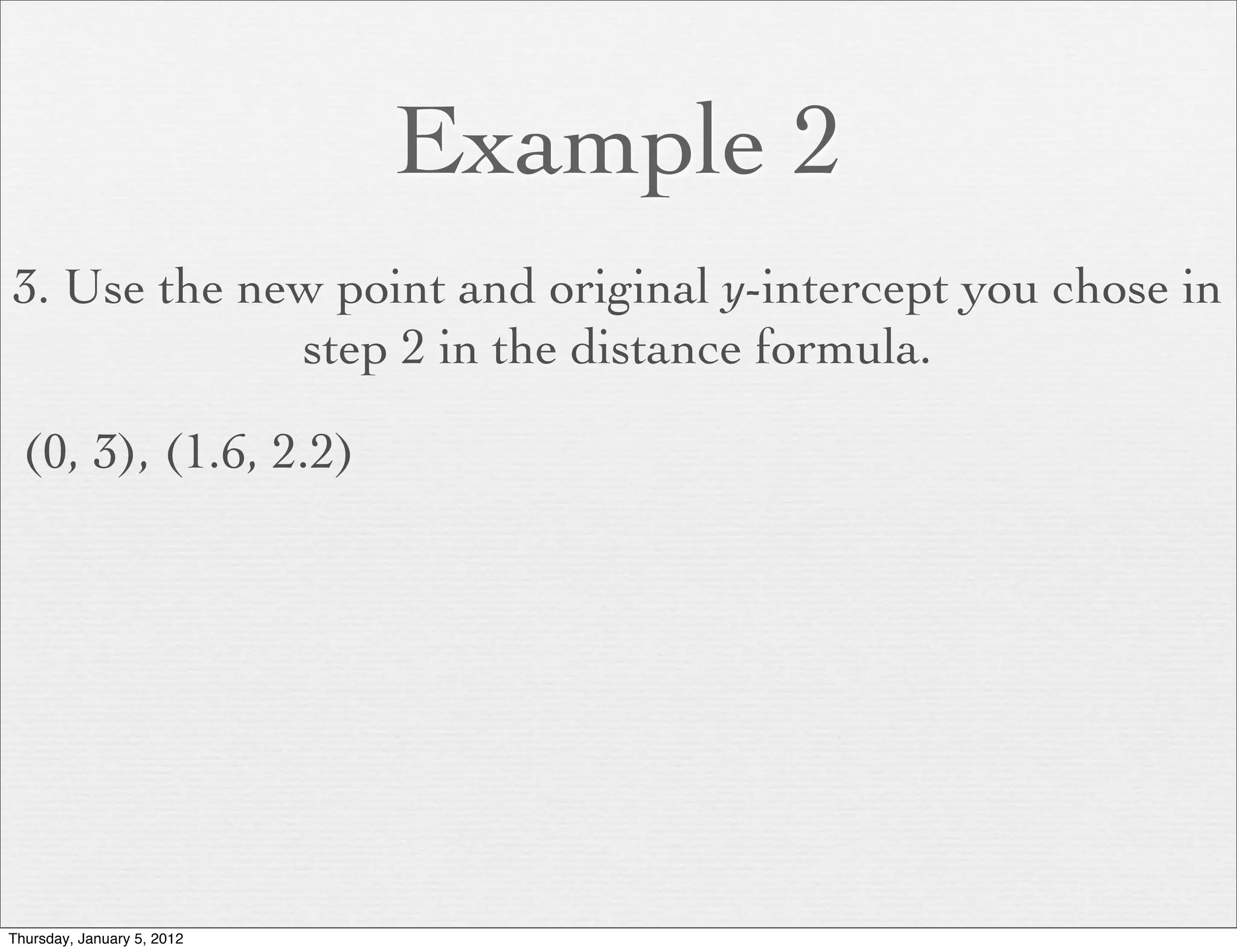
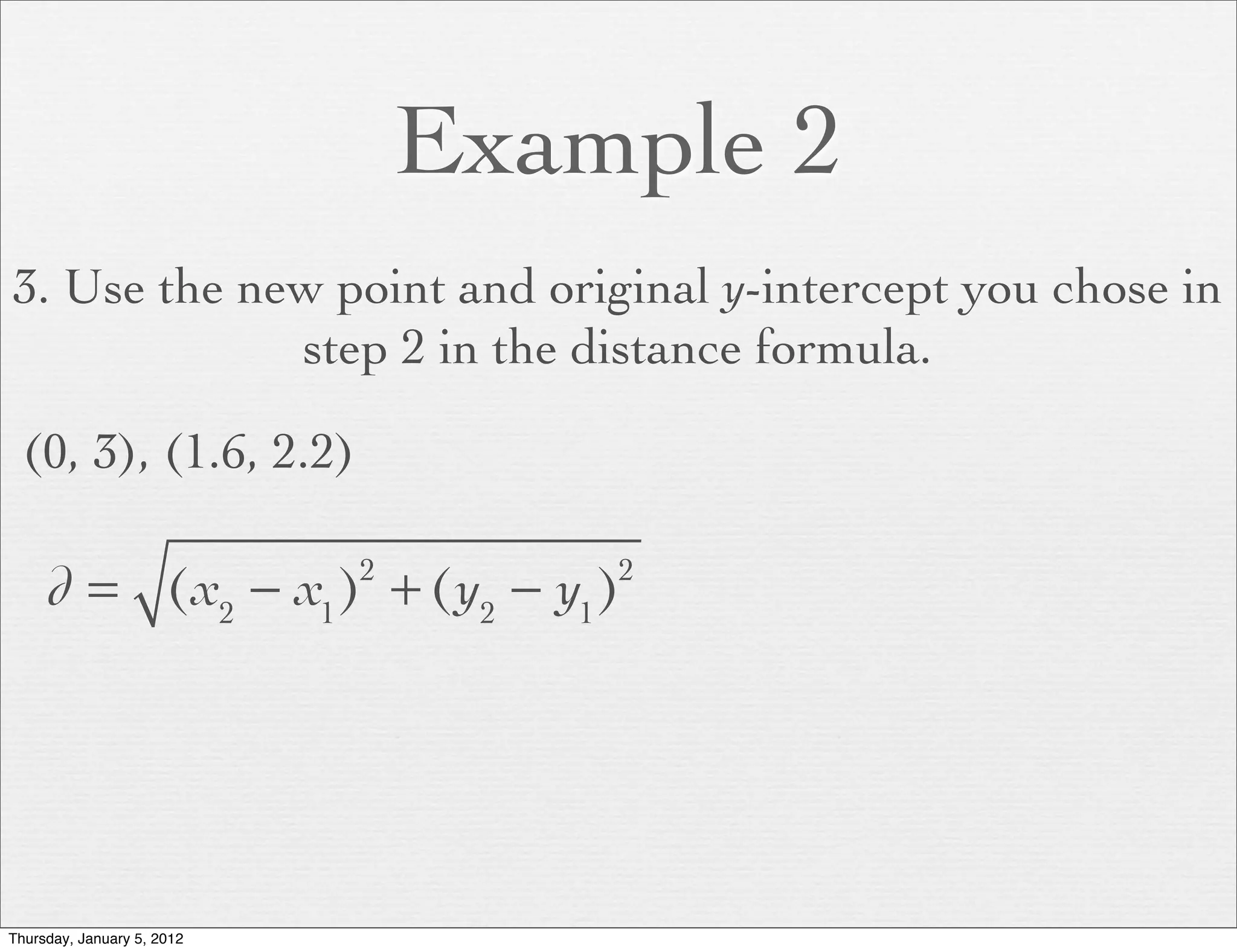
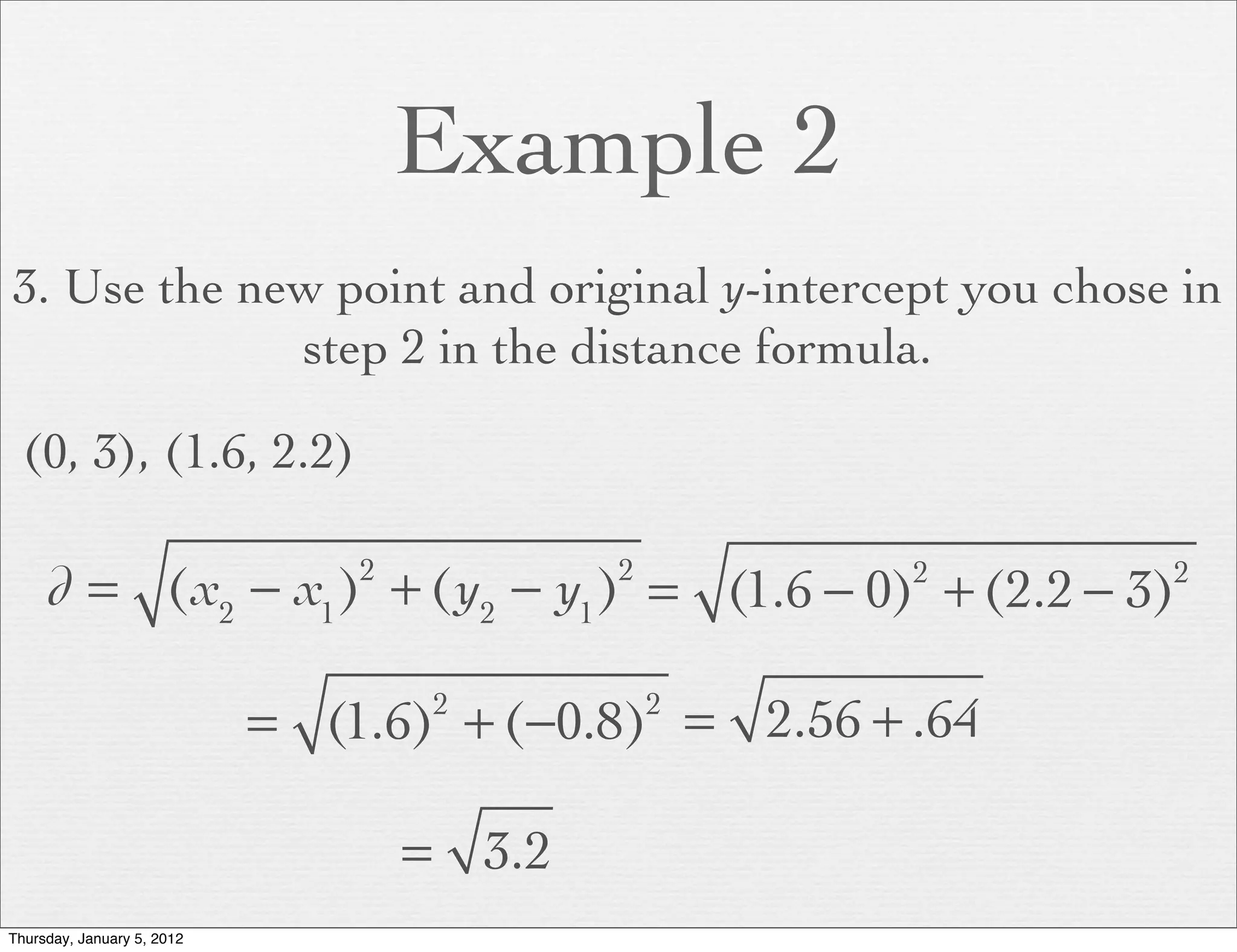
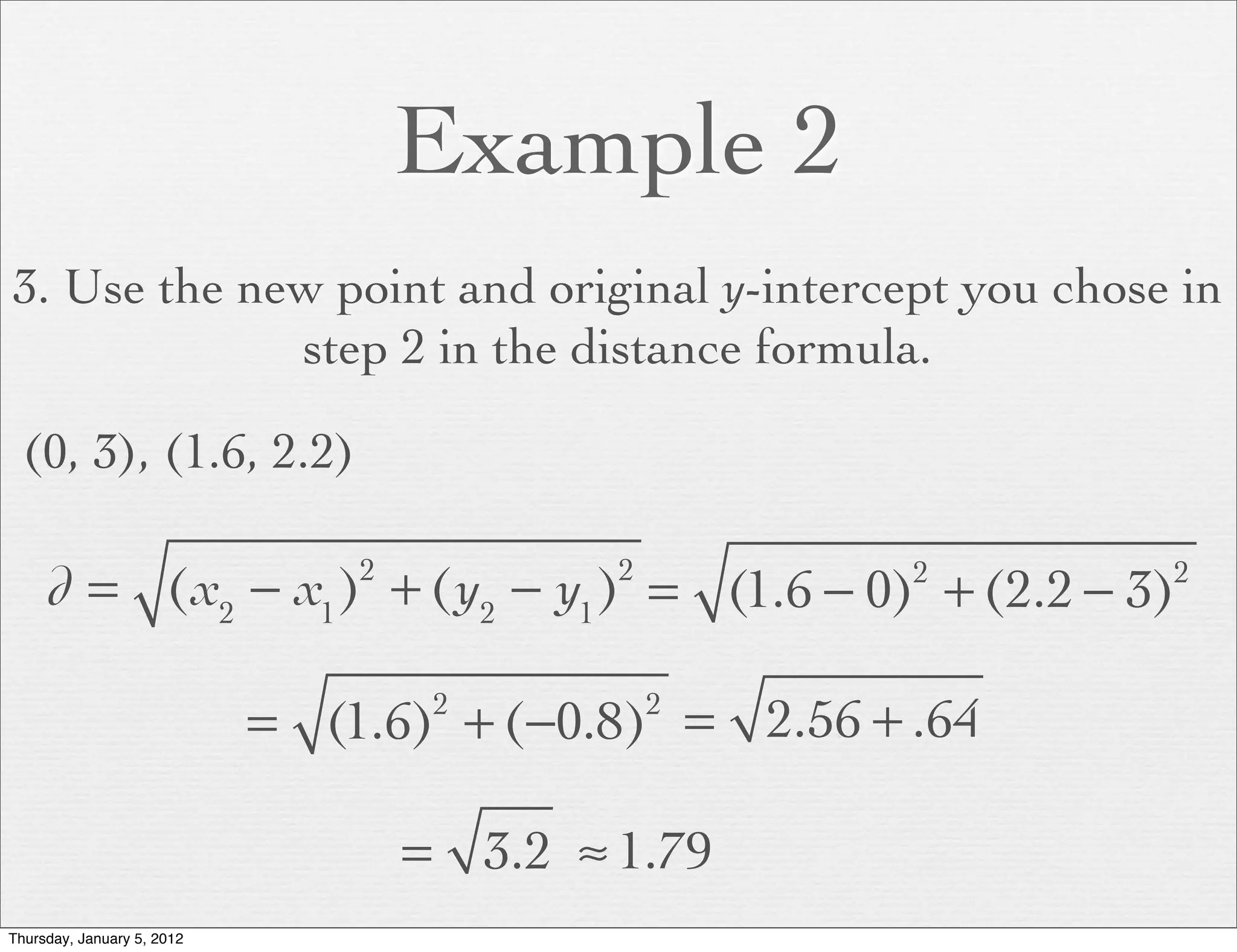
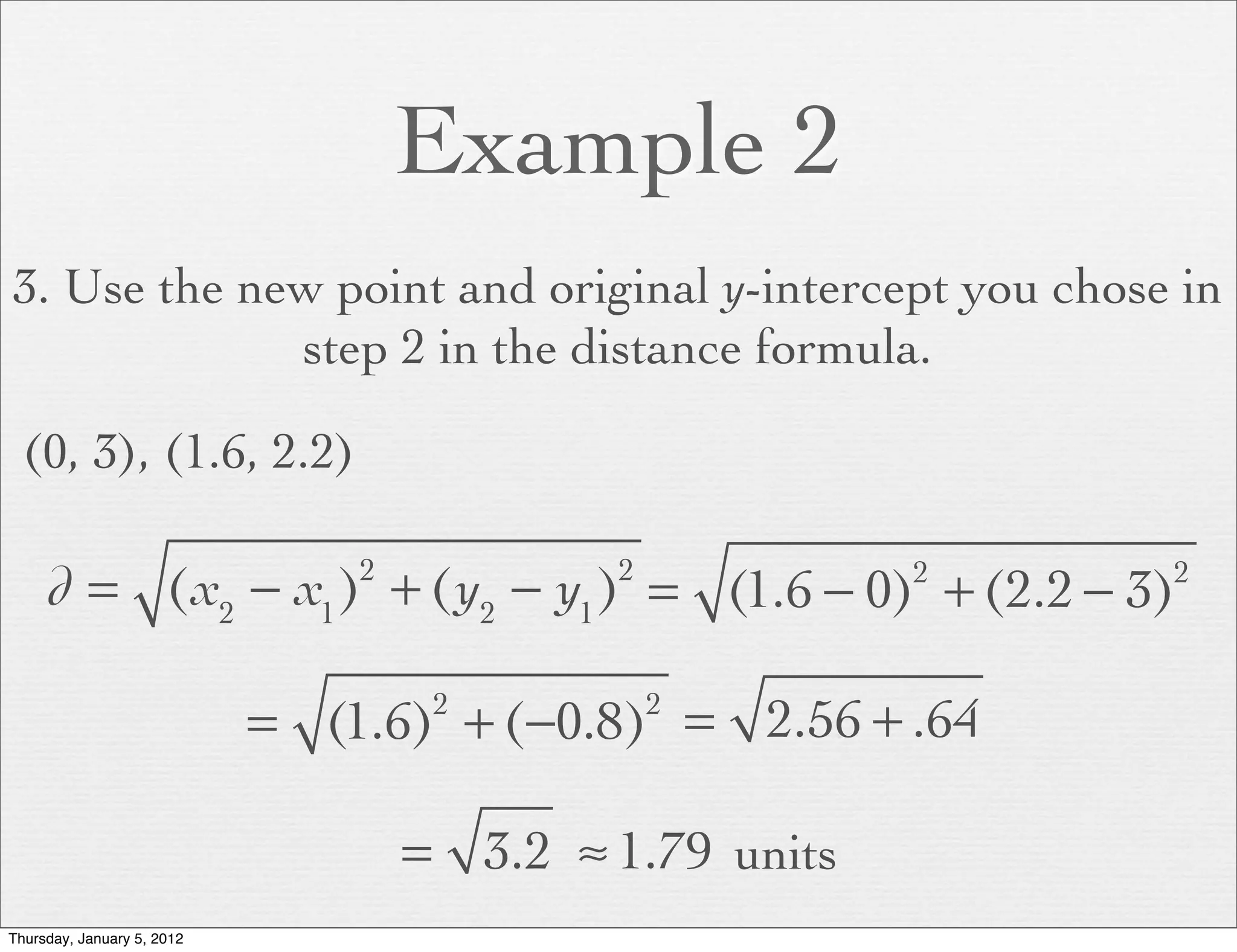
3. Use the new point and original y-intercept you chose in
             step 2 in the distance formula.


Thursday, January 5, 2012
Example 2
3. Use the new point and original y-intercept you chose in
             step 2 in the distance formula.

  (0, 3), (1.6, 2.2)


Thursday, January 5, 2012
Example 2
3. Use the new point and original y-intercept you chose in
             step 2 in the distance formula.

  (0, 3), (1.6, 2.2)

     d = (x2 − x1 ) + (y2 − y1 )
                            2       2


Thursday, January 5, 2012
Example 2
3. Use the new point and original y-intercept you chose in
             step 2 in the distance formula.

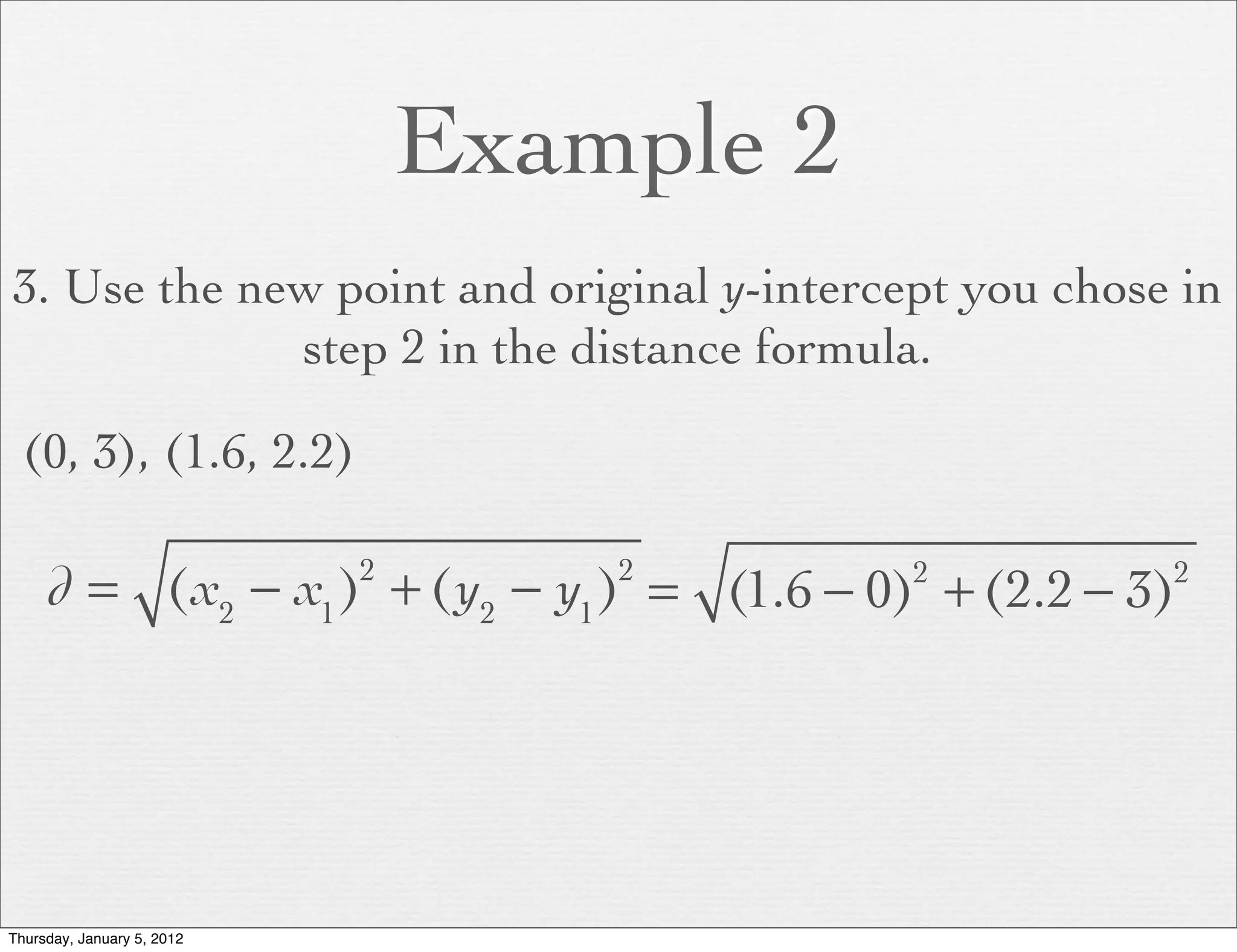
  (0, 3), (1.6, 2.2)

     d = (x2 − x1 ) + (y2 − y1 ) = (1.6 − 0) + (2.2 − 3)
                            2       2       2          2


Thursday, January 5, 2012
Example 2
3. Use the new point and original y-intercept you chose in
             step 2 in the distance formula.

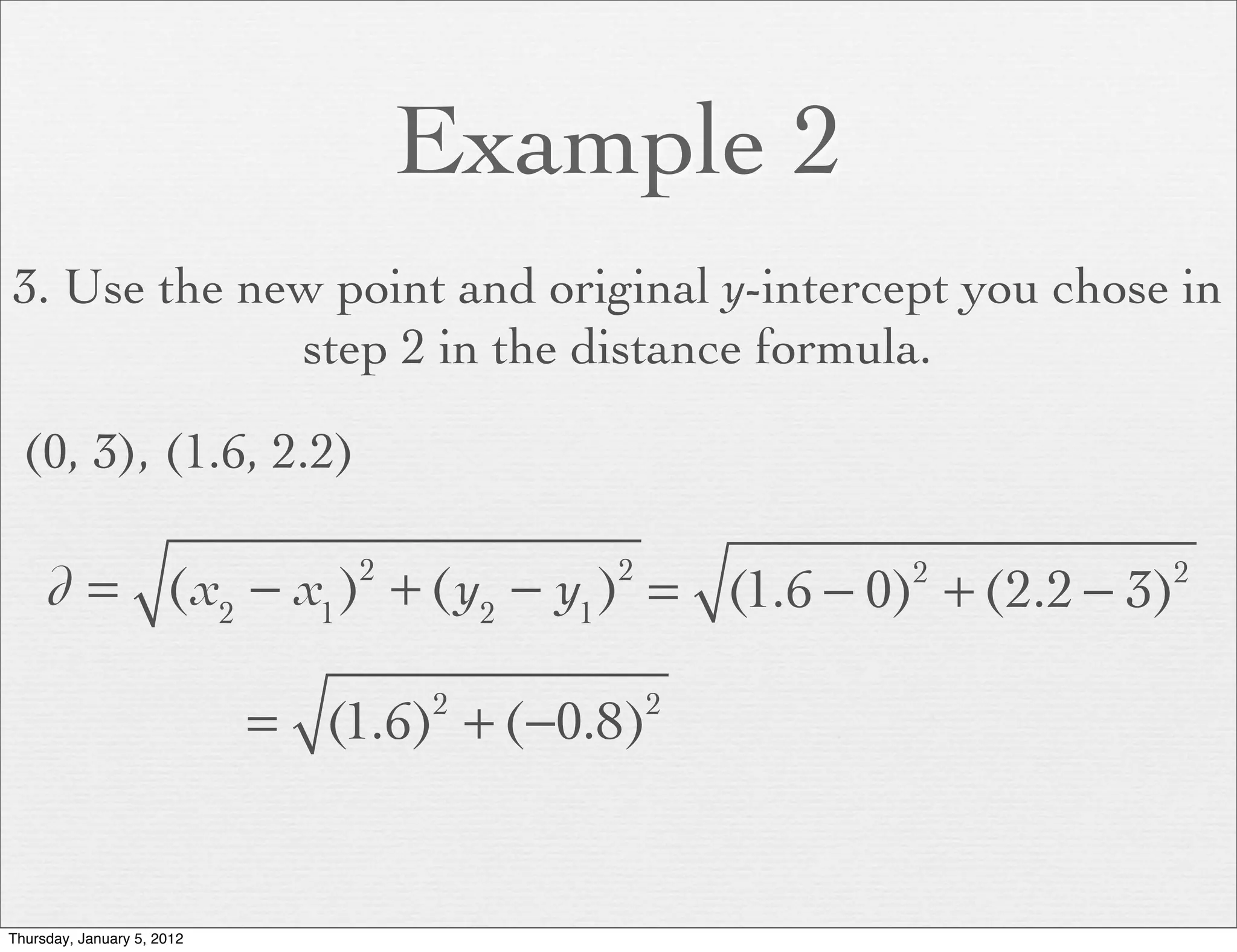
  (0, 3), (1.6, 2.2)

     d = (x2 − x1 ) + (y2 − y1 ) = (1.6 − 0) + (2.2 − 3)
                                2         2       2    2


                            = (1.6) + (−0.8)
                                    2         2


Thursday, January 5, 2012
Example 2
3. Use the new point and original y-intercept you chose in
             step 2 in the distance formula.

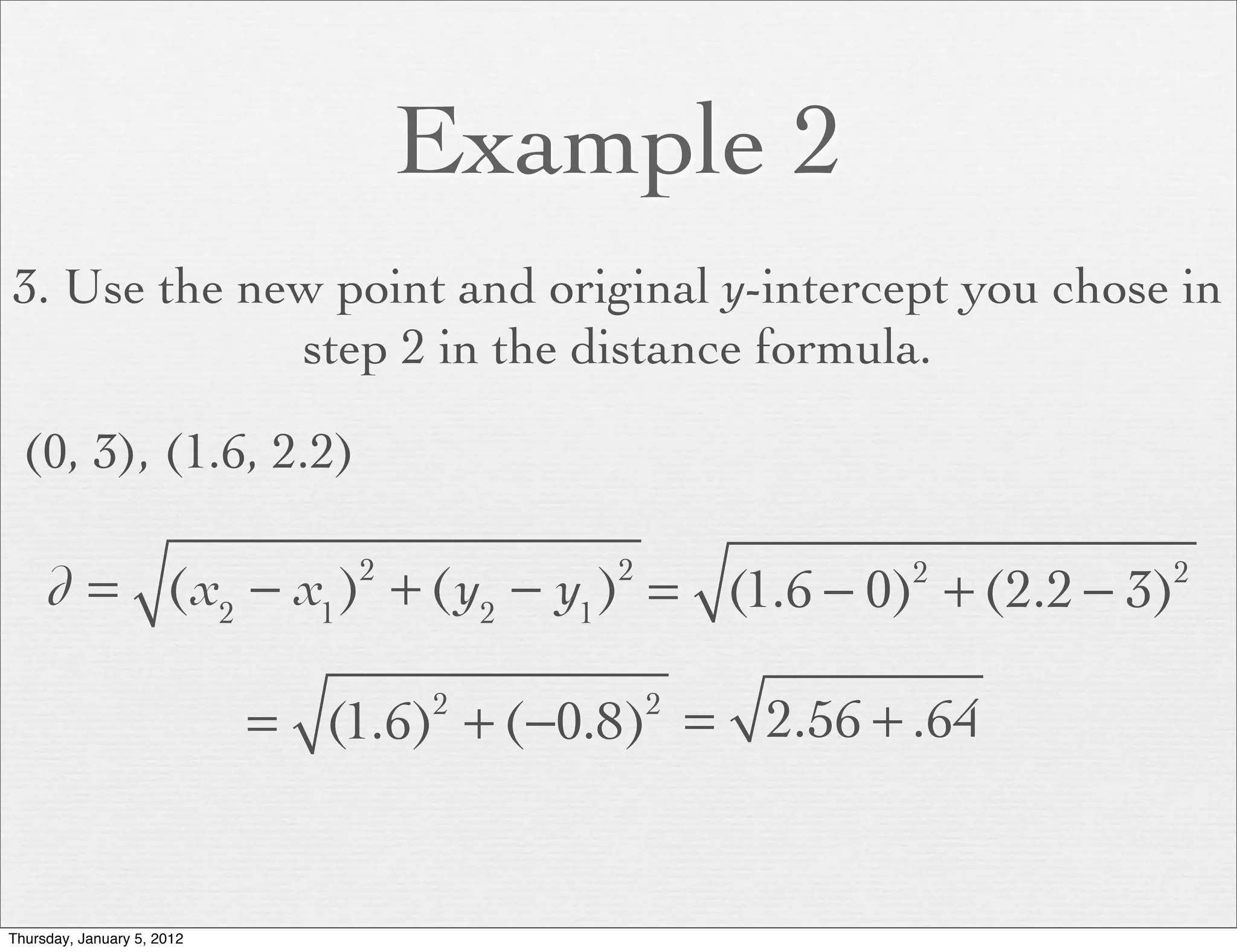
  (0, 3), (1.6, 2.2)

     d = (x2 − x1 ) + (y2 − y1 ) = (1.6 − 0) + (2.2 − 3)
                                2         2           2     2


                            = (1.6) + (−0.8) = 2.56 + .64
                                    2         2


Thursday, January 5, 2012
Example 2
3. Use the new point and original y-intercept you chose in
             step 2 in the distance formula.

  (0, 3), (1.6, 2.2)

     d = (x2 − x1 ) + (y2 − y1 ) = (1.6 − 0) + (2.2 − 3)
                                2           2         2     2


                            = (1.6) + (−0.8) = 2.56 + .64
                                     2          2


                                    = 3.2
Thursday, January 5, 2012
Example 2
3. Use the new point and original y-intercept you chose in
             step 2 in the distance formula.

  (0, 3), (1.6, 2.2)

     d = (x2 − x1 ) + (y2 − y1 ) = (1.6 − 0) + (2.2 − 3)
                                2           2         2     2


                            = (1.6) + (−0.8) = 2.56 + .64
                                     2          2


                                    = 3.2 ≈ 1.79
Thursday, January 5, 2012
Example 2
3. Use the new point and original y-intercept you chose in
             step 2 in the distance formula.

  (0, 3), (1.6, 2.2)

     d = (x2 − x1 ) + (y2 − y1 ) = (1.6 − 0) + (2.2 − 3)
                                2           2            2   2


                            = (1.6) + (−0.8) = 2.56 + .64
                                     2          2


                                    = 3.2 ≈ 1.79 units
Thursday, January 5, 2012
Example 3
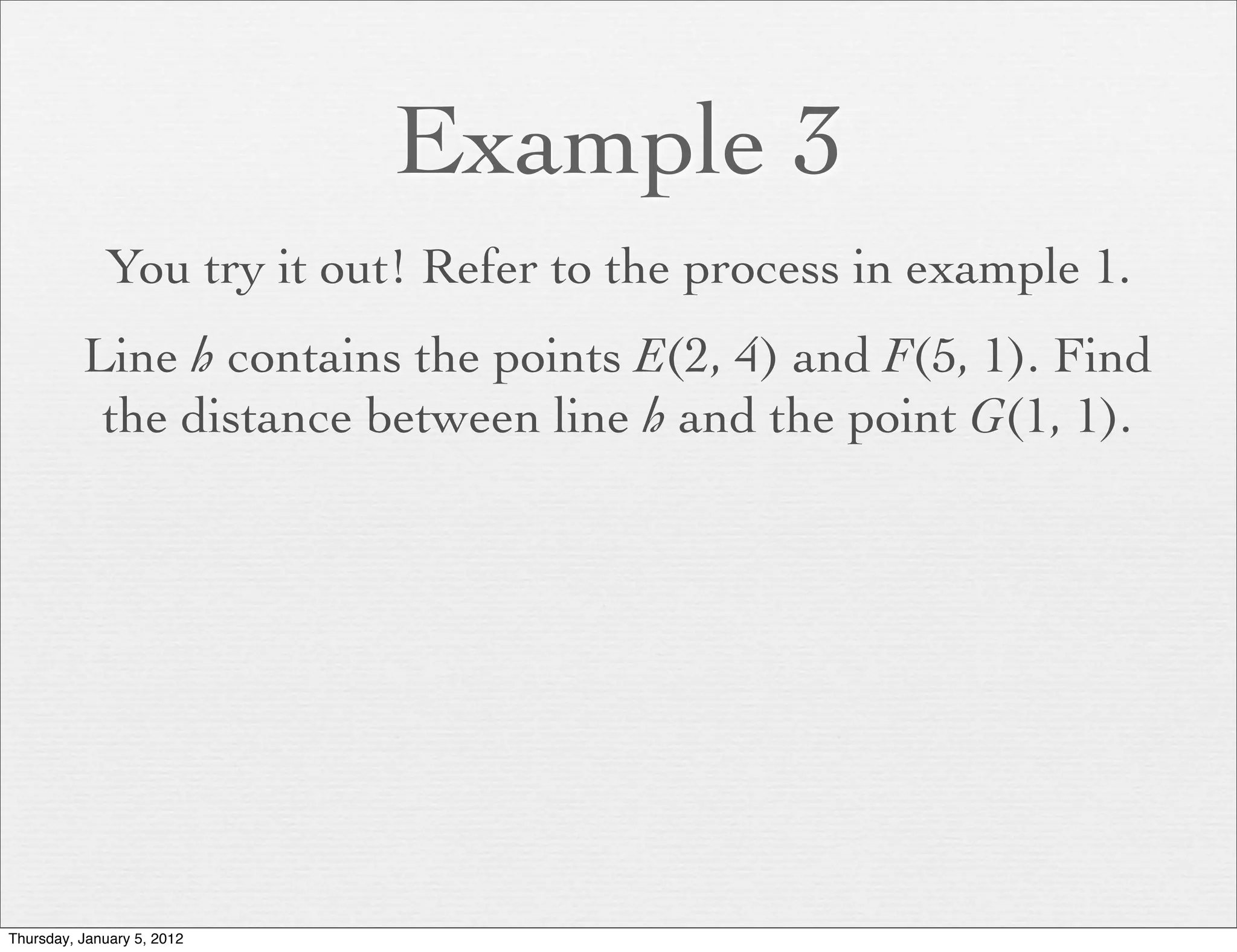
             You try it out! Refer to the process in example 1.
          Line h contains the points E(2, 4) and F(5, 1). Find
           the distance between line h and the point G(1, 1).


Thursday, January 5, 2012
Example 3
             You try it out! Refer to the process in example 1.
          Line h contains the points E(2, 4) and F(5, 1). Find
           the distance between line h and the point G(1, 1).

                                 Solution:


Thursday, January 5, 2012
Example 3
             You try it out! Refer to the process in example 1.
          Line h contains the points E(2, 4) and F(5, 1). Find
           the distance between line h and the point G(1, 1).

                                 Solution:

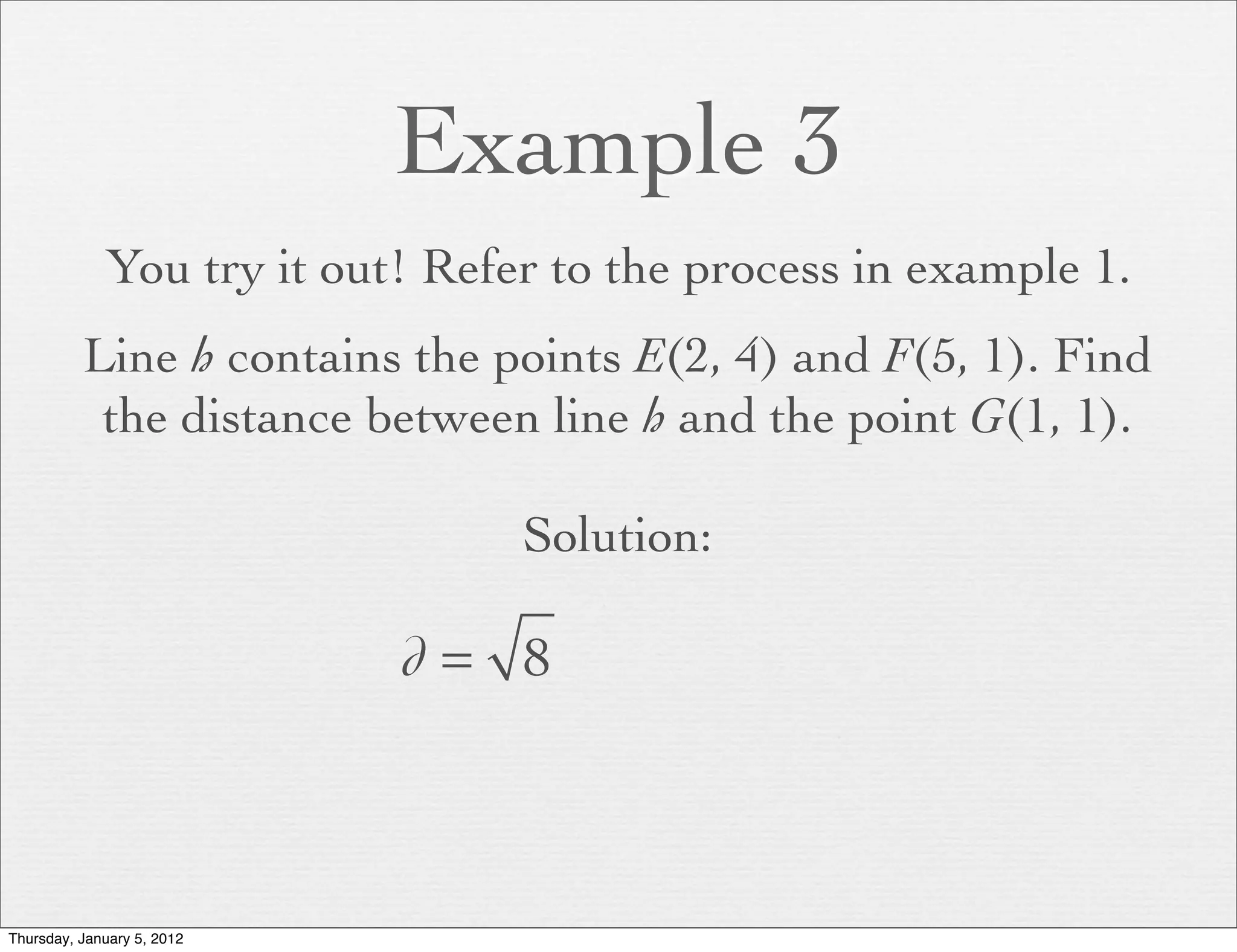
                            d= 8


Thursday, January 5, 2012
Example 3
             You try it out! Refer to the process in example 1.
          Line h contains the points E(2, 4) and F(5, 1). Find
           the distance between line h and the point G(1, 1).

                                 Solution:

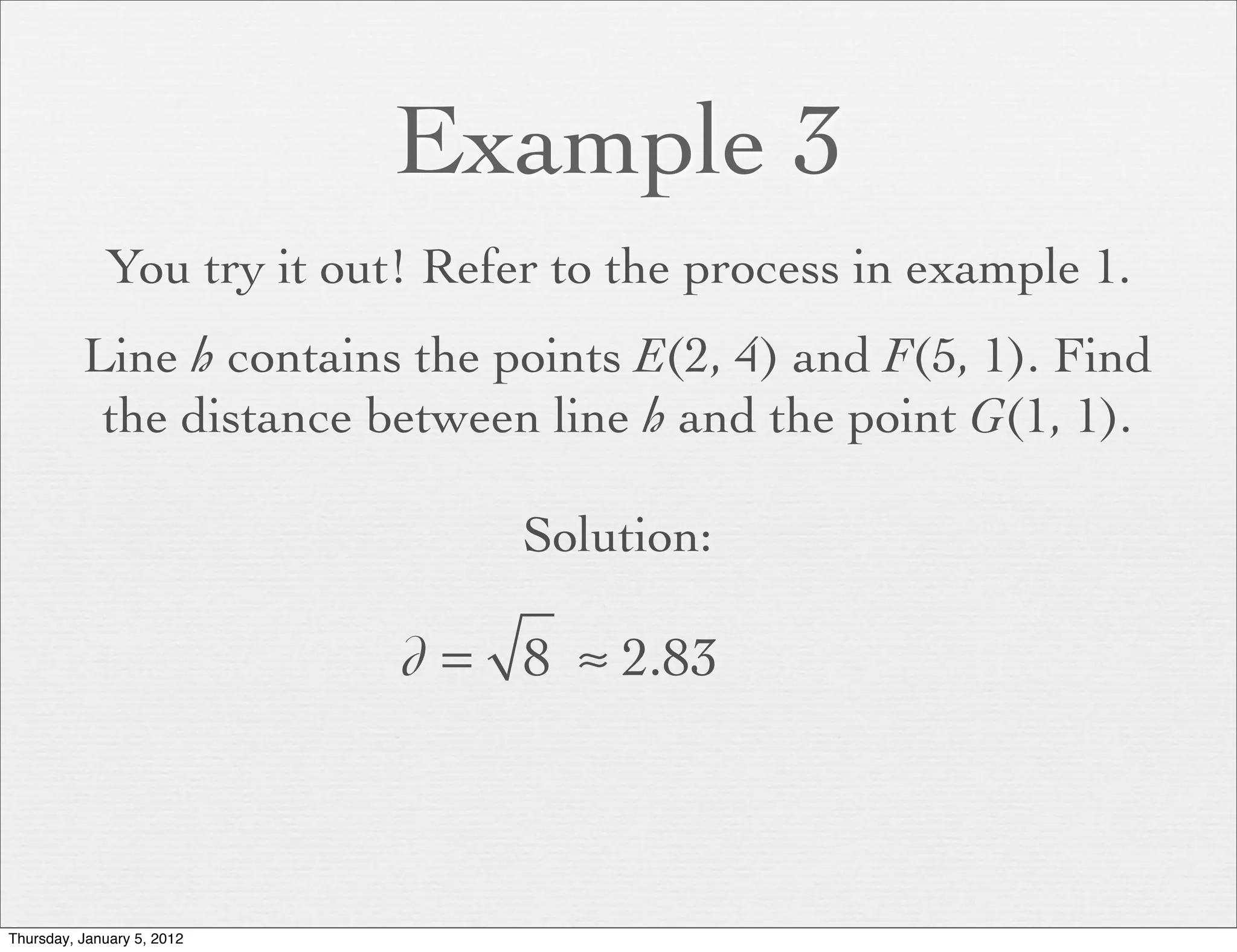
                            d = 8 ≈ 2.83


Thursday, January 5, 2012
Example 3
             You try it out! Refer to the process in example 1.
          Line h contains the points E(2, 4) and F(5, 1). Find
           the distance between line h and the point G(1, 1).

                                 Solution:

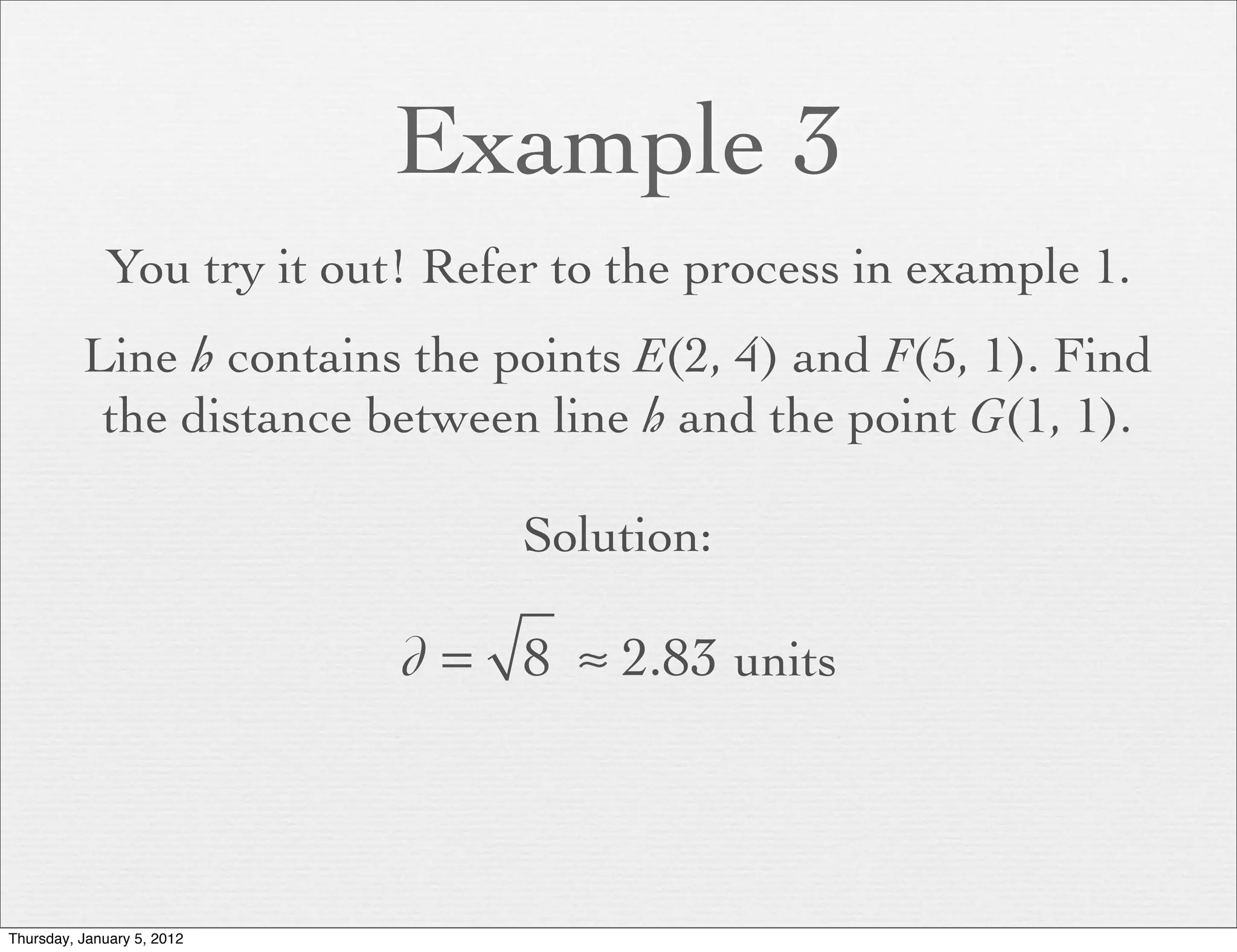
                            d = 8 ≈ 2.83 units


Thursday, January 5, 2012
Check Your Understanding


                            Review problems #1-8 on p. 218


Thursday, January 5, 2012
Problem Set


Thursday, January 5, 2012
Problem Set


                            p. 218 #13-33 odd, 53, 59, 63


 “I’m a great believer in luck, and I find the harder I work
         the more I have of it.” - Thomas Jefferson
Thursday, January 5, 2012

Geometry Section 3-6 1112

  • 1.
    Section 3-6 Perpendiculars and Distance Thursday, January 5, 2012
  • 2.
    Essential Questions n How do you find the distance between a point and a line? n How do you find the distance between parallel lines? Thursday, January 5, 2012
  • 3.
    Vocabulary 1. Equidistant: 2. Distance Between a Point and a Line: 3. Distance Between Parallel Lines: Thursday, January 5, 2012
  • 4.
    Vocabulary 1. Equidistant: The distance between any two lines as measured along a perpendicular is the same; this occurs with parallel lines 2. Distance Between a Point and a Line: 3. Distance Between Parallel Lines: Thursday, January 5, 2012
  • 5.
    Vocabulary 1. Equidistant: The distance between any two lines as measured along a perpendicular is the same; this occurs with parallel lines 2. Distance Between a Point and a Line: The length of the segment perpendicular to the line with the point one endpoint on the segment 3. Distance Between Parallel Lines: Thursday, January 5, 2012
  • 6.
    Vocabulary 1. Equidistant: The distance between any two lines as measured along a perpendicular is the same; this occurs with parallel lines 2. Distance Between a Point and a Line: The length of the segment perpendicular to the line with the point one endpoint on the segment 3. Distance Between Parallel Lines: The length of the segment perpendicular to the two parallel lines with the endpoints on either of the parallel lines Thursday, January 5, 2012
  • 7.
    Postulates & Theorems 1. Perpendicular Postulate: 2. Two Lines Equidistant from a Third: Thursday, January 5, 2012
  • 8.
    Postulates & Theorems 1. Perpendicular Postulate: If given a line and a point not on the line, then there exists exactly one line through the point that is perpendicular to the given line 2. Two Lines Equidistant from a Third: Thursday, January 5, 2012
  • 9.
    Postulates & Theorems 1. Perpendicular Postulate: If given a line and a point not on the line, then there exists exactly one line through the point that is perpendicular to the given line 2. Two Lines Equidistant from a Third: In a plane, if two lines are each equidistant from a third line, then the two lines are parallel to each other Thursday, January 5, 2012
  • 10.
    Example 1 The line a contains the points T(0, 0) and U(−5, 5). Find the distance between line a and the point V(1, 5). Thursday, January 5, 2012
  • 11.
    Example 1 The line a contains the points T(0, 0) and U(−5, 5). Find the distance between line a and the point V(1, 5). 1. Find the equation of the original line Thursday, January 5, 2012
  • 12.
    Example 1 The line a contains the points T(0, 0) and U(−5, 5). Find the distance between line a and the point V(1, 5). 1. Find the equation of the original line 0−5 m= 0+5 Thursday, January 5, 2012
  • 13.
    Example 1 The line a contains the points T(0, 0) and U(−5, 5). Find the distance between line a and the point V(1, 5). 1. Find the equation of the original line 0 − 5 −5 m= = 0+5 5 Thursday, January 5, 2012
  • 14.
    Example 1 The line a contains the points T(0, 0) and U(−5, 5). Find the distance between line a and the point V(1, 5). 1. Find the equation of the original line 0 − 5 −5 m= = = −1 0+5 5 Thursday, January 5, 2012
  • 15.
    Example 1 The line a contains the points T(0, 0) and U(−5, 5). Find the distance between line a and the point V(1, 5). 1. Find the equation of the original line 0 − 5 −5 m= = = −1 T(0, 0) 0+5 5 Thursday, January 5, 2012
  • 16.
    Example 1 The line a contains the points T(0, 0) and U(−5, 5). Find the distance between line a and the point V(1, 5). 1. Find the equation of the original line 0 − 5 −5 y = mx + b m= = = −1 T(0, 0) 0+5 5 Thursday, January 5, 2012
  • 17.
    Example 1 The line a contains the points T(0, 0) and U(−5, 5). Find the distance between line a and the point V(1, 5). 1. Find the equation of the original line 0 − 5 −5 y = mx + b m= = = −1 T(0, 0) 0+5 5 y = −x Thursday, January 5, 2012
  • 18.
    Example 1 The line a contains the points T(0, 0) and U(−5, 5). Find the distance between line a and the point V(1, 5). 1. Find the equation of the original line 0 − 5 −5 y = mx + b m= = = −1 T(0, 0) 0+5 5 y = −x 2. Find the equation of the perpendicular line through the other point Thursday, January 5, 2012
  • 19.
    Example 1 The line a contains the points T(0, 0) and U(−5, 5). Find the distance between line a and the point V(1, 5). 1. Find the equation of the original line 0 − 5 −5 y = mx + b m= = = −1 T(0, 0) 0+5 5 y = −x 2. Find the equation of the perpendicular line through the other point m =1 Thursday, January 5, 2012
  • 20.
    Example 1 The line a contains the points T(0, 0) and U(−5, 5). Find the distance between line a and the point V(1, 5). 1. Find the equation of the original line 0 − 5 −5 y = mx + b m= = = −1 T(0, 0) 0+5 5 y = −x 2. Find the equation of the perpendicular line through the other point m =1 V(1, 5) Thursday, January 5, 2012
  • 21.
    Example 1 The line a contains the points T(0, 0) and U(−5, 5). Find the distance between line a and the point V(1, 5). 1. Find the equation of the original line 0 − 5 −5 y = mx + b m= = = −1 T(0, 0) 0+5 5 y = −x 2. Find the equation of the perpendicular line through the other point m =1 y − y1 = m(x − x1 ) V(1, 5) Thursday, January 5, 2012
  • 22.
    Example 1 The line a contains the points T(0, 0) and U(−5, 5). Find the distance between line a and the point V(1, 5). 1. Find the equation of the original line 0 − 5 −5 y = mx + b m= = = −1 T(0, 0) 0+5 5 y = −x 2. Find the equation of the perpendicular line through the other point m =1 y − y1 = m(x − x1 ) V(1, 5) y − 5 = 1(x − 1) Thursday, January 5, 2012
  • 23.
    Example 1 The line a contains the points T(0, 0) and U(−5, 5). Find the distance between line a and the point V(1, 5). 1. Find the equation of the original line 0 − 5 −5 y = mx + b m= = = −1 T(0, 0) 0+5 5 y = −x 2. Find the equation of the perpendicular line through the other point m =1 y − y1 = m(x − x1 ) y − 5 = x −1 V(1, 5) y − 5 = 1(x − 1) Thursday, January 5, 2012
  • 24.
    Example 1 The line a contains the points T(0, 0) and U(−5, 5). Find the distance between line a and the point V(1, 5). 1. Find the equation of the original line 0 − 5 −5 y = mx + b m= = = −1 T(0, 0) 0+5 5 y = −x 2. Find the equation of the perpendicular line through the other point m =1 y − y1 = m(x − x1 ) y − 5 = x −1 V(1, 5) y − 5 = 1(x − 1) y = x+ 4 Thursday, January 5, 2012
  • 25.
    Example 1 3. Solve the system of these two equations. Thursday, January 5, 2012
  • 26.
    Example 1 3. Solve the system of these two equations. ⎧y = − x ⎨ ⎩y = x + 4 Thursday, January 5, 2012
  • 27.
    Example 1 3. Solve the system of these two equations. ⎧y = − x −x = x + 4 ⎨ ⎩y = x + 4 Thursday, January 5, 2012
  • 28.
    Example 1 3. Solve the system of these two equations. ⎧y = − x −x = x + 4 ⎨ −2x = 4 ⎩y = x + 4 Thursday, January 5, 2012
  • 29.
    Example 1 3. Solve the system of these two equations. ⎧y = − x −x = x + 4 ⎨ −2x = 4 ⎩y = x + 4 x = −2 Thursday, January 5, 2012
  • 30.
    Example 1 3. Solve the system of these two equations. ⎧y = − x −x = x + 4 y = −(−2) ⎨ −2x = 4 ⎩y = x + 4 x = −2 Thursday, January 5, 2012
  • 31.
    Example 1 3. Solve the system of these two equations. ⎧y = − x −x = x + 4 y = −(−2) = 2 ⎨ −2x = 4 ⎩y = x + 4 x = −2 Thursday, January 5, 2012
  • 32.
    Example 1 3. Solve the system of these two equations. ⎧y = − x −x = x + 4 y = −(−2) = 2 ⎨ −2x = 4 ⎩y = x + 4 2 = −2 + 4 x = −2 Thursday, January 5, 2012
  • 33.
    Example 1 3. Solve the system of these two equations. ⎧y = − x −x = x + 4 y = −(−2) = 2 ⎨ −2x = 4 ⎩y = x + 4 2 = −2 + 4 x = −2 (−2,2) Thursday, January 5, 2012
  • 34.
    Example 1 4.Use the distance formula utilizing this point on the line and the point not on the line. Thursday, January 5, 2012
  • 35.
    Example 1 4.Use the distance formula utilizing this point on the line and the point not on the line. (1, 5), (−2, 2) Thursday, January 5, 2012
  • 36.
    Example 1 4.Use the distance formula utilizing this point on the line and the point not on the line. (1, 5), (−2, 2) d = (x2 − x1 ) + (y2 − y1 ) 2 2 Thursday, January 5, 2012
  • 37.
    Example 1 4.Use the distance formula utilizing this point on the line and the point not on the line. (1, 5), (−2, 2) d = (x2 − x1 ) + (y2 − y1 ) = (−2 − 1) + (2 − 5) 2 2 2 2 Thursday, January 5, 2012
  • 38.
    Example 1 4.Use the distance formula utilizing this point on the line and the point not on the line. (1, 5), (−2, 2) d = (x2 − x1 ) + (y2 − y1 ) = (−2 − 1) + (2 − 5) 2 2 2 2 = (−3) + (−3) 2 2 Thursday, January 5, 2012
  • 39.
    Example 1 4.Use the distance formula utilizing this point on the line and the point not on the line. (1, 5), (−2, 2) d = (x2 − x1 ) + (y2 − y1 ) = (−2 − 1) + (2 − 5) 2 2 2 2 = (−3) + (−3) = 9 + 9 2 2 Thursday, January 5, 2012
  • 40.
    Example 1 4.Use the distance formula utilizing this point on the line and the point not on the line. (1, 5), (−2, 2) d = (x2 − x1 ) + (y2 − y1 ) = (−2 − 1) + (2 − 5) 2 2 2 2 = (−3) + (−3) = 9 + 9 = 18 2 2 Thursday, January 5, 2012
  • 41.
    Example 1 4.Use the distance formula utilizing this point on the line and the point not on the line. (1, 5), (−2, 2) d = (x2 − x1 ) + (y2 − y1 ) = (−2 − 1) + (2 − 5) 2 2 2 2 = (−3) + (−3) = 9 + 9 = 18 ≈ 4.24 2 2 Thursday, January 5, 2012
  • 42.
    Example 1 4.Use the distance formula utilizing this point on the line and the point not on the line. (1, 5), (−2, 2) d = (x2 − x1 ) + (y2 − y1 ) = (−2 − 1) + (2 − 5) 2 2 2 2 = (−3) + (−3) = 9 + 9 = 18 ≈ 4.24 units 2 2 Thursday, January 5, 2012
  • 43.
    Example 2 Find the distance between the parallel lines m and n with the following equations. y = 2x + 3 y = 2x − 1 Thursday, January 5, 2012
  • 44.
    Example 2 Find the distance between the parallel lines m and n with the following equations. y = 2x + 3 y = 2x − 1 1. Find the equation of the perpendicular line. Thursday, January 5, 2012
  • 45.
    Example 2 Find the distance between the parallel lines m and n with the following equations. y = 2x + 3 y = 2x − 1 1. Find the equation of the perpendicular line. y = mx + b Thursday, January 5, 2012
  • 46.
    Example 2 Find the distance between the parallel lines m and n with the following equations. y = 2x + 3 y = 2x − 1 1. Find the equation of the perpendicular line. y = mx + b 1 m = − ,(0,3) 2 Thursday, January 5, 2012
  • 47.
    Example 2 Find the distance between the parallel lines m and n with the following equations. y = 2x + 3 y = 2x − 1 1. Find the equation of the perpendicular line. y = mx + b 1 m = − ,(0,3) 2 1 y = − x+3 2 Thursday, January 5, 2012
  • 48.
    Example 2 2. Find the intersection of the perpendicular line and the other parallel line using a system. Thursday, January 5, 2012
  • 49.
    Example 2 2. Find the intersection of the perpendicular line and the other parallel line using a system. ⎧ y = 2x − 1 ⎪ ⎨ 1 ⎪y = − x + 3 ⎩ 2 Thursday, January 5, 2012
  • 50.
    Example 2 2. Find the intersection of the perpendicular line and the other parallel line using a system. ⎧ y = 2x − 1 ⎪ ⎨ 1 ⎪y = − x + 3 ⎩ 2 1 2x − 1 = − x + 3 2 Thursday, January 5, 2012
  • 51.
    Example 2 2. Find the intersection of the perpendicular line and the other parallel line using a system. ⎧ y = 2x − 1 ⎪ ⎨ 1 ⎪y = − x + 3 ⎩ 2 1 2x − 1 = − x + 3 2 5 x= 4 2 Thursday, January 5, 2012
  • 52.
    Example 2 2. Find the intersection of the perpendicular line and the other parallel line using a system. ⎧ y = 2x − 1 ⎪ ⎨ 1 ⎪y = − x + 3 ⎩ 2 1 2x − 1 = − x + 3 2 5 x= 4 x = 1.6 2 Thursday, January 5, 2012
  • 53.
    Example 2 2. Find the intersection of the perpendicular line and the other parallel line using a system. ⎧ y = 2x − 1 ⎪ y = 2(1.6) − 1 ⎨ 1 ⎪y = − x + 3 ⎩ 2 1 2x − 1 = − x + 3 2 5 x= 4 x = 1.6 2 Thursday, January 5, 2012
  • 54.
    Example 2 2. Find the intersection of the perpendicular line and the other parallel line using a system. ⎧ y = 2x − 1 ⎪ y = 2(1.6) − 1 ⎨ 1 ⎪y = − x + 3 y = 2.2 ⎩ 2 1 2x − 1 = − x + 3 2 5 x= 4 x = 1.6 2 Thursday, January 5, 2012
  • 55.
    Example 2 2. Find the intersection of the perpendicular line and the other parallel line using a system. ⎧ y = 2x − 1 1 ⎪ y = 2(1.6) − 1 y = − (1.6) − 1 ⎨ 1 2 ⎪y = − x + 3 y = 2.2 ⎩ 2 1 2x − 1 = − x + 3 2 5 x= 4 x = 1.6 2 Thursday, January 5, 2012
  • 56.
    Example 2 2. Find the intersection of the perpendicular line and the other parallel line using a system. ⎧ y = 2x − 1 1 ⎪ y = 2(1.6) − 1 y = − (1.6) − 1 ⎨ 1 2 ⎪y = − x + 3 y = 2.2 ⎩ 2 y = 2.2 1 2x − 1 = − x + 3 2 5 x= 4 x = 1.6 2 Thursday, January 5, 2012
  • 57.
    Example 2 2. Find the intersection of the perpendicular line and the other parallel line using a system. ⎧ y = 2x − 1 1 ⎪ y = 2(1.6) − 1 y = − (1.6) − 1 ⎨ 1 2 ⎪y = − x + 3 y = 2.2 ⎩ 2 y = 2.2 1 2x − 1 = − x + 3 (1.6, 2.2) 2 5 x= 4 x = 1.6 2 Thursday, January 5, 2012
  • 58.
    Example 2 3. Usethe new point and original y-intercept you chose in step 2 in the distance formula. Thursday, January 5, 2012
  • 59.
    Example 2 3. Usethe new point and original y-intercept you chose in step 2 in the distance formula. (0, 3), (1.6, 2.2) Thursday, January 5, 2012
  • 60.
    Example 2 3. Usethe new point and original y-intercept you chose in step 2 in the distance formula. (0, 3), (1.6, 2.2) d = (x2 − x1 ) + (y2 − y1 ) 2 2 Thursday, January 5, 2012
  • 61.
    Example 2 3. Usethe new point and original y-intercept you chose in step 2 in the distance formula. (0, 3), (1.6, 2.2) d = (x2 − x1 ) + (y2 − y1 ) = (1.6 − 0) + (2.2 − 3) 2 2 2 2 Thursday, January 5, 2012
  • 62.
    Example 2 3. Usethe new point and original y-intercept you chose in step 2 in the distance formula. (0, 3), (1.6, 2.2) d = (x2 − x1 ) + (y2 − y1 ) = (1.6 − 0) + (2.2 − 3) 2 2 2 2 = (1.6) + (−0.8) 2 2 Thursday, January 5, 2012
  • 63.
    Example 2 3. Usethe new point and original y-intercept you chose in step 2 in the distance formula. (0, 3), (1.6, 2.2) d = (x2 − x1 ) + (y2 − y1 ) = (1.6 − 0) + (2.2 − 3) 2 2 2 2 = (1.6) + (−0.8) = 2.56 + .64 2 2 Thursday, January 5, 2012
  • 64.
    Example 2 3. Usethe new point and original y-intercept you chose in step 2 in the distance formula. (0, 3), (1.6, 2.2) d = (x2 − x1 ) + (y2 − y1 ) = (1.6 − 0) + (2.2 − 3) 2 2 2 2 = (1.6) + (−0.8) = 2.56 + .64 2 2 = 3.2 Thursday, January 5, 2012
  • 65.
    Example 2 3. Usethe new point and original y-intercept you chose in step 2 in the distance formula. (0, 3), (1.6, 2.2) d = (x2 − x1 ) + (y2 − y1 ) = (1.6 − 0) + (2.2 − 3) 2 2 2 2 = (1.6) + (−0.8) = 2.56 + .64 2 2 = 3.2 ≈ 1.79 Thursday, January 5, 2012
  • 66.
    Example 2 3. Usethe new point and original y-intercept you chose in step 2 in the distance formula. (0, 3), (1.6, 2.2) d = (x2 − x1 ) + (y2 − y1 ) = (1.6 − 0) + (2.2 − 3) 2 2 2 2 = (1.6) + (−0.8) = 2.56 + .64 2 2 = 3.2 ≈ 1.79 units Thursday, January 5, 2012
  • 67.
    Example 3 You try it out! Refer to the process in example 1. Line h contains the points E(2, 4) and F(5, 1). Find the distance between line h and the point G(1, 1). Thursday, January 5, 2012
  • 68.
    Example 3 You try it out! Refer to the process in example 1. Line h contains the points E(2, 4) and F(5, 1). Find the distance between line h and the point G(1, 1). Solution: Thursday, January 5, 2012
  • 69.
    Example 3 You try it out! Refer to the process in example 1. Line h contains the points E(2, 4) and F(5, 1). Find the distance between line h and the point G(1, 1). Solution: d= 8 Thursday, January 5, 2012
  • 70.
    Example 3 You try it out! Refer to the process in example 1. Line h contains the points E(2, 4) and F(5, 1). Find the distance between line h and the point G(1, 1). Solution: d = 8 ≈ 2.83 Thursday, January 5, 2012
  • 71.
    Example 3 You try it out! Refer to the process in example 1. Line h contains the points E(2, 4) and F(5, 1). Find the distance between line h and the point G(1, 1). Solution: d = 8 ≈ 2.83 units Thursday, January 5, 2012
  • 72.
    Check Your Understanding Review problems #1-8 on p. 218 Thursday, January 5, 2012
  • 73.
  • 74.
    Problem Set p. 218 #13-33 odd, 53, 59, 63 “I’m a great believer in luck, and I find the harder I work the more I have of it.” - Thomas Jefferson Thursday, January 5, 2012