Proving Triangles
Congruent
Triangle Congruency Short-Cuts
If you can prove one of the following short
cuts, you have two congruent triangles
1. SSS (side-side-side)
2. SAS (side-angle-side)
3. ASA (angle-side-angle)
4. AAS (angle-angle-side)
5. HL (hypotenuse-leg) right triangles only!
Built – In Information in
Triangles
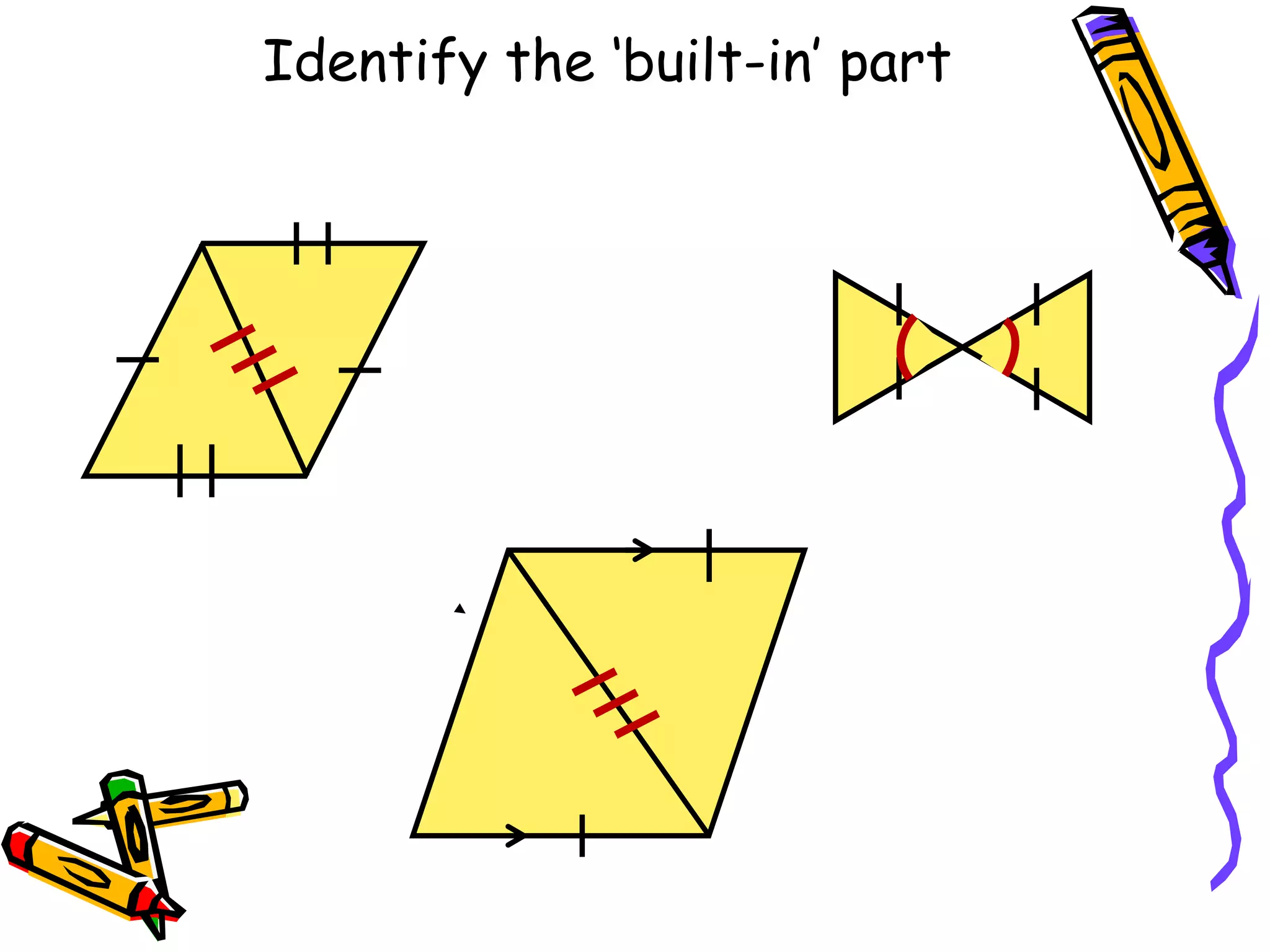
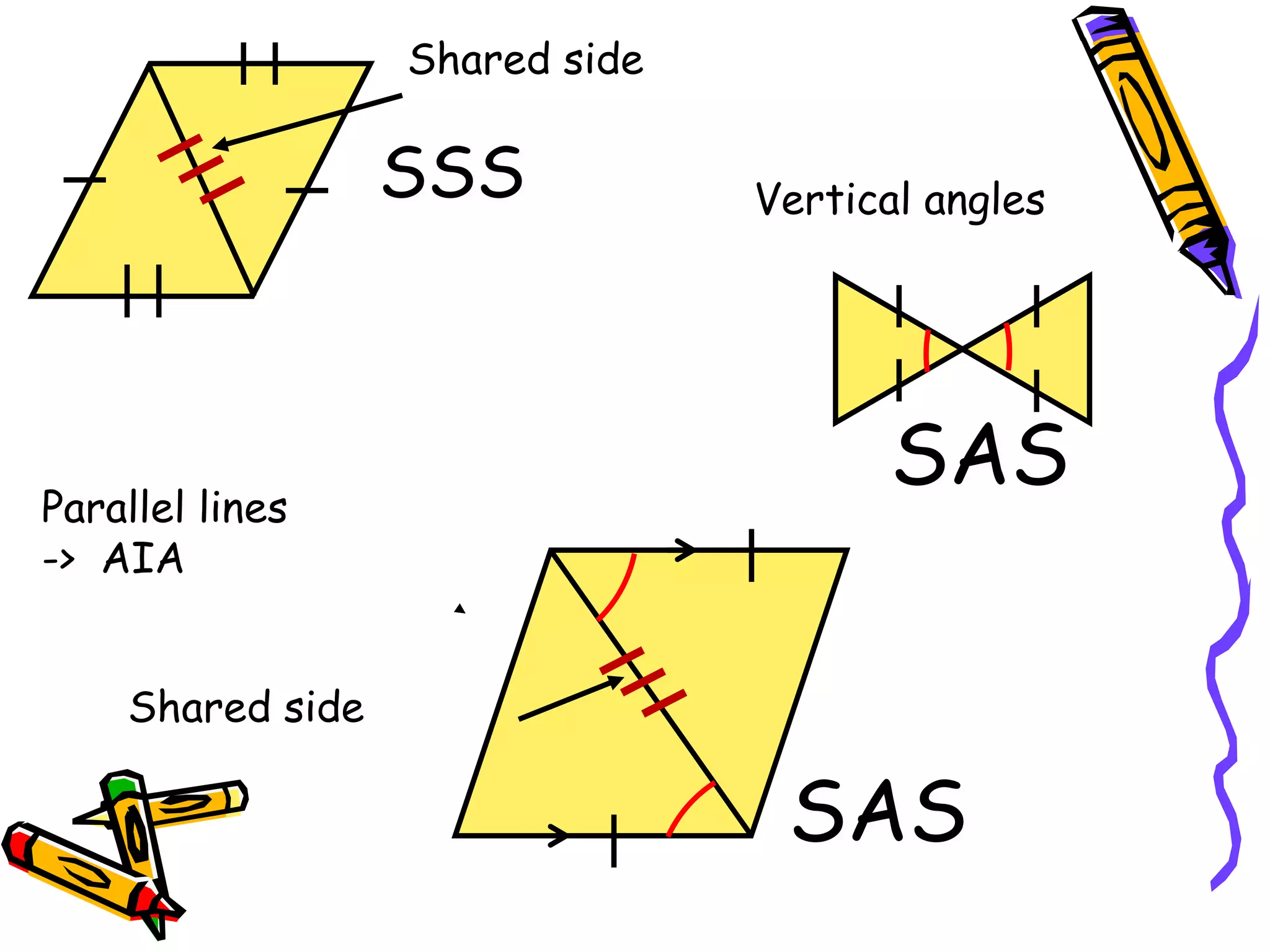
Identify the ‘built-in’ part
Shared side
Parallel lines
-> AIA
Shared side
Vertical angles
SAS
SAS
SSS
SOME REASONS For Indirect
Information
• Def of midpoint
• Def of a bisector
• Vert angles are congruent
• Def of perpendicular bisector
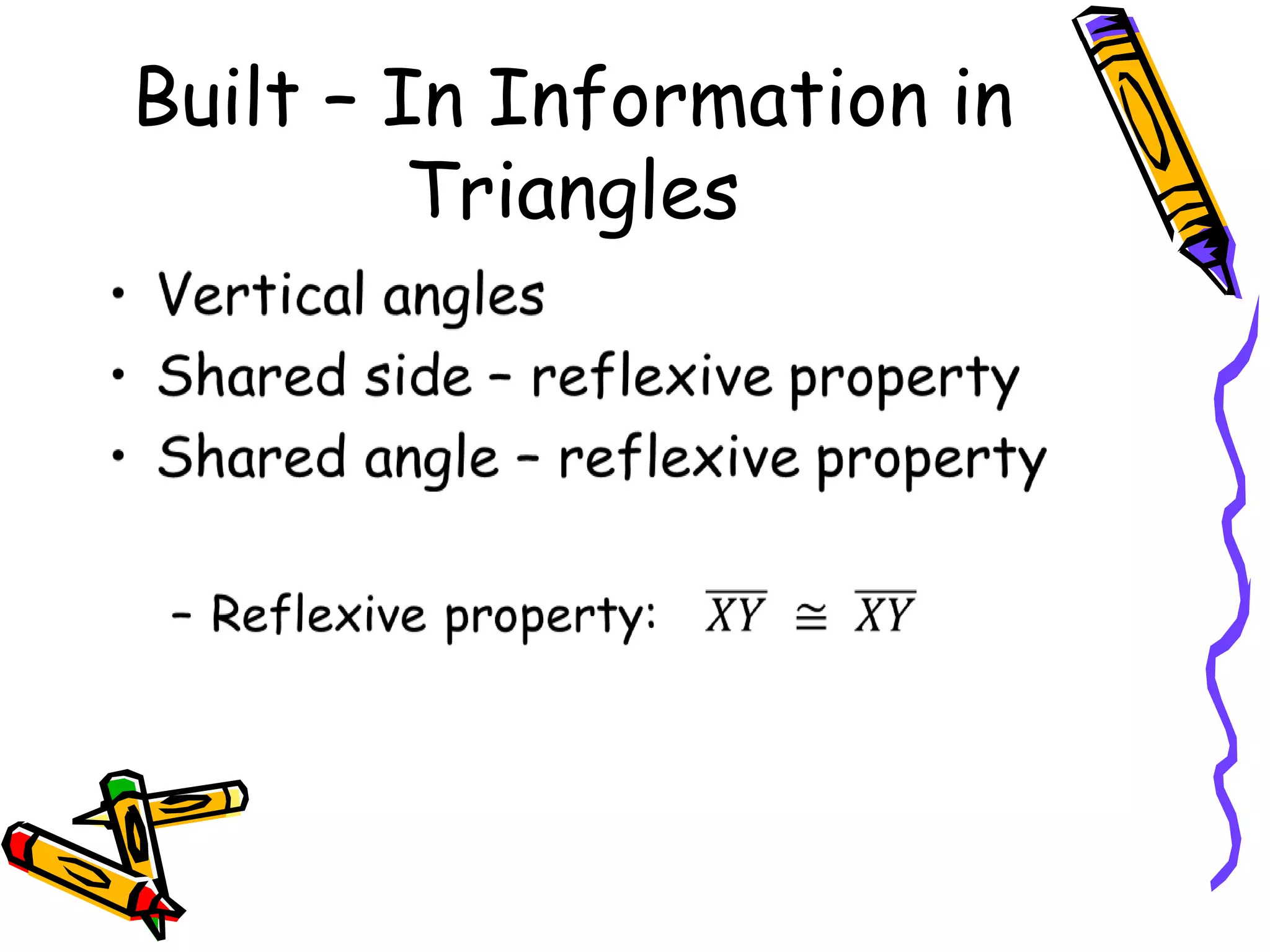
• Reflexive property (shared side)
• Parallel lines ….. alt int angles
• Property of Perpendicular Lines
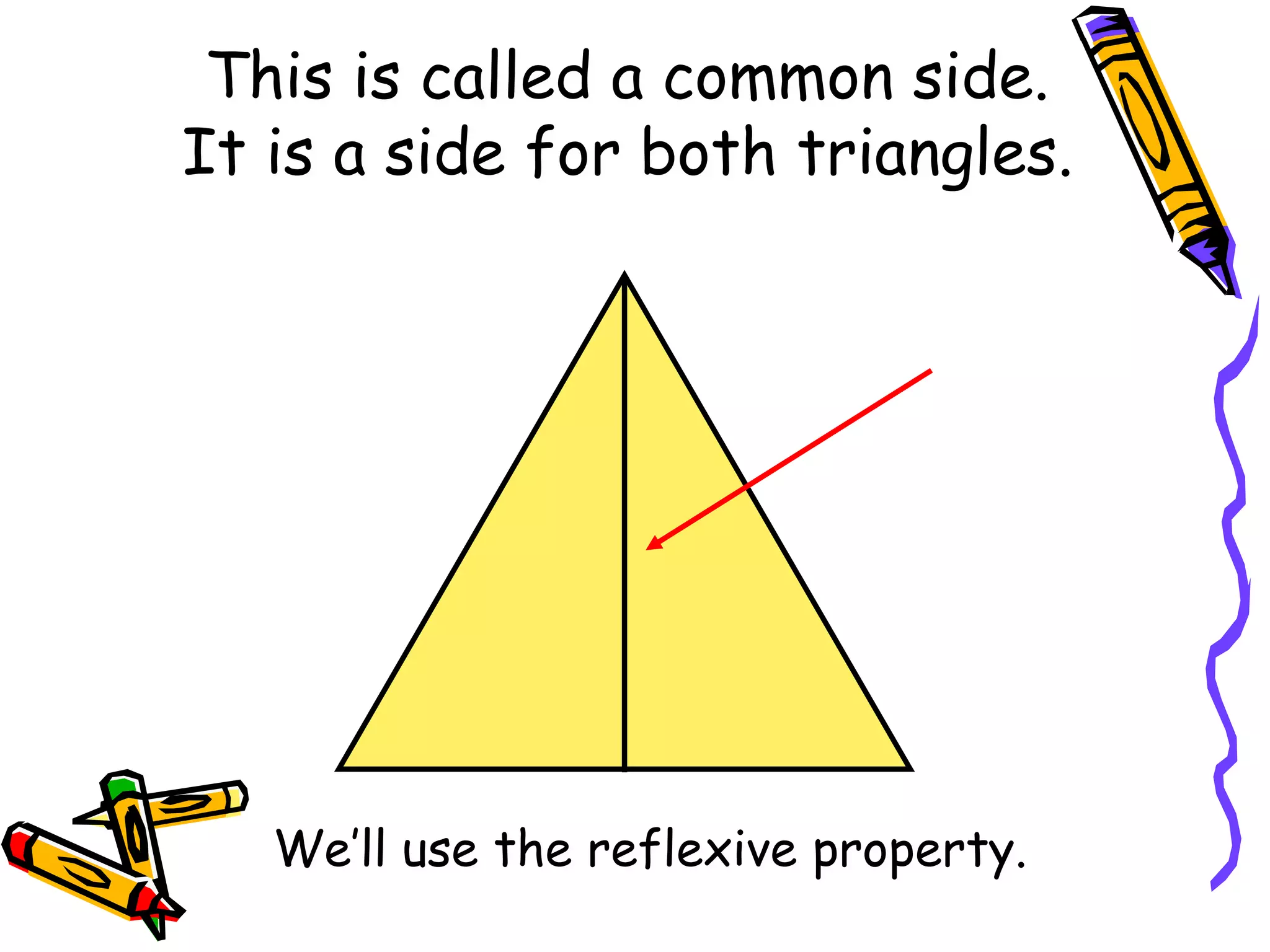
This is called a common side.
It is a side for both triangles.
We’ll use the reflexive property.
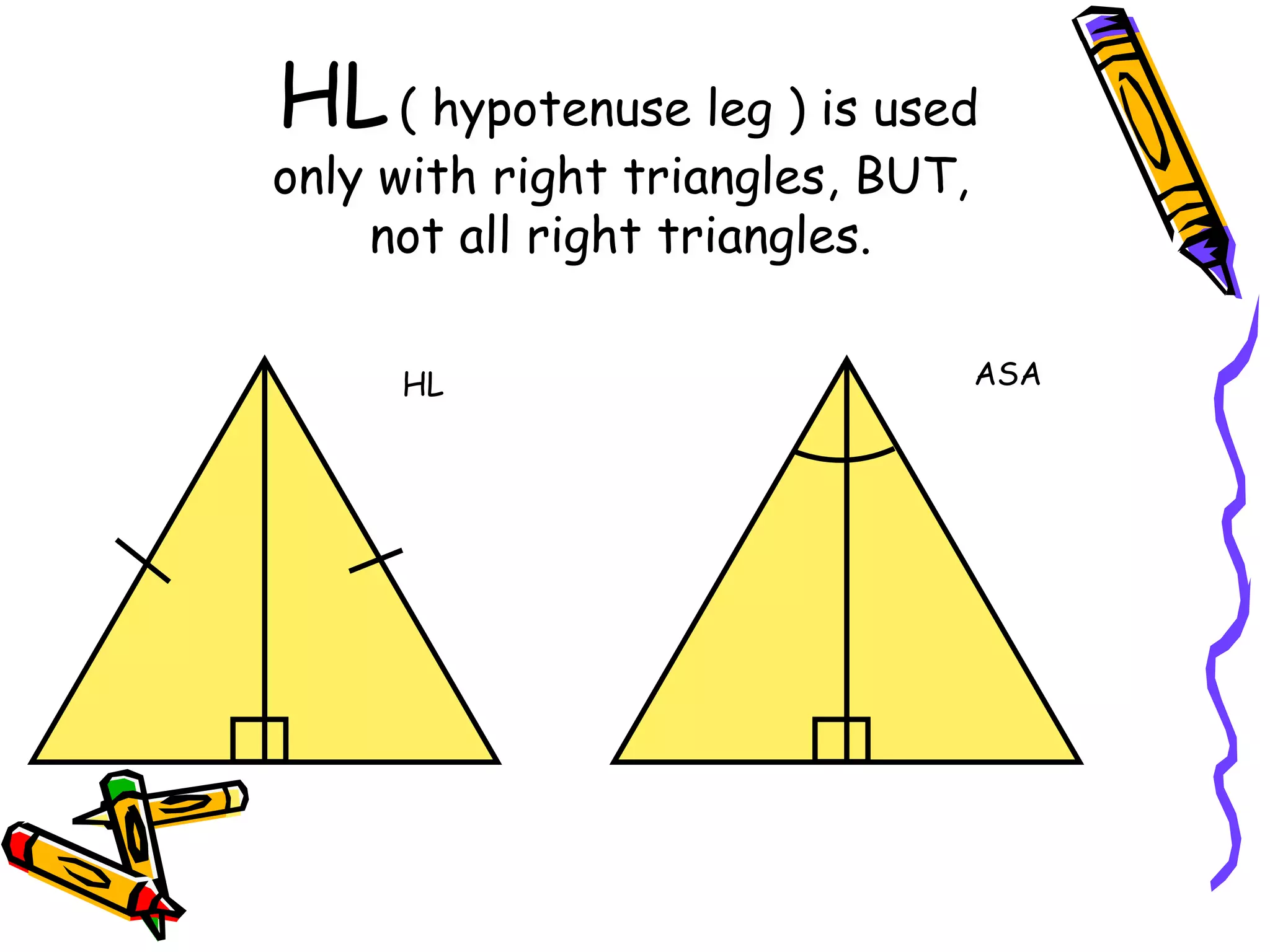
HL( hypotenuse leg ) is used
only with right triangles, BUT,
not all right triangles.
HL ASA
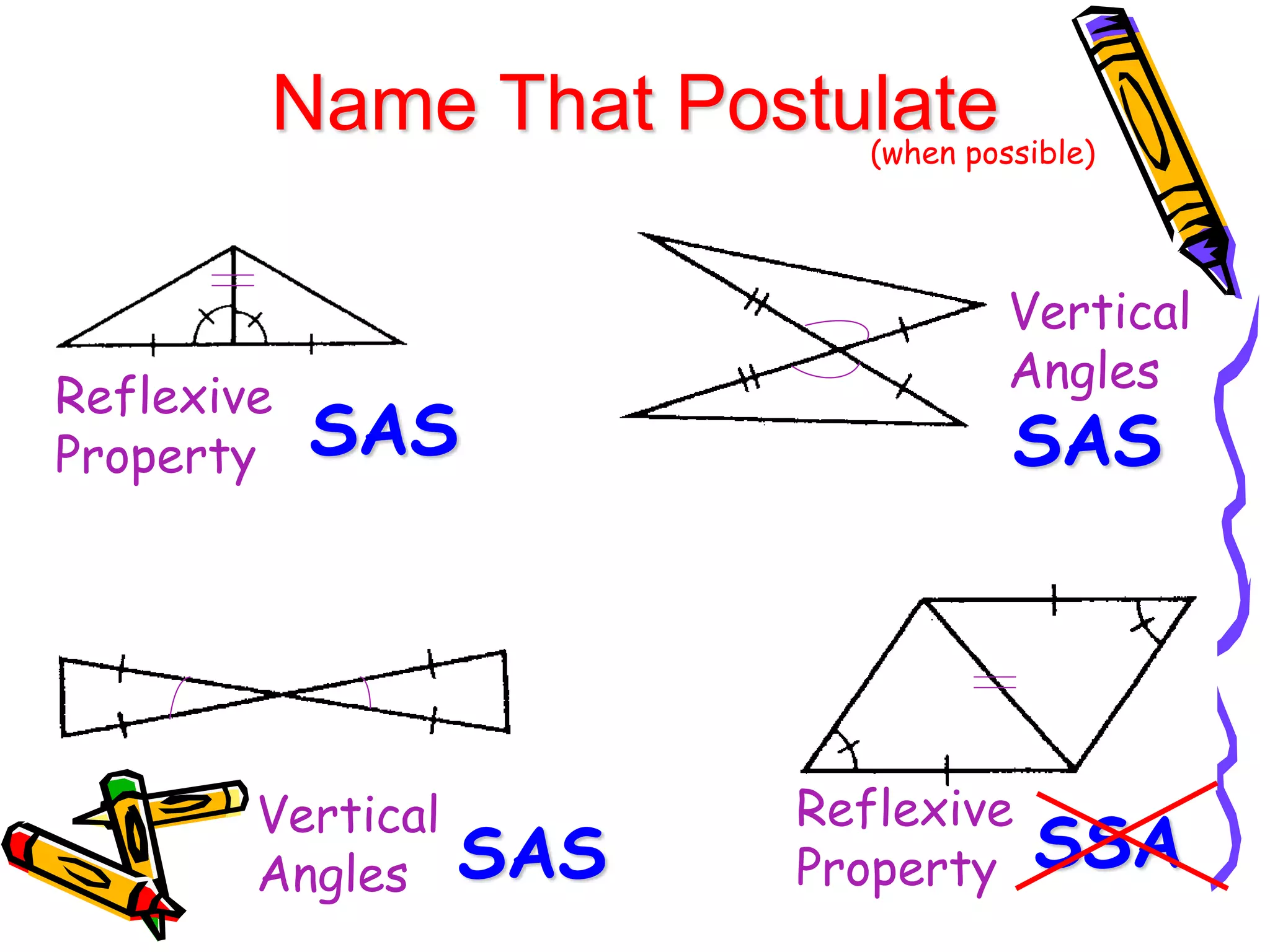
Name That Postulate
(when possible)
SAS
SAS
SAS
Reflexive
Property
Vertical
Angles
Vertical
Angles
Reflexive
Property SSA
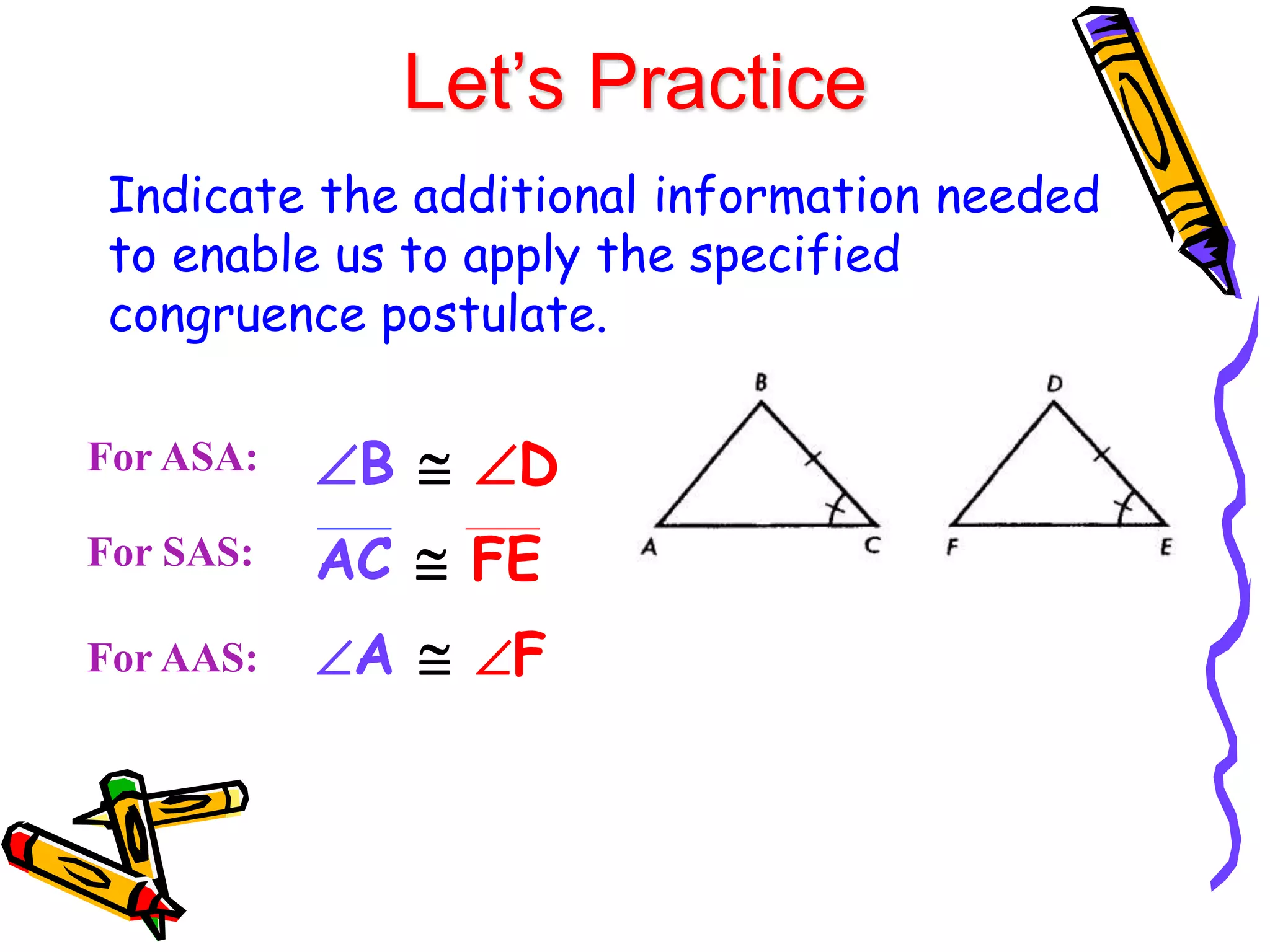
Let’s Practice
Indicate the additional information needed
to enable us to apply the specified
congruence postulate.
For ASA:
For SAS:
B  D
For AAS: A  F
AC  FE
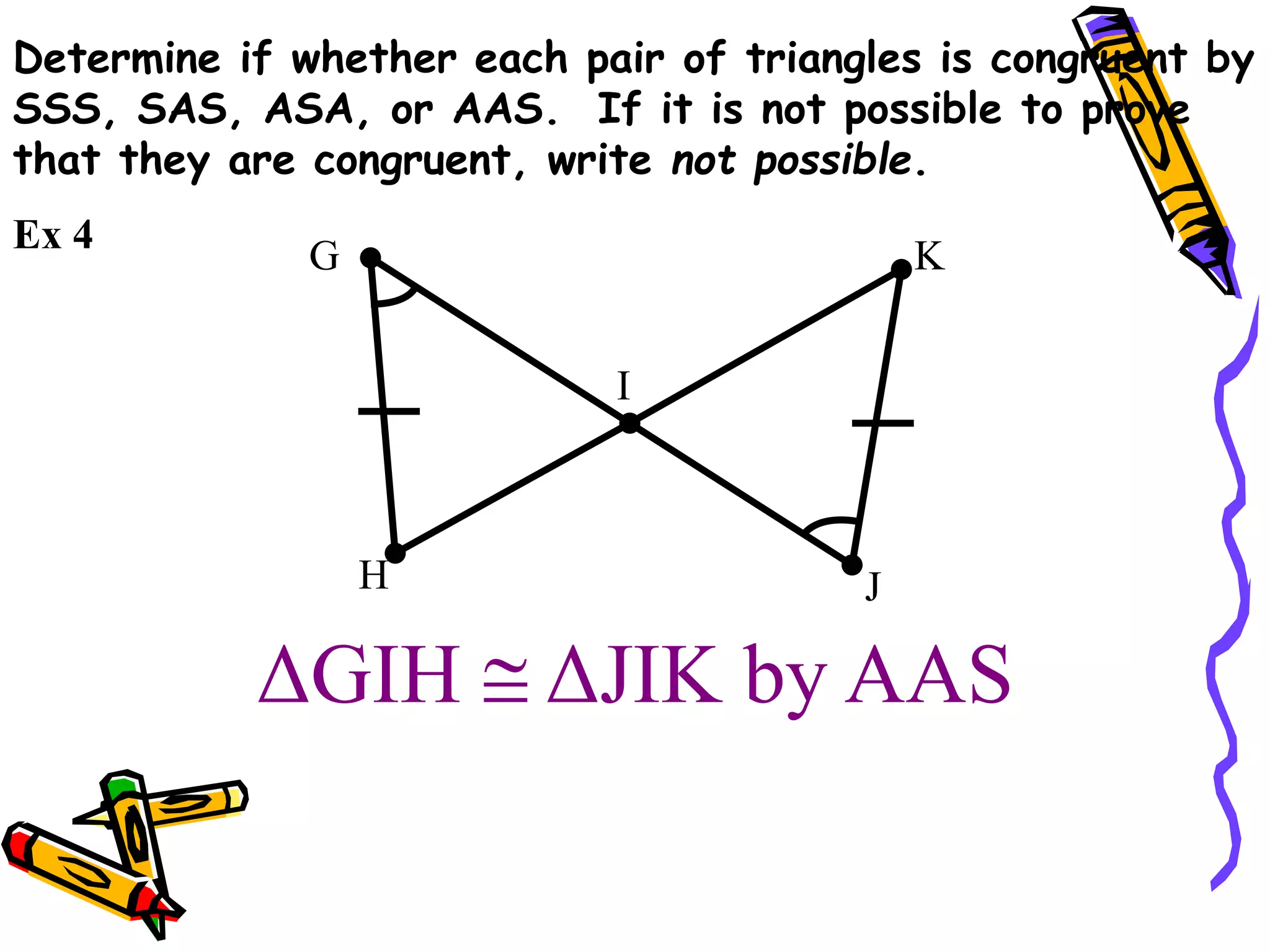
Determine if whether each pair of triangles is congruent by
SSS, SAS, ASA, or AAS. If it is not possible to prove
that they are congruent, write not possible.
ΔGIH  ΔJIK by AAS
G
I
H J
K
Ex 4
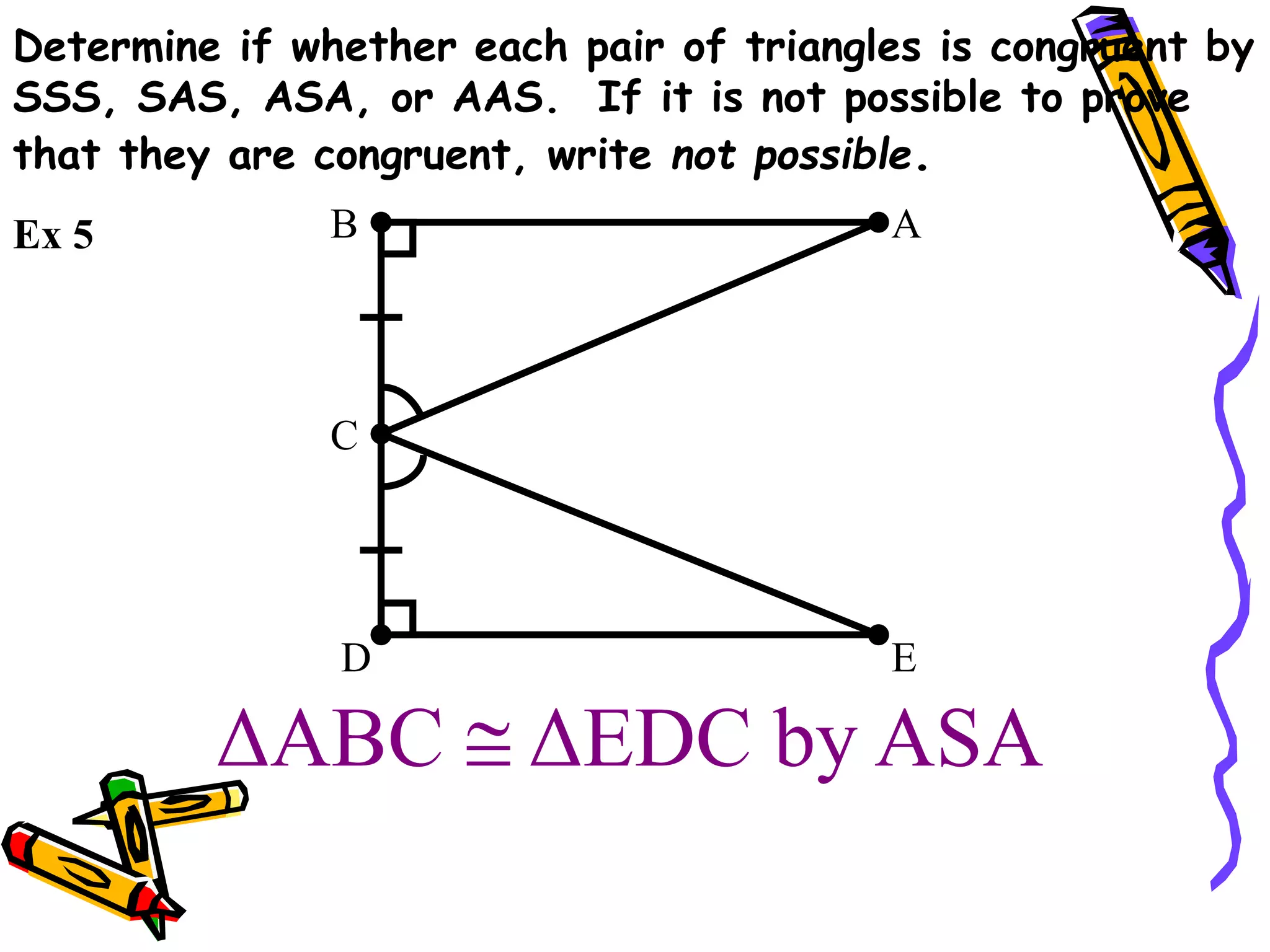
ΔABC  ΔEDC by ASA
B A
C
E
D
Ex 5
Determine if whether each pair of triangles is congruent by
SSS, SAS, ASA, or AAS. If it is not possible to prove
that they are congruent, write not possible.
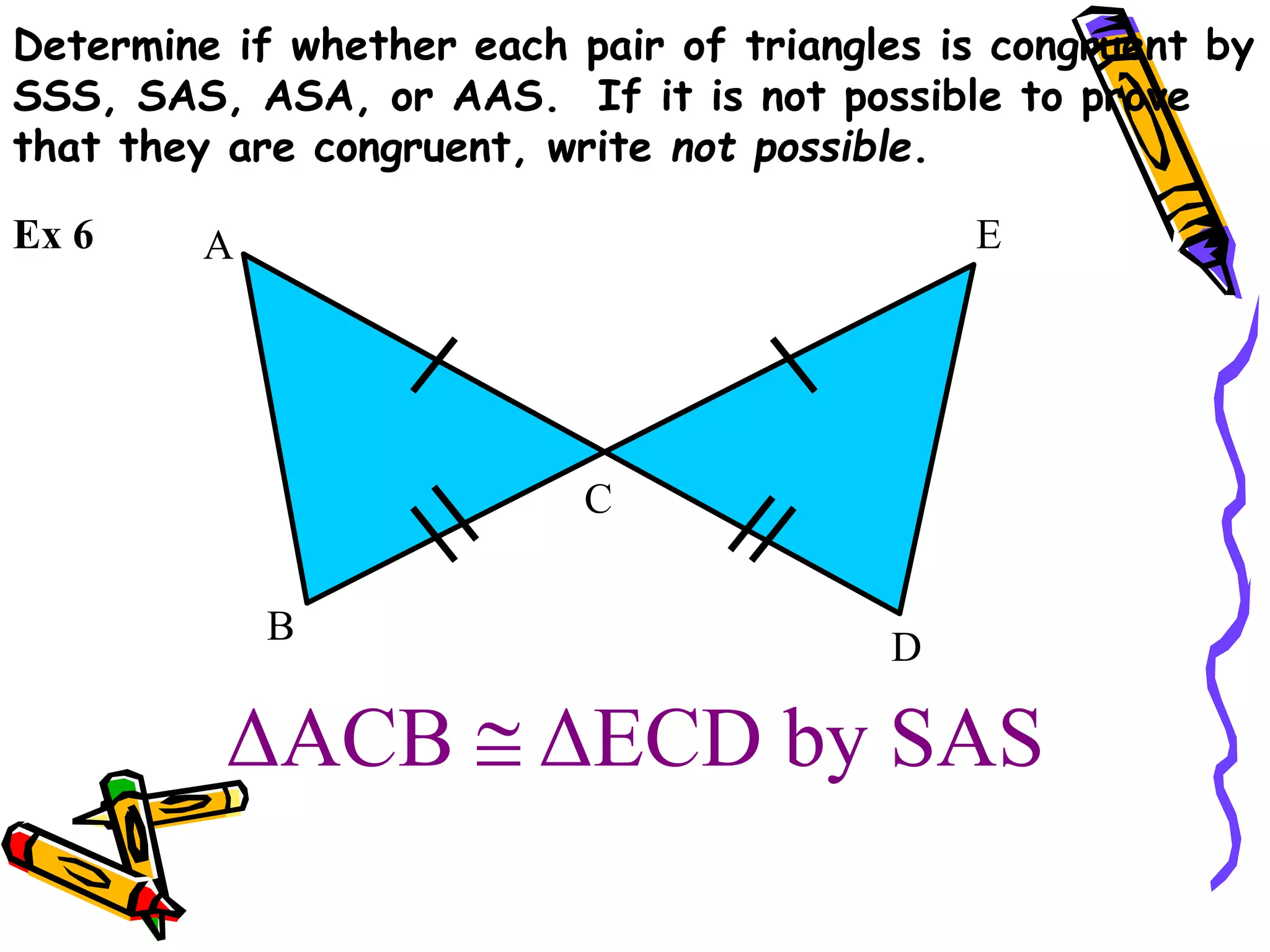
ΔACB  ΔECD by SAS
B
A
C
E
D
Ex 6
Determine if whether each pair of triangles is congruent by
SSS, SAS, ASA, or AAS. If it is not possible to prove
that they are congruent, write not possible.
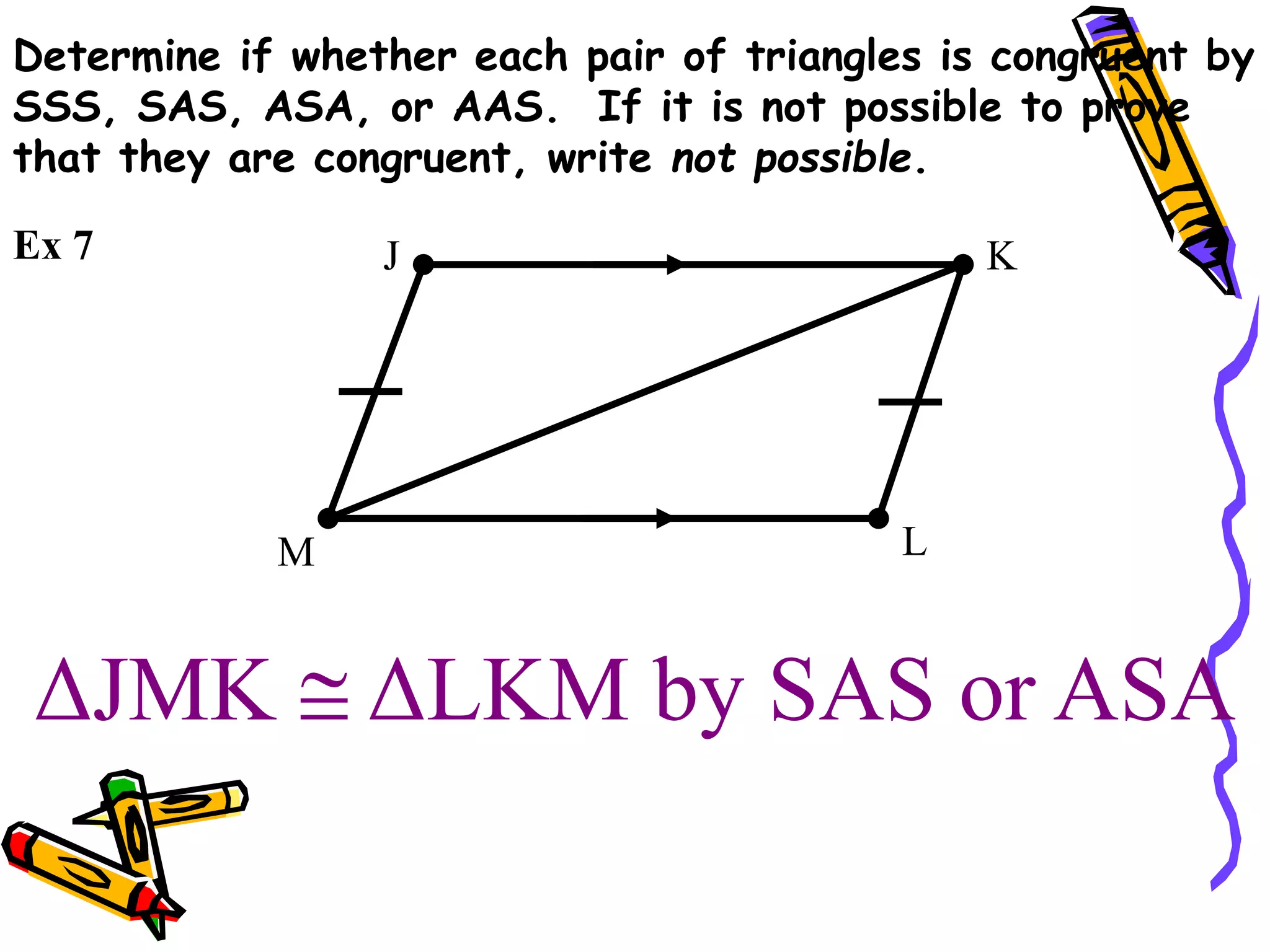
ΔJMK  ΔLKM by SAS or ASA
J K
L
M
Ex 7
Determine if whether each pair of triangles is congruent by
SSS, SAS, ASA, or AAS. If it is not possible to prove
that they are congruent, write not possible.
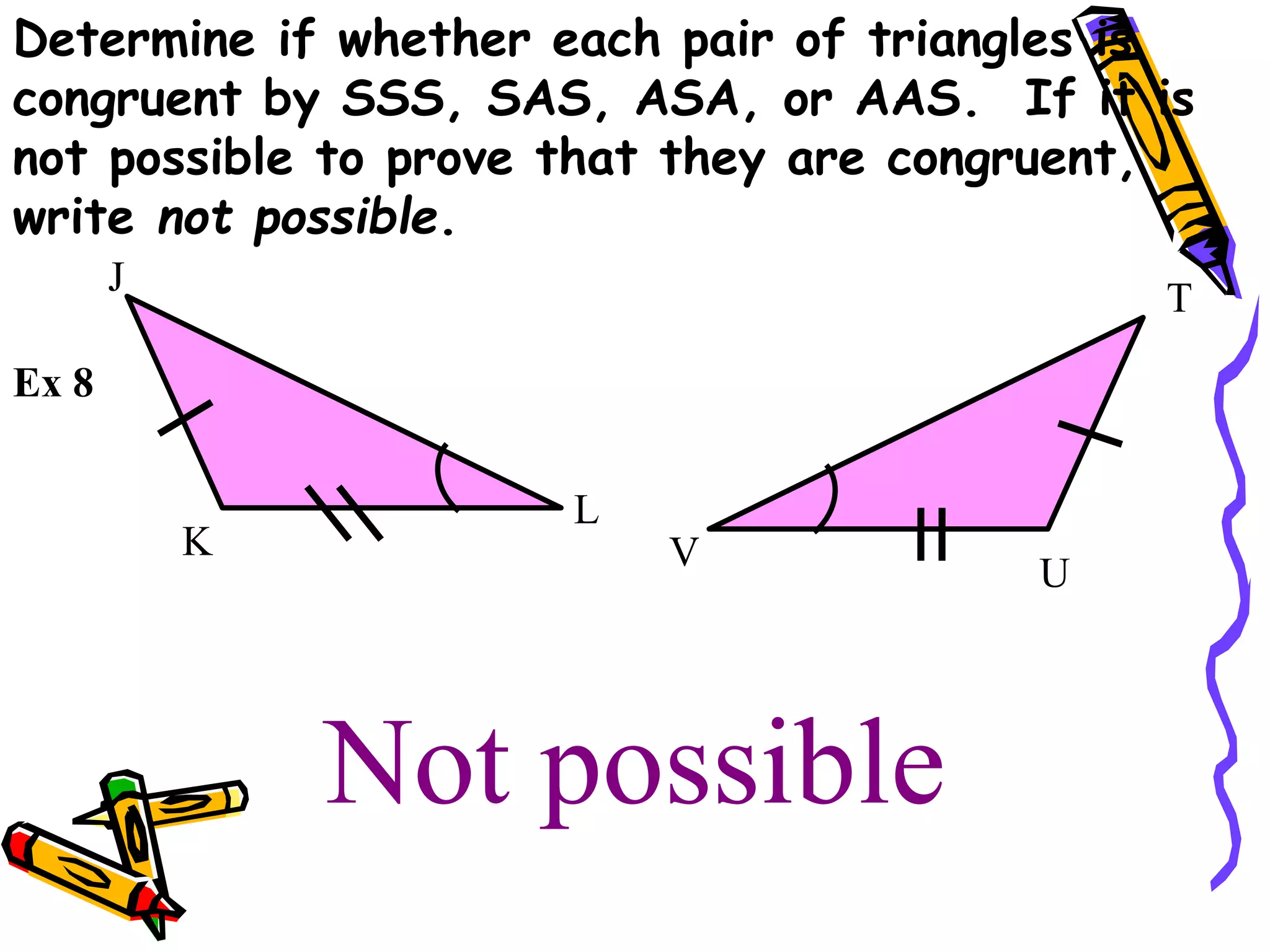
Not possible
K
J
L
T
U
Ex 8
Determine if whether each pair of triangles is
congruent by SSS, SAS, ASA, or AAS. If it is
not possible to prove that they are congruent,
write not possible.
V
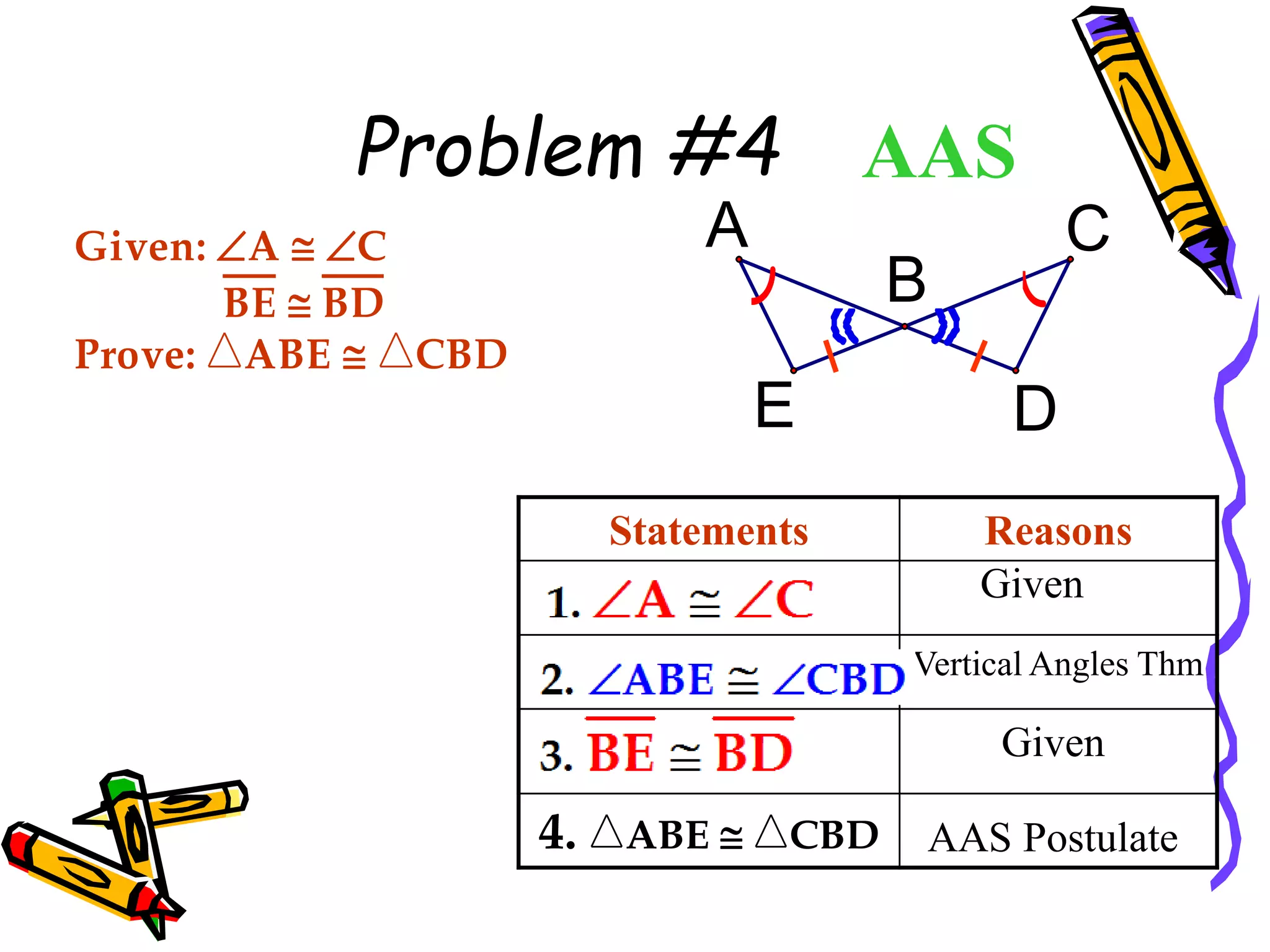
Problem #4
Statements Reasons
AAS
Given
Given
Vertical Angles Thm
AAS Postulate
Given: A  C
BE  BD
Prove: ABE  CBD
E
C
D
A
B
4. ABE  CBD
37
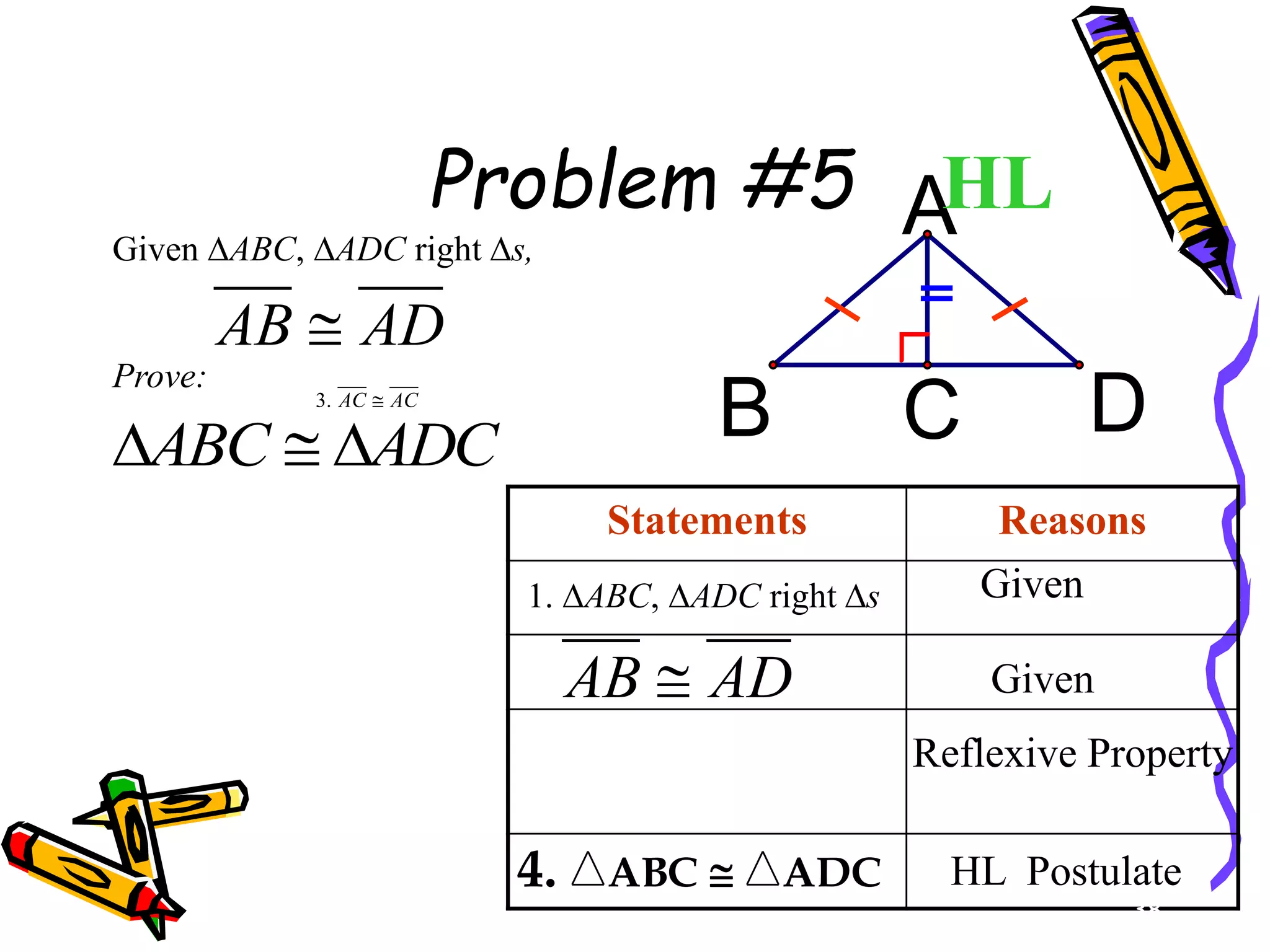
Problem #5
3. AC AC

Statements Reasons
C
B D
AHL
Given
Given
Reflexive Property
HL Postulate
4. ABC  ADC
1. ABC, ADC right s
AB AD

Given ABC, ADC right s,
Prove:
AB AD

ABC ADC
  
38
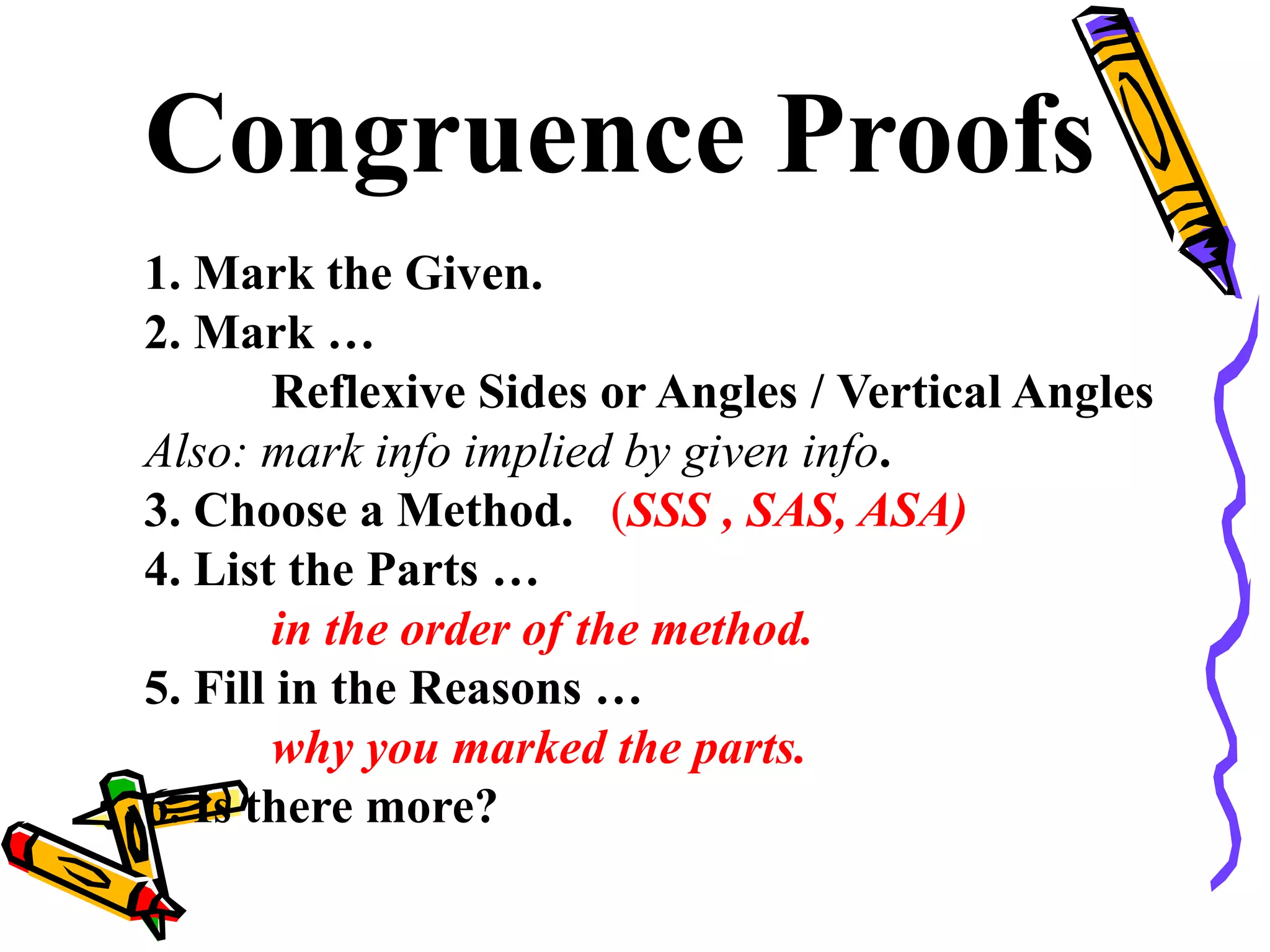
Congruence Proofs
1. Mark the Given.
2. Mark …
Reflexive Sides or Angles / Vertical Angles
Also: mark info implied by given info.
3. Choose a Method. (SSS , SAS, ASA)
4. List the Parts …
in the order of the method.
5. Fill in the Reasons …
why you marked the parts.
6. Is there more?
39
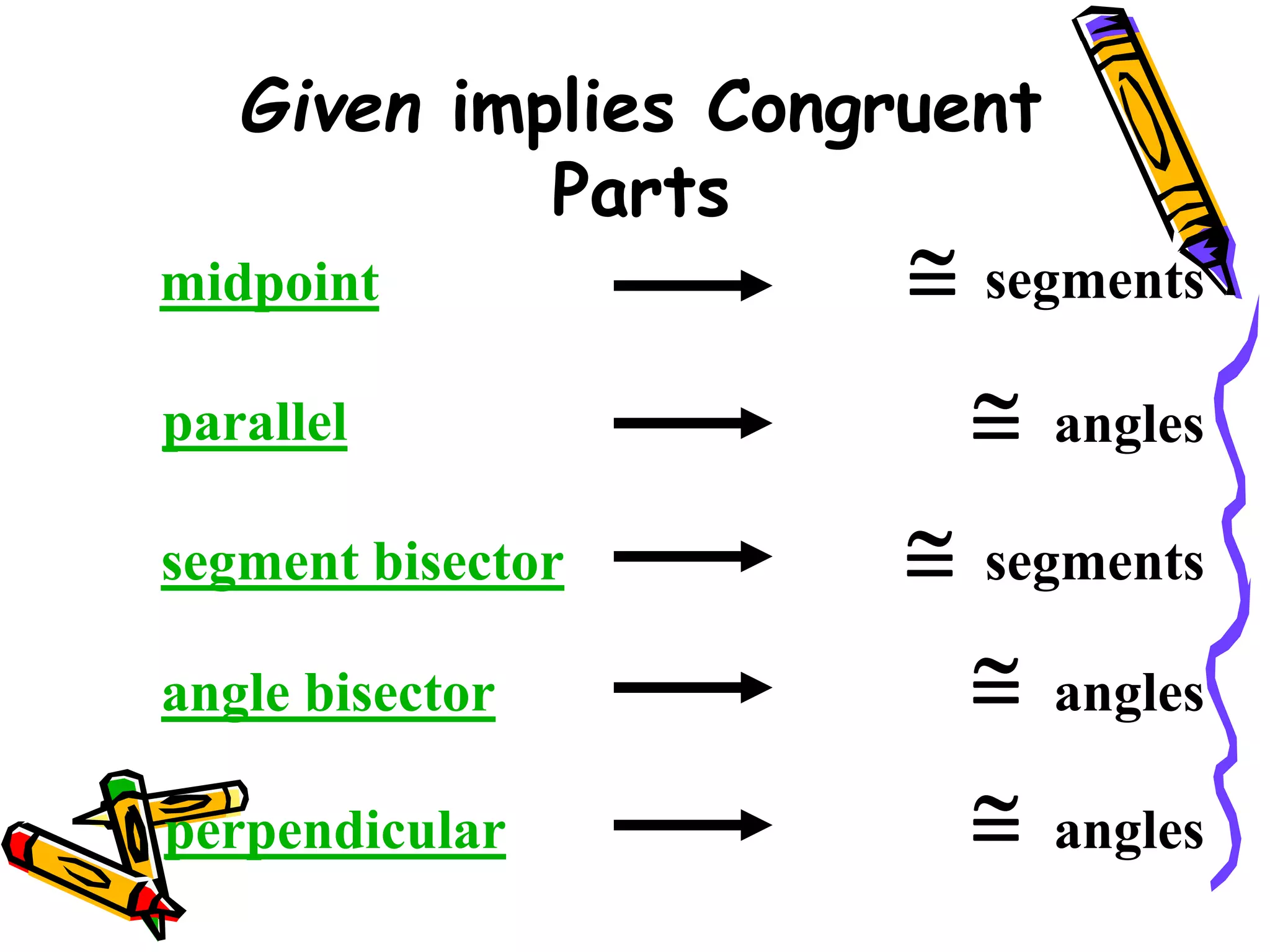
Given implies Congruent
Parts
midpoint
parallel
segment bisector
angle bisector
perpendicular
segments

angles

segments

angles

angles

40
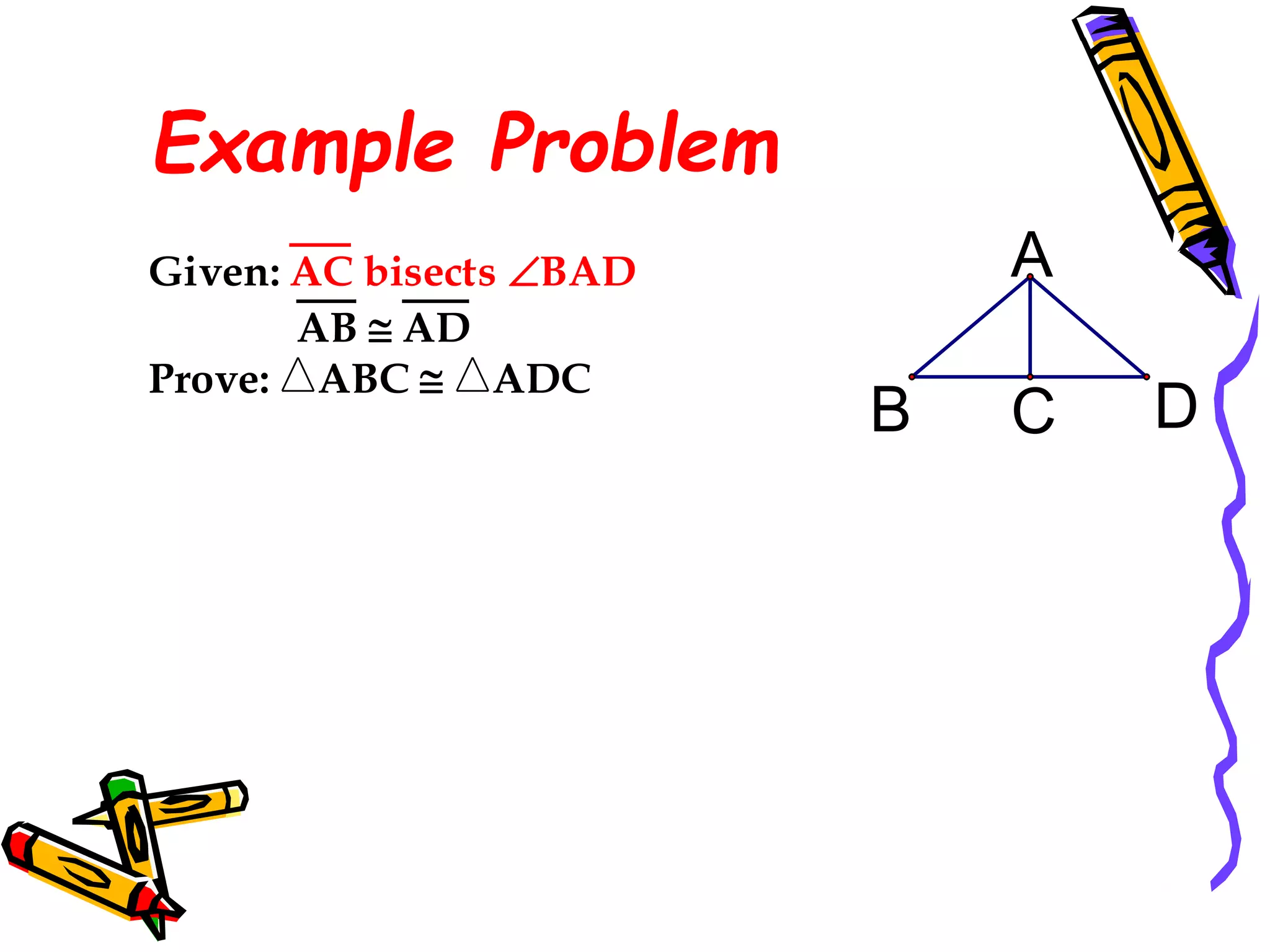
Example Problem
C
B D
A
Given: AC bisects BAD
AB  AD
Prove: ABC  ADC
41
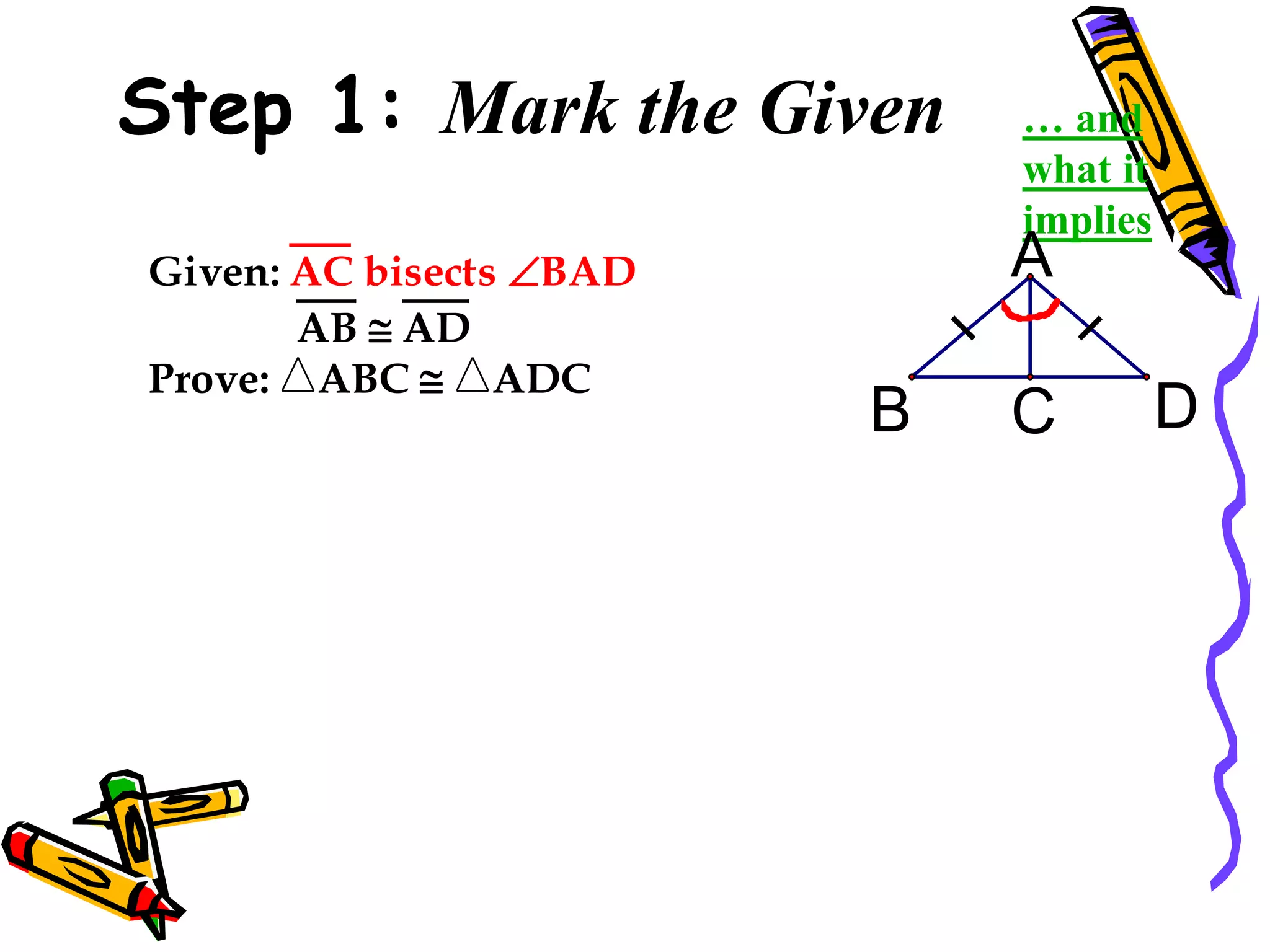
Step 1: Mark the Given … and
what it
implies
C
B D
A
Given: AC bisects BAD
AB  AD
Prove: ABC  ADC
42
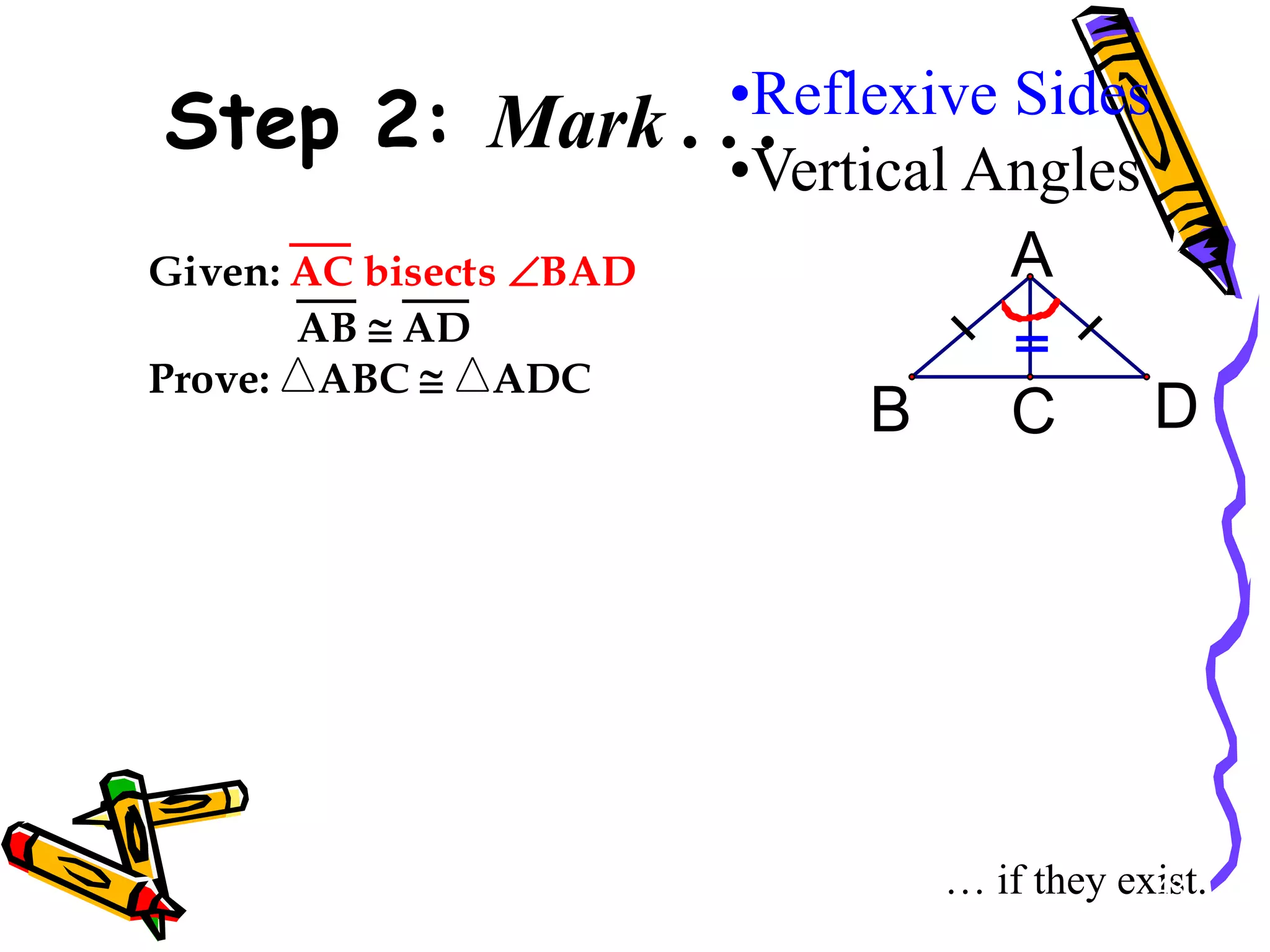
•Reflexive Sides
•Vertical Angles
Step 2: Mark . . .
… if they exist.
C
B D
A
Given: AC bisects BAD
AB  AD
Prove: ABC  ADC
43
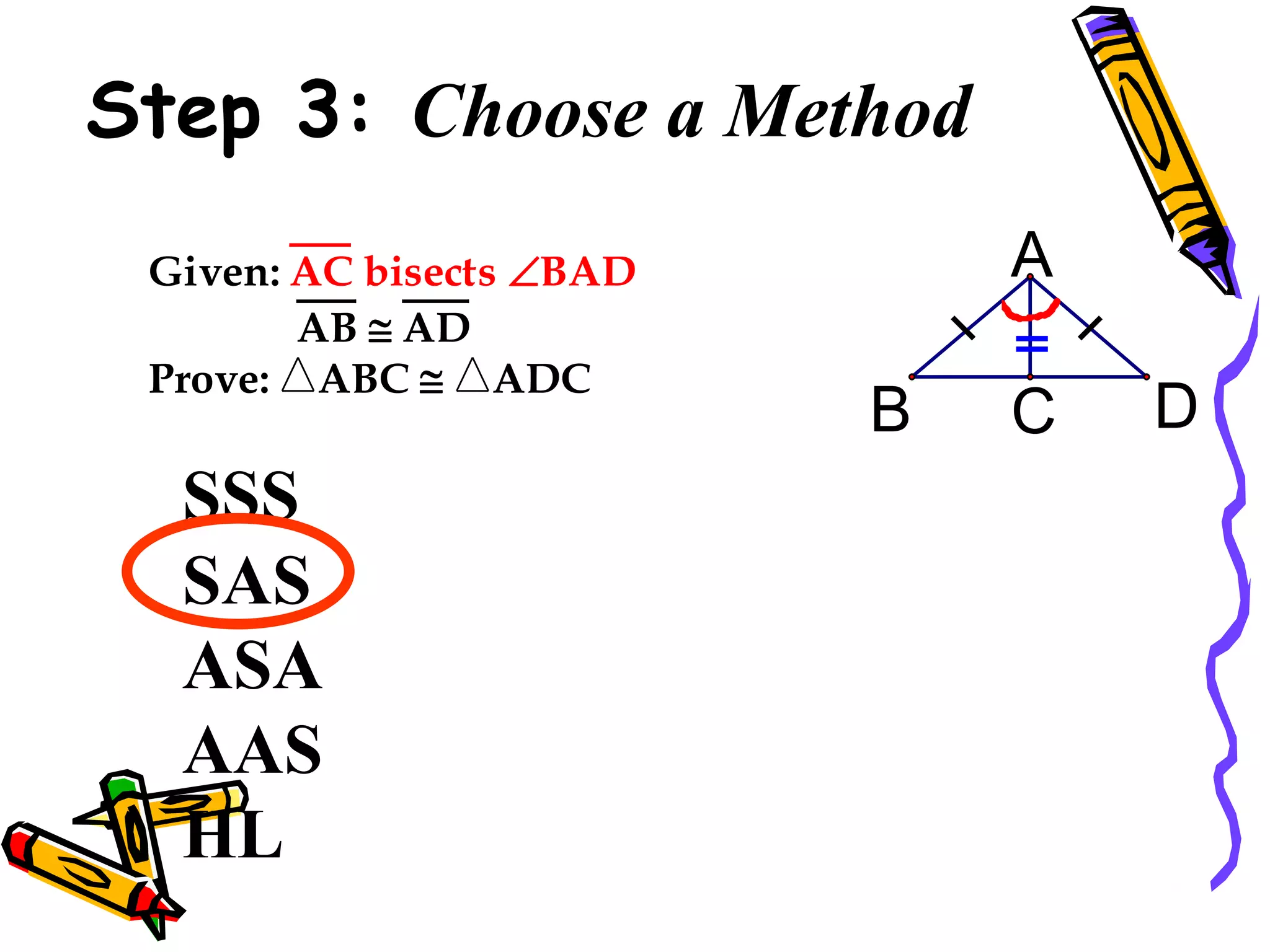
Step 3: Choose a Method
SSS
SAS
ASA
AAS
HL
C
B D
A
Given: AC bisects BAD
AB  AD
Prove: ABC  ADC
44
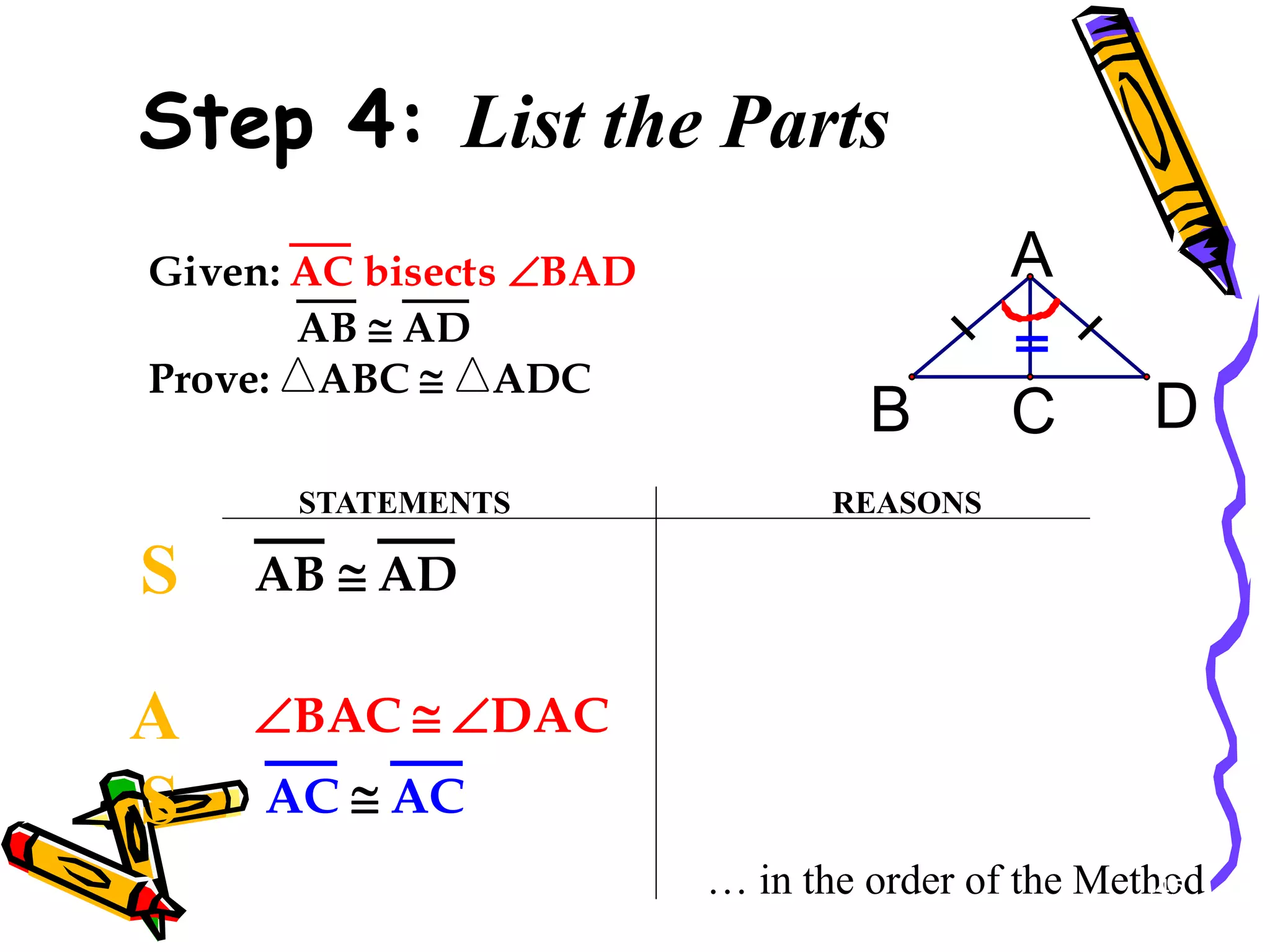
Step 4: List the Parts
STATEMENTS REASONS
… in the order of the Method
C
B D
A
Given: AC bisects BAD
AB  AD
Prove: ABC  ADC
BAC  DAC
AB  AD
AC  AC
S
A
S
45
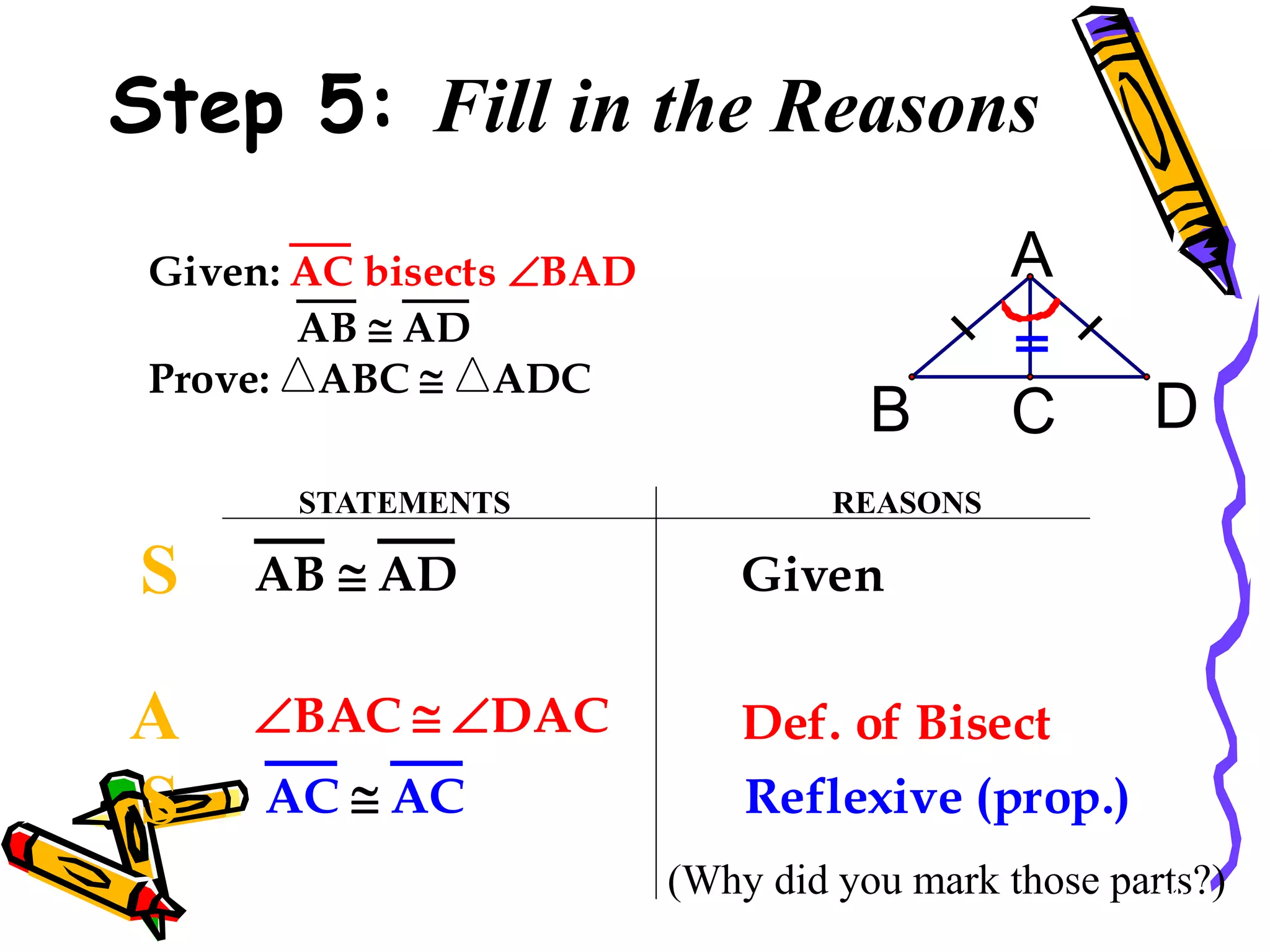
Step 5: Fill in the Reasons
(Why did you mark those parts?)
STATEMENTS REASONS
C
B D
A
Given: AC bisects BAD
AB  AD
Prove: ABC  ADC
BAC  DAC
AB  AD
AC  AC
Given
Def. of Bisector
Reflexive (prop.)
S
A
S
46
S
A
S
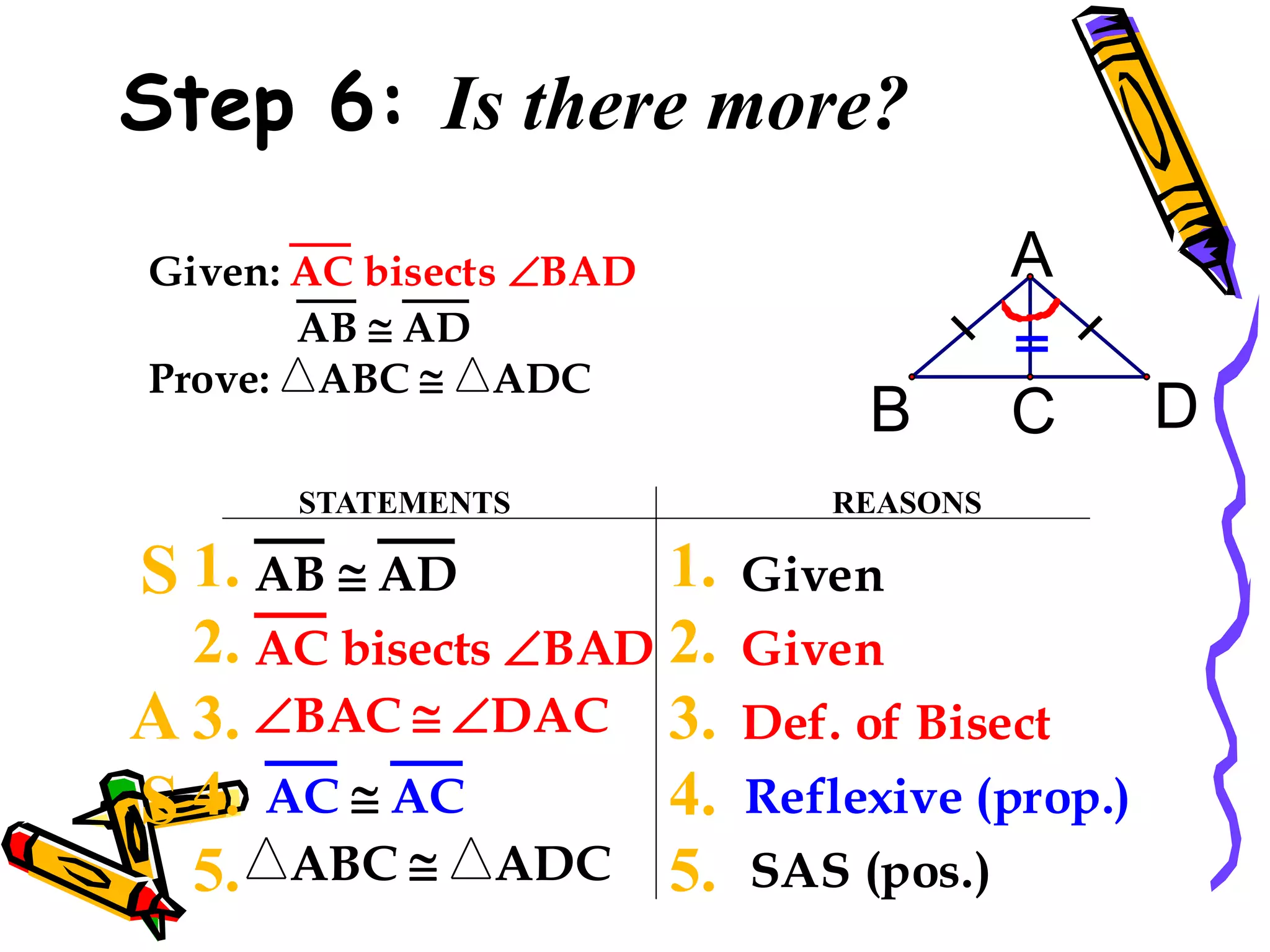
Step 6: Is there more?
STATEMENTS REASONS
C
B D
A
Given: AC bisects BAD
AB  AD
Prove: ABC  ADC
BAC  DAC
AB  AD
AC  AC
Given
AC bisects BAD Given
Def. of Bisector
Reflexive (prop.)
ABC  ADC SAS (pos.)
1.
2.
3.
4.
5.
1.
2.
3.
4.
5. 47
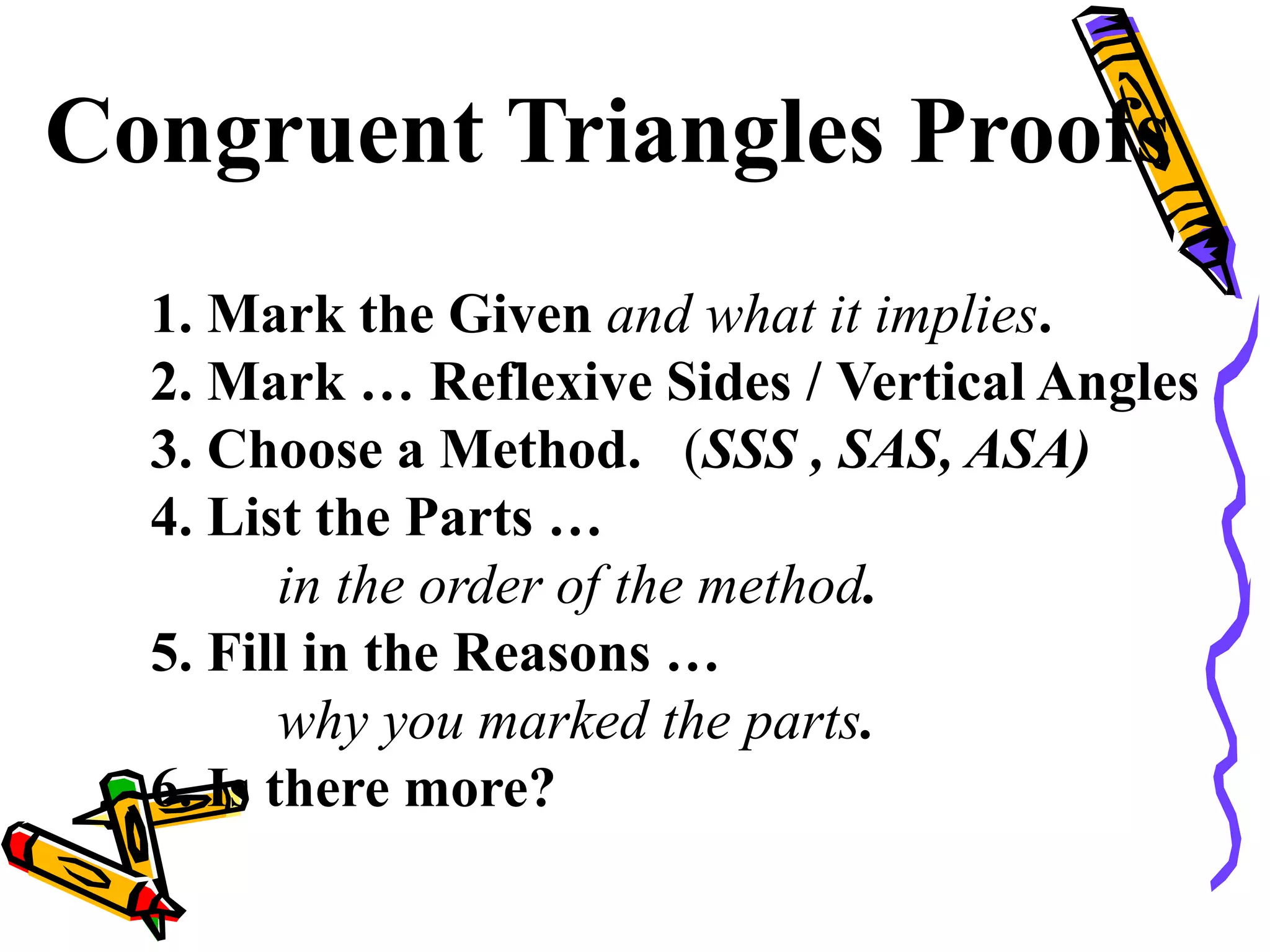
Congruent Triangles Proofs
1. Mark the Given and what it implies.
2. Mark … Reflexive Sides / Vertical Angles
3. Choose a Method. (SSS , SAS, ASA)
4. List the Parts …
in the order of the method.
5. Fill in the Reasons …
why you marked the parts.
6. Is there more?
53
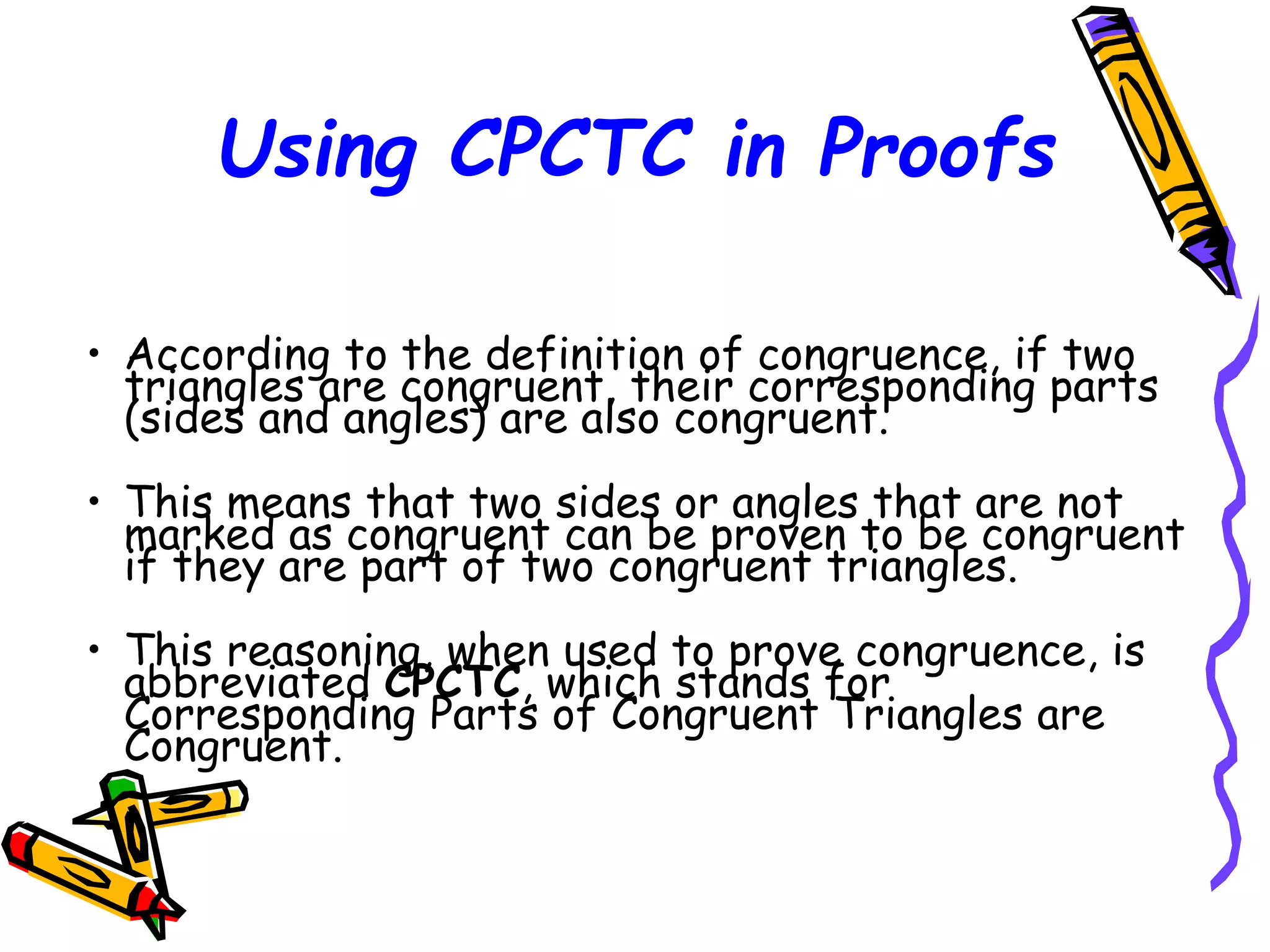
Using CPCTC in Proofs
• According to the definition of congruence, if two
triangles are congruent, their corresponding parts
(sides and angles) are also congruent.
• This means that two sides or angles that are not
marked as congruent can be proven to be congruent
if they are part of two congruent triangles.
• This reasoning, when used to prove congruence, is
abbreviated CPCTC, which stands for
Corresponding Parts of Congruent Triangles are
Congruent.
54
Corresponding Parts of
Congruent Triangles
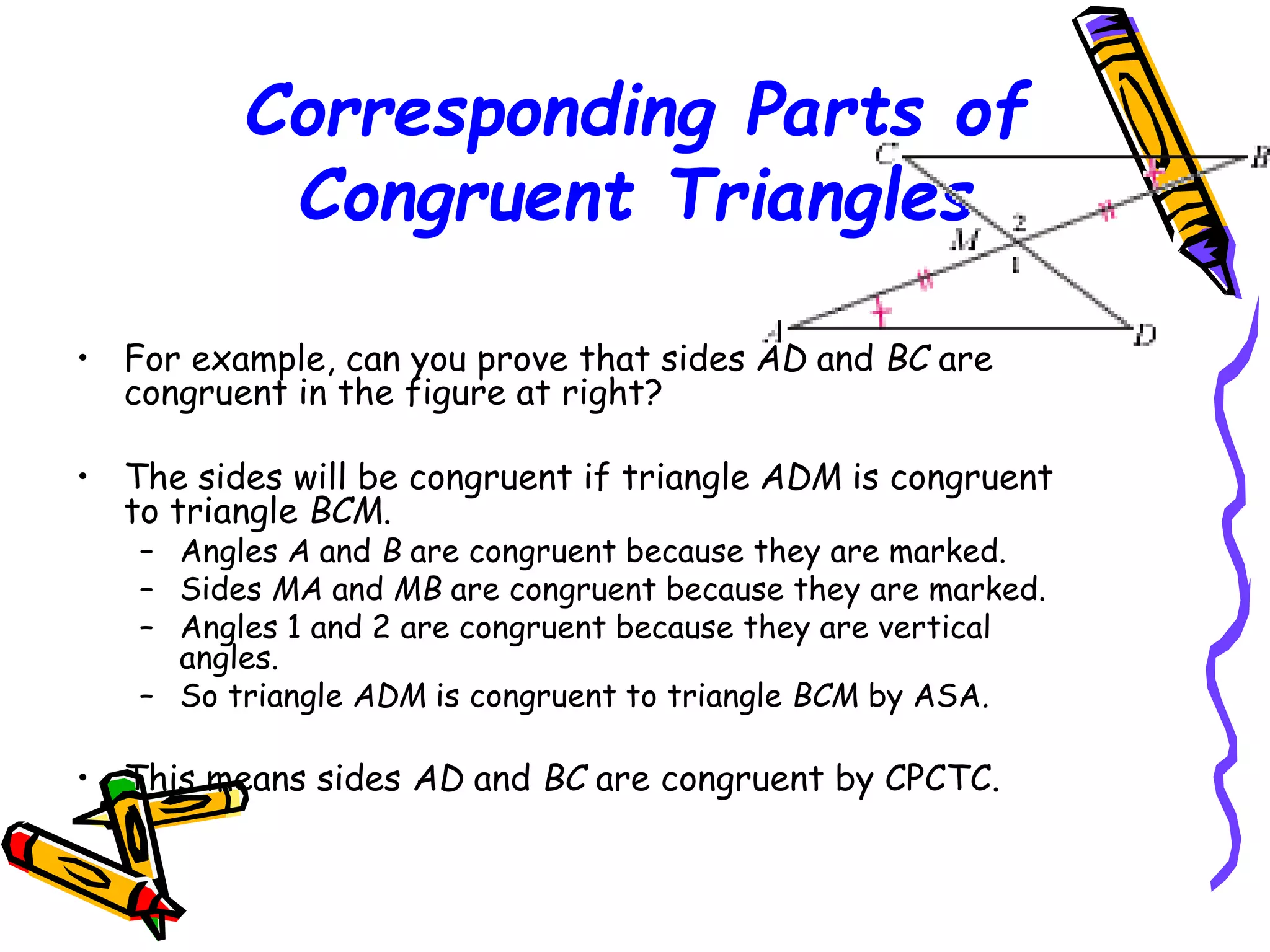
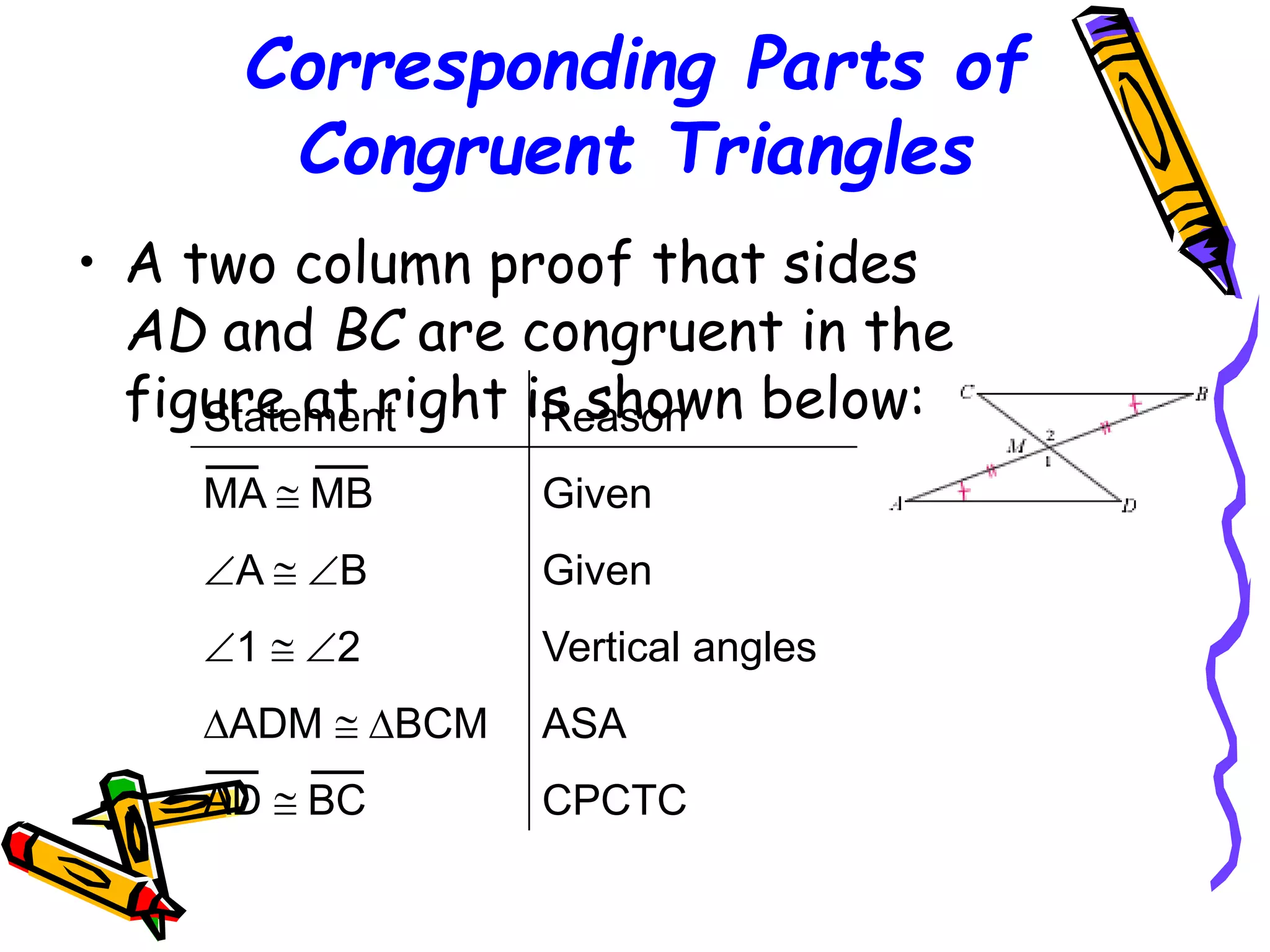
• For example, can you prove that sides AD and BC are
congruent in the figure at right?
• The sides will be congruent if triangle ADM is congruent
to triangle BCM.
– Angles A and B are congruent because they are marked.
– Sides MA and MB are congruent because they are marked.
– Angles 1 and 2 are congruent because they are vertical
angles.
– So triangle ADM is congruent to triangle BCM by ASA.
• This means sides AD and BC are congruent by CPCTC.
55
Corresponding Parts of
Congruent Triangles
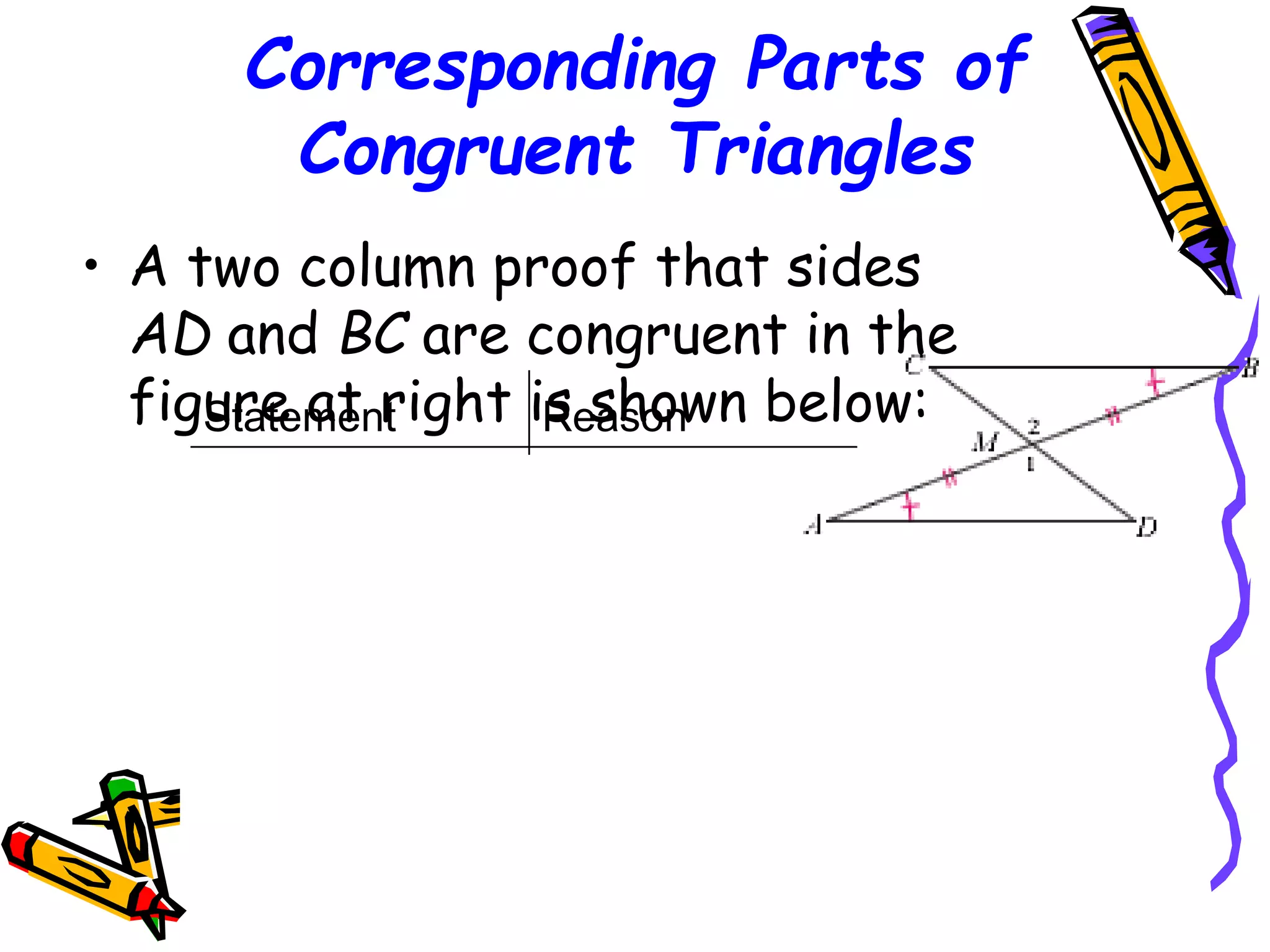
• A two column proof that sides
AD and BC are congruent in the
figure at right is shown below:
Statement Reason
MA  MB Given
A  B Given
1  2 Vertical angles
ADM  BCM ASA
AD  BC CPCTC
56
Corresponding Parts of
Congruent Triangles
• A two column proof that sides
AD and BC are congruent in the
figure at right is shown below:
Statement Reason
MA  MB Given
A  B Given
1  2 Vertical angles
ADM  BCM ASA
AD  BC CPCTC
57
Corresponding Parts of
Congruent Triangles
• Sometimes it is necessary to add an
auxiliary line in order to complete a
proof
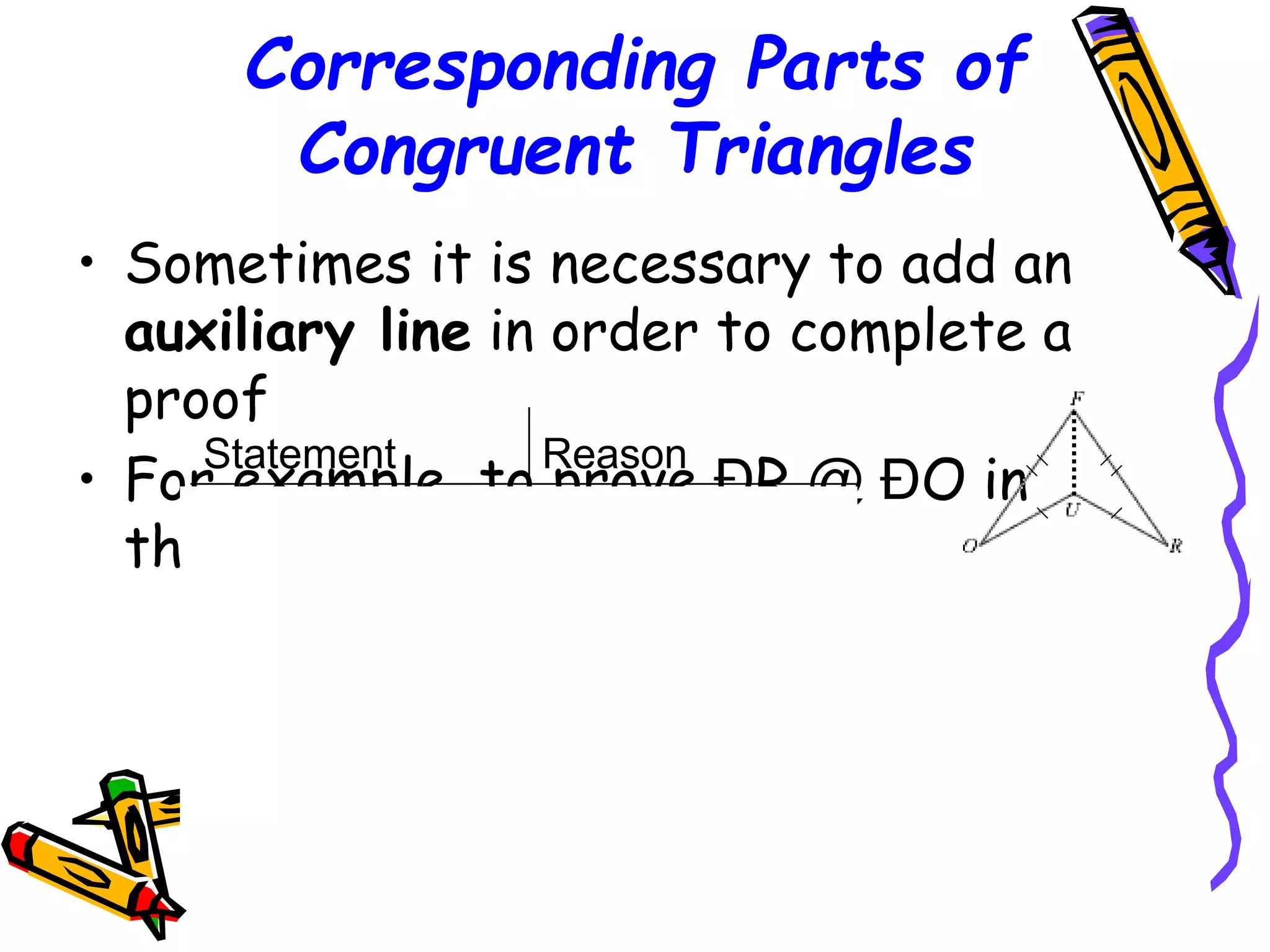
• For example, to prove ÐR @ ÐO in
this picture
Statement Reason
FR @ FO Given
RU @ OU Given
UF @ UF reflexive prop.
DFRU @ DFOU SSS
ÐR @ ÐO CPCTC
58
Corresponding Parts of
Congruent Triangles
• Sometimes it is necessary to add an
auxiliary line in order to complete a
proof
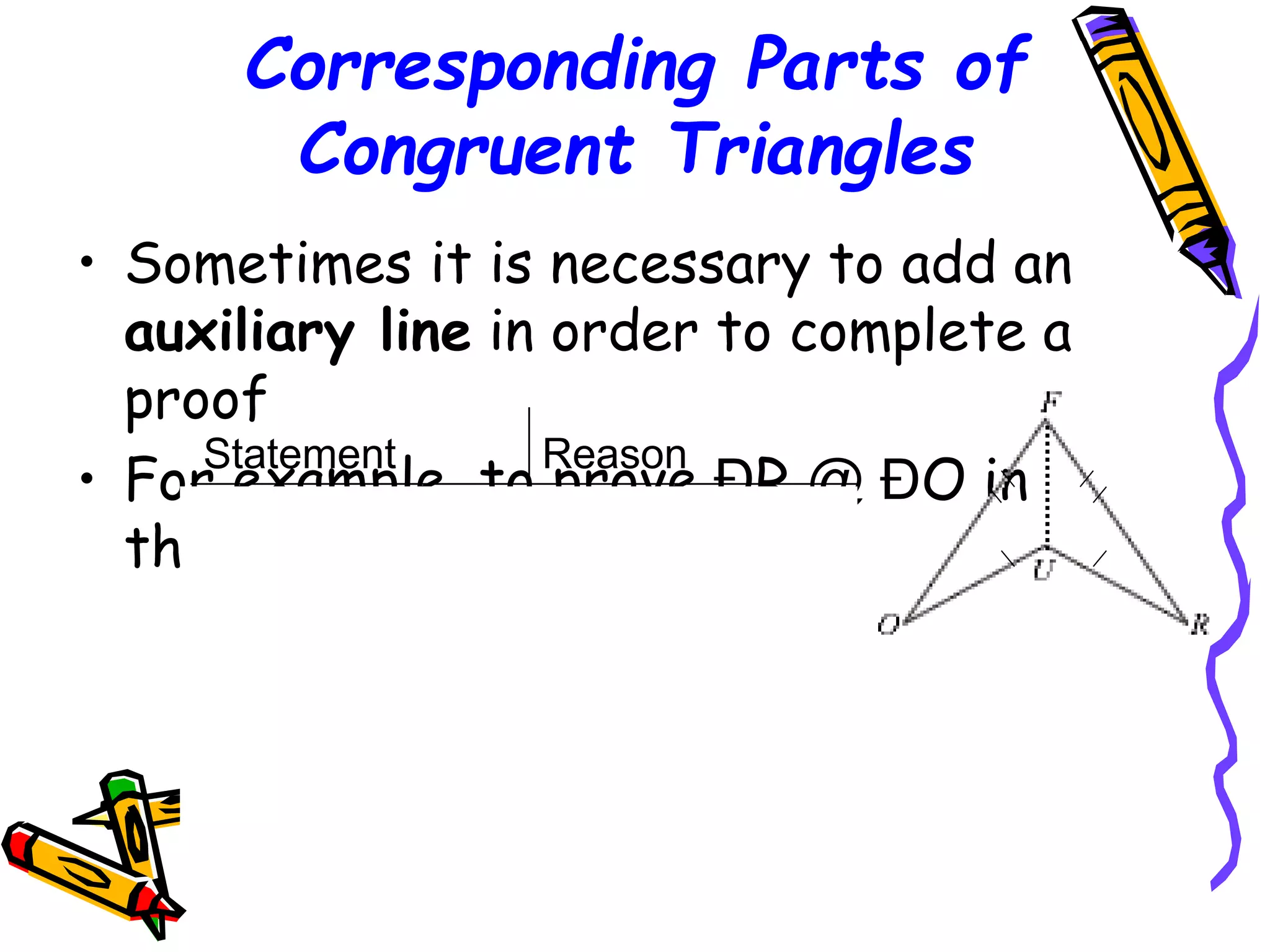
• For example, to prove ÐR @ ÐO in
this picture
Statement Reason
FR @ FO Given
RU @ OU Given
UF @ UF Same segment
DFRU @ DFOU SSS
ÐR @ ÐO CPCTC
59

10.17 Triangle Congruence Proofs Day 2.ppt

  • 1.
  • 2.
    Triangle Congruency Short-Cuts Ifyou can prove one of the following short cuts, you have two congruent triangles 1. SSS (side-side-side) 2. SAS (side-angle-side) 3. ASA (angle-side-angle) 4. AAS (angle-angle-side) 5. HL (hypotenuse-leg) right triangles only!
  • 3.
    Built – InInformation in Triangles
  • 4.
  • 5.
    Shared side Parallel lines ->AIA Shared side Vertical angles SAS SAS SSS
  • 6.
    SOME REASONS ForIndirect Information • Def of midpoint • Def of a bisector • Vert angles are congruent • Def of perpendicular bisector • Reflexive property (shared side) • Parallel lines ….. alt int angles • Property of Perpendicular Lines
  • 7.
    This is calleda common side. It is a side for both triangles. We’ll use the reflexive property.
  • 8.
    HL( hypotenuse leg) is used only with right triangles, BUT, not all right triangles. HL ASA
  • 9.
    Name That Postulate (whenpossible) SAS SAS SAS Reflexive Property Vertical Angles Vertical Angles Reflexive Property SSA
  • 10.
    Let’s Practice Indicate theadditional information needed to enable us to apply the specified congruence postulate. For ASA: For SAS: B  D For AAS: A  F AC  FE
  • 11.
    Determine if whethereach pair of triangles is congruent by SSS, SAS, ASA, or AAS. If it is not possible to prove that they are congruent, write not possible. ΔGIH  ΔJIK by AAS G I H J K Ex 4
  • 12.
    ΔABC  ΔEDCby ASA B A C E D Ex 5 Determine if whether each pair of triangles is congruent by SSS, SAS, ASA, or AAS. If it is not possible to prove that they are congruent, write not possible.
  • 13.
    ΔACB  ΔECDby SAS B A C E D Ex 6 Determine if whether each pair of triangles is congruent by SSS, SAS, ASA, or AAS. If it is not possible to prove that they are congruent, write not possible.
  • 14.
    ΔJMK  ΔLKMby SAS or ASA J K L M Ex 7 Determine if whether each pair of triangles is congruent by SSS, SAS, ASA, or AAS. If it is not possible to prove that they are congruent, write not possible.
  • 15.
    Not possible K J L T U Ex 8 Determineif whether each pair of triangles is congruent by SSS, SAS, ASA, or AAS. If it is not possible to prove that they are congruent, write not possible. V
  • 16.
    Problem #4 Statements Reasons AAS Given Given VerticalAngles Thm AAS Postulate Given: A  C BE  BD Prove: ABE  CBD E C D A B 4. ABE  CBD 37
  • 17.
    Problem #5 3. ACAC  Statements Reasons C B D AHL Given Given Reflexive Property HL Postulate 4. ABC  ADC 1. ABC, ADC right s AB AD  Given ABC, ADC right s, Prove: AB AD  ABC ADC    38
  • 18.
    Congruence Proofs 1. Markthe Given. 2. Mark … Reflexive Sides or Angles / Vertical Angles Also: mark info implied by given info. 3. Choose a Method. (SSS , SAS, ASA) 4. List the Parts … in the order of the method. 5. Fill in the Reasons … why you marked the parts. 6. Is there more? 39
  • 19.
    Given implies Congruent Parts midpoint parallel segmentbisector angle bisector perpendicular segments  angles  segments  angles  angles  40
  • 20.
    Example Problem C B D A Given:AC bisects BAD AB  AD Prove: ABC  ADC 41
  • 21.
    Step 1: Markthe Given … and what it implies C B D A Given: AC bisects BAD AB  AD Prove: ABC  ADC 42
  • 22.
    •Reflexive Sides •Vertical Angles Step2: Mark . . . … if they exist. C B D A Given: AC bisects BAD AB  AD Prove: ABC  ADC 43
  • 23.
    Step 3: Choosea Method SSS SAS ASA AAS HL C B D A Given: AC bisects BAD AB  AD Prove: ABC  ADC 44
  • 24.
    Step 4: Listthe Parts STATEMENTS REASONS … in the order of the Method C B D A Given: AC bisects BAD AB  AD Prove: ABC  ADC BAC  DAC AB  AD AC  AC S A S 45
  • 25.
    Step 5: Fillin the Reasons (Why did you mark those parts?) STATEMENTS REASONS C B D A Given: AC bisects BAD AB  AD Prove: ABC  ADC BAC  DAC AB  AD AC  AC Given Def. of Bisector Reflexive (prop.) S A S 46
  • 26.
    S A S Step 6: Isthere more? STATEMENTS REASONS C B D A Given: AC bisects BAD AB  AD Prove: ABC  ADC BAC  DAC AB  AD AC  AC Given AC bisects BAD Given Def. of Bisector Reflexive (prop.) ABC  ADC SAS (pos.) 1. 2. 3. 4. 5. 1. 2. 3. 4. 5. 47
  • 27.
    Congruent Triangles Proofs 1.Mark the Given and what it implies. 2. Mark … Reflexive Sides / Vertical Angles 3. Choose a Method. (SSS , SAS, ASA) 4. List the Parts … in the order of the method. 5. Fill in the Reasons … why you marked the parts. 6. Is there more? 53
  • 28.
    Using CPCTC inProofs • According to the definition of congruence, if two triangles are congruent, their corresponding parts (sides and angles) are also congruent. • This means that two sides or angles that are not marked as congruent can be proven to be congruent if they are part of two congruent triangles. • This reasoning, when used to prove congruence, is abbreviated CPCTC, which stands for Corresponding Parts of Congruent Triangles are Congruent. 54
  • 29.
    Corresponding Parts of CongruentTriangles • For example, can you prove that sides AD and BC are congruent in the figure at right? • The sides will be congruent if triangle ADM is congruent to triangle BCM. – Angles A and B are congruent because they are marked. – Sides MA and MB are congruent because they are marked. – Angles 1 and 2 are congruent because they are vertical angles. – So triangle ADM is congruent to triangle BCM by ASA. • This means sides AD and BC are congruent by CPCTC. 55
  • 30.
    Corresponding Parts of CongruentTriangles • A two column proof that sides AD and BC are congruent in the figure at right is shown below: Statement Reason MA  MB Given A  B Given 1  2 Vertical angles ADM  BCM ASA AD  BC CPCTC 56
  • 31.
    Corresponding Parts of CongruentTriangles • A two column proof that sides AD and BC are congruent in the figure at right is shown below: Statement Reason MA  MB Given A  B Given 1  2 Vertical angles ADM  BCM ASA AD  BC CPCTC 57
  • 32.
    Corresponding Parts of CongruentTriangles • Sometimes it is necessary to add an auxiliary line in order to complete a proof • For example, to prove ÐR @ ÐO in this picture Statement Reason FR @ FO Given RU @ OU Given UF @ UF reflexive prop. DFRU @ DFOU SSS ÐR @ ÐO CPCTC 58
  • 33.
    Corresponding Parts of CongruentTriangles • Sometimes it is necessary to add an auxiliary line in order to complete a proof • For example, to prove ÐR @ ÐO in this picture Statement Reason FR @ FO Given RU @ OU Given UF @ UF Same segment DFRU @ DFOU SSS ÐR @ ÐO CPCTC 59