
UUNNIITT 66..44 PPRROOPPEERRTTIIEESS OOFF 
RRHHOOMMBBUUSSEESS,, RREECCTTAANNGGLLEESS AANNDD 
SSQQUUAARREESS 
Holt Geometry
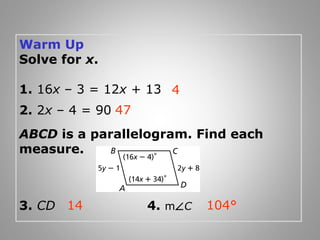
Warm Up 
Solve for x. 
1. 16x – 3 = 12x + 13 
4 
2. 2x – 4 = 90 
47 
ABCD is a parallelogram. Find each 
measure. 
14 104° 
3. CD 4. mÐC
Objectives 
Prove and apply properties of 
rectangles, rhombuses, and squares. 
Use properties of rectangles, 
rhombuses, and squares to solve 
problems.
rectangle 
rhombus 
square 
Vocabulary
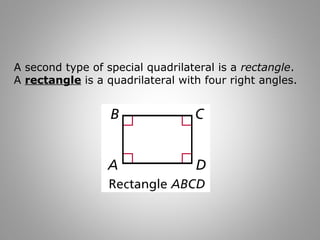
A second type of special quadrilateral is a rectangle. 
A rectangle is a quadrilateral with four right angles.
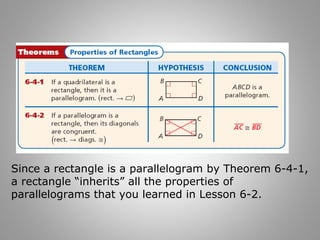
Since a rectangle is a parallelogram by Theorem 6-4-1, 
a rectangle “inherits” all the properties of 
parallelograms that you learned in Lesson 6-2.
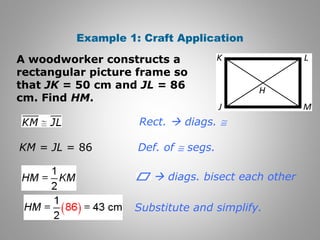
Example 1: Craft Application 
A woodworker constructs a 
rectangular picture frame so 
that JK = 50 cm and JL = 86 
cm. Find HM. 
Rect.  diags. @ 
Def. of @ segs. 
Substitute and simplify. 
KM = JL = 86 
 diags. bisect each other
Check It Out! Example 1a 
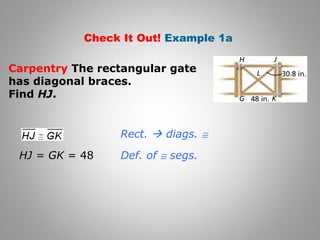
Carpentry The rectangular gate 
has diagonal braces. 
Find HJ. 
Rect.  diags. @ 
Def. of @ segs. 
HJ = GK = 48
Check It Out! Example 1b 
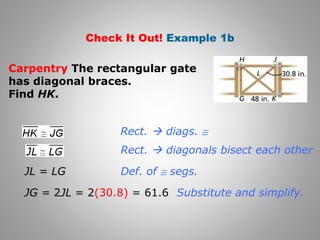
Carpentry The rectangular gate 
has diagonal braces. 
Find HK. 
Rect.  diags. @ 
Rect.  diagonals bisect each other 
Def. of @ segs. 
JL = LG 
JG = 2JL = 2(30.8) = 61.6 Substitute and simplify.
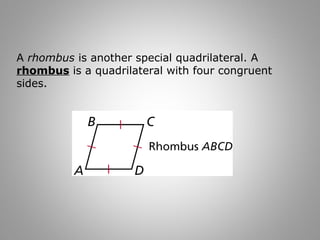
A rhombus is another special quadrilateral. A 
rhombus is a quadrilateral with four congruent 
sides.
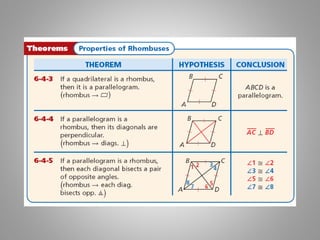
Like a rectangle, a rhombus is a parallelogram. So you 
can apply the properties of parallelograms to 
rhombuses.
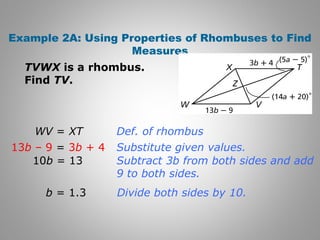
Example 2A: Using Properties of Rhombuses to Find 
Measures 
TVWX is a rhombus. 
Find TV. 
Def. of rhombus 
Substitute given values. 
Subtract 3b from both sides and add 
9 to both sides. 
Divide both sides by 10. 
WV = XT 
13b – 9 = 3b + 4 
10b = 13 
b = 1.3
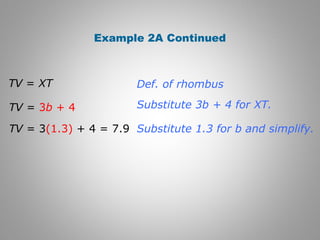
Example 2A Continued 
Def. of rhombus 
Substitute 3b + 4 for XT. 
Substitute 1.3 for b and simplify. 
TV = XT 
TV = 3b + 4 
TV = 3(1.3) + 4 = 7.9
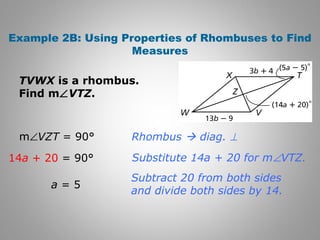
Example 2B: Using Properties of Rhombuses to Find 
Measures 
TVWX is a rhombus. 
Find mÐVTZ. 
Rhombus  diag. ^ 
Substitute 14a + 20 for mÐVTZ. 
Subtract 20 from both sides 
and divide both sides by 14. 
mÐVZT = 90° 
14a + 20 = 90° 
a = 5
Example 2B Continued 
Rhombus  each diag. 
bisects opp. Ðs 
Substitute 5a – 5 for mÐVTZ. 
Substitute 5 for a and simplify. 
mÐVTZ = mÐZTX 
mÐVTZ = (5a – 5)° 
mÐVTZ = [5(5) – 5)]° 
= 20°
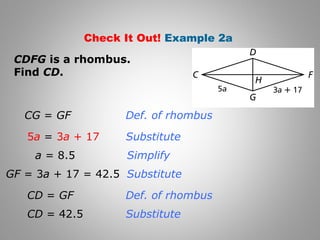
Check It Out! Example 2a 
CDFG is a rhombus. 
Find CD. 
Def. of rhombus 
Substitute 
Simplify 
Substitute 
Def. of rhombus 
Substitute 
CG = GF 
5a = 3a + 17 
a = 8.5 
GF = 3a + 17 = 42.5 
CD = GF 
CD = 42.5
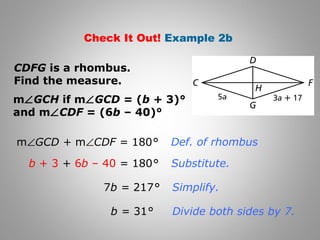
Check It Out! Example 2b 
CDFG is a rhombus. 
Find the measure. 
mÐGCH if mÐGCD = (b + 3)° 
and mÐCDF = (6b – 40)° 
mÐGCD + mÐCDF = 180° 
b + 3 + 6b – 40 = 180° 
7b = 217° 
b = 31° 
Def. of rhombus 
Substitute. 
Simplify. 
Divide both sides by 7.
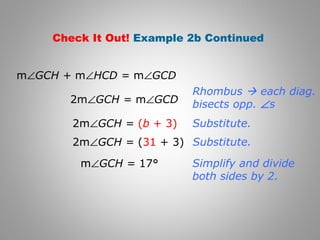
Check It Out! Example 2b Continued 
mÐGCH + mÐHCD = mÐGCD 
2mÐGCH = mÐGCD 
Rhombus  each diag. 
bisects opp. Ðs 
2mÐGCH = (b + 3) 
2mÐGCH = (31 + 3) 
mÐGCH = 17° 
Substitute. 
Substitute. 
Simplify and divide 
both sides by 2.
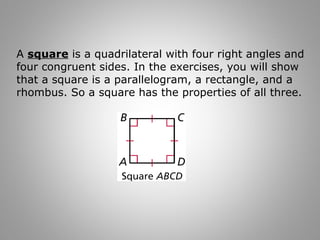
A square is a quadrilateral with four right angles and 
four congruent sides. In the exercises, you will show 
that a square is a parallelogram, a rectangle, and a 
rhombus. So a square has the properties of all three.
Helpful Hint 
Rectangles, rhombuses, and squares are 
sometimes referred to as special parallelograms.
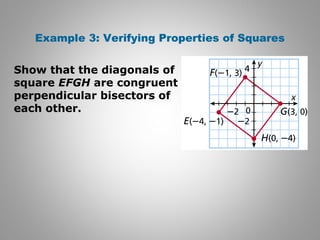
Example 3: Verifying Properties of Squares 
Show that the diagonals of 
square EFGH are congruent 
perpendicular bisectors of 
each other.
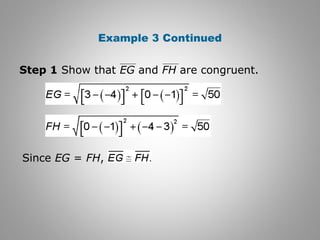
Example 3 Continued 
Step 1 Show that EG and FH are congruent. 
Since EG = FH,
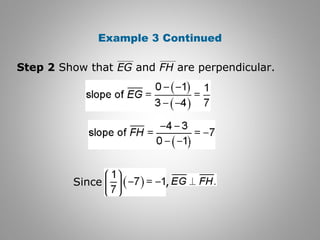
Example 3 Continued 
Step 2 Show that EG and FH are perpendicular. 
Since ,
Example 3 Continued 
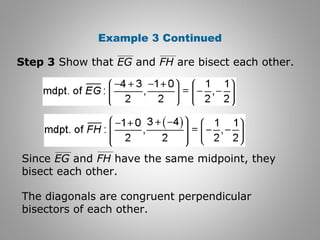
Step 3 Show that EG and FH are bisect each other. 
Since EG and FH have the same midpoint, they 
bisect each other. 
The diagonals are congruent perpendicular 
bisectors of each other.
Check It Out! Example 3 
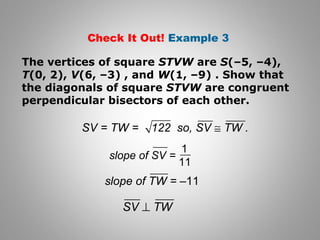
The vertices of square STVW are S(–5, –4), 
T(0, 2), V(6, –3) , and W(1, –9) . Show that 
the diagonals of square STVW are congruent 
perpendicular bisectors of each other. 
SV = TW = 122 so, SV @ TW . 
1 
slope of SV = 11 
slope of TW = –11 
SV ^ TW
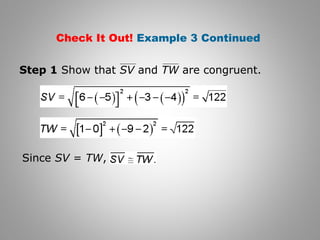
Check It Out! Example 3 Continued 
Step 1 Show that SV and TW are congruent. 
Since SV = TW,
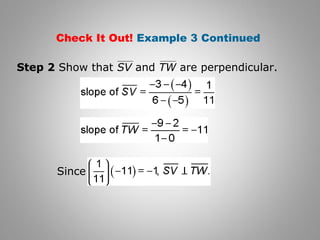
Check It Out! Example 3 Continued 
Step 2 Show that SV and TW are perpendicular. 
Since
Check It Out! Example 3 Continued 
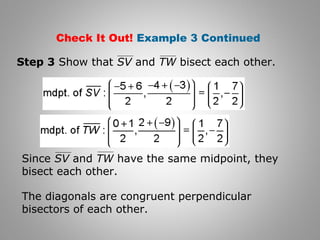
Step 3 Show that SV and TW bisect each other. 
Since SV and TW have the same midpoint, they 
bisect each other. 
The diagonals are congruent perpendicular 
bisectors of each other.
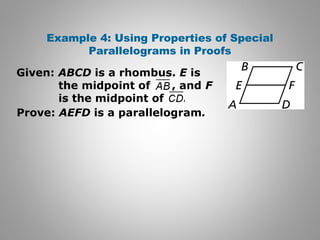
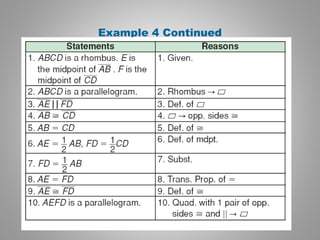
Example 4: Using Properties of Special 
Parallelograms in Proofs 
Given: ABCD is a rhombus. E is 
the midpoint of , and F 
is the midpoint of . 
Prove: AEFD is a parallelogram.
Example 4 Continued 
||
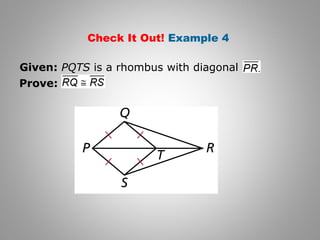
Check It Out! Example 4 
Given: PQTS is a rhombus with diagonal 
Prove:
Check It Out! Example 4 Continued 
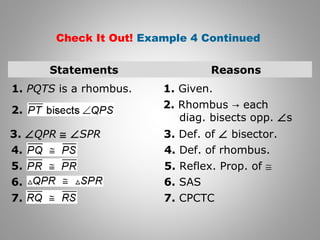
Statements Reasons 
1. PQTS is a rhombus. 1. Given. 
2. Rhombus → each 
diag. bisects opp. Ðs 
3. ÐQPR @ ÐSPR 3. Def. of Ð bisector. 
4. Def. of rhombus. 
5. Reflex. Prop. of @ 
6. SAS 
7. CPCTC 
2. 
4. 
5. 
6. 
7.
Lesson Quiz: Part I 
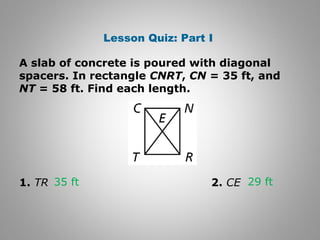
A slab of concrete is poured with diagonal 
spacers. In rectangle CNRT, CN = 35 ft, and 
NT = 58 ft. Find each length. 
35 ft 29 ft 
1. TR 2. CE
Lesson Quiz: Part II 
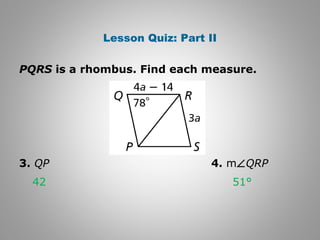
PQRS is a rhombus. Find each measure. 
3. QP 4. mÐQRP 
42 51°
Lesson Quiz: Part III 
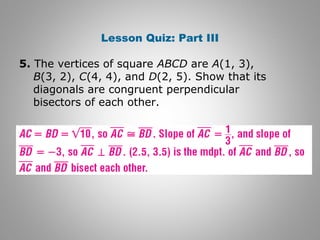
5. The vertices of square ABCD are A(1, 3), 
B(3, 2), C(4, 4), and D(2, 5). Show that its 
diagonals are congruent perpendicular 
bisectors of each other.
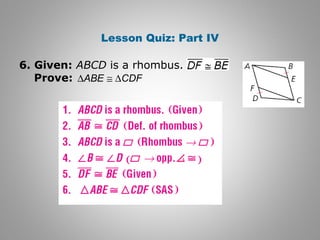
Lesson Quiz: Part IV 
6. Given: ABCD is a rhombus. 
DABE @ DCDF 
Ð 
Prove:
All rights belong to their 
respective owners. 
Copyright Disclaimer Under 
Section 107 of the 
Copyright Act 1976, 
allowance is made for "fair 
use" for purposes such as 
criticism, comment, news 
reporting, TEACHING, 
scholarship, and research. 
Fair use is a use permitted 
by copyright statute that 
might otherwise be 
infringing. 
Non-profit, EDUCATIONAL 
or personal use tips the 
balance in favor of fair use.

Geometry unit 6.4

  • 1.
    UUNNIITT 66..44 PPRROOPPEERRTTIIEESSOOFF RRHHOOMMBBUUSSEESS,, RREECCTTAANNGGLLEESS AANNDD SSQQUUAARREESS Holt Geometry
  • 2.
    Warm Up Solvefor x. 1. 16x – 3 = 12x + 13 4 2. 2x – 4 = 90 47 ABCD is a parallelogram. Find each measure. 14 104° 3. CD 4. mÐC
  • 3.
    Objectives Prove andapply properties of rectangles, rhombuses, and squares. Use properties of rectangles, rhombuses, and squares to solve problems.
  • 4.
  • 5.
    A second typeof special quadrilateral is a rectangle. A rectangle is a quadrilateral with four right angles.
  • 6.
    Since a rectangleis a parallelogram by Theorem 6-4-1, a rectangle “inherits” all the properties of parallelograms that you learned in Lesson 6-2.
  • 7.
    Example 1: CraftApplication A woodworker constructs a rectangular picture frame so that JK = 50 cm and JL = 86 cm. Find HM. Rect.  diags. @ Def. of @ segs. Substitute and simplify. KM = JL = 86  diags. bisect each other
  • 8.
    Check It Out!Example 1a Carpentry The rectangular gate has diagonal braces. Find HJ. Rect.  diags. @ Def. of @ segs. HJ = GK = 48
  • 9.
    Check It Out!Example 1b Carpentry The rectangular gate has diagonal braces. Find HK. Rect.  diags. @ Rect.  diagonals bisect each other Def. of @ segs. JL = LG JG = 2JL = 2(30.8) = 61.6 Substitute and simplify.
  • 10.
    A rhombus isanother special quadrilateral. A rhombus is a quadrilateral with four congruent sides.
  • 12.
    Like a rectangle,a rhombus is a parallelogram. So you can apply the properties of parallelograms to rhombuses.
  • 13.
    Example 2A: UsingProperties of Rhombuses to Find Measures TVWX is a rhombus. Find TV. Def. of rhombus Substitute given values. Subtract 3b from both sides and add 9 to both sides. Divide both sides by 10. WV = XT 13b – 9 = 3b + 4 10b = 13 b = 1.3
  • 14.
    Example 2A Continued Def. of rhombus Substitute 3b + 4 for XT. Substitute 1.3 for b and simplify. TV = XT TV = 3b + 4 TV = 3(1.3) + 4 = 7.9
  • 15.
    Example 2B: UsingProperties of Rhombuses to Find Measures TVWX is a rhombus. Find mÐVTZ. Rhombus  diag. ^ Substitute 14a + 20 for mÐVTZ. Subtract 20 from both sides and divide both sides by 14. mÐVZT = 90° 14a + 20 = 90° a = 5
  • 16.
    Example 2B Continued Rhombus  each diag. bisects opp. Ðs Substitute 5a – 5 for mÐVTZ. Substitute 5 for a and simplify. mÐVTZ = mÐZTX mÐVTZ = (5a – 5)° mÐVTZ = [5(5) – 5)]° = 20°
  • 17.
    Check It Out!Example 2a CDFG is a rhombus. Find CD. Def. of rhombus Substitute Simplify Substitute Def. of rhombus Substitute CG = GF 5a = 3a + 17 a = 8.5 GF = 3a + 17 = 42.5 CD = GF CD = 42.5
  • 18.
    Check It Out!Example 2b CDFG is a rhombus. Find the measure. mÐGCH if mÐGCD = (b + 3)° and mÐCDF = (6b – 40)° mÐGCD + mÐCDF = 180° b + 3 + 6b – 40 = 180° 7b = 217° b = 31° Def. of rhombus Substitute. Simplify. Divide both sides by 7.
  • 19.
    Check It Out!Example 2b Continued mÐGCH + mÐHCD = mÐGCD 2mÐGCH = mÐGCD Rhombus  each diag. bisects opp. Ðs 2mÐGCH = (b + 3) 2mÐGCH = (31 + 3) mÐGCH = 17° Substitute. Substitute. Simplify and divide both sides by 2.
  • 20.
    A square isa quadrilateral with four right angles and four congruent sides. In the exercises, you will show that a square is a parallelogram, a rectangle, and a rhombus. So a square has the properties of all three.
  • 21.
    Helpful Hint Rectangles,rhombuses, and squares are sometimes referred to as special parallelograms.
  • 22.
    Example 3: VerifyingProperties of Squares Show that the diagonals of square EFGH are congruent perpendicular bisectors of each other.
  • 23.
    Example 3 Continued Step 1 Show that EG and FH are congruent. Since EG = FH,
  • 24.
    Example 3 Continued Step 2 Show that EG and FH are perpendicular. Since ,
  • 25.
    Example 3 Continued Step 3 Show that EG and FH are bisect each other. Since EG and FH have the same midpoint, they bisect each other. The diagonals are congruent perpendicular bisectors of each other.
  • 26.
    Check It Out!Example 3 The vertices of square STVW are S(–5, –4), T(0, 2), V(6, –3) , and W(1, –9) . Show that the diagonals of square STVW are congruent perpendicular bisectors of each other. SV = TW = 122 so, SV @ TW . 1 slope of SV = 11 slope of TW = –11 SV ^ TW
  • 27.
    Check It Out!Example 3 Continued Step 1 Show that SV and TW are congruent. Since SV = TW,
  • 28.
    Check It Out!Example 3 Continued Step 2 Show that SV and TW are perpendicular. Since
  • 29.
    Check It Out!Example 3 Continued Step 3 Show that SV and TW bisect each other. Since SV and TW have the same midpoint, they bisect each other. The diagonals are congruent perpendicular bisectors of each other.
  • 30.
    Example 4: UsingProperties of Special Parallelograms in Proofs Given: ABCD is a rhombus. E is the midpoint of , and F is the midpoint of . Prove: AEFD is a parallelogram.
  • 31.
  • 32.
    Check It Out!Example 4 Given: PQTS is a rhombus with diagonal Prove:
  • 33.
    Check It Out!Example 4 Continued Statements Reasons 1. PQTS is a rhombus. 1. Given. 2. Rhombus → each diag. bisects opp. Ðs 3. ÐQPR @ ÐSPR 3. Def. of Ð bisector. 4. Def. of rhombus. 5. Reflex. Prop. of @ 6. SAS 7. CPCTC 2. 4. 5. 6. 7.
  • 34.
    Lesson Quiz: PartI A slab of concrete is poured with diagonal spacers. In rectangle CNRT, CN = 35 ft, and NT = 58 ft. Find each length. 35 ft 29 ft 1. TR 2. CE
  • 35.
    Lesson Quiz: PartII PQRS is a rhombus. Find each measure. 3. QP 4. mÐQRP 42 51°
  • 36.
    Lesson Quiz: PartIII 5. The vertices of square ABCD are A(1, 3), B(3, 2), C(4, 4), and D(2, 5). Show that its diagonals are congruent perpendicular bisectors of each other.
  • 37.
    Lesson Quiz: PartIV 6. Given: ABCD is a rhombus. DABE @ DCDF Ð Prove:
  • 38.
    All rights belongto their respective owners. Copyright Disclaimer Under Section 107 of the Copyright Act 1976, allowance is made for "fair use" for purposes such as criticism, comment, news reporting, TEACHING, scholarship, and research. Fair use is a use permitted by copyright statute that might otherwise be infringing. Non-profit, EDUCATIONAL or personal use tips the balance in favor of fair use.