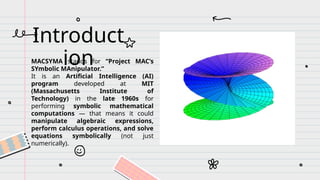
MACSYMA stands for“Project MAC’s
SYmbolic MAnipulator.”
It is an Artificial Intelligence (AI)
program developed at MIT
(Massachusetts Institute of
Technology) in the late 1960s for
performing symbolic mathematical
computations — that means it could
manipulate algebraic expressions,
perform calculus operations, and solve
equations symbolically (not just
numerically).
Introduct
ion
6.
History
• It wasdeveloped in the late 1960s at the Massachusetts
Institute of Technology (MIT) as part of Project MAC
(Multiple Access Computer project).
• At that time, computers were mainly used for numerical
calculations — like adding, multiplying, or computing
numbers.
However, mathematicians and engineers needed a tool that
could reason symbolically, the same way humans
manipulate equations and formulas using algebraic rules.
• That’s when MACSYMA was born — one of the first AI-based
computer algebra systems capable of performing symbolic
mathematical reasoning.
7.
Background and
Development
1. MACSYMAwas developed between 1967 and 1971 at MIT.
2. The project was funded by DARPA (Defense Advanced
Research Projects Agency) — the same organization that
funded early AI research and the internet.
3. The main developer was Carl Engelmann, with contributions
from other MIT researchers.
4. MACSYMA became the most powerful symbolic
computation system of its time.
It was written in the LISP programming language, which was
commonly used in AI because it handled symbolic processing
efficiently.
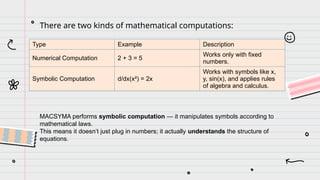
There are twokinds of mathematical computations:
Type Example Description
Numerical Computation 2 + 3 = 5
Works only with fixed
numbers.
Symbolic Computation d/dx(x²) = 2x
Works with symbols like x,
y, sin(x), and applies rules
of algebra and calculus.
MACSYMA performs symbolic computation — it manipulates symbols according to
mathematical laws.
This means it doesn’t just plug in numbers; it actually understands the structure of
equations.
10.
Example to UnderstandIt
Better
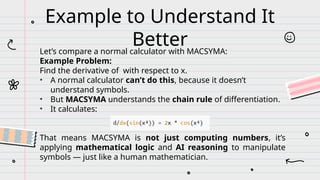
Let’s compare a normal calculator with MACSYMA:
Example Problem:
Find the derivative of with respect to x.
• A normal calculator can’t do this, because it doesn’t
understand symbols.
• But MACSYMA understands the chain rule of differentiation.
• It calculates:
That means MACSYMA is not just computing numbers, it’s
applying mathematical logic and AI reasoning to manipulate
symbols — just like a human mathematician.
Purpose of MACSYMA
Themain purposes of MACSYMA were:
1. To perform symbolic mathematical operations such as:
a. Simplification
b. Differentiation
c. Integration
d. Equation solving
e. Algebraic manipulation
2. To help scientists, mathematicians, and engineers solve
theoretical problems symbolically instead of manually.
3. To serve as a research tool for developing AI reasoning methods for
mathematical problem-solving.
Input Stage —Understanding the
1️
1️
⃣
User’s Request
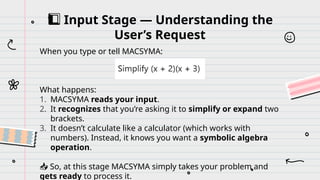
When you type or tell MACSYMA:
What happens:
1. MACSYMA reads your input.
2. It recognizes that you’re asking it to simplify or expand two
brackets.
3. It doesn’t calculate like a calculator (which works with
numbers). Instead, it knows you want a symbolic algebra
operation.
📥 So, at this stage MACSYMA simply takes your problem and
gets ready to process it.
15.
Parsing and RuleMatching — Understanding What
2️
2️
⃣
the Math Means
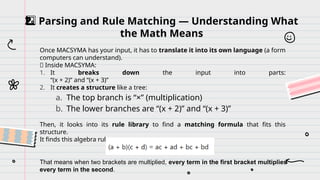
Once MACSYMA has your input, it has to translate it into its own language (a form
computers can understand).
💬 Inside MACSYMA:
1. It breaks down the input into parts:
“(x + 2)” and “(x + 3)”
2. It creates a structure like a tree:
a. The top branch is “×” (multiplication)
b. The lower branches are “(x + 2)” and “(x + 3)”
Then, it looks into its rule library to find a matching formula that fits this
structure.
It finds this algebra rule:
That means when two brackets are multiplied, every term in the first bracket multiplies
every term in the second.
16.
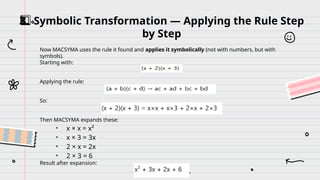
Symbolic Transformation —Applying the Rule Step
3️
3️
⃣
by Step
Now MACSYMA uses the rule it found and applies it symbolically (not with numbers, but with
symbols).
Starting with:
Applying the rule:
So:
Then MACSYMA expands these:
• x × x = x²
• x × 3 = 3x
• 2 × x = 2x
• 2 × 3 = 6
Result after expansion:
17.
4 ️
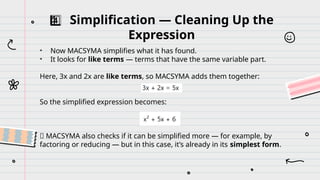
4️⃣ Simplification— Cleaning Up the
Expression
• Now MACSYMA simplifies what it has found.
• It looks for like terms — terms that have the same variable part.
Here, 3x and 2x are like terms, so MACSYMA adds them together:
So the simplified expression becomes:
🎯 MACSYMA also checks if it can be simplified more — for example, by
factoring or reducing — but in this case, it’s already in its simplest form.
18.
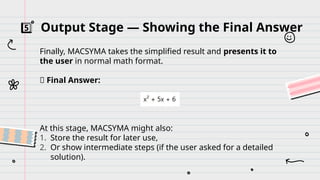
5️⃣ Output Stage— Showing the Final Answer
Finally, MACSYMA takes the simplified result and presents it to
the user in normal math format.
✅ Final Answer:
At this stage, MACSYMA might also:
1. Store the result for later use,
2. Or show intermediate steps (if the user asked for a detailed
solution).
️
⃣ 1 SymbolicComputation
What it means:
● MACSYMA doesn’t just work with numbers — it can handle
symbols and formulas like x, y, or sin(x).
Why it’s special:
● Normal calculators give answers only when numbers are
used.
● MACSYMA, however, can think in terms of algebra — just
like a human mathematician.
️
⃣ 2 Algebraic Manipulation
What it means:
MACSYMA can simplify, expand, or rearrange algebraic
expressions according to mathematical laws.
● Expand brackets
● Combine like terms
● Factorize expressions
● Simplify complicated formulas
21.
️
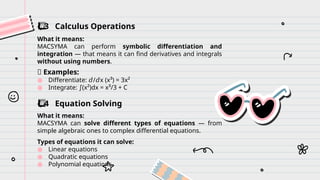
⃣ 3 CalculusOperations
What it means:
MACSYMA can perform symbolic differentiation and
integration — that means it can find derivatives and integrals
without using numbers.
✨ Examples:
● Differentiate: / x (x³) = 3x²
𝑑 𝑑
● Integrate: (x²)dx = x³/3 + C
∫
️
⃣ 4 Equation Solving
What it means:
MACSYMA can solve different types of equations — from
simple algebraic ones to complex differential equations.
Types of equations it can solve:
● Linear equations
● Quadratic equations
● Polynomial equations
22.
️
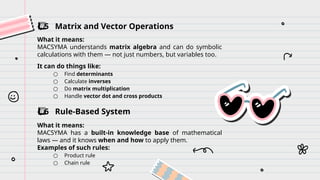
⃣ 5 Matrixand Vector Operations
What it means:
MACSYMA understands matrix algebra and can do symbolic
calculations with them — not just numbers, but variables too.
It can do things like:
○ Find determinants
○ Calculate inverses
○ Do matrix multiplication
○ Handle vector dot and cross products
️
⃣ 6 Rule-Based System
What it means:
MACSYMA has a built-in knowledge base of mathematical
laws — and it knows when and how to apply them.
Examples of such rules:
○ Product rule
○ Chain rule
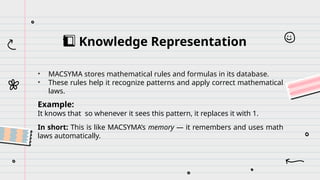
Knowledge Representation
1️
1️
⃣
• MACSYMAstores mathematical rules and formulas in its database.
• These rules help it recognize patterns and apply correct mathematical
laws.
Example:
It knows that so whenever it sees this pattern, it replaces it with 1.
In short: This is like MACSYMA’s memory — it remembers and uses math
laws automatically.
25.
2 ️
2️⃣ InferenceMechanism
• This part decides which rule to use and when.
• It checks the input, matches it with stored rules, and applies
the correct one.
Example:
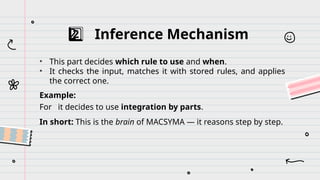
For it decides to use integration by parts.
In short: This is the brain of MACSYMA — it reasons step by step.
26.
Heuristics (Smart DecisionRules)
3️
3️
⃣
• Heuristics help MACSYMA choose the best way to solve a
problem when many options exist.
• It uses smart shortcuts like humans do.
Example:
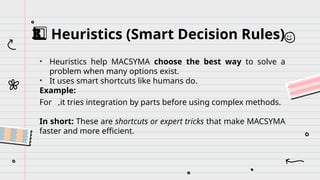
For ,it tries integration by parts before using complex methods.
In short: These are shortcuts or expert tricks that make MACSYMA
faster and more efficient.
27.
Symbolic Reasoning
4️
⃣
• MACSYMAmanipulates symbols instead of numbers.
• It applies rules like the chain rule or product rule to
expressions.
Example:
In short: This is what makes MACSYMA different from a
calculator — it understands formulas, not just numbers.
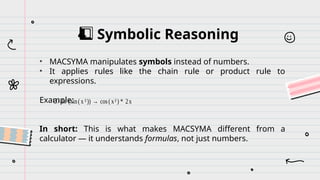
d / dx (sin(x²)) → cos(x²) * 2x
28.
Problem Solving (Goal-Oriented
5️
5️
⃣
Thinking)
•MACSYMA looks at the problem as a goal and tries to reach it
step by step.
• It compares the current expression with the goal and applies
transformations to reduce the difference.
Example:
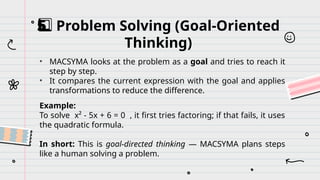
To solve x² - 5x + 6 = 0 , it first tries factoring; if that fails, it uses
the quadratic formula.
In short: This is goal-directed thinking — MACSYMA plans steps
like a human solving a problem.
Engineering:
• Used forsolving circuit, mechanical, and thermodynamic
equations.
• Example: Automates symbolic modeling of systems in
electrical engineering.
Physics:
• Helps solve theoretical problems like motion equations,
quantum mechanics formulas, or relativity calculations.
Mathematics:
• Automates calculus, algebra, trigonometry, and differential
equations.
31.
Education:
• Used asa learning tool for teaching symbolic mathematics.
Computer Science:
• Became the foundation for future systems:
i. Mathematica
ii. Maple
iii.Maxima (open-source version of MACSYMA)
Accurate Symbolic Results
1️
⃣
•MACSYMA performs symbolic (not numeric) calculations.
• This means it works with formulas and symbols instead of
decimal values — so there are no rounding or
approximation errors.
Time-Saving
2️
2️
⃣
• It can solve complex algebraic, calculus, and matrix problems
in seconds, which might take humans hours to do manually.
• This automation helps scientists and engineers save time
when performing lengthy symbolic computations.
34.
️
⃣ 3 HandlesComplex Problems
• MACSYMA can easily handle large mathematical
expressions that are difficult for humans to manage.
• It doesn’t get confused by lengthy equations or multi-step
operations — it follows logic step by step.
️
⃣ 4 Extensible System
• Users can add their own mathematical rules, formulas, or
algorithms to MACSYMA’s knowledge base.
• This makes it flexible — it can grow and learn new concepts.
35.
️
⃣ 5 Foundationfor Modern Systems
• MACSYMA was one of the first symbolic AI systems and
inspired later powerful tools like Mathematica, Maple, and
Maxima.
• These modern tools are still used today for symbolic and
numeric computation in research and education.
️
⃣ 6 Supports Research and Science
• MACSYMA helps scientists, mathematicians, and engineers
perform theoretical modeling, symbolic differentiation, and
simulation.
• It’s used in fields like physics, computer science, and
engineering for designing and testing new theories.
1. High ComputationCost:
• Required large memory and powerful processors
(rare in the 1970s).
2. Complex to Use:
• Needed mathematical expertise to operate.
3. Limited Problem Domain:
• Focused only on symbolic math, not logical or real-
world reasoning.
38.
4. No User-FriendlyInterface:
• Text-based, not graphical.
5. Slow on Large Problems:
• Early hardware couldn’t handle extremely large
equations efficiently.
39.
Conclusion
• MACSYMA wasa revolutionary AI project
that proved computers could think
mathematically.
• It was the first symbolic reasoning system
that worked with algebraic expressions like a
human mathematician.
• Although limited by technology, it became the
foundation for modern computer algebra
systems used in education, science, and
engineering today.
• Its legacy continues through Maxima, the
open-source descendant of MACSYMA, still
used worldwide.